EP0843249B1 - Dynamische Dienstklassen für eine internationale kryptographische Struktur - Google Patents
Dynamische Dienstklassen für eine internationale kryptographische Struktur Download PDFInfo
- Publication number
- EP0843249B1 EP0843249B1 EP97115746A EP97115746A EP0843249B1 EP 0843249 B1 EP0843249 B1 EP 0843249B1 EP 97115746 A EP97115746 A EP 97115746A EP 97115746 A EP97115746 A EP 97115746A EP 0843249 B1 EP0843249 B1 EP 0843249B1
- Authority
- EP
- European Patent Office
- Prior art keywords
- application
- service
- class
- level
- certificate
- Prior art date
- Legal status (The legal status is an assumption and is not a legal conclusion. Google has not performed a legal analysis and makes no representation as to the accuracy of the status listed.)
- Expired - Lifetime
Links
Images




Classifications
-
- G—PHYSICS
- G06—COMPUTING OR CALCULATING; COUNTING
- G06F—ELECTRIC DIGITAL DATA PROCESSING
- G06F21/00—Security arrangements for protecting computers, components thereof, programs or data against unauthorised activity
- G06F21/50—Monitoring users, programs or devices to maintain the integrity of platforms, e.g. of processors, firmware or operating systems
- G06F21/57—Certifying or maintaining trusted computer platforms, e.g. secure boots or power-downs, version controls, system software checks, secure updates or assessing vulnerabilities
-
- G—PHYSICS
- G06—COMPUTING OR CALCULATING; COUNTING
- G06F—ELECTRIC DIGITAL DATA PROCESSING
- G06F21/00—Security arrangements for protecting computers, components thereof, programs or data against unauthorised activity
- G06F21/50—Monitoring users, programs or devices to maintain the integrity of platforms, e.g. of processors, firmware or operating systems
- G06F21/51—Monitoring users, programs or devices to maintain the integrity of platforms, e.g. of processors, firmware or operating systems at application loading time, e.g. accepting, rejecting, starting or inhibiting executable software based on integrity or source reliability
Definitions
- the invention relates to cryptography. More particularly, the invention relates to dynamic classes of service for use with an international cryptography framework.
- a four-part technology framework that supports international cryptography which includes a national flag card, a cryptographic unit, a host system, and a network security server is disclosed by K. Klemba, R. Merckling, International Cryptography Framework , in a copending U.S. patent application serial no 08/401,588, which was filed on 8 March 1995.
- Three of these four service elements have a fundamentally hierarchical relationship.
- the National Flag Card (NFC) is installed into the Cryptographic Unit (CU) which, in turn, is installed into a Host System (HS).
- HS Host System
- Cryptographic functions on the Host System cannot be executed without a Cryptographic Unit, which itself requires the presence of a valid National Flag Card before it's services are available.
- the fourth service element, a Network Security Server (NSS) can provide a range of different security services including verification of the other three service elements.
- the international cryptography framework supports the design, implementation, and operational elements of any and all national policies, while unifying the design, development, and operation of independent national security policies.
- the framework thus gives standard form to the service elements of national security policies, where such service elements include such things as hardware form factors, communication protocols, and on-line and off-line data definitions.
- a certification authority is provided for generating certificates.
- the certification authority generates and signs public key certificates for local key managers and registered users, wherein the local key manager is a program which manages the cryptographic information about the specific host and local users.
- the certificate is validated by generating a signature consisting of a hash of the user information encrypted with the certification authority's private key.
- the public key certificates are sent to a recipient, wherein the recipient's validation of the digital signature associated with the public key certificate provides assurance that the certificate is authentic and the information within has not been tampered with.
- US-A-4,649,510 relates to methods and apparatus for the protection control of computer programs.
- this document is concerned with modifying a valid program to provide a furnished program and a corresponding restoration program.
- One or both of these are modified in accordance with confirmation data.
- the furnished program, confirmation data and the restoration program data are then supplied to an equipped computer installation via separate commercial channels.
- EP-A-0 828 208 was published after the priority date of the present application and relates to application certification for an internal cryptography framework. This document is silent about a structure of a class of services including a method field and a constraints field.
- the international cryptography framework allows manufacturers to comply with varying national laws governing the distribution of cryptographic capabilities.
- such a framework makes it possible to ship worldwide cryptographic capabilities in all types of information processing devices (e.g. printers, palm-tops).
- a cryptographic unit contains several cryptographic methods (e.g. DES, RSA, MD5).
- the invention herein is concerned primarily with the application certification aspects of the framework. It is a fundamental requirement of ICF that an application which requests cryptographic services from the ICF service elements is identified through some form of certificate to protect against the misuse of a granted level of cryptography. The levels of cryptography granted are described via security policies and expressed as classes of service.
- the cryptographic unit one of the ICF core elements, can be used to build several certification schemes for application objects.
- the invention provides various methods that determine the strength of binding between an application code image and the issued certificates within the context of the ICF elements.
- a key element with regard to the exercise of a cryptographic function concerns the special requirements for the trust relation that an authority specifies for the cryptographic unit. For example, any function exercised by the cryptographic unit must be controllable by the associated class of service which represents the security policy.
- the touchpointing concept discussed in this document for both the application and the firmware elements inside the cryptographic unit plays a key role in exercising control over the functioning of these modules.
- the invention also provides methods that allow a determination of whether or not the cryptographic unit has been replaced or tampered with.
- National cryptography policy often varies by industry segment, political climate, and/or message function. This makes it difficult to assign one uniform policy across all industries for all time. Consequently, the flexibility of a cryptography framework that incorporates a national flag card, i.e. policy, is very attractive.
- the invention is therefore primarily directed to resolving problems surrounding international cryptography. However, the invention is adapted to, and intended for, many other applications.
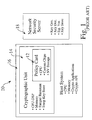
- Fig. 1 is a block diagram of the international cryptography framework (ICF) 10, including a national flag card (also referred to herein as a "policy card” (PC) and as a "policy") 12, a cryptographic unit 14, a host system 16, and a network security server 18.
- ICF international cryptography framework
- HS Host System
- CU Cryptographic Unit
- CU Cryptographic Unit
- the cryptographic functions included in the CU are determined by business demand.
- the CU is tamper resistant to protect any keying material that may be stored therein. It is the CU's responsibility to maintain contact with a PC. Failing to do so results in the decay of the CU's functionality.
- PC Policy Card
- Policy cards can be implemented in either physical or virtual form.
- a physical policy card requires hardware support inside the CU, which then engages with the PC in a heartbeat relation.
- Hardware level touchpoints the method of disabling the hardware cryptographic functions (see Klemba et al , Cryptographic Unit Touch Point Logic , U.S. Patent Application Serial No. 08/685,076, filed 23 July 1996), must be implemented for a physical policy card.
- a virtual policy card (VPC) operates in conjunction with a hardware or a firmware implementation of the touchpoint techniques. In the VPC scenario, policy distribution involves the network security server.
- Network Security Server The system or unit that acts as a trusted third party to provide network security services to HSs, Cus, and PCs. These services can include policy enhancements, policy distribution, unit verification, adjustments to authorizations, and key management services.
- ICF Management Framework Peripheral to the core elements of ICF are the manufacturers of the cryptographic equipment and the domain authorities which implement the policy definition and enforcement through the framework.
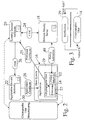
- Fig. 2 is a block schematic diagram that introduces these additional management elements of the ICF.
- Security Domain Authority There are four basic elements within the administration framework. These are the Security Domain Authority 20, the Application Domain Authority 22, the Host System Elements 16, and the Network Security Server 18.
- the manufacturer is the actual producer of cryptographic equipment. The manufacturer shares information with the security domain authority about each lot of Cus manufactured.
- the security domain authority SDA is the institution which defines the security policies governing the domain. Security policies are presented to the other framework elements via classes of services (COS). Knowledge of manufacturing information allows the creation of classes of services targeted to a deterministic set of Cus.
- the Application Domain Authority acts as the authority that creates certificates for the application.
- the certificate contains the granted classes of service to the application as they were granted by the SDA.
- the Network Security Server acts as the trusted on-line authority that manages policy activation for a given CU.
- the host system on which the applications are installed and on which the CU services are used form the execution elements to be controlled by the framework.
- the two domain authorities are shown at the top of Fig. 2.
- the security domain authority (SDA) is responsible for granting a set of classes of service 26 to the application domain authority.
- the SDA is also responsible for issuing policy cards which contain the COS information and the touchpoint data for the CU.
- the SDA manufactures this information upon request from the site which installs the CU into a host system.
- the application domain authority receives the COS elements granted by the SDA. It has the responsibility of issuing application certificates 28 to applications 29 that belong to its domain.
- An application certificate contains an application ID and the COS granted by the ADA.
- Applications receive a certificate from the ADA, which must be presented to the CU to receive the desired COS level.
- the CU upon receiving the request, uses the certificate to determine whether the application has the right to access the requested cryptographic function. If the COS requested via the application certificate matches the COS granted by the SDA to the ADA, and stored in the policy card, the request is handled, otherwise it is not handled.
- the touchpoint data are the information that is stored on the policy card 12, and which enable the cryptographic hardware for the defined classes of service. Periodically, this information is recomputed by the CU and validated by the policy card. Any mismatch causes the cryptographic capability of the CU to decay.
- the network security server 18 acts as an on-line instrument for policy negotiation and changes to the policy information stored on the policy card. Adding a class of service to the set of services normally requires the issuing of a new policy card containing the changed information. Alternatively, the NSS performs the update of the policy card on behalf of the SDA.
- the NSS also plays the role of distribution of virtual policy cards (VPC).
- VPC implementations must contact the NSS at defined points, e.g. system startup to retrieve the COS information.
- COS attributes which define exactly when a CU must contact the NSS.
- the ICF architecture rests on a few very basic assumptions about the core elements. They are as follows:
- one technique that is exploited to advantage by the invention to enhance security within the framework is to require certification at various points.
- the use of certificates in general is known. See, for example ITU-T Recommendation X.509(1993).
- the X509(93) certificate format is as follows:
- a system which implements the physical policy card scheme requires the CU to implement hardware touchpoints.
- the CU does not provide the HS with any cryptographic functions without entering into and maintaining contact with a PC.
- a system which implements the virtual PC scheme requires the presence of an NSS. There must be at least an initial contact between the NSS and CU to distribute the VPC.
- the CU may also be required to contact the NSS on a regular basis that is determined by COS attributes which describe the policy life cycle.
- the CU or CUs controlled by a given PC or VPC is deterministic, i.e. every event, act, and decision of the CU is the inevitable consequence of antecedents that are independent of the PC.
- FIG. 3 is a block schematic illustration of the ICF and certification requirements.
- the ICF environment depends on a method of validating that an application 29 rightfully executes a certain level of cryptography as it was granted by the application domain authority in the form of a certificate containing the valid class of services. A tight binding of the application to this certificate is therefore an important element of the ICF.
- the process of establishing this trust is referred to as application certification throughput this document.
- Application certification describes two major elements of establishing trust between the application 29 and the cryptographic unit 14.
- the first part concerns the process of analyzing a piece of data to determine that it has not been tampered with.
- the first class concerns the subject of program image certification.
- the second class generalizes the process and applies the concept to a variety of data objects.
- the characteristics of the CU namely a tamper-resistant functional unit, allow for the construction of general certification methods of arbitrary data objects.
- CU validation concerns the process of assuring the application that the CU has not been tampered with, i.e. it has not been replaced with a bogus CU. After the process of CU validation, the application can assume that the correct CU is performing the requested cryptographic services.
- a trusted load subsystem is the part of the operating system which is responsible for loading a program image into the system memory space and, while doing that, validating that the application has not been tampered with.
- Mechanisms, such as a checksum over the program image are commonly used for this purpose. In such applications, if the checksum does not match the checksum stored by the loader subsystem at application installation time, the load fails and the program image is not loaded.
- a trusted loader subsystem cannot exist independently from a relationship to the operating system. Trusting the loader to validate that the application has not been tampered with, implies that the operating system trusts the loader.
- a trusted kernel which is validated at system boot time, usually by a piece of hardware, builds the core of the trust hierarchy on which the application resides.
- a CU also includes firmware elements 27 (see Fig. 2) which implement the CU runtime, cryptographic service modules, and potential user level service module that implements security protocols or other user level functions.
- firmware elements 27 which implement the CU runtime, cryptographic service modules, and potential user level service module that implements security protocols or other user level functions.
- the requirements that apply to application certification also apply to the firmware.
- firmware modules which are loaded into the CU are accompanied by a firmware certificate 25 (Fig. 2).
- Validating a code image to determine the rightful usage of a certificate can be generalized to validating any object governed by a certificate.
- an Internet applet as they are provided for World Wide Web applications through the JAVA programming language, could also take advantage of the scheme described herein. Any object to be used or accessed could be accompanied by a certificate.
- the validation step is very similar to the steps performed by a trusted load subsystem for code images.
- CU Validation describes the process of ensuring that the application requesting cryptographic services is assured about the identity of the CU. There are several methods which can accomplish this task, e . g .:
- the second method has additional applicability for software copyright schemes. Sending the application in encrypted form to the target side and letting the CU decrypt the program does not only reveal that the CU is a valid CU, but also allows the software manufacturer to send out an application tailored to that particular CU. i.e host system. Unfortunately, once decrypted the application image is available in the clear and can be copied to other systems with little or no effort.
- the ICF foundation allows for a method which is referred to as software level touchpoints and which addresses both the CU validation aspects of the invention, as well as copyright protection schemes.
- the concept of software level touchpoints is explained in greater detail below.
- the ICF model implements a policy scheme in which the application requests a class of services which ultimately define the level of cryptography allowed in the application.
- the following is a discussion of the concepts of policy and class of service and how the administrative elements SDA, ADA, and NSS, interplay in the definition and distribution of policies.
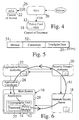
- Fig. 4 is a block diagram showing the relationship of the administration elements of the ICF, i.e. ADA and SDA.
- the ICF is a policy driven implementation of cryptography.
- a policy is the formal definition of the level of service that is granted in form of classes of services. For example, in response to a business requirement to have a strong level of cryptography for an Email application, a security domain authority may create the class of service "DES 128bit.” ADAs asking for this strong level of cryptography are given the COS defined to implement this policy.
- the security domain authority defined in the ICF administration framework is the element that creates classes of service from policies defined to meet the authorities' security interests and requirements.
- a COS has a unique identification, i.e. a serial number, that is not to be reused by this authority, and that has to be understood semantically by other SDAs in a function of cross-certification.
- a COS 26 provided to the ADA 22 allows the ADA to issue application certificates for an application which contains the COS. This forms a path of access control.
- An application must have a certificate to access the method identified by the COS, e.g. a cryptographic operation at a certain strength.
- the other path of control within the ICF architecture is the path of existence.
- the COS defined must be propagated to the CU to enable this service at a target CU. Even if the path of access indicates a valid access, the methods labelled by the COS must be in a present state for the request to be executed. If, for example, the COS is stored on the physical policy card and that policy card is removed from the CU, the associated methods no longer exist, i.e. they are not operating.
- Control of access and control of existence of a method are fundamental to the ICF architecture and both should always be present in any implementation. Removal of the COS from the existence path results in a non-functioning method regardless of the access path evaluation result.
- Policy activation describes the order of events which must take place for a CU to offer services, as defined through the classes of service. Before an application can ask for a COS via the application certificate, the CU must be activated for this particular COS.
- the ICF is unique in the concept of policy controlled activation of cryptography.
- the cryptographic unit must be in connection with a policy card for the COS to be downloaded from the policy card.
- the VPC scenario requires a network connection to the NSS to download the COS to the CU. While these solutions are technically more or less equivalent, they have a profound implication for the trust model of the entire framework.
- a physical policy card based solution requires that the CU implements touchpoints in hardware. The main reason for this is the detachment of control in the physical policy card case.
- a physical policy card is not necessarily connected to the domain authority environment and lesser control over the policy is possible once it is issued. To compensate for this, hardware touchpoints are placed in deterministic locations in the hardware, so that a policy card containing the touchpoint data can be loaded, but cannot be removed from the implementation without a decay of the controlled application.
- a firmware implementation of the touchpoint concept operates in a much more dynamic way with regard to the location and installation of these touchpoints because the actual firmware to be loaded is not known a priori , thus leaving more room for the attacker.
- an on-line element is present, in the form of the NSS, which allows for a more dynamic control of the firmware based touchpoint implementation.
- FIG. 5 is an illustration of the class of service structure.
- a class of service (COS) describes policies. As discussed above, a policy is translated into one or more COS structures.
- Classes of service are a structure signed by the issuing SDA 20.
- a COS also contains the touchpoint data necessary to control the touchpoint mechanisms inside the CU.
- Classes of service can be nested, i.e. a COS can contain as the method part other classes of services. Some classes of service, in particular the non-cryptographic classes of service, may not contain touchpoint data.
- COS can be declared to be valid for an unbounded lifetime or it may be limited in lifetime. Examples for a limited lifetime are a link of the COS lifetime to the lifetime of the OS, the application instance, or the context established with the CU. Restarting the OS or application, or closing the CU context, would mark the COS as expired and invalid. Interaction with the NSS to activate the COS would then be necessary.
- the ICF CU is unique in that it offers cryptographic services driven by a class of service with constraints that do expire.
- COS0 A special, predefined class of service, COS0, is used to guard the COS decay functionality. Because the COS0 is itself subject to a decay policy, COS processing can be made cease to exist, thus describing the entire CU for any kind of service. A new activation from the NSS would be required in this case.
- Classes of Service Levels Classes of service are organized not only by the object they describe, but also by the level of validation an implementation performs before granting the service level described by the COS.
- the preferred embodiment of the ICF defines six validation levels for a COS. As the levels increase, tighter validation (and therefore control) over the service to be granted is achieved.
- Fig. 6 is a block schematic diagram that illustrates the COS level concept.
- the ICF implements several levels of COS validation. These levels of COS validation are examples only. It will be appreciated that other levels of validation, and combinations thereof, may be provided in practicing the invention herein. They are labelled COS level 0 through 5. As the level increases, the amount of validation increases.
- Fig. 6 includes a counterclockwise circle 61 which shows the elements involved in the validation. At the lowest certified level, only the SDA origin of the COS is validated; while at the highest certified level, an on-line connection and authorization to the NSS for each operation is required.
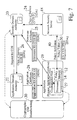
- Fig. 7 is a block schematic diagram that illustrates key elements in the administration process. Such elements include the application certificate 28, the class of service 24, 26, and the domain authorities that manage them. Fig. 7 includes both a high level view of these elements and their flow (as shown by the lines and arrows in the figure).
- Fig. 8 is a software architecture overview of the ICF software environment.
- the ICF software architecture describes the layers of libraries and system elements which are needed to implement the ICF elements on a given host system. The following discussion provides an overview on the main software architecture elements:
- the key elements are divided into two groups: host system software and cryptographic unit firmware. Between the two major blocks is the definition of a command set which is used to communicate requests from the host system to the cryptographic unit and vice versa. Each of the main elements is described in more detail below.
- the host system software consists of application level programming interfaces, system level drivers, and utility programs which help in configuring and managing the subsystem. This portion may look different depending on the target platform and interfaces selected.
- APIs may already exist, new ones are being proposed as "standards," yet others need to be developed to take advantage of the full capabilities of the cryptographic unit.
- An example would be the ability to download and execute code dynamically in a trusted environment.
- the cryptographic unit operates in conjunction with a wide range of programming interfaces. APIs may also be hidden from the application in form of subsystem libraries or middleware layers which mask the cryptographic operations.
- the host system must integrate the cryptographic unit into the operating environment. From a software perspective this includes the device drivers and any configuration software needed to install, configure, and manage the policy card.
- Utility software is responsible for installation, management and configuration of the cryptographic unit subsystem. It is also necessary to provide utilities for developing service modules, and utilities for downloading these modules into the cryptographic unit.
- the host system software communicates with the cryptographic unit through a set of requests. Examples for requests are the download of a service library or the encryption of a data buffer. To support multiple platforms with the same cryptographic unit, the command set should be the same and have the same format for all target platforms. The main benefit is a single implementation of the cryptographic unit software layers.
- the command set itself can be divided into main categories.
- the first category offers commands which map to the available functionality of the cryptographic unit, such as the execution of a hash algorithm.
- the second category concerns commands between the host software and the service layer software inside the unit. The content of these commands is largely unknown to the firmware and they are routed to the appropriate service layer.
- the ICF introduces the concept of policy driven cryptography.
- Application programming interfaces allow to select the desired services based on the application certificate granted by the ADA. This is in contrast to the currently available cryptographic programming interfaces.
- Most of the current cryptographic APIs are built around the concept of a cryptographic context. Applications establish this context before they can use any cryptographic service. No linkage is done between the application and the class of service offered by the CU.
- the Microsoft CryptoAPI offers a programming interface which allows the user to select the cryptographic service provider (CSP) type and load the software module into the system. Thereafter, an application can make calls to the CSP and use its services. There are, however, no methods to distinguish cryptographic functions based on what the application is doing.
- CSP cryptographic service provider
- Fig. 9 illustrates the methods available to pass certificates 90 to the service provider 91 responsible for executing the requested functions.
- ICF Cryptographic Unit At the core of the ICF framework is the CU.
- An implementation of the CU provides a set of services to the host system. These services include cryptographic functions but also other functions, such as storing sensitive information that take advantage of the tamper resistant characteristics of the CU.
- the following three broad categories of services are offered by the CU:
- Fig. 10 is a block schematic diagram that illustrates an exemplary architecture of the CU. Fig. 10 does not refer to a particular physical implementation, but rather shows the main elements needed inside the CU to implement the three broad categories of functionality outlined above. There are several components which form the CU:
- FIG. 11 is a block schematic diagram of the cryptographic unit firmware.
- the CU firmware 27 is the software which resides inside the cryptographic unit 14.
- the firmware components can be divided among a sharp line which is called the trust boundary 115. Below the trust boundary, the CU core runtime and the actual hardware can be found. Above the trust boundary, the CU runtime managing the entire chip and upper level service modules can be found.
- the CU core runtime implements the low level services which shield the underlying hardware. It also offers services to the support layers to manage the resources offered by the CU, e.g. memory objects for code module storage.
- the CU core runtime is responsible for the COS processing. Each operation requested by the upper layers is accompanied by a COS identifier. The COS decay policy is implemented below this boundary.
- the CU core runtime protection rests on the following key mechanisms:
- the CU runtime services provides the elementary operating system functions needed to manage and organize the card. It resides directly on top of the CU core runtime. This runtime may be thought of as a micro kernel which runs at high execution privilege level. This kernel is the only place which drives the cryptographic functions available for the higher level service modules. The following basic capabilities should be available:
- This set of libraries runs at the least privileged protection level.
- This level hosts libraries which could implement services for a given programming interface, such as the ICF Envelope APIs, cryptographic APIs, such as the Microsoft Crypto API or the X/Open GCS API, or any other APIs as needed to offer an abstraction for secure storage, secure execution, or downloading facilities. Commands exchanged between the host system and this layer are defined by the implementor of this layer.
- the service libraries layer also offers the possibility of allowing an application to execute some portion of itself in a secure and trusted environment. This facility could be used to implement copyright schemes, or special functionality such as risk evaluation modules for financial applications.
- the programming interfaces are application dependent.
- the host system driver passes the information between the application and the service libraries as messages.
- Fig. 12 is a block schematic diagram that illustrates the concept of a virtual CPU. Another way to look at the firmware structure discussed above is to combine the lower level firmware found in the CU core runtime and the underlying hardware into a virtual CPU executing under the constraints implemented by this combination.
- the ICF CPU can be seen as a processor capable of executing instructions under the control of a policy. Part of this ICF CPU is concerned with the COS evaluation and the resulting touchpoint resolution process. Looking at the combination of the firmware and hardware elements as a joint unit allows a better description of the trust model, and evaluation of a hardware / firmware combination against it. Once this component is validated, analysis of any module loaded and executed on top does not have to be evaluated with all the lower layer interaction around touchpoints and memory protection intermixed.
- Any physical processor model / ROM combination which can implement the protection mechanisms outlined above is therefore capable of being configured as a virtual CPU, as may be required by the ICF CU architecture. Any module written for such an ICF CPU can run on any ICF CPU that passes the strong security requirements.
- Software component certification is the process of ensuring that there is a tight binding between the application image and the application certificate issued by the ADA. It also includes firmware components and firmware certificate issued by the SDA.
- the process of software component certification can be described in two distinct stages. They are the installation stage and the execution stage. Whenever the term application is used in the following text, it shall also include the firmware components. The following is a brief description of the certification process stages.
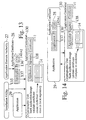
- Fig. 13 is a block schematic diagram that shows the software component certification process during the installation stage.
- Certified Applications are introduced to the host system at the application installation stage.
- a certified application consists of the application image 29, i.e. the code file, and the certificate 28 issued by the application domain authority.
- the result of the installation stage is an application credential 130 which uniquely denotes the application, the CU, and the valid classes of services. This result is referred to herein as an application credential.
- the purpose of the install process is to introduce the application 29 to the CU 14.
- a special utility program, the install program 135, is called to carry out the necessary work.
- the main task of this utility perform is to pass a reference to the program image and the application certificate to the CU.
- the CU upon receiving the request for installation uses its host system memory access capabilities to compute a hash value from the program image.
- the application certificate contains, among other information,the application ID 137 and the class of service 136 defined for this application. Using these two elements of information, the CU produces a credential which identifies the application, e.g. through a name, the hash value of the application image, and the class of service defined for the application.
- the credential is then signed 138 by the CU and stored in local non-volatile memory inside the CU. If desired, the credential could also be exported to an external area. Because the credentials are only useful to the CU that generated them, it only needs to be ensured that the credentials have not been tampered with while outside the CU boundaries.
- Fig. 14 is a block schematic diagram that shows the software component certification process during the execution stage.
- an application 29 is loaded by the operating system into the memory system and starts execution. At some point in the application execution., the application requests cryptographic services.
- the first step is to establish a context with the CU.
- An application passes the application certificate 28 issued by the ADA to the CU 14 when it establishes a logical association, e.g. a cryptographic context.
- the CU Upon receiving the request to establish an association, the CU validates the identity of the application based on the certificate passed. Through the operating system components, the CU has access to the application image and is therefore able to compute the signature of the application. For example, using the DMA capability and the knowledge of the memory address range of the application within the memory system, the CU can compute a hash value.
- the CU After validating the correctness of the certificate, the CU uses the certificate to locate the application credential 130 corresponding to the certificate.
- the credential contains, among other information, the computed signature 138 of the application image from the installation process described in the previous subsection. If the values match, two important facts can be deduced. First, the application's identity is established because the computed signature over this image matches the computed signature at installation time. Second, the application has not been tampered with since the installation stage.
- the application can issue calls to the CU requesting cryptographic operations.
- the CU may decide to execute this validation process again.
- the options range from validating on a periodic basis to validating upon each request.
- Firmware certification is not fundamentally different from application level certification. Both share the objective of establishing a tight binding between the certificate and the software object.
- One difference that can be seen is that the lower level firmware objects are certified by the SDA rather than the ADA.
- High level firmware objects, e.g. user written protocol modules which are downloaded to the CU, are certified by the ADA.
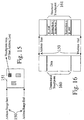
- FIG. 15 illustrates software level touchpoints.
- ICF Software touchpoints are areas of data that are not usable to the host or CU system environment until preprocessed.
- One example of a software touchpoint is that of instruction sequences in a code image which have been transformed in a way that the instruction fetch unit of the processor cannot decoded them successfully.
- a software touchpoint is characterized by a starting address within the address range 150 of the object 151 and the length of the touchpoint.
- Data level touchpoints describe an area inside a data object. No further information about the Touchpoint is recorded in the data object about this touchpoint. A separate data area describes these touchpoints outside of the data object.
- Instruction level touchpoints describe touchpoints inside an instruction stream. There are two sub classes. The first subclass describes instruction level touchpoints similar to their data level counterparts. In this case, an area in the instruction stream is replaced by the touchpoint information. The second subclass describes instruction level touchpoints that have a structure. A structured touchpoint starts and ends with a special instruction which demarcates the touchpoint area. All these types of touchpoints are described in more detail below.
- FIG. 16 illustrates instruction level touchpoints.
- the first type 160 implements an instruction level touchpoint as a data area in the instruction stream which has been replaced by a scrambled version. No further information is available about the touchpoint at the location itself.
- the second type 161 implements the touchpoint with a distinct instruction at the beginning and an instruction at the end of the touchpoint area. To distinguish the two touchpoint areas, the first type of touchpoint is referred to herein as an unstructured touchpoint, while the second type of a touchpoint is referred to herein as a structured touchpoint
- CU Validation Process Applications must be assured about the correctness of the CU. The objective is to avoid the scenario in which someone redirects the application requests to a different cryptographic function.
- the CU validation process describes the steps taken to assure the application about the identity of the CU.
- the validation process described in this chapter uses the software level touchpoints as the main concept used. CU validation can be described in three distinct stages:
- the CU validation process outlined below allows for additional benefits that go beyond the main goal of CU validation. From a software manufacturers perspective, issues concerning copyright protection are becoming increasingly critical in a network world. A software manufacturer therefore would like to be assured that the software shipped to a customer is not copied to another system. The range of requirements can range from ensuring that the software is loaded to only a valid group of authorized systems to customizing the software for exactly one system.
- Fig. 17 is a block schematic diagram showing the manufacturing stage.
- the application 29a is produced by the application manufacturer 170.
- the objectives are to build an application which can be tailored for the particular group of target systems or a single target system.
- the target system is identified by the CU installed in it.
- the application manufacturer first develops the application. This is the executable version of the application for the target host system platform. Before the application can be shipped to the target host system, the customize step 171 installs the software level touchpoints. After the installation, the application 29 can be shipped.
- the customize component shown in Fig. 17 is responsible for installing the touchpoints in the application image.
- the ADA 22 is the domain authority in which the application manufacturer resides.
- the ADA is granted a class of services by the SDA 20 which define the function used to install the touchpoints into the application image.
- One point of the touchpoint installation is to produce a list of location and length of the touchpoint areas within the code image. In the case of unstructured instruction level touchpoints, this information is needed to locate the touchpoints. For structured instruction level touchpoints, this information is not strictly necessary. There are also considerations concerning exactly where a touchpoint could be placed and what the length of such a sequence should be.
- a further tailoring down of the target system requires additional knowledge about this system. Because this introduces a tighter dependency between the manufacturer and the target recipient, a higher effort is necessary on the administration side.
- Fig. 18 is a block schematic diagram showing the installation stage.
- the installation stage describes the steps taken at the target site, i.e. the host system and a specific CU 14 are necessary to prepare the application 29 for use on this system.
- the first objective is to ensure that an application is assured about the integrity of the CU. This assurance is achieved by that fact that only a CU which was granted the necessary COS to process the application image is able to successfully transform this image into a usable one.
- the second objective is to ensure that once an application is installed on the target system it is only usable by this system and cannot be copied to another system.
- the installer component 180 is responsible for installing the application in the target system. As a part of the install process, the application's credential 28 which describes the COS 26 available to the application is created. The details of this process are described in greater detail above. The other part of the install; process preforms the steps necessary to prove that this is a valid CU and to build an application image which cannot be used other than in combination with the CU that was used by the install process.
- the SDA 20 grants the ADA 22 the set of COS 26.
- the ADA grants the application rights to a set of COS.
- the policy card 12 contains the valid COS for the ADA and the COS for the installer as it was granted to the ADA of the application manufacturer. The installation component can therefore only process the touchpoints in the application image if it was granted the COS to do so.
- Touchpoints can in theory be removed at the installation stage. However, removing them from the application image at this stage has two consequences. First, the application has only a one time assurance that the CU is a valid CU at installation time. After the removal of touchpoints another CU could be installed along with another policy card or be bypassed when the application requests cryptographic services. Second, without the touchpoints the application is in the clear and can be copied and executed on any other system. To prevent these scenarios, the touchpoint should be removed as late as possible in the execution cycle.
- Fig. 19 is a block schematic diagram of the execution stage.
- the application runs on the host system.
- the operating system loader 190 transforms the application file image into the executable memory image.
- One part of the process concerns the requirement of validating that the application has not been tampered with since installation time and rightfully requests a certain class of service. The steps taken to ensure this have been described above in connection with the discussion of application certification. For the CU validation portion, additional steps are required.
- the first objective is to validate the CU. This task is accomplished if the CU is able to resolve the software touchpoints from the application. For, example if the CU is able to compute the original signature of the application without the touchpoints, it proved that it can successfully remove them and is therefore a valid CU because it was granted the COS to perform this operation.
- the second objective is to resolve the touchpoints. The CU is responsible for removing the touchpoints before the application portion that contains them is executed.
- the simplest case is for the CU to remove the touchpoints from the application code image.
- the file image of the program would still contain the touchpoints and stays useless if copied to another system.
- the memory portion is however in the clear and could be copied if a malicious user would write a copy program which constructs the file image from the memory image.
- Such a task requires some skillset and knowledge of the underlying operating system, but is not impossible.
- the application manufacturer needs to tailor the application component to the target system CU. This could be done, for example, by creating a unique COS which is shared between the manufacturer's ADA and the SDA.
- the SDA installs the unique COS on the policy card when it is customized for the target system CU and shares that COS with the ADA of the application manufacturer. Only the installation utility on the target system which is granted that unique COS can successfully install the software on the target system.
- Fig. 20 illustrates the principle of Classes of Service, touchpoints, and envelopes.
- Firmware level touchpoints are touchpoints installed in a firmware module which resides inside the CU. As such, they must be controlled by the ICF CPU described in above. There are three basic blocks of functionality which the ICF CPU must provide to handle firmware level touchpoints.
- the first block is envelope handling 200.
- Policy activation i.e. the process of sending the appropriate information to the CU to activate a certain class of service, is communicated between the NSS and the ICF CPU via envelopes 201 as they are described in the ICF architecture. Before any further processing of these envelopes takes place, their origin and validity needs to be verified.
- the validated and authenticated content of the envelope is passed on to the second component which is the COS engine 202.
- the COS engine can be seen as the heart of managing the classes of service installed on this CU. Each request for a service associated with a COS is directed to this engine and evaluated for access control to this resource.
- the COS engine also maintains a heartbeat function which allows implementation of COS decay. Periodically, the COS engine analyzes each COS stored and verifies that the boundary conditions for this COS are still true. The boundary conditions are also evaluated for each request if the COS attribute specifies it. For example, a COS which specifies that only a certain number of operations are allowed invokes the engine evaluation mechanism on each request and decrement a counter.
- the third basic component is TP Resolution 203.
- the TP resolution block is responsible for handling the resolution of touchpoints 204 as they are encountered by the executing firmware. Through one of the mechanisms outlined earlier, control of execution transfers to this component and the instructions which are masked by the touchpoint are executed within the trust boundary 205 established by the ICF CPU. Once the COS engine determines that a COS is no longer accessible, the COS is marked invalid and the TP resolution process does not function for this COS. As a result, the firmware can no longer be used.
- Fig. 21 illustrates the memory hierarchy with respect to the software touchpoint resolution.
- Software level touchpoints can take advantage of hardware support from the host system CPU.
- a key aspect of this embodiment of the invention brings the resolution process of touchpoints closer to the host system processor execution elements. By moving the resolution process close to the processor 210, e.g. the cache subsystem 211, no touchpoint areas in the clear are in the main memory system 212 or storage elements 213 at a lower level in the memory hierarchy.
- the host processor generates an exception upon detection of a software touchpoint which invokes the CU to resolve the software touchpoint.
- the second approach is fairly similar, except that it uses the host system processing elements for the actual operations. Both approaches can further be subdivided according to structured versus unstructured software touchpoint.
- Fig. 22 shows a host system processor fetching instructions from the memory code image 221 of an application which has structured instruction level touchpoints 222 installed.
- the host system processor 223 raises an exception when encountering a touchpoint start instruction.
- the exception handler invokes the CU component to remove the touchpoint and replace the touchpoint data with executable instructions.
- the host system processor then continues to execute the application.
- the host system processor traps again and the CU can transform the memory image back to the touchpoint state.
- the host system processor uses the tp_start instruction to raise an exception which cause the CU to be invoked.
- the CU is then given the knowledge of the memory address range and the memory location of the touchpoint to transform the touchpoint body into an instruction sequence which can be executed by the host system processor. Control then returns back to the host system processor.
- the touchpoint is translated in this fashion, other application instances could potentially access the touchpoint area. It is therefore important to implement the touchpoints as a critical section in which no application context switching is allowed.
- the tp_end instruction causes a trap to the CU which allows the CU to reverse the touchpoint data back to its original state.
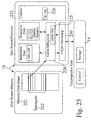
- Fig. 23 is a block schematic diagram that illustrate instruction level touchpoint support inside the host system processor. This second approach assumes that the host system processor 223 has a built in logic component 230 which allows it to decode the touchpoint during instruction fetch. Upon encountering a touchpoint start instruction, the host system processor translates the touchpoint data within the processor's cache 224 and continues the execution. No memory image changes take place. Upon encountering the touchpoint end instruction, the cache line 225 is flushed or left for future use. To support this scheme, touchpoints are required to align on a cache boundary which should be a multiple of the cache line size.
- the host system Upon detecting a tp_start instruction by the host system processor instruction fetch unit, the host system first fetches and then transforms one or more cache lines that contain the touchpoint area, using the key stored in a host system processor control register 226.
- Each application may have a different tp_reg value for resolving the touchpoint area.
- the tp_reg value is part of the COS-TP which was used to install the application in the host system.
- the loading of the tp_reg control register at context switch involves the CU as the keeper of the information.
- the key_reg value could also be made part of the application context state, so that it can be loaded during a context switch without invoking the CU.
- touchpoints To detect a touchpoint area, mechanisms must be put into place in both the software environment and the hardware to propagate the information about the location of the touchpoints to the host system processing elements. For example, if the granularity of the touchpoint areas is chosen to be on a page size of the virtual memory system of the host system, the information about the touchpoint location could be communicated through the page tables and translation look aside buffers to the host system processor.
- the host processor can detect whether the address range to be translated contains software touchpoints or not.
- the touchpoint area is resolved in the cache subsystem as described above. Similar techniques apply when the resolved touchpoint areas are kept in the cache lines and are not accessible in main memory, or the disc images of the objects that contain them. Read only cache lines are simply flushed whenever they are not needed anymore. Cache lines modified must be transformed back before they are written back to the main memory system.
Landscapes
- Engineering & Computer Science (AREA)
- Computer Security & Cryptography (AREA)
- Software Systems (AREA)
- Theoretical Computer Science (AREA)
- Computer Hardware Design (AREA)
- General Engineering & Computer Science (AREA)
- Physics & Mathematics (AREA)
- General Physics & Mathematics (AREA)
- Storage Device Security (AREA)
- Stored Programmes (AREA)
Claims (25)
- Eine Vorrichtung zum Validieren, dass eine Anwendung (29) eine bestimmte Dienstklasse (26) rechtmäßig ausführt, wobei die Vorrichtung folgende Merkmale umfasst:wobei die Dienstklasse eine eindeutige Identifikation aufweist, die durch die Sicherheitsdomainautorität nicht wiederverwendet wird,eine Anwendungsdomainautorität (22) zum Gewähren eines Autoritätspegels in der Form eines Zertifikats (28), das gültige Dienstklassen enthält;eine Einrichtung, um entweder Dienstklassen mit einer Sicherheitsdomainautorität zu erzeugen oder Dienstklassen mit der Anwendungsdomainautorität zu definieren, wobei die Dienstklassen durch die Sicherheitsdomainautorität validiert werden, die Richtlinien definiert hat, um die Sicherheitsinteressen und - anforderungen der Sicherheitsdomainautorität zu erfüllen;eine Einrichtung (14) zum engen Binden der Anwendung an das Zertifikat;ein vertrauenswürdiges Ladeteilsystem (12) zum Durchführen einer Anwendungsvalidierung;eine Einrichtung (14) zum Laden eines Programmbildes in einen Systemspeicherplatz, und während dies durchgeführt wird, Validieren, dass diese Anwendung nicht manipuliert wurde, '
wobei die Dienstklasse ein Verfahrensfeld (51) umfasst, das ein tatsächliches Verfahren beschreibt, für das die Dienstklasse steht,
wobei die Dienstklasse ein Beschränkungsfeld (52) enthält, das Attribute des Verfahrens beschreibt, das in dem Verfahrensfeld beschrieben ist, wobei die Attribute die Verwendung der Dienstklasse regeln, und
wobei eine Anwendung ein Zertifikat aufweisen muss, um auf ein Verfahren zuzugreifen, das durch die Dienstklasse identifiziert wird. - Die Vorrichtung gemäß Anspruch 1, die ferner folgende Merkmale umfasst:eine kryptographische Einheit (14); undeine Einrichtung (12) zum Herstellen von Vertrauen zwischen der Anwendung und der kryptographischen Einheit, wobei der Anwendung versichert wird, dass die kryptographische Einheit nicht manipuliert wurde.
- Die Vorrichtung gemäß Anspruch 1 oder 2, bei der das vertrauenswürdige Ladeteilsystem ferner folgendes Merkmal umfasst:wobei die Ladung ausfällt und das Programmbild nicht geladen wird, falls die Prüfsumme nicht mit einer Prüfsumme übereinstimmt, die durch ein Laderteilsystem bei der Anwendungsinstallationszeit gespeichert wurde.eine Einrichtung (27) zum Verwenden einer Prüfsumme über ein Programmbild;
- Die Vorrichtung gemäß einem der Ansprüche 1 bis 3, die ferner folgendes Merkmal umfasst:eine Einrichtung (27) zum Validieren jedes Objekts, das durch ein Zertifikat geregelt wird.
- Die Vorrichtung gemäß Anspruch 2, die ferner folgendes Merkmal umfasst:eine Einrichtung (27) zum Herausfordern der kryptographischen Einheit.
- Die Vorrichtung gemäß Anspruch 2, bei der die Anwendung in verwürfelter Form an ein Zielsystem gesendet wird;
wobei die Vorrichtung ferner folgendes Merkmal umfasst:wobei nur eine kryptographische Einheit, die einen korrekten Verschlüsselungsschlüssel aufweist, die Anwendung entwürfeln kann.eine Einrichtung (30) zum Vorbereiten der Anwendung zum Wirken mit der kryptographischen Einheit; - Die Vorrichtung gemäß einem der Ansprüche 1 bis 6, die ferner folgendes Merkmal umfasst:wobei ein Weg der Zugriffssteuerung gebildet wird.eine Einrichtung zum Liefern einer Dienstklasse von der Sicherheitsdomainautorität (20) an die Anwendungsdomainautorität (22), um es der Anwendungsdomainautorität zu ermöglichen, Anwendungszertifikate (28) für eine Anwendung auszugeben, die die Dienstklasse enthält;
- Die Vorrichtung gemäß Anspruch 2, die ferner folgendes Merkmal umfasst:wobei Verfahren, die durch die Dienstklasse markiert sind, in einem aktuellen Zustand sein müssen, damit eine Anforderung ausgeführt werden kann.eine Einrichtung (28) zum Ausbreiten einer Dienstklasse an die kryptographische Einheit, um die Dienstklasse an einer kryptographischen Zieleinheit freizugeben;
- Die Vorrichtung gemäß einem der Ansprüche 1 bis 7, bei der sowohl die Steuerung des Zugriffs und die Steuerung der Existenz eines Verfahrens immer vorliegen muss, um ein Verfahren, das durch die Anwendung definiert ist, in einem funktionierenden Zustand zu halten.
- Die Vorrichtung gemäß Anspruch 2, die ferner folgendes Merkmal umfasst:eine Taktik (12) zum Aktivieren der kryptographischen Einheit, bevor einer Anwendung über das Anwendungszertifikat eine Dienstklasse gewährt werden kann.
- Die Vorrichtung gemäß Anspruch 10, bei der die kryptographische Einheit (14) in Kommunikation mit einer Taktik (12) sein muss, damit die Dienstklasse heruntergeladen werden kann.
- Die Vorrichtung gemäß Anspruch 2, die ferner folgendes Merkmal umfasst:eine virtuelle Taktik (12), die eine Netzwerkverbindung mit einem Netzwerksicherheitsserver (18) erfordert, um die virtuelle Taktik an die kryptographische Einheit (14) zu verteilen.
- Die Vorrichtung gemäß einem der Ansprüche 1 bis 11, die ferner folgendes Merkmal umfasst:wobei die Berührungspunkte in deterministische Positionen in der Hardware plaziert werden; undeine physikalische Taktik (12), die es erfordert, dass die kryptographische Einheit (14) Berührungspunkte in Hardware implementiert;
wobei eine Taktik, die Berührungspunktdaten enthält, geladen werden kann, aber nicht ohne einen Zerfall der Funktion der Anwendung von der kryptographischen Einheit entfernt werden kann. - Die Vorrichtung gemäß einem der Ansprüche 1 bis 13, bei der die Dienstklasse Berührungspunktdaten enthält, die notwendig sind, um Berührungspunkte in der kryptographischen Einheit zu steuern.
- Die Vorrichtung gemäß einem der Ansprüche 1 bis 14, bei der das Intervall, für das eine Dienstklasse als gültig erklärt werden kann, ein ungebundenes sein kann oder durch vorbestimmte Kriterien beschränkt sein kann.
- Die Vorrichtung gemäß einem der Ansprüche 1 bis 15, bei der die Dienstklasse ferner folgendes Merkmal umfasst:eine spezielle vordefinierte Dienstklasse, die verwendet wird, um die Dienstklassenzerfallfunktionalität zu sichern.
- Die Vorrichtung gemäß einem der Ansprüche 1 bis 16, bei der die Dienstklassen nicht nur durch ein Objekt organisiert sind, das dieselben beschreiben, sondern auch durch einen Validierungspegel oder einen Satz von Beschränkungen, den eine Implementierung durchführt, bevor ein Dienstpegel gewährt wird, der durch die Dienstklasse beschrieben wird.
- Die Vorrichtung gemäß einem der Ansprüche 1 bis 17, bei der eine engere Validierung und Steuerung über einen Dienst, der gewährt werden soll, auf der Basis des Validierungspegels oder des Satzes von Beschränkungen erreicht wird.
- Die Vorrichtung gemäß einem der Ansprüche 1 bis 18, die ferner folgendes Merkmal umfasst:einen Dienstklassenpegel, der die Dienstklassen-ID validiert, wenn dieselbe durch ein Anwendungszertifikat verfügbar gemacht wird und durch eine Sicherheitsdomainautorität unterzeichnet wurde.
- Die Vorrichtung gemäß einem der Ansprüche 1 bis 19, die ferner folgendes Merkmal umfasst:einen Dienstklassenpegel, der die Validierung des Anwendungszertifikats erfordert, wobei das Zertifikat durch die Anwendungsdomainautorität ausgestellt werden muss, das die Dienstklasse angefordert hat, die durch die Dienstklassen-ID von der Sicherheitsdomainautorität identifiziert ist.
- Die Vorrichtung gemäß einem der Ansprüche 1 bis 20, die ferner folgendes Merkmal umfasst:einen Dienstklassenpegel, der die Validierung der Anwendungs-ID erfordert, die durch die Anwendungsdomainautorität ausgegeben wird. '
- Die Vorrichtung gemäß einem der Ansprüche 1 bis 21, die ferner folgendes Merkmal umfasst:einen Dienstklassenpegel, der eine Interaktion mit einem nationalen Sicherheitsserver erfordert, um die Dienstklasse zu validieren, die durch die Anwendung angefordert wird.
- Die Vorrichtung gemäß einem der Ansprüche 1 bis 22, die ferner folgendes Merkmal umfasst:einen Dienstklassenpegel, der mit dem nationalen Sicherheitsserver an jeder Operation interagiert, die durch die Anwendung angefordert wird.
- Die Vorrichtung gemäß einem der Ansprüche 1 bis 23, die ferner folgendes Merkmal umfasst:einen Dienstklassenpegel, der ein Token (50) für jede oder jede Kombination von Validierungen und Interaktionen erfordert.
- Die Vorrichtung gemäß einem der Ansprüche 1 bis 24, bei der die Dienstklassenpegel allein oder in Kombination vorgesehen sein können.
Applications Claiming Priority (2)
| Application Number | Priority Date | Filing Date | Title |
|---|---|---|---|
| US748085 | 1996-11-12 | ||
| US08/748,085 US5841870A (en) | 1996-11-12 | 1996-11-12 | Dynamic classes of service for an international cryptography framework |
Publications (2)
| Publication Number | Publication Date |
|---|---|
| EP0843249A1 EP0843249A1 (de) | 1998-05-20 |
| EP0843249B1 true EP0843249B1 (de) | 2004-11-24 |
Family
ID=25007943
Family Applications (1)
| Application Number | Title | Priority Date | Filing Date |
|---|---|---|---|
| EP97115746A Expired - Lifetime EP0843249B1 (de) | 1996-11-12 | 1997-09-10 | Dynamische Dienstklassen für eine internationale kryptographische Struktur |
Country Status (4)
| Country | Link |
|---|---|
| US (2) | US5841870A (de) |
| EP (1) | EP0843249B1 (de) |
| JP (1) | JPH10313309A (de) |
| DE (1) | DE69731714T2 (de) |
Cited By (5)
| Publication number | Priority date | Publication date | Assignee | Title |
|---|---|---|---|---|
| US7529927B2 (en) | 1999-03-27 | 2009-05-05 | Microsoft Corporation | Specifying security for an element by assigning a scaled value representative of the relative security thereof |
| US7757077B2 (en) | 2000-01-14 | 2010-07-13 | Microsoft Corporation | Specifying security for an element by assigning a scaled value representative of the relative security thereof |
| US8700535B2 (en) | 2003-02-25 | 2014-04-15 | Microsoft Corporation | Issuing a publisher use license off-line in a digital rights management (DRM) system |
| US8725646B2 (en) | 2005-04-15 | 2014-05-13 | Microsoft Corporation | Output protection levels |
| US8781969B2 (en) | 2005-05-20 | 2014-07-15 | Microsoft Corporation | Extensible media rights |
Families Citing this family (99)
| Publication number | Priority date | Publication date | Assignee | Title |
|---|---|---|---|---|
| US6216231B1 (en) | 1996-04-30 | 2001-04-10 | At & T Corp. | Specifying security protocols and policy constraints in distributed systems |
| WO1998008155A1 (en) * | 1996-08-20 | 1998-02-26 | Hewlett-Packard Company | Secure enablement of a processing entity |
| US7058822B2 (en) * | 2000-03-30 | 2006-06-06 | Finjan Software, Ltd. | Malicious mobile code runtime monitoring system and methods |
| US9219755B2 (en) | 1996-11-08 | 2015-12-22 | Finjan, Inc. | Malicious mobile code runtime monitoring system and methods |
| US8079086B1 (en) | 1997-11-06 | 2011-12-13 | Finjan, Inc. | Malicious mobile code runtime monitoring system and methods |
| US6154844A (en) * | 1996-11-08 | 2000-11-28 | Finjan Software, Ltd. | System and method for attaching a downloadable security profile to a downloadable |
| US7613926B2 (en) * | 1997-11-06 | 2009-11-03 | Finjan Software, Ltd | Method and system for protecting a computer and a network from hostile downloadables |
| US6167520A (en) * | 1996-11-08 | 2000-12-26 | Finjan Software, Inc. | System and method for protecting a client during runtime from hostile downloadables |
| US6317832B1 (en) | 1997-02-21 | 2001-11-13 | Mondex International Limited | Secure multiple application card system and process |
| US5915085A (en) * | 1997-02-28 | 1999-06-22 | International Business Machines Corporation | Multiple resource or security contexts in a multithreaded application |
| US6389535B1 (en) * | 1997-06-30 | 2002-05-14 | Microsoft Corporation | Cryptographic protection of core data secrets |
| US6389534B1 (en) | 1997-06-30 | 2002-05-14 | Taher Elgamal | Cryptographic policy filters and policy control method and apparatus |
| US6397330B1 (en) | 1997-06-30 | 2002-05-28 | Taher Elgamal | Cryptographic policy filters and policy control method and apparatus |
| US6317868B1 (en) * | 1997-10-24 | 2001-11-13 | University Of Washington | Process for transparently enforcing protection domains and access control as well as auditing operations in software components |
| US7418731B2 (en) * | 1997-11-06 | 2008-08-26 | Finjan Software, Ltd. | Method and system for caching at secure gateways |
| US7975305B2 (en) * | 1997-11-06 | 2011-07-05 | Finjan, Inc. | Method and system for adaptive rule-based content scanners for desktop computers |
| US8225408B2 (en) * | 1997-11-06 | 2012-07-17 | Finjan, Inc. | Method and system for adaptive rule-based content scanners |
| US6125447A (en) * | 1997-12-11 | 2000-09-26 | Sun Microsystems, Inc. | Protection domains to provide security in a computer system |
| US6308266B1 (en) * | 1998-03-04 | 2001-10-23 | Microsoft Corporation | System and method for enabling different grades of cryptography strength in a product |
| US6178504B1 (en) * | 1998-03-12 | 2001-01-23 | Cheyenne Property Trust C/O Data Securities International, Inc. | Host system elements for an international cryptography framework |
| US6751735B1 (en) * | 1998-03-23 | 2004-06-15 | Novell, Inc. | Apparatus for control of cryptography implementations in third party applications |
| US6701433B1 (en) | 1998-03-23 | 2004-03-02 | Novell, Inc. | Method and apparatus for escrowing properties used for accessing executable modules |
| US6202145B1 (en) * | 1998-12-14 | 2001-03-13 | International Business Machines Corporation | System and method for eliminating a ring transition while executing in protected mode |
| US7055040B2 (en) * | 1999-04-02 | 2006-05-30 | Hewlett-Packard Development Company, L.P. | Method and apparatus for uniquely and securely loading software to an individual computer |
| EP1505473A1 (de) * | 1999-07-23 | 2005-02-09 | Microsoft Corporation | Verfahren und Anordnung zur Abbildung von stark unterschiedlichen tragbaren Token zu einer statischen maschinenkonzentrischen Verschlüsselungsumgebung |
| US6484259B1 (en) | 1999-07-23 | 2002-11-19 | Microsoft Corporation | Methods and arrangements for mapping widely disparate portable tokens to a static machine concentric cryptographic environment |
| US7243236B1 (en) * | 1999-07-29 | 2007-07-10 | Intertrust Technologies Corp. | Systems and methods for using cryptography to protect secure and insecure computing environments |
| US6944765B1 (en) * | 1999-12-21 | 2005-09-13 | Qualcomm, Inc. | Method of authentication anonymous users while reducing potential for “middleman” fraud |
| US6665709B1 (en) * | 2000-03-27 | 2003-12-16 | Securit-E-Doc, Inc. | Method, apparatus, and system for secure data transport |
| US6757822B1 (en) | 2000-05-31 | 2004-06-29 | Networks Associates Technology, Inc. | System, method and computer program product for secure communications using a security service provider manager |
| JP2002014737A (ja) * | 2000-06-29 | 2002-01-18 | Fujitsu Ltd | 処理装置、集積回路、および集積回路パッケージ |
| RU2183348C2 (ru) * | 2000-07-19 | 2002-06-10 | Военный университет связи | Способ аутентификации объектов |
| US6993448B2 (en) | 2000-08-09 | 2006-01-31 | Telos Corporation | System, method and medium for certifying and accrediting requirements compliance |
| US7380270B2 (en) * | 2000-08-09 | 2008-05-27 | Telos Corporation | Enhanced system, method and medium for certifying and accrediting requirements compliance |
| US6901346B2 (en) | 2000-08-09 | 2005-05-31 | Telos Corporation | System, method and medium for certifying and accrediting requirements compliance |
| RU2184390C1 (ru) * | 2000-11-08 | 2002-06-27 | Военный университет связи | Способ аутентификации объектов |
| JP4759826B2 (ja) * | 2000-11-10 | 2011-08-31 | ソニー株式会社 | アダプタ装置及びメモリ装置 |
| GB2372412A (en) * | 2001-02-20 | 2002-08-21 | Hewlett Packard Co | Digital credential monitoring |
| US7178024B2 (en) | 2001-04-05 | 2007-02-13 | Sap Ag | Security service for an electronic marketplace |
| US7363384B2 (en) * | 2001-07-11 | 2008-04-22 | Sony Computer Entertainment America Inc. | Selection of content in response to communication environment |
| US20030046535A1 (en) * | 2001-09-06 | 2003-03-06 | Nelson Dean S. | System and method for authenticating use of a network appliance |
| JP2003085321A (ja) * | 2001-09-11 | 2003-03-20 | Sony Corp | コンテンツ利用権限管理システム、コンテンツ利用権限管理方法、および情報処理装置、並びにコンピュータ・プログラム |
| US20030053630A1 (en) * | 2001-09-20 | 2003-03-20 | International Business Machines Corporation | Method and system for key usage control in an embedded security system |
| US7299504B1 (en) | 2002-03-08 | 2007-11-20 | Lucent Technologies Inc. | System and method for implementing security management using a database-modeled security policy |
| US7167983B1 (en) | 2002-03-08 | 2007-01-23 | Lucent Technologies Inc. | System and method for security project management |
| US7146307B2 (en) * | 2002-03-22 | 2006-12-05 | Sun Microsystems, Inc. | System and method for testing telematics software |
| US7400722B2 (en) * | 2002-03-28 | 2008-07-15 | Broadcom Corporation | Methods and apparatus for performing hash operations in a cryptography accelerator |
| US7152243B2 (en) * | 2002-06-27 | 2006-12-19 | Microsoft Corporation | Providing a secure hardware identifier (HWID) for use in connection with digital rights management (DRM) system |
| US7137142B2 (en) * | 2002-06-28 | 2006-11-14 | Motorola, Inc. | Method and system for vehicle authentication of a component using key separation |
| EP1429224A1 (de) | 2002-12-10 | 2004-06-16 | Texas Instruments Incorporated | Firmware Laufzeit Authentisierung |
| US7207067B2 (en) * | 2002-11-12 | 2007-04-17 | Aol Llc | Enforcing data protection legislation in Web data services |
| US6980927B2 (en) * | 2002-11-27 | 2005-12-27 | Telos Corporation | Enhanced system, method and medium for certifying and accrediting requirements compliance utilizing continuous risk assessment |
| US6983221B2 (en) * | 2002-11-27 | 2006-01-03 | Telos Corporation | Enhanced system, method and medium for certifying and accrediting requirements compliance utilizing robust risk assessment model |
| US20040103309A1 (en) * | 2002-11-27 | 2004-05-27 | Tracy Richard P. | Enhanced system, method and medium for certifying and accrediting requirements compliance utilizing threat vulnerability feed |
| US6965968B1 (en) | 2003-02-27 | 2005-11-15 | Finjan Software Ltd. | Policy-based caching |
| EP1611708A4 (de) * | 2003-03-10 | 2009-12-30 | Cyberview Technology Inc | Dynamische konfiguration eines spielsystems |
| US8491391B2 (en) * | 2003-03-10 | 2013-07-23 | Igt | Regulated gaming—agile media player for controlling games |
| US7921302B2 (en) | 2003-03-10 | 2011-04-05 | Igt | Universal game download methods and system for legacy gaming machines |
| US7337330B2 (en) * | 2003-03-10 | 2008-02-26 | Cyberview Technology, Inc. | Universal game download system for legacy gaming machines |
| US7802087B2 (en) | 2003-03-10 | 2010-09-21 | Igt | Universal method for submitting gaming machine source code software to a game certification laboratory |
| US7669225B2 (en) * | 2003-05-06 | 2010-02-23 | Portauthority Technologies Inc. | Apparatus and method for assuring compliance with distribution and usage policy |
| US7188331B2 (en) * | 2003-06-30 | 2007-03-06 | Hewlett-Packard Development Company, L.P. | Firmware development within a framework from different design centers depositing component(s) with related contextual and genealogy information in an accessible repository |
| US7290278B2 (en) | 2003-10-02 | 2007-10-30 | Aol Llc, A Delaware Limited Liability Company | Identity based service system |
| US7698552B2 (en) | 2004-06-03 | 2010-04-13 | Intel Corporation | Launching a secure kernel in a multiprocessor system |
| US20060047959A1 (en) * | 2004-08-25 | 2006-03-02 | Microsoft Corporation | System and method for secure computing |
| US7802110B2 (en) * | 2004-08-25 | 2010-09-21 | Microsoft Corporation | System and method for secure execution of program code |
| US20060080331A1 (en) * | 2004-10-12 | 2006-04-13 | International Business Machines Corporation | Common interface system administration service library |
| US20070180275A1 (en) * | 2006-01-27 | 2007-08-02 | Brian Metzger | Transparent encryption using secure JDBC/ODBC wrappers |
| US8051299B2 (en) * | 2006-03-20 | 2011-11-01 | Hewlett-Packard Development Company, L.P. | Computer security method and computer system |
| JP4419977B2 (ja) * | 2006-03-31 | 2010-02-24 | ブラザー工業株式会社 | プログラム作成装置、及びプログラム |
| EP2016535A4 (de) | 2006-04-19 | 2010-06-23 | Stepnexus Holdings | Verfahren und systeme zum laden einer ic-card-anwendung |
| US20070250711A1 (en) * | 2006-04-25 | 2007-10-25 | Phonified Llc | System and method for presenting and inputting information on a mobile device |
| US7761468B2 (en) * | 2006-10-04 | 2010-07-20 | International Business Machines Corporation | Supporting multiple security mechanisms in a database driver |
| US8640215B2 (en) * | 2007-03-23 | 2014-01-28 | Microsoft Corporation | Secure isolation of application pools |
| US8683549B2 (en) * | 2007-03-23 | 2014-03-25 | Microsoft Corporation | Secure data storage and retrieval incorporating human participation |
| JP5303988B2 (ja) * | 2008-03-27 | 2013-10-02 | 株式会社リコー | 暗号機能を搭載可能な装置及び暗号機能利用制限方法 |
| US8536976B2 (en) * | 2008-06-11 | 2013-09-17 | Veritrix, Inc. | Single-channel multi-factor authentication |
| US8006291B2 (en) | 2008-05-13 | 2011-08-23 | Veritrix, Inc. | Multi-channel multi-factor authentication |
| US8468358B2 (en) * | 2010-11-09 | 2013-06-18 | Veritrix, Inc. | Methods for identifying the guarantor of an application |
| US8516562B2 (en) | 2008-05-13 | 2013-08-20 | Veritrix, Inc. | Multi-channel multi-factor authentication |
| US8166297B2 (en) | 2008-07-02 | 2012-04-24 | Veritrix, Inc. | Systems and methods for controlling access to encrypted data stored on a mobile device |
| WO2010051342A1 (en) | 2008-11-03 | 2010-05-06 | Veritrix, Inc. | User authentication for social networks |
| US8505813B2 (en) | 2009-09-04 | 2013-08-13 | Bank Of America Corporation | Customer benefit offer program enrollment |
| WO2011159715A2 (en) * | 2010-06-14 | 2011-12-22 | Engels Daniel W | Key management systems and methods for shared secret ciphers |
| US10114660B2 (en) * | 2011-02-22 | 2018-10-30 | Julian Michael Urbach | Software application delivery and launching system |
| US8751298B1 (en) | 2011-05-09 | 2014-06-10 | Bank Of America Corporation | Event-driven coupon processor alert |
| US9892419B1 (en) | 2011-05-09 | 2018-02-13 | Bank Of America Corporation | Coupon deposit account fraud protection system |
| US8474014B2 (en) | 2011-08-16 | 2013-06-25 | Veritrix, Inc. | Methods for the secure use of one-time passwords |
| US20130212381A1 (en) * | 2012-02-15 | 2013-08-15 | Roche Diagnostics Operations, Inc. | System and method for controlling authorized access to a structured testing procedure on a medical device |
| US9225715B2 (en) * | 2013-11-14 | 2015-12-29 | Globalfoundries U.S. 2 Llc | Securely associating an application with a well-known entity |
| US9344419B2 (en) | 2014-02-27 | 2016-05-17 | K.Y. Trix Ltd. | Methods of authenticating users to a site |
| CN111917571B (zh) * | 2017-01-25 | 2022-09-23 | 华为技术有限公司 | 一种策略管理方法、装置和系统 |
| US10511692B2 (en) | 2017-06-22 | 2019-12-17 | Bank Of America Corporation | Data transmission to a networked resource based on contextual information |
| US10313480B2 (en) | 2017-06-22 | 2019-06-04 | Bank Of America Corporation | Data transmission between networked resources |
| US10524165B2 (en) | 2017-06-22 | 2019-12-31 | Bank Of America Corporation | Dynamic utilization of alternative resources based on token association |
| CN108427886B (zh) * | 2018-01-25 | 2020-06-02 | 上海掌门科技有限公司 | 一种应用程序访问权限设置方法、系统、设备及可读介质 |
| JP7262269B2 (ja) * | 2019-03-27 | 2023-04-21 | キヤノン株式会社 | 情報処理装置、及び情報処理装置の制御方法、プログラム |
| FR3116922B1 (fr) * | 2020-12-01 | 2023-06-16 | Banks And Acquirers Int Holding | Procédé de configuration d’un terminal de paiement, terminal de paiement associé. |
| WO2023156006A1 (en) | 2022-02-18 | 2023-08-24 | Volkswagen Aktiengesellschaft | Control device comprising a processor circuit for executing applications that use cryptographic service functions and method for operating the control device and motor vehicle |
Citations (1)
| Publication number | Priority date | Publication date | Assignee | Title |
|---|---|---|---|---|
| EP0828208A2 (de) * | 1996-08-23 | 1998-03-11 | Hewlett-Packard Company | Beglaubigung des Anwendungsprogramms für eine internationale kryptographische Struktur |
Family Cites Families (17)
| Publication number | Priority date | Publication date | Assignee | Title |
|---|---|---|---|---|
| US4649510A (en) * | 1982-04-30 | 1987-03-10 | Schmidt Walter E | Methods and apparatus for the protection and control of computer programs |
| GB2205667B (en) * | 1987-06-12 | 1991-11-06 | Ncr Co | Method of controlling the operation of security modules |
| JPH02202642A (ja) * | 1989-02-01 | 1990-08-10 | Toshiba Corp | プログラム動作監視装置 |
| US5099516A (en) * | 1989-06-12 | 1992-03-24 | Dell Corporate Services Corporation | Digital computer code word identification system |
| US5123045A (en) * | 1989-08-18 | 1992-06-16 | Massachusetts Institute Of Technology | Comprehensive software protection system |
| CA2035697A1 (en) * | 1991-02-05 | 1992-08-06 | Brian James Smyth | Encryption apparatus for computer device |
| CA2074121C (en) * | 1991-07-19 | 2000-09-26 | Lawrence David Benson | System and method for selectively preventing a software program from being operable |
| US5301231A (en) * | 1992-02-12 | 1994-04-05 | International Business Machines Corporation | User defined function facility |
| US5276735A (en) * | 1992-04-17 | 1994-01-04 | Secure Computing Corporation | Data enclave and trusted path system |
| US5412717A (en) * | 1992-05-15 | 1995-05-02 | Fischer; Addison M. | Computer system security method and apparatus having program authorization information data structures |
| ATE177857T1 (de) * | 1992-05-15 | 1999-04-15 | Addison M Fischer | Verfahren und vorrichtung zur sicherheit eines computersystem mit programmberechtigungsdatenstrukturen |
| US5224166A (en) * | 1992-08-11 | 1993-06-29 | International Business Machines Corporation | System for seamless processing of encrypted and non-encrypted data and instructions |
| US5315655A (en) * | 1992-12-16 | 1994-05-24 | Notable Technologies, Inc. | Method and apparatus for encoding data objects on a computer system |
| JP2576385B2 (ja) * | 1993-10-28 | 1997-01-29 | 日本電気株式会社 | データ保護装置 |
| US5530752A (en) * | 1994-02-22 | 1996-06-25 | Convex Computer Corporation | Systems and methods for protecting software from unlicensed copying and use |
| US5651068A (en) * | 1995-03-08 | 1997-07-22 | Hewlett-Packard Company | International cryptography framework |
| US5600726A (en) * | 1995-04-07 | 1997-02-04 | Gemini Systems, L.L.C. | Method for creating specific purpose rule-based n-bit virtual machines |
-
1996
- 1996-11-12 US US08/748,085 patent/US5841870A/en not_active Expired - Fee Related
- 1996-12-19 US US08/770,747 patent/US5740248A/en not_active Expired - Fee Related
-
1997
- 1997-09-10 DE DE69731714T patent/DE69731714T2/de not_active Expired - Fee Related
- 1997-09-10 EP EP97115746A patent/EP0843249B1/de not_active Expired - Lifetime
- 1997-11-12 JP JP9310211A patent/JPH10313309A/ja active Pending
Patent Citations (1)
| Publication number | Priority date | Publication date | Assignee | Title |
|---|---|---|---|---|
| EP0828208A2 (de) * | 1996-08-23 | 1998-03-11 | Hewlett-Packard Company | Beglaubigung des Anwendungsprogramms für eine internationale kryptographische Struktur |
Cited By (6)
| Publication number | Priority date | Publication date | Assignee | Title |
|---|---|---|---|---|
| US7529927B2 (en) | 1999-03-27 | 2009-05-05 | Microsoft Corporation | Specifying security for an element by assigning a scaled value representative of the relative security thereof |
| US7757077B2 (en) | 2000-01-14 | 2010-07-13 | Microsoft Corporation | Specifying security for an element by assigning a scaled value representative of the relative security thereof |
| US8700535B2 (en) | 2003-02-25 | 2014-04-15 | Microsoft Corporation | Issuing a publisher use license off-line in a digital rights management (DRM) system |
| US8719171B2 (en) | 2003-02-25 | 2014-05-06 | Microsoft Corporation | Issuing a publisher use license off-line in a digital rights management (DRM) system |
| US8725646B2 (en) | 2005-04-15 | 2014-05-13 | Microsoft Corporation | Output protection levels |
| US8781969B2 (en) | 2005-05-20 | 2014-07-15 | Microsoft Corporation | Extensible media rights |
Also Published As
| Publication number | Publication date |
|---|---|
| DE69731714D1 (de) | 2004-12-30 |
| US5740248A (en) | 1998-04-14 |
| DE69731714T2 (de) | 2005-11-03 |
| US5841870A (en) | 1998-11-24 |
| JPH10313309A (ja) | 1998-11-24 |
| EP0843249A1 (de) | 1998-05-20 |
Similar Documents
| Publication | Publication Date | Title |
|---|---|---|
| US5841870A (en) | Dynamic classes of service for an international cryptography framework | |
| US6148083A (en) | Application certification for an international cryptography framework | |
| US11704389B2 (en) | Controlling access to digital assets | |
| US6178504B1 (en) | Host system elements for an international cryptography framework | |
| JP4498735B2 (ja) | オペレーティングシステムおよびカスタマイズされた制御プログラムとインタフェースする安全なマシンプラットフォーム | |
| US6609199B1 (en) | Method and apparatus for authenticating an open system application to a portable IC device | |
| US7139915B2 (en) | Method and apparatus for authenticating an open system application to a portable IC device | |
| US11706220B2 (en) | Securing application behavior in serverless computing | |
| US20100229242A1 (en) | Program execution control system, program execution control method and computer program for program execution control | |
| EP0570123B1 (de) | Verfahren und Vorrichtung zur Sicherheit eines Computersystem mit Programmberechtigungsdatenstrukturen | |
| US20060150256A1 (en) | Secure system for allowing the execution of authorized computer program code | |
| KR20010040979A (ko) | 스택에 기초한 액세스 제어 | |
| US8375458B2 (en) | System and method for authenticating code executing on computer system | |
| US7925881B2 (en) | Method and apparatus for preventing rogue implementations of a security-sensitive class interface | |
| KR101504647B1 (ko) | 가상 머신 활성화를 갖는 휴대용 대량 저장장치 | |
| WO2007055169A1 (ja) | 通信端末装置、サーバ端末装置、それらを用いる通信システム | |
| JP4507569B2 (ja) | 情報処理装置および情報処理方法、プログラム、並びに記録媒体 | |
| Koved et al. | The evolution of Java security | |
| Al-Windawi et al. | Secure Module Invocation System (SMIS) | |
| Nguyen et al. | Load Time Code Validation for Mobile Phone Java Cards | |
| Riseborough | MULTOS M3 | |
| Dragoni et al. | High-level algorithms and data structures requirements for security-by-contract on Java cards |
Legal Events
| Date | Code | Title | Description |
|---|---|---|---|
| PUAI | Public reference made under article 153(3) epc to a published international application that has entered the european phase |
Free format text: ORIGINAL CODE: 0009012 |
|
| AK | Designated contracting states |
Kind code of ref document: A1 Designated state(s): DE FR GB |
|
| 17P | Request for examination filed |
Effective date: 19980723 |
|
| AKX | Designation fees paid |
Free format text: DE FR GB |
|
| RBV | Designated contracting states (corrected) |
Designated state(s): DE FR GB |
|
| RAP1 | Party data changed (applicant data changed or rights of an application transferred) |
Owner name: CHEYENNE PROPERTY TRUST |
|
| 17Q | First examination report despatched |
Effective date: 20010202 |
|
| GRAP | Despatch of communication of intention to grant a patent |
Free format text: ORIGINAL CODE: EPIDOSNIGR1 |
|
| GRAS | Grant fee paid |
Free format text: ORIGINAL CODE: EPIDOSNIGR3 |
|
| GRAA | (expected) grant |
Free format text: ORIGINAL CODE: 0009210 |
|
| AK | Designated contracting states |
Kind code of ref document: B1 Designated state(s): DE FR GB |
|
| REG | Reference to a national code |
Ref country code: GB Ref legal event code: FG4D |
|
| RIN1 | Information on inventor provided before grant (corrected) |
Inventor name: KLEMBA, KEITH Inventor name: MERCKLING, ROGER Inventor name: FIERES, HELMUT |
|
| REF | Corresponds to: |
Ref document number: 69731714 Country of ref document: DE Date of ref document: 20041230 Kind code of ref document: P |
|
| PLBE | No opposition filed within time limit |
Free format text: ORIGINAL CODE: 0009261 |
|
| STAA | Information on the status of an ep patent application or granted ep patent |
Free format text: STATUS: NO OPPOSITION FILED WITHIN TIME LIMIT |
|
| ET | Fr: translation filed | ||
| 26N | No opposition filed |
Effective date: 20050825 |
|
| PGFP | Annual fee paid to national office [announced via postgrant information from national office to epo] |
Ref country code: FR Payment date: 20060918 Year of fee payment: 10 |
|
| PGFP | Annual fee paid to national office [announced via postgrant information from national office to epo] |
Ref country code: GB Payment date: 20060925 Year of fee payment: 10 |
|
| PGFP | Annual fee paid to national office [announced via postgrant information from national office to epo] |
Ref country code: DE Payment date: 20061031 Year of fee payment: 10 |
|
| GBPC | Gb: european patent ceased through non-payment of renewal fee |
Effective date: 20070910 |
|
| PG25 | Lapsed in a contracting state [announced via postgrant information from national office to epo] |
Ref country code: DE Free format text: LAPSE BECAUSE OF NON-PAYMENT OF DUE FEES Effective date: 20080401 |
|
| REG | Reference to a national code |
Ref country code: FR Ref legal event code: ST Effective date: 20080531 |
|
| PG25 | Lapsed in a contracting state [announced via postgrant information from national office to epo] |
Ref country code: FR Free format text: LAPSE BECAUSE OF NON-PAYMENT OF DUE FEES Effective date: 20071001 |
|
| PG25 | Lapsed in a contracting state [announced via postgrant information from national office to epo] |
Ref country code: GB Free format text: LAPSE BECAUSE OF NON-PAYMENT OF DUE FEES Effective date: 20070910 |