EP0843263A1 - Système pour connecter des unités de disques SCSI, des unités de disques IDE ou des unités de bandes souples à un PC - Google Patents
Système pour connecter des unités de disques SCSI, des unités de disques IDE ou des unités de bandes souples à un PC Download PDFInfo
- Publication number
- EP0843263A1 EP0843263A1 EP97203490A EP97203490A EP0843263A1 EP 0843263 A1 EP0843263 A1 EP 0843263A1 EP 97203490 A EP97203490 A EP 97203490A EP 97203490 A EP97203490 A EP 97203490A EP 0843263 A1 EP0843263 A1 EP 0843263A1
- Authority
- EP
- European Patent Office
- Prior art keywords
- connector
- interface
- memory module
- scsi
- dock
- Prior art date
- Legal status (The legal status is an assumption and is not a legal conclusion. Google has not performed a legal analysis and makes no representation as to the accuracy of the status listed.)
- Withdrawn
Links
Images
Classifications
-
- G—PHYSICS
- G06—COMPUTING OR CALCULATING; COUNTING
- G06F—ELECTRIC DIGITAL DATA PROCESSING
- G06F13/00—Interconnection of, or transfer of information or other signals between, memories, input/output devices or central processing units
- G06F13/38—Information transfer, e.g. on bus
- G06F13/382—Information transfer, e.g. on bus using universal interface adapter
- G06F13/385—Information transfer, e.g. on bus using universal interface adapter for adaptation of a particular data processing system to different peripheral devices
Definitions
- Another possibility is to add an additional harddisk drive in the PC which through one of the present controllers can be connected and installed in the computer.
- the original harddisk drive maintains in use and the capacity thereof is as it were, supplemented by the capacity of the additional installed harddisk drive. Room should be available in the computer to build in the additional drive adjacent to the already present drive.
- a third possibility is to purchase an external memory unit in an own housing which through one of the present ports can be connected. Thereby the original harddisk maintains in use and the capacity thereof is supplemented as it were by the capacity of the externally connected memory unit.
- PC's comprise a parallel port embodied with a standardized connector and functioning according to a specified protocol.
- This parallel port (and the protocol thereof) is in principle designed for controlling printers and as such this port is traditionally mainly used for this function.
- PC's can have a Controller with a SCSI port embodied with another but also standardized connector functioning according to the SCSI protocol. Not all PC's offer the possibility to add a SCSI port afterwards. Especially with the smaller type computers such as "notebooks” etc. the realisation of an additional SCSI connection is impossible.
- PC's may be equipped with an IDE controller comprising another standardized connector and functioning according to another protocol.
- Both the SCSI protocol as well as the IDE protocol are in principle designed for controlling memory units, such as harddisks, cdrom's, optical disks, removable cartridge disks, tape drives etc.
- the IDE controller and SCSI controller are used mainly for that purpose.
- a SCSI controller in general comprises an additional connector, accessible at the outside of the PC (without the necessity to open the PC housing) and destined for connecting an external peripheral outside the PC.
- IDE controllers are in particular applied for controlling the internal harddisk or the internal DDROM player and are in general not equipped with an external connector and are therefore mainly suited for connecting drives which have to be installed within the PC.
- An externally accessible IDE port can be built in Notebook computers which are equipped with so-called PCMCIA slots. In that case the IDE controller is installed on a so-called PCMCIA card which can be inserted into the PCMCIA slot.
- PCMCIA cards have a connector which is accessible for external IDE drives.
- Another protocol is the so-called 'floppy protocol' which is especially used for controlling floppy disk stations, but also for controlling specific type of tape drives, especially those drives which are functioning according to the floppy protocol.
- the PC user who wants to apply a memory unit first of all has to determine which connecting possibilities the related PC has, parallel, SCSI or IDE, and will then have to purchase a corresponding memory unit.
- Connecting a SCSI drive to a SCSI controller and connecting an IDE drive to an IDE controller does not involve in any problems.
- For connecting an external SCSI drive to a parallel port there are protocol-converters for converting parallel to SCSI and vice versa. If the PC does not have a SCSI connector or the SCSI connector is for other reasons not available then by means of such a converter a SCSI drive can be connected to the parallel port.
- This converter is in general integrated in the housing of the external drive.
- an IDE protocol-converter or floppy-tape protocol-converter can be used to connect an IDE drive or floppy-tape drive to the parallel port.
- protocol converters on the market which combine both protocol converters into one physical protocol converter.
- the memory units can be installed as an external unit, i.e. within a housing adjacent and outside the PC, or as an internal unit, i.e. resident installed within the PC.
- the purpose of the invention is to provide a system with which it is possible to connect a SCSI drive both to a parallel port as well as to a SCSI port whereby a significant part of the above described problems related with the prior art are eliminated.
- This system should relieve the user from the problem that he or she dependent on a certain type of available port is forced to select a specific suitable drive and should furthermore offer the user the possibility to disconnect the drive from the one PC and without any problems connect it to another PC even if there is no SCSI port available but only a parallel port.
- an object of the invention is to realize a modular concept for externally connecting a SCSI drive very easily through various ports (parallel or SCSI) or internally through a bay in various PC's, whereby furthermore different numbers and types of drives ((harddisks, exchangeable media drives, etc.) can be applied.
- the purpose of the invention is to provide a system with which it is possible to connect an IDE drive both to a parallel port as well as to a IDE port whereby a significant part of the above described problems related with the prior art are eliminated.
- This system should relieve the user from the problem that he or she dependent on a certain type of available port is forced to select a specific suitable drive and should furthermore offer the user the possibility to disconnect the drive from the one PC and without any problems connect it to another PC even if there is no IDE port available but only a parallel port.
- an object of the invention is to realize a modular concept for externally connecting an IDE drive very easily through various ports (parallel or IDE) or internally through a bay in various PC's, whereby furthermore different numbers and types of drives ((harddisks, exchangeable media drives, etc.) can be applied.
- Another object of the invention is to provide a system which in a similar manner enables the connection of a floppy disk tape drive to the parallel port, whereby a significant part of the above-described problems related to the state of the art are eliminated.
- an object of the invention is to provide a modular concept for connecting a floppy tape drive externally through the parallel port or internally through a bay in various PC's whereby furthermore different numbers and types of drives can be used.
- the memory is contained in a separate housing comprising a click connector and the dock is contained in a separate housing comprising a host connector matching with said click connector.
- the drive is unlinked from the connector technology so that the drive can be exchanged easily and can be used in combination with other personal computers.
- the actual memory module is connected through a connector to the interface and can be decoupled from the interface, it is possible to use multiple SCSI modules on said interface.
- These modules could be of the same type, for instance harddisks, but could also be of different type, for instance a harddisk and an optical disk drive.
- both the drive as well as the interface unit are contained in one and the same housing.
- an interface unit or dock which comprises only one single interface connector, so that the costs of the interface are reduced and in many cases also the necessary space is reduced.
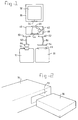
- Figure 1 illustrates a schematical view on a system according to the invention comprising a SCSI module, an interface unit (dock) and a number of connecting cables.
- Figure 2 illustrates the use of the releasable module according to figure 1 in a slide-in station or bay built into a personal computer.
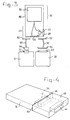
- Figure 3 illustrates a schematical view of a system according to the invention in which the drive and the interface unit are contained in one single housing.
- Figure 4 illustrates schematically an embodiment with a divided housing, whereby one part thereof contains the memory module and the other part contains the dock.
- Figure 1 illustrates schematically a first personal computer, shortly indicated as PC 10, comprising a parallel port 12, and a second personal computer, shortly indicated as PC 20, comprising a SCSI port 22.
- a module 30 comprising a SCSI drive 32.
- This SCSI drive may for instance be a harddisk, an optical disk drive, a CDROM drive etc.
- the module comprises furthermore a connector 34 which hereinafter will be indicated as the click-connector.
- FIG. 1 illustrates furthermore an interface unit 40 comprising a parallel to SCSI protocol converter 42, an interface connector 44 and a counter-connector 46 matching the click connector 34 of the memory module 30. Furthermore the interface unit comprises preferably an additional SCSI connector 48 to be able to loop through to a further interface unit.
- the interface unit 40 will be indicated hereinafter also by the term dock.
- the interface unit 44 can be connected to the SCSI port 22 of the PC 20, or can be connected to the parallel port 12 of the PC 10 through a special cable 60.
- the standard SCSI cable 50 comprises a the side of the dock 40 a counter-connector 52 matching the interface connector 44 and comprises at the PC side the SCSI counter-connector 54 matching the SCSI port 22.
- This cable is available on the market as a standard SCSI cable.
- the cable 60 comprises at its one end a counter-connector 62 matching the interface connector 44 and at its other end a parallel counter connector 64 matching the parallel port 12.
- This cable is non-standardly available on the market, but can be made by any cable manufacturer using standard connectors because only the 'pin assignment' within the cable is different from standard available cables.
- the parallel port 12 of the PC 10 is of a different type than the SCSI port 22 of the PC 20 so that not the same cable can be used for connecting to the interface connector 44.
- both connectors 12 and 22 have the same physical embodiment, event then two different types of cables will be necessary because both ports each have a separate protocol.
- the difference resides in the so-called 'pin assignment', i.e. the number of internal leads and the way in which these leads in the cable are at both ends attached to the connectors.
- this hypothesis is in fact used in agreement with the invention for both cables.
- the connectors 52 and 62 have the same embodiment. They fit both to the interface connector 44. However, the 'pin assignment' on both connectors is mutually different. They both are used with a different protocol, in the illustrated embodiment the parallel port protocol and the SCSI protocol.
- an electronic circuit 42 which performs a signal conversion such that the signals according to the parallel port protocol are converted into SCSI-protocol signals and vice versa. If the module 30 is connected to the SCSI port 22 of the PC 20 through the dock 40 and using the cable 50, then between the port 22 and the SCSI drive 32 a connection is realized functioning according to the SCSI protocol whereby in fact the converter circuit 42 is not active.
- the parallel protocol uses less pins than the SCSI protocol
- the interface connector 44 has the same external embodiment as the standard available SCSI connector. This has the advantage that for the cable 50 a standard SCSI cable can be used.
- Such an already applied random peripheral can have a SCSI connector for connection to a SCSI port.
- Another peripheral can comprise a physically different connector for connecting to the parallel port, whereby inside the housing of the peripheral use is made of a parallel to SCSI converter.
- SCSI peripherals available on the market which combine both connection methods, however, always using two physically different connectors on the peripheral: one for direct connection to a SCSI port, and the other for connection to a parallel port.
- the first advantage causes a decrease of the cost price and the second advantage could lead to a restriction of the dimensions of the peripheral, an aspect which is relevant with respect to the increasing demand for still smaller and still more portable products.
- FIG. 2 illustrates an embodiment of a computer PC 70 in which a slide-in station or bay 72 is installed.
- This bay is a mechanical container, partly open, which comprises at the inside a SCSI connector (not visible in the figure) providing a connection to the SCSI controller of the PC.
- the module 30 from figure 1 containing therein the SCSI drive 32 can be moved into the thereto designed slide of the bay 72.
- this slide-in station will present itself to the user as a cavity of which the dimensions correspond to the dimensions of the module 30.
- By sliding the module 30 inside the cavity up to a sufficient depth at the end of the slide-in movement contact will be made between the connector 34 onto the module 30 and the built in connector within the slide.
- These types of slides are known as such, for instance applied in combination with car radios, and do not need further explanation.
- FIG 3 illustrates an embodiment of the system according to the invention whereby the dock and the memory module are contained into one single housing. This housing is indicated by 80. All the other components are completely the same as illustrated in figure 1 and are therefore indicated by the same reference numbers.
- the additional SCSI connector 48 can be present for looping through to other interface units or docks.
- the use of such looping though possibilities is, however, standard in the SCSI technology and is as such not considered part of the invention.
- FIG 4 illustrates a practical embodiment of a divided housing.
- the memory module 30 containing the drive 32 is installed within a separate housing and the dock 40 containing the converter 42 as well as the necessary wiring is installed into a separate housing, indicated by 40 in figure 40.
- the host connector 46 and the click connector 34 are indicated by dot lines in figure 4.
- the interface connector 44 for providing the connection with any of the ports of a PC is visible.
- the housings are embodied such that the user obtains the visual impression of only one integrated unit. For the user only the seam 82 is visible which makes clear that in fact the housing comprises two separate sections.
- the connection between the housing 30 and the housing 40 is preferably obtained by a snap connection. These snap elements can be present for instance within the connectors 46 and 34, but can also be present at the housing itself. As such the realisation of a snap connection is known and therefore no further details will be provided.
- a user has at home a Notebook computer and a desktop PC. At the office he makes use of another desktop PC. In both desktop PC's a SCSI controller is already present, however, the PC at home does not have an external SCSI port. The SCSI controller therein is purely destined for controlling the internal harddisk.
- the Notebook does not provide a SCSI controller at all but has a PCMCIA slot and of course a parallel port.
- the user may decide to have a tapestreamer built into the PC at home, because in this PC sufficient space is available.
- the disadvantage thereof is that said tapestreamer is not available for the other PC's.
- a second SCSI controller has to be built into the PC at home, because the already available SCSI controller does not have an external SCSI port. Howevr, iuseablen that case the external tapestreamer can also be used in combination with the PC at the office.
- Unfortunately however, not in combination with the Notebook, because the Notebook does not have a SCSI port.
- a further disadvantage is that the external tapestreamer is more expensive than the internal tapestreamer.
- a parallel port tapestreamer has to be selected which again is more expensive than the external SCSI tapestreamer. Considering pros and cons our user decides to buy an external parallel port tapestreamer.
- the PC at the office he decides to replace the harddisk for another harddisk having a larger capacity.
- the PC is too vital to transport it to the dealer for carrying out the operation. Therefore the dealer is asked to come to the office to perform the replacement there.
- the dealer Apart from the costs for making a housecall the dealer also charges additional labour time for transferring data from the old harddisk to the new harddisk.
- the old harddisk has to be written off, because it cannot be used in the PC anymore. There is only room for one harddisk. It is also impossible to build this harddisk into the Notebook.
- the dock comprises the possibility to "loop through” to a second SCSI drive through the SCSI out connector installed on the dock (48 in figure 1).
- the user is able to decouple a module (for instance a harddisk) which is used with a specific PC, very easily, couple it to any other PC, and use it there. Furthermore the dealer has explained that if he might need additional disk space in future he does not have to count with further installation costs. The dealer is now able to supply ready modules for direct use in a bay or through a dock.
- a module for instance a harddisk
- An additional advantage is that a module can be secured physically by putting it for instance into a safe or in a locked drawer. Especially with harddisks this can be desirable.
- a last advantage is the portability.
- the separate modules are of course smaller that a complete external drive built into a housing. Therefore the modules are not only simpler to install but also easier to carry.
Landscapes
- Engineering & Computer Science (AREA)
- Theoretical Computer Science (AREA)
- Physics & Mathematics (AREA)
- General Engineering & Computer Science (AREA)
- General Physics & Mathematics (AREA)
- Bus Control (AREA)
Applications Claiming Priority (2)
| Application Number | Priority Date | Filing Date | Title |
|---|---|---|---|
| NL1004514A NL1004514C2 (nl) | 1996-11-13 | 1996-11-13 | Stelsel voor het aansluiten van SCSI drives, IDE drives dan wel floppy tape drives op een PC. |
| NL1004514 | 1996-11-13 |
Publications (1)
| Publication Number | Publication Date |
|---|---|
| EP0843263A1 true EP0843263A1 (fr) | 1998-05-20 |
Family
ID=19763862
Family Applications (1)
| Application Number | Title | Priority Date | Filing Date |
|---|---|---|---|
| EP97203490A Withdrawn EP0843263A1 (fr) | 1996-11-13 | 1997-11-10 | Système pour connecter des unités de disques SCSI, des unités de disques IDE ou des unités de bandes souples à un PC |
Country Status (3)
| Country | Link |
|---|---|
| EP (1) | EP0843263A1 (fr) |
| CA (1) | CA2221006A1 (fr) |
| NL (1) | NL1004514C2 (fr) |
Cited By (2)
| Publication number | Priority date | Publication date | Assignee | Title |
|---|---|---|---|---|
| GB2351576A (en) * | 1999-01-28 | 2001-01-03 | Hewlett Packard Co | Providing protocols to a connector |
| US6546445B1 (en) | 2000-01-13 | 2003-04-08 | Dell Usa, L.P. | Method and system for connecting dual storage interfaces |
Citations (4)
| Publication number | Priority date | Publication date | Assignee | Title |
|---|---|---|---|---|
| EP0394098A1 (fr) * | 1989-04-14 | 1990-10-24 | Altec | Dispositif pour branchement d'un disque dur amovible |
| US5335338A (en) * | 1991-05-31 | 1994-08-02 | Micro Solutions, Inc. | General purpose parallel port interface |
| US5457785A (en) * | 1993-02-10 | 1995-10-10 | Elonex Technologies, Inc. | CPU-independent and device-driver transparent system for translating a computer's internal bus signals onto an intermediate bus and further translating onto an expansion bus |
| WO1996036055A1 (fr) * | 1995-05-12 | 1996-11-14 | Iomega Corporation | Cable combine pour port scsi/parallele |
-
1996
- 1996-11-13 NL NL1004514A patent/NL1004514C2/nl not_active IP Right Cessation
-
1997
- 1997-11-10 EP EP97203490A patent/EP0843263A1/fr not_active Withdrawn
- 1997-11-13 CA CA002221006A patent/CA2221006A1/fr not_active Abandoned
Patent Citations (4)
| Publication number | Priority date | Publication date | Assignee | Title |
|---|---|---|---|---|
| EP0394098A1 (fr) * | 1989-04-14 | 1990-10-24 | Altec | Dispositif pour branchement d'un disque dur amovible |
| US5335338A (en) * | 1991-05-31 | 1994-08-02 | Micro Solutions, Inc. | General purpose parallel port interface |
| US5457785A (en) * | 1993-02-10 | 1995-10-10 | Elonex Technologies, Inc. | CPU-independent and device-driver transparent system for translating a computer's internal bus signals onto an intermediate bus and further translating onto an expansion bus |
| WO1996036055A1 (fr) * | 1995-05-12 | 1996-11-14 | Iomega Corporation | Cable combine pour port scsi/parallele |
Non-Patent Citations (1)
| Title |
|---|
| SWITZ J ET AL: "PARALLEL-TO-SCSI OFFERS SOLUTION", COMPUTER TECHNOLOGY REVIEW, vol. 13, no. 8, 1 July 1993 (1993-07-01), pages 32, 36, XP000374237 * |
Cited By (4)
| Publication number | Priority date | Publication date | Assignee | Title |
|---|---|---|---|---|
| GB2351576A (en) * | 1999-01-28 | 2001-01-03 | Hewlett Packard Co | Providing protocols to a connector |
| US6334160B1 (en) | 1999-01-28 | 2001-12-25 | Hewlett-Packard Co. | Apparatus and method for providing multiple protocols through a common connector in a device |
| GB2351576B (en) * | 1999-01-28 | 2004-02-11 | Hewlett Packard Co | Apparatus for multiplexing serial signals onto a parallel bus |
| US6546445B1 (en) | 2000-01-13 | 2003-04-08 | Dell Usa, L.P. | Method and system for connecting dual storage interfaces |
Also Published As
| Publication number | Publication date |
|---|---|
| CA2221006A1 (fr) | 1998-05-13 |
| NL1004514C2 (nl) | 1998-05-14 |
Similar Documents
| Publication | Publication Date | Title |
|---|---|---|
| US6086430A (en) | Enhanced universal serial bus | |
| US5528758A (en) | Method and apparatus for providing a portable computer with integrated circuit (IC) memory card storage in custom and standard formats | |
| EP0793164B1 (fr) | Station de couplage pour ordinateur portable | |
| US6292863B1 (en) | PC card | |
| US5497464A (en) | Address mapping logic for transferring data between a peripheral device of a base function expander unit and a palmtop computer as if the peripheral was a peripheral of the computer | |
| US5822547A (en) | Method and apparatus for providing a portable computer with hot pluggable modular bays | |
| KR970004523B1 (ko) | 퍼스널 컴퓨터 시스템 | |
| US5608608A (en) | Cartridge-based design for portable and fixed computers | |
| US6654842B1 (en) | Swap bay device supporting both master mode and slave mode and portable computer having the same | |
| JPH07507412A (ja) | コンピュータと周辺装置との間の再構成可能インターフェイス | |
| US5077683A (en) | Expansion slot adapter with embedded data device interface | |
| EP0890905A2 (fr) | Dispositif d'interfaçage d'ordinateur | |
| US6625144B1 (en) | Dual-use DB9 connector for RS-232 or dual-active controller communication | |
| US20040019742A1 (en) | Portable data storage device | |
| US5524252A (en) | Personal computer system combined with an adapter for networks having varying characteristics, and adapter for coupling a personal computer to such networks | |
| CA2271905C (fr) | Appareil de traitement de signaux numeriques | |
| EP0843263A1 (fr) | Système pour connecter des unités de disques SCSI, des unités de disques IDE ou des unités de bandes souples à un PC | |
| US6078112A (en) | Computer bay modular adapter | |
| EP0517508A1 (fr) | Contrôleur d'emmagasinage pour un ordinateur personnel | |
| US5778254A (en) | Recording device with connection means to first and second recording device with switch means having a preset connection pattern connecting first and second selection signals | |
| US7155624B2 (en) | Powered newcard connector | |
| JP2012014727A (ja) | コンピュータ周辺機器の適応装置及び方法 | |
| US20060119595A1 (en) | Computer system of combining user interface and a display device | |
| US6970349B2 (en) | Expandale modular storage unit | |
| KR100260887B1 (ko) | 디바이스 베이 제어기능을 갖는 유에스비 허브 시스템 |
Legal Events
| Date | Code | Title | Description |
|---|---|---|---|
| PUAI | Public reference made under article 153(3) epc to a published international application that has entered the european phase |
Free format text: ORIGINAL CODE: 0009012 |
|
| AK | Designated contracting states |
Kind code of ref document: A1 Designated state(s): AT BE CH DE DK ES FI FR GB GR IE IT LI LU MC NL PT SE |
|
| AX | Request for extension of the european patent |
Free format text: AL;LT;LV;MK;RO;SI |
|
| AKX | Designation fees paid | ||
| RBV | Designated contracting states (corrected) | ||
| STAA | Information on the status of an ep patent application or granted ep patent |
Free format text: STATUS: THE APPLICATION IS DEEMED TO BE WITHDRAWN |
|
| 18D | Application deemed to be withdrawn |
Effective date: 19981121 |