EP0843368A2 - Magnetoresistiver Film - Google Patents
Magnetoresistiver Film Download PDFInfo
- Publication number
- EP0843368A2 EP0843368A2 EP97120206A EP97120206A EP0843368A2 EP 0843368 A2 EP0843368 A2 EP 0843368A2 EP 97120206 A EP97120206 A EP 97120206A EP 97120206 A EP97120206 A EP 97120206A EP 0843368 A2 EP0843368 A2 EP 0843368A2
- Authority
- EP
- European Patent Office
- Prior art keywords
- layer
- magnetoresistive film
- antiferromagnetic
- ferromagnetic
- film
- Prior art date
- Legal status (The legal status is an assumption and is not a legal conclusion. Google has not performed a legal analysis and makes no representation as to the accuracy of the status listed.)
- Withdrawn
Links
Images













Classifications
-
- H—ELECTRICITY
- H10—SEMICONDUCTOR DEVICES; ELECTRIC SOLID-STATE DEVICES NOT OTHERWISE PROVIDED FOR
- H10N—ELECTRIC SOLID-STATE DEVICES NOT OTHERWISE PROVIDED FOR
- H10N50/00—Galvanomagnetic devices
- H10N50/80—Constructional details
- H10N50/85—Materials of the active region
-
- B—PERFORMING OPERATIONS; TRANSPORTING
- B82—NANOTECHNOLOGY
- B82Y—SPECIFIC USES OR APPLICATIONS OF NANOSTRUCTURES; MEASUREMENT OR ANALYSIS OF NANOSTRUCTURES; MANUFACTURE OR TREATMENT OF NANOSTRUCTURES
- B82Y10/00—Nanotechnology for information processing, storage or transmission, e.g. quantum computing or single electron logic
-
- B—PERFORMING OPERATIONS; TRANSPORTING
- B82—NANOTECHNOLOGY
- B82Y—SPECIFIC USES OR APPLICATIONS OF NANOSTRUCTURES; MEASUREMENT OR ANALYSIS OF NANOSTRUCTURES; MANUFACTURE OR TREATMENT OF NANOSTRUCTURES
- B82Y25/00—Nanomagnetism, e.g. magnetoimpedance, anisotropic magnetoresistance, giant magnetoresistance or tunneling magnetoresistance
-
- H—ELECTRICITY
- H01—ELECTRIC ELEMENTS
- H01F—MAGNETS; INDUCTANCES; TRANSFORMERS; SELECTION OF MATERIALS FOR THEIR MAGNETIC PROPERTIES
- H01F10/00—Thin magnetic films, e.g. of one-domain structure
- H01F10/32—Spin-exchange-coupled multilayers, e.g. nanostructured superlattices
- H01F10/324—Exchange coupling of magnetic film pairs via a very thin non-magnetic spacer, e.g. by exchange with conduction electrons of the spacer
- H01F10/3268—Exchange coupling of magnetic film pairs via a very thin non-magnetic spacer, e.g. by exchange with conduction electrons of the spacer the exchange coupling being asymmetric, e.g. by use of additional pinning, by using antiferromagnetic or ferromagnetic coupling interface, i.e. so-called spin-valve [SV] structure, e.g. NiFe/Cu/NiFe/FeMn
-
- G—PHYSICS
- G11—INFORMATION STORAGE
- G11B—INFORMATION STORAGE BASED ON RELATIVE MOVEMENT BETWEEN RECORD CARRIER AND TRANSDUCER
- G11B5/00—Recording by magnetisation or demagnetisation of a record carrier; Reproducing by magnetic means; Record carriers therefor
- G11B5/127—Structure or manufacture of heads, e.g. inductive
- G11B5/33—Structure or manufacture of flux-sensitive heads, i.e. for reproduction only; Combination of such heads with means for recording or erasing only
- G11B5/39—Structure or manufacture of flux-sensitive heads, i.e. for reproduction only; Combination of such heads with means for recording or erasing only using magneto-resistive devices or effects
- G11B2005/3996—Structure or manufacture of flux-sensitive heads, i.e. for reproduction only; Combination of such heads with means for recording or erasing only using magneto-resistive devices or effects large or giant magnetoresistive effects [GMR], e.g. as generated in spin-valve [SV] devices
-
- Y—GENERAL TAGGING OF NEW TECHNOLOGICAL DEVELOPMENTS; GENERAL TAGGING OF CROSS-SECTIONAL TECHNOLOGIES SPANNING OVER SEVERAL SECTIONS OF THE IPC; TECHNICAL SUBJECTS COVERED BY FORMER USPC CROSS-REFERENCE ART COLLECTIONS [XRACs] AND DIGESTS
- Y10—TECHNICAL SUBJECTS COVERED BY FORMER USPC
- Y10S—TECHNICAL SUBJECTS COVERED BY FORMER USPC CROSS-REFERENCE ART COLLECTIONS [XRACs] AND DIGESTS
- Y10S428/00—Stock material or miscellaneous articles
- Y10S428/90—Magnetic feature
-
- Y—GENERAL TAGGING OF NEW TECHNOLOGICAL DEVELOPMENTS; GENERAL TAGGING OF CROSS-SECTIONAL TECHNOLOGIES SPANNING OVER SEVERAL SECTIONS OF THE IPC; TECHNICAL SUBJECTS COVERED BY FORMER USPC CROSS-REFERENCE ART COLLECTIONS [XRACs] AND DIGESTS
- Y10—TECHNICAL SUBJECTS COVERED BY FORMER USPC
- Y10T—TECHNICAL SUBJECTS COVERED BY FORMER US CLASSIFICATION
- Y10T428/00—Stock material or miscellaneous articles
- Y10T428/11—Magnetic recording head
- Y10T428/1107—Magnetoresistive
- Y10T428/1121—Multilayer
Definitions
- the present invention relates to a magnetoresistive film, and more particularly to a magnetoresistive film having a spin valve structure.
- a magnetoresistive element is an element which measures a magnetic field strength and its variations by detecting changes in electric resistance of a magnetoresistive film in response to an applied magnetic field.
- a reproduce head (MR head) incorporating such a magnetoresistive element offers a higher magnetic sensitivity relative to conventional inductive heads, and its application to a reproduce head for hard disk drives has been widely investigated.
- the enhanced magnetic sensitivity of such an MR head serves to push an areal recording limits. Accordingly, increased efforts have been recently made to develop a magnetoresistive film which exhibits a high MR ratio that can be associated with the improved sensitivity.
- a giant magnetoresistive element is known as exhibiting a high MR ratio.
- a spin valve film which has a multilayer structure consisting of antiferromagnetic/ ferromagnetic/ nonmagnetic conductive/ ferromagnetic layers.
- One known specific spin valve film has an FeMn/NiFe/Co/Cu/Co/NiFe multilayer structure.
- the FeMn antiferromagnetic layer is strongly exchange coupled to the NiFe layer formed thereon while the NiFe layer is ferromagnetically coupled to the Co layer.
- the FeMn antiferromagnetic layer is strongly exchange coupled to the NiFe layer formed thereon while the NiFe layer is ferromagnetically coupled to the Co layer.
- the FeMn antiferromagnetic layer is strongly exchange coupled to the NiFe layer formed thereon while the NiFe layer is ferromagnetically coupled to the Co layer.
- the FeMn antiferromagnetic layer is strongly exchange coupled to the NiFe layer formed thereon while the
- FeMn employed for the conventional antiferromagnetic layer is susceptible to corrosion, and produces corrosion pits (micropores) after passed through a polishing process generally using water. This results in an undesirable degradation of magnetoresistive characteristics.
- a magnetoresistive film in accordance with a first aspect of the present invention has a layered structure which comprises a first ferromagnetic layer, a second ferromagnetic layer, a nonmagnetic conductive layer interposed between the first and second ferromagnetic layers, and an antiferromagnetic layer coupled with (provided on) one of the first and second ferromagnetic layers, which antiferromagnetic layer comprises an antiferromagnetic antimony-base alloy.
- the antiferromagnetic antimony-base alloys include CrSb, FeSb 2 or (Mn X Cr 1-X ) Y Sb 100-Y (0 ⁇ X ⁇ 0.3, 40 ⁇ Y ⁇ 60), for example.
- a magnetoresistive film in accordance with a second aspect of the present invention has a layered structure which comprises a first ferromagnetic layer, a second ferromagnetic layer, a nonmagnetic conductive layer interposed between the first and second ferromagnetic layers, and an antiferromagnetic layer coupled with one of the first and second ferromagnetic layers, which antiferromagnetic layer comprises an antiferromagnetic fluoride.
- the antiferromagnetic fluorides include CoF 3 and FeF 3 , for example.
- a magnetoresistive film in accordance with a third aspect of the present invention has a layered structure which comprises a first ferromagnetic layer, a second ferromagnetic layer, a nonmagnetic conductive layer interposed between the first and second ferromagnetic layers, and an antiferromagnetic layer coupled with one of the first and second ferromagnetic layers, which antiferromagnetic layer comprises an FeRh-base alloy.
- FeRh-base alloy Fe X Rh 100-X (40 ⁇ X ⁇ 60), for example.
- the FeRh-base alloy may contain at least one metallic element selected from the group consisting of Pt, Ir, Pd, Zr, Nb, Mo, Ru, Hf, Ta, W, Re and Os.
- the content of such an additive element in the FeRh-base alloy is preferably not greater than 30 atomic percent.
- FeRh-base alloys containing the additive element examples include Fe X (Rh 1-Y Pt Y ) 100-X (40 ⁇ X ⁇ 60, 0 ⁇ Y ⁇ 0. 5), Fe X (Rh 1-Y Ir Y ) 100-X (40 ⁇ X ⁇ 60, 0 ⁇ Y ⁇ 0.5) and Fe X (Rh 1-Y Pd Y ) 100-X (40 ⁇ X ⁇ 60, 0 ⁇ Y ⁇ 0.5).
- FeRh-base alloy has a composition of Fe 50 Rh 50-X Pd X (X ⁇ 30).
- the value of X in the Fe 50 Rh 50-X Pd X alloy composition is preferably in the range of 10-25, more preferably in the range of 15-20.
- the alloys having such compositions exhibit a high Neel temperature and is accordingly able to impart an improved heat-resistance to magnetoresistive films.
- a magnetoresistive film in accordance with a fourth aspect of the present invention has a layered structure which comprises a first ferromagnetic layer, a second ferromagnetic layer, a nonmagnetic conductive layer interposed between the first and second ferromagnetic layers, and an antiferromagnetic layer coupled with one of the first and second ferromagnetic layers, which antiferromagnetic layer comprises FeS.
- a magnetoresistive film in accordance with a fifth aspect of the present invention has a layered structure which comprises a first ferromagnetic layer, a second ferromagnetic layer, a nonmagnetic conductive layer interposed between the first and second ferromagnetic layers, and an antiferromagnetic layer coupled with one of the first and second ferromagnetic layers, which antiferromagnetic layer comprises an IrMnCo-base alloy.
- the IrMnCo-base alloy may be (IrMn) 100-X Co X (0 ⁇ X ⁇ 30), specifically (Ir 25 Mn 75 ) 100-X Co X (0 ⁇ X ⁇ 30), for example.
- a further preferred value of X is in the range of 0.1 ⁇ X ⁇ 20.
- a magnetoresistive film in accordance with a sixth aspect of the present invention has a layered structure which comprises a first ferromagnetic layer, a second ferromagnetic layer, a nonmagnetic conductive layer interposed between the first and second ferromagnetic layers, and an antiferromagnetic layer coupled with one of the first and second ferromagnetic layers, which antiferromagnetic layer comprises a CrAl-base alloy.
- the CrAl-base alloy may be Cr X Al 100-X (50 ⁇ X ⁇ 80), for example.
- an antiferromagnetic layer is disposed toward a substrate, it is preferred to provide, as an underlayer for the antiferromagnetic layer, at least one metallic layer selected from the Group IVa, Group Va and Group VIa metals of the periodic table, or a nonmagnetic metallic layer having a bcc (body-centered cubic) crystal structure.
- the Group IVa, Group Va and Group VIa metals of the periodic table include Ti, Zr, Hf, V, Nb, Ta, Cr, Mo and W, for example. These metallic layers exhibit satisfactory wettabilities to antiferromagnetic layer materials employed in the above-described first through fourth aspects of the present invention. These metallic layers are not limited to those having a crystalline structure, and may be amorphous metallic layers.
- the nonmagnetic metallic layers having a bcc (body-centered cubic) crystal structure include Cr and Fe, for example.
- the formation of the present antiferromagnetic layer such as on a Cr layer can impart a more desirable crystal structure and improved magnetic characteristics to the antiferromagnetic layer.
- the antiferromagnetic layer has a bcc (body-centered cubic) crystal structure or a bct (body-centered tetragonal) crystal structure
- the provision of the underlayer formed of a material having a bcc (body-centered cubic) crystal structure allows the antiferromagnetic layer to have a crystal structure which exhibits a large exchange coupling to the ferromagnetic layer, and thereby imparting stable magnetic characteristics to the antiferromagnetic layer.
- a magnetoresistive film in accordance with a seventh aspect of the present invention has a layered structure which includes a first ferromagnetic layer, a second ferromagnetic layer, a nonmagnetic conductive layer interposed between the first and second ferromagnetic layers, an antiferromagnetic layer coupled with one of the first and second ferromagnetic layers and comprised of a material having a body-centered cubic (bcc) or tetragonal (bct) structure, and an underlayer provided beneath the antiferromagnetic layer and comprised of a material having a body-centered cubic structure.
- bcc body-centered cubic
- bct tetragonal
- a magnetoresistive element in accordance with an eighth aspect of the present invention includes a magnetroresistive film and a domain control film having a layered structure for controlling a magnetic domain of the magnetoresistive film.
- the layered structure includes an antiferromagnetic layer comprised of a material having a body-centered cubic (bcc) or tetragonal (bct) structure, a ferromagnetic layer provided on the antiferromagnetic layer, and an underlayer provided beneath the antiferromagnetic layer and comprised of a material having a body-centered cubic structure.
- the magnetoresistive film in the above-described magnetoresistive element is identical to the magnetoresistive film in accordance with the above seventh aspect.
- the underlayers, respectively, in the magnetoresistive film and the domain control film are formed of the same material while the antiferromagnetic layers, respectively, in the magnetoresistive film and the domain control film are formed of the same material.
- the underlayer may be formed of Cr; an alloy of Cr and at least one element selected from Ta, Zr, Nb, fe, W, V, Mo, Hf, Cs and Rb; Ta; or an alloy of Ta and at least one element selected from Zr and Nb, for example.
- the antiferromagnetic layer may be formed of an alloy of at least one element selected from Fe, Mn and Cr, and at least one element selected from Rh, Pd, Co, Ir, Pt, Ni, Sb and F, for example.
- the underlayer preferably has a (100) plane as its preferentially oriented crystal plane.
- a preferentially oriented crystal plane of the antiferromagnetic layer is a (100) plane or a (001) plane.
- a preferentially oriented crystal plane, i.e., the (100) or (001) plane, of the antiferromagnetic layer can be readily realized if the underlayer is preferentially oriented in the (100) plane.
- the underlayer is formed of Cr and the antiferromagnetic layer is formed of an FeRh-base alloy.
- the FhRh-base alloys includes Ferh, and alloys of FhRh and at least one element selected from Pd, Co, Ir, Pt, Ni, Sb and F, for example.
- a thickness of the antiferromagnetic layer in the present invention is not particularly limited, but is generally in the range of 5-100 nm, preferably in the range of 5-25 nm.
- the material type of the ferromagnetic layer employed in the present invention is not particularly limited, so long as the ferromagnetic layer is formed of a ferromagnetic material whose Curie temperature is above an element operating temperature.
- the ferromagnetic layer may be an NiFe layer, a Co layer, or a two-layer film combining the NiFe layer with the Co layer, for example.
- the ferromagnetic layer may also be selected from alloys thereof.
- a thickness of the ferromagnetic layer is generally in the range of 1-10 nm.
- the nonmagnetic conductive layer may be a Cu layer or an Ag layer, for example.
- a thickness of the nonmagnetic conductive layer is generally in the range of 1-5 nm.
- a thickness of the underlayer in the present invention, if provided beneath the antiferromagnetic layer, is generally in the range of 1-50 nm, preferably in the range of 1-20 nm.
- the magnetoresistive film of the present invention is generally provided on a substrate. Any material can be employed for the substrate, so long as it is nonmagnetic. Examples of the substrate materials include Si, TiC, Al 2 O 3 , and glass.
- the magnetoresistive film of the present invention Since the materials employed for the antiferromagnetic layer in the magnetoresistive film of the present invention respectively exhibit excellent corrosion resistances, the magnetoresistive film of the present invention exhibit a giant magnetoresistance as well as an excellent corrosion resistance. Consequently, the magnetoresistive film can be protected against corrosion, e.g. in its fabricating process, to exhibit excellent magnetoresistive characteristics.
- the underlayer is formed of a material having a body-centered cubic structure while the antiferromagnetic layer is formed of a material having a body-centered cubic or tetragonal structure, which allows the antiferromagnetic layer to have a crystal orientation that favorably acts to enhance exchange coupling between the ferromagnetic and antiferromagnetic layers.
- the enhanced exchange coupling between the ferromagnetic and antiferromagnetic layers serves to impart stable and excellent magnetoresistive characteristics to the magnetoresistive film.
- Figure 1 is a cross-sectional view of one magnetoresistive film embodiment in accordance with a first aspect of the present invention.
- an underlayer 8 film thickness: 5 nm
- an antiferromagnetic layer 2 film thickness: 15 nm
- an antiferromagnetic material which is an antimony-base alloy in this embodiment.
- each of the NiFe layers 3, 7 is formed of Ni 80 Fe 20 .
- a first ferromagnetic layer includes the NiFe layer 3 and the Co layer 4.
- the Cu layer 5 as a nonmagnetic conductive layer is formed on the first ferromagnetic layer.
- a second ferromagnetic layer which includes the Co layer 6 and the NiFe layer 7.
- the antiferromagnetic layer 2 is strongly exchange coupled to the NiFe layer 3 and Co layer 4, and the NiFe layer 3 and Co layer 4 are in a so-called pinned state. If an external magnetic field is either absent or weakly applied, a magnetization direction of the second ferromagnetic layer including the Co layer 6 and the NiFe layer 7 is set parallel to that of the first ferromagnetic layer including the NiFe layer 3 and the Co layer 4. When a strong external field is subsequently applied in an antiparallel direction, the magnetization of the second ferromagnetic layer including the Co layer 6 and the NiFe layer 7 is brought into an antiparallel orientation. As such a change occurs, a marked variation in a MR ratio is observed. Accordingly, the magnetoresistive film as shown in Figure 1 now defines a spin valve magnetoresistive film.
- the Cr layer 8 is an underlayer for the antiferromagnetic layer 2.
- the provision of the antiferromagnetic layer 2 on such an underlayer 8 serves to impart improved film properties to the antiferromagnetic layer 2.
- the underlayer 8 may be formed of a metallic element in Group IVa, Group Va and Group VI of the periodic table, e.g., Zr, Ta or Hf.
- FIG 2 is a cross-sectional view of another magnetoresistive film embodiment in accordance with the first aspect of the present invention.
- the antiferromagnetic layer 2 in the magnetoresistive film is distanced from the substrate 1 to define an upper-most layer.
- formed on the glass substrate 1 are the NiFe layer 7, Co layer 6, Cu layer 5, Co layer 4 and NiFe layer 3 in such a stacked order.
- the film thickness of each layer is substantially identical to that of the corresponding layer of the embodiment as shown in Figure 1.
- the stacked order of those layers 2 through 7 in the magnetoresistive film embodiment of Figure 1 can be reversed to provide the embodiment as shown in Figure 2.
- a technique of forming a thin film for each layer incorporated in the magnetoresistive films shown in Figures 1 and 2 is not particularly limited, and can be ion beam sputtering, for example.
- the magnetoresistive film embodiments of Figures 1 and 2 as well as the conventional magnetoresistive film were respectively subjected to heat treatment at 260 °C for 10 hours for evaluation of MR characteristics after heat treatment.
- the Neel temperatures of those materials are listed below.
- each of the antiferromagnetic materials used in the present embodiments was evaluated for its corrosion resistance.
- a Co layer, an NiFe layer and a CrSb layer were formed on a silicone substrate in such a stacked order to prepare a sample thin film for evaluation of corrosion resistance.
- the results are shown in Figure 3.
- a Co layer, an NiFe layer and an FeMn layer were formed on a silicone substrate in such a stacked order to prepare a comparative sample thin film for evaluation of its corrosion resistance.
- a film thickness of each layer was identical to that of the corresponding layer in the embodiments shown in Figures 1 and 2.
- One hundred samples were immersed into purified water at 20 °C for 5 hours.
- the antiferromagnetic CrSb layer exhibits highly improved corrosion resistance relative to the conventional FeMn layer.
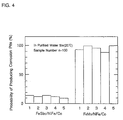
- sample thin films were prepared using FeSb 2 and (Mn 0.2 Cr 0.8 ) 50 Sb 50 , respectively, for the antiferromagnetic layer to measure the probabilities of producing corrosion pits.
- the results are given in Figures 4 and 5.
- the antiferromagnetic layers used in the respective embodiments in accordance with the first aspect of the present invention exhibit highly improved corrosion resistance relative to the conventional FeMn layer.
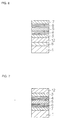
- Figure 6 is a cross-sectional view of one magnetoresistive film embodiment in accordance with a second aspect of the present invention.
- an underlayer 8 upon which is formed an antiferromagnetic layer 12 (film thickness: 5 nm) of CoF 3 or FeF 3 .
- Additional layers are formed on the antiferromagnetic layer 12, as analogous to the embodiment of Figure 1, to constitute the magnetoresistive film. Since the layers excluding the antiferromagnetic layer 12 are analogous to those in the embodiment of Figure 1, like reference numerals are denoted to those like layers to omit the explanation thereof.
- Figure 7 is a cross-sectional view of another magnetoresistive film embodiment in accordance with the second aspect of the present invention.
- the stacked order of the layers 12 and 3 through 7 in the magnetoresistive film embodiment of Figure 6 is reversed so that the antiferromagnetic layer 12 defines the upper-most layer. Since the antiferromagnetic layer 12 is the upper-most layer in this embodiment, the underlayer 8 is omitted, as contrary to the embodiment of Figure 6 wherein the underlayer 8 is formed on the substrate 1.
- a CoF 3 layer and an FeF 3 layer were employed as the antiferromagnetic layer 12 to prepare the magnetoresistive films respectively shown in Figure 6 and 7 for measurement of their MR characteristics.
- the prepared magnetoresistive films exhibited the MR characteristics either comparable or superior to the conventional magnetoresistive film incorporating the FeMn layer as the antiferromagnetic layer.
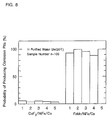
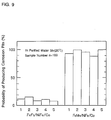
- a CoF 3 layer and an FeF 3 layer as the antiferromagnetic layer were respectively stacked on a two-layer film including Co and NiFe layers to prepare sample films for measurement of probabilities of producing corrosion pits.
- the results are shown in Figures 8 and 9.
- Figure 8 shows the measurement results for the CoF 3 layer.
- Figure 9 shows the measurement results for the FeF 3 layer.
- the antiferromagnetic CoF 3 and FeF 3 layers both exhibit highly improved corrosion resistance relative to the conventional antiferromagnetic FeMn layer.
- Figure 10 is a cross-sectional view of one magnetoresistive film embodiment in accordance with a third aspect of the present invention.
- a substrate 1 formed on a substrate 1 is an underlayer 8 upon which is formed an antiferromagnetic layer 22 (film thickness: 5 nm) of Fe 50 Rh 35 Pd 15 .
- Additional layers are formed on the antiferromagnetic layer 22, as analogously to the embodiment of Figure 1, to constitute the magnetoresistive film. Since the layers excluding the antiferromagnetic layer 22 are analogous to those in the embodiment of Figure 1, like reference numerals are denoted to those like layers to omit the explanation thereof.
- Figure 11 is a cross-sectional view of another magnetoresistive film embodiment in accordance with the third aspect of the present invention.
- the stacked order of the layers 22 and 3 through 7 in the magnetoresistive film embodiment of Figure 10 is reversed so that the antiferromagnetic layer 22 defines an upper-most layer.
- the NiFe layer 7 is directly formed on the substrate 1 to omit the underlayer 8, as contrary to the embodiment of Figure 10 wherein the underlayer 8 is formed on the substrate 1.
- the magnetoresistive film embodiments of Figures 10 and 11 were measured for their respective MR characteristics. They exhibited the MR characteristics either comparable or superior to the conventional magnetoresistive film incorporating the FeMn layer as the antiferromagnetic layer.
- Figure 13 is a cross-sectional view of one magnetoresistive film embodiment in accordance with a fourth aspect of the present invention.
- an underlayer 8 upon which is formed an antiferromagnetic layer 32 (film thickness: 5 nm) of FeS. Additional layers are formed on the antiferromagnetic layer 32, as analogously to the embodiment of Figure 1, to constitute the magnetoresistive film. Since the layers excluding the antiferromagnetic layer 32 are analogous to those in the embodiment of Figure 1, like reference numerals are denoted to those like layers to omit the explanation thereof.
- Figure 14 is a cross-sectional view of another magnetoresistive film embodiment in accordance with the fourth aspect of the present invention.
- the stacked order of the layers 32 and 3 through 7 in the magnetoresistive film embodiment of Figure 13 is reversed so that the antiferromagnetic layer 32 defines an upper-most layer, as shown in Figure 14.
- the NiFe layer 7 is directly formed on the substrate 1 to omit the underlayer 8.
- the magnetoresistive film embodiments of Figures 13 and 14 were measured for their respective MR characteristics. They exhibited the MR characteristics either comparable or superior to the conventional magnetoresistive film incorporating the FeMn layer as the antiferromagnetic layer.
- the magnetoresistive film embodiments of Figures 13 and 14 as well as the conventional magnetoresistive film for comparison were respectively subjected to heat treatment at 260 °C for 10 hours for evaluation of their respective MR characteristics after heat treatment.
- the conventional magnetoresistive film incorporating the FeMn layer as the antiferromagnetic layer exhibited a marked reduction in MR characteristics
- the magnetoresistive film embodiments including the FeS layer as the antiferromagnetic layer exhibited a slight reduction in MR characteristics. This is believed likely due to the higher Neel temperature of FeS, which is 613 K (340 °C), relative to the Neel temperature of FeMn, which is 478 K (205 °C).
- the antiferromagnetic layer of FeS was measured in the same manner as described above for its probability of producing corrosion pits. The results are shown in Figure 15. As apparent from Figure 15, it exhibited highly improved corrosion resistance relative to the conventional FeMn layer.
- Figure 16 is a graph showing current-potential curves of the antiferromagnetic layer (film thickness: 50 nm) when measured with a potentiostat.
- Figure 16 shows a current-potential curve of the conventional FeMn antiferromagnetic layer, and also shows current-potential curves of the FeRh and CrSb antiferromagnetic layers in accordance with the present invention.
- a corrosion potential of each material which is indicative of its corrosion resistance level, was determined in the manner as shown on a data curve of FeMn in Figure 16. As a potential continues to increase, a current starts to rise. A regression line is drawn to follow a slope of the rise in current. The intercept of this line on the X-axis is taken as the corrosion potential.
- Figure 17 shows a corrosion potential of each material.
- FeRh and CrSb which are employed for the antiferromagnetic layer in the present invention, exhibit higher corrosion potentials than FeMn, which has been employed for the conventional antiferromagnetic layer. This also demonstrates that the use of FeRh or CrSb for the antiferromagnetic layer can improve the corrosion resistance thereof.
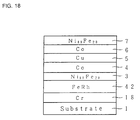
- Figure 18 is a cross-sectional view of one magnetoresistive film embodiment in accordance with the third aspect and a seventh aspect of the present invention.
- an underlayer 18 film thickness: 10 nm
- Cr which is a material having a body-centered cubic structure
- an antiferromagnetic layer 42 film thickness: 50 nm
- FeRh an antiferromagnetic material having a body-centered cubic structure.
- formed on the antiferromagnetic layer 42 are an NiFe layer 3, a Co layer 4, a Cu layer 5, a Co layer 6 and an NiFe layer 7 in such a stacked order to constitute a spin valve magnetoresistive film.
- FeRh for the antiferromagnetic layer 42 has a composition of Fe 50 Rh 50 .
- Each layer is formed by means of an RF sputtering technique.
- An Ar gas pressure was set at 1 mTorr. while an RF power was set at 100 W.
- a substrate temperature was maintained at 150 °C or higher during film formation of the underlayer 18 and at room temperature during film formation of the other layers.
- a film forming rate was controlled at about 2-5 ⁇ /sec.
- Figure 19 is a graph showing an X-ray diffraction pattern of the layered film embodiment shown in Figure 18.
- Figure 20 is a graph showing an X-ray diffraction pattern of a comparative layered film in which the underlayer 18 is excluded from the embodiment of Figure 18 to form the FeRh layer 42 directly on the substrate 1.
- a peak of the (200) plane of the Cr underlayer and a peak of the (200) plane of FeRh appear in the spectrum. It is identified by this that the Cr layer is oriented in the (100) plane and the FeRh layer is oriented in the (100) plane.
- a peak of the (100) plane is difficult to appear in the X-ray diffraction pattern.
- the orientation is identified by a peak of the (200) plane.
- the FeRh layer is oriented in the (110) plane as shown in Figure 20.
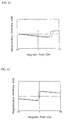
- Figure 21 is a graph showing an M-H curve of a layered film comprised of Cr (10 nm)/FeRh (50 nm)/NiFe (5 nm).
- Figure 22 is an M-H curve of a comparative layered film comprised of FeRh (50 nm)/NiFe (5nm), which excludes the Cr layer and forms the FeRh layer directly on the substrate.
- the provision of the Cr underlayer results in the enhanced exchange coupling field of the antiferromagnetic and ferromagnetic layers.
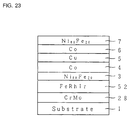
- FIG 23 is a cross-sectional view of another magnetoresistive film embodiment in accordance with the third and seventh aspects of the present invention.
- an underlayer 28 film thickness: 20 nm
- CrMo which is a material having a body-centered cubic structure
- an antiferromagnetic layer 52 film thickness: 50 nm
- FeRhIr an antiferromagnetic material having a body-centered cubic structure.
- an NiFe layer 3 As analogous to the above embodiment of Figure 18, formed on the antiferromagnetic layer 52 are an NiFe layer 3, a Co layer 4, a Cu layer 5, a Co layer 6 and an NiFe layer 7 in such a stacked order to constitute a spin valve magnetoresistive film.
- FeRhIr for the antiferromagnetic layer 52 has a composition of Fe 50 Rh 35 Ir 15 .
- Each of the layers constituting the magnetoresistive film is formed by means of the RF sputtering technique, as analogously to the embodiment shown in Figure 18.
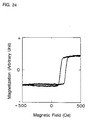
- Figure 24 is a graph showing an M-H curve of a layered film comprised of CrMo (20 nm)/FeRhIr (50 nm)/NiFe (5 nm). As can be apparently seen from Figure 24, again in this embodiment, a large exchange coupling field is produced between the antiferromagnetic and ferromagnetic layers.
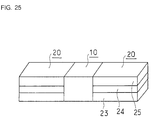
- Figure 25 is a perspective view showing one embodiment of the magnetoresistive element in accordance with an eighth aspect of the present invention.
- a domain control film 20 for controlling a magnetic domain of the magnetoresistive film 10 is disposed at each side of the magnetoresistive film 10.
- This domain control film 20 has a layered structure including the ferromagnetic layer 25 formed on the antiferromagnetic layer 24.
- the domain control film 20 further includes an underlayer 23 disposed beneath the antiferromagnetic layer 24.
- the underlayer 23 and the antiferromagnetic layer 24 are both formed of a material having a body-centered cubic structure.
- the underlayer 23 is comprised of a CrMo layer (film thickness: 20 nm) while the antiferromagnetic layer 24 is comprised of an FeRhIr layer (film thickness: 50 nm).
- the ferromagnetic layer 25 comprises an NiFe layer (film thickness: 20 nm).
- the antiferromagnetic layer 24 in the domain control film 20 of the present invention is also oriented in the (100) plane, as similar to the embodiments respectively shown in Figures 18 and 23. Accordingly, a large exchange coupling field is produced between the antiferromagnetic layer 24 and the ferromagnetic layer 25. As a result, a large bias field can be stably applied to the magnetoresistive film 10 to thereby enable an improved control of the magnetic domain.
- the magnetoresistive film 10 is the magnetoresistive film in accordance with the seventh aspect of the present invention and is the spin valve magnetoresistive film which includes an underlayer of material having a body-centered cubic structure, an antiferromagnetic layer of material having a body-centered cubic structure, a first ferromagnetic layer, a nonmagnetic conductive layer and a second ferromagnetic layer in such a stacked order
- the underlayer of the magnetoresistive film 10 and the underlayer 23 of the domain control film 20 can be formed of the same material.
- the antiferromagnetic layer of the magnetoresistive film 10 and the antiferromagnetic layer 24 of the domain control film 20 can also be formed of the same material.
- the underlayers respectively of the magnetoresistive film 10 and the domain control film 20 can be formed through the same thin film formation process.
- the antiferromagnetic layers respectively of the magnetoresistive film 10 and the domain control film 20 can be formed through the same thin film formation process. This enables a simplified and efficient formation thereof.
- the above-described effects can be similarly obtained, if the antiferromagnetic layer is formed of a material having a body-centered tetragonal structure, or if a preferentially oriented crystal plane of the antiferromagnetic layer is the (001) plane.
- the present invention is not limited to those materials. Other materials can be suitably employed. Also in the embodiments which are not specifically illustrated as having the domain control film, it should be understood that the domain control film generally employed in magnetoresistive elements, e.g., a longitudinally or transversely biasing layer, can be further combined.
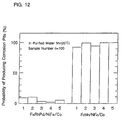
- Figure 26 shows measurement results for probabilities that Fe 50 Rh 50 , employed as the antiferromagnetic layer in the third aspect of the present invention, produced corrosion pits.
- a sample film was prepared in the same manner as described above, i.e., by forming on a substrate a Co layer, an NiFe layer, and an antiferromagnetic layer as an object of measurement, in such a stacked order.
- the Fe 50 Rh 50 layer used as the antiferromagnetic layer exhibits a remarkably superior corrosion resistance to the conventional FeMn layer.
- Figure 27 shows measurement results for probabilities that Fe 50 Rh 35 Ir 15 , employed as the antiferromagnetic layer in the third aspect of the present invention, produced corrosion pits.
- the Fe 50 Rh 35 Ir 15 layer used as the antiferromagnetic layer exhibits a remarkably superior corrosion resistance to the conventional FeMn layer.
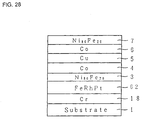
- Figure 28 is a cross-sectional view of still another magnetoresistive film embodiment in accordance with the third and seventh aspects of the present invention.
- an underlayer 18 film thickness: 10 nm
- Cr which is a material having a body-centered cubic structure
- an antiferromagnetic layer 62 film thickness: 50 nm
- FeRhPt an antiferromagnetic material having a body-centered cubic structure.
- formed on the antiferromagnetic layer 62 are an NiFe layer 3, a Co layer 4, a Cu layer 5, a Co layer 6 and an NiFe layer 7 in such a stacked order to constitute a spin valve magnetoresistive film.
- FeRhPt employed for the antiferromagnetic layer 62 has a composition of Fe 50 Rh 35 Pt 15 .
- the formation of the FeRhPt layer having a body-centered cubic structure on the Cr layer 18 having a body-centered cubic structure serves to provide stable and excellent magnetoresistive characteristics.
- Figure 29 shows measurement results for probabilities that FeRhPt, employed as the antiferromagnetic layer in the third aspect of the present invention, produced corrosion pits.
- the FeRhPt layer exhibits a remarkably improved corrosion resistance relative to the conventional FeMn layer.
- FIG 30 is a cross-sectional view of one magnetoresistive film embodiment in accordance with a fifth aspect of the present invention.
- an underlayer 18 film thickness: 10 nm
- Cr which is a material having a body-centered cubic structure
- an antiferromagnetic layer 72 film thickness: 50 nm
- formed on the antiferromagnetic layer 72 are an NiFe layer 3, a Co layer 4, a Cu layer 5, a Co layer 6 and an NiFe layer 7 in such a stacked order to constitute a spin valve magnetoresistive film.
- CrAlt employed for the antiferromagnetic layer 72 has a composition of Cr 60 Al 40 .
- the CrAl antiferromagnetic layer in accordance with the fifth aspect of the present invention is preferably formed on an underlayer of a material having a body-centered cubic structure. An excellent crystallinity can be imparted to the antiferromagnetic layer as formed on such an underlayer, resulting in stable and excellent magnetoresistive characteristics.
- Figure 31 shows measurement results for probabilities that the antiferromagnetic layer of Cr 60 Al 40 produced corrosion pits. As apparent from Figure 31, the Cr 60 Al 40 layer exhibits a remarkably improved corrosion resistance relative to the conventional FeMn layer.
- Figure 32 is a perspective view showing a magnetoresistive element construction to which the magnetoresistive film of the present invention is applied.
- the magnetoresistive element in accordance with the present embodiment includes a domain control film 20 at each side of a magnetoresistive film 10, as similar to the embodiment shown in Figure 25.
- Figure 32 also shows an electrode 30 provided on the domain control film 20.
- the electrode 30 is provided for supplying a current to the magnetoresistive film and for reading a voltage.
- the electrode 30 is made of Cu.
- the magnetoresistive film 10, the domain control film 20 and others are formed on a substrate. Polishing is thereafter applied to define a surface corresponding to an air-bearing surface (ABS).
- ABS air-bearing surface
- the use of a low corrosion-resistant, antiferromagnetic layer generally results in corrosion thereof in the polishing process.
- the FeRh-base alloy antiferromagnetic layer in accordance with the third aspect and the CrAl-base alloy antiferromagnetic layer in accordance with the fifth aspect produce no corrosion pits even in such a polishing process, exhibiting a practically excellent corrosion resistance.
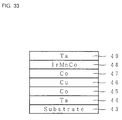
- FIG 33 is a cross-sectional view of one magnetoresistive film embodiment in accordance with a sixth aspect of the present invention.
- a Ta underlayer 44 (film thickness: 6.5 nm) is formed on a glass substrate 43.
- a Co ferromagnetic layer 45 film thickness: 5 nm
- a Cu nonmagnetic conductive layer film thickness: 2.5 nm
- a Co ferromagnetic layer 47 film thickness: 3 nm
- An IrMnCo antiferromagnetic layer 48 film thickness: 15 nm
- a Ta layer 49 film thickness: 5 nm as a protective layer is formed on the IrMnCo antiferromagnetic layer 48.
- Co is added to an IrMn-base alloy, which is generally poor in corrosion-resistance, to impart an improved corrosion resistance.
- the Co addition to the IrMn-base alloy is preferably not greater than 30 atomic percent, more preferably in the range of 0.1-20 atomic percent.
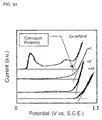
- Figure 34 is a graph showing current-potential curves of an antiferromagnetic film when measured with a potentiostat.
- Figure 34 shows measurement results for Ir 25 Mn 75 antiferromagnetic layers to which 0, 1, 5 and 10 atomic percent of Co were respectively added.
- a sample film employed for measurement was prepared by forming each antiferromagnetic layer on a glass substrate to a thickness of 100 ⁇ .
- the corrosion potential goes higher, resulting in more improved corrosion resistances.
- Figure 35 is a graph showing MR characteristics of the magnetoresistive film shown in Figure 33 in which (Ir 25 Mn 75 ) 90 Co 10 , i.e., the Ir 25 Mn 75 -base alloy to which 10 atomic percent of Co was added, was employed for the antiferromagnetic layer 48.
- Figure 36 is a graph showing MR characteristics of a comparative magnetoresistive film which employed Ir 25 Mn 75 for the antiferromagnetic layer.
- the magnetoresistive film is provided to which the greatly improved corrosion resistance can be imparted without sacrificing the magnetoresistive characteristics.
- the layers are illustrated to be stacked in the order of a ferromagnetic layer/ nonmagnetic conductive layer/ ferromagnetic layer/ antiferromagnetic layer.
- a stacked order may be reversed, i.e., they may be stacked in the order of an antiferromagnetic layer/ ferromagnetic layer/ nonmagnetic conductive layer/ ferromagnetic layer.
- a dual-type layered structure is applicable which, for example, comprises an antiferromagnetic layer/ ferromagnetic layer/ nonmagnetic conductive layer/ ferromagnetic layer/ nonmagnetic conductive layer/ ferromagnetic layer/ antiferromagnetic layer.
- the magnetoresistive film of the present invention employs highly corrosion-resistant materials to form an antiferromagnetic layer, and therefore exhibits a very superior corrosion resistance to the conventional magnetoresistive films incorporating an FeMn layer as an antiferromagnetic layer.
- the magnetoresistive films in accordance with the first and fourth aspects of the present invention employ antiferromagnetic materials having higher Neel temperatures, and therefore exhibit superior heat-resistances to the conventional magnetroresistive films.
- the magnetoresistive film in accordance with the seventh aspect of the present invention provides an underlayer of a material having a body-centered cubic structure beneath an antiferromagnetic layer of a material having a body-centered cubic or tetragonal structure, and is therefore able to orient its crystal plane so that the antiferromagnetic and ferromagnetic layers produce a large exchange coupling field for exhibiting stable and excellent magnetoresistive characteristics.
- the magnetoresistive element in accordance with the eighth aspect of the present invention provides an underlayer beneath an antiferromagnetic layer in a domain control film.
- the underlayer is formed of a material having a body-centered cubic structure while the antiferromagnetic layer is formed of a material having a body-centered cubic or tetragonal structure.
- Such a construction can impart a stable biasing field to a magnetoresistive film, resulting in a better domain control.
Landscapes
- Engineering & Computer Science (AREA)
- Chemical & Material Sciences (AREA)
- Nanotechnology (AREA)
- Crystallography & Structural Chemistry (AREA)
- Physics & Mathematics (AREA)
- Mathematical Physics (AREA)
- Theoretical Computer Science (AREA)
- Power Engineering (AREA)
- Hall/Mr Elements (AREA)
- Thin Magnetic Films (AREA)
Applications Claiming Priority (6)
| Application Number | Priority Date | Filing Date | Title |
|---|---|---|---|
| JP30673696 | 1996-11-18 | ||
| JP306736/96 | 1996-11-18 | ||
| JP30673696 | 1996-11-18 | ||
| JP171781/97 | 1997-06-27 | ||
| JP17178197 | 1997-06-27 | ||
| JP17178197 | 1997-06-27 |
Publications (2)
| Publication Number | Publication Date |
|---|---|
| EP0843368A2 true EP0843368A2 (de) | 1998-05-20 |
| EP0843368A3 EP0843368A3 (de) | 2000-01-26 |
Family
ID=26494390
Family Applications (1)
| Application Number | Title | Priority Date | Filing Date |
|---|---|---|---|
| EP97120206A Withdrawn EP0843368A3 (de) | 1996-11-18 | 1997-11-18 | Magnetoresistiver Film |
Country Status (4)
| Country | Link |
|---|---|
| US (1) | US6146775A (de) |
| EP (1) | EP0843368A3 (de) |
| KR (1) | KR19980042427A (de) |
| CN (1) | CN1192589A (de) |
Cited By (4)
| Publication number | Priority date | Publication date | Assignee | Title |
|---|---|---|---|---|
| WO2002050924A1 (en) * | 2000-12-21 | 2002-06-27 | Fujitsu Limited | Magnetoresistive device, magnetic head, and magnetic disk player |
| EP1935029A4 (de) * | 2005-09-20 | 2009-11-11 | Grandis Inc | Magnetische anordungen mit einer stabilisierten freien ferromagnetischen schicht oder mehrschichtigen freien ferromagnetischen schicht |
| US7777261B2 (en) | 2005-09-20 | 2010-08-17 | Grandis Inc. | Magnetic device having stabilized free ferromagnetic layer |
| US7894248B2 (en) | 2008-09-12 | 2011-02-22 | Grandis Inc. | Programmable and redundant circuitry based on magnetic tunnel junction (MTJ) |
Families Citing this family (25)
| Publication number | Priority date | Publication date | Assignee | Title |
|---|---|---|---|---|
| US6359289B1 (en) * | 2000-04-19 | 2002-03-19 | International Business Machines Corporation | Magnetic tunnel junction device with improved insulating tunnel barrier |
| US6753072B1 (en) | 2000-09-05 | 2004-06-22 | Seagate Technology Llc | Multilayer-based magnetic media with hard ferromagnetic, anti-ferromagnetic, and soft ferromagnetic layers |
| KR100427183B1 (ko) * | 2000-12-16 | 2004-04-17 | 한국전기연구원 | 고감도 자기 저항 소자 및 그 제조 방법 |
| JP3260740B1 (ja) * | 2001-04-25 | 2002-02-25 | ティーディーケイ株式会社 | 磁気抵抗効果装置の製造方法および薄膜磁気ヘッドの製造方法 |
| US7060376B1 (en) | 2001-12-06 | 2006-06-13 | Seagate Technology Llc | Amorphous soft underlayers for perpendicular recording media |
| DE10258860A1 (de) * | 2002-12-17 | 2004-07-15 | Robert Bosch Gmbh | Magnetoresistives Schichtsystem und Sensorelement mit diesem Schichtsystem |
| US20050013059A1 (en) * | 2003-07-15 | 2005-01-20 | International Business Machines Corporation | Magnetoresistive sensor with a net magnetic moment |
| US6946697B2 (en) * | 2003-12-18 | 2005-09-20 | Freescale Semiconductor, Inc. | Synthetic antiferromagnet structures for use in MTJs in MRAM technology |
| US7372116B2 (en) * | 2004-06-16 | 2008-05-13 | Hitachi Global Storage Technologies Netherlands B.V. | Heat assisted switching in an MRAM cell utilizing the antiferromagnetic to ferromagnetic transition in FeRh |
| US7576956B2 (en) * | 2004-07-26 | 2009-08-18 | Grandis Inc. | Magnetic tunnel junction having diffusion stop layer |
| US7859034B2 (en) * | 2005-09-20 | 2010-12-28 | Grandis Inc. | Magnetic devices having oxide antiferromagnetic layer next to free ferromagnetic layer |
| US7430135B2 (en) * | 2005-12-23 | 2008-09-30 | Grandis Inc. | Current-switched spin-transfer magnetic devices with reduced spin-transfer switching current density |
| US20070246787A1 (en) * | 2006-03-29 | 2007-10-25 | Lien-Chang Wang | On-plug magnetic tunnel junction devices based on spin torque transfer switching |
| US7851840B2 (en) * | 2006-09-13 | 2010-12-14 | Grandis Inc. | Devices and circuits based on magnetic tunnel junctions utilizing a multilayer barrier |
| US7957179B2 (en) | 2007-06-27 | 2011-06-07 | Grandis Inc. | Magnetic shielding in magnetic multilayer structures |
| US7982275B2 (en) * | 2007-08-22 | 2011-07-19 | Grandis Inc. | Magnetic element having low saturation magnetization |
| US8054677B2 (en) | 2008-08-07 | 2011-11-08 | Seagate Technology Llc | Magnetic memory with strain-assisted exchange coupling switch |
| US8217478B2 (en) | 2008-10-10 | 2012-07-10 | Seagate Technology Llc | Magnetic stack with oxide to reduce switching current |
| US7947188B2 (en) * | 2008-12-30 | 2011-05-24 | Tdk Corporation | Method for manufacturing CPP-type magnetoresistance effect element |
| US8685547B2 (en) | 2009-02-19 | 2014-04-01 | Seagate Technology Llc | Magnetic recording media with enhanced writability and thermal stability |
| US9142240B2 (en) | 2010-07-30 | 2015-09-22 | Seagate Technology Llc | Apparatus including a perpendicular magnetic recording layer having a convex magnetic anisotropy profile |
| JP2014060297A (ja) * | 2012-09-18 | 2014-04-03 | Toshiba Corp | 磁気抵抗効果素子 |
| JP6640766B2 (ja) | 2017-02-07 | 2020-02-05 | 株式会社東芝 | 磁性素子、圧力センサ、磁気ヘッド、および磁性メモリ |
| JP2018206855A (ja) * | 2017-05-31 | 2018-12-27 | Tdk株式会社 | 積層構造体及びスピン変調素子 |
| JP7379272B2 (ja) * | 2020-06-01 | 2023-11-14 | 株式会社東芝 | 磁気ヘッド及び磁気記録装置 |
Family Cites Families (11)
| Publication number | Priority date | Publication date | Assignee | Title |
|---|---|---|---|---|
| US5549978A (en) * | 1992-10-30 | 1996-08-27 | Kabushiki Kaisha Toshiba | Magnetoresistance effect element |
| US5373238A (en) * | 1992-11-06 | 1994-12-13 | International Business Machines Corporation | Four layer magnetoresistance device and method for making a four layer magnetoresistance device |
| US5552949A (en) * | 1993-03-03 | 1996-09-03 | Kabushiki Kaisha Toshiba | Magnetoresistance effect element with improved antiferromagnetic layer |
| US5874886A (en) * | 1994-07-06 | 1999-02-23 | Tdk Corporation | Magnetoresistance effect element and magnetoresistance device |
| JP3153739B2 (ja) * | 1994-07-06 | 2001-04-09 | ティーディーケイ株式会社 | 磁気抵抗効果素子および磁気変換素子 |
| JP3083237B2 (ja) * | 1995-03-07 | 2000-09-04 | 株式会社日立製作所 | 磁気抵抗効果素子及び磁気ヘッド |
| JPH0950612A (ja) * | 1995-08-04 | 1997-02-18 | Hitachi Ltd | 磁気抵抗効果膜,磁気抵抗効果素子,磁気ヘッドおよび磁気記録再生装置 |
| US5768067A (en) * | 1995-09-19 | 1998-06-16 | Alps Electric Co., Ltd. | Magnetoresistive head using exchange anisotropic magnetic field with an antiferromagnetic layer |
| US5869963A (en) * | 1996-09-12 | 1999-02-09 | Alps Electric Co., Ltd. | Magnetoresistive sensor and head |
| EP0831541A3 (de) * | 1996-09-19 | 1999-05-06 | TDK Corporation | Ferromagnetischer Tunnelübergang, magnetoresistives Element und Magnetkopf |
| JP3291208B2 (ja) * | 1996-10-07 | 2002-06-10 | アルプス電気株式会社 | 磁気抵抗効果型センサおよびその製造方法とそのセンサを備えた磁気ヘッド |
-
1997
- 1997-11-14 KR KR1019970059993A patent/KR19980042427A/ko not_active Ceased
- 1997-11-17 US US08/972,212 patent/US6146775A/en not_active Expired - Lifetime
- 1997-11-18 EP EP97120206A patent/EP0843368A3/de not_active Withdrawn
- 1997-11-18 CN CN97122666A patent/CN1192589A/zh active Pending
Cited By (6)
| Publication number | Priority date | Publication date | Assignee | Title |
|---|---|---|---|---|
| WO2002050924A1 (en) * | 2000-12-21 | 2002-06-27 | Fujitsu Limited | Magnetoresistive device, magnetic head, and magnetic disk player |
| US7221547B2 (en) | 2000-12-21 | 2007-05-22 | Fujitsu Limited | Magnetoresistive effect element, a magnetic head, and a magnetic reproducing apparatus therewith |
| EP1935029A4 (de) * | 2005-09-20 | 2009-11-11 | Grandis Inc | Magnetische anordungen mit einer stabilisierten freien ferromagnetischen schicht oder mehrschichtigen freien ferromagnetischen schicht |
| US7777261B2 (en) | 2005-09-20 | 2010-08-17 | Grandis Inc. | Magnetic device having stabilized free ferromagnetic layer |
| US7973349B2 (en) | 2005-09-20 | 2011-07-05 | Grandis Inc. | Magnetic device having multilayered free ferromagnetic layer |
| US7894248B2 (en) | 2008-09-12 | 2011-02-22 | Grandis Inc. | Programmable and redundant circuitry based on magnetic tunnel junction (MTJ) |
Also Published As
| Publication number | Publication date |
|---|---|
| US6146775A (en) | 2000-11-14 |
| EP0843368A3 (de) | 2000-01-26 |
| CN1192589A (zh) | 1998-09-09 |
| KR19980042427A (ko) | 1998-08-17 |
Similar Documents
| Publication | Publication Date | Title |
|---|---|---|
| US6146775A (en) | Magnetoresistive film | |
| US6057049A (en) | Exchange coupling film and magnetoresistive element | |
| KR100192192B1 (ko) | 자기저항 효과막, 이를 제조하는 방법 및 자기저항효과소자 | |
| US6833981B2 (en) | Spin valve magnetic head with three underlayers | |
| US6313973B1 (en) | Laminated magnetorestrictive element of an exchange coupling film, an antiferromagnetic film and a ferromagnetic film and a magnetic disk drive using same | |
| US5955211A (en) | Magnetoresistive film | |
| US6074743A (en) | Magnetoresistance effect element and magnetoresistance device | |
| US5552949A (en) | Magnetoresistance effect element with improved antiferromagnetic layer | |
| JP3735443B2 (ja) | 交換結合膜とそれを用いた磁気抵抗効果素子、磁気ヘッドおよび磁気記憶装置 | |
| US5661449A (en) | Magnetic multilayer film, method for making, and magnetoresistance device | |
| KR100302029B1 (ko) | 자기저항효과소자와자기저항헤드그리고자기저항효과소자제조방법 | |
| JPH11121832A (ja) | スピンバルブ型薄膜素子 | |
| Soeya et al. | Effect of metallic additives (M) on the exchange coupling of antiferromagnetic CrMnM x films to a ferromagnetic Ni 81 Fe 19 film | |
| US6215631B1 (en) | Magnetoresistive effect film and manufacturing method therefor | |
| JP3497573B2 (ja) | 交換結合膜および磁気抵抗効果素子 | |
| US6055135A (en) | Exchange coupling thin film and magnetoresistive element comprising the same | |
| JP3247535B2 (ja) | 磁気抵抗効果素子 | |
| JP3393963B2 (ja) | 交換結合膜および磁気抵抗効果素子 | |
| JP3226254B2 (ja) | 交換結合膜、磁気抵抗効果素子および磁気抵抗効果ヘッド | |
| US8124253B2 (en) | Tunneling magnetic sensing element including MGO film as insulating barrier layer | |
| US7609489B2 (en) | Magnetic sensor using NiFe alloy for pinned layer | |
| JPH1174123A (ja) | 磁気抵抗効果膜 | |
| JP3274449B2 (ja) | 磁気抵抗効果素子、ならびに、前記磁気抵抗効果素子を用いた薄膜磁気ヘッド | |
| JP3392317B2 (ja) | 交換結合膜 | |
| JPH07263773A (ja) | 磁気抵抗効果素子及びその製造方法 |
Legal Events
| Date | Code | Title | Description |
|---|---|---|---|
| PUAI | Public reference made under article 153(3) epc to a published international application that has entered the european phase |
Free format text: ORIGINAL CODE: 0009012 |
|
| AK | Designated contracting states |
Kind code of ref document: A2 Designated state(s): AT BE CH DE DK ES FI FR GB GR IE IT LI LU MC NL PT SE |
|
| AX | Request for extension of the european patent |
Free format text: AL;LT;LV;MK;RO;SI |
|
| PUAL | Search report despatched |
Free format text: ORIGINAL CODE: 0009013 |
|
| AK | Designated contracting states |
Kind code of ref document: A3 Designated state(s): AT BE CH DE DK ES FI FR GB GR IE IT LI LU MC NL PT SE |
|
| AX | Request for extension of the european patent |
Free format text: AL;LT;LV;MK;RO;SI |
|
| AKX | Designation fees paid | ||
| REG | Reference to a national code |
Ref country code: DE Ref legal event code: 8566 |
|
| STAA | Information on the status of an ep patent application or granted ep patent |
Free format text: STATUS: THE APPLICATION IS DEEMED TO BE WITHDRAWN |
|
| 18D | Application deemed to be withdrawn |
Effective date: 20000727 |