EP0843659B1 - Polyhydroxyalkyl-amidaminoxide - Google Patents
Polyhydroxyalkyl-amidaminoxide Download PDFInfo
- Publication number
- EP0843659B1 EP0843659B1 EP96927681A EP96927681A EP0843659B1 EP 0843659 B1 EP0843659 B1 EP 0843659B1 EP 96927681 A EP96927681 A EP 96927681A EP 96927681 A EP96927681 A EP 96927681A EP 0843659 B1 EP0843659 B1 EP 0843659B1
- Authority
- EP
- European Patent Office
- Prior art keywords
- weight
- aqueous
- formula
- mixture
- radical
- Prior art date
- Legal status (The legal status is an assumption and is not a legal conclusion. Google has not performed a legal analysis and makes no representation as to the accuracy of the status listed.)
- Expired - Lifetime
Links
Classifications
-
- A—HUMAN NECESSITIES
- A61—MEDICAL OR VETERINARY SCIENCE; HYGIENE
- A61Q—SPECIFIC USE OF COSMETICS OR SIMILAR TOILETRY PREPARATIONS
- A61Q19/00—Preparations for care of the skin
- A61Q19/10—Washing or bathing preparations
-
- C—CHEMISTRY; METALLURGY
- C07—ORGANIC CHEMISTRY
- C07C—ACYCLIC OR CARBOCYCLIC COMPOUNDS
- C07C291/00—Compounds containing carbon and nitrogen and having functional groups not covered by groups C07C201/00 - C07C281/00
- C07C291/02—Compounds containing carbon and nitrogen and having functional groups not covered by groups C07C201/00 - C07C281/00 containing nitrogen-oxide bonds
- C07C291/04—Compounds containing carbon and nitrogen and having functional groups not covered by groups C07C201/00 - C07C281/00 containing nitrogen-oxide bonds containing amino-oxide bonds
-
- A—HUMAN NECESSITIES
- A61—MEDICAL OR VETERINARY SCIENCE; HYGIENE
- A61K—PREPARATIONS FOR MEDICAL, DENTAL OR TOILETRY PURPOSES
- A61K8/00—Cosmetics or similar toiletry preparations
- A61K8/18—Cosmetics or similar toiletry preparations characterised by the composition
- A61K8/30—Cosmetics or similar toiletry preparations characterised by the composition containing organic compounds
- A61K8/40—Cosmetics or similar toiletry preparations characterised by the composition containing organic compounds containing nitrogen
-
- A—HUMAN NECESSITIES
- A61—MEDICAL OR VETERINARY SCIENCE; HYGIENE
- A61Q—SPECIFIC USE OF COSMETICS OR SIMILAR TOILETRY PREPARATIONS
- A61Q5/00—Preparations for care of the hair
- A61Q5/02—Preparations for cleaning the hair
-
- C—CHEMISTRY; METALLURGY
- C11—ANIMAL OR VEGETABLE OILS, FATS, FATTY SUBSTANCES OR WAXES; FATTY ACIDS THEREFROM; DETERGENTS; CANDLES
- C11D—DETERGENT COMPOSITIONS; USE OF SINGLE SUBSTANCES AS DETERGENTS; SOAP OR SOAP-MAKING; RESIN SOAPS; RECOVERY OF GLYCEROL
- C11D1/00—Detergent compositions based essentially on surface-active compounds; Use of these compounds as a detergent
- C11D1/66—Non-ionic compounds
- C11D1/75—Amino oxides
-
- Y—GENERAL TAGGING OF NEW TECHNOLOGICAL DEVELOPMENTS; GENERAL TAGGING OF CROSS-SECTIONAL TECHNOLOGIES SPANNING OVER SEVERAL SECTIONS OF THE IPC; TECHNICAL SUBJECTS COVERED BY FORMER USPC CROSS-REFERENCE ART COLLECTIONS [XRACs] AND DIGESTS
- Y10—TECHNICAL SUBJECTS COVERED BY FORMER USPC
- Y10S—TECHNICAL SUBJECTS COVERED BY FORMER USPC CROSS-REFERENCE ART COLLECTIONS [XRACs] AND DIGESTS
- Y10S516/00—Colloid systems and wetting agents; subcombinations thereof; processes of
- Y10S516/01—Wetting, emulsifying, dispersing, or stabilizing agents
-
- Y—GENERAL TAGGING OF NEW TECHNOLOGICAL DEVELOPMENTS; GENERAL TAGGING OF CROSS-SECTIONAL TECHNOLOGIES SPANNING OVER SEVERAL SECTIONS OF THE IPC; TECHNICAL SUBJECTS COVERED BY FORMER USPC CROSS-REFERENCE ART COLLECTIONS [XRACs] AND DIGESTS
- Y10—TECHNICAL SUBJECTS COVERED BY FORMER USPC
- Y10S—TECHNICAL SUBJECTS COVERED BY FORMER USPC CROSS-REFERENCE ART COLLECTIONS [XRACs] AND DIGESTS
- Y10S516/00—Colloid systems and wetting agents; subcombinations thereof; processes of
- Y10S516/01—Wetting, emulsifying, dispersing, or stabilizing agents
- Y10S516/07—Organic amine, amide, or n-base containing
Definitions
- the invention relates to polyhydroxyalkyl amidamine oxides, aqueous, alcoholic or aqueous-alcoholic solutions thereof, a process for producing these amine oxides and their solutions as well as the use of the new ones Amine oxide compounds and their solutions.
- Amine oxides are valuable compounds from the group the zwitterionic surfactants. Because of their good Cleaning ability and their other advantageous Properties, especially regarding Foaming behavior and skin tolerance, they are in Form of liquid formulations mainly for Hair and body cleansing used.
- the solvents are generally water, lower alkanols such as Methanol, ethanol, isopropanol, ethylene glycol and / or Propylene glycol or a mixture thereof.
- amine oxide solutions in general have an amine oxide content (active substance content) of less than 30% by weight. In the case of 30 to about 35% by weight Active ingredient content is called concentrated and even higher drug content from highly concentrated Amine oxide solutions.
- Amine oxides are generally prepared by oxidation of tertiary amine compounds with hydrogen peroxide in aqueous or aqueous-alcoholic medium.
- amidamine oxides A new class of amidamine oxides has now emerged found by good water solubility distinguish and also low-viscosity formulations with result in a high amine oxide concentration.
- the aliphatic acyl radical RCO which is preferably the fatty acyl radical mentioned, can be saturated or unsaturated (preferably mono- to trisaturated). Examples include the acyl radicals of caprylic, capric, lauric, palmitic, stearic and oleic acid, and cocosacyl, tallow acyl, preferably hardened tallow acyl, and the like.
- the fatty acid residue often represents a mixture of two or more acyl groups, for example C 12 and C 14 acyl (C 12/14 ), C 16 and C 18 acyl (C 16/18 ) or C 12 to C 18 acyl .
- the linear polyhydroxy hydrocarbon residue preferably comes from sugar alcohols, derived from the group of reducing sugars or reducing sugar derivatives.
- Preferred reducing sugars are the monosaccharides, preferably pentoses and hexoses, and the oligosaccharides, preferably disaccharides and optionally also trisaccharides.
- monosaccharides are glucose, galactose, mannose and talose as hexoses and arabinose, ribose and xylose as pentoses.
- the hexoses are preferred.
- Examples of oligosaccharides (polysaccharides) are lactose, maltose, maltotriose and the like.
- Particularly preferred polyhydroxyalkyl radicals come from reducing hexoses, in particular from glucose (sorbityl radical).
- the amine oxides of the formula (1) according to the invention are prepared by oxidation of a tertiary amine compound of the formula (2) in which R, R 1 , R 2 , Z and m have the meanings given, with hydrogen peroxide in water, a lower alcohol or a mixture of water and a lower alcohol as a solvent.
- the reaction of tertiary amine compound to Example N, N-dimethylaminopropyl fatty acyl glucamide, with Hydrogen peroxide is in detail in the way carried out that the tertiary amine and Oxidizing agent in a molar ratio of 1: 1 to 1.2, preferably 1: 1 to 1.15. possibly a sequestering agent is added.
- the solvent may be water, a lower alcohol, preferably Methanol, ethanol, isopropanol, ethylene glycol and / or Propylene glycol or a mixture of water and alcohols mentioned.
- the amount of solvent (as such or in the form of solutions from Starting compounds in the reaction mixture is generally chosen so that the amine oxide solution obtained after the reaction Amine oxide content (active ingredient content) from 30 to about 65% by weight and preferably from 30 to 60% by weight, Percentages by weight based on the solution.
- the Hydrogen peroxide comes in the form of commercially available aqueous solutions in the range from 20 to 90% by weight applied.
- the reaction temperature is in general 60 to 110 ° C, preferably 70 to 100 ° C.
- the at Atmospheric pressure oxidation reaction becomes one maintained until the desired sales is reached.
- the amine oxide solutions obtained contain this Amine oxide according to the invention in high concentration. It can by separating the solvent in pure form be won. This is generally not necessary because the amine oxides of the invention above all anyway are used in solutions.
- Step a) is a reductive amination of one polyhydroxylated compound of the type specified above such as mono- or disaccharide compounds, preferably Hexoses such as glucose, with an amine of formula (3).
- the Sugar compound and the amine compound are in the Molar ratio of about 1: 1 to 1.2 used.
- the Solvent which is preferably water or a Mixture of water and a low alcohol like Methanol, ethanol and / or isopropanol is in an amount of about 30 to 50% by weight based on formed polyhydroxyalkylamine used.
- Catalysts can be the usual hydrogenation catalysts like palladium on activated carbon, Copper chromite and especially Raney nickel in one Amount of generally 0.01 to 3% by weight, preferably 0.1 to 1 wt .-%, based on the aminating sugar compound can be used.
- the reductive amination reaction is carried out at one temperature from 40 to 150 ° C, preferably 50 to 120 ° C, and at a hydrogen pressure of 10 to 200 bar, preferably 20 to 100 bar.
- the aminosugar compound according to formula (4) falls in practically quantitative Yields.
- step b) that obtained in step a) Reaction product (if necessary after filtering off the Catalyst) in the presence of a basic catalyst with about 1 mol of fatty acid ester of the formula (5) per mol Amino sugar compound acylated. This will be preferred at a temperature of about 60 to 130 ° C performed, for example by cooking the Reaction mixture at reflux, and leads to the acylated Aminosugar of formula (2).
- the amine oxides according to the invention have unexpectedly good ones Properties on. You are in water, low Alcohols or mixtures thereof at room temperature (20 to 25 ° C) soluble up to high concentrations.
- the concentrated to highly concentrated solutions are surprisingly low viscosity at room temperature, that means well flowable, pourable, pumpable and the like.
- the aqueous, alcoholic or aqueous-alcoholic Amine oxide solutions are also characterized by a high Clarity (they appear to the human eye water-clear) and shelf life.
- the Amine oxides according to the invention are based on renewable Raw materials and are biodegradable, which one another advantage of these surfactant compounds represents excellent surfactant properties. Because of this property profile will be the invention Amine oxides and amine oxide solutions advantageous for Manufacture of surfactants for Hair and body care used.
- DMAP Dimethylaminopropyl
- GA glucamide
- reaction mixture is then stirred for a further 5 to 8 hours at 75 to 80 ° C. and a thin solution containing 44% by weight of the corresponding amine oxide of the formula (1) is obtained (97% yield); the residual hydrogen peroxide content is a maximum of 0.1% by weight.
- the reaction is carried out analogously to Example 1.
- Man receives a low viscosity, 44% by weight in 97% yield of the corresponding amine oxide of formula (1) containing Solution.
- the reaction is carried out analogously to Example 1.
- Man receives a viscous, 30% by weight in 96% yield of the corresponding amine oxide of formula (1) containing Solution.
Landscapes
- Chemical & Material Sciences (AREA)
- Organic Chemistry (AREA)
- Health & Medical Sciences (AREA)
- Life Sciences & Earth Sciences (AREA)
- Animal Behavior & Ethology (AREA)
- General Health & Medical Sciences (AREA)
- Public Health (AREA)
- Veterinary Medicine (AREA)
- Birds (AREA)
- Epidemiology (AREA)
- Dermatology (AREA)
- Chemical Kinetics & Catalysis (AREA)
- Wood Science & Technology (AREA)
- Oil, Petroleum & Natural Gas (AREA)
- Engineering & Computer Science (AREA)
- Organic Low-Molecular-Weight Compounds And Preparation Thereof (AREA)
- Cosmetics (AREA)
- Macromolecular Compounds Obtained By Forming Nitrogen-Containing Linkages In General (AREA)
- Treatment Of Liquids With Adsorbents In General (AREA)
- Detergent Compositions (AREA)
- Hydrogenated Pyridines (AREA)
Description
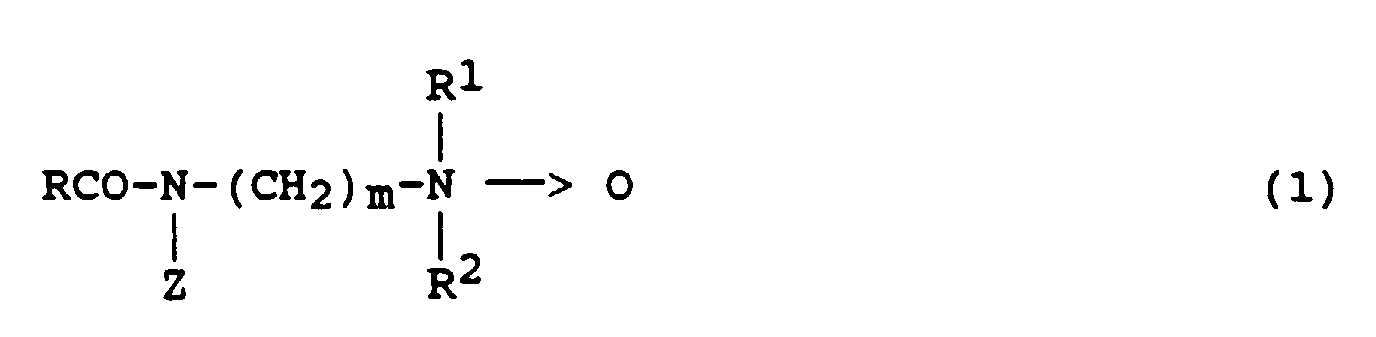
- RCO
- einen aliphatischen Acylrest mit 6 bis 22 Kohlenstoffatomen,
- z
- einen linearen Polyhydroxykohlenwasserstoffrest mit mindestens 3 gegebenenfalls oxalkylierten Hydroxylgruppen,
- m
- eine ganze Zahl von 1 bis 4,
- R1
- C1 bis C4-Alkyl oder C2 bis C4-Hydroxyalkyl und
- R2
- C1 bis C4-Alkyl oder C2 bis C4-Hydroxyalkyl.
- RCO
- ein Fettacylrest mit 8 bis 18 Kohlenstoffatomen ist,
- Z
- ein Rest eines Zuckeralkohols ist, der sich von einem reduzierenden Mono- oder Disaccharid, insbesondere von Glucose, ableitet,
- m
- für die Zahl 3 steht und
- R1 und R2
- (gleich oder verschieden) Methyl, Ethyl, Propyl oder Hydroxyethyl sind.
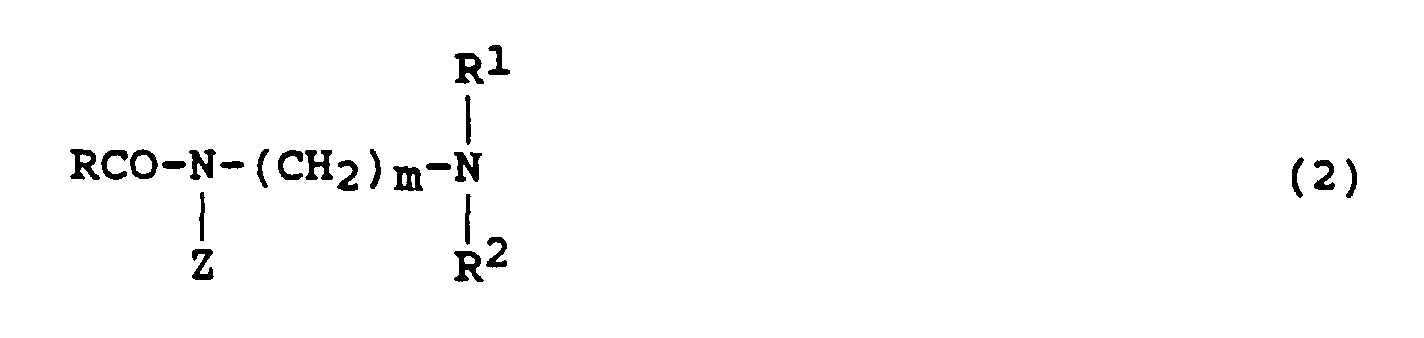
mit Wasserstoffperoxid in Wasser, einem niedrigen Alkohol oder einer Mischung aus Wasser und einem niedrigen Alkohol als Lösungsmittel.

in einem wäßrigen oder wäßrig-alkoholischen Medium und in Gegenwart von einem Hydrierkatalysator zum Polyhydroxyalkylamin der Formel (4)

und

zum Polyhydroxyalkylamidamin der angegebenen Formel (2). Im folgenden werden die Schritte a) und b) noch näher beschrieben:
| Ansatzgröße: | |
| 263,0 g (0,55 mol) | eines 95gew.%igen alkali- und erdalkaliionenfreien beziehungsweise -armen DMAP-C12/14-GA |
| 255,2 g | destilliertes Wasser |
| 0,1 g | EDTA |
| 56,1 g (0,578 mol) | einer 35gew.%igen wäßrigen Wasserstoffperoxidlösung |
| Ansatzgröße: | |
| 138,0 g (0,25 mol) | eines 93gew.%igen alkali- und erdalkaliionenfreien beziehungsweise -armen DMAP-C16/18-GA |
| 259,9 g | destilliertes Wasser |
| 0,1 g | EDTA |
| 25,5 g (0,263 mol) | einer 35gew.%igen wäßrigen Wasserstoffperoxidlösung |
Claims (10)
- Polyhydroxyalkyl-amidaminoxide der nachstehenden Formel (1)worin bedeuten
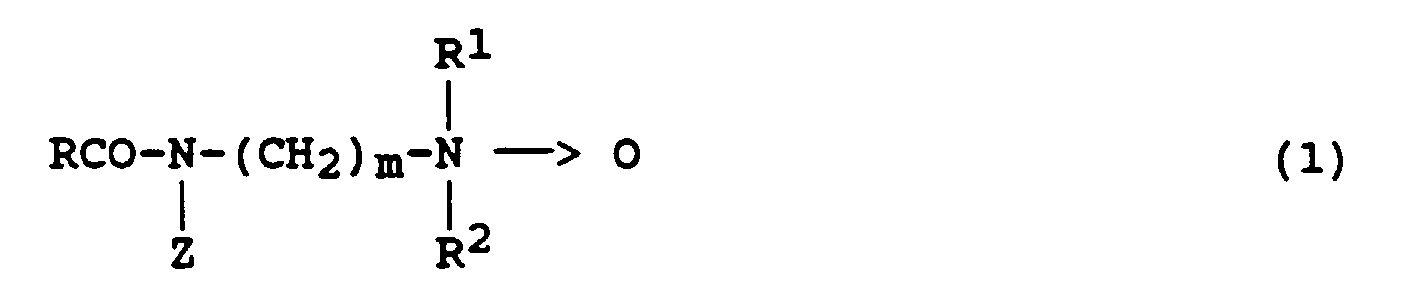
- RCO
- einen aliphatischen Acylrest mit 6 bis 22 Kohlenstoffatomen,
- Z
- einen linearen Polyhydroxykohlenwasserstoffrest mit mindestens 3 gegebenenfalls oxalkylierten Hydroxylgruppen,
- m
- eine ganze Zahl von 1 bis 4,
- R1
- C1 bis C4-Alkyl oder C2 bis C4-Hydroxyalkyl und
- R2
- C1 bis C4-Alkyl oder C2 bis C4-Hydroxyalkyl.
- Aminoxide nach Anspruch 1, wobei in Formel (1)
- RCO
- ein Fettacylrest mit 8 bis 18 Kohlenstoffatomen ist,
- Z
- ein Rest eines Zuckeralkohols ist, der sich von einem reduzierenden Mono- oder Disaccharid ableitet,
- m
- für die Zahl 3 steht und
- R1 und R2
- Methyl, Ethyl, Propyl oder Hydroxyethyl sind.
- Aminoxide nach Anspruch 1, wobei in Formel (1)
- RCO
- ein Fettacylrest mit 8 bis 18 Kohlenstoffatomen ist,
- Z
- ein Sorbitylrest ist,
- m
- für die Zahl 3 steht und
- R1 und R2
- Methyl, Ethyl, Propyl oder Hydroxyethyl sind.
- Verfahren zur Herstellung der Polyhydroxyalkyl-amidaminoxide nach Anspruch 1, gekennzeichnet durch Oxidation einer tertiären Aminverbindung der Formel (2)in der R, R1, R2, Z und m die angegebenen Bedeutungen haben,

mit Wasserstoffperoxid in Wasser, einem niedrigen Alkohol oder einer Mischung aus Wasser und einem niedrigen Alkohol als Lösungsmittel. - Verfahren nach Anspruch 4, dadurch gekennzeichnet, daß man 1 bis 1,2 mol Wasserstoffperoxid pro mol tertiäre Aminverbindung und das Lösungsmittel in einer solchen Menge einsetzt, daß die nach der Umsetzung erhaltene Aminoxidlösung einen Aminoxidgehalt von 30 bis 65 Gew.-% hat, bezogen auf das Gewicht der Lösung, und die Oxidationsreaktion bei einer Temperatur von 60 bis 110 °C durchgeführt wird.
- Verfahren nach Anspruch 4, dadurch gekennzeichnet, daß mana) eine Mischung aus dem Lösungsmittel und der tertiären Aminverbindung bereitet und diese Mischung auf 70 bis 100 °C erhitzt,b) in die erhitzte Mischung 1 bis 1,2 mol Wasserstoffperoxid in Form einer 20 bis 90gew.%igen wäßrigen Lösung pro mol Amin unter Aufrechterhaltung der genannten Temperatur von 70 bis 100 °C einbringt und daß manc) die im Schritt b) erhaltene Reaktionsmischung bei einer Temperatur von 70 bis 100 °C hält, bis der angestrebte Aminoxidgehalt erreicht ist.
- Wäßrige, alkoholische oder wäßrig-alkoholische Lösungen von Polyhydroxyalkyl-amidaminoxiden, bestehend im wesentlichen ausA) 30 bis 65 Gew.-% von mindestens einer Verbindung der Formel (1) in Anspruch 1 undB) Wasser, einem niedrigen Alkohol oder einer Mischung aus Wasser und einem niedrigen Alkohol als Rest auf 100 Gew.-%.
- Lösung nach Anspruch 7, dadurch gekennzeichnet, daß die Komponente A) in einer Menge von 30 bis 60 Gew.-% vorliegt.
- Verwendung der Polyhydroxyalkyl-amidaminoxide nach Anspruch 1 zur Herstellung von oberflächenaktiven Mitteln zur Haar- und Körperpflege.
- Verwendung der wäßrigen, alkoholischen oder wäßrigalkoholischen Lösungen nach Anspruch 7 zur Herstellung von oberflächenaktiven Mitteln zur Haar- und Körperpflege.
Applications Claiming Priority (3)
| Application Number | Priority Date | Filing Date | Title |
|---|---|---|---|
| DE19529466A DE19529466A1 (de) | 1995-08-11 | 1995-08-11 | Polyhydroxyalkyl-amidaminoxide |
| DE19529466 | 1995-08-11 | ||
| PCT/EP1996/003445 WO1997007094A1 (de) | 1995-08-11 | 1996-08-05 | Polyhydroxyalkyl-amidaminoxide |
Publications (2)
| Publication Number | Publication Date |
|---|---|
| EP0843659A1 EP0843659A1 (de) | 1998-05-27 |
| EP0843659B1 true EP0843659B1 (de) | 1999-04-14 |
Family
ID=7769198
Family Applications (1)
| Application Number | Title | Priority Date | Filing Date |
|---|---|---|---|
| EP96927681A Expired - Lifetime EP0843659B1 (de) | 1995-08-11 | 1996-08-05 | Polyhydroxyalkyl-amidaminoxide |
Country Status (15)
| Country | Link |
|---|---|
| US (1) | US5760258A (de) |
| EP (1) | EP0843659B1 (de) |
| JP (1) | JPH11511148A (de) |
| KR (1) | KR19990036274A (de) |
| AT (1) | ATE178889T1 (de) |
| AU (1) | AU694059B2 (de) |
| BR (1) | BR9610229A (de) |
| CA (1) | CA2229161A1 (de) |
| CZ (1) | CZ41598A3 (de) |
| DE (2) | DE19529466A1 (de) |
| ES (1) | ES2132949T3 (de) |
| HU (1) | HUP9900373A3 (de) |
| NO (1) | NO980392L (de) |
| PL (1) | PL324926A1 (de) |
| WO (1) | WO1997007094A1 (de) |
Families Citing this family (2)
| Publication number | Priority date | Publication date | Assignee | Title |
|---|---|---|---|---|
| DE19640186A1 (de) * | 1996-09-30 | 1998-04-02 | Clariant Gmbh | Tensidhaltige Formulierungen |
| DE10207924A1 (de) | 2002-02-23 | 2003-09-04 | Clariant Gmbh | Hochkonzentrierte wässrige Lösungen von Betainen oder Aminoxiden |
Family Cites Families (4)
| Publication number | Priority date | Publication date | Assignee | Title |
|---|---|---|---|---|
| US4077990A (en) * | 1976-10-26 | 1978-03-07 | Kewanee Industries | Surface-active agent |
| JPS61283695A (ja) * | 1985-06-11 | 1986-12-13 | 川研ファインケミカル株式会社 | 洗浄剤組成物 |
| US4864060A (en) * | 1987-08-31 | 1989-09-05 | Witco Corporation | Surface active compounds, methods for making same and uses thereof |
| EP0367926B1 (de) * | 1988-10-10 | 1993-10-20 | Blendax GmbH | Haarfärbe- und Haartönungsmittel |
-
1995
- 1995-08-11 DE DE19529466A patent/DE19529466A1/de not_active Withdrawn
-
1996
- 1996-08-05 JP JP9508890A patent/JPH11511148A/ja active Pending
- 1996-08-05 PL PL96324926A patent/PL324926A1/xx unknown
- 1996-08-05 AU AU67420/96A patent/AU694059B2/en not_active Ceased
- 1996-08-05 CZ CZ98415A patent/CZ41598A3/cs unknown
- 1996-08-05 AT AT96927681T patent/ATE178889T1/de not_active IP Right Cessation
- 1996-08-05 CA CA002229161A patent/CA2229161A1/en not_active Abandoned
- 1996-08-05 WO PCT/EP1996/003445 patent/WO1997007094A1/de not_active Ceased
- 1996-08-05 EP EP96927681A patent/EP0843659B1/de not_active Expired - Lifetime
- 1996-08-05 BR BR9610229A patent/BR9610229A/pt not_active Application Discontinuation
- 1996-08-05 DE DE59601675T patent/DE59601675D1/de not_active Expired - Fee Related
- 1996-08-05 ES ES96927681T patent/ES2132949T3/es not_active Expired - Lifetime
- 1996-08-05 KR KR1019980700942A patent/KR19990036274A/ko not_active Withdrawn
- 1996-08-08 US US08/694,102 patent/US5760258A/en not_active Expired - Fee Related
- 1996-08-11 HU HU9900373A patent/HUP9900373A3/hu unknown
-
1998
- 1998-01-29 NO NO980392A patent/NO980392L/no unknown
Also Published As
| Publication number | Publication date |
|---|---|
| AU6742096A (en) | 1997-03-12 |
| HUP9900373A3 (en) | 2000-01-28 |
| NO980392D0 (no) | 1998-01-29 |
| HUP9900373A2 (hu) | 1999-05-28 |
| ATE178889T1 (de) | 1999-04-15 |
| NO980392L (no) | 1998-01-29 |
| DE59601675D1 (de) | 1999-05-20 |
| EP0843659A1 (de) | 1998-05-27 |
| DE19529466A1 (de) | 1997-02-13 |
| AU694059B2 (en) | 1998-07-09 |
| CA2229161A1 (en) | 1997-02-27 |
| US5760258A (en) | 1998-06-02 |
| BR9610229A (pt) | 1999-06-29 |
| ES2132949T3 (es) | 1999-08-16 |
| JPH11511148A (ja) | 1999-09-28 |
| KR19990036274A (ko) | 1999-05-25 |
| MX9801150A (es) | 1998-10-31 |
| WO1997007094A1 (de) | 1997-02-27 |
| CZ41598A3 (cs) | 1998-06-17 |
| PL324926A1 (en) | 1998-06-22 |
Similar Documents
| Publication | Publication Date | Title |
|---|---|---|
| DE69516584T2 (de) | Verfahren zur Herstellung von Amidoethercarbonsäure oder deren Salz und diese enthaltende oberflächenaktive Mischung | |
| DE69108921T2 (de) | Verwendung von gemischen auf der basis von fettalkoholen zur herstellung von emulsionen, verfahren zur herstellung von emulsionen und danach hergestellte emulsionen. | |
| DE3785627T2 (de) | Oberflaechenaktives mittel, abgeleitet von hydroxy-substituierten bi- oder tri-carbonsaeuren. | |
| EP0633244B1 (de) | Verfahren zur kontinuierlichen Herstellung von Polyhydroxyfettsäureamiden aus N-Alkylpolyhydroxyaminen und Fettsäurealkylestern | |
| DE69209709T2 (de) | Verfahren zur Herstellung von aus Di- oder Tri-Carboxylsäuren abgeleiteten Grenzflächenaktiven Mitteln | |
| DE69214346T2 (de) | Gegen mikrobielle Aktivität stabile wässerige Alkylglycosidlösung | |
| DE4435495C2 (de) | Pumpfähige wäßrige Tensidkonzentrate | |
| DE2752116C2 (de) | Salze von N-[N',N'-Bis(2-carboxyethyl)-aminoethyl]-N-(2-hydroxyethyl)-carbonsäureamiden, Verfahren zu ihrer Herstellung und ihre Verwendung als grenzflächenaktive Stoffe | |
| EP1436306A2 (de) | Verfahren zur herstellung von tensidgemischen | |
| EP0295578B1 (de) | Verwendung von Erdalkalisalzen von Ethercarbonsäuren als Katalysatoren für die Alkoxylierung | |
| DE69416524T2 (de) | Hautreinigungstück | |
| DE69611502T2 (de) | (Oxo-1-Alkyl)amino-2-desoxy-2-glucopyranosid von Dihydroxy-2,3-propyl, Verfahren zur Herstellung und ihre Verwendungen | |
| EP0843659B1 (de) | Polyhydroxyalkyl-amidaminoxide | |
| EP0621283B1 (de) | Fettsäureester von Methylglucosid-Derivaten | |
| DE19527630A1 (de) | Polyhydroxyalkylamidobetaine | |
| EP0846100B1 (de) | Amidopropyl-n-alkyl-polyhydroxyalkylamin-verbindungen, verfahren zu deren herstellung und deren verwendung | |
| EP0833813B1 (de) | Konzentrierte lösungen von polyhydroxyalkylaminen und deren verwendung, insbesondere zur herstellung von polyhydroxyalkylcarbonsäureamiden | |
| EP1589022B1 (de) | Verfahren zur Herstellung eines Gemischs enthaltend Fettalkohole und APG- ethercarboxylat | |
| DE19622981A1 (de) | Säure-Addukte von Fettsäurepolyhydroxyalkylamiden | |
| WO1997019915A1 (de) | Sulfosuccinate von polyhydroxyamiden | |
| EP0781292A1 (de) | Mischung aus alkylierungsprodukten von acetalisierten monosacchariden mit epoxiden | |
| EP0662974A1 (de) | Verfahren zur herstellung von oberflächenaktiven stoffen mit verbesserter reinigungsleistung | |
| DE19524265A1 (de) | Verfahren zur Herstellung von Amphotensiden | |
| MXPA98001150A (en) | Oxides of polyhydroxyalyl-amidoam |
Legal Events
| Date | Code | Title | Description |
|---|---|---|---|
| PUAI | Public reference made under article 153(3) epc to a published international application that has entered the european phase |
Free format text: ORIGINAL CODE: 0009012 |
|
| 17P | Request for examination filed |
Effective date: 19980311 |
|
| AK | Designated contracting states |
Kind code of ref document: A1 Designated state(s): AT BE CH DE ES FI FR GB IE IT LI NL SE |
|
| GRAG | Despatch of communication of intention to grant |
Free format text: ORIGINAL CODE: EPIDOS AGRA |
|
| 17Q | First examination report despatched |
Effective date: 19980722 |
|
| GRAG | Despatch of communication of intention to grant |
Free format text: ORIGINAL CODE: EPIDOS AGRA |
|
| GRAH | Despatch of communication of intention to grant a patent |
Free format text: ORIGINAL CODE: EPIDOS IGRA |
|
| RBV | Designated contracting states (corrected) |
Designated state(s): AT BE CH DE ES FI FR GB IE IT LI NL SE |
|
| GRAH | Despatch of communication of intention to grant a patent |
Free format text: ORIGINAL CODE: EPIDOS IGRA |
|
| GRAA | (expected) grant |
Free format text: ORIGINAL CODE: 0009210 |
|
| AK | Designated contracting states |
Kind code of ref document: B1 Designated state(s): AT BE CH DE ES FI FR GB IE IT LI NL SE |
|
| PG25 | Lapsed in a contracting state [announced via postgrant information from national office to epo] |
Ref country code: SE Free format text: THE PATENT HAS BEEN ANNULLED BY A DECISION OF A NATIONAL AUTHORITY Effective date: 19990414 Ref country code: FI Free format text: LAPSE BECAUSE OF NON-PAYMENT OF DUE FEES Effective date: 19990414 |
|
| REF | Corresponds to: |
Ref document number: 178889 Country of ref document: AT Date of ref document: 19990415 Kind code of ref document: T |
|
| REG | Reference to a national code |
Ref country code: CH Ref legal event code: EP |
|
| REG | Reference to a national code |
Ref country code: IE Ref legal event code: FG4D Free format text: GERMAN |
|
| REF | Corresponds to: |
Ref document number: 59601675 Country of ref document: DE Date of ref document: 19990520 |
|
| GBT | Gb: translation of ep patent filed (gb section 77(6)(a)/1977) |
Effective date: 19990610 |
|
| ET | Fr: translation filed | ||
| PG25 | Lapsed in a contracting state [announced via postgrant information from national office to epo] |
Ref country code: AT Free format text: LAPSE BECAUSE OF NON-PAYMENT OF DUE FEES Effective date: 19990805 |
|
| REG | Reference to a national code |
Ref country code: ES Ref legal event code: FG2A Ref document number: 2132949 Country of ref document: ES Kind code of ref document: T3 |
|
| PG25 | Lapsed in a contracting state [announced via postgrant information from national office to epo] |
Ref country code: IE Free format text: LAPSE BECAUSE OF NON-PAYMENT OF DUE FEES Effective date: 19991206 |
|
| REG | Reference to a national code |
Ref country code: IE Ref legal event code: FD4D |
|
| PLBE | No opposition filed within time limit |
Free format text: ORIGINAL CODE: 0009261 |
|
| STAA | Information on the status of an ep patent application or granted ep patent |
Free format text: STATUS: NO OPPOSITION FILED WITHIN TIME LIMIT |
|
| 26N | No opposition filed | ||
| PGFP | Annual fee paid to national office [announced via postgrant information from national office to epo] |
Ref country code: NL Payment date: 20000718 Year of fee payment: 5 |
|
| PGFP | Annual fee paid to national office [announced via postgrant information from national office to epo] |
Ref country code: ES Payment date: 20000721 Year of fee payment: 5 |
|
| PG25 | Lapsed in a contracting state [announced via postgrant information from national office to epo] |
Ref country code: LI Free format text: LAPSE BECAUSE OF NON-PAYMENT OF DUE FEES Effective date: 20000831 Ref country code: CH Free format text: LAPSE BECAUSE OF NON-PAYMENT OF DUE FEES Effective date: 20000831 |
|
| PGFP | Annual fee paid to national office [announced via postgrant information from national office to epo] |
Ref country code: BE Payment date: 20000915 Year of fee payment: 5 |
|
| REG | Reference to a national code |
Ref country code: CH Ref legal event code: PL |
|
| PG25 | Lapsed in a contracting state [announced via postgrant information from national office to epo] |
Ref country code: ES Free format text: LAPSE BECAUSE OF NON-PAYMENT OF DUE FEES Effective date: 20010806 |
|
| PG25 | Lapsed in a contracting state [announced via postgrant information from national office to epo] |
Ref country code: BE Free format text: LAPSE BECAUSE OF NON-PAYMENT OF DUE FEES Effective date: 20010831 |
|
| REG | Reference to a national code |
Ref country code: GB Ref legal event code: IF02 |
|
| BERE | Be: lapsed |
Owner name: CLARIANT G.M.B.H. Effective date: 20010831 |
|
| PG25 | Lapsed in a contracting state [announced via postgrant information from national office to epo] |
Ref country code: NL Free format text: LAPSE BECAUSE OF NON-PAYMENT OF DUE FEES Effective date: 20020301 |
|
| NLV4 | Nl: lapsed or anulled due to non-payment of the annual fee |
Effective date: 20020301 |
|
| REG | Reference to a national code |
Ref country code: ES Ref legal event code: FD2A Effective date: 20020911 |
|
| REG | Reference to a national code |
Ref country code: FR Ref legal event code: CD |
|
| PGFP | Annual fee paid to national office [announced via postgrant information from national office to epo] |
Ref country code: IT Payment date: 20080625 Year of fee payment: 13 |
|
| PGFP | Annual fee paid to national office [announced via postgrant information from national office to epo] |
Ref country code: DE Payment date: 20080620 Year of fee payment: 13 |
|
| PGFP | Annual fee paid to national office [announced via postgrant information from national office to epo] |
Ref country code: FR Payment date: 20080612 Year of fee payment: 13 |
|
| PGFP | Annual fee paid to national office [announced via postgrant information from national office to epo] |
Ref country code: GB Payment date: 20080730 Year of fee payment: 13 |
|
| REG | Reference to a national code |
Ref country code: FR Ref legal event code: ST Effective date: 20090430 |
|
| PG25 | Lapsed in a contracting state [announced via postgrant information from national office to epo] |
Ref country code: FR Free format text: LAPSE BECAUSE OF NON-PAYMENT OF DUE FEES Effective date: 20080901 |
|
| GBPC | Gb: european patent ceased through non-payment of renewal fee |
Effective date: 20090805 |
|
| PG25 | Lapsed in a contracting state [announced via postgrant information from national office to epo] |
Ref country code: DE Free format text: LAPSE BECAUSE OF NON-PAYMENT OF DUE FEES Effective date: 20100302 |
|
| PG25 | Lapsed in a contracting state [announced via postgrant information from national office to epo] |
Ref country code: GB Free format text: LAPSE BECAUSE OF NON-PAYMENT OF DUE FEES Effective date: 20090805 |
|
| PG25 | Lapsed in a contracting state [announced via postgrant information from national office to epo] |
Ref country code: IT Free format text: LAPSE BECAUSE OF NON-PAYMENT OF DUE FEES Effective date: 20090805 |