EP0844419A2 - Corps cylindrique de type soufflet. - Google Patents
Corps cylindrique de type soufflet. Download PDFInfo
- Publication number
- EP0844419A2 EP0844419A2 EP97120450A EP97120450A EP0844419A2 EP 0844419 A2 EP0844419 A2 EP 0844419A2 EP 97120450 A EP97120450 A EP 97120450A EP 97120450 A EP97120450 A EP 97120450A EP 0844419 A2 EP0844419 A2 EP 0844419A2
- Authority
- EP
- European Patent Office
- Prior art keywords
- bellows
- cylindrical body
- type cylindrical
- bellows portion
- bellows type
- Prior art date
- Legal status (The legal status is an assumption and is not a legal conclusion. Google has not performed a legal analysis and makes no representation as to the accuracy of the status listed.)
- Granted
Links
Images



Classifications
-
- F—MECHANICAL ENGINEERING; LIGHTING; HEATING; WEAPONS; BLASTING
- F16—ENGINEERING ELEMENTS AND UNITS; GENERAL MEASURES FOR PRODUCING AND MAINTAINING EFFECTIVE FUNCTIONING OF MACHINES OR INSTALLATIONS; THERMAL INSULATION IN GENERAL
- F16F—SPRINGS; SHOCK-ABSORBERS; MEANS FOR DAMPING VIBRATION
- F16F9/00—Springs, vibration-dampers, shock-absorbers, or similarly-constructed movement-dampers using a fluid or the equivalent as damping medium
- F16F9/32—Details
- F16F9/38—Covers for protection or appearance
-
- B—PERFORMING OPERATIONS; TRANSPORTING
- B60—VEHICLES IN GENERAL
- B60G—VEHICLE SUSPENSION ARRANGEMENTS
- B60G15/00—Resilient suspensions characterised by arrangement, location or type of combined spring and vibration damper, e.g. telescopic type
- B60G15/02—Resilient suspensions characterised by arrangement, location or type of combined spring and vibration damper, e.g. telescopic type having mechanical spring
- B60G15/06—Resilient suspensions characterised by arrangement, location or type of combined spring and vibration damper, e.g. telescopic type having mechanical spring and fluid damper
- B60G15/062—Resilient suspensions characterised by arrangement, location or type of combined spring and vibration damper, e.g. telescopic type having mechanical spring and fluid damper the spring being arranged around the damper
- B60G15/063—Resilient suspensions characterised by arrangement, location or type of combined spring and vibration damper, e.g. telescopic type having mechanical spring and fluid damper the spring being arranged around the damper characterised by the mounting of the spring on the damper
-
- F—MECHANICAL ENGINEERING; LIGHTING; HEATING; WEAPONS; BLASTING
- F16—ENGINEERING ELEMENTS AND UNITS; GENERAL MEASURES FOR PRODUCING AND MAINTAINING EFFECTIVE FUNCTIONING OF MACHINES OR INSTALLATIONS; THERMAL INSULATION IN GENERAL
- F16J—PISTONS; CYLINDERS; SEALINGS
- F16J3/00—Diaphragms; Bellows; Bellows pistons
- F16J3/04—Bellows
- F16J3/041—Non-metallic bellows
-
- B—PERFORMING OPERATIONS; TRANSPORTING
- B60—VEHICLES IN GENERAL
- B60G—VEHICLE SUSPENSION ARRANGEMENTS
- B60G2204/00—Indexing codes related to suspensions per se or to auxiliary parts
- B60G2204/10—Mounting of suspension elements
- B60G2204/12—Mounting of springs or dampers
- B60G2204/124—Mounting of coil springs
- B60G2204/1242—Mounting of coil springs on a damper, e.g. MacPerson strut
Definitions
- the present invention relates to a bellows type cylindrical body which partially includes a bellows portion.
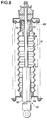
- a bellows type cylindrical body for front or rear wheels in a vehicle, there is known a suspension which is structured such that, as shown in Fig. 8, a bump cushion (which is also referred to as a bump stopper or a cushion rubber) 55 is mounted on the upper portion of a piston rod 51 of a hydraulic bumper 50, and a bellows type cylindrical body 61 formed of elastic material such as rubber or the like for covering the piston rod 51 and bump cushion 55 is also mounted on the piston rod 51 upper portion, while a coil spring 65 is mounted on the outside of the bellows type cylindrical body 61.
- a bump cushion which is also referred to as a bump stopper or a cushion rubber
- reference numeral 52 designates a cylinder, 67 an upper spring seat, 68 a lower spring seat, and 69 a metal-made cylindrical reinforcing member, respectively.
- a bellows type cylindrical body 61 used in the suspension of a vehicle is generally referred to as a dust cover but, in the following description, it is called the bellows type cylindrical body.
- the piston rod 51 and coil spring 65 of the bumper are expanded and compressed to thereby absorb the shocks and, when they are compressed to their limits, the upper end of the cylinder 52 is butted against the bump cushion 55 to compress and deform the bump cushion 55, thereby preventing the cylinder 52 from butting against the bottom of the wheel.
- the bellows type cylindrical body 61 can be expanded and compressed together with the piston rod 51 and coil spring 65 to thereby prevent mud from attaching to the piston rod 51 and bump cushion 55 or prevent stones on the road surface from butting against them.
- the piston rod 51 and the like vary in length
- the bellows type cylindrical body 61 also varies in length according to the lengths of the piston rod 51 and the like. Therefore, as in the conventional suspension, when the bellows type cylindrical body 61 is rather long, as shown in Fig. 9, in the bellows type cylindrical body 61 which has a large length, the bellows portion 62 thereof can be flexed in the radial direction (which is hereinafter referred to as body bending) during the compression thereof to thereby touch the coil spring 65 and cylinder 52. And, there is a fear that the bellows portion 62 of the bellows type cylindrical body can be broken due to the contact of the bellows type cylindrical body 61 with the coil spring 65 and the like.
- the diameter of the bellows type cylindrical body 61 is increased.
- the coil spring 65 is present on the outer periphery of the bellows type cylindrical body 61, there is a limit to such increase in the diameter of the bellows type cylindrical body 61, that is, the diameter of the bellows type cylindrical body 61 cannot be increased so sufficiently as to be able to prevent the body bending thereof when it is compressed.
- the diameter of the coil spring 65 is decided based on the function and space thereof, it is also impossible to change the diameter of the coil spring 65 for the purpose of increasing the diameter of the bellows type cylindrical body 61.
- the present invention aims at eliminating the drawbacks found in the above-mentioned conventional bellows type cylindrical body, and therefore an object of the invention is to provide a bellows type cylindrical body for use not only in a vehicle suspension but also in ordinary mechanical devices which can reduce its body bending when it is compressed.
- a bellows type cylindrical body comprising: a compressible bellows portion body which is classified into a plurality of bellows regions along a longitudinal direction thereof, wherein spring rates of said compressible bellows portion body are relatively different between said bellows regions.
- the spring rate means a stiffness of the compressible bellows portion, that is, a ratio of a linear displacement of the spring (the compressible bellows portion) to a variation in a force exerted on the spring.
- the compressible bellows portion is classified into a plurality of regions along the longitudinal direction, and for example, since the thickness of the projecting portions in the compressible bellows portion is changed for each of the classified regions as will be described later, even if the same force is applied to the respective regions, the replacement of the compressible bellows portion which is caused by application of the force is different between the respective regions, thus obtaining the bellows type cylindrical body having the compressible bellows portion one region of which is relatively different in a spring rate from another region.
- the compressible bellows portion can be repeatedly contracted and expanded in such a manner that a center line of the compressible bellows portion in its section is not largely decentered from a center line of the compressible main body (piston).
- the thicknesses of the projecting portions of the bellows portion in the above respective regions are set different from each other so that the thicknesses of the projecting portions become gradually larger from one end side bellows region toward the other end side bellows region.
- diameter differences between the projecting portions and valley portions of the bellows portion in the above respective areas are set different from each other so that they become gradually larger from one end side bellows region toward the other end side bellows region.
- the thicknesses of the projecting portions of the bellows portion in the above respective areas are set different from each other so that they become gradually larger from one end side bellows region toward the other end side bellows.
- Fig. 1 is a section view a bellows type cylindrical body according to one embodiment of the invention, illustrating how it is used
- Figs. 2A to 2C are section views of the tube walls of the respective areas of the bellows type cylindrical body
- Fig. 3 is a section view of the bellows type cylindrical body, showing the initial stage of compression of the bellows portion of the bellows type cylindrical body
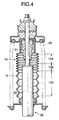
- Fig. 4 is a section view of the bellows type cylindrical body, showing the middle stage of compression of the bellows portion of the bellows type cylindrical body
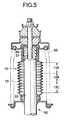
- Fig. 5 is a section view of the bellows type cylindrical body, showing the final stage of compression of the bellows portion of the bellows type cylindrical body.
- Fig. 2A to 2C are section views of the tube walls of the respective areas of the bellows type cylindrical body
- Fig. 3 is a section view of the bellows type cylindrical body, showing the initial stage of compression of the bellows portion of the bellows type cylindrical body
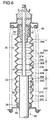
- Fig. 6 is a section view of a bellows type cylindrical body according to another embodiment of the invention, illustrating how it is used
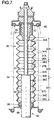
- Fig. 7 is a section view of a bellows type cylindrical body of according to still another embodiment of the invention, showing how it is used.
- a cylindrical body of a bellows type 10 is to be mounted in such a manner that it covers a piston rod of a bumper 50 employed in a vehicle suspension and is formed of rubber, polyolefin-system thermoplastic elastomer (TPO), polyethylene, polyester elastomer, or the like.
- the bellows type cylindrical body 10 according to the embodiment is structured such that the upper portion thereof consists of a storage cylindrical portion 11 and the lower portion thereof consists of a bellows portion 13. Also, in the inner peripheral surface of the lower-most end of the bellows type cylindrical body, there is formed a groove 17 which is used for engagement with a lower spring seat 68.
- the bellows portion 13 is used to allow the bellows type cylindrical body to be expanded and compressed to the expansion and compression of a piston rod 51 and coil spring 65, and is structured such that it has a given pitch and a given outside diameter. Also, the bellows portion 13 is divided into three areas, that is, an upper area 13A, an intermediate area 13B and a lower area 13C at a given interval along the longitudinal direction thereof (that is, a direction intersecting at right angles to the diameter thereof), while the projecting portions 14A, 14B and 14C of the respective areas are different in thickness from each other. On the other hand, the valley portions 15A, 15B and 15C of the respective areas are identical in thickness with each other and they are uniform in thickness over the whole of the bellows portion 13.
- Fig. 2A shows the tube wall of the upper area 13A
- Fig. 2B shows the tube wall of the intermediate area 13B
- Fig. 2C shows the tube wall of the lower area 13C, respectively.
- the thicknesses of the projecting portions 14A, 14B and 14C of the respective areas are constant within their respective areas but are different from each other.
- the thickness of the projecting portion 14A in the upper area 13A is set smallest, while the thicknesses of the projecting portions 14B and 14C of the middle and lower areas 14B and 14C become larger in this order.
- the thicknesses of the projecting portions 14A, 14B and 14C have an effect on the compression of the bellows portion 13 and, in particular, the smaller the thickness is, the easier the compression of the bellows portion 13 is. Therefore, in the embodiment, the upper area 13A, with the thickness of the projecting portion 14A set smallest, can be compressed most easily, the middle area 13B can be compressed second easily, and the lower area 13C is most difficult to be compressed.
- the bellows portion of the bellows type cylindrical body 10 is compressed in the following manner: that is, the upper area 13A that is easiest to be compressed is compressed first, after then, the middle area 13B that is second easiest to be compressed is compressed in such a manner as shown in Fig. 4 and, finally, the lower area 13C that is most difficult to be compressed is compressed in such a manner as shown in Fig. 5.
- the length of the portion to be compressed provides the length of the area to be compressed and thus it is shorter than the length of the whole of the bellows portion 13. This is the same as in a case in which a bellows type cylindrical body including a short bellows portion is compressed sequentially and, therefore, as in the embodiment, even in the case of the bellows type cylindrical body 10 including the bellows portion 13 which is long as a whole, there can be reduced the body bending of the bellows portion 13 caused when it is compressed.
- the bellows portion 13 since the respective areas of the bellows portion 13 thereof are arranged sequentially in such a manner that the thicknesses of the projecting portions of the areas become larger from one end side (upper side) of the bellows portion 13 toward the other end side (lower side) thereof, the bellows portion 13 is compressed sequentially starting from one end side thereof.
- the central portion thereof that is weak in rigidity is first compressed and is thereby flexed easily in the radial direction. That is, the area arrangement of the bellows portion 13 according to the embodiment can restrain such flexion, which in turn can reduce the above-mentioned body bending as well.
- the bellows type cylindrical body can be formed of an TPO blow molding in which the whole length thereof is 330 mm, the length of the upper area 13A of the bellows portion 13 is 84 mm, the length of the middle area 13B is 74 mm, the length of the lower area 13C is 84 mm, the major diameter of the bellows portion 13 is 76 mm, the minor diameter of the bellows portion 13 is 56 mm, the pitch thereof is 10 mm, the thickness of the projecting portion 14A of the upper area 13A is 0.2 mm, the thickness of the projecting portion 14B of the upper area 13B is 0.4 mm, and the thickness of the projecting portion 14C of the upper area 13C is 0.6 mm.
- a bellows type cylindrical body according to the invention and having the above-mentioned dimensions and a bellows type cylindrical body having a conventional structure in which the projecting portions and valley portions of a bellows portion thereof are constant over the whole length of the bellows portion were respectively mounted on the outer periphery of a piston rod of a bumper, and were compressed, and then the quantities of the maximum deformation of the respective bellows portions in the diametrical direction thereof were measured.
- the maximum deformation quantity of the invention was 2.8 mm
- the maximum deformation quantity of the conventional bellows type cylindrical body was 4.3 mm. That is, it can be clearly confirmed from the above measurement that the invention is much harder to produce the body bending than the conventional cylindrical body.
- a bellows type cylindrical body 20 shown in Fig. 6 is formed of similar material to the bellows type cylindrical body 10 that has been previously described in the embodiment according to the invention, and is mounted in such a manner that it covers a piston rod 51 of a bumper 50.
- reference numeral 21 designates a storage cylindrical portion for storing a bump cushion 55
- 23 stands for a cylindrical bellows portion
- 28 represents an engaging groove which can be engaged with a lower spring seat 68.
- the bellows type cylindrical body 20 is similar in structure to the bellows type cylindrical body 10 previously described in the embodiment according to the invention, except for the bellows portion 23.
- the bellows portion 23 is divided into three areas along the longitudinal direction thereof, that is, an upper area 23A, a middle area 23B and a lower area 23C sequentially in this order from top to bottom; and, diameter differences (in general, which means a difference between the radial of the projecting portion and the radial of the valley portion of each area), in particular, 26A, 26B and 26C between the projecting portions 24A, 24B, 24C and the valley portions 25A, 25B and 25C are different from each other. Also, in each area, the diameter difference is set constant. By the way, the pitch, tube wall thickness and outside diameter are set constant over the whole of the bellows portion 23.
- the diameter differences are set such that they become smaller sequentially from the upper area 23A toward the lower area 23C. That is, the radial differences are set such that 26A>26B>26C.
- This radial differences have an effect on the facility of the compression of the bellows portion 23.
- the fact that the radial differences are large means that the widths of tube walls 27A, 27B and 27C between the projecting portions 24A, 24B, 24C and the valley portions 25A, 25B and 25C are large.
- the rigidity of the tube walls 27A, 27B and 27C between the projecting portions and valley portions is reduced to thereby be able to facilitate the compression of the bellows portion 23 and also, when the pitch is set uniform, the tube walls 27A, 27B and 27C between the projecting portions 24A, 24B, 24C and the valley portions 25A, 25B and 25C lie down in the horizontal direction, which can also facilitate the compression of the bellows portion 23. That is, in the embodiment, the upper area 23A having the largest diameter difference is easiest to be compressed, the middle area 23B is second easiest to be compressed, and the lower area 23C is most difficult to be compressed.
- the bellows portion 23 of the bellows type cylindrical body 20 is compressed in the following manner: that is, the most easily compressible upper area 23A is first compressed, after then, the second most easily compressible middle area 23B is next compressed, and the least compressible lower area 23C is compressed finally. That is, as has been previously described, the bellows portion 23 is compressed in the same way as a plurality of cylindrical bodies of a bellows type each including a short bellows portion are compressed sequentially and, therefore, even in the case of the bellows type cylindrical body 20 including the bellows portion 23 which is long as a whole, the body bending can be reduced.
- the bellows portion 23 since the respective areas of the bellows portion thereof are arranged in such a manner that the diameter differences decrease sequentially from one end side (upper portion side) of the bellows portion 23 toward the other end side (lower portion side) thereof, the bellows portion 23 is compressed starting from the one end side thereof. For this reason, the central portion of the bellows portion 23 weak in rigidity is not compressed firstly, which in turn can reduce the body bending of the bellows portion of the bellows type cylindrical body 20.
- a bellows type cylindrical body may be formed of a TPO blow molding in such a manner that the whole length thereof is 330 mm, the length of the upper area 23A of the bellows portion 23 is 84 mm, the length of the middle area 23B is 74 mm, the length of the lower area 23C is 84 mm, the major diameter of the bellows portion 23 is 70 mm, the pitch thereof is 15 mm, the thickness thereof is 0.5 mm, the minor diameter of the upper area 23 is 53 mm, the diameter difference 26A is 17 mm, the minor diameter of the middle area 23B is 56 mm, the diameter difference 26B is 14 mm, the minor diameter of the lower area 23C is 58 mm, and the diameter difference 26C is 12 mm.
- a bellows type cylindrical body according to the invention was mounted on the outer periphery of a piston rod 51 of a bumper, and was compressed, and then the quantity of maximum deformation of the bellows portion thereof in the diametrical direction was measured. According to such measurement, the maximum deformation quantity of the embodiment was found 3.1 mm. That is, when compared with the conventional bellows type cylindrical body in which, as has been previously described, the maximum deformation quantity of the bellows portion thereof was found 4.3 mm, it can be clearly confirmed from the above measurement that the invention is much harder to produce the body bending than the conventional cylindrical body.
- a bellows type cylindrical body 30 shown in Fig. 6 is formed of similar material to the bellows type cylindrical body 10 that has been previously described in the embodiment according to the invention, and is mounted in such a manner that it covers a piston rod 51 of a bumper 50.
- reference numeral 31 designates a cylindrical storage portion for attaching a bump cushion 55
- 33 stands for a cylindrical bellows portion
- 38 represents an engaging groove which can be engaged with a lower spring seat 68.
- the bellows portion 33 thereof combines the structure of the embodiment with the above structure and, except for the bellows portion 33, the bellows type cylindrical body 30 is similar in structure to the embodiment according to Fig. 1.
- the bellows portion 33 includes an upper area 33A, a middle area 33B and a lower area 33C arranged from the upper end thereof in this order, while the thicknesses of the projecting portions 34A, 34B and 34C of the bellows of the respective areas as well as diameter differences 36A, 36B and 36C between the projecting portions 34A, 34B, 34C and the valley portions 35A, 35B, 35C in the respective areas are different from each other. Also, the thicknesses of the projecting portions are set such that they become larger sequentially from the upper area 33A toward the lower area 33C and, on the other hand, the diameter differences are set such that they become smaller sequentially from the upper area 33A toward the lower area 33C.
- reference character 37A designates a tube wall between the projecting portion 34A and valley portion 35A in the upper area 33A, 37B a tube wall between the projecting portion 34B and valley portion 35B in the upper area 33B, and 37C a tube wall between the projecting portion 34C and valley portion 35C in the upper area 33C, respectively.
- the thicknesses of the projecting portions are set such that they become larger sequentially from the upper area 33A toward the lower area 33C and, on the other hand, the diameter differences are set such that they become smaller sequentially from the upper area 33A toward the lower area 33C, there can be obtained a multiplier effect not only due to the variations in the thicknesses of the projecting portions described above but also due to the variations in the diameter differences described above, which makes it possible to prevent the body bending of the bellows portion in the compression thereof more effectively.
- a bellows type cylindrical body was formed of a TPO blow molding in such a manner that the whole length thereof is 330 mm, the length of the upper area 33A of the bellows portion 33 is 84 mm, the length of the middle area 33B thereof is 74 mm, the length of the lower area 33C thereof is 84 mm, the major diameter of the bellows portion 33 is 70 mm, the pitch thereof is 15 mm, the minor diameter of the upper area 33A is 53 mm, the thickness of the projecting portion 34A is 0.2 mm, the diameter difference 36A is 17 mm, the minor diameter of the middle area 33B is 56 mm, the thickness of the projecting portion 34B is 0.4 mm, the diameter difference 36B is 14 mm, the minor diameter of the lower area 33C is 58 mm, the thickness of the projecting portion 34C is 0.6 mm, the diameter difference 36C is 12 mm, and the thickness of the valley portions of the whole of the bellows portion 33 is 0.6 mm
- the thus structured bellows type cylindrical body was then mounted on the outer periphery of the piston rod 51 of a bumper, and was compressed. After then, the maximum quantity of deformation of the bellows portion 33 in the diametrical direction was measured and was found 1.9 mm. That is, according to the invention, the body bending in the compression of the bellows portion was found smallest when compared with the embodiments according to the above embodiments of the invention.
- the invention can also apply to a bellows type cylindrical body for use in other mechanical devices.
- the bellows type cylindrical body may be changed in design properly, for example, it may be structured such that a bellows portion is provided over the whole area thereof, or a mounting portion for mounting it to the mechanical device is provided, or the like.
- the bellows portion is divided into a plurality of areas along the longitudinal direction of the bellows type cylindrical body, the thicknesses of the projecting portions of the bellows portion in the respective areas are different from each other, and the thicknesses of the above projecting portions are set such that they become larger or smaller sequentially from one end side area of the bellows portion toward the other end side area thereof, so that the bellows portion is sequentially compressed starting from the area in which the thickness of the projecting portion thereof is smallest.
- the bellows portion thereof is divided into a plurality of areas along the longitudinal direction of the bellows type cylindrical body, the diameter differences between the projecting portions and valley portions of the bellows in the respective areas are set different from each other, and the diameter differences are set such that they become larger or smaller sequentially from the one end side area of the bellows portion toward the other side area thereof, so that the bellows portion can be compressed sequentially from the area having the largest diameter difference.
- a bellows type cylindrical body includes a long bellows portion
- the long bellows portion is divided into short areas and thus the bellows portion is compressed sequentially from the one end side area thereof, which can reduce the body bending in the compression of the bellows portion that has been produced because the bellows portion is long.
- the bellows portion thereof is divided into a plurality of areas along the longitudinal direction of the bellows type cylindrical body, the diameter differences between the projecting portions and valley portions of the bellows of the respective areas are set different from each other, and the thicknesses of the projecting portions are set such that they become larger or smaller sequentially from the one end side area of the bellows portion toward the other side area thereof, and, on the other hand, the diameter differences are set such that they become smaller or larger sequentially from the one end side area of the bellows portion toward the other side area thereof. Thanks to this structure, due to a multiplier effect obtained by the inventions, the body bending in the compression of the bellows portion can be controlled to a minimum.
Landscapes
- Engineering & Computer Science (AREA)
- General Engineering & Computer Science (AREA)
- Mechanical Engineering (AREA)
- Diaphragms And Bellows (AREA)
- Fluid-Damping Devices (AREA)
- Sealing Devices (AREA)
Applications Claiming Priority (3)
| Application Number | Priority Date | Filing Date | Title |
|---|---|---|---|
| JP327791/96 | 1996-11-22 | ||
| JP32779196 | 1996-11-22 | ||
| JP32779196A JPH10159975A (ja) | 1996-11-22 | 1996-11-22 | 蛇腹式筒状体 |
Publications (3)
| Publication Number | Publication Date |
|---|---|
| EP0844419A2 true EP0844419A2 (fr) | 1998-05-27 |
| EP0844419A3 EP0844419A3 (fr) | 1999-06-23 |
| EP0844419B1 EP0844419B1 (fr) | 2004-02-04 |
Family
ID=18203035
Family Applications (1)
| Application Number | Title | Priority Date | Filing Date |
|---|---|---|---|
| EP19970120450 Expired - Lifetime EP0844419B1 (fr) | 1996-11-22 | 1997-11-21 | Corps cylindrique de type soufflet. |
Country Status (3)
| Country | Link |
|---|---|
| EP (1) | EP0844419B1 (fr) |
| JP (1) | JPH10159975A (fr) |
| DE (1) | DE69727452T2 (fr) |
Cited By (3)
| Publication number | Priority date | Publication date | Assignee | Title |
|---|---|---|---|---|
| CN116292735A (zh) * | 2023-03-27 | 2023-06-23 | 临沂天一减震器有限公司 | 一种具有双减震功能的汽车减震器 |
| US12140199B2 (en) | 2019-03-27 | 2024-11-12 | Subaru Corporation | Dust cover, suspension device, and method for manufacturing dust cover |
| US20250162369A1 (en) * | 2023-11-16 | 2025-05-22 | Sumitomo Riko Company Limited | Upper support assembly |
Families Citing this family (4)
| Publication number | Priority date | Publication date | Assignee | Title |
|---|---|---|---|---|
| JP2012154355A (ja) * | 2011-01-21 | 2012-08-16 | Showa Corp | 油圧緩衝器のダストカバー構造 |
| JP2014020503A (ja) * | 2012-07-20 | 2014-02-03 | Jtekt Corp | プロペラシャフト用ブーツ |
| CN104373499A (zh) * | 2014-11-12 | 2015-02-25 | 四川宁江山川机械有限责任公司 | 减振器新型综合防尘罩 |
| KR102575143B1 (ko) * | 2018-03-13 | 2023-09-06 | 현대자동차주식회사 | 좌굴 방지 쇽업쇼버 더스트커버 |
Family Cites Families (4)
| Publication number | Priority date | Publication date | Assignee | Title |
|---|---|---|---|---|
| US3313319A (en) * | 1964-08-25 | 1967-04-11 | Dayco Corp | Flexible hose |
| DE2839336A1 (de) * | 1978-09-09 | 1980-03-27 | Continental Gummi Werke Ag | Faltenbalg |
| JPS58152970A (ja) * | 1982-03-05 | 1983-09-10 | Nippon Mektron Ltd | ベロ−ズ |
| US5308091A (en) * | 1992-09-14 | 1994-05-03 | Mihalcin E Robert | Protective boot |
-
1996
- 1996-11-22 JP JP32779196A patent/JPH10159975A/ja active Pending
-
1997
- 1997-11-21 DE DE69727452T patent/DE69727452T2/de not_active Expired - Fee Related
- 1997-11-21 EP EP19970120450 patent/EP0844419B1/fr not_active Expired - Lifetime
Non-Patent Citations (1)
| Title |
|---|
| None |
Cited By (5)
| Publication number | Priority date | Publication date | Assignee | Title |
|---|---|---|---|---|
| US12140199B2 (en) | 2019-03-27 | 2024-11-12 | Subaru Corporation | Dust cover, suspension device, and method for manufacturing dust cover |
| CN116292735A (zh) * | 2023-03-27 | 2023-06-23 | 临沂天一减震器有限公司 | 一种具有双减震功能的汽车减震器 |
| CN116292735B (zh) * | 2023-03-27 | 2023-08-15 | 临沂天一减震器有限公司 | 一种具有双减震功能的汽车减震器 |
| US20250162369A1 (en) * | 2023-11-16 | 2025-05-22 | Sumitomo Riko Company Limited | Upper support assembly |
| US12330460B2 (en) * | 2023-11-16 | 2025-06-17 | Sumitomo Riko Company Limited | Upper support assembly |
Also Published As
| Publication number | Publication date |
|---|---|
| DE69727452T2 (de) | 2004-12-16 |
| DE69727452D1 (de) | 2004-03-11 |
| JPH10159975A (ja) | 1998-06-16 |
| EP0844419B1 (fr) | 2004-02-04 |
| EP0844419A3 (fr) | 1999-06-23 |
Similar Documents
| Publication | Publication Date | Title |
|---|---|---|
| US6042092A (en) | Bellows cylinder | |
| US5470049A (en) | Bearing for a spring strut of a motor vehicle | |
| US6328294B1 (en) | Elastomeric spring system | |
| EP0844419A2 (fr) | Corps cylindrique de type soufflet. | |
| US9694638B2 (en) | Spring rubber seat and strut-type suspension | |
| JPH0630550Y2 (ja) | 車両用バンパリインホースメント | |
| US5954168A (en) | Dust cover for shock absorber and method of manufacturing the same | |
| US7281705B2 (en) | Jounce assembly for a suspension system | |
| JP6817731B2 (ja) | 筒部材及び緩衝器 | |
| CN107035809A (zh) | 防尘罩 | |
| JP6362618B2 (ja) | ジャウンスバンパアセンブリ | |
| US20120241267A1 (en) | Dust cover structure of hydraulic shock absorber | |
| JPS59226724A (ja) | 車輌空気ばね用ロ−ルベロ−ズ | |
| US10203014B2 (en) | Cover member and shock absorber | |
| NL8300992A (nl) | Hol rubberen stootkussen. | |
| US6371461B1 (en) | Elastic bush with two armatures; torque take up connecting rod equipped with a bush of this kind | |
| US6789579B1 (en) | Hose | |
| JP6207310B2 (ja) | ダストカバー | |
| JPH10169777A (ja) | 蛇腹式筒状体 | |
| KR940009221B1 (ko) | 제어가능한 브레이크오버(breakover) 및 스프링 정수(spring rate)를 갖는 원통형 탄성물질 스프링 | |
| JPH08247204A (ja) | 緩衝器用バンプストッパ | |
| JP3970363B2 (ja) | 蛇腹式筒状体 | |
| EP0816734A2 (fr) | Support élastique | |
| JPH07259907A (ja) | コイル圧縮ばね装置 | |
| JP2003191737A (ja) | バウンドストッパ |
Legal Events
| Date | Code | Title | Description |
|---|---|---|---|
| PUAI | Public reference made under article 153(3) epc to a published international application that has entered the european phase |
Free format text: ORIGINAL CODE: 0009012 |
|
| AK | Designated contracting states |
Kind code of ref document: A2 Designated state(s): DE GB |
|
| AX | Request for extension of the european patent |
Free format text: AL;LT;LV;MK;RO;SI |
|
| PUAL | Search report despatched |
Free format text: ORIGINAL CODE: 0009013 |
|
| AK | Designated contracting states |
Kind code of ref document: A3 Designated state(s): AT BE CH DE DK ES FI FR GB GR IE IT LI LU MC NL PT SE |
|
| AX | Request for extension of the european patent |
Free format text: AL;LT;LV;MK;RO;SI |
|
| 17P | Request for examination filed |
Effective date: 19990818 |
|
| AKX | Designation fees paid |
Free format text: DE GB |
|
| 17Q | First examination report despatched |
Effective date: 20020523 |
|
| GRAH | Despatch of communication of intention to grant a patent |
Free format text: ORIGINAL CODE: EPIDOS IGRA |
|
| GRAP | Despatch of communication of intention to grant a patent |
Free format text: ORIGINAL CODE: EPIDOSNIGR1 |
|
| GRAS | Grant fee paid |
Free format text: ORIGINAL CODE: EPIDOSNIGR3 |
|
| GRAA | (expected) grant |
Free format text: ORIGINAL CODE: 0009210 |
|
| AK | Designated contracting states |
Kind code of ref document: B1 Designated state(s): DE GB |
|
| REG | Reference to a national code |
Ref country code: GB Ref legal event code: FG4D |
|
| REF | Corresponds to: |
Ref document number: 69727452 Country of ref document: DE Date of ref document: 20040311 Kind code of ref document: P |
|
| PLBE | No opposition filed within time limit |
Free format text: ORIGINAL CODE: 0009261 |
|
| STAA | Information on the status of an ep patent application or granted ep patent |
Free format text: STATUS: NO OPPOSITION FILED WITHIN TIME LIMIT |
|
| 26N | No opposition filed |
Effective date: 20041105 |
|
| PGFP | Annual fee paid to national office [announced via postgrant information from national office to epo] |
Ref country code: GB Payment date: 20051116 Year of fee payment: 9 |
|
| PGFP | Annual fee paid to national office [announced via postgrant information from national office to epo] |
Ref country code: DE Payment date: 20051117 Year of fee payment: 9 |
|
| PG25 | Lapsed in a contracting state [announced via postgrant information from national office to epo] |
Ref country code: DE Free format text: LAPSE BECAUSE OF NON-PAYMENT OF DUE FEES Effective date: 20070601 |
|
| GBPC | Gb: european patent ceased through non-payment of renewal fee |
Effective date: 20061121 |
|
| PG25 | Lapsed in a contracting state [announced via postgrant information from national office to epo] |
Ref country code: GB Free format text: LAPSE BECAUSE OF NON-PAYMENT OF DUE FEES Effective date: 20061121 |