EP0844476A1 - Dispositif de détection de produits gazeux dans un matériau isolant organique - Google Patents
Dispositif de détection de produits gazeux dans un matériau isolant organique Download PDFInfo
- Publication number
- EP0844476A1 EP0844476A1 EP97402743A EP97402743A EP0844476A1 EP 0844476 A1 EP0844476 A1 EP 0844476A1 EP 97402743 A EP97402743 A EP 97402743A EP 97402743 A EP97402743 A EP 97402743A EP 0844476 A1 EP0844476 A1 EP 0844476A1
- Authority
- EP
- European Patent Office
- Prior art keywords
- gaseous products
- optical fiber
- optical
- chemical attack
- fiber
- Prior art date
- Legal status (The legal status is an assumption and is not a legal conclusion. Google has not performed a legal analysis and makes no representation as to the accuracy of the status listed.)
- Withdrawn
Links
- 239000011810 insulating material Substances 0.000 title claims description 11
- 238000012544 monitoring process Methods 0.000 title 1
- 239000000835 fiber Substances 0.000 claims abstract description 29
- 230000003287 optical effect Effects 0.000 claims abstract description 26
- 239000000126 substance Substances 0.000 claims abstract description 23
- 229920003229 poly(methyl methacrylate) Polymers 0.000 claims abstract description 10
- 239000004926 polymethyl methacrylate Substances 0.000 claims abstract description 10
- 230000005684 electric field Effects 0.000 claims abstract description 9
- 239000013307 optical fiber Substances 0.000 claims description 32
- 239000012212 insulator Substances 0.000 claims description 16
- 229920000642 polymer Polymers 0.000 claims description 14
- 239000002253 acid Substances 0.000 claims description 11
- 239000000463 material Substances 0.000 claims description 11
- 230000001590 oxidative effect Effects 0.000 claims description 11
- 239000007789 gas Substances 0.000 claims description 10
- QTBSBXVTEAMEQO-UHFFFAOYSA-N Acetic acid Chemical compound CC(O)=O QTBSBXVTEAMEQO-UHFFFAOYSA-N 0.000 claims description 9
- MUBZPKHOEPUJKR-UHFFFAOYSA-N Oxalic acid Chemical compound OC(=O)C(O)=O MUBZPKHOEPUJKR-UHFFFAOYSA-N 0.000 claims description 9
- 239000003153 chemical reaction reagent Substances 0.000 claims description 9
- 239000011248 coating agent Substances 0.000 claims description 8
- 238000000576 coating method Methods 0.000 claims description 8
- 238000001514 detection method Methods 0.000 claims description 8
- 150000007513 acids Chemical class 0.000 claims description 7
- 239000001257 hydrogen Substances 0.000 claims description 7
- 229910052739 hydrogen Inorganic materials 0.000 claims description 7
- 125000004435 hydrogen atom Chemical class [H]* 0.000 claims description 7
- 230000004048 modification Effects 0.000 claims description 6
- 238000012986 modification Methods 0.000 claims description 6
- 239000011148 porous material Substances 0.000 claims description 6
- 239000012855 volatile organic compound Substances 0.000 claims description 5
- GRYLNZFGIOXLOG-UHFFFAOYSA-N Nitric acid Chemical class O[N+]([O-])=O GRYLNZFGIOXLOG-UHFFFAOYSA-N 0.000 claims description 4
- GQPLMRYTRLFLPF-UHFFFAOYSA-N nitrous oxide Inorganic materials [O-][N+]#N GQPLMRYTRLFLPF-UHFFFAOYSA-N 0.000 claims description 4
- YAXWOADCWUUUNX-UHFFFAOYSA-N 1,2,2,3-tetramethylpiperidine Chemical compound CC1CCCN(C)C1(C)C YAXWOADCWUUUNX-UHFFFAOYSA-N 0.000 claims description 3
- RKMGAJGJIURJSJ-UHFFFAOYSA-N 2,2,6,6-Tetramethylpiperidine Substances CC1(C)CCCC(C)(C)N1 RKMGAJGJIURJSJ-UHFFFAOYSA-N 0.000 claims description 3
- VYPSYNLAJGMNEJ-UHFFFAOYSA-N Silicium dioxide Chemical group O=[Si]=O VYPSYNLAJGMNEJ-UHFFFAOYSA-N 0.000 claims description 3
- 230000002378 acidificating effect Effects 0.000 claims description 3
- 235000006408 oxalic acid Nutrition 0.000 claims description 3
- 239000013308 plastic optical fiber Substances 0.000 claims description 3
- 230000001131 transforming effect Effects 0.000 claims description 2
- -1 oxalic acid Chemical class 0.000 claims 1
- 230000035515 penetration Effects 0.000 claims 1
- 239000011368 organic material Substances 0.000 abstract description 2
- LGZDNJBUAAXEMN-UHFFFAOYSA-N 1,2,2,3-tetramethyl-1-oxidopiperidin-1-ium Chemical compound CC1CCC[N+](C)([O-])C1(C)C LGZDNJBUAAXEMN-UHFFFAOYSA-N 0.000 abstract 1
- 230000015556 catabolic process Effects 0.000 description 8
- 238000009413 insulation Methods 0.000 description 7
- 239000007787 solid Substances 0.000 description 6
- 238000012423 maintenance Methods 0.000 description 5
- 230000032683 aging Effects 0.000 description 4
- 230000008901 benefit Effects 0.000 description 4
- 230000008859 change Effects 0.000 description 4
- 238000006731 degradation reaction Methods 0.000 description 3
- 238000004519 manufacturing process Methods 0.000 description 3
- IJGRMHOSHXDMSA-UHFFFAOYSA-N Atomic nitrogen Chemical compound N#N IJGRMHOSHXDMSA-UHFFFAOYSA-N 0.000 description 2
- MHAJPDPJQMAIIY-UHFFFAOYSA-N Hydrogen peroxide Chemical compound OO MHAJPDPJQMAIIY-UHFFFAOYSA-N 0.000 description 2
- 230000006378 damage Effects 0.000 description 2
- 230000006866 deterioration Effects 0.000 description 2
- NIXOWILDQLNWCW-UHFFFAOYSA-M Acrylate Chemical compound [O-]C(=O)C=C NIXOWILDQLNWCW-UHFFFAOYSA-M 0.000 description 1
- CBENFWSGALASAD-UHFFFAOYSA-N Ozone Chemical compound [O-][O+]=O CBENFWSGALASAD-UHFFFAOYSA-N 0.000 description 1
- NINIDFKCEFEMDL-UHFFFAOYSA-N Sulfur Chemical compound [S] NINIDFKCEFEMDL-UHFFFAOYSA-N 0.000 description 1
- 230000003213 activating effect Effects 0.000 description 1
- 230000005540 biological transmission Effects 0.000 description 1
- 238000006243 chemical reaction Methods 0.000 description 1
- 229920001688 coating polymer Polymers 0.000 description 1
- 239000004020 conductor Substances 0.000 description 1
- 238000005336 cracking Methods 0.000 description 1
- 230000007547 defect Effects 0.000 description 1
- 238000009792 diffusion process Methods 0.000 description 1
- 238000009826 distribution Methods 0.000 description 1
- 230000000694 effects Effects 0.000 description 1
- 238000010616 electrical installation Methods 0.000 description 1
- 238000005530 etching Methods 0.000 description 1
- 230000000977 initiatory effect Effects 0.000 description 1
- 238000009434 installation Methods 0.000 description 1
- 239000007788 liquid Substances 0.000 description 1
- 238000005259 measurement Methods 0.000 description 1
- 230000007246 mechanism Effects 0.000 description 1
- 238000000034 method Methods 0.000 description 1
- 229910052757 nitrogen Inorganic materials 0.000 description 1
- 239000000615 nonconductor Substances 0.000 description 1
- 239000007800 oxidant agent Substances 0.000 description 1
- 230000003647 oxidation Effects 0.000 description 1
- 238000007254 oxidation reaction Methods 0.000 description 1
- 239000002245 particle Substances 0.000 description 1
- 230000010287 polarization Effects 0.000 description 1
- 239000002861 polymer material Substances 0.000 description 1
- 229920002635 polyurethane Polymers 0.000 description 1
- 239000004814 polyurethane Substances 0.000 description 1
- 230000035945 sensitivity Effects 0.000 description 1
- 230000035882 stress Effects 0.000 description 1
- 239000011593 sulfur Substances 0.000 description 1
- 229910052717 sulfur Inorganic materials 0.000 description 1
- 230000009466 transformation Effects 0.000 description 1
Images
Classifications
-
- G—PHYSICS
- G01—MEASURING; TESTING
- G01N—INVESTIGATING OR ANALYSING MATERIALS BY DETERMINING THEIR CHEMICAL OR PHYSICAL PROPERTIES
- G01N21/00—Investigating or analysing materials by the use of optical means, i.e. using sub-millimetre waves, infrared, visible or ultraviolet light
- G01N21/75—Systems in which material is subjected to a chemical reaction, the progress or the result of the reaction being investigated
- G01N21/77—Systems in which material is subjected to a chemical reaction, the progress or the result of the reaction being investigated by observing the effect on a chemical indicator
- G01N21/78—Systems in which material is subjected to a chemical reaction, the progress or the result of the reaction being investigated by observing the effect on a chemical indicator producing a change of colour
- G01N21/783—Systems in which material is subjected to a chemical reaction, the progress or the result of the reaction being investigated by observing the effect on a chemical indicator producing a change of colour for analysing gases
-
- G—PHYSICS
- G01—MEASURING; TESTING
- G01N—INVESTIGATING OR ANALYSING MATERIALS BY DETERMINING THEIR CHEMICAL OR PHYSICAL PROPERTIES
- G01N21/00—Investigating or analysing materials by the use of optical means, i.e. using sub-millimetre waves, infrared, visible or ultraviolet light
- G01N21/75—Systems in which material is subjected to a chemical reaction, the progress or the result of the reaction being investigated
- G01N21/77—Systems in which material is subjected to a chemical reaction, the progress or the result of the reaction being investigated by observing the effect on a chemical indicator
- G01N21/7703—Systems in which material is subjected to a chemical reaction, the progress or the result of the reaction being investigated by observing the effect on a chemical indicator using reagent-clad optical fibres or optical waveguides
Definitions
- Partial discharges occur in particular in the equipment used in high-pressure installations transmission or distribution network tension of electrical energy.
- a partial discharge is a dielectric breakdown phenomenon occurring in a only part of the insulation separating two conductors without that this causes the complete breakdown of the components concerned.
- Detection of a partial discharge can provide indications on the aging of certain components. Of this detection can significantly improve the predictive maintenance means, particularly in high voltage electrical installations.
- partial discharge detection allows changing of components of the electrical machine before the breakdown complete does not intervene. Such a breakdown can, in addition to destroy the component, seriously damaging the entire electric machine.
- the term "electric machine” will be taken in the broad sense including in particular energy cables isolated, transformers, alternators, generators, and more generally any electrical device involving an inaccessible electrical insulator requiring heavy maintenance.
- the solid insulating material includes defects from either manufacturing or thermal and / or mechanical stresses undergone during its placed in the electric machine, either during implementation of the electric machine.
- faults are generally gaps or faults filled with a gas like more or less humid air.
- the gas contained in spaces is subjected to an electric field which creates crown discharges. Therefore it is modified chemically by activating its molecules under the field electric.
- the gaseous products resulting from this modification are strongly oxidizing and / or acidic.
- the insulation can be more or less porous. Of this fact, there is a possible diffusion of gaseous products in the periphery of spaces or faults and therefore a degradation in the thickness of the walls of the spaces or flaws.
- Partial discharges can be initiated by a protuberance on the transformer tank, by a floating particle, or by wrapped wires.
- the purpose of the present invention is to provide a sensor based on a principle completely different from art previous in that it does not rely on protests electric, light, or sound of partial discharges but on detecting chemical changes intervening within the insulation during its aging and this, depending on the sensitivity of the sensor, prior to initiation of partial discharges.
- the invention relates to a device for detection of gaseous products in an insulating material organic of an electric machine, subjected to a field electric E.
- the device comprises a optical fiber having optical properties which can be modified by a chemical attack on said gaseous products, and
- a generator and a receiver / wave comparator connected to fiber optics to detect changes characteristics of a wave emitted by the generator and transported by optical fiber.
- the insulator In a first form of application, for example oil transformers, the insulator, subjected to the electric field, produces hydrogen H 2 .
- the detection device therefore comprises an optical fiber having optical properties which can be modified by chemical attack by hydrogen H 2 , embedded in the organic insulator (oil for example).
- the insulation is solid and includes faults in the form of spaces or faults filled with gas chemically transforming into oxidizing gaseous products and / or acids.
- the device then comprises an optical fiber having optical properties modifiable by chemical attack of said gaseous oxidizing and / or acid products, embedded in organic insulation.
- Optical fiber is sensitive to chemical attack by one or more of the following gaseous products: O 3 , H 2 O 2 , NO x , SO x , nitrous / nitric acids, volatile organic compounds such as oxalic acid, acid acetic or equivalent.
- the fiber optical material is more susceptible to attack chemicals by gaseous oxidizing and / or acid products that the organic insulating material.
- the fiber optical is an optical fiber with a silica core continuously sensitive to gaseous products including a coating polymer with an index less than 1.46.
- the fiber optic core can be off-center.
- the polymer coating can be a polymer photocrosslinkable based on polydiene, or chemically sensitive to gaseous products.
- the polymeric coating may be a porous polymer, the pores of which include a reagent to gaseous products, said pores having a sufficient diameter to allow at least one of the gaseous products to penetrate retaining the reagent.
- the optical fiber is a plastic optical fiber of the type polymethylmethacrylate (PMMA) having an optical sheath including a colored indicator, the color of which changes when chemical attack on gaseous products.
- PMMA polymethylmethacrylate
- the colored indicator can for example be oxidized tetramethylpiperidine (TEMPOL) introduced into PMMA.
- TEMPOL oxidized tetramethylpiperidine
- One of the advantages of the present invention is that ability to determine aging of insulating material before the appearance of partial discharges. That is important in certain areas such as, for example, predictive maintenance in insulated power cables solid, where, partial discharges are a sign of almost immediate destruction.
- Another advantage is the insensitivity of the fiber electromagnetic interference, and its security for use in hostile environments.
- Another advantage results from the low price of fibers optics, polymer materials and chemical reagents.
- the insulator In a first application to electrical machines with liquid organic insulator of oil type, the insulator, subjected to the electric field, produces hydrogen H 2 .
- the detection device then comprises an optical fiber having optical properties which can be modified by chemical attack with hydrogen H 2 , embedded in the organic insulator.
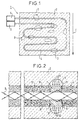
- the device according to the invention makes it possible to detect oxidizing gaseous products and / or acids in the organic insulating material 2 of the electric machine subjected to an electric field E.
- the insulation comprising faults 3 in the form spaces or faults 3 filled with a gas.
- the gaseous products result from the ionization of the contained gas in spaces or faults 3 of the insulating organic material 2.
- the device according to the invention comprises a fiber optic 4 having optical properties which can be modified by etching 10 of oxidizing gaseous products and / or acids, embedded in organic insulator 2, and
- a generator 5 and a wave receiver / comparator 6 connected to the optical fiber 4 to detect the 11 modifications of the characteristics of a wave 9 emitted by the generator 5 and transported by the optical fiber 4.
- Modifiable means the fact that the attack chemical 10 of optical fiber 4 by gaseous products, physically and / or chemically changes the appearance of the fiber optic 4 at the point 7 where it is attacked, and these chemical or physical changes induce changes in the optical properties of the fiber optical.
- the change of color and / or index of part 7 of optical fiber 4 attacked the increase or decrease in volume of the part of optical fiber attacked, etc ...
- the optical fiber 4 is naturally chosen in such a way so that it is sensitive to gaseous products which may be generated by the gas contained in spaces or faults.
- the gas contained in the spaces or faults 3 can be more or less humid air.
- the gaseous products resulting from the ionization of dry air are mainly, ozone O 3 ; oxides of nitrogen or sulfur NO x , SO x ; and volatile organic compounds VOC of the oxalic acid, acetic acid or equivalent type.
- the gaseous products resulting from the ionization of humid air are mainly nitrous / nitric acids and hydrogen peroxide H 2 O 2 .
- the optical fiber 4 chosen will therefore be sensitive to chemical attack by one or more of the following gaseous products: O 3 , H 2 O 2 , NO x , SO x , nitrous / nitric acids, volatile organic compounds of acid type oxalic, acetic acid or equivalent.
- an optical fiber 4 in a material more sensitive to chemical attack 10 by oxidizing and / or acidic gaseous products as the material organic insulator 2.
- the fiber optical 4 is an optical fiber with a silica core 12 comprising a polymer coating 8 of index less than 1.46 continuously sensitive to gaseous products.
- the value of 1.46 has been fixed so that the light wave 9 sent into the fiber 4 remains confined therein.
- the core 12 of the optical fiber can be off-center.
- the polymer coating 8 can be a polymer photocrosslinkable based on polydiene.
- the gaseous products mentioned above cut and / or modify the chemical bonds of the polymer.
- the polymer coating 8 can be a porous polymer, the pores of which comprise a reagent to gaseous products, said pores having a diameter sufficient to allow at least one of the products to penetrate gas while retaining the reagent. This is the reaction at least one of the gaseous products with the reagent which will significantly change the optical properties of the fiber optical.
- the optical fiber 4 is a plastic optical fiber of the type polymethylmethacrylate (PMMA) having an optical sheath 8 including a colored indicator, the color of which changes when chemical attack by gaseous products.
- PMMA polymethylmethacrylate
- the colored indicator can be, for example, oxidized tetramethylpiperidine (TEMPOL) introduced into PMMA.
- TEMPOL oxidized tetramethylpiperidine
- the optical fiber 4 is integrated into the material organic insulator 2 during the manufacturing of the material or its location in the electric machine.
- Fiber 4 is connected to wave generator 5 and to receiver / comparator 6 according to all known means.
- generator 5 to one of the ends of fiber 4 and receiver / comparator 6 to the other end of the fiber, or the generator and receiver / comparator are connected at the same end of the fiber, the other end possibly comprising a means reflecting to send back the emitted wave (air can be enough on reflection of the wave).
- Wave 9 is either sent in continuous, either periodically, for example during periods maintenance of the electric machine.
- Chemical attack 10 of gaseous products on fiber optical 4 generates changes in optical properties of the part 7 of the fiber which is attacked, and therefore of 11 changes in optical characteristics of wave 9 emitted, transmitted by fiber.
- These changes in optical characteristics can be for example a change of trajectory 11 of the made from a change in refractive index of part 7 of attacked fiber, or a modification of the polarization due to pressure generated by a variation in fiber volume etc ...
- Receiver / comparator 6 identifying differences between wave 9 transmitted and wave received gives a message by any known means.
- the invention is not limited to the mode of implementation or realization described and represented, but it is susceptible of numerous variants accessible to the skilled person without departing from the invention.
- the number of devices can be doubled or tripled for safety without departing from the scope of the invention.
- the position of the fiber in the insulating material organic may vary without departing from the scope of the invention.
Landscapes
- Physics & Mathematics (AREA)
- Chemical & Material Sciences (AREA)
- Life Sciences & Earth Sciences (AREA)
- Chemical Kinetics & Catalysis (AREA)
- Plasma & Fusion (AREA)
- Health & Medical Sciences (AREA)
- Engineering & Computer Science (AREA)
- Analytical Chemistry (AREA)
- Biochemistry (AREA)
- General Health & Medical Sciences (AREA)
- General Physics & Mathematics (AREA)
- Immunology (AREA)
- Pathology (AREA)
- Testing Relating To Insulation (AREA)
- Investigating Or Analysing Materials By The Use Of Chemical Reactions (AREA)
Abstract
Description
- la figure 1 est une représentation schématique d'un dispositif selon l'invention.
- la figure 2 est une représentation schématique d'un détail de la figure 1 illustrant un des modes de fonctionnement du dispositif selon l'invention.
Claims (11)
- Dispositif de détection de produits gazeux dans un matériau isolant organique d'une machine électrique (1), soumis à un champ électrique E, caractérisé en ce qu'il comprend une fibre optique (4) ayant des propriétés optiques modifiables par une attaque chimique (10) desdits produits gazeux, et
un générateur (5) et un récepteur/comparateur (6) d'onde connectés à la fibre optique (4) pour détecter les modifications (11) des caractéristiques d'une onde émise (9) par le générateur (5) et transportée par la fibre optique (4). - Dispositif de détection selon la revendication 1, ledit isolant, soumis au champ électrique, produisant de l'hydrogène H2 caractérisé en ce qu'il comprend une fibre optique (4) ayant des propriétés optiques modifiables par une attaque chimique (10) par l'hydrogène H2, noyée dans l'isolant organique (2).
- Dispositif de détection selon la revendication 1, ledit isolant, soumis au champ électrique, comprenant des défauts (3) sous forme d'espaces ou failles remplis d'un gaz se transformant chimiquement en produits gazeux oxydants et/ou acides, caractérisé en ce qu'il comprend une fibre optique (4) ayant des propriétés optiques modifiables par une attaque chimique (10) desdits produits gazeux oxydants et/ou acides, noyée dans l'isolant organique (2).
- Dispositif selon la revendication 3 caractérisé en ce que la fibre optique (4) est sensible aux attaques chimiques (10) de l'un ou de plusieurs des produits gazeux suivants : O3, H2O2, NOx, SOx, les acides nitreux/nitriques, les composés volatiles organiques de type acide oxalique, ou acide acétique.
- Dispositif selon la revendication 3 ou 4 caractérisé en ce que la fibre optique (4) est en un matériau plus sensible aux attaques chimiques (10) par les produits gazeux oxydants et/ou acides que le matériau isolant organique (2).
- Dispositif selon l'une quelconque des revendications 3 à 5 caractérisé en ce que la fibre optique (4) est une fibre optique à coeur de silice (12) comprenant un revêtement polymère (8) d'indice inférieur à 1,46, continûment sensible aux produits gazeux.
- Dispositif selon la revendication 6 caractérisé en ce que le coeur (12) de la fibre optique est décentré.
- Dispositif selon la revendication 6 ou 7 caractérisé en ce que le revêtement polymère (8) est un polymère photoréticulable à base de polydiène, ou chimiquement sensible aux produits gazeux.
- Dispositif selon la revendication 6 caractérisé en ce que le revêtement polymère (8) est un polymère poreux, les pores comprenant un réactif aux produits gazeux, lesdits pores ayant un diamètre suffisant pour laisser pénétrer au moins un des produits gazeux réagissant avec le réactif tout en retenant le réactif.
- Dispositif selon l'une quelconque des revendications 3 à 5 caractérisé en ce que la fibre optique (4) est une fibre optique plastique de type polyméthylméthacrylate (PMMA) ayant une gaine optique (8) comprenant un indicateur coloré dont la couleur change lors de l'attaque chimique (10) des produits gazeux.
- Dispositif selon la revendication 10 caractérisé en ce que l'indicateur coloré peut être par exemple du tétraméthylpipéridine oxydé (TEMPOL) introduit dans le PMMA.
Applications Claiming Priority (2)
| Application Number | Priority Date | Filing Date | Title |
|---|---|---|---|
| FR9614207 | 1996-11-21 | ||
| FR9614207A FR2756043B1 (fr) | 1996-11-21 | 1996-11-21 | Dispositif de detection de produits gazeux dans un materiau isolant organique |
Publications (1)
| Publication Number | Publication Date |
|---|---|
| EP0844476A1 true EP0844476A1 (fr) | 1998-05-27 |
Family
ID=9497855
Family Applications (1)
| Application Number | Title | Priority Date | Filing Date |
|---|---|---|---|
| EP97402743A Withdrawn EP0844476A1 (fr) | 1996-11-21 | 1997-11-17 | Dispositif de détection de produits gazeux dans un matériau isolant organique |
Country Status (2)
| Country | Link |
|---|---|
| EP (1) | EP0844476A1 (fr) |
| FR (1) | FR2756043B1 (fr) |
Citations (5)
| Publication number | Priority date | Publication date | Assignee | Title |
|---|---|---|---|---|
| EP0061884A1 (fr) * | 1981-03-30 | 1982-10-06 | Imperial Chemical Industries Plc | Capteur en fibre optique |
| EP0072627A2 (fr) * | 1981-08-14 | 1983-02-23 | Imperial Chemical Industries Plc | Sensor fibre-optique avec couche de couleur incorporée |
| EP0292207A2 (fr) * | 1987-05-22 | 1988-11-23 | AT&T Corp. | Capteurs à fibres optiques pour la détection chimique |
| EP0434893A2 (fr) * | 1989-11-24 | 1991-07-03 | Mitsubishi Denki Kabushiki Kaisha | Dispositif pour détecter une anomalie |
| US5337376A (en) * | 1993-04-19 | 1994-08-09 | Hughes Aircraft Company | Chemically sensitive fiber optic cable |
-
1996
- 1996-11-21 FR FR9614207A patent/FR2756043B1/fr not_active Expired - Fee Related
-
1997
- 1997-11-17 EP EP97402743A patent/EP0844476A1/fr not_active Withdrawn
Patent Citations (5)
| Publication number | Priority date | Publication date | Assignee | Title |
|---|---|---|---|---|
| EP0061884A1 (fr) * | 1981-03-30 | 1982-10-06 | Imperial Chemical Industries Plc | Capteur en fibre optique |
| EP0072627A2 (fr) * | 1981-08-14 | 1983-02-23 | Imperial Chemical Industries Plc | Sensor fibre-optique avec couche de couleur incorporée |
| EP0292207A2 (fr) * | 1987-05-22 | 1988-11-23 | AT&T Corp. | Capteurs à fibres optiques pour la détection chimique |
| EP0434893A2 (fr) * | 1989-11-24 | 1991-07-03 | Mitsubishi Denki Kabushiki Kaisha | Dispositif pour détecter une anomalie |
| US5337376A (en) * | 1993-04-19 | 1994-08-09 | Hughes Aircraft Company | Chemically sensitive fiber optic cable |
Non-Patent Citations (1)
| Title |
|---|
| SHINZO MUTO ET AL: "SIMPLE GAS SENSOR USING DYE-DOPED PLASTIC FIBERS", JAPANESE JOURNAL OF APPLIED PHYSICS, vol. 28, no. 1, January 1989 (1989-01-01), pages 125 - 127, XP000027026 * |
Also Published As
| Publication number | Publication date |
|---|---|
| FR2756043B1 (fr) | 1998-12-24 |
| FR2756043A1 (fr) | 1998-05-22 |
Similar Documents
| Publication | Publication Date | Title |
|---|---|---|
| US20180106852A1 (en) | Field Control Element For A High-Voltage Cable Accessory And Method of Optically Measuring Partial Discharges | |
| CN105675587B (zh) | 基于激光诱导击穿光谱的电力设备在线监测方法及装置 | |
| KR20180004260A (ko) | 고전압 케이블 세트와 그 제조방법 | |
| Mahanta | Green transformer oil: A review | |
| CA1326576C (fr) | Suppression des decharges arborescentes dans les isolants haute tension polymeriques | |
| FR2864687A1 (fr) | Transformateurs de courant pour detection de decharges partielles sur des cables et des fils dans des aeronefs | |
| CN111504922A (zh) | 一种基于空芯光子晶体光纤的gis内部气体组分检测装置及方法 | |
| CN110398671B (zh) | 局部放电检测设备 | |
| Chaganti et al. | Fiber optic acoustic sensor based on SMS structure with thin polymer diaphragm for partial discharge detection | |
| EP0844476A1 (fr) | Dispositif de détection de produits gazeux dans un matériau isolant organique | |
| Onn et al. | Fiber Bragg grating sensor for detecting ageing transformer oil | |
| Barnier et al. | Fibre optic jacket removal by pulsed laser ablation | |
| US5218212A (en) | Device for optically detecting a chemical change in fluid | |
| KR970052760A (ko) | 플라즈마 에칭 설비에서의 엔드 포인트(Endpoint) 검출 장치 | |
| Mahanta et al. | Transformer dielectric liquid: A review | |
| HU217851B (hu) | Szigetelőanyag és eljárás annak előállítására | |
| US5075544A (en) | Optical color change device for detecting electrical abnormality | |
| Li et al. | Compact all-fibre on-line power monitor via core-to-cladding mode coupling | |
| Cao et al. | Electrical aging phenomena of medium voltage EPR cable energized by ac voltage with switching impulses superimposed | |
| CN1046830C (zh) | 纤维光缆监测系统 | |
| Lee et al. | Fiber optic fluorescent sensor for electric discharge detection | |
| Ding et al. | The insulation characteristics of optical fiber in transformer oil under long-term thermal aging | |
| Phung et al. | Development of new partial discharge sensors for condition monitoring of power system equipment | |
| Jones et al. | Optical Fibre Monitoring of Power Circuit Breakers | |
| WO2016166094A1 (fr) | Fibre optique, procédé de fabrication d'une telle fibre optique et dispositif de mesure destiné à la détection d'hydrogène équipé d'une telle fibre optique |
Legal Events
| Date | Code | Title | Description |
|---|---|---|---|
| PUAI | Public reference made under article 153(3) epc to a published international application that has entered the european phase |
Free format text: ORIGINAL CODE: 0009012 |
|
| AK | Designated contracting states |
Kind code of ref document: A1 Designated state(s): CH DE GB LI |
|
| AX | Request for extension of the european patent |
Free format text: AL;LT;LV;MK;RO;SI |
|
| 17P | Request for examination filed |
Effective date: 19981127 |
|
| AKX | Designation fees paid |
Free format text: CH DE GB LI |
|
| RBV | Designated contracting states (corrected) |
Designated state(s): CH DE GB LI |
|
| RAP3 | Party data changed (applicant data changed or rights of an application transferred) |
Owner name: ALCATEL |
|
| RAP3 | Party data changed (applicant data changed or rights of an application transferred) |
Owner name: ALCATEL |
|
| RAP1 | Party data changed (applicant data changed or rights of an application transferred) |
Owner name: NEXANS |
|
| STAA | Information on the status of an ep patent application or granted ep patent |
Free format text: STATUS: THE APPLICATION HAS BEEN WITHDRAWN |
|
| 18W | Application withdrawn |
Effective date: 20051110 |