EP0844601A2 - Verminderung des Suchraumes bei Spracherkennung - Google Patents
Verminderung des Suchraumes bei Spracherkennung Download PDFInfo
- Publication number
- EP0844601A2 EP0844601A2 EP97120621A EP97120621A EP0844601A2 EP 0844601 A2 EP0844601 A2 EP 0844601A2 EP 97120621 A EP97120621 A EP 97120621A EP 97120621 A EP97120621 A EP 97120621A EP 0844601 A2 EP0844601 A2 EP 0844601A2
- Authority
- EP
- European Patent Office
- Prior art keywords
- threshold
- reference patterns
- pruning
- prevailing
- branches
- Prior art date
- Legal status (The legal status is an assumption and is not a legal conclusion. Google has not performed a legal analysis and makes no representation as to the accuracy of the status listed.)
- Withdrawn
Links
Images




Classifications
-
- G—PHYSICS
- G10—MUSICAL INSTRUMENTS; ACOUSTICS
- G10L—SPEECH ANALYSIS TECHNIQUES OR SPEECH SYNTHESIS; SPEECH RECOGNITION; SPEECH OR VOICE PROCESSING TECHNIQUES; SPEECH OR AUDIO CODING OR DECODING
- G10L15/00—Speech recognition
- G10L15/08—Speech classification or search
-
- G—PHYSICS
- G10—MUSICAL INSTRUMENTS; ACOUSTICS
- G10L—SPEECH ANALYSIS TECHNIQUES OR SPEECH SYNTHESIS; SPEECH RECOGNITION; SPEECH OR VOICE PROCESSING TECHNIQUES; SPEECH OR AUDIO CODING OR DECODING
- G10L15/00—Speech recognition
- G10L15/08—Speech classification or search
- G10L2015/085—Methods for reducing search complexity, pruning
Definitions
- the present invention relates to a speech recognizing system for recognizing speech through similarity computation involving pruning on the basis of a threshold and, more particularly, to a speech recognizing system capable of reducing the number of reference patterns of words to be recognized.
- a beam search process As means for reducing the processing effort in this type of speech recognition, a beam search process is well known in the art.
- the beam search process aims at processing effort reduction by pruning out reference patterns which are low in similarity to input speech and dispensing with a recognizing process on these low similarity reference patterns.
- the beam search process is detailed in Sakoe et al, "High rate DP Matching by Combined Frame Synchronization, Beam Search and Vector Quantization", Trans. of IECE of Japan, Vol. J71-D, No. 9, pp. 1650-1659, 1988-10 (hereinafter referred to as Literature 1).
- Literature 1 shows one, in which similarity comparison is made with reference to a predetermined threshold to leave reference patters with similarities higher than the threshold.
- Murakami et al "Expansion of Words to Speech Recognition and Free Speaking Recognition Utilizing Trigram", Technical Report of IECE of Japan, SP 93-127, 1994-01 (hereinafter referred to as Literature 2), shows a pruning process, in which a predetermined number of reference patterns with higher similarities are left.
- Literature 2 also shows another pruning process, in which search is performed for a threshold which gives a predetermined number of reference patterns that leave.
- Fig. 6 is a block diagram showing the basic construction of a prior art speech recognition system (shown in Literature 1).
- a speech waveform is inputted as input speech data from an input terminal 301 to an speech analyzer 302 for its conversion to a feature vector series representing its acoustical features.
- Reference patterns representing acoustical features of words to be recognized are cumulatively stored in a reference pattern memory 303.
- Partial reference patterns (or branches) which are subjects of similarity computation and the prevailing accumulation, are stored in a temporary pattern memory 304.
- a predetermined threshold is stored in a threshold memory 305.
- a similarity computing unit 308 computes acoustical feature similarities, with input feature parameters, of those of branches, i.e., partial reference patterns, among those stored in the temporary pattern memory 304 having similarities higher than a threshold stored in the threshold memory 305.
- a determining unit 309 determines one of the branches stored in the temporary pattern memory 304 having the highest cumulative similarity as a result of recognition and, when similarity computations with all input feature parameters have been completed, or when it has become that the branches stored in the temporary pattern memory 304 all belong to a single word, and outputs this recognition result to an output terminal 310.
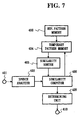
- Fig. 7 is a block diagram showing a basic construction of another prior art speech recognition system (shown in Literature 2).
- a speech waveform is inputted as input speech data from an input terminal 401 to an speech analyzer 402 for its conversion to a feature vector series representing its acoustical features.
- Reference patterns representing acoustical features of words to be recognized are cumulatively stored in a reference pattern memory 403. Partial reference patterns (or branches) as subjects of similarity computation and the prevailing accumulation likelihood, are stored in a temporary pattern storage 404.
- a similarity sorter 405 sorts out the branches, i.e., the partial reference patterns, stored in the temporary storage 404 in the order of higher cumulative similarities.
- a similarity computing unit 408 computes acoustical feature similarities, with input feature parameters, of a predetermined number of higher similarity branches from the one of the highest similarity, having been sorted out in the similarity sorter 405 and stored in the temporary pattern memory 404, and updates the branches stored in the temporary pattern memory 404 and the accumulation likelihood.
- a determining unit 409 determines one of the branches stored in the temporary pattern memory 404 having the highest cumulative similarity as a result of recognition, when similarity computations with all input feature parameters have been completed, or when it has become that the branches stored in a temporary pattern memory 404 belong to a single word, and outputs the recognition result to an output terminal 410.
- Fig. 8 is a block diagram showing a basic construction of a further prior art speech recognizer (shown in Literature 2).
- a speech waveform is inputted as input speech data from an input terminal 501 to an speech analyzer 502 for its conversion to a feature vector sequence representing its acoustical features.
- Reference patterns representing acoustical features of words to be recognized are stored in a reference pattern memory 503.
- Partial reference patterns (or branches) as subjects of similarity computation and the prevailing accumulation likelihood are stored in a temporary pattern memory 504.
- a threshold searcher 505 searches a threshold, which leaves a predetermined number of branches, i.e., partial reference patterns, among those stored in the temporary pattern memory 504.
- a similarity computing unit 508 computes acoustical feature similarities, with input feature parameters, of only branches of similarities higher than the threshold obtained in the threshold searcher 505 among those stored in the temporary pattern memory 504, thereby updating the temporary pattern memory 504.
- a determining unit 509 determines one of the branches stored in the temporary pattern memory 504 having the highest cumulative similarity as a result of recognition, when similarity computations with all input feature parameters have been completed, or when it has become that the branches stored in the temporary pattern memory 54 all belong to a single word, and outputs the recognition result to an output terminal 510.
- a predetermined threshold is given. In this case, it is impossible to control the number of branches that are left in the beam after pruning. This gives rise to a problem that the number of branches after pruning may be excessive to make read-time operation difficult or insufficient to result in pruning of correct vocabulary branches.
- the threshold can be searched efficiently by two-branched search.
- the processing effort i.e., computational effort
- necessary for obtaining the threshold is reduced compared to the case of sorting all the branches as shown in Fig. 7.
- computational effort of the order of log N is necessary. Therefore, as N is increased, the processing effort necessary for the sorting is increased to result in an excessive process time.
- the threshold cannot be changed such as to give a desired number of branches. Therefore, it is impossible to obtain accurate and quick speech recognition with less computational effort.
- the present invention seeks to solve the above problems, and its object is to provide speech recognition system, which permits accurate and quick recognition to be obtained with less computational effect.
- a speech analyzing unit for analyzing an input speech waveform to extract feature quantities and converting the extracted feature quantities to an input pattern
- a reference pattern memory for storing reference patterns of words to be recognized
- a temporary pattern memory for storing partial reference patterns as subjects of similarity computation with the input pattern among the stored reference patterns and the cumulative similarities of the partial reference patterns and the input pattern with one another
- a threshold memory for storing at least one prevailing threshold
- a counting unit for counting partial reference patterns of higher cumulative similarities among the stored partial reference patterns by comparing the cumulative similarities with the prevailing thresholds
- a threshold computer for computing a threshold of pruning which gives a predetermined number of branches according to the correspondence relation between the number of branches and the threshold of pruning
- a similarity computer for computing similarities of higher cumulative similarities among the stored partial reference patterns with the extracted feature quantities with respect to the threshold of pruning
- a determining unit for determining a word corresponding to one of the partial reference patterns with the highest similarity as a result of recognition.
- a speech recognizing method comprising steps of memorizing partial reference patterns to be subjects of similarity computation with an input pattern and cumulative similarities of these patterns, comparing the memorized cumulative similarities with a prevailing threshold and counting partial reference patterns of higher cumulative similarities than the prevailing threshold, computing a threshold of pruning from the correspondence relation between the number of branches and the prevailing threshold, computing similarity, with the featuring quantities, of partial reference patterns with higher similarities with reference to the prevailing threshold of pruning, and determining a word corresponding to one of the partial reference patterns with the highest similarity as a result of recognition.
- the threshold memory has one or more prevailing thresholds
- the threshold computing unit estimates the relation between the number of branches and the prevailing threshold on the basis of from the number of branches corresponding to the prevailing threshold, and a threshold of pruning which gives a desired number of branches is obtained from the relation and used for the pruning.
- the threshold updating unit updates the prevailing threshold of pruning by using as values in the neighborhood of the prevailing threshold as new prevailing thresholds. It is thus possible to make setting and updating of the prevailing threshold with less computational effort.
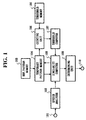
- Fig. 1 is a block diagram showing a basic construction of an embodiment of the speech recognition system according to the present invention.
- This speech recognition system comprises a speech analyzer 102 for analyzing an input speech waveform to extract feature quantities thereof and executing a conversion thereof to an input pattern, a reference pattern memory 103 for storing reference patterns of words to be recognized, a temporary pattern memory 104 for storing partial reference patterns or branches as subjects of similarity computation with input patterns among the reference patterns and also cumulative similarities of the branches with the input patterns, a threshold memory 105 for storing at least one prevailing threshold, a counting unit 106 for counting branches of higher similarities than the prevailing threshold, a threshold computing unit 107 for computing a threshold of pruning corresponding to a predetermined number of branches in accordance with the relation between the prevailing threshold and number of branches, and a similarity computing unit 108 for computing similarity, with feature quantities, of branches of higher similarities with respect to the threshold of pruning, and a determining unit 109 for determining a word corresponding to one of the branches in the temporary pattern memory 104 with the highest similarity.
- a speech waveform is inputted as input speech data from an input terminal 101 to the pattern analyzer 102 for its acoustical analysis for every 15 ms. for instance, to obtain a feature vector series containing speech power representing its acoustical features.
- the feature vector may be Cepstrum, LPC coefficient, changes in these values with time, etc., which are obtainable by FFT analysis, Linear Prediction Analysis, etc. mentioned in Furui "Digital Speech Processing", Publishing Association, Tokai University (hereinafter referred to as Literature 3).
- Reference patterns representing acoustical features of words to be recognized are cumulatively stored in a reference pattern memory 103.
- time sequential patterns are stored in the case of DP matching, while states are stored in the case of HMM, although this depends on the recognition system. It is not only possible to make words to be units of recognition to store patterns of the words, but also possible to make sound elements or syllables of words as units of recognition to store these sound elements or syllables together with coupling data thereof (language models).
- Partial reference patterns as subjects of similarity computation and the prevailing accumulation likelihood are stored in the temporary pattern memory 104.
- This temporary pattern memory 104 is a work area GNJ shown in Literature 1.
- words N and frame numbers J are provided as separate tables.
- dispersed word recognition is given as an example, it is also possible to obtain continuous speech recognition.
- Continuous speech recognition may be obtained by storing finite state automaton states as well as described in Literature 1. Specifically, the end may be attained by providing a controller based on finite state automaton, a work area for back tracking, etc., which are necessary for usual continuous speech recognition as shown in Literature 1.
- the threshold memory 105 At least one prevailing threshold is stored.
- the counting unit 106 obtains the number of branches of cumulative similarities higher than the prevailing threshold stored in the threshold memory 105 by comparing the cumulative similarities stored in the temporary pattern memory 104 with the threshold.
- the threshold computing unit 107 obtains a threshold for pruning corresponding to a desired number of branches by obtaining the correspondence relation between the prevailing threshold stored in the threshold memory 105 and the corresponding number of branches as obtained in the counting unit 106.
- the threshold for pruning may be obtained by approximating the correspondence relation for utilization with various functions such as a finite number of linear bent lines, quadratic curves and exponential functions. The function may be selected in dependence on the necessary accuracy and permissible processing effort.
- the similarity computing unit 108 computes acoustical feature similarity, with input feature parameters, of partial reference patterns or branches of higher similarities than the threshold of pruning obtained in the threshold computing unit 107 among those stored in the temporary pattern memory 104, and updates the branches in the temporary pattern memory 104 and the accumulation likelihood.
- the determining unit 109 determines one of the branches stored in the temporary pattern memory 104 with the highest cumulative similarity as a result of recognition, when the similarity computations concerning all the input feature parameters have been completed, or when it has become that branches stored in the temporary pattern memory 104 all belong to a single word, and outputs the recognition result to an output terminal 110.
- Fig. 2 is a block diagram showing a basic construction of a different embodiment of the speech recognition system according to the present invention.
- This speech recognition system is basically the same as the system shown in Fig. 1, and different in that it further comprises a threshold updating unit 211, which updates the prevailing threshold of pruning to values close thereto by using the prevailing threshold and the number of branches, i.e., partial reference patterns, stored in the temporary pattern memory 204 or the number of branches corresponding to at least either data stored in the threshold memory 205 with respect to the prevailing threshold or data used for the counting of branches in the counting unit 206.
- a threshold updating unit 211 which updates the prevailing threshold of pruning to values close thereto by using the prevailing threshold and the number of branches, i.e., partial reference patterns, stored in the temporary pattern memory 204 or the number of branches corresponding to at least either data stored in the threshold memory 205 with respect to the prevailing threshold or data used for the counting of branches in the counting unit 206.
- the input terminal 201, analyzing unit 202, reference pattern memory 203, temporary pattern memory 204, threshold memory 205, counting unit 206, threshold computing unit 207, similarity computing unit 208 and determining unit 209 are the same as those in the system shown in Fig. 1.
- the threshold updating unit 211 updates the prevailing threshold in the manner as described hereinbelow.
- Fig. 3 shows the relation between the number of branches and the threshold of pruning at a particular instant in a frame synchronization DP matching algorithm, which is necessary for the updating of the prevailing threshold in the threshold updating unit 211.
- HMM shown in, for instance, Rabiner L. R. and Juang B. H. "An introduction to Hidden Markov Models", IEEE ASSP Mag., pp. 416, 1986-1 with words as units of recognition.
- branch is meant a state in which a word is constituted.
- the total number of branches is about 140,000. It will be seen from the Fig. 3 that the number of branches increases gently with increasing threshold of pruning and turns to increase exponentially. A case will now be considered, in which the number of branches is reduced to about several % of the total number by beam search.
- Fig. 4 is a fragmentary enlarged-scale showing of Fig. 3. It will be seen from the Figure that since the correspondence relation between the number of branches and the threshold of pruning is relatively simple, a threshold which leaves a desired number of branches can be simply obtained as the prevailing threshold by utilizing this correspondence relation if the relation is obtainable.
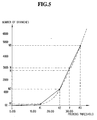
- Fig. 5 shows the relation between the number of branches and the threshold of pruning, which is represented by a specific portion of the graph shown in Fig. 4.
- three thresholds ⁇ 1 to ⁇ 3 of pruning were given, and corresponding branch numbers N1 to N3 were obtained.
- the threshold updating unit 211 approximates or estimates the correspondence relation between the number of branches and the threshold of pruning from a certain number of such sets of the numbers of branches and the corresponding thresholds of pruning.
- the correspondence relation between the number of branches and the threshold of pruning may be approximated by utilizing various functions such as bent line approximation (i.e., a finite number of linear functions), quadratic function approximation, exponential function approximation, etc. Generally, for utilizing more complicated functions it is necessary to obtain greater numbers of branch numbers and thresholds of pruning.
- the solid plot represents the correspondence relation in the case of purely bent line approximation.
- the broken plot represents the same correspondence relation as that shown in Fig. 4.
- N 3,000
- the threshold ⁇ of pruning 30.00.
- the actual number of branches that are left is about 2,800.
- the desired number of branches is obtained with an error of about 7 %.
- the accuracy can be improved by increasing the number M of points of approximation or using functions of higher degrees.
- the threshold updating in the threshold updating unit 211 will now be described specifically with reference to Fig. 5.
- a threshold of pruning has been obtained in the threshold computing unit 207 at a certain instant, it is estimated from the consideration of the continuity of speech that the threshold of pruning at the next instant is in the proximity of ⁇ .
- ⁇ '1 ⁇ - ( ⁇ 2 - ⁇ 1)
- the determining unit 209 thus determines one of the branches, i.e., partial reference patterns, stored in the temporary pattern memory 204 having the highest cumulative similarity as a result of recognition, when similarity computations concerning all the input feature parameters have been completed, or when the branches stored in the temporary pattern memory 204 all belong to a single word, and outputs the recognition result to the output terminal 210.
- the branches i.e., partial reference patterns
- the computational effort is of the order of M.
- the correspondence relation between the number of branches and the thresholds of pruning is estimated from one or more numbers of branches corresponding to prevailing thresholds, a threshold of pruning which gives a desired number of branches is obtained using this relation and used for pruning, and the prevailing threshold of pruning is updated by using values in the neighborhood of the prevailing threshold as new prevailing thresholds. It is thus possible to obtain efficient setting and updating of the prevailing threshold by beam search with less computational effort, thus permitting highly accurate and quick speech recognition.
Landscapes
- Engineering & Computer Science (AREA)
- Computational Linguistics (AREA)
- Health & Medical Sciences (AREA)
- Audiology, Speech & Language Pathology (AREA)
- Human Computer Interaction (AREA)
- Physics & Mathematics (AREA)
- Acoustics & Sound (AREA)
- Multimedia (AREA)
- Image Analysis (AREA)
- Telephonic Communication Services (AREA)
- Measurement Of Mechanical Vibrations Or Ultrasonic Waves (AREA)
Applications Claiming Priority (2)
| Application Number | Priority Date | Filing Date | Title |
|---|---|---|---|
| JP313274/96 | 1996-11-25 | ||
| JP8313274A JP3061114B2 (ja) | 1996-11-25 | 1996-11-25 | 音声認識装置 |
Publications (2)
| Publication Number | Publication Date |
|---|---|
| EP0844601A2 true EP0844601A2 (de) | 1998-05-27 |
| EP0844601A3 EP0844601A3 (de) | 1999-01-20 |
Family
ID=18039244
Family Applications (1)
| Application Number | Title | Priority Date | Filing Date |
|---|---|---|---|
| EP97120621A Withdrawn EP0844601A3 (de) | 1996-11-25 | 1997-11-25 | Verminderung des Suchraumes bei Spracherkennung |
Country Status (4)
| Country | Link |
|---|---|
| US (1) | US5970450A (de) |
| EP (1) | EP0844601A3 (de) |
| JP (1) | JP3061114B2 (de) |
| CA (1) | CA2222075C (de) |
Families Citing this family (18)
| Publication number | Priority date | Publication date | Assignee | Title |
|---|---|---|---|---|
| JP3061114B2 (ja) | 1996-11-25 | 2000-07-10 | 日本電気株式会社 | 音声認識装置 |
| GB9802836D0 (en) * | 1998-02-10 | 1998-04-08 | Canon Kk | Pattern matching method and apparatus |
| JP2001051690A (ja) | 1999-08-16 | 2001-02-23 | Nec Corp | パターン認識装置 |
| JP2003256466A (ja) * | 2002-03-04 | 2003-09-12 | Denso Corp | 適応的情報検索システム |
| US6823493B2 (en) * | 2003-01-23 | 2004-11-23 | Aurilab, Llc | Word recognition consistency check and error correction system and method |
| US8200495B2 (en) * | 2005-02-04 | 2012-06-12 | Vocollect, Inc. | Methods and systems for considering information about an expected response when performing speech recognition |
| US8682668B2 (en) * | 2008-05-16 | 2014-03-25 | Nec Corporation | Language model score look-ahead value imparting device, language model score look-ahead value imparting method, and program storage medium |
| US8392187B2 (en) * | 2009-01-30 | 2013-03-05 | Texas Instruments Incorporated | Dynamic pruning for automatic speech recognition |
| JP5161174B2 (ja) * | 2009-08-28 | 2013-03-13 | 日本電信電話株式会社 | 経路探索装置、音声認識装置、これらの方法及びプログラム |
| US9047562B2 (en) | 2010-01-06 | 2015-06-02 | Nec Corporation | Data processing device, information storage medium storing computer program therefor and data processing method |
| US8914290B2 (en) | 2011-05-20 | 2014-12-16 | Vocollect, Inc. | Systems and methods for dynamically improving user intelligibility of synthesized speech in a work environment |
| US9514739B2 (en) * | 2012-06-06 | 2016-12-06 | Cypress Semiconductor Corporation | Phoneme score accelerator |
| US9224384B2 (en) | 2012-06-06 | 2015-12-29 | Cypress Semiconductor Corporation | Histogram based pre-pruning scheme for active HMMS |
| US9978395B2 (en) | 2013-03-15 | 2018-05-22 | Vocollect, Inc. | Method and system for mitigating delay in receiving audio stream during production of sound from audio stream |
| US10714121B2 (en) | 2016-07-27 | 2020-07-14 | Vocollect, Inc. | Distinguishing user speech from background speech in speech-dense environments |
| CN112053692B (zh) * | 2020-09-24 | 2024-01-12 | 上海明略人工智能(集团)有限公司 | 语音识别处理方法、装置及存储介质 |
| WO2023162133A1 (ja) * | 2022-02-25 | 2023-08-31 | 日本電信電話株式会社 | 学習装置、学習方法および学習プログラム |
| JP2024076459A (ja) * | 2022-11-25 | 2024-06-06 | カシオ計算機株式会社 | 動作制御装置、動作制御方法、及び、プログラム |
Family Cites Families (17)
| Publication number | Priority date | Publication date | Assignee | Title |
|---|---|---|---|---|
| US4624008A (en) * | 1983-03-09 | 1986-11-18 | International Telephone And Telegraph Corporation | Apparatus for automatic speech recognition |
| US4811399A (en) * | 1984-12-31 | 1989-03-07 | Itt Defense Communications, A Division Of Itt Corporation | Apparatus and method for automatic speech recognition |
| US4980918A (en) * | 1985-05-09 | 1990-12-25 | International Business Machines Corporation | Speech recognition system with efficient storage and rapid assembly of phonological graphs |
| US4783803A (en) * | 1985-11-12 | 1988-11-08 | Dragon Systems, Inc. | Speech recognition apparatus and method |
| US5140668A (en) * | 1987-11-10 | 1992-08-18 | Nec Corporation | Phoneme recognition utilizing relative positions of reference phoneme patterns and input vectors in a feature space |
| US4977598A (en) * | 1989-04-13 | 1990-12-11 | Texas Instruments Incorporated | Efficient pruning algorithm for hidden markov model speech recognition |
| JP2864775B2 (ja) | 1991-03-28 | 1999-03-08 | 日本電気株式会社 | 音声認識装置 |
| US5241619A (en) * | 1991-06-25 | 1993-08-31 | Bolt Beranek And Newman Inc. | Word dependent N-best search method |
| JP2980420B2 (ja) * | 1991-07-26 | 1999-11-22 | 富士通株式会社 | 動的計画法照合装置 |
| US5349645A (en) * | 1991-12-31 | 1994-09-20 | Matsushita Electric Industrial Co., Ltd. | Word hypothesizer for continuous speech decoding using stressed-vowel centered bidirectional tree searches |
| JP2797949B2 (ja) * | 1994-01-31 | 1998-09-17 | 日本電気株式会社 | 音声認識装置 |
| JP2775140B2 (ja) * | 1994-03-18 | 1998-07-16 | 株式会社エイ・ティ・アール人間情報通信研究所 | パターン認識方法、音声認識方法および音声認識装置 |
| JP2692581B2 (ja) * | 1994-06-07 | 1997-12-17 | 日本電気株式会社 | 音響カテゴリ平均値計算装置及び適応化装置 |
| US5999902A (en) * | 1995-03-07 | 1999-12-07 | British Telecommunications Public Limited Company | Speech recognition incorporating a priori probability weighting factors |
| JPH08248975A (ja) * | 1995-03-09 | 1996-09-27 | Nec Corp | 標準パターン学習装置およびこの装置を使用した音声認識装置 |
| US5806021A (en) * | 1995-10-30 | 1998-09-08 | International Business Machines Corporation | Automatic segmentation of continuous text using statistical approaches |
| JP3061114B2 (ja) | 1996-11-25 | 2000-07-10 | 日本電気株式会社 | 音声認識装置 |
-
1996
- 1996-11-25 JP JP8313274A patent/JP3061114B2/ja not_active Expired - Fee Related
-
1997
- 1997-11-24 US US08/977,346 patent/US5970450A/en not_active Expired - Fee Related
- 1997-11-24 CA CA002222075A patent/CA2222075C/en not_active Expired - Fee Related
- 1997-11-25 EP EP97120621A patent/EP0844601A3/de not_active Withdrawn
Also Published As
| Publication number | Publication date |
|---|---|
| JPH10153999A (ja) | 1998-06-09 |
| CA2222075A1 (en) | 1998-05-25 |
| CA2222075C (en) | 2001-12-18 |
| EP0844601A3 (de) | 1999-01-20 |
| JP3061114B2 (ja) | 2000-07-10 |
| US5970450A (en) | 1999-10-19 |
Similar Documents
| Publication | Publication Date | Title |
|---|---|---|
| US5970450A (en) | Speech recognition system using modifiable recognition threshold to reduce the size of the pruning tree | |
| US6735588B2 (en) | Information search method and apparatus using Inverse Hidden Markov Model | |
| EP0240679B1 (de) | Ausbildung von in einem Spracherkennungssystem verwandten Markov-Modellen | |
| EP0966736B1 (de) | Verfahren zum diskriminativen training von spracherkennungsmodellen | |
| EP0805434B1 (de) | Verfahren und System zur Spracherkennung mittels verborgener Markoff-Modelle mit kontinuierlichen Ausgangswahrscheinlichkeiten | |
| EP0635820B1 (de) | Training von kombinierten Kettenmodellen mit minimaler Fehlerrate | |
| US6195634B1 (en) | Selection of decoys for non-vocabulary utterances rejection | |
| US6751595B2 (en) | Multi-stage large vocabulary speech recognition system and method | |
| US5822728A (en) | Multistage word recognizer based on reliably detected phoneme similarity regions | |
| US20050021330A1 (en) | Speech recognition apparatus capable of improving recognition rate regardless of average duration of phonemes | |
| EP0645755B1 (de) | Sprachkodiergerät und Verfahren unter Verwendung von Klassifikationsregeln | |
| US20110077943A1 (en) | System for generating language model, method of generating language model, and program for language model generation | |
| US20040148284A1 (en) | Word recognition consistency check and error correction system and method | |
| EP1576580B1 (de) | Verfahren zur optimierung der durchführung eines neuronalen netzwerkes in einem spracherkennungssystem durch bedingtes überspringen einer variablen anzahl von zeitfenstern | |
| EP2539888A1 (de) | Online-maximum-likelihood-durchschnittswert und varianznormalisierung für spracherkennung | |
| Hochberg et al. | Recent improvements to the ABBOT large vocabulary CSR system | |
| US5737488A (en) | Speech recognizer | |
| US5444817A (en) | Speech recognizing apparatus using the predicted duration of syllables | |
| US5732190A (en) | Number-of recognition candidates determining system in speech recognizing device | |
| WO2004072947A2 (en) | Speech recognition with soft pruning | |
| Bacchiani et al. | Design of a speech recognition system based on acoustically derived segmental units | |
| JP2938866B1 (ja) | 統計的言語モデル生成装置及び音声認識装置 | |
| US6195639B1 (en) | Matching algorithm for isolated speech recognition | |
| US20050049873A1 (en) | Dynamic ranges for viterbi calculations | |
| US7356466B2 (en) | Method and apparatus for performing observation probability calculations |
Legal Events
| Date | Code | Title | Description |
|---|---|---|---|
| PUAI | Public reference made under article 153(3) epc to a published international application that has entered the european phase |
Free format text: ORIGINAL CODE: 0009012 |
|
| AK | Designated contracting states |
Kind code of ref document: A2 Designated state(s): BE DE FR GB NL SE |
|
| AX | Request for extension of the european patent |
Free format text: AL;LT;LV;MK;RO;SI |
|
| PUAL | Search report despatched |
Free format text: ORIGINAL CODE: 0009013 |
|
| AK | Designated contracting states |
Kind code of ref document: A3 Designated state(s): AT BE CH DE DK ES FI FR GB GR IE IT LI LU MC NL PT SE |
|
| AX | Request for extension of the european patent |
Free format text: AL;LT;LV;MK;RO;SI |
|
| 17P | Request for examination filed |
Effective date: 19990318 |
|
| AKX | Designation fees paid |
Free format text: BE DE FR GB NL SE |
|
| 17Q | First examination report despatched |
Effective date: 20011127 |
|
| GRAH | Despatch of communication of intention to grant a patent |
Free format text: ORIGINAL CODE: EPIDOS IGRA |
|
| RIC1 | Information provided on ipc code assigned before grant |
Ipc: 7G 10L 15/08 A |
|
| RIC1 | Information provided on ipc code assigned before grant |
Ipc: 7G 10L 15/08 A |
|
| STAA | Information on the status of an ep patent application or granted ep patent |
Free format text: STATUS: THE APPLICATION IS DEEMED TO BE WITHDRAWN |
|
| 18D | Application deemed to be withdrawn |
Effective date: 20030524 |