EP0844766A2 - Méthode de transmission des données d'adresse - Google Patents
Méthode de transmission des données d'adresse Download PDFInfo
- Publication number
- EP0844766A2 EP0844766A2 EP97119690A EP97119690A EP0844766A2 EP 0844766 A2 EP0844766 A2 EP 0844766A2 EP 97119690 A EP97119690 A EP 97119690A EP 97119690 A EP97119690 A EP 97119690A EP 0844766 A2 EP0844766 A2 EP 0844766A2
- Authority
- EP
- European Patent Office
- Prior art keywords
- data
- data source
- information
- identification
- data transmission
- Prior art date
- Legal status (The legal status is an assumption and is not a legal conclusion. Google has not performed a legal analysis and makes no representation as to the accuracy of the status listed.)
- Granted
Links
- 230000005540 biological transmission Effects 0.000 title claims abstract description 172
- 238000000034 method Methods 0.000 title claims abstract description 38
- 238000004891 communication Methods 0.000 description 3
- 238000010586 diagram Methods 0.000 description 3
- 238000000926 separation method Methods 0.000 description 3
- 238000006243 chemical reaction Methods 0.000 description 2
- 238000001514 detection method Methods 0.000 description 2
- 230000010287 polarization Effects 0.000 description 2
- 238000012546 transfer Methods 0.000 description 2
- 101100476983 Saccharomyces cerevisiae (strain ATCC 204508 / S288c) SDT1 gene Proteins 0.000 description 1
- 230000015572 biosynthetic process Effects 0.000 description 1
- 230000006835 compression Effects 0.000 description 1
- 238000007906 compression Methods 0.000 description 1
- 238000012937 correction Methods 0.000 description 1
- 238000013461 design Methods 0.000 description 1
- 230000000694 effects Effects 0.000 description 1
- 230000008030 elimination Effects 0.000 description 1
- 238000003379 elimination reaction Methods 0.000 description 1
- 239000000945 filler Substances 0.000 description 1
- 230000002452 interceptive effect Effects 0.000 description 1
- 230000008520 organization Effects 0.000 description 1
- 230000000704 physical effect Effects 0.000 description 1
- 238000012545 processing Methods 0.000 description 1
- 230000008054 signal transmission Effects 0.000 description 1
- 230000005236 sound signal Effects 0.000 description 1
Images





Classifications
-
- H—ELECTRICITY
- H04—ELECTRIC COMMUNICATION TECHNIQUE
- H04N—PICTORIAL COMMUNICATION, e.g. TELEVISION
- H04N21/00—Selective content distribution, e.g. interactive television or video on demand [VOD]
- H04N21/20—Servers specifically adapted for the distribution of content, e.g. VOD servers; Operations thereof
- H04N21/23—Processing of content or additional data; Elementary server operations; Server middleware
- H04N21/235—Processing of additional data, e.g. scrambling of additional data or processing content descriptors
-
- H—ELECTRICITY
- H04—ELECTRIC COMMUNICATION TECHNIQUE
- H04L—TRANSMISSION OF DIGITAL INFORMATION, e.g. TELEGRAPHIC COMMUNICATION
- H04L61/00—Network arrangements, protocols or services for addressing or naming
- H04L61/45—Network directories; Name-to-address mapping
- H04L61/4505—Network directories; Name-to-address mapping using standardised directories; using standardised directory access protocols
- H04L61/4511—Network directories; Name-to-address mapping using standardised directories; using standardised directory access protocols using domain name system [DNS]
-
- H—ELECTRICITY
- H04—ELECTRIC COMMUNICATION TECHNIQUE
- H04N—PICTORIAL COMMUNICATION, e.g. TELEVISION
- H04N21/00—Selective content distribution, e.g. interactive television or video on demand [VOD]
- H04N21/40—Client devices specifically adapted for the reception of or interaction with content, e.g. set-top-box [STB]; Operations thereof
- H04N21/43—Processing of content or additional data, e.g. demultiplexing additional data from a digital video stream; Elementary client operations, e.g. monitoring of home network or synchronising decoder's clock; Client middleware
- H04N21/434—Disassembling of a multiplex stream, e.g. demultiplexing audio and video streams, extraction of additional data from a video stream; Remultiplexing of multiplex streams; Extraction or processing of SI; Disassembling of packetised elementary stream
-
- H—ELECTRICITY
- H04—ELECTRIC COMMUNICATION TECHNIQUE
- H04N—PICTORIAL COMMUNICATION, e.g. TELEVISION
- H04N21/00—Selective content distribution, e.g. interactive television or video on demand [VOD]
- H04N21/40—Client devices specifically adapted for the reception of or interaction with content, e.g. set-top-box [STB]; Operations thereof
- H04N21/43—Processing of content or additional data, e.g. demultiplexing additional data from a digital video stream; Elementary client operations, e.g. monitoring of home network or synchronising decoder's clock; Client middleware
- H04N21/434—Disassembling of a multiplex stream, e.g. demultiplexing audio and video streams, extraction of additional data from a video stream; Remultiplexing of multiplex streams; Extraction or processing of SI; Disassembling of packetised elementary stream
- H04N21/4345—Extraction or processing of SI, e.g. extracting service information from an MPEG stream
-
- H—ELECTRICITY
- H04—ELECTRIC COMMUNICATION TECHNIQUE
- H04N—PICTORIAL COMMUNICATION, e.g. TELEVISION
- H04N21/00—Selective content distribution, e.g. interactive television or video on demand [VOD]
- H04N21/40—Client devices specifically adapted for the reception of or interaction with content, e.g. set-top-box [STB]; Operations thereof
- H04N21/43—Processing of content or additional data, e.g. demultiplexing additional data from a digital video stream; Elementary client operations, e.g. monitoring of home network or synchronising decoder's clock; Client middleware
- H04N21/435—Processing of additional data, e.g. decrypting of additional data, reconstructing software from modules extracted from the transport stream
-
- H—ELECTRICITY
- H04—ELECTRIC COMMUNICATION TECHNIQUE
- H04L—TRANSMISSION OF DIGITAL INFORMATION, e.g. TELEGRAPHIC COMMUNICATION
- H04L2101/00—Indexing scheme associated with group H04L61/00
- H04L2101/60—Types of network addresses
- H04L2101/604—Address structures or formats
Definitions
- the present invention relates to the methods for finding out address information of a data source in a data transmission system as disclosed in the preambles of the claims 1 and 2, as well as to the data transmission systems as disclosed in the preambles of the claims 10 and 11.
- a landline transmission via an antenna in the air, a satellite connection, a cable TV network, a telephone or telecommunication network, or a light cable network, through which digital information is transmitted to a large number of receivers.
- An advantage of the transmission of digital signals over analog transmission is the fact that the same transmission channel can be used for the transmission of signals from several different program sources. This can be implemented for example in a way that the signals are divided by a method known as such to packets which are transmitted on the transmission channel. Packets formed of different program sources are broadcast in a time-interlaced manner, wherein a packet comprises advantageously a name field bearing information on which program source said packet belongs to, and a data field having the information to be broadcast.
- analog signals Before analog signals can be broadcast in packet form, the analog signals must first be converted to digital signals at the sending end, wherein the digital signal formed can be arranged in packets to be sent to the transmission channel. At the receiving end, the analog signals converted to digital signals are converted back to analog form.
- One important application of transmission of digital signals in packet form is the digital television system, in which several programs are transmitted simultaneously in one broadcasting channel.
- the broadcasting channel carries packets containing video, audio and data information of different programs in turns.
- MPEG-2 Motion Picture Experts Group
- One video data packet usually covers image information from several macroblocks containing 16 x 16 pixels.
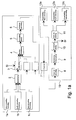
- Figure 1 shows a data transmission system, in which video, audio and data signals formed by different program sources are transmitted in the channel to the receiver.
- packets are formed from different types of information, such as video, audio and data, which are integrated into program packets, for example by a multiplexer 2. Further information on the program, such as service information (SI) identifying the program, is added to the program packets in a second multiplexer 3.
- SI service information
- Figure 1 shows the packet-stream forming devices 1a, 1b, 1c, 2, 3 for only one program, but at the transmitting end, several different programs can be combined to the same data transmission stream.
- the system of Fig. 1 contains a program multiplexer 4 for integrating packets from different program sources advantageously to a data transmission stream in packet form for broadcasting further.
- the channel-coder 6 converts the data transmission stream to a signal which is suitable for the data transmission channel used at the time, as is known.
- the data transmission channel 7 is for example a satellite connection, a cable connection or a landline link connection.
- the converse operations are performed in relation to the sending, i.e. channel decoding, deciphering, separation of SI information, and demultiplexing of program packets, wherein the packets belonging to a program to be watched at a time are separated as one signal from the data transmission stream, wherein the video packets, audio packets and data packets are separated from the signal of the program to be received.
- STB Set-Top-Box
- the received digital video signal is demodulated and error-correction is conducted for elimination of possible errors that have interfered the signal on the transmission channel.
- those packets are selected which belong to the program that is intended to be watched, and possible encryption is deciphered, provided that the viewer has the right for encryption deciphering.
- the deciphered signal is decoded, that is, the reverse operation is performed in relation to the coding at the transmission stage, for example coding according to the MPEG-2 algorithm.
- Decoding is conducted on both audio and video signals, wherein the decoder makes advantageously both an audio and a video signal.
- the decoded signals are at this stage still in digital form, the audio signal is still directed to the digital-to-analog converter and the video signal is directed e.g. to a PAL converter or a NTSC converter according to the system used for transmitting the color information of the video image.
- PAL and NTSC color systems are the most common ones, but also other color coding systems are known.
- FIG. 1 is a reduced illustration of the operational blocks of a STB device: the channel coder 8, the encryption deciphering means 9, a demultiplexer 10 for separation of service information from the packets, a demultiplexer 11 for program packets, as well as means 12a, 12b, 12c for separation of program packets and formation of video, audio and data signals corresponding to the broadcast signals.
- the STB device can include means for storing service information.
- the audio and video signals generated by the STB device are conveyed to a conventional television set, particularly to the video or SCART connection of the television, wherein the received information can be watched on the television screen.
- the transmission servers form digital packets of several programs to be broadcast, and these packets are transmitted to the transmission channel, such as a satellite 16a, 16b (Fig. 1b).
- the programs to be broadcast may include for example commercial videos, music videos, movies, sports events, current affairs programs, and news.
- the STB device is capable of selecting from the incoming data transmission stream the program that the viewer wishes to watch. Thus the viewer must give the device the identification of the program in question, or the STB device can make a list of the identifications of those programs that are included in the data transmission stream to be received, for example in the signal from the satellite to which a receiving antenna 21 is directed.
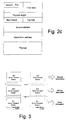
- Figure 2a shows an example of giving the title of a program in text form.
- the first field shows the identification of the protocol to be used, such as digital video broadcasting (DVB) or hypertext transfer protocol (HTTP).
- the protocol identifier is followed by a protocol separator, with which the protocol field is separated from the next field.
- the next field is a service name field, which is again followed by a field separator.
- the third field is the service provider name field, which is separated by a field separator from the fourth field, i.e. the network name field.
- the network name field is finally followed by a name separator.
- FIG. 2b is an exemplified illustration on the presentation of one text-form service information item in numerical form, including information also on the physical parameters.
- the viewer would like to watch this program, he or she should enter the numerical data to the STB device, or this data should be stored using another known method.
- This involves also the disadvantage that any changes in the physical parameters should be updated to the STB device. Such numerical strings are difficult to remember, and their input will easily involve writing errors which are not even necessarily noticed, in which case it is not possible to watch the desired program.
- STB devices which have browsing properties, wherein the STB device forms advantageously a list to be displayed of the programs which are transmitted in the data transmission stream received by the STB device at a time. The viewer can then select from the list the program he or she wishes to watch.
- this system involves the disadvantage that the list of programs is limited only to the programs in the data transmission stream received at the time. The viewer may still have access to the address data of a program which is broadcast via another data transmission stream, maybe via a different type of data transmission channel. Thus the viewer must enter into the STB device also the parameters of the data transmission channel which are not necessarily known to the viewer.
- the aim of the present invention is to provide a method in which the identification data of a program intended to be received can be acquired on the basis of information in the first form, such as title information in text form, wherein the system produces the information in the second form corresponding to that in the first form.
- the first advantageous embodiment of the method according to the present invention is characterized in what will be presented in the characterizing part of the appended claim 1.
- the second advantageous embodiment of the method according to the present invention is characterized in what will be presented in the characterizing part of the appended claim 2.
- the third advantageous embodiment of the method according to the present invention is characterized in what will be presented in the characterizing part of the appended claim 3.
- the fourth advantageous embodiment of the method according to the present invention is characterized in what will be presented in the characterizing part of the appended claim 4.
- the first advantageous embodiment of the system according to the present invention is characterized in what will be presented in the characterizing part of the appended claim 10.
- the second advantageous embodiment of the system according to the present invention is characterized in what will be presented in the characterizing part of the appended claim 11.
- the invention is based on the idea that the information presented in the first form is utilized to find out the information corresponding to that given in the first form but presented in the second form.
- the detection can be conducted by transmitting the information given in the first form to a name server, in which for each program the information corresponding to the information in the first form is stored in the second form, and this information is provided by the name server.
- the detection can also be conducted advantageously by searching for the information in the first form from the service information joined to the data transmission stream and containing the identification data of the programs to be broadcast in the data transmission stream, such as the title and physical parameters of the transmission channel.
- the information in the second form can be produced on the basis of the parameters connected to this information.
- the STB device selects the transmission channel corresponding to the selected program and separates the packets of the selected program from the data transmission packets of the transmission channel.
- At least part of the service information received from the data transmission stream is stored in the STB device.
- the present invention gives remarkable advantages to the methods of prior art.
- the viewer does not need to know which physical transmission channel is utilized for transmission of the desired program, wherein program selection is easy.
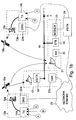
- the appended Fig. 1b shows a data communication system in which the present invention can be advantageously applied.
- Program services providers A, B, C, D, E each send their own program to a broadcasting station 13a, 13b of a provider of broadcasting services.
- the broadcasting station 13a, 13b comprises e.g. a program server 14a, 14b and means 15a, 15b for broadcasting the data transmission stream to the transmission channel.
- each program (data source) to be broadcast is converted into packets which are multiplexed advantageously to one data transmission stream (TS).
- TS data transmission stream
- the data transmission stream is sent from the transmitter antenna 15a, 15b for example to a satellite 16a, 16b.
- the satellite 16a, 16b transmits the data transmission stream to a ground station 17, which is e.g. the satellite receiver 19 of the operator of a cable television network 18.
- the data transmission stream is transmitted from the ground station 17 to the cable television network 18, which incorporates STB devices 19 of the viewers for selecting the desired programs to be watched from the data transmission stream.
- the programme transmitted via the satellite 16a, 16b can be watched also directly, wherein the STB device 19 is connected to a satellite receiver 20 in which the signal received by the satellite antenna 21 is converted to a form suitable for the STB device.
- the satellite receiver 20 can possibly be adjusted to receive data transmission streams transmitted also by other satellites, such as the second satellite 16b in Fig. 1b.
- the satellites 16a, 16b can belong to the same program server, or they can be satellites of different program servers 14a, 14b.
- the STB device of the viewer is advantageously set for a defined default data transmission stream which the STB device starts to receive when the STB device is turned on.
- the STB device For receiving other data transmission streams, the STB device must be adjusted to the signal transmitted the desired data transmission stream; for example, the receiving antenna 21 must be directed to a different satellite and tuned to the channel frequency in which the data transmission stream is broadcast.
- the transmission channel can also be the signal of the cable television network 18, wherein the STB device is adjusted to receive signals from the cable.
- the practical implementation of data transmission in different types of data transmission channels is prior art as such, so it does not need to be presented in this context.
- the data transmission stream can comprise packet-coded data packets of one or several programs, as presented above in this description.
- the data packets are e.g. program packets or packets containing information on other data transmission streams and program services contained in them to be transmitted via the video server in question.
- the design of the structure of the data transmission stream makes it possible to subject the data transmission stream to a large number of different operations in a way that their implementation does not require much capacity.
- the information on the program to be broadcast in the data transmission stream TS i.e. program specific information (PSI)
- PSI program specific information
- HTML hypertext mark up language
- news etc.
- Interactive applications such as Internet browsers
- URL uniform resource locator
- an open application programmers interface (API) link is used, applying the digital video broadcasting (DVB) protocol for detecting the application-specific link, wherein the correct information can be detected from the data transmission stream TS.
- API application programmers interface
- One method for entering the content of the data transmission stream is to use a general numerical addressing method.
- the link structure should be as general as possible, and it supports preferably a numerical addressing (Internet protocol, IP) and a domain name service (DNS) type addressing.
- IP Internet protocol
- DNS domain name service
- One known numerical addressing method is used in the Internet data network.
- TCP/IP Transmission Control Protocol/Internet Protocol
- IP Internet Protocol
- the Internet covering well particularly the industrialized countries, is a huge router network using the TCP/IP connection practice. At present, the Internet connects more than 1.5 million terminals and 20 million people. The largest group of users of the Internet, which was started only for scientific use, consists of companies which buy their services from commercial connection providers. In the Internet, each terminal has its own identifying IP address.
- the IP address is a 32-bit or four-byte figure which is divided by two into the organization-specific network address and the network-specific terminal address.
- point notation system For facilitating the processing of addresses, a decimal, so-called point notation system has been introduced, in which the addresses are given in 8-bit figures (octets) separated by points.
- octets 8-bit figures
- One octet is a figure from 0 to 255.
- This address mechanism is further divided into three different classes (ABC) which make it possible to use network and terminal addresses of different lengths.
- the title field is followed by the payload field, or the actual information to be transmitted.
- Figure 3 shows the general arrangement of the source information and its table hierarchy.
- the data is presented in layers, wherein the first layer shows information on the network, the second layer contains service descriptions, and the third layer contains information on events.
- the network may comprise for example the program servers 14a, 14b of a certain provider of program services.
- the program services provider has advantageously at least one domain name server (DNS) 22a, 22b, 22c in which information on data transmission streams to be transmitted and data sources is stored.
- DNS domain name server
- the stored data include the identification of the data source, such as the name, and information on the data transmission channel to be used in data transmission of the data source.
- the identification of the data source can be used for detecting the parameters of the data transmission channel and the data transmission stream by data transmission of the data source.
- a data transmission connection between the domain name servers 22a, 22b, 22c can be formed e.g. via a data network 25.
- the network 25 can be even world-wide.
- Figure 4 shows an example of the structure of a network information table NIT of the first layer.
- the network information table contains information on the physical arrangement of data transmission channels or data transmission streams in the given network as well as information on the properties of the network.
- the network information table NIT comprises several descriptors containing information needed for detecting a name.
- Figure 5 shows a service description table SDT.
- Service description tables show the services available in each data transmission stream.
- Service description tables are network-specific, wherein each network has its own service description table SDT0, SDT1, ..., SDTX.
- FIG. 6 shows the structure of a bouquet association table BAT.
- a bouquet association table shows information related to the services of the network.
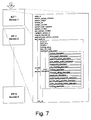
- FIG. 7 shows the structure of an event information table EIT.
- An event information table shows information related to events contained in each service in chronological order.
- the above-mentioned tables are primarily given only as examples of how to arrange information related to data sources and data transmission channels and how to make references between different tables.
- the present invention can be advantageously applied also in using different types of information structures, where the identification of a data source is presented in a way that on basis of the search information in the first form, it is possible to search the table structure for information to locate the data transmission stream of the data source, e.g. the physical parameters of a satellite channel or cable channel used for broadcasting of the data transmission stream.
- Finding information from the data networks is based on the fact that there is a common agreement on the naming practice, i.e. the way of forming the address of the information to be transmitted via the data transmission channel.
- this naming practice makes limits to how a provider of information formulates the address for the information supplied.
- the Internet network is a network of this kind, in which a large number of different programs has been developed for finding information, such as WWW browsers.
- naming instructions have been formulated, which in this description are called the DVB naming practice.
- the present invention is not limited solely to this naming practice, but it is used in this context primarily as an example.
- digital information signals refers in this context to video, audio and data signals.
- the DVB naming practice is used for identification of data sources (entities) in each data transmission network by using the service information contained in the MPEG data transmission stream TS.
- the viewer has adjusted his or her STB device to show any data source in the default data transmission stream at the stage of starting an application, such as a WWW browser.
- the parameters related to the data network with the default value are stored for example in a non-volatile random-access memory NVRAM in the STB device, or the user can enter them e.g. via a keyboard.
- a link denotes in this context a two-part address, with the first part identifying the data network, such as a name server, and the second part identifying the location of the data source in said network such as an index, a directory, and the file structure.
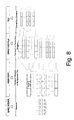
- Figure 8 exemplifies the connection between the second part of the link and the hierarchy of the data transmission streams.
- the naming practice to be disclosed below is intended for use in the device of the subscriber (viewer), such as an STB device, wherein identification of the data source is made with help of the service information available in the default value network.
- a data source with a default value, to which the STB device is adjusted, is assumed to contain also the service information of other data sources in the network. Name resolution can only be made for those data sources, of which information is available via the data source with the default value. Information on data sources contained in other networks can be found out by detecting the physical parameters of the data source by using the method of the invention, as will be presented below in the description.
- the first part of the link defines the name server, as shown in the example of Fig. 2a.
- the first part of the link is usually presented in the first form, such as text form, and it is converted to the second form, such as numerical form, to include the physical parameters of the network in question.
- the first form is the text form
- the second form is the form of Internet protocol version 6 (IPv6), but the invention is not limited solely to these embodiments.
- Figure 2a shows a method for converting the information of the first part of the link from the first form to the second form by using the service information contained in the default value data source.
- the first part of the link is composed of text fields separated from each other by separators.
- the first field gives the protocol used, such as HTTP, DSMCC, DVB, etc.
- the name of the protocol is separated from the following field by a protocol separator (://).
- the name field contains the text fields which are separated from each other with a field separator (.).
- the first field describes the name of the service
- the second field describes the name of the service provider
- the third field describes the name of the network.
- the name fields are followed by a name separator (/) separating the first part from the second part of the link.
- the above-mentioned fields do not necessarily come one after the other, but they can be positioned at different locations in the program-specific record.
- the STB device forms a data transmission connection e.g. to the default value data network, such as cable network 8, or to another data network 25, e.g. through a modem 23 via a landline telecommunication network 24 to the Internet data network.
- the STB device can also be in connection with a satellite 16a, 16b, wherein the data transmission connection can be made via the satellite to the default value data network.
- the selected network 25 incorporates at least one name server 22a, 22b, 22c which is in data transmission connection with the network 25.
- the name server 22a, 22b is for example the mainframe or the like of a company supplying cable network services.
- the name server 22a, 22b is advantageously in data transmission connection with also other computers connected to the network 25 as well as with other networks, wherein data can be transmitted between different networks.
- the name server 22a, 22b has advantageously a service file containing information corresponding to that in the SI file.
- the service information file contains information on services and their providers.
- the name of the desired services is found in a table of the service information file, wherein the data source is identified, the name of the service provider contained in the table is compared with the text field in the first field of the link, where the name of the service provider is presented. If the data are identical, a search is made in the network information table NIT or the like for information on the network to be used for data transmission.
- the name of the network is given in the text field of the first part of the link, wherein this information can be utilized in the search.
- the network information table gives the physical parameters of the data transmission channel to be used for data transmission, wherein the address of the link can be converted to the second form on the basis of the searched information.
- the address is returned in the second form to the STB device, wherein it separates the physical parameters of the data transmission channel given in the address, wherein the STB device can start receiving the desired broadcasting.
- the STB device can also generate control signals ctrl (Fig. 9a) for directing the receiving antenna and adjusting polarization e.g. in a satellite antenna. This is advantageous for example in situations in which it is possible to follow signals from several satellites, wherein the viewer does not need to adjust the satellite antenna manually.
- the name server 22a, 22b can transfer a request to another name server in the network or to a name server connected to another network, until the information on the service is found.
- the STB device makes a search for the SI information transmitted advantageously in the form of SDT tables in the data transmission streams received by the STB device, to find out if the information on the desired service can be found in the memory of the STB device.
- the search can be made on the same principle, i.e. by comparing the content of the name fields of the SDT tables with the name of the given service. If the name of the service is found, the information on the SDT table can be used for producing the address in the second form, to comprise advantageously the physical parameters of the data transmission channel.
- the methods of the first and second embodiments are combined in a way that the STB device first examines the search information stored in it to find out the data transmission channel. If the information on the desired program is not found in the STB device, a data transmission connection is formed to the name server 22a, 22b, and the next steps are the same as those described in connection with the method according to the first embodiment of the invention.
- the fourth advantageous embodiment of the invention combines the methods according to the first and second embodiment in a way that a data transmission connection is formed to the name server 22a, 22b, and for finding out the data transmission channel, the next steps are the same as those described above in connection with the method according to the first embodiment of the invention. If the information on the desired program is not found in the STB device, the STB device will then make a search in the search information stored in it, as described above in connection with the second embodiment of the invention.
- the second form used for the address it is advantageous to use the link local use address form defined in the standard of Internet Protocol Version 6 (IPv6).
- IPv6 Internet Protocol Version 6
- Table 1 The address comprises a 10-bit link local prefix having the binary value 1111 1110 11.
- the following 27 bits are set in this example to be zero, wherein 91 bits are reserved for the parameters of the data transmission channel.
- the structure of the parameter field varies with different types of data transmission channels.
- Table 2 shows as an example parameters of a cable television network
- Table 3 shows parameters of a satellite channel.
- the first column gives the name of the field
- the second column gives the number of bits reserved for the field
- the third column gives the defined values for an example channel
- the fourth column gives the defined values in binary digit form.
- code rate 0011 Total 128 field name length in bits value binary value channel type 3 satellite 010 carrier frequency 32 11.75725 MHz 0000 0001 0001 0111 0101 0111 0010 0101 satellite location 16 19.2 degrees 0000 0001 1001 0010 East/West (1/0) 1 East 1 polarization 2 circle, counter-clockwise 10 modulation method 5 QPSK 0 0001 symbol rate 28 27.4500 0000 0010 0111 0100 0101 0000 0000 FEC innter code 4 3/4 conv. code rate 0011 Total 128
- Figures 9a and 9b illustrate browsing and search of services to be conducted with the STB device in hierarchic block chart.
- any known browsing program can be used, such as a WWW browser. Changes are required in the WWW browser only in the protocol converter for implementing the interface of the protocol (e.g. HTTP, DVB, DSMCC) between the application and the protocol stack (TCP/IP). Further changes are required only in the driver/hardware interface.
- the protocol converter e.g. HTTP, DVB, DSMCC
- TCP/IP protocol stack
- Further changes are required only in the driver/hardware interface.
- the change points are marked as ruled areas in Fig. 9a.
- Figure 9b shows also an alternative implementation for the TCP/IP protocol, whereby the protocol stack is rearranged according to the protocol used, such as DVB. Also in this situation, the actual application program does not require any changes other than the changes in the protocol converter. Thus the user interface can remain unchanged, which makes it easier to use the application software particularly in a situation where the user is used to the user interface in another context, such as the Internet.
Landscapes
- Engineering & Computer Science (AREA)
- Signal Processing (AREA)
- Multimedia (AREA)
- Computer Networks & Wireless Communication (AREA)
- Data Exchanges In Wide-Area Networks (AREA)
Applications Claiming Priority (2)
| Application Number | Priority Date | Filing Date | Title |
|---|---|---|---|
| FI964640A FI964640A7 (fi) | 1996-11-21 | 1996-11-21 | Menetelmä osoitetietojen välittämiseksi |
| FI964640 | 1996-11-21 |
Publications (3)
| Publication Number | Publication Date |
|---|---|
| EP0844766A2 true EP0844766A2 (fr) | 1998-05-27 |
| EP0844766A3 EP0844766A3 (fr) | 2001-05-02 |
| EP0844766B1 EP0844766B1 (fr) | 2004-04-28 |
Family
ID=8547102
Family Applications (1)
| Application Number | Title | Priority Date | Filing Date |
|---|---|---|---|
| EP97119690A Expired - Lifetime EP0844766B1 (fr) | 1996-11-21 | 1997-11-11 | Méthode de transmission des données d'adresse |
Country Status (4)
| Country | Link |
|---|---|
| US (1) | US6314111B1 (fr) |
| EP (1) | EP0844766B1 (fr) |
| DE (1) | DE69728841T2 (fr) |
| FI (1) | FI964640A7 (fr) |
Cited By (15)
| Publication number | Priority date | Publication date | Assignee | Title |
|---|---|---|---|---|
| EP0964581A1 (fr) * | 1998-06-10 | 1999-12-15 | NOKIA TECHNOLOGY GmbH | Procédé et dispositif pour la transmission d'information vers un réseau DVB |
| WO1999065229A3 (fr) * | 1998-06-12 | 2000-03-09 | Koninkl Philips Electronics Nv | Systeme de transmission |
| WO1999065230A3 (fr) * | 1998-06-12 | 2000-04-06 | Koninkl Philips Electronics Nv | Systeme de transmission |
| EP1022884A1 (fr) * | 1999-01-25 | 2000-07-26 | CANAL+ Société Anonyme | Attribution d'adresses dans un système de transmission digital |
| WO2001005158A1 (fr) * | 1999-07-13 | 2001-01-18 | Sun Microsystems, Inc. | Procedes et dispositifs destines a choisir des donnees ip de multidiffusion transmises dans des flux radiodiffuses |
| FR2804275A1 (fr) * | 2000-01-25 | 2001-07-27 | Sagem | Decodeur de television et procede de decodage de signaux d'un flux |
| WO2001089154A1 (fr) * | 2000-05-19 | 2001-11-22 | Domiras Oy | Transmission de donnees via un reseau de diffusion |
| WO2001061960A3 (fr) * | 2000-02-14 | 2002-02-07 | Gen Instrument Corp | Procede et appareil permettant de definir, gerer, et distribuer des noms de domaines de diffusion |
| JP2002229881A (ja) * | 2001-02-05 | 2002-08-16 | Sony Corp | 受信装置、受信方法および名前解決方法 |
| US6986155B1 (en) | 1999-07-13 | 2006-01-10 | Sun Microsystems, Inc. | Methods and apparatus for selecting multicast IP data transmitted in broadcast streams |
| US7060339B2 (en) | 2002-10-15 | 2006-06-13 | Nitto Denko Corporation | Dicing/die-bonding film, method of fixing chipped work and semiconductor device |
| WO2006031925A3 (fr) * | 2004-09-15 | 2006-10-26 | Nokia Corp | Fourniture de flux de saut de chaine a des recepteurs de programmes |
| US7257812B1 (en) | 1999-12-16 | 2007-08-14 | Sun Microsystems, Inc. | Methods and apparatus for managing an application |
| US7309925B2 (en) | 2003-12-26 | 2007-12-18 | Nitto Denko Corporation | Dicing die-bonding film |
| ITRM20130362A1 (it) * | 2013-06-25 | 2014-12-26 | Eurotek Srl | "metodo e apparato per la protezione da utilizzo fraudolento di apparecchiature di trasmissione di flussi di segnali video digitali dvb " |
Families Citing this family (34)
| Publication number | Priority date | Publication date | Assignee | Title |
|---|---|---|---|---|
| JP4114234B2 (ja) * | 1998-06-09 | 2008-07-09 | ソニー株式会社 | 信号処理装置および受信装置と信号処理方法 |
| US6959451B1 (en) * | 1998-08-21 | 2005-10-25 | Intel Corporation | Transmission communications management |
| US6650879B1 (en) * | 2000-04-18 | 2003-11-18 | Sirf Technology, Inc. | Personal communications device with GPS receiver and common clock source |
| US7082292B2 (en) * | 2000-04-18 | 2006-07-25 | Sirf Technology, Inc. | Mobile communications device with GPS receiver and common clock source |
| US20020031102A1 (en) * | 2000-05-02 | 2002-03-14 | Globalstar L.P. | On-board DNS service for a satellite ISP system using non-geosynchronous orbit satellites |
| US20060095939A1 (en) * | 2000-06-30 | 2006-05-04 | Jutzi Curtis E | Method and apparatus for the separation of data from digital broadcast signals for distribution via a computer network to clients |
| US7895616B2 (en) | 2001-06-06 | 2011-02-22 | Sony Corporation | Reconstitution of program streams split across multiple packet identifiers |
| US7127619B2 (en) * | 2001-06-06 | 2006-10-24 | Sony Corporation | Decoding and decryption of partially encrypted information |
| US7215770B2 (en) | 2002-01-02 | 2007-05-08 | Sony Corporation | System and method for partially encrypted multimedia stream |
| US7823174B2 (en) | 2002-01-02 | 2010-10-26 | Sony Corporation | Macro-block based content replacement by PID mapping |
| US7302059B2 (en) | 2002-01-02 | 2007-11-27 | Sony Corporation | Star pattern partial encryption |
| US7155012B2 (en) | 2002-01-02 | 2006-12-26 | Sony Corporation | Slice mask and moat pattern partial encryption |
| US7292690B2 (en) | 2002-01-02 | 2007-11-06 | Sony Corporation | Video scene change detection |
| US6728241B2 (en) * | 2002-02-27 | 2004-04-27 | Nokia Corporation | Boolean protocol filtering |
| FI113722B (fi) * | 2002-03-28 | 2004-05-31 | Isi Industry Software Ab Oy | Menetelmä lähetyksen vastaanottimien asettamiseksi, lähetyksen vastaanotin ja palvelin |
| US7979521B2 (en) * | 2002-06-03 | 2011-07-12 | Oracle America, Inc. | Method and system for relocating and using enterprise management tools in a service provider model |
| US8818896B2 (en) | 2002-09-09 | 2014-08-26 | Sony Corporation | Selective encryption with coverage encryption |
| US7409702B2 (en) * | 2003-03-20 | 2008-08-05 | Sony Corporation | Auxiliary program association table |
| US7292692B2 (en) * | 2003-03-25 | 2007-11-06 | Sony Corporation | Content scrambling with minimal impact on legacy devices |
| US7286667B1 (en) | 2003-09-15 | 2007-10-23 | Sony Corporation | Decryption system |
| FR2860674A1 (fr) * | 2003-10-07 | 2005-04-08 | Thomson Licensing Sa | Methode de transmission de services dvb sur un reseau ip et appareil mettant en oeuvre la methode |
| US7620180B2 (en) | 2003-11-03 | 2009-11-17 | Sony Corporation | Preparation of content for multiple conditional access methods in video on demand |
| US7853980B2 (en) | 2003-10-31 | 2010-12-14 | Sony Corporation | Bi-directional indices for trick mode video-on-demand |
| WO2006055897A2 (fr) | 2004-11-19 | 2006-05-26 | Nielsen Media Research, Inc. | Procedes et appareils pour detecter un contenu de medias espace dans l'espace associe a un dispositif d'enregistrement/ de lecture |
| US8041190B2 (en) | 2004-12-15 | 2011-10-18 | Sony Corporation | System and method for the creation, synchronization and delivery of alternate content |
| US7895617B2 (en) | 2004-12-15 | 2011-02-22 | Sony Corporation | Content substitution editor |
| US8185921B2 (en) | 2006-02-28 | 2012-05-22 | Sony Corporation | Parental control of displayed content using closed captioning |
| US7555464B2 (en) | 2006-03-01 | 2009-06-30 | Sony Corporation | Multiple DRM management |
| US7913277B1 (en) * | 2006-03-30 | 2011-03-22 | Nortel Networks Limited | Metadata extraction and re-insertion and improved transcoding in digital media systems |
| US20080134283A1 (en) * | 2006-12-05 | 2008-06-05 | Electronics And Telecommunications Research Institute | Security apparatus and method for supporting IPv4 and IPv6 |
| US7849494B2 (en) * | 2007-05-09 | 2010-12-07 | Sony Service Centre (Europe) N.V. | Digital television receiver |
| US8327410B2 (en) * | 2008-12-15 | 2012-12-04 | Intel Corporation | Networked-enabled mass storage dongle with networked media content aggregation |
| KR20120084233A (ko) * | 2011-01-19 | 2012-07-27 | 삼성전자주식회사 | 엠엠티 제어 계층을 이용한 위젯/어플리케이션 명령어 전송 방법 |
| CA2890912C (fr) * | 2012-11-11 | 2018-01-16 | Lg Electronics Inc. | Procede et appareil servant a traiter un signal de service numerique |
Family Cites Families (9)
| Publication number | Priority date | Publication date | Assignee | Title |
|---|---|---|---|---|
| US5043605A (en) * | 1989-06-26 | 1991-08-27 | At&T Bell Laboratories | CMOS to ECL output buffer |
| US5517618A (en) * | 1992-02-10 | 1996-05-14 | Matsushita Electric Industrial Co., Ltd. | Mobile migration communications control device |
| US5640193A (en) | 1994-08-15 | 1997-06-17 | Lucent Technologies Inc. | Multimedia service access by reading marks on an object |
| US5774170A (en) * | 1994-12-13 | 1998-06-30 | Hite; Kenneth C. | System and method for delivering targeted advertisements to consumers |
| US5898695A (en) * | 1995-03-29 | 1999-04-27 | Hitachi, Ltd. | Decoder for compressed and multiplexed video and audio data |
| US6018764A (en) * | 1996-12-10 | 2000-01-25 | General Instrument Corporation | Mapping uniform resource locators to broadcast addresses in a television signal |
| US5990883A (en) * | 1997-04-28 | 1999-11-23 | Microsoft Corporation | Unified presentation of programming from different physical sources |
| US6073122A (en) * | 1997-08-15 | 2000-06-06 | Lucent Technologies Inc. | Cryptographic method and apparatus for restricting access to transmitted programming content using extended headers |
| US6061719A (en) * | 1997-11-06 | 2000-05-09 | Lucent Technologies Inc. | Synchronized presentation of television programming and web content |
-
1996
- 1996-11-21 FI FI964640A patent/FI964640A7/fi unknown
-
1997
- 1997-11-11 DE DE69728841T patent/DE69728841T2/de not_active Expired - Fee Related
- 1997-11-11 EP EP97119690A patent/EP0844766B1/fr not_active Expired - Lifetime
- 1997-11-21 US US08/976,240 patent/US6314111B1/en not_active Expired - Fee Related
Cited By (29)
| Publication number | Priority date | Publication date | Assignee | Title |
|---|---|---|---|---|
| US6763035B1 (en) | 1998-06-10 | 2004-07-13 | Nokia Technology Gmbh | Method and device for transmitting information to the DVB network |
| EP0964581A1 (fr) * | 1998-06-10 | 1999-12-15 | NOKIA TECHNOLOGY GmbH | Procédé et dispositif pour la transmission d'information vers un réseau DVB |
| WO1999065229A3 (fr) * | 1998-06-12 | 2000-03-09 | Koninkl Philips Electronics Nv | Systeme de transmission |
| WO1999065230A3 (fr) * | 1998-06-12 | 2000-04-06 | Koninkl Philips Electronics Nv | Systeme de transmission |
| EP1022884A1 (fr) * | 1999-01-25 | 2000-07-26 | CANAL+ Société Anonyme | Attribution d'adresses dans un système de transmission digital |
| WO2000044145A1 (fr) * | 1999-01-25 | 2000-07-27 | Canal+ Societe Anonyme | Affectation d'adresses dans un systeme de transmission numerique |
| CN100370793C (zh) * | 1999-01-25 | 2008-02-20 | 卡纳尔股份有限公司 | 数字传输系统中的地址分配 |
| US7228558B1 (en) | 1999-01-25 | 2007-06-05 | Thomson Licensing S.A. | Address assignment in digital transmission system |
| RU2251817C9 (ru) * | 1999-01-25 | 2005-09-10 | КАНАЛЬ+ Сосьетэ Аноним | Присваивание адресов в системе цифровой передачи |
| RU2251817C2 (ru) * | 1999-01-25 | 2005-05-10 | КАНАЛЬ+ Сосьетэ Аноним | Присваивание адресов в системе цифровой передачи |
| AU776813B2 (en) * | 1999-07-13 | 2004-09-23 | Sun Microsystems, Inc. | Methods and apparatus for selecting multicast IP data transmitted in broadcast streams |
| JP4814465B2 (ja) * | 1999-07-13 | 2011-11-16 | オラクル・アメリカ・インコーポレイテッド | 放送ストリームで送信されるマルチキャストipデータを選択するための方法および装置 |
| US6986155B1 (en) | 1999-07-13 | 2006-01-10 | Sun Microsystems, Inc. | Methods and apparatus for selecting multicast IP data transmitted in broadcast streams |
| WO2001005158A1 (fr) * | 1999-07-13 | 2001-01-18 | Sun Microsystems, Inc. | Procedes et dispositifs destines a choisir des donnees ip de multidiffusion transmises dans des flux radiodiffuses |
| JP2003522442A (ja) * | 1999-07-13 | 2003-07-22 | サン・マイクロシステムズ・インコーポレイテッド | 放送ストリームで送信されるマルチキャストipデータを選択するための方法および装置 |
| US7257812B1 (en) | 1999-12-16 | 2007-08-14 | Sun Microsystems, Inc. | Methods and apparatus for managing an application |
| FR2804275A1 (fr) * | 2000-01-25 | 2001-07-27 | Sagem | Decodeur de television et procede de decodage de signaux d'un flux |
| EP1120960A3 (fr) * | 2000-01-25 | 2002-02-20 | Sagem SA | Décodeur de télévision et procédé de décodage de signaux d'un flux |
| US6643707B1 (en) | 2000-02-14 | 2003-11-04 | General Instrument Corporation | Method and apparatus for defining, managing and distributing broadcast names |
| WO2001061960A3 (fr) * | 2000-02-14 | 2002-02-07 | Gen Instrument Corp | Procede et appareil permettant de definir, gerer, et distribuer des noms de domaines de diffusion |
| WO2001089154A1 (fr) * | 2000-05-19 | 2001-11-22 | Domiras Oy | Transmission de donnees via un reseau de diffusion |
| EP1367491A4 (fr) * | 2001-02-05 | 2006-08-23 | Sony Corp | Dispositif de reception, procede de reception et procede de resolution de nom |
| US7558879B2 (en) | 2001-02-05 | 2009-07-07 | Sony Corporation | Receiving apparatus, receiving methods, and name resolving method |
| JP2002229881A (ja) * | 2001-02-05 | 2002-08-16 | Sony Corp | 受信装置、受信方法および名前解決方法 |
| US7060339B2 (en) | 2002-10-15 | 2006-06-13 | Nitto Denko Corporation | Dicing/die-bonding film, method of fixing chipped work and semiconductor device |
| US7309925B2 (en) | 2003-12-26 | 2007-12-18 | Nitto Denko Corporation | Dicing die-bonding film |
| WO2006031925A3 (fr) * | 2004-09-15 | 2006-10-26 | Nokia Corp | Fourniture de flux de saut de chaine a des recepteurs de programmes |
| US8291448B2 (en) | 2004-09-15 | 2012-10-16 | Nokia Corporation | Providing zapping streams to broadcast receivers |
| ITRM20130362A1 (it) * | 2013-06-25 | 2014-12-26 | Eurotek Srl | "metodo e apparato per la protezione da utilizzo fraudolento di apparecchiature di trasmissione di flussi di segnali video digitali dvb " |
Also Published As
| Publication number | Publication date |
|---|---|
| US6314111B1 (en) | 2001-11-06 |
| EP0844766B1 (fr) | 2004-04-28 |
| DE69728841D1 (de) | 2004-06-03 |
| FI964640A7 (fi) | 1998-07-28 |
| FI964640A0 (fi) | 1996-11-21 |
| EP0844766A3 (fr) | 2001-05-02 |
| DE69728841T2 (de) | 2005-04-21 |
Similar Documents
| Publication | Publication Date | Title |
|---|---|---|
| US6314111B1 (en) | Method for transmission of address data | |
| EP0854650A2 (fr) | Méthode pour l'addressage d'un service dans un système de diffusion vidéo numérique | |
| US8898328B2 (en) | Method of processing non-real time service and broadcast receiver | |
| US10075772B2 (en) | Method of processing non-real time service and broadcast receiver | |
| KR101727049B1 (ko) | 비실시간 서비스 처리 방법 및 방송 수신기 | |
| US9204182B2 (en) | Method of receiving a broadcasting signal and receiving system for receiving a broadcasting signal | |
| KR101643637B1 (ko) | 비실시간 서비스 처리 방법 및 방송 수신기 | |
| CA2725288C (fr) | Methode de reception d'un signal diffuse et dispositif de reception servant a recevoir un signal diffuse | |
| JP2003533060A (ja) | 地上放送、ケーブル放送または衛星放送に適したプログラム・マップ・情報の形成および処理を行うシステム | |
| CN1273731A (zh) | 广播系统中用于按优先序排列的双向通信的多媒体解码器 | |
| KR20010014342A (ko) | 육상, 케이블 또는 위성 방송에 적합한 프로그램 고유정보를 형성 및 처리하기 위한 시스템 | |
| CN1273738A (zh) | 多媒体解码器和双向广播通信系统 | |
| CN1276941A (zh) | 按优先序排列双向广播数据的系统 | |
| JP2022507912A (ja) | ミドルウェアによるチューナ制御のための装置及び方法 | |
| US20030097663A1 (en) | Method and apparatus for dynamic provisioning of IP-based services in a DVB network | |
| US20040111746A1 (en) | IP to DVB subchannel mapping | |
| HK1029697B (en) | A system for forming and processing program specific information suitable for terrestrial, cable or satellite broadcast | |
| MXPA00000347A (es) | Un sistema para formar y procesar informacion especifica de programas conveniente para transmision terrestre, por cable o satelite | |
| MXPA00000344A (en) | A system for forming and processing program specific information containing text data for terrestrial, cable or satellite broadcast | |
| MXPA00000346A (en) | A system for forming and processing text data for use in program specific information for broadcast |
Legal Events
| Date | Code | Title | Description |
|---|---|---|---|
| PUAI | Public reference made under article 153(3) epc to a published international application that has entered the european phase |
Free format text: ORIGINAL CODE: 0009012 |
|
| AK | Designated contracting states |
Kind code of ref document: A2 Designated state(s): DE FR GB IT |
|
| AX | Request for extension of the european patent |
Free format text: AL;LT;LV;MK;RO;SI |
|
| PUAL | Search report despatched |
Free format text: ORIGINAL CODE: 0009013 |
|
| AK | Designated contracting states |
Kind code of ref document: A3 Designated state(s): AT BE CH DE DK ES FI FR GB GR IE IT LI LU MC NL PT SE |
|
| AX | Request for extension of the european patent |
Free format text: AL;LT;LV;MK;RO;SI |
|
| RIC1 | Information provided on ipc code assigned before grant |
Free format text: 7H 04L 29/06 A, 7G 06F 17/30 B, 7H 04L 12/18 B, 7H 04L 29/12 B |
|
| 17P | Request for examination filed |
Effective date: 20010802 |
|
| AKX | Designation fees paid |
Free format text: DE FR GB IT |
|
| RAP1 | Party data changed (applicant data changed or rights of an application transferred) |
Owner name: NOKIA TECHNOLOGY GMBH |
|
| RAP1 | Party data changed (applicant data changed or rights of an application transferred) |
Owner name: NOKIA TECHNOLOGY GMBH |
|
| 17Q | First examination report despatched |
Effective date: 20030417 |
|
| GRAP | Despatch of communication of intention to grant a patent |
Free format text: ORIGINAL CODE: EPIDOSNIGR1 |
|
| GRAS | Grant fee paid |
Free format text: ORIGINAL CODE: EPIDOSNIGR3 |
|
| GRAA | (expected) grant |
Free format text: ORIGINAL CODE: 0009210 |
|
| AK | Designated contracting states |
Kind code of ref document: B1 Designated state(s): DE FR GB IT |
|
| PG25 | Lapsed in a contracting state [announced via postgrant information from national office to epo] |
Ref country code: IT Free format text: LAPSE BECAUSE OF FAILURE TO SUBMIT A TRANSLATION OF THE DESCRIPTION OR TO PAY THE FEE WITHIN THE PRESCRIBED TIME-LIMIT;WARNING: LAPSES OF ITALIAN PATENTS WITH EFFECTIVE DATE BEFORE 2007 MAY HAVE OCCURRED AT ANY TIME BEFORE 2007. THE CORRECT EFFECTIVE DATE MAY BE DIFFERENT FROM THE ONE RECORDED. Effective date: 20040428 |
|
| REG | Reference to a national code |
Ref country code: GB Ref legal event code: FG4D |
|
| REF | Corresponds to: |
Ref document number: 69728841 Country of ref document: DE Date of ref document: 20040603 Kind code of ref document: P |
|
| ET | Fr: translation filed | ||
| PLBE | No opposition filed within time limit |
Free format text: ORIGINAL CODE: 0009261 |
|
| STAA | Information on the status of an ep patent application or granted ep patent |
Free format text: STATUS: NO OPPOSITION FILED WITHIN TIME LIMIT |
|
| 26N | No opposition filed |
Effective date: 20050131 |
|
| PGFP | Annual fee paid to national office [announced via postgrant information from national office to epo] |
Ref country code: DE Payment date: 20081107 Year of fee payment: 12 |
|
| PGFP | Annual fee paid to national office [announced via postgrant information from national office to epo] |
Ref country code: FR Payment date: 20081112 Year of fee payment: 12 |
|
| PGFP | Annual fee paid to national office [announced via postgrant information from national office to epo] |
Ref country code: GB Payment date: 20081105 Year of fee payment: 12 |
|
| GBPC | Gb: european patent ceased through non-payment of renewal fee |
Effective date: 20091111 |
|
| REG | Reference to a national code |
Ref country code: FR Ref legal event code: ST Effective date: 20100730 |
|
| PG25 | Lapsed in a contracting state [announced via postgrant information from national office to epo] |
Ref country code: FR Free format text: LAPSE BECAUSE OF NON-PAYMENT OF DUE FEES Effective date: 20091130 |
|
| PG25 | Lapsed in a contracting state [announced via postgrant information from national office to epo] |
Ref country code: DE Free format text: LAPSE BECAUSE OF NON-PAYMENT OF DUE FEES Effective date: 20100601 |
|
| PG25 | Lapsed in a contracting state [announced via postgrant information from national office to epo] |
Ref country code: GB Free format text: LAPSE BECAUSE OF NON-PAYMENT OF DUE FEES Effective date: 20091111 |