EP0845182B1 - Reglementierung von datenverkehr für breitbandnetze - Google Patents
Reglementierung von datenverkehr für breitbandnetze Download PDFInfo
- Publication number
- EP0845182B1 EP0845182B1 EP96927467A EP96927467A EP0845182B1 EP 0845182 B1 EP0845182 B1 EP 0845182B1 EP 96927467 A EP96927467 A EP 96927467A EP 96927467 A EP96927467 A EP 96927467A EP 0845182 B1 EP0845182 B1 EP 0845182B1
- Authority
- EP
- European Patent Office
- Prior art keywords
- cell
- arrival time
- tat
- conforming
- current
- Prior art date
- Legal status (The legal status is an assumption and is not a legal conclusion. Google has not performed a legal analysis and makes no representation as to the accuracy of the status listed.)
- Expired - Lifetime
Links
Images

Classifications
-
- H—ELECTRICITY
- H04—ELECTRIC COMMUNICATION TECHNIQUE
- H04L—TRANSMISSION OF DIGITAL INFORMATION, e.g. TELEGRAPHIC COMMUNICATION
- H04L12/00—Data switching networks
- H04L12/54—Store-and-forward switching systems
- H04L12/56—Packet switching systems
- H04L12/5601—Transfer mode dependent, e.g. ATM
- H04L12/5602—Bandwidth control in ATM Networks, e.g. leaky bucket
-
- H—ELECTRICITY
- H04—ELECTRIC COMMUNICATION TECHNIQUE
- H04L—TRANSMISSION OF DIGITAL INFORMATION, e.g. TELEGRAPHIC COMMUNICATION
- H04L47/00—Traffic control in data switching networks
- H04L47/10—Flow control; Congestion control
- H04L47/20—Traffic policing
-
- H—ELECTRICITY
- H04—ELECTRIC COMMUNICATION TECHNIQUE
- H04L—TRANSMISSION OF DIGITAL INFORMATION, e.g. TELEGRAPHIC COMMUNICATION
- H04L47/00—Traffic control in data switching networks
- H04L47/10—Flow control; Congestion control
- H04L47/215—Flow control; Congestion control using token-bucket
-
- H—ELECTRICITY
- H04—ELECTRIC COMMUNICATION TECHNIQUE
- H04L—TRANSMISSION OF DIGITAL INFORMATION, e.g. TELEGRAPHIC COMMUNICATION
- H04L47/00—Traffic control in data switching networks
- H04L47/10—Flow control; Congestion control
- H04L47/28—Flow control; Congestion control in relation to timing considerations
- H04L47/283—Flow control; Congestion control in relation to timing considerations in response to processing delays, e.g. caused by jitter or round trip time [RTT]
-
- H—ELECTRICITY
- H04—ELECTRIC COMMUNICATION TECHNIQUE
- H04L—TRANSMISSION OF DIGITAL INFORMATION, e.g. TELEGRAPHIC COMMUNICATION
- H04L12/00—Data switching networks
- H04L12/54—Store-and-forward switching systems
- H04L12/56—Packet switching systems
- H04L12/5601—Transfer mode dependent, e.g. ATM
- H04L2012/5614—User Network Interface
- H04L2012/5615—Network termination, e.g. NT1, NT2, PBX
-
- H—ELECTRICITY
- H04—ELECTRIC COMMUNICATION TECHNIQUE
- H04L—TRANSMISSION OF DIGITAL INFORMATION, e.g. TELEGRAPHIC COMMUNICATION
- H04L12/00—Data switching networks
- H04L12/54—Store-and-forward switching systems
- H04L12/56—Packet switching systems
- H04L12/5601—Transfer mode dependent, e.g. ATM
- H04L2012/5629—Admission control
- H04L2012/5631—Resource management and allocation
- H04L2012/5636—Monitoring or policing, e.g. compliance with allocated rate, corrective actions
Definitions
- This invention relates to a method of traffic policing in broadband cell-based networks, such as ATM (Asynchronous Transfer Mode) Networks
- UPC User Parameter Control
- QoS Quality-of-Service
- GCRA Generic Cell Rate Algorithm
- BSS 'Broad Band Switching System
- GCRA(I, L) When it is used to police the Peak Cell Rate (PCR) of a connection, it becomes GCRA(1/PCR, CDVT); when it is applied to police Sustainable Cell Rate (SCR), it becomes GCRA(1/SCR, BT).
- PCR Peak Cell Rate
- SCR police Sustainable Cell Rate
- the GCRA is a virtual scheduling algorithm that updates the Theoretical Arrival Time (TAT) of a cell, which is the nominal arrival time of the cell assuming that the active source sends equally spaced cells. If the actual arrival time of a cell is not "too" early relative to the TAT. and in particular if the actual arrival time is after TAT-L. then the cell is considered conforming. otherwise it is considered non-conforming.
- TAT Theoretical Arrival Time
- the theoretical arrival time is initialized to the current time, t a (l).
- the arrival time of the k th cell, t a (k) is actually the current value of TAT then the cell is conforming and TAT is updated to the current time t a (k), plus the increment I.
- the arrival time of the k th cell is greater than or equal to TAT-L but less than TAT, then again the cell is conforming, and the TAT is increased by the increment I.
- the arrival time of the k th cell is less than TAT-L (i.e., if TAT is greater than t a (k) + L. then the cell is non-conforming and the TAT is unchanged.
- CDVT cell delay variation tolerance
- CDV cell delay variation
- a policing algorithm such as GCRA is too stringent to end-users because it is so sensitive to minor violations that the end-users may receive a transmission capacity significantly lower than what they have paid for. In the worst case, it can be only one-half of what they have paid for. Furthermore, to end-users, the unfairness to VCs (virtual Channels) violating traffic contracts is not acceptable because a VC with minor rate violation may get penalized far more than a VC with large rate violation.
- An object of the invention is to alleviate the disadvantages of the GCRA algorithm, such as unfairness and sensitivity to minor contract-violation.
- a method of traffic policing in packet-based, broadband asynchronous networks comprising the steps of measuring the actual arrival time t a(k) of incoming cells k, providing a reference clock that maintains a time representing the theoretical arrival time of a current incoming cell, determining whether the current incoming cell is conforming or non-conforming to a predetermined condition, advancing said clock by an increment I after the arrival of each conforming cell to determine the theoretical arrival time of the next incoming cell, and if the current incoming cell is late by an amount greater than its theoretical arrival time plus the value of the increment I, updating the theoretical arrival time for the current cell to the actual arrival time for the current cell prior to advancing said reference clock.
- the new method is more robust than GCRA. It resolves the drawbacks in the GCRA algorithms such as unfairness to VCs slightly violating their traffic contracts, and sensitivity to CDV which is dependent on unknown aggregate traffic behavior; on the other hand it bounds the CDV or BT (Burst Tolerance) of the conformed cell-stream.
- the method in accordance with the invention provides end users with a more playful network environment than GCRA at the expense of limited extra bandwidth and buffering requirements on networks and user-end equipment.
- the method brings the end-user an admitted rate much closer to the PCR (Peak Cell Rate). Although an increase on cell-clumping in the delivered traffic is expected as fewer cells are discarded, the increase is bounded and the impact on switch resource allocation and the AAL (ATM Adaptation Layer) cell-assembly buffer is also limited.
- AAL ATM Adaptation Layer
- the invention also provides a user parameter control moduler for implementing traffic policing in packet-based, broadband networks, such as ATM networks, comprising means for monitoring the arrival of incoming cells, means for advancing a reference clock on a step of I if an arrival is late but not later than I, where I is an increment, and if an arrival is later than I assuming a new busy period and means for setting the reference clock at the arrival time.
- a user parameter control moduler for implementing traffic policing in packet-based, broadband networks, such as ATM networks, comprising means for monitoring the arrival of incoming cells, means for advancing a reference clock on a step of I if an arrival is late but not later than I, where I is an increment, and if an arrival is later than I assuming a new busy period and means for setting the reference clock at the arrival time.
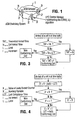
- an ATM network 1 comprises a plurality of interconnected ATM switches 2.
- UPC User Parameter Control
- modulers 3 implementing the invention protect the network from malicious and unintentional misbehaviour by performing traffic policing on arriving cells.
- Traffic sources 10 1 ...10 N are connected through MUX 11 and virtual shaper 12 implementing traffic shaping to PHY SAP 13 (Physical Service Access Point). From there cells pass through terminal units 14, 15 to UPC 3.
- PHY SAP 13 Physical Service Access Point
- Figure 3 depicts the prior art GCRA(I, L) in the Virtual Scheduling Algorithm version.
- gap-skip The purpose of gap-skip is to eliminate the effect of gaps in the measurement of cell-clumping, and to allow GCRA to focus on enforcing CDVT, which is actually defined as cell-clumping tolerance or positive-CDV tolerance instead of CDV tolerance.
- CDVT Cell-clumping tolerance or positive-CDV tolerance instead of CDV tolerance.
- the conformed cell streams after GCRA have consecutive cell-clumpings bounded by CDVT, and therefore the CAC (Connection Admission Control) function inside the switch can accordingly allocate resources to meet the QoS objectives of compliant connections.
- CDVT Physical Channels
- gap-skip In GCRA(I, L), the effect of gap-skip is equivalent to adding a positive phase to the original reference clock.
- the original reference TAT advances by steps equal to integer number of I's, gap-skip sets TAT(k) to t a (k), which is equivalent to adding the original evolved TAT with a phase --- (t a (k) -TAT(k))%I .
- (x%y is the remainder of x ⁇ y)
- the phase is not added, namely the reference clock TAT E still advances by steps of I's, then for the next arrival, the (k+1) th cell arrival, the new reference clock TAT E (k+1) is earlier than the GCRA reference clock TAT G (k+1) by a phase of (t a (k)-TAT E (k))%I . Therefore, cell loss caused by late arrival can be avoided.
- the present invention is based on the above observation.
- ECRA(I, L) Enhanced Cell Rate Algorithm
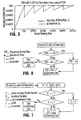
- the reference clock TAT advances by an increment I if a cell arrival is late but not later than I . This avoids the impact of late arrival on the following cells. If the arrival is later than I , a new busy period is assumed to start and the clock is set at the arrival time. In this way, the clock's reference point is allowed to be refreshed. This is better than having fixed reference point, which may already have a delay variation.
- Figure 7 shows an alternative implementation in accordance with the invention employing a continuous leaky bucket algorithm.
- the admitted rate of conformed traffic is always equal to or higher than the admitted rate in GCRA.
- ECRA(1/PCR, 0) guarantees the average admitted rate equals to PCR.
- FIG. 8 shows one example observed in a test lab.
- the GCRA discarded one in every three cells while the ECRA with the same parameters discarded one in every four cells.
- the maximum positive CDV of conformed cell stream after implementation of the described method may be higher than the maximum positive CDV of conformed cell stream after GCRA.
- the increment is bounded by
- the maximum burst size of conformed cell stream after may be higher than the maximum burst size of conformed cell stream after GCRA, but the increment is at most I cell.
- the described method is also more tolerant to VCs with minor traffic violations; therefore an increment on network resource allocation is expected. However, only a small increment is required for bandwidth allocation inside switches. The extra buffer requirement is minor because the traffic burst size is at most increased by one cell. To end users, this means just increasing the AAL assemble buffer by one more cell.
- the interoperability between the described method and GCRA is not an issue if the described method is implemented after GCRA. If a GCRA is at a Network-Network Interface, the CDVT or BT must be large enough to accommodate cell-clumping caused by queuing and multiplexing inside the network. The effect of an ECRA at a User-Network Interface in front of the GCRA is bounded to be small compare to the cell-clumping caused inside the network, and therefore can be ignored.
- the described method thus addresses the drawbacks of GCRA algorithm such as unfairness and sensitivity to minor contract-violation.
- the algorithm brings end-user an admitted rate much closer to PCR: on the other hand. although an increase on cell-clumping in the delivered traffic is expected as fewer cells are discarded. the increase is bounded and the impact on switch resource allocation and AAL cell-assemble buffer is also limited.
- the present invention avoids skipping the reference arrival clock if an arrival is late. but not later than I. and hence avoids the impact of the late arrival of the following cells.
- the ECRA algorithm resolves the unfairness of GCRA to VCs slightly violating traffic contract, and increases the robustness of GCRA to minor traffic-violations.
Landscapes
- Engineering & Computer Science (AREA)
- Computer Networks & Wireless Communication (AREA)
- Signal Processing (AREA)
- Data Exchanges In Wide-Area Networks (AREA)
Claims (5)
- Eine Methode zur Verkehrsüberwachung auf Paketbasis, asynchrones Breitbandnetzwerk, wie zum Beispiel ATM-Netzwerke, welche die Schritte zum Messen der aktuellen Ankunftszeit ta(k) der eingehenden Elemente k umfasst, wobei ein Bezugstaktgeber bereigestellt wird, der eine Zeit aufrechterhält, welche die theoretische Ankunftszeit eines aktuellen eingehenden Elementes darstellt, die bestimmt, ob das aktuelle eingehende Element mit einer vorher festgelegten Bedingung übereinstimmt oder nicht, dadurch gekennzeichnet, dass die gennante Methode die Schritte zum Vorstellen des besagten Taktgebers durch ein Inkrement I, nach der Ankunft des jeweiligen übereinstimmenden Elementes, umfasst, um die theoretische Ankunftszeit des nächsten eingehenden Elementes zu bestimmen und wenn das aktuelle eingehende Element um einen Betrag verspätet ist, der größer ist, als seine theoretische Ankunftszeit plus dem Wert des Inkrements I, wobei die theoretische Ankunftszeit für das aktuelle Element auf die aktuelle Ankunftszeit für das aktuelle Element vor dem Vorstellen des besagten Bezugstaktgebers aktualisiert wird.
- Eine Methode nach dem Anspruch 1, welche den folgenden Algorithmus durchführt:sonstBestimmung der theoretischen Zeit TAT eines aktuellen eingehenden Elementes;Messen der Ankunftszeit ta (k) eines eingehenden Elementes k;wenn TAT + I<ta
Einstellung TAT = ta
Einstellung TAT = TAT + I
wenn TAT>ta + L, wobei L ein vorher festgelegter
Grenzwert ist
Festlegung Element stimmt nicht überein
sonst
Einstellung TAT= TAT + I. - Eine Methode nach Anspruch 1, welche unter Einsatz eines Leaky-Bucket-Algorithmus durchgeführt wird.
- Eine Methode nach Anspruch 3, welche die folgenden Algorithmen durchführt:Messung der Ankunftszeit ta(k) eines eingehenden Elementes k;Einstellen einer Variablen X' = X - (ta(k) - LCT), wobei X der Wert des Leaky-Bucket-Zählers ist und LCT die Zeit der Ankunft des letzten übereinstimmenden Elementes;wenn X'<-I, Einstellung X' = 0, X = I, und LCT = ta(k);
sonstwenn X'< L, wobei L ein vorher festgelegter Grenzwert ist und das aktuelle nicht übereinstimmende Element festlegtsonst Einstellung X = X' + I, LCT = ta(k). - Ein Anwenderparameterkontrollmodul zur Durchführung einer Verkehrsüberwachung auf Paketbasis, Breitbandnetzwerke, wie zum Beispiel ATM-Netzwerke, das Mittel zum Messen der aktuellen Ankunftszeit ta(k) von eingehenden Elementen k umfasst, einen Bezugstaktgeber zum Aufrechthalten einer Zeit, welche die theoretische Ankunftszeit eines aktuellen eingehenden Elementes darstellt, um zu bestimmen, ob das aktuelle eingehende Element mit der vorher festgelegten Bedingung übereinstimmt oder nicht, dadurch gekennzeichnet, dass das besagte Modul Mittel zum Vorstellen des besagten Taktgebers umfasst, durch ein Inkrement I, nach der Ankunft des jeweiligen übereinstimmenden Elementes, um die theoretische Ankunftszeit des nächsten eingehenden Elementes zu bestimmen und wenn das aktuelle eingehende Element um einen Betrag verspätet ist, welcher größer ist als seine theoretische Ankunftszeit plus dem Wert des Inkrements I, wobei die theoretische Ankunftszeit für das aktuelle Element auf die aktuelle Ankunftszeit für das aktuelle Element vor dem Vorstellen des besagten Bezugstaktgebers aktualisiert wird.
Applications Claiming Priority (3)
| Application Number | Priority Date | Filing Date | Title |
|---|---|---|---|
| GBGB9516931.4A GB9516931D0 (en) | 1995-08-18 | 1995-08-18 | Method of traffic policing in broadband cell-based networks |
| GB9516931 | 1995-08-18 | ||
| PCT/CA1996/000556 WO1997007615A1 (en) | 1995-08-18 | 1996-08-19 | Traffic policing in broadband networks |
Publications (2)
| Publication Number | Publication Date |
|---|---|
| EP0845182A1 EP0845182A1 (de) | 1998-06-03 |
| EP0845182B1 true EP0845182B1 (de) | 2003-05-28 |
Family
ID=10779420
Family Applications (1)
| Application Number | Title | Priority Date | Filing Date |
|---|---|---|---|
| EP96927467A Expired - Lifetime EP0845182B1 (de) | 1995-08-18 | 1996-08-19 | Reglementierung von datenverkehr für breitbandnetze |
Country Status (7)
| Country | Link |
|---|---|
| US (1) | US6198743B1 (de) |
| EP (1) | EP0845182B1 (de) |
| AU (1) | AU6728496A (de) |
| CA (1) | CA2229732A1 (de) |
| DE (1) | DE69628435T2 (de) |
| GB (1) | GB9516931D0 (de) |
| WO (1) | WO1997007615A1 (de) |
Families Citing this family (16)
| Publication number | Priority date | Publication date | Assignee | Title |
|---|---|---|---|---|
| JP3157718B2 (ja) | 1996-08-21 | 2001-04-16 | 日本電気エンジニアリング株式会社 | Atm伝送網の時刻管理方法 |
| KR100221323B1 (ko) * | 1996-12-26 | 1999-09-15 | 전주범 | 비동기식 전송모드 통신망의 사용자망 접면에서의 사용자 변수제어에 있어서 이전 셀 간격 정보를 이용한 셀 간격 조절방법 |
| US6381214B1 (en) * | 1998-10-09 | 2002-04-30 | Texas Instruments Incorporated | Memory-efficient leaky bucket policer for traffic management of asynchronous transfer mode data communications |
| US6510393B1 (en) * | 1998-12-21 | 2003-01-21 | Siemens Atkiengesellschaft | Method for detecting faults in a switching device |
| KR20010108575A (ko) * | 2000-05-29 | 2001-12-08 | 은종명 | 초고속 폴리싱 장치 및 그 방법 |
| US6466541B1 (en) * | 2000-05-31 | 2002-10-15 | Fujitsu Network Communications, Inc. | Cell pacing on a network link employing a rate-based flow control protocol with underlying credit-based flow control mechanisms |
| US7149187B1 (en) * | 2000-12-28 | 2006-12-12 | Cisco Technology, Inc. | Random early detection policer using randomization of packet drops |
| US7126910B1 (en) | 2001-12-13 | 2006-10-24 | Alcatel | Load balancing technique for a resilient packet ring |
| US7539756B2 (en) * | 2002-01-31 | 2009-05-26 | Darby & Mohaine, L.L.C. | Method and system of data packet transmission timing for controlling bandwidth |
| US7369489B1 (en) | 2002-03-12 | 2008-05-06 | Cisco Technology, Inc. | Unbiased token bucket |
| US7428243B2 (en) | 2002-10-18 | 2008-09-23 | Darby & Mohaine, Llc | Method and system for varying data packet size for controlling bandwidth |
| US7499398B2 (en) * | 2003-04-16 | 2009-03-03 | International Business Machines Corporation | Method and system for oversubscribing bandwidth in a communications network |
| US7477596B1 (en) * | 2004-08-31 | 2009-01-13 | Adtran, Inc. | Policing engine providing dynamic adjustment of peak and sustained data cell rates and efficient transfer of AAL5 cells |
| DE102012216689B4 (de) * | 2012-09-18 | 2017-05-04 | Continental Automotive Gmbh | Verfahren zur Überwachung eines Ethernet-basierten Kommunikationsnetzwerks in einem Kraftfahrzeug |
| US9178783B1 (en) * | 2013-12-18 | 2015-11-03 | Cisco Technology, Inc. | Measuring network performance using inter-packet gap metric |
| US11043823B2 (en) * | 2017-04-06 | 2021-06-22 | Tesla, Inc. | System and method for facilitating conditioning and testing of rechargeable battery cells |
Family Cites Families (8)
| Publication number | Priority date | Publication date | Assignee | Title |
|---|---|---|---|---|
| EP0548995A2 (de) * | 1991-12-26 | 1993-06-30 | Fujitsu Limited | Steuerungsschaltung des Benutzungsparameters |
| US5691975A (en) * | 1993-03-12 | 1997-11-25 | Fujitsu Limited | Method and apparatus for control in ATM |
| KR100293920B1 (ko) * | 1993-06-12 | 2001-09-17 | 윤종용 | 비동기전송모드의사용자망접속인터페이스의트래픽제어장치및방법 |
| US5530695A (en) * | 1993-12-15 | 1996-06-25 | Nec Usa, Inc. | UPC-based traffic control framework for ATM networks |
| US5524006A (en) * | 1995-02-15 | 1996-06-04 | Motorola, Inc. | Second-order leaky bucket device and method for traffic management in cell relay networks |
| US5677907A (en) * | 1995-03-16 | 1997-10-14 | Fujitsu Limited | Method of calculating cell loss ratio and call accept controller using the same method |
| US5666353A (en) * | 1995-03-21 | 1997-09-09 | Cisco Systems, Inc. | Frame based traffic policing for a digital switch |
| JPH09224034A (ja) * | 1996-02-19 | 1997-08-26 | Fujitsu Ltd | カウンタ値のオーバーフロー処理方式、セル流入制御方式 |
-
1995
- 1995-08-18 GB GBGB9516931.4A patent/GB9516931D0/en active Pending
-
1996
- 1996-08-19 EP EP96927467A patent/EP0845182B1/de not_active Expired - Lifetime
- 1996-08-19 US US09/011,739 patent/US6198743B1/en not_active Expired - Fee Related
- 1996-08-19 AU AU67284/96A patent/AU6728496A/en not_active Abandoned
- 1996-08-19 DE DE69628435T patent/DE69628435T2/de not_active Expired - Fee Related
- 1996-08-19 WO PCT/CA1996/000556 patent/WO1997007615A1/en not_active Ceased
- 1996-08-19 CA CA002229732A patent/CA2229732A1/en not_active Abandoned
Also Published As
| Publication number | Publication date |
|---|---|
| WO1997007615A1 (en) | 1997-02-27 |
| EP0845182A1 (de) | 1998-06-03 |
| DE69628435T2 (de) | 2004-04-08 |
| DE69628435D1 (de) | 2003-07-03 |
| AU6728496A (en) | 1997-03-12 |
| GB9516931D0 (en) | 1995-10-18 |
| US6198743B1 (en) | 2001-03-06 |
| CA2229732A1 (en) | 1997-02-27 |
Similar Documents
| Publication | Publication Date | Title |
|---|---|---|
| KR100293920B1 (ko) | 비동기전송모드의사용자망접속인터페이스의트래픽제어장치및방법 | |
| US5812527A (en) | Simplified calculation of cell transmission rates in a cell based netwook | |
| JP3088464B2 (ja) | Atmネットワークのバンド幅管理とアクセス制御 | |
| US6198743B1 (en) | Traffic policing in broadband networks | |
| EP1192768B1 (de) | Verfahren zur messungsbasierten verbindungszulassungsssteuerung (mbac) in einem paketnetzwerk | |
| US5777984A (en) | Method and apparatus for controlling cell transmission rate in a cell based network in the presence of congestion | |
| EP0851706A1 (de) | Flusssteuerung für starke "Bursty" Verbindungen in Zellenvermittlungsnetzen mit hoher Geschwindigkeit | |
| EP0748086A1 (de) | Planungsverfahren für ausgehende Nachrichtenzelle eines ATM-Knotens | |
| JP2930023B2 (ja) | Atm網における仮想送信端末/仮想受信端末 | |
| CA2076803A1 (en) | Arrangement for monitoring the bit rate in atm networks | |
| AU1191799A (en) | Wireless atm network with high quality of service scheduling | |
| EP0817433B1 (de) | Paketvermitteltes Kommunikationssystem und Verfahren zur Verkehrsformung | |
| EP1065908B1 (de) | Verfahren zur Erzeugung von ATM Zellen für Anwendungen mit niedriger Bitrate | |
| US6167050A (en) | User traffic control apparatus for asynchronous transfer mode networks | |
| JP3075188B2 (ja) | セルレート監視装置 | |
| EP1090529B1 (de) | Verfahren und vorrichtung zur rückschleifverbindung unter verwendung von ubr mit priorität und einem adsl-modem | |
| Archambault et al. | Performance analysis of per-VC queueing | |
| Bates | The asynchronous transfer mode: Is it a waste of space? | |
| Bisdikian et al. | Approaching B-ISDN: An Overview of ATM and DQDB | |
| KR100283391B1 (ko) | 에이티엠 스위치에서의 버퍼 할당 방법_ | |
| Long et al. | An enhanced explicit rate algorithm for ABR traffic control in ATM networks | |
| Ryoo et al. | A real-time integrated traffic management scheme in ATM networks: design and simulation | |
| KR970002718B1 (ko) | 셀 손실 우선순위를 이용한 셀 간격 조정 방법 | |
| KR100221323B1 (ko) | 비동기식 전송모드 통신망의 사용자망 접면에서의 사용자 변수제어에 있어서 이전 셀 간격 정보를 이용한 셀 간격 조절방법 | |
| Bansal | A second order leaky bucket algorithm for traffic shaping in ATM networks |
Legal Events
| Date | Code | Title | Description |
|---|---|---|---|
| PUAI | Public reference made under article 153(3) epc to a published international application that has entered the european phase |
Free format text: ORIGINAL CODE: 0009012 |
|
| 17P | Request for examination filed |
Effective date: 19980317 |
|
| AK | Designated contracting states |
Kind code of ref document: A1 Designated state(s): DE FR GB |
|
| RAP1 | Party data changed (applicant data changed or rights of an application transferred) |
Owner name: ALCATEL CANADA INC. |
|
| 17Q | First examination report despatched |
Effective date: 20020402 |
|
| GRAH | Despatch of communication of intention to grant a patent |
Free format text: ORIGINAL CODE: EPIDOS IGRA |
|
| GRAH | Despatch of communication of intention to grant a patent |
Free format text: ORIGINAL CODE: EPIDOS IGRA |
|
| GRAA | (expected) grant |
Free format text: ORIGINAL CODE: 0009210 |
|
| AK | Designated contracting states |
Designated state(s): DE FR GB |
|
| REG | Reference to a national code |
Ref country code: GB Ref legal event code: FG4D |
|
| REF | Corresponds to: |
Ref document number: 69628435 Country of ref document: DE Date of ref document: 20030703 Kind code of ref document: P |
|
| ET | Fr: translation filed | ||
| PLBE | No opposition filed within time limit |
Free format text: ORIGINAL CODE: 0009261 |
|
| STAA | Information on the status of an ep patent application or granted ep patent |
Free format text: STATUS: NO OPPOSITION FILED WITHIN TIME LIMIT |
|
| 26N | No opposition filed |
Effective date: 20040302 |
|
| PGFP | Annual fee paid to national office [announced via postgrant information from national office to epo] |
Ref country code: DE Payment date: 20070822 Year of fee payment: 12 |
|
| PGFP | Annual fee paid to national office [announced via postgrant information from national office to epo] |
Ref country code: GB Payment date: 20070823 Year of fee payment: 12 |
|
| PGFP | Annual fee paid to national office [announced via postgrant information from national office to epo] |
Ref country code: FR Payment date: 20070812 Year of fee payment: 12 |
|
| GBPC | Gb: european patent ceased through non-payment of renewal fee |
Effective date: 20080819 |
|
| REG | Reference to a national code |
Ref country code: FR Ref legal event code: ST Effective date: 20090430 |
|
| PG25 | Lapsed in a contracting state [announced via postgrant information from national office to epo] |
Ref country code: FR Free format text: LAPSE BECAUSE OF NON-PAYMENT OF DUE FEES Effective date: 20080901 Ref country code: DE Free format text: LAPSE BECAUSE OF NON-PAYMENT OF DUE FEES Effective date: 20090303 |
|
| PG25 | Lapsed in a contracting state [announced via postgrant information from national office to epo] |
Ref country code: GB Free format text: LAPSE BECAUSE OF NON-PAYMENT OF DUE FEES Effective date: 20080819 |