EP0845247A2 - Enhancement to an activation and monitoring system of a dental unit - Google Patents
Enhancement to an activation and monitoring system of a dental unit Download PDFInfo
- Publication number
- EP0845247A2 EP0845247A2 EP97830631A EP97830631A EP0845247A2 EP 0845247 A2 EP0845247 A2 EP 0845247A2 EP 97830631 A EP97830631 A EP 97830631A EP 97830631 A EP97830631 A EP 97830631A EP 0845247 A2 EP0845247 A2 EP 0845247A2
- Authority
- EP
- European Patent Office
- Prior art keywords
- chair
- memory
- unit
- setting level
- operating
- Prior art date
- Legal status (The legal status is an assumption and is not a legal conclusion. Google has not performed a legal analysis and makes no representation as to the accuracy of the status listed.)
- Granted
Links
Images
Classifications
-
- A—HUMAN NECESSITIES
- A61—MEDICAL OR VETERINARY SCIENCE; HYGIENE
- A61C—DENTISTRY; APPARATUS OR METHODS FOR ORAL OR DENTAL HYGIENE
- A61C1/00—Dental machines for boring or cutting ; General features of dental machines or apparatus, e.g. hand-piece design
- A61C1/0007—Control devices or systems
- A61C1/0015—Electrical systems
Definitions
- the present invention relates to an enhancement to an activation and monitoring system for a dental unit.
- a solution of this kind (by the same Applicant, see patent application BO95A000132) comprises a console equipped with a microprocessor and integrated in a tablet or handpiece holder of the dental unit.
- the console is provided with a display wherein there is a first portion defining viewing fields, in a fixed number, of operating function data of the dental unit, or scroll-through view fields showing accessory function data along a line of the display itself.
- a corresponding series of first push-buttons for the variation - activation of the operating function data or of the passing fields located outside the display, correlated to the fixed viewing fields, and activating the function corresponding to the viewing field displayed each time.
- the microprocessor recognises the type of handpiece which has been drawn (thanks to sensors suitably placed on the holder), and on the display a screen pertaining to that handpiece appears: for instance if the handpiece is a turbine 1, that screen will display, on the first portion 2, operating data regarding number of rpm 3, power output 4, etc., whilst in a portion of the fields of the underlying string 5 are displayed the scales of increase or decrease 6 or of activation of the rotation 6a, by means of the aforesaid corresponding first push-buttons, of the operating data of the handpiece.
- accessory and general data of the dental unit such as operation of lamp 6b, activation of water to the cup and spittoon 6c, water temperature 6d, liquids and air supply to the handpiece 6e, 6f, etc.
- the microprocessor stores a series of memory banks, or operating modes in parallel for each of these handpiece, in order quickly to move from one mode to another one, better suited to the treatment to be performed at that moment.
- the subject enhancement pertains to an activation and monitoring system of a dental unit which is not shown in its entirety as it is well known in the prior art.
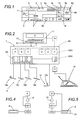
- the subject system allows to provide the dental unit with a microprocessor unit 7 which monitors the dental unit itself and is connected to and acts upon a display 8 for displaying screens of operating function data related to major equipment items 9, and of accessory function data related to auxiliary equipment 10 (such as a cup and a spittoon shown in the display in Figure 1) which do not depend on the screen displayed each time.
- a microprocessor unit 7 which monitors the dental unit itself and is connected to and acts upon a display 8 for displaying screens of operating function data related to major equipment items 9, and of accessory function data related to auxiliary equipment 10 (such as a cup and a spittoon shown in the display in Figure 1) which do not depend on the screen displayed each time.
- first and second activation - variation means 11 and 12 shown schematically in Figure 2 with a series of push-buttons (preferably of the "no touch" type), which are connected to the microprocessor unit 7 in order to accomplish the aforesaid variation according to the type of operation to be performed.
- the microprocessor unit 7 is connected with means 13 for the command and direct activation ofthe major equipment items selected and of the auxiliary equipment 9 and 10; means 13 which are shown in Figure 2 with a known pedal set 13p.
- a memory unit HD which can record a first setting level HD1 for each handpiece 18 present; this first setting level HD1 comprises the last screen related to operating function data and accessory function data activated in correspondence with a last selection of the corresponding handpiece 18; in this way, when the physician draws the same handpiece 18 anew, the last screen selected is called up with the related data.
- the aforesaid memory unit HD can provide for the recording of a second setting level HD2, also for each handpiece 18, comprising a series of operating modes, indicated as S1, S2, S3, S4...Sn, related to different operating function data and accessories each "dedicated" to a particular treatment, similar and independent one from the other, which can be called up progressively and displayed by means of the aforesaid first activation - variation means 11.
- the microprocessor unit 7 is provided with means 50 for recording a third setting level HD3, which comprises a plurality of user groups A, B...N independent from each other and each of which provides for a related first and second setting level HD1 and HD2 selected by an individual operator.
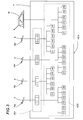
- This third level HD3 (shown more in detail in Figure 3 wherein only a third level HD3 is shown and indicated as A) can be activated by a related recognition means 14 acting on the microprocessor unit 7, which can comprise, for instance, a specific password that can be typed by means of the related keys positioned below the display 8, through which the third level HD3 of the related user A, B...N is entered, or else a magnetic recognition key.
- a related recognition means 14 acting on the microprocessor unit 7, which can comprise, for instance, a specific password that can be typed by means of the related keys positioned below the display 8, through which the third level HD3 of the related user A, B...N is entered, or else a magnetic recognition key.
- Figures 4 and 5 show, designated as 15, means for the forced alignment of the major equipment items 9 (i.e. of the handpieces 18), which can be activated through the related means 51, which in turn can comprise an appropriate push button of the aforesaid first activation - variation means 11.
- These forced alignment means 15 allow to position, or align, the operating modes S1, S2, S3, S4...Sn of the second setting level HD2 of each handpiece 18 on the corresponding operating mode selected on the handpiece 18 chosen on each occasion by the operator.
- an operating mode related to a particular treatment which may be mode S1 (see Figure 3) of the handpiece 18a selected by the physician
- the operating modes of the remaining handpieces 18 will automatically align themselves onto their corresponding mode S1: in this way, each handpiece 18 selected thereafter shall already be aligned on operating mode S1 with no need for the physician to intervene on the activation - variation means 11 (see also Figure 5).
- the activation or deactivation of the forced alignment means 15 can be stored in the third setting level HD3 of each user unit A, B,...N according to the habits or operating requirements of the physician using the dental unit at that moment.
- the microprocessor unit 7 provides for the storage, by the memory HD, of a series of operating modes P1, P2, P3, P4...Pn related to different configurations of the chair 16 in the second setting level HD2.
- This storage of operating modes P1, P2, P3, P4...Pn of the chair 16 by the memory unit HD can be combined in the third setting HD3 of each user group A, B,...N: in this way also the operating mode P1, P2, P3, P4...Pn of the chair 16 can be constrained to the corresponding operating mode S1, S2, S3, S4...Sn initially selected by the physician on the handpiece 18, since the chair 16 too is subjected to the constraining action of the aforesaid forced alignment means 15.
- FIGS 2 and 3 show six memory blocks, in the memory unit HD, which can be recorded in the second setting level HD2, and six memory blocks recordable as the third setting level HD3.
- the capability of aligning the operating modes of the handpieces and of the chair to the operating mode selected on each occasion allows the physician to make a single initial selection knowing that the other handpieces will already be perfectly aligned to the first one.
Landscapes
- Health & Medical Sciences (AREA)
- Engineering & Computer Science (AREA)
- Water Supply & Treatment (AREA)
- Oral & Maxillofacial Surgery (AREA)
- Dentistry (AREA)
- Epidemiology (AREA)
- Life Sciences & Earth Sciences (AREA)
- Animal Behavior & Ethology (AREA)
- General Health & Medical Sciences (AREA)
- Public Health (AREA)
- Veterinary Medicine (AREA)
- Dental Tools And Instruments Or Auxiliary Dental Instruments (AREA)
Abstract
Description
- Figure 1 shows an operating display of the activation and monitoring system enclosed in the Italian patent application BO96A000132;
- Figure 2 shows a first general diagram of the operational and management functions of the enhancement to the system of activation and monitoring constituting the object of the present invention on a dental unit;
- Figure 3 shows an additional, more detailed diagram of a series of levels of possible settings which can be performed with the subject enhanced system;
- Figures 4 and 5 show two flow charts illustrating respective possible operating configurations of the subject enhanced operating system.
Claims (9)
- Enhancement to an activation and monitoring system of a dental unit comprising, among other elements, a microprocessor unit (7) for monitoring said dental unit connected to and acting upon a display (8) for showing screens of operating function data related to selected major equipment (9) and of accessory function data related to auxiliary data (10) which do not depend on said screen displayed on each occasion; said data being within related viewing fields present in the same display and variable through activation - variation means (11, 12) connected to said microprocessor unit (7) according to the type of operation to be performed; to said microprocessor unit (7) being associated a memory unit (HD) able to record a first setting level (HD1), for at least each said major equipment item (9), comprising the last screen related to said operating function data and said accessory function data activated in correspondence with a last selection of the corresponding said equipment (9) and such as to call up said data and display anew the related last screen in correspondence with a subsequent selection of the same equipment; said memory unit (HD) also being able to record a second setting level (HD2), for at least each said main equipment item (9), comprising a series of operating modes (S1, S2, S3, S4...Sn) defining screens related to different operating and accessory function data, similar and not independent one from the other, which can be called up progressively and displayed through said activation - variation means (11), characterised in that said microprocessor unit (7) is provided with means (50) for recording a third setting level (HD3) comprising a series of user groups (A, B...N) independent one from the other and each of which comprises a related said first and second setting level (HD1, HD2) selected by an individual operator; said third level (HD3) being able to be activated by a related recognition means (14) acting on said microprocessor unit (7), and in that it comprises means (15) for the forced alignment of at least said main equipment (9), which can be activated through related means (51), and able to position, or align, said operating modes (S1, S2, S3, S4...Sn) of said second setting level (HD2) of each said equipment item (9) onto the corresponding operating mode selected on each occasion.
- Enhancement according to claim 1, characterised in that said alignment means (15) comprise their own activation or deactivation operating mode, which can be stored by said memory unit (HD) in said third setting level (HD3).
- Enhancement according to claim 1, characterised in that said forced alignment means (15) can be activated or deactivated only in correspondence with said third setting level (HD3).
- Enhancement according to claim 1, characterised in that said recording means (50) are associated to said microprocessor unit (7) and are comprised in said memory unit (HD).
- Enhancement according to claim 1, characterised in that said dental unit comprises a chair (16) adjustable in height and inclination and equipped with related means (17) for controlling the positions which the chair itself can assume, characterised in that said microprocessor unit (7) provides for the storage, by said memory (HD), of a series of operating modes (P1, P2, P3, P4...Pn) related to different configurations of said chair (16).
- Enhancement according to claim 1, wherein said dental unit comprises a chair (16) adjustable in height and inclination and provided with related means (17) for controlling the positions the chair itself can assume, and wherein said main equipment items (9) comprise a plurality of handpieces (18), characterised in that said microprocessor unit (7) provides for the storage, by said memory (HD), of a series of operating modes (P1, P2, P3, P4...Pn) related to different operating configurations of said chair (16); said memory (HD) also providing for the combination, in said third setting (HD3), of said selected configuration (P1, P2, P3, P4...Pn) of said chair (16) by said user to the corresponding said user group (A, B...N).
- Enhancement according to claim 1, wherein said dental unit comprises a chair (16) adjustable in height and inclination and provided with related means (17) for controlling the positions the chair itself can assume, and wherein said major equipment items (9) comprise a plurality of handpieces (18), characterised in that said microprocessor unit (7) provides for the storage, by said memory (HD), of a series of operating modes (P1, P2, PE, P4...Pn) related to different operating conditions of said chair (16); said memory (HD) also providing for the combination, in said third setting (HD3), of said selected configuration (P1, P2, P3, P4...Pn) of said chair (16) to the corresponding said user group (A, B...N); said forced alignment means (15) acting on said operating modes (S1, S2, S3, S4...Sn) of said handpieces (18) and on said operating modes (P1, P2, P3, P4...Pn) of said chair (16).
- Enhancement according to claim 1, characterised in that in said memory (HD) a recording is provided of at least six independent and parallel memory blocks for said second setting level (HD2).
- Enhancement according to claim 1, characterised in that in said memory (HD) a recording is provided of at least six independent and parallel memory blocks for said third setting level (HD3).
Applications Claiming Priority (2)
| Application Number | Priority Date | Filing Date | Title |
|---|---|---|---|
| IT96BO000616A IT1286793B1 (en) | 1996-11-29 | 1996-11-29 | IMPROVEMENT OF AN ACTIVATION AND MONITORING SYSTEM OF A DENTAL UNIT |
| ITBO960616 | 1996-11-29 |
Publications (3)
| Publication Number | Publication Date |
|---|---|
| EP0845247A2 true EP0845247A2 (en) | 1998-06-03 |
| EP0845247A3 EP0845247A3 (en) | 1998-07-29 |
| EP0845247B1 EP0845247B1 (en) | 2003-02-26 |
Family
ID=11341749
Family Applications (1)
| Application Number | Title | Priority Date | Filing Date |
|---|---|---|---|
| EP97830631A Expired - Lifetime EP0845247B1 (en) | 1996-11-29 | 1997-11-28 | Activation and monitoring system of a dental unit |
Country Status (4)
| Country | Link |
|---|---|
| EP (1) | EP0845247B1 (en) |
| DE (1) | DE69719297T2 (en) |
| ES (1) | ES2193344T3 (en) |
| IT (1) | IT1286793B1 (en) |
Cited By (5)
| Publication number | Priority date | Publication date | Assignee | Title |
|---|---|---|---|---|
| EP0993808A2 (en) | 1998-10-13 | 2000-04-19 | CASTELLINI S.p.A. | A control unit for dental handpiece functions |
| WO2002100289A1 (en) | 2001-06-12 | 2002-12-19 | Sirona Dental Systems Gmbh | Method and system for operating a dental operating chair connected to a computer |
| WO2008119874A1 (en) * | 2007-03-19 | 2008-10-09 | Planmeca Oy | User-friendly dental care unit |
| JP2010522001A (en) * | 2007-03-19 | 2010-07-01 | プランメカ オイ | Dental unit with programmable functions |
| US10614025B2 (en) | 2016-04-04 | 2020-04-07 | A-Dec, Inc. | High speed communications network in dental equipment |
Family Cites Families (3)
| Publication number | Priority date | Publication date | Assignee | Title |
|---|---|---|---|---|
| DE4202438C2 (en) * | 1992-01-29 | 1993-12-09 | Siemens Ag | Control panel for a dental device |
| DE4238259C2 (en) * | 1992-11-12 | 1995-06-22 | Kaltenbach & Voigt | Operating part for a device for medical treatment of the human or animal body |
| IT1281768B1 (en) * | 1995-03-27 | 1998-03-03 | Castellini Spa | ACTIVATION AND MONITORING SYSTEM OF A DENTAL UNIT |
-
1996
- 1996-11-29 IT IT96BO000616A patent/IT1286793B1/en active IP Right Grant
-
1997
- 1997-11-28 ES ES97830631T patent/ES2193344T3/en not_active Expired - Lifetime
- 1997-11-28 EP EP97830631A patent/EP0845247B1/en not_active Expired - Lifetime
- 1997-11-28 DE DE69719297T patent/DE69719297T2/en not_active Expired - Fee Related
Cited By (11)
| Publication number | Priority date | Publication date | Assignee | Title |
|---|---|---|---|---|
| EP0993808A2 (en) | 1998-10-13 | 2000-04-19 | CASTELLINI S.p.A. | A control unit for dental handpiece functions |
| EP0993808A3 (en) * | 1998-10-13 | 2001-06-20 | CASTELLINI S.p.A. | A control unit for dental handpiece functions |
| WO2002100289A1 (en) | 2001-06-12 | 2002-12-19 | Sirona Dental Systems Gmbh | Method and system for operating a dental operating chair connected to a computer |
| JP2004532085A (en) * | 2001-06-12 | 2004-10-21 | ジロナ デンタール システムス ゲゼルシャフト ミット ベシュレンクテル ハフツング | Apparatus and method for operating a dental care facility connected to a computer |
| US7421608B2 (en) | 2001-06-12 | 2008-09-02 | Sirona Dental Systems Gmbh | Method and system for operating a dental operating chair connected to a computer |
| WO2008119874A1 (en) * | 2007-03-19 | 2008-10-09 | Planmeca Oy | User-friendly dental care unit |
| JP2010522002A (en) * | 2007-03-19 | 2010-07-01 | プランメカ オイ | User-friendly dental care unit |
| JP2010522001A (en) * | 2007-03-19 | 2010-07-01 | プランメカ オイ | Dental unit with programmable functions |
| US8219239B2 (en) | 2007-03-19 | 2012-07-10 | Planmeca Oy | Dental unit with programmable functions |
| US10614025B2 (en) | 2016-04-04 | 2020-04-07 | A-Dec, Inc. | High speed communications network in dental equipment |
| US11023407B2 (en) | 2016-04-04 | 2021-06-01 | A-Dec, Inc. | High speed communications network in dental equipment |
Also Published As
| Publication number | Publication date |
|---|---|
| IT1286793B1 (en) | 1998-07-17 |
| ITBO960616A0 (en) | 1996-11-29 |
| ES2193344T3 (en) | 2003-11-01 |
| EP0845247A3 (en) | 1998-07-29 |
| DE69719297D1 (en) | 2003-04-03 |
| DE69719297T2 (en) | 2003-12-11 |
| EP0845247B1 (en) | 2003-02-26 |
| ITBO960616A1 (en) | 1998-05-29 |
Similar Documents
| Publication | Publication Date | Title |
|---|---|---|
| US7739125B2 (en) | Automation of a dental environment | |
| EP1383035A3 (en) | Display control device | |
| KR100988191B1 (en) | Dental procedure operation system | |
| WO2000039680A8 (en) | Multiple integrated machine system | |
| EP0845247B1 (en) | Activation and monitoring system of a dental unit | |
| AU2008266143A1 (en) | Database design for collection of medical instrument parameters | |
| JPH0767471B2 (en) | Dental care equipment | |
| US20100199203A1 (en) | Apparatus for Displaying and Managing System Parameters and Data Pertaining to a Dental Treatment Station | |
| EP3833294B1 (en) | Electric dental handpiece and wearable controller | |
| EP1302173B1 (en) | A dental unit. | |
| JPS60222048A (en) | Dental treating apparatus | |
| EP3067077A1 (en) | System comprising a multiplicity of medical devices and a central display control device | |
| EP0734689B1 (en) | A system for activating and monitoring a dental unit | |
| EP1738712B1 (en) | Auxiliary apparatus for dental treatments | |
| EP1738711B1 (en) | A dental unit | |
| EP0759727A1 (en) | A microprocessor controlled dental apparatus having selectable instrument operating functions | |
| EP0993808B1 (en) | A control unit for dental handpiece functions | |
| JP3073538U (en) | Revolution control device for medical micromotor | |
| JPH04335816A (en) | Work equipment operating device | |
| JPH07334586A (en) | Electronic medical card device | |
| JP2000051245A (en) | Dental medical care supporting device | |
| JPH04335819A (en) | Work equipment operating device | |
| Wilson | Saskatchewan appoints nurse as associate health minister | |
| DK157388B (en) | MICROPROCESSOR CONTROL DENTAL APPLIANCE |
Legal Events
| Date | Code | Title | Description |
|---|---|---|---|
| PUAI | Public reference made under article 153(3) epc to a published international application that has entered the european phase |
Free format text: ORIGINAL CODE: 0009012 |
|
| AK | Designated contracting states |
Kind code of ref document: A2 Designated state(s): DE ES FR GB |
|
| AX | Request for extension of the european patent |
Free format text: AL;LT;LV;MK;RO;SI |
|
| PUAL | Search report despatched |
Free format text: ORIGINAL CODE: 0009013 |
|
| AK | Designated contracting states |
Kind code of ref document: A3 Designated state(s): AT BE CH DE DK ES FI FR GB GR IE IT LI LU MC NL PT SE |
|
| AX | Request for extension of the european patent |
Free format text: AL;LT;LV;MK;RO;SI |
|
| RIN1 | Information on inventor provided before grant (corrected) |
Inventor name: CASTELLINI, FRANCO |
|
| 17P | Request for examination filed |
Effective date: 19980917 |
|
| AKX | Designation fees paid |
Free format text: DE ES FR GB |
|
| RBV | Designated contracting states (corrected) |
Designated state(s): DE ES FR GB |
|
| 17Q | First examination report despatched |
Effective date: 20010412 |
|
| RTI1 | Title (correction) |
Free format text: ACTIVATION AND MONITORING SYSTEM OF A DENTAL UNIT |
|
| GRAG | Despatch of communication of intention to grant |
Free format text: ORIGINAL CODE: EPIDOS AGRA |
|
| GRAG | Despatch of communication of intention to grant |
Free format text: ORIGINAL CODE: EPIDOS AGRA |
|
| GRAH | Despatch of communication of intention to grant a patent |
Free format text: ORIGINAL CODE: EPIDOS IGRA |
|
| GRAH | Despatch of communication of intention to grant a patent |
Free format text: ORIGINAL CODE: EPIDOS IGRA |
|
| GRAA | (expected) grant |
Free format text: ORIGINAL CODE: 0009210 |
|
| AK | Designated contracting states |
Designated state(s): DE ES FR GB |
|
| REG | Reference to a national code |
Ref country code: GB Ref legal event code: FG4D |
|
| REF | Corresponds to: |
Ref document number: 69719297 Country of ref document: DE Date of ref document: 20030403 Kind code of ref document: P |
|
| REG | Reference to a national code |
Ref country code: ES Ref legal event code: FG2A Ref document number: 2193344 Country of ref document: ES Kind code of ref document: T3 |
|
| ET | Fr: translation filed | ||
| PLBE | No opposition filed within time limit |
Free format text: ORIGINAL CODE: 0009261 |
|
| STAA | Information on the status of an ep patent application or granted ep patent |
Free format text: STATUS: NO OPPOSITION FILED WITHIN TIME LIMIT |
|
| 26N | No opposition filed |
Effective date: 20031127 |
|
| PGFP | Annual fee paid to national office [announced via postgrant information from national office to epo] |
Ref country code: FR Payment date: 20051108 Year of fee payment: 9 |
|
| PGFP | Annual fee paid to national office [announced via postgrant information from national office to epo] |
Ref country code: GB Payment date: 20051123 Year of fee payment: 9 |
|
| PGFP | Annual fee paid to national office [announced via postgrant information from national office to epo] |
Ref country code: DE Payment date: 20051124 Year of fee payment: 9 |
|
| PGFP | Annual fee paid to national office [announced via postgrant information from national office to epo] |
Ref country code: ES Payment date: 20051219 Year of fee payment: 9 |
|
| PG25 | Lapsed in a contracting state [announced via postgrant information from national office to epo] |
Ref country code: DE Free format text: LAPSE BECAUSE OF NON-PAYMENT OF DUE FEES Effective date: 20070601 |
|
| GBPC | Gb: european patent ceased through non-payment of renewal fee |
Effective date: 20061128 |
|
| REG | Reference to a national code |
Ref country code: FR Ref legal event code: ST Effective date: 20070731 |
|
| PG25 | Lapsed in a contracting state [announced via postgrant information from national office to epo] |
Ref country code: GB Free format text: LAPSE BECAUSE OF NON-PAYMENT OF DUE FEES Effective date: 20061128 |
|
| REG | Reference to a national code |
Ref country code: ES Ref legal event code: FD2A Effective date: 20061129 |
|
| PG25 | Lapsed in a contracting state [announced via postgrant information from national office to epo] |
Ref country code: FR Free format text: LAPSE BECAUSE OF NON-PAYMENT OF DUE FEES Effective date: 20061130 Ref country code: ES Free format text: LAPSE BECAUSE OF NON-PAYMENT OF DUE FEES Effective date: 20061129 |