EP0845465A2 - Method for the preparation of acryloxy-functional or methacryloxy-functional organosilicon compounds - Google Patents
Method for the preparation of acryloxy-functional or methacryloxy-functional organosilicon compounds Download PDFInfo
- Publication number
- EP0845465A2 EP0845465A2 EP97120665A EP97120665A EP0845465A2 EP 0845465 A2 EP0845465 A2 EP 0845465A2 EP 97120665 A EP97120665 A EP 97120665A EP 97120665 A EP97120665 A EP 97120665A EP 0845465 A2 EP0845465 A2 EP 0845465A2
- Authority
- EP
- European Patent Office
- Prior art keywords
- component
- reaction
- functional
- acryloxy
- addition
- Prior art date
- Legal status (The legal status is an assumption and is not a legal conclusion. Google has not performed a legal analysis and makes no representation as to the accuracy of the status listed.)
- Withdrawn
Links
Classifications
-
- C—CHEMISTRY; METALLURGY
- C07—ORGANIC CHEMISTRY
- C07F—ACYCLIC, CARBOCYCLIC OR HETEROCYCLIC COMPOUNDS CONTAINING ELEMENTS OTHER THAN CARBON, HYDROGEN, HALOGEN, OXYGEN, NITROGEN, SULFUR, SELENIUM OR TELLURIUM
- C07F7/00—Compounds containing elements of Groups 4 or 14 of the Periodic Table
- C07F7/02—Silicon compounds
- C07F7/08—Compounds having one or more C—Si linkages
- C07F7/0803—Compounds with Si-C or Si-Si linkages
- C07F7/0825—Preparations of compounds not comprising Si-Si or Si-cyano linkages
- C07F7/0827—Syntheses with formation of a Si-C bond
- C07F7/0829—Hydrosilylation reactions
-
- C—CHEMISTRY; METALLURGY
- C07—ORGANIC CHEMISTRY
- C07F—ACYCLIC, CARBOCYCLIC OR HETEROCYCLIC COMPOUNDS CONTAINING ELEMENTS OTHER THAN CARBON, HYDROGEN, HALOGEN, OXYGEN, NITROGEN, SULFUR, SELENIUM OR TELLURIUM
- C07F7/00—Compounds containing elements of Groups 4 or 14 of the Periodic Table
- C07F7/02—Silicon compounds
- C07F7/08—Compounds having one or more C—Si linkages
- C07F7/0834—Compounds having one or more O-Si linkage
- C07F7/0838—Compounds with one or more Si-O-Si sequences
- C07F7/0872—Preparation and treatment thereof
- C07F7/0876—Reactions involving the formation of bonds to a Si atom of a Si-O-Si sequence other than a bond of the Si-O-Si linkage
- C07F7/0878—Si-C bond
- C07F7/0879—Hydrosilylation reactions
-
- C—CHEMISTRY; METALLURGY
- C07—ORGANIC CHEMISTRY
- C07F—ACYCLIC, CARBOCYCLIC OR HETEROCYCLIC COMPOUNDS CONTAINING ELEMENTS OTHER THAN CARBON, HYDROGEN, HALOGEN, OXYGEN, NITROGEN, SULFUR, SELENIUM OR TELLURIUM
- C07F7/00—Compounds containing elements of Groups 4 or 14 of the Periodic Table
- C07F7/02—Silicon compounds
- C07F7/08—Compounds having one or more C—Si linkages
- C07F7/12—Organo silicon halides
- C07F7/14—Preparation thereof from optionally substituted halogenated silanes and hydrocarbons hydrosilylation reactions
-
- C—CHEMISTRY; METALLURGY
- C07—ORGANIC CHEMISTRY
- C07F—ACYCLIC, CARBOCYCLIC OR HETEROCYCLIC COMPOUNDS CONTAINING ELEMENTS OTHER THAN CARBON, HYDROGEN, HALOGEN, OXYGEN, NITROGEN, SULFUR, SELENIUM OR TELLURIUM
- C07F7/00—Compounds containing elements of Groups 4 or 14 of the Periodic Table
- C07F7/02—Silicon compounds
- C07F7/08—Compounds having one or more C—Si linkages
- C07F7/18—Compounds having one or more C—Si linkages as well as one or more C—O—Si linkages
- C07F7/1804—Compounds having Si-O-C linkages
- C07F7/1872—Preparation; Treatments not provided for in C07F7/20
- C07F7/1876—Preparation; Treatments not provided for in C07F7/20 by reactions involving the formation of Si-C linkages
Definitions
- This invention is a method for the preparation of acryloxy-functional or methacryloxy-functional organosilicon compounds. More particularly, it gives a very efficient method for the preparation of high-purity acryloxy-functional of methacryloxy-functional organosilicon compounds in which the generation of reaction by-products is inhibited and gelation of the reaction product does not occur.
- Organosilicon compounds functionalized with the acryloxy or methacryloxy group (hereinafter abbreviated as (meth)acryloxy-functional organosilicon compounds) readily react with radically-polymerizable monomers such as methyl methacrylate and styrene and as a consequence are used as starting materials for copolymers deriving from these monomers and modifiers for polymers obtained from these monomers.
- These (meth)acryloxy-functional organosilicon compounds are prepared by addition-reacting the acrylate ester or methacrylate ester of an aliphatically unsaturated alcohol with a SiH-function halosilane and subsequently isolating the (meth)acryloxy-functional organosilicon compound from the reaction mixture by distillative purification (refer, for example, to JP-A 5-301881 (301,881/1993)).
- these addition reactions are frequently accompanied by the generation of reaction by-products such as acrylic and methacrylic acid.
- reaction by-products as well as the (meth)acryloxy-functional compounds are compounds that readily polymerize upon heating, these methods are also often accompanied by polymerization to high molecular weights and gelation during the addition-reaction stage and during the distillation step. As a consequence, the addition reactions in these methods must be ran while maintaining the reaction temperature at a level at which thermal polymerization will not occur. This type of temperature control is quite difficult, however, and the reaction products still often undergo polymerization to high molecular weights and gelation.
- JP-A 5-186478 (186.478/1993) discloses a method that uses N,N,-dialkylaminomethylenephenol as polymerization inhibitor.
- This inhibitor has relatively good effects in terms of inhibiting the polymerization of acrylic-functional silane and halosilane, but it is a poison of the platinum catalysts used as addition-reaction catalyst in the synthesis of the silanes by addition reaction as described above. This method thus suffers from the problem of requiring the use of large amounts of platinum catalyst to complete the reaction.
- the object of the present invention is to provide a high-yield method for the synthesis of high-purity (meth)acryloxy-functional organosilicon compounds in which during the production of these compounds the generation of reaction by-products is inhibited and gelation of the reaction mixture does not occur.
- the present invention is a method for the preparation of acryloxy-functional or methacryloxy-functional organosilicon compounds comprising effecting a addition reaction between
- the acrylate ester of an aliphatically unsaturated alcohol, component (A), used herein is exemplified by allyl acrylate, hexenyl acrylate, allyloxyethyl acrylate, and 4-vinylphenyl acrylate.
- the methacrylate ester of an aliphatically unsaturated alcohol is exemplified by allyl methacrylate, hexenyl methacrylate, allyloxyethyl methacrylate, and 4-vinylphenyl methacrylate.
- the SiH-functiononal organosilicon compound, component (B), used in the present method is not particularly restricted other than that the product afforded by the addition reaction of (B) should have a boiling point in a temperature range capable of distillation.
- Component (B) is exemplified by trichlorosilane, methyldichlorosilane, dimethylchlorosilane, trimethoxysilane, methyldimethoxysilane, dimethylmethoxysilane, pentamethyldisiloxane, and 1,1,2,2 tetramethyldisiloxane.
- Component (B) is preferably used at from 0.8 to 1.2 equivalents per equivalent of component (A).
- the hydrosilylation-reaction catalyst, component (C), used in the present method is preferably a transition metal catalyst from Croup VIII of the Periodic Table, among which platinum catalysts are the most preferred.
- the instant platinum catalysts are exemplified by the alcohol solutions of chloroplatinic acid, platinum-olefin complexes, and platinum complexes with vinyl-functional siloxane.
- Component (C) is preferably used at from 0.1 to 200 weight-ppm based on the total quantity of components (A) and (B).
- the component (D) used in the present method is the component that characterizes the present invention. This component functions to inhibit the generation of by-products that may be produced during the addition reaction between components (A) and (B) and to prevent the reaction product from polymerizing to high molecular weights and gelling.
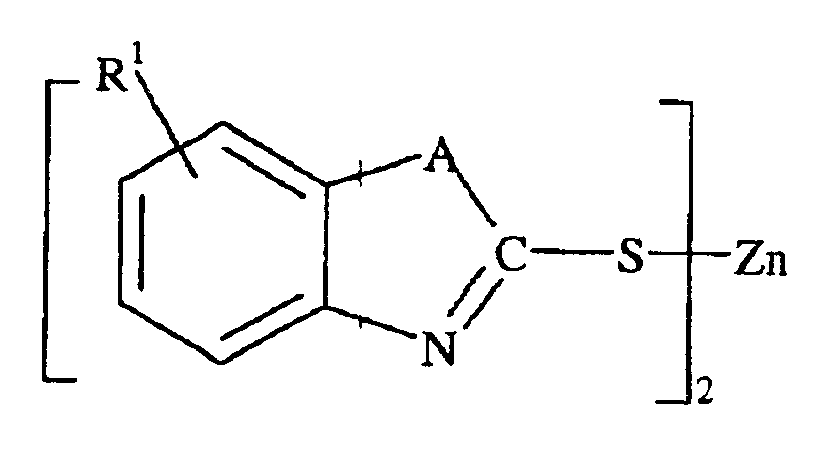
- Component (D) encompasses compounds described by the following general formula (1) where A is a sulfur atom or NH and R 1 is a methyl group or a hydrogen atom and compounds described by general formula (2) where R 2 and R 3 are independently selected monovalent hydrocarbon groups.
- Compound (1) is, specifically exemplified by the zinc salt of 2-mercaptobenzothiazole and the zinc salt of 2-mercaptoimidazole.
- Compounds in which the sulfur atom is selected for A in the preceding formula (1) have the same effect as compounds in which NH is selected for A, and the same is true for the selection of methyl for R 1 versus the selection of hydrogen for R 1 .
- R 2 and R 3 in general formula (2) are selected from alkyls such as methyl, ethyl, and butyl and aryl such as phenyl.
- Compound (2) is specifically exemplified by zinc dimethyldithiocarbamate and zinc dimethyldithiocarbamate.
- component (D) is preferably added at from 0.0001 to 1 weight part per 100 weight parts component (A) and particularly preferably at from 0.001 to 0.5 weight part per 100 weight parts component (A).
- Organic solvents usable for running the method in the presence of organic solvent are exemplified by aromatic hydrocarbons such as benzene, toluene, and xylene; aliphatic hydrocarbons such as hexane and heptane; ethers such as tetrahydrofuran and diethyl ether: ketones such as acetone and methyl ethyl ketone; and esters such as ethyl acetate and butyl acetate.
- the present method can be run at room temperature, but is preferably run at temperatures of at least 30°C in order to obtain food reaction rates.
- the reaction temperature preferably does not exceed 100°C and more preferably is in the range of from 30°C to 90°C.
- the reaction mixture afforded by the present method can be purified by distillation directly as obtained upon completion of the reaction.
- the known radical-polymerization inhibitors such as hindered phenol compounds, amine compounds, quinone compounds, and oxygen can be added to the reaction mixture.
- Example 1 60.0 g (0.48 mol) allyl methacrylate, 0.04 g chloroplatinic acid/divinyltetramethyldisiloxane complex (this provided 2.7 ppm platinum metal based on the weight of allyl methacrylate), and 0.0033 g (8.3 ⁇ 10 -6 mol) of the zinc salt of 2-mercaptobenzothiazole were introduced into a 300-mL four-neck flask equipped with a condenser, stirrer, thermometer, and addition funnel. The temperature in the flask was brought to 80°C and 70.9 g trichlorosilane were gradually added dropwise. Afier the completion of addition, the reaction was stirred for an additional 1 hour while maintaining the reaction temperature at 80°C. This yielded 119.2 g of a reaction mixture.
- Example 2 60.0 g (0.48 mol) Allyl methacrylate, 0.04 g (2.7 ppm) chloroplatinic acid/divinyltetramethyldisiloxane complex, and 0.0025 g (8.3 x 10 -6 mol) zinc dimethyldithiocarbamate were introduced into a 300-ml four-neck flask equipped with a condenser, stirrer, thermometer, and addition funnel. The temperature in the flask was brought to 80°C and 70.9 g (0.52 mol) trichlorosilane were gradually added dropwise. After the completion of addition, the reaction was stirred for an additional 1 hour while maintaining the reaction temperature at 80°C. This yielded 121.0 g of a reaction mixture.
- Comparative example 2 An addition reaction was run as in Example 2, but in this case without the addition of the zinc dimethyldithiocarbamate that was used in Example 2. In this case, the reaction product lost fluidity and converted to a gel 30 minutes after the start of the dropwise addition of the trichlorosilane.
Landscapes
- Chemical & Material Sciences (AREA)
- Organic Chemistry (AREA)
- Chemical Kinetics & Catalysis (AREA)
- Low-Molecular Organic Synthesis Reactions Using Catalysts (AREA)
- Catalysts (AREA)
Abstract
Description
and
and


Claims (7)
- A method for preparation of acryloxy-functional or methacryloxy-functional organosilicon compounds comprising effecting an addition reaction between(A) an acrylate ester or methacrylate ester of an aliphatically unsaturated alcohol
and(B) a SiH-functional organisilicon compound in the presence of(C) a hydrosilylation-reaction catalyst and(D) a compound described by formulawhere A is a sulfur atom or NH ad R1 is a methyl group or a hydrogen atom or a compound described by general formula where R2 and R3 are independently selected monovalent hydrocarbon groups.
- The method according to Claim 1, where the quantity of component (D) is from 0.0001 to 1 weight part per 100 weight parts of component (A).
- The method according to Claim 1 , where component (D) is selected from zinc salt of 2-mercaptobenzothiazole or zinc salt of 2-mercaptoimidazole.
- The method according to Claim 1, where component (D) is selected from the group consisting of zinc dimethyldithiocarbamate and zinc dimethyldithiocarbamate.
- The method according to Claim 1. where component (A) is allyl methacrylate and component (B) is trichlorosilane.
- The method according to Claim 1, where the addition reaction is effected at a temperature within a range of 30°C to 90°C.
- The method according to Claim 1, where component (A) is allyl methacrylate, component (B) is trichlorosilane, component (C) comprises a chloroplatinic acid/divinyltetramethyldisiloxane complex and component (D) is zinc dimethyldithiocarbamate.
Applications Claiming Priority (3)
| Application Number | Priority Date | Filing Date | Title |
|---|---|---|---|
| JP33501896 | 1996-11-28 | ||
| JP8335018A JPH10158276A (en) | 1996-11-28 | 1996-11-28 | Method for producing acryloxy or methacryloxy group-containing organosilicon compound |
| JP335018/96 | 1996-11-28 |
Publications (2)
| Publication Number | Publication Date |
|---|---|
| EP0845465A2 true EP0845465A2 (en) | 1998-06-03 |
| EP0845465A3 EP0845465A3 (en) | 1999-08-18 |
Family
ID=18283829
Family Applications (1)
| Application Number | Title | Priority Date | Filing Date |
|---|---|---|---|
| EP97120665A Withdrawn EP0845465A3 (en) | 1996-11-28 | 1997-11-26 | Method for the preparation of acryloxy-functional or methacryloxy-functional organosilicon compounds |
Country Status (3)
| Country | Link |
|---|---|
| US (1) | US5789611A (en) |
| EP (1) | EP0845465A3 (en) |
| JP (1) | JPH10158276A (en) |
Cited By (2)
| Publication number | Priority date | Publication date | Assignee | Title |
|---|---|---|---|---|
| DE102008040475A1 (en) | 2008-07-16 | 2010-01-21 | Wacker Chemie Ag | Process for preventing the polymerization of unsaturated organosilicon compounds |
| CN102295592A (en) * | 2011-06-22 | 2011-12-28 | 濮阳蔚林化工股份有限公司 | Preparation method of rubber vulcanization accelerator zinc dimethyldithiocarbamate |
Families Citing this family (4)
| Publication number | Priority date | Publication date | Assignee | Title |
|---|---|---|---|---|
| DE19854218A1 (en) * | 1998-11-25 | 2000-05-31 | Degussa | 3-methacryloxy and 3-acryloxyisobutylalkoxysilanes |
| JP4688311B2 (en) * | 2001-02-22 | 2011-05-25 | 東レ・ダウコーニング株式会社 | Method for producing (meth) acrylic functional group-containing organosilicon compound |
| DE10118489C1 (en) * | 2001-04-12 | 2002-07-25 | Wacker Chemie Gmbh | Production of organosilane with unsaturated, organic carbonyloxy group, used as adhesion promoters, comprises reacting halosilane with an unsaturated carboxylic acid in the presence of phosphonium salt as phase transfer catalyst |
| DE102008042679A1 (en) * | 2008-10-08 | 2010-04-15 | Wacker Chemie Ag | Process for the preparation of (meth) acrylic silanes |
Family Cites Families (11)
| Publication number | Priority date | Publication date | Assignee | Title |
|---|---|---|---|---|
| US4021310A (en) * | 1972-12-22 | 1977-05-03 | Nippon Shokubai Kagaku Kogyo Co., Ltd. | Method for inhibiting the polymerization of acrylic acid or its esters |
| US3925434A (en) * | 1975-01-22 | 1975-12-09 | Union Carbide Corp | The reaction of chlorosilanes with unsaturated organic compounds |
| DE2824630A1 (en) * | 1978-06-05 | 1979-12-13 | Wacker Chemie Gmbh | HEAT-CURABLE ORGANOPOLYSILOXANE COMPOUNDS |
| US4558111A (en) * | 1984-12-05 | 1985-12-10 | General Electric Company | Method for preparing acrylic functional halosilanes and halosiloxanes |
| US5145979A (en) * | 1990-08-23 | 1992-09-08 | Tonen Corporation | Processes for the preparation of γ-methacryloxypropylsilane compounds |
| US5103032A (en) * | 1991-06-27 | 1992-04-07 | Union Carbide Chemicals & Plastics Technology Corporation | Inhibited acryloxysilanes and methacryloxysilanes |
| JP2851477B2 (en) * | 1992-03-25 | 1999-01-27 | 東レ・ダウコーニング・シリコーン株式会社 | Method for producing acryloxy or methacryloxy group-containing organosilicon compound |
| JPH05301881A (en) * | 1992-04-23 | 1993-11-16 | Toray Dow Corning Silicone Co Ltd | Process for producing acryloxy group- or methacryloxy group-containing organosilicon compound |
| JPH0776556A (en) * | 1993-09-06 | 1995-03-20 | Daicel Chem Ind Ltd | (meth)acrylic monomer |
| JP3733635B2 (en) * | 1996-02-01 | 2006-01-11 | 東亞合成株式会社 | Method for producing organosilicon compound |
| JP4009335B2 (en) * | 1996-04-26 | 2007-11-14 | 東レ・ダウコーニング株式会社 | Method for producing organosilicon compound containing acryloxy group or methacryloxy group |
-
1996
- 1996-11-28 JP JP8335018A patent/JPH10158276A/en active Pending
-
1997
- 1997-11-24 US US08/977,292 patent/US5789611A/en not_active Expired - Fee Related
- 1997-11-26 EP EP97120665A patent/EP0845465A3/en not_active Withdrawn
Cited By (3)
| Publication number | Priority date | Publication date | Assignee | Title |
|---|---|---|---|---|
| DE102008040475A1 (en) | 2008-07-16 | 2010-01-21 | Wacker Chemie Ag | Process for preventing the polymerization of unsaturated organosilicon compounds |
| US8247590B2 (en) | 2008-07-16 | 2012-08-21 | Wacker Chemie Ag | Method for preventing polymerization of unsaturated organosilicon compounds |
| CN102295592A (en) * | 2011-06-22 | 2011-12-28 | 濮阳蔚林化工股份有限公司 | Preparation method of rubber vulcanization accelerator zinc dimethyldithiocarbamate |
Also Published As
| Publication number | Publication date |
|---|---|
| EP0845465A3 (en) | 1999-08-18 |
| JPH10158276A (en) | 1998-06-16 |
| US5789611A (en) | 1998-08-04 |
Similar Documents
| Publication | Publication Date | Title |
|---|---|---|
| JP3529808B2 (en) | Synthetic method of epoxy silicone | |
| EP0629648B1 (en) | Method for preparation of carbinol-functional siloxanes | |
| EP0693492B1 (en) | Method for preparation of methacryloxypropyldimethylchlorosilane | |
| EP3819301B1 (en) | Preparation of organosilicon compound having (meth)acryloyloxy group | |
| JPH0651707B2 (en) | Method for producing acrylic functional halosilanes and halosiloxanes | |
| US5260455A (en) | Polyepoxysilanes and radiation-curable polyepoxysilicone compositions | |
| JP2795135B2 (en) | Method for producing organoalkoxysilane compound | |
| US5789611A (en) | Method for the preparation of acryloxy-functional or methacryloxy-functional organosilicon compounds | |
| US5175328A (en) | Method for the preparation of organopolysiloxane | |
| EP0992527B1 (en) | Preparation of epoxy group-bearing organopolysiloxanes or organosilanes | |
| US5902870A (en) | Method for the preparation of acryloxy-functional or methacryloxy-functional organosilcon compounds | |
| JP4009335B2 (en) | Method for producing organosilicon compound containing acryloxy group or methacryloxy group | |
| US4469881A (en) | [2-(p-t-Butylphenyl)ethyl]silanes and method of making the same | |
| JPH1129584A (en) | Method for producing acryloxy or methacryloxy group-containing chlorosilane | |
| JPH05301881A (en) | Process for producing acryloxy group- or methacryloxy group-containing organosilicon compound | |
| JP3611668B2 (en) | Acrylic functional silane polymerization inhibitor | |
| JPH04128292A (en) | Production of gamma-methacryloxypropylsilane compound | |
| EP0803507A2 (en) | Polymerization inhibitor for acrylic-functional organo-silicon compounds | |
| JP3856087B2 (en) | Method for producing 3-aminopropyl monoorganodiorganooxysilane | |
| US6118014A (en) | Organofunctional cocyclic siloxanes | |
| JP3823337B2 (en) | Method for producing γ- (meth) acryloxypropylsilane compound | |
| US7932412B2 (en) | Method of manufacturing an aminoaryl-containing organosilicon compound and method of manufacturing an intermediate product of the aforementioned compound | |
| JPH085903B2 (en) | Epoxy group-containing alkoxysiloxane and method for producing the same | |
| JPH04128294A (en) | Production of gamma-methacryloxypropylsilane compound | |
| JPH0673073A (en) | Production of organotrialalkoxysilane |
Legal Events
| Date | Code | Title | Description |
|---|---|---|---|
| PUAI | Public reference made under article 153(3) epc to a published international application that has entered the european phase |
Free format text: ORIGINAL CODE: 0009012 |
|
| AK | Designated contracting states |
Kind code of ref document: A2 Designated state(s): DE FR GB IT |
|
| AX | Request for extension of the european patent |
Free format text: AL;LT;LV;MK;RO;SI |
|
| PUAL | Search report despatched |
Free format text: ORIGINAL CODE: 0009013 |
|
| AK | Designated contracting states |
Kind code of ref document: A3 Designated state(s): AT BE CH DE DK ES FI FR GB GR IE IT LI LU MC NL PT SE |
|
| AX | Request for extension of the european patent |
Free format text: AL;LT;LV;MK;RO;SI |
|
| 17P | Request for examination filed |
Effective date: 19991201 |
|
| AKX | Designation fees paid |
Free format text: DE FR GB IT |
|
| 17Q | First examination report despatched |
Effective date: 20010516 |
|
| STAA | Information on the status of an ep patent application or granted ep patent |
Free format text: STATUS: THE APPLICATION IS DEEMED TO BE WITHDRAWN |
|
| 18D | Application deemed to be withdrawn |
Effective date: 20010927 |