EP0845533A2 - Kératine sulfate 6-sulfotransférase et ADN codant pour celle-ci - Google Patents
Kératine sulfate 6-sulfotransférase et ADN codant pour celle-ci Download PDFInfo
- Publication number
- EP0845533A2 EP0845533A2 EP97309564A EP97309564A EP0845533A2 EP 0845533 A2 EP0845533 A2 EP 0845533A2 EP 97309564 A EP97309564 A EP 97309564A EP 97309564 A EP97309564 A EP 97309564A EP 0845533 A2 EP0845533 A2 EP 0845533A2
- Authority
- EP
- European Patent Office
- Prior art keywords
- polypeptide
- sulfate
- dna
- sulfotransferase
- activity
- Prior art date
- Legal status (The legal status is an assumption and is not a legal conclusion. Google has not performed a legal analysis and makes no representation as to the accuracy of the status listed.)
- Granted
Links
- QAOWNCQODCNURD-UHFFFAOYSA-L Sulfate Chemical compound [O-]S([O-])(=O)=O QAOWNCQODCNURD-UHFFFAOYSA-L 0.000 title claims abstract description 43
- 102000011782 Keratins Human genes 0.000 title 1
- 108010076876 Keratins Proteins 0.000 title 1
- 108090000765 processed proteins & peptides Proteins 0.000 claims abstract description 106
- 229920001184 polypeptide Polymers 0.000 claims abstract description 100
- 102000004196 processed proteins & peptides Human genes 0.000 claims abstract description 100
- 230000000694 effects Effects 0.000 claims abstract description 89
- 229920000288 Keratan sulfate Polymers 0.000 claims abstract description 77
- KXCLCNHUUKTANI-RBIYJLQWSA-N keratan Chemical compound CC(=O)N[C@@H]1[C@@H](O)C[C@@H](COS(O)(=O)=O)O[C@H]1O[C@@H]1[C@@H](O)[C@H](O[C@@H]2[C@H](O[C@@H](O[C@H]3[C@H]([C@@H](COS(O)(=O)=O)O[C@@H](O)[C@@H]3O)O)[C@H](NC(C)=O)[C@H]2O)COS(O)(=O)=O)O[C@H](COS(O)(=O)=O)[C@@H]1O KXCLCNHUUKTANI-RBIYJLQWSA-N 0.000 claims abstract description 77
- GACDQMDRPRGCTN-KQYNXXCUSA-N 3'-phospho-5'-adenylyl sulfate Chemical compound C1=NC=2C(N)=NC=NC=2N1[C@@H]1O[C@H](COP(O)(=O)OS(O)(=O)=O)[C@@H](OP(O)(O)=O)[C@H]1O GACDQMDRPRGCTN-KQYNXXCUSA-N 0.000 claims abstract description 14
- 229920002567 Chondroitin Polymers 0.000 claims abstract description 13
- DLGJWSVWTWEWBJ-HGGSSLSASA-N chondroitin Chemical compound CC(O)=N[C@@H]1[C@H](O)O[C@H](CO)[C@H](O)[C@@H]1OC1[C@H](O)[C@H](O)C=C(C(O)=O)O1 DLGJWSVWTWEWBJ-HGGSSLSASA-N 0.000 claims abstract description 11
- SQDAZGGFXASXDW-UHFFFAOYSA-N 5-bromo-2-(trifluoromethoxy)pyridine Chemical compound FC(F)(F)OC1=CC=C(Br)C=N1 SQDAZGGFXASXDW-UHFFFAOYSA-N 0.000 claims abstract description 10
- 229920001287 Chondroitin sulfate Polymers 0.000 claims abstract description 9
- 229920000045 Dermatan sulfate Polymers 0.000 claims abstract description 9
- 229940059329 chondroitin sulfate Drugs 0.000 claims abstract description 9
- AVJBPWGFOQAPRH-FWMKGIEWSA-L dermatan sulfate Chemical compound CC(=O)N[C@H]1[C@H](O)O[C@H](CO)[C@H](OS([O-])(=O)=O)[C@@H]1O[C@H]1[C@H](O)[C@@H](O)[C@H](O)[C@H](C([O-])=O)O1 AVJBPWGFOQAPRH-FWMKGIEWSA-L 0.000 claims abstract description 9
- 229940051593 dermatan sulfate Drugs 0.000 claims abstract description 9
- 125000002887 hydroxy group Chemical group [H]O* 0.000 claims abstract description 9
- KXKPYJOVDUMHGS-OSRGNVMNSA-N chondroitin sulfate Chemical compound CC(=O)N[C@H]1[C@H](O)O[C@H](OS(O)(=O)=O)[C@H](O)[C@@H]1O[C@H]1[C@H](O)[C@@H](O)[C@H](O)[C@@H](C(O)=O)O1 KXKPYJOVDUMHGS-OSRGNVMNSA-N 0.000 claims abstract description 7
- 239000000758 substrate Substances 0.000 claims abstract description 7
- 230000009471 action Effects 0.000 claims abstract description 5
- 230000004913 activation Effects 0.000 claims abstract description 4
- 229920000669 heparin Polymers 0.000 claims abstract 2
- 229960002897 heparin Drugs 0.000 claims abstract 2
- 125000003275 alpha amino acid group Chemical group 0.000 claims description 22
- 239000002773 nucleotide Substances 0.000 claims description 22
- 125000003729 nucleotide group Chemical group 0.000 claims description 22
- 238000012217 deletion Methods 0.000 claims description 20
- 230000037430 deletion Effects 0.000 claims description 20
- 150000001413 amino acids Chemical class 0.000 claims description 18
- 238000007792 addition Methods 0.000 claims description 17
- 238000006467 substitution reaction Methods 0.000 claims description 17
- FWMNVWWHGCHHJJ-SKKKGAJSSA-N 4-amino-1-[(2r)-6-amino-2-[[(2r)-2-[[(2r)-2-[[(2r)-2-amino-3-phenylpropanoyl]amino]-3-phenylpropanoyl]amino]-4-methylpentanoyl]amino]hexanoyl]piperidine-4-carboxylic acid Chemical compound C([C@H](C(=O)N[C@H](CC(C)C)C(=O)N[C@H](CCCCN)C(=O)N1CCC(N)(CC1)C(O)=O)NC(=O)[C@H](N)CC=1C=CC=CC=1)C1=CC=CC=C1 FWMNVWWHGCHHJJ-SKKKGAJSSA-N 0.000 claims description 15
- 229920001282 polysaccharide Polymers 0.000 claims description 12
- 239000005017 polysaccharide Substances 0.000 claims description 12
- 150000004676 glycans Chemical class 0.000 claims description 11
- 230000001180 sulfating effect Effects 0.000 claims description 11
- 238000004519 manufacturing process Methods 0.000 claims description 9
- 239000001963 growth medium Substances 0.000 claims description 7
- 230000004927 fusion Effects 0.000 claims description 6
- 238000012258 culturing Methods 0.000 claims description 3
- 108020004414 DNA Proteins 0.000 description 75
- 239000002299 complementary DNA Substances 0.000 description 65
- 210000004027 cell Anatomy 0.000 description 45
- 108010017957 carbohydrate sulfotransferases Proteins 0.000 description 34
- 238000000034 method Methods 0.000 description 31
- 108010079295 Chondroitin 4-sulfotransferase Proteins 0.000 description 25
- 102100038768 Carbohydrate sulfotransferase 3 Human genes 0.000 description 23
- 108090001033 Sulfotransferases Proteins 0.000 description 22
- 102000004896 Sulfotransferases Human genes 0.000 description 22
- FAPWRFPIFSIZLT-UHFFFAOYSA-M Sodium chloride Chemical compound [Na+].[Cl-] FAPWRFPIFSIZLT-UHFFFAOYSA-M 0.000 description 20
- 238000006243 chemical reaction Methods 0.000 description 20
- 108090000623 proteins and genes Proteins 0.000 description 19
- 238000002360 preparation method Methods 0.000 description 18
- 239000011541 reaction mixture Substances 0.000 description 18
- 229920002683 Glycosaminoglycan Polymers 0.000 description 17
- 239000000523 sample Substances 0.000 description 17
- QTBSBXVTEAMEQO-UHFFFAOYSA-N acetic acid Substances CC(O)=O QTBSBXVTEAMEQO-UHFFFAOYSA-N 0.000 description 16
- 238000009396 hybridization Methods 0.000 description 16
- 108091032973 (ribonucleotides)n+m Proteins 0.000 description 15
- 239000013612 plasmid Substances 0.000 description 15
- 239000000243 solution Substances 0.000 description 15
- 102000004190 Enzymes Human genes 0.000 description 14
- 108090000790 Enzymes Proteins 0.000 description 14
- 239000000872 buffer Substances 0.000 description 14
- 239000012634 fragment Substances 0.000 description 14
- 238000003556 assay Methods 0.000 description 13
- 239000012528 membrane Substances 0.000 description 11
- 239000011780 sodium chloride Substances 0.000 description 10
- OKKJLVBELUTLKV-UHFFFAOYSA-N Methanol Chemical compound OC OKKJLVBELUTLKV-UHFFFAOYSA-N 0.000 description 9
- 108091034057 RNA (poly(A)) Proteins 0.000 description 9
- 239000000284 extract Substances 0.000 description 9
- 238000012546 transfer Methods 0.000 description 9
- 238000010367 cloning Methods 0.000 description 8
- 230000001747 exhibiting effect Effects 0.000 description 8
- 238000002372 labelling Methods 0.000 description 8
- 239000000203 mixture Substances 0.000 description 8
- 102000004169 proteins and genes Human genes 0.000 description 8
- 238000012216 screening Methods 0.000 description 8
- 239000007836 KH2PO4 Substances 0.000 description 7
- 108091028043 Nucleic acid sequence Proteins 0.000 description 7
- 208000037065 Subacute sclerosing leukoencephalitis Diseases 0.000 description 7
- 206010042297 Subacute sclerosing panencephalitis Diseases 0.000 description 7
- 230000014509 gene expression Effects 0.000 description 7
- 229910000402 monopotassium phosphate Inorganic materials 0.000 description 7
- GNSKLFRGEWLPPA-UHFFFAOYSA-M potassium dihydrogen phosphate Chemical compound [K+].OP(O)([O-])=O GNSKLFRGEWLPPA-UHFFFAOYSA-M 0.000 description 7
- 239000000047 product Substances 0.000 description 7
- 239000013598 vector Substances 0.000 description 7
- UHOVQNZJYSORNB-UHFFFAOYSA-N Benzene Chemical compound C1=CC=CC=C1 UHOVQNZJYSORNB-UHFFFAOYSA-N 0.000 description 6
- IAZDPXIOMUYVGZ-UHFFFAOYSA-N Dimethylsulphoxide Chemical compound CS(C)=O IAZDPXIOMUYVGZ-UHFFFAOYSA-N 0.000 description 6
- LFQSCWFLJHTTHZ-UHFFFAOYSA-N Ethanol Chemical compound CCO LFQSCWFLJHTTHZ-UHFFFAOYSA-N 0.000 description 6
- WSFSSNUMVMOOMR-UHFFFAOYSA-N Formaldehyde Chemical compound O=C WSFSSNUMVMOOMR-UHFFFAOYSA-N 0.000 description 6
- ZHNUHDYFZUAESO-UHFFFAOYSA-N Formamide Chemical compound NC=O ZHNUHDYFZUAESO-UHFFFAOYSA-N 0.000 description 6
- LRHPLDYGYMQRHN-UHFFFAOYSA-N N-Butanol Chemical compound CCCCO LRHPLDYGYMQRHN-UHFFFAOYSA-N 0.000 description 6
- YXFVVABEGXRONW-UHFFFAOYSA-N Toluene Chemical compound CC1=CC=CC=C1 YXFVVABEGXRONW-UHFFFAOYSA-N 0.000 description 6
- MSWZFWKMSRAUBD-UHFFFAOYSA-N beta-D-galactosamine Natural products NC1C(O)OC(CO)C(O)C1O MSWZFWKMSRAUBD-UHFFFAOYSA-N 0.000 description 6
- 210000003837 chick embryo Anatomy 0.000 description 6
- RGWHQCVHVJXOKC-SHYZEUOFSA-J dCTP(4-) Chemical compound O=C1N=C(N)C=CN1[C@@H]1O[C@H](COP([O-])(=O)OP([O-])(=O)OP([O-])([O-])=O)[C@@H](O)C1 RGWHQCVHVJXOKC-SHYZEUOFSA-J 0.000 description 6
- 238000010828 elution Methods 0.000 description 6
- 239000013604 expression vector Substances 0.000 description 6
- 108010015332 keratanase II Proteins 0.000 description 6
- UCSJYZPVAKXKNQ-HZYVHMACSA-N streptomycin Chemical compound CN[C@H]1[C@H](O)[C@@H](O)[C@H](CO)O[C@H]1O[C@@H]1[C@](C=O)(O)[C@H](C)O[C@H]1O[C@@H]1[C@@H](NC(N)=N)[C@H](O)[C@@H](NC(N)=N)[C@H](O)[C@H]1O UCSJYZPVAKXKNQ-HZYVHMACSA-N 0.000 description 6
- 102000040650 (ribonucleotides)n+m Human genes 0.000 description 5
- 239000006144 Dulbecco’s modified Eagle's medium Substances 0.000 description 5
- 125000000539 amino acid group Chemical group 0.000 description 5
- 210000004556 brain Anatomy 0.000 description 5
- 238000001962 electrophoresis Methods 0.000 description 5
- 238000004128 high performance liquid chromatography Methods 0.000 description 5
- 238000003752 polymerase chain reaction Methods 0.000 description 5
- 238000000746 purification Methods 0.000 description 5
- 230000002285 radioactive effect Effects 0.000 description 5
- 102000005962 receptors Human genes 0.000 description 5
- 108020003175 receptors Proteins 0.000 description 5
- 238000012163 sequencing technique Methods 0.000 description 5
- 239000012279 sodium borohydride Substances 0.000 description 5
- 229910000033 sodium borohydride Inorganic materials 0.000 description 5
- -1 sulfates keratan sulfate Chemical class 0.000 description 5
- XLYOFNOQVPJJNP-UHFFFAOYSA-N water Substances O XLYOFNOQVPJJNP-UHFFFAOYSA-N 0.000 description 5
- MSWZFWKMSRAUBD-IVMDWMLBSA-N 2-amino-2-deoxy-D-glucopyranose Chemical compound N[C@H]1C(O)O[C@H](CO)[C@@H](O)[C@@H]1O MSWZFWKMSRAUBD-IVMDWMLBSA-N 0.000 description 4
- UXVMQQNJUSDDNG-UHFFFAOYSA-L Calcium chloride Chemical compound [Cl-].[Cl-].[Ca+2] UXVMQQNJUSDDNG-UHFFFAOYSA-L 0.000 description 4
- HTTJABKRGRZYRN-UHFFFAOYSA-N Heparin Chemical class OC1C(NC(=O)C)C(O)OC(COS(O)(=O)=O)C1OC1C(OS(O)(=O)=O)C(O)C(OC2C(C(OS(O)(=O)=O)C(OC3C(C(O)C(O)C(O3)C(O)=O)OS(O)(=O)=O)C(CO)O2)NS(O)(=O)=O)C(C(O)=O)O1 HTTJABKRGRZYRN-UHFFFAOYSA-N 0.000 description 4
- TWRXJAOTZQYOKJ-UHFFFAOYSA-L Magnesium chloride Chemical compound [Mg+2].[Cl-].[Cl-] TWRXJAOTZQYOKJ-UHFFFAOYSA-L 0.000 description 4
- 239000004677 Nylon Substances 0.000 description 4
- 108700026244 Open Reading Frames Proteins 0.000 description 4
- CDBYLPFSWZWCQE-UHFFFAOYSA-L Sodium Carbonate Chemical compound [Na+].[Na+].[O-]C([O-])=O CDBYLPFSWZWCQE-UHFFFAOYSA-L 0.000 description 4
- 239000001110 calcium chloride Substances 0.000 description 4
- 229910001628 calcium chloride Inorganic materials 0.000 description 4
- 210000001612 chondrocyte Anatomy 0.000 description 4
- 239000000287 crude extract Substances 0.000 description 4
- 239000003814 drug Substances 0.000 description 4
- 230000001605 fetal effect Effects 0.000 description 4
- 229960002442 glucosamine Drugs 0.000 description 4
- 210000004962 mammalian cell Anatomy 0.000 description 4
- MYWUZJCMWCOHBA-VIFPVBQESA-N methamphetamine Chemical compound CN[C@@H](C)CC1=CC=CC=C1 MYWUZJCMWCOHBA-VIFPVBQESA-N 0.000 description 4
- 229920001778 nylon Polymers 0.000 description 4
- 238000004816 paper chromatography Methods 0.000 description 4
- SCVFZCLFOSHCOH-UHFFFAOYSA-M potassium acetate Chemical compound [K+].CC([O-])=O SCVFZCLFOSHCOH-UHFFFAOYSA-M 0.000 description 4
- 230000019635 sulfation Effects 0.000 description 4
- 238000005670 sulfation reaction Methods 0.000 description 4
- CSCPPACGZOOCGX-UHFFFAOYSA-N Acetone Chemical compound CC(C)=O CSCPPACGZOOCGX-UHFFFAOYSA-N 0.000 description 3
- 241000588724 Escherichia coli Species 0.000 description 3
- PEDCQBHIVMGVHV-UHFFFAOYSA-N Glycerine Chemical compound OCC(O)CO PEDCQBHIVMGVHV-UHFFFAOYSA-N 0.000 description 3
- OVRNDRQMDRJTHS-UHFFFAOYSA-N N-acelyl-D-glucosamine Natural products CC(=O)NC1C(O)OC(CO)C(O)C1O OVRNDRQMDRJTHS-UHFFFAOYSA-N 0.000 description 3
- OVRNDRQMDRJTHS-RTRLPJTCSA-N N-acetyl-D-glucosamine Chemical compound CC(=O)N[C@H]1C(O)O[C@H](CO)[C@@H](O)[C@@H]1O OVRNDRQMDRJTHS-RTRLPJTCSA-N 0.000 description 3
- MBLBDJOUHNCFQT-LXGUWJNJSA-N N-acetylglucosamine Natural products CC(=O)N[C@@H](C=O)[C@@H](O)[C@H](O)[C@H](O)CO MBLBDJOUHNCFQT-LXGUWJNJSA-N 0.000 description 3
- 108091034117 Oligonucleotide Proteins 0.000 description 3
- 229930182555 Penicillin Natural products 0.000 description 3
- JGSARLDLIJGVTE-MBNYWOFBSA-N Penicillin G Chemical compound N([C@H]1[C@H]2SC([C@@H](N2C1=O)C(O)=O)(C)C)C(=O)CC1=CC=CC=C1 JGSARLDLIJGVTE-MBNYWOFBSA-N 0.000 description 3
- 102100028688 Putative glycosylation-dependent cell adhesion molecule 1 Human genes 0.000 description 3
- 239000003795 chemical substances by application Substances 0.000 description 3
- 239000013599 cloning vector Substances 0.000 description 3
- 238000004440 column chromatography Methods 0.000 description 3
- 210000004087 cornea Anatomy 0.000 description 3
- 238000011033 desalting Methods 0.000 description 3
- LOKCTEFSRHRXRJ-UHFFFAOYSA-I dipotassium trisodium dihydrogen phosphate hydrogen phosphate dichloride Chemical compound P(=O)(O)(O)[O-].[K+].P(=O)(O)([O-])[O-].[Na+].[Na+].[Cl-].[K+].[Cl-].[Na+] LOKCTEFSRHRXRJ-UHFFFAOYSA-I 0.000 description 3
- VHJLVAABSRFDPM-QWWZWVQMSA-N dithiothreitol Chemical compound SC[C@@H](O)[C@H](O)CS VHJLVAABSRFDPM-QWWZWVQMSA-N 0.000 description 3
- 238000001952 enzyme assay Methods 0.000 description 3
- 229940049954 penicillin Drugs 0.000 description 3
- 239000002953 phosphate buffered saline Substances 0.000 description 3
- 229960005322 streptomycin Drugs 0.000 description 3
- 108010012704 sulfated glycoprotein p50 Proteins 0.000 description 3
- 238000003786 synthesis reaction Methods 0.000 description 3
- 230000002194 synthesizing effect Effects 0.000 description 3
- 210000001519 tissue Anatomy 0.000 description 3
- JDIIGWSSTNUWGK-UHFFFAOYSA-N 1h-imidazol-3-ium;chloride Chemical compound [Cl-].[NH2+]1C=CN=C1 JDIIGWSSTNUWGK-UHFFFAOYSA-N 0.000 description 2
- VUPXKQHLZATXTR-UHFFFAOYSA-N 2,4-diphenyl-1,3-oxazole Chemical compound C=1OC(C=2C=CC=CC=2)=NC=1C1=CC=CC=C1 VUPXKQHLZATXTR-UHFFFAOYSA-N 0.000 description 2
- MSWZFWKMSRAUBD-GASJEMHNSA-N 2-amino-2-deoxy-D-galactopyranose Chemical compound N[C@H]1C(O)O[C@H](CO)[C@H](O)[C@@H]1O MSWZFWKMSRAUBD-GASJEMHNSA-N 0.000 description 2
- IJGRMHOSHXDMSA-UHFFFAOYSA-N Atomic nitrogen Chemical compound N#N IJGRMHOSHXDMSA-UHFFFAOYSA-N 0.000 description 2
- 241000972773 Aulopiformes Species 0.000 description 2
- 102000011413 Chondroitinases and Chondroitin Lyases Human genes 0.000 description 2
- 108010023736 Chondroitinases and Chondroitin Lyases Proteins 0.000 description 2
- 108091026890 Coding region Proteins 0.000 description 2
- AEMOLEFTQBMNLQ-AQKNRBDQSA-N D-glucopyranuronic acid Chemical compound OC1O[C@H](C(O)=O)[C@@H](O)[C@H](O)[C@H]1O AEMOLEFTQBMNLQ-AQKNRBDQSA-N 0.000 description 2
- 102000053602 DNA Human genes 0.000 description 2
- 229920002307 Dextran Polymers 0.000 description 2
- IAJILQKETJEXLJ-UHFFFAOYSA-N Galacturonsaeure Natural products O=CC(O)C(O)C(O)C(O)C(O)=O IAJILQKETJEXLJ-UHFFFAOYSA-N 0.000 description 2
- VEXZGXHMUGYJMC-UHFFFAOYSA-N Hydrochloric acid Chemical compound Cl VEXZGXHMUGYJMC-UHFFFAOYSA-N 0.000 description 2
- 108091092195 Intron Proteins 0.000 description 2
- 102000007327 Protamines Human genes 0.000 description 2
- 108010007568 Protamines Proteins 0.000 description 2
- JUJWROOIHBZHMG-UHFFFAOYSA-N Pyridine Chemical compound C1=CC=NC=C1 JUJWROOIHBZHMG-UHFFFAOYSA-N 0.000 description 2
- 229920002684 Sepharose Polymers 0.000 description 2
- 239000002253 acid Substances 0.000 description 2
- 230000003321 amplification Effects 0.000 description 2
- 238000004458 analytical method Methods 0.000 description 2
- 230000015572 biosynthetic process Effects 0.000 description 2
- AIYUHDOJVYHVIT-UHFFFAOYSA-M caesium chloride Chemical compound [Cl-].[Cs+] AIYUHDOJVYHVIT-UHFFFAOYSA-M 0.000 description 2
- 230000000295 complement effect Effects 0.000 description 2
- 238000007796 conventional method Methods 0.000 description 2
- 125000000118 dimethyl group Chemical group [H]C([H])([H])* 0.000 description 2
- 238000005194 fractionation Methods 0.000 description 2
- 238000005227 gel permeation chromatography Methods 0.000 description 2
- 238000010353 genetic engineering Methods 0.000 description 2
- 229940097043 glucuronic acid Drugs 0.000 description 2
- 238000010438 heat treatment Methods 0.000 description 2
- 230000002209 hydrophobic effect Effects 0.000 description 2
- 238000002169 hydrotherapy Methods 0.000 description 2
- 238000010348 incorporation Methods 0.000 description 2
- 238000003780 insertion Methods 0.000 description 2
- 230000037431 insertion Effects 0.000 description 2
- 229910001629 magnesium chloride Inorganic materials 0.000 description 2
- 238000003199 nucleic acid amplification method Methods 0.000 description 2
- 238000004806 packaging method and process Methods 0.000 description 2
- 239000002245 particle Substances 0.000 description 2
- 235000011056 potassium acetate Nutrition 0.000 description 2
- 239000002244 precipitate Substances 0.000 description 2
- 230000008569 process Effects 0.000 description 2
- 239000012264 purified product Substances 0.000 description 2
- 108091008146 restriction endonucleases Proteins 0.000 description 2
- 235000019515 salmon Nutrition 0.000 description 2
- 150000003839 salts Chemical class 0.000 description 2
- 238000000926 separation method Methods 0.000 description 2
- 210000002966 serum Anatomy 0.000 description 2
- 238000002741 site-directed mutagenesis Methods 0.000 description 2
- 229910000029 sodium carbonate Inorganic materials 0.000 description 2
- 239000000126 substance Substances 0.000 description 2
- 238000001890 transfection Methods 0.000 description 2
- DGVVWUTYPXICAM-UHFFFAOYSA-N β‐Mercaptoethanol Chemical compound OCCS DGVVWUTYPXICAM-UHFFFAOYSA-N 0.000 description 2
- WHTVZRBIWZFKQO-AWEZNQCLSA-N (S)-chloroquine Chemical compound ClC1=CC=C2C(N[C@@H](C)CCCN(CC)CC)=CC=NC2=C1 WHTVZRBIWZFKQO-AWEZNQCLSA-N 0.000 description 1
- QKNYBSVHEMOAJP-UHFFFAOYSA-N 2-amino-2-(hydroxymethyl)propane-1,3-diol;hydron;chloride Chemical compound Cl.OCC(N)(CO)CO QKNYBSVHEMOAJP-UHFFFAOYSA-N 0.000 description 1
- YPYPBEGIASEWKA-UHFFFAOYSA-N 5-phenyl-1,3-oxazole Chemical compound O1C=NC=C1C1=CC=CC=C1 YPYPBEGIASEWKA-UHFFFAOYSA-N 0.000 description 1
- 108010085238 Actins Proteins 0.000 description 1
- VHUUQVKOLVNVRT-UHFFFAOYSA-N Ammonium hydroxide Chemical compound [NH4+].[OH-] VHUUQVKOLVNVRT-UHFFFAOYSA-N 0.000 description 1
- 241000283690 Bos taurus Species 0.000 description 1
- 108091003079 Bovine Serum Albumin Proteins 0.000 description 1
- 108010072135 Cell Adhesion Molecule-1 Proteins 0.000 description 1
- 102100024649 Cell adhesion molecule 1 Human genes 0.000 description 1
- 229910021580 Cobalt(II) chloride Inorganic materials 0.000 description 1
- 108020004635 Complementary DNA Proteins 0.000 description 1
- 229910021592 Copper(II) chloride Inorganic materials 0.000 description 1
- 108020003215 DNA Probes Proteins 0.000 description 1
- 239000003298 DNA probe Substances 0.000 description 1
- KCXVZYZYPLLWCC-UHFFFAOYSA-N EDTA Chemical compound OC(=O)CN(CC(O)=O)CCN(CC(O)=O)CC(O)=O KCXVZYZYPLLWCC-UHFFFAOYSA-N 0.000 description 1
- 241000588722 Escherichia Species 0.000 description 1
- 229920001917 Ficoll Polymers 0.000 description 1
- 102000005720 Glutathione transferase Human genes 0.000 description 1
- 108010070675 Glutathione transferase Proteins 0.000 description 1
- 229920002971 Heparan sulfate Polymers 0.000 description 1
- 241000282412 Homo Species 0.000 description 1
- 101000883008 Homo sapiens Carbohydrate sulfotransferase 1 Proteins 0.000 description 1
- 206010061218 Inflammation Diseases 0.000 description 1
- 108010092694 L-Selectin Proteins 0.000 description 1
- 102100033467 L-selectin Human genes 0.000 description 1
- 239000007993 MOPS buffer Substances 0.000 description 1
- 229910021380 Manganese Chloride Inorganic materials 0.000 description 1
- GLFNIEUTAYBVOC-UHFFFAOYSA-L Manganese chloride Chemical compound Cl[Mn]Cl GLFNIEUTAYBVOC-UHFFFAOYSA-L 0.000 description 1
- 102100038243 Mitogen-activated protein kinase kinase kinase 10 Human genes 0.000 description 1
- OVRNDRQMDRJTHS-CBQIKETKSA-N N-Acetyl-D-Galactosamine Chemical group CC(=O)N[C@H]1[C@@H](O)O[C@H](CO)[C@H](O)[C@@H]1O OVRNDRQMDRJTHS-CBQIKETKSA-N 0.000 description 1
- OVRNDRQMDRJTHS-FMDGEEDCSA-N N-acetyl-beta-D-glucosamine Chemical group CC(=O)N[C@H]1[C@H](O)O[C@H](CO)[C@@H](O)[C@@H]1O OVRNDRQMDRJTHS-FMDGEEDCSA-N 0.000 description 1
- 230000004988 N-glycosylation Effects 0.000 description 1
- 229910021586 Nickel(II) chloride Inorganic materials 0.000 description 1
- 241000157908 Paenarthrobacter aurescens Species 0.000 description 1
- 229920005654 Sephadex Polymers 0.000 description 1
- 239000012507 Sephadex™ Substances 0.000 description 1
- 229930006000 Sucrose Natural products 0.000 description 1
- CZMRCDWAGMRECN-UGDNZRGBSA-N Sucrose Chemical compound O[C@H]1[C@H](O)[C@@H](CO)O[C@@]1(CO)O[C@@H]1[C@H](O)[C@@H](O)[C@H](O)[C@@H](CO)O1 CZMRCDWAGMRECN-UGDNZRGBSA-N 0.000 description 1
- 239000012505 Superdex™ Substances 0.000 description 1
- 102000004357 Transferases Human genes 0.000 description 1
- 108090000992 Transferases Proteins 0.000 description 1
- 229920004890 Triton X-100 Polymers 0.000 description 1
- 239000013504 Triton X-100 Substances 0.000 description 1
- 238000010521 absorption reaction Methods 0.000 description 1
- 238000005377 adsorption chromatography Methods 0.000 description 1
- 239000011543 agarose gel Substances 0.000 description 1
- 150000001298 alcohols Chemical class 0.000 description 1
- 239000003513 alkali Substances 0.000 description 1
- 239000000908 ammonium hydroxide Substances 0.000 description 1
- AVKUERGKIZMTKX-NJBDSQKTSA-N ampicillin Chemical compound C1([C@@H](N)C(=O)N[C@H]2[C@H]3SC([C@@H](N3C2=O)C(O)=O)(C)C)=CC=CC=C1 AVKUERGKIZMTKX-NJBDSQKTSA-N 0.000 description 1
- 229960000723 ampicillin Drugs 0.000 description 1
- 238000005571 anion exchange chromatography Methods 0.000 description 1
- 229940121363 anti-inflammatory agent Drugs 0.000 description 1
- 239000002260 anti-inflammatory agent Substances 0.000 description 1
- 238000013459 approach Methods 0.000 description 1
- 238000000376 autoradiography Methods 0.000 description 1
- 108010058966 bacteriophage T7 induced DNA polymerase Proteins 0.000 description 1
- 229910001626 barium chloride Inorganic materials 0.000 description 1
- WDIHJSXYQDMJHN-UHFFFAOYSA-L barium chloride Chemical compound [Cl-].[Cl-].[Ba+2] WDIHJSXYQDMJHN-UHFFFAOYSA-L 0.000 description 1
- 239000011324 bead Substances 0.000 description 1
- 238000009835 boiling Methods 0.000 description 1
- 239000006285 cell suspension Substances 0.000 description 1
- 238000012512 characterization method Methods 0.000 description 1
- 229960003677 chloroquine Drugs 0.000 description 1
- WHTVZRBIWZFKQO-UHFFFAOYSA-N chloroquine Natural products ClC1=CC=C2C(NC(C)CCCN(CC)CC)=CC=NC2=C1 WHTVZRBIWZFKQO-UHFFFAOYSA-N 0.000 description 1
- 238000004587 chromatography analysis Methods 0.000 description 1
- 210000000349 chromosome Anatomy 0.000 description 1
- 238000004590 computer program Methods 0.000 description 1
- ORTQZVOHEJQUHG-UHFFFAOYSA-L copper(II) chloride Chemical compound Cl[Cu]Cl ORTQZVOHEJQUHG-UHFFFAOYSA-L 0.000 description 1
- 239000012228 culture supernatant Substances 0.000 description 1
- 230000000593 degrading effect Effects 0.000 description 1
- 238000000432 density-gradient centrifugation Methods 0.000 description 1
- 238000000502 dialysis Methods 0.000 description 1
- 150000002016 disaccharides Chemical class 0.000 description 1
- 201000010099 disease Diseases 0.000 description 1
- 208000037265 diseases, disorders, signs and symptoms Diseases 0.000 description 1
- 229940079593 drug Drugs 0.000 description 1
- 238000001035 drying Methods 0.000 description 1
- 230000002708 enhancing effect Effects 0.000 description 1
- 238000012869 ethanol precipitation Methods 0.000 description 1
- ZMMJGEGLRURXTF-UHFFFAOYSA-N ethidium bromide Chemical compound [Br-].C12=CC(N)=CC=C2C2=CC=C(N)C=C2[N+](CC)=C1C1=CC=CC=C1 ZMMJGEGLRURXTF-UHFFFAOYSA-N 0.000 description 1
- 229960005542 ethidium bromide Drugs 0.000 description 1
- 239000013613 expression plasmid Substances 0.000 description 1
- 239000012091 fetal bovine serum Substances 0.000 description 1
- 229930182830 galactose Natural products 0.000 description 1
- 238000002523 gelfiltration Methods 0.000 description 1
- 238000001415 gene therapy Methods 0.000 description 1
- 230000002068 genetic effect Effects 0.000 description 1
- 210000003917 human chromosome Anatomy 0.000 description 1
- 239000000413 hydrolysate Substances 0.000 description 1
- 230000001771 impaired effect Effects 0.000 description 1
- 238000000338 in vitro Methods 0.000 description 1
- 238000001727 in vivo Methods 0.000 description 1
- 238000011534 incubation Methods 0.000 description 1
- 230000004054 inflammatory process Effects 0.000 description 1
- 238000011835 investigation Methods 0.000 description 1
- BAUYGSIQEAFULO-UHFFFAOYSA-L iron(2+) sulfate (anhydrous) Chemical compound [Fe+2].[O-]S([O-])(=O)=O BAUYGSIQEAFULO-UHFFFAOYSA-L 0.000 description 1
- 229910000359 iron(II) sulfate Inorganic materials 0.000 description 1
- 238000002955 isolation Methods 0.000 description 1
- 239000003446 ligand Substances 0.000 description 1
- 210000004698 lymphocyte Anatomy 0.000 description 1
- 239000011565 manganese chloride Substances 0.000 description 1
- 239000002609 medium Substances 0.000 description 1
- 108020004999 messenger RNA Proteins 0.000 description 1
- 238000013508 migration Methods 0.000 description 1
- 230000005012 migration Effects 0.000 description 1
- 238000002156 mixing Methods 0.000 description 1
- QMMRZOWCJAIUJA-UHFFFAOYSA-L nickel dichloride Chemical compound Cl[Ni]Cl QMMRZOWCJAIUJA-UHFFFAOYSA-L 0.000 description 1
- 229910052757 nitrogen Inorganic materials 0.000 description 1
- 108020004707 nucleic acids Proteins 0.000 description 1
- 102000039446 nucleic acids Human genes 0.000 description 1
- 150000007523 nucleic acids Chemical class 0.000 description 1
- 229920001542 oligosaccharide Polymers 0.000 description 1
- 239000003960 organic solvent Substances 0.000 description 1
- 239000012071 phase Substances 0.000 description 1
- 230000001766 physiological effect Effects 0.000 description 1
- 229920001467 poly(styrenesulfonates) Polymers 0.000 description 1
- 229920001223 polyethylene glycol Polymers 0.000 description 1
- 229920000036 polyvinylpyrrolidone Polymers 0.000 description 1
- 239000001267 polyvinylpyrrolidone Substances 0.000 description 1
- 235000013855 polyvinylpyrrolidone Nutrition 0.000 description 1
- 125000002924 primary amino group Chemical group [H]N([H])* 0.000 description 1
- 238000012545 processing Methods 0.000 description 1
- 229940048914 protamine Drugs 0.000 description 1
- UMJSCPRVCHMLSP-UHFFFAOYSA-N pyridine Natural products COC1=CC=CN=C1 UMJSCPRVCHMLSP-UHFFFAOYSA-N 0.000 description 1
- 238000000163 radioactive labelling Methods 0.000 description 1
- 239000000941 radioactive substance Substances 0.000 description 1
- 230000035484 reaction time Effects 0.000 description 1
- 230000009467 reduction Effects 0.000 description 1
- 238000010839 reverse transcription Methods 0.000 description 1
- 238000005096 rolling process Methods 0.000 description 1
- AJPJDKMHJJGVTQ-UHFFFAOYSA-M sodium dihydrogen phosphate Chemical compound [Na+].OP(O)([O-])=O AJPJDKMHJJGVTQ-UHFFFAOYSA-M 0.000 description 1
- 229910000162 sodium phosphate Inorganic materials 0.000 description 1
- 239000007790 solid phase Substances 0.000 description 1
- 229910001631 strontium chloride Inorganic materials 0.000 description 1
- AHBGXTDRMVNFER-UHFFFAOYSA-L strontium dichloride Chemical compound [Cl-].[Cl-].[Sr+2] AHBGXTDRMVNFER-UHFFFAOYSA-L 0.000 description 1
- 238000012916 structural analysis Methods 0.000 description 1
- 125000001424 substituent group Chemical group 0.000 description 1
- 239000005720 sucrose Substances 0.000 description 1
- 150000005846 sugar alcohols Chemical class 0.000 description 1
- 150000003467 sulfuric acid derivatives Chemical class 0.000 description 1
- 239000006228 supernatant Substances 0.000 description 1
- 239000012134 supernatant fraction Substances 0.000 description 1
- 229940126585 therapeutic drug Drugs 0.000 description 1
- 238000013518 transcription Methods 0.000 description 1
- 230000035897 transcription Effects 0.000 description 1
- 230000001131 transforming effect Effects 0.000 description 1
- 230000010474 transient expression Effects 0.000 description 1
- 238000000108 ultra-filtration Methods 0.000 description 1
- 239000011592 zinc chloride Substances 0.000 description 1
- JIAARYAFYJHUJI-UHFFFAOYSA-L zinc dichloride Chemical compound [Cl-].[Cl-].[Zn+2] JIAARYAFYJHUJI-UHFFFAOYSA-L 0.000 description 1
Images


Classifications
-
- C—CHEMISTRY; METALLURGY
- C12—BIOCHEMISTRY; BEER; SPIRITS; WINE; VINEGAR; MICROBIOLOGY; ENZYMOLOGY; MUTATION OR GENETIC ENGINEERING
- C12N—MICROORGANISMS OR ENZYMES; COMPOSITIONS THEREOF; PROPAGATING, PRESERVING, OR MAINTAINING MICROORGANISMS; MUTATION OR GENETIC ENGINEERING; CULTURE MEDIA
- C12N9/00—Enzymes; Proenzymes; Compositions thereof; Processes for preparing, activating, inhibiting, separating or purifying enzymes
- C12N9/10—Transferases (2.)
- C12N9/13—Transferases (2.) transferring sulfur containing groups (2.8)
-
- C—CHEMISTRY; METALLURGY
- C12—BIOCHEMISTRY; BEER; SPIRITS; WINE; VINEGAR; MICROBIOLOGY; ENZYMOLOGY; MUTATION OR GENETIC ENGINEERING
- C12P—FERMENTATION OR ENZYME-USING PROCESSES TO SYNTHESISE A DESIRED CHEMICAL COMPOUND OR COMPOSITION OR TO SEPARATE OPTICAL ISOMERS FROM A RACEMIC MIXTURE
- C12P19/00—Preparation of compounds containing saccharide radicals
- C12P19/26—Preparation of nitrogen-containing carbohydrates
Definitions
- the present invention relates to a polypeptide of glycosaminoglycan sulfotransferase (glycosaminoglycan sulfate group transferase) and a DNA coding for it. More particularly, the present invention relates to a polypeptide of 6-sulfotransferase originating from human, which sulfates keratan sulfate, but substantially does not sulfate chondroitin, chondroitin sulfate A, chondroitin sulfate C, dermatan sulfate and CDSNS-heparin, and a DNA coding for it. The present invention further relates to a method for the preparation of the polypeptide and a method for using the polypeptide of 6-sulfotransferase.
- Keratan sulfate is a kind of glycosaminoglycan constituted by galactose residues (Gal), and N-acetylglucosamine residues (GlcNAc) a part of which has substituents of sulfate groups at the C-6 position, and its repetition structure is represented by 3Gal ⁇ 1 ⁇ 4GlcNAc ⁇ 1 ⁇ .
- glycosaminoglycan For glycosaminoglycan, it would provide information about substrate specificity of its receptors and approaches useful for structural and functional investigation of glycosaminoglycan.
- Various glycosaminoglycan sulfotransferases seem to be involved in the synthesis of glycosaminoglycan.
- C6ST chondroitin 6-sulfotransferase
- any DNA coding for a polypeptide of sulfotransferase that sulfates only keratan sulfate among chondroitins and keratan sulfate, i.e., sulfotransferase specific for keratan sulfate has not been reported.
- a sulfotransferase originating from human and hence expected to be useful for pharmaceuticals has never been reported.
- An enzyme which specifically transfers a sulfate group to keratan sulfate is important in functional studies of keratan sulfate.
- an enzyme of human origin is very important for providing keratan sulfates in order to create pharmaceuticals exhibiting physiological activity preferred for humans.
- a DNA coding for a polypeptide of keratan sulfate 6-sulfotransferase originating from human is obtained, it may be expected to be used for therapeutic drugs including those for gene therapy or diagnostic drugs for human diseases caused by, for example, low sulfation of galactose residues of keratan sulfate at their C-6 positions ("low sulfation" herein used means that sulfation degree is low).
- the enzyme which specifically transfers a sulfate group to keratan sulfate is expected to be used for the syntheses of GlyCAM-1 (highly glycosylated cell adhesion molecule-1, glycosylation-dependent cell adhesion molecule-1, expected to be used as an antiinflammatory agent), which is considered as one of ligands for L-selectin involved in homing of lymphocytes and rolling of leucocytes occurring during an early phase of inflammation, and sulfated lactosamine oligosaccharides.
- the DNA coding for this enzyme is also expected to be used for the production of the enzyme in a large scale and in vivo synthesis of GlyCAM-1 by gene transfer.
- the present inventors have cloned a cDNA coding for chick chondroitin 6-sulfotransferase, and by using a fragment derived from the chick cDNA successfully cloned a cDNA coding for glycosaminoglycan 6-sulfotransferase that sulfates galactose residues of keratan sulfate but substantially does not sulfate chondroitins (referred to as "KSGal6ST" hereinafter) from human cDNA library.
- the present invention provides a polypeptide of KSGal6ST or a part thereof (generically referred to as “polypeptide of the present invention” hereinafter), and a DNA coding for at least a part of human KSGal6ST (referred to as "DNA of the present invention” hereinafter).
- the polypeptide of the present invention may be a polypeptide of keratan sulfate 6-sulfotransferase exhibiting the following physicochemical properties:
- the polypeptide of the present invention may be a polypeptide of 6-sulfotransferase which selectively sulfates C-6 positions of galactose residues of keratan sulfate and comprises at least a part of the amino acid sequence shown in SEQ ID NO: 2, which may include deletion, substitution or addition of one or more amino acids which substantially does not impair the 6-sulfotransferase activity for sulfating keratan sulfate.
- the polypeptide is preferably a polypeptide of 6-sulfotransferase which selectively sulfates C-6 positions of galactose residues of keratan sulfate and comprises at least a part of the amino acid sequence shown in SEQ ID NO: 2. More preferably, it is a polypeptide comprising at least a part of an amino acid sequence represented by amino acids 1-411 of SEQ ID NO: 2.
- polypeptide of the present invention may also be a polypeptide containing a portion of the polypeptides mentioned above.
- polypeptide of the present invention may be a polypeptide fused with another polypeptide.
- the DNA of the present invention is a DNA coding for at least a part of the above polypeptides.
- it has a nucleotide sequence coding for the amino acid sequence represented by the amino acids 1 to 411 of SEQ ID NO: 2, and more preferably, it comprises a part or all of a nucleotide sequence represented by the nucleotides 1 to 1233 of SEQ ID NO: 1.
- the present invention also provides a method for the preparation of the polypeptide of the present invention comprising culturing cells harboring the DNA of the present invention in a suitable culture medium so that a polypeptide coded by the DNA is produced and accumulated in the culture, and collecting the polypeptide from the culture, and a method for producing a sulfated polysaccharide, comprising exposing keratan sulfate to the above polypeptide of 6-sulfotransferase.
- a DNA coding for human keratan sulfate 6-sulfotransferase which transfers a sulfate group to the hydroxyl group at C-6 position of galactose residue of keratan sulfate, and a polypeptide expressed by a DNA fragment derived from the DNA.
- human KSGal6ST could be produced in such a large scale that industrial use of human KSGal6ST could be realized.
- the uses of the DNA of human KSGal6ST and KSGal6ST enzyme protein for pharmaceuticals are also expected.
- Fig. 1 shows the results of DEAE-Sephacel column chromatography.
- a and C represent the elution profiles of extracts of COS-7 cells with pCXNKSST introduced, and B and D for the extracts of control COS-7 cells.
- a and B represent KSST activity, and C and D represent CST activity.
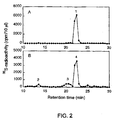
- Fig. 2 shows the result of HPLC (Partisil 10-SAX) column chromatography of products obtained by degrading with keratanase II.
- A represents the elution profile of degraded products of keratan sulfate
- B represents that of degraded products of partially desulfated keratan sulfate.
- Fig. 3 shows the result of HPLC column chromatography of hydrolysates obtained with keratanase II.
- A is the elution profile of 3 H-labeled Gal (6SO 4 ) ⁇ 1-4GlcNAc R (peak 1), Cal ⁇ 1-4GlcNAc R (6SO 4 ) (peak 2), GlcNAc R (6SO 4 ) (peak 3) and Gal R (6SO 4 ) (peak 4).
- B represents the elution profile of the peak 1 of Fig. 2
- C represents the peak 2 of Fig. 2
- D represents the peak 4 of Fig. 2, B, respectively.
- ⁇ represents 3 H radioactivity
- ⁇ represents 35 S-radioactivity.
- the present invention will be further described in detail regarding to the polypeptide of the present invention, the method for the preparation of the polypeptide of the present invention, the DNA of the present invention and the method for the preparation of the sulfated polysaccharide in this order.
- the polypeptide of the present invention may be a polypeptide of keratan sulfate 6-sulfotransferase having the following physicochemical properties:
- 3'-phosphoadenosine 5'-phosphosulfate is preferred.
- the polypeptide of the present invention may also be a polypeptide of 6-sulfotransferase which selectively sulfates C-6 position of galactose residues of keratan sulfate and comprises at least a part of the amino acid sequence shown in SEQ ID NO: 2, which may contain deletion, substitution or addition of one or more amino acids which substantially does not impair the 6-sulfotransferase activity for sulfating keratan sulfate.
- polypeptide of 6-sulfotransferase which selectively sulfates C-6 position of galactose residues of keratan sulfate and comprises at least a part of the following amino acid sequence (a) or (b):
- Such deletion, substitution or addition of one or more amino acids can be obtained by introducing deletion, substitution or addition of nucleotides which may cause deletion, substitution or addition of one or more amino acids into a DNA coding for at least a part of the sequence of SEQ ID NO: 2 and expressing the resulting DNA.
- Such introduction of deletion, substitution or addition of nucleotides into a DNA sequence can be made by synthesizing a sequence containing a mutated sequence and restriction sites at the both ends, and replacing a corresponding portion of an unmutated sequence with the synthesized sequence. Deletion, substitution or addition can also be introduced into a DNA sequence by the site-directed mutagenesis (Kramer, W. and Frits, H.J., Meth.
- the activity for selectively sulfating keratan sulfate that is, transferring a sulfate group from a sulfate group donor to C-6 position of galactose residue of keratan sulfate can be measured by, for example, an enzyme activity assay method to be described hereinafter, and those skilled in the art will readily identify such deletion, substitution or addition of one or more amino acids that substantially do not impair the activity.
- the polypeptide of the present invention is preferably a polypeptide of KSGal6ST containing at least a part of the amino acid sequence shown in SEQ ID NO: 2 and not containing substitution, deletion or addition of the amino acids. More preferably, it is a polypeptide containing at least a part of the amino acid sequence represented by the amino acids 1-411 of SEQ ID NO: 2.
- polypeptide of the present invention include homologous variants having the differences.
- the expression of "to comprise at least a part of an amino acid sequence” means to contain a minimum amino acid sequence sufficient for exhibiting the sulfotransferase activity for selectively sulfating keratan sulfate.
- polypeptide of the present invention may also be a polypeptide comprising a portion of the polypeptide mentioned above.
- portion herein used means a portion exhibiting some activity or having some function such as sulfotransferase activity and antigenicity. Such a portion can be readily identified by those skilled in the art.
- the polypeptide of the present invention should not necessarily be constituted by only the polypeptide itself, and it may be in the form of fused polypeptide, if necessary.
- a fusion polypeptide containing the peptide of the present invention and another polypeptide required for the expression a fusion polypeptide containing the peptide of the present invention and glutathione-S-transferase, a fusion polypeptide containing the peptide of the present invention and a peptide to be biotinylated and the like can be exemplified, but it is not limited to these.
- polypeptide of the present invention mentioned above can be obtained by using the DNA of the present invention described hereinafter.
- the polypeptide of the present invention can be produced by culturing cells harboring the DNA of the present invention in a suitable culture medium so that a polypeptide coded by the DNA is produced and accumulated in the culture, and collecting the polypeptide from the culture.
- Cells harboring a DNA of the present invention can be obtained by inserting a fragment of the DNA of the present invention into a known expression vector to construct a recombinant plasmid, and transforming cells with the recombinant plasmid.
- the cells may be procaryotic cells such as E. coli or eucaryotic cells such as mammalian cells.
- any host-vector systems conventionally used for the production of proteins can be used and, for example, a combination of mammalian cells such as COS-7 cells and a vector for mammalian cell expression such as pCXN2 (Niwa, H., Yamamura, K. andMiyazaki, J. (1991) Gene 108, 193-200) or the like may be preferably employed.
- Culture medium and culture condition may be suitably selected depending on the host cells to be used.
- the DNA of the present invention may be directly expressed, or may be expressed as a fusion polypeptide with another polypeptide.
- the DNA of the present invention may be expressed in its full length, or its part may be expressed as a partial peptide.
- the polypeptide of the present invention can be collected from culture by a known method for purification of polypeptides.
- the culture includes culture medium and cells contained in the medium.
- Antibodies binding to KSGal6ST can be prepared by using a polypeptide of KSGal6ST, a partial polypeptide thereof or a fusion polypeptide thereof with another polypeptide prepared as above. The preparation of such antibodies can be carried out in a manner similar to that of the conventional preparation of antibodies. Monoclonal antibodies binding to KSGal6ST may also be prepared in a conventional manner.
- the DNA of the present invention is a DNA coding for at least a part of the above polypeptide of keratan sulfate 6-sulfotransferase (KSGal6ST), and it is isolated from human for the first time according to the present invention.
- Nucleotide sequence of the DNA of the present invention is not particularly limited so long as it codes for at least a part of the polypeptide of KSGal6ST.
- the polypeptide of human KSGal6ST coded by the DNA of the present invention may contain deletion, substitution or addition of one or more amino acids that substantially does not impair the activity for selectively sulfating keratan sulfate.
- a DNA having nucleotide sequence coding for the amino acid sequence represented by the amino acids 1-411 of SEQ ID NO: 2 can be mentioned, and such a DNA is preferred.
- a DNA containing at least a part of the nucleotide sequence shown as SEQ ID NO: 1 can be mentioned, and such a DNA is particularly preferred.
- Specific examples of such a DNA include a DNA having a nucleotide sequence represented by nucleotides 1 to 1233 of SEQ ID NO: 1.
- chromosome KSGal6ST gene contains introns in the coding region
- a DNA fragment interrupted with introns may be a DNA fragment of the present invention so long as it codes for at least a part of the polypeptide of KSGal6ST. That is, the expression of "code for" herein used may also mean to have a nucleotide sequence which may undergo processing during transcription and ultimately afford a desired polypeptide.
- sequence coding for at least a part of polypeptide preferably means a sequence coding for a sequence exhibiting a certain activity or function such as the KSGal6ST activity and antigenicity, or a sequence containing a nucleotide sequence specific to that of KSGal6ST and hence usable as a primer or probe.
- any DNA or RNA complementary to the DNA of the present invention also falls within the scope of the present invention.
- the DNA of the present invention may be constituted by a single strand coding for KSGal6ST, or it may be a double stranded nucleic acid consisting of a DNA strand coding for KSGal6ST and another DNA or RNA strand complementary to the DNA strand.
- the DNA of the present invention may contain the KSGal6ST coding region in its full length, or may contain a sequence coding for a part of the KSGal6ST peptide.
- the nucleotide sequence of the DNA of the present invention has been elucidated by the present invention, it can be obtained by synthesizing it based on the elucidated sequence, or it can be obtained by amplifying it from human chromosome DNA or mRNA by PCR (polymerase chain reaction) technique using an oligonucleotide primer prepared based on the elucidated sequence.
- the DNA of the present invention was originally obtained by cDNA cloning process comprising the steps mentioned below as described in the examples hereinafter.
- the preparation of the DNA of the present invention is not limited to the methods mentioned above, and the DNA of the present invention can be produced by PCR or any other known methods for cDNA cloning.
- Cloning of cDNA coding for polypeptide of chick C6ST can be performed according to a known method. (Fukuta, M., Uchimura. K., Nakashima, K., Kato, M., Kimata, K., Shinomura, T., and Habuchi, O. (1995) J. Biol. Chem. 270, 18575-18580)
- a radioactive probe labeled with [ 32 P]dCTP for cDNA library screening can be obtained by the random primer labeling method using the cDNA of chick C6ST obtained as described above. That is, such a radioactively labeled DNA probe can be obtained by the random oligonucleotide-primed labeling method (Feinberg, A.P., and Vogelstein, B. (1983) Anal. Biochem. 132, 6-13) for the above chick cDNA using [ ⁇ - 32 P] dCTP (Amersham) and DNA Random Labeling Kit (Takara Shuzo).
- a human cDNA library can be constructed by the preparation of total RNAs from human tissues or cells, preparation of poly(A) + RNAs from the total RNAs, and reverse transcription using the poly (A) + RNAs as templates. All of these process can be done by methods conventionally used in the field of genetic engineering.
- Each cDNA is ligated to a cloning vector.
- the cloning vector is not particularly limited, for example, ⁇ gt11 digested with Eco RI is preferably used.
- Commercially available human cDNA ligated to a cloning vector may also be used.
- human fetal brain cDNA library utilizing lambda vector, ⁇ gt11, available from Clontech is preferred.
- Phage clones containing a full length KSGal6ST cDNA can be selected from the human cDNA library obtained as described above by hybridization utilizing the radioactive probe labeled with [ 32 P]dCTP prepared in the above 1 ⁇ . Hybridization can be performed by a conventional method used in the field of genetic engineering such as plaque hybridization. Positive clones can be selected as the plaques hybridized with the probe by detecting the labeling agent bound to the probe.
- Phage DNA is prepared from the selected positive clones, and digested with an appropriate restriction enzyme to afford a cDNA fragment for insertion. This fragment is inserted into a suitable expression vector to construct a recombinant plasmid. Host cells suitable for the expression vector are transfected with the recombinant plasmid, and the cDNA is expressed in the host cell. Chondroitin 6-sulfotransferase activity, chondroitin 4-sulfotransferase activity and keratan sulfate sulfotransferase activity in the cells are measured, and cells exhibiting only the keratan sulfate sulfotransferase (KSST) activity are selected.
- KSST keratan sulfate sulfotransferase
- clones introduced into the cells strongly exhibiting only the KSST activity are used to prepare phage DNA, and KSGal6ST cDNA can be excised by using a suitable restriction enzyme from the phage DNA.
- the resulting cDNA can be sequenced as they are, or after subcloned into a suitable plasmid.
- the DNA obtained as described above may have substitution, deletion or addition of a nucleotide, which may cause substitution, deletion or addition of one or more amino acid residues, so long as the activity for sulfating keratan sulfate of KSGal6ST coded by this DNA is not substantially impaired.
- substitution, deletion or addition of a nucleotide can be introduced into the DNA sequence by synthesizing a sequence containing restriction sites at its both ends and mutated sequence, and replacing a corresponding sequence of unmutated DNA sequence with the synthesized sequence.
- substitution, deletion or addition can be introduced into a DNA sequence by the site-directed mutagenesis (Kramer, W. and Frits, H.J., Meth.
- the activity for selectively sulfating keratan sulfate i.e., the activity for selectively transferring a sulfate group from a sulfate group donor to the hydroxyl group at C-6 position of galactose residue of keratan sulfate can be measured by, for example, the enzyme activity assay method described hereinafter, and those skilled in the art will be able to readily identify substitution, deletion or addition of one or more amino acid residues which does not substantially impair the activity.
- the method for producing a sulfated polysaccharide of the present invention is characterized in that it comprises exposing keratan sulfate to KSGal6ST which selectively sulfates keratan sulfate.
- the reaction temperature for the reaction utilizing the KSGal6ST is not also particularly limited so long as the activity of the KSGal6ST is maintained, but it is preferred that the reaction should be performed at a temperature around the optimum temperature of the KSGal6ST. when an agent capable of enhancing the activity of Lhe KSGal6ST is available, such an agent maybe added to the reaction system.
- Reaction time can be suitably selected by those skilled in the art depending on amounts of keratan sulfate, the sulfate group donor and the KSGal6ST, and other reaction conditions.
- the reaction is preferably performed at a temperature of around 37°C and a pH value of about 6 to 7. Ca 2+ or Mn 2+ ions may be coexisted during the reaction.
- an active sulfate (3'-phosphoadenosine 5'-phosphosulfate, referred to as "PAPS" hereinafter) is preferred.
- the KSGal6ST selectively sulfating keratan sulfate itself can be used with keratan sulfate and the sulfate group donor.
- the KSGal6ST immobilized on a suitable solid phase e.g., beads
- the reaction system can be placed under continuous action of the enzyme by using a reactor of membrane type provided with a ultrafiltration membrane, dialysis membrane or the like.
- a bioreacter which recycles (synthesizes) the sulfate group donor can be used together.
- conventional methods for the separation and purification of polysaccharides can be used. For example, it can be performed by, adsorption chromatography, anion exchange chromatography, hydrophobic chromatography, gel filtration, gel permeation chromatography, paper electrophoresis, paper chromatography, fractionation with an organic solvent (for example, alcohols, acetone and the like are preferred) or a combination thereof.
- an organic solvent for example, alcohols, acetone and the like are preferred
- the separation and purification methods are not limited to these.
- the substrate, keratan sulfate is not also particularly limited, and those from various origins with various sulfation degrees and molecular weights can be used.
- the reaction mixtures for the assay of chondroitin sulfotransferase activity and keratan sulfate sulfotransferase activity had the following composition: 2.5 ⁇ mol of imidazole-hydrochloric acid (pH 6.8), 1.25 ⁇ g (for the chondroitin sulfotransferase activity assay) or 3.75 ⁇ g (for the keratan sulfate sulfotransferase activity assay) of protamine hydrochloride, 0.1 ⁇ mol of dithiothreitol, 25 nmol (as glucuronic acid) of chondroitin (for the chondroitin sulfotransferase activity assay) or 25 nmol (as glucosamine) of keratan sulfate (for the keratan sulfate sulfotransferase activity assay), 25 pmol of [ 35 S]PAPS (3
- Another reaction mixture for the assay of activity for various kinds of glycosaminoglycan had the following composition: 2.5 ⁇ mol of imidazole-hydrochloric acid (pH 6.8), 0.5 ⁇ g of CaCl 2 , 0.1 ⁇ mol of dithiothreitol, 25 nmol (as glucosamine) of keratan sulfate, 25 pmol of [ 35 S]PAPS and enzyme in a total volume of 50 ⁇ l (Reaction Mixture II).
- glycosaninoglycans as the substrate were assayed by using 25 nmol (as galactosamine for chondroitin sulfate (A and C) and dermatan sulfate, and as glucosamine for keratan sulfate and CDSNS-heparin (completely desulfated, N-sulfated heparin, available from Seikagaku Corp.)) of glycosaminoglycan instead of keratan sulfate.
- 25 nmol as galactosamine for chondroitin sulfate (A and C) and dermatan sulfate
- glucosamine for keratan sulfate and CDSNS-heparin (completely desulfated, N-sulfated heparin, available from Seikagaku Corp.)
- reaction mixtures were incubated at 37°C for 20 minutes, and the reaction was stopped by immersing reaction tubes into boiling water for one minute.
- chondroitin sulfate A was added as a carrier, and 3 volumes of ethanol containing 1.3% potassium acetate was added to the reaction mixture to precipitate 35 S-labeled polysaccharide.
- the reaction mixture was centrifuged at 10,000 ⁇ g for 10 minutes, and the resulting precipitates were dissolved in 70 ⁇ l of water.
- the resulting solution 50 ⁇ l was loaded on a desalting column equilibrated with 0.1 M NH 4 HCO 3 , and the eluted fractions containing the 35 S-labeled polysaccharide were collected.
- Scintillation cocktail (1 ml, Clearsol, Nakarai Tesque) was added to 200 ⁇ l of each of the obtained fractions, and incorporation of 35 S into the polysaccharide was determined by assaying 35 S-radioactivity. Activity catalyzing transfer of 1 pmol sulfate group/minute was defined as 1 unit.
- the precipitates were dissolved in a buffcr (25 ⁇ l) containing 0.1 mg/ml of BSA, 0.05 M Tris-acetic acid, pH 7.5, and 10 milliunits of chondroitinase ACII (derived from Arthrobacter aurescens, Seikagaku Corp.), and allowed to react at 37°C for two hours.
- reaction mixture was spotted on Whatman No.1 filter paper together with 0.1 ⁇ mol each of 2-acetamido-2-deoxy-3-O-( ⁇ -D-gluco-4-enopyranosyluronic acid)-6-O-sulfo-D-galactose ( ⁇ Di-6S) and 2-acetamido-2-deoxy-3-O-( ⁇ -D-gluco-4-enopyranosyluronic acid)-4-O-sulfo-D-galactose ( ⁇ Di-4S) (both from seikagaku Corp.), and developed with 1-butanol/acetic acid/1 M ammonium hydroxide (2:3:1 (V/V/V)) for 20 hours.
- Positions of ⁇ Di-6S and ⁇ Di-4S were determined by means of a ultraviolet lamp, and each site was cut out from the filter paper, and put into a scintillator prepared by dissolving 5 g of diphenyloxazole and 0.25 g of dimethyl 1,4-bis (2- (5-phenyloxazole))benzene in 1L of toluene, and the radioactivity was measured.
- radioactivity was measured for the sample which was degraded with chondroitinase ACII, radioactivity remained at the starting point of the filter paper was 1% or less of the spotted radioactivity.
- chondroitin 6-sulfotransferase activity and chondroitin 4-transferase activity were calculated.
- a radioactive probe for cDNA library screening which was labeled with [ 32 P]dCTP, was prepared by the random primer labeling method using the cDNA of chick C6ST derived from chick chondrocytes and obtained by a known method (J. Biol. Chem. 270(31), 18575-18580, 1995). That is, aprobe was obtained by radiolabeling the above chick cDNA in accordance with the random oligonucleotide-primed labeling method (Feinberg, A.P., and Vogelstein, B. (1983) Anal. Biochem. 132, 6-13) using [ ⁇ - 32 P]dCTP (Amersham) and DNA Random Labeling Kit (Takara Shuzo).
- a human fetal brain cDNA library (Clontech) based on a lambda vector, ⁇ gt11, was used.
- cDNAs of this human fetal brain cDNA library were packaged into phage particles using an in vitro packaging kit (Gigapack II packaging extract, Stratagene). Escherichia coil Y1088 was infected with the resulting phage particles, and overlaid on a plate so that plaques was formed. The resulting phage library obtained as described above was used for cDNA screening without further amplification.
- the fixed phage DNAs on the membrane were prehybridized in a solution containing 50% formamide, 5 ⁇ SSPE (composition of 1 ⁇ SSPE: 10 mM of NaH 2 PO 4 (pH 7.4), 150 mM of NaCl, 1 mM of EDTA), 5 ⁇ Denhardt's solution (composition of 1 ⁇ Denhardt's solution: 0.02% of Ficoll 400, 0.02% of polyvinylpyrrolidone, 0.02% of BSA), 0.5% SDS, 0.04 mg/ml of denatured salmon sperm DNA, and 0.004 mg/ml of E. coli DNA at 42°C for 3.5 hours.
- 5 SSPE composition of 1 ⁇ SSPE: 10 mM of NaH 2 PO 4 (pH 7.4)
- 150 mM of NaCl 1 mM of EDTA
- 5 ⁇ Denhardt's solution composition of 1 ⁇ Denhardt's solution: 0.02% of Ficoll 400
- Hybridization was performed in the same solution as above except that it contained the 32 P labeled probe (prepared in the above ⁇ 1> (1)) at 42°C for 16 hours. Then, the membrane was washed with 1 ⁇ SSPE, 0.1% SDS and then with 0.1 ⁇ SSPE, 0.1% SDS at 55°C, and hybridization positive clones were detected by autoradiography. About 90 positive clones were obtained from 5 ⁇ 10 5 plaques.
- expression vector pCXN2 for mammalian cells (it was constructed by Dr. Jun'ichi Miyazaki of the University of Tokyo (Niwa, H., Yamamura, K., and Miyazaki, J. (1991) Gene 108, 193-200), obtained as a gift from Dr. Yasuhiro Hashimoto of The Tokyo Metropolitan Institute of Medical Science), was used.
- pCXN2 is a vector which contains streptomycin-resistant gene and penicillin-resistant gene, and can express a DNA fragment inserted in Eco RI site with the aid of ⁇ -actin gene promoter. Each cDNA fragment obtained from the above positive clones was ligated to the Eco RI site of pCXN2.
- E. coli JM109 was transformed by using this ligation solution, and plated on a LB plate containing ampicillin. Recombinant plasmid was collected from the transformants, and purified by three times of CsCl/ethidium bromide density-gradient centrifugation.
- COS-7 cells were used as the host for the expression of cDNA.
- COS-7 cells obtained from the RIKEN GENE BANK, Tsukuba, Japan
- DMEM Dulbecco's Modified Eagle medium
- penicillin 100 units/ml
- streptomycin 50 ⁇ g/ml
- 10% fetal bovine scrum Gibco BRL
- the COS-7 cells were transfected. Transfection was performed by the DEAE-dextran method (Aruffo, A. (1991) in Current Protocols in Molecular Biology, Suppl. 14, Unit 16.13, Greene Publishing Associates and Wiley Interscience, New York). Five milliliters of preliminarily heated DMEM containing 10% of Nu serum (serum substitute with a low protein concentration, Collaborative Biomedical Products) was mixed with 0.2 ml of PBS (phosphate buffered saline) containing 10 mg/ml DEAE-dextran and 2.5 mM Chloroquine solution.
- PBS phosphate buffered saline
- This solution was mixed with 15 ⁇ g of the recombinant plasmid, and the mixture was added to the cell suspension.
- the culture medium was substituted with 5 ml of PBS solution containing 10% dimethyl sulfoxide (DMSO).
- DMSO dimethyl sulfoxide
- the cells were left at room temperature for two minutes, the dimethyl sulfoxide solution was removed by aspiration, and 25 ml of DMEM containing penicillin (100 units/ml), streptomycin (50 ⁇ g/ml) and 10% fetal bovine serum was added thereto.
- the cells were incubated for 67 hours, and then washed with DMEM alone.
- the cells were collected and homogenized in 1.5 ml of 0.25 M sucrose, 10 mM Tris-HCl (pH 7.2) and 0.5% Triton X-100 solution per cells from one dish by a Dounce homogenizer. The resulting homogenate was centrifuged at 10,000 ⁇ g for 20 minutes, and chondroitin 6-sulfotransferase (C6ST) activity, chondroitin 4-sulfotransferase (C4ST) activity and keratan sulfate sulfotransferase (KSST) activity in the supernatant fraction were assayed by the activity assay method utilizing Reaction Mixture I.
- C6ST chondroitin 6-sulfotransferase
- C4ST chondroitin 4-sulfotransferase
- KSST keratan sulfate sulfotransferase
- the reaction mixture was incubated at 37°C for 20 minutes, and then Lhe reaction was stopped by heating the reaction tube at 100°C for one minute. Then, the produced 35 S-labeled. glycosaminoglycan was collected by ethanol precipitation, separated by gel chromatography utilizing a fast desalting column (Habuchi et al., J. Biol. Chem., 268(29) 21968-21974, 1993), and its radioactivity was measured. As a result, it was found that, while C6ST and C4ST activities were not observed in the transfected cells, some of them exhibited strong KSST activity.
- each phage DNA was prepared therefrom and digested with Eco RI to excise cDNA insertion fragment as a single fragment.
- the resulting cDNA fragments were subcloned into Bluescript plasmid (Stratagene). Deletion clones were prepared by a known method (Henikoff, S. (1984) Gene 28, 351-359, Yanisch-Perron, C., Viera, J., and Messing, J. (1985) Gene 33, 103-109) using DNA deletion kit (Takara Shuzo) .
- a single open reading frame suggests a polypeptide of 411 amino acid residues coded by the cDNA with a molecular weight of about 46700 and an isoelectric point of about 9.5 deduced from the amino acid sequence.
- This polypeptide also contained 5 positions susceptible to N-linked glycosylation.
- a hydropathy plot was prepared from the deduced amino acid sequence. The hydropathy plot was calculated with a window of 11 amino acids according to the method of Kyte (Kyte, J. and Doolittle, R. F., (1982) J. Mol. Biol. 157, 105-132). Analysis of the plot revealed a distinctive hydrophobic domain of 12 amino acid residues at the amino terminus, which was considered as a transmembrane domain.
- This cDNA was introduced into a plasmid (pCXN2) (a recombinant plasmid where the direction of the promoter is conformed with that of the cDNA was designated as pCXNKSST, and recombinant plasmid where the cDNA was inserted in a reversed direction was designated as pCXNKSST2), and COS-7 cells were transfected with the obtained plasmids by the method described above. Sixty seven hours after the transfection, the COS-7 cells were homogenized and centrifuged, and activities of C6ST, C4ST and KSST in the resulting supernatant were assayed according to the activity assay method utilizing Reaction Mixture I.
- the cells incorporated with the vector inserted with the isolated cDNA of KSST in the correct direction exhibited 6- to 10-fold higher KSST activity compared with the control, whereas they exhibited no increase of the C6ST and C4ST activities.
- dermatan sulfate, heparan sulfate, or completely desulfated N-sulfated heparin (CDSNS-heparin) was used as the sulfate gruup receptor, no increase of sulfotransferase activity was observed.
- a crude extract of COS-7 cells with pCXNKSST introduced, or COS-7 cells without pCXNKSST introduced (control) (4.8 mg as protein) was applied onto a DEAE-Sephacel column (Pharmacia, bed volume; 1 ml) equilibrated with 10 mM Tcis-HCl buffer, pH 7.2, containing 20% glycerol, 20 mM MgCl 2 , 2 mM CaCl 2 and 10 mM 2-mercaptoethanol (Buffer A).
- the column was washed with Buffer A containing 0.05 M NaCl, and absorbed fraction was eluted with Buffer A containing 0.5 M NaCl to collect 1-ml fractions.
- KSST activity and chondroitin sulfotransferase (CST) activity of the eluted fractions of the extracts of COS-7 cells with pCXNKSST introduced and the control COS-7 cells were assayed by the activity assay method utilizing Reaction Mixture I. The results are shown in Fig. 1.
- FIG. 1 A and C are elution profiles of the extract of COS-7 cells with pCXNKSST introduced, and B and D are those of the extract of control COS-7 cells.
- a and B represent KSST activity, and C and D represent CST activity.
- the arrows in Fig. 1 represent the starting point of the elution with Buffer A containing 0.5 M NaCl.
- KSST not having CST activity was isolated from the non-adsorbed fraction as follows.
- the fraction not adsorbed was pooled and applied to a Heparin-Sepharose CL-6B column (Pharmacia, 1.2 ⁇ 8.0 cm) equilibrated with Buffer A containing 0.15 M NaCl.
- the adsorbed fraction was eluted with Buffer A containing 0.5 M NaCl, and the eluate was dialyzed against Buffer A containing 50 mM NaCl.
- the dialysate was used as KSST not containing CST.
- the KSST activity was purified by 15 times after the Heparin-Sepharose CL-6B column purification.
- Table 2 presents the data of KSST enzyme activity of the crude extract and the partially purified product with respect to Various kinds of receptors, which were assayed by the activity assay method utilizing Reaction Mixture II.
- the activity assay 25 nmol (as galactosamine for chondroitin, chondroitin sulfate A, chondroitin sulfate C and dermatan sulfate, and as glucosamine for keratan sulfate and CDSNS-heparin) of glycosaminoglycan was used instead of the keratan sulfate contained in the standard reaction mixture.
- the sulfotransferase activity for transferring a sulfate group to chondroitin, CDSNS-heparin or the like was found in the crude extract, but it was reduced to 2% or less of the keratan sulfate sulfotransferase activity after the purification.
- Glycosaminoglycan (Receptor) Sulfotransferase activity (pmol/minute/mg protein ⁇ 10 -z ) Crude extract Partially purified product None 0.002 0.01 Keratan sulfate 0.168 2.51 Chondroitin 0.016 0.03 Chondroitin sulfate A 0.009 0.03 Chondroitin sulfate C 0.005 0.02 Dermatan sulfate 0.005 0.02 CDSNS-heparin 0.109 0.05
- KSST activity was measured by changing the CaCl 2 used in the activity assay method utilizing Reaction Mixture II to various kinds of salts at a final concentration of 5 mM, Mn 2+ and Ca 2+ most strongly enhanced the KSST activity as shown in Table 3.
- the optimum concentration of Ca 2+ was about 10 mM.
- Dithiothreitol at a concentration up to 10 mM did not affect the KSST activity.
- Km value for PAPS was 2 ⁇ 10 -7 M.
- the sample was degraded in 50 ⁇ l of 2.5 ⁇ mol acetic acid buffer (pH 6.5) containing 0.005 unit of keratanase II, and the reaction mixture was incubated at 37°C for 24 hours.
- the keratanase II degraded product was analyzed by HPLC using Whatman Partisil 10-SAX column (Whatman, 4.5 ⁇ 25 cm) equilibrated with 5 mM KH 2 PO 4 .
- the column was developed with 5 mM KH 2 PO 4 for five minutes, and eluted with a gradient of 5 mM to 250 mM KH 2 PO 4 over 20 minutes at a flow rate of 1 ml/min to collect 0.5-ml fractions, and 35 S-radioactivity was then measured (Fig. 2, A).
- a single peak corresponding to Gal(6SO 4 ) ⁇ 1-4GlcNAc(6SO 4 ) having 35 S-radioactivity was obtained (Fig. 2, peak 1).
- the radioactive peak was collected, dried on a vacuum centrifugal evaporator, dissolved in a small amount of water, and injected into a Hiload Superdex 30 16/60 column (Pharmacia) equilibrated with 0.2 M NH 4 HCO 3 . Fractionation was performed at a flow rate of 1 ml/min to collect 1-ml fractions, each of which was mixed with 4 ml of Clearsol (Nakarai Tesque) and 35 S-radioactivity was measured. Disaccharide was monitored by absorption at 210 nm. The resulting eluate was lyophilized.
- the 35 S-radioactive substance contained in Peak 1 in Fig. 2 was reduced with NaBH 4 and hydrolyzed with 50 ⁇ l of 0.1 M HCl at 100°C for 40 minutes.
- the hydrolysate was purified by paper chromatography and paper electrophoresis. Specifically, the paper chromatography was performed by using Whatman No.3 filter paper (2.5 cm ⁇ 57 cm) and developing with 1-butanol/acetic acid/1 M NH 3 (3:2:1 (V/V/V)).
- the paper electrophoresis was performed by using Whatman No.3 filter paper (2.5 cm ⁇ 57 an) which was immersed in a mixture of pyridine/acetic acid/water (1:10:400 (V/V/V), pH 4) at 30 V/cm for 40 minutes. After the paper electrophoresis and the paper chromatography, the filter paper was dried and cut into 1.25 cm pieces for each lane, and radioactivity was measured in a scintillation solution containing 5 g of diphenyloxazole and 0.25 g of dimethyl 1,4-bis(2-(5-phenyloxazole))benzene in 1 L of toluene.
- the 35 S-labeled substance migrated during the above operation to a position corresponding to Gal ⁇ 1-4GlcNAc R (6SO 4 ) wherein R means alditol formed by the reduction with NaBH 4 was subjected to HPLC to separate into Gal(6SO 4 ) ⁇ 1-4GlcNAc R and Gal ⁇ 1-4GlcNAc R (6SO 4 ) (Fig. 3, B).
- a sample was applied on a Whatman Partisil 10-SAX column (4.5 ⁇ 25 cm) equilibrated with 5 mM KH 2 PO 4 , and developed with 5 mM KH 2 PO 4 at a flow rate of 1 ml/min and a column temperature of 40°C.
- KSST transfers sulfate groups to monosulfated repetition units of keratan sulfate, i.e., C-6 position of galactose residues contained in a structure composed of the repetition unit Gal ⁇ 1-4GlcNAc(6SO 4 ).
- the activity assay method utilizing Reaction Mixturc II was performed by using partially desulfated keratan sulfate as receptor of sulfate groups with incubation of 18 hours.
- the 35 S-labeled glycosaminoglycan produced from the desulfated keratan sulfate was degraded with 0.005 unit of keratanase II, and the degraded product was subjected to HPLC utilizing Whatman Partisil 10-SAX column (4.5 ⁇ 25 cm) equilibrated with 5 mM KH 2 PO 4 , which was developed at a flow rate of 1 ml/min for 5 minutes, and eluted with a gradient of 5 mM to 250 mM of KH 2 PO 4 over 20 minutes at a flow rate of 1 ml/min as described above. 0.5-ml fractions were collected to obtain three radioactive peaks (Fig. 2, B). Peak 2 in Fig.
- B was eluted a little earlier than Gal ⁇ 1-4GlcNAc (6SO 4 ), and Peak 4 was eluted at the location of Gal(6SO 4 ) ⁇ 1-4GlcNAc(6SO 4 ). Peak 3 was eluted between Peak 2 and Peak 4.
- Peak 2 and Peak 4 of Fig. 2 were similarly analyzed as the above Peak 1 of Fig. 2, and, as a result, a single peak was observed at the position of Gal(6SO 4 ) ⁇ 1-4GlcNAc R (the results of the analysis of Peak 2 in Fig. 2 are shown in Fig. 3, C, and those for Peak 4 in Fig. 2 are shown in Fig. 3, D).
- Fig. 3 the results of the analysis of Peak 2 in Fig. 2 are shown in Fig. 3, C, and those for Peak 4 in Fig. 2 are shown in Fig. 3, D).
- the enzyme of the present invention was named keratan sulfate galactose 6-sulfotransferase (KSGal6ST).
- RNA extracted from various human tissues was denatured with 20 mM MOPS buffer, pH 7.0, containing 50% formamide (V/V) and 5% formaldehyde (V/V), and subjected to electrophoresis on 1.2% agarose gel containing 5% formaldehyde. It was transferred to a Hybond N + nylon membrane overnight. The RNA was fixed by heating to 80°C for two hours, and prehybridized in a solution containing 50% formamide, 5 ⁇ SSPE, 5 ⁇ Denhardt's solution, 0.5% SDS and 0.1 mg/ml denatured salmon sperm DNA at 42°C for three hours.
- Hybridization was performed at 42°C for 14 hours using the above buffer containing a probe prepared by using 32 P-labeled KSGal6ST cDNA prepared by the random oligonucleotide-primed labeling method.
- the membrane was washed with 2 ⁇ SSPE and 0.1% SDS at 65°C, and then with 1 ⁇ SSPE and 0.1% SDS.
- An X-ray film was exposed to the membrane using an intensifying screen at -80°C for 26 hours. As a result, when poly(A) + RNA of brain was used, a hybridization band was observed around 2.8 kb.
- KSGal6ST in cornea was also examined by cross hybridization. Specifically, poly(A) + RNA from chick embryo cornea was prepared instead of the above poly(A) + RNA extracted from human tissues, and cross hybridization was performed by using a probe prepared from human KSGal6ST cDNA according to the method described above. Poly (A) + RNAs extracted from heart and brain of chick embryo were used as control. The poly(A) + RNA prepared from cornea of chick embryo showed a cross hybridization band.
Landscapes
- Life Sciences & Earth Sciences (AREA)
- Chemical & Material Sciences (AREA)
- Organic Chemistry (AREA)
- Health & Medical Sciences (AREA)
- Wood Science & Technology (AREA)
- Zoology (AREA)
- Engineering & Computer Science (AREA)
- Bioinformatics & Cheminformatics (AREA)
- Genetics & Genomics (AREA)
- General Health & Medical Sciences (AREA)
- Microbiology (AREA)
- Biotechnology (AREA)
- Molecular Biology (AREA)
- Biochemistry (AREA)
- General Engineering & Computer Science (AREA)
- Medicinal Chemistry (AREA)
- Biomedical Technology (AREA)
- Chemical Kinetics & Catalysis (AREA)
- General Chemical & Material Sciences (AREA)
- Enzymes And Modification Thereof (AREA)
- Preparation Of Compounds By Using Micro-Organisms (AREA)
- Peptides Or Proteins (AREA)
- Saccharide Compounds (AREA)
- Polysaccharides And Polysaccharide Derivatives (AREA)
Applications Claiming Priority (3)
| Application Number | Priority Date | Filing Date | Title |
|---|---|---|---|
| JP32053596 | 1996-11-29 | ||
| JP320535/96 | 1996-11-29 | ||
| JP32053596A JP3766487B2 (ja) | 1996-11-29 | 1996-11-29 | ケラタン硫酸6−スルホトランスフェラーゼ及びそれをコードするdna |
Publications (3)
| Publication Number | Publication Date |
|---|---|
| EP0845533A2 true EP0845533A2 (fr) | 1998-06-03 |
| EP0845533A3 EP0845533A3 (fr) | 1999-07-07 |
| EP0845533B1 EP0845533B1 (fr) | 2003-06-18 |
Family
ID=18122527
Family Applications (1)
| Application Number | Title | Priority Date | Filing Date |
|---|---|---|---|
| EP97309564A Expired - Lifetime EP0845533B1 (fr) | 1996-11-29 | 1997-11-27 | Kératane sulfate 6-sulfotransférase et ADN codant pour celle-ci |
Country Status (4)
| Country | Link |
|---|---|
| US (1) | US6051406A (fr) |
| EP (1) | EP0845533B1 (fr) |
| JP (1) | JP3766487B2 (fr) |
| DE (1) | DE69722901T2 (fr) |
Cited By (1)
| Publication number | Priority date | Publication date | Assignee | Title |
|---|---|---|---|---|
| EP1062326A4 (fr) * | 1998-03-20 | 2002-03-06 | Univ California | Glycosylsulfotransferase-3 |
Families Citing this family (1)
| Publication number | Priority date | Publication date | Assignee | Title |
|---|---|---|---|---|
| US6399358B1 (en) * | 1997-03-31 | 2002-06-04 | Thomas Jefferson University | Human gene encoding human chondroitin 6-sulfotransferase |
Family Cites Families (1)
| Publication number | Priority date | Publication date | Assignee | Title |
|---|---|---|---|---|
| JPH08322573A (ja) * | 1995-05-31 | 1996-12-10 | Seikagaku Kogyo Co Ltd | スルホトランスフェラーゼをコードするdna |
-
1996
- 1996-11-29 JP JP32053596A patent/JP3766487B2/ja not_active Expired - Fee Related
-
1997
- 1997-11-27 EP EP97309564A patent/EP0845533B1/fr not_active Expired - Lifetime
- 1997-11-27 DE DE69722901T patent/DE69722901T2/de not_active Expired - Lifetime
- 1997-12-01 US US08/980,659 patent/US6051406A/en not_active Expired - Lifetime
Cited By (1)
| Publication number | Priority date | Publication date | Assignee | Title |
|---|---|---|---|---|
| EP1062326A4 (fr) * | 1998-03-20 | 2002-03-06 | Univ California | Glycosylsulfotransferase-3 |
Also Published As
| Publication number | Publication date |
|---|---|
| US6051406A (en) | 2000-04-18 |
| EP0845533A3 (fr) | 1999-07-07 |
| JPH10155488A (ja) | 1998-06-16 |
| EP0845533B1 (fr) | 2003-06-18 |
| JP3766487B2 (ja) | 2006-04-12 |
| DE69722901T2 (de) | 2004-05-19 |
| DE69722901D1 (de) | 2003-07-24 |
Similar Documents
| Publication | Publication Date | Title |
|---|---|---|
| US7935792B2 (en) | Antibody reacting with N-acetylglucosamine-6-O-sulfotransferase product | |
| JP3818676B2 (ja) | ヘパラン硫酸6−o−硫酸基転移酵素 | |
| Wei et al. | Formation of HNK-1 determinants and the glycosaminoglycan tetrasaccharide linkage region by UDP-GlcUA: galactose β1, 3-glucuronosyltransferases | |
| WO2004017910A2 (fr) | Synthese totale de l'heparine | |
| EP0845533B1 (fr) | Kératane sulfate 6-sulfotransférase et ADN codant pour celle-ci | |
| JP4791676B2 (ja) | 硫酸基転移酵素及び該酵素をコードするdna | |
| JP2003047467A (ja) | コンドロイチン合成酵素 | |
| US5827713A (en) | DNA coding for sulfotransferase | |
| JP4571242B2 (ja) | ヒト由来のグリコサミノグリカンスルホトランスフェラーゼのポリペプチド及びそれをコードするdna | |
| JP4226693B2 (ja) | 硫酸基転移酵素及びそれをコードするdna | |
| JPWO2002000889A1 (ja) | 硫酸基転移酵素及び該酵素をコードするdna | |
| US20040043447A1 (en) | Production of sulfated polysaccharides using glycosaminoglycan-specific sulfotransferases | |
| US5955325A (en) | Method for producing sulfated lactosamine oligosaccharide | |
| JPH1169983A (ja) | ヘパラン硫酸6−o硫酸基転移酵素のポリペプチド及びそれをコードするdna | |
| JP4590434B2 (ja) | ヒト由来のグリコサミノグリカンスルホトランスフェラーゼを含有する硫酸基転移剤 | |
| JP2942813B2 (ja) | 新規なヒアルロン酸合成酵素のポリペプチド及びそれをコードするdna | |
| JP4377987B2 (ja) | ガラクトース転移酵素及びそれをコードするdna | |
| JP4629214B2 (ja) | N−アセチルグルコサミン転移酵素 | |
| Wei | Glucuronosyltransferases in heparan sulfate initiation and polymerization | |
| JP2003289883A (ja) | 新規n−アセチルガラクトサミン転移酵素及びそれをコードする核酸 |
Legal Events
| Date | Code | Title | Description |
|---|---|---|---|
| PUAI | Public reference made under article 153(3) epc to a published international application that has entered the european phase |
Free format text: ORIGINAL CODE: 0009012 |
|
| AK | Designated contracting states |
Kind code of ref document: A2 Designated state(s): DE FR GB |
|
| AX | Request for extension of the european patent |
Free format text: AL;LT;LV;MK;RO;SI |
|
| RIN1 | Information on inventor provided before grant (corrected) |
Inventor name: HABUCHI, OSAMI Inventor name: FUKUTA, MASAKAZU |
|
| RTI1 | Title (correction) |
Inventor name: HABUCHI, OSAMI |
|
| PUAL | Search report despatched |
Free format text: ORIGINAL CODE: 0009013 |
|
| AK | Designated contracting states |
Kind code of ref document: A3 Designated state(s): AT BE CH DE DK ES FI FR GB GR IE IT LI LU MC NL PT SE |
|
| AX | Request for extension of the european patent |
Free format text: AL;LT;LV;MK;RO;SI |
|
| 17P | Request for examination filed |
Effective date: 19991122 |
|
| AKX | Designation fees paid |
Free format text: DE FR GB |
|
| 17Q | First examination report despatched |
Effective date: 20011002 |
|
| GRAH | Despatch of communication of intention to grant a patent |
Free format text: ORIGINAL CODE: EPIDOS IGRA |
|
| GRAH | Despatch of communication of intention to grant a patent |
Free format text: ORIGINAL CODE: EPIDOS IGRA |
|
| GRAA | (expected) grant |
Free format text: ORIGINAL CODE: 0009210 |
|
| AK | Designated contracting states |
Designated state(s): DE FR GB |
|
| REG | Reference to a national code |
Ref country code: GB Ref legal event code: FG4D |
|
| REF | Corresponds to: |
Ref document number: 69722901 Country of ref document: DE Date of ref document: 20030724 Kind code of ref document: P |
|
| ET | Fr: translation filed | ||
| PLBE | No opposition filed within time limit |
Free format text: ORIGINAL CODE: 0009261 |
|
| STAA | Information on the status of an ep patent application or granted ep patent |
Free format text: STATUS: NO OPPOSITION FILED WITHIN TIME LIMIT |
|
| 26N | No opposition filed |
Effective date: 20040319 |
|
| REG | Reference to a national code |
Ref country code: FR Ref legal event code: CA |
|
| PGFP | Annual fee paid to national office [announced via postgrant information from national office to epo] |
Ref country code: DE Payment date: 20131120 Year of fee payment: 17 Ref country code: FR Payment date: 20131108 Year of fee payment: 17 Ref country code: GB Payment date: 20131127 Year of fee payment: 17 |
|
| REG | Reference to a national code |
Ref country code: DE Ref legal event code: R119 Ref document number: 69722901 Country of ref document: DE |
|
| GBPC | Gb: european patent ceased through non-payment of renewal fee |
Effective date: 20141127 |
|
| REG | Reference to a national code |
Ref country code: FR Ref legal event code: ST Effective date: 20150731 |
|
| PG25 | Lapsed in a contracting state [announced via postgrant information from national office to epo] |
Ref country code: GB Free format text: LAPSE BECAUSE OF NON-PAYMENT OF DUE FEES Effective date: 20141127 Ref country code: DE Free format text: LAPSE BECAUSE OF NON-PAYMENT OF DUE FEES Effective date: 20150602 |
|
| PG25 | Lapsed in a contracting state [announced via postgrant information from national office to epo] |
Ref country code: FR Free format text: LAPSE BECAUSE OF NON-PAYMENT OF DUE FEES Effective date: 20141201 |