EP0845578A2 - Schiebeseitentüranlage zur Verwendung in einem Bohrloch - Google Patents
Schiebeseitentüranlage zur Verwendung in einem Bohrloch Download PDFInfo
- Publication number
- EP0845578A2 EP0845578A2 EP97307048A EP97307048A EP0845578A2 EP 0845578 A2 EP0845578 A2 EP 0845578A2 EP 97307048 A EP97307048 A EP 97307048A EP 97307048 A EP97307048 A EP 97307048A EP 0845578 A2 EP0845578 A2 EP 0845578A2
- Authority
- EP
- European Patent Office
- Prior art keywords
- sleeve
- central axis
- ball
- housing
- port
- Prior art date
- Legal status (The legal status is an assumption and is not a legal conclusion. Google has not performed a legal analysis and makes no representation as to the accuracy of the status listed.)
- Withdrawn
Links
- 238000007789 sealing Methods 0.000 claims abstract description 148
- 239000012530 fluid Substances 0.000 claims description 9
- 238000004891 communication Methods 0.000 claims description 6
- 239000002184 metal Substances 0.000 description 23
- 239000004020 conductor Substances 0.000 description 14
- 238000000034 method Methods 0.000 description 6
- 210000002445 nipple Anatomy 0.000 description 6
- 238000004519 manufacturing process Methods 0.000 description 5
- 230000008878 coupling Effects 0.000 description 4
- 238000010168 coupling process Methods 0.000 description 4
- 238000005859 coupling reaction Methods 0.000 description 4
- 238000000429 assembly Methods 0.000 description 3
- 230000000712 assembly Effects 0.000 description 3
- 230000007613 environmental effect Effects 0.000 description 3
- 238000005299 abrasion Methods 0.000 description 2
- 230000000694 effects Effects 0.000 description 2
- 239000000126 substance Substances 0.000 description 2
- 230000009471 action Effects 0.000 description 1
- 235000021452 apple slice Nutrition 0.000 description 1
- 230000015556 catabolic process Effects 0.000 description 1
- 238000010276 construction Methods 0.000 description 1
- 238000006731 degradation reaction Methods 0.000 description 1
- 238000005553 drilling Methods 0.000 description 1
- 230000007246 mechanism Effects 0.000 description 1
Images

Classifications
-
- E—FIXED CONSTRUCTIONS
- E21—EARTH OR ROCK DRILLING; MINING
- E21B—EARTH OR ROCK DRILLING; OBTAINING OIL, GAS, WATER, SOLUBLE OR MELTABLE MATERIALS OR A SLURRY OF MINERALS FROM WELLS
- E21B34/00—Valve arrangements for boreholes or wells
- E21B34/06—Valve arrangements for boreholes or wells in wells
- E21B34/14—Valve arrangements for boreholes or wells in wells operated by movement of tools, e.g. sleeve valves operated by pistons or wire line tools
Definitions
- This invention relates to well tools and more particularly to flow control devices.
- the invention is especially concerned with a sliding door assembly for use in a wellbore, particularly a metal-to-metal sliding door assembly.
- Conventional side doors for use in oil and gas wells include elastomeric seals for sealing the side port of the fluid conductor.
- the side door assembly is needed in down-hole environments subjecting the side door assembly to hostile conditions, such as high temperature, abrasion, and corrosive chemicals.
- the elastomeric seals have a relatively short useful life under such hostile conditions.
- These flow control devices include a nipple provided with lateral ports and a valve sleeve longitudinally slidably positioned in the nipple for movement between an open position wherein the ports of the nipple are fully opened to permit flow of fluids into the conductor, an equalizing position wherein the flow of well fluids through the ports is restricted whereby the pressure differential between the exterior of the flow conductor and the interior of the flow conductor may be equalized slowly, and a closed position wherein the lateral ports of the nipple are closed to prevent any flow of fluids therethrough into the well flow conductor.
- elastomeric sealing assemblies and an O-ring are positioned and adapted to seal between a sealing sleeve section of the nipple and the valve sleeve which is longitudinally movable in the nipple.
- These elastomeric elements are susceptible to degradation under harsh environmental conditions.
- U.S. Patent No. 3,414,060 issued to Joseph T. Zak on December 3, 1968 describes a selective shifting tool for use in well tubing in conjunction with shifting a sleeve and establishing communication in drilling and production operations between the tubing-casing annulus.
- the shifting tool can be a mandrel, a wire line attachment at the upper end of the mandrel for connection with a wire line and lowering the tool into a shiftable sleeve to engage and lift the sleeve to move the ports thereof into alignment with the ports in the tubing, thus establishing communication with the tubing-casing annulus, or in the event of multiple completion, establishing connection with another zone where pressure of the other zone is greater than the tubing pressure.
- improved assemblies and methods are provided for selectively opening and closing a side port in a flow conductor for a well. More particularly, a sliding side door assembly and method of using the sliding side door assembly is provided for use in a well bore.
- the sliding side door assembly includes a housing and a door subassembly.
- the housing has a generally tubular shape defining a fluid conducting interior therethrough and central axis.
- a side port is formed in the housing, and a ball seat is positioned in the housing adjacent the side port.
- the door subassembly is operatively engaged with the housing adjacent the side port.
- the door subassembly includes a translating sleeve positioned within the housing and adjacent the side port and a ball sealing member defining a generally spherical sealing surface adapted to engage the ball seat of the housing.
- a ball port is formed through the ball sealing member.
- the purpose of the translating sleeve is to provide a structure for translating a driving axial movement of a standard shifting or positioning tool to a rotational movement of the ball sealing member, whereby the rotational movement rotates the ball port into and out of overlapping alignment with the side port to open and close the side port.
- a cooperatively engaged helical track and follower member are provided for translating a driving movement along the central axis through the translating sleeve to a rotational movement of the ball sealing member about the central axis.
- Driving movements acting on the door subassembly can be provided by a standard shifting tool.
- a driving movement acting on the door subassembly in an axial direction along the central axis causes the translating sleeve to rotate the ball sealing member, thereby opening or closing the side port.
- a sliding side door assembly for use in a well bore having a side bore, the sliding side door assembly comprising:
- the ball sealing member may be positioned on the translating sleeve to move with the translating sleeve.
- the ball sealing member may be formed in at least two segments.
- the assembly may further comprise a spring positioned in the housing opposite the side port to urge the ball sealing member toward the side port, thereby assisting in maintaining a sealing engagement between the ball sealing member on the translating sleeve and the ball seat.
- the assembly may further comprise a seat cushion for the translating sleeve of the door subassembly positioned in the housing opposite the side port and between the spring and the translating sleeve.
- the door subassembly further comprises: a shifting sleeve positioned for movement along the central axis within the housing adjacent the translating sleeve; and an alignment member and an alignment groove cooperatively engaged between the shifting sleeve and the housing such that the shifting sleeve can move along the central axis but is prevented from rotational movement about the central axis; and wherein the helical track is positioned in the translating sleeve and the follower member is positioned on the shifting sleeve; whereby a first driving movement acting on the door subassembly in a first axial direction along the central axis causes the shifting sleeve to move in the first axial direction, which causes the follower member on the shifting sleeve engaged with the helical track on the translating sleeve to rotate the translating sleeve in a first rotational direction about the central axis, thereby causing the ball port to move into overlapping alignment with the side port to open the side port
- the shifting sleeve may be adapted to be engaged by a standard wireline tool for transmitting the first and second driving movements to the shifting sleeve of the door subassembly.
- the alignment member may be positioned on the shifting sleeve and the alignment groove may be positioned on the housing.
- the ball sealing member has a bore formed through the ball sealing member, and a portion of the translating sleeve of the door subassembly is positioned in the bore of the ball sealing member.
- the door subassembly may further comprise: an alignment member and an alignment groove cooperatively engaged between the translating sleeve and the housing such that the translating sleeve can move along the central axis but is prevented from rotational movement about the central axis; and a sleeve port formed in the translating sleeve, the helical track being positioned in the translating sleeve and the follower member being positioned on the ball sealing member; whereby a first driving movement acting on the door subassembly in a first axial direction along the central axis causes the translating sleeve to move in the first axial direction, which causes the follower member on the ball sealing member engaged with the helical track on the translating sleeve to rotate the ball sealing member in a first rotational direction about the central axis, thereby causing the sleeve port to move into overlapping alignment with the side port and causing the ball port to move into overlapping alignment with the side port to open the side port; and whereby a
- the translating sleeve may be adapted to be engaged by a standard wireline tool for transmitting the first and second driving movements to the translating sleeve of the door subassembly.
- the assembly may further comprise at least one equalizing port that is substantially smaller than the ball seat formed in the translating sleeve, whereby at least some of any differential pressure across the side port is equalized through the equalizing port before the sleeve port and ball port move into complete overlapping alignment to open the side port.
- the alignment member may be positioned on the translating sleeve and the alignment groove may be positioned in the housing.
- the follower member may be in the form of a pin and the alignment member may be in the form of a pin.
- the assembly may further comprise a spring positioned in the housing opposite the side port to urge the ball sealing member toward the side port, thereby assisting in maintaining a sealing engagement between the ball sealing member and the ball seat.
- the assembly may further comprise a seat cushion for the ball sealing member opposite the side port and between the spring and the ball sealing member.
- the ball sealing member may be rotatable relative to the translating sleeve.
- At least a portion of the housing may be integrally formed with a tubing section for use in a tubing string.
- the ball seat may be formed of metal and the ball sealing member may be formed of metal to create a metal-to-metal seal.
- a metal O-ring may be provided for the metal ball seat.
- a sliding side door assembly for use in a well bore having a side bore, the sliding side door assembly comprising:
- a sliding side door assembly for use in a well bore having a side bore, the sliding side door assembly comprising:
- a sliding side door assembly for use in a well bore comprising:
- a sliding side door assembly is provided that has metal-to-metal sealing surfaces. This metal-to-metal engagement eliminates the need for elastomeric seals.
- the metal-to-metal sliding side door is capable of withstanding more extreme environmental conditions than a side door having elastomeric seal.
- the sliding side door assembly 10 is particularly adapted for use in a well bore and in general includes a housing 12 and a door subassembly 14.
- the housing 12 has a generally tubular shape defining an interior flow conductor 16 therethrough and a central axis X.
- the housing 12 can be formed in one or more parts as may be appropriate taking into account manufacturing and assembly considerations.
- the housing 12 preferably has an upper subsection 18, an intermediate subsection 20, and a lower subsection 22.
- the terms "upper”, “upward”, “lower”, “below”, “down hole”, and the like, as used herein, shall mean in relation to the bottom, or furthest extent of, the surrounding wellbore even though the wellbore or portions of it may be deviated or horizontal.
- the upper subsection 18 preferably has a reduced externally threaded upper end portion 24 so that it can be connected to an end of a well flow conductor, such as a tubing string section (not shown) by means, for example, of a suitable tubular coupling collar (not shown) according to methods well known in the art.
- the lower subsection 22 is preferably similarly provided with a lower reduced externally threaded end portion 26 so that it too can be connected to another end of a well flow conductor, such as a tubing string section (not shown) by means, for example, of a suitable tubular coupling collar (not shown).
- the upper subsection 18 of the housing 12 can be integrally formed with a tubing section (not shown) for use in a tubing string.
- the upper subsection 18 preferably has reduced internal bores adjacent its end portion 24 to provide key retaining surfaces and camming shoulders for engaging a standard shifting or positioning tool to thereby allow engaging the sliding side door assembly 10.
- shifting or positioned tools are well known in the art and commercially available, for example, from Halliburton Energy Services.
- the housing 12 has a side port 28 formed therein for providing fluid communication between the interior 16 of the housing 12 and the exterior of the housing, such as to an annular area around the housing 12 or with a side bore of the well.
- a ball seat 30 is positioned in the housing 12 adjacent the side port 28.
- the ball seat 30 is adapted to receive and engage a portion of a generally spherical sealing surface defined by a ball sealing member.
- the ball seat 30 is formed of metal.
- the metal is selected to withstand hostile down-hole well conditions.
- An O-ring 32 is preferably included to help the ball seat 30 seal the side port 28.
- the O-ring 32 is also most preferably formed of metal.
- the term "generally spherical sealing surface” is intended to define a surface having a contour of at least a portion of a sphere. It is to be understood that the sealing surface is not required to be completely spherical, but only that the sealing surface can be rotated between at least two positions and such that the spherical surface contour is presented to engage a seat, such as ball seat 30, as the sealing surface is rotated between the two positions.
- the term "generally spherical sealing surface” can include a dome shaped surface mounted for movement within the housing 12 adjacent the side port 28.
- the door subassembly 14 is operatively engaged with the housing 12 adjacent the side port 28.
- the door subassembly 14 is for selectively opening and closing the side port 28.
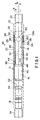
- the door subassembly 14 according to the first embodiment of the invention is shown in FIG. 1.
- the door subassembly 14 includes a translating sleeve 34 positioned within the housing 12 and adjacent the side port 28.
- the translating sleeve 34 is preferably in the form of a hollow tubular member.
- the door subassembly 14 includes a ball sealing member 36 defining a spherical sealing surface 38 that is adapted to engage with the ball seat 30.
- the ball sealing member 36 includes ball port 40, which is illustrated in phantom lines.
- the ball port 40 is preferably of the same size and shape as the side port 28. It is to be understood that by rotating the ball sealing member 36 about the central axis X of the housing 12, the ball port 40 can be moved into overlapping alignment with the side port 28 of the housing 12 to open the side port.
- the ball seat 30 and O-ring 32 are both most preferably formed of metal, and the ball sealing member 36 is also formed of metal, thereby creating a metal-to-metal seal between the ball seat 30 and the ball sealing member 36 without need for any elastomeric seals.
- the ball sealing member 36 is preferably positioned on the translating sleeve to move with the translating sleeve 34.
- the ball sealing member 36 can be integrally formed on the translating sleeve 34.
- the ball sealing member 36 can alternatively be formed in two or more ball segments, which when assembled onto the translating sleeve 34 can be forced to rotate with the translating sleeve 34 by suitable structures, such as splines or pins engaging corresponding receiving structures in the segments of the ball sealing member 36.
- Forming the ball sealing member 36 in segments may be desirable for manufacturing and assembly considerations, whereby the segments can be positioned within the housing 12 whereas an integrally formed ball sealing member would be more difficult to engineer for positioning within the housing 12.
- the door subassembly 14 includes cooperatively engaged helical tracks 42 and follower members 44 for translating a driving movement along the central axis X through the translating sleeve 34 to a rotational movement of the ball sealing member 36 formed or mounted on the translating sleeve 34 to move therewith about the central axis X.
- the helical tracks 42 are preferably in the form of a pair of helically symmetrical and balanced tracks, although only one of the tracks is represented in FIG. 1 for clarity of the drawings.
- the two diametrically opposed follower members 44 are employed to engage the pair of helical tracks 42.
- the additional helical tracks and follower members can be used as a matter of engineering design to translate an axial movement to a rotational movement.
- the follower members 44 are in the form of pins as shown in FIG. 1 of the drawings.
- the door subassembly 14 includes a shifting sleeve 46 positioned for movement along the central axis X within the housing 12 adjacent the translating sleeve 34.
- Alignment members 48 and alignment grooves 50 are cooperatively positioned and engaged between the shifting sleeve 46 and the housing 12 such that the shifting sleeve 46 can move along the central axis X but is prevented from rotational movement about the central axis X.
- each of the alignment members 48 is in the form of a pin; it is to be understood, however, that the alignment member 48 can have any other suitable structural form, such as a spline.
- the alignment members 48 are formed on the shifting sleeve 46 and the alignment grooves 50 are formed on the interior wall of the housing 12, however, such relative positioning of the alignment members 48 and grooves 50 is a matter of engineering design choice. Furthermore, only one cooperatively engaged alignment member 48 and alignment groove 50 is required; however, at least two are preferred, and most preferably the illustrated diametrically opposed pair of such engaging features.
- the helical tracks 42 are shown positioned in the exterior surface of the translating sleeve, and the track followers 44 are shown positioned on the interior surface of the shifting sleeve 46. It is to be understood that such relative positioning of the helical tracks and followers is a matter of engineering design choice; for example, it is envisioned that the helical tracks can be alternatively formed on the interior surface of the shifting sleeve and the track followers can be formed on the translating sleeve.
- the shifting sleeve 46 has a plurality of key retaining and camming structures 52, whereby a standard positioning tool (not shown) can be used to engage with the shifting sleeve 46 and move the shifting sleeve along the central axis X.
- a standard positioning tool (not shown) can be used to engage with the shifting sleeve 46 and move the shifting sleeve along the central axis X.
- the longitudinal movement of the shifting sleeve 46 along the axis X is stopped by upper shoulder 54 and lower shoulder 56, thereby defining the range of movement for the shifting sleeve 46.
- the sliding side door assembly 10 preferably includes a seat cushion 58 for the ball sealing member 36.
- the seat cushion 58 is preferably positioned substantially circumferential of the housing, having a first portion 58a above the ball sealing member 36 and a second portion 58b below the ball sealing member 36, the first and second portions 58a and 58b of the seat cushion being adapted to engage and retain the ball sealing member 36 in position within the housing 12.
- the ends of the first and second portions 58a and 58b forming the seat cushion in the first embodiment according to the invention are preferably formed to abut the ball seat 30.
- the door subassembly 14 of the sliding side door assembly 10 preferably includes a spring 60, most preferably of the Belville type, positioned in the housing 12 opposite the side port 28 to urge the ball sealing member 36 toward the side port 28.
- the spring 60 assists in maintaining a sealing engagement between the surface 38 of the ball sealing member 36 and the ball seat 30 of the housing 12.
- a first driving movement acting on the shifting sleeve 46 of the door subassembly 14 in a first axial direction represented by the arrow A along the central axis X causes the translating sleeve 34 to rotate the ball sealing member 36 about the central axis X in the rotational direction indicated by the arrow B such that the ball port 40 moves into overlapping alignment with the side port 28, thereby opening the side port.
- a second driving movement acting on the shifting sleeve 46 of the door subassembly 14 in a second axial direction along the central axis X opposite the first axial direction A causes the translating sleeve 34 to rotate the ball sealing member 36 in a rotational direction opposite to that indicated by the arrow B such that the ball port 40 moves out of overlapping alignment with the side port 28 and back to the position shown in FIG. 1, thereby closing the side port.
- the sliding side door assembly according to the second embodiment is generally referred to by the reference numeral 100.
- the sliding side door assembly 100 is particularly adapted for use in a well bore and in general includes a housing 112 and a door subassembly 114.
- the housing 112 has a generally tubular shape defining an interior flow conductor 116 and a central axis X.
- the housing 112 can be formed in one or more parts as may be appropriate taking into account manufacturing and assembly considerations.
- the housing 112 preferably has an upper subsection 118, an intermediate subsection 120, and a lower subsection 122.
- the upper subsection 118 preferably has a reduced externally threaded upper end portion 124 so that it can be connected to an end of a well flow conductor, such as a tubing string section (not shown) by means, for example, of a suitable tubular coupling collar (not shown) according to methods well known in the art.
- the lower subsection 122 is preferably similarly provided with a lower reduced externally threaded end portion 126 so that it too can be connected to another end of a well flow conductor, such as a tubing string section (not shown) by means, for example, of a suitable tubular coupling collar (not shown).
- a well flow conductor such as a tubing string section (not shown)
- the upper subsection 118 is preferably connected to the intermediate subsection 120 at threaded interface 127.
- the upper subsection 118 of the housing 112 can be integrally formed with a tubing section (not shown) for use in a tubing string.
- the upper subsection 118 preferably has reduced internal bores adjacent its end portion 124 to provide key retaining surfaces and camming shoulders for engaging a standard shifting or positioning tool for engaging the door sliding side door assembly 100.
- shifting or positioned tools are well known in the art and commercially available, for example, from Halliburton Energy Services.
- the housing 112 has a side port 128 formed therein for providing fluid communication between the interior 116 of the housing 112 and the exterior of the housing, such as to an annular area around the housing 112 or with a side bore of the well.
- a ball seat 130 is positioned in the housing 112 adjacent the side port 128.
- the ball seat 130 is adapted to receive and engage a portion of a generally spherical sealing surface defined by a ball sealing member.
- the ball seat 130 is formed of metal.
- the metal is selected to withstand hostile down-hole well conditions.
- An O-ring 132 is preferably included to help the ball seat 130 seal the side port 128.
- the O-ring 132 is also most preferably formed of metal.
- the door subassembly 114 is operatively engaged with the housing 112 adjacent the side port 128.
- the door subassembly 114 according to the second embodiment of the invention is for selectively opening and closing the side port 128.
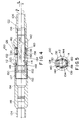
- the door subassembly 114 according to the second embodiment of the invention is shown in FIGS. 2 - 5.
- the door subassembly 114 includes a translating sleeve 134 positioned within the housing 112 and adjacent the side port 128.
- the translating sleeve 134 is preferably in the form of a hollow tubular member.
- the door subassembly 114 preferably includes a sleeve port 135 formed in the translating sleeve 134.
- the sleeve port 135 is preferably the same size and shape as the side port 128. It is to be understood that according to the second embodiment of the invention, shifting the translating sleeve 134 along the central axis X of the housing from the position shown in FIG. 2 to the position shown in FIG. 4 of the drawings will cause the sleeve port 135 to be moved into overlapping alignment with the side port 128 of the housing 112.
- the door subassembly 114 includes a ball sealing member 136 defining a generally spherical sealing surface 138 that is adapted to engage with the ball seat 130.
- the ball sealing member 136 has a ball bore 139 formed through the ball sealing member 136.
- a portion of the translating sleeve 134 of the door subassembly 114 is positioned in the ball bore 139 of the ball sealing member 136.
- the ball sealing member 136 can be rotated relative to the translating sleeve 134.
- the ball sealing member 136 includes ball port 140, which is illustrated in phantom lines in FIG. 2 of the drawings.
- the ball port 140 is preferably of the same size and shape as the side port 128. It is to be understood that by rotating the ball sealing member 136 about the central axis X of the housing 112, the ball port 140 can be moved into overlapping alignment with the side port 128 of the housing 112 to open the side port.
- the ball seat 130 and O-ring 132 are both most preferably formed of metal, and the ball sealing member 136 is also formed of metal, thereby creating a metal-to-metal seal between the ball seat 130 and the ball sealing member 136 without need for any elastomeric seals.
- the door subassembly 114 includes cooperatively engaged helical tracks 142 and follower members 144 for translating a driving movement along the central axis X through the translating sleeve 134 to a rotational movement of the ball sealing member 136 about the central axis X.
- the helical tracks 142 are preferably in the form of a pair of helically symmetrical and balanced tracks, although only one of the tracks is represented in the FIGS. 2 and 4 for clarity of the drawings.
- Two diametrically opposed follower members 144 are employed for the pair of helical tracks 142.
- the helical tracks 142 are shown positioned in the exterior surface of the translating sleeve 134, and the track followers 144 are shown positioned on the interior surface of the ball bore 139 of the ball sealing member 136. It is to be understood, however, the additional helical tracks and follower members can be used as a matter of engineering design to translate an axial movement to a rotational movement.
- the follower members 144 are in the form of pins as shown in the drawings.
- the door subassembly 114 does not require a separate shifting sleeve.
- Alignment members 148 and alignment grooves 150 are cooperatively positioned and engaged between the translating sleeve 134 and the housing 112 such that the translating sleeve 134 can move along the central axis X but is prevented from rotational movement about the central axis X.
- each of the alignment members 148 is in the form of a pin; it is to be understood, however, that the alignment member 148 can have any other suitable structural form, such as a spline.
- the alignment members 148 are formed on the translating sleeve 134 and the alignment grooves 150 are formed on the interior wall of the housing 112; however, such relative positioning of the alignment members 148 and grooves 150 is a matter of engineering design choice.
- only one cooperatively engaged alignment member 148 and alignment groove 150 is required; however, at least two are preferred, and the illustrated diametrically opposed pair of such engaging features is most preferred.
- the translating sleeve 134 has a plurality of key retaining and camming structures 152, whereby a standard positioning tool (not shown) can be used to engage with the translating sleeve 134 and move the translating sleeve along the central axis X.
- a standard positioning tool (not shown) can be used to engage with the translating sleeve 134 and move the translating sleeve along the central axis X.
- the longitudinal movement of the translating sleeve 134 along the axis X is stopped by upper shoulder 154 and lower shoulder 156, thereby defining the range of movement for the translating sleeve 134.
- the sliding side door assembly 100 preferably includes a seat cushion 158 for the ball sealing member 136.
- the seat cushion 158 is preferably positioned opposite the side port 128 of the housing 112.
- the door subassembly 114 of the sliding side door assembly 100 preferably includes a spring 160, most preferably of the Belville type, positioned in the housing 112 opposite the side port 128 to urge the ball sealing member 136 toward the side port 128.
- the spring 160 assists in maintaining a sealing engagement between the generally spherical sealing surface 138 of the ball sealing member 136 on the translating sleeve 134 and the ball seat 130 of the housing 112. Having the ball seat 130 and seat cushion 158 constantly spring loaded against the ball sealing member 136 assures that debris will not intrude between the sealing surfaces. Additionally the sealing surfaces are wiped clean during each rotational cycle of the ball sealing member 136.
- a first driving movement acting on the translating sleeve 134 of the door subassembly 114 in a first axial direction indicated by the arrow A along the central axis X causes the translating sleeve 134 to move in the first axial direction, which causes the follower members 144 on the ball sealing member 136 engaged with the helical tracks 142 on the translating sleeve 134 to rotate the ball sealing member 136 in a first rotational direction indicated by the arrow B about the central axis X, thereby causing the sleeve port 139 to move into overlapping alignment with the side port 128 and causing the ball port 140 to move into overlapping alignment with the side port 128, thereby opening the side port.
- a second driving movement acting on the translating sleeve 134 of the door subassembly 114 in a second axial direction opposite the direction indicated by the arrow A along the central axis X causes the translating sleeve 134 to move in the second axial direction, which causes the follower members 144 on the ball sealing member 136 engaged with the helical tracks 142 on the translating sleeve 134 to rotate the ball sealing member 136 in a second rotational direction opposite to the rotational direction indicated by the arrow B about the central axis, thereby causing the sleeve port 139 to move out of overlapping alignment with the side port 128 and causing the ball port 140 to move out of overlapping alignment with the side port 128, thereby closing the side port.
- the sliding side door assembly 100 can be dimensioned or ported to be self-equalizing by the choking effect of the tight tolerance between the internal diameter of the housing 112 and the translating sleeve 134. The action would be such that partial rotation of the ball sealing member 136 would occur prior to the sleeve port 135 of the translating sleeve 134 passing the leading edge of the side port 128.
- At least one equalizing port 162 is preferably provided in the translating sleeve 134. More preferably, several equalizing ports 162 are provided, which are spaced circumferentially around the translating sleeve 134 intermediate the length of the helical tracks 142. Thus, at least one of the equalizing ports 162 moves into overlapping alignment with the side port as the translating sleeve 134 is moved from the position shown in FIG. 2 to the position shown in FIG. 4 of the drawings.
- the equalizing port 162 is preferably substantially smaller than the side port 128 and the ball seat 130, whereby at least some of any differential pressure across the side port 128 when it is closed can be choked and equalized through the equalizing port 162 before the sleeve port 135 and ball port 140 are moved into overlapping alignment to open the side port 128, thereby helping to reduce the effects of flow-cutting across the closure mechanism.
Landscapes
- Life Sciences & Earth Sciences (AREA)
- Engineering & Computer Science (AREA)
- Geology (AREA)
- Mining & Mineral Resources (AREA)
- Physics & Mathematics (AREA)
- Environmental & Geological Engineering (AREA)
- Fluid Mechanics (AREA)
- General Life Sciences & Earth Sciences (AREA)
- Geochemistry & Mineralogy (AREA)
- Taps Or Cocks (AREA)
- Power-Operated Mechanisms For Wings (AREA)
Applications Claiming Priority (2)
| Application Number | Priority Date | Filing Date | Title |
|---|---|---|---|
| US08/753,662 US5794699A (en) | 1996-11-27 | 1996-11-27 | Metal-to-metal sliding side door for wells |
| US753662 | 1996-11-27 |
Publications (2)
| Publication Number | Publication Date |
|---|---|
| EP0845578A2 true EP0845578A2 (de) | 1998-06-03 |
| EP0845578A3 EP0845578A3 (de) | 2002-01-23 |
Family
ID=25031617
Family Applications (1)
| Application Number | Title | Priority Date | Filing Date |
|---|---|---|---|
| EP97307048A Withdrawn EP0845578A3 (de) | 1996-11-27 | 1997-09-11 | Schiebeseitentüranlage zur Verwendung in einem Bohrloch |
Country Status (5)
| Country | Link |
|---|---|
| US (1) | US5794699A (de) |
| EP (1) | EP0845578A3 (de) |
| AU (1) | AU716162B2 (de) |
| CA (1) | CA2221557A1 (de) |
| NO (1) | NO310434B1 (de) |
Cited By (1)
| Publication number | Priority date | Publication date | Assignee | Title |
|---|---|---|---|---|
| EP0792997A3 (de) * | 1996-02-29 | 1999-01-13 | Halliburton Energy Services, Inc. | Verfahren und Vorrichtung zur Zugangskontrolle eines Werkzeuges in einer Seitenbohrung |
Families Citing this family (12)
| Publication number | Priority date | Publication date | Assignee | Title |
|---|---|---|---|---|
| WO1999005395A1 (en) * | 1997-07-24 | 1999-02-04 | Camco International Inc. | Full bore variable flow control device |
| US6422317B1 (en) | 2000-09-05 | 2002-07-23 | Halliburton Energy Services, Inc. | Flow control apparatus and method for use of the same |
| US6715558B2 (en) | 2002-02-25 | 2004-04-06 | Halliburton Energy Services, Inc. | Infinitely variable control valve apparatus and method |
| GB0504055D0 (en) * | 2005-02-26 | 2005-04-06 | Red Spider Technology Ltd | Valve |
| GB0621031D0 (en) * | 2006-10-24 | 2006-11-29 | Red Spider Technology Ltd | Downhole apparatus and method |
| NO336371B1 (no) * | 2012-02-28 | 2015-08-10 | West Production Technology As | Mateanordning for nedihullsverktøy samt framgangsmåte for aksiell mating av et nedihullsverktøy |
| US8763707B2 (en) * | 2012-04-03 | 2014-07-01 | Halliburton Energy Services, Inc. | Downhole circulating valve having a metal-to-metal seal |
| US9388663B2 (en) * | 2012-04-03 | 2016-07-12 | Halliburton Energy Services, Inc. | Downhole circulating valve having a metal-to-metal seal and method for operating same |
| US9133682B2 (en) * | 2012-04-11 | 2015-09-15 | MIT Innovation Sdn Bhd | Apparatus and method to remotely control fluid flow in tubular strings and wellbore annulus |
| US9915354B2 (en) * | 2014-12-19 | 2018-03-13 | Schlumberger Technology Corporation | Rotary check valve |
| CN107366522B (zh) * | 2017-08-01 | 2023-08-18 | 中国石油天然气集团有限公司 | 一种可变长度的滑套开启工具及其套管滑套 |
| CA2994290C (en) | 2017-11-06 | 2024-01-23 | Entech Solution As | Method and stimulation sleeve for well completion in a subterranean wellbore |
Citations (2)
| Publication number | Priority date | Publication date | Assignee | Title |
|---|---|---|---|---|
| US3051243A (en) | 1958-12-12 | 1962-08-28 | George G Grimmer | Well tools |
| US3414060A (en) | 1967-11-20 | 1968-12-03 | Joseph T. Zak | Selective shifting tool |
Family Cites Families (11)
| Publication number | Priority date | Publication date | Assignee | Title |
|---|---|---|---|---|
| US2710655A (en) * | 1952-07-19 | 1955-06-14 | J B Nelson | Rotatable port control sleeve |
| US3376936A (en) * | 1966-12-13 | 1968-04-09 | Paraffin Tool & Equipment Co | Bypass valve for removing paraffin in oil wells |
| US3815675A (en) * | 1972-05-22 | 1974-06-11 | Exxon Production Research Co | Wireline operated subsurface safety valve |
| US3815676A (en) * | 1972-10-16 | 1974-06-11 | Dresser Ind | Indexing equalizing valve for retrievable well packer |
| US4296807A (en) * | 1979-12-27 | 1981-10-27 | Halliburton Company | Crossover tool |
| FR2509366A1 (fr) * | 1981-07-08 | 1983-01-14 | Flopetrol | Dispositif de commande d'un outil de fermeture de la colonne de production d'un puits |
| US4489963A (en) * | 1982-04-13 | 1984-12-25 | Otis Engineering Corporation | Pipe joint |
| US4473245A (en) * | 1982-04-13 | 1984-09-25 | Otis Engineering Corporation | Pipe joint |
| US4433862A (en) * | 1982-04-13 | 1984-02-28 | Otis Engineering Corporation | Pipe joint |
| US4458925A (en) * | 1983-05-19 | 1984-07-10 | Otis Engineering Corporation | Pipe joint |
| US4903775A (en) * | 1989-01-06 | 1990-02-27 | Halliburton Company | Well surging method and apparatus with mechanical actuating backup |
-
1996
- 1996-11-27 US US08/753,662 patent/US5794699A/en not_active Expired - Fee Related
-
1997
- 1997-08-28 NO NO19973961A patent/NO310434B1/no not_active IP Right Cessation
- 1997-09-11 EP EP97307048A patent/EP0845578A3/de not_active Withdrawn
- 1997-11-19 CA CA002221557A patent/CA2221557A1/en not_active Abandoned
- 1997-11-24 AU AU45363/97A patent/AU716162B2/en not_active Ceased
Patent Citations (2)
| Publication number | Priority date | Publication date | Assignee | Title |
|---|---|---|---|---|
| US3051243A (en) | 1958-12-12 | 1962-08-28 | George G Grimmer | Well tools |
| US3414060A (en) | 1967-11-20 | 1968-12-03 | Joseph T. Zak | Selective shifting tool |
Cited By (1)
| Publication number | Priority date | Publication date | Assignee | Title |
|---|---|---|---|---|
| EP0792997A3 (de) * | 1996-02-29 | 1999-01-13 | Halliburton Energy Services, Inc. | Verfahren und Vorrichtung zur Zugangskontrolle eines Werkzeuges in einer Seitenbohrung |
Also Published As
| Publication number | Publication date |
|---|---|
| AU4536397A (en) | 1998-06-04 |
| AU716162B2 (en) | 2000-02-17 |
| US5794699A (en) | 1998-08-18 |
| NO973961L (no) | 1998-05-28 |
| EP0845578A3 (de) | 2002-01-23 |
| CA2221557A1 (en) | 1998-05-27 |
| NO310434B1 (no) | 2001-07-02 |
| NO973961D0 (no) | 1997-08-28 |
Similar Documents
| Publication | Publication Date | Title |
|---|---|---|
| US7673689B2 (en) | Dual flapper barrier valve | |
| US5794699A (en) | Metal-to-metal sliding side door for wells | |
| CA1038750A (en) | Wireline safety valve with split ball | |
| US8403067B2 (en) | Repeatable, compression set downhole bypass valve | |
| US4945993A (en) | Surface controlled subsurface safety valve | |
| US8113286B2 (en) | Downhole barrier valve | |
| US8727026B2 (en) | Dual isolation mechanism of cementation port | |
| US9784057B2 (en) | Mechanical bi-directional isolation valve | |
| GB2396633A (en) | Choke valve with rotatable sleeve | |
| GB2214955A (en) | Surface controlled subsurface safety valve | |
| US5826657A (en) | Selectively locking open a downhole tester valve | |
| US4503913A (en) | Subsurface well safety valve | |
| EP2412917B1 (de) | Hydraulisches bidirektionales Drehisolierventil | |
| EP2459842B1 (de) | Reinigungswerkzeug für ein bohrloch | |
| EP2834444B1 (de) | Aktuator für doppelbohrgestängeventil und drehbohrgestängeventilkonfiguration dafür | |
| CA2905813C (en) | Resettable ball seat for hydraulically actuating tools | |
| US6105670A (en) | Injection/isolation tool | |
| US11091982B2 (en) | Equalizing device | |
| US3385371A (en) | Sleeve valve for well tools | |
| GB2169332A (en) | Subsurface well safely valve | |
| GB2323872A (en) | Subsurface safety valve having non-metallic, non-elastomeric seals |
Legal Events
| Date | Code | Title | Description |
|---|---|---|---|
| PUAI | Public reference made under article 153(3) epc to a published international application that has entered the european phase |
Free format text: ORIGINAL CODE: 0009012 |
|
| AK | Designated contracting states |
Kind code of ref document: A2 Designated state(s): AT BE CH DE DK ES FI FR GB GR IE IT LI LU MC NL PT SE |
|
| AX | Request for extension of the european patent |
Free format text: AL;LT;LV;RO;SI |
|
| PUAL | Search report despatched |
Free format text: ORIGINAL CODE: 0009013 |
|
| AK | Designated contracting states |
Kind code of ref document: A3 Designated state(s): AT BE CH DE DK ES FI FR GB GR IE IT LI LU MC NL PT SE |
|
| AX | Request for extension of the european patent |
Free format text: AL;LT;LV;RO;SI |
|
| 17P | Request for examination filed |
Effective date: 20020301 |
|
| STAA | Information on the status of an ep patent application or granted ep patent |
Free format text: STATUS: THE APPLICATION HAS BEEN WITHDRAWN |
|
| 18W | Application withdrawn |
Withdrawal date: 20020523 |