EP0847963A2 - Procédé pour exploiter une installation d'épuration des eaux communales à deux étages et installation mettant en oeuvre ce procédé - Google Patents
Procédé pour exploiter une installation d'épuration des eaux communales à deux étages et installation mettant en oeuvre ce procédé Download PDFInfo
- Publication number
- EP0847963A2 EP0847963A2 EP97114054A EP97114054A EP0847963A2 EP 0847963 A2 EP0847963 A2 EP 0847963A2 EP 97114054 A EP97114054 A EP 97114054A EP 97114054 A EP97114054 A EP 97114054A EP 0847963 A2 EP0847963 A2 EP 0847963A2
- Authority
- EP
- European Patent Office
- Prior art keywords
- stage
- denitrification
- partial
- reactor
- wastewater
- Prior art date
- Legal status (The legal status is an assumption and is not a legal conclusion. Google has not performed a legal analysis and makes no representation as to the accuracy of the status listed.)
- Withdrawn
Links
Images


Classifications
-
- C—CHEMISTRY; METALLURGY
- C02—TREATMENT OF WATER, WASTE WATER, SEWAGE, OR SLUDGE
- C02F—TREATMENT OF WATER, WASTE WATER, SEWAGE, OR SLUDGE
- C02F3/00—Biological treatment of water, waste water, or sewage
- C02F3/02—Aerobic processes
- C02F3/12—Activated sludge processes
- C02F3/1205—Particular type of activated sludge processes
- C02F3/121—Multistep treatment
-
- C—CHEMISTRY; METALLURGY
- C02—TREATMENT OF WATER, WASTE WATER, SEWAGE, OR SLUDGE
- C02F—TREATMENT OF WATER, WASTE WATER, SEWAGE, OR SLUDGE
- C02F3/00—Biological treatment of water, waste water, or sewage
- C02F3/02—Aerobic processes
- C02F3/06—Aerobic processes using submerged filters
-
- C—CHEMISTRY; METALLURGY
- C02—TREATMENT OF WATER, WASTE WATER, SEWAGE, OR SLUDGE
- C02F—TREATMENT OF WATER, WASTE WATER, SEWAGE, OR SLUDGE
- C02F3/00—Biological treatment of water, waste water, or sewage
- C02F3/30—Aerobic and anaerobic processes
- C02F3/302—Nitrification and denitrification treatment
-
- Y—GENERAL TAGGING OF NEW TECHNOLOGICAL DEVELOPMENTS; GENERAL TAGGING OF CROSS-SECTIONAL TECHNOLOGIES SPANNING OVER SEVERAL SECTIONS OF THE IPC; TECHNICAL SUBJECTS COVERED BY FORMER USPC CROSS-REFERENCE ART COLLECTIONS [XRACs] AND DIGESTS
- Y02—TECHNOLOGIES OR APPLICATIONS FOR MITIGATION OR ADAPTATION AGAINST CLIMATE CHANGE
- Y02W—CLIMATE CHANGE MITIGATION TECHNOLOGIES RELATED TO WASTEWATER TREATMENT OR WASTE MANAGEMENT
- Y02W10/00—Technologies for wastewater treatment
- Y02W10/10—Biological treatment of water, waste water, or sewage
Definitions
- the invention relates to a method for operating a two stage cleaning system for cleaning municipal commercial wastewater with raw sewage supply and Activated sludge discharge and a drain for the treated Sewage.
- the invention further relates to a plant for cleaning of municipal commercial wastewater for the invention Operation is set up.
- a known one Process of the type mentioned, of which the Invention comes out (Katsumi Nomura, "Development and Optimization of a process combination of medium and highly loaded revitalization and biologically intensive Filtration with high performance on the smallest Jardin ", dissertation TH Aachen, 1988, pages 183 to 187) is with a medium to high stress level worked on a biologically intensified filter stage is connected downstream.
- the biological activity is through an oxygen supply to the filter bed of the filter stage guaranteed.
- a partial flow of the treated in the filter stage and running sewage is in the known Process returned to the filter stage.
- AB system a two-stage activation system
- the high-load activation stage (A stage) is operated as an adsorption stage with a sludge load of at least 2 kg BOD 5 per kg dry matter and day aerobically or optionally anaerobically with at least 500 x 10 5 prokaryote germs in cm 2 .
- carbon removal takes place primarily, but phosphorus and nitrogen are also eliminated due to the high sludge production. To some extent, denitrification also takes place.
- the second cleaning stage in this known system is designed as a classic activation stage, which is operated as an aerated stage with a sludge load of less than 0.15 kg BOD 5 per kg of dry matter and day.
- a recirculation of sludge from the clarification is also planned.
- the sludge is at least partially reintroduced into the adsorption stage, with the proviso that the amount of sludge reintroduced in the adsorption stage does not interfere with the operation of the first activation stage as the adsorption stage.
- this known system is characterized by a relatively high space requirement.
- the framework wastewater administration regulations require a very extensive treatment of the wastewater, which in conventional sewage treatment plants requires a lot of space and space.
- the discharge limit for inorganic nitrogen N inorganic ⁇ 18 mg / l is required in the Federal Republic of Germany.
- the European directive calls for sensitive areas a flow limit for N tot ⁇ 10 gm / l at more than 100,000 PT. Such cleaning performance requires a very large amount of space for conventional sewage treatment plants.
- the invention is based on the technical problem To operate the system of the structure described at the beginning, that sufficient nitrogen elimination is achieved and at the same time the space requirement for the system is reduced.
- a method for operating a two-stage Cleaning system for the cleaning of municipal trade Wastewater with raw wastewater inlet and activated sludge discharge which cleaning system a biological High load revitalization stage and a downstream biological intensified filter stage as well as a process for the treated Has wastewater, with the biologically intensified Filter stage with an upstream denitrification stage is operated.
- the high-load revitalization level operated as an adsorption stage and the The adsorption stage is expediently an intermediate clarification stage downstream.
- the biologically intensified filter stage or filter system preferably consists of at least two filter stages, namely the upstream denitrification stage and expediently a downstream one Nitrification level.
- the biologically intensified filter system to a third filter stage.
- Each of the filter stages can consist of one or more Filter units exist. At least the first two Filter stages are intensified biologically. All filter levels can be operated in full flow or in partial flow. It is within the scope of the invention that the third filter stage is carried out as a further denitrification stage, An external carbon source is then expedient added.
- the further denitrification stage can be done with or be operated without phosphorus elimination.
- a classic filtration stage for the suspension of suspensions a multilayer filter stage and the like acts.
- Other examples of this are ongoing operated filter with internal backwashing, in phases backwashed filters, fluid bed reactors with / without dosing as well as optional internal or external material return, Floating bed reactors or activated carbon filters.
- Other filter materials are plastics, e.g. Styrofoam, for use.
- Phosphorus elimination can be provided with precipitants. All filter stages of the biologically intensified filter system can flow either upwards or downwards will.
- first filter stage If the first filter stage is flown upwards, can at a freely selectable height of the filter bed atmospheric oxygen to be entered in the first filter stage a lower anoxic part and an upper aerobic part to divide.
- the second filter stage can also be divided into one lower anoxic part and an upper aerobic part be divided.
- the atmospheric oxygen can be caused by pure oxygen be enriched or replaced.
- the Nitrate nitrogen from the end of the second filter stage of the Biologically intensified filter system for the denitrification stage recirculated.
- the one contained in the waste water Carbon used for upstream denitrification and at the same time the carbon is oxidized.
- the invention is based on the finding that very good wastewater treatment performance can be achieved by combining a high-load revitalization stage (A stage) with a biologically intensified filter system which follows in the flow direction and has an upstream denitrification stage. These allow a remarkably large amount of space to be saved compared to the same loads of single-stage wastewater treatment plants.
- the system according to the invention saves a considerable amount of clarification space, since on the one hand only little space is required for the elimination of nitrogen and phosphorus and for nitrification and the clarification is not required.
- the wastewater treated in the high-load revitalization stage (A stage) has excellent degradability.
- the remaining carbon from the A stage is more readily available or usable for the subsequent denitrification in the biologically intensified filter stage, although the concentration is nominally lower compared to a classic preliminary clarification.
- the A stage buffers freight fluctuations in the inflowing wastewater very well.
- the biologically intensified filter system connected downstream according to the invention brings about a physical / biological cleaning, eliminates the carbon load still present in the denitrification stage from the high-load revitalization by the biological denitrification.
- the NH 4 -N exposure to oxygen is eliminated and nitrified.
- a first larger partial flow of more than 50% of that Drain treated wastewater as partial power flow introduced to the fixed bed denitrification stage and the rest of the wastewater withdrawn goes into the adsorption stage introduced.
- Preferably 75% of the deducted Waste water introduced into the fixed bed denitrification stage and 25% of this wastewater is introduced into the adsorption stage. It is understood that the above Percentages are% by weight.
- the partial power flow as well as the denitrification partial flow can by the same flow channel up to the junction of the partial power flow be performed, the denitrification substream after the branch to the adsorption stage is continued. But it is also within the scope of Invention that the partial power flow on the one hand and Denitrification substream on the other hand by two separate Flow channels in the fixed bed denitrification reactor or be introduced into the adsorption stage.
- the invention is based on the knowledge that in a Plant with biological high-load revitalization stage and downstream biologically intensified filter stage or fixed bed reactor stage the adsorption level to a considerable extent can participate in nitrogen reduction if you have enough Oxygen and nitrate is provided.
- the improvement achieved is based on the fact that a increased nitrogen reduction in the Adsorption stage occurs when a partial flow of treated wastewater of the adsorption stage as Denitrification substream is fed again.
- the nitrate nitrogen is already in the adsorption stage partially denitrified.
- the contained in the wastewater Carbon is used for denitrification and at the same time the carbon is oxidized.
- the invention takes advantage of the fact that the wastewater flowing out of the adsorption stage is readily biodegradable.
- the activated sludge present in the adsorption stage is highly active and, if it finds oxygen compounds, rapidly degrades these compounds.
- Relief of the denitrification reactor is achieved because, according to the invention, part of the waste water treated in the nitrification stage is returned to the adsorption stage.
- the degree of reconciliation can be varied depending on the quality and quantity. It has proven useful to reintroduce about 25% of this treated wastewater from the nitrification stage into the adsorption stage. Effective denitrification takes place here, so that for the remaining denitrification there remains only a substantially smaller quantity of nitrogen per liter.
- the dimensioning of the power part current of the fixed bed reactor stage can be optimized.
- the adsorption stage can be very largely optimized in relation to the nitrogen reduction without having to accept an impairment of the function of the adsorption stage in relation to the adsorption process.
- the invention further relates to a plant for the purification of municipal industrial wastewater according to claim 7.
- the first return channel and the second return channel can up to the branching of the partial power flow to one Line channel are summarized. But it is also in the Within the scope of the invention two separate return channels to provide.
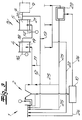
- Fig. 1 shows a simplified schematic diagram of a inventive two-stage cleaning system for the Purification of municipal commercial wastewater for implementation of the method according to claim 1.
- the system points a biological high-load revitalization level, which as Adsorption stage 1 is carried out, the adsorption stage 1 an intermediate clarification stage 2 is connected.
- Adsorption stage 1 is in the exemplary embodiment according to FIG. 1 a rough cleaning 7 upstream, which is expedient is designed as a coarse screen and also a fine cleaning 8 upstream, which expediently as a fine rake is executed.
- 1 is the Adsorption stage 1 also preceded by a sand and fat trap 8a.
- the system according to the invention also points a biologically intensified filter stage, which is shown in Fig.
- This denitrification stage 4 is a nitrification stage 5 downstream as a second filter stage.
- a third filter stage 9 provided for the phosphate removal can be used.
- the third filter stage also is designed as a denitrification stage. 1 is recognizable that a partial flow of the treated wastewater from the sequence of the second filter stage, in the exemplary embodiment subtracted from the nitrification stage 5 and into the denitrification stage 4 is reintroduced.
- FIG. 2 shows a further embodiment of a two-stage Cleaning system for the cleaning of municipal trade Wastewater shown, wherein Fig. 2 is a 1 shows a more detailed representation.
- the biological intensified filter stage as fixed bed reactor stage 3 with Denitrification reactor 4 and nitrification reactor 5 with Run 6 for the treated wastewater.
- a third filter stage 9 is optionally provided, which is dashed was drawn and in the embodiment 2 in the form of a further denitrification reactor is realized.
- a first Sub-stream 11 of the treated waste water is withdrawn from the outlet 6 and reintroduced into the denitrification reactor 4 becomes. This is the so-called partial power flow.
- a second substream 12 of the treated wastewater is from the Drain 6 deducted and in the adsorption stage 1 again introduced. This is the denitrification substream.
- the relationship between the partial power flow on the one hand and the Denitrification substream on the other hand is chosen so that already a significant part in adsorption stage 1, preferably 10% to 50% of the incoming raw sewage entrained nitrogen in the adsorption stage 1 degraded becomes.
- adsorption stage is ventilated with air or pure oxygen.
- rinsing water that is used for filter rinsing Fixed bed reactors occur via a flushing water line 22 introduced in adsorption stage 1.
- this rinse water a rinse water treatment 23, which is shown in Fig. 3.
- the process water in the Activated sludge treatment 10 occur via a process water pipe 24 reintroduced into adsorption stage 1.
- from the Intermediate clarification stage 2 activated sludge drawn into the Adsorption stage 1 can be recirculated.
- the third filter stage 9 as a denitrification reactor is executed here expediently metered carbon, since the from the Adsorption stage 1 carbon content already running at large part in the first filter stage or in the upstream Denitrification reactor 4 is consumed. It but is also within the scope of the invention that in the denitrification reactor 4 Carbon is added if the Drain concentration from the adsorption stage is relatively low should be.
- the fixed bed reactor stage 3 acts as biological intensified filter system and causes a physical / biological Cleaning.
- the denitrification reactor 4 forms the first filter stage and the nitrification reactor 5 forms the second filter stage.
- the embodiment 2 and 3 is a third filter stage for a downstream denitrification provided, for which purpose an external carbon source to the third Filter stage is connected.
- Each filter level can be made one or more filter units.
- the in Feed of the denitrification reactor 4 still contained Carbon pollution is in the denitrification reactor 4 degraded by biological denitrification and at the same time the nitrate nitrogen is denitrified.
- nitrification reactor 5 is the remaining carbon load eliminated by oxygen supply and at the same time ammonium is nitrified.
- FIG. 3 is the treated wastewater as above explained deducted from the sequence 6 via the conduit 13.
- a first partial stream 11 is the denitrification reactor 4 fed again and a second partial stream 12th is returned to adsorption stage 1.
- Waste water contained carbon used for denitrification are oxidized and at the same time the carbon will.
- the denitrification reactor 4 and the nitrification reactor 5 can either be from top to bottom or from flowed through from the bottom to the top.
- Preferably is at a selectable height of the filter bed or Reactor beds in each case atmospheric oxygen via a feed 16, 17 introduced.
- the atmospheric oxygen can be caused by pure oxygen be enriched or replaced.
- In the embodiment 3 is in the first, from the waste water upwards Air oxygen through the inlet through the filter stage 16 introduced in the upper area of the filter bed. Thereby the first filter stage has an upper aerobic part 18 and a lower anoxic part 19. in the 3 is in the lower region of the second filter stage atmospheric oxygen via feed 17 introduced. This turns the second filter stage into one upper aerobic section 20 and a lower anoxic Section 21 divided.
- Fig. 3 it can be seen that the rinsing waste water from the fixed bed reactors 4, 5, 9 in the adsorption stage 1 via a Flush water line 22 can be inserted. It is also in the context of the invention, this rinse water of the rinse water treatment 23 feed and the cleaned rinse water over Introduce lines 25 into the adsorption stage 1 and / or in the first filter stage or in the denitrification reactor 4 to introduce.
- the one in the rinse water treatment 23 excess sludge is expediently the Activated sludge treatment 10 using the excess sludge line 26 supplied.
- the resulting process water can via the process water line 24 in the adsorption stage be introduced.
- the BOD 5 and COD degradation is practically twice as high as 50% to 60% compared to 30% compared to preliminary clarification in a conventional single-stage cleaning system.
- the combination of an upstream adsorption stage and an upstream denitrification reactor in the biologically intensified filter stage results in a considerable improvement in the NH 4 -N volume conversion performance of the nitrification reactor.
- a normal municipal wastewater with normal pollution is used.
- the plant is first run with a return of the first partial flow (partial power flow) of the treated wastewater into the denitrification reactor, but without return of the second partial flow (partial denitrification flow) into the adsorption stage.
- the volume of the adsorption stage is 750 m 3 .
- the BOD 5 cleaning performance of the adsorption stage is 55% with an oxygen content of ⁇ 0.2 mg / l.
- the adsorption stage has a BOD 5 inflow of 6,000 kg BOD 5 / d.
- the space load of the adsorption stage is 8 kg BOD 5 / m 3 d.
- the biomass in the aeration tank of the adsorption stage has a value of 2 kg TS / m 3 (TS dry matter).
- the sludge load in the adsorption stage is 4 kg BOD 5 / kg TS.
- the volume of the intermediate clarification stage has a value of 1,875 m 3 and the flow from the intermediate clarification stage to the fixed bed reactor stage is on average 137.5 mg BOD 5 / l.
- N D 33 mg / l.
- the denitrification of this nitrogen load takes place in the denitrification reactor. This requires a volume of the denitrification reactor of 1,100 m 3 . In this respect, there is a BOD 5 / N D value of 4.1 with respect to the feed to the denitrification reactor.
- Relief of the denitrification reactor is achieved if a partial stream of the wastewater treated in the fixed bed reactor stage is withdrawn from the outlet of the nitrification reactor of the fixed bed reactor stage and introduced into the adsorption stage. If 25% of this treated wastewater is introduced into the adsorption stage, considerable denitrification already takes place in the adsorption stage. In this way, 8.3 mg N / l can already be denitrified in the adsorption stage, so that of the 33 mg N / l only 24.8 mg N / l remain in the denitrification reactor for denitrification. Accordingly, the denitrification reactor can be made much smaller and, as a result, can be reduced by 25% of its volume.
- the required volume of the denitrification reactor is only 833 m 3 .
- the BOD 5 / N D value with respect to the feed to the denitrification reactor improves from 4.1 to 5.5.
Landscapes
- Life Sciences & Earth Sciences (AREA)
- Biodiversity & Conservation Biology (AREA)
- Microbiology (AREA)
- Hydrology & Water Resources (AREA)
- Engineering & Computer Science (AREA)
- Environmental & Geological Engineering (AREA)
- Water Supply & Treatment (AREA)
- Chemical & Material Sciences (AREA)
- Organic Chemistry (AREA)
- Purification Treatments By Anaerobic Or Anaerobic And Aerobic Bacteria Or Animals (AREA)
Applications Claiming Priority (4)
| Application Number | Priority Date | Filing Date | Title |
|---|---|---|---|
| DE19651871 | 1996-12-13 | ||
| DE1996151871 DE19651871A1 (de) | 1996-12-13 | 1996-12-13 | Anlage für die Reinigung von Abwasser |
| DE19651870 | 1996-12-13 | ||
| DE19651870A DE19651870A1 (de) | 1996-12-13 | 1996-12-13 | Verfahren zum Betrieb einer zweistufigen Reinigungsanlage für die Reinigung von kommunal-gewerblichem Abwasser und Anlage für die Durchführung eines solchen Verfahrens |
Publications (2)
| Publication Number | Publication Date |
|---|---|
| EP0847963A2 true EP0847963A2 (fr) | 1998-06-17 |
| EP0847963A3 EP0847963A3 (fr) | 1999-01-27 |
Family
ID=26032178
Family Applications (1)
| Application Number | Title | Priority Date | Filing Date |
|---|---|---|---|
| EP97114054A Withdrawn EP0847963A3 (fr) | 1996-12-13 | 1997-08-14 | Procédé pour exploiter une installation d'épuration des eaux communales à deux étages et installation mettant en oeuvre ce procédé |
Country Status (1)
| Country | Link |
|---|---|
| EP (1) | EP0847963A3 (fr) |
Cited By (2)
| Publication number | Priority date | Publication date | Assignee | Title |
|---|---|---|---|---|
| AT410439B (de) * | 2001-03-02 | 2003-04-25 | Matsche Norbert Dipl Ing Dr | Verfahren und anlage zum klären von abwässern |
| EP2479147A4 (fr) * | 2009-09-14 | 2013-05-15 | Obschestvo S Ogranichennoi Otvetstvennostyu Ural Protsess Inzhiniring Kompania Upek | Procédé de purification biologique d'eaux usées |
Family Cites Families (8)
| Publication number | Priority date | Publication date | Assignee | Title |
|---|---|---|---|---|
| CA1034265A (fr) * | 1974-06-26 | 1978-07-04 | Elton S. Savage | Methode et materiel de traitement des eaux usees |
| US4179374A (en) * | 1976-05-12 | 1979-12-18 | Dravo Corporation | Apparatus for the treatment of wastewater |
| DE3706504A1 (de) * | 1987-02-27 | 1988-09-08 | Efka Werke Kiehn Gmbh Fritz | Handstopfgeraet fuer zigarettenhuelsen, insbesondere fuer zigarettenfilterhuelsen |
| AU7764691A (en) * | 1990-05-18 | 1991-12-10 | Utb Umwelttechnik Buchs Ag | Process for eliminating nitrates and phosphates in the biological purification of waste water |
| FR2682100B1 (fr) * | 1991-10-02 | 1993-12-03 | Degremont | Procede et dispositif pour l'epuration biologique des eaux residuaires. |
| DK206291D0 (da) * | 1991-12-23 | 1991-12-23 | Krueger I Systems As | Fremgangsmaade til rensning af forurenet vand |
| DE4317197A1 (de) * | 1992-05-27 | 1993-12-02 | Goett Umwelttechnik Gmbh I G | Verfahren zur Denitrifikation von Abwässern |
| DE4308156C2 (de) * | 1993-03-15 | 2000-04-27 | Philipp Mueller Gmbh | Anlage für die Reinigung von Abwasser |
-
1997
- 1997-08-14 EP EP97114054A patent/EP0847963A3/fr not_active Withdrawn
Cited By (2)
| Publication number | Priority date | Publication date | Assignee | Title |
|---|---|---|---|---|
| AT410439B (de) * | 2001-03-02 | 2003-04-25 | Matsche Norbert Dipl Ing Dr | Verfahren und anlage zum klären von abwässern |
| EP2479147A4 (fr) * | 2009-09-14 | 2013-05-15 | Obschestvo S Ogranichennoi Otvetstvennostyu Ural Protsess Inzhiniring Kompania Upek | Procédé de purification biologique d'eaux usées |
Also Published As
| Publication number | Publication date |
|---|---|
| EP0847963A3 (fr) | 1999-01-27 |
Similar Documents
| Publication | Publication Date | Title |
|---|---|---|
| EP0247519B1 (fr) | Procédé d'épuration des eaux d'égout | |
| EP0689523B1 (fr) | Procédé de purification des eaux usées, en particulier des eaux usées communales | |
| DE2616212A1 (de) | Verfahren zur schlamm-abwasser- aufbereitung, insbesondere zur entfernung stickstoff- und kohlenstoffhaltiger stoffe aus haushalts- und industrieabwaessern | |
| DE2809094A1 (de) | Verfahren zur entfernung von organischen stoffen und stickstoffverbindungen aus abwasser | |
| DD253247A5 (de) | Verfahren zur biologischen abwasserreinigung | |
| EP0019203B1 (fr) | Procédé et dispositif pour la nitrification et la dénitrification d'eaux résiduaires | |
| DE69513205T2 (de) | Methode und einrichtung für die reinigung von abwasser nach der belebtschlamm-methode | |
| DE3908779C1 (en) | Lagoon installation | |
| DE69604705T2 (de) | Verfahren zur Abwasserbehandlung mittels biologischen Filtern oder anderen Vorrichtungen mit sessilen Biomassen | |
| DE2904335A1 (de) | Verfahren zur reinigung von abwasser mit einem hohen gehalt an stickstoffverbindungen | |
| EP0847963A2 (fr) | Procédé pour exploiter une installation d'épuration des eaux communales à deux étages et installation mettant en oeuvre ce procédé | |
| DE2924449C2 (de) | Verfahren zum Reinigen von Abwasser nach dem Belebtschlammverfahren | |
| DE3916679C2 (fr) | ||
| DE3136409A1 (de) | Verfahren und vorrichtung zur biologischen reinigung von abwasser | |
| EP0527123B1 (fr) | Procédé de traitement d'eaux usées en boue activée | |
| DE3933513C2 (fr) | ||
| DE3507388A1 (de) | Verfahren fuer die reinigung von abwasser | |
| DE69801235T2 (de) | Verfahren zur biologischen reinigung von abwasser mit umgekehrten verfahrensablauf | |
| DE3235992A1 (de) | Anlage zur biologischen reinigung und denitrifikation von abwasser | |
| DE19651870A1 (de) | Verfahren zum Betrieb einer zweistufigen Reinigungsanlage für die Reinigung von kommunal-gewerblichem Abwasser und Anlage für die Durchführung eines solchen Verfahrens | |
| DE3828579C2 (de) | Verfahren zur Filtration von in Kläranlagen aufbereitetem Abwasser und Vorrichtung zur Durchführung des Verfahrens | |
| EP0839766B1 (fr) | Procédé à plusieurs étapes pour l'élimination finale d'azote dans une installation de purification d'eau usée | |
| DE3141889C2 (de) | Verfahren zum Betrieb einer Teichbelüftungsanlage | |
| DE4204590C2 (de) | Verfahren zur biologischen Abwasserreinigung in einem Belebungsbecken | |
| EP2230212B9 (fr) | Procédé de fonctionnement d'une station d'épuration destinée au nettoyage des eaux usées, ainsi que station d'épuration |
Legal Events
| Date | Code | Title | Description |
|---|---|---|---|
| PUAI | Public reference made under article 153(3) epc to a published international application that has entered the european phase |
Free format text: ORIGINAL CODE: 0009012 |
|
| AK | Designated contracting states |
Kind code of ref document: A2 Designated state(s): AT BE CH DE DK ES FI FR GB GR IE IT LI LU MC NL PT SE |
|
| AX | Request for extension of the european patent |
Free format text: AL;LT;LV;RO;SI |
|
| PUAL | Search report despatched |
Free format text: ORIGINAL CODE: 0009013 |
|
| AK | Designated contracting states |
Kind code of ref document: A3 Designated state(s): AT BE CH DE DK ES FI FR GB GR IE IT LI LU MC NL PT SE |
|
| AX | Request for extension of the european patent |
Free format text: AL;LT;LV;RO;SI |
|
| AKX | Designation fees paid | ||
| STAA | Information on the status of an ep patent application or granted ep patent |
Free format text: STATUS: THE APPLICATION IS DEEMED TO BE WITHDRAWN |
|
| 18D | Application deemed to be withdrawn |
Effective date: 19990728 |
|
| REG | Reference to a national code |
Ref country code: DE Ref legal event code: 8566 |