EP0848558B1 - Anordnung und Verfahren zur Bewegungsvektorbestimmung - Google Patents
Anordnung und Verfahren zur Bewegungsvektorbestimmung Download PDFInfo
- Publication number
- EP0848558B1 EP0848558B1 EP19970305364 EP97305364A EP0848558B1 EP 0848558 B1 EP0848558 B1 EP 0848558B1 EP 19970305364 EP19970305364 EP 19970305364 EP 97305364 A EP97305364 A EP 97305364A EP 0848558 B1 EP0848558 B1 EP 0848558B1
- Authority
- EP
- European Patent Office
- Prior art keywords
- motion vector
- picture
- area
- picture frame
- data
- Prior art date
- Legal status (The legal status is an assumption and is not a legal conclusion. Google has not performed a legal analysis and makes no representation as to the accuracy of the status listed.)
- Expired - Lifetime
Links
Images







Classifications
-
- H—ELECTRICITY
- H04—ELECTRIC COMMUNICATION TECHNIQUE
- H04N—PICTORIAL COMMUNICATION, e.g. TELEVISION
- H04N19/00—Methods or arrangements for coding, decoding, compressing or decompressing digital video signals
- H04N19/42—Methods or arrangements for coding, decoding, compressing or decompressing digital video signals characterised by implementation details or hardware specially adapted for video compression or decompression, e.g. dedicated software implementation
- H04N19/43—Hardware specially adapted for motion estimation or compensation
- H04N19/433—Hardware specially adapted for motion estimation or compensation characterised by techniques for memory access
-
- H—ELECTRICITY
- H04—ELECTRIC COMMUNICATION TECHNIQUE
- H04N—PICTORIAL COMMUNICATION, e.g. TELEVISION
- H04N19/00—Methods or arrangements for coding, decoding, compressing or decompressing digital video signals
- H04N19/50—Methods or arrangements for coding, decoding, compressing or decompressing digital video signals using predictive coding
- H04N19/503—Methods or arrangements for coding, decoding, compressing or decompressing digital video signals using predictive coding involving temporal prediction
- H04N19/51—Motion estimation or motion compensation
Definitions
- the present invention relates to a motion vector search in predictive coding of a digital picture.
- An inter-frame predictive coding may be given as a method of reducing data by making use of time-base directional redundancy of a motion picture among methods of compressing a data quantity of motion picture data.
- MPEG-1/2 defined as an international standardizing system for digital motion picture coding, both of a forward prediction and a bidirectional prediction can be availed.
- a motion between a frame in the past and a frame at present is detected as a forward motion vector, and the frame at present is generated referring to the frame in the past (FIG. 1).
- This motion vector searching is done by a macroblock consisting of, e.g., 16 X 16 pixels.
- a difference in terms of a spatial position from an area exhibiting a largest correlation with respect to a frame with a prediction effected in the forward reference frame, is detected as a motion vector.
- the present frame is generated referring to both or one of the past frame and the prospective frame.
- the motion is sought in every area consisting of a plurality of pixels, and a quantity of data for coding the motion in every area as vector data instead of the pixel data can be remarkably reduced. If there is a difference between an original picture and a picture (a predictive picture) composed by use of the motion vectors, data about this difference is coded together with the vector data. Namely, a larger quantity of data can be reduced as the difference between the predictive picture and the original picture becomes smaller. If a motion vector search range is the same, the bidirectional prediction exhibits a higher possibility that a reference picture more approximate to the picture serving as a prediction target will be obtained than by the forward prediction, and hence generally a predictive efficiency becomes higher by using the bidirectional prediction than by the forward prediction.
- I-picture Intra Coded Picture
- P-picture Predictive Coded Picture
- B-picture A frame coded by use of the forward/backward bidirectional predictions from past/prospective pictures.
- the motion vector search is attained by sectioning the original picture into a plurality of areas on the coding basis, comparing these areas with a reference picture while being shifted pixelwise in parallel in the horizontal and vertical directions, and thereby seeking a position having the highest correlation.
- a range for shifting the picture in parallel to obtain the degree of correlation is limited by a performance of transferring the data between a processor for calculating the degree of correlation and the frame memory for storing the reference picture.
- FIG. 7 is a block diagram illustrating a construction of the coding apparatus using a conventional vector searching method
- FIG. 9 is a flowchart thereof.
- FIG. 3 shows an example of a coding sequence and the conventional motion vector search.
- a frame memory 71 is so used as to be sectioned into an area 71a used for inputting pictures, an area 71b for storing a coding target picture, an area 71c for storing a forward reference picture, and an area 71d for storing a backward reference picture.
- a degree-of-correlation calculating unit 72 performs a motion vector search. This degree-of-correlation calculating unit 72, upon inputting coded area data of a coding target picture, designates areas for the forward reference picture and the backward reference picture, and there are inputted pixel data of the reference areas from these reference pictures.
- the data inputted to the degree-of-correlation calculating unit 72 are only pixel data (71b) of the area becoming a coding target of the original picture, and pixel data (71c) of the reference range of the forward reference picture. Further, when coding the B-picture, the reference picture turns out to be the pixel data (71c, 71d) in both of the forward and backward reference ranges.
- the degree-of-correlation calculating unit 72 outputs, to a coding unit 73, the forward-motion vector in the case of coding the P-picture, and the forward and backward motion vectors in the case of coding the B-picture.
- the coding unit 73 generates the reference picture with reference to a local decode picture frame memory 74 on the basis of these pieces of vector data, and executes inter-frame predictive coding. The thus coded picture is simultaneously decoded and recorded in the local decode picture frame memory 74 so as to be used as a reference picture thereafter.
- FIG. 9 shows a processing flow in the coding apparatus shown in FIG. 7.
- a picture type e.g., I-picture coding, P-picture coding or B-picture coding (901)
- the picture data of the coding target area is extracted out (903), and the processing is diverged depending on the kinds (the I-picture, or the P-picture, or the B-picture) of the relevant picture data (904, 905). More specifically, in the case of the I-picture, the processing moves directly to a coding step (909).
- the motion vector search is executed with the I-or P-picture just anterior serving as a reference frame (908), and thereafter the coding step is implemented. (909). Furthermore, in the case of the B-picture, the motion vector search is effected with the I- or P-picture just anterior serving as a forward reference frame (906). Moreover, the motion vector search is carried out with the I- or P-picture just pasterior serving as a backward reference frame(907), and thereafter the coding process is executed.
- FIG. 3 is a sequence diagram on the assumption that a single frame to which the bidirectional prediction is applied is provided behind the frame to which the forward prediction is applied.
- the coding process is executed by use of a frame memory composed of five areas, an interval for inputting each frame is fixed according to the general video signal specifications, and an interval for coding each frame is also fixed. Therefore, for example, a time I and a time II in the coding process are equal to each other.
- an input sequence of the picture data is different from a coding sequence.
- the five areas of the frame memory are needed for rearranging this processing sequence.
- the motion vector search is implemented just before coding irrespective of the forward/bidirectional predictions. It was a general practice that a P1 motion vector search (P1f) and the coding process are executed for the time I, while B2 bidirectional motion vector searches (B2f, B2b) are performed for the time II.
- P1f P1 motion vector search
- B2f, B2b B2 bidirectional motion vector searches
- the plurality of frame memories are constructed typically of inexpensive DRAMs in order to process a large quantity of data when dealing with the picture data.
- the plurality of frame memories share a single line of data bus.
- a reduction in costs for manufacturing the motion vector search modules entails decreasing the number of data I/O terminals for the frame memories. If the plurality of frame memories share the I/O terminals, however, a degree of freedom of accessing to the frame memory is restricted because of a conflict of accessing, and hence, when the number of terminals is excessively decreased, the quantity of transferable data can not be secured.
- the data quantity transferrable per unit time is restricted due to a limit in terms of data write/read speeds of the memory device.
- the vector search it is required for surely searching the motion vector that the vector search be executed in a relatively wide area of the reference picture.
- the forward and backward reference pictures are needed, and therefore the reference picture data the quantity of which is twice that of the picture with only the forward prediction effected, are required of the processor for obtaining the degree of correlation between the pictures.
- a large amount of accesses to the frame memories stored with the reference picture data are necessary for reading the above data.
- both of the motion vector search and the coding process be executed within a fixed time to perform the motion vector search just before coding.
- the time spent for the motion vector search is limited, if a vector search range is taken large on the reference picture, it is impossible to effect the accesses to the frame memories enough to transfer the necessary data. This results in a difficulty to secure a sufficient motion vector search range.
- WO 9504432 (British Telecom) discloses a system for encoding video frames in accordance with an MPEG standard, in real-time, and 'A new technique for block-based motion compensation' by kozu et al (proceedings of the International conference on acoustics, Sydney, April 19-23, 1994) presents an algorithm for finding motion vectors of bidirectional frames in the MPEG scheme.
- the apparatus includes a frame memory, composed of at least a plurality of areas, for storing picture data about an original picture and a reference picture, a controller for controlling the frame memory on the basis of predictive system data given from outside and determining a motion vector between the pictures by obtaining a degree of correlation between the original picture and the reference picture, and a motion vector data storage device for storing motion vector data.
- a controller may be constructed of a frame memory control unit to which predictive system data is inputted from outside, and a degree-of-correlation calculating unit.
- the frame memory is sectioned into an area used for inputting pictures, an area for storing a motion vector searching target picture, an area for storing a prospective motion vector searching target picture, and an area for storing a picture referred to in common, and the frame memory control unit designates a bank (an address), thereby reading the data therefrom.
- the degree-of-correlation calculating unit calculates a degree of correlation with respect to a reference picture block upon inputting picture block data of a searching target area from each of the areas of the frame memory, and thereby calculates a motion vector.
- a memory for storing the motion vector data is provided, and is used for temporarily storing the motion vector calculated by the degree-of-correlation calculating unit.
- the frame memory control unit and the degree-of-correlation calculating unit when searching a motion vector for an arbitrary area of a designated (particular) picture, and if the frame memory contains an area within an unprocessed picture being the same area referred to as the area within a reference picture to which the designated picture refers, simultaneously perform the motion vector search with respect to this area.
- the frame memory control unit and the degree-of-correlation calculating unit store in the vector data storage device (a motion vector data storage memory) a piece of vector data of the above area with respect to the prospective picture among pieces of above-obtained motion vector data, and, if the vector data obtained in the past about the above area of the present picture exists in the vector data storage device (the motion vector data storage memory), output the motion vector of the designated area in addition to the above-obtained motion vector data.
- the vector data storage device a motion vector data storage memory
- the quantity of reference picture data to be read from the frame memory can be reduced.
- the I/O data quantity with respect to the memory can be reduced on the whole. It is therefore feasible to execute the motion vector search while securing the same search range as that in the prior art by use of a more inexpensive memory that is slower at inputting and outputting the data.
- the motion vector can be searched in a much broader range by use of the memory having the same I/O speed as in the prior art.
- a first apparatus for use in solving the above problems is constructed of controller, prepared with a frame memory, composed of at least a plurality of areas, for storing picture data about an original picture and a reference picture, a controller for controlling the frame memory on the basis of predictive system data given from outside and determining an inter-picture motion vector by obtaining a degree of correlation between the original picture and the reference picture, and a motion vector data storage device for storing the motion vector data.
- FIG. 15 is a principle diagram showing the first apparatus.
- the controller according to this apparatus is constructed of a frame memory control unit 1502 to which predictive system data is inputted from outside, and a degree-of-correlation calculating unit 1503.
- a frame memory 1501 is sectioned into an area 1501a used for inputting pictures, an area 1501b stored with a motion vector searching target picture, an area 1501c stored with a prospective motion vector searching target picture, and an area 1501d stored with a picture referred to in common.
- the frame memory control unit 1502 designates a bank (address), thereby reading the data therefrom.
- the degree-of-correlation calculating unit 1503 calculates a degree of correlation with respect to a reference picture block upon inputting picture block data of a searching target area from each of the areas of the frame memory 1501, and thereby calculates a motion vector.
- a memory 1504 for storing motion vector data is used to temporarily store the motion vector calculated by the degree-of-correlation calculating unit 1503.
- the numeral 1505 represents a multiplexing unit.
- the frame memory control unit 1502 and the degree-of-correlation calculating unit 1503 store the vector data storage device (the motion vector data storage memory 1504) with a piece of vector data of the above area with respect to the prospective picture (1501c) among pieces of above-obtained motion vector data, and, if the vector data obtained in the past about the above area of the present picture exists in the vector data storage device (the motion vector data storage memory 1504), output the motion vector of the designated area in addition to the above-obtained motion vector data.
- a second apparatus for use in solving the above problems when obtaining a forward motion vector in an arbitrary area within a designated picture, and if there might be a picture with a prediction effected using the same reference picture in the past and the vector data storage device is stored with the forward motion vector, reads this forward motion vector therefrom and performs the forward motion vector search on the basis of coordinates indicated by that motion vector.
- FIG. 16 is a principle diagram illustrating the second apparatus.
- a controller in this second apparatus is also constructed of the frame memory control unit 1502 and the degree-of-correlation calculating unit 1503.
- the frame memory control unit 1502 is supplied with predictive system data from a predictive system management unit 1602.
- a frame memory 1601 is sectioned into an area 1601a used for inputting pictures, an area 1601b stored with a forward motion vector searching target picture, and an area 1601c stored with a picture referred to.
- the frame memory control unit 1502 designates a bank (address), thereby reading the data therefrom.
- the degree-of-correlation calculating unit 1503 calculates a degree of correlation with respect to a reference picture block upon inputting picture block data of a searching target area from each of the areas of the frame memory 1601, and thereby calculates a motion vector.
- the memory 1504 for storing the motion vector data is temporarily stored with the motion vector calculated by the degree-of-correlation calculating unit 1503.
- the numeral 1505 denotes the multiplexing unit.
- the frame memory control unit 1502 when obtaining a forward motion vector in an arbitrary area 1601b within the designated picture, the frame memory control unit 1502 detects that there exists a picture with the prediction effected using the same reference picture in the past, and, if the motion vector data storage memory 1504 is stored with the forward motion vector, reads this forward motion vector. Then, the frame memory control unit 1502 performs the forward motion vector search on the basis of coordinates indicated by that motion vector.
- a third apparatus for use in obviating the above problems is constructed of a frame memory, composed of at least a plurality of areas, for storing picture data about an original picture and a reference picture, a controller for controlling the frame memory based on the predictive system data given from outside and determining an inter-picture motion vector by obtaining a degree of correlation between the original picture and the reference picture, and a motion vector data storage device for storing the motion vector data.
- FIG. 17 is a principle diagram showing the third apparatus.
- the controller in this third apparatus comprises the frame memory control unit 1502 to which the predictive system data is inputted from outside, and the degree-of-correlation calculating unit 1503.
- the frame memory 1701 is sectioned into an area 1701a used for inputting pictures, an area 1701b stored with a bidirectional motion vector searching target picture, an area 1701c stored with a prospective motion vector searching target picture, and an area 1701d stored with a picture referred to in common.
- the frame memory control unit 1502 designates a bank (address), thereby reading the data therefrom.
- the degree-of-correlation calculating unit 1503 calculates a degree of correlation with respect to a reference picture block upon inputting picture block data of a searching target area from each of the areas of the frame memory 1701, and thereby calculates a motion vector.
- the memory 1504 for storing motion vector data is temporarily stored with the motion vector calculated by the degree-of-correlation calculating unit 1503.
- the numeral 1505 represents the multiplexing unit.
- the frame memory control unit 1502 and the degree-of-correlation calculating unit 1503 store the motion vector data storage memory 1504 with the above-obtained prospective area forward motion vector data, and output, as designated area motion vector data, the above-obtained backward motion vector data and the forward motion vector data already obtained in the past by the same method as the above-mentioned and stored in the motion vector data storage memory 1504 via the multiplexing unit 1505.
- a fourth apparatus for use in obviating the above problems when there is a picture with the prediction effected using the same reference picture sometime back, and if the motion vector data storage device is stored with the forward motion vector thereof, reads this forward motion vector therefrom and performs the forward motion vector search of a forward predictive picture on the basis of the coordinates indicated by the motion vector.
- FIG. 16 A principle diagram thereof is the same as FIG. 16 showing the second apparatus explained along therewith.
- a fifth apparatus for use in solving the above problems is concerned with a motion picture coding apparatus.
- the motion picture coding apparatus is constructed of devices for inputting a forward motion vector and a backward motion vector that are outputted from the above third apparatus, and forming a forward reference picture and a backward reference picture from local decode pictures by use of the above forward and backward motion vectors, a device for selecting a reference picture from those respective references as a predictive picture most approximate to the original picture, devices for quantizing and reversely quantizing difference data between the predictive picture and the original picture, and a device for storing the reversely-quantized data as local decode picture data.
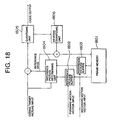
- FIG. 18 is a principle diagram illustrating the fifth apparatus.
- the forward motion vector and the backward motion vector that are given from the motion vector searching apparatus shown by way of the first to fourth apparatuses, are inputted to respective reference picture buffers 1802, 1803.
- the reference picture buffers 1802, 1803 read reference pictures from a frame memory 1801.
- Reference picture data read from these reference picture buffers 1802, 1803 to a reference picture determining unit, are selectively subtraction-processed with respect to coding target picture data, and a difference therebetween is quantized by a quantizing unit 1805.
- the thus quantized data is reversely quantized by a reverse quantizing unit 1806.
- the reversely quantized data is thereafter added to the above reference picture data and stored as restored picture data in the frame memory.
- a sixth apparatus for use in obviating the above problems is operable to pick up a picture, as a predictive picture, having a smaller pixel difference absolute value sum in pixels between the reference pictures and the original picture.
- an accumulated value of differences between the reference picture data and the coding target picture (original picture), is calculated, and only the picture having the smaller pixel difference absolute value sum in pixels between the reference pictures and the original picture may be outputted to the quantizing unit 1805.
- a plurality of difference accumulated value calculating devices and a comparing device for making comparisons therebetween may be provided between the quantizing unit 1805 and a difference arithmetic unit.
- a motion vector data storage device e.g., a memory
- the forward motion vector search effected for the forward prediction in the vector searching process for coding a B-picture is executed asynchronously with the coding process to disperse frame memory accessing. Further, at the same time, it is feasible to obtain data for narrowing down a motion vector search range in a P-picture.
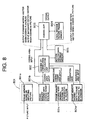
- FIG. 8 is a diagram illustrating a construction of a coding apparatus using the motion vector searching method according to the present invention
- FIG. 10 is a flowchart thereof.
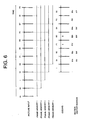
- FIG. 4 shows an example of sequence of the coding processes and the motion vector search as well.
- a frame memory 801 is so used as to be sectioned into an area 801a used for inputting pictures, an area 801b for storing a coding target picture, an area 801c for storing an original picture for a prospective B-picture, and an area 801d stored with a picture referred to in common.
- a degree-of-correlation calculating unit 802 carries out a motion vector search. This degree-of-correlation calculating unit 802, upon inputting coding area data (801b) of the coding target picture, designates the area (801d) for a forward reference picture and a backward reference picture, and picture data of a reference area is inputted based on these reference pictures.
- Inputted, herein, to the degree-of-correlation calculating unit 802 for performing the motion vector search are only pixel data (801b) of the area that serves as a coding target of the original picture and pixel data (801d) of a reference range of the forward reference picture as in the same way with the prior art method when coding the P-picture.
- the degree-of-correlation calculating unit 802 is capable of calculating a degree of correlation between the two pictures at one time by simultaneously moving two original pictures in parallel with respect to one reference picture.
- FIG. 10 is a flowchart for explaining in greater detail the coding process shown in FIG. 8.
- a picture type e.g., P-picture coding or B-picture coding (1001)
- the picture data of the coding target area is extracted out (1003), and the processing is diverged depending on the kinds (the I-picture, or the P-picture, or the B-picture) of the relevant picture data (1004, 1005).
- the processing moves directly to a coding step (1009).
- the motion vector search is executed with the I- or P-picture just anterior serving as a reference frame (1008), and thereafter the coding step is implemented. (1009).
- the motion vector search is effected with the I- or P-picture just posterior serving as a backward reference frame, and simultaneously there is performed the motion vector search of the prospective B-picture referred forward to with respect to the same frame (1006).
- the motion vector with respect to the forward reference frame which vector has come to a completion of its being searched, is read from a motion vector storage unit 805 (1007).
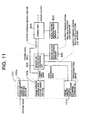
- FIG. 11 is a block diagram showing a construction of the coding apparatus in terms of functions in steps 1006 and 1007.
- the P-picture there must be two kinds of inputs such as the pixel data(1101b) of an area within the picture to be coded, the pixel data(1101c) within a reference range of the I- or P-picture just anterior.
- the motion vector data storage device (805)is stored with the forward motion vector thereof, reads this forward motion vector therefrom and performs the forward motion vector search of the P-picture on the basis of the coordinates indicated by the motion vector.
- the forward motion vector search of the B-picture starts, as shown in FIG. 4, immediately after inputting the original picture.
- a forward motion vector search (expressed by B3f in FIG. 4) of B3 starts immediately after an end of inputting B3
- the same reference picture P1 is used both for a B3 forward prediction and for a B2 backward prediction (expressed by B2b in FIG. 4), and hence a read access to the frame memory to transfer the reference picture can be done at one time by processing the motion vector searches of these two frames at one time.
- the accessing to the frame memory can be reduced down to half as compared with the prior art system wherein pieces of reference picture data are individually transferred. Further, as compared with the prior art shown in FIG. 3, a period for which to store the reference frame can be shortened, and therefore the frame memory for one area becomes unnecessary.
- the alternative method is to widen the motion vector search range of the P-frame in order to secure a searching precision.
- the forward motion vector search B3f has already been finished just when starting the P2 motion vector search, and, with reference to this result, the motion vector search range can be narrowed down.
- one quantity of vector is needed per block area of 8 bits and 16 X 16 (256) pixels. Supposing that the motion vector range is within ⁇ 128 pixels in terms of both horizontal component and vertical component, a quantity of reference pixel data that can be reduced is 256 bytes per block, and contrastingly a quantity of vector data to be newly stored is merely 2 bytes.
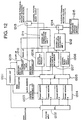
- FIG. 12 shows an example embodiment of a vector searching apparatus to which the present invention is applied.
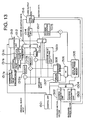
- FIG. 13 illustrates an example of an apparatus for coding the picture by use of the motion vector data outputted by the motion vector searching apparatus to which the present invention is applied.
- control unit 1201 controls mainly the motion vector search.
- a selector 1202 incorporates a function to switch the picture data to be inputted trough a bank designation given from the control unit 1201.
- a frame memory 1204 is accessed from the control unit 1201 via an address generating unit 1203, thereby executing write and read processes.
- a read selector 1205 incorporates a function to selectively output the picture data read from the frame memory 1204 to an original picture block data memory 1206, a reference picture block data memory 1207, and an original block data memory 1208.
- a vector generating unit 1209 for generating a vector for search is actuated by the control unit 1201.
- a value of the vector generated by the vector generating unit 1209 is transformed into memory address by an address generating unit 1210.
- the pixel data of the reference block transfered from the reference picture block data memory 1207 to the both degree-of-correlation calculating unit 1211, 1212.
- Degree-of-correlation calculating units 1211, 1212 each calculate a motion vector from each piece of picture data and output it to a coding unit via flip-flops FF (1213, 1214).
- a motion vector temporary storage memory 1215 temporarily stores a B-picture forward motion vector.
- the processing in the case of the P-picture will be touched upon, however, it is assumed that the same search as the prior art is conducted for the P-picture in this embodiment.
- the pixel data of the area to be coded are transferred via the selector 1205 to the original block data memory 1206 from the frame memory 1204.
- the pixel data of the frame to be referred forward to are similarly transferred via the selector 1205 to the reference picture block data memory 1207 from the frame memory 1204.
- the reference picture block secures a wide area enough to cover a position in which a certain object exists within the original picture block.
- the data of the area having the same size as the original picture block size is transmitted from the reference picture block data memory to the degree-of-correlation calculating unit 1211, wherein a degree of correlation is calculated.
- the reference picture block data memory 1207 sequentially transmits the block pictures shifted pixelwise in parallel in the horizontal or vertical direction to the degree-of-correlation calculating unit 1211 in accordance with a designation of the address calculated from a virtual vector value outputted from the searched vector generating unit 1209. Hence, a degree of correlation is obtained each time. A deviation from a position exhibiting a highest correlation in the end with respect to all the reference picture blocks, is outputted as a motion vector to the coding unit.
- the pixel data of the are to be coded are transferred to the original block data memory 1206 from the frame memory 1204.
- the pixel data of the frame to be referred backward to are transferred to the reference picture block data memory 1207 from the frame memory 1204.
- the picture to be processed as a B-picture in the future and referring forward to the same reference picture is inputted to the frame memory 1204.
- the same area as the area with the B-picture that is going to be coded at present is transferred to the original block data memory 1208.
- the reference picture block data memory 1207 transmits the data of the area having the same size as the original block size to the degree-of-correlation calculating units 1211, 1212.
- the degree-of-correlation calculating units 1211, 1212 calculate degree of correlations between respective pieces of original picture data (outputted from the memories 1206, 1208) and a reference picture block (data outputted from the memory 1207).
- the reference picture block data memory 1207 transmits the block pictures shifted pixelwise in parallel in the horizontal or vertical direction to the degree-of-correlation calculating units 1211, 1212 in accordance with address values calculated by the address generating unit 1210 on the basis of a virtual vector value outputted from the searched vector generating unit 1209.
- a degree of correlation is calculated each time.
- a deviation from a position exhibiting a highest correlation in the end with respect to all the reference picture blocks, is outputted as a motion vector.
- the backward motion vector among the motion vectors calculated above is outputted to the posterior coding unit to be used for subsequent coding.
- the forward motion vector is stored in the motion vector temporary storage memory 1215 until the time when the prospective B-picture is to be processed.
- the forward motion vector of the B-picture to be coded at present has been similarly already stored in the motion vector temporary storage memory 1215, therefore read therefrom and outputted to the coding unit.
- a control unit 1301 controls mainly the coding process.
- Address generating units 1302, 1303 generate addresses for accessing to a local decode picture frame memory 1305 on the basis of inputs of the forward and backward motion vectors.
- a selector 1304 controls the addresses for accessing to the local decode picture frame memory 1305 under the control of the control unit 1301.
- a switch 1306 has a function to allocate the reference picture block data read from the local decode picture frame memory so as to store a forward memory 1307 and a backward memory 1308 with these pieces of reference picture block data.
- An average value calculating unit 1309 incorporates a function to calculate an average value of the forward reference picture block data stored in the forward memory 1307 and the backward reference picture block data stored in the backward memory 1308.
- Memories 1310a - 1310c are defined as buffers for temporary storing the difference between the forward reference picture block data, the backward reference block data, the average reference picture block data, and the original picture block data respectively.
- Difference accumulated value calculating units 1311a - 1311c respectively have functions to calculate difference accumulated values between the forward reference picture block data, the backward reference picture block data, the average reference picture block data, and original picture block data.
- a comparator 1313 compares these difference accumulated values and select data to be outputted to a quantizing unit 1314 by controlling the selector 1312. Further, the comparator 1313 also controls a selector 1317 for selecting the reference picture block data for generating a decode picture to be written to the local decode picture frame memory 1305.
- a coding allocation unit 1316 encodes the quantized data outputted from the quantizing unit 1314 with the motion vector data selected by the comparing unit 1313, and outputs the encoded data.
- the forward motion vector is inputted in the case of the P-picture, and the reference picture block corresponding to an address designated by the address generating unit 1302 is read from the local decode frame memory 1305 via the selector 1304 on the basis of the designated address.
- This reference picture block is stored in the forward memory 1307 through the switch 1306, and further a difference between the reference picture block and the original block is calculated and stored in the memory 1310a. Further, this difference is quantized by the quantizing unit 1314 through the selector 1312. Moreover, thus quantized data is reversely quantized and added to the above reference picture block, thereby reproducing a decode picture.
- This decode picture is stored in the local decode picture frame memory 1305.
- an average value of two reference pictures can be set as a reference picture in addition to the above two reference pictures, and hence the average value calculating unit 1309 previously calculates the average value.
- the forward reference picture block, the backward reference picture block and the average value (an average reference block) thereof are subjected to a subtracting process with the original block, and a difference calculated with respect to the one selected reference picture is quantized by the quantizing unit 1314 through the respective memories 1310a, 1310b, 1310c and further reversely quantized by the reverse quantizing unit 1315.
- the thus reversely quantized result is added to the reference picture block, thereby reproducing a decode picture.
- This decode picture is stored in the local decode picture frame memory 1305.
- FIG. 14 is a diagram illustrating a construction of a second embodiment.
- the construction of the present apparatus is substantially the same as that in the embodiment 1 discussed referring to FIG. 12.
- the original picture block data memory 1208, the degree-of-correlation calculating unit 1212 and the flip-flop 1214 are omitted.
- Other structures are the same as those in FIG. 12, and therefore their explanations are omitted.
- the pixel data of the area to be coded is at first transferred to the original picture block data memory 1206 from the frame memory 1204.
- the pixel data of the frame serving as a forward reference target are transferred to the reference picture block data memory 1207.
- the motion vector temporary storage memory 1215 refers to the forward motion vector of the B-picture in the area existing in the same position obtained just before it, and, this being criterion, the searched vector generating unit 1209 determines a search area.
- the reference picture block data memory 1207 transmits the data of the area having the same size as the original block size to the degree-of-correlation calculating unit 1211, wherein a degree of correlation is calculated.
- the reference picture block data memory 1207 transmits the block pictures shifted pixelwise in parallel in the horizontal or vertical direction in accordance with a designation of the address calculated from a virtual vector value outputted from the searched vector generating unit 1209, and a degree of correlation is calculated each time. Then, a deviation from a position exhibiting a highest correlation in the end with respect to all the reference picture blocks, is outputted as a motion vector to the coding unit via the flip-flop 1213.
Landscapes
- Engineering & Computer Science (AREA)
- Multimedia (AREA)
- Signal Processing (AREA)
- Compression Or Coding Systems Of Tv Signals (AREA)
- Compression, Expansion, Code Conversion, And Decoders (AREA)
Claims (7)
- Bewegungsvektorsuchvorrichtung mit:dadurch gekennzeichnet, daßeinem Rahmenspeicher (801), der eine Vielzahl von Bereichen (801a, 801b, 801c, 801d) hat, zum Speichern von Bilddaten eines besonderen Bildrahmens, eines Referenzbildrahmens und eines unverarbeiteten Bildrahmens,einem Steuermittel (802) zum Steuern des Rahmenspeichers auf der Basis von Vorhersagesystemdaten, die von außerhalb der Bewegungsvektorsuchvorrichtung erhalten werden,bei der das Steuermittel dafür ausgelegt ist, einen besonderen Bewegungsvektor zwischen einem Bereich des besonderen Bildrahmens und einem Bereich des Referenzbildrahmens zu bestimmen,
ein Bewegungsvektordatenspeichermittel (805) zum Speichern von Bewegungsvektordaten vorgesehen ist und
das Steuermittel (802) dafür ausgelegt ist, beim Bestimmen eines besonderen Bewegungsvektors (B2b) zwischen einem Bereich des besonderen Bildrahmens (B2) und einem Bereich des Referenzbildrahmens (P1)
gleichzeitig einen zusätzlichen Bewegungsvektor (B3f) zwischen einem Bereich des unverarbeiteten Bildrahmens (B3) und dem Bereich des Referenzbildrahmens (P1) zu bestimmen und den zusätzlichen Bewegungsvektor in dem Bewegungsvektordatenspeichermittel (805) zu speichern, wenn der Rahmenspeicher den unverarbeiteten Bildrahmen (B3) enthält, für den ein Bewegungsvektor für den Bereich des Referenzbildrahmens berechnet werden muß, und
jegliche zuvor gespeicherten Bewegungsvektordaten (B2f) in dem Bewegungsvektordatenspeichermittel bezüglich des Bereiches des besonderen Bildrahmens (B2) auszugeben sowie den besonderen Bewegungsvektor (B2b) auszugeben. - Bewegungsvektorsuchvorrichtung nach Anspruch 1, bei der dann, wenn ein Vorwärtsbewegungsvektor in einem beliebigen Bereich innerhalb des besonderen bezeichneten Bildrahmens erhalten wird und falls ein Bildrahmen mit einer unter Verwendung desselben Referenzbildrahmens in der Vergangenheit vorgenommenen Vorhersage vorhanden ist und in dem Vektordatenspeichermittel (805) der Vorwärtsbewegungsvektor gespeichert ist, dieser Vorwärtsbewegungsvektor gelesen wird und eine Vorwärtsbewegungsvektorsuche auf der Basis von Koordinaten ausgeführt wird, die durch jenen Bewegungsvektor angegeben werden.
- Bewegungsvektorsuchvorrichtung nach Anspruch 1, bei der das Steuermittel (802) beim Bestimmen eines Rückwärtsbewegungsvektors zwischen einem Bereich eines besonderen bidirektionalen Bildrahmens und einem Bereich eines Referenzbildrahmens gleichzeitig einen zusätzlichen Vorwärtsbewegungsvektor zwischen einem Bereich eines unverarbeiteten bidirektionalen Bildrahmens und dem Bereich des Referenzrahmens bestimmt und den zusätzlichen Vorwärtsbewegungsvektor in dem Bewegungsvektordatenspeichermittel (805) speichert, wenn der Rahmenspeicher einen unverarbeiteten Bildrahmen enthält, für den ein Vorwärtsbewegungsvektor für den Bereich des Referenzbildrahmens berechnet werden muß, und
jegliche zuvor gespeicherten Vorwärtsbewegungsvektordaten in dem Bewegungsvektordatenspeichermittel (805) bezüglich des Bereiches des besonderen Bildrahmens ausgibt und auch den besonderen Rückwärtsbewegungsvektor ausgibt. - Bewegungsvektorsuchvorrichtung nach Anspruch 3, bei der das Steuermittel (802) dann, wenn ein Bild mit einer unter Verwendung desselben Referenzbildes in der Vergangenheit vorgenommenen Vorhersage vorhanden ist und falls in dem Bewegungsvektordatenspeichermittel (805) dessen Vorwärtsbewegungsvektor gespeichert ist, diesen Vorwärtsbewegungsvektor aus ihm liest und eine Vorwärtsbewegungsvektorsuche eines Vorwärtsvorhersagebildes auf der Basis von Koordinaten ausführt, die durch den Bewegungsvektor angegeben werden.
- Vorrichtung nach Anspruch 3, ferner mit:einem Mittel zum Eingeben eines Vorwärtsbewegungsvektors (1802) und eines Rückwärtsbewegungsvektors (1803), die durch das Steuermittel (802) ausgegeben werden, und zum Bilden eines Vorwärtsreferenzbildes und eines Rückwärtsreferenzbildes aus lokal decodierten Bildern unter Verwendung der Vorwärts- und Rückwärtsbewegungsvektoren;einem Mittel zum Selektieren eines Referenzbildes (1804) von jenen jeweiligen Referenzbildern als Vorhersagebild, das einem Originalbild am nächsten kommt;einem Mittel zum Quantisieren (1805) und Zurückquantisieren (1806) von Differenzdaten zwischen dem Vorhersagebild und dem Originalbild; undeinem Mittel zu Speichern der zurückquantisierten Daten als lokal decodierte Bilddaten.
- Bewegungsvektorsuchvorrichtung nach Anspruch 5, bei der ein Bild, das eine kleinere Pixeldifferenz-Absolutwertsumme in Pixels zwischen den Referenzbildern und dem Originalbild hat, als Vorhersagebild genommen wird.
- Bewegungsvektorsuchverfahren mit:gekennzeichnet durcheinem Schritt zum Speichern von Bilddaten eines besonderen Bildrahmens, eines Referenzbildrahmens und eines unverarbeiteten Bildrahmens;einem Schritt zum Bestimmen eines besonderen Bewegungsvektors zwischen einem Bereich des besonderen Bildrahmens und einem Bereich des Referenzbildrahmens,
einen Schritt, beim Bestimmen (1006) des besonderen Bewegungsvektors für einen beliebigen Bereich des besonderen Bildrahmens, der durch ein Eingabemittel bezeichnet wird, und falls ein Rahmenspeicher (1501) einen Bereich innerhalb eines unverarbeiteten Bildrahmens enthält, für den ein Bewegungsvektor bei demselben Bereich für den Bereich des Referenzbildrahmens berechnet werden muß, zum gleichzeitigen Bestimmen (1006) eines zusätzlichen Bewegungsvektors zwischen einem Bereich des unverarbeiteten Bildrahmens und dem Bereich des Referenzbildrahmens;
einen Schritt zum Bewirken, daß das Vektordatenspeichermittel (1504) die zusätzlichen Vektordaten speichert; und,
falls Vektordaten existieren, die in der Vergangenheit über den obigen Bereich des gegenwärtigen Bildes erhalten wurden, einen Schritt zum Ausgeben jeglicher zuvor gespeicherten Bewegungsvektordaten bezüglich des Bereiches des besonderen Bildrahmens zusätzlich zu dem Ausgeben des oben erhaltenen besonderen Bewegungsvektors.
Applications Claiming Priority (3)
| Application Number | Priority Date | Filing Date | Title |
|---|---|---|---|
| JP33430596 | 1996-12-13 | ||
| JP334305/96 | 1996-12-13 | ||
| JP33430596A JP4294743B2 (ja) | 1996-12-13 | 1996-12-13 | 動きベクトル探索装置および動画像符号化装置 |
Publications (2)
| Publication Number | Publication Date |
|---|---|
| EP0848558A1 EP0848558A1 (de) | 1998-06-17 |
| EP0848558B1 true EP0848558B1 (de) | 2004-03-03 |
Family
ID=18275870
Family Applications (1)
| Application Number | Title | Priority Date | Filing Date |
|---|---|---|---|
| EP19970305364 Expired - Lifetime EP0848558B1 (de) | 1996-12-13 | 1997-07-18 | Anordnung und Verfahren zur Bewegungsvektorbestimmung |
Country Status (4)
| Country | Link |
|---|---|
| US (1) | US6263112B1 (de) |
| EP (1) | EP0848558B1 (de) |
| JP (1) | JP4294743B2 (de) |
| DE (1) | DE69727897D1 (de) |
Families Citing this family (15)
| Publication number | Priority date | Publication date | Assignee | Title |
|---|---|---|---|---|
| DE69941316D1 (de) * | 1998-03-03 | 2009-10-08 | Imec | Schnelles Videokodierungsverfahren mit geringem Energieverbrauch |
| US6690835B1 (en) | 1998-03-03 | 2004-02-10 | Interuniversitair Micro-Elektronica Centrum (Imec Vzw) | System and method of encoding video frames |
| KR100301833B1 (ko) * | 1998-08-20 | 2001-09-06 | 구자홍 | 오류은폐방법 |
| KR100446235B1 (ko) * | 2001-05-07 | 2004-08-30 | 엘지전자 주식회사 | 다중 후보를 이용한 움직임 벡터 병합 탐색 방법 |
| US8275047B2 (en) | 2001-09-20 | 2012-09-25 | Xilinx, Inc. | Method and device for block-based conditional motion compensation |
| JP4724351B2 (ja) * | 2002-07-15 | 2011-07-13 | 三菱電機株式会社 | 画像符号化装置、画像符号化方法、画像復号装置、画像復号方法、および通信装置 |
| US6925123B2 (en) * | 2002-08-06 | 2005-08-02 | Motorola, Inc. | Method and apparatus for performing high quality fast predictive motion search |
| US20050286777A1 (en) * | 2004-06-27 | 2005-12-29 | Roger Kumar | Encoding and decoding images |
| EP1917812B1 (de) | 2005-08-17 | 2009-11-11 | Nxp B.V. | Videocodierung und -decodierung unter berücksichtigung von positionen im cache |
| WO2007091588A1 (ja) * | 2006-02-09 | 2007-08-16 | Nec Corporation | 動画像復号装置、復号画像記録装置、それらの方法及びプログラム |
| JP2008011158A (ja) * | 2006-06-29 | 2008-01-17 | Matsushita Electric Ind Co Ltd | 動きベクトル探索方法及び動きベクトル探索装置 |
| JP4764807B2 (ja) * | 2006-11-30 | 2011-09-07 | 富士通セミコンダクター株式会社 | 動きベクトル検出装置および動きベクトル検出方法 |
| JP5163429B2 (ja) * | 2008-11-05 | 2013-03-13 | ソニー株式会社 | 動きベクトル検出装置、その処理方法およびプログラム |
| JP6665611B2 (ja) | 2016-03-18 | 2020-03-13 | 富士通株式会社 | 符号化処理プログラム、符号化処理方法及び符号化処理装置 |
| JP7201906B2 (ja) * | 2019-01-15 | 2023-01-11 | 日本電信電話株式会社 | 参照領域決定装置及びプログラム |
Family Cites Families (8)
| Publication number | Priority date | Publication date | Assignee | Title |
|---|---|---|---|---|
| GB8722612D0 (en) * | 1987-09-25 | 1987-11-04 | British Telecomm | Motion estimator |
| US5815646A (en) * | 1993-04-13 | 1998-09-29 | C-Cube Microsystems | Decompression processor for video applications |
| US5699460A (en) * | 1993-04-27 | 1997-12-16 | Array Microsystems | Image compression coprocessor with data flow control and multiple processing units |
| US5982439A (en) | 1993-07-30 | 1999-11-09 | British Telecommunications Public Limited Company | Coding image data |
| JP3360942B2 (ja) | 1994-06-20 | 2003-01-07 | 沖電気工業株式会社 | 動画像符号化装置 |
| US5724446A (en) * | 1995-04-18 | 1998-03-03 | Advanced Micro Devices, Inc. | Video decoder apparatus using non-reference frame as an additional prediction source and method therefor |
| US5778102A (en) * | 1995-05-17 | 1998-07-07 | The Regents Of The University Of California, Office Of Technology Transfer | Compression embedding |
| JPH0965339A (ja) * | 1995-08-18 | 1997-03-07 | Mitsubishi Electric Corp | 画像ブロック動き検出装置 |
-
1996
- 1996-12-13 JP JP33430596A patent/JP4294743B2/ja not_active Expired - Fee Related
-
1997
- 1997-05-30 US US08/866,111 patent/US6263112B1/en not_active Expired - Lifetime
- 1997-07-18 DE DE69727897T patent/DE69727897D1/de not_active Expired - Lifetime
- 1997-07-18 EP EP19970305364 patent/EP0848558B1/de not_active Expired - Lifetime
Also Published As
| Publication number | Publication date |
|---|---|
| JP4294743B2 (ja) | 2009-07-15 |
| US6263112B1 (en) | 2001-07-17 |
| EP0848558A1 (de) | 1998-06-17 |
| JPH10174108A (ja) | 1998-06-26 |
| DE69727897D1 (de) | 2004-04-08 |
Similar Documents
| Publication | Publication Date | Title |
|---|---|---|
| EP0848558B1 (de) | Anordnung und Verfahren zur Bewegungsvektorbestimmung | |
| US5841475A (en) | Image decoding with dedicated bidirectional picture storage and reduced memory requirements | |
| US8279942B2 (en) | Image data processing apparatus, image data processing method, program for image data processing method, and recording medium recording program for image data processing method | |
| JP3159713B2 (ja) | デジタル化ビデオシーケンス符号器における運動推定回路 | |
| EP0804034B1 (de) | Verfahren und Vorrichtung zur Detektion von Bewegungsvektoren | |
| EP0698861B1 (de) | Blockübereinstimmungsverfahren mit reduzierter Anzahl von Zugriffen auf einem Referenz-Rasterspeicher | |
| EP1345448A2 (de) | Bildkodierungsgerät und Bilddekodierungsgerät | |
| US8203648B2 (en) | Motion vector detecting apparatus and motion vector detecting method | |
| JP2002511687A (ja) | 動き推定システムおよび方法 | |
| US20100239024A1 (en) | Image decoding device and image decoding method | |
| JP2003522486A (ja) | Pフレームに対する2ステップ動き推定を伴なうビデオ符号化 | |
| KR100646302B1 (ko) | 움직임 벡터 검출 장치 및 움직임 벡터 검출 방법 | |
| KR20050055553A (ko) | 동영상 부호화를 위한 움직임 추정 방법 및 이를 구현하기위한 프로그램이 기록된 기록 매체 | |
| CN102362499A (zh) | 图像编码装置及图像编码方法 | |
| EP1461770B1 (de) | Bilddatenzugriff | |
| KR100843418B1 (ko) | 화상 부호화 장치 및 화상 부호화 방법 | |
| JPH0759096A (ja) | ビデオエンコーダ及びデコーダ | |
| JP4732184B2 (ja) | 動画像符号化装置及びその制御方法、コンピュータプログラム、記憶媒体 | |
| GB2400260A (en) | Video compression method and apparatus | |
| JPH10145237A (ja) | 圧縮データ復号装置 | |
| JPH0879761A (ja) | 動き予測装置および動きベクトルを計算する装置 | |
| US5917478A (en) | Memory allocation method and apparatus for compression and decoding picture data | |
| JP2003102007A (ja) | 信号処理装置 | |
| US8000391B2 (en) | Motion vector estimating method and motion picture processor | |
| JPH1042300A (ja) | 動きベクトル検出装置 |
Legal Events
| Date | Code | Title | Description |
|---|---|---|---|
| PUAI | Public reference made under article 153(3) epc to a published international application that has entered the european phase |
Free format text: ORIGINAL CODE: 0009012 |
|
| AK | Designated contracting states |
Kind code of ref document: A1 Designated state(s): DE FR GB |
|
| AX | Request for extension of the european patent |
Free format text: AL;LT;LV;RO;SI |
|
| 17P | Request for examination filed |
Effective date: 19981207 |
|
| AKX | Designation fees paid |
Free format text: DE FR GB |
|
| RBV | Designated contracting states (corrected) |
Designated state(s): DE FR GB |
|
| 17Q | First examination report despatched |
Effective date: 20020730 |
|
| GRAP | Despatch of communication of intention to grant a patent |
Free format text: ORIGINAL CODE: EPIDOSNIGR1 |
|
| RTI1 | Title (correction) |
Free format text: MOTION VECTOR DETERMINING APPARATUS AND METHOD |
|
| GRAS | Grant fee paid |
Free format text: ORIGINAL CODE: EPIDOSNIGR3 |
|
| GRAA | (expected) grant |
Free format text: ORIGINAL CODE: 0009210 |
|
| AK | Designated contracting states |
Kind code of ref document: B1 Designated state(s): DE FR GB |
|
| REG | Reference to a national code |
Ref country code: GB Ref legal event code: FG4D |
|
| REF | Corresponds to: |
Ref document number: 69727897 Country of ref document: DE Date of ref document: 20040408 Kind code of ref document: P |
|
| PG25 | Lapsed in a contracting state [announced via postgrant information from national office to epo] |
Ref country code: DE Free format text: LAPSE BECAUSE OF FAILURE TO SUBMIT A TRANSLATION OF THE DESCRIPTION OR TO PAY THE FEE WITHIN THE PRESCRIBED TIME-LIMIT Effective date: 20040604 |
|
| ET | Fr: translation filed | ||
| PLBE | No opposition filed within time limit |
Free format text: ORIGINAL CODE: 0009261 |
|
| STAA | Information on the status of an ep patent application or granted ep patent |
Free format text: STATUS: NO OPPOSITION FILED WITHIN TIME LIMIT |
|
| 26N | No opposition filed |
Effective date: 20041206 |
|
| PGFP | Annual fee paid to national office [announced via postgrant information from national office to epo] |
Ref country code: FR Payment date: 20130724 Year of fee payment: 17 Ref country code: GB Payment date: 20130717 Year of fee payment: 17 |
|
| GBPC | Gb: european patent ceased through non-payment of renewal fee |
Effective date: 20140718 |
|
| REG | Reference to a national code |
Ref country code: FR Ref legal event code: ST Effective date: 20150331 |
|
| PG25 | Lapsed in a contracting state [announced via postgrant information from national office to epo] |
Ref country code: FR Free format text: LAPSE BECAUSE OF NON-PAYMENT OF DUE FEES Effective date: 20140731 Ref country code: GB Free format text: LAPSE BECAUSE OF NON-PAYMENT OF DUE FEES Effective date: 20140718 |