EP0848937A2 - Vorrichtung zur Herstellung von medizinischen Pflastern zur perkutanen Verabreichung - Google Patents
Vorrichtung zur Herstellung von medizinischen Pflastern zur perkutanen Verabreichung Download PDFInfo
- Publication number
- EP0848937A2 EP0848937A2 EP97122411A EP97122411A EP0848937A2 EP 0848937 A2 EP0848937 A2 EP 0848937A2 EP 97122411 A EP97122411 A EP 97122411A EP 97122411 A EP97122411 A EP 97122411A EP 0848937 A2 EP0848937 A2 EP 0848937A2
- Authority
- EP
- European Patent Office
- Prior art keywords
- roller
- die cutting
- die
- adhesive tape
- scrap
- Prior art date
- Legal status (The legal status is an assumption and is not a legal conclusion. Google has not performed a legal analysis and makes no representation as to the accuracy of the status listed.)
- Granted
Links
Images



Classifications
-
- A—HUMAN NECESSITIES
- A61—MEDICAL OR VETERINARY SCIENCE; HYGIENE
- A61F—FILTERS IMPLANTABLE INTO BLOOD VESSELS; PROSTHESES; DEVICES PROVIDING PATENCY TO, OR PREVENTING COLLAPSING OF, TUBULAR STRUCTURES OF THE BODY, e.g. STENTS; ORTHOPAEDIC, NURSING OR CONTRACEPTIVE DEVICES; FOMENTATION; TREATMENT OR PROTECTION OF EYES OR EARS; BANDAGES, DRESSINGS OR ABSORBENT PADS; FIRST-AID KITS
- A61F13/00—Bandages or dressings; Absorbent pads
- A61F13/02—Adhesive bandages or dressings
- A61F13/0276—Apparatus or processes for manufacturing adhesive dressings or bandages
-
- A—HUMAN NECESSITIES
- A61—MEDICAL OR VETERINARY SCIENCE; HYGIENE
- A61F—FILTERS IMPLANTABLE INTO BLOOD VESSELS; PROSTHESES; DEVICES PROVIDING PATENCY TO, OR PREVENTING COLLAPSING OF, TUBULAR STRUCTURES OF THE BODY, e.g. STENTS; ORTHOPAEDIC, NURSING OR CONTRACEPTIVE DEVICES; FOMENTATION; TREATMENT OR PROTECTION OF EYES OR EARS; BANDAGES, DRESSINGS OR ABSORBENT PADS; FIRST-AID KITS
- A61F13/00—Bandages or dressings; Absorbent pads
- A61F13/02—Adhesive bandages or dressings
- A61F13/0276—Apparatus or processes for manufacturing adhesive dressings or bandages
- A61F2013/0296—Apparatus or processes for manufacturing adhesive dressings or bandages for making transdermal patches (chemical processes excluded)
Definitions
- the present invention relates to an apparatus for manufacturing medicinal patch for percutaneous administration and more particularly it relates to a main processing unit which performs processing steps such as half die cutting, mutual bonding and die cutting on the base film strip and adhesive tape strip both of which are main stuffs to be used in making the patch.
- Medicinal patches for percutaneous administration need capability to fulfill their physical requirements, that is, they have such capability as to adhere to the skin of the knee or elbow securely and elastically for a long period of time even during bath or shower bath, and be not easily contaminated by the dirt without loss of medicinal properties.
- the patch provided by using the inventive apparatus can be accomplished by attaching a base film which contains medicinal properties over an adhesive tape through a series of manufacturing steps of the present invention.
- the base film which is used in making the patch of the invention has a structure of lamination of a separate liner, a medicament layer, a first elastic film layer and a first release liner in order; and the adhesive tape which is also used in making the patch of the invention has a structure of lamination of a second elastic film, an adhesive layer and a second release liner in order.
- piroxicam a non-steroidal anti-inflammatory and analgesic agent
- the preparations of its medicinal substrate are of course a matter of primary importance, and the physical characteristics of the patch are by no means the least importance if we are to achieve the desired efficacy of drug over the percutaneous administration. That is, aparting from what the composition of the medicinal substrate contained in the patch, the patch must securely adhere to an articulation such as the knee or elbow maintaining its elasticity even during bath or shower bath, and should be free from contamination and loss of medicinal properties.
- the medicinal patch preferably has a round or oval shape and is thin and small so as to facilitate topical application thereof.
- conventional medicinal patches in which medicaments are simply applied over a non-woven fabric or textile fail to meet the above requirements.
- the present invention is directed to provide an apparatus for manufacturing medicinal patch for percutaneous administration that is thin and small in an oval or round shape to be securely and elastically adhered to the skin of the human body for a long period of time.
- an apparatus for manufacturing a medicinal patch for percutaneous administration comprising the following elements:
- Figs. 1(a) and 1(b) are each a plan view of a medicinal patch provided in accordance with the present invention, and an enlarged-sectional view thereof as taken along the line a - a of Fig. 1(a).
- Fig. 2(a) shows a perspective view of a base film roll used for making the inventive medicinal patch for percutaneous administration, and a sectional view thereof as taken along the line b - b.
- Fig. 2(b) shows a perspective view of an adhesive tape roll used for the inventive medicinal patch for percutaneous administration, and a sectional view thereof as taken along the line c - c.
- Fig. 3 schematically depicts steps of manufacturing the medicinal patch for percutaneous administration in accordance with the present invention.
- Figs. 4(a) to 4(m) are each plan and sectional views of respective base film strip and/or adhesive tape strip or its scrap to be removed according to the steps of manufacture the medicinal patch in accordance with the present invention.
- Fig. 5 is a front view of an apparatus for manufacturing medicinal patch for percutaneous administration in accordance with the present invention.
- Fig. 6 shows an enlarged main part of the apparatus for manufacturing medicinal patch for percutaneous administration in accordance with the present invention.
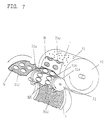
- Fig. 7 is a perspective view of the part B shown in Fig. 6.
- Fig. 8 shows sectional views of main die roller and vacuum pad roller.
- a preferable medicinal patch which obviates the drawbacks of the conventional art and fulfills the physical requirement of a transdermal skin patch is depicted in Figs. 1(a) and 1(b).
- Fig. 1(a) is a plan view of the medicinal patch provided according to the present invention
- Fig. 1(b) is an enlarged-sectional view thereof as taken along the line a - a of Fig. 1(a).
- Reference numeral 1 designates a separate liner that is to be finally removed when the patch P is applied to the skin of the human body.
- the separate liner 1 being used as a releaser at the time of use, is favorably formed by coating silicon on such the resin as polyethylene terephthalate (PET) or paper.
- PET polyethylene terephthalate
- Fig. 1(b) which shows a section of the patch
- a medicament layer 3 As can be seen from Fig. 1(b) which shows a section of the patch, on the separate liner 1 are deposited a medicament layer 3, a first elastic film layer 4, an adhesive layer 6 and a second elastic film layer 7 in order.
- the first elastic film layer 4 has an elasticity of more than about 100% and thickness of 5 to 300 micrometers and is preferably made from polyurethane (PU), polyethylene terephthalate (PET) or styrene iso-styrene (SIS), and the like.
- PU polyurethane
- PET polyethylene terephthalate
- SIS styrene iso-styrene
- a base film 10 which is used as one of main stuffs in making the patch P of the invention is shown in Fig. 2(a) and has a structure of lamination of a separate liner 1, a medicament layer 3, a first elastic film layer 4 and a first release liner 5 in order.
- a adhesive tape 20 which is also used as another main stuff in making the patch of the invention has a structure of lamination of a second release liner 5', an adhesive layer 6 and a second elastic film 7 in order as can be seen in Fig. 2(b).
- the base film 10 and the adhesive tape 20 undergo a series of processing steps such as a few times half-die cutting, mutual bonding, die cutting and drawing-up etc. with the help of the apparatus of the present invention.
- a method of manufacturing the base film 10 has been fully described in another korean patent application filed by us on the same date of priority of the present invention, entitled "Method of manufacturing a base film for a transdermal skin patch and an apparatus for making the same". Since the method of manufacturing the base film 10 itself is another invention and not material to understand the present invention, the detailed description thereabout is omitted in this specification. Furthermore, the description about a method of manufacturing the adhesive tape 20 itself is also omitted for the same reason.
- Fig. 3 schematically depicts the steps of manufacturing the medicinal patch for percutaneous administration in accordance with the present invention and Figs. 4(a) to 4(m) are each plan and sectional views of respective base film strip and adhesive tape strip or its/their residual scrap/scraps to be removed in the process of the present invention.
- FIG. 3 indicates the development of the manufacturing steps in accordance with the present invention.
- the base film 10 which is provided with a form of roll and whose structure is a lamination of the separate liner 1, the medicament layer 3, the first elastic film layer 4 and the first release liner 5 in order is drawn out from one of first feed rollers 12 and 12' while the first release liner 5 is peeled off from the base film 10 for removal and wound around its winding roller 60 (Hereinafter the base film with no release liner 5 being preferably called 'released base film').
- This step can be referred to Figs. 3, 4(a) and 4(b).
- the released base film 10 being unwound from one of first feed rollers 12 and 12', passes through a pair of first half-die cutting rollers 14 and 14' so that at least one wave-shaped cut-and-tear line 2 is consecutively formed only on the separate liner 1 along the length of the released base film 10 as depicted in Figs. 3 and 4(c).
- each of the medicament layer 3 and the elastic film layers 4 and 7 is no more than a few tens of micrometers in thickness and the overall medicinal patch P is so thin that it is not easy to remove the separate liner 1 from the patch unless appropriate cut-and-tear line is provided therein when applying the patch to the diseased region of the body. Therefore, the second step is carried out for consecutively forming at least one cut-and-tear line 2 just on the separate liner 1 by the half-die cutting technique.
- the medicament layer 3 and the first elastic film layer 4, overlapped on the separate liner 1 of the base film 10, are simultaneously half-die cut into an oval or round shape on a main die roller 60 through second half-die cutting.
- a scrap 16 of the medicament layer 3 and the first elastic film layer 4 created from the second half-die cutting is wound on a roller 66 to be removed from the separate liner 1, as shown in Figs. 3 and 4(d) and 4(e).
- the adhesive tape 20 which is prepared as a roll and whose structure is a lamination of the second release liner 5', the adhesive layer 6 and second elastic film layer 7 is continuously provided from a second feed roller 22 while its second release liner 5' being removed therefrom and collected on its winding roller 70 and, thus, makes a released adhesive tape 24 with no release liner 5'.
- the released adhesive tape 24 is then attached over the first resultant strip 18 where the medicament layer 3 and the first elastic film layer 4 are remained in the shape of oval or circle on the separate liner 1, which is well depicted in Figs. 3 and 4(f), 4(g), 4(h) and 4(i).
- the fourth step is also carried out on the main die roller 60 with the help of pressing rollers 56 and 58 which give attaching pressure to the first resultant strip 18 against the main die roller 60 right after the released adhesive tape strip 24 is laid over the first resultant strip 18.
- the released adhesive tape 24 which has been attached over the first resultant strip 18 are manipulated to have the coincidental oval or circular shape just on the corresponding oval or circular medicament layer 3 and the first elastic film layer 4 by a third half-die cutting.
- the oval or circular regions of the adhesive tape 24 have the same shapes as those of the medicament layer 3 and the first elastic film layer 4 of the first resultant strip 18 but are a little larger than the medicament layer 3 and the first elastic film layer 4 so as to let the differentiated larger area have a role of adhering capability to the skin.
- a scrap 26 of the released adhesive tape produced at this point is removed by being wound on a roller 74, thus, creating a second resultant strip 30. This process can be well referred to in Figs. 3, 4(j) and 4(k).
- the second resultant strip 30 which has the consecutive separate liner 1 with at least one cut-and-tear line 2 therein, the ovally or circularly shaped medicament layer 3 and first elastic film layer 4 lied on said separated liner 1 and the ovally or circularly shaped adhesive layer 6 and second elastic film layer 7 lied just on said ovally or circularly shaped medicament layer 3 and first elastic film layer 4 is drawn up and transferred forward.
- a die cutting is performed on the second resultant strip 30 into a predetermined shape (e.g. square shape), thus, producing a third resultant strip 32.
- a scrap 86 of the separate liner 1 created from this die cutting is finally removed.
- the third resultant strips 32 make finished products of medicinal patch prior to packing for sale.
- the finished products of the third resultant strip 32 are drawn up and transferred from the main die roller 60 to a conveyor 62 by a vacuum pad roller 90.
- the method of making the medicinal patch for percutaneous administration comprises the above-described seven steps and the present invention relates to a main unit to perform particularly from the third to seventh steps in the above.
- Fig. 5 is a front view of an apparatus for performing said manufacturing steps for manufacturing medicinal patch for percutaneous administration in accordance with the present invention.
- Reference numeral 100 denotes a frame of the apparatus for manufacturing the inventive medicinal patch P which is movable with a jack or jacks(not drawn), and made preferably from stainless steel.
- the first feed rollers 12 and 12' for mounting the roll of base film 10 and drawing it out are rollingly mounted on the frame up and down, so one of them unwinds the base film 10 selectively. If the base film roll mounted on any one of the upper and lower rollers 12 and 12' is all run out, a spare base film roll provided on the other feed roller starts to be drawn out without delay, which saves the loading time to enhance the productivity.
- These rollers 12 and 12' include a controller to minutely control the base film roll's mounting condition, a hand brake, a device for alarming decrement of the base film, and a sensor for detecting the cutting thereof(not shown).
- a pair of rollers 40 and 41 which are so provided as to transfer the base film 10 control their rolling speed according to displacement of a dancer roller 42 having a balancer, and assures the constant-speed transfer of the base film.
- the dancer roller 42 keeps a predetermined weight by the balancer, and transfers the base film 10 to the main die roller 60 under a given tension regardless of the remained diameter of the base film roll wound around the feed roller 12 or 12'.
- a cutting apparatus 44 which comprises a pair of the first die cutting rollers 14, 14' serves to half-die cut only the separate liner 1 of the base film 10 into a waveform. As the base film 10 passes between a pair of the first half-die cutting rollers 14 and 14' (first half-die cutting rollers), the separate liner 1 is half-die cut to have at least one continuous wave-shaped line 2 along its longitudinal direction.
- Reference numeral 50 denotes a main unit of the apparatus for making the inventive medicinal patch.
- the main unit 50 are performed the following five steps: one is the second half-die cutting by which the medicament layer 3 and the first elastic film layer 4 which are laminated over the separated liner 1 are processed into an oval or round shape; another is attaching the released adhesive tape 24 to the first resultant strip 18; the next is is the third half-die cutting the adhesive tape into an oval or round shape; the next is performing a die cutting the resultant strip 32 to a predetermined shape (e.g. square shape) to produce finished products of medicinal patch P ; and the last is finally drawing up the finished products by the vacuum pad roller 90 and moving them to the conveyor 62.
- a predetermined shape e.g. square shape
- half-die cutting means that, when the sectional structure of a certain strip is made from more than two layers laminated, only the intended or predetermined layer/layers is/are to be cut among the laminated layers, whereas die-cut means to cut all the layers of the section at once.
- half-die cutting roller means a kind or piece of machine to perform half-die cut
- die-cutting roller means a kind or piece of machine to perform die-cut.
- a die cutting roller 59 also has a plurality of predetermined shaped, for example, quadri-shaped kiss cutting blades formed equidistant from one another at its outer surface and the detailed structure or configuration of the die cutting roller 59 can be seen in Fig. 7 which shows a perspective view of the part B shown in Fig. 6.
- a plurality of vacuum holes(not drawn) are formed on the outer surface of the main die roller 60 for drawing up and transferring the base film 10 during the second, third half-die cutting steps and final die cutting step.
- the preliminary and main pressure rollers 56 and 58 used for adhering the adhesive tape 24 over the first resultant strip 18 are interposed between the second half-die cutting roller 52 and the third half-die cutting roller 54.
- the preliminary pressure roller 56 is an auxiliary one
- the roller 58 is a main one.
- the process of rolling and compressing the released adhesive tape strip 24 against the first resultant strip 18 on the main die roller 60 prevents bonding failure(for example, air gap entrapped between the base film and the adhesive tape).
- the vacuum pad roller 90 has rubber suckers(not drawn) on its outer surface for drawing up the finished products of medicinal patch from the surface of the main die roller 60 by suction, and transfers them to the conveyor 62.
- the first release liner 5 of the base film 10 is collected on a first release liner winding roller 64 under a constant tension with the help of a powder clutch(not drawn) and a tension controller (TC1) regardless its winding diameter.
- Reference numeral 66 denotes a roller on which a scrap 16 of the medicament layer 3 and the first elastic film layer 4 is wound.
- the scrap 16 is wound on the first release liner winding roller 66 under a constant tension with the help of a powder clutch(not drawn) and a tension controller (TC2) regardless of the diameter of the scrap 16 wound.
- the adhesive tape roll 20 is the second feed roller 22.
- Reference numeral 70 is a second release liner winding roller with a single-end fixing type shaft on which the second release liner 5' is collected after being separated from the adhesive tape 20.
- An alarming system is provided to the second release liner winding roller 70 for informing an operator of the second release liner 5's being fully wound thereon.
- the winding tension is constantly kept by a powder clutch(not drawn) and a tension controller (TC3) when winding the release liner 5'.
- Reference numeral 74 denotes a roller on ⁇ which the scrap 26 of the adhesive tape, produced after the third half-die cutting, is wound.
- An alarming system is also provided to the roller 74, thus informing the operator of the scrap 26's being fully wound on the roller 74.
- the tension of the strap 26 is constantly maintained by a powder clutch (not drawn)and a tension controller (TC4) when winding the scrap 26 on the roller 74.
- a peeling roller 72 has a plurality of vacuum holes(not drawn) on its outer surface for drawing up the adhesive tape strip while separating the second release liner 5' from the adhesive tape strip 20.
- Reference numerals 76, 78, and 80 designate temporarily winding rollers, and these are positioned adjacent to the scrap winding roller 66, the second release liner winding roller 70, and the roller 74 on which the scrap 26 of the adhesive tape is wound, respectively.
- the rollers 76, 78, and 80 are used only when the scraps are fully wound on the rollers 66, 70, and 74, respectively and so the used ones are to be replaced with the new empty ones. All the rollers 76, 78, and 80 have a same role to save loading or replacing time.
- These rollers 76, 78, and 80 are preferably configured for non-viscidity to prevent the scraps from sticking to the outer surface of each of them.
- Ovally or circularly punched portions 21 are serially formed on the scrap 26 of the released adhesive tape 24 by the third half-die cutting, as shown in Fig. 4(j), and in particular, its tensile strength becomes considerably lessen so that the scrap 26 is easily broken during its winding. Once the scrap 26 is broken, the apparatus cannot perform the next steps, thus lowering the productivity.
- reference numeral 91 denotes a means for increasing the tensile strength of the scrap 26 and preventing cutting of the scrap 26 during winding after the adhesive tape 24 is adhered to the first resultant strip 18.
- the tensile stress reinforcing means is realized by thread or string provided to regions of the both longitudinal edges and/or middle portion of the punched scrap 26 of the adhesive tape 24.
- Fig. 6 shows an enlarged main part of the apparatus for manufacturing medicinal patch for percutaneous administration in accordance with the present invention, which corresponds to the part A of Fig. 5.
- Fig. 7 is a perspective view of the second half-die cutting roller(part B of Fig. 6) in order to show structures of the second and third half-die rollers 52, 54 and die-cutting roller 59(these three being substantially identical).
- Fig. 8 depicts sectional views of the main die roller 60 and vacuum pad roller 90 to show air passage 61 and vacuum holes 93 for vacuum sucking the patches from the main die roller.
- the second half die cutting roller 52 comprises large-diameter parts 52A formed on both end; a small-diameter part 52B formed between said large-diameter parts; and a plurality of ovally or roundly shaped kiss cutting blades 52C equidistantly installed on outer surface of said small-diameter part, the height of said kiss cutting blades being a little lower than that of the differenc made by said large-diameter parts and small diameter part.
- the strip can be transferred in the condition of its close contact to the outer surface of the main die roller during processing steps of said second and third half-die cutting and die-cutting.
- the strip, under being transferred is to pass the gaps formed by said difference of heights between the large-diameter parts and small-diameter part of said half-die cutting rollers and die cutting roller and, thus, is to be half-die cut or die cut by said kiss cut blades installed on the small diameter surface.
- the following description relates to the operation of the apparatus for making the inventive medicinal patch P.
- the base film 10 fed from one of the first feed rollers 12 and 12' at a required constant speed by a pair of transferring rollers 40 and 41, passes between the first half-die cutting rollers 14 and 14' so that only the separate liner 1 of the base film 10 is continuously half-die cut to have at least one wave-shaped cutting line 2(the first half-die cutting).
- the released base film travels the outer surface of the main die roller 60 by closely vacuum contact thereon in accordance with the rolling movement of the main die roller and, then, the medicament layer 3 and the first elastic film layer 4 of the base film 10 are cut out by the oval or round kiss cutting blades equidistantly formed along the outer surface of the second half-die cutting roller 52.
- the adhesive tape 24 produced from the adhesive tape roll 20 by peeling off the second release liner 5' therefrom is attached over the first resultant strip 18 with the help of the pressing rollers 56 and 58.
- the thread or string 91 is provided to the back of the adhesive tape 24.
- the third half-die cutting roller 54 having a plurality of oval- or round-shaped kiss cutting blades equidistantly installed on its outer surface, half-die cuts only the adhesive tape 24 of the second resultant strip into an oval or round shape.
- a scrap 26 produced from the above process is wound on the roller 74 for removal.
- the third half-die cutting is carried out on the regions of the adhesive tape 24 corresponding to the ovally or circularly shaped medicament and first elastic film layers 3 and 4.
- the strip on which the third half-die cutting is performed is moved a little way along the main die roller 60 closely contacting the main die roller 60.
- the overall strip is then die cut out by the die cutting roller 59 which has a plurality of square-shaped kiss cutting blades formed equidistant from one another at its outer surface, thus producing finished products of medicinal patch P as shown in Fig. 1.
- the vacuum pad roller 90 draws up each finished product with its rubber suckers that are circumferentially formed equidistantly from each other, and transfers it to the conveyor 62. Automatic inspection and packing are performed on each finished product P of medicinal patch on the conveyor 62.
- medicinal patch for percutaneous administration made by the apparatus according to the manufacturing steps of the present invention can fulfill the physical requirements of a transdermal skin patch. That is, the inventive medicinal patch can adhere to the skin of the knee or elbow securely and elastically for a long period of time even during bath or shower bath, and is not easily contaminated by the dirt without loss of medicinal properties.
- the oval- or round-shaped medicinal patch of the present invention is so thin and small that it can be securely attached to the skin of any diseased region of the human body, thus being superior to the presently-available transdermal skin patch.
Landscapes
- Engineering & Computer Science (AREA)
- Health & Medical Sciences (AREA)
- Manufacturing & Machinery (AREA)
- Biomedical Technology (AREA)
- Heart & Thoracic Surgery (AREA)
- Vascular Medicine (AREA)
- Life Sciences & Earth Sciences (AREA)
- Animal Behavior & Ethology (AREA)
- General Health & Medical Sciences (AREA)
- Public Health (AREA)
- Veterinary Medicine (AREA)
- Medicinal Preparation (AREA)
Applications Claiming Priority (2)
| Application Number | Priority Date | Filing Date | Title |
|---|---|---|---|
| KR9669415 | 1996-12-21 | ||
| KR1019960069415A KR19980050583A (ko) | 1996-12-21 | 1996-12-21 | 약물 경피투여제의 제조장치 |
Publications (3)
| Publication Number | Publication Date |
|---|---|
| EP0848937A2 true EP0848937A2 (de) | 1998-06-24 |
| EP0848937A3 EP0848937A3 (de) | 1999-11-17 |
| EP0848937B1 EP0848937B1 (de) | 2002-10-09 |
Family
ID=19489920
Family Applications (1)
| Application Number | Title | Priority Date | Filing Date |
|---|---|---|---|
| EP97122411A Expired - Lifetime EP0848937B1 (de) | 1996-12-21 | 1997-12-18 | Vorrichtung zur Herstellung von medizinischen Pflastern zur perkutanen Verabreichung |
Country Status (4)
| Country | Link |
|---|---|
| EP (1) | EP0848937B1 (de) |
| KR (1) | KR19980050583A (de) |
| DE (1) | DE69716223T2 (de) |
| ES (1) | ES2184953T3 (de) |
Cited By (13)
| Publication number | Priority date | Publication date | Assignee | Title |
|---|---|---|---|---|
| WO2000074618A1 (de) * | 1999-06-02 | 2000-12-14 | Lts Lohmann Therapie-Systeme Ag | Verfahren und vorrichtung zum herstellen eines produktes aus streifenband, insbesondere eines medizinischen und/oder wirkstoffhaltigen produktes sowie befüllbaren behältern oder siegelrandbeuteln |
| WO2001060306A1 (en) * | 2000-02-18 | 2001-08-23 | Angelo Dotta | Sealed package for adhesive wound dressing, and apparatus therefore |
| EP1297803A3 (de) * | 2001-09-28 | 2004-06-23 | JOHNSON & JOHNSON KABUSHIKI KAISHA | Versiegelungsvorrichtung für Pflaster |
| EP1584448A1 (de) * | 2004-04-08 | 2005-10-12 | Tetra Laval Holdings & Finance S.A. | Siegeleinheit zum Aufbringen einer Kunststoffolie auf ein Substratmaterial |
| US9283738B2 (en) | 2011-10-24 | 2016-03-15 | Hisamitsu Pharmaceutical Co., Inc. | Method for producing pressure-sensitive adhesive tape package |
| EP2804734B1 (de) | 2012-01-20 | 2016-04-13 | Acino AG | Gitterverlustreduktion bei pflasterherstellung |
| WO2017141255A1 (en) | 2016-02-18 | 2017-08-24 | Alma Therapeutics Ltd. | Regulator device for drug patch |
| CN111870772A (zh) * | 2020-07-15 | 2020-11-03 | 中国科学院大学宁波华美医院 | 防卷边留置针敷贴 |
| CN112829004A (zh) * | 2020-12-29 | 2021-05-25 | 安捷利(番禺)电子实业有限公司 | 一种自动冲切覆盖膜装置 |
| CN113456492A (zh) * | 2021-06-25 | 2021-10-01 | 殷兴营 | 一种中药加工用仙人掌去刺装置 |
| US11147955B2 (en) | 2015-02-18 | 2021-10-19 | Alma Therapeutics Ltd. | Regulator device for drug patch |
| CN114983825A (zh) * | 2022-07-04 | 2022-09-02 | 安徽金马药业股份有限公司 | 一种膏药贴加工成型一体设备 |
| WO2023246407A1 (zh) * | 2022-06-22 | 2023-12-28 | 苏州悦肤达医疗科技有限公司 | 贴片产品加工系统及贴片产品加工方法 |
Families Citing this family (1)
| Publication number | Priority date | Publication date | Assignee | Title |
|---|---|---|---|---|
| KR102242543B1 (ko) * | 2019-11-13 | 2021-04-22 | 임병진 | 티눈제거용 패치 제조장치 |
Family Cites Families (8)
| Publication number | Priority date | Publication date | Assignee | Title |
|---|---|---|---|---|
| US2680943A (en) * | 1948-12-31 | 1954-06-15 | American White Cross Lab Inc | Bandage forming and wrapping machine |
| US4789415A (en) * | 1983-01-24 | 1988-12-06 | Faasse Jr Adrian L | Pharmaceutical packaging machine |
| IT1242561B (it) * | 1990-08-24 | 1994-05-16 | Gd Spa | Dispositivo per il taglio di un nastro in macchine confezionatrici di prodotti. |
| AU2004092A (en) * | 1991-04-25 | 1992-12-21 | Noven Pharmaceuticals, Inc. | Method and apparatus for forming a transdermal drug device |
| CA2078960A1 (en) * | 1992-04-21 | 1993-10-22 | John Wick | Hydrogel applicator and methods of making same |
| AU682853B2 (en) * | 1993-03-22 | 1997-10-23 | Minnesota Mining And Manufacturing Company | Windowless frame delivered dressing and method of manufacture |
| KR100214007B1 (ko) * | 1996-12-21 | 1999-08-02 | 조민호 | 약물 경피투여제의 제조방법 및 제조장치 |
| KR19980050582A (ko) * | 1996-12-21 | 1998-09-15 | 김준웅 | 약물 경피투여제 제조장치에 있어서의 원판 이형필름의 배할장치 |
-
1996
- 1996-12-21 KR KR1019960069415A patent/KR19980050583A/ko not_active Withdrawn
-
1997
- 1997-12-18 DE DE69716223T patent/DE69716223T2/de not_active Expired - Lifetime
- 1997-12-18 EP EP97122411A patent/EP0848937B1/de not_active Expired - Lifetime
- 1997-12-18 ES ES97122411T patent/ES2184953T3/es not_active Expired - Lifetime
Cited By (22)
| Publication number | Priority date | Publication date | Assignee | Title |
|---|---|---|---|---|
| WO2000074618A1 (de) * | 1999-06-02 | 2000-12-14 | Lts Lohmann Therapie-Systeme Ag | Verfahren und vorrichtung zum herstellen eines produktes aus streifenband, insbesondere eines medizinischen und/oder wirkstoffhaltigen produktes sowie befüllbaren behältern oder siegelrandbeuteln |
| US7114422B1 (en) | 1999-06-02 | 2006-10-03 | Lts Lohmann Therapie-Systeme Ag | Method and device for producing a product made of strip tape, especially a medical product and/or a product containing active substances as well as fillable receptacles or pouches whose edges can be sealed |
| US7370563B2 (en) | 1999-06-02 | 2008-05-13 | Lts Lohmann Therapie-Systeme Ag | Process and device for manufacturing a product from strip tape, especially for manufacturing a medicinal and/or active substance-containing product as well as fillable containers or sealed-margin bags |
| US8616101B2 (en) | 1999-06-02 | 2013-12-31 | Lts Lohmann Therapie-Systeme Ag | Process and device for manufacturing a product from strip tape, especially for manufacturing a medicinal and/or active substance-containing product as well as fillable containers or sealed-margin bags |
| WO2001060306A1 (en) * | 2000-02-18 | 2001-08-23 | Angelo Dotta | Sealed package for adhesive wound dressing, and apparatus therefore |
| US6719137B2 (en) | 2000-02-18 | 2004-04-13 | Angelo Dotta | Sealed package for adhesive wound dressing, and apparatus therefore |
| EP1297803A3 (de) * | 2001-09-28 | 2004-06-23 | JOHNSON & JOHNSON KABUSHIKI KAISHA | Versiegelungsvorrichtung für Pflaster |
| EP1584448A1 (de) * | 2004-04-08 | 2005-10-12 | Tetra Laval Holdings & Finance S.A. | Siegeleinheit zum Aufbringen einer Kunststoffolie auf ein Substratmaterial |
| JP2005298067A (ja) * | 2004-04-08 | 2005-10-27 | Tetra Laval Holdings & Finance Sa | 基板材料にプラスチックホイルを貼付するためのシーリングユニット |
| US9283738B2 (en) | 2011-10-24 | 2016-03-15 | Hisamitsu Pharmaceutical Co., Inc. | Method for producing pressure-sensitive adhesive tape package |
| EP2804734B1 (de) | 2012-01-20 | 2016-04-13 | Acino AG | Gitterverlustreduktion bei pflasterherstellung |
| EP2804734B2 (de) † | 2012-01-20 | 2025-01-15 | Luye Pharma AG | Gitterverlustreduktion bei pflasterherstellung |
| US11147955B2 (en) | 2015-02-18 | 2021-10-19 | Alma Therapeutics Ltd. | Regulator device for drug patch |
| WO2017141255A1 (en) | 2016-02-18 | 2017-08-24 | Alma Therapeutics Ltd. | Regulator device for drug patch |
| US11197789B2 (en) | 2016-08-17 | 2021-12-14 | Alma Therapeutics Ltd. | Regulator device for drug patch |
| CN111870772A (zh) * | 2020-07-15 | 2020-11-03 | 中国科学院大学宁波华美医院 | 防卷边留置针敷贴 |
| CN112829004A (zh) * | 2020-12-29 | 2021-05-25 | 安捷利(番禺)电子实业有限公司 | 一种自动冲切覆盖膜装置 |
| CN112829004B (zh) * | 2020-12-29 | 2022-07-29 | 安捷利(番禺)电子实业有限公司 | 一种自动冲切覆盖膜装置 |
| CN113456492A (zh) * | 2021-06-25 | 2021-10-01 | 殷兴营 | 一种中药加工用仙人掌去刺装置 |
| CN113456492B (zh) * | 2021-06-25 | 2023-10-17 | 江苏康康同学科技有限公司 | 一种中药加工用仙人掌去刺装置 |
| WO2023246407A1 (zh) * | 2022-06-22 | 2023-12-28 | 苏州悦肤达医疗科技有限公司 | 贴片产品加工系统及贴片产品加工方法 |
| CN114983825A (zh) * | 2022-07-04 | 2022-09-02 | 安徽金马药业股份有限公司 | 一种膏药贴加工成型一体设备 |
Also Published As
| Publication number | Publication date |
|---|---|
| ES2184953T3 (es) | 2003-04-16 |
| EP0848937A3 (de) | 1999-11-17 |
| KR19980050583A (ko) | 1998-09-15 |
| DE69716223T2 (de) | 2003-11-27 |
| EP0848937B1 (de) | 2002-10-09 |
| DE69716223D1 (de) | 2002-11-14 |
Similar Documents
| Publication | Publication Date | Title |
|---|---|---|
| EP0848937B1 (de) | Vorrichtung zur Herstellung von medizinischen Pflastern zur perkutanen Verabreichung | |
| US12011906B2 (en) | Methods of wrapping an item with a wrapping material | |
| CN109625598B (zh) | 制造用于包缠成形捆包的材料的方法和包缠网组件 | |
| US4525229A (en) | Method for attaching elastic band to sanitary articles | |
| CN107107598B (zh) | 处理粘合层合物贴剂的方法 | |
| EP0848936B1 (de) | Verfahren zur Herstellung von medizinischen Pflastern zur perkutanen Verabreichung, und Vorrichtung dafür | |
| CN101232875B (zh) | 处理粘合层叠片片段的方法 | |
| JP4418848B1 (ja) | 救急絆創膏の製造装置 | |
| KR101554328B1 (ko) | 포장지에 약제가 붙지 않고 약제수율이 개선된 약제패치 제조장치 | |
| KR101554329B1 (ko) | 포장지에 약제가 붙지 않고 약제수율이 개선된 약제패치 및 그 제조방법 | |
| EP0827453B1 (de) | Verfahren zur behandlung einer materialbahn auf einer zentralen behandlungstrommel | |
| KR101785425B1 (ko) | 약제용 패치 제조장치 | |
| KR100262698B1 (ko) | 약물 경피투여제의 제조방법 및 그 제조장치 | |
| ZA200109764B (en) | Method and device for producing a product made of strip tape, especially a medical product and/or a product containing active substances as well as fillable receptacles or pouches. | |
| JP2011183062A (ja) | 粘着性被覆体の製造装置 | |
| KR100212024B1 (ko) | 약물 경피투여제 제조용 원판 롤의 제조방법 및 그 제조장치 | |
| KR100290135B1 (ko) | 약물경피투여제제조용원판롤의제조방법및그제조장치 | |
| KR19980050582A (ko) | 약물 경피투여제 제조장치에 있어서의 원판 이형필름의 배할장치 | |
| EP4046798A1 (de) | Vorrichtung und verfahren zum entfernen mindestens einer schicht von einer artikelstruktur | |
| JPH10510741A (ja) | 弾性フィルムのストリップを製造する方法およびそのストリップを組み入れた吸収性製品 | |
| EP0124732A2 (de) | Verpackungssystem für Okklusivverband | |
| CA2788931C (en) | El-tabbed double-sided tape roll and method of preparation | |
| MXPA99006826A (es) | Vendaje adhesivo esteril y metodos asociados. |
Legal Events
| Date | Code | Title | Description |
|---|---|---|---|
| PUAI | Public reference made under article 153(3) epc to a published international application that has entered the european phase |
Free format text: ORIGINAL CODE: 0009012 |
|
| AK | Designated contracting states |
Kind code of ref document: A2 Designated state(s): DE ES FR GB IT |
|
| AX | Request for extension of the european patent |
Free format text: AL;LT;LV;MK;RO;SI |
|
| PUAL | Search report despatched |
Free format text: ORIGINAL CODE: 0009013 |
|
| AK | Designated contracting states |
Kind code of ref document: A3 Designated state(s): AT BE CH DE DK ES FI FR GB GR IE IT LI LU MC NL PT SE |
|
| AX | Request for extension of the european patent |
Free format text: AL;LT;LV;MK;RO;SI |
|
| 17P | Request for examination filed |
Effective date: 20000202 |
|
| AKX | Designation fees paid |
Free format text: DE ES FR GB IT |
|
| GRAG | Despatch of communication of intention to grant |
Free format text: ORIGINAL CODE: EPIDOS AGRA |
|
| RTI1 | Title (correction) |
Free format text: APPARATUS FOR MANUFACTURING MEDICINAL PATCHES FOR PERCUTANEOUS ADMINISTRATION |
|
| 17Q | First examination report despatched |
Effective date: 20020219 |
|
| GRAG | Despatch of communication of intention to grant |
Free format text: ORIGINAL CODE: EPIDOS AGRA |
|
| GRAH | Despatch of communication of intention to grant a patent |
Free format text: ORIGINAL CODE: EPIDOS IGRA |
|
| GRAH | Despatch of communication of intention to grant a patent |
Free format text: ORIGINAL CODE: EPIDOS IGRA |
|
| GRAA | (expected) grant |
Free format text: ORIGINAL CODE: 0009210 |
|
| AK | Designated contracting states |
Kind code of ref document: B1 Designated state(s): DE ES FR GB IT |
|
| REG | Reference to a national code |
Ref country code: GB Ref legal event code: FG4D |
|
| REF | Corresponds to: |
Ref document number: 69716223 Country of ref document: DE Date of ref document: 20021114 |
|
| ET | Fr: translation filed | ||
| REG | Reference to a national code |
Ref country code: ES Ref legal event code: FG2A Ref document number: 2184953 Country of ref document: ES Kind code of ref document: T3 |
|
| PLBE | No opposition filed within time limit |
Free format text: ORIGINAL CODE: 0009261 |
|
| STAA | Information on the status of an ep patent application or granted ep patent |
Free format text: STATUS: NO OPPOSITION FILED WITHIN TIME LIMIT |
|
| 26N | No opposition filed |
Effective date: 20030710 |
|
| REG | Reference to a national code |
Ref country code: FR Ref legal event code: PLFP Year of fee payment: 19 |
|
| REG | Reference to a national code |
Ref country code: DE Ref legal event code: R082 Ref document number: 69716223 Country of ref document: DE Representative=s name: SSM SANDMAIR PATENTANWAELTE RECHTSANWALT PARTN, DE Ref country code: DE Ref legal event code: R082 Ref document number: 69716223 Country of ref document: DE Representative=s name: SCHWABE SANDMAIR MARX PATENTANWAELTE RECHTSANW, DE |
|
| REG | Reference to a national code |
Ref country code: FR Ref legal event code: PLFP Year of fee payment: 20 |
|
| PGFP | Annual fee paid to national office [announced via postgrant information from national office to epo] |
Ref country code: GB Payment date: 20161122 Year of fee payment: 20 Ref country code: DE Payment date: 20161122 Year of fee payment: 20 Ref country code: FR Payment date: 20161124 Year of fee payment: 20 |
|
| PGFP | Annual fee paid to national office [announced via postgrant information from national office to epo] |
Ref country code: IT Payment date: 20161214 Year of fee payment: 20 Ref country code: ES Payment date: 20161205 Year of fee payment: 20 |
|
| REG | Reference to a national code |
Ref country code: DE Ref legal event code: R071 Ref document number: 69716223 Country of ref document: DE |
|
| REG | Reference to a national code |
Ref country code: GB Ref legal event code: PE20 Expiry date: 20171217 |
|
| PG25 | Lapsed in a contracting state [announced via postgrant information from national office to epo] |
Ref country code: GB Free format text: LAPSE BECAUSE OF EXPIRATION OF PROTECTION Effective date: 20171217 |
|
| REG | Reference to a national code |
Ref country code: ES Ref legal event code: FD2A Effective date: 20180508 |
|
| PG25 | Lapsed in a contracting state [announced via postgrant information from national office to epo] |
Ref country code: ES Free format text: LAPSE BECAUSE OF EXPIRATION OF PROTECTION Effective date: 20171219 |