EP0849947B1 - Empfänger für Fernsehsignale mit einer elektronischen Programmauswahl von verfügbaren Fernsehprogrammen - Google Patents
Empfänger für Fernsehsignale mit einer elektronischen Programmauswahl von verfügbaren Fernsehprogrammen Download PDFInfo
- Publication number
- EP0849947B1 EP0849947B1 EP96120485A EP96120485A EP0849947B1 EP 0849947 B1 EP0849947 B1 EP 0849947B1 EP 96120485 A EP96120485 A EP 96120485A EP 96120485 A EP96120485 A EP 96120485A EP 0849947 B1 EP0849947 B1 EP 0849947B1
- Authority
- EP
- European Patent Office
- Prior art keywords
- digital signals
- program
- signals according
- receiver
- processing digital
- Prior art date
- Legal status (The legal status is an assumption and is not a legal conclusion. Google has not performed a legal analysis and makes no representation as to the accuracy of the status listed.)
- Expired - Lifetime
Links
- 238000000034 method Methods 0.000 title claims abstract description 49
- 238000003825 pressing Methods 0.000 claims description 11
- 230000008859 change Effects 0.000 claims description 2
- 230000008569 process Effects 0.000 claims description 2
- 230000003247 decreasing effect Effects 0.000 claims 1
- 230000005540 biological transmission Effects 0.000 description 9
- 230000006870 function Effects 0.000 description 8
- 238000010586 diagram Methods 0.000 description 6
- 230000008901 benefit Effects 0.000 description 3
- 238000004458 analytical method Methods 0.000 description 2
- 230000009471 action Effects 0.000 description 1
- 230000015572 biosynthetic process Effects 0.000 description 1
- 239000003086 colorant Substances 0.000 description 1
- 238000000605 extraction Methods 0.000 description 1
- 238000004519 manufacturing process Methods 0.000 description 1
- 239000000463 material Substances 0.000 description 1
- 238000003786 synthesis reaction Methods 0.000 description 1
Images


Classifications
-
- H—ELECTRICITY
- H04—ELECTRIC COMMUNICATION TECHNIQUE
- H04N—PICTORIAL COMMUNICATION, e.g. TELEVISION
- H04N21/00—Selective content distribution, e.g. interactive television or video on demand [VOD]
- H04N21/40—Client devices specifically adapted for the reception of or interaction with content, e.g. set-top-box [STB]; Operations thereof
- H04N21/43—Processing of content or additional data, e.g. demultiplexing additional data from a digital video stream; Elementary client operations, e.g. monitoring of home network or synchronising decoder's clock; Client middleware
- H04N21/433—Content storage operation, e.g. storage operation in response to a pause request, caching operations
- H04N21/4332—Content storage operation, e.g. storage operation in response to a pause request, caching operations by placing content in organized collections, e.g. local EPG data repository
-
- H—ELECTRICITY
- H04—ELECTRIC COMMUNICATION TECHNIQUE
- H04N—PICTORIAL COMMUNICATION, e.g. TELEVISION
- H04N21/00—Selective content distribution, e.g. interactive television or video on demand [VOD]
- H04N21/40—Client devices specifically adapted for the reception of or interaction with content, e.g. set-top-box [STB]; Operations thereof
- H04N21/47—End-user applications
-
- H—ELECTRICITY
- H04—ELECTRIC COMMUNICATION TECHNIQUE
- H04N—PICTORIAL COMMUNICATION, e.g. TELEVISION
- H04N7/00—Television systems
- H04N7/08—Systems for the simultaneous or sequential transmission of more than one television signal, e.g. additional information signals, the signals occupying wholly or partially the same frequency band, e.g. by time division
- H04N7/087—Systems for the simultaneous or sequential transmission of more than one television signal, e.g. additional information signals, the signals occupying wholly or partially the same frequency band, e.g. by time division with signal insertion during the vertical blanking interval only
- H04N7/088—Systems for the simultaneous or sequential transmission of more than one television signal, e.g. additional information signals, the signals occupying wholly or partially the same frequency band, e.g. by time division with signal insertion during the vertical blanking interval only the inserted signal being digital
- H04N7/0882—Systems for the simultaneous or sequential transmission of more than one television signal, e.g. additional information signals, the signals occupying wholly or partially the same frequency band, e.g. by time division with signal insertion during the vertical blanking interval only the inserted signal being digital for the transmission of character code signals, e.g. for teletext
-
- H—ELECTRICITY
- H04—ELECTRIC COMMUNICATION TECHNIQUE
- H04N—PICTORIAL COMMUNICATION, e.g. TELEVISION
- H04N7/00—Television systems
- H04N7/08—Systems for the simultaneous or sequential transmission of more than one television signal, e.g. additional information signals, the signals occupying wholly or partially the same frequency band, e.g. by time division
- H04N7/087—Systems for the simultaneous or sequential transmission of more than one television signal, e.g. additional information signals, the signals occupying wholly or partially the same frequency band, e.g. by time division with signal insertion during the vertical blanking interval only
- H04N7/088—Systems for the simultaneous or sequential transmission of more than one television signal, e.g. additional information signals, the signals occupying wholly or partially the same frequency band, e.g. by time division with signal insertion during the vertical blanking interval only the inserted signal being digital
- H04N7/0887—Systems for the simultaneous or sequential transmission of more than one television signal, e.g. additional information signals, the signals occupying wholly or partially the same frequency band, e.g. by time division with signal insertion during the vertical blanking interval only the inserted signal being digital for the transmission of programme or channel identifying signals
Definitions
- the present invention refers to a method of processing digital signals inserted during vertical flyback periods in a television signal by a television signals receiver, comprising:
- the broadcasting stations that also transmit teletext signals usually provide, in appropriate pages, the transmission of lists of the available programs for the current and/or successive days.
- the aim of the present invention is that of indicating how it is possible to manufacture a television signals receiver able to help the user in a simple and practical way, not only by indicating the programs which can be chosen, but facilitating the user to the maximum with this task.
- the subject of the present invention is a method of processing digital signals inserted during vertical flyback periods in a television signal by a television signals receiver having the characteristics being principally described in the first claim.
- the standardised information relating to television programs can be contained in a plurality of teletext type pages; one of these pages contains the index (directory) of the other pages that contain the information relative to the television programs.
- This index page is identified by a special and defined page number (code); for instance this number contains at least a number being greater than 9. Examples of numbers of this type are 1A0 or C00.
- the decoder of the receiver according to the invention (that can obviously be either a television set, a video recorder, or a simple tuner-amplifier, such as those used for satellite receivers) is programmed to search for such index page; from which it obtains the numbers of the pages containing information on programs; this information is expressed in a standardised manner, so as that the decoder can without difficulty obtain all the data that it needs.
- the decoder reads the pages of interest, stores the data and with such data is able to create a menu to be produced on a display screen.
- Such menu can be stored every time that a determined key is pressed (key M, figure 4); inasmuch the key in question in a preferred solution is also able to recall the receiver from the stand-by condition, so that the display of the menu is automatically effected when the receiver is recalled from stand-by.
- the central unit of control and processing (15) be programmed in such a way to provide for updating the memory only with data relating to television programs of the broadcasting stations, the coordinates of which have been stored in said first memory (17), repeating the operations as mentioned in claim 1 at relatively brief determined intervals of times, for instance every hour, either when the receiver is in the stand-by condition, or when it is in its normal functioning condition.
- the said central unit (15) be on the other hand programmed to update the memory with data relating to television programs relating to all the receivable broadcasting stations, at relatively long determined intervals of time, for instance once a day.
- the central unit provides for storing it and assigning it a tuning program number" to which the data of programs obtained from the teletext pages transmitted by the said transmitting station can be associated.
- the receiver can advantageously be equipped with more than one tuner, so as to be able to update the memory even during the display of a program or its recording; the other tuner (or tuners) also allows for the display of a program and, simultaneously, the recording of another.
- the base menu can advantageously contain the programs being transmitted at the moment of recall from "stand-by", i.e. those of which the beginning is previous, and the end is successive, to the time of display of the menu.
- the menu can advantageously be constituted by at least 9 lines, each containing a program; in the heading of the menu, on the first line, the date and current hour will be indicated.
- Every line can contain from left to right:
- FIG. 5 An example of a program list, representing the programs on show during a normal evening in England, is represented in figure 5.
- the "tuning numbers" illustrated in figure 5 correspond to the following broadcasting stations:
- a cursor can advantageously be displayed (for instance a flashing square or an arrow) for indicating the selected program; as an alternative rather than the cursor the "tuning program number" itself can flash or the whole line; or the selected line can be displayed in a different colour than the others, for instance red.
- the line can also be displayed in a different colour according to the type of program; for instance, see figure 5, the following colours can be used:
- the type of program can be indicated, after the title of the program, by clear or abbreviated writing (film, sport, news, various; or F, S, N, V).
- the user has the availability, upon the moment of switching on the apparatus, of the situation of the programs in that moment; the user can select the program that he prefers from the menu, moving the cursor on the line (i.e. on the program) desired by way of two keys distinguished with an upward pointing arrow and a downward pointing arrow ( ⁇ , ⁇ see figure 4).
- the relative program is tuned and displayed; it is also possible to provide for that once, on the menu of current programs, a determined program has been selected and that such selection is not changed for a determined time (for instance 3 seconds), the receiver automatically provides for tuning and displaying the program without the necessity of pressing P key.
- the previously described base menu re-appears; with the key distinguished with the right pointing arrow ( ⁇ ) the menu of the successive programs respect those of the base menu is shown (i.e. programs that have not yet started); the left pointing arrow ( ⁇ ) returns to the previous menu.
- the receiver is programmed to switch on to the selected program at the time in which the program begins, with a suitable anticipation, for instance 5 minutes before it starts. If, during the same conditions of a menu relating to future transmissions, the R key is pressed the receiver is programmed to record the selected program; the receiver could eventually switch itself on even 5 minutes before the starting time of the program and provide to record the selected program, switching itself off for instance 10 minutes after the time of the programs end.
- the microprocessor of the central control unit 15 uses the relevant information in order to record only the desired program, without the need of starting the recording in advance and to finish it in delay.
- the remaining two keys of figure 5 are usually "stand-by” and audio "muting" keys.
- the audio is mute.
- the receiver does not have, in its memory, data concerning a program relative to a determined broadcasting station, the corresponding line of the menu will be empty or will carry an indication of the type "Data not available”.
- the television receiver according to the invention allows, with the maximum ease, the user to choose in a moment the preferred program from those available or to program in advance its vision or recording; the ease of use of the receiver according to the invention is such that even instructions for its use do not seem necessary.
- a very long program which may be interrupted for transmitting a different program
- this fact can also be signalled in the menu.
- a film may be divided in two halves and a news bulletin may be transmitted in between; or a so called "container program" may contain different items. Any item could be identified separately in the menu.
- the user can decide whether he or she wants that the selected "container" program remains selected until the final end or until the interruption. For example double pressing of the M key (or the P key or the R key) could mean that the final end of the selected program has to be waited for.
- the receiver according to the invention can also supply more sophisticated applications; in fact the data stored relative to the transmission of programs can be processed by the control unit of the receiver in such a way so as to create a real and proper database with which it would then be possible to search and view, or to program, for instance, all the transmissions relating to sport, or all the films and so on.
- the keyboard of the remote control would also be appropriately equipped with numeric keys 1-9.
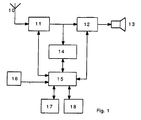
- reference number 10 indicates the receiving antenna
- 11 indicates a conventional tuner and amplifier of television signals, which we can suppose by way of example is of the frequency synthesis type comprising an intermediate frequency amplifier and the video detector.
- Reference number 12 indicates, in the same figure, the circuit block, also conventional, comprising the amplifier of the video signals; the reference number 13 indicates the image display device, which we may suppose as being of the conventional type (cathode-ray tube being internal or external of the appliance).
- Reference number 14 indicates a teletext decoder, which provides for extracting the teletext signals from the video signal, said teletext signals being inserted in normal way in the interval of the vertical flyback periods; the decoder 14 also provides for, in the know way, decoding said teletext signals and for processing them so as to reconstruct the transmitted pages of text.
- the teletext decoder can be of a conventional type, modified, if necessary, in order to be able of handling pages having greater numbers than usual.
- Reference number 15 indicates a central unit of control and digital processing (microprocessor), of the known type, which provides for the functional management of the television signals receiver.
- Reference number 16 indicates a command generating means, that can be comprised for example of a known infrared rays remote control with a keyboard, and relative interface towards the central unit 15; reference number 17 indicates a read and write memory (RAM) of the non volatile type, for memorising the digital data; whereas reference number 18 indicates a read only non volatile memory (ROM) which contains the operative instructions for the central unit 15.
- command generating means that can be comprised for example of a known infrared rays remote control with a keyboard, and relative interface towards the central unit 15;
- reference number 17 indicates a read and write memory (RAM) of the non volatile type, for memorising the digital data; whereas reference number 18 indicates a read only non volatile memory (ROM) which contains the operative instructions for the central unit 15.
- RAM read and write memory
- ROM read only non volatile memory
- central unit 15 provides more precisely to:
- the receiver In order to store all the teletext pages transmitted by the various broadcasting stations being relative to the programming of television programs the receiver has to periodically carry out, upon command or automatically, the following operations:
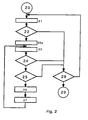
- figure 2 the block diagram of a first significant part of the logic flow according to the invention of the central unit of the receiver of figure 1 is represented.
- Such flow corresponds to a selected part of the operative instructions contained in the memory 18.
- the block indicated with number 20 indicates the starting block of the logic flow relative to the functions of search and storing on the teletext pages information relative to the programming of television transmissions.
- Control can reach block 20 in two ways; for example it can be provided that every time the receiver is switched on the control automatically passes to block 20; or the control can reach block 20 after the user has sent a determined command signal, or when the receiver is found to be in the stand-by condition at a time of an established day or every time that the receiver is placed in the stand-by condition.
- control is then passed from block 20 to the successive block 21.
- Block 21 provides for tuning the next receivable station in the range of available frequencies; control passes to the successive block 22.
- Block 22 is a test block; it controls whether the broadcasting station transmits a teletext service; in the affirmative case control passes to block 22a; in the negative case control passes to block 28; in all the test blocks the lower output corresponds to the YES output; the lateral output corresponds to the NO output.
- Block 22a provides for identifying the special index page of the television programs; it obtains the numbers of the pages containing the information on the programs and stores them; control then passes to the successive block 23.
- Block 23 provides for the acquisition of the current teletext page; control passes to the successive block 24.
- Block 24 is a test block; it controls whether the acquired teletext page has not already been received; in the affirmative case (page not received) control passes to block 25; in the negative case (page already received) control passes to block 28.
- Block 25 is a test block; it controls whether the acquired teletext page relates to the programming of the transmissions; in the affirmative case control passes to block 26; in the negative case control passes to block 28.
- Block 26 provides for extracting the information from the acquired page and to store it in the memory 17; control passes to the successive block 27.
- Block 27 provides for increasing the number of the current page; control passes back to block 23.
- Block 28 is a test block; it controls whether the tuned broadcasting station is the last of the frequencies to be explored; in the affirmative case control passes to block 29; in the negative case control passes back to block 21.
- Block 29 is the end of function block; control can return to a block of the main program of the control unit 15, for instance the one in which the unit 15 carries out the reading of the keyboard of the command means 16.
- the information can advantageously be stored in the memory 17 under the form of a "database”, i.e. under the form of a series of "records", each being relative to a determined television program. Every "record” could for instance be constituted of a fixed number of characters, for example 48; every “record” will be divided in a certain number of "fields", for example 5.
- the title of the program will be contained; in the second field, to which for example 6 characters could be assigned, the type of program (film, sport, news, documentary, etc.) will be contained; in the third field, to which for example 15 characters could be assigned, the date and program starting time will be contained; in the fourth field, to which for example 5 characters could be assigned, the name of the broadcasting station of the program will be contained; finally in the fifth field, to which for example 4 characters could be assigned, the duration, expressed in minutes, will be contained.
- figure 3 the block diagram of a second significant part of the logic flow according to the invention of the central unit of the receiver of figure 1 is represented.
- Such flow corresponds to a selected part of the operative instructions contained in the memory 18.
- the block indicated with the number 30 indicates the starting block of the logic flow relative to the search and display function of the "records" that the user wishes to consult from among those stored.
- Control reaches block 30 after the user has sent a determined command signal for starting the search.
- Control is passed from block 30 to the successive block 31.
- Block 31 provides for asking the user the field of records to search; a message of the type: "Indicate the desired field number” is displayed on the screen and the user then types the relative number; for instance if the desired field is that of the title the user will type the number 1; such number is stored and control passes to the successive block 32.
- Block 32 is a test block; it controls whether the field number indicated is number 1; in the affirmative case control passes to block 33; in the negative case control passes to block 34.
- Block 33 provides for asking the user the title of the records to be searched; a message of the type: "Indicate the title of the desired program" is displayed on the screen and the user will introduce such title by way of the keyboard according to one of the various systems known for sending alphanumeric data by way of a remote control unit to the central unit 15, such indication is stored and control passes to the successive block 40.
- Block 34 is a test block; it controls whether the number of the field indicated is number 2; in the affirmative case control passes to block 35; in the negative case control passes to block 36.
- Block 35 provides for asking the user the type of program to be searched; a message of the type: "Indicated the type of program desired” is displayed on the screen and the user will introduce the type of program desired; such indication is stored and control passes to the successive block 40.
- Block 36 is a test block; it controls whether the field number indicated is 3; in the affirmative case control passes to block 37; in the negative case control passes to block 38.
- Block 37 provides for asking the user the date and starting time of the program to be searched; a message of the type: "Indicate date and starting time of desired program" is displayed on the screen and the user will introduce the date and starting time of the desired program; such indication is stored and control passes to the successive block 40.
- Block 38 is a test block; it controls whether the field number indicated is 4; in the affirmative case control passes to block 39; in the negative case control passes back to block 31.
- Block 39 provides for asking the user the broadcasting station of the desired program to be searched; a message of the type: "Indicate the broadcasting station of the desired program" is displayed on the screen and the user will introduce the broadcasting station of the desired program; such indication is stored and control passes to the successive block 40.
- Block 40 provides to make equal to 1 the number N of the record to be examined (current record) and to set to zero the number N1 of the displayed records; control then passes to block 41.
- Block 41 provides for examining the field indicated of the record having the current number N; control passes to the successive block 42.
- Block 42 is a test block; it controls whether the contents of the field indicated correspond to the text indicated by the user; in the affirmative case control passes to block 43; in the negative case control passes back to block 49.
- Block 43 provides for extracting the record examined and to display it on the screen; control passes to the successive block 44.
- Block 44 provides for increasing by one unit the number N1 of the records displayed and passes the control to the successive block 45.
- Block 45 is a test block; it controls whether the number N1 of the records displayed is greater than 15, i.e. the screen is full; in the affirmative case control passes to block 46; in the negative case control passes to block 49.
- Block 46 provides for displaying a message of the type: "Press a key to continue” and passes the control to the successive block 47.
- Block 47 is a test block; it controls whether the user has pressed any key on the keyboard; in the affirmative case control passes to block 48; in the negative case control passes back to block 47.
- Block 48 provides for canceling the screen and setting to zero the number N1 of the records displayed; control passes to block 49.
- Block 49 provides for increasing by one unit the number N of the current record; control passes to block 50.
- Block 50 is a test block; it controls whether the number N of the current record is greater than the total number of records stored in the memory; in the affirmative case control passes to block 51; in the negative case control passes back to block 41.
- Block 51 is the end of function block; control can go back to a block of the main program of the central unit 15, for instance the one in which the unit 15 carries out the reading of the keyboard of the command means 16, in particular to control whether a signal is sent which indicates to select a program from among those found in this way.
Landscapes
- Engineering & Computer Science (AREA)
- Multimedia (AREA)
- Signal Processing (AREA)
- Databases & Information Systems (AREA)
- Television Systems (AREA)
- Circuits Of Receivers In General (AREA)
- Two-Way Televisions, Distribution Of Moving Picture Or The Like (AREA)
Claims (37)
- Verfahren zur Verarbeitung von Digitalsignalen, die während der vertikalen Rücklaufzeiten in ein durch einen Femsehsignalempfänger empfangenes Fernsehsignal eingefügt sind, umfassend:- mindestens eine Tunervorrichtung (11) zur Einstellung1 auf eine der verschiedenen empfangbaren Fernsehstationen nach Wahl,- einen Decoder (14) zum Empfangen und Decodieren der während der vertikalen Rücklaufzeiten in das empfangene Fernsehsignal eingefügten Digitalsignale,- eine Zentraleinheit zur Steuerung und digitalen Verarbeitung (15), verbunden mit dem Decoder ebenfalls zur Auswertung der empfangenen, decodierten Signale,- ein Eingabemittel2 (16), das es dem Nutzer gestattet, Bedienungs-Befehle an die Zentraleinheit zu senden (15),- ein erster, nicht flüchtiger Digitalspeicher (17) zur Datenspeicherung, in dem das Speichern der Empfangsinformationen einer Vielzahl von Fernsehstationen möglich ist; wobei die Empfangsinformationen einer jeden Femsehstation einer bestimmten Stationsnummer zugeordnet sind, die einer Fernsehstation zugeordnet ist, und- ein zweiter, nicht flüchtiger Digitalspeicher (18) zur Speicherung von Bedienungs-Befehlen für die Zentraleinheit (15),wobei der Empfänger umfasst oder ist verbunden mit:- einer Bildanzeigevorrichtung (13) oder- eine Vorrichtung zur Aufnahme von Fernsehprogrammen,dadurch gekennzeichnet, dass der zweite Speicher (18) Befehle umfasst, um zu bewirken, dass die Zentraleinheit ein Verfahren zur Verarbeitung der Digitalsignale gemäß folgenden Schritten ausführt:a) der Tuner (11) wird so gesteuert, dass er sich auf die erste empfangbare Fernsehstation einstellt,b) das eingestellte Fernsehsignal wird untersucht und darauf geprüft, ob es in die vertikalen Rücklaufzeiten eingefügte Digitalsignale des Videotext-Typs enthält,c) in positivem Fall wird das Digitalsignal des Videotext-Typs ausgewertet und darauf geprüft, ob in dem Signal eine spezielle Seite, die durch einen speziellen, genormten Code identifiziert wird, verfügbar ist, bei der es sich um eine Inhaltsseite zur Identifizierung der Seiten handelt, die Informationen über Fernsehprogramme enthalten,d) diese Informationen werden auf eine genormte Weise ausgedrückt,e) in positivem Fall werden die Seiten untersucht und die in den Seiten enthaltenen Daten gespeichert,
1 wir haben das modernere Wort statt "Abstimmung" genommen, auch weil es sonst an anderen Stellen des Textes nicht passt (A.d.Ü.)
2 Sammelbegriff im Ausgangstext, jedoch Singularf) der Tuner (11) wird so gesteuert, dass er sich auf eine zweite empfangbare Fernsehstation einstellt, die vorherigen Schritte b, c, e werden wiederholt, anschließend wird der Tuner so gesteuert, dass er sich auf eine dritte Fernsehstation einstellt und so weiter bis zur Ausschöpfung aller empfangbaren, verfügbaren Fernsehstationen,g) die auf diese Weise gespeicherten Informationen zu den durch die Fernsehstationen gelieferten Fernsehprogrammen, die gemäß den oben genannten Schritten abgetastet wurden, werden ausgewertet und sortiert, wobei ein Verzeichnis in Form einer Liste von Fernsehprogrammen bereitgestellt wird, das durch Kombinierung der Informationen aus den abgetasteten Fernsehstationen entsteht, undh) der Empfänger ist auf die Anzeige einer Liste der durch die abgetasteten Fernsehstationen bereitgestellten Fernsehprogramme auf der Anzeigevorrichtung (13) vorprogrammiert, jedes Mal, wenn eine/ein bestimmte/r, in dem Eingabemittel (16) enthaltene/r erste/r Taste oder Schalter (M), insbesondere die Taste oder der Schalter, die/der zum Aktivieren des Empfängers aus der "Betriebsbereitschaft" dient, gedrückt wird, wobei die Fernsehprogramme der Reihe nach, neben den entsprechenden "Empfangs-Programmnummern", die in dem ersten Speicher (17) wie oben beschrieben gespeichert wurden, aufgelistet werden. - Verfahren zur Verarbeitung von Digitalsignalen nach Anspruch 1, dadurch gekennzeichnet, dass die Liste die Programme umfasst, die gerade gesendet werden, wenn die erste Taste (M) gedrückt wird.
- Verfahren zur Verarbeitung von Digitalsignalen nach Anspruch 1, dadurch gekennzeichnet, dass sich die Liste wie folgt zusammensetzt:- in der ersten Zeile sind Datum und aktuelle Uhrzeit angegeben- jede der folgenden Zeilen enthält, von links nach rechts, folgende Angaben:- die der Fernsehstation zugeordnete "Empfangs-Programmnummer",- die Anfangszeit des Programms- möglichst die Endzeit des Programms- die Programmbezeichnung.
- Verfahren zur Verarbeitung von Digitalsignalen nach Anspruch 3, dadurch gekennzeichnet, dass die Farbe, mit der eine Zeile der besagten Liste angezeigt wird, von dem Programmtyp abhängt, den diese Zeile betrifft (rot = Film, gelb = Sport, Weiß = Nachrichten, Grün = Unterhaltung3 usw.)
- Verfahren zur Verarbeitung von Digitalsignalen nach Anspruch 4, dadurch gekennzeichnet, dass ein Cursor angezeigt wird, der sich von Zeile zu Zeile zur Auswahl des entsprechenden Programms bewegen lässt.
- Verfahren zur Verarbeitung von Digitalsignalen nach Anspruch 3, dadurch gekennzeichnet, dass jede Zeile der besagten Liste auch eine - ausgeschriebene oder abgekürzte - Angabe über den Programmtyp (Film, Sport, Nachrichten, Sonstiges) umfasst.
- Verfahren zur Verarbeitung von Digitalsignalen nach Anspruch 3 oder 6, dadurch gekennzeichnet, dass eine der Zeilen der Liste oder eines Teils der Liste zur
3 vgl. Anspruch 6, es könnte auch "Sonstiges" gemeint sein (A.d.Ü.) Anzeige des ausgewählten Programms blinkt oder besonders hervorgehoben wird. - Verfahren zur Verarbeitung von Digitalsignalen nach Anspruch 6, dadurch gekennzeichnet, dass eine der Zeilen der Liste oder eines Teils der Liste eine bestimmte Farbe (rot) zur Anzeige des ausgewählten Programms aufweist.
- Verfahren zur Verarbeitung von Digitalsignalen nach einem der Ansprüche 5 bis 8, dadurch gekennzeichnet, dass der Nutzer, zur Auswahl der gewünschten Zeile (des gewünschten Programms) auf der Liste, zwei entsprechende, in dem Eingabemittel (16) enthaltene Tasten verwenden kann, die durch zwei Pfeile - einer nach oben und einer nach unten gerichtet - gekennzeichnet sind.
- Verfahren zur Verarbeitung von Digitalsignalen nach Anspruch 2, dadurch gekennzeichnet, dass durch Drücken einer oder zwei entsprechenden, in dem Eingabemittel (16) enthaltenen Tasten (Pfeil nach rechts oder Pfeil nach links), eine Liste von Programmen angezeigt wird, die auf die zur Zeit laufenden Programme aufeinanderfolgen bzw. diesen vorhergehen.
- Verfahren zur Verarbeitung von Digitalsignalen nach Anspruch 1, dadurch gekennzeichnet, dass durch Drücken einer zweiten bestimmten, in dem Eingabemittel (16) enthaltenen Taste (P), das ausgewählte Programm eingestellt und angezeigt wird, wenn es läuft; hat das ausgewählte Programm jedoch noch nicht angefangen, wird der Empfänger so programmiert, dass er sich auf es einstellt und anzeigt, insbesondere mit einer angemessenen Vorlaufzeit (z.B. 5 Minuten) vor der vorgesehenen Anfangszeit.
- Verfahren zur Verarbeitung von Digitalsignalen nach Anspruch 9, dadurch gekennzeichnet, dass durch Drücken einer dritten bestimmten, in dem Eingabemittel (16) enthaltenen Taste (R), der Empfänger so programmiert wird, dass er sich auf das Programm einstellt und es aufnimmt, insbesondere mit einer angemessenen Vorlaufzeit (z.B. 5 Minuten) vor der vorgesehenen Anfangszeit.
- Verfahren zur Verarbeitung von Digitalsignalen nach Anspruch 9, dadurch gekennzeichnet, dass, nachdem ein bestimmtes Programm auf dem Menü der laufenden Programme ausgewählt wurde und diese Auswahl innerhalb einer bestimmten Zeit (z.B. 3 Sekunden) nicht geändert wird, der Empfänger sich auf das ausgewählte Programm automatisch einstellt und es anzeigt, ohne dass irgendwelche Tasten betätigt werden müssen.
- Verfahren zur Verarbeitung von Digitalsignalen nach einem der vorherigen Ansprüche, dadurch gekennzeichnet, dass, wenn der Empfänger ein Fernsehprogramm gerade anzeigt, die vier in dem Eingabemittel (16) enthaltenen Pfeiltasten dazu dienen können, das Programm durch Erhöhung (Pfeil nach oben) oder Verminderung (Pfeil nach unten) der "Empfangs-Programmnummer" zu wechseln bzw. die Lautstärke durch Erhöhung (Pfeil nach links) oder Verminderung (Pfeil nach rechts) einzustellen.
- Verfahren zur Verarbeitung von Digitalsignalen nach einem der vorherigen Ansprüche, dadurch gekennzeichnet, dass die Lautstärke während der Anzeige der Programmliste unterdrückt wird (Stummschaltung).
- Verfahren zur Verarbeitung von Digitalsignalen nach einem der vorherigen Ansprüche, dadurch gekennzeichnet, dass, wenn die Daten zu einer bestimmten Fernsehstation im Speicher - auf der entsprechenden Zeile, nach der Programmnummer - nicht verfügbar sind, die Zeile leer bleibt oder eine erläuternde Meldung ("Daten nicht verfügbar") ausgegeben wird.
- Verfahren zur Verarbeitung von Digitalsignalen nach einem der vorherigen Ansprüche, dadurch gekennzeichnet, dass sich der Empfänger aus der "Betriebsbereitschaft" nicht nur durch Betätigung der ersten Taste (M), sondern auch durch Betätigung der zweiten Taste (P) aktivieren lässt, wobei in diesem Fall ein vorbestimmtes Programm (Nummer 1) direkt eingestellt und angezeigt wird.
- Verfahren zur Verarbeitung von Digitalsignalen nach einem der vorherigen Ansprüche, dadurch gekennzeichnet, dass das Eingabemittel nur 9 Tasten oder Schalter enthält: die erste Taste (M), die zweite Taste (P), die dritte Taste (R), die vier Pfeiltasten, die Taste zum Einleiten der "Betriebsbereitschaft" und die "Stumm"-Taste.
- Verfahren zur Verarbeitung von Digitalsignalen nach einem der vorherigen Ansprüche, dadurch gekennzeichnet, dass die Zentraleinheit zur Steuerung und Verarbeitung (15) so programmiert ist, dass sie die Aktualisierung des Speichers lediglich mit den Daten zu den Fernsehprogrammen der Fernsehstationen bewirkt, deren Informationen in dem ersten Speicher (17) gespeichert wurden, wobei die Schritte von Anspruch 1 in relativ kurzen bestimmten Zeitintervallen (z.B. 1 Stunde) wiederholt werden, wenn sich der Empfänger in "Betriebsbereitschaft" oder in normalem Betriebszustand befindet.
- Verfahren zur Verarbeitung von Digitalsignalen nach dem vorherigen Anspruch, dadurch gekennzeichnet, dass der Empfänger, um das Verfahren der Aktualisierung der Daten in dem Speicher ausführen zu können, einen zweiten Tuner umfasst, der für die Aktualisierung verwendet wird, es sei denn, der Empfänger wird gleichzeitig zur Anzeige eines Programms und Aufnahme eines anderen verwendet.
- Verfahren zur Verarbeitung von Digitalsignalen nach Anspruch 1, dadurch gekennzeichnet, dass die ausgewerteten und klassifizierten Informationen zu den Programmen in der Form einer Reihe von "Datensätzen" gespeichert werden, die jeweils verschiedene Felder umfassen.
- Verfahren zur Verarbeitung von Digitalsignalen nach Anspruch 12, dadurch gekennzeichnet, dass jeder "Datensatz" eine vorbestimmte Anzahl von "Feldern" umfasst, die jeweils einen Text oder Schlüssel enthalten.
- Verfahren zur Verarbeitung von Digitalsignalen nach Anspruch 22, dadurch gekennzeichnet, dass die Zentraleinheit zur Ausführung von Suchoperationen auf Befehl, mit Zugang für alle besagten "Schlüssel", sowie zur Ausführung der entsprechenden Anzeige der "Datensätze", die die gleichen enthalten, ausgestaltet ist.
- Verfahren zur Verarbeitung von Digitalsignalen nach Anspruch 22, dadurch gekennzeichnet, dass alle besagten "Datensätze" mindestens folgende "Felder" enthalten: Programmbezeichnung, Programmtyp, Anfangszeit, Dauer, Fernsehstation.
- Verfahren zur Verarbeitung von Digitalsignalen nach Anspruch 21, dadurch gekennzeichnet, dass alle besagten "Felder" aus einer Anzahl von feststehenden Zeichen bestehen.
- Verfahren zur Verarbeitung von Digitalsignalen nach Anspruch 21, dadurch gekennzeichnet, dass alle besagten "Felder" aus einer Anzahl von Zeichen bestehen, die von Feld zu Feld unterschiedlich ist, jedoch für dasselbe Feld von Datensatz zu Datensatz gleich ist.
- Verfahren zur Verarbeitung von Digitalsignalen nach Anspruch 21, dadurch gekennzeichnet, dass das Verfahren zur Verarbeitung der in den vertikalen Rücklaufzeiten enthaltenen Digitalsignale jedes Mal automatisch ausgeführt wird, wenn das Gerät eingeschaltet wird.
- Verfahren zur Verarbeitung von Digitalsignalen nach Anspruch 21, dadurch gekennzeichnet, dass das Verfahren zur Verarbeitung der in den vertikalen Rücklaufzeiten enthaltenen Digitalsignale infolge eines bestimmten, durch den Nutzer gesendeten Befehls ausgeführt wird.
- Verfahren zur Verarbeitung von Digitalsignalen nach Anspruch 22, dadurch gekennzeichnet, dass der zweite Speicher (18) Befehle umfasst, um zu bewirken, dass die Zentraleinheit infolge eines bestimmten, durch den Nutzer gesendeten Befehls ein Verfahren zur Suche und Anzeige der "Datensätze", die der Nutzer unter den gespeicherten einsehen möchte, gemäß folgenden Schritten ausführt:a) der Nutzer wird aufgefordert, den zu suchenden Text und das Feld der Datensätze, im dem die Suche erfolgen soll, anzugeben;b) in dem angegebenen Feld werden die Datensätze ein nach dem anderen untersucht und darauf geprüft, ob der darin enthaltene Text mit dem gesuchten Text übereinstimmt;c) es werden die Datensätze angezeigt, bei denen eine Übereinstimmung festgestellt wurde.
- Verfahren zur Verarbeitung von Digitalsignalen nach Anspruch 29, dadurch gekennzeichnet, dass ein Cursor in der dargebotenen Anzeige der Datensätze verfügbar ist, den der Nutzer entsprechend dem gewünschten Datensatz bewegen kann, und dass der Empfänger auf den Betrieb mit dem ausgewählten Programm, zur angegebenen Uhrzeit und auf dem angegebenen Kanal, bei Betätigung einer entsprechenden Taste programmiert werden kann.
- Verfahren zur Verarbeitung von Digitalsignalen nach Anspruch 1, dadurch gekennzeichnet, dass das bestimmte Ereignis die Verbindung/Trennung eines Teils des Empfängers mit oder von dem Hauptversorgungsnetz ist.
- Verfahren zur Verarbeitung von Digitalsignalen nach Anspruch 1, dadurch gekennzeichnet, dass die spezielle, durch eine bestimmte Nummer identifizierte Seite durch eine Nummer identifiziert wird, die eine mindestens über 9 liegende Zahl enthält.
- Verfahren zur Verarbeitung von Digitalsignalen nach einem der vorherigen Ansprüche, dadurch gekennzeichnet, dass die Zentraleinheit zur Steuerung und Verarbeitung (15) so programmiert ist, dass sie die Aktualisierung in dem Speicher der Daten zu den Fernsehprogrammen aller empfangbaren Fernsehstationen bewirkt, wobei die Schritte von Anspruch 1 in relativ langen Zeitintervallen (z.B. einmal täglich) wiederholt werden.
- Verfahren zur Verarbeitung von Digitalsignalen nach Anspruch 11 oder 12, dadurch gekennzeichnet, dass, wenn die zweite bestimmte Taste (P) oder die dritte bestimmte Taste (R) gedrückt wird und das ausgewählte Programm noch nicht angefangen hat, bei Verfügbarkeit eines VPS-Codes der Empfänger so programmiert wird, dass er sich auf es einstellt und es anzeigt bzw. aufnimmt, wobei der Empfänger die VPS-Informationen zur genauen Bestimmung der Anfangs- und Endzeit des Programms verwendet.
- Verfahren zur Verarbeitung von Digitalsignalen nach Anspruch 11 oder 12, dadurch gekennzeichnet, dass, wenn die zweite bestimmte Taste (P) oder die dritte bestimmte Taste (R) gedrückt wird und eine Unterbrechung des ausgewählten Programms durch ein anderes Programm und dann die Fortsetzung des ersteren vorausgesagt wird, die Möglichkeit besteht, dass der Nutzer entscheiden kann, ob das ausgewählte (zu unterbrechende) Programm bis zum Ende oder nur bis zur Unterbrechung eingestellt bleiben soll.
- Verfahren zur Verarbeitung von Digitalsignalen nach Anspruch 35, dadurch gekennzeichnet, dass, wenn das ausgewählte Programm durch ein anderes Programm unterbrochen und dann fortgesetzt wird, das Doppeldrücken einer bestimmten Taste (M, R, P) zur Auswahl der Möglichkeit, dass das Programm bis zum Ende eingestellt bleibt, vorgesehen ist.
- Fernsehsignalempfänger zur Ausführung eines Verfahrens zur Verarbeitung von Digitalsignalen, die während der vertikalen Rücklaufzeiten in ein empfangenes Fernsehsignal eingefügt sind, umfassend:- mindestens eine Tunervorrichtung (11) zur Einstellung auf eine der verschiedenen empfangbaren Fernsehstationen nach Wahl,- einen Decoder (14) zum Empfangen und Decodieren der während der vertikalen Rücklaufzeiten in das empfangene Fernsehsignal eingefügten Digitalsignale,- eine Zentraleinheit zur Steuerung und digitalen Verarbeitung (15), verbunden mit dem Decoder ebenfalls zur Auswertung der empfangenen, decodierten Signale,- ein Eingabemittel (16), das es dem Nutzer gestattet, Bedienungs-Befehle an die Zentraleinheit zu senden (15),- ein erster, nicht flüchtiger Digitalspeicher (17) zur Datenspeicherung, in dem das Speichern der Empfangsinformationen einer Vielzahl von Fernsehstationen möglich ist; wobei die Empfangsinformationen einer jeden Fernsehstation einer bestimmten Stationsnummer zugeordnet sind, die einer Fernsehstation zugeordnet ist, und- ein zweiter, nicht flüchtiger Digitalspeicher (18) zur Speicherung von Bedienungs-Befehlen für die Zentraleinheit (15),wobei der Empfänger umfasst oder ist verbunden mit:- einer Bildanzeigevorrichtung (13) oder- eine Vorrichtung zur Aufnahme von Fernsehprogrammen,dadurch gekennzeichnet, dass in dem zweiten Speicher (18) Befehle gespeichert sind, um zu bewirken, dass die Zentraleinheit die Digitalsignale gemäß folgenden Schritten verarbeitet:a) der Tuner (11) wird so gesteuert, dass er sich auf die erste empfangbare Fernsehstation einstellt,b) das eingestellte Fernsehsignal wird untersucht und darauf geprüft, ob es in die vertikalen Rücklaufzeiten eingefügte Digitalsignale des Videotext-Typs enthält,c) in positivem Fall wird das Digitalsignal des Videotext-Typs abgetastet und darauf geprüft, ob in dem Signal eine bestimmte Seite, die durch einen speziellen, genormten Code identifiziert wird, verfügbar ist, bei der es sich um eine Inhaltsseite zur Identifizierung der Seiten handelt, die Informationen über Fernsehprogramme enthalten,d) diese Informationen werden auf eine genormte Weise ausgedrückt,e) in positivem Fall werden die Seiten untersucht und die in den Seiten enthaltenen Daten gespeichert,f) der Tuner (11) wird so gesteuert, dass er sich auf eine zweite empfangbare Fernsehstation einstellt, die vorherigen Schritte b, c, e werden wiederholt, anschließend wird der Tuner so gesteuert, dass er sich auf eine dritte Fernsehstation einstellt und so weiter bis zur Ausschöpfung aller empfangbaren, verfügbaren Fernsehstationen.g) die auf diese Weise gespeicherten Informationen zu den durch die Fernsehstationen gelieferten Fernsehprogrammen, die gemäß den oben genannten Schritten abgetastet wurden, werden ausgewertet und sortiert, wobei ein Verzeichnis in Form einer Liste von Fernsehprogrammen, die durch Kombinierung der Informationen aus den abgetasteten Fernsehstationen erhalten wird, bereitgestellt wird, undh) der Empfänger ist auf die Anzeige einer Liste der durch die abgetasteten Fernsehstationen bereitgestellten Fernsehprogramme auf der Anzeigevorrichtung (13) vorprogrammiert, jedes Mal, wenn eine/ein bestimmte/r, in dem Eingabemittel (16) enthaltene erste Taste oder Schalter (M), insbesondere die Taste oder der Schalter, die/der zum Einschalten des Empfängers aus der "Betriebsbereitschaft" dient, gedrückt wird, wobei die Fernsehprogramme der Reihe nach, neben den entsprechenden "Empfangs-Programmnummern", die in dem ersten Speicher (17) wie oben beschrieben gespeichert wurden, aufgelistet werden.
Priority Applications (3)
| Application Number | Priority Date | Filing Date | Title |
|---|---|---|---|
| DE69636905T DE69636905T2 (de) | 1996-12-19 | 1996-12-19 | Empfänger für Fernsehsignale mit einer elektronischen Programmauswahl von verfügbaren Fernsehprogrammen |
| EP96120485A EP0849947B1 (de) | 1996-12-19 | 1996-12-19 | Empfänger für Fernsehsignale mit einer elektronischen Programmauswahl von verfügbaren Fernsehprogrammen |
| AT96120485T ATE354254T1 (de) | 1996-12-19 | 1996-12-19 | Empfänger für fernsehsignale mit einer elektronischen programmauswahl von verfügbaren fernsehprogrammen |
Applications Claiming Priority (1)
| Application Number | Priority Date | Filing Date | Title |
|---|---|---|---|
| EP96120485A EP0849947B1 (de) | 1996-12-19 | 1996-12-19 | Empfänger für Fernsehsignale mit einer elektronischen Programmauswahl von verfügbaren Fernsehprogrammen |
Publications (2)
| Publication Number | Publication Date |
|---|---|
| EP0849947A1 EP0849947A1 (de) | 1998-06-24 |
| EP0849947B1 true EP0849947B1 (de) | 2007-02-14 |
Family
ID=8223519
Family Applications (1)
| Application Number | Title | Priority Date | Filing Date |
|---|---|---|---|
| EP96120485A Expired - Lifetime EP0849947B1 (de) | 1996-12-19 | 1996-12-19 | Empfänger für Fernsehsignale mit einer elektronischen Programmauswahl von verfügbaren Fernsehprogrammen |
Country Status (3)
| Country | Link |
|---|---|
| EP (1) | EP0849947B1 (de) |
| AT (1) | ATE354254T1 (de) |
| DE (1) | DE69636905T2 (de) |
Families Citing this family (7)
| Publication number | Priority date | Publication date | Assignee | Title |
|---|---|---|---|---|
| US6990680B1 (en) * | 1998-01-05 | 2006-01-24 | Gateway Inc. | System for scheduled caching of in-band data services |
| DE19924196C2 (de) * | 1998-05-27 | 2001-06-07 | Technisat Digital Gmbh | Verfahren und Einrichtung zum Bereitstellen eines EPG in einem analogen Fernsehempfänger |
| CH693660A5 (de) * | 1998-12-21 | 2003-11-28 | Twix Equipment Ag | Verfahren zum Bereitstellen von Informationen auf dem Gebiet der Telekommunikation, sowie eine elektronische Schaltungseinrichtung zur Durchführung des Verfahrens. |
| US6978471B1 (en) * | 1999-05-25 | 2005-12-20 | Thomson Licensing S.A. | System for acquiring and processing broadcast programs and program guide data |
| FR2809265B1 (fr) * | 2000-05-17 | 2005-04-15 | Sagem | Recepteur de television perfectionne |
| AU2001280957A1 (en) * | 2001-08-03 | 2003-12-22 | Hughes Electronics Corporation | Method and apparatus for creating electronic program guide without consolidated program guide information transmission |
| DE102007001011B4 (de) * | 2007-01-02 | 2009-04-16 | Fujitsu Siemens Computers Gmbh | Verfahren zum Einstellen einer Anzeige eines Hauptbildes auf einem Anzeigegerät |
Citations (1)
| Publication number | Priority date | Publication date | Assignee | Title |
|---|---|---|---|---|
| US5585857A (en) * | 1994-06-16 | 1996-12-17 | U.S. Philips Electronics Corporation | Method of transmitting teletext page codes for hexadecimal pages |
Family Cites Families (6)
| Publication number | Priority date | Publication date | Assignee | Title |
|---|---|---|---|---|
| IT1159638B (it) | 1983-11-22 | 1987-03-04 | Indesit | Ricevitore teletext perfezionato |
| DE69133588D1 (de) * | 1990-08-10 | 2008-01-31 | Matsushita Electric Industrial Co Ltd | Übertragungssystem |
| EP0536828A1 (de) * | 1991-10-07 | 1993-04-14 | Koninklijke Philips Electronics N.V. | Fernsehempfänger |
| JPH07193756A (ja) | 1993-12-27 | 1995-07-28 | Matsushita Electric Ind Co Ltd | テレビジョン受信機 |
| JPH07298245A (ja) | 1994-04-25 | 1995-11-10 | Toshiba Corp | センター局装置及び端末装置 |
| US5473609A (en) | 1994-05-26 | 1995-12-05 | Thomson Consumer Electronics, Inc. | Method and apparatus for processing a conditional access program guide as for a satellite TV service |
-
1996
- 1996-12-19 EP EP96120485A patent/EP0849947B1/de not_active Expired - Lifetime
- 1996-12-19 DE DE69636905T patent/DE69636905T2/de not_active Expired - Lifetime
- 1996-12-19 AT AT96120485T patent/ATE354254T1/de not_active IP Right Cessation
Patent Citations (1)
| Publication number | Priority date | Publication date | Assignee | Title |
|---|---|---|---|---|
| US5585857A (en) * | 1994-06-16 | 1996-12-17 | U.S. Philips Electronics Corporation | Method of transmitting teletext page codes for hexadecimal pages |
Also Published As
| Publication number | Publication date |
|---|---|
| DE69636905D1 (de) | 2007-03-29 |
| EP0849947A1 (de) | 1998-06-24 |
| ATE354254T1 (de) | 2007-03-15 |
| DE69636905T2 (de) | 2007-11-22 |
Similar Documents
| Publication | Publication Date | Title |
|---|---|---|
| US6072983A (en) | Merging multi-source information in a television system | |
| CA2218543C (en) | Merging multi-source information in a television system | |
| US8640170B2 (en) | Multi-source switching in a television system displaying source indicators | |
| US6075526A (en) | Method and apparatus for sorting and searching a television program guide based on user profile | |
| US5886746A (en) | Method for channel scanning | |
| EP0801865B1 (de) | Verfahren zur kanalabtastung nach thema | |
| US6317883B2 (en) | System and method for content-based television program selection | |
| US8955013B2 (en) | Television schedule system and method of operation for multiple program occurrences | |
| JPH06217271A (ja) | データ伝送方法及びその装置 | |
| KR20040101327A (ko) | 텔레비젼 수신기와 이를 포함하는 시스템 | |
| EP0849947B1 (de) | Empfänger für Fernsehsignale mit einer elektronischen Programmauswahl von verfügbaren Fernsehprogrammen |
Legal Events
| Date | Code | Title | Description |
|---|---|---|---|
| PUAI | Public reference made under article 153(3) epc to a published international application that has entered the european phase |
Free format text: ORIGINAL CODE: 0009012 |
|
| AK | Designated contracting states |
Kind code of ref document: A1 Designated state(s): AT CH DE ES FR GB GR IE IT LI NL PT |
|
| 17P | Request for examination filed |
Effective date: 19981116 |
|
| AKX | Designation fees paid |
Free format text: AT CH DE ES FR GB GR IE IT LI NL PT |
|
| RBV | Designated contracting states (corrected) |
Designated state(s): AT CH DE ES FR GB GR IE IT LI NL PT |
|
| RAP1 | Party data changed (applicant data changed or rights of an application transferred) |
Owner name: S.I.SV.EL. S.P.A. |
|
| 17Q | First examination report despatched |
Effective date: 20020718 |
|
| GRAP | Despatch of communication of intention to grant a patent |
Free format text: ORIGINAL CODE: EPIDOSNIGR1 |
|
| GRAS | Grant fee paid |
Free format text: ORIGINAL CODE: EPIDOSNIGR3 |
|
| GRAA | (expected) grant |
Free format text: ORIGINAL CODE: 0009210 |
|
| AK | Designated contracting states |
Kind code of ref document: B1 Designated state(s): AT CH DE ES FR GB GR IE IT LI NL PT |
|
| PG25 | Lapsed in a contracting state [announced via postgrant information from national office to epo] |
Ref country code: AT Free format text: LAPSE BECAUSE OF FAILURE TO SUBMIT A TRANSLATION OF THE DESCRIPTION OR TO PAY THE FEE WITHIN THE PRESCRIBED TIME-LIMIT Effective date: 20070214 |
|
| REG | Reference to a national code |
Ref country code: GB Ref legal event code: FG4D |
|
| REG | Reference to a national code |
Ref country code: CH Ref legal event code: EP |
|
| REF | Corresponds to: |
Ref document number: 69636905 Country of ref document: DE Date of ref document: 20070329 Kind code of ref document: P |
|
| REG | Reference to a national code |
Ref country code: IE Ref legal event code: FG4D |
|
| PG25 | Lapsed in a contracting state [announced via postgrant information from national office to epo] |
Ref country code: ES Free format text: LAPSE BECAUSE OF FAILURE TO SUBMIT A TRANSLATION OF THE DESCRIPTION OR TO PAY THE FEE WITHIN THE PRESCRIBED TIME-LIMIT Effective date: 20070525 |
|
| PG25 | Lapsed in a contracting state [announced via postgrant information from national office to epo] |
Ref country code: PT Free format text: LAPSE BECAUSE OF FAILURE TO SUBMIT A TRANSLATION OF THE DESCRIPTION OR TO PAY THE FEE WITHIN THE PRESCRIBED TIME-LIMIT Effective date: 20070716 |
|
| REG | Reference to a national code |
Ref country code: CH Ref legal event code: PL Ref country code: CH Ref legal event code: NV Representative=s name: ING. C. GAGGINI BREVETTI - MARCHI Ref country code: CH Ref legal event code: AEN Free format text: DAS PATENT IST AUFGRUND DES WEITERBEHANDLUNGSANTRAGS VOM 15.06.2007 REAKTIVIERT WORDEN. |
|
| ET | Fr: translation filed | ||
| PLBE | No opposition filed within time limit |
Free format text: ORIGINAL CODE: 0009261 |
|
| STAA | Information on the status of an ep patent application or granted ep patent |
Free format text: STATUS: NO OPPOSITION FILED WITHIN TIME LIMIT |
|
| 26N | No opposition filed |
Effective date: 20071115 |
|
| PG25 | Lapsed in a contracting state [announced via postgrant information from national office to epo] |
Ref country code: GR Free format text: LAPSE BECAUSE OF FAILURE TO SUBMIT A TRANSLATION OF THE DESCRIPTION OR TO PAY THE FEE WITHIN THE PRESCRIBED TIME-LIMIT Effective date: 20070515 |
|
| PG25 | Lapsed in a contracting state [announced via postgrant information from national office to epo] |
Ref country code: IE Free format text: LAPSE BECAUSE OF NON-PAYMENT OF DUE FEES Effective date: 20071219 |
|
| PGFP | Annual fee paid to national office [announced via postgrant information from national office to epo] |
Ref country code: CH Payment date: 20111206 Year of fee payment: 16 |
|
| REG | Reference to a national code |
Ref country code: CH Ref legal event code: PL |
|
| PG25 | Lapsed in a contracting state [announced via postgrant information from national office to epo] |
Ref country code: CH Free format text: LAPSE BECAUSE OF NON-PAYMENT OF DUE FEES Effective date: 20121231 Ref country code: LI Free format text: LAPSE BECAUSE OF NON-PAYMENT OF DUE FEES Effective date: 20121231 |
|
| REG | Reference to a national code |
Ref country code: FR Ref legal event code: PLFP Year of fee payment: 20 |
|
| PGFP | Annual fee paid to national office [announced via postgrant information from national office to epo] |
Ref country code: GB Payment date: 20151221 Year of fee payment: 20 |
|
| PGFP | Annual fee paid to national office [announced via postgrant information from national office to epo] |
Ref country code: NL Payment date: 20151217 Year of fee payment: 20 Ref country code: FR Payment date: 20151221 Year of fee payment: 20 |
|
| PGFP | Annual fee paid to national office [announced via postgrant information from national office to epo] |
Ref country code: IT Payment date: 20151230 Year of fee payment: 20 Ref country code: DE Payment date: 20151229 Year of fee payment: 20 |
|
| REG | Reference to a national code |
Ref country code: DE Ref legal event code: R071 Ref document number: 69636905 Country of ref document: DE |
|
| REG | Reference to a national code |
Ref country code: NL Ref legal event code: MK Effective date: 20161218 |
|
| REG | Reference to a national code |
Ref country code: GB Ref legal event code: PE20 Expiry date: 20161218 |
|
| PG25 | Lapsed in a contracting state [announced via postgrant information from national office to epo] |
Ref country code: GB Free format text: LAPSE BECAUSE OF EXPIRATION OF PROTECTION Effective date: 20161218 |