EP0850397B1 - Procedes de detection de stries - Google Patents
Procedes de detection de stries Download PDFInfo
- Publication number
- EP0850397B1 EP0850397B1 EP96930807A EP96930807A EP0850397B1 EP 0850397 B1 EP0850397 B1 EP 0850397B1 EP 96930807 A EP96930807 A EP 96930807A EP 96930807 A EP96930807 A EP 96930807A EP 0850397 B1 EP0850397 B1 EP 0850397B1
- Authority
- EP
- European Patent Office
- Prior art keywords
- values
- locations
- striae
- column
- phase plot
- Prior art date
- Legal status (The legal status is an assumption and is not a legal conclusion. Google has not performed a legal analysis and makes no representation as to the accuracy of the status listed.)
- Expired - Lifetime
Links
- 206010040925 Skin striae Diseases 0.000 title claims description 74
- 238000000034 method Methods 0.000 title claims description 43
- 238000001914 filtration Methods 0.000 claims description 27
- 238000012935 Averaging Methods 0.000 claims description 18
- 239000005350 fused silica glass Substances 0.000 claims description 15
- VYPSYNLAJGMNEJ-UHFFFAOYSA-N Silicium dioxide Chemical compound O=[Si]=O VYPSYNLAJGMNEJ-UHFFFAOYSA-N 0.000 claims description 10
- 239000003638 chemical reducing agent Substances 0.000 claims description 10
- 238000003908 quality control method Methods 0.000 claims description 8
- 238000012360 testing method Methods 0.000 claims description 4
- 239000012071 phase Substances 0.000 description 20
- 238000013459 approach Methods 0.000 description 15
- 230000008569 process Effects 0.000 description 11
- 230000003287 optical effect Effects 0.000 description 8
- 230000000737 periodic effect Effects 0.000 description 8
- 230000000694 effects Effects 0.000 description 6
- 239000011521 glass Substances 0.000 description 6
- 238000005259 measurement Methods 0.000 description 6
- 230000007547 defect Effects 0.000 description 5
- 230000007062 hydrolysis Effects 0.000 description 5
- 238000006460 hydrolysis reaction Methods 0.000 description 5
- 230000008901 benefit Effects 0.000 description 4
- 238000010586 diagram Methods 0.000 description 4
- 238000012986 modification Methods 0.000 description 4
- 230000004048 modification Effects 0.000 description 4
- 206010010071 Coma Diseases 0.000 description 3
- 230000009467 reduction Effects 0.000 description 3
- 201000009310 astigmatism Diseases 0.000 description 2
- 238000001514 detection method Methods 0.000 description 2
- 238000003384 imaging method Methods 0.000 description 2
- 239000000463 material Substances 0.000 description 2
- 238000001393 microlithography Methods 0.000 description 2
- 238000011002 quantification Methods 0.000 description 2
- 238000005070 sampling Methods 0.000 description 2
- 230000004075 alteration Effects 0.000 description 1
- 238000004458 analytical method Methods 0.000 description 1
- 238000010420 art technique Methods 0.000 description 1
- 230000015572 biosynthetic process Effects 0.000 description 1
- 238000004364 calculation method Methods 0.000 description 1
- 229910052681 coesite Inorganic materials 0.000 description 1
- 229910052906 cristobalite Inorganic materials 0.000 description 1
- 238000000151 deposition Methods 0.000 description 1
- 238000009826 distribution Methods 0.000 description 1
- 239000000428 dust Substances 0.000 description 1
- 238000005516 engineering process Methods 0.000 description 1
- 230000002708 enhancing effect Effects 0.000 description 1
- 238000005816 glass manufacturing process Methods 0.000 description 1
- 238000009499 grossing Methods 0.000 description 1
- 238000004519 manufacturing process Methods 0.000 description 1
- 239000011159 matrix material Substances 0.000 description 1
- 230000003647 oxidation Effects 0.000 description 1
- 238000007254 oxidation reaction Methods 0.000 description 1
- 239000002245 particle Substances 0.000 description 1
- 238000005498 polishing Methods 0.000 description 1
- 238000012545 processing Methods 0.000 description 1
- 239000010453 quartz Substances 0.000 description 1
- 239000000377 silicon dioxide Substances 0.000 description 1
- 239000004071 soot Substances 0.000 description 1
- 229910052682 stishovite Inorganic materials 0.000 description 1
- 238000006467 substitution reaction Methods 0.000 description 1
- 230000009466 transformation Effects 0.000 description 1
- 229910052905 tridymite Inorganic materials 0.000 description 1
- 239000012808 vapor phase Substances 0.000 description 1
- 230000000007 visual effect Effects 0.000 description 1
Images



Classifications
-
- G—PHYSICS
- G01—MEASURING; TESTING
- G01N—INVESTIGATING OR ANALYSING MATERIALS BY DETERMINING THEIR CHEMICAL OR PHYSICAL PROPERTIES
- G01N21/00—Investigating or analysing materials by the use of optical means, i.e. using sub-millimetre waves, infrared, visible or ultraviolet light
- G01N21/84—Systems specially adapted for particular applications
- G01N21/88—Investigating the presence of flaws or contamination
- G01N21/95—Investigating the presence of flaws or contamination characterised by the material or shape of the object to be examined
- G01N21/958—Inspecting transparent materials or objects, e.g. windscreens
-
- G—PHYSICS
- G01—MEASURING; TESTING
- G01M—TESTING STATIC OR DYNAMIC BALANCE OF MACHINES OR STRUCTURES; TESTING OF STRUCTURES OR APPARATUS, NOT OTHERWISE PROVIDED FOR
- G01M11/00—Testing of optical apparatus; Testing structures by optical methods not otherwise provided for
- G01M11/02—Testing optical properties
- G01M11/0242—Testing optical properties by measuring geometrical properties or aberrations
-
- G—PHYSICS
- G01—MEASURING; TESTING
- G01M—TESTING STATIC OR DYNAMIC BALANCE OF MACHINES OR STRUCTURES; TESTING OF STRUCTURES OR APPARATUS, NOT OTHERWISE PROVIDED FOR
- G01M11/00—Testing of optical apparatus; Testing structures by optical methods not otherwise provided for
- G01M11/02—Testing optical properties
- G01M11/0242—Testing optical properties by measuring geometrical properties or aberrations
- G01M11/0271—Testing optical properties by measuring geometrical properties or aberrations by using interferometric methods
-
- G—PHYSICS
- G01—MEASURING; TESTING
- G01N—INVESTIGATING OR ANALYSING MATERIALS BY DETERMINING THEIR CHEMICAL OR PHYSICAL PROPERTIES
- G01N21/00—Investigating or analysing materials by the use of optical means, i.e. using sub-millimetre waves, infrared, visible or ultraviolet light
- G01N21/17—Systems in which incident light is modified in accordance with the properties of the material investigated
- G01N21/41—Refractivity; Phase-affecting properties, e.g. optical path length
- G01N21/45—Refractivity; Phase-affecting properties, e.g. optical path length using interferometric methods; using Schlieren methods
- G01N21/455—Schlieren methods, e.g. for gradient index determination; Shadowgraph
-
- G—PHYSICS
- G03—PHOTOGRAPHY; CINEMATOGRAPHY; ANALOGOUS TECHNIQUES USING WAVES OTHER THAN OPTICAL WAVES; ELECTROGRAPHY; HOLOGRAPHY
- G03F—PHOTOMECHANICAL PRODUCTION OF TEXTURED OR PATTERNED SURFACES, e.g. FOR PRINTING, FOR PROCESSING OF SEMICONDUCTOR DEVICES; MATERIALS THEREFOR; ORIGINALS THEREFOR; APPARATUS SPECIALLY ADAPTED THEREFOR
- G03F7/00—Photomechanical, e.g. photolithographic, production of textured or patterned surfaces, e.g. printing surfaces; Materials therefor, e.g. comprising photoresists; Apparatus specially adapted therefor
- G03F7/70—Microphotolithographic exposure; Apparatus therefor
- G03F7/70483—Information management; Active and passive control; Testing; Wafer monitoring, e.g. pattern monitoring
- G03F7/70591—Testing optical components
-
- G—PHYSICS
- G03—PHOTOGRAPHY; CINEMATOGRAPHY; ANALOGOUS TECHNIQUES USING WAVES OTHER THAN OPTICAL WAVES; ELECTROGRAPHY; HOLOGRAPHY
- G03F—PHOTOMECHANICAL PRODUCTION OF TEXTURED OR PATTERNED SURFACES, e.g. FOR PRINTING, FOR PROCESSING OF SEMICONDUCTOR DEVICES; MATERIALS THEREFOR; ORIGINALS THEREFOR; APPARATUS SPECIALLY ADAPTED THEREFOR
- G03F7/00—Photomechanical, e.g. photolithographic, production of textured or patterned surfaces, e.g. printing surfaces; Materials therefor, e.g. comprising photoresists; Apparatus specially adapted therefor
- G03F7/70—Microphotolithographic exposure; Apparatus therefor
- G03F7/70483—Information management; Active and passive control; Testing; Wafer monitoring, e.g. pattern monitoring
- G03F7/70591—Testing optical components
- G03F7/706—Aberration measurement
-
- G—PHYSICS
- G03—PHOTOGRAPHY; CINEMATOGRAPHY; ANALOGOUS TECHNIQUES USING WAVES OTHER THAN OPTICAL WAVES; ELECTROGRAPHY; HOLOGRAPHY
- G03F—PHOTOMECHANICAL PRODUCTION OF TEXTURED OR PATTERNED SURFACES, e.g. FOR PRINTING, FOR PROCESSING OF SEMICONDUCTOR DEVICES; MATERIALS THEREFOR; ORIGINALS THEREFOR; APPARATUS SPECIALLY ADAPTED THEREFOR
- G03F7/00—Photomechanical, e.g. photolithographic, production of textured or patterned surfaces, e.g. printing surfaces; Materials therefor, e.g. comprising photoresists; Apparatus specially adapted therefor
- G03F7/70—Microphotolithographic exposure; Apparatus therefor
- G03F7/708—Construction of apparatus, e.g. environment aspects, hygiene aspects or materials
- G03F7/7095—Materials, e.g. materials for housing, stage or other support having particular properties, e.g. weight, strength, conductivity, thermal expansion coefficient
- G03F7/70958—Optical materials or coatings, e.g. with particular transmittance, reflectance or anti-reflection properties
Definitions
- This invention relates to methods for detecting and quantifying inhomogeneities in the index of refraction of fused silica glasses using interferometric techniques.
- the invention relates to detecting and quantifying striae in such glasses.
- Fused silica glasses of high homogeneity can be made by a variety of processes, one of the most common of which involves depositing SiO 2 soot particles on the hot surface of a rotating body (often referred to as a "boule").
- glass making procedures of this type are known as vapor phase hydrolysis/oxidation processes or simply as flame hydrolysis processes.
- boules can have diameters on the order of five feet (1.5 meters) and thicknesses on the order of 5-8 inches (13-20 cm).
- Multiple blanks are cut from such boules and used to make various products, including optical elements, such as, lenses (including lenses for microlithography systems), prisms, and the like.
- the blanks are generally cut in a direction parallel to the axis about which the boule was rotated during its formation.
- the optical axis of a lens element made from such a blank will also generally be parallel to the boule's axis of rotation.
- measurements of inhomogeneity made in this direction will be referred, to herein as “z-axis” or “z-direction” measurements.
- Measurements made in. a direction perpendicular to the z-axis will be referred to as "off-axis” measurements.
- the present invention is primarily concerned with off-axis inhomogeneity measurements.
- the amount of variation in the index of refraction of a blank which can be tolerated depends on the product which is to be made from the blank. For example, extremely high levels of z-axis and off-axis homogeneity are required for the optical elements employed in microlithography systems which are used to produce integrated circuits. See, for example, Pfau et al., "Quartz inhomogeneity effects in diffraction-limited deep ultraviolet imaging," Applied Optics , Vol. 31, No. 31, pages 6658-6661 (November 1, 1992) and Japanese Patent Application Disclosure No. 6-308717, published November 4, 1994.
- off-axis homogeneity can be observed and/or measured through the use of a shadowgram in which diverging light from a point source is passed through a sample and the resulting pattern is observed on an observation screen.
- diffraction-based techniques can be used where collimated light is passed through a sample and the far-field diffraction pattern is observed in the Fourier transform plane of a long focal length lens. See “Corning Tests for Striae in Fused Silica," Laser Focus World, page 110, August 1993.
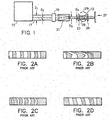
- Figure 1 is a schematic diagram illustrating suitable equipment for measuring the off-axis homogeneity of a sample 13 of fused silica glass. It is to be understood of course that the system shown in Figure 1 is for purposes of illustration only and is not intended to limit the scope of the invention. Other types of interferometers employing different components and having different layouts can be used in the practice of the invention if desired.
- interferometer mainframe 15 e.g., a ZYGO brand mainframe, Zygo Corporation, Middlefield, Connecticut
- phase modulation unit 19 oil-on plate 23, sample 13, and oil-on plate 25.
- the beam then strikes reference flat 27 and is reflected back to mainframe 15 through the same components.
- beam reducer 21 the use of which constitutes one of the aspects of the invention and is discussed below.
- Phase modulation unit 19 is controlled by mainframe 15 and serves to vary the optical path length between the mainframe and the reference flat as the interference pattern is generated.
- Oil-on plates 23 and 25 provide substantially flat air-glass interfaces for sample 13 without the need for extensive polishing of the sample.
- Sample 13 is mounted on a swivel table, shown schematically by reference numbers 29, which allows the sample to be rotated relative to beam 17 in order to optimize the intensity of the interference pattern produced by off-axis striae.
- the swivel table can be motorized.
- the interference pattern is highly sensitive to the angle between the striae planes and beam 17.
- the angle ⁇ is generally less than a degree for the periodic striae encountered in practice and typical pathlengths. Moreover, in actual practice, the useable angular range has been found to be even smaller than that predicted by equation (1). Accordingly, detection of striae depends on careful alignment of sample 13 with beam 17.
- the interference pattern produced by a sample can be displayed as, for example, a fringe pattern or a phase plot.
- the present invention detects striae by analysis of phase plots, as opposed to fringe patterns.
- Mainframe 15 includes (or is associated with) a digital camera for recording and displaying such plots.
- the interferometer/camera system must have a sufficiently fine spatial resolution to detect the inhomogeneities of interest.
- the spatial resolution is preferably in the range of 18-20 pixels/mm of glass for periodic off-axis striae having ⁇ z striae values in the 0.5 to 3.0 mm range.
- Such resolution can be achieved by employing a high resolution camera.
- this level of resolution can be achieved through the use of beam reducer 21.
- Higher levels of resolution can, of course, be used if desired.
- lower resolutions can be used for striae having a larger spatial extent or if the loss of information resulting from such lower resolution can be tolerated.
- striae have been characterized by visual observation of interferometric fringes. According to this method, striae are defined as kinks or abrupt ripples in otherwise continuous fringes. The fringes may be straight or slightly curved, with the magnitude of the fringe curves being much greater than the magnitude of the fringe kinks caused by striae.
- Figure 2 illustrates this approach, where Figures 2A and 2B show target and low limit fringe patterns, respectively, and Figures 2C and 2D show reject .and pass samples, respectively.
- the subjective nature of this limit sample approach is evident from Figure 2.
- the present invention is directed at providing an improved method for detecting and quantifying striae which is not subject to the subjective limitations of the prior art.
- the invention in accordance with certain of its embodiments provides a process for detecting striae in a sample comprising the steps of:
- the high pass filtering (step 2) is performed by applying a low pass filter to the set of first values to provide a filtered set of first values and then subtracting the filtered set of first values from the original set of first values to produce the set of second values.
- the low pass filtering is preferably performed by local averaging, although other methods can be used if desired.
- the set of second locations on the sample can be identical to the set of first locations or can be a subset thereof.
- the set of second locations is a subset of the set of first locations, i.e., it comprises the set of first locations minus data points along the edges of the set of first locations.
- the statistical filtering step (step 3) is optional and can be omitted if desired.
- the set of third locations can be identical to the set of second locations or a subset thereof. For example, if outlying data points are simply eliminated (the preferred approach), the set of third locations will be a subset of the set of second locations. On the other hand, if outlying values are replaced with substitute values, the set of third locations will be identical to the set of second locations.
- the striae become dramatically apparent, as can be seen by comparing Figure 10 with any of Figures 3, 5, 6, or 8.
- the column averaged set of values can be used to set objective, as opposed to subjective, quality control standards for striae in transparent media.
- FIG. 1 is a schematic diagram of an interferometer system suitable for use in practicing the present invention.
- the drawing is not intended to indicate scale or relative proportions of the elements shown therein.
- Figure 2 illustrates a prior art technique for detecting striae and providing quality control standards for fused silica products wherein a fringe pattern for a sample is compared with fringe patterns for limit samples.
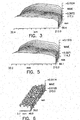
- Figure 3 is an off-axis interferometric phase plot for a fused silica blank.
- the "wave" parameter used in this figure and in Figures 5-8 and 10 represents the phase of the wavefront in terms of the wavelength of the interferometer's laser. A typical value for the wavelength is 632.8 nm.
- Figure 4 is a schematic diagram illustrating a preferred procedure for performing low pass filtering on an interferometric phase plot.
- Figure 5 is a plot of the results of applying the preferred low pass filtering procedure illustrated in Figure 4 to the plot of Figure 3.
- Figure 6 is a plot of the difference between the plots of Figure 3 and Figure 5.
- Figure 6 thus constitutes a high pass filtered version of the data of Figure 3.
- Figure 7 is a histogram of the data values of Figure 6.
- Figure 8 shows the results of statistical filtering of the plot of Figure 6 based on the statistical distribution of the high pass filtered data as shown in Figure 7.
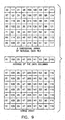
- Figure 9 is a schematic diagram illustrating the column averaging step of the invention.
- Figure 10 shows the results of applying the column averaging step to the plot of Figure 8.
- Figure 11 is a profile line for the plot of Figure 10 which can be used to set quality control standards for permissible levels of striae.
- the present invention relates to methods for detecting and quantifying striae in transparent bodies such as blanks or optical elements (collectively, samples) of fused silica glass.
- the first step of the process comprises preparing a digitized phase plot for the sample using an interferometer, i.e., the first step comprises obtaining a set of first measured values (phase values) at a set of first locations on the sample.
- the spatial resolution at the digital camera of the interferometer system must be greater than the size of the image detail.
- the camera resolution should be at least about 10 pixels/mm, where "pixels/mm" means camera pixels/millimeter-on-the-test-piece. Accordingly, to resolve a 1 mm defect, there should be at least 10 measurement points across the size of the defect. Higher resolutions (>10 pixels/mm), of course, will rdsult in a better representation of the actual defect, and lower resolutions ( ⁇ 10 pixels/mm) will result in a poorer representation. If the resolution drops below 1 pixel/mm, defects smaller than a millimeter will not be seen at all.
- the striae observed in fused silica blanks can have characteristic dimensions as small as 0.5 mm. Accordingly, as indicated above, it is preferred that the interferometer/camera system have a resolution of 18-20 pixels/mm. This can be achieved through the use of a high resolution camera. Alternatively, as shown in Figure 1, a beam reducer 21 can be used for this purpose.
- the beam reducer allows beam 17 to be focused down onto a small portion of the sample as the beam passes from the mainframe to the reference flat and to be expanded back out to its original diameter as it passes back through the system. In this way, a high spatial resolution can be achieved at the camera.
- a typical interferometer camera can have 210 pixels in the x-direction and 230 pixels in the y-direction.
- a typical diameter D 1 for beam 17 is 100 mm. Accordingly, the spatial resolution at the camera is approximately 2 pixels/mm if no adjustments are made to the beam.
- Interferometers typically have some zoom (magnification) capability, a typical maximum value being 6X.
- zoom magnification
- the effective aperture D 2 of the system can be reduced to around 17 mm, giving a spatial resolution at the camera of around 12 pixels/mm.
- this level of resolution is generally not high enough to resolve off-axis inhomogeneities and, in particular, off-axis periodic striae.
- Beam reducer 21 solves this problem by operating on D 1 so that it becomes D 3 which, when operated on by the interferometer's zoom system, gives an effective aperture D 4 .
- D 3 which, when operated on by the interferometer's zoom system, gives an effective aperture D 4 .
- the desired spatial resolution of 18-20 pixels/mm can be readily achieved with the interferometer's zoom system operating at a magnification in the 3X range.
- the beam reducer has the advantage of being a relatively inexpensive way of achieving a high level of resolution.
- the size of the beam is reduced, only a small portion of the sample can be examined at any one time.
- Such a reduction in sampling size does, however, have some advantages.
- cavity errors tend to be small when a beam reducer is used.
- the low spatial frequency components of the phase plot tend to be relatively constant for small sampling sizes which allows the high pass filtering, as well as the statistical filtering, to be eliminated in some cases.
- the column averaging step still provides the important advantages of making the striae dramatically apparent and allowing the sample to be tested objectively, as opposed to subjectively, for striae.
- the next step in the process involves high pass filtering of that plot so that striae can be distinguished from bulk refractive index variations.
- Various approaches can be used to filter out the low frequency variation in the phase plot, examples of which can be found in textbooks on digital filtering.
- a preferred approach involves applying a low-pass, average filter to the phase plot data and then subtracting the resulting low frequency data from the original data to obtain the desired high frequency data.
- the low pass filter can'take the form of a square array of pixels (a sub-array) which is translated across the original data, with the center pixel at each point being replaced with the average of the pixels within the sub-array.
- a kernel of given size surrounding the pixel is used to compute the mean of all surrounding pixels and the value so computed is placed in the location of the pixel of interest. The process is repeated for every pixel.
- Figure 4 schematically illustrates this approach.
- the size of the kernel should be chosen to be a good fit to the general contour of the phase plot while smoothing over the striae.
- a sub-array which corresponds to a 7 mm x 7 mm area on the glass sample has been found to work successfully for fused silica glasses.
- Other sub-array sizes can, of course, be used if desired.
- the 7x7 sub-array in Figure 4 is for purposes of illustration only. The actual size of the sub-array to achieve a 7 mm x 7 mm area will depend on the resolution of the interferometer/camera system. If that resolution is 1 pixel/mm, a 7x7 sub-array will correspond to a 7 mm x 7 mm area on the glass sample.
- a disadvantage of the local averaging approach is that data are lost around the edges of the image, where the kernel is not complete. This is illustrated in Figure 4 by the reduction from 29 x 23 pixels to 23 x 17 pixels, three pixels being lost along each of the four edges of the original data array. The information in these lost pixels is, however, used in the calculation of the outmost pixels that remain.
- a common polynomial used to fit phase plot data is the Zernike polynomial and commercially available interferometers, including ZYGO brand interferometers, typically include software for performing high pass filtering using this polynomial.
- the Zernike polynomial normally has 36 terms, which closely resemble the classic Seidel aberrations such as focus, coma, stigmatism, etc.
- a subset of Zernike terms, e.g., PST (piston), TLT (tilt), PWR (power), AST (astigmatism), and CMA (coma) in the ZYGO nomenclature, will generally fit the low frequency components of the raw data quite well. If this fit is then subtracted from the raw data, the desired high frequency data is obtained.
- the Zernike polynomial approach In comparison to the filtering by the local averaging approach, the Zernike polynomial approach has the advantage that no data are lost around the edge. Its disadvantages are that one needs a circular dataset and the fit is optimized for circularly-symmetric errors. Because most striae files are rectangular, the local averaging approach is, in general, preferred.
- the local averaging approach is also preferred because it can be applied more than once to first detect relatively large striae and subsequently detect striae having a smaller spatial extent.
- the raw data can be processed with a relatively large kernel, corresponding to a relatively large area on the sample, to remove bulk effects while leaving both large and small striae in the high pass data, and then the high pass data can be reprocessed with a smaller kernel which removes large striae but leaves small striae to produce a new set of high pass data specifically directed to the small striae.
- the kernel sizes are picked based on the expected dimensions of the striae and the resolution of the interferometer/camera system which, as discussed above, determines the area on the sample to which a pixel corresponds.
- Figures 3, 5, and 6 illustrate the transformation from raw data to high frequency data by means of the low pass, averaging filter. Specifically, Figure 3 shows the raw data, Figure 5 the raw data after low, pass filtering, and Figure 6 the difference between the raw data and the low pass filtered data. Note that the axes in Figure 6 have been rotated 90 degrees counter-clockwise relative to those of Figures 3 and 5 to make the striae more visible on the isometric plot. Even with this rotation, the striae are difficult to see in Figure 6.
- the high frequency data includes the effects of striae, as well as other random, noisy information, usually consisting of spikes. Some spikes may be due to dust on lenses, retroreflections, or unknown causes.
- off-axis striae in fused silica can be essentially planar with, the peaks and valleys of the striae occurring in essentially a parallel orientation in the phase plot.
- the peaks and valleys of the striae can be made to occur along the rows or columns of the image, depending on the orientation of the sample.
- two further processing steps are performed, namely, statistical filtering and column averaging.
- the average plus or minus three standard deviations (av. ⁇ 3 ⁇ ) represents 99.7% of all data points. If we consider that spurious data usually consists of spikes, which may be either high or low points in the data, then removal of 0.3% of the highest and lowest data should enhance the striae.
- the statistical filter works in this way and is used to eliminate those data points which fall outside the ⁇ 3 ⁇ range.
- the mean and standard deviation of the high frequency data is determined and those points which lie outside of the ⁇ 3 ⁇ range are marked as' "no data” points. It is this marking of "no data” points which produces the set of third locations on the sample discussed above.
- the outlying values at these points can be replaced with a substitute value such as a local mean or the global mean for the entire data set.
- the set of third locations is identical to the set of second locations.
- Figure 8 represents the results of applying this procedure (specifically, the "no data” point procedure) to the high frequency data of Figure 6.
- a comparison of these two plots shows the enhancement of the striae component achieved by the statistical filtering.
- the column averaging step further eliminates the random noise based on the fact that the striae occur in planes and that the planes are oriented along the pixel matrix of the image.
- Each column (or row) of pixels which lies parallel to the striae planes has its mean of pixel values calculated.
- the result is a line of data, with each value representing the mean of pixel values along the entire column.
- a new image is then constructed which consists of the column averaged profile line in place of the high frequency data. That is, as illustrated in Figure 9, the column average value is substituted for each pixel in the column. It should be noted that this substitution is done for every pixel in the high pass data set, irrespective of whether some of those pixels were designated as "no data" points in the statistical filtering step. Accordingly, after the column averaging step, data exists for the entire set of second locations.
- Figure 10 shows the result of the column averaging step. As this figure demonstrates, the striae are now clearly evident.
- Figure 11 illustrates how the column averaged data can be used to quantify striae in an objective manner. This figure constitutes a line plot of the column averaged data. Various criteria can be applied to this line plot to establish quality control criteria for acceptable levels of striae.
- local maxima and minima can be identified and described by their amplitude in terms of waves (y-axis) and their location in mm (x-axis).
- the magnitude of striae can then be defined by the optical path difference between adjacent local maxima and minima (waves per striae) or by the lateral distance between local maxima and minima (mm).
- both of these variables can be used to specify a wavefront slope per striae (waves per striae per mm).
- off-axis striae including, in particular, periodic off-axis striae
- ⁇ n striae is the average peak-to-valley magnitude of the striae's index of refraction variation
- ⁇ z striae is the average peak-to-peak period of that variation determined from a profile line like that of Figure 11.
- a variation expressed in waves can, of course, be readily transformed into one expressed in terms of index of refraction by multiplying by the interferometer's wavelength (e.g., 632.8 nm) and dividing by the thickness of the sample.
- the quantification step can be readily automated and the results compared to quality control value or values to reject or accept particular samples.
Landscapes
- Physics & Mathematics (AREA)
- General Physics & Mathematics (AREA)
- Chemical & Material Sciences (AREA)
- Analytical Chemistry (AREA)
- Health & Medical Sciences (AREA)
- Immunology (AREA)
- General Health & Medical Sciences (AREA)
- Biochemistry (AREA)
- Life Sciences & Earth Sciences (AREA)
- Pathology (AREA)
- Geometry (AREA)
- Environmental & Geological Engineering (AREA)
- Engineering & Computer Science (AREA)
- Epidemiology (AREA)
- Public Health (AREA)
- Investigating Or Analysing Materials By Optical Means (AREA)
- Instruments For Measurement Of Length By Optical Means (AREA)
- Length Measuring Devices By Optical Means (AREA)
- Investigating Materials By The Use Of Optical Means Adapted For Particular Applications (AREA)
Claims (15)
- Un procédé pour rechercher dans un pièce transparente (13) la présence de stries, comprenant les opérations consistant :(A) à préparer un diagramme de phase numérisé pour la pièce (13) au moyen d'un interféromètre (15, 19, 21, 23, 25, 27, 29) ;(B) à faire la moyenne des colonnes du diagramme de phase numérisé, et(C) à examiner le diagramme de phase numérisé dont on a fait les moyennes des colonnes pour mettre en évidence les stries.
- Le procédé de la revendication 1 comprenant, entre les opérations (A) et (B) l'opération additionnelle consistant à appliquer un filtrage passe-haut au diagramme de phase.
- Le procédé de la revendication 1 comprenant, entre les opérations (A) et (B) les opérations additionnelles consistant :(a) à appliquer un filtrage passe-haut au diagramme de phase ; et(b) à appliquer un filtrage statistique aux résultats du filtrage passe-haut afin d'éliminer les éléments statistiques aberrants.
- Le procédé de la revendication 3 dans lequel :(i) le diagramme de phase numérisé de l'opération (A) comprend un ensemble de premières valeurs afférentes à un ensemble de premiers emplacements sur la pièce ;(ii) le filtrage passe-haut de l'opération (a) est appliqué à l'ensemble de premières valeurs et il produit un ensemble de deuxièmes valeurs en un ensemble de deuxièmes emplacements sur la pièce ;(iii) le filtrage statistique de l'opération (b) est appliqué à l'ensemble de deuxièmes valeurs et il produit un ensemble de troisièmes valeurs en un ensemble de troisièmes emplacements sur la pièce ;(iv) l'opération de prise de moyenne des colonnes de l'opération (B) est appliquée à l'ensemble de troisièmes valeurs pour produire un ensemble de quatrièmes valeurs en l'ensemble de deuxièmes emplacements sur la pièce, ledit ensemble de quatrièmes valeurs étant la moyenne des troisièmes valeurs sur une colonne, la valeur de la quatrième valeur en tous les deuxièmes emplacements d'une colonne particulière étant la moyenne des troisièmes valeurs pour cette colonne ; et(v) l'ensemble de quatrièmes valeurs en l'ensemble de deuxièmes emplacements sont examinés pour mettre en évidence les stries à l'opération (C).
- Le procédé de la revendication 4 dans lequel l'application d'un filtrage passe-haut au diagramme de phase à l'opération (ii) est effectuée :en soumettant à un filtrage passe-bas l'ensemble de premières valeurs pour produire un ensemble de valeurs venues de filtrage passe-bas en l'ensemble de deuxièmes emplacements ; eten soustrayant l'ensemble de valeurs venues de filtrage passe-bas de l'ensemble de premières valeurs pour produire l'ensemble de deuxièmes valeurs en l'ensemble de deuxièmes emplacements.
- Le procédé de la revendication 6 dans lequel le filtrage passe-bas comprend un filtrage à moyenne locale de l'ensemble de premières valeurs.
- Le procédé de la revendication 6 dans lequel l'ensemble de deuxièmes emplacements comprend l'ensemble de premiers emplacements moins des emplacements le long des bords extérieurs de l'ensemble de premiers emplacements.
- Le procédé de la revendication 5 dans lequel le filtrage passe-bas comprend l'ajustement d'un polynôme de Zernike à l'ensemble de premières valeurs.
- Le procédé de la revendication 8 dans lequel l'ensemble de premiers emplacements et l'ensemble de deuxièmes emplacements sont les mêmes.
- Le procédé de la revendication 4 dans lequel l'ensemble de troisièmes emplacements est un sous-ensemble de l'ensemble de deuxièmes emplacements.
- Le procédé de la revendication 4 dans lequel l'ensemble de troisièmes emplacements est identique à l'ensemble de deuxièmes emplacements.
- Le procédé de la revendication 4 dans lequel l'examen de l'ensemble de quatrièmes valeurs en l'ensemble de deuxièmes emplacements pour y mettre en évidence des stries à l'opération (v) comprend l'application d'un critère de contrôle de qualité à l'ensemble de quatrièmes valeurs.
- Le procédé de la revendication 12 dans lequel l'ensemble de quatrièmes valeurs est transformé en un profil de courbe avant l'application du critère de contrôle de qualité.
- Le procédé de l'une quelconque des revendications précédentes dans lequel l'interféromètre comporte un réducteur de faisceau (21).
- Le procédé de l'une quelconque des revendications précédentes dans lequel la pièce transparente (13) est composée de silice fondue.
Applications Claiming Priority (3)
| Application Number | Priority Date | Filing Date | Title |
|---|---|---|---|
| US360795P | 1995-09-12 | 1995-09-12 | |
| US3607 | 1995-09-12 | ||
| PCT/US1996/014529 WO1997010487A1 (fr) | 1995-09-12 | 1996-09-11 | Procedes de detection de stries |
Publications (3)
| Publication Number | Publication Date |
|---|---|
| EP0850397A1 EP0850397A1 (fr) | 1998-07-01 |
| EP0850397A4 EP0850397A4 (fr) | 2000-03-15 |
| EP0850397B1 true EP0850397B1 (fr) | 2002-04-24 |
Family
ID=21706671
Family Applications (1)
| Application Number | Title | Priority Date | Filing Date |
|---|---|---|---|
| EP96930807A Expired - Lifetime EP0850397B1 (fr) | 1995-09-12 | 1996-09-11 | Procedes de detection de stries |
Country Status (5)
| Country | Link |
|---|---|
| US (1) | US5764345A (fr) |
| EP (1) | EP0850397B1 (fr) |
| JP (1) | JPH11513481A (fr) |
| DE (1) | DE69620896T2 (fr) |
| WO (1) | WO1997010487A1 (fr) |
Cited By (1)
| Publication number | Priority date | Publication date | Assignee | Title |
|---|---|---|---|---|
| TWI504884B (zh) * | 2012-02-07 | 2015-10-21 | Schott Ag | Apparatus and method for detecting defects inside a transparent plate body and use of the device |
Families Citing this family (24)
| Publication number | Priority date | Publication date | Assignee | Title |
|---|---|---|---|---|
| US6319634B1 (en) | 1999-03-12 | 2001-11-20 | Corning Incorporated | Projection lithography photomasks and methods of making |
| US6242136B1 (en) | 1999-02-12 | 2001-06-05 | Corning Incorporated | Vacuum ultraviolet transmitting silicon oxyfluoride lithography glass |
| US6782716B2 (en) * | 1999-02-12 | 2004-08-31 | Corning Incorporated | Vacuum ultraviolet transmitting silicon oxyfluoride lithography glass |
| US6783898B2 (en) | 1999-02-12 | 2004-08-31 | Corning Incorporated | Projection lithography photomask blanks, preforms and method of making |
| US6682859B2 (en) * | 1999-02-12 | 2004-01-27 | Corning Incorporated | Vacuum ultraviolet trasmitting silicon oxyfluoride lithography glass |
| US6265115B1 (en) | 1999-03-15 | 2001-07-24 | Corning Incorporated | Projection lithography photomask blanks, preforms and methods of making |
| AU2000274686A1 (en) * | 2000-08-09 | 2002-02-18 | Turkiye Sise Ve Cam Fabrikalari A.S. | Method and apparatus for imaging inhomogeneity in a transparent solid medium |
| US7797966B2 (en) * | 2000-12-29 | 2010-09-21 | Single Crystal Technologies, Inc. | Hot substrate deposition of fused silica |
| US20020083740A1 (en) * | 2000-12-29 | 2002-07-04 | Pandelisev Kiril A. | Process and apparatus for production of silica grain having desired properties and their fiber optic and semiconductor application |
| US20020083739A1 (en) * | 2000-12-29 | 2002-07-04 | Pandelisev Kiril A. | Hot substrate deposition fiber optic preforms and preform components process and apparatus |
| DE10111450B4 (de) * | 2001-03-09 | 2005-02-10 | Schott Ag | Verfahren und Vorrichtung zur Bewertung von Schlieren |
| US6766042B2 (en) | 2001-04-26 | 2004-07-20 | Memphis Eye & Contact Associates | System to automatically detect eye corneal striae |
| KR20040032947A (ko) * | 2001-08-21 | 2004-04-17 | 웨이브프론트 싸이언씨스 인코포레이티드 | 데이터 세트를 고대역 필터링하는 방법 |
| US20030110809A1 (en) * | 2001-10-26 | 2003-06-19 | Corning, Inc. | Characterization of optical preforms |
| US7053017B2 (en) | 2002-03-05 | 2006-05-30 | Corning Incorporated | Reduced striae extreme ultraviolet elements |
| US7142295B2 (en) * | 2003-03-05 | 2006-11-28 | Corning Incorporated | Inspection of transparent substrates for defects |
| JP5319876B2 (ja) * | 2006-07-31 | 2013-10-16 | 株式会社日立ハイテクノロジーズ | 表面検査装置及び表面検査方法 |
| US8892630B1 (en) | 2008-09-29 | 2014-11-18 | Amazon Technologies, Inc. | Facilitating discussion group formation and interaction |
| US9083600B1 (en) | 2008-10-29 | 2015-07-14 | Amazon Technologies, Inc. | Providing presence information within digital items |
| US8706685B1 (en) | 2008-10-29 | 2014-04-22 | Amazon Technologies, Inc. | Organizing collaborative annotations |
| US9251130B1 (en) * | 2011-03-31 | 2016-02-02 | Amazon Technologies, Inc. | Tagging annotations of electronic books |
| US9513214B2 (en) * | 2013-07-02 | 2016-12-06 | Corning Incorporated | Skewed sectional measurement of striated glass |
| JP6904662B2 (ja) * | 2016-01-29 | 2021-07-21 | 株式会社アドテックエンジニアリング | 露光装置 |
| JP7041201B2 (ja) * | 2020-06-30 | 2022-03-23 | 株式会社アドテックエンジニアリング | 露光方法 |
Family Cites Families (8)
| Publication number | Priority date | Publication date | Assignee | Title |
|---|---|---|---|---|
| US4195931A (en) * | 1978-05-18 | 1980-04-01 | The United States Of America As Represented By The Secretary Of The Army | Clear air turbulence detector |
| US4998017A (en) * | 1989-05-01 | 1991-03-05 | Ryan Fredrick M | Method and arrangement for measuring the optical absorptions of gaseous mixtures |
| US5020904A (en) * | 1989-09-06 | 1991-06-04 | Mcmahan Jr Robert K | Dynamic laser speckle profilometer and method |
| US5133601A (en) * | 1991-06-12 | 1992-07-28 | Wyko Corporation | Rough surface profiler and method |
| JP3656855B2 (ja) * | 1993-04-23 | 2005-06-08 | 株式会社ニコン | 光リソグラフィー用石英ガラス部材 |
| US5416586A (en) * | 1993-10-15 | 1995-05-16 | Tropel Corporation | Method of testing aspherical optical surfaces with an interferometer |
| US5479006A (en) * | 1994-08-10 | 1995-12-26 | Minnesota Mining And Manufacturing Company | Positioning skew compensation for imaging system using photoconductive material |
| US5544518A (en) * | 1995-06-02 | 1996-08-13 | Veeder-Root Company | Apparatus and method for calibrating manifolded tanks |
-
1996
- 1996-09-11 JP JP9512046A patent/JPH11513481A/ja not_active Ceased
- 1996-09-11 EP EP96930807A patent/EP0850397B1/fr not_active Expired - Lifetime
- 1996-09-11 DE DE69620896T patent/DE69620896T2/de not_active Expired - Fee Related
- 1996-09-11 WO PCT/US1996/014529 patent/WO1997010487A1/fr not_active Ceased
- 1996-09-11 US US08/710,093 patent/US5764345A/en not_active Expired - Fee Related
Cited By (2)
| Publication number | Priority date | Publication date | Assignee | Title |
|---|---|---|---|---|
| TWI504884B (zh) * | 2012-02-07 | 2015-10-21 | Schott Ag | Apparatus and method for detecting defects inside a transparent plate body and use of the device |
| US9546967B2 (en) | 2012-02-07 | 2017-01-17 | Schott Ag | Apparatus and method for identifying defects within the volume of a transparent sheet and use of the apparatus |
Also Published As
| Publication number | Publication date |
|---|---|
| EP0850397A1 (fr) | 1998-07-01 |
| DE69620896D1 (de) | 2002-05-29 |
| EP0850397A4 (fr) | 2000-03-15 |
| US5764345A (en) | 1998-06-09 |
| WO1997010487A1 (fr) | 1997-03-20 |
| JPH11513481A (ja) | 1999-11-16 |
| DE69620896T2 (de) | 2002-10-10 |
Similar Documents
| Publication | Publication Date | Title |
|---|---|---|
| US5764345A (en) | Methods for detecting inhomogeneities, specifically, striae, infused silica glasses | |
| US20020051564A1 (en) | Method and device for optically monitoring fabrication processes of finely structured surfaces in a semiconductor production | |
| JP7329608B2 (ja) | 空間的に変化する偏光回転子および偏光子を用いた高感度粒子検出 | |
| JP2005530144A (ja) | 単一構造の光学測定法 | |
| WO2003031955A1 (fr) | Appareil et procede de mesure destines a l'etude rapide, quantitative, topographique exempte de contact de plaquettes semi-conductrices et d'autres surfaces similaires a des miroirs | |
| DE102009043001A1 (de) | Verfahren zur Bestimmung von Defekten in einem Für elektromagnetische Wellen transparenten Material, insbesonders für optische Zwecke, eine Vorrichtung hierzusowie die Verwendung dieser Materialien | |
| Dai et al. | Define and measure the dimensional accuracy of two-photon laser lithography based on its instrument transfer function | |
| US6995847B2 (en) | Methods and systems for substrate surface evaluation | |
| JP2003021596A (ja) | シュリーレン分析方法及び装置 | |
| Baker | Microscope image comparator | |
| EP1324015A1 (fr) | Méthode et dispositif pour tester et mappage des éléments optiques | |
| JP4260555B2 (ja) | 光学結晶内局所構造判定方法 | |
| Pekelsky et al. | Imaging laser diffractometer for traceable grating pitch calibration | |
| EP0128183B1 (fr) | Appareil et procede d'inspection | |
| Baker | Metrics for high-quality specular surfaces | |
| JP7525119B2 (ja) | 試料測定装置および試料測定方法 | |
| US10976249B1 (en) | Reflective pupil relay system | |
| JP7763352B2 (ja) | 試料表面品質管理装置 | |
| Ohlídal et al. | A method of shearing interferometry for determining the statistical quantities of randomly rough surfaces of solids | |
| CN119860727B (zh) | 一种用于硅抛光片平整度的检测方法及检测装置 | |
| US20070170362A1 (en) | Method and apparatus for internal reflection imaging | |
| Goloborodko et al. | Surface defects determining by the wave front scanner | |
| Miyashita | International standards for metrology of microlens arrays | |
| JPH10111244A (ja) | 屈折率分布の測定方法及び装置 | |
| Seebacher et al. | Determination of geometric properties of SNOM tips by means of far-field evaluation |
Legal Events
| Date | Code | Title | Description |
|---|---|---|---|
| PUAI | Public reference made under article 153(3) epc to a published international application that has entered the european phase |
Free format text: ORIGINAL CODE: 0009012 |
|
| 17P | Request for examination filed |
Effective date: 19980318 |
|
| AK | Designated contracting states |
Kind code of ref document: A1 Designated state(s): DE FR GB NL |
|
| RIN1 | Information on inventor provided before grant (corrected) |
Inventor name: RIEKS, STEPHEN, J. Inventor name: FLADD, DAVID, R. |
|
| A4 | Supplementary search report drawn up and despatched |
Effective date: 20000131 |
|
| AK | Designated contracting states |
Kind code of ref document: A4 Designated state(s): DE FR GB NL |
|
| RIC1 | Information provided on ipc code assigned before grant |
Free format text: 7G 01B 9/02 A, 7G 01M 11/02 B, 7G 01N 21/89 B, 7G 01N 21/45 B |
|
| 17Q | First examination report despatched |
Effective date: 20010409 |
|
| GRAG | Despatch of communication of intention to grant |
Free format text: ORIGINAL CODE: EPIDOS AGRA |
|
| GRAG | Despatch of communication of intention to grant |
Free format text: ORIGINAL CODE: EPIDOS AGRA |
|
| GRAH | Despatch of communication of intention to grant a patent |
Free format text: ORIGINAL CODE: EPIDOS IGRA |
|
| REG | Reference to a national code |
Ref country code: GB Ref legal event code: IF02 |
|
| GRAH | Despatch of communication of intention to grant a patent |
Free format text: ORIGINAL CODE: EPIDOS IGRA |
|
| GRAA | (expected) grant |
Free format text: ORIGINAL CODE: 0009210 |
|
| AK | Designated contracting states |
Kind code of ref document: B1 Designated state(s): DE FR GB NL |
|
| REG | Reference to a national code |
Ref country code: GB Ref legal event code: FG4D |
|
| REF | Corresponds to: |
Ref document number: 69620896 Country of ref document: DE Date of ref document: 20020529 |
|
| ET | Fr: translation filed | ||
| PLBE | No opposition filed within time limit |
Free format text: ORIGINAL CODE: 0009261 |
|
| STAA | Information on the status of an ep patent application or granted ep patent |
Free format text: STATUS: NO OPPOSITION FILED WITHIN TIME LIMIT |
|
| 26N | No opposition filed |
Effective date: 20030127 |
|
| PGFP | Annual fee paid to national office [announced via postgrant information from national office to epo] |
Ref country code: GB Payment date: 20030807 Year of fee payment: 8 |
|
| PGFP | Annual fee paid to national office [announced via postgrant information from national office to epo] |
Ref country code: NL Payment date: 20030812 Year of fee payment: 8 |
|
| PGFP | Annual fee paid to national office [announced via postgrant information from national office to epo] |
Ref country code: FR Payment date: 20030902 Year of fee payment: 8 |
|
| PG25 | Lapsed in a contracting state [announced via postgrant information from national office to epo] |
Ref country code: GB Free format text: LAPSE BECAUSE OF NON-PAYMENT OF DUE FEES Effective date: 20040911 |
|
| PG25 | Lapsed in a contracting state [announced via postgrant information from national office to epo] |
Ref country code: NL Free format text: LAPSE BECAUSE OF NON-PAYMENT OF DUE FEES Effective date: 20050401 |
|
| GBPC | Gb: european patent ceased through non-payment of renewal fee |
Effective date: 20040911 |
|
| PG25 | Lapsed in a contracting state [announced via postgrant information from national office to epo] |
Ref country code: FR Free format text: LAPSE BECAUSE OF NON-PAYMENT OF DUE FEES Effective date: 20050531 |
|
| NLV4 | Nl: lapsed or anulled due to non-payment of the annual fee |
Effective date: 20050401 |
|
| REG | Reference to a national code |
Ref country code: FR Ref legal event code: ST |
|
| PGFP | Annual fee paid to national office [announced via postgrant information from national office to epo] |
Ref country code: DE Payment date: 20051031 Year of fee payment: 10 |
|
| PG25 | Lapsed in a contracting state [announced via postgrant information from national office to epo] |
Ref country code: DE Free format text: LAPSE BECAUSE OF NON-PAYMENT OF DUE FEES Effective date: 20070403 |