EP0850882A2 - Dispositif pour le traitement d'eau usée organique à l'aide de microorganismes - Google Patents
Dispositif pour le traitement d'eau usée organique à l'aide de microorganismes Download PDFInfo
- Publication number
- EP0850882A2 EP0850882A2 EP97310647A EP97310647A EP0850882A2 EP 0850882 A2 EP0850882 A2 EP 0850882A2 EP 97310647 A EP97310647 A EP 97310647A EP 97310647 A EP97310647 A EP 97310647A EP 0850882 A2 EP0850882 A2 EP 0850882A2
- Authority
- EP
- European Patent Office
- Prior art keywords
- waste water
- outer casing
- casing
- carrier
- disc
- Prior art date
- Legal status (The legal status is an assumption and is not a legal conclusion. Google has not performed a legal analysis and makes no representation as to the accuracy of the status listed.)
- Granted
Links
- XLYOFNOQVPJJNP-UHFFFAOYSA-N water Substances O XLYOFNOQVPJJNP-UHFFFAOYSA-N 0.000 title claims abstract description 75
- 244000005700 microbiome Species 0.000 title claims abstract description 72
- 239000010815 organic waste Substances 0.000 title claims description 29
- 239000002351 wastewater Substances 0.000 claims abstract description 168
- 239000007788 liquid Substances 0.000 claims abstract description 50
- 239000004698 Polyethylene Substances 0.000 claims abstract description 14
- -1 polyethylene Polymers 0.000 claims abstract description 14
- 229920000573 polyethylene Polymers 0.000 claims abstract description 14
- 238000005192 partition Methods 0.000 claims description 29
- 239000006260 foam Substances 0.000 claims description 27
- QNRATNLHPGXHMA-XZHTYLCXSA-N (r)-(6-ethoxyquinolin-4-yl)-[(2s,4s,5r)-5-ethyl-1-azabicyclo[2.2.2]octan-2-yl]methanol;hydrochloride Chemical compound Cl.C([C@H]([C@H](C1)CC)C2)CN1[C@@H]2[C@H](O)C1=CC=NC2=CC=C(OCC)C=C21 QNRATNLHPGXHMA-XZHTYLCXSA-N 0.000 claims description 17
- 230000000630 rising effect Effects 0.000 claims description 11
- 230000005855 radiation Effects 0.000 claims description 10
- 230000000712 assembly Effects 0.000 claims description 7
- 238000000429 assembly Methods 0.000 claims description 7
- 239000011148 porous material Substances 0.000 claims description 6
- 241000195493 Cryptophyta Species 0.000 claims description 5
- 230000004888 barrier function Effects 0.000 claims description 4
- 125000006850 spacer group Chemical group 0.000 description 35
- 239000010802 sludge Substances 0.000 description 10
- 230000004087 circulation Effects 0.000 description 9
- QVGXLLKOCUKJST-UHFFFAOYSA-N atomic oxygen Chemical compound [O] QVGXLLKOCUKJST-UHFFFAOYSA-N 0.000 description 5
- 244000052616 bacterial pathogen Species 0.000 description 5
- 239000000463 material Substances 0.000 description 5
- 229910052760 oxygen Inorganic materials 0.000 description 5
- 239000001301 oxygen Substances 0.000 description 5
- 239000000837 restrainer Substances 0.000 description 5
- 239000000126 substance Substances 0.000 description 5
- 230000002829 reductive effect Effects 0.000 description 4
- 241000270282 Nerodia Species 0.000 description 3
- 230000000694 effects Effects 0.000 description 3
- 238000000034 method Methods 0.000 description 3
- 239000005416 organic matter Substances 0.000 description 2
- 239000002244 precipitate Substances 0.000 description 2
- 239000006228 supernatant Substances 0.000 description 2
- 238000005273 aeration Methods 0.000 description 1
- 230000004323 axial length Effects 0.000 description 1
- 239000000428 dust Substances 0.000 description 1
- 210000005069 ears Anatomy 0.000 description 1
- 238000007667 floating Methods 0.000 description 1
- 244000144992 flock Species 0.000 description 1
- 230000005484 gravity Effects 0.000 description 1
- 229920001903 high density polyethylene Polymers 0.000 description 1
- 239000004700 high-density polyethylene Substances 0.000 description 1
- 238000002844 melting Methods 0.000 description 1
- 230000008018 melting Effects 0.000 description 1
- 239000000203 mixture Substances 0.000 description 1
- 230000004048 modification Effects 0.000 description 1
- 238000012986 modification Methods 0.000 description 1
- 238000005086 pumping Methods 0.000 description 1
Images

Classifications
-
- C—CHEMISTRY; METALLURGY
- C02—TREATMENT OF WATER, WASTE WATER, SEWAGE, OR SLUDGE
- C02F—TREATMENT OF WATER, WASTE WATER, SEWAGE, OR SLUDGE
- C02F3/00—Biological treatment of water, waste water, or sewage
- C02F3/02—Aerobic processes
- C02F3/10—Packings; Fillings; Grids
- C02F3/101—Arranged-type packing, e.g. stacks, arrays
-
- C—CHEMISTRY; METALLURGY
- C02—TREATMENT OF WATER, WASTE WATER, SEWAGE, OR SLUDGE
- C02F—TREATMENT OF WATER, WASTE WATER, SEWAGE, OR SLUDGE
- C02F3/00—Biological treatment of water, waste water, or sewage
- C02F3/02—Aerobic processes
- C02F3/06—Aerobic processes using submerged filters
-
- Y—GENERAL TAGGING OF NEW TECHNOLOGICAL DEVELOPMENTS; GENERAL TAGGING OF CROSS-SECTIONAL TECHNOLOGIES SPANNING OVER SEVERAL SECTIONS OF THE IPC; TECHNICAL SUBJECTS COVERED BY FORMER USPC CROSS-REFERENCE ART COLLECTIONS [XRACs] AND DIGESTS
- Y02—TECHNOLOGIES OR APPLICATIONS FOR MITIGATION OR ADAPTATION AGAINST CLIMATE CHANGE
- Y02W—CLIMATE CHANGE MITIGATION TECHNOLOGIES RELATED TO WASTEWATER TREATMENT OR WASTE MANAGEMENT
- Y02W10/00—Technologies for wastewater treatment
- Y02W10/10—Biological treatment of water, waste water, or sewage
Definitions
- This invention relates to an apparatus for treating organic waste water utilizing microorganisms and more particularly to an apparatus for treating waste water contained organic matter, or the like such as, living drainage, factory drainage, etc., by utilizing microorganisms.
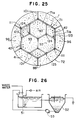
- a former apparatus for treating organic waste water has, as shown in Fig.26, a reaction tank 51 to bring floating active sludge germ ( a flock of various microorganisms ) into contact with waste water.
- the reaction tank 51 is connected with a settling pond 52 and the waste water contacted with active sludge germ is separated by gravity in the settling pond 52.
- the active sludge germs precipitate and the supernatant water is to be a treated water.
- the settling pond 52 is connected with the reaction tank 51 through a sludge return pump 53.
- a precipitated active sludge germ is sucked by the pump 53 and returned as a second seed germ into the reaction tank 51.
- the operation according to the apparatus is done continuously, and parts of active sludge germs do not precipitate in the settling pond but float in the supernatant water and flow out with the treated water.
- active sludge germs increase in number in the reaction tank, the speedier waste water is purified.
- parts of active sludges flow out the settling pond so that the quantity of active sludge germs in the reaction tank is limited.
- active sludge germs are not aggregates of only microorganisms which oxidize and resolve organic matters in the waste water, and generally they contain inactive microorganisms which do not directly take part in purifying.
- Another object of the present invention is to provide an apparatus of high efficiency for purifying waste water.
- Further object of the present invention is to provide an apparatus which can be assembled in a suitable scale under its using condition.
- the first apparatus for treating organic waste water utilizing microorganism (hereinafter referred to as [the first apparatus]) of the present invention comprises an inner casing, an outer casing, a waste water supply tank and an air supply pipe.
- the inner casing is a vertical type and its upper and lower ends are open and in the inner casing porous carrier discs of polyethylene to which microorganisms are made to take root and which have liquid passages are piled with each space between every two carrier discs.
- the outer casing is a vertical type and its bottom is closed by a bottom cap.
- the outer casing is coaxially arranged with the inner casing with a downward circuit for flowing down liquid between them and has outflow holes for the treated water above the upper end of the inner casing.
- the waste water supply tank is for having waste water a head to flow into the outer casing, above which a waste water supply pipe is open.
- the inside of the waste water tank communicates with the bottom of the outer casing by a leading pipe and has an overflow to keep a water level constant.
- the air supply pipe is connected with an air scattering disc below the lower end of the inner casing in the outer casing.
- the outflow holes are made radially, each inner end face being open to an overflow groove provided along the inner periphery of the outer casing, the overflow groove being formed, by fixing an outer flange at the lower end of a circular board through which orifices pass radially to the inner periphery of the outer casing, the outer end face of the outflow hole being open to a circular gutter, and the circular gutter being provided on the outer circumference of the outer casing and connected with an outflow pipe.
- the circular board also functions as a guide pipe to lead part of the treated water upward and to overflow it through the orifices.
- the liquid passages comprise small holes provided all over the surface and large holes which stud the surface of the carrier disc, phases of the mutual large holes of the two carrier discs adjacent upward and downward being shifted with each other in the horizontal plane so that the mutual large holes do not align in a vertical line.
- the liquid passage is the shape of cone cut off its head, a bore of the liquid passage in the waste water inflow side being smaller than that of outflow side.
- the carrier discs are washed by rising foams and water and prevented from stacking thereto inert organisms, such as, algae, mold, etc., so that micro pores in the carrier discs are not clogged.
- inert organisms such as, algae, mold, etc.
- the second apparatus for treating organic waste water utilizing microorganism (hereinafter called as [the second apparatus]) of the present invention comprises inner partition walls, an outer casing, a waste water supply tank and an air supply pipe.
- the inner partition walls to form substantially an inner casing is arranged respectively along the outer periphery of each regular hexagonal inner carrier disc of polyethylene closely in each space between every two inner carrier discs, and the carrier discs are piled in the same phase with the space.
- Each inner carrier disc which is porous and has liquid passages is for making microorganisms take root thereto.
- the outer casing is coaxially arranged with the inner casing with a circular flowing down passage for liquid between them.
- the outer casing is closed of its bottom by a bottom cap and of its top by a top plate, respectively.
- the outer casing has an outflow port for the treated water above the uppermost inner carrier disc and exhaust ports above the outflow port.
- porous outer carrier discs of polyethylene for taking microorganisms root thereto are closely piled with a space between every two discs.
- the waste water supply tank is for having waste water a head to flow into the outer casing, above which a waste water supply pipe is open.
- the inside of the waste water tank communicates with the bottom of the outer casing by a leading pipe and has an overflow to keep a water level constant,
- the air supply pipe is connected with an air scattering disc below the lower end of the inner casing in the outer casing.
- the outflow holes are open at their inner end to an overflow groove provided along the inner periphery of the outer casing.
- the overflow groove is formed, by fixing an outer flange at the lower end of a circular board through which orifices pass radially to the inner periphery of the outer casing.
- the outer end face of the outflow hole is open to a circular gutter, and the gutter is provided on the outer circumference of the outer casing and connected with an outflow pipe.
- the circular board in this case may be the same structure as of the first apparatus.
- each of the outer carrier discs is made by connecting units in a ring-like form, each of the units being the shape which corresponds to a segment formed by a side of the inner carrier disc, radiations from the center of the inner carrier disc to both ends of the side and a side of the outer casing cut off by the radiations.
- the inner carrier discs and the units and the mutual units are connected, by fitting each in respective grooves of an H-shaped rail.
- the third apparatus for treating organic waste water utilizing microorganisms (hereinafter called as [the third apparatus]) of the present invention comprises inner partition walls, an outer casing, a waste water supply tank and an air supply pipe.
- the inner partition walls to form substantially an inner casing are arranged respectively along the outer periphery of each regular hexagonal inner carrier disc assembly closely in each space between every two inner carrier disc assemblies.
- the assemblies are piled in the same phase with the space.
- Each inner carrier disc of the assemblies made of polyethylene which is porous and has liquid passages is for making microorganisms take root thereto.
- the carrier disc assembly comprises regular hexagonal discs and rhombic segments in the shape of a trisection of the regular hexagonal disc and is made by arranging the regular hexagonal disc in the center in a honeycomb fashion and the rhombic segments in the empty portion in the outer circumference.
- the outer casing is coaxially arranged with the inner casing with a circular flowing down passage for liquid between them.
- the outer casing is closed of its bottom by a bottom cap and of its top by a top plate, respectively.
- the outer casing has an outflow port for the treated water above the uppermost inner carrier disc and exhaust ports above the outflow port.
- porous outer carrier discs of polyethylene for taking microorganisms root thereto are closely piled with a space between every two discs.
- the waste water supply tank is for having waste water a head to flow into the outer casing, above which a waste water supply pipe is open.
- the inside of the waste water supply tank communicates with the bottom of the outer casing by a leading pipe and the waste water supply tank has an overflow to keep a water level constant,
- the air supply pipe is connected with an air scattering disc below the lower end of the inner casing in the outer casing.
- each outer carrier discs is made by connecting units in a ring-like form.
- Each unit is the shape which corresponds to a segment formed by a side of the inner carrier disc, radiations from the center of the inner carrier disc to both ends of the side and a side of the outer casing cut off by the radiations.
- the mutual regular hexagonal carrier discs, the regular hexagonal carrier disc and the rhombic segment, the regular hexagonal carrier disc and the unit, the rhombic segment and the unit and the mutual units are connected, respectively, by fitting each in respective grooves of an H-shaped rail.
- an inner casing, an outer casing, a waste water supply tank and an air supply pipe are prepared.
- the inner sizes of the inner and outer casings are determined according to quantity and quality of waste water to be treated.
- These inner and outer casings are preferably cylinder, but one or both of them may take the form of a polygon, and when the outer casing takes the form of fixing the bottom cap to its lower portion, it becomes easy to set the inner casing in the outer casing.
- Carrier discs of polyethylene to which microorganisms are made to take root and which have liquid passages are prepared.
- the material is the same as adopted in the patent publication No.8-10557 filed by the present applicant.
- the material is made of a high density polyethylene and is placed on sale under the article name [POLEX] (the trade mark of TECHNOLOGIES CO., LTD.)
- the number of the carrier discs is determined according to a property of waste water and it is preferable to suit the outer shape of the carrier disc to the sectional shape of the inner casing.
- the necessary numbers of the carrier discs are piled with each space between every two carrier discs in the inner casing. This piling is easy when done as follows.
- Supporters such as flanges, pins, etc., are formed on the inner periphery of the lower portion of the inner casing and let the disc assembly be supported by the supporters, by inserting the disc assembly into the inner casing through its uppermost opening plane.
- microorganisms take root to a carrier disc as it is, but they may be made to take root to a disc assembly form.
- the inner casing is coaxially placed in the outer casing.
- the inner sizes of the inner and outer casings are determined so as to form a flow down circuit for liquid between both planes facing each other, that is, between sides and the upper and lower ends.
- the coaxial placement of both casings can be done, for example, by protruding pins from the inner wall of the outer casing to its center.
- the setting of the inner casing in relation to the outer casing in the axial direction can be done, by providing ledges for receiving the inner casing on or by protruding arms from the inside of the outer casing.
- the waste water flown into the bottom portion of the outer casing rises into the inner casing through its lower opening.
- the waste water overflows, by supplying air therein, at its upper end and flows down in the flow down circuit to the bottom portion of the outer casing, and then the waste water is to repeat a travel entering again the inner casing through its lower opening and rising.
- the outer casing has an outflow ports for the treated water, which are open at the upper portion than the overflow plane at the upper end of the inner casing.
- the adjustment is preferable to be adjustable type when quality and quantity of waste water to be treated, but it may be fixed type when invariable.
- the ratio between quantities of liquids flowing out through the outflow port at the uppermost and circulating between the inner and the outer casings is to be number of turn.
- This ratio is easily settled at high so that efficiency rises, and even an apparatus of small size can effectively be applied.
- the waste water supply tank is for having waste water a head to flow into the outer casing.
- a waste water supply pipe is open to continuously supply waste water therein and an excess waste water is drained outward at the overflow.
- the supplying may be done by natural flowing down or by pumping up from a waste water sink.
- waste water When let the overflow open to a sink, waste water can be utilized cyclically.
- the inside of the waste water tank communicates with the bottom of the outer casing by a leading pipe, and when let a valve on the way open, the waste water given a head flows out of the waste water supplying tank into the outer and the inner casings through the leading pipe.
- the air supply pipe is connected at one end with an air supply source such as blower and at the other end with an air scattering disc below the lower end of the inner casing in the outer casing.
- the air scattering disc is an ordinary type which emits air supplied thereto from the face as foams.
- each carrier disc numberless microorganisms are made to take root, and when waste water passes through the liquid passages organic substances contained therein are made a prey of the microorganisms.
- the waste water is purified gradually during its circulation between the inner and the outer casings, and the purified treated water is, by overflowing through the outflow ports, taken out of the outer casing.
- the outflow holes are made radially.
- the inner end planes of the outflow ports are open to an overflow groove provided along the inner periphery of the outer casing.
- the overflow groove is formed, by fixing an outer flange at the lower end of a circular board through which orifices pass through radially to the inner periphery of the outer casing.
- the inner ends of the outflow ports may be located under the overflowing plane of the inner casing.
- the outer end faces of the outflow holes are open to a circular gutter, which is provided on the outer circumference of the outer casing and connected with an outflow pipe.
- liquid passages comprise small holes provided all over the surface and large holes which stud the surface of the carrier disc, phase of the mutual large holes of the two carrier disc adjacent upward and downward being shifted with each other in the horizontal plane so that the mutual large holes do not align in a vertical line, part of waste water rises with less resistance and the number of circulation of waste water increases, so that it is useful for purifying the waste water and the oxygen melted therein is effectively supplied to microorganisms in the small holes. Also the air stays long, therefore, the oxygen melted therein increases and acts effectively on microorganisms for their living, and let waste water snake to increase a chance of contacting waste water with microorganisms.
- the liquid passage is the shape of a cone cut off its head, a bore of the liquid passage in the waste water inflow side being smaller than that of outflow side, the frictional resistance to the water including foams becomes less also air locking can be prevented.
- the carrier discs are washed by rising foams and water and prevented from stacking thereto inert organisms, such as, algae, mold, etc., so that micro pores in the carrier discs are not clogged, life environment of microorganisms is kept comfortably and the carrier disc can be used long.
- the inner disc of the second apparatus is the same material as of the carrier disc of the first apparatus also has liquid passages, the shape of the inner carrier disc is regular hexagonal and the outer carrier disc also made of the same material as of the carrier disc of the first apparatus.
- a liquid passage in this case is for preventing waste water from naturally flowing down by the outer carrier disc and for multiplying a chance of contacting organic substance with waste water.
- the inner partition walls are arranged respectively along the outer periphery of each regular hexagonal inner carrier disc assembly closely in each space between every two inner carrier disc assemblies.
- the outer periphery here stated includes in case of the outer periphery of a plane of the carrier disc and of an outer portion of a plane of the outer carrier disc which is connected with a carrier disc. Also [being arranged closely in each space] means to form by the inner partition wall an enclosed space between two inner discs adjacent upward and downward direction.
- the inner partition walls forms substantially a cylinder. It executes substantially the same function as of the inner casing of the first apparatus.
- the outer casing is coaxially arranged with the inner casing with a downward circuit for liquid between them.
- the outer casing is also to be arranged coaxially with carrier disc.
- the outer casing is closed of its bottom by a bottom cap and of its top by a top plate.
- the outer casing has an outflow port for the treated water above the uppermost inner carrier disc and exhaust ports above the outflow port.
- the exhaust ports are not needed, but in the second apparatus, as there is the top plate, the exhaust ports are provided. If not the exhaust ports, in case the apparatus is settled outdoors, rain or snow mixes with waste water and environment around microorganisms varies and microorganisms die or become lost their activities. Therefore, the expected treatment of waste water can not become done.
- porous outer carrier discs of polyethylene for taking microorganisms root thereto are closely piled with a space between every two discs.
- the organic waste water to be treated circulate at high speed upward at the central aerating portion of the apparatus and downward in the downward circuit in the outer circumference.
- the regular hexagonal carrier discs and the outer carrier discs (porex sheets) taken root with active sludge organisms are arranged with a space between two discs in the aerating portion enclosed by the inner partition wall which forms substantially the inner casing and in the downward circuit where waste water flows down, respectively, and during the frequent contact with the circulating water at each step, the organic substances in the waste water are taken out.
- Quantity and treating speed of organic matter to be treatable are proportioned to the absolute volume of the fixing organisms which live within both the carrier discs, so that the more capacities of both the carrier discs the better, but from a structure of apparatus and an economical efficiency a rational capacity is required naturally.
- an aerating portion is, on various elements such as a height of a pile, sectional area, a shape, of the inner carrier disc, demanded a rational size to be obtainable a necessary and enough supply of air and the rising of water level necessary for circulating at high speed. Accordingly, to increase capacity a necessary capacity is to be kept in the downward circuit in the outer circumference, and in this case, also a rational sectional area and capacity which can be obtained an even flow and can apply effectively whole outer carrier discs piled must be required.
- the downward circuit has about 1.35 times to the aerating portion.
- the greater part of treating function in the second apparatus is to be in the downward circuit in the outer circumstances.
- the inner carrier discs piled in the central aerating portion have the functions for raising melting speed of oxygen in the air in the circulating water and the water level to obtain a circulation at high speed, so that they have, in the structure of the second apparatus for treating waste water, they have a necessary indispensable meaning.
- the outflow port is open at its inner end to an overflow groove provided along the inner periphery of the outer casing, the overflow groove being formed, by fixing an outer flange at the lower end of a circular board through which orifices pass radially to the inner periphery of the outer casing, the outer end face of the outflow port being open to a circular gutter.
- the circulating quantity to be treated can be varied and the treated waste water can be drained directly to the outflow pipe through the outflow ports.
- each of the outer carrier discs (72) is made by connecting units in a ring-like form, each of which is the shape corresponding to a segment formed by a side of the regular hexagonal inner carrier disc, radiations from the center of the inner carrier disc to both ends of the side and a side of the outer casing cut off by the radiations, it becomes easy to coaxially arrange the central aerating portion with the outer circumferential downward circuit for flowing the waste water downward.
- the unit is to be the shape of a fan when the outer casing is cylinder, and a trapezoid when a similar figure as the inner carrier disc.
- the third apparatus of the present invention differs from the second apparatus in arrangement of the inner and the outer carrier discs and the explanations are made in respect of these points.
- the inner carrier discs becomes an assembly, which comprises regular hexagonal discs and rhombic segments in the shape of a trisection of the regular hexagonal disc and is made by arranging the regular hexagonal disc in the center in a honeycomb fashion and the rhombic segments in the empty portions in the outer circumference.
- This case is applicable for enlarging an apparatus.
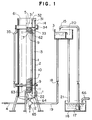
- Fig.1 is a partially cut off side view which illustrates one embodiment of the apparatus for treating waste water utilizing microorganisms of the present invention.
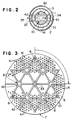
- Fig.2 is a plan view of a parts of the inner and the outer casings 1 and 2.
- Fig.3 is the base view of the carrier disc 7 for making microorganisms take root therein.
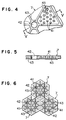
- Fig.4 is a partially enlarged view of Fig.3 showing the small holes 43 in limited area.
- Fig.5 is a section along line 5-5 of Fig.4.
- Fig.6 is an explanatory view of the honeycomb like carrier disc when in use.
- Fig.7 is a partially cut off side view which illustrates one embodiment of the second apparatus of the present invention.
- Fig.8 is a partially cut off plan view of Fig.7.
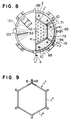
- Fig.9 is a plan view showing the detail of the inner partition wall 1' which is partially cut off.
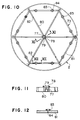
- Fig.10 is a plan view of the receiving frame 73.
- Fig.11 is a section along line 11-11 of Fig.10.
- Fig.12 is a section along line 12-12 of Fig. 10.
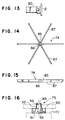
- Fig.13 is a detail of the supporting structure of the receiving frame 73 to the outer casing 2.
- Fig.14 is a plan view of the restrainer 74.
- Fig.15 is a side view of the Fig.14.
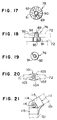
- Fig.16 is a side view of the spacer 75 a half of which in section.
- Fig.17 is a plan view of Fig.16.
- Fig.18 is a side view of the spacer 76 a half of which in section.
- Fig.19 is a plan view of Fig.18.
- Fig.20 is an end view of the H-shaped rail.
- Fig.21 is a plan view of the corner spacer 111.
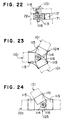
- Fig.22 is a side view of Fig.21.
- Fig.23 is a plan view of the corner spacer 124.
- Fig.24 is a plan view of the corner spacer 125.
- Fig.25 is a plan view illustrates one embodiment of an assembly of the inner carrier discs used in the third apparatus of the present invention.
- Fig.26 is a rough drawing of an apparatus for treating organic waste water heretofore in use.
- Fig.1 through Fig.6 show an embodiment of the first apparatus of the present invention.
- the first apparatus comprises an inner casing 1, an outer casing 2, a waste water supply tank 3 and an air supply pipe 4.
- the inner casing 1 is a vertical cylinder and its upper and lower ends are open.
- the inner casing 1 is provided with a disc assembly 5 therein.
- the disc assembly 5 is such that carrier discs to which microorganisms are made to take root of porous and having liquid passages 6 are piled by means of bolts 10 which pass through their bolt holes 8 and spacers 9 inserted between every two carrier discs and nuts 11.
- the carrier disc 7 shown in the drawings is a form of a circular disc.
- the carrier disc is made of an intensified polyethylene and the material is placed on sale under the article name [POREX] (a trade mark of TECHNOLOGIES CO., LTD.)
- the outer casing 2 is a vertical cylinder and its bottom is closed by a bottom cap 12.
- the outer casing 2 is arranged coaxially with the inner casing 1 with a downward circuit 13 between them.
- the outer casing 2 has outflow ports 14 for the treated water above the opening plane serving the purpose of an overflow at the upper end of the inner casing 1.
- the waste water supply tank 3 is for having waste water a certain head and settled on an appropriate outside position of the outer casing 2.
- a waste water supply pipe 15 is open and waste water is supplied continuously therein.
- the other end of the waste water supply pipe 15 may be connected with a passage of waste water or, as shown in the drawings, with a waste water sink 16 through a pump 17. Waste water is to be fed to the sink 16.
- the inside of the waste water supply tank 3 leads to the inside of the outer casing 2 through the bottom cap 12 by means of a leading pipe 19 with a valve 18.
- the waste water supply tank 3 is provided with an overflow 20 and a drain pipe 21 is made to open to the waste water sink 16.
- Waste water is supplied continuously in the waste water tank 3 through the waste water supply pipe 15 and an excess waste water is drained outward at the overflow 20.
- a valve 18 open, the waste water given a head flows out of the waste water supply tank 3 into the outer casing 2 and the inner casing 1 through the leading pipe 19.
- the air supply pipe 4 is at one end connected with an air scattering disc 22 located under the lower end opening plane of the inner casing 1 in the outer casing 2 and at the other end connected, as usual, with an air supplying machine such as a blower (not shown).
- the air scattering disc 22 is an ordinal type which is placed on sale.
- root is preferably done when the carrier disc is in itself but it may be done when the carrier discs are in a state of a disc assembly.
- air is fed, by starting a blower and the like, to the air scattering disc 22 through the air supply pipe 4.
- the air becomes small foams as usual when it passes through the air scattering disc 22 and rises evenly in the inner casing 1.
- the level of the waste water in the inner casing 1 rises, and the waste water overflows at the opening plane at the upper end of the inner casing and flows in the downward circuit 13 between the side walls of the outer casing 2 and the inner casing 1.
- the foams are at this moment separated from the waste water and discharged in atmosphere through the opening plane at the upper end of the outer casing 2.
- the waste water overflowed in the downward circuit 13 between the side walls of the outer casing 2 and the inner casing flows down the downward circuit 13 and again rises with foams in the inner casing 1.
- the waste water repeats the stroke.
- the waste water contacts, when it passes through the liquid passages 6 of the carrier disc 7, with the microorganisms taken root therein and the organic matters contained in the waste water are made a prey of the microorganisms and the waste water is gradually purified.
- the number of circulating times of waste water is suitably decided as waste water is purified.
- the decision is done, by performing one work or two or more assembled works such as settling a head of the waste water supplied from the waste water supply tank 3, adjusting a volume of air from the air supply pipe 4, varying the height of the orifice 31' of the outer casing 2.
- the waste water With respect to quality of the waste water, it can cope by adjusting the number of the carrier discs 7 or by arranging the treating apparatuses in series and also with respect to quantity of waste water it can cope by planning the capacities of the outer casing 2 and the inner casing 1 for fitting thereto or by arranging the treating apparatuses in parallel.
- part of the purified waste water flows continuously through the outflow ports 14 out of the outer casing 2 and proportionate quantity of waste water to the flown out quantity flows continuously in the outer casing 1 from the waste water supply tank 3.
- the outflow ports 14 are made radially. Each inner end plane of the outflow ports 14 is open to an overflow groove 31 which is provided along the inner periphery of the outer casing 2.
- the overflow groove 31 is formed, by fixing an outer flange 33 at the lower end of a circular board 32 through which orifices 31' pass radially to the inner periphery of the outer casing 2.
- the outer end planes of the outflow ports 14 are open to a circular gutter 34, which is provided on the outer circumference of the outer casing 2 and connected with an outflow pipe 35.
- Phases of the mutual liquid passages 6 of two carrier discs 7 adjacent upward and downward are shifted with each other in the horizontal plane so that the mutual liquid passages 6 do not align in a vertical line, that is, in case the liquid passages 6 of the carrier discs 7 are located as shown in Fig.3, when one of the carrier discs 7 is rotated in a 90-degree to the arrow, the liquid passages 6 of one of the carrier discs 7 are so shifted within an area against the other carrier disc as not to pass through with each other in a vertical line.
- the air stays long, therefore, oxygen melted therein increases and acts effectively on microorganisms for their living, and by letting the waste water snake, a chance of contacting the waste water with microorganisms increases.
- the liquid passages 6 comprise small holes 41 provided all over the surface and large holes 42 which stud the surface of the carrier disc 7.
- part of the waste water rises through the large holes 42 with less resistance and the number of circulations of the waste water increases, so that it is useful for purifying the waste water, and in the small holes 41 oxygen melted therein and energy source are effectively supplied to the microorganisms taken root therein.
- Each liquid passage 6 is, as shown in Fig.5, the shape of a cone cut off its head, a bore of the liquid passage in the waste water inflow side being smaller than that of outflow side, the frictional resistance to the water including foams becomes less and also air locking can be prevented.
- the carrier disc 7, as shown in Fig.6, is the regular hexagonal shape which is connectable in a honeycomb fashion. Therefore it can cope with the variation of quantity of waste water to be treated, by connecting the carrier discs 7 and securing a necessary area.
- the carrier discs 7 are washed by the rising foams and water and prevented from stacking thereto inert organisms, such as, algae, mold, etc. Accordingly, as micro pores in the carrier discs 7 own are not clogged, life environment of microorganisms is kept comfortably and it can be used long the carrier discs.
- bars 61 are fixed on the top of the outer casing 2 and spanned over the overflow groove 31.
- Arms 62 protruding radially from the outer periphery at the upper end of the inner casing 1 are for centering the inner casing 1.
- a base 63 is for supporting carrier discs. Legs 64 are provided at lower end of the inner casing 1. A drain 65 and a waste water inflow pipe 66 are shown in Fig.1.
- Fig.7 through Fig.9 show an embodiment of the second apparatus of the present invention.
- the inner carrier discs 71 are the regular hexagonal shapes and piled in the same phases with each space between every two discs, and around the outer circumferences of the inner carrier discs 71 the outer carrier discs 72 are piled with each space between every two discs.
- the inner partition wall 1' is arranged between the outer carrier discs 72, 72 and forms a closed space S between them.
- the inner partition wall 1' may be formed in advance of a regular hexagonal cylinder having an axial length fitting in with a space between the outer carrier discs 72, 72.
- the inner partition wall 1' is, as shown in Fig.9, formed in order by connecting six segments 1'' each of which is a board of length fitting for a side of the regular hexagon and formed outward ears at its both ends with each bolt hole through them, by means of bolts and nuts, it is easily fitted in an apparatus of a large scale.
- the inner partition wall 1' is in the middle of an assembly in a state merely put between the outer carrier discs 72, 72 adjacent upward and downward.
- the inner partition wall 1' fastens closely on the upper and the lower carrier discs 72 and closes the inner space S.
- the inner partition walls 1', putting the outer carrier disc 72 forms an apparent inner casing as of the first apparatus, and the waste water which rises on aerating function naturally passes through the inner carrier discs 71.
- One embodiment of a method to assemble the inner and the outer carrier discs 71 and 72 is as follows.
- receiving frames 73 of regular hexagons (Figs.10-13), restrainers 74 (Figs.14, 15), spacers 75, 76 (Figs.16-19) and bolts 10 and nuts 11 as of the first apparatus are used.
- Each receiving frame 73 has a boss 77 at its center, which is provided on the upper plane with a receiver 78 for a spacer 75.
- Each arm 80 is longer than the size from the center of the inner carrier disc 71 to one of its apexes and holes 82 for bolts 10 are made just outward of the apexes.
- Each ledge 81 is for supporting the outer carrier disc 72 and provided on its upper plane with saucers 83, and in their axial lines holes 84 for the bolts 10 pass through the ledges 81.
- Each restrainer 74 has a hole 86 passing through their central boss 85 for the bolt 10 and from the boss 85 six arms 87 protrude radially at an even angle, and the outer end of each arm 87 comes near to the corner of the inner carrier disc 71.
- Figs.16 and 17 show the spacer 75.
- the spacer 75 is for receiving the inner carrier disc 71 of wide area and the spacer 76 is for a unit (Fig.8) of lesser area to form the outer carrier disc 72. It is a mountain like in section, through which an axial hole 89 for the bolt 10 passes and the base plate 92 protrudes upward in a size fitting to a thickness of the inner carrier disc 71 and is for fitting closely in a hole 93 (refer also to Fig.8) of the inner carrier disc 71.
- a protruding portion from the upper end of the mountain like portion 92 becomes a reductive diameter portion 94 and at the lower end of the axial hole 89 a larger diameter portion 95 of a length in which the reductive diameter portion 95 of another spacer 75 closely fits in is provided.
- the spacer 76 shown in Figs.18 and 19 is almost same structure as the spacer 75. Only, there is not a rib 90 to the base plate 91, the outer diameter of the base plate being small and the diameters of the mountain like portion 92 and the axial hole 89 also being shortened.
- the bolt 10 and the nut 11 are the same as used in the first apparatus.
- the receiving frame 73 put on a lifting cylinder (not shown) and getting the base portion 91 of the spacer 75 into the receiver 78 of the boss 77.
- the inner carrier disc 71 put thereon, coaxially with the receiving frame 73 and facing each corner to each arm 80 of the receiving frame 73, and let the mountain like portion 92 of the spacer 75 fit in the central hole 93.
- the inner carrier discs 71 are not flapped by buoyancy. It may be assembled by letting the bolts 10 stand in advance on a cylinder and the inner carrier discs pass through the bolts. It is similar in case of the outer carrier discs 72 and also it is applied in the following case.
- the receiving frame 73 is used together with the inner carrier disc 71. Also at suitable position of the outer carrier disc 72 holes 96 (refer also to Fig.8) for the bolts 10 are made.
- Assembling is similarly done as the inner carrier discs 71 through the spacers 76.
- the restrainer 74 is not needed.
- the outer carrier discs 72 are restrained directly by means of the nuts 11 at both ends of the bolts.
- Fig.20 shows an H-shaped rail 101.
- the rail 101 is used for connecting the outer carrier discs 72 along the outer circumference of in the same plane with the inner carrier disc 72.
- the inner carrier disc 71 and the outer carrier disc 72 (when the outer carrier disc 72 is formed with units 88, mutual respective unit 88) fit therein.
- the H-shaped rail is formed with a male and female members 104, 105 which fit in with each other at their webs 103 which are adjustable of their lengths, it can carry out close contact of both carrier discs with the rail 101 when they fitted in each groove 102, respectively.
- Figs.21 and 22 show a corner spacer 111 which is applied to a corner of the inner carrier disc 71.
- the corner spacer 111 is provided with a spacing portion 112, a protrusion 113 on the underside of the portion, a protrusion receiver 114 aligned with the protrusion 113 and protruding from the upper plane of the portion 112, and a couple of rail receivers 115 spread Ed from the axial line of the protrusion 113 at right angle with a 120-degree between them.
- the lowermost outer carrier disc 72'' is connected outward with the lowermost inner carrier disc 71'' by means of the H-shaped rail 101 and put on the receiving frame 73.
- the mutual units 88 are also connected with each other by means of the H-shaped rail 101 and encircle the outer circumference of the inner carrier disc 71.
- the inner partition wall 1' is surrounded.
- the outer casing 2 is a cylinder and coaxially arranged with the inner partition wall 1', and the downward circuit 13 for flowing the circulating waste water downward is formed between them.
- the bottom of the outer casing 2 is closed by the bottom cap 12 and the top is closed by the top plate 121.
- the outer casing 2 is, above the uppermost inner carrier disc 71', provided with the outflow port 14 for the treated water and the exhaust ports 122 above the outflow port 14.
- the outer carrier discs 72 are piled in the downward circuit 13 with a space between every two outer carrier discs and the outer casing 2 is in close contact with each of them.
- the outer carrier disc 72 may be formed by connecting in ring-shaped the units 88.
- the unit 88 in the form of a fan when the outer casing 2 is a cylinder and a trapezoid when a similar figure.
- the inner casing 1 used in case of the first apparatus is not used in the second apparatus and the inner partition walls 1' connected through the outer carrier disc upward and downward forms the inner casing 1 in appearance to act its function. Also the circular gutter 34 is omitted, by connecting the outflow port 14 directly with the outflow pipe 35.
- the waste water rises with the air in the inner casing 1 in appearance formed with the inner partition walls 1' piled through the outer carrier discs 72.
- the organic substances included therein contact with the microorganisms in the inner carrier discs 71 and become the prey of them and the waste water overflows at the upper end of the inner casing 1.
- the waste water in the inner casing 1 increases its capacity by the numberless foams fed therein so that part of it rises in a space enclosed by the circular board 32 and flows out in the overflow groove 31 through the orifices 31' and then it flows out directly in the outflow pipe 35 through the outflow port 14. Also the foams are separated in the space from the waste water and exhausted through the exhaust ports 122.
- the passing speeds through the inner and the outer carrier discs 71 and 72 under a certain condition are as follows.
- Sectional area in appearance 0.4935m 2
- Sectional area for passing the circulating water there through 0.1029m 2
- Open area rate: (0.1029/0.4935)x100 20.85%
- Q 69.41/min (100m 3 /d)
- Quantity of air: 1000l/min Passing speed: V 0 (69.4+1000)x10 -3 x1/0.4935 0.0361m/s
- V 1 (69.4+1000)x10 -3 x1/0.1029 0.173m/s
- the outflow port 14 is at its inner end open to the overflow groove 31 around the inner periphery of the outer casing 2.
- the overflow groove 31 is formed, by fixing the outward flange 33 at the lower end of the circular board 32 through which the orifices 31' pass through radially to the inner periphery of the outer casing 2.
- Fig.25 is a plan view of the parts of the inner and the outer carrier discs 71 and 72 used in the third apparatus of the present invention.
- the third apparatus is similar to the second apparatus so that it is mainly set forth the different points from the second apparatus.
- the inner carrier disc 71 becomes an assembled carrier disc.
- the inner disc 71 comprises three regular hexagonal discs 71a and three rhombic segments 71b in the shape of trisection of the regular hexagon.
- the inner carrier disc 71 is made by arranging the regular hexagonal disc 71a in the center in a honeycomb fashion and the rhombic segments 71b in the empty portions 123 in the outer circumference.
- the outer carrier discs are, though omitted in the drawing, arranged coaxially with and forming a downward circuit 13 for liquid between them. And, in the downward circuit the plural outer carrier discs 72 are piled with a space between every two outer carrier discs.
- the process of treating waste water is the same as in the second apparatus.
- the H-shaped rail 101 in the second apparatus and corner spacers 124 (Fig.23) which is a modification of the corner spacer 111 and has rail receivers 115 spread with 60-degree between them.
- a corner spacer 125 (Fig.24) is adopted, which has the rail receivers 115 which spread at right angle with the axial line with a 180-degree and which has a rail receiver 115 which in both the rail receivers spreads with a 60-degree to one of the receivers.
- the corner spacer arranged at the outer corner of the rhombic segment 71b is the same as the corner spacer 111 of the second apparatus.
- the piling of the outer carrier discs 72 is the same as the second apparatus, and in case of its size being too large, it may be formed as a unit 88 and further, the unit 88 may be formed by connecting divided parts in two or more with each other.
- the process of treating waste water is done like as in the second apparatus.
- the first apparatus of the present invention as microorganisms are made to take root in the porous carrier discs, which are piled in the inner casing with each space between every two carrier discs, it becomes sufficient the contacting efficiency of microorganisms with waste water.
- the downward circuit for the waste water to be treated is formed between them and under the lower end of the inner casing an air scattering disc for sending out air as small foams is provided, waste water to be treated rises by the foams in the inner casing and overflows at the opening plane at its upper end in the downward circuit between them to the bottom portion of the outer casing.
- the waste water flows again in the inner casing and rises by the foams.
- the outer casing has the outflow holes which are open to the upper portion than the overflowing plane of the inner casing, it can overflow outward part of the circulating waste water through the outflow holes so that even the apparatus of small size can effectively treat waste water.
- the treating apparatus When arranging the treating apparatus in series, it can cope with quality of waste water and when in parallel it can cope with its quantity.
- the frictional resistance of the waste water included foams is reduced and airlock can be checked.
- the rising flow of the water mixed with the foams becomes equalized and the air stays long.
- the foams are prevented from gathering with each other or from becoming one body.
- the carrier discs are washed by rising foams and water and prevented from stacking thereto inert organisms, such as, algae, mold, etc., so that micro pores in the carrier discs are not clogged, life environment of microorganisms is kept comfortably and the carrier disc can be used long.
- an apparatus of a large scale is made easily. And it can be raised the degree of purifying the circulating waste water as it falls under the preying function of the microorganisms at both the inner and the outer carrier discs. Also as the upper end of the outer casing is closed by the top plate and has the exhaust ports at its upper portion, rainwater, snowfall and dust do not enter and it can keep the capacity of treating waste water from lowering.
- the overflowed water can be flowed directly to the outflow pipe through the outflow port.
- outer carrier discs in a ring-like form in a horizontal plane, they are closely fit in the downward circuit around the outer circumference for flowing down the waste water.
- respective connecting portion closely contacts with each other and the connection is easily done.
- the regular hexagonal inner carrier disc is formed rhombic segments in the shape of trisection of the regular hexagonal segment in the same plane, when choosing number of them and forming a regular hexagon, it can freely be formed the inner carrier discs of from small to large sizes.
Landscapes
- Life Sciences & Earth Sciences (AREA)
- Biodiversity & Conservation Biology (AREA)
- Microbiology (AREA)
- Hydrology & Water Resources (AREA)
- Engineering & Computer Science (AREA)
- Environmental & Geological Engineering (AREA)
- Water Supply & Treatment (AREA)
- Chemical & Material Sciences (AREA)
- Organic Chemistry (AREA)
- Biological Treatment Of Waste Water (AREA)
Applications Claiming Priority (6)
| Application Number | Priority Date | Filing Date | Title |
|---|---|---|---|
| JP35925396 | 1996-12-30 | ||
| JP359253/96 | 1996-12-30 | ||
| JP35925396 | 1996-12-30 | ||
| JP199208/97 | 1997-07-09 | ||
| JP19920897 | 1997-07-09 | ||
| JP19920897A JP3238885B2 (ja) | 1996-12-30 | 1997-07-09 | 微生物を利用する有機性廃水処理装置 |
Publications (3)
| Publication Number | Publication Date |
|---|---|
| EP0850882A2 true EP0850882A2 (fr) | 1998-07-01 |
| EP0850882A3 EP0850882A3 (fr) | 1998-11-11 |
| EP0850882B1 EP0850882B1 (fr) | 2002-05-08 |
Family
ID=26511403
Family Applications (1)
| Application Number | Title | Priority Date | Filing Date |
|---|---|---|---|
| EP19970310647 Expired - Lifetime EP0850882B1 (fr) | 1996-12-30 | 1997-12-29 | Dispositif pour le traitement d'eau usée organique à l'aide de microorganismes |
Country Status (4)
| Country | Link |
|---|---|
| US (1) | US5972212A (fr) |
| EP (1) | EP0850882B1 (fr) |
| JP (1) | JP3238885B2 (fr) |
| DE (1) | DE69712453T2 (fr) |
Cited By (2)
| Publication number | Priority date | Publication date | Assignee | Title |
|---|---|---|---|---|
| EP0962427A1 (fr) * | 1998-06-05 | 1999-12-08 | Hongo Company Limited | Dispositif pour le traitement d'eaux brutes organiques à l'aide de microorganismes anaérobies |
| EP2483209A4 (fr) * | 2009-09-09 | 2014-05-21 | Septicosol Inc | Appareil de traitement d'eaux usées |
Families Citing this family (9)
| Publication number | Priority date | Publication date | Assignee | Title |
|---|---|---|---|---|
| US7008539B2 (en) * | 2003-05-14 | 2006-03-07 | University Of Utah Research Foundation | Submerged ammonia removal system and method |
| KR100639296B1 (ko) * | 2005-09-16 | 2006-10-27 | (주)에코데이 | 생물학적 수처리 장치 |
| US7465394B2 (en) | 2006-09-05 | 2008-12-16 | Aeration Industries International, Inc. | Wastewater treatment system |
| JP4849481B2 (ja) * | 2008-03-18 | 2012-01-11 | 中国電力株式会社 | 微生物固定化担体、dhsリアクタ、及び生物学的硝化脱窒装置 |
| US8764986B2 (en) | 2008-12-22 | 2014-07-01 | University Of Utah Research Foundation | Submerged system and method for removal of undesirable substances from aqueous media |
| US8919745B1 (en) * | 2011-09-27 | 2014-12-30 | Carroll G. Rowe | High flow rate foam generating apparatus |
| US9675942B1 (en) | 2013-10-15 | 2017-06-13 | Aeration Industries International, LLC. | Universal bridge and wall mounted aeration apparatus |
| US11406943B1 (en) | 2019-06-14 | 2022-08-09 | Aeration Industries International, Llc | Apparatus for treating fluids having improved aeration efficiency and dual function operation |
| US11596907B1 (en) | 2019-06-14 | 2023-03-07 | Aeration Industries International, Llc | Apparatus for treating fluids having improved aeration efficiency and operational durability |
Family Cites Families (18)
| Publication number | Priority date | Publication date | Assignee | Title |
|---|---|---|---|---|
| US3112261A (en) * | 1961-04-13 | 1963-11-26 | Fluor Corp | Apparatus and method for promoting biological oxidation of organic material |
| US3329271A (en) * | 1962-06-21 | 1967-07-04 | Texas Vitrified Pipe Company | Trickling filter media |
| US3966599A (en) * | 1971-11-26 | 1976-06-29 | Ecodyne Corporation | Method and apparatus |
| US4045344A (en) * | 1974-04-29 | 1977-08-30 | Ishigaki Kiko Co., Ltd. | Apparatus for treating waste water |
| ZA762830B (en) * | 1975-05-21 | 1977-04-27 | Norton Co | Trickling filters media for biological filters |
| GB2006181B (en) * | 1977-10-20 | 1982-05-19 | Hartley Simon Ltd | Growth of biological material |
| DE2841011A1 (de) * | 1978-09-21 | 1980-04-03 | Metallgesellschaft Ag | Verfahren und vorrichtung zum behandeln von abwasser mittels mikroorganismen |
| SU912677A1 (ru) * | 1980-07-18 | 1982-03-15 | Украинский Государственный Проектный И Научно-Исследовательский Институт Коммунальных Сооружений Городов | Устройство дл биологической очистки сточных вод |
| US4427548A (en) * | 1982-01-06 | 1984-01-24 | The Dow Chemical Company | Filtering method and apparatus |
| US4477394A (en) * | 1982-03-15 | 1984-10-16 | Armstrong Charles M | Fluid contact panel |
| JPS5919584A (ja) * | 1982-07-26 | 1984-02-01 | Nippon Fuirukon Kk | 洗浄装置付接触酸化槽 |
| DE3738295A1 (de) * | 1987-09-03 | 1989-03-16 | Tecon Gmbh | Reaktor und verfahren zum biologischen reinigen von schadstoffhaltigem wasser |
| JPH03127691A (ja) * | 1989-10-13 | 1991-05-30 | Toshiba Corp | 廃水処理装置の立上げ方法 |
| JPH03207493A (ja) * | 1990-01-09 | 1991-09-10 | Nkk Corp | 接触材充填型ディープシャフト |
| US5190646A (en) * | 1991-03-11 | 1993-03-02 | Nikki Hanbai Co., Ltd. | Wastewater treating biological film tank |
| US5211847A (en) * | 1991-04-22 | 1993-05-18 | Infilco Degremont Inc. | Denitrification methods |
| JP3107950B2 (ja) * | 1993-07-07 | 2000-11-13 | オルガノ株式会社 | 生物処理装置、及び同装置を用いた水処理方法 |
| US5770059A (en) * | 1996-10-03 | 1998-06-23 | Rhee; Choong H. | Waste water treatment apparatus |
-
1997
- 1997-07-09 JP JP19920897A patent/JP3238885B2/ja not_active Expired - Fee Related
- 1997-12-29 EP EP19970310647 patent/EP0850882B1/fr not_active Expired - Lifetime
- 1997-12-29 DE DE69712453T patent/DE69712453T2/de not_active Expired - Fee Related
- 1997-12-29 US US08/998,853 patent/US5972212A/en not_active Expired - Fee Related
Cited By (2)
| Publication number | Priority date | Publication date | Assignee | Title |
|---|---|---|---|---|
| EP0962427A1 (fr) * | 1998-06-05 | 1999-12-08 | Hongo Company Limited | Dispositif pour le traitement d'eaux brutes organiques à l'aide de microorganismes anaérobies |
| EP2483209A4 (fr) * | 2009-09-09 | 2014-05-21 | Septicosol Inc | Appareil de traitement d'eaux usées |
Also Published As
| Publication number | Publication date |
|---|---|
| EP0850882B1 (fr) | 2002-05-08 |
| DE69712453T2 (de) | 2003-01-09 |
| JPH10244282A (ja) | 1998-09-14 |
| EP0850882A3 (fr) | 1998-11-11 |
| US5972212A (en) | 1999-10-26 |
| JP3238885B2 (ja) | 2001-12-17 |
| DE69712453D1 (de) | 2002-06-13 |
Similar Documents
| Publication | Publication Date | Title |
|---|---|---|
| US8889006B2 (en) | System for wastewater treatment using aquatic plants | |
| US5972212A (en) | Apparatus for treating organic waste water utilizing microorganisms | |
| CN110759591B (zh) | 一种高效脱氮除磷的农村生活污水处理工艺及系统 | |
| US5377624A (en) | Abalone farming system | |
| US20120267325A1 (en) | Wastewater treatment plant and method for treating wastewater, and wastewater treatment system | |
| CA2155755C (fr) | Reacteur pour le traitement biologique des eaux usees | |
| CN109721160A (zh) | 一种花坛式污水处理渗水井及其运行方法 | |
| KR100510878B1 (ko) | 호기성 생물 여과 시스템을 이용한 폐수처리장치 및 이를 이용한 폐수처리방법 | |
| CN106082562A (zh) | 一种社区污水一体化处理回用系统及应用 | |
| JPH0623388A (ja) | 活性汚泥床による汚水処理装置 | |
| SE539465C2 (en) | Floating bioreactor | |
| CN108585177A (zh) | 一种竖流强化式生物净水装置及净水方法 | |
| EP0683755B1 (fr) | Procede et appareil de traitement des eaux usees par activation biologique | |
| US7160460B2 (en) | System and method for treating wastewater using coir filter | |
| KR200307946Y1 (ko) | 하천정화기구의 설치구조 | |
| CN208532360U (zh) | 一种竖流强化式生物净水装置 | |
| EP0962427A1 (fr) | Dispositif pour le traitement d'eaux brutes organiques à l'aide de microorganismes anaérobies | |
| CN212982577U (zh) | 一种集装箱式深度脱氮污水处理装置 | |
| KR20050121767A (ko) | 상향식 유동성 부유접촉재 모듈을 이용한 수질정화장치 | |
| CN113402121A (zh) | 一种能够处理生活污水、雨水的湿地系统及其使用方法 | |
| JP3437966B1 (ja) | 流体供給管および該流体供給管を備えた排水処理装置 | |
| CN106242057A (zh) | 用于污水处理的生物反应器 | |
| CN205953780U (zh) | 一种社区污水一体化处理回用系统 | |
| CN119263495B (zh) | 一种微型模块化人工湿地单元及应用 | |
| KR200369130Y1 (ko) | 수질 정화 처리를 위한 수상 설치 구조물 |
Legal Events
| Date | Code | Title | Description |
|---|---|---|---|
| PUAI | Public reference made under article 153(3) epc to a published international application that has entered the european phase |
Free format text: ORIGINAL CODE: 0009012 |
|
| AK | Designated contracting states |
Kind code of ref document: A2 Designated state(s): DE FR GB |
|
| AX | Request for extension of the european patent |
Free format text: AL;LT;LV;MK;RO;SI |
|
| PUAL | Search report despatched |
Free format text: ORIGINAL CODE: 0009013 |
|
| AK | Designated contracting states |
Kind code of ref document: A3 Designated state(s): AT BE CH DE DK ES FI FR GB GR IE IT LI LU MC NL PT SE |
|
| AX | Request for extension of the european patent |
Free format text: AL;LT;LV;MK;RO;SI |
|
| 17P | Request for examination filed |
Effective date: 19990415 |
|
| AKX | Designation fees paid |
Free format text: DE FR GB |
|
| 17Q | First examination report despatched |
Effective date: 19991115 |
|
| GRAG | Despatch of communication of intention to grant |
Free format text: ORIGINAL CODE: EPIDOS AGRA |
|
| GRAG | Despatch of communication of intention to grant |
Free format text: ORIGINAL CODE: EPIDOS AGRA |
|
| GRAH | Despatch of communication of intention to grant a patent |
Free format text: ORIGINAL CODE: EPIDOS IGRA |
|
| REG | Reference to a national code |
Ref country code: GB Ref legal event code: IF02 |
|
| GRAH | Despatch of communication of intention to grant a patent |
Free format text: ORIGINAL CODE: EPIDOS IGRA |
|
| GRAA | (expected) grant |
Free format text: ORIGINAL CODE: 0009210 |
|
| AK | Designated contracting states |
Kind code of ref document: B1 Designated state(s): DE FR GB |
|
| REF | Corresponds to: |
Ref document number: 69712453 Country of ref document: DE Date of ref document: 20020613 |
|
| ET | Fr: translation filed | ||
| PLBE | No opposition filed within time limit |
Free format text: ORIGINAL CODE: 0009261 |
|
| STAA | Information on the status of an ep patent application or granted ep patent |
Free format text: STATUS: NO OPPOSITION FILED WITHIN TIME LIMIT |
|
| 26N | No opposition filed |
Effective date: 20030211 |
|
| PGFP | Annual fee paid to national office [announced via postgrant information from national office to epo] |
Ref country code: FR Payment date: 20041118 Year of fee payment: 8 |
|
| PGFP | Annual fee paid to national office [announced via postgrant information from national office to epo] |
Ref country code: GB Payment date: 20041222 Year of fee payment: 8 |
|
| PGFP | Annual fee paid to national office [announced via postgrant information from national office to epo] |
Ref country code: DE Payment date: 20050127 Year of fee payment: 8 |
|
| PG25 | Lapsed in a contracting state [announced via postgrant information from national office to epo] |
Ref country code: GB Free format text: LAPSE BECAUSE OF NON-PAYMENT OF DUE FEES Effective date: 20051229 |
|
| PG25 | Lapsed in a contracting state [announced via postgrant information from national office to epo] |
Ref country code: DE Free format text: LAPSE BECAUSE OF NON-PAYMENT OF DUE FEES Effective date: 20060701 |
|
| GBPC | Gb: european patent ceased through non-payment of renewal fee |
Effective date: 20051229 |
|
| PG25 | Lapsed in a contracting state [announced via postgrant information from national office to epo] |
Ref country code: FR Free format text: LAPSE BECAUSE OF NON-PAYMENT OF DUE FEES Effective date: 20060831 |
|
| REG | Reference to a national code |
Ref country code: FR Ref legal event code: ST Effective date: 20060831 |