EP0851006B1 - Compositions des pigments organiques - Google Patents
Compositions des pigments organiques Download PDFInfo
- Publication number
- EP0851006B1 EP0851006B1 EP97122501A EP97122501A EP0851006B1 EP 0851006 B1 EP0851006 B1 EP 0851006B1 EP 97122501 A EP97122501 A EP 97122501A EP 97122501 A EP97122501 A EP 97122501A EP 0851006 B1 EP0851006 B1 EP 0851006B1
- Authority
- EP
- European Patent Office
- Prior art keywords
- pigment
- heteroarylamidomethyl
- composition according
- organic
- derivative
- Prior art date
- Legal status (The legal status is an assumption and is not a legal conclusion. Google has not performed a legal analysis and makes no representation as to the accuracy of the status listed.)
- Expired - Lifetime
Links
- 239000000203 mixture Substances 0.000 title claims description 71
- 239000012860 organic pigment Substances 0.000 title claims description 65
- 239000000049 pigment Substances 0.000 claims description 177
- -1 3,5-dimethylpyrazolyl group Chemical group 0.000 claims description 36
- 238000000034 method Methods 0.000 claims description 33
- 239000003973 paint Substances 0.000 claims description 29
- NRCMAYZCPIVABH-UHFFFAOYSA-N Quinacridone Chemical compound N1C2=CC=CC=C2C(=O)C2=C1C=C1C(=O)C3=CC=CC=C3NC1=C2 NRCMAYZCPIVABH-UHFFFAOYSA-N 0.000 claims description 26
- 229910052736 halogen Inorganic materials 0.000 claims description 22
- 150000002367 halogens Chemical group 0.000 claims description 22
- 239000002253 acid Substances 0.000 claims description 19
- 229910052757 nitrogen Inorganic materials 0.000 claims description 19
- 125000004169 (C1-C6) alkyl group Chemical group 0.000 claims description 16
- 150000001408 amides Chemical class 0.000 claims description 16
- RBTKNAXYKSUFRK-UHFFFAOYSA-N heliogen blue Chemical compound [Cu].[N-]1C2=C(C=CC=C3)C3=C1N=C([N-]1)C3=CC=CC=C3C1=NC([N-]1)=C(C=CC=C3)C3=C1N=C([N-]1)C3=CC=CC=C3C1=N2 RBTKNAXYKSUFRK-UHFFFAOYSA-N 0.000 claims description 15
- 238000002156 mixing Methods 0.000 claims description 14
- 125000004191 (C1-C6) alkoxy group Chemical group 0.000 claims description 13
- 125000004433 nitrogen atom Chemical group N* 0.000 claims description 11
- 125000004962 sulfoxyl group Chemical group 0.000 claims description 10
- 229910052799 carbon Inorganic materials 0.000 claims description 9
- 125000005647 linker group Chemical group 0.000 claims description 8
- 125000002080 perylenyl group Chemical group C1(=CC=C2C=CC=C3C4=CC=CC5=CC=CC(C1=C23)=C45)* 0.000 claims description 8
- 125000002915 carbonyl group Chemical group [*:2]C([*:1])=O 0.000 claims description 7
- 230000003750 conditioning effect Effects 0.000 claims description 7
- 125000002883 imidazolyl group Chemical group 0.000 claims description 7
- 125000000168 pyrrolyl group Chemical group 0.000 claims description 7
- 230000015572 biosynthetic process Effects 0.000 claims description 5
- CSHWQDPOILHKBI-UHFFFAOYSA-N peryrene Natural products C1=CC(C2=CC=CC=3C2=C2C=CC=3)=C3C2=CC=CC3=C1 CSHWQDPOILHKBI-UHFFFAOYSA-N 0.000 claims description 5
- 238000003786 synthesis reaction Methods 0.000 claims description 5
- XQGDNRFLRLSUFQ-UHFFFAOYSA-N 2H-pyranthren-1-one Chemical class C1=C(C2=C3C4=C56)C=CC3=CC5=C3C=CC=CC3=CC6=CC=C4C=C2C2=C1C(=O)CC=C2 XQGDNRFLRLSUFQ-UHFFFAOYSA-N 0.000 claims description 4
- XCJYREBRNVKWGJ-UHFFFAOYSA-N copper(II) phthalocyanine Chemical compound [Cu+2].C12=CC=CC=C2C(N=C2[N-]C(C3=CC=CC=C32)=N2)=NC1=NC([C]1C=CC=CC1=1)=NC=1N=C1[C]3C=CC=CC3=C2[N-]1 XCJYREBRNVKWGJ-UHFFFAOYSA-N 0.000 claims description 4
- 235000019239 indanthrene blue RS Nutrition 0.000 claims description 4
- 229910052500 inorganic mineral Inorganic materials 0.000 claims description 4
- PXZQEOJJUGGUIB-UHFFFAOYSA-N isoindolin-1-one Chemical class C1=CC=C2C(=O)NCC2=C1 PXZQEOJJUGGUIB-UHFFFAOYSA-N 0.000 claims description 4
- GWVMLCQWXVFZCN-UHFFFAOYSA-N isoindoline Chemical class C1=CC=C2CNCC2=C1 GWVMLCQWXVFZCN-UHFFFAOYSA-N 0.000 claims description 4
- 239000011707 mineral Substances 0.000 claims description 4
- 239000004033 plastic Substances 0.000 claims description 4
- 229920003023 plastic Polymers 0.000 claims description 4
- 125000005518 carboxamido group Chemical group 0.000 claims description 3
- 125000005420 sulfonamido group Chemical group S(=O)(=O)(N*)* 0.000 claims description 3
- XLYOFNOQVPJJNP-UHFFFAOYSA-N water Substances O XLYOFNOQVPJJNP-UHFFFAOYSA-N 0.000 description 44
- 239000006185 dispersion Substances 0.000 description 21
- 239000011541 reaction mixture Substances 0.000 description 20
- 239000007787 solid Substances 0.000 description 19
- 125000004432 carbon atom Chemical group C* 0.000 description 18
- QAOWNCQODCNURD-UHFFFAOYSA-N Sulfuric acid Chemical compound OS(O)(=O)=O QAOWNCQODCNURD-UHFFFAOYSA-N 0.000 description 16
- 239000007788 liquid Substances 0.000 description 16
- OKKJLVBELUTLKV-UHFFFAOYSA-N Methanol Chemical compound OC OKKJLVBELUTLKV-UHFFFAOYSA-N 0.000 description 15
- 238000001914 filtration Methods 0.000 description 14
- 239000011230 binding agent Substances 0.000 description 13
- IEQIEDJGQAUEQZ-UHFFFAOYSA-N phthalocyanine Chemical class N1C(N=C2C3=CC=CC=C3C(N=C3C4=CC=CC=C4C(=N4)N3)=N2)=C(C=CC=C2)C2=C1N=C1C2=CC=CC=C2C4=N1 IEQIEDJGQAUEQZ-UHFFFAOYSA-N 0.000 description 13
- WSFSSNUMVMOOMR-UHFFFAOYSA-N Formaldehyde Chemical compound O=C WSFSSNUMVMOOMR-UHFFFAOYSA-N 0.000 description 12
- TXWSZJSDZKWQAU-UHFFFAOYSA-N 2,9-dimethyl-5,12-dihydroquinolino[2,3-b]acridine-7,14-dione Chemical compound N1C2=CC=C(C)C=C2C(=O)C2=C1C=C(C(=O)C=1C(=CC=C(C=1)C)N1)C1=C2 TXWSZJSDZKWQAU-UHFFFAOYSA-N 0.000 description 11
- 239000002002 slurry Substances 0.000 description 11
- 239000002904 solvent Substances 0.000 description 11
- 125000000041 C6-C10 aryl group Chemical group 0.000 description 10
- 239000000654 additive Substances 0.000 description 10
- 125000000217 alkyl group Chemical group 0.000 description 10
- 125000003710 aryl alkyl group Chemical group 0.000 description 10
- 125000000000 cycloalkoxy group Chemical group 0.000 description 10
- 125000000753 cycloalkyl group Chemical group 0.000 description 10
- 229910052751 metal Inorganic materials 0.000 description 10
- 239000002184 metal Substances 0.000 description 10
- 125000003545 alkoxy group Chemical group 0.000 description 9
- 125000001424 substituent group Chemical group 0.000 description 9
- ZAMOUSCENKQFHK-UHFFFAOYSA-N Chlorine atom Chemical compound [Cl] ZAMOUSCENKQFHK-UHFFFAOYSA-N 0.000 description 8
- 229920000180 alkyd Polymers 0.000 description 8
- 125000003118 aryl group Chemical group 0.000 description 8
- 238000006243 chemical reaction Methods 0.000 description 8
- 239000000460 chlorine Substances 0.000 description 8
- 229910052801 chlorine Inorganic materials 0.000 description 8
- 239000012141 concentrate Substances 0.000 description 8
- 229930040373 Paraformaldehyde Natural products 0.000 description 7
- 125000001072 heteroaryl group Chemical group 0.000 description 7
- 229920002866 paraformaldehyde Polymers 0.000 description 7
- 229920000137 polyphosphoric acid Polymers 0.000 description 7
- 238000002360 preparation method Methods 0.000 description 7
- 238000012360 testing method Methods 0.000 description 7
- IJGRMHOSHXDMSA-UHFFFAOYSA-N Atomic nitrogen Chemical compound N#N IJGRMHOSHXDMSA-UHFFFAOYSA-N 0.000 description 6
- UHOVQNZJYSORNB-UHFFFAOYSA-N Benzene Chemical compound C1=CC=CC=C1 UHOVQNZJYSORNB-UHFFFAOYSA-N 0.000 description 6
- 125000004104 aryloxy group Chemical group 0.000 description 6
- 150000001875 compounds Chemical class 0.000 description 6
- 239000000463 material Substances 0.000 description 6
- 238000005259 measurement Methods 0.000 description 6
- GWEVSGVZZGPLCZ-UHFFFAOYSA-N Titan oxide Chemical compound O=[Ti]=O GWEVSGVZZGPLCZ-UHFFFAOYSA-N 0.000 description 5
- 230000002378 acidificating effect Effects 0.000 description 5
- 239000002245 particle Substances 0.000 description 5
- 150000002979 perylenes Chemical class 0.000 description 5
- 125000001997 phenyl group Chemical group [H]C1=C([H])C([H])=C(*)C([H])=C1[H] 0.000 description 5
- 125000003226 pyrazolyl group Chemical group 0.000 description 5
- 238000003756 stirring Methods 0.000 description 5
- 239000000126 substance Substances 0.000 description 5
- 239000004925 Acrylic resin Substances 0.000 description 4
- 229920000178 Acrylic resin Polymers 0.000 description 4
- 229920003275 CYMEL® 325 Polymers 0.000 description 4
- RYGMFSIKBFXOCR-UHFFFAOYSA-N Copper Chemical compound [Cu] RYGMFSIKBFXOCR-UHFFFAOYSA-N 0.000 description 4
- LFQSCWFLJHTTHZ-UHFFFAOYSA-N Ethanol Chemical compound CCO LFQSCWFLJHTTHZ-UHFFFAOYSA-N 0.000 description 4
- XEEYBQQBJWHFJM-UHFFFAOYSA-N Iron Chemical compound [Fe] XEEYBQQBJWHFJM-UHFFFAOYSA-N 0.000 description 4
- 229920000877 Melamine resin Polymers 0.000 description 4
- LRHPLDYGYMQRHN-UHFFFAOYSA-N N-Butanol Chemical compound CCCCO LRHPLDYGYMQRHN-UHFFFAOYSA-N 0.000 description 4
- PXHVJJICTQNCMI-UHFFFAOYSA-N Nickel Chemical compound [Ni] PXHVJJICTQNCMI-UHFFFAOYSA-N 0.000 description 4
- 125000004390 alkyl sulfonyl group Chemical group 0.000 description 4
- 150000008064 anhydrides Chemical class 0.000 description 4
- 125000004391 aryl sulfonyl group Chemical group 0.000 description 4
- 125000003178 carboxy group Chemical group [H]OC(*)=O 0.000 description 4
- 239000003795 chemical substances by application Substances 0.000 description 4
- 238000001816 cooling Methods 0.000 description 4
- 229910052802 copper Inorganic materials 0.000 description 4
- 239000010949 copper Substances 0.000 description 4
- RAABOESOVLLHRU-UHFFFAOYSA-N diazene Chemical compound N=N RAABOESOVLLHRU-UHFFFAOYSA-N 0.000 description 4
- 229910000071 diazene Inorganic materials 0.000 description 4
- 125000002887 hydroxy group Chemical group [H]O* 0.000 description 4
- 150000002825 nitriles Chemical class 0.000 description 4
- 239000003960 organic solvent Substances 0.000 description 4
- XQZYPMVTSDWCCE-UHFFFAOYSA-N phthalonitrile Chemical compound N#CC1=CC=CC=C1C#N XQZYPMVTSDWCCE-UHFFFAOYSA-N 0.000 description 4
- 229920006391 phthalonitrile polymer Polymers 0.000 description 4
- 150000003839 salts Chemical class 0.000 description 4
- JMHCCAYJTTWMCX-QWPJCUCISA-M sodium;(2s)-2-amino-3-[4-(4-hydroxy-3,5-diiodophenoxy)-3,5-diiodophenyl]propanoate;pentahydrate Chemical compound O.O.O.O.O.[Na+].IC1=CC(C[C@H](N)C([O-])=O)=CC(I)=C1OC1=CC(I)=C(O)C(I)=C1 JMHCCAYJTTWMCX-QWPJCUCISA-M 0.000 description 4
- 125000000472 sulfonyl group Chemical group *S(*)(=O)=O 0.000 description 4
- BQHRUMUJZUGUCI-UHFFFAOYSA-N 1,2-bis(methylcarbamoyl)perylene-3,4-dicarboxylic acid Chemical compound C1=CC(C2=C(C(C(O)=NC)=C(C(O)=O)C=3C2=C2C=CC=3C(O)=O)C(O)=NC)=C3C2=CC=CC3=C1 BQHRUMUJZUGUCI-UHFFFAOYSA-N 0.000 description 3
- FVLUGNOOEZYDNV-UHFFFAOYSA-N 2,5-bis(4-methylanilino)terephthalic acid Chemical compound C1=CC(C)=CC=C1NC(C(=C1)C(O)=O)=CC(C(O)=O)=C1NC1=CC=C(C)C=C1 FVLUGNOOEZYDNV-UHFFFAOYSA-N 0.000 description 3
- ZJQZWNLKRBUEKX-UHFFFAOYSA-N 2,5-dianilinoterephthalic acid Chemical compound OC(=O)C=1C=C(NC=2C=CC=CC=2)C(C(=O)O)=CC=1NC1=CC=CC=C1 ZJQZWNLKRBUEKX-UHFFFAOYSA-N 0.000 description 3
- ZWEHNKRNPOVVGH-UHFFFAOYSA-N 2-Butanone Chemical compound CCC(C)=O ZWEHNKRNPOVVGH-UHFFFAOYSA-N 0.000 description 3
- RSWGJHLUYNHPMX-UHFFFAOYSA-N Abietic-Saeure Natural products C12CCC(C(C)C)=CC2=CCC2C1(C)CCCC2(C)C(O)=O RSWGJHLUYNHPMX-UHFFFAOYSA-N 0.000 description 3
- CSCPPACGZOOCGX-UHFFFAOYSA-N Acetone Chemical compound CC(C)=O CSCPPACGZOOCGX-UHFFFAOYSA-N 0.000 description 3
- LSNNMFCWUKXFEE-UHFFFAOYSA-M Bisulfite Chemical compound OS([O-])=O LSNNMFCWUKXFEE-UHFFFAOYSA-M 0.000 description 3
- 0 CC(C)(*C([n]1nc(C)cc1C)=O)C(C)(C=C1)C=CC(Nc(c2c3)cc4c3Nc(cccc3)c3C4=O)=C1C2=O Chemical compound CC(C)(*C([n]1nc(C)cc1C)=O)C(C)(C=C1)C=CC(Nc(c2c3)cc4c3Nc(cccc3)c3C4=O)=C1C2=O 0.000 description 3
- LYCAIKOWRPUZTN-UHFFFAOYSA-N Ethylene glycol Chemical compound OCCO LYCAIKOWRPUZTN-UHFFFAOYSA-N 0.000 description 3
- PEDCQBHIVMGVHV-UHFFFAOYSA-N Glycerine Chemical compound OCC(O)CO PEDCQBHIVMGVHV-UHFFFAOYSA-N 0.000 description 3
- 239000004640 Melamine resin Substances 0.000 description 3
- ZMXDDKWLCZADIW-UHFFFAOYSA-N N,N-Dimethylformamide Chemical compound CN(C)C=O ZMXDDKWLCZADIW-UHFFFAOYSA-N 0.000 description 3
- 229920003265 Resimene® Polymers 0.000 description 3
- HEMHJVSKTPXQMS-UHFFFAOYSA-M Sodium hydroxide Chemical compound [OH-].[Na+] HEMHJVSKTPXQMS-UHFFFAOYSA-M 0.000 description 3
- 229910052782 aluminium Inorganic materials 0.000 description 3
- XAGFODPZIPBFFR-UHFFFAOYSA-N aluminium Chemical compound [Al] XAGFODPZIPBFFR-UHFFFAOYSA-N 0.000 description 3
- OXBLHERUFWYNTN-UHFFFAOYSA-M copper(I) chloride Chemical compound [Cu]Cl OXBLHERUFWYNTN-UHFFFAOYSA-M 0.000 description 3
- 239000012024 dehydrating agents Substances 0.000 description 3
- 125000006159 dianhydride group Chemical group 0.000 description 3
- 150000005125 dioxazines Chemical class 0.000 description 3
- 150000002148 esters Chemical class 0.000 description 3
- 239000000976 ink Substances 0.000 description 3
- 125000002496 methyl group Chemical group [H]C([H])([H])* 0.000 description 3
- 238000003801 milling Methods 0.000 description 3
- OBJNZHVOCNPSCS-UHFFFAOYSA-N naphtho[2,3-f]quinazoline Chemical class C1=NC=C2C3=CC4=CC=CC=C4C=C3C=CC2=N1 OBJNZHVOCNPSCS-UHFFFAOYSA-N 0.000 description 3
- FVDOBFPYBSDRKH-UHFFFAOYSA-N perylene-3,4,9,10-tetracarboxylic acid Chemical compound C=12C3=CC=C(C(O)=O)C2=C(C(O)=O)C=CC=1C1=CC=C(C(O)=O)C2=C1C3=CC=C2C(=O)O FVDOBFPYBSDRKH-UHFFFAOYSA-N 0.000 description 3
- 239000006104 solid solution Substances 0.000 description 3
- 229940124530 sulfonamide Drugs 0.000 description 3
- 150000003456 sulfonamides Chemical class 0.000 description 3
- 239000004094 surface-active agent Substances 0.000 description 3
- 239000000979 synthetic dye Substances 0.000 description 3
- 239000001040 synthetic pigment Substances 0.000 description 3
- FQERLIOIVXPZKH-UHFFFAOYSA-N 1,2,4-trioxane Chemical compound C1COOCO1 FQERLIOIVXPZKH-UHFFFAOYSA-N 0.000 description 2
- 125000001637 1-naphthyl group Chemical group [H]C1=C([H])C([H])=C2C(*)=C([H])C([H])=C([H])C2=C1[H] 0.000 description 2
- KAESVJOAVNADME-UHFFFAOYSA-N 1H-pyrrole Natural products C=1C=CNC=1 KAESVJOAVNADME-UHFFFAOYSA-N 0.000 description 2
- 125000001622 2-naphthyl group Chemical group [H]C1=C([H])C([H])=C2C([H])=C(*)C([H])=C([H])C2=C1[H] 0.000 description 2
- 125000000094 2-phenylethyl group Chemical group [H]C1=C([H])C([H])=C(C([H])=C1[H])C([H])([H])C([H])([H])* 0.000 description 2
- ZCYVEMRRCGMTRW-UHFFFAOYSA-N 7553-56-2 Chemical compound [I] ZCYVEMRRCGMTRW-UHFFFAOYSA-N 0.000 description 2
- WKBOTKDWSSQWDR-UHFFFAOYSA-N Bromine atom Chemical compound [Br] WKBOTKDWSSQWDR-UHFFFAOYSA-N 0.000 description 2
- KAKZBPTYRLMSJV-UHFFFAOYSA-N Butadiene Chemical compound C=CC=C KAKZBPTYRLMSJV-UHFFFAOYSA-N 0.000 description 2
- PXGOKWXKJXAPGV-UHFFFAOYSA-N Fluorine Chemical compound FF PXGOKWXKJXAPGV-UHFFFAOYSA-N 0.000 description 2
- CTQNGGLPUBDAKN-UHFFFAOYSA-N O-Xylene Chemical compound CC1=CC=CC=C1C CTQNGGLPUBDAKN-UHFFFAOYSA-N 0.000 description 2
- NBIIXXVUZAFLBC-UHFFFAOYSA-N Phosphoric acid Chemical compound OP(O)(O)=O NBIIXXVUZAFLBC-UHFFFAOYSA-N 0.000 description 2
- LGRFSURHDFAFJT-UHFFFAOYSA-N Phthalic anhydride Natural products C1=CC=C2C(=O)OC(=O)C2=C1 LGRFSURHDFAFJT-UHFFFAOYSA-N 0.000 description 2
- 239000004698 Polyethylene Substances 0.000 description 2
- KHPCPRHQVVSZAH-HUOMCSJISA-N Rosin Natural products O(C/C=C/c1ccccc1)[C@H]1[C@H](O)[C@@H](O)[C@@H](O)[C@@H](CO)O1 KHPCPRHQVVSZAH-HUOMCSJISA-N 0.000 description 2
- PPBRXRYQALVLMV-UHFFFAOYSA-N Styrene Chemical compound C=CC1=CC=CC=C1 PPBRXRYQALVLMV-UHFFFAOYSA-N 0.000 description 2
- WYURNTSHIVDZCO-UHFFFAOYSA-N Tetrahydrofuran Chemical compound C1CCOC1 WYURNTSHIVDZCO-UHFFFAOYSA-N 0.000 description 2
- XSQUKJJJFZCRTK-UHFFFAOYSA-N Urea Chemical compound NC(N)=O XSQUKJJJFZCRTK-UHFFFAOYSA-N 0.000 description 2
- HCHKCACWOHOZIP-UHFFFAOYSA-N Zinc Chemical compound [Zn] HCHKCACWOHOZIP-UHFFFAOYSA-N 0.000 description 2
- 150000007513 acids Chemical class 0.000 description 2
- 150000001298 alcohols Chemical class 0.000 description 2
- 125000001931 aliphatic group Chemical group 0.000 description 2
- 239000002585 base Substances 0.000 description 2
- 125000003785 benzimidazolyl group Chemical group N1=C(NC2=C1C=CC=C2)* 0.000 description 2
- 125000005605 benzo group Chemical group 0.000 description 2
- 125000001797 benzyl group Chemical group [H]C1=C([H])C([H])=C(C([H])=C1[H])C([H])([H])* 0.000 description 2
- 125000000051 benzyloxy group Chemical group [H]C1=C([H])C([H])=C(C([H])=C1[H])C([H])([H])O* 0.000 description 2
- GDTBXPJZTBHREO-UHFFFAOYSA-N bromine Substances BrBr GDTBXPJZTBHREO-UHFFFAOYSA-N 0.000 description 2
- 229910052794 bromium Inorganic materials 0.000 description 2
- JHIWVOJDXOSYLW-UHFFFAOYSA-N butyl 2,2-difluorocyclopropane-1-carboxylate Chemical compound CCCCOC(=O)C1CC1(F)F JHIWVOJDXOSYLW-UHFFFAOYSA-N 0.000 description 2
- 125000000484 butyl group Chemical group [H]C([*])([H])C([H])([H])C([H])([H])C([H])([H])[H] 0.000 description 2
- 239000004202 carbamide Substances 0.000 description 2
- 125000000609 carbazolyl group Chemical group C1(=CC=CC=2C3=CC=CC=C3NC12)* 0.000 description 2
- 239000003054 catalyst Substances 0.000 description 2
- 238000000576 coating method Methods 0.000 description 2
- 239000010941 cobalt Substances 0.000 description 2
- 229910017052 cobalt Inorganic materials 0.000 description 2
- GUTLYIVDDKVIGB-UHFFFAOYSA-N cobalt atom Chemical compound [Co] GUTLYIVDDKVIGB-UHFFFAOYSA-N 0.000 description 2
- 239000003086 colorant Substances 0.000 description 2
- 125000004093 cyano group Chemical group *C#N 0.000 description 2
- 125000000582 cycloheptyl group Chemical group [H]C1([H])C([H])([H])C([H])([H])C([H])([H])C([H])(*)C([H])([H])C1([H])[H] 0.000 description 2
- 125000003113 cycloheptyloxy group Chemical group C1(CCCCCC1)O* 0.000 description 2
- 125000000113 cyclohexyl group Chemical group [H]C1([H])C([H])([H])C([H])([H])C([H])(*)C([H])([H])C1([H])[H] 0.000 description 2
- 125000001511 cyclopentyl group Chemical group [H]C1([H])C([H])([H])C([H])([H])C([H])(*)C1([H])[H] 0.000 description 2
- SWXVUIWOUIDPGS-UHFFFAOYSA-N diacetone alcohol Chemical compound CC(=O)CC(C)(C)O SWXVUIWOUIDPGS-UHFFFAOYSA-N 0.000 description 2
- 239000002270 dispersing agent Substances 0.000 description 2
- UKMSUNONTOPOIO-UHFFFAOYSA-N docosanoic acid Chemical compound CCCCCCCCCCCCCCCCCCCCCC(O)=O UKMSUNONTOPOIO-UHFFFAOYSA-N 0.000 description 2
- 239000000839 emulsion Substances 0.000 description 2
- 125000001495 ethyl group Chemical group [H]C([H])([H])C([H])([H])* 0.000 description 2
- 229910052731 fluorine Inorganic materials 0.000 description 2
- 239000011737 fluorine Substances 0.000 description 2
- 238000009472 formulation Methods 0.000 description 2
- 238000010438 heat treatment Methods 0.000 description 2
- 125000005842 heteroatom Chemical group 0.000 description 2
- 125000004051 hexyl group Chemical group [H]C([H])([H])C([H])([H])C([H])([H])C([H])([H])C([H])([H])C([H])([H])* 0.000 description 2
- 150000002430 hydrocarbons Chemical group 0.000 description 2
- 150000003949 imides Chemical class 0.000 description 2
- 125000003453 indazolyl group Chemical group N1N=C(C2=C1C=CC=C2)* 0.000 description 2
- 125000001041 indolyl group Chemical group 0.000 description 2
- 239000004615 ingredient Substances 0.000 description 2
- 229910052740 iodine Inorganic materials 0.000 description 2
- 239000011630 iodine Substances 0.000 description 2
- 229910052742 iron Inorganic materials 0.000 description 2
- 125000000904 isoindolyl group Chemical group C=1(NC=C2C=CC=CC12)* 0.000 description 2
- 150000002576 ketones Chemical class 0.000 description 2
- 229920002521 macromolecule Polymers 0.000 description 2
- HQKMJHAJHXVSDF-UHFFFAOYSA-L magnesium stearate Chemical compound [Mg+2].CCCCCCCCCCCCCCCCCC([O-])=O.CCCCCCCCCCCCCCCCCC([O-])=O HQKMJHAJHXVSDF-UHFFFAOYSA-L 0.000 description 2
- 150000002739 metals Chemical class 0.000 description 2
- 125000001624 naphthyl group Chemical group 0.000 description 2
- 125000004923 naphthylmethyl group Chemical group C1(=CC=CC2=CC=CC=C12)C* 0.000 description 2
- 229910052759 nickel Inorganic materials 0.000 description 2
- GLDOVTGHNKAZLK-UHFFFAOYSA-N octadecan-1-ol Chemical compound CCCCCCCCCCCCCCCCCCO GLDOVTGHNKAZLK-UHFFFAOYSA-N 0.000 description 2
- 150000007524 organic acids Chemical class 0.000 description 2
- 235000005985 organic acids Nutrition 0.000 description 2
- 229910052760 oxygen Inorganic materials 0.000 description 2
- 239000000123 paper Substances 0.000 description 2
- 125000001147 pentyl group Chemical group C(CCCC)* 0.000 description 2
- 125000000951 phenoxy group Chemical group [H]C1=C([H])C([H])=C(O*)C([H])=C1[H] 0.000 description 2
- 229920000573 polyethylene Polymers 0.000 description 2
- 229920000642 polymer Polymers 0.000 description 2
- 239000002243 precursor Substances 0.000 description 2
- BDERNNFJNOPAEC-UHFFFAOYSA-N propan-1-ol Chemical compound CCCO BDERNNFJNOPAEC-UHFFFAOYSA-N 0.000 description 2
- 125000001436 propyl group Chemical group [H]C([*])([H])C([H])([H])C([H])([H])[H] 0.000 description 2
- 150000003233 pyrroles Chemical class 0.000 description 2
- 239000011369 resultant mixture Substances 0.000 description 2
- 238000012552 review Methods 0.000 description 2
- 238000006467 substitution reaction Methods 0.000 description 2
- 229910052717 sulfur Inorganic materials 0.000 description 2
- KHPCPRHQVVSZAH-UHFFFAOYSA-N trans-cinnamyl beta-D-glucopyranoside Natural products OC1C(O)C(O)C(CO)OC1OCC=CC1=CC=CC=C1 KHPCPRHQVVSZAH-UHFFFAOYSA-N 0.000 description 2
- 239000001993 wax Substances 0.000 description 2
- 239000008096 xylene Substances 0.000 description 2
- 229910052725 zinc Inorganic materials 0.000 description 2
- 239000011701 zinc Substances 0.000 description 2
- 125000004178 (C1-C4) alkyl group Chemical group 0.000 description 1
- RYHBNJHYFVUHQT-UHFFFAOYSA-N 1,4-Dioxane Chemical compound C1COCCO1 RYHBNJHYFVUHQT-UHFFFAOYSA-N 0.000 description 1
- NDOIVBNLFLMVIT-UHFFFAOYSA-N 2,5-dianilino-3,6-dioxocyclohexa-1,4-diene-1,4-dicarboxylic acid Chemical compound O=C1C(C(O)=O)=C(NC=2C=CC=CC=2)C(=O)C(C(=O)O)=C1NC1=CC=CC=C1 NDOIVBNLFLMVIT-UHFFFAOYSA-N 0.000 description 1
- 229940058020 2-amino-2-methyl-1-propanol Drugs 0.000 description 1
- BTXXTMOWISPQSJ-UHFFFAOYSA-N 4,4,4-trifluorobutan-2-one Chemical compound CC(=O)CC(F)(F)F BTXXTMOWISPQSJ-UHFFFAOYSA-N 0.000 description 1
- YEIYQKSCDPOVNO-UHFFFAOYSA-N 5,8,9,12-tetrahydroquinolino[2,3-b]acridine-7,14-dione Chemical compound N1C2=CC=CC=C2C(=O)C(C=C2N3)=C1C=C2C(=O)C1=C3C=CCC1 YEIYQKSCDPOVNO-UHFFFAOYSA-N 0.000 description 1
- BQACOLQNOUYJCE-FYZZASKESA-N Abietic acid Natural products CC(C)C1=CC2=CC[C@]3(C)[C@](C)(CCC[C@@]3(C)C(=O)O)[C@H]2CC1 BQACOLQNOUYJCE-FYZZASKESA-N 0.000 description 1
- HRPVXLWXLXDGHG-UHFFFAOYSA-N Acrylamide Chemical compound NC(=O)C=C HRPVXLWXLXDGHG-UHFFFAOYSA-N 0.000 description 1
- NLHHRLWOUZZQLW-UHFFFAOYSA-N Acrylonitrile Chemical compound C=CC#N NLHHRLWOUZZQLW-UHFFFAOYSA-N 0.000 description 1
- 235000021357 Behenic acid Nutrition 0.000 description 1
- OYPRJOBELJOOCE-UHFFFAOYSA-N Calcium Chemical compound [Ca] OYPRJOBELJOOCE-UHFFFAOYSA-N 0.000 description 1
- 235000008733 Citrus aurantifolia Nutrition 0.000 description 1
- 208000000655 Distemper Diseases 0.000 description 1
- 206010013647 Drowning Diseases 0.000 description 1
- 235000010469 Glycine max Nutrition 0.000 description 1
- 244000068988 Glycine max Species 0.000 description 1
- DGAQECJNVWCQMB-PUAWFVPOSA-M Ilexoside XXIX Chemical compound C[C@@H]1CC[C@@]2(CC[C@@]3(C(=CC[C@H]4[C@]3(CC[C@@H]5[C@@]4(CC[C@@H](C5(C)C)OS(=O)(=O)[O-])C)C)[C@@H]2[C@]1(C)O)C)C(=O)O[C@H]6[C@@H]([C@H]([C@@H]([C@H](O6)CO)O)O)O.[Na+] DGAQECJNVWCQMB-PUAWFVPOSA-M 0.000 description 1
- FXHOOIRPVKKKFG-UHFFFAOYSA-N N,N-Dimethylacetamide Chemical compound CN(C)C(C)=O FXHOOIRPVKKKFG-UHFFFAOYSA-N 0.000 description 1
- REYJJPSVUYRZGE-UHFFFAOYSA-N Octadecylamine Chemical compound CCCCCCCCCCCCCCCCCCN REYJJPSVUYRZGE-UHFFFAOYSA-N 0.000 description 1
- 239000004952 Polyamide Substances 0.000 description 1
- 239000004743 Polypropylene Substances 0.000 description 1
- ZLMJMSJWJFRBEC-UHFFFAOYSA-N Potassium Chemical compound [K] ZLMJMSJWJFRBEC-UHFFFAOYSA-N 0.000 description 1
- XBDQKXXYIPTUBI-UHFFFAOYSA-M Propionate Chemical compound CCC([O-])=O XBDQKXXYIPTUBI-UHFFFAOYSA-M 0.000 description 1
- 229920000297 Rayon Polymers 0.000 description 1
- 235000021355 Stearic acid Nutrition 0.000 description 1
- 235000011941 Tilia x europaea Nutrition 0.000 description 1
- SMEGJBVQLJJKKX-HOTMZDKISA-N [(2R,3S,4S,5R,6R)-5-acetyloxy-3,4,6-trihydroxyoxan-2-yl]methyl acetate Chemical compound CC(=O)OC[C@@H]1[C@H]([C@@H]([C@H]([C@@H](O1)O)OC(=O)C)O)O SMEGJBVQLJJKKX-HOTMZDKISA-N 0.000 description 1
- 229940081735 acetylcellulose Drugs 0.000 description 1
- 150000001252 acrylic acid derivatives Chemical class 0.000 description 1
- 230000000996 additive effect Effects 0.000 description 1
- 150000001338 aliphatic hydrocarbons Chemical class 0.000 description 1
- 239000003513 alkali Substances 0.000 description 1
- 229910052783 alkali metal Inorganic materials 0.000 description 1
- 229910052784 alkaline earth metal Inorganic materials 0.000 description 1
- 229910000147 aluminium phosphate Inorganic materials 0.000 description 1
- CEGOLXSVJUTHNZ-UHFFFAOYSA-K aluminium tristearate Chemical compound [Al+3].CCCCCCCCCCCCCCCCCC([O-])=O.CCCCCCCCCCCCCCCCCC([O-])=O.CCCCCCCCCCCCCCCCCC([O-])=O CEGOLXSVJUTHNZ-UHFFFAOYSA-K 0.000 description 1
- 229940063655 aluminum stearate Drugs 0.000 description 1
- 125000003368 amide group Chemical group 0.000 description 1
- 150000001412 amines Chemical class 0.000 description 1
- CBTVGIZVANVGBH-UHFFFAOYSA-N aminomethyl propanol Chemical compound CC(C)(N)CO CBTVGIZVANVGBH-UHFFFAOYSA-N 0.000 description 1
- 150000003863 ammonium salts Chemical class 0.000 description 1
- 125000002490 anilino group Chemical group [H]N(*)C1=C([H])C([H])=C([H])C([H])=C1[H] 0.000 description 1
- 239000003945 anionic surfactant Substances 0.000 description 1
- 150000004945 aromatic hydrocarbons Chemical class 0.000 description 1
- 238000000498 ball milling Methods 0.000 description 1
- 229910052788 barium Inorganic materials 0.000 description 1
- DSAJWYNOEDNPEQ-UHFFFAOYSA-N barium atom Chemical compound [Ba] DSAJWYNOEDNPEQ-UHFFFAOYSA-N 0.000 description 1
- 238000010296 bead milling Methods 0.000 description 1
- 229940116226 behenic acid Drugs 0.000 description 1
- 238000009835 boiling Methods 0.000 description 1
- 229910052791 calcium Inorganic materials 0.000 description 1
- 239000011575 calcium Substances 0.000 description 1
- 229920002301 cellulose acetate Polymers 0.000 description 1
- 229920001727 cellulose butyrate Polymers 0.000 description 1
- 239000004568 cement Substances 0.000 description 1
- 238000005119 centrifugation Methods 0.000 description 1
- 238000007385 chemical modification Methods 0.000 description 1
- 239000011248 coating agent Substances 0.000 description 1
- 229920001577 copolymer Polymers 0.000 description 1
- 239000013078 crystal Substances 0.000 description 1
- 238000010908 decantation Methods 0.000 description 1
- 210000003298 dental enamel Anatomy 0.000 description 1
- 235000014113 dietary fatty acids Nutrition 0.000 description 1
- ZITKDVFRMRXIJQ-UHFFFAOYSA-N dodecane-1,2-diol Chemical compound CCCCCCCCCCC(O)CO ZITKDVFRMRXIJQ-UHFFFAOYSA-N 0.000 description 1
- JRBPAEWTRLWTQC-UHFFFAOYSA-N dodecylamine Chemical compound CCCCCCCCCCCCN JRBPAEWTRLWTQC-UHFFFAOYSA-N 0.000 description 1
- 238000009837 dry grinding Methods 0.000 description 1
- 238000001035 drying Methods 0.000 description 1
- 229920001971 elastomer Polymers 0.000 description 1
- 150000002170 ethers Chemical class 0.000 description 1
- 239000000194 fatty acid Substances 0.000 description 1
- 229930195729 fatty acid Natural products 0.000 description 1
- 150000004665 fatty acids Chemical class 0.000 description 1
- 239000000835 fiber Substances 0.000 description 1
- 238000005189 flocculation Methods 0.000 description 1
- 230000016615 flocculation Effects 0.000 description 1
- ZZUFCTLCJUWOSV-UHFFFAOYSA-N furosemide Chemical compound C1=C(Cl)C(S(=O)(=O)N)=CC(C(O)=O)=C1NCC1=CC=CO1 ZZUFCTLCJUWOSV-UHFFFAOYSA-N 0.000 description 1
- 238000007429 general method Methods 0.000 description 1
- 238000011065 in-situ storage Methods 0.000 description 1
- 239000001023 inorganic pigment Substances 0.000 description 1
- 229910001867 inorganic solvent Inorganic materials 0.000 description 1
- 239000003049 inorganic solvent Substances 0.000 description 1
- 238000004898 kneading Methods 0.000 description 1
- 239000004922 lacquer Substances 0.000 description 1
- 239000004571 lime Substances 0.000 description 1
- 235000019359 magnesium stearate Nutrition 0.000 description 1
- OBQVOBQZMOXRAL-UHFFFAOYSA-L magnesium;docosanoate Chemical compound [Mg+2].CCCCCCCCCCCCCCCCCCCCCC([O-])=O.CCCCCCCCCCCCCCCCCCCCCC([O-])=O OBQVOBQZMOXRAL-UHFFFAOYSA-L 0.000 description 1
- 238000004519 manufacturing process Methods 0.000 description 1
- JDSHMPZPIAZGSV-UHFFFAOYSA-N melamine Chemical compound NC1=NC(N)=NC(N)=N1 JDSHMPZPIAZGSV-UHFFFAOYSA-N 0.000 description 1
- 239000000155 melt Substances 0.000 description 1
- 150000002734 metacrylic acid derivatives Chemical class 0.000 description 1
- 238000013508 migration Methods 0.000 description 1
- 230000005012 migration Effects 0.000 description 1
- GOQYKNQRPGWPLP-UHFFFAOYSA-N n-heptadecyl alcohol Natural products CCCCCCCCCCCCCCCCCO GOQYKNQRPGWPLP-UHFFFAOYSA-N 0.000 description 1
- QIQXTHQIDYTFRH-UHFFFAOYSA-N octadecanoic acid Chemical compound CCCCCCCCCCCCCCCCCC(O)=O QIQXTHQIDYTFRH-UHFFFAOYSA-N 0.000 description 1
- OQCDKBAXFALNLD-UHFFFAOYSA-N octadecanoic acid Natural products CCCCCCCC(C)CCCCCCCCC(O)=O OQCDKBAXFALNLD-UHFFFAOYSA-N 0.000 description 1
- 230000003647 oxidation Effects 0.000 description 1
- 238000007254 oxidation reaction Methods 0.000 description 1
- 239000006072 paste Substances 0.000 description 1
- 239000003209 petroleum derivative Substances 0.000 description 1
- 230000019612 pigmentation Effects 0.000 description 1
- 239000004014 plasticizer Substances 0.000 description 1
- 229920002647 polyamide Polymers 0.000 description 1
- 239000004417 polycarbonate Substances 0.000 description 1
- 229920000515 polycarbonate Polymers 0.000 description 1
- 229920000098 polyolefin Polymers 0.000 description 1
- 229920001155 polypropylene Polymers 0.000 description 1
- 229920002635 polyurethane Polymers 0.000 description 1
- 239000004814 polyurethane Substances 0.000 description 1
- 239000011118 polyvinyl acetate Substances 0.000 description 1
- 229920002689 polyvinyl acetate Polymers 0.000 description 1
- 239000004800 polyvinyl chloride Substances 0.000 description 1
- 229920000915 polyvinyl chloride Polymers 0.000 description 1
- 239000011591 potassium Substances 0.000 description 1
- 229910052700 potassium Inorganic materials 0.000 description 1
- 239000003755 preservative agent Substances 0.000 description 1
- UBQKCCHYAOITMY-UHFFFAOYSA-N pyridin-2-ol Chemical class OC1=CC=CC=N1 UBQKCCHYAOITMY-UHFFFAOYSA-N 0.000 description 1
- 150000003222 pyridines Chemical class 0.000 description 1
- 150000003856 quaternary ammonium compounds Chemical class 0.000 description 1
- 238000010992 reflux Methods 0.000 description 1
- 229920005989 resin Polymers 0.000 description 1
- 239000011347 resin Substances 0.000 description 1
- 239000000344 soap Substances 0.000 description 1
- 229910052708 sodium Inorganic materials 0.000 description 1
- 239000011734 sodium Substances 0.000 description 1
- 241000894007 species Species 0.000 description 1
- 230000003595 spectral effect Effects 0.000 description 1
- 238000005507 spraying Methods 0.000 description 1
- 239000008117 stearic acid Substances 0.000 description 1
- 238000000859 sublimation Methods 0.000 description 1
- 230000008022 sublimation Effects 0.000 description 1
- 239000000725 suspension Substances 0.000 description 1
- YLQBMQCUIZJEEH-UHFFFAOYSA-N tetrahydrofuran Natural products C=1C=COC=1 YLQBMQCUIZJEEH-UHFFFAOYSA-N 0.000 description 1
- 239000004753 textile Substances 0.000 description 1
- 239000005028 tinplate Substances 0.000 description 1
- 239000004408 titanium dioxide Substances 0.000 description 1
- 150000004072 triols Chemical class 0.000 description 1
- JSPLKZUTYZBBKA-UHFFFAOYSA-N trioxidane Chemical class OOO JSPLKZUTYZBBKA-UHFFFAOYSA-N 0.000 description 1
- 229920002554 vinyl polymer Polymers 0.000 description 1
- 238000005406 washing Methods 0.000 description 1
- 238000001238 wet grinding Methods 0.000 description 1
- XOOUIPVCVHRTMJ-UHFFFAOYSA-L zinc stearate Chemical compound [Zn+2].CCCCCCCCCCCCCCCCCC([O-])=O.CCCCCCCCCCCCCCCCCC([O-])=O XOOUIPVCVHRTMJ-UHFFFAOYSA-L 0.000 description 1
Classifications
-
- C—CHEMISTRY; METALLURGY
- C09—DYES; PAINTS; POLISHES; NATURAL RESINS; ADHESIVES; COMPOSITIONS NOT OTHERWISE PROVIDED FOR; APPLICATIONS OF MATERIALS NOT OTHERWISE PROVIDED FOR
- C09D—COATING COMPOSITIONS, e.g. PAINTS, VARNISHES OR LACQUERS; FILLING PASTES; CHEMICAL PAINT OR INK REMOVERS; INKS; CORRECTING FLUIDS; WOODSTAINS; PASTES OR SOLIDS FOR COLOURING OR PRINTING; USE OF MATERIALS THEREFOR
- C09D11/00—Inks
- C09D11/02—Printing inks
- C09D11/03—Printing inks characterised by features other than the chemical nature of the binder
- C09D11/037—Printing inks characterised by features other than the chemical nature of the binder characterised by the pigment
-
- C—CHEMISTRY; METALLURGY
- C09—DYES; PAINTS; POLISHES; NATURAL RESINS; ADHESIVES; COMPOSITIONS NOT OTHERWISE PROVIDED FOR; APPLICATIONS OF MATERIALS NOT OTHERWISE PROVIDED FOR
- C09B—ORGANIC DYES OR CLOSELY-RELATED COMPOUNDS FOR PRODUCING DYES, e.g. PIGMENTS; MORDANTS; LAKES
- C09B67/00—Influencing the physical, e.g. the dyeing or printing properties of dyestuffs without chemical reactions, e.g. by treating with solvents grinding or grinding assistants, coating of pigments or dyes; Process features in the making of dyestuff preparations; Dyestuff preparations of a special physical nature, e.g. tablets, films
- C09B67/0033—Blends of pigments; Mixtured crystals; Solid solutions
- C09B67/0034—Mixtures of two or more pigments or dyes of the same type
-
- G—PHYSICS
- G03—PHOTOGRAPHY; CINEMATOGRAPHY; ANALOGOUS TECHNIQUES USING WAVES OTHER THAN OPTICAL WAVES; ELECTROGRAPHY; HOLOGRAPHY
- G03G—ELECTROGRAPHY; ELECTROPHOTOGRAPHY; MAGNETOGRAPHY
- G03G9/00—Developers
- G03G9/08—Developers with toner particles
- G03G9/09—Colouring agents for toner particles
- G03G9/0906—Organic dyes
- G03G9/0918—Phthalocyanine dyes
-
- G—PHYSICS
- G03—PHOTOGRAPHY; CINEMATOGRAPHY; ANALOGOUS TECHNIQUES USING WAVES OTHER THAN OPTICAL WAVES; ELECTROGRAPHY; HOLOGRAPHY
- G03G—ELECTROGRAPHY; ELECTROPHOTOGRAPHY; MAGNETOGRAPHY
- G03G9/00—Developers
- G03G9/08—Developers with toner particles
- G03G9/09—Colouring agents for toner particles
- G03G9/0906—Organic dyes
- G03G9/092—Quinacridones
-
- G—PHYSICS
- G03—PHOTOGRAPHY; CINEMATOGRAPHY; ANALOGOUS TECHNIQUES USING WAVES OTHER THAN OPTICAL WAVES; ELECTROGRAPHY; HOLOGRAPHY
- G03G—ELECTROGRAPHY; ELECTROPHOTOGRAPHY; MAGNETOGRAPHY
- G03G9/00—Developers
- G03G9/08—Developers with toner particles
- G03G9/09—Colouring agents for toner particles
- G03G9/0906—Organic dyes
- G03G9/0922—Formazane dyes; Nitro and Nitroso dyes; Quinone imides; Azomethine dyes
-
- G—PHYSICS
- G03—PHOTOGRAPHY; CINEMATOGRAPHY; ANALOGOUS TECHNIQUES USING WAVES OTHER THAN OPTICAL WAVES; ELECTROGRAPHY; HOLOGRAPHY
- G03G—ELECTROGRAPHY; ELECTROPHOTOGRAPHY; MAGNETOGRAPHY
- G03G9/00—Developers
- G03G9/08—Developers with toner particles
- G03G9/09—Colouring agents for toner particles
- G03G9/0906—Organic dyes
- G03G9/0924—Dyes characterised by specific substituents
Definitions
- This invention relates to pigment compositions obtained by treating organic pigments with N-heteroarylamidomethyl pigment derivatives that impart excellent pigmentary and improved rheological properties.
- pigments can be treated with various additives, such as sulfonic acid and sulfonamide derivatives of various pigments.
- additives such as sulfonic acid and sulfonamide derivatives of various pigments.
- EP-A-508 704 discloses pigment compositions having an excellent flow behaviour which contain a pigment and a phthalocyanine derivative.
- pigment derivatives have also been disclosed for use as pigment additives.
- pyrazolylmethyl quinacridone derivatives are described in U.S. Patent 5,334,727. This patent, however, does not suggest the introduction of an amido functionality between the pyrazole ring and the methyl group, a critical feature of the present invention.
- Substituted benzamidomethyl quinacridones and structurally related phthalimidomethyl and sulfobenzimidomethyl quinacridones are described in U.S.
- pigment compositions having excellent pigmentary quality and rheological properties can be obtained by treating organic pigments with certain pigment derivatives bearing one or more heteroarylamidomethyl substituents in which the carbonyl function of each amidomethyl linking group is attached at a ring nitrogen atom of a nitrogen-containing heteroaromatic group.
- This invention relates to pigment compositions comprising an organic pigment treated with about 0.1 to about 20% by weight (preferably 1 to 10% by weight), based on the organic pigment, of an N-heteroarylamidomethyl pigment derivative (preferably a pyrazolylamidomethyl pigment derivative) having the formula (I) wherein
- This invention further relates to the use of such pigment compositions in the pigmentation of paints, plastics, fibers, inks, and toners.
- Quinacridone pigments are particularly suitable organic pigments.
- Quinacridones (which, as used herein, includes unsubstituted quinacridone, quinacridone derivatives, and solid solutions thereof) can be prepared by any of several methods known in the art but are preferably prepared by thermally ring-closing various 2,5-dianilinoterephthalic acid precursors in the presence of polyphosphoric acid. E.g., S.S. Labana and L.L. Labana, "Quinacridones" in Chemical Review, 67 , 1-18 (1967), and U.S. Patents 3,157,659, 3,256,285, 3,257,405, and 3,317,539.
- Suitable quinacridone pigments can be unsubstituted or substituted (for example, with one or more alkyl, alkoxy, halogens such as chlorine, or other substituents typical of quinacridone pigments).
- Metal phthalocyanine pigments are also suitable organic pigments. Although copper phthalocyanines are preferred, other metal-containing phthalocyanine pigments, such as those based on zinc, cobalt, iron, nickel, and other such metals, may also be used. Suitable phthalocyanine pigments can be unsubstituted or partially substituted (for example, with one or more alkyl, alkoxy, halogens such as chlorine, or other substituents typical of phthalocyanine pigments).
- Crude phthalocyanines can be prepared by any of several methods known in the art but are preferably prepared by a reaction of phthalic anhydride, phthalonitrile or derivatives thereof with a metal donor, a nitrogen donor (such as urea or the phthalonitrile itself), and an optional catalyst, preferably in an organic solvent.
- a metal donor such as urea or the phthalonitrile itself
- an optional catalyst preferably in an organic solvent.
- the organic pigments can be treated according to the invention, for example, by mixing crude organic pigments with N-heteroarylamidomethyl pigment derivatives in a strong mineral acid, by wet or dry blending crude or finished organic pigments with N-heteroarylamidomethyl pigment derivatives, or by adding N-heteroarylamidomethyl pigment derivatives during pigment synthesis. It is also possible to treat organic pigments by conditioning in the presence of N-heteroarylamidomethyl pigment derivatives. Combinations of such methods are also suitable.
- Suitable N-heteroarylamidomethyl pigment derivatives are compounds having the formula (I) in which Q represents an organic pigment moiety; NHet represents a nitrogen-containing heteroaromatic group attached at a ring nitrogen atom to the carbonyl function of the amidomethyl (i.e., -CH 2 -NH-CO-) linking group; and n is from 1 to 4.
- Preferred N-heteroarylamidomethyl pigment derivatives are those containing from one or two (preferably one) N-heteroarylamidomethyl groups attached to pigment moiety Q.
- Pigment moiety Q can be derived from essentially any class of organic pigments, including quinacridones, phthalocyanines, perylenes (particularly the imides, diimides, anhydrides, and/or dianhydrides of perylene-3,4,9,10-tetracarboxylic acid), dioxazines (that is, triphenedioxazines), 1,4-diketopyrrolopyrroles, anthrapyrimidines, anthanthrones, flavanthrones, indanthrones, isoindolines, isoindolinones, perinones, pyranthrones, thioindigos, 4,4'-diamino-1,1'-dianthraquinonyl, or azo compounds, as well as substituted derivatives thereof.
- quinacridones phthalocyanines
- perylenes particularly the imides, diimides, anhydrides, and/or dianhydrides of perylene-3,4,9,10-t
- Suitable derivatives include those having one or more substituents that are typical of such pigments, such as C 1 -C 6 alkyl, C 1 -C 6 alkoxy, C 5 -C 7 cycloalkyl, C 5 -C 7 cycloalkoxy, C 6 -C 10 aryl, C 6 -C 10 aryloxy, C 7 -C 16 aralkyl, C 7 -C 16 aralkoxy, hydroxy, halogen, nitrile, carboxyl or amides thereof, sulfonyl groups (such as alkyl- and arylsulfonyl or sulfoxyl and amides thereof) or combinations thereof.
- substituents that are typical of such pigments, such as C 1 -C 6 alkyl, C 1 -C 6 alkoxy, C 5 -C 7 cycloalkyl, C 5 -C 7 cycloalkoxy, C 6 -C 10 aryl, C 6 -C 10
- Substituted derivatives of pigment moiety Q can, of course, include those in which ring nitrogen atoms are substituted with chemically reasonable groups such as alkyl, cycloalkyl, aryl, or aralkyl. It is often desirable to use N-heteroarylamidomethyl pigment derivatives in which pigment moiety Q is the same pigment type as the organic pigment being treated. However, it can often be desirable to use N-heteroarylamidomethyl pigment derivatives in which the pigment moiety Q is a different pigment type from the organic pigment being treated.
- Preferred pigment derivatives are those derived from quinacridones, phthalocyanines, and perylenes.
- Suitable heteroaromatic NHet groups are nitrogen-containing aromatic species in which the ring nitrogen atom that is attached to the amidomethyl linking group cannot be quaternary (i.e., tetravalent).
- Preferred nitrogen-containing heteroaromatic NHet groups include pyrrolyl, imidazolyl, and pyrazolyl groups or derivatives thereof in which one or more ring carbon atoms are substituted with C 1 -C 6 alkyl, C 1 -C 6 alkoxy, C 5 -C 7 cycloalkyl, C 5 -C 7 cycloalkoxy, C 6 -C 10 aryl, C 6 -C 10 aryloxy, C 7 -C 16 aralkyl, C 7 -C 16 aralkoxy, hydroxy, halogen, nitrile, carboxyl or amides thereof, sulfonyl groups (such as alkyl- and arylsulfonyl or sulfoxyl and
- C 1 -C 6 alkyl refers to straight or branched chain aliphatic hydrocarbon groups having from 1 to 6 carbon atoms. Examples of C 1 -C 6 alkyl are methyl, ethyl, propyl, butyl, pentyl, hexyl, and the isomeric forms thereof.
- C 1 -C 6 alkoxy refers to straight or branched chain alkyl oxy groups having from 1 to 6 carbon atoms. Examples of C 1 -C 6 alkoxy are methoxy, ethoxy, propoxy, butoxy, pentyloxy, hexyloxy, and the isomeric forms thereof.
- C 5 -C 7 cycloalkyl refers to cycloaliphatic hydrocarbons groups having from 5 to 7 carbon atoms. Examples of C 5 -C 7 cycloalkyl are cyclopentyl, cyclohexyl, and cycloheptyl.
- C 5 -C 7 cycloalkoxy refers to cycloalkyl oxy groups having from 5 to 7 carbon atoms. Examples of C 5 -C 7 cycloalkoxy are cyclopentyloxy, cyclohexyloxy, and cycloheptyloxy.
- C 6 -C 10 aryl refers to phenyl and 1- or 2-naphthyl, as well as to phenyl and naphthyl groups substituted with alkyl, alkoxy, halogen, cyano, as defined herein.
- C 6 -C 10 aryloxy refers to phenoxy and 1- or 2-naphthoxy, in which the aryl portion can optionally be substituted as described above for "aryl.”
- C 7 -C 16 aralkyl refers to C 1 -C 6 alkyl substituted with C 6 -C 10 aryl such that the total number of carbon atoms is from 7 to 16.
- C 7 -C 16 aralkyl examples include benzyl, phenethyl, and naphthylmethyl.
- C 7 -C 16 aralkoxy refers to C 1 -C 6 alkoxy substituted with C 6 -C 10 aryl such that the total number of carbon atoms is from 7 to 16.
- An example of C 7 -C 16 aralkoxy is benzyloxy.
- Examples of halogen are fluorine, chlorine, bromine, and iodine.
- a particularly preferred heteroaromatic NHet group is the 3,5-dimethylpyrazolyl group attached to the amidomethyl linking group at the 1-nitrogen.
- heteroaromatic NHet groups include polyaromatic pyrrolyl, imidazolyl, or pyrazolyl derivatives in which one or two pairs of adjacent ring carbon atoms are fused with aromatic rings (such as benzene or heteroaromatic analogs thereof) that can themselves be ring-substituted as described above or, less preferably, that can contain one or more ring heteroatoms selected from O, S, and N.
- Suitable such polyaromatic NHet groups include indolyl and isoindolyl (i.e., benzo derivatives of pyrrole), carbazolyl (i.e., a dibenzo derivative of pyrrole), indazolyl, and benzimidazolyl, as well as ring-substituted derivatives thereof.
- N-Heteroarylamidomethyl pigment derivatives used according to the invention can be prepared by known methods, for example, by condensing the pigment to be derivatized with a mixture of an N-heteroarylcarboxamide (such as pyrazolyl-1-carboxamide) or derivative thereof and formaldehyde or a functional equivalent (such as the polymeric form paraformaldehyde or a formaldehyde-producing compound such as trioxane) or with a corresponding N-methylol derivative of a N-heteroarylcarboxamide in the presence of a dehydrating agent at a temperature of about 0 to about 200°C.
- an N-heteroarylcarboxamide such as pyrazolyl-1-carboxamide
- formaldehyde or a functional equivalent such as the polymeric form paraformaldehyde or a formaldehyde-producing compound such as trioxane
- Suitable dehydrating agents include sulfuric acid, oleum, polyphosphoric acid, organic acids or their anhydrides, and mixtures thereof. Oleum is a particularly suitable condensing agent, especially for the less reactive pigments.
- the degree of N-heteroarylamidomethyl substitution on the pigment molecule can be affected by various factors, such as the quantity of N-heteroarylcarboxamide, the reaction temperature, and length of reaction.
- the resultant N-heteroarylamidomethyl pigment derivatives can be isolated by adding the reaction mixture to a liquid in which the pigment derivative is completely or almost completely insoluble, preferably water or methanol or other lower aliphatic alcohols (such as ethanol, propanol, or butanol), as well as mixtures thereof. It can also be advantageous to include various additives, such as surfactants, in the liquid. The pigment derivatives are then isolated (for example, by filtration or other known methods) and washed until free of residual acid.
- N-heteroarylamidomethyl pigment derivatives for use in treating pigments according to the invention include
- Formulas (II), (III), and (IV) are not intended to indicate specific locations for the R groups and pyrazolylamidomethyl groups but rather to indicate that such groups are located in chemically reasonable positions of each pigment moiety.
- This invention further relates to pigment compositions comprising an organic pigment treated with about 0.1 to about 20% by weight (preferably 1 to 10% by weight), based on the organic pigment, of an N-heteroarylamidomethyl pigment derivative (preferably a pyrazolylamidomethyl pigment derivative) having the formula (I) wherein
- Suitable organic pigments that can be treated by the process of the present invention include quinacridone, phthalocyanine, and perylene pigments, as well as other known organic pigments. Mixtures, including solid solutions, of such pigments are also suitable.
- Quinacridone pigments are particularly suitable organic pigments.
- Quinacridones (which, as used herein, includes unsubstituted quinacridone, quinacridone derivatives, and solid solutions thereof) can be prepared by any of several methods known in the art but are preferably prepared by thermally ring-closing various 2,5-dianilinoterephthalic acid precursors in the presence of polyphosphoric acid. E.g., S.S. Labana and L.L. Labana, "Quinacridones" in Chemical Review, 67 , 1-18 (1967), and U.S. Patents 3,157,659, 3,256,285, 3,257,405, and 3,317,539.
- Suitable quinacridone pigments can be unsubstituted or substituted (for example, with one or more alkyl, alkoxy, halogens such as chlorine, or other substituents typical of quinacridone pigments).
- Metal phthalocyanine pigments are also suitable organic pigments. Although copper phthalocyanines are preferred, other metal-containing phthalocyanine pigments, such as those based on zinc, cobalt, iron, nickel, and other such metals, may also be used. Suitable phthalocyanine pigments can be unsubstituted or partially substituted (for example, with one or more alkyl, alkoxy, halogens such as chlorine, or other substituents typical of phthalocyanine pigments).
- Crude phthalocyanines can be prepared by any of several methods known in the art but are preferably prepared by a reaction of phthalic anhydride, phthalonitrile or derivatives thereof with a metal donor, a nitrogen donor (such as urea or the phthalonitrile itself), and an optional catalyst, preferably in an organic solvent.
- a metal donor such as urea or the phthalonitrile itself
- an optional catalyst preferably in an organic solvent.
- Perylenes particularly the diimides and dianhydrides of perylene-3,4,9,10-tetracarboxylic acid, are also suitable organic pigments.
- Suitable perylene pigments can be unsubstituted or substituted (for example, with one or more alkyl, alkoxy, halogens such as chlorine, or other substituents typical of perylene pigments), including those substituted at imide nitrogen atoms with chemically reasonable groups such as alkyl.
- Crude perylenes can be prepared by methods known in the art. E.g., W. Herbst and K. Hunger, Industrial Organic Pigments (New York: VCH Publishers, Inc., 1993), pages 9 and 467-475, H.
- organic pigments include dioxazines (that is, triphenedioxazines), 1,4-diketopyrrolopyrroles, anthrapyrimidines, anthanthrones, flavanthrones, indanthrones, isoindolines, isoindolinones, perinones, pyranthrones, thioindigos, 4,4'-diamino-1,1'-dianthraquinonyl, and azo compounds, as well as substituted derivatives.
- dioxazines that is, triphenedioxazines
- 1,4-diketopyrrolopyrroles 1,4-diketopyrrolopyrroles
- anthrapyrimidines anthanthrones
- flavanthrones flavanthrones
- indanthrones isoindolines
- isoindolinones isoindolinones
- perinones perinones
- pyranthrones thioindigos
- the organic pigments can be treated according to the invention, for example, by mixing crude organic pigments with N-heteroarylamidomethyl pigment derivatives in a strong mineral acid, by wet or dry blending crude or finished organic pigments with N-heteroarylamidomethyl pigment derivatives, or by adding N-heteroarylamidomethyl pigment derivatives during pigment synthesis. It is also possible to treat organic pigments by conditioning in the presence of N-heteroarylamidomethyl pigment derivatives. Combinations of such methods are also suitable.
- Preferred nitrogen-containing heteroaromatic NHet groups are pyrrolyl, imidazolyl, and pyrazolyl groups or derivatives thereof in which one or more ring carbon atoms are substituted with C 1 -C 6 alkyl, C 1 -C 6 alkoxy, C 5 -C 7 cycloalkyl, C 5 -C 7 cycloalkoxy, C 6 -C 10 aryl, C 6 -C 10 aryloxy, C 7 -C 16 aralkyl, C 7 -C 16 aralkoxy, hydroxy, halogen, nitrile, carboxyl or amides thereof, sulfonyl groups (such as alkyl- and arylsulfonyl or sulfoxyl and amides thereof) or combinations thereof.
- sulfonyl groups such as alkyl- and arylsulfonyl or sulfoxyl and amides thereof
- C 1 -C 6 alkyl refers to straight or branched chain aliphatic hydrocarbon groups having from 1 to 6 carbon atoms. Examples of C 1 -C 6 alkyl are methyl, ethyl, propyl, butyl, pentyl, hexyl, and the isomeric forms thereof.
- C 1 -C 6 alkoxy refers to straight or branched chain alkyl oxy groups having from 1 to 6 carbon atoms. Examples of C 1 -C 6 alkoxy are methoxy, ethoxy, propoxy, butoxy, pentyloxy, hexyloxy, and the isomeric forms thereof.
- C 5 -C 7 cycloalkyl refers to cycloaliphatic hydrocarbons groups having from 5 to 7 carbon atoms. Examples of C 5 -C 7 cycloalkyl are cyclopentyl, cyclohexyl, and cycloheptyl.
- C 5 -C 7 cycloalkoxy refers to cycloalkyl oxy groups having from 5 to 7 carbon atoms. Examples of C 5 -C 7 cycloalkoxy are cyclopentyloxy, cyclohexyloxy, and cycloheptyloxy.
- C 6 -C 10 aryl refers to phenyl and 1- or 2-naphthyl, as well as to phenyl and naphthyl groups substituted with alkyl, alkoxy, halogen, cyano, as defined herein.
- C 6 -C 10 aryloxy refers to phenoxy and 1- or 2-naphthoxy, in which the aryl portion can optionally be substituted as described above for "aryl”.
- C 7 -C 16 aralkyl refers to C 1 -C 6 alkyl substituted with C 6 -C 10 aryl such that the total number of carbon atoms is from 7 to 16.
- C 7 -C 16 aralkyl examples include benzyl, phenethyl, and naphthylmethyl.
- C 7 -C 16 aralkoxy refers to C 1 -C 6 alkoxy substituted with C 6 -C 10 aryl such that the total number of carbon atoms is from 7 to 16.
- An example of C 7 -C 16 aralkoxy is benzyloxy.
- Examples of halogen are fluorine, chlorine, bromine, and iodine.
- a particularly preferred heteroaromatic NHet group is the 3,5-dimethylpyrazolyl group attached to the amidomethyl linking group at the 1-nitrogen.
- heteroaromatic NHet groups include polyaromatic pyrrolyl, imidazolyl, or pyrazolyl derivatives in which one or two pairs of adjacent ring carbon atoms are fused with aromatic rings (such as benzene or heteroaromatic analogs thereof) that can themselves be ring-substituted as described above or, less preferably, that can contain one or more ring heteroatoms selected from O, S, and N.
- Suitable such polyaromatic NHet groups include indolyl and isoindolyl (i.e., benzo derivatives of pyrrole), carbazolyl (i.e., a dibenzo derivative of pyrrole), indazolyl, and benzimidazolyl, as well as ring-substituted derivatives thereof.
- N-Heteroarylamidomethyl pigment derivatives used according to the invention can be prepared by known methods, for example, by condensing the pigment to be derivatized with a mixture of an N-heteroarylcarboxamide (such as pyrazolyl-1-carboxamide) or derivative thereof and formaldehyde or a functional equivalent (such as the polymeric form paraformaldehyde or a formaldehyde-producing compound such as trioxane) or with a corresponding N-methylol derivative of a N-heteroarylcarboxamide in the presence of a dehydrating agent at a temperature of about 0 to about 200°C.
- an N-heteroarylcarboxamide such as pyrazolyl-1-carboxamide
- formaldehyde or a functional equivalent such as the polymeric form paraformaldehyde or a formaldehyde-producing compound such as trioxane
- Suitable dehydrating agents include sulfuric acid, oleum, polyphosphoric acid, organic acids or their anhydrides, and mixtures thereof. Oleum is a particularly suitable condensing agent, especially for the less reactive pigments.
- the degree of N-heteroarylamidomethyl substitution on the pigment molecule can be affected by various factors, such as the quantity of N-heteroarylcarboxamide, the reaction temperature, and length of reaction.
- the resultant N-heteroarylamidomethyl pigment derivatives can be isolated by adding the reaction mixture to a liquid in which the pigment derivative is completely or almost completely insoluble, preferably water or methanol or other lower aliphatic alcohols (such as ethanol, propanol, or butanol), as well as mixtures thereof. It can also be advantageous to include various additives, such as surfactants, in the liquid.
- the pigment derivatives are then isolated (for example, by filtration or other known methods) and washed until free of residual acid
- N-heteroarylamidomethyl pigment derivatives for use in treating pigments according to the invention include
- Formulas (II), (III), and (IV) are not intended to indicate specific locations for the R groups and pyrazolylamidomethyl groups but rather to indicate that such groups are located in chemically reasonable positions of each pigment moiety.
- the pigment moiety can be sulfonated.
- sulfonated derivatives can be isolated as the free acid, an ammonium salt, or a metal salt (including, for example, alkali metal salts such as those of sodium or potassium, alkaline earth metal salts such as those of calcium or barium, and Group III metal salts such as those of aluminum).
- an organic pigment is blended with a suitable N-heteroarylamidomethyl pigment derivative using wet or dry blending variants.
- the dry blending variant comprises (a) dry blending an organic pigment with about 0.1 to about 20% by weight (preferably 1 to 10% by weight), based on the organic pigment, of an N-heteroarylamidomethyl pigment derivative of formula (I); and (b) collecting the pigment composition.
- the wet blending variant comprises (a) treating an organic pigment with (1) about 0.1 to about 20% by weight (preferably 1 to 10% by weight), based on the organic pigment, of an N-heteroarylamidomethyl pigment derivative of formula (I), and (2) about 5 to about 20% by weight (preferably 5 to 15% by weight), based on the organic pigment, of a liquid in which the organic pigment is substantially insoluble, thereby forming a suspension of the treated pigment composition in the liquid; and (b) collecting the pigment composition.
- the liquid used for wet blending is a liquid in which the organic pigment is substantially insoluble, preferably water, a water-miscible solvent such as methanol or other lower aliphatic alcohols, or mixtures thereof.
- Suitable liquids include water and/or water-miscible organic liquids; including, for example, lower aliphatic alcohols, such as methanol; ketones and ketoalcohols, such as acetone, methyl ethyl ketone, and diacetone alcohol; amides, such as dimethylformamide and dimethylacetamide; ethers, such as tetrahydrofuran and dioxane; alkylene glycols and triols, such as ethylene glycol and glycerol; and other such organic liquids known in the art. Other organic liquids can be used but are generally less preferred.
- the temperature at which wet blending is carried out is generally not critical but is usually maintained between about 5°C and about 60°C (preferably below the boiling point of the liquid).
- a suitable N-heteroarylamidomethyl pigment derivative is added during or even before synthesis of the organic pigment being treated such that the reaction and the treatment processes can take place in situ, at least in part, as the organic pigment is formed.
- a preferred preparative method comprises (a) heating, at a temperature of about 80°C to about 145°C (preferably 100°C to 130°C), a reaction mixture comprising (i) 2,5-dianilinoterephthalic acid, 2,5-dianilino-6,13-dihydroterephthalic acid, 2,5-dianilino-3,6-dioxo-1,4-cyclohexadiene-1,4-dicarboxylic acid, or a derivative thereof having one or more substituents in at least one aniline ring; a salt or ester of said acid or derivative thereof; or a mixture thereof, (ii) about 0.1 to about 15 percent by weight (preferably 0.1 to 10 percent by weight), based on component (a)(i), of a suitable N-heteroarylamidomethyl pigment derivative, (iii) about 3 to about 20 parts by weight (preferably 3 to 10 parts by weight), per part of component (a)(i), of a
- Each of the above methods can be carried out in the presence of one or more additional pigment derivatives known in the art, particularly sulfonic acid and sulfonamide derivatives.
- the resultant pigment composition is collected by methods known in the art, preferably filtration followed by a washing step to remove residual acid. Other collection methods known in the art, such as centrifugation or even simple decantation, are suitable but generally less preferred.
- the pigment composition is then dried for use or for further manipulation before use.
- Pigment compositions according to the invention can be obtained by conditioning organic pigments in the presence of N-heteroarylamidomethyl pigment derivative, carried out either instead of or in addition to the preparative methods described above. It is, of course, possible to include one or more additional pigment derivatives known in the art, particularly sulfonic acid and sulfonamide derivatives. Conditioning can be carried out using any of various methods known in the art, such as solvent treatment or milling in combination with solvent treatment. Final particle size of the pigment can be controlled by varying the method of aftertreatment. For example, pigments can be made more transparent by reducing the particle size or more opaque by increasing the particle size.
- Suitable milling methods include dry-milling methods such as sand-milling, ball-milling, and the like, with or without additives, or wet-milling methods such as salt-kneading, bead-milling, and the like in water or organic solvents, with or without additives.
- Tinctorial strength and transparency of the pigment can also be affected by solvent treatment carried out by heating a dispersion of the pigment composition, often in the presence of additives, in a suitable solvent.
- suitable solvents include organic solvents, such as alcohols, esters, ketones, and aliphatic and aromatic hydrocarbons and derivatives thereof, and inorganic solvents, such as water.
- Suitable additives include compositions that lessen or avoid flocculation, increase dispersion stability, and reduce coating viscosity, such as polymeric dispersants (or surfactants). E.g., U.S. Patents 4,455,173, 4,758,665, 4,844,742, 4,895,948, and 4,895,949.
- optional ingredients include fatty acids having at least 12 carbon atoms, such as stearic acid or behenic acid, or corresponding amides, esters, or salts, such as magnesium stearate, zinc stearate, aluminum stearate, or magnesium behenate; quaternary ammonium compounds, such as tri[(C 1 -C 4 alkyl)benzyl]ammonium salts; plasticizers, such as epoxidized soya bean oil; waxes, such as polyethylene wax; resin acids, such as abietic acid, rosin soap, hydrogenated or dimerized rosin; C 12 -C 18 -paraffin-disulfonic acids; alkylphenols; alcohols, such as stearyl alcohol; amines, such as laurylamine or stearylamine; and aliphatic 1,2-diols, such as dodecane-1,2-d
- pigment compositions according to the present invention are suitable for many different pigment applications.
- pigment compositions according to the invention can be used as the colorant (or as one of two or more colorants) for very lightfast pigmented systems.
- examples include pigmented mixtures with other materials, pigment formulations, paints, printing ink, colored paper, or colored macromolecular materials.
- mixtures with other materials is understood to include, for example, mixtures with inorganic white pigments, such as titanium dioxide or cement, or other inorganic pigments.
- pigment formulations include flushed pastes with organic liquids or pastes and dispersions with water, dispersants, and, where appropriate, preservatives.
- paints in which pigment compositions of the invention can be used include, for example, physically or oxidatively drying lacquers, stoving enamels, reactive paints, two-component paints, solvent- or water-based paints, emulsion paints for weatherproof coatings, and distempers.
- Printing inks include those known for use in paper, textile, and tinplate printing.
- Suitable macromolecular substances include those of a natural origin, such as rubber; those obtained by chemical modification, such as acetyl cellulose, cellulose butyrate, or viscose; or those produced synthetically, such as polymers, polyaddition products, and polycondensates.
- Examples of synthetically produced macromolecular substances include plastic materials, such as polyvinyl chloride, polyvinyl acetate, and polyvinyl propionate; polyolefins, such as polyethylene and polypropylene; high molecular weight polyamides; polymers and copolymers of acrylates, methacrylates, acrylonitrile, acrylamide, butadiene, or styrene; polyurethanes; and polycarbonates.
- the materials pigmented with the pigment compositions of the present invention can have any desired shape or form.
- the pigment compositions prepared according to this invention are highly water-resistant, oil-resistant, acid-resistant, lime-resistant, alkali-resistant, solvent-resistant, fast to over-lacquering, fast to over-spraying, fast to sublimation, heat-resistant, and resistant to vulcanizing, yet give a very good tinctorial yield and are readily dispersible (for example, in plastic materials).
- Method A To 210 g of 100% sulfuric acid was added 3.0 g (0.10 mol) of paraformaldehyde with stirring over a period of 15 minutes at about 25°C. The acidic mixture was stirred for an additional 10 minutes, after which 13.92 g (0.10 mol) of 3,5-dimethylpyrazolyl-1-carboxamide was added over a period of 10 minutes. The reaction mixture was stirred for two hours at room temperature, then cooled to 5°C with external cooling. To this mixture was added 31.2 g (0.10 mol) of quinacridone over a period of 10 minutes at a temperature of 5-10°C. The mixture was stirred for two hours at 5-10°C, then allowed to warm to room temperature and stir for 18 hours.
- the reaction mixture was then held at 60°C for three hours. After being cooled to 30°C, the reaction mixture was slowly poured into 2 kg of iced water over a period of 10 minutes. The resultant slurry was stirred for 30 minutes, after which the solid was isolated by filtration and washed with water. The wet presscake was reslurried with water and heated to 60°C, after which the solid was isolated by filtration and washed with water. The wet presscake was dried in an oven at 60°C to give 41.5 g of 3,5-dimethylpyrazolylamidomethylquinacridone (90% yield).
- Method B (general method for the preparation of pyrazolylmethylquinacridones described in U.S. Patent 5,334,727).
- To 200 g of 96% sulfuric acid was added 31.2 g (0.10 mol) of quinacridone with stirring over a period of 15 minutes at about 35°C.
- the acidic mixture was stirred for an additional 15 minutes, after which 13.92 g (0.10 mol) of 3,5-dimethylpyrazolyl-1-carboxamide was added over a period of 15 minutes while the temperature was maintained below 40°C with external cooling.
- the resultant mixture was stirred for an additional 5 minutes, after which 3.0 g (0.10 mol) of paraformaldehyde was added over a period of 15 minutes while the temperature was maintained below 40°C.
- the reaction mixture was heated at 60°C for five hours. After being cooled to 30°C, the reaction mixture was slowly poured into 1 kg of iced water over a period of 10 minutes. The resultant slurry was stirred for 30 minutes, after which the solid was isolated by filtration and washed with water. The wet presscake was reslurried with water and heated to 60°C, after which the solid was isolated by filtration and washed with water. The wet presscake was dried in an oven at 60°C to give 41.9 g of 3,5-dimethylpyrazolylamidomethylquinacridone (90% yield).
- the reaction mixture was then held at 60°C for three hours. After being cooled to 30°C, the reaction mixture was slowly poured into 2 kg of iced water over a period of 10 minutes. The resultant slurry was stirred for 30 minutes, after which the solid was isolated by filtration and washed with water. The wet presscake was reslurried with water and heated to 60°C, after which the solid was isolated by filtration and washed with water. The wet presscake was dried in an oven at 60°C to give 50.8 g of di(3,5-dimethylpyrazolylamidomethyl)quinacridone.
- the resultant slurry was stirred for 1.5 hours, after which the solid was isolated by filtration and washed with water.
- the wet presscake was reslurried with water and heated for 30 minutes at 60°C, after which the solid was isolated by filtration and washed with water.
- the wet presscake was dried in an oven at 60°C to give 28.4 g of 3,5-dimethylpyrazolylamidomethyl copper phthalocyanine.
- Aqueous dispersions were prepared using a mixture of 12.4% AROLON® 559-G4-70 acrylic resin (Reichhold Chemicals, Inc.), 3.2% SOLSPERSE® 27000 hyperdispersant (Zeneca, Inc.), 1.6% 2-amino-2-methyl-1-propanol (Angus Chemical), and 18% pigment, which gave a pigment-to-binder ratio of 18:12 and a total solids content of 30%.
- Clear coats containing a mixture of 80% of AROPLAZ® 1453-X-50 alkyd resin and 20% CYMEL® 325 melamine/ formaldehyde resin at a total solids level of 57% were then applied over the base coat at a 76 ⁇ m wet film thickness allowed to stand at room temperature for fifteen minutes and at 121°C for fifteen minutes.
- Undertone tint paints were prepared from the reduced aqueous dispersions described above having a pigment-to-binder ratio of 10:40 by adding additional AROLON® 559-G4-70 acrylic resin, CYMEL® 325 melamine/formaldehyde resin, and 35% TINT-AYD® CW-5003 white dispersion (Daniel Products Company), which gave a pigment-to-binder ratio of 1:1.1, a total solids content of 55%, and a TiO 2 -to-pigment ratio of 90:10. Color measurements were made using films applied at 38 ⁇ m wet film thickness and allowed to stand at room temperature for fifteen minutes and at 100°C for five minutes. Clear coats were then applied and baked as described above.
- Metallic paints were prepared from the dispersion described above having a pigment-to-binder ratio of 18:12 using a water-dispersible aluminum pigment (available as HYDRO PASTE® 8726 from Silberline Manufacturing Co., Inc.), AROLON® 559-G4-70 acrylic resin, and CYMEL® 325 melamine/formaldehyde resin in quantities that provided a pigment-to-binder ratio of 1:2, an aluminum-to-pigment ratio of 20:80, and a total solids content of 43%. Color measurements were made using films applied at 38 ⁇ m wet film thickness and baked as described above. Clear coats were then applied and baked as described above.
- Viscosity was measured on dispersion samples (taken before reducing the pigment-to-binder ratio from 18:12 to 10:40) using a Haake RheoStress RS100 rheometer fitted with a temperature control (Fision Instruments, Paramus, New Jersey). Viscosities were determined as shear stress (mPa ⁇ s) at a shear rate of 4 sec -1 at a temperature of 25°C.
- Solvent-based paint tests were carried out using a generic alkyd melamine paint system.
- Pigment dispersions were prepared using a mixture of 33% AROPLAZ® 1453-X-50 alkyd resin (Reichhold Chemicals, Inc.), 63% xylene, and 4% pigment, which gave a pigment-to-binder ratio of 4:33 and a total solids content of 37%.
- the pigment-to-binder ratio was reduced 1:10 by addition of 2.3% AROPLAZ® 1453-X-50 alkyd resin and 6.5% RESIMENE® 717 melamine resin (Monsanto Company), which gave a total solids content of 40%.
- Masstone and transparency measurements were made using films applied at 152 ⁇ m and 38 ⁇ m wet film thickness, respectively, and flashed at room temperature for 30 minutes and at 121°C for 30 minutes.
- Undertone tint paints were prepared from the dispersion described above having a pigment-to-binder ratio of 4:33 by adding 31% of a dispersion prepared from 30% AROPLAZ® 1453-X-50 alkyd resin, 20% xylene, 5% NUOSPERSE® 657 (Hüls America), and 50% TI-PURE® R-960 TiO 2 pigment (DuPont); 21% AROPLAZ® 1453-X-50 alkyd resin; and 7% RESIMENE® 717 melamine resin, which gave a pigment-to-binder ratio of 1:2, a total solids content of 50%, and a TiO 2 -to-pigment ratio of 90:10. Color measurements were made using films applied at 76 ⁇ m wet film thickness and flashed at room temperature for 30 minutes and at 121°C for 30 minutes.
- Metallic paints were prepared from the dispersion described above having a pigment-to-binder ratio of 4:33 using an aluminum paste (available as 5251 AR from Silberline Manufacturing Co., Inc.), AROPLAZ® 1453-X-50 alkyd resin, and RESIMENE® 717 melamine resin in quantities that provided a pigment-to-binder ratio of 1:9, an aluminum-to-pigment ratio of 20:80, and a total solids content of 41%. Color measurements were made using films applied at 76 ⁇ m wet film thickness and flashed at room temperature for 30 minutes and at 121°C for 30 minutes.
- Pigmentary 2,9-dimethylquinacridone was prepared in the absence of an N-heteroarylamidomethyl pigment derivative according to the invention.
- 2,9-Dimethylquinacridone prepared according to the method of comparison Example 1 was dry-blended with 10% by weight of 3,5-dimethylpyrazolylamidomethylquinacridone.
- a water-based paint prepared as described above exhibited a more transparent masstone and increased metallic blueness and brightness compared to a paint prepared using the comparison 2,9-dimethylquinacridone pigment of Example 1.
- 2,9-Dimethylquinacridone prepared according to the method of comparison Example 1 was dry-blended with 10% by weight of di(3,5-dimethylpyrazolylamidomethyl)quinacridone.
- a water-based paint prepared as described above exhibited a more transparent masstone and increased metallic blueness and brightness compared to a paint prepared using the comparison 2,9-dimethylquinacridone pigment of Example 1.
- 2,9-Dimethylquinacridone 60 g was prepared according to the method of comparison Example 1 except that 6.8 g of 3,5-dimethylpyrazolylamidomethylquinacridone (10% by weight based on the 2,5-di(4-methylanilino)terephthalic acid) was added to the polyphosphoric acid before adding the 2,5-di(4-methylanilino)terephthalic acid.
- a water-based paint prepared as described above exhibited a much deeper, brighter, more transparent masstone and increased metallic blueness and brightness compared to a paint prepared using the comparison 2,9-dimethylquinacridone pigment of Example 1.
- Monochloro copper phthalocyanine chlorine content of about 5.7% by weight was dry-blended with 10% by weight of 3,5-dimethylpyrazolylamidomethyl copper phthalocyanine.
- a water-based paint prepared as described above exhibited a brighter, redder tint and increased metallic redness and brightness compared to a water-based paint prepared using monochloro copper phthalocyanine that was not treated with 3,5-dimethylpyrazolylamidomethyl copper phthalocyanine.
- a solvent-based alkyd paint prepared as described above exhibited a greener tint and increased metallic greenness compared to a solvent-based paint prepared using monochloro copper phthalocyanine that was not treated with 3,5-dimethylpyrazolylamidomethyl copper phthalocyanine.
- N,N'-Dimethylperylenetetracarboxylic acid diimide was dry-blended with 10% by weight of (3,5-dimethylpyrazolylamidomethyl)-N,N'-dimethylperylenetetracarboxylic acid diimide.
- a water-based paint prepared as described above exhibited a slightly lighter, slightly more opaque masstone and blue tint and increased metallic yellowness compared to a water-based paint prepared using N,N'-dimethylperylenetetracarboxylic acid diimide that was not treated with (3,5-dimethylpyrazolylamidomethyl)-N,N'-dimethylperylenetetracarboxylic acid diimide.
Landscapes
- Chemical & Material Sciences (AREA)
- Physics & Mathematics (AREA)
- General Physics & Mathematics (AREA)
- Organic Chemistry (AREA)
- Chemical Kinetics & Catalysis (AREA)
- General Chemical & Material Sciences (AREA)
- Life Sciences & Earth Sciences (AREA)
- Engineering & Computer Science (AREA)
- Materials Engineering (AREA)
- Wood Science & Technology (AREA)
- Inks, Pencil-Leads, Or Crayons (AREA)
- Compositions Of Macromolecular Compounds (AREA)
- Paints Or Removers (AREA)
- Pigments, Carbon Blacks, Or Wood Stains (AREA)
Claims (19)
- Composition de pigment comprenant un pigment organique traité avec environ 0,1 à environ 20% en masse, sur la base du pigment organique d'un dérivé N-hétéroarylamidométhyle de pigment de formuledans laquelle
 Q représente un reste d'un pigment organique,NHet représente un groupe pyrrolyle, imidazolyle ou leurs dérivés ou un groupe 3,5-diméthylpyrazolyle lié par un atome d'azote cyclique à la fonction carbonyle du groupe de liaison amidométhyle etn est compris entre 1 et 4.
 - Composition de pigment selon la revendication 1, dans laquelle le pigment organique est traité avec 1 à 10% en masse du dérivé N-hétéroarylamidométhyle de pigment.
- Composition de pigment selon la revendication 1, dans laquelle NHet représente un groupe 3,5-diméthylpyrazolyle lié par un atome d'azote cyclique à la fonction carbonyle du groupe de liaison amidométhyle.
- Composition de pigment selon la revendication 1, dans laquelle le dérivé N-hétéroarylamidométhyle de pigment est(a) une pyrazolylamidométhylquinacridone de formuledans laquelle

R est un groupe alkyle en C1-6, alcoxy en C1-6, halogène ou sulfoxyle (ou un de ses amides) lié à un atome de carbone du cycle quinacridone; n est compris entre 1 et 4 et r est compris entre zéro et 4;(b) une pyrazolylamidométhylphtalocyanine de cuivre de formuledans laquelle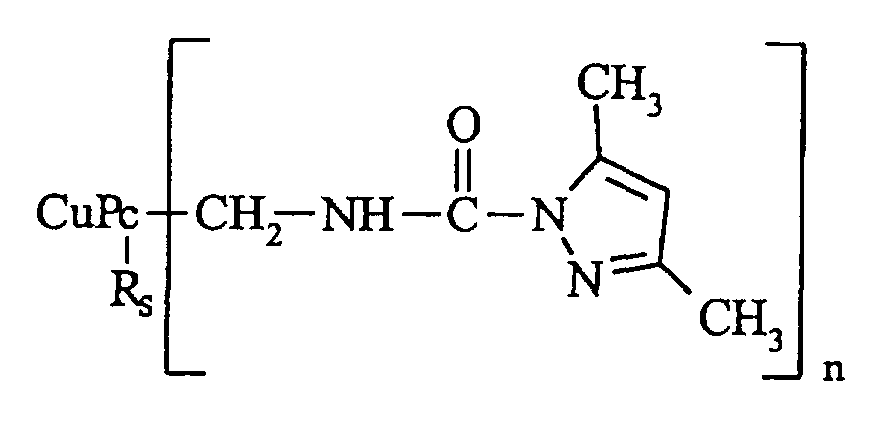
CuPc représente un reste phtalocyanine de cuivre; chaque R représente indépendamment un groupe alkyle en C1-6, halogène ou sulfoxyle (ou un de ses amides) lié à un atome de carbone du cycle phtalocyanine; n est compris entre 1 et 4 et s est compris entre zéro et 8; ou(c) un pyrazolylamidométhylpérylène de formuledans laquelle chaque R représente indépendamment un groupe halogène, carboxamido ou sulfonamido lié à un atome de carbone du cycle pérylène; n est compris entre 1 et 4 et t est compris entre zéro et 4.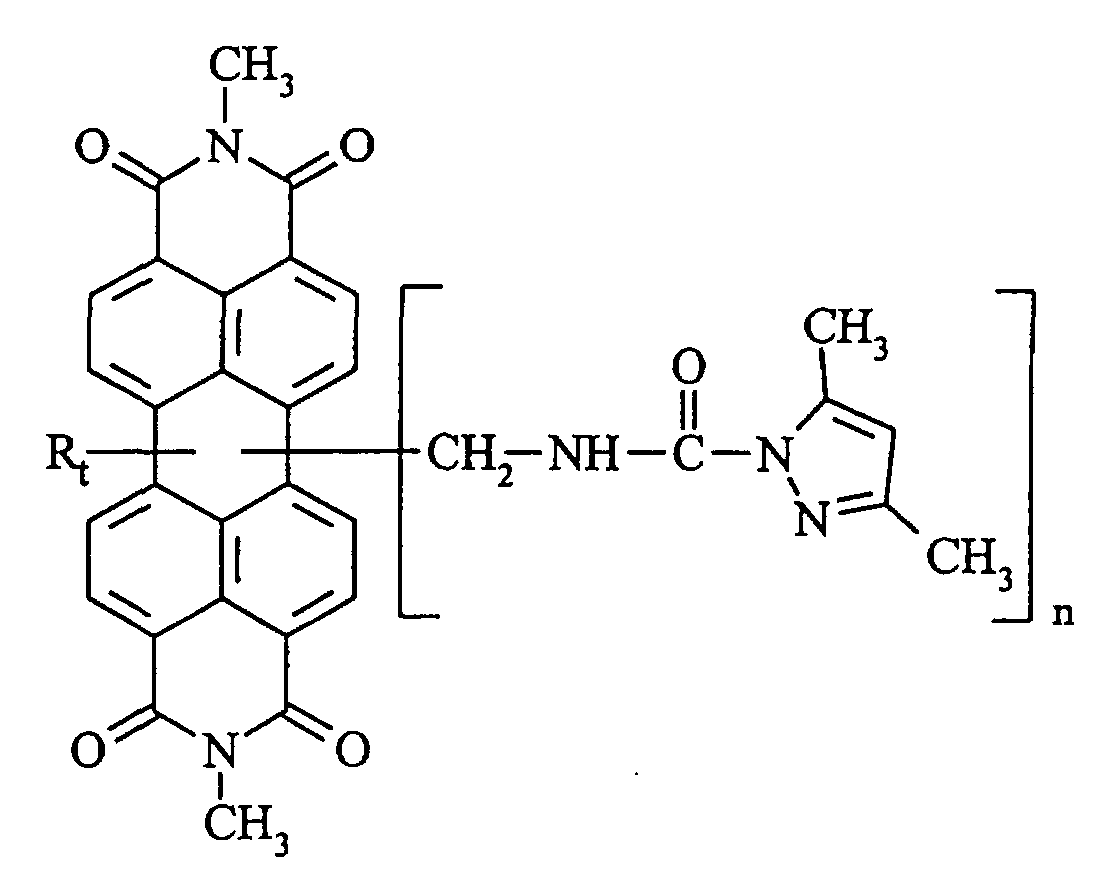
- Composition de pigment selon la revendication 1, dans laquelle le dérivé N-hétéroarylamidométhyle de pigment est une pyrazolylamidométhylquinacridone de formuledans laquelle n est compris entre 1 et 4.
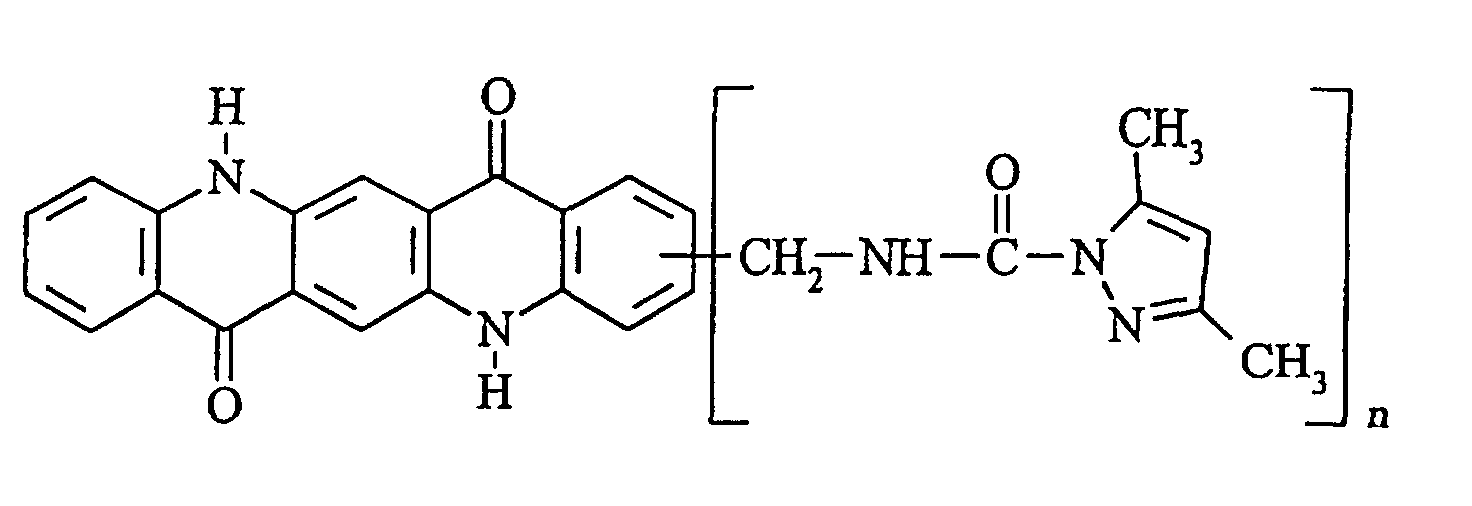
- Composition de pigment selon la revendication 5, dans laquelle le pigment organique est une quinacridone.
- Composition de pigment selon la revendication 1, dans laquelle le dérivé N-hétéroarylamidométhyle de pigment est une pyrazolylamidométhylphtalocyanine de cuivre de formuledans laquelle CuPc représente un reste phtalocyanine de cuivre.

- Composition de pigment selon la revendication 7, dans laquelle le pigment organique est une phtalocyanine de cuivre.
- Composition de pigment selon la revendication 1, dans laquelle le dérivé N-hétéroarylamidométhyle de pigment est un pyrazolylamidométhylpérylène de formuledans laquelle
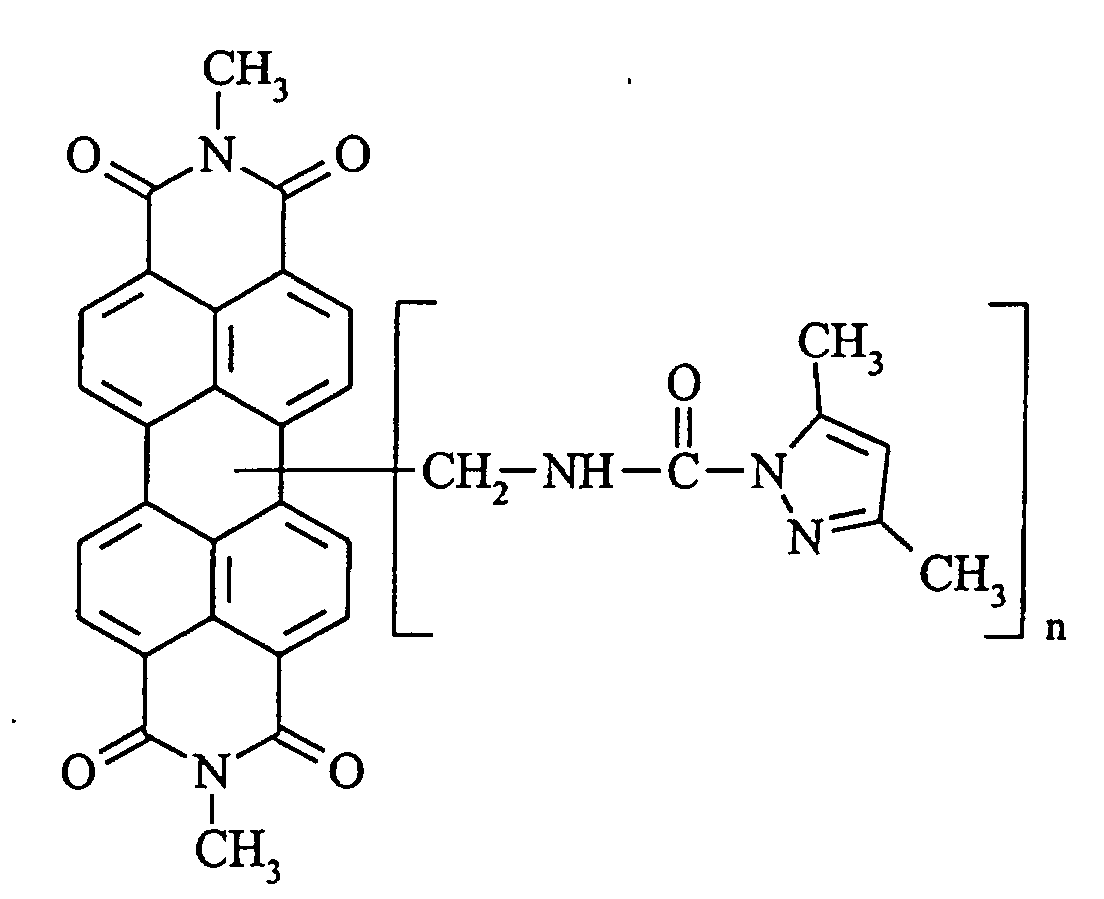
n est compris entre 1 et 4. - Composition de pigment selon la revendication 9, dans laquelle le pigment organique est un pérylène.
- Composition de pigment selon la revendication 1, dans laquelle le pigment organique est traité para) mélange d'un pigment organique brut avec un dérivé N-hétéroarylamidométhyle de pigment selon la revendication 1 dans un acide minéral fort,b) malaxage à l'état humide ou à sec d'un pigment organique brut ou fini avec un dérivé N-hétéroarylamidométhyle de pigment selon la revendication 1,c) addition d'un dérivé N-hétéroarylamidométhyle de pigment selon la revendication 1 au cours de la synthèse du pigment organique,d) conditionnement d'un pigment organique en présence d'un dérivé N-hétéroarylamidométhyle de pigment selon la revendication 1 oue) combinaison d'un ou plusieurs des procédés a), b), c) et d).
- Composition de pigment comprenant un pigment organique traité avec environ 0,1 à environ 20% en masse, sur la base du pigment organique, d'un dérivé N-hétéroarylamidométhyle de pigment de formuledans laquelle
 Q représente un reste d'un pigment organique, choisi dans le groupe constitué par les quinacridones, les pérylènes, les 1,4-dicétopyrrolopyrroles, les anthrapyrimidines, les anthanthrones, les flavanthrones, les indanthrones, les isoindolines, les isoindolinones, les périnones, les pyranthrones, les thioindigos, le 4,4'-diamino-1,1'-dianthraquinonyle, les composés azoïques et leurs dérivés substitués,NHet représente un groupe pyrrolyle, imidazolyle ou leurs dérivés ou un groupe 3,5-diméthylpyrazolyle lié par un atome d'azote cyclique à la fonction carbonyle du groupe de liaison amidométhyle etn est compris entre 1 et 4.
 - Composition de pigment selon la revendication 12, dans laquelle le pigment organique est traité avec 1 à 10% en masse du dérivé N-hétéroarylamidométhyle de pigment.
- Composition de pigment selon la revendication 12, dans laquelle le dérivé N-hétéroarylamidométhyle de pigment est un dérivé pyrazolylamidométhyle de pigment.
- Composition de pigment selon la revendication 12, dans laquelle le pigment organique est traité para) mélange d'un pigment organique brut avec un dérivé N-hétéroarylamidométhyle de pigment selon la revendication 12 dans un acide minéral fort,b) malaxage à l'état humide ou à sec d'un pigment organique brut ou fini avec un dérivé N-hétéroarylamidométhyle de pigment selon la revendication 12,c) addition d'un dérivé N-hétéroarylamidométhyle de pigment selon la revendication 12 au cours de la synthèse du pigment organique,d) conditionnement d'un pigment organique en présence d'un dérivé N-hétéroarylamidométhyle de pigment selon la revendication 12 oue) combinaison d'un ou plusieurs des procédés a), b), c) et d).
- Peinture pigmentée contenant une composition de pigment selon la revendication 1 ou la revendication 12.
- Matière plastique pigmentée contenant une composition de pigment selon la revendication 1 ou la revendication 12.
- Encre contenant en tant que pigment une composition de pigment selon la revendication 1 ou la revendication 12.
- Toner contenant en tant que pigment une composition de pigment selon la revendication 1 ou la revendication 12.
Applications Claiming Priority (2)
| Application Number | Priority Date | Filing Date | Title |
|---|---|---|---|
| US08/777,863 US5711800A (en) | 1996-12-31 | 1996-12-31 | Organic pigment compositions |
| US777863 | 1996-12-31 |
Publications (2)
| Publication Number | Publication Date |
|---|---|
| EP0851006A1 EP0851006A1 (fr) | 1998-07-01 |
| EP0851006B1 true EP0851006B1 (fr) | 2002-04-03 |
Family
ID=25111542
Family Applications (1)
| Application Number | Title | Priority Date | Filing Date |
|---|---|---|---|
| EP97122501A Expired - Lifetime EP0851006B1 (fr) | 1996-12-31 | 1997-12-19 | Compositions des pigments organiques |
Country Status (5)
| Country | Link |
|---|---|
| US (1) | US5711800A (fr) |
| EP (1) | EP0851006B1 (fr) |
| JP (1) | JP4191809B2 (fr) |
| CA (1) | CA2224619C (fr) |
| DE (1) | DE69711580T2 (fr) |
Families Citing this family (13)
| Publication number | Priority date | Publication date | Assignee | Title |
|---|---|---|---|---|
| GB9609436D0 (en) * | 1996-05-04 | 1996-07-10 | Zeneca Ltd | Composition and use |
| US5879444A (en) * | 1997-09-02 | 1999-03-09 | Bayer Corporation | Organic pigment compositions |
| US5972099A (en) * | 1997-12-17 | 1999-10-26 | Bayer Corporation | Process for preparing organic pigment compositions |
| JP5641929B2 (ja) | 2007-04-24 | 2014-12-17 | サン・ケミカル・コーポレーション | 非水溶性インク及び塗料用の顔料 |
| KR101639701B1 (ko) | 2009-08-27 | 2016-07-14 | 후지필름 가부시키가이샤 | 디클로로디케토피롤로피롤 안료, 이것을 함유하는 색재 분산물 및 그 제조방법 |
| WO2019054281A1 (fr) | 2017-09-15 | 2019-03-21 | 富士フイルム株式会社 | Composition, film, stratifié, filtre de transmission infrarouge, dispositif d'imagerie à semi-conducteurs et capteur infrarouge |
| WO2020059509A1 (fr) | 2018-09-20 | 2020-03-26 | 富士フイルム株式会社 | Composition durcissable, film durci, filtre de transmission infrarouge, stratifié, élément d'imagerie à l'état solide, capteur, et procédé de formation de motif |
| EP4024097B1 (fr) | 2019-08-29 | 2024-05-22 | FUJIFILM Corporation | Composition, film, filtre éliminateur d'infrarouge proche, procédé de formation de motif, stratifié, élément d'imagerie à semi-conducteurs, capteur infrarouge, dispositif d'affichage d'image, module de caméra et composé |
| JPWO2022131191A1 (fr) | 2020-12-16 | 2022-06-23 | ||
| JP7741819B2 (ja) | 2020-12-17 | 2025-09-18 | 富士フイルム株式会社 | 組成物、膜、光学フィルタ、固体撮像素子、画像表示装置および赤外線センサ |
| EP4535047A4 (fr) | 2022-06-01 | 2025-10-08 | Fujifilm Corp | Élément de détection de lumière, capteur d'image et procédé de production d'élément de détection de lumière |
| WO2023234094A1 (fr) | 2022-06-01 | 2023-12-07 | 富士フイルム株式会社 | Élément photodétecteur, capteur d'image et procédé de fabrication d'élément photodétecteur |
| WO2023234095A1 (fr) | 2022-06-01 | 2023-12-07 | 富士フイルム株式会社 | Élément de photodétection, capteur d'image et procédé de fabrication d'élément de photodétection |
Family Cites Families (32)
| Publication number | Priority date | Publication date | Assignee | Title |
|---|---|---|---|---|
| NL263729A (fr) * | 1960-04-18 | |||
| GB1138465A (en) * | 1965-08-16 | 1969-01-01 | Ici Ltd | Pigment compositions |
| US3635981A (en) * | 1968-11-01 | 1972-01-18 | Xerox Corp | Photoelectrophoretic imaging pigment composition and process |
| JPS5828303B2 (ja) * | 1974-08-07 | 1983-06-15 | トウヨウインキセイゾウ カブシキガイシヤ | ガンリヨウソセイブツ |
| DK140901C (da) * | 1975-04-12 | 1980-05-19 | Basf Ag | Phthalocyaninpigmentpraeparater stabiliseret mod rekrystallisation og modifikationsomdannelse |
| JPS52132031A (en) * | 1976-04-30 | 1977-11-05 | Toyo Ink Mfg Co Ltd | Phthalocyanine pigment composition |
| JPS5940172B2 (ja) * | 1977-10-28 | 1984-09-28 | 東洋インキ製造株式会社 | フタロシアニン顔料組成物 |
| US4197404A (en) * | 1978-05-08 | 1980-04-08 | E. I. Du Pont De Nemours And Company | Preparation of γ-quinacridone pigment |
| DE2905114C2 (de) * | 1979-02-10 | 1981-03-19 | Basf Ag, 6700 Ludwigshafen | Pigmentzubereitungen |
| JPS56118462A (en) * | 1980-02-25 | 1981-09-17 | Toyo Ink Mfg Co Ltd | Pigment composition |
| US4455173A (en) * | 1981-07-07 | 1984-06-19 | E. I. Du Pont De Nemours And Company | Preparation of pigmentary form of quinacridone pigments |
| US4541872A (en) * | 1982-06-21 | 1985-09-17 | Ciba-Ceigy Corporation | Preparation of pigmentary grade pigment from crude pigment |
| US4439240A (en) * | 1983-02-16 | 1984-03-27 | E. I. Du Pont De Nemours & Company | Aqueous milling of quinacridone pigment |
| US4478968A (en) * | 1983-04-06 | 1984-10-23 | Ciba-Geigy Corporation | Manufacture of resin extended pigments |
| US4844742A (en) * | 1986-04-08 | 1989-07-04 | Ciba-Geigy Corporation | Surface modified pigment compositions |
| US4895948A (en) * | 1988-06-20 | 1990-01-23 | Ciba-Geigy Corporation | Process for preparation of opaque quinacridones |
| US4895949A (en) * | 1988-06-20 | 1990-01-23 | Ciba-Geigy Corporation | Process for preparation of quinacridone solid solutions |
| DE3833422A1 (de) * | 1988-10-01 | 1990-04-05 | Hoechst Ag | Chinacridone mit gezielt eingestellten triboelektrischen effekten |
| DE3833423A1 (de) * | 1988-10-01 | 1990-04-19 | Hoechst Ag | Chinacridon-pigmente, verfahren zu ihrer herstellung und ihre verwendung |
| DE69109057T2 (de) * | 1990-11-08 | 1995-09-21 | Ciba Geigy Ag | Pyrazol enthaltende Pigmentderivate. |
| GB9107651D0 (en) * | 1991-04-11 | 1991-05-29 | Ciba Geigy Ag | Pigment compositions |
| GB9110260D0 (en) * | 1991-05-11 | 1991-07-03 | Ciba Geigy Ag | Pigment compositions |
| US5194088A (en) * | 1991-07-08 | 1993-03-16 | Ciba-Geigy Corporation | Process for conditioning organic pigments |
| US5286863A (en) * | 1991-08-22 | 1994-02-15 | Ciba-Geigy Corporation | Oxidation process for preparing quinacridone pigments |
| EP0538784B2 (fr) * | 1991-10-23 | 2000-12-27 | Clariant GmbH | Préparations pigmentaires |
| DK0574792T3 (da) * | 1992-06-18 | 1999-03-22 | Clariant Gmbh | Fremgangsmåde til fremstilling af kobberphthalocyaninpigmentpræparater i alfa-fasen |
| US5476544A (en) * | 1993-02-26 | 1995-12-19 | Toyo Ink Manufacturing Co., Ltd. | Water-based pigment dispersion |
| JP3129030B2 (ja) * | 1993-06-04 | 2001-01-29 | 東洋インキ製造株式会社 | 銅フタロシアニン顔料組成物の製造方法 |
| US5457203A (en) * | 1993-09-15 | 1995-10-10 | Ciba-Geigy Corporation | Pigmentary synthesis of quinacridone solid solutions |
| US5424429A (en) * | 1993-09-15 | 1995-06-13 | Ciba-Geigy Corporation | Preparation of pigmentary 2,9-dichloroquinacridone |
| US5453151A (en) * | 1994-01-25 | 1995-09-26 | Ciba-Geigy Corporation | Resinated 2,9-dimethylquinacridone |
| DE4403231A1 (de) * | 1994-02-03 | 1995-08-10 | Hoechst Ag | Verfahren zur Herstellung von Chinacridonpigmenten |
-
1996
- 1996-12-31 US US08/777,863 patent/US5711800A/en not_active Expired - Lifetime
-
1997
- 1997-12-11 CA CA002224619A patent/CA2224619C/fr not_active Expired - Fee Related
- 1997-12-19 EP EP97122501A patent/EP0851006B1/fr not_active Expired - Lifetime
- 1997-12-19 DE DE69711580T patent/DE69711580T2/de not_active Expired - Fee Related
- 1997-12-29 JP JP36783097A patent/JP4191809B2/ja not_active Expired - Lifetime
Also Published As
| Publication number | Publication date |
|---|---|
| US5711800A (en) | 1998-01-27 |
| JPH10195326A (ja) | 1998-07-28 |
| DE69711580T2 (de) | 2002-09-26 |
| CA2224619C (fr) | 2007-08-14 |
| JP4191809B2 (ja) | 2008-12-03 |
| CA2224619A1 (fr) | 1998-06-30 |
| EP0851006A1 (fr) | 1998-07-01 |
| DE69711580D1 (de) | 2002-05-08 |
Similar Documents
| Publication | Publication Date | Title |
|---|---|---|
| US5711800A (en) | Organic pigment compositions | |
| US5755873A (en) | Incorporation of quinacridone additives during quinacridone preparation | |
| US5972099A (en) | Process for preparing organic pigment compositions | |
| EP2556117A1 (fr) | Nouveaux pigments magenta de quinacridone | |
| US6066203A (en) | Pigment derivatives for waterborne coatings | |
| CA2203619C (fr) | Modificateurs de la croissance cristalline pour pigments de perylene | |
| US5713999A (en) | Incorporation of pigment derivatives in quinacridone processes | |
| US5698024A (en) | Organic pigment compositions | |
| US5683502A (en) | Incorporation of aromatic polycyclic compounds in quinacridone processes | |
| EP0905199B1 (fr) | Synthèses par microondes de quinacridones, 6,13-dihydroquinacridones et 6,13-quinacridonequinones | |
| US5879444A (en) | Organic pigment compositions | |
| US20020078860A1 (en) | Preparation of quinacridone pigment compositions | |
| MXPA98000112A (es) | Composiciones de pigmentos organicos | |
| MXPA97010432A (en) | Compositions of organi pigments | |
| MXPA97003122A (en) | Incorporation of pigment derivatives enprocedimientos de quinacrid | |
| MXPA98006969A (en) | Organic pigment compositions | |
| MXPA97008779A (es) | Incorporacion de aditivos de quinacridona durantela preparacion de quinacridona | |
| MXPA99004000A (en) | Pigment derivatives for acu base coatings |
Legal Events
| Date | Code | Title | Description |
|---|---|---|---|
| PUAI | Public reference made under article 153(3) epc to a published international application that has entered the european phase |
Free format text: ORIGINAL CODE: 0009012 |
|
| AK | Designated contracting states |
Kind code of ref document: A1 Designated state(s): CH DE FR GB LI |
|
| AX | Request for extension of the european patent |
Free format text: AL;LT;LV;MK;RO;SI |
|
| 17P | Request for examination filed |
Effective date: 19990104 |
|
| AKX | Designation fees paid |
Free format text: CH DE FR GB LI |
|
| RBV | Designated contracting states (corrected) |
Designated state(s): CH DE FR GB LI |
|
| 17Q | First examination report despatched |
Effective date: 19990322 |
|
| GRAG | Despatch of communication of intention to grant |
Free format text: ORIGINAL CODE: EPIDOS AGRA |
|
| GRAG | Despatch of communication of intention to grant |
Free format text: ORIGINAL CODE: EPIDOS AGRA |
|
| GRAH | Despatch of communication of intention to grant a patent |
Free format text: ORIGINAL CODE: EPIDOS IGRA |
|
| GRAH | Despatch of communication of intention to grant a patent |
Free format text: ORIGINAL CODE: EPIDOS IGRA |
|
| REG | Reference to a national code |
Ref country code: GB Ref legal event code: IF02 |
|
| GRAA | (expected) grant |
Free format text: ORIGINAL CODE: 0009210 |
|
| AK | Designated contracting states |
Kind code of ref document: B1 Designated state(s): CH DE FR GB LI |
|
| REG | Reference to a national code |
Ref country code: CH Ref legal event code: EP |
|
| REG | Reference to a national code |
Ref country code: CH Ref legal event code: NV Representative=s name: E. BLUM & CO. PATENTANWAELTE |
|
| REF | Corresponds to: |
Ref document number: 69711580 Country of ref document: DE Date of ref document: 20020508 |
|
| ET | Fr: translation filed | ||
| PLBE | No opposition filed within time limit |
Free format text: ORIGINAL CODE: 0009261 |
|
| STAA | Information on the status of an ep patent application or granted ep patent |
Free format text: STATUS: NO OPPOSITION FILED WITHIN TIME LIMIT |
|
| 26N | No opposition filed |
Effective date: 20030106 |
|
| REG | Reference to a national code |
Ref country code: CH Ref legal event code: PUE Owner name: BAYER POLYMERS LLC Free format text: BAYER CORPORATION#100 BAYER ROAD#PITTSBURGH, PA 15205-9741 (US) -TRANSFER TO- BAYER POLYMERS LLC#100 BAYER ROAD#PITTSBURGH, PA 15205-9741 (US) Ref country code: CH Ref legal event code: PUE Owner name: SUN CHEMICAL CORPORATION Free format text: BAYER POLYMERS LLC#100 BAYER ROAD#PITTSBURGH, PA 15205-9741 (US) -TRANSFER TO- SUN CHEMICAL CORPORATION#222 BRIDGE PLAZA SOUTH#FORT LEE, NJ 07024 (US) |
|
| REG | Reference to a national code |
Ref country code: GB Ref legal event code: 732E |
|
| REG | Reference to a national code |
Ref country code: FR Ref legal event code: TP |
|
| REG | Reference to a national code |
Ref country code: CH Ref legal event code: PFA Owner name: SUN CHEMICAL CORPORATION Free format text: SUN CHEMICAL CORPORATION#222 BRIDGE PLAZA SOUTH#FORT LEE, NJ 07024 (US) -TRANSFER TO- SUN CHEMICAL CORPORATION#35 WATERVIEW BOULEVARD#PARSIPPANY, NJ 07054-1285 (US) |
|
| REG | Reference to a national code |
Ref country code: CH Ref legal event code: PFA Owner name: SUN CHEMICAL CORPORATION Free format text: SUN CHEMICAL CORPORATION#35 WATERVIEW BOULEVARD#PARSIPPANY, NJ 07054-1285 (US) -TRANSFER TO- SUN CHEMICAL CORPORATION#35 WATERVIEW BOULEVARD#PARSIPPANY, NJ 07054-1285 (US) |
|
| PGFP | Annual fee paid to national office [announced via postgrant information from national office to epo] |
Ref country code: DE Payment date: 20071213 Year of fee payment: 11 |
|
| PG25 | Lapsed in a contracting state [announced via postgrant information from national office to epo] |
Ref country code: DE Free format text: LAPSE BECAUSE OF NON-PAYMENT OF DUE FEES Effective date: 20090701 |
|
| PGFP | Annual fee paid to national office [announced via postgrant information from national office to epo] |
Ref country code: GB Payment date: 20101215 Year of fee payment: 14 |
|
| GBPC | Gb: european patent ceased through non-payment of renewal fee |
Effective date: 20111219 |
|
| PG25 | Lapsed in a contracting state [announced via postgrant information from national office to epo] |
Ref country code: GB Free format text: LAPSE BECAUSE OF NON-PAYMENT OF DUE FEES Effective date: 20111219 |
|
| REG | Reference to a national code |
Ref country code: FR Ref legal event code: PLFP Year of fee payment: 19 |
|
| REG | Reference to a national code |
Ref country code: FR Ref legal event code: PLFP Year of fee payment: 20 |
|
| PGFP | Annual fee paid to national office [announced via postgrant information from national office to epo] |
Ref country code: CH Payment date: 20161227 Year of fee payment: 20 |
|
| PGFP | Annual fee paid to national office [announced via postgrant information from national office to epo] |
Ref country code: FR Payment date: 20161227 Year of fee payment: 20 |
|
| REG | Reference to a national code |
Ref country code: CH Ref legal event code: PL |