EP0851049A2 - Gelege aus Filamentgarn, Verfahren zu seiner Herstellung, Vorrichtung zur Durchführung diese Verfahrens - Google Patents
Gelege aus Filamentgarn, Verfahren zu seiner Herstellung, Vorrichtung zur Durchführung diese Verfahrens Download PDFInfo
- Publication number
- EP0851049A2 EP0851049A2 EP97118911A EP97118911A EP0851049A2 EP 0851049 A2 EP0851049 A2 EP 0851049A2 EP 97118911 A EP97118911 A EP 97118911A EP 97118911 A EP97118911 A EP 97118911A EP 0851049 A2 EP0851049 A2 EP 0851049A2
- Authority
- EP
- European Patent Office
- Prior art keywords
- threads
- copolymer
- heating
- weft
- scrim
- Prior art date
- Legal status (The legal status is an assumption and is not a legal conclusion. Google has not performed a legal analysis and makes no representation as to the accuracy of the status listed.)
- Withdrawn
Links
Images



Classifications
-
- D—TEXTILES; PAPER
- D04—BRAIDING; LACE-MAKING; KNITTING; TRIMMINGS; NON-WOVEN FABRICS
- D04H—MAKING TEXTILE FABRICS, e.g. FROM FIBRES OR FILAMENTARY MATERIAL; FABRICS MADE BY SUCH PROCESSES OR APPARATUS, e.g. FELTS, NON-WOVEN FABRICS; COTTON-WOOL; WADDING ; NON-WOVEN FABRICS FROM STAPLE FIBRES, FILAMENTS OR YARNS, BONDED WITH AT LEAST ONE WEB-LIKE MATERIAL DURING THEIR CONSOLIDATION
- D04H3/00—Non-woven fabrics formed wholly or mainly of yarns or like filamentary material of substantial length
- D04H3/005—Synthetic yarns or filaments
-
- D—TEXTILES; PAPER
- D04—BRAIDING; LACE-MAKING; KNITTING; TRIMMINGS; NON-WOVEN FABRICS
- D04H—MAKING TEXTILE FABRICS, e.g. FROM FIBRES OR FILAMENTARY MATERIAL; FABRICS MADE BY SUCH PROCESSES OR APPARATUS, e.g. FELTS, NON-WOVEN FABRICS; COTTON-WOOL; WADDING ; NON-WOVEN FABRICS FROM STAPLE FIBRES, FILAMENTS OR YARNS, BONDED WITH AT LEAST ONE WEB-LIKE MATERIAL DURING THEIR CONSOLIDATION
- D04H3/00—Non-woven fabrics formed wholly or mainly of yarns or like filamentary material of substantial length
- D04H3/005—Synthetic yarns or filaments
- D04H3/009—Condensation or reaction polymers
- D04H3/011—Polyesters
-
- D—TEXTILES; PAPER
- D04—BRAIDING; LACE-MAKING; KNITTING; TRIMMINGS; NON-WOVEN FABRICS
- D04H—MAKING TEXTILE FABRICS, e.g. FROM FIBRES OR FILAMENTARY MATERIAL; FABRICS MADE BY SUCH PROCESSES OR APPARATUS, e.g. FELTS, NON-WOVEN FABRICS; COTTON-WOOL; WADDING ; NON-WOVEN FABRICS FROM STAPLE FIBRES, FILAMENTS OR YARNS, BONDED WITH AT LEAST ONE WEB-LIKE MATERIAL DURING THEIR CONSOLIDATION
- D04H3/00—Non-woven fabrics formed wholly or mainly of yarns or like filamentary material of substantial length
- D04H3/02—Non-woven fabrics formed wholly or mainly of yarns or like filamentary material of substantial length characterised by the method of forming fleeces or layers, e.g. reorientation of yarns or filaments
- D04H3/04—Non-woven fabrics formed wholly or mainly of yarns or like filamentary material of substantial length characterised by the method of forming fleeces or layers, e.g. reorientation of yarns or filaments in rectilinear paths, e.g. crossing at right angles
-
- D—TEXTILES; PAPER
- D04—BRAIDING; LACE-MAKING; KNITTING; TRIMMINGS; NON-WOVEN FABRICS
- D04H—MAKING TEXTILE FABRICS, e.g. FROM FIBRES OR FILAMENTARY MATERIAL; FABRICS MADE BY SUCH PROCESSES OR APPARATUS, e.g. FELTS, NON-WOVEN FABRICS; COTTON-WOOL; WADDING ; NON-WOVEN FABRICS FROM STAPLE FIBRES, FILAMENTS OR YARNS, BONDED WITH AT LEAST ONE WEB-LIKE MATERIAL DURING THEIR CONSOLIDATION
- D04H3/00—Non-woven fabrics formed wholly or mainly of yarns or like filamentary material of substantial length
- D04H3/08—Non-woven fabrics formed wholly or mainly of yarns or like filamentary material of substantial length characterised by the method of strengthening or consolidating
- D04H3/14—Non-woven fabrics formed wholly or mainly of yarns or like filamentary material of substantial length characterised by the method of strengthening or consolidating with bonds between thermoplastic yarns or filaments produced by welding
- D04H3/147—Composite yarns or filaments
Definitions
- the invention relates to a scrim made of filament yarns according to the preamble of claim 1, a method for manufacturing a clutch according to the preamble of claim 7 and one Device for performing this method according to the preamble of claim 10.
- the threads are basically together to glue. This is done with known fabrics through an adhesive.
- the disadvantage is that the Also glue the warp threads or weft threads outside of the Crossing points includes. Therefore, not only the thread properties through the application of the stop Plastic changes, but it also becomes additional Glue needed.
- the object of the invention is therefore the known clutch so improve that for connecting the crossing points no additional materials are required.
- the advantage of the invention is that the fixed Connection between the warp threads of the upper chain and the warp threads the lower chain and the wefts on the common Crossing points occurs, and that nonetheless neither disturbing Influence on the thread properties still arises on any subsequent processing.
- Warp threads of the upper chain and the warp threads of the lower chain and / or the weft thread consists of a material mixture, one of which has a high melting point and the other material component - also called copolymer - has a low melting point.
- polyester for example, it is a melting temperature of approximately 257 degrees Celsius.
- the low melting copolymer can be selected so that its melting point in the range between approx. 120 and 180 degrees Celsius lies.
- the melting point of the copolymer can be thermal Activation of the relevant threads in the crossover area between Warp threads and weft threads take place without melting of the polyester would be feared.
- Suitable yarns for this are so-called hybrid yarns (e.g. B. Hoechst AG, Frankfurt / Main). However, the use these yarns as filament yarns for the production of scrims not yet occurred.
- the present invention is therefore also fundamental to be distinguished from the use of two-component yarns for full-surface tissue.
- This is known, for example in plastic construction.
- this full-surface fabric however, there is neither the need to fix the crossing points together, the different components still have an effect in terms of sliding resistance.
- all-over tissue is already due to the relatively dense number of threads per unit length achieved a sufficiently sliding-resistant structure.
- Such fabrics are preferred in the technical field before, e.g. as a reinforcement grid for foil lamination, adhesive strips, Wipes, paper reinforcement, aluminum bandage laminates, Building materials, so that at least for these applications proposed the use of high tenacity polyester yarns becomes.
- a major advantage of the invention is also based on the fact that a device suitable for manufacturing simply integrated into existing scrim making machines can be. For this purpose, it is essentially proposed that the heating zone immediately behind the weft insertion zone to be arranged to move the To prevent scrim.
- the heater can be on fixed or piecewise carried radiant heater be.
- a heating roller is preferred to achieve this a continuous heating effect, while continuous Production of the scrim.
- the scrim made by this method can, however, in connection with downstream heating thermally so that the shrinking process already when winding up the melted at the crossing points Is finished.
- the special way of making the scrim with one Upper chain and a lower chain causes upper chain and lower chain during production automatically under longitudinal tension being held. Because the longitudinal tension of the thread shrinkage counteracts when heated, the upper chain is preferred and the sub-chain with the low melting temperature copolymer equip. It is taken into account that the weldable portion of the thread material the higher shrink potential Has. This keeps the longitudinal tension Chain the weft in position until it is fixed. The one here thread tension occurring is greater than the shrinkage potential.
- Such a clutch 1 shows a clutch 1.
- Such a clutch 1 has a relatively low thread density per unit length.
- Dependent the usual thread densities of the thread thickness are between 0.5 up to 10 threads per centimeter, for example with 4 threads per centimeter. It is easy to imagine that - due to the loose Laying - the sliding resistance of such fabrics is practical is missing.
- the crossing points 4 between the warp threads 2 and the wefts 3 by thermal activation of the copolymer fused together. As shown in Fig.2, there is always a fused one in the area of the intersection points 4 Area 5, in which the copolymer shares of Mixed yarns between the filaments of the neighboring ones Threads have penetrated and then cool down there.
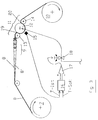
- FIGs 3.4 show a corresponding one Device for carrying out the present method.
- Such fabrics 1 are in a manner known per se Laying machines manufactured. For this purpose, a warp beam 7 or a chain of warp threads drawn from a creel and fanned out. The upper warp sheet 8 and the lower warp sheet 8 'are performed in parallel. In between is about one Rotor with thread guide of the weft thread moved back and forth. Subsequently become the upper warp sheet 8 and the lower Warp thread sheet 8 'merged. The back and forth forward weft pinched.
- the winding tree 10 has a regulated rotational speed to a to achieve constant longitudinal tension of the warp threads as possible.
- FIG. 4 there is such a heating device from a rotatingly driven heating roller 12.
- the Heating roller 12 is connected to a heating circuit.
- the heating roller e.g. to run as a steam-heated roller.
- the heating roller of this type is now precrossed
- the fabric is wrapped at an angle of at least 180 degrees.
- the angle can also be considerably larger.
- two pressure rollers 13, 14 are used, under a certain Preload force at roll entry point 19 or roll exit point 20 rest on the heating roller 12.
- the deduction takes place the scrim with a predetermined force F2.
- the two Pressure rollers 13, 14 therefore prevent the Laid on the heating roller surface 12.
- Between the entry point 19 and the outlet point 20 forms a decoupled Area 21 on which the heating of the pre-crossed Scrim can be done without displacement. So far the melting process in the decoupled area 21 of the copolymer in the area of the crossing points against displacement to lead.
- the heating device 11 a Includes temperature sensor 15, which is the current one Heating temperature measures.
- the measured is in a controller 16 Temperature compared with a predetermined target temperature.
- the target temperature is above the melting point of the copolymer, but below the melting point of the other material.
- the output signal of the controller via the operational amplifier 17 to one Control signal converted.
- the control signal is then the mixing valve 18 abandoned so that a closed regulation arises. If the heater 11 is a total of a steam heater fed, this offers the additional advantage faster reaction times in the event of control deviations anyway good heat transfer between heating medium and heating roller. It is therefore necessary for the most accurate process management possible to use quickly responding regulated heating circuit.
- Heating roller 12 While now the advanced clutch continues towards Heating roller 12 is guided, it also passes through the area of upstream pressure roller 13 (see Fig. 4). There it will pre-laid scrims redirected and towards the surface the heating roller 12 out. It passes through the roller inlet 19, where the upper and lower warp threads with the weft threads already pre-warmed. During the further circulation the heating roller 12 finds another heat transfer instead, the copolymer in the area of the crossing points so far melts that penetration of the melted Copolymers between the individual filaments of warp threads or weft threads. The penetration therefore leads to an intimate bond of the individual crossing filaments. The bond is based on the adhesive fused together Copolymer.
- the material is low Melting point regardless of the material with high Melting point always referred to as a "copolymer", even if that Material with a high melting point is not a polymer (e.g. glass fiber, Carbon fiber).
- a polymer e.g. glass fiber, Carbon fiber
- a scrim made of polyester filament yarn consisting of polyester material with high melting temperature and low melting temperature copolymer, wherein Warp and weft threads of the scrim at the crossing points non-slip with each other by means of the fused copolymer are connected, in which both the warp threads of the upper chain as well as the warp threads of the lower chain and also the Weft threads each made of technical polyester filament yarn high-strength properties exist in which of the warp threads both the upper chain and the warp threads of the lower chain and at least one of the weft threads Thread materials from the high melting temperature polyester material and the copolymer has a low melting temperature, the thread density of the scrim in the range between 0.5 to 10 threads / cm, preferably between 1.5 to 4 threads / cm is.
- Such a fabric avoids the risk that the crossing points between the weft and warp threads burst, when the scrim is put under mechanical stress becomes.
- a clutch has a pronounced Grid structure in which the crossing points between the Warp threads of both the upper chain and the lower chain and the wefts with each other under minimal conditions are intimately fused that the danger of bursting the Intersection points are excluded under load.
Landscapes
- Engineering & Computer Science (AREA)
- Textile Engineering (AREA)
- Chemical & Material Sciences (AREA)
- Chemical Kinetics & Catalysis (AREA)
- Treatment Of Fiber Materials (AREA)
- Yarns And Mechanical Finishing Of Yarns Or Ropes (AREA)
- Woven Fabrics (AREA)
- Nonwoven Fabrics (AREA)
- Knitting Of Fabric (AREA)
Abstract
Description
- Fig.1
- ein erfindungsgemäßes Gelege in schematischer Ansicht,
- Fig.2
- einen vergrößerten Kreuzungspunkt 4 des Geleges nach Fig.1,
- Fig.3
- eine Vorrichtung zur Herstellung eines Geleges gemäß Fig.1,2, und
- Fig.4
- eine vergrößerte Darstellung der Heizeinrichtung gemäß Fig.3.
Claims (13)
- Gelege (1) aus Filamentgarn, wobei Kettfäden (2) und Schußfäden (3) des Geleges an den Kreuzungspunkten (4) schiebefest miteinander verbunden sind, dadurch gekennzeichnet, daß1.1 von den Kettfäden (2) sowohl der Oberkette als auch der Unterkette und von den Schußfäden (3) wenigstens eines der beiden Fadenmaterialien aus einem Material hoher Schmelztemperatur und einem Copolymer niedriger Schmelztemperatur besteht, und daß1.2 Kettfäden (2) und Schußfäden (3) an den Kreuzungspunkten (4) mittels des Copolymers miteinander verschmolzen sind.
- Gelege nach Anspruch 1, dadurch gekennzeichnet, daß Kettfäden (2) und Schußfäden (3) jeweils aus einem Mischgarn bestehen, welches von Filamenten aus einem Material hoher Schmelztemperatur und Copolymer niedriger Schmelztemperatur gebildet wird.
- Gelege nach Anspruch 2, dadurch gekennzeichnet, daß Kettfaden (2) und Schußfaden (3) dasselbe Copolymer aufweisen.
- Gelege nach Anspruch 3, dadurch gekennzeichnet, daß Kettfaden (2) und Schußfaden (3) aus demselben Mischgarn bestehen.
- Gelege nach einem der Ansprüche 1 bis 4, dadurch gekennzeichnet, daß die Fadendichte im Bereich zwischen 0,5 bis 10 Faden pro Zentimeter, vorzugsweise zwischen 1,5 bis 4 Fäden pro Zentimeter beträgt.
- Gelege nach einem der Ansprüche 1 bis 5, dadurch gekennzeichnet, daß es sich um Polyesterfilamentgarn, insbesondere um technisches Polyesterfilamentgarn mit hochfesten Eigenschaften handelt.
- Verfahren zur Herstellung eines Geleges nach einem der Ansprüche 1 bis 6, dadurch gekennzeichnet, daß unmittelbar hinter den Verkreuzungsstellen (4), an denen die Schußfäden (3) mit den Kettfäden (2) verkreuzt werden, das vorverkreuzte Gelege (1) an einer Heizeinrichtung (11) vorbeigeführt wird, daß die Heizeinrichtung (11) auf eine Heiztemperatur oberhalb der Schmelztemperatur des Copolymers jedoch unterhalb der Schmelztemperatur des Polyestermaterials beheizt ist und daß nach dem Aufschmelzen des Copolymers eine Fixierung durch Druck erfolgt.
- Verfahren nach Anspruch 7, dadurch gekennzeichnet, daß die Beheizung berührungslos erfolgt.
- Verfahren nach Anspruch 7, dadurch gekennzeichnet, daß die Beheizung zugleich mit der Fixierung erfolgt.
- Vorrichtung zur Durchführung des Verfahrens nach einem der Ansprüche 7 bis 9, bestehend aus einer Gelegemaschine, einem Kettbaum (7) einer Schußfadeneintragszone (9) und einer Aufwickeleinrichtung (10) für das Gelege, dadurch gekennzeichnet, daß umittelbar hinter der Schußfadeneintragszone (9) eine Heizzone mit Heizeinrichtung (11) angeordnet ist, daß die Heizeinrichtung (11) auf eine Temperatur größer der Schmelztemperatur des Copolymers, jedoch geringer als die Schmelztemperatur des anderen Materials beheizbar ist, daß auf die Heizzone eine Fixierzone mit Fixiereinrichtung folgt.
- Vorrichtung nach Anspruch 10, dadurch gekennzeichnet, daß die Heizeinrichtung eine mitbewegte Kontaktheizung ist.
- Vorrichtung nach Anspruch 11, dadurch gekennzeichnet, daß die Heizeinrichtung eine Heizwalze ist.
- Vorrichtung nach Anspruch 12, dadurch gekennzeichnet, daß Walzeneinlaufpunkt (19) und Walzenauslaufpunkt (20) von jeweils einer Andrückwalze (13,14) bestimmt ist, und daß die Andrückkraft mindestens so groß ist, daß zwischen Walzeneinlaufpunkt (19) und Walzenauslaufpunkt (20) ein zugentkoppelter Bereich (21) entsteht.
Applications Claiming Priority (2)
| Application Number | Priority Date | Filing Date | Title |
|---|---|---|---|
| DE19643871 | 1996-10-30 | ||
| DE1996143871 DE19643871A1 (de) | 1996-10-30 | 1996-10-30 | Gelege aus Filamentgarn, Verfahren zu seiner Herstellung, Vorrichtung zur Durchführung dieses Verfahrens |
Publications (2)
| Publication Number | Publication Date |
|---|---|
| EP0851049A2 true EP0851049A2 (de) | 1998-07-01 |
| EP0851049A3 EP0851049A3 (de) | 1999-12-29 |
Family
ID=7809652
Family Applications (1)
| Application Number | Title | Priority Date | Filing Date |
|---|---|---|---|
| EP97118911A Withdrawn EP0851049A3 (de) | 1996-10-30 | 1997-10-30 | Gelege aus Filamentgarn, Verfahren zu seiner Herstellung, Vorrichtung zur Durchführung diese Verfahrens |
Country Status (2)
| Country | Link |
|---|---|
| EP (1) | EP0851049A3 (de) |
| DE (1) | DE19643871A1 (de) |
Cited By (1)
| Publication number | Priority date | Publication date | Assignee | Title |
|---|---|---|---|---|
| EP1111114A1 (de) | 1999-12-17 | 2001-06-27 | Chavanoz Industrie | Textiles Gitter mit einer reduzierten Dicke |
Families Citing this family (1)
| Publication number | Priority date | Publication date | Assignee | Title |
|---|---|---|---|---|
| FR2797892B1 (fr) * | 1999-08-27 | 2002-08-30 | Vetrotex France Sa | Procede et dispositif de fabrication de plaques composites |
Family Cites Families (9)
| Publication number | Priority date | Publication date | Assignee | Title |
|---|---|---|---|---|
| FR1579042A (de) * | 1968-06-19 | 1969-08-22 | ||
| SE374398B (de) * | 1970-02-27 | 1975-03-03 | Kimberly Clark Co | |
| GB1573714A (en) * | 1976-12-13 | 1980-08-28 | Hellenic Plastics Rubber | Bonded non-woven net structures and articles incorporating such structures |
| EP0081843A3 (de) * | 1981-12-16 | 1986-02-05 | Kurashiki Boseki Kabushiki Kaisha | Nichtgewebte Verstärkung für ein zusammengesetztes Produkt |
| US4841749A (en) * | 1985-10-04 | 1989-06-27 | Burlington Industries, Inc. | Warp-knit, weft-inserted fabric with multiple substrate layers and method of producing same |
| WO1989005367A1 (fr) * | 1987-11-30 | 1989-06-15 | Hagihara Industries, Inc. | Etoffe non tissee et installation de production de cette etoffe |
| DE4137310A1 (de) * | 1991-11-13 | 1993-05-19 | Akzo Nv | Gittermatte |
| JP2736017B2 (ja) * | 1994-10-21 | 1998-04-02 | 鐘紡株式会社 | 糸条を緯とする広幅経緯積層布体の製造方法 |
| DE29507863U1 (de) * | 1995-05-12 | 1996-09-19 | Lückenhaus Technische Textilien GmbH & Co. KG, 42389 Wuppertal | Gittergewebe aus Polyesterfilamentgarn, Vorrichtung zu dessen Herstellung |
-
1996
- 1996-10-30 DE DE1996143871 patent/DE19643871A1/de not_active Withdrawn
-
1997
- 1997-10-30 EP EP97118911A patent/EP0851049A3/de not_active Withdrawn
Cited By (1)
| Publication number | Priority date | Publication date | Assignee | Title |
|---|---|---|---|---|
| EP1111114A1 (de) | 1999-12-17 | 2001-06-27 | Chavanoz Industrie | Textiles Gitter mit einer reduzierten Dicke |
Also Published As
| Publication number | Publication date |
|---|---|
| DE19643871A1 (de) | 1998-05-07 |
| EP0851049A3 (de) | 1999-12-29 |
Similar Documents
| Publication | Publication Date | Title |
|---|---|---|
| DE102008063545C5 (de) | Multiaxialgelege, Verfahren zur Herstellung eines Faserverbundkunststoffs und Faserverbundkunststoff | |
| DE102014103861B4 (de) | Abstandsgewirke sowie Verfahren zur Herstellung eines Abstandsgewirkes | |
| DE102005052660B3 (de) | Vorrichtung und Verfahren zum Ausbreiten eines Karbonfaserstrangs | |
| EP1339534B1 (de) | Verfahren zum herstellen von mehrschichtigen tfp-preforms mittels schmelzbaren fixierfäden | |
| DE69925140T3 (de) | Faservliess als unterlage und tufting-teppich | |
| EP2976450A1 (de) | Abstandsgewirke sowie verfahren zur herstellung eines abstandsgewirkeabschnitts | |
| WO2009015793A1 (de) | Verfahren zum herstellen eines schuhoberteils | |
| DD201921A5 (de) | Verfahren und vorrichtung zur herstellung synthetischer garne und garnaehnlicher strukturen | |
| EP1749924A1 (de) | Formiersieb für den Einsatz in einer Papiermaschine sowie Verfahren zur Herstellung eines solchen Formiersiebes | |
| DE3544523C2 (de) | ||
| EP0485892B1 (de) | Bandförmiges Halbzeug, Verfahren zu dessen Herstellung und Verwendung | |
| DE69827697T2 (de) | Gewebe-Prepreg und Nassverfahren zur Herstellung desselben | |
| DE102011109231A1 (de) | Verstärkungshalbzeug für Organobleche und Verfahren zu dessen Herstellung | |
| EP0742300B1 (de) | Gittergewebe aus Polyesterfilamentgarn, Verfahren zu seiner Herstellung, Vorrichtung zur Durchführung dieses Verfahrens | |
| EP1057931A2 (de) | Elastische Walze und Verfahren zum Herstellen einer solchen | |
| DE4229546A1 (de) | Verfahren und Garn zur Herstellung eines Verbundwerkstoffes | |
| DE60022157T2 (de) | Kontinuierliche und/oder diskontinuierliche dreikomponente Polymerfasern für Vliesstoffe, und Herstellungsverfahren | |
| DE19629044C2 (de) | Flächige Struktur aus Faserverbundwerkstoffen und Verfahren zu ihrer Herstellung | |
| DE1479995C3 (de) | Glasfaserhaltige gewebte Textilschicht zur Herstellung von Laminaten mit verbesserter innerer Haftung | |
| EP0851049A2 (de) | Gelege aus Filamentgarn, Verfahren zu seiner Herstellung, Vorrichtung zur Durchführung diese Verfahrens | |
| EP1505187A1 (de) | Spinnvlies und Verfahren zur Herstellung eines Spinnvlieses | |
| EP4137628B1 (de) | Verfahren zur herstellung eines nonwovenelements sowie nonwovenelement und hygieneartikel | |
| DE29507863U1 (de) | Gittergewebe aus Polyesterfilamentgarn, Vorrichtung zu dessen Herstellung | |
| DE102020104993B4 (de) | Halbzeug für ein Schleifmittel, Schleifmittel und Verfahren zur Herstellung derselben | |
| DE69400153T2 (de) | Verbundvliesstoff aus mindestens zwei Schichten und Verfahren zur Herstellung eines solchen Vliesstoff |
Legal Events
| Date | Code | Title | Description |
|---|---|---|---|
| PUAI | Public reference made under article 153(3) epc to a published international application that has entered the european phase |
Free format text: ORIGINAL CODE: 0009012 |
|
| AK | Designated contracting states |
Kind code of ref document: A2 Designated state(s): AT BE CH DE DK ES FI FR IT LI NL SE |
|
| AX | Request for extension of the european patent |
Free format text: AL;LT;LV;RO;SI |
|
| PUAL | Search report despatched |
Free format text: ORIGINAL CODE: 0009013 |
|
| AK | Designated contracting states |
Kind code of ref document: A3 Designated state(s): AT BE CH DE DK ES FI FR GB GR IE IT LI LU MC NL PT SE |
|
| AX | Request for extension of the european patent |
Free format text: AL;LT;LV;RO;SI |
|
| RIC1 | Information provided on ipc code assigned before grant |
Free format text: 6D 04H 3/04 A, 6D 04H 3/14 B |
|
| 17P | Request for examination filed |
Effective date: 20000303 |
|
| AKX | Designation fees paid |
Free format text: AT BE CH DE DK ES FI FR IT LI NL SE |
|
| STAA | Information on the status of an ep patent application or granted ep patent |
Free format text: STATUS: THE APPLICATION IS DEEMED TO BE WITHDRAWN |
|
| 18D | Application deemed to be withdrawn |
Effective date: 20010501 |