EP0851246B1 - Fibre optique avec une gaine optique d'une composition photodurcissable à indice de réfraction bas - Google Patents
Fibre optique avec une gaine optique d'une composition photodurcissable à indice de réfraction bas Download PDFInfo
- Publication number
- EP0851246B1 EP0851246B1 EP97310141A EP97310141A EP0851246B1 EP 0851246 B1 EP0851246 B1 EP 0851246B1 EP 97310141 A EP97310141 A EP 97310141A EP 97310141 A EP97310141 A EP 97310141A EP 0851246 B1 EP0851246 B1 EP 0851246B1
- Authority
- EP
- European Patent Office
- Prior art keywords
- acrylate
- meth
- optical fiber
- cladding
- fluorinated
- Prior art date
- Legal status (The legal status is an assumption and is not a legal conclusion. Google has not performed a legal analysis and makes no representation as to the accuracy of the status listed.)
- Expired - Lifetime
Links
- 239000000203 mixture Substances 0.000 title claims description 61
- 239000013307 optical fiber Substances 0.000 title claims description 29
- 238000005253 cladding Methods 0.000 claims description 73
- NIXOWILDQLNWCW-UHFFFAOYSA-M acrylate group Chemical group C(C=C)(=O)[O-] NIXOWILDQLNWCW-UHFFFAOYSA-M 0.000 claims description 57
- 239000000463 material Substances 0.000 claims description 35
- 239000000178 monomer Substances 0.000 claims description 23
- JOYRKODLDBILNP-UHFFFAOYSA-N urethane group Chemical group NC(=O)OCC JOYRKODLDBILNP-UHFFFAOYSA-N 0.000 claims description 13
- 150000002009 diols Chemical class 0.000 claims description 9
- 238000006243 chemical reaction Methods 0.000 claims description 7
- 125000005442 diisocyanate group Chemical group 0.000 claims description 6
- 125000001033 ether group Chemical group 0.000 claims description 6
- 125000002496 methyl group Chemical group [H]C([H])([H])* 0.000 claims description 5
- YCKRFDGAMUMZLT-UHFFFAOYSA-N Fluorine atom Chemical compound [F] YCKRFDGAMUMZLT-UHFFFAOYSA-N 0.000 claims description 4
- 125000003118 aryl group Chemical group 0.000 claims description 4
- 229910052731 fluorine Inorganic materials 0.000 claims description 4
- 239000011737 fluorine Substances 0.000 claims description 4
- 229910052739 hydrogen Inorganic materials 0.000 claims description 4
- 239000001257 hydrogen Substances 0.000 claims description 4
- 125000002887 hydroxy group Chemical group [H]O* 0.000 claims description 4
- 239000010702 perfluoropolyether Substances 0.000 claims description 4
- 125000000391 vinyl group Chemical group [H]C([*])=C([H])[H] 0.000 claims description 4
- 125000004432 carbon atom Chemical group C* 0.000 claims description 3
- 125000001495 ethyl group Chemical group [H]C([H])([H])C([H])([H])* 0.000 claims description 3
- 125000004435 hydrogen atom Chemical class [H]* 0.000 claims description 3
- CBOIHMRHGLHBPB-UHFFFAOYSA-N hydroxymethyl Chemical compound O[CH2] CBOIHMRHGLHBPB-UHFFFAOYSA-N 0.000 claims description 3
- 125000006838 isophorone group Chemical group 0.000 claims description 3
- QLOAVXSYZAJECW-UHFFFAOYSA-N methane;molecular fluorine Chemical group C.FF QLOAVXSYZAJECW-UHFFFAOYSA-N 0.000 claims description 3
- 125000001436 propyl group Chemical group [H]C([*])([H])C([H])([H])C([H])([H])[H] 0.000 claims description 3
- 125000005649 substituted arylene group Chemical group 0.000 claims description 3
- 229910014033 C-OH Inorganic materials 0.000 claims description 2
- 229910014570 C—OH Inorganic materials 0.000 claims description 2
- 229920000193 polymethacrylate Polymers 0.000 claims description 2
- 238000000576 coating method Methods 0.000 description 32
- 239000000835 fiber Substances 0.000 description 30
- VYPSYNLAJGMNEJ-UHFFFAOYSA-N Silicium dioxide Chemical compound O=[Si]=O VYPSYNLAJGMNEJ-UHFFFAOYSA-N 0.000 description 22
- 239000011248 coating agent Substances 0.000 description 22
- 238000009472 formulation Methods 0.000 description 18
- 239000011521 glass Substances 0.000 description 18
- 230000009477 glass transition Effects 0.000 description 13
- DZZAHYHMWKNGLC-UHFFFAOYSA-N (1,2,2,3,3,4,4,5,5,6,6-undecafluorocyclohexyl)methyl 2-methylprop-2-enoate Chemical compound CC(=C)C(=O)OCC1(F)C(F)(F)C(F)(F)C(F)(F)C(F)(F)C1(F)F DZZAHYHMWKNGLC-UHFFFAOYSA-N 0.000 description 12
- QJEJDNMGOWJONG-UHFFFAOYSA-N 2,2,3,3,4,4,5,5,6,6,7,7-dodecafluoroheptyl prop-2-enoate Chemical compound FC(F)C(F)(F)C(F)(F)C(F)(F)C(F)(F)C(F)(F)COC(=O)C=C QJEJDNMGOWJONG-UHFFFAOYSA-N 0.000 description 10
- 150000001252 acrylic acid derivatives Chemical class 0.000 description 10
- 229920000642 polymer Polymers 0.000 description 10
- 239000000377 silicon dioxide Substances 0.000 description 10
- 230000005855 radiation Effects 0.000 description 9
- 125000004386 diacrylate group Chemical group 0.000 description 8
- HXWLCYMHOULBJZ-UHFFFAOYSA-N [1-(benzenesulfonyl)indol-2-yl]boronic acid Chemical compound OB(O)C1=CC2=CC=CC=C2N1S(=O)(=O)C1=CC=CC=C1 HXWLCYMHOULBJZ-UHFFFAOYSA-N 0.000 description 7
- RIWRBSMFKVOJMN-UHFFFAOYSA-N 2-methyl-1-phenylpropan-2-ol Chemical compound CC(C)(O)CC1=CC=CC=C1 RIWRBSMFKVOJMN-UHFFFAOYSA-N 0.000 description 5
- CERQOIWHTDAKMF-UHFFFAOYSA-M Methacrylate Chemical compound CC(=C)C([O-])=O CERQOIWHTDAKMF-UHFFFAOYSA-M 0.000 description 5
- UKLDJPRMSDWDSL-UHFFFAOYSA-L [dibutyl(dodecanoyloxy)stannyl] dodecanoate Chemical compound CCCCCCCCCCCC(=O)O[Sn](CCCC)(CCCC)OC(=O)CCCCCCCCCCC UKLDJPRMSDWDSL-UHFFFAOYSA-L 0.000 description 5
- 239000012975 dibutyltin dilaurate Substances 0.000 description 5
- 230000006870 function Effects 0.000 description 5
- NIMLQBUJDJZYEJ-UHFFFAOYSA-N isophorone diisocyanate Chemical compound CC1(C)CC(N=C=O)CC(C)(CN=C=O)C1 NIMLQBUJDJZYEJ-UHFFFAOYSA-N 0.000 description 5
- 238000013459 approach Methods 0.000 description 4
- 239000003054 catalyst Substances 0.000 description 4
- 230000003287 optical effect Effects 0.000 description 4
- -1 perfluoroheptoxy Chemical group 0.000 description 4
- BWTMTZBMAGYMOD-UHFFFAOYSA-N (2,2,3,3,4,4,5,5-octafluoro-6-prop-2-enoyloxyhexyl) prop-2-enoate Chemical compound C=CC(=O)OCC(F)(F)C(F)(F)C(F)(F)C(F)(F)COC(=O)C=C BWTMTZBMAGYMOD-UHFFFAOYSA-N 0.000 description 3
- DYEMEIBDBHAAFO-UHFFFAOYSA-N (2,2,3,3-tetrafluoro-4-prop-2-enoyloxybutyl) prop-2-enoate Chemical compound C=CC(=O)OCC(F)(F)C(F)(F)COC(=O)C=C DYEMEIBDBHAAFO-UHFFFAOYSA-N 0.000 description 3
- 0 *OC(C(c1ccccc1)=O)c1ccccc1 Chemical compound *OC(C(c1ccccc1)=O)c1ccccc1 0.000 description 3
- VOBUAPTXJKMNCT-UHFFFAOYSA-N 1-prop-2-enoyloxyhexyl prop-2-enoate Chemical compound CCCCCC(OC(=O)C=C)OC(=O)C=C VOBUAPTXJKMNCT-UHFFFAOYSA-N 0.000 description 3
- ZWEHNKRNPOVVGH-UHFFFAOYSA-N 2-Butanone Chemical compound CCC(C)=O ZWEHNKRNPOVVGH-UHFFFAOYSA-N 0.000 description 3
- OMIGHNLMNHATMP-UHFFFAOYSA-N 2-hydroxyethyl prop-2-enoate Chemical compound OCCOC(=O)C=C OMIGHNLMNHATMP-UHFFFAOYSA-N 0.000 description 3
- XEKOWRVHYACXOJ-UHFFFAOYSA-N Ethyl acetate Chemical compound CCOC(C)=O XEKOWRVHYACXOJ-UHFFFAOYSA-N 0.000 description 3
- ZMXDDKWLCZADIW-UHFFFAOYSA-N N,N-Dimethylformamide Chemical compound CN(C)C=O ZMXDDKWLCZADIW-UHFFFAOYSA-N 0.000 description 3
- SJRJJKPEHAURKC-UHFFFAOYSA-N N-Methylmorpholine Chemical compound CN1CCOCC1 SJRJJKPEHAURKC-UHFFFAOYSA-N 0.000 description 3
- ZMANZCXQSJIPKH-UHFFFAOYSA-N Triethylamine Chemical compound CCN(CC)CC ZMANZCXQSJIPKH-UHFFFAOYSA-N 0.000 description 3
- 229910052769 Ytterbium Inorganic materials 0.000 description 3
- 230000015572 biosynthetic process Effects 0.000 description 3
- 239000008199 coating composition Substances 0.000 description 3
- 238000001723 curing Methods 0.000 description 3
- UHESRSKEBRADOO-UHFFFAOYSA-N ethyl carbamate;prop-2-enoic acid Chemical class OC(=O)C=C.CCOC(N)=O UHESRSKEBRADOO-UHFFFAOYSA-N 0.000 description 3
- 239000003365 glass fiber Substances 0.000 description 3
- 239000003999 initiator Substances 0.000 description 3
- 125000000538 pentafluorophenyl group Chemical group FC1=C(F)C(F)=C(*)C(F)=C1F 0.000 description 3
- 239000002904 solvent Substances 0.000 description 3
- 238000003786 synthesis reaction Methods 0.000 description 3
- NAWDYIZEMPQZHO-UHFFFAOYSA-N ytterbium Chemical compound [Yb] NAWDYIZEMPQZHO-UHFFFAOYSA-N 0.000 description 3
- CDMDQYCEEKCBGR-UHFFFAOYSA-N 1,4-diisocyanatocyclohexane Chemical compound O=C=NC1CCC(N=C=O)CC1 CDMDQYCEEKCBGR-UHFFFAOYSA-N 0.000 description 2
- YSQGYEYXKXGAQA-UHFFFAOYSA-N 2,2,3,3,4,4,5,5,6,6,7,7,8,8,8-pentadecafluorooctyl prop-2-enoate Chemical compound FC(F)(F)C(F)(F)C(F)(F)C(F)(F)C(F)(F)C(F)(F)C(F)(F)COC(=O)C=C YSQGYEYXKXGAQA-UHFFFAOYSA-N 0.000 description 2
- 229910052691 Erbium Inorganic materials 0.000 description 2
- 239000005058 Isophorone diisocyanate Substances 0.000 description 2
- WYURNTSHIVDZCO-UHFFFAOYSA-N Tetrahydrofuran Chemical compound C1CCOC1 WYURNTSHIVDZCO-UHFFFAOYSA-N 0.000 description 2
- HVVWZTWDBSEWIH-UHFFFAOYSA-N [2-(hydroxymethyl)-3-prop-2-enoyloxy-2-(prop-2-enoyloxymethyl)propyl] prop-2-enoate Chemical compound C=CC(=O)OCC(CO)(COC(=O)C=C)COC(=O)C=C HVVWZTWDBSEWIH-UHFFFAOYSA-N 0.000 description 2
- 239000011149 active material Substances 0.000 description 2
- 239000000654 additive Substances 0.000 description 2
- 238000013019 agitation Methods 0.000 description 2
- 230000008901 benefit Effects 0.000 description 2
- 239000007822 coupling agent Substances 0.000 description 2
- 230000003247 decreasing effect Effects 0.000 description 2
- 230000008034 disappearance Effects 0.000 description 2
- 239000002019 doping agent Substances 0.000 description 2
- UYAHIZSMUZPPFV-UHFFFAOYSA-N erbium Chemical compound [Er] UYAHIZSMUZPPFV-UHFFFAOYSA-N 0.000 description 2
- 229920002313 fluoropolymer Polymers 0.000 description 2
- FUZZWVXGSFPDMH-UHFFFAOYSA-M hexanoate Chemical compound CCCCCC([O-])=O FUZZWVXGSFPDMH-UHFFFAOYSA-M 0.000 description 2
- 239000003112 inhibitor Substances 0.000 description 2
- IQPQWNKOIGAROB-UHFFFAOYSA-N isocyanate group Chemical group [N-]=C=O IQPQWNKOIGAROB-UHFFFAOYSA-N 0.000 description 2
- 239000007788 liquid Substances 0.000 description 2
- 238000004519 manufacturing process Methods 0.000 description 2
- 238000005259 measurement Methods 0.000 description 2
- 238000006116 polymerization reaction Methods 0.000 description 2
- 238000010926 purge Methods 0.000 description 2
- 229910052761 rare earth metal Inorganic materials 0.000 description 2
- 150000002910 rare earth metals Chemical class 0.000 description 2
- 125000000876 trifluoromethoxy group Chemical group FC(F)(F)O* 0.000 description 2
- 150000003673 urethanes Chemical class 0.000 description 2
- QERNPKXJOBLNFM-UHFFFAOYSA-N 1,1,2,2,3,3,4,4-octafluoropentane Chemical compound CC(F)(F)C(F)(F)C(F)(F)C(F)F QERNPKXJOBLNFM-UHFFFAOYSA-N 0.000 description 1
- AJDIZQLSFPQPEY-UHFFFAOYSA-N 1,1,2-Trichlorotrifluoroethane Chemical compound FC(F)(Cl)C(F)(Cl)Cl AJDIZQLSFPQPEY-UHFFFAOYSA-N 0.000 description 1
- GFNDFCFPJQPVQL-UHFFFAOYSA-N 1,12-diisocyanatododecane Chemical compound O=C=NCCCCCCCCCCCCN=C=O GFNDFCFPJQPVQL-UHFFFAOYSA-N 0.000 description 1
- GHXPTDPKJYFMOE-UHFFFAOYSA-N 1,2-bis(isocyanatomethyl)cyclohexane Chemical compound O=C=NCC1CCCCC1CN=C=O GHXPTDPKJYFMOE-UHFFFAOYSA-N 0.000 description 1
- ZGDSDWSIFQBAJS-UHFFFAOYSA-N 1,2-diisocyanatopropane Chemical compound O=C=NC(C)CN=C=O ZGDSDWSIFQBAJS-UHFFFAOYSA-N 0.000 description 1
- AZYRZNIYJDKRHO-UHFFFAOYSA-N 1,3-bis(2-isocyanatopropan-2-yl)benzene Chemical compound O=C=NC(C)(C)C1=CC=CC(C(C)(C)N=C=O)=C1 AZYRZNIYJDKRHO-UHFFFAOYSA-N 0.000 description 1
- XSCLFFBWRKTMTE-UHFFFAOYSA-N 1,3-bis(isocyanatomethyl)cyclohexane Chemical compound O=C=NCC1CCCC(CN=C=O)C1 XSCLFFBWRKTMTE-UHFFFAOYSA-N 0.000 description 1
- VGHSXKTVMPXHNG-UHFFFAOYSA-N 1,3-diisocyanatobenzene Chemical compound O=C=NC1=CC=CC(N=C=O)=C1 VGHSXKTVMPXHNG-UHFFFAOYSA-N 0.000 description 1
- UFXYYTWJETZVHG-UHFFFAOYSA-N 1,3-diisocyanatobutane Chemical compound O=C=NC(C)CCN=C=O UFXYYTWJETZVHG-UHFFFAOYSA-N 0.000 description 1
- IKYNWXNXXHWHLL-UHFFFAOYSA-N 1,3-diisocyanatopropane Chemical compound O=C=NCCCN=C=O IKYNWXNXXHWHLL-UHFFFAOYSA-N 0.000 description 1
- ROHUXHMNZLHBSF-UHFFFAOYSA-N 1,4-bis(isocyanatomethyl)cyclohexane Chemical compound O=C=NCC1CCC(CN=C=O)CC1 ROHUXHMNZLHBSF-UHFFFAOYSA-N 0.000 description 1
- ALQLPWJFHRMHIU-UHFFFAOYSA-N 1,4-diisocyanatobenzene Chemical compound O=C=NC1=CC=C(N=C=O)C=C1 ALQLPWJFHRMHIU-UHFFFAOYSA-N 0.000 description 1
- OVBFMUAFNIIQAL-UHFFFAOYSA-N 1,4-diisocyanatobutane Chemical compound O=C=NCCCCN=C=O OVBFMUAFNIIQAL-UHFFFAOYSA-N 0.000 description 1
- SBJCUZQNHOLYMD-UHFFFAOYSA-N 1,5-Naphthalene diisocyanate Chemical compound C1=CC=C2C(N=C=O)=CC=CC2=C1N=C=O SBJCUZQNHOLYMD-UHFFFAOYSA-N 0.000 description 1
- DFPJRUKWEPYFJT-UHFFFAOYSA-N 1,5-diisocyanatopentane Chemical compound O=C=NCCCCCN=C=O DFPJRUKWEPYFJT-UHFFFAOYSA-N 0.000 description 1
- ATOUXIOKEJWULN-UHFFFAOYSA-N 1,6-diisocyanato-2,2,4-trimethylhexane Chemical compound O=C=NCCC(C)CC(C)(C)CN=C=O ATOUXIOKEJWULN-UHFFFAOYSA-N 0.000 description 1
- QUPKOUOXSNGVLB-UHFFFAOYSA-N 1,8-diisocyanatooctane Chemical compound O=C=NCCCCCCCCN=C=O QUPKOUOXSNGVLB-UHFFFAOYSA-N 0.000 description 1
- PUCOLQDJAFBFDR-UHFFFAOYSA-N 2,2,3,3,4,4,5,5,6,6,7,7,8,8,9,9,10,10,11,11-icosafluoroundecyl 2-methylprop-2-enoate Chemical compound CC(=C)C(=O)OCC(F)(F)C(F)(F)C(F)(F)C(F)(F)C(F)(F)C(F)(F)C(F)(F)C(F)(F)C(F)(F)C(F)F PUCOLQDJAFBFDR-UHFFFAOYSA-N 0.000 description 1
- ASJLMYWCUSHRIW-UHFFFAOYSA-N 2,2,3,3,4,4,5,5,6,6,7,7,8,8,9,9,10,10,11,11-icosafluoroundecyl prop-2-enoate Chemical compound FC(F)C(F)(F)C(F)(F)C(F)(F)C(F)(F)C(F)(F)C(F)(F)C(F)(F)C(F)(F)C(F)(F)COC(=O)C=C ASJLMYWCUSHRIW-UHFFFAOYSA-N 0.000 description 1
- XAENZTGUQXVFPQ-UHFFFAOYSA-N 2,2,3,3,4,4,5,5,6,6,7,7,8,8,9,9-hexadecafluorononyl 2-methylprop-2-enoate Chemical compound CC(=C)C(=O)OCC(F)(F)C(F)(F)C(F)(F)C(F)(F)C(F)(F)C(F)(F)C(F)(F)C(F)F XAENZTGUQXVFPQ-UHFFFAOYSA-N 0.000 description 1
- QXDKTLFTMZTCKT-UHFFFAOYSA-N 2,2,3,3,4,4,5,5,6,6,7,7,8,8,9,9-hexadecafluorononyl prop-2-enoate Chemical compound FC(F)C(F)(F)C(F)(F)C(F)(F)C(F)(F)C(F)(F)C(F)(F)C(F)(F)COC(=O)C=C QXDKTLFTMZTCKT-UHFFFAOYSA-N 0.000 description 1
- YJKHMSPWWGBKTN-UHFFFAOYSA-N 2,2,3,3,4,4,5,5,6,6,7,7-dodecafluoroheptyl 2-methylprop-2-enoate Chemical compound CC(=C)C(=O)OCC(F)(F)C(F)(F)C(F)(F)C(F)(F)C(F)(F)C(F)F YJKHMSPWWGBKTN-UHFFFAOYSA-N 0.000 description 1
- ZNJXRXXJPIFFAO-UHFFFAOYSA-N 2,2,3,3,4,4,5,5-octafluoropentyl 2-methylprop-2-enoate Chemical compound CC(=C)C(=O)OCC(F)(F)C(F)(F)C(F)(F)C(F)F ZNJXRXXJPIFFAO-UHFFFAOYSA-N 0.000 description 1
- LHNAURKRXGPVDW-UHFFFAOYSA-N 2,3-diisocyanatobutane Chemical compound O=C=NC(C)C(C)N=C=O LHNAURKRXGPVDW-UHFFFAOYSA-N 0.000 description 1
- DBCGADAHIXJHCE-UHFFFAOYSA-N 2-[ethyl(1,1,2,2,3,3,4,4,5,5,6,6,7,7,8,8,8-heptadecafluorooctylsulfonyl)amino]ethyl 2-methylprop-2-enoate Chemical compound CC(=C)C(=O)OCCN(CC)S(=O)(=O)C(F)(F)C(F)(F)C(F)(F)C(F)(F)C(F)(F)C(F)(F)C(F)(F)C(F)(F)F DBCGADAHIXJHCE-UHFFFAOYSA-N 0.000 description 1
- ZAZJGBCGMUKZEL-UHFFFAOYSA-N 2-[ethyl(1,1,2,2,3,3,4,4,5,5,6,6,7,7,8,8,8-heptadecafluorooctylsulfonyl)amino]ethyl prop-2-enoate Chemical compound C=CC(=O)OCCN(CC)S(=O)(=O)C(F)(F)C(F)(F)C(F)(F)C(F)(F)C(F)(F)C(F)(F)C(F)(F)C(F)(F)F ZAZJGBCGMUKZEL-UHFFFAOYSA-N 0.000 description 1
- QZWKEPYTBWZJJA-UHFFFAOYSA-N 3,3'-Dimethoxybenzidine-4,4'-diisocyanate Chemical compound C1=C(N=C=O)C(OC)=CC(C=2C=C(OC)C(N=C=O)=CC=2)=C1 QZWKEPYTBWZJJA-UHFFFAOYSA-N 0.000 description 1
- HBZFBSFGXQBQTB-UHFFFAOYSA-N 3,3,4,4,5,5,6,6,7,7,8,8,9,9,10,10,10-heptadecafluorodecyl 2-methylprop-2-enoate Chemical compound CC(=C)C(=O)OCCC(F)(F)C(F)(F)C(F)(F)C(F)(F)C(F)(F)C(F)(F)C(F)(F)C(F)(F)F HBZFBSFGXQBQTB-UHFFFAOYSA-N 0.000 description 1
- SJECZPVISLOESU-UHFFFAOYSA-N 3-trimethoxysilylpropan-1-amine Chemical compound CO[Si](OC)(OC)CCCN SJECZPVISLOESU-UHFFFAOYSA-N 0.000 description 1
- ZLQGITSKRNWIOT-UHFFFAOYSA-N 5-(dimethylamino)furan-2-carbaldehyde Chemical compound CN(C)C1=CC=C(C=O)O1 ZLQGITSKRNWIOT-UHFFFAOYSA-N 0.000 description 1
- XSXVOVXVHBSSSN-UHFFFAOYSA-N 6-o-tert-butyl 3-o-ethyl 2-amino-5,7-dihydro-4h-thieno[2,3-c]pyridine-3,6-dicarboxylate Chemical compound C1N(C(=O)OC(C)(C)C)CCC2=C1SC(N)=C2C(=O)OCC XSXVOVXVHBSSSN-UHFFFAOYSA-N 0.000 description 1
- ZOXJGFHDIHLPTG-UHFFFAOYSA-N Boron Chemical compound [B] ZOXJGFHDIHLPTG-UHFFFAOYSA-N 0.000 description 1
- DKPFZGUDAPQIHT-UHFFFAOYSA-N Butyl acetate Natural products CCCCOC(C)=O DKPFZGUDAPQIHT-UHFFFAOYSA-N 0.000 description 1
- OKTJSMMVPCPJKN-UHFFFAOYSA-N Carbon Chemical group [C] OKTJSMMVPCPJKN-UHFFFAOYSA-N 0.000 description 1
- JIGUQPWFLRLWPJ-UHFFFAOYSA-N Ethyl acrylate Chemical compound CCOC(=O)C=C JIGUQPWFLRLWPJ-UHFFFAOYSA-N 0.000 description 1
- 239000005057 Hexamethylene diisocyanate Substances 0.000 description 1
- ZCDADJXRUCOCJE-UHFFFAOYSA-N O=C1c2cc(Cl)ccc2Sc2ccccc12 Chemical compound O=C1c2cc(Cl)ccc2Sc2ccccc12 ZCDADJXRUCOCJE-UHFFFAOYSA-N 0.000 description 1
- 229920001774 Perfluoroether Polymers 0.000 description 1
- ATJFFYVFTNAWJD-UHFFFAOYSA-N Tin Chemical compound [Sn] ATJFFYVFTNAWJD-UHFFFAOYSA-N 0.000 description 1
- XSQUKJJJFZCRTK-UHFFFAOYSA-N Urea Chemical compound NC(N)=O XSQUKJJJFZCRTK-UHFFFAOYSA-N 0.000 description 1
- 230000000996 additive effect Effects 0.000 description 1
- 239000002318 adhesion promoter Substances 0.000 description 1
- 125000001931 aliphatic group Chemical group 0.000 description 1
- 125000003277 amino group Chemical group 0.000 description 1
- 239000003963 antioxidant agent Substances 0.000 description 1
- 125000002619 bicyclic group Chemical group 0.000 description 1
- 230000005540 biological transmission Effects 0.000 description 1
- 239000004305 biphenyl Substances 0.000 description 1
- 229910052796 boron Inorganic materials 0.000 description 1
- 239000004202 carbamide Substances 0.000 description 1
- 230000008859 change Effects 0.000 description 1
- 239000003795 chemical substances by application Substances 0.000 description 1
- 229920001688 coating polymer Polymers 0.000 description 1
- 238000004891 communication Methods 0.000 description 1
- 150000001875 compounds Chemical class 0.000 description 1
- 230000008878 coupling Effects 0.000 description 1
- 238000010168 coupling process Methods 0.000 description 1
- 238000005859 coupling reaction Methods 0.000 description 1
- 230000007423 decrease Effects 0.000 description 1
- 230000001627 detrimental effect Effects 0.000 description 1
- KORSJDCBLAPZEQ-UHFFFAOYSA-N dicyclohexylmethane-4,4'-diisocyanate Chemical compound C1CC(N=C=O)CCC1CC1CCC(N=C=O)CC1 KORSJDCBLAPZEQ-UHFFFAOYSA-N 0.000 description 1
- 238000007607 die coating method Methods 0.000 description 1
- USIUVYZYUHIAEV-UHFFFAOYSA-N diphenyl ether Natural products C=1C=CC=CC=1OC1=CC=CC=C1 USIUVYZYUHIAEV-UHFFFAOYSA-N 0.000 description 1
- 230000000694 effects Effects 0.000 description 1
- 238000010894 electron beam technology Methods 0.000 description 1
- 239000008393 encapsulating agent Substances 0.000 description 1
- 150000002170 ethers Chemical class 0.000 description 1
- SUPCQIBBMFXVTL-UHFFFAOYSA-N ethyl 2-methylprop-2-enoate Chemical compound CCOC(=O)C(C)=C SUPCQIBBMFXVTL-UHFFFAOYSA-N 0.000 description 1
- 230000005281 excited state Effects 0.000 description 1
- 238000003682 fluorination reaction Methods 0.000 description 1
- 125000003709 fluoroalkyl group Chemical group 0.000 description 1
- 238000005755 formation reaction Methods 0.000 description 1
- 238000010438 heat treatment Methods 0.000 description 1
- RRAMGCGOFNQTLD-UHFFFAOYSA-N hexamethylene diisocyanate Chemical compound O=C=NCCCCCCN=C=O RRAMGCGOFNQTLD-UHFFFAOYSA-N 0.000 description 1
- 230000001771 impaired effect Effects 0.000 description 1
- 230000006872 improvement Effects 0.000 description 1
- 238000010128 melt processing Methods 0.000 description 1
- 150000002734 metacrylic acid derivatives Chemical class 0.000 description 1
- MYWUZJCMWCOHBA-VIFPVBQESA-N methamphetamine Chemical group CN[C@@H](C)CC1=CC=CC=C1 MYWUZJCMWCOHBA-VIFPVBQESA-N 0.000 description 1
- 238000000034 method Methods 0.000 description 1
- 238000002156 mixing Methods 0.000 description 1
- 238000012986 modification Methods 0.000 description 1
- 230000004048 modification Effects 0.000 description 1
- WWZKQHOCKIZLMA-UHFFFAOYSA-N octanoic acid Chemical compound CCCCCCCC(O)=O WWZKQHOCKIZLMA-UHFFFAOYSA-N 0.000 description 1
- UJMWVICAENGCRF-UHFFFAOYSA-N oxygen difluoride Chemical compound FOF UJMWVICAENGCRF-UHFFFAOYSA-N 0.000 description 1
- 239000002245 particle Substances 0.000 description 1
- PNJWIWWMYCMZRO-UHFFFAOYSA-N pent‐4‐en‐2‐one Natural products CC(=O)CC=C PNJWIWWMYCMZRO-UHFFFAOYSA-N 0.000 description 1
- 230000000704 physical effect Effects 0.000 description 1
- 239000005056 polyisocyanate Substances 0.000 description 1
- 229920001228 polyisocyanate Polymers 0.000 description 1
- 230000008569 process Effects 0.000 description 1
- 230000001737 promoting effect Effects 0.000 description 1
- 239000011253 protective coating Substances 0.000 description 1
- 230000001681 protective effect Effects 0.000 description 1
- 230000009993 protective function Effects 0.000 description 1
- 238000005086 pumping Methods 0.000 description 1
- 238000003847 radiation curing Methods 0.000 description 1
- 239000007787 solid Substances 0.000 description 1
- 239000000126 substance Substances 0.000 description 1
- 239000000758 substrate Substances 0.000 description 1
- 150000003512 tertiary amines Chemical class 0.000 description 1
- YLQBMQCUIZJEEH-UHFFFAOYSA-N tetrahydrofuran Natural products C=1C=COC=1 YLQBMQCUIZJEEH-UHFFFAOYSA-N 0.000 description 1
- 239000002562 thickening agent Substances 0.000 description 1
- 150000003606 tin compounds Chemical class 0.000 description 1
- RUELTTOHQODFPA-UHFFFAOYSA-N toluene 2,6-diisocyanate Chemical compound CC1=C(N=C=O)C=CC=C1N=C=O RUELTTOHQODFPA-UHFFFAOYSA-N 0.000 description 1
- 238000012546 transfer Methods 0.000 description 1
- 229940086542 triethylamine Drugs 0.000 description 1
Images


Classifications
-
- G—PHYSICS
- G02—OPTICS
- G02B—OPTICAL ELEMENTS, SYSTEMS OR APPARATUS
- G02B6/00—Light guides; Structural details of arrangements comprising light guides and other optical elements, e.g. couplings
- G02B6/02—Optical fibres with cladding with or without a coating
- G02B6/02033—Core or cladding made from organic material, e.g. polymeric material
-
- G—PHYSICS
- G02—OPTICS
- G02B—OPTICAL ELEMENTS, SYSTEMS OR APPARATUS
- G02B6/00—Light guides; Structural details of arrangements comprising light guides and other optical elements, e.g. couplings
- G02B6/24—Coupling light guides
- G02B6/42—Coupling light guides with opto-electronic elements
- G02B6/4201—Packages, e.g. shape, construction, internal or external details
- G02B6/4249—Packages, e.g. shape, construction, internal or external details comprising arrays of active devices and fibres
Definitions
- the present invention relates to low refractive index photo-curable materials based on fluorinated urethane acrylates.
- optical fibers consist of a doped or undoped glass core surrounded by a doped or undoped glass cladding.
- a polymeric material as cladding instead of siliceous glass.
- Polymeric materials are flexible, so they do not break as easily when the fiber is bent.
- the refractive index of polymers can be made much lower than the achievable by doping silica with fluorine or boron. A lower index can provide a larger numerical aperture, thereby increasing the acceptance angle for the incoming radiation.
- U.S. Pat. No. 4,511,209 and European Pat. No. 0 333 464 B1 disclose polymer compositions suitable for use as cladding for optical fibers.
- optical fibers lasers and amplifiers such as those described in co-assigned U.S. Pat. No.5 873 923 A and in U.S. Pat. No. 4,815,079 .
- These devices comprise a doped silica core, a doped or undoped glass cladding, and an outer polymer cladding.
- the core is pumped by a laser guided through the inner (glass) cladding; the outer (polymer) cladding has an even lower refractive index so that the combination inner/outer cladding can act as a waveguide.
- the process currently used to coat glass fibers with polymers comprises applying a UV-curable formulation with a die.
- Acrylate-functional formulations are the most widely used coating materials because of their extremely fast curing rates, ease of synthesis and commercial availability.
- fluorinated coatings it is necessary to employ fluorinated coatings.
- commercially available fluorinated acrylates have viscosities that are too low for a standard die-coating application.
- U.S. Pat. No. 5,024,507 describes the use of a fluorinated polymer as a "viscosity modifying agent" in the UV-curable formulation.
- the composition is coated on an optical fibre and then cured.
- EP-A-0737871 addresses the problem of reducing the value of the refractive index of urethane (meth)acrylates used as thickeners and proposes the use of urethane (meth)acrylates derived from a diisocyanate and a diol having a fluoroalkyl group.
- a clad optical fiber comprising a core and a cladding made of a material having a refractive index smaller than that of the core, wherein the cladding is made of a cured material comprising a perfluoropolyether or perfluorohydrocarbon backbone end capped with (meth)acrylate groups via urethane groups.
- the cured material is preferably obtained from a mixture comprising from 30-100% by weight, preferably 65%-95% by weight of the urethane group-containing (meth)acrylate, up to about 70 weight %, preferably up to 35% of fluorinated (meth)acrylate monomer or mixtures of monomers, and up to about 50% by wt., preferably up to 35% of a di-or multi-functional (meth)acrylate which is optionally fluorinated or mixtures thereof.
- the fluorinated (meth)acrylate monomer can be a fluorinated rigid molecule with (meth)acrylate functionality.
- the (meth)acrylate can be perfluorocyclohexylmethyl methacrylate;
- the difunctional (meth)acrylates can include:
- the difunctional (meth)acrylates can alternatively include:
- the clad fiber can be prepared by coating the optical fiber with a layer comprising the perfluoropolyether or perfluorohydrocarbon backbone end capped with (meth)acrylate groups via urethane groups and a photopolymerization initiator and curing the layer of the optical fiber.
- the layer can be cured by exposing the layer to radiation.
- a composition useful for making a clad optical fiber has a refractive index smaller than that of the optical fiber wherein the composition comprises a perfluoropolyether or perfluorohydrocarbon backbone end capped with (meth)acrylate groups via urethane groups and a photopolymerization initiator.
- the cured material can be derived from a fluorinated diol having repeating ether groups.
- the cured material can be derived from the reaction of the fluorinated diol with a diisocyanate and a hydroxy-containing mono-, di, or poly(meth)acrylate.
- the composition can comprise from 30-100% by weight, preferably 65%-95% by weight of the urethane group-containing (meth)acrylate, up to about 70 weight %, preferably up to 35% of fluorinated (meth)acrylate monomer or mixtures of monomers, and up to about 50% by wt., preferably up to 35% of a di- or multi-functional (meth)acrylate which is optionally fluorinated or mixtures thereof.
- R 2 can be a fluorinated ether with the structure -O(CH 2 -CH 2 -O) n -(CF 2 -CF 2 -O) P -(CF 2 -O) q -(CH 2 -CH 2 -O) n - -O(CH 2 CH 2 O) n CH 2 CF 2 O(CF 2 CF 2 O) p (CF 2 O) q CF 2 CH 2 O(CH 2 CH 2 O) n - -O CH 2 CF 2 O(CF 2 CF 2 O) p (CF 2 O) q CF 2 CH 2 O- - ⁇ OCH 2 CF(CF 3 )O[CF(CF 3 )CF 2 O] 2 C 2 F 4 ⁇ 2 and -O CH 2 CH(OH)CH 2 OCH 2 CF 2 O(CF 2 CF 2 O) p (CF 2 O) q CF 2 CH 2 CH(OH)CH 2 O- -O-CH 2 -(CF 2 )
- R 1 and R 3 are the isophorone residue;
- the molecular weight of R 2 is between 1,300 and 3,300;
- the average value of n is between 1 and 3 and 0.8 ⁇ p/q ⁇ 1.25.
- the composition can be prepared from a fluorinated diol which is HO(CH 2 CH 2 O) n (CF 2 CF 2 O) p (CF 2 O) q (CH 2 CH 2 O) n H HO(CH 2 CH 2 O) n CH 2 CF 2 O(CF 2 CF 2 O) p (CF 2 O) q CF 2 CH 2 O(CH 2 CH 2 O) n H HO CH 2 CF 2 O(CF 2 CF 2 O) p (CF 2 O) q CF 2 CH 2 OH, HO CH 2 CH(OH)CH 2 OCH 2 CF 2 O(CF 2 CF 2 O) p (CF 2 O) q CF 2 CH 2 CH(OH)CH 2 OH, or ⁇ HOCH 2 CF(CF 3 )O[CF(CF 3 )CF 2 O] 2 C 2 F 4 ⁇ 2 .
- the (meth)acrylate monomer can be a fluorinated rigid molecule with (meth)acrylate functionality.
- the rigid (meth)acrylate can be perfluorocyclohexylmethyl methacrylate; pentafluorobenzyl(meth)acrylate; pentafluorophenyl(meth)acrylate; perfluoronorbornylmethyl(meth)acrylate; 1H-perfluoroisobornyl(meth)acrylate;
- a composition useful for making a clad optical fiber has a refractive index smaller than that of the fiber wherein the composition is photocurable or E-beam curable and has a viscosity of between about 1000 and 100,000 cP at 23°C, a refractive index of the cured material lower than 1.390 (at 633 nm and 23°C); a glass transition temperature greater than 30°C; an elastic modulus at 23°C greater than 30 MPa (measured at a strain rate of 0.1% / min) or greater than 120 MPa (measured at a strain rate of 100% / min); an elongation at break greater than 20%; and a tensile strength greater than 8 MPa (at 100% / min).
- the clad optical fiber comprises a core of glass and a cladding made of one of the above compositions.
- An apparatus may comprise a fiber including a core of size and transparency for transmitting electromagnetic wave energy of a first wavelength, the core being encompassed within a contacting pump cladding for receiving and transfering pump energy to the core, the pump cladding forming an interface with an enveloping second cladding, the improvement wherein the second cladding is derived from any one of the above compositions.
- the core can be rare-earth doped, in which transferred energy pumps rare earth in the core to an excited state which upon relaxation emits output radiation of the first wavelength.
- the apparatus can comprise a laser; and core can contain erbium, ytterbium or neodynium., erbium and ytterbium. Both core and pump cladding can be comprised of silica-rich glass.
- An apparatus may comprise a fiber including a core of size and transparency for transmitting electromagnetic wave energy of a first wavelength, the core being encompassed within a contacting pump cladding for receiving and transferring pump energy to the core, the pump cladding forming an interface with an enveloping second cladding, the second cladding being derived from any one of the above mentioned compositions.
- Up to 50% of the backbone ends can be end-capped with alkoxysilane groups with the balance being end-capped with meth(acrylate) groups.
- the present invention relates to a composition having a low refractive index which is a photo-curable coating and is suitable for use as a cladding for optical waveguides.
- the coating of the instant invention is based on a fluorinated backbone end-capped with (meth)acrylate groups via urethane bonds.
- the fluorinated backbone provides the low refractive index, whereas the hydrogen bonding from the urethane bonds provides both high viscosity in the liquid coating and mechanical strength in the cured coating.
- the coating formulation can optionally have up to about 70 wt% of a fluorinated (meth)acrylate monomer, and up to about 50 wt% of a di- or multi-functional (meth)acrylate which may or may not contain fluorinated moieties.
- the formulation contains between 0.1 and 8 wt% photoinitiator, and it may contain other additives such as antioxidants and adhesion promoters.
- the coatings of the present invention have refractive indices ranging from about 1.37 to 1.41.
- R 1 and R 3 are independently, linear, branched or cyclic alkylene of from four to twenty carbon atoms that may be optionally substituted with groups such as aromatic rings or R 1 and R 3 independently are optionally substituted arylene groups;
- R 2 is a fluorinated carbon-based chain with a fluorine content between about 25 % and about 70 % by weight.
- R 2 structures include -O-(CH 2 -CH 2 -O) n -(CF 2 -CF 2 -O) P -(CF 2 -O) q -(CH 2 -CH 2 -O) n - -O(CH 2 CH 2 O) n CH 2 CF 2 O(CF 2 CF 2 O) p (CF 2 O) q CF 2 CH 2 O(CH 2 CH 2 O) n - -O CH 2 CF 2 O(CF 2 CF 2 O) p (CF 2 O) q CF 2 CH 2 O- - ⁇ OCH 2 CF(CF 3 )O[CF(CF 3 )CF 2 O] 2 C 2 F 4 ⁇ 2 and -O CH 2 CH(OH)CH 2 OCH 2 CF 2 O(CF 2 CF 2 O) p (CF 2 O) q CF 2 CH 2 CH(OH)CH 2 O- -O-CH 2 -(CF 2 ) i -CH 2 -O
- R 1 and R 3 are the isophorone residue
- the molecular weight of R 2 is between 1,300 and 3,300
- the average value of n is 1.5
- a preferred material for coating of optical fibers is a material having an elastic modulus of at least about 12 MPa measured at a strain rate of 0.1 % /min.at room temperature (23°C).
- the material used for coating the optical fibers has an elastic modulus of greater than about 30 MPa measured at a strain rate of 0.1 % /min. at room temperature (23°). The modulus value depends upon the rate of the measurement. The modulus values reported in this paragraph would change to 53 MPa and 120 MPa, respectively, if the measurement strain rate is 100 % /min. Unless otherwise noted, the modulus values in this document were measured at 0.1 % /min. strain rate.
- a material having an elastic modulus of less than 12 MPa can be employed to coat optical fibers if the coated optical fiber is subsequently coated with a tougher material to provide a desired level of handleability.
- fluorinated diols for the urethane backbone include: HO(CH 2 CH 2 O) n CH 2 CF 2 O(CF 2 CF 2 O) p (CF 2 O) q CF 2 CH 2 O(CH 2 CH 2 O) n H HO CH 2 CF 2 O(CF 2 CF 2 O) p (CF 2 O) q CF 2 CH 2 OH ⁇ HOCH 2 CF(CF 3 )O[CF(CF 3 )CF 2 O] 2 C 2 F 4 ⁇ 2 and an example of a tetrafunctional diol is: HO CH 2 CH(OH)CH 2 OCH 2 CF 2 O(CF 2 CF 2 O) p (CF 2 O) q CF 2 CH 2 CH(OH)CH 2 OH
- the urethane oligomers of the general formula shown above can be used alone or optionally in admixture with up to 70 % by weight, preferably up to 35 % by weight, of a fluorinated(meth)acrylate monomer or mixture of monomers and up to 50 weight %, preferably up to 35 % by weight, of a di-or multi-functional (meth)acrylate which is optionally fluorinated.
- the possible additive materials include, for example 1H, 1H, 7H-dodeca-fluoroheptyl acrylate (DFHA), perfluoro-cyclohexylmethyl acrylate (PFCHMA), octafluoro hexanediol diacrylate (OFHDDA).
- Examples of monofunctional fluorinated (meth)acrylates include:
- difunctional acrylates examples include:
- a coating composition having the following properties may be employed: photocurable or E-beam curable and which has a viscosity of between about 1000 and 100,000 cP at 23°C; a refractive index of the cured material lower than 1.390 (at 633 nm and 23°C); a glass transition temperature greater than 30°C; an elastic modulus at 23°C greater than 30 MPa (measured at a strain rate of 0.1 % /min) or greater than 120 MPa (measured at a strain rate of 100 % /min); an elongation at break greater than 20 %; and a tensile strength greater than 8 MPa (at 100 % /min).
- the present preferred coatings are distinguished by having all of the above listed properties. Usually, coatings which are hard don't meet the present elongation requirement and tend to have low viscosities. In addition, such coatings tend to be brittle. In the past coatings having the desired viscosity property are not very hard.
- the present preferred coatings meet all of the above properties. Photocurability, viscosity and refractive index are indispensable properties. In order that the coating can be the sole polymeric coating on a fiber, the coating needs to meet the above listed glass transition temperature, elastic modulus, elongation at break and tensile strength properties. If the latter four properties are not satisfied, the polymer-clad fiber can be jacketed or overcoated with another protective polymer layer.
- a cladding pumped laser may be provided for a high-power fiber laser. It relies on a multi-mode (pump) cladding for accepting and transferring pump energy to an active core along the length of the device through the core-clad interface. Energy is guided within the pump cladding by a second cladding of a lower index of refraction.
- the configuration is useful in fiber amplifiers as well as in fiber lasers.
- the structure of the configuration comprises a centrally-positioned single mode core within a multimode pump cladding.
- the pump cladding forms an interface with a second cladding.
- a third cladding forms a more nearly circular interface with the second cladding.
- a preferred triple-clad structure can comprise a silica-based glass core, a pump clad and a second clad, all enveloped by an organic polymeric third clad.
- a double-clad structure is also possible which consists of a core and first cladding, both generally of silica-based glass, and final polymeric cladding forming an interface with the inorganic glass structure.
- These structures provide for containment of energy in the pump cladding. This function is served by the second glass cladding layer together with polymeric cladding such as the present urethane acrylates with the two forming the interface.
- the claddings are of successively lower refractive index than pump cladding.
- a glass-polymer interface offers an operating advantage. Its differential index of refraction may be far greater than permitted between silica-rich compositions that differ only in minor dopant content.
- the coatings of the present invention which are fluorinated urethanes have indices which are especially useful in these structures.
- cladding is intended to connote (low index) guiding layers, and is not intended to include protective coatings of higher index than that of underlying material.
- outer claddings serve for accepting and transferring introduced energy into the pump clad, and are a part of the collection area. Enhanced energy transfer is due to the pump cladding.
- the thickness of outer claddings is, accordingly, minimized and that of the pump cladding maximized commensurate with other considerations.
- the diisocyanates useful in the present invention include trimethylene diisocyanate, tetramethylene diisocyanate, hexamethylene diisocyanate, pentamethylene diisocyanate, 1,2-propylene diisocyanate, 2,3-butylene diisocyanate, 1,3-butylene diisocyanate, 2,4,4- or 2,2,4-trimethylhexamethylene diisocyanate, dodecamethylene diisocyanate, 1,8-diisocyanatooctane and 2,6-diisocyanatomethyl caproate, cycloalkylene diisocyanates, such as 1,3-cyclopentane diisocyanate, 1,4-cyclohexane diisocyanate, 1,3-cyclohexane diisocyanate, isophorone diisocyanate, OCN-CH 2 -CH(CH 3 )C(CH 3 ) 2 CH 2 CH 2 -NCO, OCN-CH 2 -
- a solvent may optionally be used for preparing the present urethanes and, if any solvent is used, it is preferable to use one which is inert to the above described diisocyantes.
- Illustrative solvents which can be used include ethyl acetate, butyl acetate, methyl ethyl ketone, dimethylformamide, 1,1,2-trichlorotrifluoroethane and tetrahydrofuran.
- a catalyst can optionally be employed for promoting the urethane formation reaction.
- Illustrative catalysts include organic tin compounds such as tin octylate or dibuty-tin dilaurate, or tertiary amines such as N-methylmorpholine or triethyl amine.
- compositions can be cured by radiation or by thermal means.
- the radiation curing can be carried out by particle radiation of an electron beam or ionization, or a chemical beam such as ultraviolet rays.
- Photopolymerization is a preferred curing means in the presence of a photoinitiator.
- Examples of the photo-polymerizing initiator specifically include Trigonal 121 (manufactured by Azo Co.), Darocure 1664 (manufactured by E. Merck Co.), Ultracure DRX (Sherwin-Williams Co.) and TBA (manufactured by BASF Co.), etc.
- BHT polymerization inhibitor
- IPDI isophorone diisocyanate
- DBTDL dibutyl tin dilaurate
- Fluorolink-E The structure of Fluorolink-E is depicted below: HO-(CH 2 -CH 2 -O) N -(CF 2 -CF 2 -O) P -(CF 2 O) q -(CH 2 -CH 2 -O) N -H where n ⁇ 1.5, 0.8 ⁇ p/q ⁇ 1.25, and the molecular weight is approximately 2100.
- the temperature of the reacting mixture was raised to 70°C. After 2 hours, 49.2 ml hydroxyethyl acrylate was added. The reaction was allowed to proceed for 16 hours. Completion of the reaction was confirmed by the disappearance of the NCO infrared peak at 2270 cm -1 .
- the oligomer synthesized as described in Example 1 has a very high viscosity; it is almost a solid at room temperature. This viscosity drops with temperature, so a viscosity appropriate for using this material as a coating for optical fibers can be achieved by heating the coating to 50 - 80°C.
- An alternative way to achieve the proper viscosity is by blending this oligomer with low viscosity monomers. If the monomer used is difunctional, a high modulus material will be obtained upon cure. On the other hand, the use of monofunctional monomers will produce lower modulus, rubbery coatings.
- the refractive index of the cured oligomer is approximately 1.38 at room temperature and 633 nm. This index can be slightly increased or decreased according to the refractive index of the monomer added.
- an alkoxysilane functionality can be incorporated into the oligomer as described in co-assigned U.S. patent No. 6 355 751 A .
- a certain percent of the oligomer molecules will consist of amphifunctional molecules with a (meth)acrylate on one end and an alkoxysilane on the other end.
- These amphiphilic molecules work as coupling agents tying the glass substrate to the coating polymer network.
- BHT polymerization inhibitor
- IPDI isophorone diisocyanate
- DBTDL dibutyl tin dilaurate
- Fomblin Fluorolink-E (Ausimont) was slowly added under dry air and constant agitation.
- the temperature of the reacting mixture was raised to 70°C.
- 7.2 ml aminopropyl-trimethoxysilane was added. This amount corresponds to 10 % of the available isocyanate reactive groups.
- the amine group reacts with the isocyanate group to form a urea linkage.
- the reaction was allowed to proceed for 16 hours.
- 44.3 ml hydroxyethyl acrylate was added.
- the reaction was allowed to proceed for 7 hours. Completion of the reaction was confirmed by the disappearance of the NCO infrared peak at 2270 cm-1.
- the product consists of about 81 % of the diacrylated oligomer, and about 18 % of amphifunctional (acrylate - alkoxysilane) oligomer.
- the product from Example 2 was mixed with 1 % Darocur 1173 and different amounts of 1H,1H,7H-dodecafluoroheptyl acrylate (DFHA), perfluorocyclohexylmethyl acrylate (PFCHMA), octafluoro hexanediol diacrylate (OFHDDA), eicosafluoroundecyl acrylate (EFUA), or FX-189 (2-N-butylperfluorooctanesulfonamide) ethylacrylate supplied by 3M).
- DFHA perfluorocyclohexylmethyl acrylate
- OFHDDA octafluoro hexanediol diacrylate
- EFUA eicosafluoroundecyl acrylate
- FX-189 (2-N-butylperfluorooctanesulfonamide
- the preceding table shows that the elastic modulus can be significantly improved by using difunctional monomer such a OFDDA.
- the refractive index using this monomer is slightly higher.
- a lower index can be achieved by using a monomer with a higher percent of fluorination (such as DFHA), but the elastic modulus is lower because the use of the monomer decreases the crosslink density.
- the oligomer from Example 2 was blended with different amounts of DFHA.
- the following table gives the viscosities of the blend at room temperature (Brookfield viscometer, 20 rpm). Table 2. Viscosity of different oligomer/monomer blends at room temperature WT% DFHA VISCOSITY (cP) 14.4 51,000 22.4 12,300 23.9 8,000 25.0 6,900 30.0 4,300
- the elastic modulus of the cured films is somewhat higher if the alkoxysilane described in Example 2 is not used, because a higher crosslink density can be achieved.
- the oligomer from Example 1 was blended with 1 wt% Darocur 1173 and 14 % octafluorohexanediol diacrylate.
- the elastic modulus of cured films at 23°C is about 80 - 120 MPa
- the refractive index is 1.388.
- Another way to increase the modulus of the coating is to endcap the oligomer with a polyfunctional acrylate. This is illustrated in the following example:
- 0.027g BHT was dissolved in 4.36 ml IPDI.
- the mixture was heated to 50°C under dry air.
- 0.02g dibutyltindilaurate was added, and then 12.5 ml Fluorolink E was gradually added.
- the temperature was raised to 90°C and maintained for 2.5 hours.
- 2.6 ml pentaerythritol triacrylate (PETA) was added gradually and allowed to react for one hour.
- 1.23 ml hydroxyethyl acrylate was added and allowed to react for 1.5 hours at 95°C.
- the reacting mixture was then cooled down to 70°C and allowed to finish reacting overnight.
- the resulted oligomer had about half of its chain-ends capped with monofunctional acrylate and half end-capped with a trifunctional acrylate.
- the oligomer from Example 6 was mixed with 1 wt% Darocur 1173 and then UV-cured.
- the resulting film had an elastic modulus of 45 MPa and a refractive index of 1.390 at 23°C.
- Example 5 The formulation from Example 5 was coated on a glass fiber and UV-cured. Several hundred meters of fiber were drawn. The resulting fiber has a hard, tough coating. This plastic-clad fiber acts as a waveguide; not too much scattering was observed when launching a HeNe laser into this fiber.
- Another approach taken in the present invention consists of developing a low refractive index coating that is hard and tough enough to provide adequate mechanical protection to the glass fiber.
- One way to increase the modulus of a coating is to increase the crosslink density. As shown above, this can be done by adding a difunctional acrylate such as octafluoro-hexanediol diacrylate, or multifunctional acrylate.
- a possible drawback to this approach is that the addition of OFHDDA can increase the refractive index.
- the base formulation comprises the oligomer from Example 1 (above) and 1 % Darocur 1173. % OFHDDA % PDFHMA % L9367 modulus (MPa) refractive index 19 5 0 107 1.3884 17.1 7.4 0 71 1.3847 18 4.7 5.25 1.384 19 9 78.5 1.3831
- Another approach for obtaining a high modulus coating without paying a high refractive index penalty is to add a component that will contribute towards a high glass transition temperature. This component should have a low refractive index and should be able to react into the (meth)acrylate network.
- Suitable materials are highly fluorinated rigid molecules with (meth)acrylate functionality.
- the rigidity in the molecule is typically achieved by the presence of carbon rings with four to eight ring members, or by bicyclic or multicyclic structures.
- the rings can be aromatic or aliphatic, but the latter are preferred because of their lower refractive index.
- the methacrylate functionality provides a higher rigidity than the acrylate functionality.
- rigid (monofunctional) (meth)acrylates examples include:
- a preferred compound for this application is perfluorocyclohexylmethylmethacrylate.
- this material When homopolymerized, this material has a glass transition temperature in excess of 100°C. Therefore when this material is copolymerized with the urethane-acrylate coating, it will raise the glass transition of the overall formulation. If the glass transition is raised to a value above room temperature, a significant gain in room temperature modulus can be achieved. On the other hand, since this material is monofunctional it will lower the crosslink density; therefore one should not add too much of this material. Besides, methacrylates are slower to react than acrylates, so if cure speed is an issue, the methacrylate concentration should not be too high.
- Example 2 The oligomer synthesized as described in Example 1 (above) was mixed with different amounts of 2,2,3,3,4,4,5,5,-octafluoro-1,6,hexanedioldiacrylate (OFHDDA) and perfluorocyclohexylmethylmethacrylate (PFCHMMA), as shown in the following table.
- OFHDDA 2,2,3,3,4,4,5,5,-octafluoro-1,6,hexanedioldiacrylate
- PFCHMMA perfluorocyclohexylmethylmethacrylate
- Darocur 1173 was added to each formulation (1 wt%), and flat rectangular films were UV-cured out of these formulations.
- the refractive index at room temperature and 633 nm is shown, together with the elastic modulus.
- the modulus rises as the concentration of PFCHMMA is increased because this molecule raises the glass transition temperature of the overall formulation.
- further increases in PFCHMMA concentration (formulation C and D) lead to a lower modulus because of the lower crosslink density.
- the PFCHMMA contributes a high glass transition temperature
- the OFHDDA increases the crosslink density.
- the glass transition temperature of formulation E was measured with a differential scanning calorimeter.
- the glass transition temperature defined as the temperature at which the specific heat reaches the midpoint between its value in the glassy state and its value in the rubbery state, was measured to be 57°C.
- the high room temperature modulus of this material is a consequence of the glass transition being higher than room temperature.
- Formulation E has the following physical properties:
- the present invention includes fiber structures having cladding.
- One possible embodiment includes a double clad structure ( Fig. 2 ) and another embodiment is a triple-clad structure ( Fig. 1 ).
- the triple clad structure consists of a centrally-positioned single mode core 10 within a multimode pump cladding 11.
- the pump cladding forms an interface 12 with a second cladding 13.
- Third cladding 14 forms a more nearly circular interface 15 with the second cladding 13.
- the triple clad structure was constituted of silica-based glass core, pump clad and a second clad which can be prepared from the present compositions, all enveloped by an organic polymeric coating.
- the double-clad structure of Fig. 2 consists of core 20 and first cladding 21, both generally of silica-based glass, and final polymeric cladding 22, forming interface 23 with the inorganic glass structure.
- the Fig. 1 structure retains the operating characteristics of Fig. 2 , but facilitates cleaving.
- a smooth featureless circular interface can also be employed. However, with the shaped interfaces, the probability of non-intersecting mode paths is decreased. Fabrication of that polygonal interface is facilitated by melt processing as described in copending U.S. patent No. 5 873 923 A .
- Figs. 1 and 2 provide for containment of energy in the pump cladding.
- the function is served by a second cladding layer 13 with the two forming interface 15.
- Cladding 13 is of a lower refractive index than pump cladding 11.
- a glass-polymer interface offers an operating advantage. Its differential index of refraction may be far greater than permitted between silica-rich compositions that differ only in minor dopant content. Fluorinated polymers such as those disclosed herein are used in these structures.
- the outer cladding serves for accepting and transferring introduced energy into the pump clad, and is a part of the collection area.
- a preferred structural embodiment has an outer surface approaching that of the smooth featureless surface of transmission fiber.
- the cladding surround the pump-cladding (the second cladding) is desirably of sufficient thickness to accommodate undulations in the outer surface of the pump-cladding.
- this second cladding is necessarily of thickness somewhat greater than the difference between the radially measured minimum and maximum thickness of this cladding.
- the polymer cladding of the invention serves a guiding function as well as a protective function.
- the clad/core ratio of cross-sectional areas is generally in the range of 100-300.
- splicing expediency is not significantly impaired by same size mismatch.
- the cladding-pumped structure may be double that of the fiber to be spliced.
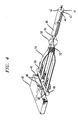
- Fig. 4 taken from U.S. Patent 5,268,978 , but substituting a preferred trough-containing structure, shows an arrangement for coupling with a diode array.
- the cladding pump structure 40 is triple-clad and is constituted of core 41, pump clad 42, second clad 43, and third clad 44.
- the energy source for pumping structure 40 is a diode array 45 consisting of four diodes 46 within a suitable encapsulant 47.
- Diode radiation is depicted as cones 48, collected by cylindrical lens 49.
- Focused radiation 50 is made incident on guides 51 which are bundled to yield a cone 52 of emanating radiation, which is focused by convex lens 53 to form beam 54 directed to structure 40.
- the structure of the fiber consisted of a silica core (diameter 6 ⁇ m) doped with ytterbium, a silica cladding with a "star" shape (as described in co-assigned U.S. Pat. No. 5 873 923 A ) and an average diameter of 130 ⁇ m, and the cured polymer outer cladding (consisting of formulation E) with an outer diameter of 250 ⁇ m.
- This double clad fiber is very robust and handleable. (See Figure 2 ). A cladding-pumped fiber laser was built with this fiber.
Landscapes
- Physics & Mathematics (AREA)
- General Physics & Mathematics (AREA)
- Optics & Photonics (AREA)
- Macromonomer-Based Addition Polymer (AREA)
- Optical Fibers, Optical Fiber Cores, And Optical Fiber Bundles (AREA)
- Polyurethanes Or Polyureas (AREA)
- Paints Or Removers (AREA)
- Addition Polymer Or Copolymer, Post-Treatments, Or Chemical Modifications (AREA)
Claims (10)
- Fibre optique revêtue comprenant un noyau (10) et un revêtement (11) réalisé en un matériau ayant un indice de réfraction inférieur à celui du noyau (10), dans laquelle le revêtement (11) est réalisé en un matériau durci comprenant une structure principale de perfluorpolyéther ou de perfluorhydrocarbure à extrémité recouverte de groupes (méth)acrylate, caractérisée par le fait que les groupes (méth)acrylate sont reliés à la structure principale par l'intermédiaire de groupes uréthane.
- Fibre optique revêtue selon la revendication 1, dans laquelle le matériau durci est dérivé d'un diol fluoré ayant des groupes éther qui se répètent.
- Fibre optique revêtue selon la revendication 2, dans laquelle le matériau durci est dérivé de la réaction du diol fluoré avec un diisocyanate et un mono-, di-, ou poly(méth)acrylate contenant de l'hydroxy.
- Fibre optique revêtue selon la revendication 1, dans lequel le matériau durci est obtenu à partir d'un mélange de (méth)acrylate contenant un groupe uréthane et un photoînitiateur.
- Fibre optique revêtue selon la revendication 4, dans laquelle le matériau durci est obtenu à partir d'un mélange comprenant de 30 à 100% en poids, de préférence 65% à 95% en poids de (méth)acrylate contenant un groupe uréthane, jusqu'à environ 70% en poids, de préférence jusqu'à 35% de fluoré monomère ou mélanges de monomères à base de (méth)acrylate, et jusqu'à environ 50% en poids, de préférence jusqu'à 35%, d'un (méth)acrylate di- ou multifonctionnel qui est, optionnellement, fluoré, ou des mélanges de ceux-ci.
- Fibre optique revêtue selon la revendication 1, dans laquelle le matériau durci est obtenu à partir d'un oligomère ayant la formule
X-O-C(O)-NH-R1-NH-C(O)-R2-C(O)-NH-R3-NH-C(O)-O-Y
où X et Y sont indépendamment
[-Cv(R4)(R5)-O-]rC(O)-C(R6)=CH2
ou
-Cv(R4)(R5)-C(R7)3-t-[-CH2-O-C(O)-C(R8)=CH2]t;
v est un nombre entier de 1 à 10, r est un nombre entier de 1 à 10, et 1 ≤ t ≤ 3;
R1 et R3 sont, indépendamment, linéaires, ramifiés ou alkylène cyclique de quatre à vingt atomes de carbone qui peuvent optionnellement être substitués par des groupes tels que des anneaux aromatiques ou
R1 et R3 sont, indépendamment, optionnellement des groupes arylène substitués;
R2 est une chaîne à base de carbone fluorée avec une teneur en fluor comprise entre environ 25 % et environ 70 % en poids, et
R4, R5, R6, R7 et R8 sont, indépendamment, hydrogène, méthyle, éthyle ou propyle. - Fibre optique revêtue selon la revendication 6, dans laquelle R2 est un éther fluoré à la structure
-O(CH2-CH2-O)n-(CF2-CF2-O)p-(CF2-O)q-(CH2CH2-O)n-
-O(CH2CH2O)nCH2CF2O(CF2CF2O)p(CF2O)qCF2CH2O(CH2CH2O)n-
-O CH2CF2O(CF2CF2O)p(CF2O)qCF2CH2O-
-{OCH2CF(CF3)O[CF(CF3)CF2O]2C2F4}2
et
-O CH2CH(OH)CH2OCH2CF2O(CF2CF2O)p(CF2O)qCF2CH2CH(OH)CH2O-
-O-CH2-(CF2)i-CH2-O-
où 3 ≤ i ≤ 20
où 0 ≤ n ≤ 5, 0,25 ≤ p/q ≤ 5, et les valeurs réelles de p et q sont telles que le poids moléculaire de R2 soit compris entre 500 et 10.000; où les groupes éther fluorés qui se répètent peuvent être des unités qui se répètent de manière aléatoire ou en bloc. - Fibre optique revêtue selon la revendication 7, dans laquelle tant X que Y sont
-CH2-CH2-O-C(O)-CH=CH2;
R1 et R3 sont le résidu d'isophorone; le poids moléculaire de R2 est compris entre 1.300 et 3.300; la valeur moyenne de n est comprise entre 1 et 3 et 0,8 ≤ p/q s 1,25. - Fibre optique revêtue selon la revendication 7, où le matériau durci est préparé à partir d'un diol fluoré qui est
HO(CH2CH2O)n(CF2CF2O)p(CF2O)q(CH2CH2O)nH
HO(CH2CH2O)nCH2CF2O(CF2CF2O)p(CF2O)qCF2CH2O(CH2CH2O)nH
HO CH2CF2O(CF2CF2O)p(CF2O)qCF2CH2OH,
HO CH2CH(OH)CH2OCH2CF2O(CF2CF2O)p(CF2O)qCF2CH2CH(OH)CH2OH,
ou
{HOCH2CF(CF3)O[CF(CF3)CF2O]2C2F4}2
- Fibre optique revêtue selon la revendication 7, dans laquelle le (méth)acrylate contenant un groupe hydroxyl est
CH2=CH-C(O)O-CH2CH2OH
CH2=CH-C(O)O-CH2CH(CH3)OH
CH2=CH-C(O)O-CH2CH2CH2CH2OH
CH2=CH-C(O)O-CH2CH(CH2CH3)OH
CH2=CH-C(O)O-CH2CH2O-[C(O)(CH2)5-O-]2-H
CH2=CH-C(O)O-[CH2CH2O]n-H,
ou
[CH2=CH-C(O)O-CH2]3C-OH.
Applications Claiming Priority (2)
| Application Number | Priority Date | Filing Date | Title |
|---|---|---|---|
| US08/775,541 US5822489A (en) | 1996-12-31 | 1996-12-31 | Low refractive index photo-curable composition for waveguide applications |
| US775541 | 1996-12-31 |
Publications (2)
| Publication Number | Publication Date |
|---|---|
| EP0851246A1 EP0851246A1 (fr) | 1998-07-01 |
| EP0851246B1 true EP0851246B1 (fr) | 2008-12-10 |
Family
ID=25104735
Family Applications (1)
| Application Number | Title | Priority Date | Filing Date |
|---|---|---|---|
| EP97310141A Expired - Lifetime EP0851246B1 (fr) | 1996-12-31 | 1997-12-16 | Fibre optique avec une gaine optique d'une composition photodurcissable à indice de réfraction bas |
Country Status (4)
| Country | Link |
|---|---|
| US (1) | US5822489A (fr) |
| EP (1) | EP0851246B1 (fr) |
| JP (1) | JP3207145B2 (fr) |
| DE (1) | DE69739155D1 (fr) |
Families Citing this family (59)
| Publication number | Priority date | Publication date | Assignee | Title |
|---|---|---|---|---|
| US6335149B1 (en) * | 1997-04-08 | 2002-01-01 | Corning Incorporated | High performance acrylate materials for optical interconnects |
| JP3888653B2 (ja) * | 1998-06-09 | 2007-03-07 | 日本化薬株式会社 | 樹脂組成物及び硬化物 |
| US6737165B1 (en) | 1998-08-06 | 2004-05-18 | Omlidon Technologies Llc | Melt-processible poly(tetrafluoroethylene) |
| US7276287B2 (en) * | 2003-12-17 | 2007-10-02 | Eidgenössische Technische Hochschule Zürich | Melt-processible poly(tetrafluoroethylene) |
| AU5468299A (en) * | 1998-08-06 | 2000-02-28 | Cees Bastiaansen | Melt-processible poly(tetrafluoroethylene) |
| US6208678B1 (en) * | 1998-11-24 | 2001-03-27 | Nortel Networks Limited | Laser pump source and method of operation thereof |
| US20040201000A1 (en) * | 1999-02-19 | 2004-10-14 | Photon-X, Inc. | Polymer blends for optical amplification |
| IT1312344B1 (it) | 1999-06-03 | 2002-04-15 | Ausimont Spa | Composizioni per film a basso indice di rifrazione. |
| US6555288B1 (en) | 1999-06-21 | 2003-04-29 | Corning Incorporated | Optical devices made from radiation curable fluorinated compositions |
| US6306563B1 (en) | 1999-06-21 | 2001-10-23 | Corning Inc. | Optical devices made from radiation curable fluorinated compositions |
| US6570702B2 (en) * | 2000-04-14 | 2003-05-27 | The Regents Of The University Of California | Antiguided fiber ribbon laser |
| US6489376B1 (en) | 2000-07-31 | 2002-12-03 | Alcatel | Formulation of UV-curable coatings for optical fiber for a fast cure |
| US6477307B1 (en) | 2000-10-23 | 2002-11-05 | Nufern | Cladding-pumped optical fiber and methods for fabricating |
| US6929899B2 (en) | 2001-01-25 | 2005-08-16 | E. I. Du Pont De Nemours And Company | Fluorinated photopolymer composition and waveguide device |
| US20020115820A1 (en) * | 2001-01-25 | 2002-08-22 | Fang Wang | Hyperbranched fluorinated multifunctional alcohols and derivatives |
| US7078445B2 (en) * | 2001-02-01 | 2006-07-18 | E. I. Du Pont De Nemours And Company | Photosensitive acrylate composition and waveguide device |
| US6689900B2 (en) | 2001-02-09 | 2004-02-10 | E. I. Du Pont De Nemours And Company | Fluorinated crosslinker and composition |
| US6516124B2 (en) * | 2001-03-02 | 2003-02-04 | Optical Power Systems Incorporated | Fiber for enhanced energy absorption |
| WO2002090451A1 (fr) * | 2001-05-07 | 2002-11-14 | Dow Global Technologies Inc. | Produit d'addition pouvant etre durci par de l'energie et contenant un groupe silane, et revetements fabriques a partir dudit produit |
| US6625363B2 (en) | 2001-06-06 | 2003-09-23 | Nufern | Cladding-pumped optical fiber |
| US6687445B2 (en) | 2001-06-25 | 2004-02-03 | Nufern | Double-clad optical fiber for lasers and amplifiers |
| EP1411073B1 (fr) * | 2001-06-27 | 2013-03-20 | Daikin Industries, Ltd. | Composition d'agent de traitement de surface et procede de fabrication associe |
| WO2003010578A1 (fr) * | 2001-07-12 | 2003-02-06 | Ocg Technology Licensing, Llc | Fibre optique |
| US6778753B2 (en) * | 2001-07-25 | 2004-08-17 | E. I. Du Pont De Nemours And Company | Halogenated optical polymer composition |
| US7039076B2 (en) * | 2001-08-10 | 2006-05-02 | Jds Uniphase Corporation | Fiber amplifier system for producing visible light |
| US7116887B2 (en) * | 2002-03-19 | 2006-10-03 | Nufern | Optical fiber |
| US7764855B2 (en) * | 2002-10-07 | 2010-07-27 | Prysmian Cavi E Sistemi Energia S.R.L. | Optical fiber with cured polymeric coating |
| US7010204B2 (en) * | 2003-03-04 | 2006-03-07 | Lucent Technologies Inc. | Optical transmission fiber with thermal management for high-power applications |
| US7207732B2 (en) * | 2003-06-04 | 2007-04-24 | Corning Incorporated | Coated optical fiber and curable compositions suitable for coating optical fiber |
| US7032492B2 (en) * | 2003-09-11 | 2006-04-25 | Milton S. Meshirer | Ammunition articles comprising light-curable moisture-preventative sealant and method of manufacturing same |
| JP4414188B2 (ja) * | 2003-09-30 | 2010-02-10 | 大日本印刷株式会社 | ハードコート層の滑り性を改善した積層体 |
| US7057810B2 (en) | 2003-12-11 | 2006-06-06 | 3M Innovative Properties Company | Microstructured screen with light absorbing material and method of manufacturing |
| US7050227B2 (en) * | 2003-12-11 | 2006-05-23 | 3M Innovative Properties Company | Composition for microstructured screens |
| FR2867183B1 (fr) * | 2004-03-04 | 2007-09-14 | Cit Alcatel | Revetement de fibre de faible indice de refraction |
| US7288619B2 (en) * | 2004-05-07 | 2007-10-30 | 3M Innovative Properties Company | Fluorinated polyether polyamine and method of making the same |
| US7342080B2 (en) * | 2004-05-07 | 2008-03-11 | 3M Innovative Properties Company | Polymerizable compositions, methods of making the same, and composite articles therefrom |
| US7239785B2 (en) * | 2004-12-30 | 2007-07-03 | Corning Incorporated | Method of preventing optical fiber failure in high power application |
| WO2006077961A1 (fr) * | 2005-01-21 | 2006-07-27 | Nec Corporation | Procede de cablage, convertisseur de cable et appareil de communication utilisant une transmission pour effectuer une communication entre des fentes d’un boitier |
| US20060216524A1 (en) * | 2005-03-23 | 2006-09-28 | 3M Innovative Properties Company | Perfluoropolyether urethane additives having (meth)acryl groups and hard coats |
| US7215860B2 (en) * | 2005-05-02 | 2007-05-08 | Lucent Technologies Inc. | Optical transmission fiber with a glass guiding cladding |
| JP2007023175A (ja) * | 2005-07-19 | 2007-02-01 | Nippon Kayaku Co Ltd | 低屈折率樹脂組成物及びその硬化物 |
| GB2444091A (en) * | 2006-11-24 | 2008-05-28 | Gsi Group Ltd | A Laser Amplifier |
| US20080124555A1 (en) * | 2006-11-29 | 2008-05-29 | 3M Innovative Properties Company | Polymerizable composition comprising perfluoropolyether urethane having ethylene oxide repeat units |
| JP2008208226A (ja) * | 2007-02-27 | 2008-09-11 | Jsr Corp | 放射線硬化性樹脂組成物 |
| US8728623B2 (en) * | 2007-08-31 | 2014-05-20 | 3M Innovative Properties Company | Hardcoats having low surface energy and low lint attraction |
| KR101529355B1 (ko) | 2007-12-12 | 2015-06-16 | 쓰리엠 이노베이티브 프로퍼티즈 컴파니 | 폴리(알킬렌 옥사이드) 반복 단위를 갖는 퍼플루오로폴리에테르 중합체를 포함하는 하드코트 |
| US20090169897A1 (en) * | 2007-12-27 | 2009-07-02 | Yuya Agata | Barrier laminate, barrier film substrate, device and optical component |
| JP5413287B2 (ja) * | 2010-04-14 | 2014-02-12 | 住友電気工業株式会社 | プラスチッククラッド光ファイバ |
| JP2012018258A (ja) * | 2010-07-07 | 2012-01-26 | Furukawa Electric Co Ltd:The | 光ファイバ心線 |
| JP5669687B2 (ja) * | 2011-07-29 | 2015-02-12 | 新中村化学工業株式会社 | 含フッ素(メタ)アクリレート化合物 |
| US20130084459A1 (en) * | 2011-09-30 | 2013-04-04 | 3M Innovative Properties Company | Low peel adhesive |
| EP2952941B1 (fr) | 2013-02-04 | 2018-01-03 | Furukawa Electric Co., Ltd. | Fibre optique et son procédé de production |
| JP6382676B2 (ja) * | 2013-10-16 | 2018-08-29 | オーエフエス ファイテル,エルエルシー | 光ファイバ用の改善された低屈折率コーティング、その製造方法、及び同コーティングを含む物品 |
| US10035915B2 (en) | 2013-10-16 | 2018-07-31 | Ofs Fitel, Llc | Low refractive index coating for optical fibers, methods of manufacture thereof and articles comprising the same |
| JPWO2015060458A1 (ja) * | 2013-10-25 | 2017-03-09 | 日産化学工業株式会社 | ヒドロキシ基を有するパーフルオロポリエーテルを含む重合性組成物 |
| TWI738819B (zh) * | 2016-07-08 | 2021-09-11 | 日商大金工業股份有限公司 | 硬化性組成物、其製造方法,以及使用該硬化性組成物之物品 |
| KR102542434B1 (ko) * | 2017-09-01 | 2023-06-14 | 솔베이 스페셜티 폴리머스 이태리 에스.피.에이. | 신규 (퍼)플루오로폴리에테르 중합체 및 이의 용도 |
| US10324260B1 (en) * | 2018-10-15 | 2019-06-18 | Corning Research & Development Corporation | Optical assembly using low DN/DT optical adhesive |
| US11932571B2 (en) | 2019-05-24 | 2024-03-19 | Covestro (Netherland) B.V. | Radiation curable compositions for coating optical fiber with enhanced high-speed processability |
Family Cites Families (10)
| Publication number | Priority date | Publication date | Assignee | Title |
|---|---|---|---|---|
| GB8621793D0 (en) * | 1986-09-10 | 1986-10-15 | Ici Plc | Coating compositions |
| JPH01308420A (ja) * | 1988-06-07 | 1989-12-13 | Nippon Kayaku Co Ltd | ウレタン(メタ)アクリレート混合物、これを用いた樹脂組成物及び光ファイバ用コーティング剤 |
| EP0454845B1 (fr) * | 1989-11-21 | 1995-02-01 | Sumitomo Electric Industries, Ltd. | Resine photo-durcissable et fibres optiques recouvertes de plastique produites a partir de cette resine |
| US5024507A (en) * | 1990-05-10 | 1991-06-18 | Polaroid Corporation | Photopolymerizable composition for cladding optical fibers |
| US5484822A (en) * | 1991-06-24 | 1996-01-16 | Polaroid Corporation | Process and composition for cladding optic fibers |
| US5239026A (en) * | 1991-08-26 | 1993-08-24 | Minnesota Mining And Manufacturing Company | Low loss high numerical aperture cladded optical fibers |
| US5373576A (en) * | 1993-05-04 | 1994-12-13 | Polaroid Corporation | High power optical fiber |
| FR2712291A1 (fr) * | 1993-11-08 | 1995-05-19 | Alcatel Cable | Matériau polymère pour revêtement de fibres optiques ou pour ruban de fibres optiques. |
| US5652821A (en) * | 1994-10-31 | 1997-07-29 | Sumitomo Electric Industries, Ltd. | Plastic-clad optical fiber |
| US5616638A (en) * | 1995-03-20 | 1997-04-01 | Rohm And Haas Company | Cured composite and process therefor |
-
1996
- 1996-12-31 US US08/775,541 patent/US5822489A/en not_active Expired - Fee Related
-
1997
- 1997-12-05 JP JP35026497A patent/JP3207145B2/ja not_active Expired - Fee Related
- 1997-12-16 DE DE69739155T patent/DE69739155D1/de not_active Expired - Lifetime
- 1997-12-16 EP EP97310141A patent/EP0851246B1/fr not_active Expired - Lifetime
Non-Patent Citations (1)
| Title |
|---|
| None * |
Also Published As
| Publication number | Publication date |
|---|---|
| JPH10197731A (ja) | 1998-07-31 |
| JP3207145B2 (ja) | 2001-09-10 |
| DE69739155D1 (de) | 2009-01-22 |
| US5822489A (en) | 1998-10-13 |
| EP0851246A1 (fr) | 1998-07-01 |
Similar Documents
| Publication | Publication Date | Title |
|---|---|---|
| EP0851246B1 (fr) | Fibre optique avec une gaine optique d'une composition photodurcissable à indice de réfraction bas | |
| DK2473455T3 (en) | Radiation-curable COATING FOR OPTICAL FIBER | |
| KR100487025B1 (ko) | 광도파로용 광경화성 수지 조성물 및 이로부터 제조된광도파로 | |
| US5416880A (en) | Optical fibre coatings and method for producing same | |
| EP0549588B1 (fr) | Rev tements pour fibres optiques a base d'ether de vinyle | |
| US6916855B2 (en) | Radiation curable compositions | |
| US6603901B1 (en) | Optical fiber gratings with index matched polymer coating for cladding mode suppression | |
| EP0990625B1 (fr) | Revêtements à base d'éthers vinyliques pour fibres optiques | |
| US6249638B1 (en) | Photocurable low refractive index coatings | |
| EP2479155B1 (fr) | Procédé d'étirage de film multicouche | |
| JP5788672B2 (ja) | 放射線硬化性樹脂組成物 | |
| KR101021577B1 (ko) | 광경화형 코팅 조성물 | |
| JP2012111924A (ja) | 放射線硬化性樹脂組成物 | |
| EP0260842A2 (fr) | Composition de revêtement | |
| CN1356965A (zh) | 液体可固化树脂组合物及固化产品 | |
| CN1314933A (zh) | 液体可固化树脂组合物 | |
| JP2012018258A (ja) | 光ファイバ心線 | |
| JP2002243995A (ja) | 光ファイバ心線 | |
| KR102353598B1 (ko) | 폴리(메타)아크릴레이트 공중합체 및 이를 기반으로 하는 광섬유 클래딩용 수지 조성물 | |
| CN101137590A (zh) | 可固化液体组合物、固化层和被涂覆的光纤 | |
| KR102190117B1 (ko) | 광섬유 클래딩용 고내수성 수지 조성물 | |
| JP3748038B2 (ja) | 液状放射線硬化型樹脂組成物、光ファイバ用被覆組成物及び光ファイバ | |
| JP3741196B2 (ja) | 液状放射線硬化型樹脂組成物並びに光ファイバ用被覆組成物及び光ファイバ | |
| JP3796655B2 (ja) | 光ファイバ用被覆材 | |
| EP4414395A1 (fr) | Composition de résine à faible indice de réfraction pour la nano-impression 3d par tpp et procédé de microcâblage filaire photonique utilisant celle-ci |
Legal Events
| Date | Code | Title | Description |
|---|---|---|---|
| PUAI | Public reference made under article 153(3) epc to a published international application that has entered the european phase |
Free format text: ORIGINAL CODE: 0009012 |
|
| AK | Designated contracting states |
Kind code of ref document: A1 Designated state(s): DE FR GB |
|
| AX | Request for extension of the european patent |
Free format text: AL;LT;LV;MK;RO;SI |
|
| 17P | Request for examination filed |
Effective date: 19981204 |
|
| AKX | Designation fees paid |
Free format text: DE FR GB |
|
| RBV | Designated contracting states (corrected) |
Designated state(s): DE FR GB |
|
| 17Q | First examination report despatched |
Effective date: 19990812 |
|
| APAB | Appeal dossier modified |
Free format text: ORIGINAL CODE: EPIDOS NOAPE |
|
| APAB | Appeal dossier modified |
Free format text: ORIGINAL CODE: EPIDOS NOAPE |
|
| APAD | Appeal reference recorded |
Free format text: ORIGINAL CODE: EPIDOS REFNE |
|
| APBT | Appeal procedure closed |
Free format text: ORIGINAL CODE: EPIDOSNNOA9E |
|
| APAF | Appeal reference modified |
Free format text: ORIGINAL CODE: EPIDOSCREFNE |
|
| GRAP | Despatch of communication of intention to grant a patent |
Free format text: ORIGINAL CODE: EPIDOSNIGR1 |
|
| RIC1 | Information provided on ipc code assigned before grant |
Ipc: C08L 33/16 20060101ALI20070118BHEP Ipc: G02B 6/02 20060101AFI20070118BHEP |
|
| GRAS | Grant fee paid |
Free format text: ORIGINAL CODE: EPIDOSNIGR3 |
|
| GRAA | (expected) grant |
Free format text: ORIGINAL CODE: 0009210 |
|
| AK | Designated contracting states |
Kind code of ref document: B1 Designated state(s): DE FR GB |
|
| REG | Reference to a national code |
Ref country code: GB Ref legal event code: FG4D |
|
| REF | Corresponds to: |
Ref document number: 69739155 Country of ref document: DE Date of ref document: 20090122 Kind code of ref document: P |
|
| RAP4 | Party data changed (patent owner data changed or rights of a patent transferred) |
Owner name: LUCENT TECHNOLOGIES INC. |
|
| PLBE | No opposition filed within time limit |
Free format text: ORIGINAL CODE: 0009261 |
|
| STAA | Information on the status of an ep patent application or granted ep patent |
Free format text: STATUS: NO OPPOSITION FILED WITHIN TIME LIMIT |
|
| 26N | No opposition filed |
Effective date: 20090911 |
|
| PGFP | Annual fee paid to national office [announced via postgrant information from national office to epo] |
Ref country code: GB Payment date: 20121227 Year of fee payment: 16 |
|
| PGFP | Annual fee paid to national office [announced via postgrant information from national office to epo] |
Ref country code: FR Payment date: 20130110 Year of fee payment: 16 |
|
| PGFP | Annual fee paid to national office [announced via postgrant information from national office to epo] |
Ref country code: DE Payment date: 20121231 Year of fee payment: 16 |
|
| REG | Reference to a national code |
Ref country code: DE Ref legal event code: R119 Ref document number: 69739155 Country of ref document: DE |
|
| GBPC | Gb: european patent ceased through non-payment of renewal fee |
Effective date: 20131216 |
|
| REG | Reference to a national code |
Ref country code: FR Ref legal event code: ST Effective date: 20140829 |
|
| REG | Reference to a national code |
Ref country code: DE Ref legal event code: R119 Ref document number: 69739155 Country of ref document: DE Effective date: 20140701 |
|
| PG25 | Lapsed in a contracting state [announced via postgrant information from national office to epo] |
Ref country code: DE Free format text: LAPSE BECAUSE OF NON-PAYMENT OF DUE FEES Effective date: 20140701 |
|
| PG25 | Lapsed in a contracting state [announced via postgrant information from national office to epo] |
Ref country code: GB Free format text: LAPSE BECAUSE OF NON-PAYMENT OF DUE FEES Effective date: 20131216 Ref country code: FR Free format text: LAPSE BECAUSE OF NON-PAYMENT OF DUE FEES Effective date: 20131231 |