EP0851271B1 - Elektrode für elektrochrome Vorrichtung sowie elektrochrome Vorrichtung - Google Patents
Elektrode für elektrochrome Vorrichtung sowie elektrochrome Vorrichtung Download PDFInfo
- Publication number
- EP0851271B1 EP0851271B1 EP97310501A EP97310501A EP0851271B1 EP 0851271 B1 EP0851271 B1 EP 0851271B1 EP 97310501 A EP97310501 A EP 97310501A EP 97310501 A EP97310501 A EP 97310501A EP 0851271 B1 EP0851271 B1 EP 0851271B1
- Authority
- EP
- European Patent Office
- Prior art keywords
- electrode
- electrochromic
- electrically conductive
- binder
- substrate
- Prior art date
- Legal status (The legal status is an assumption and is not a legal conclusion. Google has not performed a legal analysis and makes no representation as to the accuracy of the status listed.)
- Expired - Lifetime
Links
Images


Classifications
-
- G—PHYSICS
- G02—OPTICS
- G02F—OPTICAL DEVICES OR ARRANGEMENTS FOR THE CONTROL OF LIGHT BY MODIFICATION OF THE OPTICAL PROPERTIES OF THE MEDIA OF THE ELEMENTS INVOLVED THEREIN; NON-LINEAR OPTICS; FREQUENCY-CHANGING OF LIGHT; OPTICAL LOGIC ELEMENTS; OPTICAL ANALOGUE/DIGITAL CONVERTERS
- G02F1/00—Devices or arrangements for the control of the intensity, colour, phase, polarisation or direction of light arriving from an independent light source, e.g. switching, gating or modulating; Non-linear optics
- G02F1/01—Devices or arrangements for the control of the intensity, colour, phase, polarisation or direction of light arriving from an independent light source, e.g. switching, gating or modulating; Non-linear optics for the control of the intensity, phase, polarisation or colour
- G02F1/15—Devices or arrangements for the control of the intensity, colour, phase, polarisation or direction of light arriving from an independent light source, e.g. switching, gating or modulating; Non-linear optics for the control of the intensity, phase, polarisation or colour based on an electrochromic effect
- G02F1/153—Constructional details
- G02F1/155—Electrodes
-
- G—PHYSICS
- G02—OPTICS
- G02F—OPTICAL DEVICES OR ARRANGEMENTS FOR THE CONTROL OF LIGHT BY MODIFICATION OF THE OPTICAL PROPERTIES OF THE MEDIA OF THE ELEMENTS INVOLVED THEREIN; NON-LINEAR OPTICS; FREQUENCY-CHANGING OF LIGHT; OPTICAL LOGIC ELEMENTS; OPTICAL ANALOGUE/DIGITAL CONVERTERS
- G02F1/00—Devices or arrangements for the control of the intensity, colour, phase, polarisation or direction of light arriving from an independent light source, e.g. switching, gating or modulating; Non-linear optics
- G02F1/01—Devices or arrangements for the control of the intensity, colour, phase, polarisation or direction of light arriving from an independent light source, e.g. switching, gating or modulating; Non-linear optics for the control of the intensity, phase, polarisation or colour
- G02F1/15—Devices or arrangements for the control of the intensity, colour, phase, polarisation or direction of light arriving from an independent light source, e.g. switching, gating or modulating; Non-linear optics for the control of the intensity, phase, polarisation or colour based on an electrochromic effect
- G02F1/153—Constructional details
- G02F1/155—Electrodes
- G02F2001/1555—Counter electrode
-
- Y—GENERAL TAGGING OF NEW TECHNOLOGICAL DEVELOPMENTS; GENERAL TAGGING OF CROSS-SECTIONAL TECHNOLOGIES SPANNING OVER SEVERAL SECTIONS OF THE IPC; TECHNICAL SUBJECTS COVERED BY FORMER USPC CROSS-REFERENCE ART COLLECTIONS [XRACs] AND DIGESTS
- Y10—TECHNICAL SUBJECTS COVERED BY FORMER USPC
- Y10T—TECHNICAL SUBJECTS COVERED BY FORMER US CLASSIFICATION
- Y10T428/00—Stock material or miscellaneous articles
- Y10T428/24—Structurally defined web or sheet [e.g., overall dimension, etc.]
- Y10T428/24802—Discontinuous or differential coating, impregnation or bond [e.g., artwork, printing, retouched photograph, etc.]
Definitions
- the present invention relates to an electrode for an electrochromic device which may be used as a light-modulating device or a display device, and an electrochromic device provided with such electrode.
- An electrochromic device which is applicable to a variety of light-modulating devices or display devices is composed of, for example, a transparent substrate, a transparent electrically conductive film, an electrochromic film colored by oxidation or reduction, an electrolyte, an electrochromic film colored by reduction or oxidation, and a transparent electrically conductive film, provided one on another in this order.
- Japanese Laid-open Patent Application Nos. 6-281970 and 7-134318 propose an electrode configured in the form of stripes or dots which can be used as an electrode opposite to the electrode provided with a film of a material colored by either oxidation or reduction.
- an electrode for an electrochromic device comprising an electrically conductive substrate and a plurality of capacitive members arranged on said substrate, each of said capacitive members comprising fine particles bound together with a binder, said fine particles having electric capacity of not less than 1 farad/g, said binder in the capacitive member having degree of swelling of not higher than 20 mass% when measured after the binder in the capacitive member is immersed in ⁇ -butyrolactone at 25 °C for 24 hours.
- an electrochromic device comprising the electrode for an electrochromic device as mentioned above as a counterelectrode, an electrochromic electrode, and an electrolyte interposed between the counterelectrode and the electrochromic electrode.
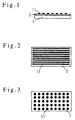
- Fig. 1 is a cross-sectional view of one embodiment of the electrode for an electrochromic device of the present invention.
- Fig. 2 is a schematic plan view of one embodiment of the electrode for an electrochromic device of the present invention.
- Fig. 3 is a schematic plan view of another embodiment of the electrode for an electrochromic device of the present invention.
- Fig. 4 is a cross-sectional view of one embodiment of the electrochromic device of the present invention.
- Fig. 5 is a cross-sectional view of one embodiment of a bus bar for an electrochromic device.
- Fig. 6 is a cross-sectional view of one embodiment of an electrochromic device provided with the bus bar of Fig. 5.
- Fig. 7 is a plan view of one embodiment of an electrode for an electrochromic device provided with a bus bar therearound.
- Fig. 8 is a cross-sectional view of one embodiment of an electrode for an electrochromic device provided with a bus bar therearound.
- Fig. 9 is a cross-sectional view of one embodiment of an electrode provided with a bus bar therearound.
- Fig. 10 is a cross-sectional view of one embodiment of an electrochromic device provided with a bus bar around the electrodes.
- Fig. 11 is a cross-sectional view of one embodiment of an electrochromic device produced in Example.
- the electrode for an electrochromic device of the present invention has an electrically conductive substrate and a plurality of particular capacitive members arranged on the substrate, and each capacitive member contains particular fine particles bound together with a particular binder for molding.
- the electrically conductive substrate used in the present invention may be selected from a variety of metal plates and transparent or opaque substrates other than metal plates provided with an electrically conductive film.
- a transparent electrically conductive substrate such as a substrate essentially composed of a transparent substrate and a transparent electrically conductive film formed thereon, is preferred.
- the transparent substrate is not particularly limited, and the material, thickness, dimensions, and configuration may suitably be selected depending on the purpose.
- colorless or colored glass, wired glass, or glass blocks may be used.
- colorless or colored transparent resins may also be used.
- resins may include polyesters such as polyethylene terephtharate; polyamide, polysulfone, polyether sulfone, polyether ether ketone, polyphenylene sulfide, polycarbonate, polyimide, polymethyl methacrylate, polystyrene, cellulose triacetate, and polymethyl pentene.
- transparent used herein means to have a light transmittance of 10 to 100 %.
- substrate used herein means a material having a smooth surface at an ordinary temperature, and the surface may be flat or curved, or deformable by stress.
- the transparent electrically conductive film is not particularly limited as long as it can achieve the object of the present invention.
- a thin metal film of gold, silver, chromium, copper, or tungsten, or an electrically conductive film of a metal oxide may be used.
- the metal oxide may be ITO (In 2 O 3 -SnO 2 ), SnO 2 :F, tin oxide, zinc oxide, ZnO:Al, or vanadium oxide.
- the thickness of the transparent electrically conductive film is usually 100 to 5000 ⁇ , preferably 500 to 3000 ⁇ .
- the surface resistivity (resistivity) of the film may suitably be selected depending on the purpose, but usually be 0.5 to 500 ⁇ /sq., preferably 2 to 50 ⁇ /sq..
- a method for forming the transparent electrically conductive film on the transparent substrate is not particularly limited, and may be selected from the conventional methods depending on the kind of the metal or metal oxide to be used for forming the transparent electrically conductive film. Usually, vacuum deposition method, ion plating method, or sputtering method is employed. In any case, it is preferred to set the substrate temperature within the range from 20 to 350 °C for forming the film.
- the particular fine particles mentioned above have the electric capacity of not less than 1 farad/g, preferably not less than 5 farad/g, more preferably not less than 10 farad/g.
- the fine particles may further have, for example, at least one of the particular electrical conductivity and the particular capability of storing electric charge.
- the electrical conductivity may usually be not lower than 10 -8 S ⁇ cm -1 , preferably not lower than 10 -5 S ⁇ cm -1 , more preferably not lower than 10 -2 S ⁇ cm -1
- the capability for storing electric charge may usually be not less than 1 coulomb/g, preferably not less than 5 coulomb/g, more preferably not less than 10 coulomb/g.
- Examples of the material of such fine particles may include porous carbon, an intercalation material, an electrically conductive polymer, or mixtures thereof.
- the material of the fine particles having the electric capacity of not less than 1 farad/g may be porous carbon having the specific surface area of not less than 10 m 2 /g, preferably 50 to 5000 m 2 /g, more preferably 300 to 4000 m 2 /g.
- Activated carbon is particularly preferred, but the material is not limited thereto.
- the porous carbon having the specific surface area of less than 10 m 2 /g is used for producing the electrode for an electrochromic device, the degree of coloration may not be sufficient when the voltage of 1 V or lower is applied to the device.
- the activated carbon mentioned above is preferably in the form of powders. Such activated carbon may be produced by carbonizing and activating coconut husk, petroleum pitch, phenol resin, rayon, phenol fibers, or polyacrylonitrile fibers.
- Examples of the material of the fine particles having the capability of storing not less than 1 C/g of electric charge in addition to the particular electric capacity may include the intercalation material or the electrically conductive polymer as mentioned above. Among these, materials capable of storing the above-mentioned amount of electrical charge at the applied voltage of 3 V or lower are particularly preferred.
- Examples of the intercalation material may include conventionally known disulfides such as TiS 2 and MoS 2 ; dioxides such as CoO 2 and NiO 2 ; and electrochromic oxides such as W 18 O 48 and W 20 O 58 .
- the electrically conductive polymer may be obtained by subjecting a polymer mainly composed of polyaniline, polythiophene, polypyrrole, polyphenylene vinylene, polyacene, or mixtures thereof to doping.
- the particle size of the particular fine particles mentioned above is not particularly limited as long as the object of the present invention is achieved, but is usually 0.1 to 500 ⁇ m, preferably 0.3 to 200 ⁇ m, more preferably 0.5 to 50 ⁇ m in the average particle size.
- the particle size distribution is not particularly limited as long as the fine particles are within the above average particle size, and may arbitrarily be decided so as to achieve the object of the present invention.
- the preferred upper limit of the particle size is usually about 700 ⁇ m.
- the particular binder mentioned above has the degree of swelling, when measured after it is immersed in ⁇ -butyrolactone at 25 °C for 24 hours, of not higher than 20 mass%, preferably not higher than 10 mass%, more preferably 5 mass%, most preferably 2 mass%.
- the degree of swelling is higher than 20 mass%, the distance between the particular fine particles increases with the lapse of time to thereby decrease electrical conduction paths. Accordingly, the light-modulating electrochromic material cannot store sufficient quantity of electricity for coloration, which may cause decrease in response time of the electrochromic device and/or degree of coloration.
- Particularly preferred binders have the degree of swelling as mentioned above, and in addition, they are substantially not electrolyzed, and substantially unreactive to the electrolytic solution or the electrolyte when the binders are used in the counterelectrode of an electrochromic device.
- the degree of swelling of the binder in the capacitive member is measured by simulating, with only the binder, the state of the binder in the capacitive member for use. That is, when the capacitive member is prepared by mixing the fine particles, the binder, and optionally other components, and subjecting the mixture to use as the capacitive member for the electrode without any reaction, the degree of swelling as mentioned above is that of the binder itself as measured in ⁇ -butyrolactone.
- the capacitive member is prepared by mixing the fine particles, a precursor of the binder, and optionally other components, curing the mixture by reaction under a particular condition, and subjecting the cured product to use as the capacitive member for the electrode, the degree of swelling as mentioned above is measured by curing the precursor of the binder alone by the reaction under the same condition as in preparation of the capacitive member, and measuring the degree of swelling of the cured product, i.e. the binder, in ⁇ -butyrolactone.
- binder may include silicon resins, epoxysilane resins, phenol resins, and epoxy resins.
- silicon resins are particularly preferred.
- the number average molecular weight of the precursor of these resins is particularly 200 to 20000, preferably 500 to 15000, more preferably 1000 to 10000, most preferably 2000 to 6000.
- the kind of the silicon resins is not particularly limited, but particularly preferred are reactive silicon resins, i.e. reactive silicon resins prepared by curing a precursor (binder precursor) such as a silicon resin having an alkoxysilyl group and/or a silanol group.
- a precursor such as a silicon resin having an alkoxysilyl group and/or a silanol group.
- the reactive silicon resin is usually synthesized by partial hydrolysis of alkoxysilanes or chlorosilanes followed by condensation.
- pure silicon varnish such as "XO07931-CLEAR” (trade name) manufactured by OKITSUMO CORPORATION
- silicon resins such as "SR2410” (trade name) manufactured by TORAY DAUCORNING SILICONE CORPORATION, or "RZ7703” (trade name) manufactured by NIPPON UNIKER CORPORATION
- silicon resins denatured with acryl such as "SILACOAT1000" (trade name) manufactured by CHISSO CORPORATION are particularly preferred.
- the resin When the silicon resin is used as the binder, the resin may be dissolved in a solvent of a variety of kinds to prepare a solution, which is then used to bind the particles, as long as the object of the present invention is achieved.
- the solvent is not particularly limited, and may be a variety of hydrocarbon solvents, ketones, ethers, esters, or ether-esters.
- the silicon resins may be aged before use.
- the conditions for curing the binder precursor to give the binder may suitably be selected depending on the kind of the binder precursor to be used or the binder to be produced, or the kind of the fine particles.
- the heating temperature is usually 20 to 350 °C, preferably 70 to 300 °C, more preferably 100 to 250 °C, most preferably 120 to 180 °C.
- the duration of heating is usually 10 to 300 minutes, preferably 30 to 200 minutes, more preferably 40 to 150 minutes, most preferably 45 to 120 minutes. In general, the lower the temperature of heating for curing, the longer the duration of the heating.
- the mixing ratio of the fine particles to the binder is particularly 90 : 10 to 20: 80, preferably 75; : 25 to 30 : 70, more preferably 60 : 40 to 40 : 60, most preferably 55 : 45 to 45 : 55 by weight.
- the capacitive member is basically composed of the fine particles and the binder, wherein the fine particles are bound together with the binder.
- the fine particles may preferably be mixed with another electrically conductive material other than the fine particles such as graphite, acetylene black, ketchen black, fine metal particles, or electrically conductive conjugated organic materials, for example, polyphenylenevinylene, polythiophene, or polypyrrole each subjected to doping.
- the amount of the electrically conductive material to be mixed with the fine particles is equal to or less than the amount of the fine particles, preferably not more than 30 weight %, more preferably not more than 10 weight %, most preferably not more than 2 weight % of the total weight of the fine particles and the electrically conductive material together.
- the capacitive members are arranged on an electrically conductive substrate, preferably on a transparent electrically conductive film formed on a substrate.
- the arrangement is not particularly limited, and may suitably be selected depending on, for example, the material of the member, capacity of the electrochromic material, object of use, or grade of the device, as long as the transparency or light transmitting property required for the electrode as a whole is achieved.
- the capacitive members may be arranged in the form of longitudinal, transverse, or corrugated stripes, a lattice pattern, or a net formed of a combination of stripes in more than three directions.
- the capacitive members are preferably configured in the form of dots or stripes, and arranged in a plurality of lines at substantially regular intervals, or in a net or lattice pattern with two directions perpendicular to each other.
- the width of each stripe or the line of the net is usually 50 to 5000 ⁇ m, preferably 100 to 2000 ⁇ m.
- the intervals between the stripes or the lines may be decided arbitrarily depending on the capacity of the counter electrode or appearance, but usually 0.3 mm to 10 cm, preferably 0.5 mm to 8 cm, more preferably 1.0 mm to 5 cm.
- the thickness of each stripe or line is not particularly limited, but usually not less than 50 ⁇ m, preferably not less than 100 ⁇ m, more preferably not less than 130 ⁇ m.
- the size of each dot is such that the projection of each dot onto the electrically conductive substrate is contained in a circle with the diameter of usually 50 to 10000 ⁇ m, preferably 100 to 5000 ⁇ m, more preferably 150 to 2000 ⁇ m.
- each dot is not particularly limited, but usually not less than 50 ⁇ m, preferably not less than 100 ⁇ m, more preferably not less than 130 ⁇ m.
- the intervals between the dots may be decided arbitrarily depending on the capacity of the counter electrode or appearance, but usually 0.2 mm to 10 cm, preferably 0.5 mm to 8 cm, more preferably 1.0 mm to 5 cm.
- the coverage of the electrode with the capacitive members ((the total area of the capacitive members /area of the electrode) ⁇ 100) may suitably be selected, but usually 3 to 70 %, preferably 5 to 50 %.
- the size or width of the capacitive members are not necessarily uniform.
- the mechanical strength of the capacitive members formed on the transparent electrically conductive substrate is not particularly limited, but preferably relatively high.
- the strength is usually not lower than 10 gf, preferably not lower than 50 gf, more preferably not lower than 100 gf, most preferably not lower than 200 gf.
- the maximum mechanical strength is not particularly limited, but usually about 10000gf.
- a coating material such as a white pigment or a white or silver electrically conductive paste may be applied to the surface of the electrically conductive substrate of the electrode in registration with the capacitive members.
- such a coating material may be applied, for example, by a method including the steps of applying a white pigment on a transparent substrate in the pattern identical with or similar to that of the capacitive members to be formed, laminating a transparent electrically conductive film thereon to cover the entire surface, and then arranging the capacitive members on the conductive film in the pattern; a method including the steps of applying a white or silver electrically conductive paste on an electrically conductive substrate in the pattern similar to that of the capacitive members to be formed, and then arranging the capacitive members in the pattern on the conductive paste; or a method including the steps of applying a white pigment on one surface of a transparent substrate in the pattern similar to that of the capacitive members to be formed, laminating a transparent electrically conductive film over the opposite surface of the substrate, and then arranging the capacitive members in the pattern on the conductive film.
- Examples of the white pigment mentioned above may include titanium oxide, zinc oxide, lithopone, white lead, antimony white, and zirconium oxide.
- the method for producing the electrode of the present invention is not particularly limited, and a variety of methods such as follows may be employed:
- the printing method and a method using a dispenser are equally preferred.
- the distance between the tip of the dispenser nozzle and the substrate surface may suitably be selected depending on the thickness and widths of the stripes to be formed, but usually about 0.01 to 10 mm.
- the discharge rate of the paste from the dispenser nozzle is usually about 1 to 50 mg/s.
- the rate for dragging the dispenser on the substrate is usually 1 to 700 mm/s, preferably 10 to 500 mm/s.
- a plurality of the dispenser nozzles may be used depending on the pattern to be formed or for shortening the time required for forming the pattern.
- the electrode of the present invention may be used in a variety of electrochromic devices.
- An electrochromic device equipped with the electrode of the present invention as a counterelectrode is now explained hereinbelow.
- the electrochromic device employing the electrode of the present invention as a counterelectrode is typically composed of the counterelectrode, an electrochromic electrode wherein, for example, an electrochromic film colored by oxidation or reduction is formed on a transparent electrode substrate, and an electrolyte interposed between the counterelectrode and the electrochromic electrode.
- the material of the electrochromic film may include materials colored by reduction such as WO 3 , MoO 3 , V 2 O 5 , Nb 2 O 5 , or TiO 2 ; materials colored by oxidation such as NiO, Cr 2 O 3 , MnO 2 , CoO, IrO 2 , or Prussian Blue; or organic electrochromic materials such as polyaniline. These materials may be coated in the form of a film on the substrate by conventional method such as vacuum deposition method, electron beam evaporation, or sputtering method.
- the transparent electrode substrate on which the electrochromic film is to be formed may be those listed for the transparent electrically conductive substrate mentioned above.
- the electrolyte may suitably be selected from liquid electrolytes and solid electrolytes depending on the purpose.
- the liquid electrolyte may be a solution prepared by dissolving salts of alkali metals or salts of quaternary ammonium in an organic solvent such as propylene carbonate, ethylene carbonate, sulfolane, ⁇ -butyrolactone, dimethylformamide, dimethylsulfoxide, tetrahydrofuran, dimethoxyethane, or mixtures thereof.
- the solid electrolyte may be a polymer solid electrolyte prepared by, for example, dissolving salts of alkali metals or salts of quaternary ammonium in a polymer matrix such as polyethylene oxide or polyoxyethylene glycol polymethacrylate or in the liquid electrolyte mentioned above substantially fixed to these polymer matrices.
- FIG. 4 A preferred embodiment of the electrochromic device of the present invention is shown in Fig. 4.
- This device has a counterelectrode which is composed of a transparent substrate 31, a transparent electrically conductive film 32 formed on the substrate, and stripe members 11 or dot members 11' containing the particular fine particles bound together with the binder and arranged on the conductive film at suitable regular intervals.
- the cross-sectional view taken parallel to the side face of the counterelectrode is shown in Fig. 1, and the plan views of the counterelectrode are shown in Figs. 2 and 3.
- 1 denotes a transparent substrate
- 2 denotes a transparent electrically conductive film.
- an electrochromic electrode Opposite to the counterelectrode, an electrochromic electrode is provided which is composed of a transparent substrate 37, a transparent electrically conductive film 36 formed on the substrate, and an electrochromic film 35 colored by reduction or oxidation formed on the conductive film.
- the space between the counterelectrode and the electrochromic electrode is filled with an electrolyte 34, and the periphery of the electrodes is sealed with a sealing material 38.
- Each of the transparent electrically conductive films 32 and 36 is connected via a bus bar 40 to a power supply 39 by a lead wire.
- the method of placing the electrochromic electrode having an electrochromic film and the counterelectrode opposing each other and to the method of arranging the bus bar there is no particular limitation to the method of placing the electrochromic electrode having an electrochromic film and the counterelectrode opposing each other and to the method of arranging the bus bar, and these may be selected from a variety of methods depending on the usage of the electrochromic device. Followings are the examples of such methods:
- the electrode for an electrochromic device of the present invention is electrochemically stable for an extremely prolonged period of time.
- the electrochromic device composed of such electrode as a counterelectrode and an electrochromic electrode containing a variety of electrochromic materials may be operated at low voltage, maintain excellent coloring rate for a long time in a stable manner, and improve the coloring-bleaching response and coloring efficiency.
- the electrochromic device of the present invention may be used as a light-modulating device for windows or partitions for buildings, or glasses for vehicles. Further the electrochromic device may also be used for a variety of usage such as a character display device.
- the activated carbon paste was applied to an ITO glass substrate (a transparent electrically conductive glass substrate prepared by forming a film on a glass substrate using an In 2 O 3 :Sn target) of 10 ⁇ /sq. in the sheet resistivity and 30 cm ⁇ 30 cm in size to form stripe members each having the width of 500 ⁇ m and the thickness of 100 ⁇ m and arranged at regular intervals, so that 20 % of the surface area of the substrate was covered with the stripe members.
- the stripe members were formed by applying the activated carbon paste on the ITO glass substrate by screen printing method. After that, the activated carbon paste was heated at 180 °C for 90 minutes for curing, thereby preparing an electrode.
- the silicon resin used above as a precursor of a binder was dissolved in butyl cellosolve, applied on a Teflon (trademark) sheet, and heated at 180 °C for 90 minutes for curing. After that, the binder thus obtained was peeled off from the Teflon sheet, and then subjected to use as a test piece for a Swelling Test.
- the test piece was measured of its initial weight V 0 , and then immersed in a ⁇ -butyrolacton (GBL) solution at 25 °C. After the lapse of 24 hours, the test piece was taken out of the GBL solution, the excess GBL solution on the surface of the test piece was wiped away, and the weight of the test piece V 24 was measured.
- GBL ⁇ -butyrolacton
- the degree of swelling of the binder was calculated in accordance with the formula 100 ⁇ (V 24 - V 0 )/V 0 .
- the degree of swelling of the binder used for producing the stripe members of the electrode in GBL was revealed to be 1 mass% or lower.
- the electrode prepared above was cut in 5 cm ⁇ 5 cm in size, and two pieces of them were prepared. The two electrode pieces were placed facing each other with a space of 300 ⁇ m therebetween, and the periphery of the electrode pieces was sealed with a thermosetting epoxy resin in the width of 2 mm except for the inlet port for an electrolyte of about 5 mm long.
- An electrolyte was prepared by adding LiClO 4 to ⁇ -butyrolacton so that the concentration of LiClO 4 was 1 M/liter. The thus prepared electrolyte was injected through the inlet port under reduced pressure into the space between the electrode pieces, and the inlet port was then sealed with the epoxy resin.
- a lead wire was attached to each of the opposing electrode pieces. The impedance of the test device was evaluated in accordance with the following test.
- Electric charges were introduced into the test device for 10 minutes by applying the constant voltage of 1 V across the opposing electrode pieces. Then the electric charge stored in the device was discharged at the constant current (I) of 1 mA, while measuring the potential between the electrodes. The potential was decreased stepwise ( ⁇ V) at the initial stage of the discharge, and then linearly as the discharge proceeded.
- the electrode prepared above was cut in 5 cm ⁇ 5 cm in size, and two pieces of them were prepared. The two electrode pieces were placed facing each other with a space of 300 ⁇ m therebetween, and the periphery of the electrode pieces was sealed with a thermosetting epoxy resin in the width of 2 mm except for the inlet port for an electrolyte of about 5 mm long.
- An electrolyte was prepared by adding LiClO 4 to ⁇ -butyrolacton so that the concentration of LiClO 4 was 1 M/liter. The thus prepared electrolyte was injected through the inlet port under reduced pressure into the space between the electrode pieces, and the inlet port was then sealed with the epoxy resin.
- a lead wire was attached to each of the opposing electrode pieces.
- Electric charges were introduced into the test device for 10 minutes by applying the constant voltage of 1 V across the opposing electrode pieces. Then the electric charge stored in the device was discharged at the constant current (I) of 1 mA, while measuring the potential between the electrodes. The potential was decreased stepwise ( ⁇ V) at the initial stage of the discharge, and then linearly as the discharge proceeded.
- the weight of the stripe portions on the electrodes measured in advance was denoted as M (g), and the weight of the fine particles was obtained from the known weight ratio ⁇ of the fine particles to the stripe portions as ⁇ M.
- the electrode prepared above was cut in 5 cm ⁇ 5 cm in size to prepare an electrode piece, and the mechanical strength of the stripe members on the electrode piece was measured using a surface measuring instrument (trade name "HEIDON-14N” manufactured by SHINTO KAGAKU CORPORATION) equipped with a blade holder to hold a blade normal to a surface of the test piece (for 90 degree) as follows.
- a surface measuring instrument trade name "HEIDON-14N” manufactured by SHINTO KAGAKU CORPORATION
- a blade holder to hold a blade normal to a surface of the test piece (for 90 degree) as follows.
- the electrode piece was fixed at the position for placing the sample in the measuring instrument, and a stainless steel plate (blade) having the width of 10 mm, the length of 30 mm, and the thickness of 0.5 mm was fixed in the blade holder so that the stainless steel plate was positioned normal to and contacts the transparent electrically conductive substrate on the surface provided with the stripe members.
- the change in the mechanical strength of the stripe members of the electrode caused by immersing the electrode in GBL was determined.
- the evaluation of the mechanical strength was made in accordance with the above method.
- the mechanical strength of the stripe members of the electrode before the immersion was 780 gf, while those after the immersion for 24 hours and 240 hours were 740 gf. Accordingly, no substantial decrease in the mechanical strength was observed.
- Tungsten oxide was deposited on an ITO glass substrate of 5 cm ⁇ 5 cm in size at room temperature at the rate of 10 to 30 ⁇ /s to have the resulting thickness of 5000 ⁇ , thereby preparing an electrochromic electrode.
- the electrochromic electrode prepared above and the electrode prepared above as a counterelectrode were placed facing each other with a space of 0.3 mm therebetween, and the periphery of the electrodes was sealed with an epoxy resin in the width of 5 mm except for an inlet for an electrolyte.
- a propylene carbonate solution of LiClO 4 (concentration: 1 M/liter) as an electrolyte was injected through the inlet port into the space between the electrodes under vacuum, and then the inlet port was sealed with the epoxy resin.
- a lead wire was attached to the electrochromic electrode and the counterelectrode, respectively, thereby preparing a device shown in Fig. 11.
- the performance of the device thus obtained was evaluated in accordance with the following tests.
- the change in the optical density of the device was determined as follows.
- the electrochromic device was irradiated at the center thereof with a beam of He-Ne laser of 633 nm expanded to have the diameter of about 20 mm by a beam expander, and the beam transmitted through the center of the device was measured by a Si photodiode.
- the bleaching voltage was applied to the device for bleaching, and the light transmittance of the device in the bleached state T bleach was measured.
- the coloring voltage was applied to the device for coloring, while the light transmittance was measured every 5 seconds.
- the light transmittance after the lapse of t seconds from the application of the coloring voltage was denoted as T(t).
- the electric voltage of 1 V was applied between the electrochromic electrode as the anode and the counterelectrode as the cathode.
- the coloring was immediately bleached over the entire device, and the optical density in the bleached state was 0.25.
- the difference in the optical density between the colored state and the bleached state was 1.25, demonstrating that high degree of coloration and the coloring rate were achieved.
- Example 1 8 g of powders of activated carbon used in Example 1, 4 g of graphite (trade name "USSP” manufactured by NIPPON GRAPHITE CORPORATION), 26.7 g of silicon varnish (trade name "7931” manufactured by OKITSUMO CORPORATION), and 25 g of butyl cellosolve were mixed to prepare an activated carbon paste.
- the activated carbon paste was applied to an ITO glass substrate (a transparent electrically conductive glass substrate prepared by forming a film on a glass substrate by sputtering an In 2 O 3 :Sn target) of 10 ⁇ /sq.
- ITO glass substrate a transparent electrically conductive glass substrate prepared by forming a film on a glass substrate by sputtering an In 2 O 3 :Sn target
- the stripe members were formed by applying the activated carbon paste on the ITO glass substrate by screen printing method. After that, the activated carbon paste was heated at 180 °C for 90 minutes for curing, thereby preparing an electrode.
- the degree of swelling of the binder was measured in the same way as in Example 1 to find that it was 0.5 mass%.
- the impedance of the electrode was measured in the same way as in Example 1 to find that it was 45 ⁇ .
- the mechanical strength of the stripe members formed on the transparent electrically conductive substrate was measured in the same way as in Example 1 to find that it was 690 gf.
- the change in the mechanical strength of the stripe members of the electrode caused by immersing the electrode in GBL was determined in the same way as in Example 1.
- the mechanical strength of the stripe members of the electrode before the immersion was 690 gf, while those after the immersion for 24 hours and 240 hours were 660 gf. Accordingly, no substantial decrease in the mechanical strength was observed.
- An electrochromic electrode was prepared in the same way as in Example 1.
- an electrochromic device was prepared in the same way as in Example 1. The performance of the device thus obtained was evaluated in accordance with the following tests.
- the electric voltage of 1 V was applied between the electrochromic electrode as the anode and the counterelectrode as the cathode.
- the coloring was immediately bleached, and the optical density in the bleached state was 0.25.
- the difference in the optical density between the colored state and the bleached state was 1.25, demonstrating that high degree of coloration and the coloring rate were achieved.
- Example 1 8 g of powders of activated carbon used in Example 1, 4 g of graphite (trade name "USSP” manufactured by NIPPON GRAPHITE CORPORATION), 34.3 g of a silicon resin (trade name "RZ7703” manufactured by NIPPON UNIKER CORPORATION), and 22 g of methylcarbitol were mixed to prepare an activated carbon paste.
- the activated carbon paste was applied to an ITO glass substrate (a transparent electrically conductive glass substrate prepared by forming a film on a glass substrate by sputtering an In 2 O 3 :Sn target) of 10 ⁇ /sq.
- ITO glass substrate a transparent electrically conductive glass substrate prepared by forming a film on a glass substrate by sputtering an In 2 O 3 :Sn target
- stripe members each having the width of 500 ⁇ m and the thickness of 100 ⁇ m and arranged at regular intervals, so that 20 % of the surface area of the substrate was covered with the stripe members.
- the stripe members were formed by a dispenser with a nozzle dragged at 90 mm/s and discharging the activated carbon paste at 3 mg/s, with its tip being maintained 160 ⁇ m away from the transparent electrically conductive substrate. After that, the activated carbon paste was heated at 180 °C for 90 minutes for curing, thereby preparing an electrode.
- the degree of swelling of the binder was measured in the same way as in Example 1 to find that it was 0.6 mass%.
- the impedance of the electrode was measured in the same way as in Example 1 to find that it was 50 ⁇ .
- the mechanical strength of the stripe members formed on the transparent electrically conductive substrate was measured in the same way as in Example 1 to find that it was 700 gf.
- the change in the mechanical strength of the stripe members of the electrode caused by immersing the electrode in GBL was determined in the same way as in Example 1.
- the mechanical strength of the stripe members of the electrode before the immersion was 700 gf, while those after the immersion for 24 hours and 240 hours were 655 gf. Accordingly, no substantial decrease in the mechanical strength was observed.
- An electrochromic electrode was prepared in the same way as in Example 1.
- an electrochromic device was prepared in the same way as in Example 1. The performance of the device thus obtained was evaluated in accordance with the following tests.
- the electric voltage of 1 V was applied between the electrochromic electrode as the anode and the counterelectrode as the cathode.
- the coloring was immediately bleached, and the optical density in the bleached state was 0.25.
- the difference in the optical density between the colored state and the bleached state was 1.30, demonstrating that high degree of coloration and the coloring rate were achieved.
- Example 1 8 g of powders of activated carbon used in Example 1, 4 g of graphite (trade name "USSP” manufactured by NIPPON GRAPHITE CORPORATION), 26.7 g of silicon varnish (trade name "7931” manufactured by OKITSUMO CORPORATION), and 25 g of butyl cellosolve were mixed to prepare an activated carbon paste.
- the activated carbon paste was applied to an ITO glass substrate (a transparent electrically conductive glass substrate prepared by forming a film on a glass substrate by sputtering an In 2 O 3 :Sn target) of 10 ⁇ /sq.
- ITO glass substrate a transparent electrically conductive glass substrate prepared by forming a film on a glass substrate by sputtering an In 2 O 3 :Sn target
- the stripe members were formed by applying the activated carbon paste on the ITO glass substrate by screen printing method. After that, the activated carbon paste was heated at 180 °C for 90 minutes for curing, thereby preparing an electrode.
- the degree of swelling of the binder was measured in the same way as in Example 1 to find that it was 0.3 mass%.
- the impedance of the electrode was measured in the same way as in Example 1 to find that it was 40 ⁇ .
- the mechanical strength of the stripe members formed on the transparent electrically conductive substrate was measured in the same way as in Example 1 to find that it was 790 gf.
- the change in the mechanical strength of the stripe members of the electrode caused by immersing the electrode in GBL was determined in the same way as in Example 1.
- the mechanical strength of the stripe members of the electrode before the immersion was 790 gf, while those after the immersion for 24 hours and 240 hours were 660 gf. Accordingly, no substantial decrease in the mechanical strength was observed.
- An electrochromic electrode was prepared in the same way as in Example 1.
- an electrochromic device was prepared in the same way as in Example 1. The performance of the device thus obtained was evaluated in accordance with the following tests.
- the electric voltage of 1 V was applied between the electrochromic electrode as the anode and the counterelectrode as the cathode.
- the coloring was immediately bleached, and the optical density in the bleached state was 0.25.
- the difference in the optical density between the colored state and the bleached state was 1.25, demonstrating that high degree of coloration and the coloring rate were achieved.
- Example 1 8 g of powders of activated carbon used in Example 1, 4 g of graphite (trade name "USSP” manufactured by NIPPON GRAPHITE CORPORATION), 34.3 g of silicon resin (trade name "RZ7703” manufactured by NIPPON UNIKER CORPORATION), and 22 g of methylcarbitol were mixed to prepare an activated carbon paste.
- the activated carbon paste was applied to an ITO glass substrate (a transparent electrically conductive glass substrate prepared by forming a film on a glass substrate by sputtering an In 2 O 3 :Sn target) of 10 ⁇ /sq.
- ITO glass substrate a transparent electrically conductive glass substrate prepared by forming a film on a glass substrate by sputtering an In 2 O 3 :Sn target
- stripe members each having the width of 500 ⁇ m and the thickness of 100 ⁇ m and arranged at regular intervals, so that 20 % of the surface area of the substrate was covered with the stripe members.
- the stripe members were formed by a dispenser with a nozzle dragged at 100 mm/s and discharging the activated carbon paste at 6 mg/s, with its tip being maintained 160 ⁇ m away from the transparent electrically conductive substrate. After that, the activated carbon paste was heated at 180 °C for 90 minutes for curing, thereby preparing an electrode.
- the degree of swelling of the binder was measured in the same way as in Example 1 to find that it was 0.6 mass%.
- the impedance of the electrode was measured in the same way as in Example 1 to find that it was 35 ⁇ .
- the mechanical strength of the stripe members formed on the transparent electrically conductive substrate was measured in the same way as in Example 1 to find that it was 670 gf.
- the change in the mechanical strength of the stripe members of the electrode caused by immersing the electrode in GBL was determined in the same way as in Example 1.
- the mechanical strength of the stripe members of the electrode before the immersion was 670 gf, while those after the immersion for 24 hours and 240 hours were 655 gf. Accordingly, no substantial decrease in the mechanical strength was observed.
- An electrochromic electrode was prepared in the same way as in Example 1.
- an electrochromic device was prepared in the same way as in Example 1. The performance of the device thus obtained was evaluated in accordance with the following tests.
- the electric voltage of 1 V was applied between the electrochromic electrode as the anode and the counterelectrode as the cathode.
- the coloring was immediately bleached, and the optical density in the bleached state was 0.25.
- the difference in the optical density between the colored state and the bleached state was 1.30, demonstrating that high degree of coloration and the coloring rate were achieved.
- the degree of swelling of the acrylic melamine resin binder in GBL was measured in the same way as in Example 1 to find that it was 26 mass%.
- the impedance of the electrode was measured in the same way as in Example 1 to find that it was 110 ⁇ .
- the mechanical strength of the stripe members formed on the transparent electrically conductive substrate was measured in the same way as in Example 1 to find that it was 870 gf.
- the mechanical strength of the stripe members after being immersed in GBL for 24 hours was declined to as low as 510 gf.
- the mechanical strength of this electrode decreased to about 60 % of the initial strength.
- the mechanical strength decreased further, and after 1 month of immersion, the mechanical strength decreased to as low as 150 gf.
- An electrochromic electrode was prepared in the same way as in Example 1.
- an electrochromic device was prepared in the same way as in Example 1. The performance of the device thus obtained was evaluated in accordance with the following tests.
- the electrochromic device was operated in the same way as in Example 1.
- the electric voltage of 1.5V was applied between the electrochromic electrode as the cathode and the counterelectrode as the anode for 70 seconds, uniform coloring in blue was observed.
- the optical density at the center of the device in the colored state measured with the beam of 633 nm was 1.20.
- the change in the optical density after 10 seconds from the commencement of the coloring was 0.6.
- the electric voltage of 1 V was applied between the electrochromic electrode as the anode and the counterelectrode as the cathode.
- the coloring was immediately bleached, and the optical density in the bleached state was 0.25.
- the difference in the optical density between the colored state and the bleached state was 0.95.
- the stripe members were formed by applying the graphite paste to the substrate by screen printing method. After that, the graphite paste was heated at 180 °C for 90 minutes for curing, thereby preparing an electrode.
- the degree of swelling of the binder was measured in the same way as in Example 1 to find that it was 0.4 mass%.
- the impedance of the electrode was measured in the same way as in Example 1 to find that it was 15 ⁇ .
- the mechanical strength of the stripe members formed on the transparent electrically conductive substrate was measured in the same way as in Example 1 to find that it was 900 gf.
- the change in the mechanical strength of the stripe members of the electrode caused by immersing the electrode in GBL was determined in the same way as in Example 1.
- the mechanical strength of the stripe members of the electrode before the immersion was 900 gf, while those after the immersion for 24 hours and 240 hours were 870 gf. Accordingly, no substantial decrease in the mechanical strength was observed.
- An electrochromic electrode was prepared in the same way as in Example 1.
- an electrochromic device was prepared in the same way as in Example 1. The performance of the device thus obtained was evaluated in accordance with the following tests.
Landscapes
- Physics & Mathematics (AREA)
- Nonlinear Science (AREA)
- General Physics & Mathematics (AREA)
- Optics & Photonics (AREA)
- Electrochromic Elements, Electrophoresis, Or Variable Reflection Or Absorption Elements (AREA)
Claims (9)
- Elektrode für eine elektrochrome Vorrichtung, umfassend ein elektrisch leitfähiges Substrat (1, 2; 31, 32) und eine Mehrzahl von kapazitiven Gliedern bzw. Kondensatorgliedern (11, 11'), die auf dem Substrat angeordnet sind, wobei jedes der kapazitiven Glieder feine Teilchen, die miteinander durch ein Bindemittel gebunden sind, umfaßt, welche feinen Teilchen eine elektrische Kapazität von nicht weniger als 1 Farad/g aufweisen, dadurch gekennzeichnet, daß das Bindemittel in dem kapazitiven Glied einen Quellgrad von nicht mehr als 20 Massen-% aufweist, wenn er gemessen wird, nachdem das Bindemittel in dem kapazitiven Glied in γ-Butyrolacton bei 25 °C für 24 h eingetaucht wurde.
- Elektrode nach Anspruch 1, worin die feinen Teilchen weiters eine Eigenschaft, gewählt aus der Gruppe, bestehend aus elektrischer Leitfähigkeit von nicht weniger als 10-8 S · cm-1, Fähigkeit einer Speicherung von elektrischer Ladung von nicht weniger als 1 Coulomb/g und Kombinationen davon, aufweisen.
- Elektrode nach Anspruch 1, worin das Bindemittel aus der Gruppe, bestehend aus einem Silikonharz, einem Epoxysilanharz, einem Phenolharz und einem Epoxyharz, gewählt ist.
- Elektrode nach Anspruch 1, worin ein Mischverhältnis der feinen Teilchen zu dem Bindemittel in dem kapazitiven Glied 90:10 bis 20:80 Gewichtsteile ist.
- Elektrode nach Anspruch 1, worin das kapazitive Glied weiters ein elektrisch leitfähiges Material außer den feinen Teilchen enthält, und das elektrisch leitfähige Material und die feinen Teilchen miteinander mit dem Bindemittel verbunden sind.
- Elektrode nach Anspruch 1, worin eine Konfiguration der kapazitiven Glieder, die auf dem elektrisch leitfähigen Substrat ausgebildet sind, aus der Gruppe, bestehend aus einer Mehrzahl von Punkten, einer Mehrzahl von Streifen und einem Netz, gewählt ist.
- Elektrode nach Anspruch 1, worin ein Beschichtungsmaterial, gewählt aus der Gruppe, bestehend aus einem weißen Pigment, einer weißen, elektrisch leitfähigen Paste und einer silbernen, elektrisch leitfähigen Paste, auf eine Oberfläche des elektrisch leitfähigen Substrats in Übereinstimmung bzw. passend mit den kapazitiven Gliedern aufgebracht ist.
- Elektrochrome Vorrichtung, umfassend die Elektrode für eine elektrochrome Vorrichtung, wie sie in Anspruch 1 beansprucht ist, als eine Gegenelektrode, eine elektrochrome Elektrode (35, 36, 37) und einen Elektrolyten (34), der zwischen der Gegenelektrode und der elektrochromen Elektrode zwischengelagert bzw. dazwischen angeordnet ist.
- Elektrochrome Vorrichtung nach Anspruch 8, worin die elektrochrome Elektrode ein transparentes Elektrodensubstrat (36, 37) und einen elektrochromen Film (35), der auf dem transparenten Elektrodensubstrat ausgebildet ist, umfaßt.
Applications Claiming Priority (6)
| Application Number | Priority Date | Filing Date | Title |
|---|---|---|---|
| JP34375996 | 1996-12-24 | ||
| JP343759/96 | 1996-12-24 | ||
| JP34375996 | 1996-12-24 | ||
| JP9010467A JPH10239716A (ja) | 1996-12-24 | 1997-01-23 | エレクトロクロミック素子用対向電極及び素子 |
| JP1046797 | 1997-01-23 | ||
| JP10467/97 | 1997-01-23 |
Publications (3)
| Publication Number | Publication Date |
|---|---|
| EP0851271A2 EP0851271A2 (de) | 1998-07-01 |
| EP0851271A3 EP0851271A3 (de) | 1999-01-27 |
| EP0851271B1 true EP0851271B1 (de) | 2003-02-26 |
Family
ID=26345749
Family Applications (1)
| Application Number | Title | Priority Date | Filing Date |
|---|---|---|---|
| EP97310501A Expired - Lifetime EP0851271B1 (de) | 1996-12-24 | 1997-12-23 | Elektrode für elektrochrome Vorrichtung sowie elektrochrome Vorrichtung |
Country Status (4)
| Country | Link |
|---|---|
| US (1) | US6118573A (de) |
| EP (1) | EP0851271B1 (de) |
| JP (1) | JPH10239716A (de) |
| CA (1) | CA2225604A1 (de) |
Families Citing this family (53)
| Publication number | Priority date | Publication date | Assignee | Title |
|---|---|---|---|---|
| JP2001100318A (ja) * | 1999-07-27 | 2001-04-13 | Kikuchi Kagaku Kenkyusho:Kk | 透過型映写スクリーン |
| DE10005678B4 (de) * | 2000-02-07 | 2006-11-30 | Magna Auteca Zweigniederlassung Der Magna Holding Ag | Elektrochromes Abblendsystem |
| US6471360B2 (en) * | 2000-08-03 | 2002-10-29 | Ppg Industries Ohio, Inc. | Switchable electrochromic devices with uniform switching and preferential area shading |
| WO2002075442A1 (en) * | 2001-03-19 | 2002-09-26 | Dow Global Technologies Inc. | Matrix addressable electrochromic display device |
| DE60226581D1 (de) * | 2001-03-30 | 2008-06-26 | Sony Corp | Anzeigeeinheit und ansteuerverfahren dafür |
| AU2003285705A1 (en) * | 2002-08-15 | 2004-03-03 | Koninklijke Philips Electronics N.V. | An electrochromic display with analog intrinsic full color pixels |
| US20080297878A1 (en) * | 2003-10-01 | 2008-12-04 | Board Of Regents, The University Of Texas System | Compositions, methods and systems for making and using electronic paper |
| US7785661B2 (en) * | 2003-12-19 | 2010-08-31 | Conocophillips Company | Methods of preparing composite carbon-graphite-silicon particles and using same |
| US7618678B2 (en) * | 2003-12-19 | 2009-11-17 | Conocophillips Company | Carbon-coated silicon particle powders as the anode material for lithium ion batteries and the method of making the same |
| DE102004005611B4 (de) * | 2004-02-05 | 2006-04-27 | Saint-Gobain Sekurit Deutschland Gmbh & Co. Kg | Transparente Scheibe mit partiell abdunkelbarem Sichtfeld und Verfahren zum Steuern eines elektrochrom verfärbbaren Flächenelements in einer transparenten Scheibe, insbesondere einer Windschutzscheibe |
| US20070092429A1 (en) * | 2005-10-24 | 2007-04-26 | Conocophillips Company | Methods of preparing carbon-coated particles and using same |
| JP5061507B2 (ja) * | 2006-06-05 | 2012-10-31 | 富士ゼロックス株式会社 | 表示素子 |
| WO2008013499A1 (en) * | 2006-07-28 | 2008-01-31 | Chromogenics Sweden Ab | Manufacturing of electrochromic devices |
| KR101467556B1 (ko) * | 2007-05-09 | 2014-12-01 | 삼성전자주식회사 | 컬러 특성이 향상된 전기변색 소자 |
| JP5087782B2 (ja) * | 2007-05-17 | 2012-12-05 | 住友金属鉱山株式会社 | エレクトロクロミック素子及びその製造方法 |
| JP2009008751A (ja) * | 2007-06-26 | 2009-01-15 | Tokai Rika Co Ltd | エレクトロクロミックミラー |
| US7800807B2 (en) | 2007-06-26 | 2010-09-21 | Kabushiki Kaisha Tokai-Rika-Denki-Seisakusho | Electrochromic mirror |
| US8514476B2 (en) | 2008-06-25 | 2013-08-20 | View, Inc. | Multi-pane dynamic window and method for making same |
| US7719751B2 (en) * | 2008-09-17 | 2010-05-18 | Soladigm, Inc. | Electrical contact technique for electrochromic windows |
| US8916770B2 (en) * | 2009-11-05 | 2014-12-23 | Samsung Sdi Co., Ltd. | Photoelectric conversion device |
| KR101097270B1 (ko) * | 2010-03-25 | 2011-12-21 | 삼성에스디아이 주식회사 | 광전변환소자 |
| CN101833211B (zh) * | 2010-04-01 | 2011-11-02 | 中国科学院宁波材料技术与工程研究所 | 一种智能调光玻璃 |
| US9958750B2 (en) | 2010-11-08 | 2018-05-01 | View, Inc. | Electrochromic window fabrication methods |
| US12560846B2 (en) | 2010-11-08 | 2026-02-24 | View Operating Corporation | Adhesive bus bars in electrochromic windows |
| CN112731720A (zh) | 2010-12-08 | 2021-04-30 | 唯景公司 | 绝缘玻璃装置的改良隔板 |
| US9442339B2 (en) | 2010-12-08 | 2016-09-13 | View, Inc. | Spacers and connectors for insulated glass units |
| US8643933B2 (en) | 2011-12-14 | 2014-02-04 | View, Inc. | Connectors for smart windows |
| CN102176103B (zh) * | 2010-12-27 | 2013-06-26 | 航天材料及工艺研究所 | 变发射率、变反射率电致变色智能热控涂层及制备方法 |
| US10429712B2 (en) | 2012-04-20 | 2019-10-01 | View, Inc. | Angled bus bar |
| US9454055B2 (en) | 2011-03-16 | 2016-09-27 | View, Inc. | Multipurpose controller for multistate windows |
| JP2013186183A (ja) * | 2012-03-06 | 2013-09-19 | Toppan Tdk Label Co Ltd | エレクトロクロミック材料を用いたセキュリティーラベル |
| US9341912B2 (en) | 2012-03-13 | 2016-05-17 | View, Inc. | Multi-zone EC windows |
| US12578609B2 (en) | 2012-03-13 | 2026-03-17 | View Operating Corporation | Methods of controlling multi-zone tintable windows |
| US12153320B2 (en) | 2012-03-13 | 2024-11-26 | View, Inc. | Multi-zone EC windows |
| US11635666B2 (en) | 2012-03-13 | 2023-04-25 | View, Inc | Methods of controlling multi-zone tintable windows |
| EP2888427B1 (de) | 2012-08-23 | 2021-02-17 | View, Inc. | Photonisch betriebene elektrochrome (ec) vorrichtungen |
| US9158172B2 (en) * | 2012-11-14 | 2015-10-13 | Sage Electrochromics, Inc. | Color matched coating for bus bars |
| EP3011387A4 (de) | 2013-06-18 | 2016-11-30 | View Inc | Elektrochrome vorrichtungen mit nicht rechteckigen formen |
| US10884311B2 (en) | 2013-12-24 | 2021-01-05 | View, Inc. | Obscuring bus bars in electrochromic glass structures |
| CN110058471A (zh) * | 2013-12-24 | 2019-07-26 | 唯景公司 | 遮掩电致变色玻璃结构中的汇流条 |
| US11906868B2 (en) | 2013-12-24 | 2024-02-20 | View, Inc. | Obscuring bus bars in electrochromic glass structures |
| RU2609599C2 (ru) * | 2015-04-14 | 2017-02-02 | Федеральное государственное унитарное предприятие "Научно-исследовательский институт прикладной акустики" | Противоэлектрод для электрохромного устройства и способ его изготовления |
| WO2017184430A1 (en) | 2016-04-19 | 2017-10-26 | Sage Electrochromics, Inc. | Electrochromic device including a transparent conductive oxide layer and a bus bar and a process of forming the same |
| JP6229755B2 (ja) * | 2016-04-21 | 2017-11-15 | 大日本印刷株式会社 | 調光フィルム及び調光フィルムの駆動方法 |
| JP2018132635A (ja) * | 2017-02-15 | 2018-08-23 | 株式会社リコー | エレクトロクロミック装置及びエレクトロクロミック装置の製造方法 |
| KR102070631B1 (ko) * | 2017-03-21 | 2020-01-29 | 주식회사 엘지화학 | 전기변색소자 |
| JP7048215B2 (ja) * | 2017-03-22 | 2022-04-05 | スタンレー電気株式会社 | 光学素子 |
| RU2676807C9 (ru) * | 2017-06-07 | 2019-03-19 | Общество с ограниченной ответственностью "СмартЭлектроГласс" | Электрохромное устройство и способ его изготовления |
| US11714327B2 (en) | 2017-09-12 | 2023-08-01 | Sage Electrochromics, Inc. | Non-light-emitting variable transmission device and a method of forming the same |
| US10732477B2 (en) | 2018-03-19 | 2020-08-04 | Oktopolymer Llc | Electrochromic device and method of its manufacturing |
| KR102799571B1 (ko) * | 2018-07-06 | 2025-04-28 | 주식회사 엘지에너지솔루션 | 전도성 물질의 비표면적 측정 방법 |
| WO2020247274A1 (en) * | 2019-06-05 | 2020-12-10 | Heliotrope Technologies, Inc. | Electrochromic device including transparent conductors having reduced sheet resistance in a direction of current flow |
| JP2021089324A (ja) * | 2019-12-02 | 2021-06-10 | 株式会社カネカ | 調光フィルム |
Family Cites Families (10)
| Publication number | Priority date | Publication date | Assignee | Title |
|---|---|---|---|---|
| GB1566031A (en) * | 1977-04-19 | 1980-04-30 | Ibm | Electrochromic display device |
| JPS5752030A (en) * | 1980-09-12 | 1982-03-27 | Nec Corp | Electrochromic display device |
| DE3211637A1 (de) * | 1982-03-30 | 1983-10-06 | Bosch Gmbh Robert | Gegenelektrode fuer eine elektrochrome anzeigevorrichtung |
| JPS61107323A (ja) * | 1984-10-31 | 1986-05-26 | Sony Corp | エレクトロクロミツク表示装置 |
| DE3614547A1 (de) * | 1985-05-01 | 1986-11-20 | Kabushiki Kaisha Toyota Chuo Kenkyusho, Nagakute, Aichi | Elektrochromes element |
| FR2684198B1 (fr) * | 1991-11-22 | 1994-09-23 | Thomson Csf | Ecran pour projection d'image. |
| JP3161626B2 (ja) * | 1992-04-28 | 2001-04-25 | 松下電器産業株式会社 | 分極性電極の製造方法 |
| US5413739A (en) * | 1992-12-22 | 1995-05-09 | Coleman; James P. | Electrochromic materials and displays |
| JP3315187B2 (ja) * | 1993-03-30 | 2002-08-19 | 新日本石油株式会社 | 調光体用対向電極および調光体 |
| JP3384848B2 (ja) * | 1993-11-10 | 2003-03-10 | 新日本石油株式会社 | 調光素子用対向電極及び調光素子 |
-
1997
- 1997-01-23 JP JP9010467A patent/JPH10239716A/ja active Pending
- 1997-12-23 EP EP97310501A patent/EP0851271B1/de not_active Expired - Lifetime
- 1997-12-23 CA CA002225604A patent/CA2225604A1/en not_active Abandoned
- 1997-12-24 US US08/998,214 patent/US6118573A/en not_active Expired - Fee Related
Also Published As
| Publication number | Publication date |
|---|---|
| JPH10239716A (ja) | 1998-09-11 |
| US6118573A (en) | 2000-09-12 |
| EP0851271A2 (de) | 1998-07-01 |
| EP0851271A3 (de) | 1999-01-27 |
| CA2225604A1 (en) | 1998-06-24 |
Similar Documents
| Publication | Publication Date | Title |
|---|---|---|
| EP0851271B1 (de) | Elektrode für elektrochrome Vorrichtung sowie elektrochrome Vorrichtung | |
| US5724176A (en) | Counterelectrode for smart window and smart window | |
| CN101802700B (zh) | 电致变色显示元件及其制造方法 | |
| US6992808B2 (en) | Electrochromic display device and electrodeposition-type display device | |
| EP0519921B1 (de) | Elektrochromes Element, Materialien zur Verwendung in einem solchen Element, Herstellungsverfahren eines derartigen Elementes sowie derartiger Materialien und die Verwendung eines solchem Elementes in einem elektrochromen Gerät | |
| US7057789B2 (en) | Display element | |
| US5274493A (en) | Electrochromic element, materials for use in such element, processes for making such element and such materials and use of such element in an electrochromic glass device | |
| JPH0676940U (ja) | 透明エレクトロクロミック物品 | |
| US5708523A (en) | Counterelectrode for smart window and smart window | |
| EP0618477B1 (de) | Intelligentes Fenster mit einer Gegen-Elektrode, die porösen Kohlenstoff enthält | |
| EP3444663B1 (de) | Elektrochrome vorrichtung und herstellungsverfahren dafür | |
| KR102079142B1 (ko) | 전기변색소자 | |
| EP0652463B1 (de) | Gegenelektrode für steuerbares Fenster und steuerbares Fenster | |
| JP3524583B2 (ja) | エレクトロクロミック表示素子 | |
| JP4166505B2 (ja) | 高分子固体電解質 | |
| EP0628848A1 (de) | Elektrochrome vorrichtung | |
| JP2003043526A (ja) | エレクトロクロミック素子 | |
| JPS6321883B2 (de) | ||
| JPH0219442B2 (de) | ||
| CN117950238A (zh) | 一种可控电致变色器件及其光学性能调控方法和应用 | |
| JPH06242473A (ja) | エレクトロクロミック素子 | |
| JPS59174822A (ja) | エレクトロクロミツク表示素子の製造方法 | |
| JP2002169186A (ja) | エレクトロクロミック調光ガラスの製造方法 |
Legal Events
| Date | Code | Title | Description |
|---|---|---|---|
| PUAI | Public reference made under article 153(3) epc to a published international application that has entered the european phase |
Free format text: ORIGINAL CODE: 0009012 |
|
| AK | Designated contracting states |
Kind code of ref document: A2 Designated state(s): FR GB |
|
| AX | Request for extension of the european patent |
Free format text: AL;LT;LV;RO;SI |
|
| PUAL | Search report despatched |
Free format text: ORIGINAL CODE: 0009013 |
|
| AK | Designated contracting states |
Kind code of ref document: A3 Designated state(s): AT BE CH DE DK ES FI FR GB GR IE IT LI LU MC NL PT SE |
|
| AX | Request for extension of the european patent |
Free format text: AL;LT;LV;RO;SI |
|
| 17P | Request for examination filed |
Effective date: 19990322 |
|
| AKX | Designation fees paid |
Free format text: FR GB |
|
| REG | Reference to a national code |
Ref country code: DE Ref legal event code: 8566 |
|
| RAP1 | Party data changed (applicant data changed or rights of an application transferred) |
Owner name: NIPPON MITSUBISHI OIL CORPORATION |
|
| GRAG | Despatch of communication of intention to grant |
Free format text: ORIGINAL CODE: EPIDOS AGRA |
|
| 17Q | First examination report despatched |
Effective date: 20020515 |
|
| GRAG | Despatch of communication of intention to grant |
Free format text: ORIGINAL CODE: EPIDOS AGRA |
|
| GRAH | Despatch of communication of intention to grant a patent |
Free format text: ORIGINAL CODE: EPIDOS IGRA |
|
| GRAH | Despatch of communication of intention to grant a patent |
Free format text: ORIGINAL CODE: EPIDOS IGRA |
|
| GRAA | (expected) grant |
Free format text: ORIGINAL CODE: 0009210 |
|
| AK | Designated contracting states |
Designated state(s): FR GB |
|
| REG | Reference to a national code |
Ref country code: GB Ref legal event code: FG4D |
|
| ET | Fr: translation filed | ||
| PLBE | No opposition filed within time limit |
Free format text: ORIGINAL CODE: 0009261 |
|
| STAA | Information on the status of an ep patent application or granted ep patent |
Free format text: STATUS: NO OPPOSITION FILED WITHIN TIME LIMIT |
|
| 26N | No opposition filed |
Effective date: 20031127 |
|
| PGFP | Annual fee paid to national office [announced via postgrant information from national office to epo] |
Ref country code: GB Payment date: 20071219 Year of fee payment: 11 Ref country code: FR Payment date: 20071210 Year of fee payment: 11 |
|
| GBPC | Gb: european patent ceased through non-payment of renewal fee |
Effective date: 20081223 |
|
| REG | Reference to a national code |
Ref country code: FR Ref legal event code: ST Effective date: 20090831 |
|
| PG25 | Lapsed in a contracting state [announced via postgrant information from national office to epo] |
Ref country code: GB Free format text: LAPSE BECAUSE OF NON-PAYMENT OF DUE FEES Effective date: 20081223 |
|
| PG25 | Lapsed in a contracting state [announced via postgrant information from national office to epo] |
Ref country code: FR Free format text: LAPSE BECAUSE OF NON-PAYMENT OF DUE FEES Effective date: 20081231 |