EP0851391A2 - Verfahren und System zur Extrahierung und Verstecken von Daten - Google Patents
Verfahren und System zur Extrahierung und Verstecken von Daten Download PDFInfo
- Publication number
- EP0851391A2 EP0851391A2 EP97309938A EP97309938A EP0851391A2 EP 0851391 A2 EP0851391 A2 EP 0851391A2 EP 97309938 A EP97309938 A EP 97309938A EP 97309938 A EP97309938 A EP 97309938A EP 0851391 A2 EP0851391 A2 EP 0851391A2
- Authority
- EP
- European Patent Office
- Prior art keywords
- hiding
- array
- information
- data
- value
- Prior art date
- Legal status (The legal status is an assumption and is not a legal conclusion. Google has not performed a legal analysis and makes no representation as to the accuracy of the status listed.)
- Granted
Links
Images





Classifications
-
- G—PHYSICS
- G06—COMPUTING OR CALCULATING; COUNTING
- G06T—IMAGE DATA PROCESSING OR GENERATION, IN GENERAL
- G06T1/00—General purpose image data processing
- G06T1/0021—Image watermarking
- G06T1/005—Robust watermarking, e.g. average attack or collusion attack resistant
- G06T1/0057—Compression invariant watermarking
-
- H—ELECTRICITY
- H04—ELECTRIC COMMUNICATION TECHNIQUE
- H04N—PICTORIAL COMMUNICATION, e.g. TELEVISION
- H04N1/00—Scanning, transmission or reproduction of documents or the like, e.g. facsimile transmission; Details thereof
- H04N1/32—Circuits or arrangements for control or supervision between transmitter and receiver or between image input and image output device, e.g. between a still-image camera and its memory or between a still-image camera and a printer device
- H04N1/32101—Display, printing, storage or transmission of additional information, e.g. ID code, date and time or title
- H04N1/32144—Display, printing, storage or transmission of additional information, e.g. ID code, date and time or title embedded in the image data, i.e. enclosed or integrated in the image, e.g. watermark, super-imposed logo or stamp
- H04N1/32149—Methods relating to embedding, encoding, decoding, detection or retrieval operations
-
- H—ELECTRICITY
- H04—ELECTRIC COMMUNICATION TECHNIQUE
- H04N—PICTORIAL COMMUNICATION, e.g. TELEVISION
- H04N1/00—Scanning, transmission or reproduction of documents or the like, e.g. facsimile transmission; Details thereof
- H04N1/32—Circuits or arrangements for control or supervision between transmitter and receiver or between image input and image output device, e.g. between a still-image camera and its memory or between a still-image camera and a printer device
- H04N1/32101—Display, printing, storage or transmission of additional information, e.g. ID code, date and time or title
- H04N1/32144—Display, printing, storage or transmission of additional information, e.g. ID code, date and time or title embedded in the image data, i.e. enclosed or integrated in the image, e.g. watermark, super-imposed logo or stamp
- H04N1/32149—Methods relating to embedding, encoding, decoding, detection or retrieval operations
- H04N1/32154—Transform domain methods
-
- H—ELECTRICITY
- H04—ELECTRIC COMMUNICATION TECHNIQUE
- H04N—PICTORIAL COMMUNICATION, e.g. TELEVISION
- H04N2201/00—Indexing scheme relating to scanning, transmission or reproduction of documents or the like, and to details thereof
- H04N2201/32—Circuits or arrangements for control or supervision between transmitter and receiver or between image input and image output device, e.g. between a still-image camera and its memory or between a still-image camera and a printer device
- H04N2201/3201—Display, printing, storage or transmission of additional information, e.g. ID code, date and time or title
- H04N2201/3225—Display, printing, storage or transmission of additional information, e.g. ID code, date and time or title of data relating to an image, a page or a document
- H04N2201/3226—Display, printing, storage or transmission of additional information, e.g. ID code, date and time or title of data relating to an image, a page or a document of identification information or the like, e.g. ID code, index, title, part of an image, reduced-size image
-
- H—ELECTRICITY
- H04—ELECTRIC COMMUNICATION TECHNIQUE
- H04N—PICTORIAL COMMUNICATION, e.g. TELEVISION
- H04N2201/00—Indexing scheme relating to scanning, transmission or reproduction of documents or the like, and to details thereof
- H04N2201/32—Circuits or arrangements for control or supervision between transmitter and receiver or between image input and image output device, e.g. between a still-image camera and its memory or between a still-image camera and a printer device
- H04N2201/3201—Display, printing, storage or transmission of additional information, e.g. ID code, date and time or title
- H04N2201/3269—Display, printing, storage or transmission of additional information, e.g. ID code, date and time or title of machine readable codes or marks, e.g. bar codes or glyphs
- H04N2201/327—Display, printing, storage or transmission of additional information, e.g. ID code, date and time or title of machine readable codes or marks, e.g. bar codes or glyphs which are undetectable to the naked eye, e.g. embedded codes
Definitions
- the present invention relates to a method for "data hiding”, i.e., a technology to embed information into data, and method for "extracting" the embedded information.
- Data hiding is a generic term of technology for embedding information into another medium (still images, audio, movies, etc.). It is, unlike encryption, intended not to keep secret information contained in a medium, but to integrate information contained in a medium with information to be embedded.
- One of significant features of the data hiding lies in that it is invisible marking. When information is embedded into a medium, it is not added with data bits, but is processed so that it cannot be perceived by human vision (data transformation). Thus, there is no increase in the amount of data due to embedding of additional information. For example, when text or audio information is embedded into an image, only one type of medium could be handled on storage.
- Another significant feature includes indivisibility of embedded information. Since the data hiding directly embeds the additional information into a data structure of the medium, not in a header or a separate file, the embedded information can be extracted even if the platform or data format of the medium is varied as long as the quality of original data is saved.
- Figure 1 is a schematic diagram for illustrating data hiding and extraction of the background art.
- a frequency spectrum is obtained by frequency converting original media information such as movies, still images, photos and audio with discrete cosine transform or fast Fourier transform.
- ID information is convoluted in the frequency spectrum of media information through spectrum spreading.
- the ID information is a random number unique to each purchaser of publication. Normal distribution is used as the algorithm for generating random numbers, with the length being 1000.
- reverse frequency conversion is performed on the frequency spectrum of the media information added with the ID information to restore the digital publication hidden with the ID information.
- the digital publication has little difference from the original so that the purchaser cannot visually recognize such difference.
- One of features of this technology is in use of a frequency space for hiding the data. That is, the media information is converted from a real space to the frequency space, and a frequency component in its frequency spectrum is manipulated on the basis of the ID information.
- the frequency region being utilized is local. That is, the spectrum spreading is conducted only on the low frequency region in the frequency spectrum of the media information without utilizing high frequency components in it. This is to prevent loss of ID information, which is caused in compressing/decompressing the ID information if it is spread to the high frequency region, In other words, this conventional approach is to locally spectrum spread the ID information in the frequency space of the media information, and to hide the ID information in the entire real space of the media information.
- the embedded information can be extracted simultaneously with access, and that the system operation can be controlled in real time.
- the conventional approach is difficult to meet such requirement because it needs enormous cost for frequency conversion or the like which is conducted in extracting the embedded information.
- the object of the present invention is to provide a data hiding method or system for embedding information into a recording medium so that information can be extracted without providing original data in extraction.
- the first aspect of the present invention provides a data hiding method for embedding information into a data array, the data array comprising a plurality of array elements, the method comprising the steps of:
- the second aspect of the present invention provides a method for extracting information embedded in a data array, the data array comprising a plurality of array elements, the method comprising the steps of:
- Data is a subject into which information is embedded, and includes still image data, movie data, and audio data.
- the data is expressed by a data array I.
- the present invention can be applied to not only two-dimensional data such as still image data, but also to one-dimensional data such as audio data.
- description is given an example where certain information is embedded into a still image or in one frame of movie image composed of 640 x 480 pixels as shown in Figure 2.
- a number of array elements a xy constituting the media array I are expressed as follows: I (x,y) : ⁇ a 11 , ..., a 640_1 , a 21 , ..., a xy , ..., a 640_480 ⁇
- (x, y) represents a position in the array, "x" being in the one-dimensional direction (lateral direction), "y” being in the two-dimensional direction (longitudinal direction).
- the image data of Figure 2 has values in a range of 1 ⁇ ⁇ ⁇ 640, 1 ⁇ y ⁇ 480.
- the array element axy is a character value expressing features of the image data, for which direct parameters of the image such as pixel values, or indirect parameters such as average or dispersion values can be used. Description is given by using pixel values herein.
- a pattern array P expressed by a plurality of array elements indicates a pattern for adding a plurality of array elements existing in a predetermined region of the data array. Individual array elements in the predetermined region are added according to the values of array elements in a locationally corresponding pattern array.
- the array element in the pattern array P includes at least a positive unit value (for example, "+1") and a negative unit value (for example, "-1").
- the pattern array P is a two-dimensional array in which a plurality of array element each having a predetermined value are arranged in a matrix.
- Figure 3 shows a pattern array consisting of 4 ⁇ 4 array elements.
- Positions of (N) number of hiding regions are defined in the media array.
- the hiding region has a size corresponding to that of the pattern array P, and consists of 4 ⁇ 4 array elements.
- the number N should be sufficiently large so that the statistical character appears, as described later.
- the hiding region may be a predetermined region independent from the image data or the like, or adaptively determined depending on the content of image data.
- the position of a hiding region can be expressed by a position (x, y) at the upper left corner of the hiding region (hereinafter called the "reference position of hiding region") and an amount of offset (i, j) with reference to such position.
- the upper left hiding region 21a can be expressed as I (1 + i, 1 + j) with reference to the upper left array element I (1, 1) 22a where 0 ⁇ i, j ⁇ 3.
- the hiding regions 21b and 21c can be expressed as I (5 + i, 1 + j) and I (633 + i, 1 + j), respectively.
- a hiding region can be expressed as follows: Hiding region I (x + 1, y + j)
- reference position (x, y) is that for the upper left array element of the hiding region, and has a discrete value on every fifth number.
- the hiding rule defines how the pattern array is applied to the hiding region in correspondence to the meaning of information to be embedded. That is, it defines which of the positive or negative unit value is added to the value of array element in the hiding region based on the positive and negative unit values in the pattern array. This is described in detail according to the hiding rule defined as follows: (Hiding rule) Information to be embedded Application of pattern array to (N) number of hiding regions Permission for copying image data (unconditional) No pattern array being applied Inhibiting copying of image data Sign relationship of pattern array being applied as it is Permission for copying image data (only once) Sign relationship of pattern array being inverted and applied
- the sign relationship of pattern array is applied as it is, and the adding operation represented by the following equation is performed. That is, adding of array elements which is convolution of the pattern array P is performed for respective hiding regions. In other words, a predetermined value is added to each of array elements constituting the hiding region according to the unit value of the pattern array. The predetermined value is determined according to the unit value in the pattern array locationally corresponding to a array element.
- I' (x + i, y + j) I (x + i, y + j) + P (i, j) (x : 1,5,9, ..., 637 y : 1,5,9, ..., 477 0 ⁇ (i, j) ⁇ 3)
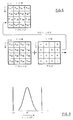
- Figure 5 illustrates the convoluting operation by applying the pattern array P to the hiding region I (1 + i, 1 + j) 21a of Figure 4 as it is.
- the positive unit value "+1,” the negative unit value "-1,” and the value “0” indicate that amount of operation "+1,” “-1,” and “0” is added to the values of corresponding hiding regions as the array position, respectively.
- the positive unit value "+1" in the pattern array P is added to four pixel values of a 11 , a 42 , a 33 , and a 24 in the hiding region I locationally corresponding to the unit value "+1.”
- the negative unit value "-1" in the pattern array P is added to four pixel values a 31 , a 22 , a 13 , and a 44 corresponding to the negative unit value "-1.”
- remain unchanged are eight pixel values a 21 , a 41 , a 12 , a 32 , a 23 , a 43 , a 14 , and a 34 corresponding to the value "0" in the pattern array P.
- Such convolution is performed on (N) number of hiding regions. This enables it to obtain a data array I' that information "inhibit copying of image data" is embedded in (N) number of hiding regions. It should be noted here that information "inhibit copying of data” is expressed by a number of hiding regions as a whole by convoluting the pattern array on these hiding regions. In other words, this means that the information "inhibit copying of data" cannot be extracted by only one hiding region to which the embedding operation is performed, details of which are described later.
- the pattern array is convoluted after its sign relationship is inverted. That is, the pattern array is applied after converting the positive unit value "+1" to the negative unit value "-1,” and vice versa.
- Application of the pattern array after it is inverted is equivalent to performing the subtraction operation as represented by the following equation.
- I' (x + i, y + j) I (x + i, y + j) - P (i, j) (x : 1,5,9, ..., 637 y : 1,5,9, ..., 477 0 ⁇ (i, j) ⁇ 3)
- the positive unit value "+1,” the negative unit value “-1,” and the value “0” indicate amount of operation "-1,” “+1” and “0” are added to that values in the hiding region locationally corresponding to the array, respectively.
- Such convolution is performed on (N) number of hiding regions. This completes to embed information "permission of copying image data (only once)" into (N) number of hiding regions.
- the feature of the present invention lies in that the information can be extracted without knowing the original data array I.
- Figure 6 shows the state of data array I' (x, y) in which what information is embedded is not known.
- Each array element a' xy may or may not be operated for its value based on the hiding rule.
- the extracting person is not necessarily to enter such information every time he or she attempts extraction. In such case, it is sufficient to enter only the data array I' into which the information is embedded for extraction.
- each hiding region is identified on the basis of the known information (b) and (c).
- the position and size of each hiding region can be identified the reference position (x, y) which is the reference position of the hiding region and an amount of offset (i, j) which indicates the size of the hiding region (see Figure 4).
- a block value F (x, y) (scalar value) is obtained by calculating the convolution between a hiding region I' (x + i, y + j) and the pattern array shown in Figure 3.
- Figure 7 illustrates the calculation of block value F (1, 1) for the hiding region I' (1 + i, 1 + j) at the upper left corner of the screen (the hiding region 21a in Figure 4).
- the block value F (1, 1) is obtained by obtaining a product of the value of each array element in the hiding region and the value of pattern array locationally corresponding to the element, and summing respective products.
- "+" indicates a positive unit value
- "-" indicates a negative unit value.
- (n) number of block values are obtained by determining such convolution for (n) number of hiding regions.
- a statistical judgment value D which is an index of information extraction is obtained by determining an average of (n) number of block values F (x, y).
- Equation 6 can be developed as follows:
- each array element in the original data array I may take various values (values in a range of 0 to 256 for pixel values).
- the sum total of the positive and negative unit values is zero, and the positive and negative unit values are uniformly distributed. Therefore, if there is no correlation between the arrangement in the original data array I (x, y) and the pattern array P (i, j), it can be expected that the statistical judgment value D which is an average of convolution of them (block values F) becomes zero. That is, since the sum total of the positive unit value "+1" and the negative unit value "-1" in the pattern array is zero, the statistical judgment value D can be converged to zero by obtaining block values F (x, y) in the number sufficient to appear statistical character, and averaging them.
- the statistical judgment value cannot converge to zero. Since. when the judgment value D converges to zero, it is judged to be a phenomenon occurring when the pattern array is not embedded, the information "Permission of copying image data (no limitation)" is extracted according to the extraction rule.
- Equation 6 for obtaining the statistical judgment value D can be developed as follows:
- the first right item becomes zero as described for the Equation 7.
- the second right item becomes a constant because it is convolution to the pattern array P itself.
- the case where the judgment value D becomes K is a unique case where the pattern array is convoluted as it is (without inverting the unit values for their positive and negative signs), so that the information "inhibit copying of image data" is extracted according to the extraction rule.
- Equation 6 for obtaining the statistical judgment value D can be developed as follows based on the Equation 4:
- the resulting statistical judgment value D becomes a value -K. Therefore, convergence of the judgment value D to the value -K is a unique case occurring when the pattern array is inverted and convoluted (that is, the unit values are inverted for their positive and negative signs), so that the information "permission of copying image data (only once)" is extracted according to the extraction rule.
- the embedded information can be identified by providing suitable thresholds between 0 and the reliability distance K and between 0 and the reliability distance -K, and comparing the calculated statistical judgment value D with the established thresholds.
- a histogram for the entire image data is produced for (N) number of block values F (x, y) calculated from (N) number of hiding regions existing in the image. That is, frequency distribution is produced for (N) number of block values. This enables it to calculate their average ⁇ 1 and standard deviation ⁇ 1.
- Each block value F (x, y) is normalized by dividing it with the number of array elements (16) in the pattern array of Figure 3. When the pixel value is within a range from 0 to 256, the normalized block value F (x, y) is distributed over a range from -64 to +64.
- the average ⁇ 1 ⁇ 0 of block value F (x, y) ⁇ 0, or it becomes zero.
- the distribution of statistical judgment value D 1/n * ⁇ F can be approximated by the average ⁇ 1 and the standard deviation ⁇ 1/ ⁇ n.
- the frequency distribution of the statistical judgment value D is as shown in Figure 8.
- the reliability distance K is established at a value sufficiently remote from the center of distribution (average) when the pattern array is not embedded, or zero, it can be said that the center of distribution (reliability distance K, -K) obtained when the pattern is embedded is a unique phenomena in term of probability.
- How much reliability distance K is established also depends of the characteristics of the image. Since a image of "a skein of birds in sunset" has different image characteristics from an image of "a tiger in forest,” it is necessary to change the reliability distance K. Therefore, it is preferable to establish the reliability distance K, measuring ⁇ , n for each image in view of its characteristics when embedding the image. If too long reliability distance K is established, it increases the amount of operation per unit hiding region so that the image quality is deteriorated. Accordingly, it is important to suitably establish a reliability distance K satisfying both the reliability for judging the embedded information and the suppression of deterioration of image quality.
- the reliability distance K is an average amount of operation per unit hiding region
- the magnitude of value to be added may be varied for each hiding region. That is, it may be allowed to add values "+2" and "-2” which is twice the positive and negative unit values to a hiding region, and to add values "+3" and "-3” which is triple those values to another hiding region.
- the magnitude of values to be added may be varied for each array element constituting the same hiding region. However, it is important in this case that the sign relationship is maintained for each unit value which the pattern array has. This is described based on Figure 5.
- deterioration of image quality can be further suppressed by varying the magnitude of value to be adaptively added. For example, smaller amount of operation is desirable for an area such as an edge of image which is visually sensitive. On the other hand, there is an are where change is visually little noticeable even if the value to be added is large. Accordingly, it is preferable to maintain the total amount of operation for all (N) number of hiding regions at constant by adaptively selecting a smaller value for a sensitive area and a larger value for a non-sensitive area.
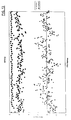
- Figure 9 is a graph showing statistical judgment values D obtained when processing is performed or not with the pattern array in a case where no signal processing is provided. It shows the statistical judgment values D obtained when the pattern array is not convoluted on an image, and when the pattern array is convoluted so that the reliability distance K exceeds at least eight.
- 100 sample images on the axis of abscissa are different images each other, and their size is 640 ⁇ 480.
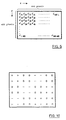
- the pattern array used is the 8 ⁇ 8 pattern shown in Figure 10. This pattern array has positive unit values of 2 ⁇ 2 size, negative unit values of 2 ⁇ 2 size, and 0s uniformly distributed.
- the statistical judgment values on the axis of ordinate are normalized using ⁇ for each image. While the statistical judgment values are concentrated near 0 when no processing is performed, they are concentrated near the reliability distance +8 when processing is performed. Thus, it is judged with a high reliability whether or not the pattern array is embedded.
- Figure 11 is a graph showing statistical judgment values obtained when JPEG compression is performed on each sample image used for Figure 9. Although the reliability distance is slightly less than +8.0 for the statistical judgment values D when processing is performed with the pattern array, it is found that the judgment values can be judged with sufficient reliability by establishing the threshold value for judging whether or not the pattern array is embedded at around +4.0.
- Figure 12 is a graph showing statistical judgment values obtained when the averaging operation is performed on each image used for Figure 9. Image detection is performed on an image which is compressed to 3/4 after an embedding operation and then expanded by 4/3. Although the reliability distance is slightly less than +8.0 for the statistical judgment values D, it is found that information can be extracted with sufficient reliability by establishing the threshold value at around +4.0.
- Figure 13 is a graph showing statistical judgment values obtained when MPEG2 operation is performed.
- the statistical judgment values are obtained by performing compression after embedding information into continuous interlace 150 frames as samples.
- One frame is 720 ⁇ 480.
- the statistical judgment value (when pattern processing is performed) obtained from B frame composed of differential information is smaller than those of I and P frames, and concentrated around +6.0, it is found that information can be extracted with sufficient reliability by establishing the threshold value at around +4.0.
- one information may be embedded in a plurality of frames. For example, 100 hiding regions are determined for one frame, and one information may be embedded in hiding regions for 10 frames (1000 hiding regions). How many hiding regions are prepared significantly depends on the size of pattern array and setting of value for the reliability distance K. When the size of pattern array is increased, the reliability distance can be assured with less amount of operation for individual pixel values. However, hiding regions should be prepared over many frames. Accordingly, it is important that a best reliability distance K is established by taking various factors into account.
- this algorithm determines in data array hiding regions in the number sufficient to appear statistical character, and performs convolution of a pattern array on them in accordance with a hiding rule, or addition operation corresponding to the value of array element.
- examination is performed on the average of convolution between the hiding regions in the obtained data array and the weight of the pattern array. Since the average varies depending on the convolution state due to the statistical character, this value enables it to detect whether or not the pattern array is convoluted including the convolution state.
- the embedded information can be identified from this value by referring to the extraction rule corresponding to the hiding rule.
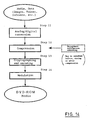
- Figure 14 is a procedure for recording data in a recording medium.
- Data such as images, audio, or software is recorded in a DVD-ROM medium according to the following procedure.
- Data that is analog data is converted into digital data through analog/digital conversion (step 11).
- the resulting digital data is compressed by using, for example, MPEG (Moving Picture Experts Group) (step 12).
- the compressed data is further coded and encrypted (step 13), and modulated (step 14) for recording on the DVD-ROM medium.
- MPEG Motion Picture Experts Group
- the data is recorded in the DVD-ROM before, during or after control information is compressed.
- the control information is for restricting access to data stored in the DVD-ROM when a system accesses such data.
- the system is controlled under this control information.
- this system comprises first storage for storing a data array, and a second storage for storing a pattern array, the pattern array consisting of a plurality of array elements, the pattern array having at least a positive unit value and a negative unit value, the sum total of the positive and negative unit values being zero.
- this system further comprises a unit for specifying in the data array (N) number of hiding regions into which certain information is embedded, each region having a size corresponding to that of the pattern array.
- an operation unit for determining an amount of operation for each of the array elements according to the locationally corresponding positive or negative unit value with respect to one of the specified (N) number of hiding regions, by referring to a hiding rule providing the correspondence between the information and an application of the pattern array to the hiding region, and for adding the determined amount of operation to each of the array elements with respect to the hiding region.
- Such system enables it to embed certain information into the (N) number of hiding regions.
- the control information is embedded in this manner.
- the data recorded in the DVD-ROM is accessed according to the following procedure. First, data is read from the DVD-ROM.
- the read out data is, as described in conjunction with Figure 1, a signal obtained by MPEG compressing (step 11), coding and encrypting (step 12), and then modulating (step 14) data embedded with the control.
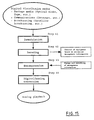
- Figure 15 is a procedure for controlling accessing to data.
- data embedded with information is supplied to an access system.
- the source of data is, for example, a recording medium such as a DVD-ROM or CD-R, communication such as internet, or satellite broadcasting.
- the supplied data is demodulated (step 41), and decoded (step 42). If the data is MPEG compressed, it is decompressed (step 43). Control information embedded in the data is extracted, and modified for its content, if required, and only necessary modification is embedded into the data again.
- a circuit for extracting control information from the data input in the recorder comprises:
- a hiding region embedded with the control information is specified from the read out data. Then, the control information is extracted according to the state of hiding region by referring to the extraction rule correlating the state of hiding region with the content of data to be extracted.
- FIG 16 is a block diagram of a playback system for data stored in a DVD-ROM.
- a DVD-ROM 51 loaded in a data supply section 61 stores data embedded with control information using the data hiding technology as described above.
- the data is read by a reader 52 in the data supply section 61, and processed by a demodulator 53, a decryption unit 54, and an MPEG decoder 55, all of which constitute a signal processing system 62.
- decompressed digital data is obtained.
- a control information extractor 56 identifies a hiding region embedded with the control information from the decompressed digital data that is the output of the MPEG decoder 55 (or, directly from MPEG data), and extracts the control information according to the state of hiding region by referring to the extraction rule correlating the state of hiding region with the content of data to be extracted. (It should be noted here that the control information can be extracted before or after MPEG decompression.)
- a D/A converter 57 in the signal processing system 62 analog converts the digitized data from which the control information is removed, and outputs an analog playback signal (for example, NTSC).
- an interference signal generated by an interference signal generator 60 (for example, APS or Analogue Protection System of Macrovision Signal or the like) is selectively superimposed on the analog playback signal by a switch 59 in an output section 63.
- the switch 59 is controlled by a control signal from a control information extractor 56.
- the output section 63 outputs the analog playback signal or a superimposed signal as an analog output signal.
- control information extractor 56 when the control information extracted by the control information extractor 56 permits duplication of data, the control information extractor 56 outputs a control signal turning off the switch 59. In this case, the interference signal is not superimposed on the analog playback signal, and the analog playback signal is output as is.
- the control information extractor 56 outputs a control signal turning on the switch 59.
- the output is a signal that is an analog signal from the D/A converter 57 superimposed with an interference signal generated by the interference signal generator 60.
- additional information may be employed for more finely controlling copying (duplication) and playback. This enables it to easily attain flexible control for the type of recording/playback medium (ROM, RAM, or R type).
- control information described above is not limited to information for restricting duplication, but may be applied to various control information for controlling a system.
- it can be appropriately used for other control including restriction on access equipment, restriction of access users, available period of data, authentication information, without departing from the present invention as defined in the claims.
- the present invention enables it to extract embedded information without providing original data as information, and to extract the information with relatively low calculation cost because no complicated operations such as frequency conversion is required.
Landscapes
- Engineering & Computer Science (AREA)
- Multimedia (AREA)
- Signal Processing (AREA)
- General Physics & Mathematics (AREA)
- Theoretical Computer Science (AREA)
- Physics & Mathematics (AREA)
- Editing Of Facsimile Originals (AREA)
- Image Processing (AREA)
- Storage Device Security (AREA)
- Television Systems (AREA)
- Signal Processing For Digital Recording And Reproducing (AREA)
- Complex Calculations (AREA)
- Measurement And Recording Of Electrical Phenomena And Electrical Characteristics Of The Living Body (AREA)
- Spectrometry And Color Measurement (AREA)
- Radar Systems Or Details Thereof (AREA)
Applications Claiming Priority (6)
| Application Number | Priority Date | Filing Date | Title |
|---|---|---|---|
| JP34556896 | 1996-12-25 | ||
| JP34556896 | 1996-12-25 | ||
| JP345568/96 | 1996-12-25 | ||
| JP23968397A JP3269014B2 (ja) | 1996-12-25 | 1997-09-04 | 統計的性質を用いたデータ・ハイディング方法及びシステム |
| JP23968397 | 1997-09-04 | ||
| JP239683/97 | 1997-09-04 |
Publications (3)
| Publication Number | Publication Date |
|---|---|
| EP0851391A2 true EP0851391A2 (de) | 1998-07-01 |
| EP0851391A3 EP0851391A3 (de) | 1999-12-01 |
| EP0851391B1 EP0851391B1 (de) | 2003-03-26 |
Family
ID=26534370
Family Applications (1)
| Application Number | Title | Priority Date | Filing Date |
|---|---|---|---|
| EP97309938A Expired - Lifetime EP0851391B1 (de) | 1996-12-25 | 1997-12-10 | Verfahren und System zur Extrahierung und Verstecken von Daten |
Country Status (8)
| Country | Link |
|---|---|
| EP (1) | EP0851391B1 (de) |
| JP (1) | JP3269014B2 (de) |
| KR (1) | KR100267822B1 (de) |
| CN (1) | CN1109993C (de) |
| AT (1) | ATE235722T1 (de) |
| DE (1) | DE69720167T2 (de) |
| MY (1) | MY117498A (de) |
| SG (1) | SG80581A1 (de) |
Cited By (5)
| Publication number | Priority date | Publication date | Assignee | Title |
|---|---|---|---|---|
| US6249870B1 (en) * | 1996-12-26 | 2001-06-19 | International Business Machines Corporation | Data hiding method and data extraction method using statistical examination |
| GB2392335A (en) * | 2002-08-23 | 2004-02-25 | Fuji Xerox Co Ltd | Method of embedding information into image data using two generated patterns |
| US10440368B2 (en) | 2014-04-01 | 2019-10-08 | Huawei Technologies Co., Ltd. | Methods and apparatus for data hiding in multi-layer structured coding units |
| US10798390B2 (en) | 2016-02-12 | 2020-10-06 | Huawei Technologies Co., Ltd. | Method and apparatus for scan order selection |
| US11582455B2 (en) | 2016-02-12 | 2023-02-14 | Huawei Technologies Co., Ltd. | Method and apparatus for scan order selection |
Families Citing this family (3)
| Publication number | Priority date | Publication date | Assignee | Title |
|---|---|---|---|---|
| JP3098513B1 (ja) | 1999-04-14 | 2000-10-16 | インターナショナル・ビジネス・マシーンズ・コーポレ−ション | 改変判定装置およびその方法 |
| CN1317679C (zh) * | 2004-11-03 | 2007-05-23 | 上海大学 | 基于灰度调整的无损信息隐藏方法 |
| CN109478381B (zh) * | 2016-07-06 | 2021-12-14 | 日本电信电话株式会社 | 秘密计算系统、秘密计算装置、秘密计算方法以及程序 |
Family Cites Families (3)
| Publication number | Priority date | Publication date | Assignee | Title |
|---|---|---|---|---|
| GB8824969D0 (en) * | 1988-10-25 | 1988-11-30 | Emi Plc Thorn | Identification codes |
| US5319735A (en) * | 1991-12-17 | 1994-06-07 | Bolt Beranek And Newman Inc. | Embedded signalling |
| JP3181440B2 (ja) * | 1993-07-30 | 2001-07-03 | 松下通信工業株式会社 | Cdma方式通信装置 |
-
1997
- 1997-09-04 JP JP23968397A patent/JP3269014B2/ja not_active Expired - Fee Related
- 1997-11-14 KR KR1019970060002A patent/KR100267822B1/ko not_active Expired - Fee Related
- 1997-12-09 MY MYPI97005923A patent/MY117498A/en unknown
- 1997-12-10 SG SG9704392A patent/SG80581A1/en unknown
- 1997-12-10 AT AT97309938T patent/ATE235722T1/de not_active IP Right Cessation
- 1997-12-10 EP EP97309938A patent/EP0851391B1/de not_active Expired - Lifetime
- 1997-12-10 DE DE69720167T patent/DE69720167T2/de not_active Expired - Lifetime
- 1997-12-10 CN CN97125381.1A patent/CN1109993C/zh not_active Expired - Fee Related
Non-Patent Citations (2)
| Title |
|---|
| SWANSON ET AL: "Transparent Robust Image Watermarking" PROCEEDINGS OF THE SINGAPORE INTERNATIONAL CONFERENCE ON IMAGE PROCESSING, vol. 3, no. 3, 16 September 1996 (1996-09-16), pages 211-214 214, XP002097961 * |
| VOYATZIS G ET AL: "APPLICATIONS OF TORAL AUTOMORPHISMS IN IMAGE WATERMARKING" PROCEEDINGS OF THE INTERNATIONAL CONFERENCE ON IMAGE PROCESSING (IC, LAUSANNE, SEPT. 16 - 19, 1996, vol. 2, 16 September 1996 (1996-09-16), pages 237-240, XP000199956 INSTITUTE OF ELECTRICAL AND ELECTRONICS ENGINEERS ISBN: 0-7803-3259-8 * |
Cited By (7)
| Publication number | Priority date | Publication date | Assignee | Title |
|---|---|---|---|---|
| US6249870B1 (en) * | 1996-12-26 | 2001-06-19 | International Business Machines Corporation | Data hiding method and data extraction method using statistical examination |
| GB2392335A (en) * | 2002-08-23 | 2004-02-25 | Fuji Xerox Co Ltd | Method of embedding information into image data using two generated patterns |
| GB2392335B (en) * | 2002-08-23 | 2005-11-02 | Fuji Xerox Co Ltd | Image processing apparatus, image processing method, and storage medium of image processing program |
| US7277557B2 (en) | 2002-08-23 | 2007-10-02 | Fuji Xerox Co., Ltd. | Image processing apparatus, image processing method, and storage medium of image processing program |
| US10440368B2 (en) | 2014-04-01 | 2019-10-08 | Huawei Technologies Co., Ltd. | Methods and apparatus for data hiding in multi-layer structured coding units |
| US10798390B2 (en) | 2016-02-12 | 2020-10-06 | Huawei Technologies Co., Ltd. | Method and apparatus for scan order selection |
| US11582455B2 (en) | 2016-02-12 | 2023-02-14 | Huawei Technologies Co., Ltd. | Method and apparatus for scan order selection |
Also Published As
| Publication number | Publication date |
|---|---|
| MY117498A (en) | 2004-07-31 |
| KR100267822B1 (ko) | 2000-10-16 |
| EP0851391B1 (de) | 2003-03-26 |
| JP3269014B2 (ja) | 2002-03-25 |
| SG80581A1 (en) | 2001-05-22 |
| ATE235722T1 (de) | 2003-04-15 |
| CN1109993C (zh) | 2003-05-28 |
| EP0851391A3 (de) | 1999-12-01 |
| DE69720167D1 (de) | 2003-04-30 |
| KR19980063583A (ko) | 1998-10-07 |
| CN1197243A (zh) | 1998-10-28 |
| JPH10240626A (ja) | 1998-09-11 |
| DE69720167T2 (de) | 2004-02-19 |
Similar Documents
| Publication | Publication Date | Title |
|---|---|---|
| US6359985B1 (en) | Procedure for marking binary coded data sets | |
| Lin et al. | Improving the robustness of DCT-based image watermarking against JPEG compression | |
| JP3349910B2 (ja) | 画像データエンコードシステム | |
| CA2227381C (en) | Image data encoding system and image inputting apparatus | |
| Hsu et al. | DCT-based watermarking for video | |
| US7269734B1 (en) | Invisible digital watermarks | |
| Swanson et al. | Multimedia data-embedding and watermarking technologies | |
| JP3214555B2 (ja) | 電子透かし挿入装置 | |
| US7620253B2 (en) | Steganographic systems and methods | |
| US6304966B1 (en) | Data hiding method and system using statistical properties | |
| AU741281B2 (en) | Method and apparatus for selective block processing | |
| CA2260094C (en) | A method for inserting and detecting electronic watermark data into a digital image and a device for the same | |
| US9639910B2 (en) | System for embedding data | |
| US20020097891A1 (en) | Electronic watermarking data insertion/detection device | |
| Cetin et al. | A new steganography algorithm based on color histograms for data embedding into raw video streams | |
| Shejul et al. | A DWT based approach for steganography using biometrics | |
| Cheddad et al. | Enhancing steganography in digital images | |
| JP3353691B2 (ja) | デジタルデータのエンコードシステム及び電子透かしデータ挿入方法並びに制御プログラムを格納した記憶媒体 | |
| EP0851391B1 (de) | Verfahren und System zur Extrahierung und Verstecken von Daten | |
| JPH10313402A (ja) | 画像データのエンコードシステム及び画像入力装置 | |
| KR100500144B1 (ko) | 디지털 영상 인증을 위한 디지털 워터마크의 삽입 및추출방법 | |
| Guan et al. | An objective comparison between spatial and DCT watermarking schemes for MPEG video | |
| KR100343604B1 (ko) | 셔플링을 이용한 객체 기반 디지털 워터마크 삽입 방법 | |
| KR100356201B1 (ko) | 에치에스아이 컬러 공간에서 저작권 보호를 위한 워터마킹및 인증 기법과 인증 기법이 적용된 컬러 동영상에서디지털 워터마크를 추출하는 추출방법 | |
| Aboalsamh et al. | Steganalysis of JPEG images: an improved approach for breaking the F5 algorithm |
Legal Events
| Date | Code | Title | Description |
|---|---|---|---|
| PUAI | Public reference made under article 153(3) epc to a published international application that has entered the european phase |
Free format text: ORIGINAL CODE: 0009012 |
|
| AK | Designated contracting states |
Kind code of ref document: A2 Designated state(s): AT BE CH DE ES FR GB IT LI NL SE |
|
| AX | Request for extension of the european patent |
Free format text: AL;LT;LV;MK;RO;SI |
|
| PUAL | Search report despatched |
Free format text: ORIGINAL CODE: 0009013 |
|
| AK | Designated contracting states |
Kind code of ref document: A3 Designated state(s): AT BE CH DE DK ES FI FR GB GR IE IT LI LU MC NL PT SE |
|
| AX | Request for extension of the european patent |
Free format text: AL;LT;LV;MK;RO;SI |
|
| 17P | Request for examination filed |
Effective date: 20000509 |
|
| AKX | Designation fees paid |
Free format text: AT BE CH DE ES FR GB IT LI NL SE |
|
| GRAH | Despatch of communication of intention to grant a patent |
Free format text: ORIGINAL CODE: EPIDOS IGRA |
|
| GRAH | Despatch of communication of intention to grant a patent |
Free format text: ORIGINAL CODE: EPIDOS IGRA |
|
| GRAA | (expected) grant |
Free format text: ORIGINAL CODE: 0009210 |
|
| AK | Designated contracting states |
Designated state(s): AT BE CH DE ES FR GB IT LI NL SE |
|
| PG25 | Lapsed in a contracting state [announced via postgrant information from national office to epo] |
Ref country code: NL Free format text: LAPSE BECAUSE OF FAILURE TO SUBMIT A TRANSLATION OF THE DESCRIPTION OR TO PAY THE FEE WITHIN THE PRESCRIBED TIME-LIMIT Effective date: 20030326 Ref country code: LI Free format text: LAPSE BECAUSE OF FAILURE TO SUBMIT A TRANSLATION OF THE DESCRIPTION OR TO PAY THE FEE WITHIN THE PRESCRIBED TIME-LIMIT Effective date: 20030326 Ref country code: CH Free format text: LAPSE BECAUSE OF FAILURE TO SUBMIT A TRANSLATION OF THE DESCRIPTION OR TO PAY THE FEE WITHIN THE PRESCRIBED TIME-LIMIT Effective date: 20030326 Ref country code: AT Free format text: LAPSE BECAUSE OF FAILURE TO SUBMIT A TRANSLATION OF THE DESCRIPTION OR TO PAY THE FEE WITHIN THE PRESCRIBED TIME-LIMIT Effective date: 20030326 |
|
| REG | Reference to a national code |
Ref country code: GB Ref legal event code: FG4D |
|
| REG | Reference to a national code |
Ref country code: CH Ref legal event code: NV Representative=s name: JULIAN DAVID WILLIAMS C/O INTERNATIONAL BUSINESS M Ref country code: CH Ref legal event code: EP |
|
| REF | Corresponds to: |
Ref document number: 69720167 Country of ref document: DE Date of ref document: 20030430 Kind code of ref document: P |
|
| PG25 | Lapsed in a contracting state [announced via postgrant information from national office to epo] |
Ref country code: SE Free format text: LAPSE BECAUSE OF FAILURE TO SUBMIT A TRANSLATION OF THE DESCRIPTION OR TO PAY THE FEE WITHIN THE PRESCRIBED TIME-LIMIT Effective date: 20030626 |
|
| NLV1 | Nl: lapsed or annulled due to failure to fulfill the requirements of art. 29p and 29m of the patents act | ||
| PG25 | Lapsed in a contracting state [announced via postgrant information from national office to epo] |
Ref country code: ES Free format text: LAPSE BECAUSE OF FAILURE TO SUBMIT A TRANSLATION OF THE DESCRIPTION OR TO PAY THE FEE WITHIN THE PRESCRIBED TIME-LIMIT Effective date: 20030930 |
|
| ET | Fr: translation filed | ||
| REG | Reference to a national code |
Ref country code: CH Ref legal event code: PL |
|
| PLBE | No opposition filed within time limit |
Free format text: ORIGINAL CODE: 0009261 |
|
| STAA | Information on the status of an ep patent application or granted ep patent |
Free format text: STATUS: NO OPPOSITION FILED WITHIN TIME LIMIT |
|
| 26N | No opposition filed |
Effective date: 20031230 |
|
| PGFP | Annual fee paid to national office [announced via postgrant information from national office to epo] |
Ref country code: IT Payment date: 20071213 Year of fee payment: 11 |
|
| PGFP | Annual fee paid to national office [announced via postgrant information from national office to epo] |
Ref country code: BE Payment date: 20071211 Year of fee payment: 11 |
|
| REG | Reference to a national code |
Ref country code: GB Ref legal event code: 746 Effective date: 20081125 |
|
| BERE | Be: lapsed |
Owner name: *INTERNATIONAL BUSINESS MACHINES CORP. Effective date: 20081231 |
|
| PG25 | Lapsed in a contracting state [announced via postgrant information from national office to epo] |
Ref country code: BE Free format text: LAPSE BECAUSE OF NON-PAYMENT OF DUE FEES Effective date: 20081231 |
|
| PGFP | Annual fee paid to national office [announced via postgrant information from national office to epo] |
Ref country code: FR Payment date: 20101221 Year of fee payment: 14 |
|
| PGFP | Annual fee paid to national office [announced via postgrant information from national office to epo] |
Ref country code: GB Payment date: 20101216 Year of fee payment: 14 |
|
| PGFP | Annual fee paid to national office [announced via postgrant information from national office to epo] |
Ref country code: DE Payment date: 20101223 Year of fee payment: 14 |
|
| GBPC | Gb: european patent ceased through non-payment of renewal fee |
Effective date: 20111210 |
|
| REG | Reference to a national code |
Ref country code: FR Ref legal event code: ST Effective date: 20120831 |
|
| REG | Reference to a national code |
Ref country code: DE Ref legal event code: R119 Ref document number: 69720167 Country of ref document: DE Effective date: 20120703 |
|
| PG25 | Lapsed in a contracting state [announced via postgrant information from national office to epo] |
Ref country code: DE Free format text: LAPSE BECAUSE OF NON-PAYMENT OF DUE FEES Effective date: 20120703 Ref country code: GB Free format text: LAPSE BECAUSE OF NON-PAYMENT OF DUE FEES Effective date: 20111210 |
|
| PG25 | Lapsed in a contracting state [announced via postgrant information from national office to epo] |
Ref country code: FR Free format text: LAPSE BECAUSE OF NON-PAYMENT OF DUE FEES Effective date: 20120102 |
|
| PG25 | Lapsed in a contracting state [announced via postgrant information from national office to epo] |
Ref country code: IT Free format text: LAPSE BECAUSE OF NON-PAYMENT OF DUE FEES Effective date: 20081210 |