EP0851633A2 - System und Verfahren zur Weiterreichen in einem schnurloses LAN durch Datenpufferung in dem anschliessenden Zugriffspunkt - Google Patents
System und Verfahren zur Weiterreichen in einem schnurloses LAN durch Datenpufferung in dem anschliessenden Zugriffspunkt Download PDFInfo
- Publication number
- EP0851633A2 EP0851633A2 EP97310182A EP97310182A EP0851633A2 EP 0851633 A2 EP0851633 A2 EP 0851633A2 EP 97310182 A EP97310182 A EP 97310182A EP 97310182 A EP97310182 A EP 97310182A EP 0851633 A2 EP0851633 A2 EP 0851633A2
- Authority
- EP
- European Patent Office
- Prior art keywords
- access point
- mobile station
- message
- handover
- recited
- Prior art date
- Legal status (The legal status is an assumption and is not a legal conclusion. Google has not performed a legal analysis and makes no representation as to the accuracy of the status listed.)
- Withdrawn
Links
Images

Classifications
-
- H—ELECTRICITY
- H04—ELECTRIC COMMUNICATION TECHNIQUE
- H04W—WIRELESS COMMUNICATION NETWORKS
- H04W36/00—Hand-off or reselection arrangements
- H04W36/02—Buffering or recovering information during reselection ; Modification of the traffic flow during hand-off
-
- H—ELECTRICITY
- H04—ELECTRIC COMMUNICATION TECHNIQUE
- H04W—WIRELESS COMMUNICATION NETWORKS
- H04W36/00—Hand-off or reselection arrangements
- H04W36/0005—Control or signalling for completing the hand-off
- H04W36/0011—Control or signalling for completing the hand-off for data sessions of end-to-end connection
- H04W36/0033—Control or signalling for completing the hand-off for data sessions of end-to-end connection with transfer of context information
-
- H—ELECTRICITY
- H04—ELECTRIC COMMUNICATION TECHNIQUE
- H04W—WIRELESS COMMUNICATION NETWORKS
- H04W36/00—Hand-off or reselection arrangements
- H04W36/08—Reselecting an access point
- H04W36/083—Reselecting an access point wherein at least one of the access points is a moving node
-
- H—ELECTRICITY
- H04—ELECTRIC COMMUNICATION TECHNIQUE
- H04W—WIRELESS COMMUNICATION NETWORKS
- H04W84/00—Network topologies
- H04W84/02—Hierarchically pre-organised networks, e.g. paging networks, cellular networks, WLAN [Wireless Local Area Network] or WLL [Wireless Local Loop]
- H04W84/10—Small scale networks; Flat hierarchical networks
- H04W84/12—WLAN [Wireless Local Area Networks]
Definitions
- the present invention is directed, in general, to a wireless computer network and, more specifically, to a system and method for achieving handover in a wireless local area network ("LAN") by buffering. data at a subsequent access point thereto.
- LAN wireless local area network
- LANs Computer systems configured as LANS have been common for nearly two decades and are popular in a wide variety of business and educational applications.
- the most common LANs comprise a number of processing devices and a server that are coupled together by a hard-wired connection. Since about 1990, however, wireless LANs have become more common in the marketplace. Although the concept behind wireless LANS had been described a decade earlier, interest in LAN networks was limited until the release of the 2.4 GHz unlicensed band for industrial, scientific and medical (“ISM”) applications.
- Wireless LAN products most often employ either direct sequence spread spectrum (“DSSS”) or frequency-hopping spread spectrum (“FHSS”) techniques to communicate between roaming mobile stations and network access points.
- DSSS direct sequence spread spectrum
- FHSS frequency-hopping spread spectrum
- the "backbone" of the LAN takes the form of one or more central servers that communicate with a number of network base stations, or access points ("APs"), through a hard-wired connection.
- the LAN backbone may actually comprise several LAN segments interconnected by transparent bridges.
- Each base station, or access point (AP) includes a transceiver for communicating with at least one roaming mobile station ("MS").
- MS roaming mobile station
- the mobile station may be a point-of-sale terminal (e . g ., an electronic cash register), a bar code reader or other scanning device, or a notepad, desktop or laptop computer.
- Each MS establishes a communication link with an AP by scanning the ISM band to find an available AP.
- the MS interacts with other mobile stations, a server or both. This allows the user of the MS to move freely in the office, factory, hospital or other facility where the wireless LAN is based, without the length of a hard-wired connection to the LAN limiting the MS.
- the MS will move out of the range, or coverage area, of its current AP, usually into the coverage area of a second AP.
- the MS senses that the communication link with the current AP is unacceptably weak
- the MS initiates a "handover" that breakdowns the communication link with the current AP and establishes a new communication link with the second AP.
- the MS instructs the current AP to buffer messages while the MS scans for a new AP.
- the MS sends a command to the current AP to send the buffered messages to the new AP through the LAN backbone.
- the MS then configures its transceiver to the frequency of the new AP, requests that any messages buffered by either AP be delivered to it, and transmits any outgoing messages buffered by the MS to the new AP.
- a common problem in such wireless LAN systems is the "cleanup" involved after the handover has been performed. It is inherently difficult to guarantee that the buffered messages that are transmitted from the old AP to the new AP via the backbone network will be delivered in the same sequence in which the buffered messages were received by the old AP.
- the present invention provides a system, associated with a first access point of a wireless LAN, for achieving handover of a mobile station from the first access point to a second access point of the wireless LAN.
- the present invention also provides a method of operating the first access point to achieve handover and a wireless computer network.
- the system includes: (1) a wireless transceiver circuit that receives a handover imminent message from the mobile station indicating that the mobile station is about to dissociate from the first access point and associate with the second access point and (2) a network interface that transmits a handover preparation message, including an identifier relating to the mobile station, across the backbone of the LAN that causes the second access point to begin to receive and buffer messages destined for the mobile station, the mobile station subsequently dissociating from the first access point and associating with the second access point to achieve the handover.
- the present invention therefore introduces the broad concept of buffering the messages destined for the mobile station in the second access point (temporally speaking, the "subsequent access point"), rather than in the first access point (also temporally speaking, the "current access point”). Because the messages are so buffered in the second access point, they are properly ordered so that the mobile station is not required to buffer and reorder messages to the extent required in the prior art.
- the present invention therefore allows smoother handover as roamable (literally, "able to roam") mobile stations handover from access point to access point as a function of their ever-changing location.
- the transceiver transmits buffered messages to the mobile station following transmission of the handover preparation message.
- the first access point continues to receive messages from the LAN that are destined for the mobile station until it receives an acknowledgment from the second access point that the second access point has begun to receive and buffer messages.
- the first access point is given an opportunity to empty its buffer to the mobile station before the mobile station dissociates from it.
- the second access point initiates the process by transmitting a "handover prepared" message to the first access point via the LAN, the handover prepared message causing the LAN to redirect messages destined for the mobile station from the first access point to the second access point.
- the handover prepared message ideally accomplishes two objectives. First, as the handover prepared message is routed through the LAN, it causes nodes therein (such as bridges, routers, repeaters and the like) to update their respective bridge filter tables to redirect messages to the second access point. This may be accomplished by using the MAC address of the mobile station as the source address in the handover prepared message, which causes an automatic update of the bridge filter tables. Second, the handover prepared message serves as an acknowledgment to the first access point that the second access point has already begun receiving and buffering messages destined for the mobile station. This frees the first mobile station to dissociate the mobile station therefrom.
- nodes therein such as bridges, routers, repeaters and the like
- the LAN comprises at least one bridge containing a bridge filter table, the second access point initiating the process by causing the bridge to update an entry in the bridge filter table corresponding to the identifier.
- bridges and other LAN nodes are conventionally capable of automatically updating their associated bridge filter tables by virtue of an embedded learning function.
- the present invention can make use of this existing function by causing the second access point to transmit an appropriate message through the LAN.
- the transceiver circuit receives messages from the mobile station destined for the LAN after the network interface transmits the handover preparation message.
- the mobile station does not dissociate from the first access point until the second access point has begun receiving and buffering messages destined for the mobile station. Accordingly, until dissociation occurs, the first access point continues to receive messages from, and transmit messages to, the mobile station.
- the transceiver transmits a dissociate message to the mobile station to cause the mobile station to dissociate from the first access point.
- the dissociate message triggers the mobile station to switch frequencies to that of the second access point, thereby causing the mobile station to reassociate and achieve handover.
- the second access point transmits the received and buffered messages to the mobile station after the mobile station associates with the second access point. This allows the mobile station to "catch up" on messages that accrued in the second mobile station while handover was occurring. Because the mobile station preferably receives messages buffered in the second access point after it does messages buffered in the first access point, the order in which the mobile station receives the messages more closely approximates the original order of their transmission. This can significantly reduce the amount of message buffering and reordering that the mobile station would otherwise be required to undertake to reconstruct the proper message order.
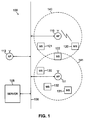
- Server 105 of wireless network 100 communicates bi-directionally with access points 110-112 via bus 106, which is typically a hard-wired connection. In other embodiments, server 105 may communicate with one or more of access points 110-112 by wireless link. AP 110-112 also communicate with one or more mobile stations (MS) 120-122 and 130-132 by wireless link. Each access point can transmit data to and receive data from mobile stations that are within the specified broadcast range of the access point. For example, AP 110 and AP 111 have broadcast ranges 140 and 141, respectively. AP 110 can communicate with MS 120, MS 121 and MS 122 and AP 111 can communicate with MS 130, MS 131, MS 132 and MS 122.
- MS mobile stations
- the exemplary broadcast coverage areas of AP 110 and AP 111 are circular in shape, it is possible for the broadcast area of an access point to assume other shapes, including hexagonal.
- the shape and size of the coverage area of an access point is frequently determined by obstructions that prevent the transmission of signals between the access point and a mobile station.
- network 100 may be a wireless LAN in an office building.
- Mobile stations 120-122 and 130-132 are typically desktop and/or notebook computers that communicate with a document server, such as server 105, or run payroll or spreadsheet applications in connection with a server.
- network 100 may be a wireless LAN used to run the operations of a warehouse facility or manufacturing plant. Employees roaming the warehouse or factory floor, or even moving outside the facility, could communicate with a central server using a wide variety of mobile stations. For example, employees could use bar code scanners to send and receive data to/from server 105 through AP 110-112. Other employees may roam a facility using notepad devices to update inventory in server 105.
- network 100 may be a wireless LAN in a large department store and mobile stations 120-122 and 130-132 may be electronic cash registers and/or bar code readers.
- the backbone of wireless computer network 100 may be comprised of two or more LAN segments joined by transparent bridges, or Medium Access Control (MAC) level bridges, in accordance with IEEE Standard 802.1(d) and (e).
- the transparent bridges and access points in a wireless computer network maintain dynamic filter tables that identify the mobile stations in the network and the specific access point that interfaces with each mobile station.
- the source address of each message received at an interface of the bridge or access point is used to update the dynamic filtering database of each access point or bridge that receives and forwards each message to its ultimate destination.
- MS 122 As mobile stations 120-122 and 130-132 move about in the wireless LAN environment, the mobile stations will enter and leave the coverage areas of different access points. For example, as MS 122 moves from AP 110 towards AP 111, MS 122 will move out of the coverage range of its current access point, AP 110, and into the coverage range of a new access point, AP 111. At some point in its movement, MS 122 determines that the signal quality of the link with current AP 110 has degraded below (or at least close to) an acceptable threshold level. When this occurs, MS 110 begins scanning for another AP in order to set up a "handover".
- the handover causes the communication link with a current access point to be broken down and a new link to be established with a future access point. Ideally, the handover appears seamless to the user of the roaming mobile station.
- the present invention avoids the previously mentioned problems in the prior art associated with ensuring "in-sequence" delivery of messages after a handover by shifting the message buffering function from the old (current) AP to the new AP prior to the handover procedure.
- the routing functions of MAC-level bridges in the LAN backbone are updated to indicate that messages destined for the mobile station are to be routed to the future access point before the roaming mobile station actually initiates handover to the new access point.
- the future access point will start receiving and buffering messages for the roaming mobile station before the mobile station does a re-association with the future access point.
- the present invention accomplishes this by sending a HANDOVER PREPARED message across the intermediate bridges of the LAN.
- This HANDOVER PREPARED message is transmitted from the future access point to the current access point, but uses the MAC address of the mobile station as the source of the HANDOVER PREPARED message (rather than the source address of the access point). This tricks the intermediate bridges into automatically updating their filter tables to reflect that the mobile station is associated with the new (future) access point. In fact, the mobile station is still associated with the old (current) access point.
- the present invention implements the improved handover procedure according to the method outlined below.
- roaming mobile station MS 122 is moving away from its current access point, AP 110, and is about to initiate a scanning process to find another (future) access point with a stronger signal and a relatively low workload.
- the future access point will be AP 111.
- the method is as follows:
- MS 122 has successfully switched from its old access point, AP 110, to a new access point, AP 111.
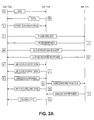
- FIGURE 2 illustrates a message protocol exchange diagram in accordance with IEEE Standard 802.1 for performing a handover from a first access point to a second access point in accordance with the method outlined above.
- the message numbers within boxes indicate the sequence of data messages and the point at which each message originates (i.e., MS 122, AP 110, AP 111).
- Messages 1A and 1B represent ongoing data transfers between MS 122 and AP 110.
- MS 122 continually monitors the quality of the communication link with AP 110. When the link quality degrades below a predetermined threshold, MS 122 enters a scanning process to find a better access point.
- MS 122 initiates the scanning process by instructing AP 110 to buffer messages during the scanning process via a START SCAN BUFFERING message (Message 2). At the same time, MS 122 begins buffering its own outbound messages.
- MS 122 transmits a PROBE REQUEST (Message 3), to measure-the link quality of other access points, including access points operating in another frequency channel.
- AP 111 (and possibly other access points) responds by transmitting a PROBE RESPONSE (Message 4) back to MS 122.
- MS 122 determines that the link quality with AP 111 is the best available and further determines that a handover will be performed from AP 110 to AP 111.
- MS 122 sends an AUTHENTICATION REQUEST to AP 111 (Message 5A).
- AP 111 responds by sending an AUTHENTICATION RESPONSE (Message 5B) to indicate that it will accept MS 122 after the handover.
- MS 122 retrieves any buffered messages from AP 110. To do this, MS 122 sets its transceiver back to the frequency of AP 110 and transmits any outbound buffered messages to AP 110 (Message 6). This step is optional, MS 122 may instead continue to buffer the messages and transmit them to AP 111 after the handover.
- AP 110 receives a data message from MS 122, AP 110 determines that MS 122 has returned from scanning and transmits the messages that AP 110 had stored in the scan buffer to MS 122 (Message 7).
- MS 122 reactivates its outbound buffering function and sends a HANDOVER IMMINENT to AP 110 (Message 8), which includes the address of AP 111.
- AP 110 continues to send buffered messages to MS 122 (Message 10), as well as any newly arrived messages destined for MS 122.
- AP 110 sends a HANDOVER PREPARATION to AP 111 (Message 9), which causes AP 111 to start a handover buffering function.
- AP 111 responds by sending a HANDOVER PREPARED message to AP 110 (Message 11), which includes the MAC level address of MS 122 as the source address.
- all LAN bridges will be tricked into believing that MS 122 is already communicating through AP 111.
- all future messages destined for MS 122 will be sent to AP 111.
- AP 111 transmits a standard DISASSOCIATE message to MS 122 (Message 12).
- MS 122 reconfigures its transmitter back to the frequency channel of AP 111 and transmits a (RE)ASSOCIATE REQUEST to AP 111 (Message 13).
- AP 111 which buffered messages in anticipation of a handover, sends a (RE)ASSOCIATE RESPONSE (Message 14).
- AP 111 and MS 122 release data buffered during the handover (Messages 15 and 16).
- the above-described method and apparatus uses the HANDOVER PREPARED message from AP 111 to AP 110 to update the bridge filter tables.
- the embedded learning function of the bridges and access points may be modified to look at the destination, as well as the source, of a message in order to trigger an update of the contents of the filter tables.
- AP 110 could transmit the HANDOVER PREPARATION message to AP 111 using the address of MS 122 as the ultimate destination of the message.
- AP 111 having been alerted already by the AUTHENTICATION REQUEST/AUTHENTICATION RESPONSE exchange about the imminent handover of MS 122, accepts the HANDOVER PREPARATION message (even though it is not yet associated with MS 122) and begins to buffer other messages intended for AP 122. Thereafter, MS 122 and AP 110 release buffered messages to each other and perform a dissociation, as before.
- the bridge filter tables of the wireless network may be updated using, for example, the AUTHENTICATION RESPONSE message.
- AP 111 After AP 111 has received an AUTHENTICATION REQUEST message from MS 122, AP 111 is aware that a handover of MS 122 to AP 111 is imminent. AP 111 may therefore send the AUTHENTICATION RESPONSE message back to MS 122 using the address of MS 122 as the source of the message. This will trigger an updating of the bridge filter tables as before.
- the embedded learning function of the bridges and access points may be triggered to update the contents of the filter tables by special purpose messages whose function is chiefly, or solely, to switch message buffering to future access points in anticipation of a handover.
Landscapes
- Engineering & Computer Science (AREA)
- Computer Networks & Wireless Communication (AREA)
- Signal Processing (AREA)
- Mobile Radio Communication Systems (AREA)
- Computer And Data Communications (AREA)
- Small-Scale Networks (AREA)
Applications Claiming Priority (2)
| Application Number | Priority Date | Filing Date | Title |
|---|---|---|---|
| US77511596A | 1996-12-30 | 1996-12-30 | |
| US775115 | 1996-12-30 |
Publications (2)
| Publication Number | Publication Date |
|---|---|
| EP0851633A2 true EP0851633A2 (de) | 1998-07-01 |
| EP0851633A3 EP0851633A3 (de) | 1999-11-10 |
Family
ID=25103373
Family Applications (1)
| Application Number | Title | Priority Date | Filing Date |
|---|---|---|---|
| EP97310182A Withdrawn EP0851633A3 (de) | 1996-12-30 | 1997-12-16 | System und Verfahren zur Weiterreichen in einem schnurloses LAN durch Datenpufferung in dem anschliessenden Zugriffspunkt |
Country Status (4)
| Country | Link |
|---|---|
| EP (1) | EP0851633A3 (de) |
| JP (1) | JPH10210533A (de) |
| KR (1) | KR19980064801A (de) |
| CA (1) | CA2221948A1 (de) |
Cited By (32)
| Publication number | Priority date | Publication date | Assignee | Title |
|---|---|---|---|---|
| WO2001030090A3 (en) * | 1999-10-18 | 2001-11-15 | Ericsson Telefon Ab L M | Method and system for the wireless transmission of loss sensitive data |
| WO2001099457A1 (en) * | 2000-06-20 | 2001-12-27 | Nokia Networks Oy | A method for performing a mobile user terminal route update in a telecommunication network operated based on the internet protocol |
| WO2002015472A3 (en) * | 2000-08-11 | 2003-01-09 | Reefedge Inc | Enabling seamless user mobility in a short-range wireless networking environment |
| WO2003015315A1 (en) * | 2001-08-09 | 2003-02-20 | Initium Co., Ltd. | Handover/roaming mechanism supporting system in a short-range wireless network based on the bluetooch |
| EP1300988A1 (de) * | 1999-08-02 | 2003-04-09 | Lucent Technologies Inc. | Verfahren zur Aufrechterhaltung einer Kommunikationsverbindung in Gruppen von drahtlosen Netzen |
| EP1303157A1 (de) * | 2001-10-09 | 2003-04-16 | Lucent Technologies Inc. | System und Verfahren zur Umschaltung zwischen Basisstationen in einem drahtlosen Kommunikationssystem |
| WO2003041341A1 (en) * | 2001-11-05 | 2003-05-15 | Matsushita Electric Industrial Co., Ltd. | Server apparatus and terminal apparatus used in video transmission system |
| EP1094647A3 (de) * | 1999-10-18 | 2003-08-20 | Nortel Networks Limited | Pufferverwaltung fürs mobile Internetprotokoll |
| WO2003092190A1 (en) * | 2002-04-23 | 2003-11-06 | Sk Telecom Co., Ltd | Authentication system and method having mobility in public wireless local area network |
| WO2003100990A3 (en) * | 2002-05-23 | 2004-02-26 | Nokia Corp | Method and system for access point roaming |
| EP1179270A4 (de) * | 1999-05-13 | 2004-04-14 | Motorola Inc | Verfahren und vorrichtung zur durchführung der verteilung in einem kommunikationssystem |
| US6826154B2 (en) * | 2001-05-24 | 2004-11-30 | 3Com Corporation | Method and apparatus for seamless mobility between different access technologies |
| WO2005025139A1 (en) * | 2003-08-26 | 2005-03-17 | Intel Corporation | Secured roaming and power saving in a wireless local area network |
| WO2005060165A1 (en) * | 2003-12-17 | 2005-06-30 | Motorola Inc | Resuming communication of content data on the initial channel when the initial and the new access point perform handover steps |
| DE102004004681A1 (de) * | 2004-01-29 | 2005-08-25 | Deutsche Telekom Ag | Verfahren zum Durchführen eines Handovers in IP-Basierten Funknetzen |
| EP1345370A3 (de) * | 2002-03-14 | 2005-11-16 | Texas Instruments Incorporated | Context-Block-Leasing für schnelles Weiterreichen |
| US7009952B1 (en) | 2001-05-24 | 2006-03-07 | 3Com Corporation | Method and apparatus for seamless mobility with layer two assistance |
| US7113599B2 (en) | 2000-09-08 | 2006-09-26 | Symantec Corporation | Location-independent packet routing and secure access in a short-range wireless networking environment |
| EP1419662A4 (de) * | 2001-07-27 | 2007-01-10 | Nokia Corp | Vorrichtung und zugeordnetes verfahren zum transferieren von daten zwischen einer ersten zielentität und einer zweiten zielentität eines mobilfunkkommunikationssystems |
| KR100672482B1 (ko) | 2005-06-08 | 2007-01-24 | 엘지전자 주식회사 | 계층적 핸드오프에 따른 데이터 처리 기능을 갖는 이동통신단말기 및 이것의 방법 |
| US7224979B2 (en) | 2001-05-03 | 2007-05-29 | Symantec Corporation | Location-aware service proxies in a short-range wireless environment |
| FR2898009A1 (fr) * | 2006-02-27 | 2007-08-31 | France Telecom | Procede de communication entre un terminal utilisateur sans fil et un point d'acces d'un reseau sans fil, terminal, point d'acces et programmes d'ordinateur associes |
| WO2008023814A3 (en) * | 2006-08-22 | 2008-06-19 | Nec Corp | Buffering of packets for a lossless handover |
| EP1471665A4 (de) * | 2001-12-29 | 2008-11-19 | Lenovo Beijing Ltd | Kombiniertes drahtloses kommunikationssystem für grosse und kleine distanzen und verfahren dafür |
| US7518994B2 (en) * | 2003-10-08 | 2009-04-14 | Research In Motion Limited | System and method of handling IP layer mobility in a wireless network |
| US7539164B2 (en) | 2002-06-14 | 2009-05-26 | Nokia Corporation | Method and system for local mobility management |
| US7558567B2 (en) * | 2003-08-01 | 2009-07-07 | Nxp B.V. | BSS-switch module for wireless devices |
| US7633910B2 (en) | 2003-04-30 | 2009-12-15 | Koninklijke Philips Electronics N.V. | Method and apparatus for smooth disassociation of stations from access points in an 802.11 WLAN |
| US7747783B2 (en) * | 1999-03-04 | 2010-06-29 | Canon Kabushiki Kaisha | Method and device for communicating a message on a network and systems using them |
| WO2012145706A1 (en) * | 2011-04-20 | 2012-10-26 | Qualcomm Incorporated | Switching between radio access technologies at a multi-mode access point |
| US8374148B2 (en) | 2003-01-23 | 2013-02-12 | Samsung Electronics Co., Ltd. | Handoff method in wireless LAN, and access point and mobile station performing handoff method |
| US8514709B2 (en) | 2003-12-19 | 2013-08-20 | International Business Machines Corporation | Autonomic disassociation of clients in a wireless local area network |
Families Citing this family (10)
| Publication number | Priority date | Publication date | Assignee | Title |
|---|---|---|---|---|
| JP3468177B2 (ja) | 1999-10-28 | 2003-11-17 | 日本電気株式会社 | 移動体無線通信システム、無線通信ゲートウェイサーバ装置、位置情報算出システム、その方法及び記録媒体 |
| JP3545682B2 (ja) * | 2000-07-04 | 2004-07-21 | 松下電器産業株式会社 | 高速パケット伝送システム |
| KR100431471B1 (ko) * | 2001-09-04 | 2004-05-14 | 아이피원(주) | 섹터화된 무선 lan을 이용한 인터넷 서비스 장치와그의 섹터간 핸드오버 및 로밍 방법 |
| KR100594947B1 (ko) * | 2001-10-12 | 2006-06-30 | 한국전자통신연구원 | 무선 통신망에서 이동성 지원을 위한 끊임없는 패킷시퀀스 제어 방법 |
| KR100438443B1 (ko) * | 2001-12-12 | 2004-07-03 | 삼성전자주식회사 | 이동통신시스템에서 핸드오프 수행방법 |
| KR20030063502A (ko) * | 2002-01-22 | 2003-07-31 | 프로모바일테크 주식회사 | 이동통신단말기의 인터넷 서비스 로밍을 처리하는 무선랜시스템 및 그 방법 |
| KR100473004B1 (ko) * | 2002-03-20 | 2005-03-09 | 에스케이 텔레콤주식회사 | 공중 무선 랜의 동일 서브넷 내에서의 로밍 방법 |
| KR100743363B1 (ko) * | 2002-06-29 | 2007-07-26 | 주식회사 케이티 | 무선랜 채널간 전파간섭을 고려한 액세스 포인트 셀 설계방법 |
| KR100485517B1 (ko) * | 2002-11-26 | 2005-04-27 | 한국전자통신연구원 | 무선랜 망간 시스템의 가입자 인증 제공 장치 및 방법 |
| WO2005081428A1 (ja) * | 2004-02-25 | 2005-09-01 | Nec Corporation | 移動通信システム及び移動通信方法 |
Family Cites Families (3)
| Publication number | Priority date | Publication date | Assignee | Title |
|---|---|---|---|---|
| US5181200A (en) * | 1990-10-29 | 1993-01-19 | International Business Machines Corporation | Handoff method and apparatus for mobile wireless workstation |
| EP0589552B1 (de) * | 1992-09-08 | 2002-10-23 | Sun Microsystems, Inc. | Verfahren und Vorrichtung zur Verbindungsmöglichkeitserhaltung von Knoten in einem drahtlosen lokalen Netz |
| GB9226707D0 (en) * | 1992-12-22 | 1993-02-17 | Ncr Int Inc | Wireless local area network system with mobile station handover |
-
1997
- 1997-11-24 CA CA002221948A patent/CA2221948A1/en not_active Abandoned
- 1997-12-16 EP EP97310182A patent/EP0851633A3/de not_active Withdrawn
- 1997-12-16 JP JP9346219A patent/JPH10210533A/ja active Pending
- 1997-12-30 KR KR1019970078384A patent/KR19980064801A/ko not_active Ceased
Cited By (65)
| Publication number | Priority date | Publication date | Assignee | Title |
|---|---|---|---|---|
| US7747783B2 (en) * | 1999-03-04 | 2010-06-29 | Canon Kabushiki Kaisha | Method and device for communicating a message on a network and systems using them |
| EP1179270A4 (de) * | 1999-05-13 | 2004-04-14 | Motorola Inc | Verfahren und vorrichtung zur durchführung der verteilung in einem kommunikationssystem |
| US8041359B1 (en) | 1999-08-02 | 2011-10-18 | Alcatel Lucent | Method for maintaining a communication link in wireless network groups |
| EP1300988A1 (de) * | 1999-08-02 | 2003-04-09 | Lucent Technologies Inc. | Verfahren zur Aufrechterhaltung einer Kommunikationsverbindung in Gruppen von drahtlosen Netzen |
| US7333451B1 (en) | 1999-10-18 | 2008-02-19 | Nortel Networks Limited | Buffer management for mobile internet protocol |
| WO2001030090A3 (en) * | 1999-10-18 | 2001-11-15 | Ericsson Telefon Ab L M | Method and system for the wireless transmission of loss sensitive data |
| EP1094647A3 (de) * | 1999-10-18 | 2003-08-20 | Nortel Networks Limited | Pufferverwaltung fürs mobile Internetprotokoll |
| US7664073B2 (en) | 2000-06-20 | 2010-02-16 | Nokia Corporation | Method for performing a mobile user terminal route update in a telecommunication network operated based on the internet protocol |
| WO2001099457A1 (en) * | 2000-06-20 | 2001-12-27 | Nokia Networks Oy | A method for performing a mobile user terminal route update in a telecommunication network operated based on the internet protocol |
| WO2001099458A1 (en) | 2000-06-20 | 2001-12-27 | Nokia Corporation | A method for performing a mobile user terminal route update in a telecommunication network operated based on the internet protocol |
| AU2001283178B2 (en) * | 2000-08-11 | 2005-09-15 | Symantec Corporation | Enabling seamless user mobility in a short-range wireless networking environment |
| WO2002015472A3 (en) * | 2000-08-11 | 2003-01-09 | Reefedge Inc | Enabling seamless user mobility in a short-range wireless networking environment |
| US6633761B1 (en) | 2000-08-11 | 2003-10-14 | Reefedge, Inc. | Enabling seamless user mobility in a short-range wireless networking environment |
| US6975864B2 (en) | 2000-08-11 | 2005-12-13 | Symantec Corporation | Seamless user mobility in a short-range wireless networking environment |
| US7197308B2 (en) | 2000-08-11 | 2007-03-27 | Symantec Corporation | Enabling seamless user mobility in a short-range wireless networking environment |
| CN100391174C (zh) * | 2000-08-11 | 2008-05-28 | 里费杰公司 | 在短程无线网络环境实现无缝用户移动性的方法和系统 |
| US7113599B2 (en) | 2000-09-08 | 2006-09-26 | Symantec Corporation | Location-independent packet routing and secure access in a short-range wireless networking environment |
| US7224979B2 (en) | 2001-05-03 | 2007-05-29 | Symantec Corporation | Location-aware service proxies in a short-range wireless environment |
| US6826154B2 (en) * | 2001-05-24 | 2004-11-30 | 3Com Corporation | Method and apparatus for seamless mobility between different access technologies |
| US7009952B1 (en) | 2001-05-24 | 2006-03-07 | 3Com Corporation | Method and apparatus for seamless mobility with layer two assistance |
| EP1419662A4 (de) * | 2001-07-27 | 2007-01-10 | Nokia Corp | Vorrichtung und zugeordnetes verfahren zum transferieren von daten zwischen einer ersten zielentität und einer zweiten zielentität eines mobilfunkkommunikationssystems |
| WO2003015315A1 (en) * | 2001-08-09 | 2003-02-20 | Initium Co., Ltd. | Handover/roaming mechanism supporting system in a short-range wireless network based on the bluetooch |
| EP1303157A1 (de) * | 2001-10-09 | 2003-04-16 | Lucent Technologies Inc. | System und Verfahren zur Umschaltung zwischen Basisstationen in einem drahtlosen Kommunikationssystem |
| US7065359B2 (en) | 2001-10-09 | 2006-06-20 | Lucent Technologies Inc. | System and method for switching between base stations in a wireless communications system |
| WO2003041341A1 (en) * | 2001-11-05 | 2003-05-15 | Matsushita Electric Industrial Co., Ltd. | Server apparatus and terminal apparatus used in video transmission system |
| EP1471665A4 (de) * | 2001-12-29 | 2008-11-19 | Lenovo Beijing Ltd | Kombiniertes drahtloses kommunikationssystem für grosse und kleine distanzen und verfahren dafür |
| EP1345370A3 (de) * | 2002-03-14 | 2005-11-16 | Texas Instruments Incorporated | Context-Block-Leasing für schnelles Weiterreichen |
| WO2003092190A1 (en) * | 2002-04-23 | 2003-11-06 | Sk Telecom Co., Ltd | Authentication system and method having mobility in public wireless local area network |
| KR100470303B1 (ko) * | 2002-04-23 | 2005-02-05 | 에스케이 텔레콤주식회사 | 공중 무선 근거리 통신망에서 이동성을 갖는 인증 시스템및 방법 |
| US7103359B1 (en) | 2002-05-23 | 2006-09-05 | Nokia Corporation | Method and system for access point roaming |
| WO2003100990A3 (en) * | 2002-05-23 | 2004-02-26 | Nokia Corp | Method and system for access point roaming |
| US7539164B2 (en) | 2002-06-14 | 2009-05-26 | Nokia Corporation | Method and system for local mobility management |
| US8374148B2 (en) | 2003-01-23 | 2013-02-12 | Samsung Electronics Co., Ltd. | Handoff method in wireless LAN, and access point and mobile station performing handoff method |
| US7633910B2 (en) | 2003-04-30 | 2009-12-15 | Koninklijke Philips Electronics N.V. | Method and apparatus for smooth disassociation of stations from access points in an 802.11 WLAN |
| US7558567B2 (en) * | 2003-08-01 | 2009-07-07 | Nxp B.V. | BSS-switch module for wireless devices |
| DE102004040466B4 (de) * | 2003-08-26 | 2011-03-31 | Intel Corporation, Santa Clara | Verfahren und Vorrichtung zum sicheren Roamen |
| WO2005025139A1 (en) * | 2003-08-26 | 2005-03-17 | Intel Corporation | Secured roaming and power saving in a wireless local area network |
| US7447177B2 (en) | 2003-08-26 | 2008-11-04 | Intel Corporation | Method and apparatus of secure roaming |
| US8442532B2 (en) | 2003-10-08 | 2013-05-14 | Research In Motion Limited | System and method of handling IP layer mobility in a wireless network |
| US7518994B2 (en) * | 2003-10-08 | 2009-04-14 | Research In Motion Limited | System and method of handling IP layer mobility in a wireless network |
| WO2005060165A1 (en) * | 2003-12-17 | 2005-06-30 | Motorola Inc | Resuming communication of content data on the initial channel when the initial and the new access point perform handover steps |
| US7496363B2 (en) | 2003-12-17 | 2009-02-24 | Motorola, Inc. | Method of changing access point for a mobile node in a wireless access network |
| US8514709B2 (en) | 2003-12-19 | 2013-08-20 | International Business Machines Corporation | Autonomic disassociation of clients in a wireless local area network |
| DE102004004681A1 (de) * | 2004-01-29 | 2005-08-25 | Deutsche Telekom Ag | Verfahren zum Durchführen eines Handovers in IP-Basierten Funknetzen |
| KR100672482B1 (ko) | 2005-06-08 | 2007-01-24 | 엘지전자 주식회사 | 계층적 핸드오프에 따른 데이터 처리 기능을 갖는 이동통신단말기 및 이것의 방법 |
| WO2007096563A3 (fr) * | 2006-02-27 | 2007-11-29 | France Telecom | Procede de communication entre un terminal utilisateur sans fil et un point d'acces d'un reseau sans fil, terminal, point d'acces et programmes d'ordinateur associes |
| FR2898009A1 (fr) * | 2006-02-27 | 2007-08-31 | France Telecom | Procede de communication entre un terminal utilisateur sans fil et un point d'acces d'un reseau sans fil, terminal, point d'acces et programmes d'ordinateur associes |
| US9363722B2 (en) | 2006-08-22 | 2016-06-07 | Nec Corporation | Facilitating method for handover of a mobile communication device |
| CN103298043B (zh) * | 2006-08-22 | 2016-08-24 | 日本电气株式会社 | 用于无损越区切换的分组缓冲 |
| US10484912B2 (en) | 2006-08-22 | 2019-11-19 | Nec Corporation | Facilitating method for handover of a mobile communication device |
| US8228869B2 (en) | 2006-08-22 | 2012-07-24 | Nec Corporation | Facilitating method for handover of a mobile communication device |
| CN101507327B (zh) * | 2006-08-22 | 2013-05-22 | 日本电气株式会社 | 用于无损越区切换的分组缓冲 |
| RU2420924C2 (ru) * | 2006-08-22 | 2011-06-10 | Нек Корпорейшн | Способ облегчения передачи обслуживания устройства мобильной связи |
| CN103298043A (zh) * | 2006-08-22 | 2013-09-11 | 日本电气株式会社 | 用于无损越区切换的分组缓冲 |
| US8570998B2 (en) | 2006-08-22 | 2013-10-29 | Nec Corporation | Facilitating method for handover of a mobile communication device |
| US8588181B2 (en) | 2006-08-22 | 2013-11-19 | Nec Corporation | Facilitating method for handover of a mobile communication device |
| US9854476B2 (en) | 2006-08-22 | 2017-12-26 | Nec Corporation | Facilitating method for handover of a mobile communication device |
| US8891484B2 (en) | 2006-08-22 | 2014-11-18 | Nec Corporation | Facilitating method for handover of a mobile communication device |
| CN102868505B (zh) * | 2006-08-22 | 2016-01-06 | 日本电气株式会社 | 用于无损越区切换的分组缓冲 |
| WO2008023814A3 (en) * | 2006-08-22 | 2008-06-19 | Nec Corp | Buffering of packets for a lossless handover |
| CN102868505A (zh) * | 2006-08-22 | 2013-01-09 | 日本电气株式会社 | 用于无损越区切换的分组缓冲 |
| US9445334B2 (en) | 2011-04-20 | 2016-09-13 | Qualcomm Incorporated | Switching between radio access technologies at a multi-mode access point |
| KR20140002066A (ko) * | 2011-04-20 | 2014-01-07 | 퀄컴 인코포레이티드 | 멀티-모드 액세스 포인트의 라디오 액세스 기술들 간의 스위칭 |
| US9913189B2 (en) | 2011-04-20 | 2018-03-06 | Qualcomm Incorporated | Switching between radio access technologies at a multi-mode access point |
| WO2012145706A1 (en) * | 2011-04-20 | 2012-10-26 | Qualcomm Incorporated | Switching between radio access technologies at a multi-mode access point |
Also Published As
| Publication number | Publication date |
|---|---|
| EP0851633A3 (de) | 1999-11-10 |
| CA2221948A1 (en) | 1998-06-30 |
| KR19980064801A (ko) | 1998-10-07 |
| JPH10210533A (ja) | 1998-08-07 |
Similar Documents
| Publication | Publication Date | Title |
|---|---|---|
| CA2221948A1 (en) | System and method for achieving handover in wireless lan by buffering data at subsequent access point | |
| CA2221231C (en) | System and method for providing seamless handover in a wireless computer network | |
| US5371738A (en) | Wireless local area network system with mobile station handover | |
| US6549786B2 (en) | Method and apparatus for connecting a wireless LAN to a wired LAN | |
| KR100448321B1 (ko) | 무선망에서의 핸드오프방법 | |
| KR0140145B1 (ko) | 라우팅 경로 보존 방법 및 시스템 | |
| US5654959A (en) | Access point for mobile wireless network node | |
| US5594731A (en) | Access point tracking for mobile wireless network node | |
| JP3449580B2 (ja) | インターネットワーク・ノード及びインターネットワークの構成方法 | |
| JP3007069B2 (ja) | 無線パケット転送方法 | |
| EP1482686A2 (de) | Erhöhen der Mobilität eines drahtlosen Kopfhörers durch Nutzung von Zugangspunkten eines drahtlosen lokalen Netzwerks (WLAN) | |
| JPH04227147A (ja) | データ通信方法及び装置 | |
| CA2435163A1 (en) | Packet communication systems | |
| CN100563389C (zh) | 移动通信系统和移动通信系统中使用的路由管理设备 | |
| US6763235B2 (en) | Method and system for mobile communication, and a computer product | |
| JP2006246198A (ja) | 識別アドレス設定装置およびこれを備えた移動網パケット中継装置 | |
| JP2942162B2 (ja) | 移動パケット通信方法 | |
| KR101209936B1 (ko) | 무선 데이터 서비스를 위한 트래픽 제어 시스템 및 방법 | |
| JP2934279B2 (ja) | 移動通信パケット転送制御方式 | |
| JP3272321B2 (ja) | ハイブリッドipパケット通信システム | |
| JP2005252416A (ja) | 無線lanシステムおよび無線lanシステムにおける端末移動自動更新方法 | |
| JPH10224287A (ja) | 移動体通信の通信処理システム | |
| JPH09275399A (ja) | 無線lanシステム |
Legal Events
| Date | Code | Title | Description |
|---|---|---|---|
| PUAI | Public reference made under article 153(3) epc to a published international application that has entered the european phase |
Free format text: ORIGINAL CODE: 0009012 |
|
| AK | Designated contracting states |
Kind code of ref document: A2 Designated state(s): AT BE CH DE DK ES FI FR GB GR IE IT LI LU MC NL PT SE |
|
| AX | Request for extension of the european patent |
Free format text: AL;LT;LV;MK;RO;SI |
|
| PUAL | Search report despatched |
Free format text: ORIGINAL CODE: 0009013 |
|
| AK | Designated contracting states |
Kind code of ref document: A3 Designated state(s): AT BE CH DE DK ES FI FR GB GR IE IT LI LU MC NL PT SE |
|
| AX | Request for extension of the european patent |
Free format text: AL;LT;LV;MK;RO;SI |
|
| AKX | Designation fees paid | ||
| REG | Reference to a national code |
Ref country code: DE Ref legal event code: 8566 |
|
| STAA | Information on the status of an ep patent application or granted ep patent |
Free format text: STATUS: THE APPLICATION IS DEEMED TO BE WITHDRAWN |
|
| 18D | Application deemed to be withdrawn |
Effective date: 20000511 |