EP0852376A2 - Codeur et méthode CELP multimodal - Google Patents
Codeur et méthode CELP multimodal Download PDFInfo
- Publication number
- EP0852376A2 EP0852376A2 EP98300004A EP98300004A EP0852376A2 EP 0852376 A2 EP0852376 A2 EP 0852376A2 EP 98300004 A EP98300004 A EP 98300004A EP 98300004 A EP98300004 A EP 98300004A EP 0852376 A2 EP0852376 A2 EP 0852376A2
- Authority
- EP
- European Patent Office
- Prior art keywords
- speech
- mode
- gain
- zero
- input
- Prior art date
- Legal status (The legal status is an assumption and is not a legal conclusion. Google has not performed a legal analysis and makes no representation as to the accuracy of the status listed.)
- Withdrawn
Links
- 238000000034 method Methods 0.000 title claims abstract description 35
- 230000005284 excitation Effects 0.000 claims description 55
- 239000013598 vector Substances 0.000 claims description 34
- 238000003786 synthesis reaction Methods 0.000 description 18
- 230000003044 adaptive effect Effects 0.000 description 9
- 230000015572 biosynthetic process Effects 0.000 description 7
- 230000008901 benefit Effects 0.000 description 5
- 238000010586 diagram Methods 0.000 description 5
- 230000004044 response Effects 0.000 description 5
- 239000011159 matrix material Substances 0.000 description 3
- 238000012986 modification Methods 0.000 description 2
- 230000004048 modification Effects 0.000 description 2
- 230000008569 process Effects 0.000 description 2
- 238000013139 quantization Methods 0.000 description 2
- 230000001052 transient effect Effects 0.000 description 2
- 230000001413 cellular effect Effects 0.000 description 1
- 239000003795 chemical substances by application Substances 0.000 description 1
- 238000001914 filtration Methods 0.000 description 1
- 230000006870 function Effects 0.000 description 1
- 230000000737 periodic effect Effects 0.000 description 1
Images
Classifications
-
- G—PHYSICS
- G10—MUSICAL INSTRUMENTS; ACOUSTICS
- G10L—SPEECH ANALYSIS TECHNIQUES OR SPEECH SYNTHESIS; SPEECH RECOGNITION; SPEECH OR VOICE PROCESSING TECHNIQUES; SPEECH OR AUDIO CODING OR DECODING
- G10L13/00—Speech synthesis; Text to speech systems
-
- G—PHYSICS
- G10—MUSICAL INSTRUMENTS; ACOUSTICS
- G10L—SPEECH ANALYSIS TECHNIQUES OR SPEECH SYNTHESIS; SPEECH RECOGNITION; SPEECH OR VOICE PROCESSING TECHNIQUES; SPEECH OR AUDIO CODING OR DECODING
- G10L19/00—Speech or audio signals analysis-synthesis techniques for redundancy reduction, e.g. in vocoders; Coding or decoding of speech or audio signals, using source filter models or psychoacoustic analysis
- G10L19/04—Speech or audio signals analysis-synthesis techniques for redundancy reduction, e.g. in vocoders; Coding or decoding of speech or audio signals, using source filter models or psychoacoustic analysis using predictive techniques
- G10L19/16—Vocoder architecture
- G10L19/18—Vocoders using multiple modes
-
- G—PHYSICS
- G10—MUSICAL INSTRUMENTS; ACOUSTICS
- G10L—SPEECH ANALYSIS TECHNIQUES OR SPEECH SYNTHESIS; SPEECH RECOGNITION; SPEECH OR VOICE PROCESSING TECHNIQUES; SPEECH OR AUDIO CODING OR DECODING
- G10L25/00—Speech or voice analysis techniques not restricted to a single one of groups G10L15/00 - G10L21/00
- G10L25/93—Discriminating between voiced and unvoiced parts of speech signals
Definitions
- the present invention relates generally to the field of speech coding, and more particularly to an improved multimodal code-excited linear prediction (CELP) coder and method.
- CELP code-excited linear prediction
- CELP Code-excited linear prediction
- a multimodal CELP coder is one that classifies each input frame into one of several classes, called modes. Modes are characterized by distinct coding techniques.
- multimodal CELP coders include separate modes for voiced and unvoiced speech.
- CELP coders have employed various techniques to distinguish between voiced and unvoiced speech. These techniques, however, generally fail to properly characterize certain transient sounds as voiced speech.
- Another common problem in CELP coders is that the output speech gain does not always match the input gain.
- the present invention provides a multimodal speech coder and method that substantially reduces or eliminates the disadvantages and problems associated with prior systems.
- speech may be classified by receiving a speech input and getting a peakiness measure of the speech input. It may then be determined if the peakiness measure is greater than a peakiness threshold. If the peakiness measure is greater than the peakiness threshold, the speech input may be classified in a first mode of a multimodal speech coder including a code-excited linear prediction mode.
- the speech classification method may further include getting an open-loop pitch prediction gain and a zero-crossing rate of the speech input. It may then be determined if the open-loop pitch prediction gain is greater than an open-loop pitch prediction gain threshold and if the zero-crossing rate is less than a zero-crossing rate threshold. In either case, the speech input may be classified in the first mode of the multimodal speech coder including the code-excited linear prediction mode. Where the speech input is not classified in the first mode, the speech input may be classified in a second mode having excitation vectors with a greater number of non-zero elements.
- speech may be encoded using gain-matched analysis-by-synthesis.
- a gain value may be gotten from a speech input.
- a target vector may then be obtained from the speech input and gain normalized.
- An optimum excitation vector may be determined by minimizing an error between the gain normalized target vector and a synthesized-filtered excitation vector.
- the multimodal CELP coder may include a peakiness module operable to properly classify and encode voiced speech having a short burst of high-energy pulses followed by a relatively quiet, noise-like interval as voice speech. Accordingly, unvoiced plosives such as /t/, /k/, and /p/ may be properly classified in a mode having any excitation vector with a fewer number of non-zero elements.
- Another technical advantage of the present invention includes providing gain-matched analysis-by-synthesis encoding for unvoiced speech.
- the CELP coder may match coded speech gain to speech input gain.
- the speech input may then be normalized with the gain.
- Analysis-by-synthesis may then be performed by the CELP coder to determine excitation parameters of the speech input.
- the gain match substantially reduces or eliminates unwanted gain fluctuations generally associated with coding unvoiced speech at low bit-rates.
- FIGURES 1-3 illustrate a multimodal code-excited linear prediction (CELP) coder including a peakiness module operable to better distinguish between and classify speech.
- CELP code-excited linear prediction
- the multimodal CELP coder may employ gain-matched analysis-by-synthesis encoding to reduce or eliminate gain fluctuations associated with speech coding.
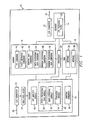
- FIGURE 1 illustrates a block diagram of a multimodal CELP coder 10 in accordance with the present invention.
- CELP coders may be linear prediction based analysis-by-synthesis speech coders which use an excitation which could be taken from a ternary, algebraic, vector-sum, randomly-populated, trained, adaptive or similar codebook.
- the multimodal CELP coder 10 may be utilized in a telephone answering device. It will be understood that the multimodal CELP coder 10 may be used in connection with other communication, telephonic, or other types of devices that provide synthesized speech. For example, the multimodal speech coder 10 may be employed by phone mail systems, digital sound recording devices, cellular telephones and the like.
- the multimodal CELP coder 10 may comprise an encoder 12 and decoder 14 pair, memory 16, random access memory 18, and a processor 20.
- the processor 20 may carry out instructions of the encoded 12 and decoder 14.
- the encoder 12 may receive speech input through a conventional analog to digital converter 22 and a conventional high pass filter 24.
- the analog to digital converter 24 may convert analog input 26 signals into a digital format.
- the high pass filter 24 may remove DC components and other biasing agents from the input signal 26.
- the encoder 12 may operate on fixed-length segments of the input signal called frames.
- the encoder 12 may process each frame of speech by computing a set of parameters which it codes for later use by the decoder 14. These parameters may include a mode bit which informs the decoder 14 of the mode being used to code the current frame, linear prediction coefficients (LPC), which specify a time-varying all-pole filter called the LPC synthesis filter, and excitation parameters which specify a time-domain waveform called the excitation signal.
- LPC linear prediction coefficients
- excitation parameters which specify a time-domain waveform called the excitation signal.
- the parameters of each frame may be stored as a coded message 28 in RAM 18. It will be understood that coded messages 28 may be otherwise stored within the scope of the present invention.
- the decoder 14 may receive the coded message 28 and synthesize an approximation to the input speech, called coded speech.
- the decoder 14 reconstructs the excitation signal and passes it through a LPC synthesis filter 30.
- the output of the synthesis filter 30 is the coded speech.
- the coded speech may be routed through a conventional digital-to-analog converter 32 where the coded speech is converted to an analog output signal 34.
- the encoder 12 may include a linear prediction coding (LPC) analysis module 40 and mode modules 42.
- the LPC analysis module 40 may analyze a frame and determine appropriate linear prediction coding LPC coefficients.
- the LPC coefficients are calculated using well-known analysis techniques and quantized in a similar manner using predictive multi-stage vector quantization.
- the LPC coefficients may be quantized using an LPC codebook 44 stored in memory 16.
- Mode decision modules 42 may include a pitch prediction gain module 50, a zero-crossing module 52 and a peakiness module 54 for classifying input speech into one of several modes characterized by distinct coding techniques.
- the multimodal CELP coder 10 may include a first mode characterized by fixed excitation and a second mode characterized by random excitation.
- the first mode may be better suited for signals with a certain degree of periodicity as well as signals that contain a few strong pulses or a localized burst of energy.
- voice sounds including unvoiced plosives such as /t/, /k/, and /p/ can be modeled using the first mode.
- the second mode is adequate for signals where the LPC residual is noise-like, such as in fricative sounds such as /s/, /sh/, /f/, /th/, as well as portions of the input signal consisting of only background noise. Accordingly, unvoiced sounds may be modeled using the second mode.
- the excitation signal may be a linear combination of two components obtained from two different codebooks, these codebooks may be an adaptive codebook 60 and a fixed excitation codebook 62.
- the adaptive codebook 60 may be associated with an adaptive gain codebook 64 and employed to encode pseudoperiodic pitch components of an LPC residual.
- the adaptive codebook 60 consists of time-shifted and interpolated values of past excitation.
- the fixed excitation codebook 62 may be associated with a fixed gain codebook 66 and used to encode a portion of the excitation signal that is left behind after the adaptive codebook 60 contribution has been subtracted.
- the fixed excitation codebook 62 may include sparse codevectors containing only a small fixed number of non-zero samples, which can be either +1 or -1.
- the excitation signal may be a gain-scaled vector taken from a random excitation codebook 70 populated with random Gaussian numbers.
- the random excitation codebook 70 may be associated with a random excitation gain codebook 72.
- the second mode may be encoded using gain-match analysis-by-synthesis encoding. This encoding method is described in more detail below in connection with FIGURE 3.
- the LPC codebook 44, fixed excitation codebook 62, fixed excitation gain codebook 66, random excitation codebook 68, and random excitation gain codebook 70 may be stored in the memory 16 of the multi-modal CELP coder 10.
- the adaptive codebook 60 may be stored in RAM 18. Accordingly, the adaptive codebook 60 may be continually updated.
- the adaptive gain codebook 64 may be stored in the encoder 12. It will be understood that the codebooks and modules of the CELP coder 10 may be otherwise stored within the scope of the present invention.
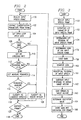
- FIGURE 2 illustrates a flow diagram of a method of classifying speech input into a first mode or a second mode in accordance with one embodiment of the present invention.
- the first mode may have an excitation vector with fewer non-zero elements than the second mode.
- the first mode may generally be associated with voiced/transient speech and the second with unvoiced speech.
- the method begins at step 100 with the encoder 12 receiving an input speech frame. Proceeding to step 102, the encoder 12 may extract classification parameters of the speech frame.
- the classification parameters may comprise an open-loop pitch gain, a zero crossing rate, and a peakiness measure.
- the open-loop pitch prediction gain module 50 may get an open-loop pitch gain of the speech frame.
- the open-loop pitch prediction gain may be determined by maximizing a normalized auto correlation value. It will be understood that the open-loop prediction gain may be otherwise obtained within the scope of the present invention. Proceeding to decisional step 106, the open-loop pitch prediction gain module 50 may determine if the open-loop pitch prediction gain is greater than an open-loop pitch prediction gain threshold.
- the open-loop pitch prediction gain threshold may range from 0.3 to 0.6. In a particular embodiment, the open-loop pitch prediction gain threshold may be 0.32. In this embodiment, the open-loop pitch prediction gain may be determined from the following equation: where
- open-loop pitch prediction gain may be otherwise determined within the scope of the present invention.
- step 108 the frame may be classified as voiced speech for fixed excitation encoding. If the open-loop pitch prediction gain is less than the open-loop pitch prediction gain threshold, the NO branch of decisional step 106 leads to step 110.
- the zero-crossing module 52 may get a zero-crossing rate of the speech frame.
- the zero crossing rate may be the number of times that the sign of the signal changes within a frame divided by the number of samples in the frame. Proceeding to decisional step 112, the zero-crossing module 52 may determine if the zero-crossing rate of the speech frame is less than a zero-crossing rate threshold.
- the zero-crossing rate threshold may range from 0.25 to 0.4. In a particular embodiment, the zero-crossing rate threshold may be 0.33. If the zero-crossing rate is less than the zero-crossing rate threshold, the YES branch of decisional step 112 may lead to step 108.
- the speech frame may be classified as voiced speech at step 108.
- the peakiness module 54 may get a peakiness measure of the speech frame.
- peakiness measure may be calculated as follows:
- Step 114 leads to decisional step 116.
- the peakiness module 54 may determine if the peakiness measure is greater than a peakiness threshold.
- the peakiness threshold may range from 1.3 to 1.4. In a particular embodiment, the peakiness threshold may be 1.3. If the peakiness measure is greater than the threshold, the YES branch of decisional step 116 may lead to step 108. As previously described, the speech frame may be classified as voiced speech at step 108. If the peakiness measure is not greater than the threshold, the NO branch of decisional step 116 leads to step 118.
- the speech frame may be classified as unvoiced speech. Steps 108 and step 118 may lead to decisional step 120.
- decisional step 120 the encoder 12 may determine if another input speech frame exists. If another frame exists, the YES branch of decisional step 120 returns to step 100 wherein the next frame is received for classification. If another speech frame does not exist, the NO branch of decisional step 120 leads to the end of the method.
- a speech frame will have a large peakiness measure where it contains a small number of samples whose magnitudes are much larger than the rest.
- the peakiness measure of the frame will become small if all the samples are comparable in terms of their absolute value. Accordingly, a periodic signal with sharp pulses will have a large peakiness value, as will a signal which contains a short burst of energy in an otherwise quiet frame.
- a noise-like signal such as an unvoiced fricative will have a small peakiness value. Accordingly, the beginning or end of a voiced utterance will be properly coded as voiced speech and speech quality improved.
- FIGURE 3 illustrates a gain-match analysis-by-synthesis for coding mode two speech in accordance with one embodiment of the present invention.
- the method begins at step 150 wherein the encoder 12 receives an input speech frame. Proceeding to step 152, the encoder 12 may extract LPC parameters of the input speech frame. At step 154, an LPC residual of the input speech frame may be determined. The LPC residual is a difference between the input speech and the speech predicted by the LPC parameters.
- a gain of the LPC residual may be determined.
- the gain may be determined by the following equation:
- the gain may be scaled.
- the gain may be scaled by multiplying the gain by a constant scale factor known as the CELP muting factor. This constant is empirically estimated and may be the average ratio of the gain of the coded speech to the original speech for all speech frames coded in the first voiced mode.
- the scaling matches the coded speech energy levels in both modes of the coder. It may be assumed that all the codevectors in the excitation codebook have a unit norm.
- the gain may then be quantized at step 160.
- a target vector may be obtained by filtering the speech frame through a pole-zero perceptual weighting filter W(z)and by subtracting from the result the zero-input response of the perceptually weighted synthesis filter at step 162.
- the target vector may be gain-normalized.
- the target vector may be gain-normalized by dividing the input speech by the gain. Accordingly, the synthetic speech will have the correct gain value, which is generally more important than the shape of the excitation vector for most unvoiced signals. This is done by precomputing the gain and using it to rescale the excitation target vector, before performing any analysis-by-synthesis quantization of the gain-normalized target vector with a vector from the excitation codebook. Accordingly, the present invention allows for the coded speech gain to match the input speech gain while still performing analysis-by-synthesis coding.
- the excitation value of the gain normalized speech frame may be determined.
- the impulse response matrix may be given by:
- the encoder 12 may store the excitation parameters of the speech frame as part of a coded message 28.
- the coded message may also include a mode bit and LPC coefficients. Step 166 leads to the end of the process.
- the present invention ensures that the synthesized speech will have the correct gain value.
- analysis-by-synthesis is performed to help retain the character of the input signal.
- unwanted gain fluctuations are substantially reduced or eliminated.
Landscapes
- Engineering & Computer Science (AREA)
- Computational Linguistics (AREA)
- Health & Medical Sciences (AREA)
- Audiology, Speech & Language Pathology (AREA)
- Human Computer Interaction (AREA)
- Physics & Mathematics (AREA)
- Acoustics & Sound (AREA)
- Multimedia (AREA)
- Signal Processing (AREA)
- Compression, Expansion, Code Conversion, And Decoders (AREA)
Applications Claiming Priority (2)
| Application Number | Priority Date | Filing Date | Title |
|---|---|---|---|
| US3447697P | 1997-01-02 | 1997-01-02 | |
| US34476P | 1997-01-02 |
Publications (2)
| Publication Number | Publication Date |
|---|---|
| EP0852376A2 true EP0852376A2 (fr) | 1998-07-08 |
| EP0852376A3 EP0852376A3 (fr) | 1999-02-03 |
Family
ID=21876667
Family Applications (1)
| Application Number | Title | Priority Date | Filing Date |
|---|---|---|---|
| EP98300004A Withdrawn EP0852376A3 (fr) | 1997-01-02 | 1998-01-02 | Codeur et méthode CELP multimodal |
Country Status (4)
| Country | Link |
|---|---|
| US (1) | US6148282A (fr) |
| EP (1) | EP0852376A3 (fr) |
| JP (1) | JPH10207498A (fr) |
| KR (1) | KR19980070294A (fr) |
Cited By (9)
| Publication number | Priority date | Publication date | Assignee | Title |
|---|---|---|---|---|
| WO2000011661A1 (fr) * | 1998-08-24 | 2000-03-02 | Conexant Systems, Inc. | Reduction adaptative de gain permettant de produire un signal cible partant d'une table de codes fixe |
| WO2000013174A1 (fr) * | 1998-09-01 | 2000-03-09 | Telefonaktiebolaget Lm Ericsson (Publ) | Critere adaptatif pour le codage de la parole |
| WO2001003114A1 (fr) * | 1999-06-30 | 2001-01-11 | Glenayre Electronics, Inc. | Localisation et codage de plosives sourdes en codage predictif lineaire de la parole |
| WO2002033695A3 (fr) * | 2000-10-17 | 2002-07-04 | Qualcomm Inc | Procede et appareil pour le codage a faible debit binaire et a haut rendement de segments non voises de la parole |
| WO2003001172A1 (fr) * | 2001-06-21 | 2003-01-03 | Nokia Corporation | Procede et dispositif de codage de la parole dans des codeurs de parole 'analyse par synthese' |
| EP1577881A3 (fr) * | 2000-07-14 | 2005-10-19 | Mindspeed Technologies, Inc. | Systeme de communication de la parole et procédé de gestion de trames perdues |
| EP1598811A3 (fr) * | 1999-06-18 | 2005-12-14 | Sony Corporation | Dispositif et méthode de décodage |
| US7146309B1 (en) | 2003-09-02 | 2006-12-05 | Mindspeed Technologies, Inc. | Deriving seed values to generate excitation values in a speech coder |
| CN1815552B (zh) * | 2006-02-28 | 2010-05-12 | 安徽中科大讯飞信息科技有限公司 | 基于线谱频率及其阶间差分参数的频谱建模与语音增强方法 |
Families Citing this family (12)
| Publication number | Priority date | Publication date | Assignee | Title |
|---|---|---|---|---|
| US6006174A (en) * | 1990-10-03 | 1999-12-21 | Interdigital Technology Coporation | Multiple impulse excitation speech encoder and decoder |
| US5621852A (en) * | 1993-12-14 | 1997-04-15 | Interdigital Technology Corporation | Efficient codebook structure for code excited linear prediction coding |
| KR100339168B1 (ko) * | 1996-11-07 | 2002-06-03 | 모리시타 요이찌 | 음원 벡터 생성 장치, 음성 부호화 장치 및 음성 복호화장치 |
| US6470309B1 (en) * | 1998-05-08 | 2002-10-22 | Texas Instruments Incorporated | Subframe-based correlation |
| WO2000000963A1 (fr) * | 1998-06-30 | 2000-01-06 | Nec Corporation | Codeur vocal |
| US7072832B1 (en) | 1998-08-24 | 2006-07-04 | Mindspeed Technologies, Inc. | System for speech encoding having an adaptive encoding arrangement |
| JP3404016B2 (ja) * | 2000-12-26 | 2003-05-06 | 三菱電機株式会社 | 音声符号化装置及び音声符号化方法 |
| EP1383112A3 (fr) * | 2002-07-17 | 2008-08-20 | STMicroelectronics N.V. | Procédé et dispositif d'encodage de la parole à bande élargie, permettant en particulier une amélioration de la qualité des trames de parole voisée |
| KR20080097178A (ko) * | 2006-01-18 | 2008-11-04 | 연세대학교 산학협력단 | 부호화/복호화 장치 및 방법 |
| KR20150032390A (ko) * | 2013-09-16 | 2015-03-26 | 삼성전자주식회사 | 음성 명료도 향상을 위한 음성 신호 처리 장치 및 방법 |
| US10535364B1 (en) * | 2016-09-08 | 2020-01-14 | Amazon Technologies, Inc. | Voice activity detection using air conduction and bone conduction microphones |
| EP4734107A1 (fr) * | 2021-06-29 | 2026-04-29 | Telefonaktiebolaget LM Ericsson (publ) | Classificateur de spectre pour sélection de mode de codage audio |
Family Cites Families (8)
| Publication number | Priority date | Publication date | Assignee | Title |
|---|---|---|---|---|
| US4969192A (en) * | 1987-04-06 | 1990-11-06 | Voicecraft, Inc. | Vector adaptive predictive coder for speech and audio |
| US5657418A (en) * | 1991-09-05 | 1997-08-12 | Motorola, Inc. | Provision of speech coder gain information using multiple coding modes |
| US5495555A (en) * | 1992-06-01 | 1996-02-27 | Hughes Aircraft Company | High quality low bit rate celp-based speech codec |
| US5734789A (en) * | 1992-06-01 | 1998-03-31 | Hughes Electronics | Voiced, unvoiced or noise modes in a CELP vocoder |
| US5327520A (en) * | 1992-06-04 | 1994-07-05 | At&T Bell Laboratories | Method of use of voice message coder/decoder |
| JP2746039B2 (ja) * | 1993-01-22 | 1998-04-28 | 日本電気株式会社 | 音声符号化方式 |
| US5673364A (en) * | 1993-12-01 | 1997-09-30 | The Dsp Group Ltd. | System and method for compression and decompression of audio signals |
| US5751903A (en) * | 1994-12-19 | 1998-05-12 | Hughes Electronics | Low rate multi-mode CELP codec that encodes line SPECTRAL frequencies utilizing an offset |
-
1997
- 1997-12-29 US US08/999,433 patent/US6148282A/en not_active Expired - Lifetime
- 1997-12-30 KR KR1019970079078A patent/KR19980070294A/ko not_active Withdrawn
-
1998
- 1998-01-02 EP EP98300004A patent/EP0852376A3/fr not_active Withdrawn
- 1998-01-05 JP JP10031913A patent/JPH10207498A/ja active Pending
Cited By (13)
| Publication number | Priority date | Publication date | Assignee | Title |
|---|---|---|---|---|
| US6104992A (en) * | 1998-08-24 | 2000-08-15 | Conexant Systems, Inc. | Adaptive gain reduction to produce fixed codebook target signal |
| WO2000011661A1 (fr) * | 1998-08-24 | 2000-03-02 | Conexant Systems, Inc. | Reduction adaptative de gain permettant de produire un signal cible partant d'une table de codes fixe |
| WO2000013174A1 (fr) * | 1998-09-01 | 2000-03-09 | Telefonaktiebolaget Lm Ericsson (Publ) | Critere adaptatif pour le codage de la parole |
| US6192335B1 (en) | 1998-09-01 | 2001-02-20 | Telefonaktieboiaget Lm Ericsson (Publ) | Adaptive combining of multi-mode coding for voiced speech and noise-like signals |
| EP1598811A3 (fr) * | 1999-06-18 | 2005-12-14 | Sony Corporation | Dispositif et méthode de décodage |
| WO2001003114A1 (fr) * | 1999-06-30 | 2001-01-11 | Glenayre Electronics, Inc. | Localisation et codage de plosives sourdes en codage predictif lineaire de la parole |
| US6304842B1 (en) | 1999-06-30 | 2001-10-16 | Glenayre Electronics, Inc. | Location and coding of unvoiced plosives in linear predictive coding of speech |
| EP1577881A3 (fr) * | 2000-07-14 | 2005-10-19 | Mindspeed Technologies, Inc. | Systeme de communication de la parole et procédé de gestion de trames perdues |
| WO2002033695A3 (fr) * | 2000-10-17 | 2002-07-04 | Qualcomm Inc | Procede et appareil pour le codage a faible debit binaire et a haut rendement de segments non voises de la parole |
| CN1302459C (zh) * | 2000-10-17 | 2007-02-28 | 高通股份有限公司 | 用于编码和解码非话音语音的方法和设备 |
| WO2003001172A1 (fr) * | 2001-06-21 | 2003-01-03 | Nokia Corporation | Procede et dispositif de codage de la parole dans des codeurs de parole 'analyse par synthese' |
| US7146309B1 (en) | 2003-09-02 | 2006-12-05 | Mindspeed Technologies, Inc. | Deriving seed values to generate excitation values in a speech coder |
| CN1815552B (zh) * | 2006-02-28 | 2010-05-12 | 安徽中科大讯飞信息科技有限公司 | 基于线谱频率及其阶间差分参数的频谱建模与语音增强方法 |
Also Published As
| Publication number | Publication date |
|---|---|
| KR19980070294A (ko) | 1998-10-26 |
| US6148282A (en) | 2000-11-14 |
| JPH10207498A (ja) | 1998-08-07 |
| EP0852376A3 (fr) | 1999-02-03 |
Similar Documents
| Publication | Publication Date | Title |
|---|---|---|
| US6148282A (en) | Multimodal code-excited linear prediction (CELP) coder and method using peakiness measure | |
| EP1224662B1 (fr) | Codage de la parole a debit binaire variable de type celp avec classification phonetique | |
| US7472059B2 (en) | Method and apparatus for robust speech classification | |
| US6556966B1 (en) | Codebook structure for changeable pulse multimode speech coding | |
| US6714907B2 (en) | Codebook structure and search for speech coding | |
| EP1062661B1 (fr) | Codage de la parole | |
| EP0802524B1 (fr) | Codeur de parole | |
| EP0766232B1 (fr) | Dispositif de codage de la parole | |
| EP0409239A2 (fr) | Procédé pour le codage et le décodage de la parole | |
| EP0532225A2 (fr) | Procédé et appareil pour le codage et le décodage du langage | |
| EP0833305A2 (fr) | Codeur de fréquence fondamentale à bas débit | |
| EP0957472A2 (fr) | Dispositif de codage et décodage de la parole | |
| US7680669B2 (en) | Sound encoding apparatus and method, and sound decoding apparatus and method | |
| US6205423B1 (en) | Method for coding speech containing noise-like speech periods and/or having background noise | |
| EP1005022B1 (fr) | Méthode et système de codage de la parole | |
| Paksoy et al. | A variable rate multimodal speech coder with gain-matched analysis-by-synthesis | |
| EP1204092A2 (fr) | Décodeur de parole avec reproduction du bruit de fond | |
| Paulus | Variable bitrate wideband speech coding using perceptually motivated thresholds | |
| US20030055633A1 (en) | Method and device for coding speech in analysis-by-synthesis speech coders | |
| EP0745972B1 (fr) | Procédé et dispositif de codage de parole | |
| EP1154407A2 (fr) | Codage de l'information de position dans un codeur de parole à impulsions multiples | |
| Salami et al. | Real-time implementation of a 9.6 kbit/s ACELP wideband speech coder | |
| Drygajilo | Speech Coding Techniques and Standards | |
| Lee et al. | A fast pitch searching algorithm using correlation characteristics in CELP vocoder | |
| JPH09179593A (ja) | 音声符号化装置 |
Legal Events
| Date | Code | Title | Description |
|---|---|---|---|
| PUAI | Public reference made under article 153(3) epc to a published international application that has entered the european phase |
Free format text: ORIGINAL CODE: 0009012 |
|
| AK | Designated contracting states |
Kind code of ref document: A2 Designated state(s): DE FR GB IT NL |
|
| AX | Request for extension of the european patent |
Free format text: AL;LT;LV;MK;RO;SI |
|
| PUAL | Search report despatched |
Free format text: ORIGINAL CODE: 0009013 |
|
| AK | Designated contracting states |
Kind code of ref document: A3 Designated state(s): AT BE CH DE DK ES FI FR GB GR IE IT LI LU MC NL PT SE |
|
| AX | Request for extension of the european patent |
Free format text: AL;LT;LV;MK;RO;SI |
|
| 17P | Request for examination filed |
Effective date: 19990721 |
|
| AKX | Designation fees paid |
Free format text: DE FR GB IT NL |
|
| 17Q | First examination report despatched |
Effective date: 20020411 |
|
| STAA | Information on the status of an ep patent application or granted ep patent |
Free format text: STATUS: THE APPLICATION IS DEEMED TO BE WITHDRAWN |
|
| 18D | Application deemed to be withdrawn |
Effective date: 20021224 |