EP0853425A2 - Dispositif de prise de vue - Google Patents
Dispositif de prise de vue Download PDFInfo
- Publication number
- EP0853425A2 EP0853425A2 EP97305730A EP97305730A EP0853425A2 EP 0853425 A2 EP0853425 A2 EP 0853425A2 EP 97305730 A EP97305730 A EP 97305730A EP 97305730 A EP97305730 A EP 97305730A EP 0853425 A2 EP0853425 A2 EP 0853425A2
- Authority
- EP
- European Patent Office
- Prior art keywords
- optical element
- portions
- optical
- restricting
- end portions
- Prior art date
- Legal status (The legal status is an assumption and is not a legal conclusion. Google has not performed a legal analysis and makes no representation as to the accuracy of the status listed.)
- Withdrawn
Links
Images










Classifications
-
- G—PHYSICS
- G02—OPTICS
- G02B—OPTICAL ELEMENTS, SYSTEMS OR APPARATUS
- G02B26/00—Optical devices or arrangements for the control of light using movable or deformable optical elements
- G02B26/08—Optical devices or arrangements for the control of light using movable or deformable optical elements for controlling the direction of light
- G02B26/0875—Optical devices or arrangements for the control of light using movable or deformable optical elements for controlling the direction of light by means of one or more refracting elements
-
- H—ELECTRICITY
- H04—ELECTRIC COMMUNICATION TECHNIQUE
- H04N—PICTORIAL COMMUNICATION, e.g. TELEVISION
- H04N23/00—Cameras or camera modules comprising electronic image sensors; Control thereof
- H04N23/58—Means for changing the camera field of view without moving the camera body, e.g. nutating or panning of optics or image sensors
Definitions
- the present invention relates to an image pickup apparatus capable of inputting an image of substantially high image quality by finely varying the optical angle of a parallel-plane plate glass or a reflecting mirror which is provided in the optical path of an image pickup system.
- pixel shifting is known as a method of increasing the image quality and the resolution of an image pickup apparatus without increasing the number of pixels per image pickup element.
- the pixel shifting is a method of finely vibrating an image pickup element itself or sequentially obtaining optical-video information by conducting, to photosensitive portions on the image pickup element, optical-image information which would have reached non-photosensitive portions between adjacent photosensitive portions, while varying the reflection angle of a reflecting mirror disposed in an optical path in an optical relay space between a lens group and the image pickup element or while varying the incident angle of light on an optical transmission glass having the shape of a parallel-plane plate or varying the thickness of the optical transmission glass by using the refraction of light by the optical transmission glass which is disposed in such optical path.
- pixel shifting it is possible to obtain an image having a high resolution which is substantially equivalent to a resolution obtainable when the number of pixels of an image pickup element is increased.
- the pixel shifting is a method which is extremely effective in increasing the resolution of the image input apparatus.
- Japanese Laid-Open Patent Application No. Sho 59-15378 discloses the art of rotating a parallel-plane plate about an axis parallel to a pixel array
- Japanese Laid-Open Patent Application No. Hei 1-121816 discloses the art of inclining a parallel-plane plate surface and rotating it about an optical axis
- Japanese Laid-Open Utility Model Application No. Hei 6-8937 discloses the art of driving a cam mechanism by means of a motor and varying the inclination of a parallel-plane plate surface in the directions of X and Y axes.
- a motor is used as a drive source which varies the optical position of the parallel-plane plate optical-transmission glass and a complicated expensive mechanism such as a position control mechanism using a cam, with the result that it is difficult to ensure the positioning accuracy of the parallel-plane plate optical-transmission glass and it is also difficult to increase the driving speed thereof.
- the present invention has been made to solve the above-described problems, and its first object is to provide a pixel shifting method, an optical (pixel shifting) apparatus and an image pickup apparatus all of which are capable of realizing high-speed driving by using a simple arrangement.
- a second object of the present invention is to provide a pixel shifting method and an optical (pixel shifting) apparatus both of which are capable of realizing pixel shifting of multiple steps and control of the amount of pixel shifting by using an extremely simple arrangement without the need for a complicated arrangement.
- a third object of the present invention is to provide an optical apparatus which enables pixel shifting which is easy to control and can be driven at extremely high speed without the need for a complicated mechanism.
- an optical apparatus which comprises an optical element for shifting a position of an incident light beam on an image forming plane, a plurality of restricting portions for controlling an inclination position of the optical element with respect to an optical axis by respectively restricting end portions of the optical element, and driving means for driving the optical element to the restricting portions.
- an optical apparatus which has position restricting surfaces formed before and behind each end portion of an optical element in the direction of the optical axis and determines the inclination angle of the optical element relative to the optical axis by restricting the position of each end portion of the optical element in the direction of the optical axis by means of the position restricting surfaces, the optical element being capable of being controlled to move among a plurality of inclination angles, by modifying a combination of the position restricting surfaces which the end portions of the optical element selectively come into abutment with.
- an optical apparatus in which a drive source for driving a parallel-plane plate disposed in an image pickup optical system includes a plurality of electromagnets and is arranged to vary the inclination position of the optical element by performing on-off control of each of the electromagnets to select the position restricting surfaces which the optical element comes into abutment with.
- an optical apparatus which is provided with a plurality of optical elements and a plurality of restricting portions and is arranged to determine an entire amount of image shifting by combining the amounts of image shifting of a light beam according to the respective inclination positions of the plurality of optical elements.
- a fourth object of the present invention is to integrate a pixel shifting mechanism with an optical apparatus as one unit and improve the applicability of the pixel shifting mechanism to various lens units and cameras as well as the versatility of the pixel shifting mechanism.
- a fifth object of the present invention is to provide a lens unit in which a pixel shifting mechanism is incorporated.
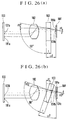
- Fig. 26(a) shows a state before an optical path is shifted
- Fig. 26(b) shows a state after the optical path is shifted.
- reference numeral 100 denotes a subject such as a document an image of which to be picked up
- reference numeral 102 denotes an image pickup lens group
- reference numeral 103 denotes an optical element made of an optically transmissive substance.
- the optical element 103 is disposed so that it can incline with respect to the optical axis of the optical system, and is shaped like a parallel-plane plate having a uniform refractive index and serves as light-beam moving means.
- Reference numeral 104 denotes a solid-state image pickup element such as a CCD which serves as image pickup means for photoelectrically converting a light image of the subject 100 focused by the lens group 102 and outputting the obtained picked-up image signal.
- ⁇ 1 (1 - 1/N) ⁇ t ⁇ ⁇ 1.
- the angle made by the optical element 103 and the image pickup surface of the solid-state image pickup element 104 at this time is denoted by ⁇ 1 for convenience' sake.
- ⁇ 2 (1 - 1/N) ⁇ t ⁇ ⁇ 2, where t is the thickness of the optical element 103 and N is the refractive index of the optical element 103.
- the light information from the point 101b on the subject 100 is made incident on the non-photosensitive portion 104b on the solid-state image pickup element 104 and is wasted as invalid data.
- the state of Fig. 26(a) is changed to the state of Fig. 26(b)
- picked-up image data obtained in the state of Fig. 26(a) and the picked-up image data obtained in the state of Fig. 26(b) are stored in a memory and the stored data are combined after phase-corrected, it is possible to obtain the amount of data which is equivalent to twice the number of pixels of the solid-state image pickup element 104.
- the optical element 103 is made stationary at several inclination positions and light information received by the solid-state image pickup element 104 for each of the inclination positions is stored in the memory, it is possible to obtain image information the amount of which is equivalent to several times the number of photosensitive portions of the solid-state image pickup element 104.
- a first embodiment of the present invention comprises a horizontal shifting mechanism and a vertical shifting mechanism both of which are provided between an image pickup lens and an image pickup element (CCD), and the horizontal shifting mechanism includes a parallel-plane plate glass for shifting a light beam entering from the image pickup lens, in a horizontal direction on an image pickup surface of the image pickup element, whereas the vertical shifting mechanism includes a parallel-plane plate glass for shifting such light beam in a vertical direction on the image pickup surface of the image pickup element.
- the horizontal shifting mechanism includes a parallel-plane plate glass for shifting a light beam entering from the image pickup lens, in a horizontal direction on an image pickup surface of the image pickup element
- the vertical shifting mechanism includes a parallel-plane plate glass for shifting such light beam in a vertical direction on the image pickup surface of the image pickup element.
- FIGs. 1(a) and 1(b) are diagrammatic perspective views showing the arrangement of a pixel shifting system in an image pickup apparatus according to the first embodiment of the present invention.
- an image pickup lens unit 1 constitutes an optical system
- an image pickup element 2 such as a CCD constitutes image pickup means.
- a transmission parallel-plane plate glass 3 (hereinafter referred to as the parallel-plane plate 3) is made of glass or plastics and constitutes a (vertical) optical element for vertically shifting a light beam passing through the image pickup lens unit 1 on an image pickup surface (image forming surface) of the image pickup element 2.
- Armatures 4U and 4D of electromagnetic soft iron, each of which constitutes an engagement part, are respectively disposed at the opposite ends of the parallel-plane plate 3, and electromagnets 5Ua and 5Ub; 5Da and 5Db which constitute driving means (electromagnetic driving means) for driving such optical element are respectively disposed before and behind the armatures 4U and 4D in the direction of the optical axis.
- the incident position of the light beam on the image pickup surface can be vertically shifted up or down by controlling the driving states of the respective electromagnets 5Ua, 5Ub, 5Da and 5Db to control the state of inclination of the parallel-plane plate 3 and rotate the parallel-plane plate 3 in either of the directions indicated by a double-headed arrow V.
- the electromagnet 5Ua is composed of a yoke 51U and a coil 53U
- the electromagnet 5Ub is composed of a yoke 52U and a coil 54U.
- the electromagnets 5Ua and 5Ub constitute (electromagnetic) driving means for moving the armature 4U back and forth in accordance with the control of supply of electricity to the respective coils 53U and 54U of the electromagnets 5Ua and 5Ub.
- the electromagnet 5Da is composed of a yoke 51D and a coil 53D
- the electromagnet 5Db is composed of a yoke 52D and a coil 54D.
- the electromagnets 5Da and 5Db constitute (electromagnetic) driving means for moving the armature 4D back and forth in accordance with the control of supply of electricity to the respective coils 53D and 54D of the electromagnets 5Da and 5Db.
- the incident position of the light beam, which has passed through the parallel-plane plate 3, on the image pickup surface of the image pickup element 2 can be shifted vertically (up or down) with respect to the direction of the optical axis.
- a parallel-plane plate glass 6 (hereinafter referred to as the parallel-plane plate 6) is provided for horizontally shifting a light beam passing through the image pickup lens unit 1 on the image pickup surface.
- Armatures 7L and 7R of electromagnetic soft iron, each of which constitutes an engagement part, are respectively disposed at the opposite ends of the parallel-plane plate 6, and electromagnets 8La and 8Lb; 8Ra and 8Rb are respectively disposed before and behind the armatures 7L and 7R in the direction of the optical axis.
- the incident position of the light beam on the image pickup surface can be horizontally shifted toward the right or the left by controlling the driving states of the respective electromagnets 8La, 8Lb, 8Ra and 8Rb to control the state of inclination of the parallel-plane plate 6 and rotate the parallel-plane plate 6 in either of the directions indicated by a double-headed arrow H.
- the electromagnet 8La is composed of a yoke 81L and a coil 83L
- the electromagnet 8Lb is composed of a yoke 82L and a coil 84L.
- the electromagnets 8La and 8Lb constitute (electromagnetic) driving means for moving the armature 7L provided at the left end of the parallel-plane plate 6, back and forth in accordance with the control of supply of electricity to the respective coils 83L and 84L of the electromagnets 8La and 8Lb.
- the electromagnet 8Ra is composed of a yoke 81R and a coil 83R
- the electromagnet 8Rb is composed of a yoke 82R and a coil 84R.
- the electromagnets 8Ra and 8Rb constitute (electromagnetic) driving means for moving the armature 7R provided at the right end of the parallel-plane plate 6, back and forth in accordance with the control of supply of electricity to the respective coils 83R and 84R of the electromagnets 8Ra and 8Rb.
- the incident position of the light beam, which has passed through the parallel-plane plate 6, on the image pickup surface of the image pickup element 2 can be shifted horizontally (toward the right or the left) with respect to the direction of the optical axis.
- the two vertical and horizontal parallel-plane plates 3 and 6 are disposed in the space between the image pickup lens unit 1 and the image pickup element 2 in such a manner that the respective parallel-plane plates 3 and 6 are made to incline with respect to the vertical and horizontal directions, thereby shifting the position of incidence on the image pickup surface of the light beam which has passed through the image pickup lens unit 1, in the vertical and horizontal directions at a pitch smaller than the pixel-to-pixel distance of the image pickup element 2.
- the image pickup apparatus can pick up an image which is incident on the image pickup surface at a location between each pixel of the image pickup element 2, so that the image pickup apparatus is capable of realizing an image quality equivalent to that of an image picked up by an image pickup element, the number of pixels of which is greater than the actual number of pixels of the image pickup element 2.
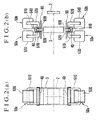
- Figs. 2(a) and 2(b) show the arrangement of the parallel-plane plate 3 which performs vertical pixel shifting.
- the pixel shifting system according to the first embodiment of the present invention is disposed between the image pickup lens unit 1 and the image pickup element 2.
- the pixel shifting system may be disposed, for example, in the lens unit of a camera or in the camera body thereof.
- Fig. 2(a) shows the state of the parallel-plane plate 3 as viewed from the front side, i.e., in the direction of incidence of a light beam
- Fig. 2(b) shows the state of the parallel-plane plate 3 as viewed from the right side.
- the parallel-plane plate 3 is positioned in front of the image pickup surface of the image pickup element 2, and has a size which covers the entire image pickup surface.
- the top and bottom armatures 4U and 4D of the parallel-plane plate 3 are located in a frame portion of the lens unit or a frame portion of the camera body.
- the parallel-plane plate 3 is held in the state in which the armatures 4U and 4D of electromagnetic soft iron provided at the opposite ends of the parallel-plane plate 3 are respectively movably fitted in recesses 91U and 91D formed in the frame portion, i.e., in the state of having predetermined clearances in the forward and rearward directions and in the upward and downward directions.
- Each of the recesses 91U and 91D is extended by a length approximately equal to the width of the parallel-plane plate 3 in a direction perpendicular to the surface of the sheet of Fig. 2(b), and the armatures 4U and 4D of electromagnetic soft iron provided at the opposite ends of the parallel-plane plate 3 are formed into cylindrical shapes which respectively extend along inner surfaces 92U and 93U of the recess 91U and inner surfaces 92D and 93D of the recess 91D. Accordingly, the armatures 4U and 4D can come into line contact with restriction surfaces in the respective recesses 91U and 91D so that the inclination of the parallel-plane plate 3 with respect to the rolling direction can be restricted. As another method for obtaining the same effect as the line contact due to the cylindrical shape, a plurality of point contact portions may be formed on the line of the line contact.
- These recesses function as restriction portions for positioning the optical element of the present invention, and the surfaces which come into abutment with the armatures which constitute the engagement parts of the parallel-plane plate serving as the optical element function as position restricting surfaces or position restricting portions for positioning.
- the inclination position of the parallel-plane plate 3 with respect to the optical axis and the position of the parallel-plane plate 3 in the direction of the optical axis are determined, and the respective amounts of movements along the optical axis of the armatures 4U and 4D provided at the opposite ends of the parallel-plane plate 3 are determined according to the respective widths of the recesses 91U and 91D which are taken in the direction of the optical axis.
- the parallel-plane plate 3 is controlled so that the amount of inclination of the parallel-plane plate 3 or the position thereof in the direction of the optical axis is made different.
- the present pixel shifting system also includes the parallel-plane plate 6 which is a horizontal parallel-plane plate having an arrangement similar to the above-described arrangement.
- the positional relation between the parallel-plane plate 3 and the parallel-plane plate 6 is shown in Figs. 3(a) and 3(b).
- Fig. 3(a) is a front elevational view taken in the direction of the optical axis
- Fig. 3(b) is a top plan view.
- the horizontal parallel-plane plate 6 and the vertical parallel-plane plate 3 are disposed in a perpendicular relation to each other between the image pickup lens unit 1 and the image pickup element 2.
- the main feature of the pixel shifting system according to the first embodiment of the present invention resides in the arrangement in which a multiplicity of inclination positions of each of the parallel-plane plates can be obtained by restricting the inclination position of each of the parallel-plane plates and the position of each of the parallel-plane plates in the direction of the optical axis by means of the armatures provided at the opposite ends and the position restricting surfaces in the corresponding recesses, and in which the electromagnets are used as driving sources for the armatures and each of the parallel-plane plates is disposed in such a manner that the armatures at the opposite end are movably fitted in the corresponding recesses with predetermined clearances.
- each of the parallel-plane plates is restricted by the electromagnetic forces of the electromagnets, and even if the electromagnets are not excited, no special supporting arrangement is needed as means for supporting the parallel-plane plates.
- a supporting arrangement unlike a conventional system, it is possible to omit a gimbal mechanism having vertical and horizontal rotating shafts, a complicated cam mechanism, a gear mechanism, a plurality of stepping motors or the like.
- each of the parallel-plane plates 3 and 6 is supported in such a manner that the opposite armatures are movably fitted in the corresponding recesses, there is no need for a special supporting mechanism such as a gimbal.
- a mechanism for transmitting the driving forces since electromagnetic forces are directly applied to the respective armatures as driving forces, there is no need for a mechanism for transmitting the driving forces, so that not only can the arrangements of the parallel-plane plates 3 and 6 be made simple but also the parallel-plane plates 3 and 6 can be driven at extremely high speeds and their positions can be restricted with high accuracy.
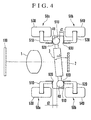
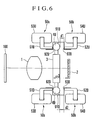
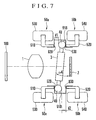
- Figs. 4 to 7 are views aiding in explaining the control of the inclination position of the parallel-plane plate 3 which performs vertical pixel shifting.
- the main feature of the arrangement of the first embodiment resides in the relative positional relation between the recesses 91U and 91D and the setting of the width of each of the recesses 91U and 91D.
- Figs. 4 to 7 respectively show different inclination positions of the parallel-plane plate 3 for sequentially shifting down the incident position of a light beam which corresponds to one point on a subject, on the image pickup surface of the image pickup element 2.
- the dimensions of the recess 91U in which the armature 4U provided at the top end of the parallel-plane plate 3 is movably fitted and those of the recess 91D in which the armature 4D provided at the bottom end of the parallel-plane plate 3 is movably fitted are set in such a manner that the widths of the recesses 91U and 91D, i.e., the lengths of the recesses 91U and 91D in the direction of the optical axis, are approximately equal to each other, and the positions of the recesses 91U and 91D are approximately the same as each other.
- the electromagnet 5Ua is on and electromagnet 5Ub is off, so that, in the recess 91U, the armature 4U is attracted to the yoke 51U of the electromagnet 5Ua and positioned by abutment with the position restricting surface 92U which is located before the armature 4U in the direction of the optical axis.
- the electromagnet 5Ua is on and electromagnet 5Ub is off, so that, in the recess 91U, the armature 4U is attracted to the yoke 51U of the electromagnet 5Ua and positioned by abutment with the position restricting surface 92U which is located before the armature 4U in the direction of the optical axis.
- the electromagnet 5Da is off and the electromagnet 5Db is on, so that the armature 4D is attracted to the yoke 52D of the electromagnet 5Db and positioned by abutment with the position restricting surface 93D which is located behind the armature 4D in the direction of the optical axis.
- the parallel-plane plate 3 when the pixel shifting system is in the state shown in Fig. 4, the parallel-plane plate 3 is set to perform upward pixel shifting with respect to the optical axis, but none of the states of inclination shown in Figs. 4, 5, 6 and 7 is absolute.
- the present pixel shifting system is intended to allow an image which originally cannot be incident on the image pickup surface to be made incident thereon according to the inclination angle of the parallel-plane plate 3, and the parallel-plane plate 3 need not be perpendicular to the optical axis in any of the states shown in Figs. 4, 5, 6 and 7.
- d1 be the clearance between the armature 4U and the width of the recess 91U, i.e., the distance between the armature 4U and the position restricting surface 93U in the recess 91U
- d2 be the clearance between the armature 4D and the width of the recess 91D, i.e., the distance between the armature 4D and the position restricting surface 92D in the recess 91D
- ⁇ 1 denotes the angle made by the parallel-plane plate 3 and the image pickup surface of the image pickup element 2.
- the distances d1 and d2 are set with high precision.
- the inclination position of the parallel-plane plate 3 is restricted by the abutment between the armature 4U provided at the top end of the parallel-plane plate 3 and the position restricting surface 93U in the recess 91U and by the abutment between the armature 4D provided at the bottom end of the parallel-plane plate 3 and the position restricting surface 93D in the recess 91D.
- the parallel-plane plate 3 is inclined from the state of Fig. 4 toward the right by one step as viewed in Fig. 4, and the incident position of the light beam on the image pickup surface of the image pickup element 2 is shifted downward on the image pickup surface.
- ⁇ 2 denotes the angle made by the image pickup surface and the parallel-plane plate 3 in the state shown in Fig. 5.
- the armature 4D provided at the bottom end of the parallel-plane plate 3 moves away from the position restricting surface 93D in the recess 91D and is attracted to the position restricting surface 92D and positioned by abutment with the position restricting surface 92D.
- the parallel-plane plate 3 goes to the state shown in Fig. 6.
- the inclination position of the parallel-plane plate 3 is restricted by the abutment between the armature 4U provided at the top end of the parallel-plane plate 3 and the position restricting surface 92U in the recess 91U and by the abutment between the armature 4D provided at the bottom end of the parallel-plane plate 3 and the position restricting surface 92D in the recess 91D.
- the position of the parallel-plane plate 3 in the direction of the optical axis is moved from the state of Fig. 5 toward the left with approximately the same inclination being maintained. (Strictly, the inclination differs between the states shown in Figs.
- ⁇ 3 denotes the angle made by the image pickup surface and the parallel-plane plate 3 in the state shown in Fig. 6.
- ⁇ 2 ⁇ ⁇ 3 and the angle made by the parallel-plane plate 3 and the optical axis in the state shown in Fig. 5 is the same as the corresponding angle obtained in the state shown in Fig. 6. Accordingly, the pixel shifting effects obtained in both states are the same, and either one of the states may be selected.
- ⁇ 4 denotes the angle made by the image pickup surface and the parallel-plane plate 3 in the state shown in Fig. 7.
- the clearance d1 between the armature 4U and the position restricting surface 92U or 93U in the recess 91U and the clearance d2 between the armature 4D and the position restricting surface 92D or 93D in the recess 91D are set so that the amount of shifting for one step becomes equal to two-thirds of the pixel-to-pixel distance of the image pickup element.
- the clearances d1 and d2, which determine the inclination angle of the parallel-plane plate 3, are varied according to the pixel-to-pixel distance of the image pickup element or the amount of shifting for one step.
- the parallel-plane plate 3 is supported with some play in such a manner that the opposite armatures 4U and 4D are movably fitted in the respective recesses 91U and 91D, and the inclination angle of the parallel-plane plate 3 is determined by bringing each of the armatures 4U and 4D into abutment with either of the position restricting surfaces in the corresponding one of the recesses 91U and 91D by the excitation of the associated one of the electromagnets.
- each of the amatures which comes into abutment with either of the corresponding position restricting surfaces has a cylindrical shape, even if the position of abutment of each of the cylindrical armatures with either of the corresponding position restricting surfaces deviates in a longitudinal direction of the parallel-plane plate 3, the inclination angle of the parallel-plane plate 3 does not vary, so that the incident position of the light beam on the image pickup surface of the image pickup element does not vary.
- each of the armatures has a cylindrical shape
- the portion of the armature which comes into closest proximity to either of the corresponding position restricting surfaces forms a point (actually, a line).
- the parallel-plane plate 3 is centered by the position of the armature of the electromagnet, and substantially does not suffer a positional deviation.
- the respective mounting positions of the yokes 51U, 52U, 51D and 52D of the electromagnets 5Ua, 5Ub, 5Da and 5Db are set so that the respective tips of the yokes 51U, 52U, 51D and 52D do not project from the position restricting surfaces 92U, 93U, 92D and 93D in the recesses 91U and 91D.
- the parallel-plane plate 3 is positioned by the position restricting surfaces in each of the recesses at all times, so that the parallel-plane plate 3 can be positioned with high accuracy without being affected by the accuracy of the mounting positions of the electromagnets.
- the inclination of the parallel-plane plate 3 is set so that the incident position of the light beam on the image pickup surface is shifted at a pitch of two-thirds of the pixel-to-pixel distance of the image pickup surface, i.e., at a two-third pixel pitch for each inclination angle. Accordingly, it is possible to obtain the number of pixels which is substantially three times the number of vertical pixels of an actual image pickup element.
- three images are picked up by the image pickup element for the respective inclination positions of the parallel-plane plate 3, and the picked-up three images are sequentially stored in a memory.
- the order of reading of each pixel of the three images is controlled so that the three images can be combined into one image of high image quality.
- the first embodiment of the present invention is also provided with a similar pixel shifting mechanism which performs horizontal pixel shifting, the first embodiment is capable of performing horizontal pixel shifting so that the number of pixels of the image pickup element can be made substantially three times, i.e., nine times in total.
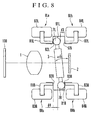
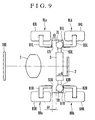
- Figs. 8 to 11 are views aiding in explaining the operation of performing horizontal pixel shifting by sequentially varying the inclination angle of the horizontal parallel-plane plate 6.
- the inclination angle of the parallel-plane plate 6 is determined by position restricting surfaces 92L and 93L of a left recess 91L in which the armature 7L mounted at the left end of the parallel-plane plate 6 is movably fitted and position restricting surfaces 92R and 93R of a right recess 91R in which the armature 7R mounted at the right end of the parallel-plane plate 6 is movably fitted.
- the clearance d3 between the armature 7L and the position restricting surface 92L or 93L in the recess 91L and the clearance D4 between the armature 7R and the position restricting surface 92R or 93R in the recess 91R are set so that the amount of shifting for one step becomes equal to two-thirds of the horizontal pixel-to-pixel distance of the image pickup element.
- the clearances d3 and d4, which determine the inclination angle of the parallel-plane plate 6, are varied according to the pixel-to-pixel distance of the image pickup element or the amount of shifting for one step.
- the vertical pixel shifting shown in Figs. 4 to 7 and the horizontal pixel shifting shown in Figs. 8 to 11 are performed so as to sequentially increase the respective inclination angles of the parallel-plane plates 3 and 6, images are picked up for the respective inclination positions and stored in the memory so that the images can be combined into one image by processing to be performed at a later time.
- the respective inclination angles of the parallel-plane plates 3 and 6 may be varied in arbitrary order.
- the vertical pixel shifting and the horizontal pixel shifting need not be limited to the order shown in Figs. 4 to 7 and the order shown in Figs. 8 to 11, and may be performed in arbitrary order as long as three images in the vertical direction and three images in the horizontal image, a total of nine images, can be picked up by controlling each of the electromagnets.
- each of the vertical and horizontal pixel shifting mechanisms are independent of each other, the direction and the order of pixel shifting by each of the vertical and horizontal pixel shifting mechanisms may be arbitrary. As a matter of course, each of the parallel plates must be kept stationary during an image pickup (charge storage) operation for each pixel shifting position.
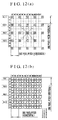
- Figs. 12(a) and 12(b) are diagrammatic views showing the spatial positions of the pixels obtained when pixel shifting is performed on the basis of a combination of the three states, shown in Figs. 4 to 7, of the parallel-plane plate 3 for vertical pixel shifting and the three states, shown in Figs. 8 to 11, of the parallel-plane plate 6 for horizontal pixel shifting.
- Fig. 12(a) the locations shaded by hatching (four kinds of hatching such as cross-hatching) show part of the positions of pixels (photosensitive portions) on an image pickup element such as an interline transfer type CCD.
- the portion (non-photosensitive portion) between each of the pixels and the neighboring pixel is divided into two parts to divide one pixel pitch by three so that the image pickup surface of the image pickup element is divided in a checkered pattern.
- the photosensitive portion denoted by symbol A can capture light beams incident on nine locations which are respectively defined by nine coordinates (H5, L5), (H5, L7), (H5, L9), (H7, L5), (H7, L7), (H7, L9), (H9, L5), (H9, L7) and (H9, L9), on the basis of the combination of the three states, shown in Figs. 4 to 7, of the parallel-plane plate 3 for vertical pixel shifting and the three states, shown in Figs. 8 to 11, of the parallel-plane plate 6 for horizontal pixel shifting.
- the light beams incident on the respective nine locations are conducted to the photosensitive portion A on a beam-by-beam basis (by pixel shifting), and the stored data (the charge stored in the photosensitive portion A) is read during reading of field data from the photosensitive portion A.
- a similar operation is performed during reading of field data from each of the other photosensitive portions.
- two parallel-plane plates which respectively perform vertical pixel shifting and horizontal pixel shifting are disposed independently of each other, and during an image pickup operation, the inclination angles of the parallel-plane plates are shifted, one in the vertical direction and the other in the horizontal direction, at a pitch of two-thirds of the pixel-to-pixel distance of the image pickup surface.
- an image quality equivalent to the number of pixels which is substantially three times the actual number of pixels with respect to each of the vertical and horizontal directions, i.e., a total of nine times the actual number of pixels.
- a second embodiment of the present invention will be described below.
- the first embodiment shown in Figs. 4 to 11 is arranged to perform pixel shifting of three steps in each of the vertical and horizontal directions
- the second embodiment is capable of performing pixel shifting of four steps in each of the vertical and horizontal directions.
- parallel-plane plates, recesses for positioning the parallel-plane plates, and electromagnets which constitute driving means are arranged in a manner similar to that described previously in connection with the first embodiment, and the feature of the second embodiment can be realized by modifying the positional relation between the recesses.
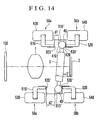
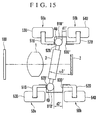
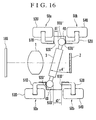
- Figs. 13 to 16 are views aiding in explaining the control of the inclination position of the parallel-plane plate 3 which performs vertical pixel shifting of four steps.
- the main feature of the arrangement of the second embodiment resides in the relative positional relation between recesses 91U' and 91D' and the setting of the width of each of the recesses 91U' and 91D'.
- Figs. 13 to 16 respectively show different inclination positions of the parallel-plane plate 3 for sequentially shifting down the incident position of a light beam which corresponds to one point on a subject, on the image pickup surface of the image pickup element 2.
- identical reference numerals are used to denote constituent parts identical to those of the first embodiment shown in Figs. 4 to 11.
- the dimensions of the recess 91U' in which the armature 4U provided at the top end of the parallel-plane plate 3 is movably fitted and those of the recess 91D' in which the armature 4D provided at the bottom end of the parallel-plane plate 3 is movably fitted are set in such a manner that the widths of the recesses 91U' and 91D', i.e., the lengths of the recesses 91U' and 91D' in the direction of the optical axis, are different from each other, and the positions of the recesses 91U and 91D are different from each other.
- the electromagnet 5Ua is on and electromagnet 5Ub is off, so that, in the recess 91U', the armature 4U is attracted to the yoke 51U of the electromagnet 5Ua and positioned by abutment with a position restricting surface 92U' which is located before the armature 4U in the direction of the optical axis.
- the electromagnet 5Ua is on and electromagnet 5Ub is off, so that, in the recess 91U', the armature 4U is attracted to the yoke 51U of the electromagnet 5Ua and positioned by abutment with a position restricting surface 92U' which is located before the armature 4U in the direction of the optical axis.
- the electromagnet 5Da is off and the electromagnet 5Db is on, so that the armature 4D is attracted to the yoke 52D of the electromagnet 5Db and positioned by abutment with a position restricting surface 93D' which is located behind the armature 4D in the direction of the optical axis.
- the parallel-plane plate 3 when the pixel shifting system is in the state shown in Fig. 13, the parallel-plane plate 3 is set to have a perpendicular positional relation to the optical axis, but none of the states of inclination shown in Figs. 13, 14, 15 and 16 is absolute.
- the present pixel shifting system is intended to allow an image which originally cannot be incident on the image pickup surface to be made incident thereon according to the inclination angle of the parallel-plane plate 3, and the parallel-plane plate 3 need not be perpendicular to the optical axis in any of the state shown in Fig. 13.
- d1' be the clearance between the armature 4U and the width of the recess 91U', i.e., the distance between the armature 4U and the position restricting surface 93U' in the recess 91U'
- d2' be the clearance between the armature 4D and the width of the recess 91D', i.e., the distance between the armature 4D and the position restricting surface 92D' in the recess 91D'
- ⁇ 1' denotes the angle made by the parallel-plane plate 3 and the image pickup surface of the image pickup element 2.
- the distances d1' and d2' are set with high precision.
- the inclination position of the parallel-plane plate 3 is restricted by the abutment between the armature 4U provided at the top end of the parallel-plane plate 3 and the position restricting surface 93U' in the recess 91U' and by the abutment between the armature 4D provided at the bottom end of the parallel-plane plate 3 and the position restricting surface 93D' in the recess 91D'.
- the parallel-plane plate 3 is inclined from the state of Fig. 13 toward the right by one step as viewed in Fig. 13, and the incident position of the light beam on the image pickup surface of the image pickup element 2 is shifted downward on the image pickup surface.
- ⁇ 2' denotes the angle made by the image pickup surface and the parallel-plane plate 3 in the state shown in Fig. 14.
- the armature 4D provided at the bottom end of the parallel-plane plate 3 moves away from the position restricting surface 93D' in the recess 91D' and is attracted to the position restricting surface 92D' and positioned by abutment with the position restricting surface 92D'.
- the parallel-plane plate 3 goes to the state shown in Fig. 15.
- the inclination position of the parallel-plane plate 3 is restricted by the abutment between the armature 4U provided at the top end of the parallel-plane plate 3 and the position restricting surface 92U' in the recess 91U' and by the abutment between the armature 4D provided at the bottom end of the parallel-plane plate 3 and the position restricting surface 92D' in the recess 91D'.
- the parallel-plane plate 3 is further inclined from the state of Fig. 14 toward the right by one step as viewed in Fig. 14, and the incident position of the light beam on the image pickup surface of the image pickup element 2 is shifted further downward on the image pickup surface.
- ⁇ 3' denotes the angle made by the image pickup surface and the parallel-plane plate 3 in the state shown in Fig. 15.
- the parallel-plane plate 3 is further inclined from the state of Fig. 15 toward the right as viewed in Fig. 16, and the inclination angle of the parallel-plane plate 3 reaches a maximum.
- ⁇ 4' denotes the angle made by the image pickup surface and the parallel-plane plate 3 in the state shown in Fig. 16.
- the clearance d1' between the armature 4U and the position restricting surface 92U' in the recess 91U' and the clearance d2' between the armature 4D and the position restricting surface 93D' in the recess 91D' are set so that the amount of shifting for one step becomes equal to half of the pixel-to-pixel distance of the image pickup element.
- the clearances d1' and d2', which determine the inclination angle of the parallel-plane plate 3, are varied according to the pixel-to-pixel distance of the image pickup element or the amount of shifting for one step.
- each of the armatures which comes into abutment with either of the corresponding position restricting surfaces has a cylindrical shape, even if the position of abutment of each of the cylindrical armatures with either of the corresponding position restricting surfaces deviates in a longitudinal direction of the parallel-plane plate 3, the inclination angle of the parallel-plane plate 3 does not vary, so that the incident position of the light beam on the image pickup surface of the image pickup element does not vary.
- the inclination of the parallel-plane plate 3 is set so that the incident position of the light beam on the image pickup surface is shifted at a pitch of half of the pixel-to-pixel distance of the image pickup surface, i.e., at a half pixel pitch for each inclination angle. Accordingly, it is possible to obtain the number of pixels which is substantially four times the number of vertical pixels of an actual image pickup element.
- the second embodiment of the present invention is also provided with a similar pixel shifting mechanism which performs horizontal pixel shifting, the second embodiment is capable of performing horizontal pixel shifting so that the number of pixels of the image pickup element can be made substantially four times, i.e., sixteen times in total.
- Figs. 17 to 20 are views aiding in explaining the operation of performing horizontal pixel shifting by sequentially varying the inclination angle of the horizontal parallel-plane plate 6.
- the inclination angle of the parallel-plane plate 6 is determined by position restricting surfaces 92L' and 93L' of a left recess 91L' in which the armature 7L mounted at the left end of the parallel-plane plate 6 is movably fitted and position restricting surfaces 92R' and 93R' of a right recess 91R' in which the armature 7R mounted at the right end of the parallel-plane plate 6 is movably fitted.
- the clearance d3' between the armature 7L and the position restricting surface 92L' or 93L' in the recess 91L' and the clearance D4 between the armature 7R and the position restricting surface 92R' or 93R' in the recess 91R' are set so that the amount of shifting for one step becomes equal to half of the horizontal pixel-to-pixel distance of the image pickup element.
- the clearances d3' and d4', which determine the inclination angle of the parallel-plane plate 6, are varied according to the pixel-to-pixel distance of the image pickup element or the amount of shifting for one step.
- the vertical pixel shifting shown in Figs. 13 to 16 and the horizontal pixel shifting shown in Figs. 17 to 20 are performed so as to sequentially increase the respective inclination angles of the parallel-plane plates 3 and 6, images are picked up for the respective inclination positions and stored in the memory so that the images can be combined into one image by processing to be performed at a later time.
- the respective inclination angles of the parallel-plane plates 3 and 6 may be varied in arbitrary order.
- the vertical pixel shifting and the horizontal pixel shifting need not be limited to the order shown in Figs. 13 to 16 and the order shown in Figs. 17 to 20, and may be performed in arbitrary order as long as four images in the vertical direction and four images in the horizontal image, a total of sixteen images, can be picked up by controlling each of the electromagnets.
- each of the vertical and horizontal pixel shifting mechanisms are independent of each other, the direction and the order of pixel shifting by each of the vertical and horizontal pixel shifting mechanisms may be arbitrary. As a matter of course, while one image is being picked up, each of the parallel plates must be kept stationary.
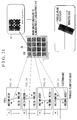
- Fig. 21 shows variations on a pixel-by-pixel basis in the incident position of a light beam on the image pickup surface, which variations correspond to the respective four states of the parallel-plane plate 3 shown in Figs. 13 to 20.
- Fig. 21 the respective states of Figs. 13 to 16 are conceptually shown in parts (1), (2), (3) and (4).
- the incident position of a light beam which would originally be made incident on only one point on the image pickup surface can be shifted among four locations. Accordingly, four light beams incident on four different locations which are spaced vertically apart from one another and some of which lie between vertically adjacent pixels, can be made incident on one pixel on the image pickup surface of the image pickup element.
- reference numeral 2a denotes an image pickup surface of the image pickup element 2.
- Four kinds of color filters which respectively constitute pixels Cy (cyan), Ye (yellow), G (green) and Mg (magenta) are disposed on the image pickup surface 2a as shown in Fig. 21, and these four pixels constitute one pixel in the case of color image pickup.
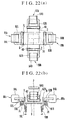
- the feature of the third embodiment resides in a simplified driving system which includes electromagnets for driving parallel-plane plates, and reduced power consumption.
- Figs. 22(a) and 22(b) show the essential portion of the third embodiment.
- Fig. 22(a) is a front elevational view taken in the direction of the optical axis
- Fig. 22(b) is a top plan view.
- the third embodiment differs from the first embodiment in that part of the electromagnets used in the first embodiment are replaced with springs.
- identical reference numerals are used to denote constituent elements identical to those used in the first embodiment, and the description of such constituent elements is omitted for the sake of simplicity.
- electromagnets 5Ua, 5Da, 8La and 8Ra are replaced with springs for urging the parallel-plane plates in the forward direction along the optical axis.
- springs 10L and 10R for pulling the respective armatures 7L and 7R of the horizontal parallel-plane plate 6 in the forward direction along the optical axis are provided instead of the electromagnets 8La and 8Ra.
- Fig. 23(a) is an exploded perspective view of a pixel shifting unit in which the pixel shifting mechanism according to the first (or second) embodiment of the present invention is incorporated.
- reference numerals 9 and 9' denote frames each of which supports the corresponding electromagnets and parallel-plane plates.
- the frames 9 and 9' are separated from each other in the direction of the optical axis, and each of them has an opening through which to pass a light beam at a location centered about the optical axis.
- the electromagnets 5Ub, 5Db, 8Lb and 8Rb are disposed at predetermined positions of the joining surface of the rear frame 9' which surrounds the opening 9a of the rear frame 9 and is opposed to the front frame portion 9'.
- the position restricting surface 93U and 93D; 93L and 93R are respectively formed in the recesses 91U and 91D; 91L and 91R into which to insert the vertical and horizontal parallel-plane plates 3 and 6, respectively.
- the respective yokes 52U and 52D of the electromagnets 5Ub and 5Db are exposed at positions opposed to the armatures 4U and 4D of the parallel-plane plate 3, while the respective yokes 82L and 82R of the respective electromagnets 8Lb and 8Rb are exposed at positions opposed to the armatures 7L and 7R of the parallel-plane plate 6.
- the front frame 9' which is opposed to the rear frame 9 has the electromagnets 5Ua, 5Ub, 5Da and 5Db at positions opposed to the respective electromagnets 5Ub, 5Db, 8Lb and 8Rb.
- the position restricting surface 92U, 92D, 92L and 92R are respectively formed in the recesses 91U, 91D, 91L and 91R.
- Fig. 23(b) is an exploded perspective view showing in detail the arrangement of the pixel shifting unit shown in Fig. 23(a) and its peripheral members.
- identical reference numerals are used to denote constituent elements identical to those shown in Fig. 23(a), and the description thereof is omitted for the sake of simplicity.
- each pair of the opposed electromagnets (5Ua and 5Ub, 5Da and 5Db, 8La and 8Lb, 8Ra and 8Rb) is integrated into one unit and the spaces between the opposed yokes 51U and 52U, 51D and 52D, 81L and 82L, and 81R and 81L are restricted by spacers 85L, 85R, 85U and 85D, respectively.
- the peripheral portion of the pixel shifting unit is restricted, the pixel shifting unit can be readily incorporated.
- the parallel-plane plates 3 and 6 are respectively supported by support frames 31 and 61, and a pair of cylindrical armatures each of which comes into abutment with either of the corresponding yokes are mounted at the opposite ends of each of the parallel-plane plates 3 and 6.
- reference numeral 202 denotes a low-pass filter
- reference numeral 209 denotes a member for connecting the pixel shifting unit composed of the frames 9' and 9 to a lens unit which will be described later.
- a low-pass filter 203 which differs in low-pass filtering direction from the low-pass filter 202 is supported for rotation about the optical axis in the rear frame 9 by a low-pass filter supporting frame 206, and a gear portion 204 disposed around the low-pass filter 203 is rotationally controlled by a motor 205.
- the low-pass effect of the low-pass filters 202 and 203 can be turned on or off by the relative rotation between the low-pass filters 202 and 203. Specifically, during a moving-image pickup mode or a normal-resolution image pickup mode, the low-pass filters 202 and 203 are controlled to serve a low-pass filter function, whereas during a high-resolution image pickup mode which uses pixel shifting, the low-pass filters 202 and 203 are controlled to cancel the low-pass filter function.
- the low-pass effect of the low-pass filters 202 and 203 can be controlled by rotationally driving the motor 205 according to the kind of image pickup mode.
- the CCD image pickup element 2 is positionally adjustably mounted on a base plate 207 via a mounting support plate 208 behind the low-pass filter supporting frame 206.
- Fig. 23(b) If the structure shown in Fig. 23(b) is integrated with a lens unit, it is possible to realize a lens unit provided with a pixel shifting system. This feature makes it possible to realize an interchangeable lens provided with a pixel shifting mechanism.
- Fig. 24 is a cross-sectional side view showing an arrangement in which the aforesaid pixel shifting unit is incorporated in a lens unit or a camera body.
- a photographing lens optical system 1 is disposed in a lens barrel 200, and the pixel shifting unit shown in Fig. 23(a) is disposed on the mount portion of the lens barrel 200.
- the pixel shifting unit is composed of the front frame 9' and the rear frame 9.
- the horizontal parallel-plane plate 6, the vertical parallel-plane plate 3 and the LPF (optical low-pass filter) 203 are disposed in that order in the pixel shifting unit
- the image pickup element 2 is disposed behind the pixel shifting unit.
- reference numeral 2a denotes an effective image pickup surface (image pickup area) of the image pickup element 2
- reference numeral 2b denotes a sealing glass for the image pickup surface of the image pickup element 2.
- An infrared cut-filter may be disposed, as by coating a surface of the parallel-plane plate 3 or 6. Further, the parallel-plane plate 3 or 6 is made of infrared absorption glass.
- the LPFs 202 and 203 cooperate in band-limiting the spatial frequency of an incident light beam, thereby eliminating moiré or the like due to a fold-back effect.
- the LPF 203 is rotatably disposed so that the effect of the LPFs 202 and 203 can be cancelled by rotating the wavelength of the incident light beam according to the rotation of the LPF 203.
- the LPFs 202 and 203 need only to be relatively rotated without being removed from the camera body.
- An arrangement for relatively rotating these two optical low-pass filters and cancelling the low-pass function thereof, and the contents of the operation of such arrangement are described in detail in Japanese Laid-Open Patent Application No. Hei 7-245762, and the description of the arrangement is omitted herein for the sake of simplicity.
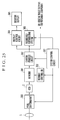
- a circuit (image processing circuit) for driving the aforesaid pixel shifting mechanism will be described below with reference to Fig. 25.
- a pixel shifting unit is disposed in the space between the image pickup lens unit 1 and the image pickup element 2.
- a picked-up image signal outputted from the image pickup element 2 is stored in a memory 301.
- the image data read from the memory 301 is supplied to a camera process circuit 302, and the camera process circuit 302 produces a luminance signal and a chrominance signal.
- the luminance signal and the chrominance signal are supplied to a recording/reproducing system 306 and recorded on a recording medium which not shown.
- the luminance signal and the chrominance signal are also supplied to a display control circuit 304.
- the display control circuit 304 converts both signals into a signal format suited to display on a monitor, and the obtained signal is visually displayed on a monitor display 305.
- the output signal of the camera process circuit 302 may be directly outputted to an external apparatus such as a personal computer through a digital image output terminal DO in the form of a digital image signal.
- the image processing circuit having the above-described arrangement is controlled by a system control circuit 307 composed of a microcomputer.
- a pixel shifting unit 300 is controlled to sequentially control the vertical and horizontal parallel-plane plates, thereby performing pixel shifting.
- the system control circuit 307 controls the parallel-plane plate 3 to perform vertical pixel shifting of four steps and, in each of the four steps, controls the parallel-plane plate 6 to perform horizontal pixel shifting of four steps. Accordingly, it is possible to obtain four images in the vertical direction and four images in the horizontal direction, a total of sixteen images.
- Each of these images is sequentially stored in the memory 301 which is being controlled by a memory controller 303. After all the images have been stored in the memory 301, the images are read from the memory 301 to combine the images into one image, while reading from the memory 301 is being sequentially controlled on a pixel-by-pixel basis.
- the obtained image signal is supplied to the camera process circuit 302, in which it is subjected to luminance signal processing and chrominance signal processing so that an image signal of high image quality can be obtained.
- the signal read from the memory 301 may be outputted to an external apparatus such as a personal computer so that various kinds of image processing can be performed on the side of the external apparatus.
- the number of members which need to have high dimensional accuracy can be minimized, and particular support shafts for controlling the inclination positions of the optical elements can be eliminated, so that it is possible to realize a pixel shifting system which is capable of obtaining a plurality of stable optical positions by means of a simple mechanism which can operate at high speed by a simple control method.
- a plurality of restricting portions for restricting the position of an optical element movable in the direction of the optical axis are formed at the opposite ends of the optical element for shifting the incident position of a light beam on a image pickup surface, and the inclination position of the optical element is controlled by bringing the optical element into selective abutment with the restricting portions.
- a pixel shifting operation basically can be realized by a simple mechanism which only brings the optical element into selective abutment with the restricting portions.
- the optical element is positioned by being selectively brought into direct abutment with the restricting surfaces, an extremely high-speed pixel shifting image pickup operation can be realized.
- the position restricting surfaces are formed before and behind each end portion of the optical element in the direction of the optical axis so that the combination of the position restricting surfaces which each end portion of the optical element selectively comes into abutment with can be modified to control the optical element to cause it to move among a plurality of inclination angles.
- the inclination angle of the optical element can be controlled among various angles by appropriately varying the amount of movement of each end portion of the optical element and the ratio of the amount of movement at one end to the amount of movement at the other end. Accordingly, it is possible to realize high-speed and high-precision pixel shifting by means of an extremely simple arrangement.
- each engagement part of the optical element is brought in point or line contact with either of the corresponding restricting surfaces during selective abutment therewith, even if a variation occurs in the position of engagement of the engagement part of the optical element (parallel-plane plate) with either of the corresponding restricting surfaces and a positional deviation of the engagement part occurs in a plane parallel to the image pickup surface, the angle of inclination of the optical element can be kept constant and such positional deviation can be prevented from affecting the amount of pixel shifting.
- the driving means are composed of a plurality of electromagnets which are provided for the respective restricting surfaces, it is possible to vary the inclination position of the optical member at high speed by means of a simple arrangement which only performs on-off control of the electromagnets.
- the driving means may be composed of elastic members and electromagnets, it is possible to further simplify the arrangement of the pixel shifting system.
- the optical elements include a vertical optical element for vertically shifting the incident position of a light beam on the image pickup surface and a horizontal optical element for horizontally shifting the incident position of a light beam on the image pickup surface, so that it is possible to realize pixel shifting in both vertical and horizontal directions, i.e., a further improvement in image quality.
- a pixel shifting unit having the above-described high-speed, high-precision and simple arrangement can be supplied to various image pickup apparatus in the form of an integrated lens unit, and the adjustment required on a user side can be simplified. It is, therefore, possible to provide a highly versatile system.
Landscapes
- Physics & Mathematics (AREA)
- Engineering & Computer Science (AREA)
- Multimedia (AREA)
- Signal Processing (AREA)
- General Physics & Mathematics (AREA)
- Optics & Photonics (AREA)
- Transforming Light Signals Into Electric Signals (AREA)
- Optical Head (AREA)
Applications Claiming Priority (6)
| Application Number | Priority Date | Filing Date | Title |
|---|---|---|---|
| JP4476/97 | 1997-01-14 | ||
| JP447697 | 1997-01-14 | ||
| JP106047/97 | 1997-04-23 | ||
| JP10604797A JP3684027B2 (ja) | 1997-01-14 | 1997-04-23 | 光学装置及び撮像装置及び画像シフト方法及びレンズユニット |
| JP9195569A JPH10262180A (ja) | 1997-01-14 | 1997-07-22 | 画像シフト装置を備えたレンズユニット及びカメラ |
| JP195569/97 | 1997-07-22 |
Publications (2)
| Publication Number | Publication Date |
|---|---|
| EP0853425A2 true EP0853425A2 (fr) | 1998-07-15 |
| EP0853425A3 EP0853425A3 (fr) | 1999-05-26 |
Family
ID=27276299
Family Applications (1)
| Application Number | Title | Priority Date | Filing Date |
|---|---|---|---|
| EP97305730A Withdrawn EP0853425A3 (fr) | 1997-01-14 | 1997-07-30 | Dispositif de prise de vue |
Country Status (3)
| Country | Link |
|---|---|
| US (1) | US6771310B1 (fr) |
| EP (1) | EP0853425A3 (fr) |
| CA (1) | CA2211986C (fr) |
Cited By (5)
| Publication number | Priority date | Publication date | Assignee | Title |
|---|---|---|---|---|
| EP0899944A3 (fr) * | 1997-08-28 | 1999-05-26 | Canon Denshi Kabushiki Kaisha | Appareil de prise de vues utilisant le décalage des pixels |
| GB2428492A (en) * | 2005-07-14 | 2007-01-31 | Point Source Ltd | Optical apparatus for control of light beam |
| WO2005069746A3 (fr) * | 2004-01-26 | 2007-05-03 | Lg Electronics Inc | Appareil et procede pour afficheur du type a projection |
| EP0871327B1 (fr) * | 1997-04-07 | 2010-09-08 | Canon Denshi Kabushiki Kaisha | Dispositif de prise de vue ayant une plaque de décalage d'image |
| CN106412388A (zh) * | 2015-07-27 | 2017-02-15 | 恩逼真股份有限公司 | 光路改变单元、模块和方法及检测半导体基板的装置 |
Families Citing this family (5)
| Publication number | Priority date | Publication date | Assignee | Title |
|---|---|---|---|---|
| JP4576876B2 (ja) * | 2004-05-10 | 2010-11-10 | 株式会社ニコン | 顕微鏡システム |
| JP4915071B2 (ja) * | 2005-09-22 | 2012-04-11 | 株式会社ニコン | 顕微鏡、およびバーチャルスライド作成システム |
| WO2014044496A2 (fr) * | 2012-09-19 | 2014-03-27 | Asml Netherlands B.V. | Procédé d'étalonnage d'un ensemble actionneur à réluctance, actionneur à réluctance et appareil lithographique comprenant ledit actionneur à réluctance |
| EP3186661B1 (fr) | 2014-08-26 | 2021-04-07 | Massachusetts Institute of Technology | Procédés et appareil pour l'imagerie tridimensionnelle (3d) |
| CN109839791A (zh) * | 2019-03-29 | 2019-06-04 | 北京镭创高科光电科技有限公司 | 一种投影系统及其消除摩尔纹的方法 |
Family Cites Families (9)
| Publication number | Priority date | Publication date | Assignee | Title |
|---|---|---|---|---|
| FR2589251B1 (fr) * | 1985-10-29 | 1988-12-09 | Labo Electronique Physique | Dispositif optique de prise de vue ou de projection |
| DE59107923D1 (de) | 1990-10-30 | 1996-07-18 | Eltro Gmbh | Verfahren und Vorrichtung zur Harmonisierung für Offset und Responsivität bei einem elektrooptischen Zeilen- oder Mosaikdetektor |
| US5400070A (en) * | 1992-10-07 | 1995-03-21 | Eastman Kodak Company | Lever actuated optical offset image sampling system |
| EP0669757B1 (fr) | 1994-02-28 | 2002-11-27 | Canon Kabushiki Kaisha | Dispositif de prise d'image |
| JP3038134B2 (ja) | 1994-06-20 | 2000-05-08 | シャープ株式会社 | 撮像装置 |
| JPH0888785A (ja) * | 1994-09-16 | 1996-04-02 | Toshiba Corp | 画像入力装置 |
| US5877806A (en) * | 1994-10-31 | 1999-03-02 | Ohtsuka Patent Office | Image sensing apparatus for obtaining high resolution computer video signals by performing pixel displacement using optical path deflection |
| JP3652059B2 (ja) * | 1997-04-07 | 2005-05-25 | キヤノン電子株式会社 | 撮像装置及び光学装置 |
| CA2246404A1 (fr) * | 1997-08-28 | 1999-02-28 | Koichi Shimada | Dispositif capteur d'image faisant appel au deplacement de pixels |
-
1997
- 1997-07-29 US US08/902,575 patent/US6771310B1/en not_active Expired - Fee Related
- 1997-07-30 CA CA002211986A patent/CA2211986C/fr not_active Expired - Fee Related
- 1997-07-30 EP EP97305730A patent/EP0853425A3/fr not_active Withdrawn
Cited By (10)
| Publication number | Priority date | Publication date | Assignee | Title |
|---|---|---|---|---|
| EP0871327B1 (fr) * | 1997-04-07 | 2010-09-08 | Canon Denshi Kabushiki Kaisha | Dispositif de prise de vue ayant une plaque de décalage d'image |
| EP0899944A3 (fr) * | 1997-08-28 | 1999-05-26 | Canon Denshi Kabushiki Kaisha | Appareil de prise de vues utilisant le décalage des pixels |
| US6753906B2 (en) | 1997-08-28 | 2004-06-22 | Canon Kabushiki Kaisha | Image sensing apparatus utilizing pixel-shifting |
| WO2005069746A3 (fr) * | 2004-01-26 | 2007-05-03 | Lg Electronics Inc | Appareil et procede pour afficheur du type a projection |
| US7237902B2 (en) | 2004-01-26 | 2007-07-03 | Lg Electronics Inc. | Apparatus and method for projection type display |
| KR100820831B1 (ko) * | 2004-01-26 | 2008-04-11 | 엘지전자 주식회사 | 투사형 디스플레이 장치 및 방법 |
| GB2428492A (en) * | 2005-07-14 | 2007-01-31 | Point Source Ltd | Optical apparatus for control of light beam |
| US7545589B2 (en) | 2005-07-14 | 2009-06-09 | Point Source Limited | Optical assembly |
| GB2428492B (en) * | 2005-07-14 | 2010-02-17 | Point Source Ltd | Optical apparatus for control of laser beam by providing lateral adjustment of lens groups |
| CN106412388A (zh) * | 2015-07-27 | 2017-02-15 | 恩逼真股份有限公司 | 光路改变单元、模块和方法及检测半导体基板的装置 |
Also Published As
| Publication number | Publication date |
|---|---|
| EP0853425A3 (fr) | 1999-05-26 |
| CA2211986A1 (fr) | 1998-07-14 |
| US6771310B1 (en) | 2004-08-03 |
| CA2211986C (fr) | 2001-04-10 |
Similar Documents
| Publication | Publication Date | Title |
|---|---|---|
| US5834761A (en) | Image input apparatus having a spatial filter controller | |
| US5774179A (en) | Method and system for fast microscanning | |
| JP3869907B2 (ja) | レンズ鏡筒およびこれを備えた撮像装置 | |
| EP0899944B1 (fr) | Appareil de prise de vues utilisant le décalage des pixels | |
| US5727239A (en) | Photographing optical apparatus | |
| EP1374601A2 (fr) | Camera stereo numerique a puce de detection simple | |
| JPH1169209A (ja) | 撮像装置 | |
| EP0853425A2 (fr) | Dispositif de prise de vue | |
| EP0871327B1 (fr) | Dispositif de prise de vue ayant une plaque de décalage d'image | |
| EP0680203B1 (fr) | Système de balayage pour la prise ou la projection d'images | |
| US20250306434A1 (en) | Lens apparatus and image pickup apparatus | |
| KR20220018027A (ko) | 다중 채널 이미징 장치 및 다중 조리개 이미징 장치를 갖는 장치 | |
| JP3684027B2 (ja) | 光学装置及び撮像装置及び画像シフト方法及びレンズユニット | |
| JP3200276B2 (ja) | 撮像装置 | |
| JPH1175099A (ja) | 撮像装置及び光学装置 | |
| JP2000032317A (ja) | 光学装置 | |
| JPH10262180A (ja) | 画像シフト装置を備えたレンズユニット及びカメラ | |
| JP3565168B2 (ja) | 広画角範囲撮像方法並びに撮像装置 | |
| JP2002287198A (ja) | 撮像装置における画像安定化装置 | |
| JPH1175107A (ja) | 光学装置及び撮像装置 | |
| JPH08328172A (ja) | 立体映像撮影装置 | |
| JPH09172568A (ja) | 撮像装置 | |
| JPH05111037A (ja) | 固体撮像素子 | |
| JP2001197374A (ja) | 撮像装置及び光学装置 | |
| JPH11355533A (ja) | Ccd解像度を倍増する光学式スキャナ装置およびその方法 |
Legal Events
| Date | Code | Title | Description |
|---|---|---|---|
| PUAI | Public reference made under article 153(3) epc to a published international application that has entered the european phase |
Free format text: ORIGINAL CODE: 0009012 |
|
| AK | Designated contracting states |
Kind code of ref document: A2 Designated state(s): DE FR GB IT NL |
|
| PUAL | Search report despatched |
Free format text: ORIGINAL CODE: 0009013 |
|
| AK | Designated contracting states |
Kind code of ref document: A3 Designated state(s): AT BE CH DE DK ES FI FR GB GR IE IT LI LU MC NL PT SE |
|
| 17P | Request for examination filed |
Effective date: 19991007 |
|
| AKX | Designation fees paid |
Free format text: DE FR GB IT NL |
|
| 17Q | First examination report despatched |
Effective date: 20030416 |
|
| STAA | Information on the status of an ep patent application or granted ep patent |
Free format text: STATUS: THE APPLICATION HAS BEEN WITHDRAWN |
|
| 18W | Application withdrawn |
Effective date: 20051121 |