EP0854507A2 - Précurseur avec un alkoxy-alkyl-silylolefin-ligand pour le depôt de cuivre - Google Patents
Précurseur avec un alkoxy-alkyl-silylolefin-ligand pour le depôt de cuivre Download PDFInfo
- Publication number
- EP0854507A2 EP0854507A2 EP97308529A EP97308529A EP0854507A2 EP 0854507 A2 EP0854507 A2 EP 0854507A2 EP 97308529 A EP97308529 A EP 97308529A EP 97308529 A EP97308529 A EP 97308529A EP 0854507 A2 EP0854507 A2 EP 0854507A2
- Authority
- EP
- European Patent Office
- Prior art keywords
- precursor compound
- precursor
- ligand
- groups
- compound according
- Prior art date
- Legal status (The legal status is an assumption and is not a legal conclusion. Google has not performed a legal analysis and makes no representation as to the accuracy of the status listed.)
- Granted
Links
Images





Classifications
-
- C—CHEMISTRY; METALLURGY
- C23—COATING METALLIC MATERIAL; COATING MATERIAL WITH METALLIC MATERIAL; CHEMICAL SURFACE TREATMENT; DIFFUSION TREATMENT OF METALLIC MATERIAL; COATING BY VACUUM EVAPORATION, BY SPUTTERING, BY ION IMPLANTATION OR BY CHEMICAL VAPOUR DEPOSITION, IN GENERAL; INHIBITING CORROSION OF METALLIC MATERIAL OR INCRUSTATION IN GENERAL
- C23C—COATING METALLIC MATERIAL; COATING MATERIAL WITH METALLIC MATERIAL; SURFACE TREATMENT OF METALLIC MATERIAL BY DIFFUSION INTO THE SURFACE, BY CHEMICAL CONVERSION OR SUBSTITUTION; COATING BY VACUUM EVAPORATION, BY SPUTTERING, BY ION IMPLANTATION OR BY CHEMICAL VAPOUR DEPOSITION, IN GENERAL
- C23C16/00—Chemical coating by decomposition of gaseous compounds, without leaving reaction products of surface material in the coating, i.e. chemical vapour deposition [CVD] processes
- C23C16/06—Chemical coating by decomposition of gaseous compounds, without leaving reaction products of surface material in the coating, i.e. chemical vapour deposition [CVD] processes characterised by the deposition of metallic material
- C23C16/18—Chemical coating by decomposition of gaseous compounds, without leaving reaction products of surface material in the coating, i.e. chemical vapour deposition [CVD] processes characterised by the deposition of metallic material from metallo-organic compounds
-
- C—CHEMISTRY; METALLURGY
- C07—ORGANIC CHEMISTRY
- C07F—ACYCLIC, CARBOCYCLIC OR HETEROCYCLIC COMPOUNDS CONTAINING ELEMENTS OTHER THAN CARBON, HYDROGEN, HALOGEN, OXYGEN, NITROGEN, SULFUR, SELENIUM OR TELLURIUM
- C07F19/00—Metal compounds according to more than one of main groups C07F1/00 - C07F17/00
-
- C—CHEMISTRY; METALLURGY
- C07—ORGANIC CHEMISTRY
- C07F—ACYCLIC, CARBOCYCLIC OR HETEROCYCLIC COMPOUNDS CONTAINING ELEMENTS OTHER THAN CARBON, HYDROGEN, HALOGEN, OXYGEN, NITROGEN, SULFUR, SELENIUM OR TELLURIUM
- C07F7/00—Compounds containing elements of Groups 4 or 14 of the Periodic Table
- C07F7/02—Silicon compounds
- C07F7/08—Compounds having one or more C—Si linkages
- C07F7/18—Compounds having one or more C—Si linkages as well as one or more C—O—Si linkages
- C07F7/1804—Compounds having Si-O-C linkages
Definitions
- This invention relates generally to integrated circuit processes and fabrication, and more particularly, to a precursor and method, having enhanced temperature stability, used to deposited copper on selected integrated circuit surfaces.
- interconnects and vias there is a need for interconnects and vias to have both low resistivity, and the ability to withstand process environments of volatile ingredients.
- Aluminum and tungsten metals are often used in the production of integrated circuits for making interconnections or vias between electrically active areas. These metals are popular because they are easy to use in a production environment, unlike copper which requires special handling.
- Copper would appear to be a natural choice to replace aluminum in the effort to reduce the size of lines and vias in an electrical circuit.
- the conductivity of copper is approximately twice that of aluminum and over three times that of tungsten. As a result, the same current can be carried through a copper line having nearly half the width of an aluminum line.
- the electromigration characteristics of copper are also much superior to those of aluminum. Aluminium is approximately ten times more susceptible than copper to degradation and breakage due to electromigration. As a result, a copper line, even one having a much smaller cross-section than an aluminum line, is better able to maintain electrical integrity.
- the technique is not selective with regard to surfaces.
- adjoining non-conductive surfaces must either be masked or etched clean in a subsequent process step.
- photoresist masks and some other adjoining IC structures are potentially damaged at the high temperatures at which copper is processed.
- the CVD technique is an improvement over PVD because it is more selective as to which surfaces copper is deposited on.
- the CVD technique is selective because it is designed to rely on a chemical reaction between the metallic surface and the copper vapor to cause the deposition of copper on the metallic surface.
- copper is combined with a ligand, or organic compound, to help insure that the copper compound becomes volatile, and eventually decomposes, at consistent temperatures. That is, copper becomes an element in a compound that is vaporized into a gas, and later deposited as a solid when the gas decomposes. Selected surfaces of an integrated circuit, such as diffusion barrier material, are exposed to the copper gas, or precursor, in an elevated temperature environment. When the copper gas compound decomposes, copper is left behind on the selected surface.
- ligand or organic compound
- Cu +2 (hfac) 2 or copper (II) hexafluoroacetylacetonate, precursors have previously been used to apply CVD copper to IC substrates and surfaces.
- these Cu +2 precursors are notable for leaving contaminates in the deposited copper, and for the relatively high temperatures that must be used to decompose the precursor into copper.
- Cu +1 (hfac) compounds to apply copper. Norman, et al., U.S. Patent No.
- 5,322,712 discloses a (hfac)Cu(tmvs), or copper hexafluoroacetylacetonate trimethylvinylsilane, precursor that is the industry standard at the time of this writing.
- tmvs is known as vtms, or vinyltrimethylsilane.
- This precursor is useful because it can be used at relatively low temperatures, approximately 200°C.
- the film resisitivity of copper applied with this method is very good, approaching the physical limit of 1.7 ⁇ -cm.
- the adhesiveness between copper deposited with this precursor and the surface to which it is deposited is not always good.
- the precursor is not especially stable, and can have a relatively short shelf life if not refrigerated.
- (hfac)Cu(tmvs) becomes unstable, and begins to decompose, above 35° C.
- Use of a (hfac)Cu(tmvs) precursor stored at this temperature leads to undesirable process results.
- the precursor is a liquid at room temperature, and must be converted to a vapor form.
- the vaporized precursor In interacting with a heated target surface, the vaporized precursor first cleaves the tmvs ligand, and then the hfac, leaving Cu on the target surface. During this process a disproportionation reaction occurs in which unchanged atoms of Cu are left on the surface, while volatile forms of Cu +2 (hfac) 2 and the tmvs ligand are exhausted through the system.
- the tmvs ligand cleaves unevenly from the precursor, some cleavage, or decomposition, occurs at low temperature, and some at higher temperatures. Because the precursor decomposes at low temperatures, the precursor vacuum pressure, or partial pressure, remains undesirably low, resulting in low Cu deposition rates, uneven surfaces, and variances in surface conductances. The effectivity of (hfac)Cu(tmvs) stored at temperatures lower than 35° C is also unpredictable. A "fresh" batch of precursor, or precursor stored at temperatures well below room temperature, is used to guarantee predictable processes.
- a Cu precursor comprising a ligand of methoxy and methyl groups is disclosed in an U.S. application Serial No. 08/779,640, filed Jan. 7, 1997, entitled “Precursor with (Methoxy)(methyl)silylolefin Ligands to Deposit Cu and Method for Same", invented by Senzaki et al., Attorney Docket No. SMT 252, and assigned to the same assignee as the instant patent.
- the disclosed precursor permits either one or two methoxy groups to be bonded to the silicon atom of the ligand. That is, the precursor can be "fine tuned" using ligands having more methoxy groups than tmvs, but less than tmovs are provided.
- the oxygen atoms in the methoxy groups contribute electrons to the Cu atoms, to strengthen the Cu-olefin bond, and so, prevent the premature decomposition of the precursor in storage, or as the precursor is heated for the application of Cu to an IC surface.
- hydrocarbon groups of one carbon atom, CH 3 (methyl) and OCH 3 (methoxy) are disclosed.
- the ligand attached to the Cu(hfac) precursor would cleave at a consistent temperature. Additionally, it would be advantageous if the alkene ligand and the hfac would cleave at approximately the same temperature to yield consistent precursor decomposition.
- the deposition temperature, or temperature at which the (hfac)Cu(ligand) compound decomposes could be decreased to simplify commercial processes.
- a high precursor vapor pressure could be maintained at these relatively low decomposition temperatures to deposit a thicker layer of copper on selected IC surfaces.
- the vapor pressure of the precursor in the gas phase could be modified with different combinations of alkyloxy and alkyl groups.
- water, H-hfac, H-hfac dihydrate (H-hfac ⁇ 2H 2 O), and silylolefin ligand additives here no longer necessary to blend with a Cu precursor to improve the thermal stability of the Cu precursor, and to improve the conductivity and deposition rate of the deposited copper.
- a volatile Cu precursor compound for the chemical vapor deposition (CVD) of Cu to selected surfaces comprises Cu +1 (hexafluoroacetylacetonate), or Cu +1 (hfac), and a silylolefin ligand including at least one ethoxy group bonded to the silicon atom, with any remaining bonds to the silicon atom being made to ethyl groups. That is, one of the three single bonds to the silicon atom of the ligand is made to an ethoxy group.
- the electron donation capability of the oxygen in the ethoxysilylolefin ligand provide a secure bond between the Cu and the ethoxysilylolefin ligand as the compound is heated to vaporization temperature.
- Prior art precursors have typically used methyl and methoxy groups bonded to silicon.
- three ethoxy groups are bonded to the silicon atom, yielding triethoxyvinylsilane (teovs), whereby the three oxygen atoms of the triethoxy group donate electrons to Cu to increase the temperature stability of the precursor.
- two ethoxy groups and one ethyl group are bonded to the silicon atom, yielding diethoxyethylvinylsilane (deoevs), whereby the two oxygen atoms of the diethoxyethyl group donate electrons to Cu to increase the temperature stability of the precursor.
- one ethoxy group and two ethyl groups are bonded to the silicon atom, yielding ethoxydiethylvinylsilane (eodevs), whereby the molecular weight of the oxygen atom of the ethoxyethyl group minimally suppresses the precursor volatility. Therefore, a ligand providing oxygen atom electrons from either one, two, or three, ethoxy groups is disclosed.
- a volatile Cu precursor compound comprising Cu +1 (hfac), and a silylolefin ligand including at least one alkyloxy group, having at least two carbon atoms, bonded to the silicon atom. That is, the ligand contains an alkyloxy group from the group consisting of ethoxy, propoxy, butoxy, pentyloxy, hexyloxy, heptyloxy, and octyloxy.
- the electron donation capability of the oxygen in said alkyloxysilylolefin ligand provides a secure bond between the Cu and the alkyloxysilylolefin ligand as the compound is heated to vaporization temperature.
- a preferred embodiment further includes alkyl groups bonded the silicon atom of the ligand, in addition to alkyloxy groups.
- a preferred embodiment further includes an addition to the compound to create a precursor blend.
- the precursor blend further comprises a water vapor having a vacuum partial pressure.
- the water vapor is blended with the precursor so that the partial pressure of the water vapor is generally in the range of 0.5 to 5% of the precursor partial pressure, whereby the addition of water vapor to the precursor increases the rate of Cu deposition.
- a method for applying chemical vapor deposition (CVD) Cu on a selected surface comprising the steps of: a) exposing each selected Cu-receiving surface to a volatile Cu precursor compound including Cu +1 (hfac) and a silylolefin ligand, the ligand includes at least one ethoxy group bonded to the silicon atom, with any remaining bonds to the silicon atom being made to ethyl groups, during this step the precursor has a predetermined vacuum pressure; and b) while continuing to carry out step a), depositing Cu on each Cu-receiving surface.
- the bond between the ethoxysilylolefin ligand and Cu prevents the decomposition of the precursor at low temperatures.
- a method for applying CVD Cu using a silylolefin ligand including at least one alkyloxy group, having at least two carbon atoms, bonded to the silicon is also provided.
- Fig. 1 is a schematic representation of the tmvs ligand (prior art).
- Fig. 2 is a schematic representation of the tmovs ligand (prior art).
- Fig. 3a is a schematic representation of the Cu precursor with (methoxy)(methyl) ligand of the U.S. patent application Serial No. 08/779,640 Attorney Docket No. SMT 252.
- Fig. 3b is a schematic representation of an embodiment of the (methoxy)(methyl)silylolefin ligand of Fig. 3a, where the ligand is a dimethoxymethylvinylsilane (dmomvs) ligand.
- dmomvs dimethoxymethylvinylsilane
- Fig. 3c is a schematic representation of another embodiment of the (methoxy)(methyl)silylolefin ligand of Fig. 3a, where the ligand is a methoxydimethylvinylsilane (modmvs) ligand.
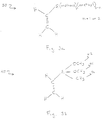
- Fig. 4a is a schematic representation of the volatile Cu precursor compound of the present invention, using an (ethoxy)(ethyl)silylolefin ligand, for the chemical vapor deposition (CVD) of Cu to selected surfaces.
- Fig. 4b is a schematic representation of a preferred embodiment of the precursor of Fig. 4a, where the (ethoxy)(ethyl)silylolefin ligand is a triethoxyvinylsilane (teovs) ligand.
- the (ethoxy)(ethyl)silylolefin ligand is a triethoxyvinylsilane (teovs) ligand.
- Fig. 4c is a schematic representation of another preferred embodiment of the precursor of Fig. 4a, where the (ethoxy)(ethyl)silylolefin ligand is a diethoxyethylvinylsilane (deoevs) ligand.
- the (ethoxy)(ethyl)silylolefin ligand is a diethoxyethylvinylsilane (deoevs) ligand.
- Fig. 4d is a schematic representation of another preferred embodiment of the precursor of Fig. 4a, where the (ethoxy)(ethyl)silylolefin ligand is a ethoxydiethylvinylsilane (eodevs) ligand.
- Fig. 5 is a schematic representation of the volatile Cu precursor compound of the present invention, using an (alkyloxy)(alkyl)silylolefin ligand, for the chemical vapor deposition (CVD) of Cu to selected surfaces.
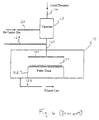
- Fig. 6 is a block diagram of apparatus suitable to deposit Cu, with the precursor of the present invention, to selected surfaces (prior art).
- Fig. 7 illustrates steps in the method of applying CVD Cu, using the (ethoxy)(ethyl)silylolefin ligand, on a selected surface.
- Fig. 8 illustrates steps in the method of applying CVD Cu, using a precursor including an (alkyloxy)(alkyl)silylolefin ligand, on a selected surface.
- Fig. 1 is a schematic representation of the tmvs ligand 10 (prior art).
- the double lines between the two carbon atoms represent double bonds, while the single lines between the remaining atoms represent, weaker, single bonds.
- Cu becomes attached to tmvs ligand 10 through the carbon atoms.
- Cu and hfac form a relatively secure bond, and the resulting Cu +1 (hfac) -1 complex has no net electrical charge.
- atoms or complexes having opposite charges combine to form very stable complexes.
- the bonding between the Cu +1 (hfac) -1 complex, hereafter called Cu(hfac) or (hfac)Cu, and ligand 10 is relatively weak due to lack of opposing net charges. For this reason, tmvs ligand 10 is first to cleave from the Cu precursor as it is vaporized and applied to a target surface. While not intending to be bound by theory, it is believed that if the ligand were able to provide more electrons, the bond between the ligand and the Cu(hfac) could be improved, resulting in a Cu precursor with improved temperature stability.
- Fig. 2 is a schematic representation of the tmovs ligand 20 (prior art).
- the difference between tmovs ligand 20 and tmvs ligand 10 of Fig. 1 is in the addition of three oxygen atoms to the three methyl groups to form three methoxy groups bound to the silicon atom. It is believed that the oxygen atoms of tmovs ligand 20 readily donate electrons to the Cu(hfac) complex, and so, allow tmovs ligand 20 to more tightly bind itself to Cu(hfac).
- the higher molecular weight of the three additional oxygen atoms will typically result in higher vaporization temperatures.
- the present invention was invented in response to the need for a precursor that could be modified to adjust the number of oxygen atoms, and the type of hydrocarbon groups, comprising the ligand.
- Fig. 3a is a schematic representation of the (methoxy)(methyl) ligand 30 of the U.S. patent application Serial No. 08/779,640, entitled “Precursor with (Methoxy)(methyl)silylolefin Ligands to Deposit Cu and Method for Same", invented by Senzaki et al., Attorney Docket No. SMT 252.
- This invention is invented to bridge the gap between ligand 10 (Fig. 1) with three methyl groups (CH 3 ), and ligand 20 (Fig. 2) with three methoxy groups (OCH 3 ).
- Ligand 30 includes at least one methoxy group bonded to the silicon atom.
- the electron donation capability of the oxygen in the (methoxy)(methyl)silylolefin ligand provides a secure bond between the Cu and the (methoxy(methyl)silylolefin ligand as the compound is heated to vaporization temperature.
- Fig. 3b is a schematic representation of an embodiment of (methoxy)(methyl)silylolefin ligand 30 of Fig. 3a, where the ligand is a dimethoxymethylvinylsilane (dmomvs) ligand 40.
- Ligand 40 includes two methoxy groups 42 and 44 (OCH 3 ), and one methyl group 46 (CH 3 ). The two oxygen atoms of the dimethoxymethyl group donate electrons to Cu to increase the temperature stability of the precursor.
- Fig. 3c is a schematic representation of another embodiment of (methoxy)(methyl)silylolefin ligand 30 of Fig. 3a, where the ligand is a methoxydimethylvinylsilane (modmvs) ligand 50.
- Ligand 50 includes one methoxy group 52 and two methyl groups 54 and 56. The single oxygen atom of the methoxydimethyl group minimally suppresses the precursor volatility, since ligand 50 has a relatively small molecular weight compared to the ligands 30 (Fig. 3a) and 40 (Fig. 3b).
- Fig. 4a is a schematic representation of the volatile Cu precursor compound 60 of the present invention, using an (ethoxy)(ethyl)silylolefin ligand, for the chemical vapor deposition (CVD) of Cu to selected surfaces.
- Precursor compound 60 comprises Cu +1 (hfac), and a silylolefin ligand including at least one ethoxy group (OC 2 H 5 ) bonded to the silicon atom. The remaining bonds to the silicon atom are made to ethyl groups (C 2 H 5 ).
- the three hydrocarbon groups bonded to the silicon are one of the following combinations: 3 ethoxy groups, 2 ethoxy groups and 1 ethyl group, or 1 ethoxy group and 2 ethyl groups.
- the electron donation capability of the oxygen in the ethoxysilylolefin ligand provides a secure bond between the Cu and the ethoxysilylolefin as compound 60 is heated to vaporization temperature.
- the electron donation capability of the long carbon chain ethyl groups also helps provide a secure bond between the ligand and the Cu.
- Fig. 4b is a schematic representation of a preferred embodiment of precursor 60 of Fig. 4a, where the (ethoxy)(ethyl)silylolefin ligand is a triethoxyvinylsilane (teovs) ligand 70.
- the (ethoxy)(ethyl)silylolefin ligand is a triethoxyvinylsilane (teovs) ligand 70.
- Three ethoxy groups (OC 2 H 5 ) 72-76 are bonded to the silicon atom, yielding teovs.
- the three oxygen atoms of the triethoxy group donate electrons to Cu to increase the temperature stability of compound 60.
- Fig. 4c is a schematic representation of another preferred embodiment of precursor 60 of Fig. 4a, where the (ethoxy)(ethyl)silylolefin ligand is a diethoxyethylvinylsilane (deoevs) ligand 80.
- the two ethoxy groups 82-84 and one ethyl group 86 are bonded to the silicon atom, yielding deoevs.
- the two oxygen atoms of the diethoxyethyl group donate electrons to Cu to increase the temperature stability of precursor 60.
- Ligand 80 has fewer oxygen atoms than ligand 70, and therefore, fewer electrons to donate. However, the molecular weight of ligand 80, for the same reason, is less than ligand 70.
- the ability to adjust the molecular weight of compound 60 is useful is adjusting the vaporization temperatures and vacuum pressures of precursor 60 to fit specific process requirements.
- Fig. 4d is a schematic representation of another preferred embodiment of precursor 60 of Fig. 4a, where the (ethoxy)(ethyl)silylolefin ligand is a ethoxydiethylvinylsilane (eodevs) ligand 90.
- the (ethoxy)(ethyl)silylolefin ligand is a ethoxydiethylvinylsilane (eodevs) ligand 90.
- One ethoxy group 92 and two ethyl groups 94 and 96 are bonded to the silicon atom, yielding eodevs.
- the molecular weight of the oxygen atom of the ethoxydiethyl group minimally suppresses the precursor volatility.
- ligand 90 has the smallest molecular weight.
- Fig. 5 is a schematic representation of the volatile Cu precursor compound 100 of the present invention, using an (alkyloxy)(alkyl)silylolefin ligand, for the chemical vapor deposition (CVD) of Cu to selected surfaces.
- Precursor compound 100 comprises Cu +1 (hfac), and a silylolefin ligand including at least one alkyloxy group, having at east two carbon atoms, bonded to the silicon atom.
- Hydrocarbon groups are generally organized into groups that include 1 through 8 carbon atoms, also represented herein as C1-C8.
- Alkyloxy groups are hydrocarbons that additionally include oxygen atoms.
- the alkyloxy groups further include methoxy (C1) when at least one other alkyloxy group, having at least two carbon atoms, is bonded to the silicon atom. That is, when two alkyloxy groups are present, one of the alkyloxy groups, in some embodiments, is method. When three alkyloxy groups are present, some embodiments include one methoxy group, and other embodiments include two methoxy groups.
- Ligand 100 further includes alkyl groups bonded to the silicon atom. That is, both alkyloxy and alkyl groups are bound to the silicon atom, with at least one group being an alkyloxy group.
- Alkyl groups generally have 1, 2, 3, 4, 5, 6, 7, or 8 carbon atoms (C1-C8). That is, the alkyl groups consist of methyl, ethyl, propyl, butyl, pentyl, hexyl, heptyl, and octyl.
- the alkyl groups also consist of aryl groups including phenyl. Further, when two alkyl groups are bonded to the silicon atom, some embodiments include alkyl groups with different numbers of carbon atoms.
- ligand 100 includes an ethyl group and a propyl group.
- alkyl groups and alkyloxy groups bonded to the same silicon atom also have different numbers of carbon atoms.
- an ethoxy group is included with a propyl group.
- the X groups are three ethoxy groups 72-76, as depicted in Fig. 4b. In another embodiment, the X groups are two ethoxy groups 82-84 and one ethyl group 86, as depicted in Fig. 4c. In one embodiment the X groups are one ethoxy group 92 and two ethyl groups 94-96, as depicted in Fig. 4d.
- a complete listing of all the alkyloxy/alkyl group combinations possible under the above structural formula is quite long and well known to those skilled in the art. Therefore, these other specific embodiments under the formula will not be listed herein.
- the X groups further include C1 (methoxy) alkyloxy groups when at least one X group is a C2-C8 alkyloxy group.
- the X groups are two ethoxy groups and one methyl group.
- the X groups are one ethoxy group and two methyl groups.
- the X groups are two methoxy groups and one ethyl group, in another, the X groups are one methoxy group and two ethyl groups.
- alkyl and alkyloxy groups are generally arranged in either straight chains, branched chains, or cyclic chains, although combination chain arrangements also exist.
- the chains include both single bond and double bond arrangements between carbon atoms to form saturated and unsaturated groups of alkyls and alkyloxys.
- Fig. 5 represents all these possible (alkyloxy)(alkyl) variations.
- the X groups are saturated and unsaturated straight carbon chains, and saturated and unsaturated branched carbon chains.
- X groups also include C3-C8 cyclic alkyl and aryl groups, as well as C3-C8 cyclic alkyloxy and aryloxy groups. These cyclic X groups chains are saturated and unsaturated.
- compound 100 of Fig. 5 includes an additive to create a precursor blend. While not intending to be bound by theory, it is believed that organic components, such as silylolefins, H-hfac, and H-hfac dihydrate decrease precursor viscosity, making control over the flow of a precursor more precise.
- the precursor blend further comprises water vapor having a vacuum partial pressure as it is blended with precursor compound 100. The water vapor is blended with precursor 100 so that the partial pressure of said water vapor is generally in the range of 0.5 to 5% of precursor 100 partial pressure.
- Precursor 100 partial pressure is the percentage of the entire system pressure than is a result of the pressure of compound 100 after it is volatilized and mixed with a carrier gas. The addition of said water vapor to precursor 100 increases the rate of Cu deposition.
- Fig. 6 is a block diagram of apparatus suitable to deposit Cu, with the precursor of the present invention, to selected surfaces (prior art).
- An environmental chamber 110 is capable of maintaining a pressurized environment. Inside chamber 110 is a wafer chuck 112, and upon wafer chuck 112 is an IC, or wafer, having a selected, or Cu-receiving, surface 114.
- Cu precursor in its liquid form, is introduced into line 116, and then into vaporizer 118, where the precursor is heated until it is volatile.
- Helium, or some other inert carrier gas is introduced into line 120, and then into vaporizer 118, where it is mixed with the volatile precursor.
- the volatile precursor and carrier gas are carried through a line 122 to chamber 110.
- the precursor/carrier gas mixture is dispersed through a showerhead 124, or some other equivalent gas dispersal means. Exhaust gases exit chamber 110 through a line 126. Line 126 is connected to a pump (not shown) to maintain a predetermined vacuum pressure in chamber 110.
- Line 128 is used to introduce additives to the volatile precursor, typically the additives are in a volatile or gaseous form.
- the water vapor additive mentioned above in discussing Fig. 5, is typically introduced through line 128.
- additives are pre-packaged in the liquid precursor, or mixed with the liquid precursor compound in line 116.
- the Cu precursor in line 116 is vaporized, in vaporizer 118, at a temperature generally in the range between 40° C and 80° C.
- the Cu precursor in line 122 applied, through showerhead 124, to each selected surface 114 has a temperature generally in the range between 40° C and 80° C.
- the Cu precursor is delivered in line 122 to each selected surface 114 with an inert gas.
- the inert gas, introduced in line 120, has a vacuum partial pressure generally in the range of 50% to 1000% of the precursor partial pressure.
- the compound includes an additive to create a precursor blend, with the precursor blend further comprising less than approximately 5% hexafluoroacetylacetone (H-hfac), as measured by weight ratio of the precursor compound.
- H-hfac hexafluoroacetylacetone
- the H-hfac additive facilitates a Cu disproportionation reaction which enhances the Cu deposition rate.
- the disproportionation reaction causes the (hfac) -1 Cu +1 to reconfigure the Cu atoms into either Cu +0 or Cu +2 atoms.
- the uncharged Cu atoms become deposited on the selected surface, as an (hfac) 2 Cu +2 complex and the ligand exit the process as exhaust gases in line 126.
- the precursor compound includes an additive to create a precursor blend, in which the precursor blend further comprises less than approximately 10% silylolefins, as measured by weight ratio of the precursor compound.
- the silylolefins are added to prevent the Cu from prematurely decomposing as the precursor is heated.
- the additional silylolefins help stabilize the precursor, if the ligand prematurely cleaves, by forming bonds with (hfac)Cu.
- the silylolefins are selected from the group consisting of trimethylvinylsilane (tmvs), dimethoxymethylvinylsilane (dmomvs), methoxydimethylvinylsilane (modmvs), trimethoxyvinylsilane (tmovs), triethoxyvinylsilane (teovs), ethoxymethoxymethylvinylsilane (eomomvs), diethoxymethylvinylsilane (deomvs), diethoxymethoxyvinylsilane (deomovs), ethoxydimethoxyvinylsilane (eodmovs), ethoxydiethylvinylsilane (eodevs), diethoxyethylvinylsilane (deoevs), dimethoxyethylvinylsilane (dmoevs), ethoxydimethylvinylsilane
- Methyl and ethyl (alkyloxy)(alkyl) combinations are listed above. A complete listing of all C1-C8 combinations would be burdensome to the reader and is obvious to those skilled in the art.
- the (alkyloxy)(alkyl) combination include saturated and unsaturated straight, branched, and cyclic carbon chain arrangements. Combination carbon chain arrangements are also included.
- the possible alkyl groups include methyl (C1), ethyl (C2), propyl (C3), butyl (C4), pentyl (C5), hexyl (C6), heptyl (C7), octyl (C8) groups, aryl groups, or combinations of these alkyl groups.
- the possible alkyloxy groups include methoxy (C1), ethoxy (C2), propoxy (C3), butoxy (C4), pentyloxy (C5), hexyloxy (C6), heptyloxy (C7), octyloxy (C8) groups, aryloxy groups or combinations of these alkyloxy groups.
- combination carbon chain arrangements are also included.
- the precursor compound includes an additive to create a precursor blend, the blend further comprises less than approximately 5% H-hfac ⁇ 2H 2 O, as measured by weight ratio of the precursor compound, to increase the deposition rate of Cu.
- the addition of water to the precursor generally increases the deposition rate of Cu on a selected surface.
- the precursor compound includes an additive to create a precursor blend
- the blend further comprises less than approximately 0.4% H-hfac ⁇ 2H 2 O, as measured by weight ratio of the precursor compound, and less than approximately 5% silylolefins, as measured by weight ratio of the precursor compound, to increase the deposition rate of Cu.
- the additional silylolefins help stabilize the precursor as it is heated.
- Fig. 7 illustrates steps in the method for applying CVD Cu, using the (ethoxy)(ethyl)silylolefin ligand, on a selected surface.
- Step 130 provides a selected surface for the application of CVD Cu.
- Step 132 exposes each selected Cu-receiving surface to a volatile Cu precursor compound including Cu +1 (hfac) and a silylolefin ligand Including at least one ethoxy group bonded to the silicon atom, with any remaining bonds to the silicon atom being made to ethyl groups.
- the precursor is applied at a predetermined vacuum pressure.
- Step 134 while continuing to carry out Step 132, deposits Cu on each Cu-receiving surface.
- Step 136 is a product, Cu deposited on a selected surface with a precursor having a bond between the ethoxysilylolefin ligand and Cu which prevents the decomposition of the precursor at low temperatures. While it is desirable to deposit Cu at relatively low temperatures (below 200° C), it is not desirable that the precursor begins the decomposition process at room storage temperatures or process delivery temperatures.
- Fig. 8 illustrates steps in the method for applying CVD Cu, using the (alkyloxy)(alkyl)silylolefin ligand, on a selected surface.
- Step 140 provides a selected surface for the application of CVD Cu.
- Step 142 exposes each selected Cu-receiving surface to a volatile Cu precursor compound including Cu +1 (hfac) and a silylolefin ligand including at least one alkyloxy group, having at least two carbon atoms, bonded to the silicon.
- the precursor is applied at a predetermined vacuum pressure.
- Step 144 while continuing to carry out Step 142, deposits Cu on each Cu-receiving surface.
- Step 146 is a product, Cu deposited on a selected surface with a precursor having a bond between the alkyloxysilylolefin ligand and Cu which prevents the decomposition of the precursor at low temperatures.
- the preferred embodiment includes the further step of, simultaneously with Step 142, exposing each selected Cu-receiving surface to water vapor at a vacuum partial pressure generally in the range between 0.5 and 5% of the precursor partial pressure.
- a vacuum partial pressure generally in the range between 0.5 and 5% of the precursor partial pressure.
- the Cu-receiving, or selected surface, of the above method is equivalent to selected surface 114 in Fig. 6.
- Each Cu-receiving surface in Step 144 has a temperature generally in the range between 160 and 250° C, and the Cu precursor vapor applied to each selected surface 114 has a temperature generally in the range bet-been 40 and 80° C. It is the relatively high temperature of the target surface that preferably causes the Cu precursor to decompose, and so deposit uncharged Cu atoms on the surface.
- Cu is deposited on each Cu-receiving surface in Step 144 for a time generally in the range between 100 and 1000 seconds. That is, the controlled deposition process occurs within 100 to 1000 seconds.
- the Cu precursor of the present invention is prepared in accordance with methods suggested by prior art synthesis methods.
- a suitable synthesis method is based on an approach taken by Doyle et al., in "Alkene and Carbon Monoxide Derivatives of Copper (I) and Silver (I) ⁇ -Diketonates", Organometallics, 1985, 4, pp. 830-835.
- the Cu precursor is obtained through the following reaction: Cu 2 O + 2 H-hfac + 2 L ⁇ 2 (hfac)CuL +H 2 O where L is the silylolefin ligand.
- Table 1 is a chart listing the deposition thickness and resistivity of Cu deposited using the precursor of the present invention and the apparatus depicted in Fig. 6.
- the teovs ligand embodiment of the invention was chosen for the experiment.
- the precursor was used to deposit Cu on a 6" diameter substrate covered with a 2000 ⁇ thick layer of silicon dioxide deposited from tetraethoxysilane (TEOS oxide), which is in turn covered with a 500 ⁇ thick layer of TiN.
- TEOS oxide tetraethoxysilane
- Cu-receiving surface 114 had a temperature of approximately 195° C.
- the deposition time for both depositions was approximately 600 seconds.
- the precursor flow rate in line 116 was approximately 0.5cc/min.
- Table 2 is a chart listing comparing the deposited thicknesses, deposition times, and resistivities of a prior art Cu precursors.
- the precursors are as follows:
- the precursor of the present invention discloses various combinations of alkyloxy groups and alkyl groups in the ligand which offer a wide range of improvements over prior art Cu precursors.
- the use of alkyloxy groups in the ligand increases the stability and shelf life of the precursor, since the electrons of the oxygen atoms are contributed to the Cu atom as the compound begins to decompose. Having the option of adjusting the ratio of alkyloxy groups to alkyl groups permits the user to select a precursor with the molecular weight optimal for a specific CVD process.
- a liquid CVD precursor is generally more capable or precise delivery and reproducibility in most CVD systems.
- One of the main advantages of the precursor of the present invention is that good deposition rates, thermal stability, and Cu conductivity are obtainable without the necessity of blending the precursor with water and organic additives.
- alternate embodiments of the precursor permit it to be blended with water, silylolefins, H-hfac, H-hfac dihydrate, and combinations of additives to provide further enhancements.
- These additives are blended with the precursor in either its liquid or volatile state. Specific combinations of ethoxy and ethyl group in the ligand have been emphasized in the above specification. Other embodiments of the invention will occur to those skilled in the art.
Landscapes
- Chemical & Material Sciences (AREA)
- Organic Chemistry (AREA)
- General Chemical & Material Sciences (AREA)
- Chemical Kinetics & Catalysis (AREA)
- Engineering & Computer Science (AREA)
- Materials Engineering (AREA)
- Mechanical Engineering (AREA)
- Metallurgy (AREA)
- Chemical Vapour Deposition (AREA)
- Electrodes Of Semiconductors (AREA)
Applications Claiming Priority (2)
| Application Number | Priority Date | Filing Date | Title |
|---|---|---|---|
| US08/786,546 US5767301A (en) | 1997-01-21 | 1997-01-21 | Precursor with (alkyloxy)(alkyl)-silylolefin ligand to deposit copper |
| US786546 | 1997-01-21 |
Publications (3)
| Publication Number | Publication Date |
|---|---|
| EP0854507A2 true EP0854507A2 (fr) | 1998-07-22 |
| EP0854507A3 EP0854507A3 (fr) | 1999-04-14 |
| EP0854507B1 EP0854507B1 (fr) | 2006-06-07 |
Family
ID=25138902
Family Applications (1)
| Application Number | Title | Priority Date | Filing Date |
|---|---|---|---|
| EP97308529A Expired - Lifetime EP0854507B1 (fr) | 1997-01-21 | 1997-10-24 | Précurseur avec un alkoxy-vinylesilane-ligand pour le depôt de cuivre |
Country Status (6)
| Country | Link |
|---|---|
| US (1) | US5767301A (fr) |
| EP (1) | EP0854507B1 (fr) |
| JP (1) | JP4132152B2 (fr) |
| KR (1) | KR100277305B1 (fr) |
| DE (1) | DE69736054T2 (fr) |
| TW (1) | TW462995B (fr) |
Cited By (2)
| Publication number | Priority date | Publication date | Assignee | Title |
|---|---|---|---|---|
| EP0852229A3 (fr) * | 1997-01-07 | 1999-07-07 | Sharp Kabushiki Kaisha | Précurseur contenant des ligands méthoxymethylsilyloléfine pour le dépÔt de cuivre |
| GB2348888A (en) * | 1999-04-13 | 2000-10-18 | Hyundai Electronics Ind | Forming copper wiring using as precursor (hfac)Cu(VTMOS) |
Families Citing this family (25)
| Publication number | Priority date | Publication date | Assignee | Title |
|---|---|---|---|---|
| US5939334A (en) * | 1997-05-22 | 1999-08-17 | Sharp Laboratories Of America, Inc. | System and method of selectively cleaning copper substrate surfaces, in-situ, to remove copper oxides |
| KR100296959B1 (ko) * | 1998-01-19 | 2001-09-22 | 정명식 | 구리의 화학 증착에 유용한 유기 구리 전구체 |
| JP2002530520A (ja) * | 1998-08-03 | 2002-09-17 | アドバンスド.テクノロジー.マテリアルズ.インコーポレイテッド | ミクロ電子工学素子構造体の製造のための銅前駆組成物及びその形成プロセス |
| KR20000013302A (ko) | 1998-08-06 | 2000-03-06 | 최형수 | 화학 증착법을 위한 유기 구리 전구체 |
| KR100566905B1 (ko) * | 1998-09-11 | 2006-07-03 | 에이에스엠지니텍코리아 주식회사 | 표면 촉매를 이용한 화학 증착방법_ |
| JP2000087241A (ja) * | 1998-09-15 | 2000-03-28 | Sharp Corp | 前駆体を(アルキルオキシ)(アルキル)シリロレフィンリガンドと共に用いる銅堆積方法 |
| US6037001A (en) * | 1998-09-18 | 2000-03-14 | Gelest, Inc. | Method for the chemical vapor deposition of copper-based films |
| US6066196A (en) * | 1998-09-18 | 2000-05-23 | Gelest, Inc. | Method for the chemical vapor deposition of copper-based films and copper source precursors for the same |
| US7012292B1 (en) * | 1998-11-25 | 2006-03-14 | Advanced Technology Materials, Inc | Oxidative top electrode deposition process, and microelectronic device structure |
| US6337148B1 (en) * | 1999-05-25 | 2002-01-08 | Advanced Technology Materials, Inc. | Copper source reagent compositions, and method of making and using same for microelectronic device structures |
| JP2002128787A (ja) * | 1999-12-15 | 2002-05-09 | Mitsubishi Materials Corp | 有機銅化合物及び該化合物を含む混合液並びにそれを用いて作製された銅薄膜 |
| KR100383759B1 (ko) * | 2000-06-15 | 2003-05-14 | 주식회사 하이닉스반도체 | 반도체 소자의 구리 금속 배선 형성 방법 |
| US6261955B1 (en) | 2000-07-18 | 2001-07-17 | Chartered Semiconductor Manufacturing Ltd. | Application of vapor phase HFACAC-based compound for use in copper decontamination and cleaning processes |
| JP2002105639A (ja) * | 2000-09-25 | 2002-04-10 | L'air Liquide | Mocvd処理用の銅原料液及びその製造方法 |
| JP2002226489A (ja) * | 2000-11-06 | 2002-08-14 | Ube Ind Ltd | 有機銅錯体およびそれを用いた銅薄膜の製造方法 |
| US7084080B2 (en) * | 2001-03-30 | 2006-08-01 | Advanced Technology Materials, Inc. | Silicon source reagent compositions, and method of making and using same for microelectronic device structure |
| US6534666B1 (en) * | 2001-12-27 | 2003-03-18 | Air Products And Chemicals, Inc. | Use of water and acidic water to purify liquid MOCVD precursors |
| US7166732B2 (en) | 2004-06-16 | 2007-01-23 | Advanced Technology Materials, Inc. | Copper (I) compounds useful as deposition precursors of copper thin films |
| US9312557B2 (en) * | 2005-05-11 | 2016-04-12 | Schlumberger Technology Corporation | Fuel cell apparatus and method for downhole power systems |
| TW200745140A (en) * | 2006-06-02 | 2007-12-16 | Advanced Tech Materials | Copper (I) amidinates and guanidinates, mixed ligand copper complexes, and compositions for chemical vapor deposition, atomic layer deposition, and rapid vapor deposition of copper |
| TW200825200A (en) * | 2006-12-05 | 2008-06-16 | Advanced Tech Materials | Metal aminotroponiminates, bis-oxazolinates and guanidinates |
| US7750173B2 (en) * | 2007-01-18 | 2010-07-06 | Advanced Technology Materials, Inc. | Tantalum amido-complexes with chelate ligands useful for CVD and ALD of TaN and Ta205 thin films |
| JP5461390B2 (ja) * | 2007-05-21 | 2014-04-02 | レール・リキード−ソシエテ・アノニム・プール・レテュード・エ・レクスプロワタシオン・デ・プロセデ・ジョルジュ・クロード | 半導体用途のための新規金属前駆体 |
| KR20100017171A (ko) * | 2007-05-21 | 2010-02-16 | 레르 리키드 쏘시에떼 아노님 뿌르 레드 에렉스뿔라따시옹 데 프로세데 조르즈 클로드 | 반도체 적용을 위한 신규 코발트 전구체 |
| US8758867B2 (en) * | 2007-09-17 | 2014-06-24 | L'Air Liquide, Société Anonyme pour l'Etude et l'Exploitation des Procédés George Claude | Neutral ligand containing precursors and methods for deposition of a metal containing film |
Family Cites Families (8)
| Publication number | Priority date | Publication date | Assignee | Title |
|---|---|---|---|---|
| US5028724A (en) * | 1990-03-30 | 1991-07-02 | Air Products And Chemicals, Inc. | Synthesis of volatile fluorinated and non-fluorinated metal-beta-ketonate and metal-beta-ketoiminato complexes |
| US5096737A (en) * | 1990-10-24 | 1992-03-17 | International Business Machines Corporation | Ligand stabilized +1 metal beta-diketonate coordination complexes and their use in chemical vapor deposition of metal thin films |
| US5098516A (en) * | 1990-12-31 | 1992-03-24 | Air Products And Chemicals, Inc. | Processes for the chemical vapor deposition of copper and etching of copper |
| US5085731A (en) * | 1991-02-04 | 1992-02-04 | Air Products And Chemicals, Inc. | Volatile liquid precursors for the chemical vapor deposition of copper |
| US5144049A (en) * | 1991-02-04 | 1992-09-01 | Air Products And Chemicals, Inc. | Volatile liquid precursors for the chemical vapor deposition of copper |
| US5187300A (en) * | 1991-02-04 | 1993-02-16 | Air Products And Chemicals, Inc. | Volatile precursors for copper CVD |
| US5322712A (en) * | 1993-05-18 | 1994-06-21 | Air Products And Chemicals, Inc. | Process for improved quality of CVD copper films |
| JP2622671B2 (ja) * | 1995-03-07 | 1997-06-18 | 株式会社トリケミカル研究所 | 銅のβ−ジケトネート錯体の製造方法 |
-
1997
- 1997-01-21 US US08/786,546 patent/US5767301A/en not_active Expired - Lifetime
- 1997-10-09 JP JP27738297A patent/JP4132152B2/ja not_active Expired - Fee Related
- 1997-10-16 TW TW086115251A patent/TW462995B/zh not_active IP Right Cessation
- 1997-10-22 KR KR1019970056786A patent/KR100277305B1/ko not_active Expired - Fee Related
- 1997-10-24 EP EP97308529A patent/EP0854507B1/fr not_active Expired - Lifetime
- 1997-10-24 DE DE69736054T patent/DE69736054T2/de not_active Expired - Fee Related
Cited By (4)
| Publication number | Priority date | Publication date | Assignee | Title |
|---|---|---|---|---|
| EP0852229A3 (fr) * | 1997-01-07 | 1999-07-07 | Sharp Kabushiki Kaisha | Précurseur contenant des ligands méthoxymethylsilyloléfine pour le dépÔt de cuivre |
| GB2348888A (en) * | 1999-04-13 | 2000-10-18 | Hyundai Electronics Ind | Forming copper wiring using as precursor (hfac)Cu(VTMOS) |
| US6346478B1 (en) | 1999-04-13 | 2002-02-12 | Hyundai Electronics Industries Co., Ltd. | Method of forming a copper wiring in a semiconductor device |
| GB2348888B (en) * | 1999-04-13 | 2003-10-22 | Hyundai Electronics Ind | Method of forming a copper wiring in a semiconductor device |
Also Published As
| Publication number | Publication date |
|---|---|
| US5767301A (en) | 1998-06-16 |
| KR19980070062A (ko) | 1998-10-26 |
| KR100277305B1 (ko) | 2001-03-02 |
| JPH10209080A (ja) | 1998-08-07 |
| TW462995B (en) | 2001-11-11 |
| EP0854507A3 (fr) | 1999-04-14 |
| JP4132152B2 (ja) | 2008-08-13 |
| DE69736054T2 (de) | 2007-01-04 |
| EP0854507B1 (fr) | 2006-06-07 |
| DE69736054D1 (de) | 2006-07-20 |
Similar Documents
| Publication | Publication Date | Title |
|---|---|---|
| US5767301A (en) | Precursor with (alkyloxy)(alkyl)-silylolefin ligand to deposit copper | |
| EP0852229B1 (fr) | Précurseur contenant des ligands méthoxymethylsilyloléfine pour le dépôt de cuivre | |
| KR20070053191A (ko) | 휘발성 금속 베타-케토이미네이트 착물 | |
| US6090963A (en) | Alkene ligand precursor and synthesis method | |
| US5994571A (en) | Substituted ethylene precursor and synthesis method | |
| US6589329B1 (en) | Composition and process for production of copper circuitry in microelectronic device structures | |
| EP0855399B1 (fr) | Précurseur contenant un alkylaminosilylolefine ligand pour le dépôt de cuivre | |
| EP0987346A1 (fr) | Procédé de dépôt de cuivre par l'intermédiaire d'un précurseur contenant des ligands de type (alkyloxy)(alkyl)silyloléfine | |
| US6015918A (en) | Allyl-derived precursor and synthesis method | |
| US6245261B1 (en) | Substituted phenylethylene precursor and synthesis method | |
| US6204176B1 (en) | Substituted phenylethylene precursor deposition method | |
| EP1000948B1 (fr) | Précurseurs à base de phénylethylène substitué et cuivre, et procédé pour le préparer |
Legal Events
| Date | Code | Title | Description |
|---|---|---|---|
| PUAI | Public reference made under article 153(3) epc to a published international application that has entered the european phase |
Free format text: ORIGINAL CODE: 0009012 |
|
| AK | Designated contracting states |
Kind code of ref document: A2 Designated state(s): DE FR GB |
|
| AX | Request for extension of the european patent |
Free format text: AL;LT;LV;RO;SI |
|
| PUAL | Search report despatched |
Free format text: ORIGINAL CODE: 0009013 |
|
| AK | Designated contracting states |
Kind code of ref document: A3 Designated state(s): AT BE CH DE DK ES FI FR GB GR IE IT LI LU MC NL PT SE |
|
| AX | Request for extension of the european patent |
Free format text: AL;LT;LV;RO;SI |
|
| RHK1 | Main classification (correction) |
Ipc: H01L 21/285 |
|
| 17P | Request for examination filed |
Effective date: 19991013 |
|
| AKX | Designation fees paid |
Free format text: DE FR GB |
|
| 17Q | First examination report despatched |
Effective date: 20030603 |
|
| GRAP | Despatch of communication of intention to grant a patent |
Free format text: ORIGINAL CODE: EPIDOSNIGR1 |
|
| RTI1 | Title (correction) |
Free format text: PRECURSOR WITH (ALKOXY) (ALKYL) VINYLSILANE LIGAND TO DEPOSIT COPPER AND METHOD FOR THE SAME |
|
| GRAS | Grant fee paid |
Free format text: ORIGINAL CODE: EPIDOSNIGR3 |
|
| GRAA | (expected) grant |
Free format text: ORIGINAL CODE: 0009210 |
|
| AK | Designated contracting states |
Kind code of ref document: B1 Designated state(s): DE FR GB |
|
| REG | Reference to a national code |
Ref country code: GB Ref legal event code: FG4D |
|
| REF | Corresponds to: |
Ref document number: 69736054 Country of ref document: DE Date of ref document: 20060720 Kind code of ref document: P |
|
| ET | Fr: translation filed | ||
| PLBE | No opposition filed within time limit |
Free format text: ORIGINAL CODE: 0009261 |
|
| STAA | Information on the status of an ep patent application or granted ep patent |
Free format text: STATUS: NO OPPOSITION FILED WITHIN TIME LIMIT |
|
| RIN2 | Information on inventor provided after grant (corrected) |
Inventor name: NGUYEN, TUE Inventor name: CHARNESKI LAWRENCE JOEL Inventor name: KOBAYASHI, MASATO Inventor name: SENZAKI YOSHIHIDE |
|
| 26N | No opposition filed |
Effective date: 20070308 |
|
| PGFP | Annual fee paid to national office [announced via postgrant information from national office to epo] |
Ref country code: DE Payment date: 20071018 Year of fee payment: 11 |
|
| PGFP | Annual fee paid to national office [announced via postgrant information from national office to epo] |
Ref country code: GB Payment date: 20071024 Year of fee payment: 11 Ref country code: FR Payment date: 20071009 Year of fee payment: 11 |
|
| GBPC | Gb: european patent ceased through non-payment of renewal fee |
Effective date: 20081024 |
|
| REG | Reference to a national code |
Ref country code: FR Ref legal event code: ST Effective date: 20090630 |
|
| PG25 | Lapsed in a contracting state [announced via postgrant information from national office to epo] |
Ref country code: DE Free format text: LAPSE BECAUSE OF NON-PAYMENT OF DUE FEES Effective date: 20090501 |
|
| PG25 | Lapsed in a contracting state [announced via postgrant information from national office to epo] |
Ref country code: FR Free format text: LAPSE BECAUSE OF NON-PAYMENT OF DUE FEES Effective date: 20081031 |
|
| PG25 | Lapsed in a contracting state [announced via postgrant information from national office to epo] |
Ref country code: GB Free format text: LAPSE BECAUSE OF NON-PAYMENT OF DUE FEES Effective date: 20081024 |