EP0855174A2 - Dispositif de support - Google Patents
Dispositif de support Download PDFInfo
- Publication number
- EP0855174A2 EP0855174A2 EP97305751A EP97305751A EP0855174A2 EP 0855174 A2 EP0855174 A2 EP 0855174A2 EP 97305751 A EP97305751 A EP 97305751A EP 97305751 A EP97305751 A EP 97305751A EP 0855174 A2 EP0855174 A2 EP 0855174A2
- Authority
- EP
- European Patent Office
- Prior art keywords
- ring
- person
- support device
- head
- resilient
- Prior art date
- Legal status (The legal status is an assumption and is not a legal conclusion. Google has not performed a legal analysis and makes no representation as to the accuracy of the status listed.)
- Withdrawn
Links
- 239000000463 material Substances 0.000 claims description 26
- 238000000034 method Methods 0.000 claims description 9
- 230000032683 aging Effects 0.000 claims description 8
- 239000006260 foam Substances 0.000 claims description 4
- 208000027418 Wounds and injury Diseases 0.000 description 7
- 239000012858 resilient material Substances 0.000 description 7
- 210000003414 extremity Anatomy 0.000 description 6
- 239000004033 plastic Substances 0.000 description 6
- 229920003023 plastic Polymers 0.000 description 6
- 208000037265 diseases, disorders, signs and symptoms Diseases 0.000 description 5
- 239000011800 void material Substances 0.000 description 4
- 201000010099 disease Diseases 0.000 description 3
- 239000013013 elastic material Substances 0.000 description 3
- 208000035475 disorder Diseases 0.000 description 2
- 210000005069 ears Anatomy 0.000 description 2
- 230000000694 effects Effects 0.000 description 2
- 239000006261 foam material Substances 0.000 description 2
- 210000000245 forearm Anatomy 0.000 description 2
- 231100000241 scar Toxicity 0.000 description 2
- 230000005808 skin problem Effects 0.000 description 2
- 208000012661 Dyskinesia Diseases 0.000 description 1
- 208000023105 Huntington disease Diseases 0.000 description 1
- 208000015592 Involuntary movements Diseases 0.000 description 1
- 208000018737 Parkinson disease Diseases 0.000 description 1
- 208000004210 Pressure Ulcer Diseases 0.000 description 1
- 229920006362 Teflon® Polymers 0.000 description 1
- 210000000078 claw Anatomy 0.000 description 1
- 238000002316 cosmetic surgery Methods 0.000 description 1
- 239000006071 cream Substances 0.000 description 1
- 230000006378 damage Effects 0.000 description 1
- 235000005911 diet Nutrition 0.000 description 1
- 230000037213 diet Effects 0.000 description 1
- 239000004744 fabric Substances 0.000 description 1
- 230000001815 facial effect Effects 0.000 description 1
- 230000003100 immobilizing effect Effects 0.000 description 1
- 208000014674 injury Diseases 0.000 description 1
- 238000004519 manufacturing process Methods 0.000 description 1
- 230000017311 musculoskeletal movement, spinal reflex action Effects 0.000 description 1
- 230000000284 resting effect Effects 0.000 description 1
- 230000000630 rising effect Effects 0.000 description 1
- 230000037390 scarring Effects 0.000 description 1
- 238000001356 surgical procedure Methods 0.000 description 1
- XLYOFNOQVPJJNP-UHFFFAOYSA-N water Substances O XLYOFNOQVPJJNP-UHFFFAOYSA-N 0.000 description 1
Images



Classifications
-
- A—HUMAN NECESSITIES
- A61—MEDICAL OR VETERINARY SCIENCE; HYGIENE
- A61F—FILTERS IMPLANTABLE INTO BLOOD VESSELS; PROSTHESES; DEVICES PROVIDING PATENCY TO, OR PREVENTING COLLAPSING OF, TUBULAR STRUCTURES OF THE BODY, e.g. STENTS; ORTHOPAEDIC, NURSING OR CONTRACEPTIVE DEVICES; FOMENTATION; TREATMENT OR PROTECTION OF EYES OR EARS; BANDAGES, DRESSINGS OR ABSORBENT PADS; FIRST-AID KITS
- A61F5/00—Orthopaedic methods or devices for non-surgical treatment of bones or joints; Nursing devices ; Anti-rape devices
- A61F5/01—Orthopaedic devices, e.g. long-term immobilising or pressure directing devices for treating broken or deformed bones such as splints, casts or braces
- A61F5/0102—Orthopaedic devices, e.g. long-term immobilising or pressure directing devices for treating broken or deformed bones such as splints, casts or braces specially adapted for correcting deformities of the limbs or for supporting them; Ortheses, e.g. with articulations
- A61F5/012—Orthopaedic devices, e.g. long-term immobilising or pressure directing devices for treating broken or deformed bones such as splints, casts or braces specially adapted for correcting deformities of the limbs or for supporting them; Ortheses, e.g. with articulations inflatable
-
- A—HUMAN NECESSITIES
- A61—MEDICAL OR VETERINARY SCIENCE; HYGIENE
- A61F—FILTERS IMPLANTABLE INTO BLOOD VESSELS; PROSTHESES; DEVICES PROVIDING PATENCY TO, OR PREVENTING COLLAPSING OF, TUBULAR STRUCTURES OF THE BODY, e.g. STENTS; ORTHOPAEDIC, NURSING OR CONTRACEPTIVE DEVICES; FOMENTATION; TREATMENT OR PROTECTION OF EYES OR EARS; BANDAGES, DRESSINGS OR ABSORBENT PADS; FIRST-AID KITS
- A61F5/00—Orthopaedic methods or devices for non-surgical treatment of bones or joints; Nursing devices ; Anti-rape devices
- A61F5/01—Orthopaedic devices, e.g. long-term immobilising or pressure directing devices for treating broken or deformed bones such as splints, casts or braces
-
- A—HUMAN NECESSITIES
- A61—MEDICAL OR VETERINARY SCIENCE; HYGIENE
- A61F—FILTERS IMPLANTABLE INTO BLOOD VESSELS; PROSTHESES; DEVICES PROVIDING PATENCY TO, OR PREVENTING COLLAPSING OF, TUBULAR STRUCTURES OF THE BODY, e.g. STENTS; ORTHOPAEDIC, NURSING OR CONTRACEPTIVE DEVICES; FOMENTATION; TREATMENT OR PROTECTION OF EYES OR EARS; BANDAGES, DRESSINGS OR ABSORBENT PADS; FIRST-AID KITS
- A61F5/00—Orthopaedic methods or devices for non-surgical treatment of bones or joints; Nursing devices ; Anti-rape devices
- A61F5/01—Orthopaedic devices, e.g. long-term immobilising or pressure directing devices for treating broken or deformed bones such as splints, casts or braces
- A61F5/30—Pressure pads
- A61F5/34—Pressure pads filled with air or liquid
Definitions
- This invention relates to a device which supports a part of the body.
- face-lifts encompasses partial face-lifts, such as lower face-lifts, eye-lifts, upper and lower eye bag removal, as well as complete face-lifts.
- a face-lift operation involves the removal of a portion of skin, followed by the stretching of the remaining skin over the portion which has been removed. The stretched skin is then stitched, or otherwise re-joined together. The portion of skin is usually removed from the neck, rising up behind the ear.
- a problem found by many people who have had face-lifts is that sleeping causes great discomfort. This is because lying down causes the stitched or scarred areas to be stretched, thus causing pain. Using pillows does not provide a satisfactory solution to the problem, since the pillow usually touches the stitched or scarred areas.
- the head When lying down with no pillow, the head is not in the same position, with respect to the rest of the body, as when standing upright. It is when standing upright that the stretching forces (due to the stretched skin) on the stitching or scar tissue, are balanced. Any movement away from that position changes the stretching forces on the stitching or scar tissue and causes pain.
- an object of the invention to provide a support which, when lying down supports the head, with respect to the rest of the body, in essentially the same position that the head would be in when standing upright. In such a case a pillow is not required.
- a device to delay the onset of ageing Wrinkling of the skin can be caused by lying on a pillow with a part of the face touching the pillow. When the face touches the pillow, the face's skin is stretched. This stretching can cause lines to develop. It is therefore desirable to provide a device which enables a person to lie down without his or her face touching the pillow. This could be achieved by the person lying on his or her back. However, for many people lying down on the back is not comfortable.
- a support according to the invention which is worn on the head, whilst lying down (sleeping or otherwise).
- the need for a pillow is overcome, or if used the head is raised off the surface of the pillow.
- the wearer lies on his or her side or back, without his or her face touching the surface on which he or she lies.
- a support device which has uses particularly in the medical field where it is desirable to lift a part of the body off the surface on which it would normally lie. This is particularly so with people who have suffered burns, or other skin problems, such as bed sores, which are irritated or cause pain simply because the skin is touching a surface, for example, when lying on a bed.
- limbs are held off surfaces by placing the limb in a sling, and suspending the sling from an object, such as an overhead member. This limits the person's movement and effectively tethers him or her to the object from which the sling is suspended.
- Such a device would also prove useful for ambulance crews and paramedics, since it would enable a part of an accident victim's body, e.g. the head, to be supported in a comfortable position rather than the head simply resting on a hard surface such as a road.
- the invention provides a support device comprising, a ring having inner and outer surfaces which, when fitted around a part of the body, lifts that part of the body clear of the surface on which the outer surface of the ring rests, and which permits the said part of the body to move.
- the dimensions of the ring and/or the material from which the said ring is made are adapted to the size and weight of the part of the body to which the said ring is to be fitted.
- the invention provides for the ring to be adaptable to the size and weight of the part of the body to which the said ring is to be fitted.
- the size of the ring may be adjustable.
- At least a part of the ring may comprise a resilient portion which may be a foam type material, or may be an inflatable member such as tube, pocket or plurality thereof.
- One or more resilient portion may be removably attachable to the ring.
- the whole of the ring is made from a resilient foam material.
- the ring may comprise a portion of resilient material, which forms the support for the part of the body, and a connecting means, such as a strap, which joins the two ends of the portion of resilient material.
- a strap may provide for adjustment, so that the ring can be used on different parts of the body, or on different people.
- the resilient material may be U shaped, the free ends of the U being joined by a strap, which may itself be made from a resilient material.
- the ring is covered with a layer of material, and preferably the or each resilient portion of the ring is covered with the layer of material. More preferably, the covering material is washable and capable of being sterilized. Even more preferably, the material is waterproof.
- the ring may be essentially circular in cross-section. Where it is desired to limit the extent to which the supported part of the body can move, at least one portion of the ring may be flat.
- Additional means to assist in securing the support to the body may be provided.
- such additional means may comprise a securing strap which is joined to opposite sides of the ring, and which passes over the top of the head when the ring is fitted to a person's head.
- the securing strap may be adjustable in length, and adjustment may be provided by telescopically mounting the securing strap on the ring, or providing one end of the strap which a buckle, and the other end with holes.
- the position of the securing strap on the ring may be varied.
- the securing strap may be mounted so as to enable it to slide with respect to the ring.
- the mounting which provides for sliding may slide along the inside or the outside of the ring.
- a support comprising a ring so shaped and dimensioned that when fitted to a person's head, and the person is lying down, the head is supported and maintained, with respect to the rest of the person's body, in essentially the same position that the head would be in if the person were standing upright.
- the support device comprises inner and outer portions, the inner portion comprising at least one resilient or inflatable member, and preferably a plurality of discrete resilient or inflatable members.
- the outer portion is preferably made from a relatively hard material, such as a plastics material, the inner portion being suitably attached to the outer portion.
- the inner portion comprises a shell formed from a relatively hard plastics material, there being at least one resilient or inflatable member mounted within the said shell.
- the shell may provide a groove in which the outer portion may sit.
- the outer portion may be provided with a groove, and the inner portion with a protrusion which co-operates with the said groove.
- the or each resilient member is sufficiently resilient to provide for the device to fit securely on to heads of differing size. Where at least one inflatable member is provided, inflating the or each member by a differing amount allows the device to fit securely on to heads of differing size.
- At least one of the resilient or inflatable members may be removably mounted on the support device.
- the inner and/or outer portions may be in the form of a ring.
- the inner and outer portions may be removably attachable one to another. Any suitable fastening means may be provided, such as hook and claw material.
- the support device comprises inner and outer rings moveable with respect to each other, the inner ring comprising at least one resilient or inflatable member, and preferably a plurality of discrete resilient or inflatable members.
- the outer ring is preferably made from a relatively hard material, such as a plastics material, the inner ring being rotatably mounted on the outer ring by a mounting means.
- the mounting means may comprise a plurality of rollers.
- the inner ring comprises a shell formed from a relatively hard plastics material, there being at least one resilient or inflatable member mounted within the said shell. The shell may provide a groove in which the outer ring may sit.
- the outer ring may be provided with a groove, and the inner ring with a protrusion which co-operates with the said groove to provide for rotation.
- the groove and/or either the inner or outer ring may be provided with a friction reducing material, such as Teflon ®, to provide for relative movement of the inner and outer rings.
- Teflon ® a friction reducing material
- the or each resilient member is sufficiently resilient to provide for the device to fit securely on to heads of differing size. Where at least one inflatable member is provided, inflating the or each member by a differing amount allows the device to fit securely on to heads of differing size.
- the invention also provides a method of supporting and maintaining a part of the body above a surface by fitting a ring having inner and outer surfaces which, when fitted around a part of the body, lifts that part of the body clear of the surface on which the outer surface of the ring rests. And preferably, the method provides for supporting and maintaining a person's head, when the person is lying down, with respect to the rest of the person's body, in essentially the same position that the head would be in if the person were standing upright.
- a method of alleviating discomfort, caused by burns or other skin conditions is provided by fitting at least two supports according to the invention to a part of the body, such as a limb, where the burnt area or skin condition is present, one ring being fitted to the part of the body on either side of the affected area of skin.
- a part of the body such as a limb
- the burnt area or skin condition is present
- one ring being fitted to the part of the body on either side of the affected area of skin.
- the device of the invention fits securely on to the desired part of the body, yet still allows that part of the body to move.
- the device has uses in many fields, for instance as a device to defer the onset of ageing, as a device which assists in preventing people suffering from nervous disorders from hurting themselves, and as device to decrease the pain suffered by people who have had face-lifts or have other skin problems.
- the device would be useful for ambulance and paramedic crews, and could form part of a basic first aid kit.
- the simplicity of the device makes it relatively cheap to manufacture, and allows it to be used for a number of different purposes. When used by persons who have undergone facial surgery it is vital that when sleeping, the head is held in such a position the wound sites are stretched as little as possible. Known devices for head protection are not capable of this. It is also important to avoid contact of the support device with wound sites.
- the device of the invention provides for this.
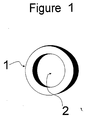
- the support shown generally at 1, comprises a cylindrical ring.
- the support device 1 is fitted around the part of the body which is to be supported, such as the head, so that the void 2 is filled.
- the diameter of the void 2 is adapted to the size of the part of the body which is to be supported.
- the support device 1 When the support device 1 is fitted, the support device is deformed, and the diameter of void 2 is increased. This ensures that the support 1 fits securely to the part of the body to be supported.
- the support device 1 is fabricated from a resilient material, such as foam.
- the support device 1 may be covered with a layer of material (not shown).
- the characteristics of the material forming the covering layer may be adapted for the particular use to which the support device 1 is to be put. Where the support device 1 is to be used in an effort to prevent ageing, the covering material would be a fabric chosen for its characteristics relating to comfort and washability. Where the support device 1 is to be used in hospitals the covering material would need to be sterilizable, and may need to be water proof.
- the support device 1 In use, for example when a person wishes to sleep without a pillow, the support device 1 is pulled onto the head so that the head fills void 2. When the person lies down, the head is maintained in a position above the surface on which the said person lies by the support device 1.
- Support device 1 may also be used on persons suffering from burns.
- One or more support devices 1 may be fitted to a limb, for example, so as to lift a burnt area of skin off the surface on which it would otherwise lie. This would provide the wearer of the device with freedom of movement which present methods (referred to earlier) do not provide for.
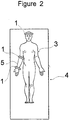
- Figure 2 shows a person 3 lying on a bed 4, and wearing three support devices 1.
- Support device 1 worn around the head of person 3 shows how the device is used either to alleviate discomfort caused by stitches/scarring as a result of a face-lift operation, or to prevent ageing.
- the support device 1 is fitted to a part of the head which has not been operated on during the face-lift.
- the device supports the head so that the stitched/scarred area on the neck and behind the ears is lifted clear of the surface of the bed 4, upon which the person lies.
- the device may be so shaped and dimensioned that when fitted to a person's head, and the person is lying down, the head is supported and maintained, with respect to the rest of the person's body, in essentially the same position that the head would be in, if the person were standing upright. This reduces to a minimum, the amount of stretching of the stitched/scarred areas.
- the support device 1 supports the head, with respect to the rest of the person's body, in essentially the same position that the head would be if the person were standing upright.
- the support device 1 also ensures that the face does not come into contact with the surface of the bed 4, which might cause wrinkling of the skin.
- Figure 2 also shows two support devices 1 fitted to the person's arm. This shows how the support device might be used on a person suffering from burns to the forearm 5. With the two support devices 1 fitted to the person's forearm 5 on either side of a burnt area, the said burnt area is lifted off the surface of the bed 4, on which it would otherwise lie. However, the person is still has freedom of movement of his/her arm, which is not the case when the limb is held off the surface by a sling, or other known devices.
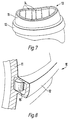
- a support device 10 is shown, the device comprising an inner ring 11 which is adapted to fit snugly on the wearer's 13 head and an outer ring 12.
- the outer ring 12 is mounted on inner ring 11 so that the outer ring 12 can rotate with respect to the inner ring 11, whilst the inner ring remains substantially fixed in place on the wearer's head 13.
- Rollers 15, as shown in Figures 5 and 8, provide for rotation of the outer ring 13 with respect to the inner ring 11.
- Outer ring 12 is made from a relatively hard material such as a plastics material
- inner ring 11 is also made from a relatively hard material such as a plastics material, but on the inner surface of inner ring 11, there is mounted a plurality of inflatable pockets 14, having valves 16 which permit inflation of the pockets 14.
- the resilient nature of the inflatable pockets 14 permits the inner ring 11 to fit snugly on to the wearer's head, and by inflating pockets 14 by differing amounts, the device can be adapted to fit heads of different size and shape.
- wound sites can be protected by selectively inflating particular pockets 14. By deflating a particular pocket 14 at a wound site, the wound site will be protected, but the head will nevertheless be supported.
- inflatable pockets 14 could be replaced by another resilient member such as a foam material.
- the inner ring 11 may be removably mounted on outer ring 13.
- the inner ring 11 is not mounted rotatably on the outer ring 13.
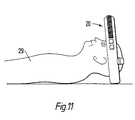
- FIG. 9 A further embodiment of a support device according to the invention is shown in Figures 9 to 11.
- the device 20 comprises a length of resilient material 21, such as foam or sponge, which is in the shape of a U, the ends of the U being joined by a length of elastic material 26.
- the length of elastic material 26 is slidably mounted in retaining members 27, and the ends of material 26 are provided with a section of Velcro ® which co-operates with one of the sections of Velcro ® 28 mounted on the sides of resilient material 21, best shown Figure 10.
- the section 28 of Velcro ® to which the Velcro ® section mounted on elastic material 26 is attached, the distance between the free ends of the U shape can be varied, so as to enable the device 20 to be used on people having heads of different sizes.
- a strap 25 is mounted in a groove 22 in material 21 by means of a slider 23.
- the slider 23 can be moved forwards or backwards in the direction indicated by arrow "x" to adjust the position of the device 20 on the wearer 29.
- the strap 25 can be moved upwards and downwards in the direction "y” by virtue of strap 25 being telescopically mounted on slider 23 by means of mounting 24.
- the telescopic mounting of strap 25 enables the device 20 to be positioned on the head of the wearer in such a manner that the device 20 will not move down the head towards the stitched or scarred region around the ears caused during a face-lift operation.
- the ends of the U shaped device 20 extend forwardly of the head. The effect of this is to limit the angle through which the head can rotate to 180 degrees.
Landscapes
- Health & Medical Sciences (AREA)
- Nursing (AREA)
- Orthopedic Medicine & Surgery (AREA)
- Engineering & Computer Science (AREA)
- Biomedical Technology (AREA)
- Heart & Thoracic Surgery (AREA)
- Vascular Medicine (AREA)
- Life Sciences & Earth Sciences (AREA)
- Animal Behavior & Ethology (AREA)
- General Health & Medical Sciences (AREA)
- Public Health (AREA)
- Veterinary Medicine (AREA)
- Invalid Beds And Related Equipment (AREA)
- Curtains And Furnishings For Windows Or Doors (AREA)
- Spinning Or Twisting Of Yarns (AREA)
- Manipulator (AREA)
Applications Claiming Priority (2)
| Application Number | Priority Date | Filing Date | Title |
|---|---|---|---|
| GB9701486A GB2309383B (en) | 1996-01-24 | 1997-01-24 | A support device |
| GB9701486 | 1997-01-24 |
Publications (2)
| Publication Number | Publication Date |
|---|---|
| EP0855174A2 true EP0855174A2 (fr) | 1998-07-29 |
| EP0855174A3 EP0855174A3 (fr) | 1999-10-13 |
Family
ID=10806541
Family Applications (1)
| Application Number | Title | Priority Date | Filing Date |
|---|---|---|---|
| EP97305751A Withdrawn EP0855174A3 (fr) | 1997-01-24 | 1997-07-30 | Dispositif de support |
Country Status (1)
| Country | Link |
|---|---|
| EP (1) | EP0855174A3 (fr) |
Cited By (1)
| Publication number | Priority date | Publication date | Assignee | Title |
|---|---|---|---|---|
| CN110215362A (zh) * | 2019-06-10 | 2019-09-10 | 郑州大学第一附属医院 | 一种脑部手术后脑神经养护装置 |
Citations (4)
| Publication number | Priority date | Publication date | Assignee | Title |
|---|---|---|---|---|
| GB1510415A (en) | 1975-06-09 | 1978-05-10 | Petersson New Prod Bengt | Inflatable cushion |
| GB2198341A (en) | 1986-12-11 | 1988-06-15 | El Asir Rabei Khaled | Inflatable neck pillow |
| US5007122A (en) | 1990-08-06 | 1991-04-16 | Daughdrill Annette S | Head restraint |
| US5418991A (en) | 1992-12-10 | 1995-05-30 | Shiflett; Diana C. | Therapeutic appliance for spacing legs |
Family Cites Families (4)
| Publication number | Priority date | Publication date | Assignee | Title |
|---|---|---|---|---|
| US3848281A (en) * | 1974-01-23 | 1974-11-19 | D Mathews | Apertured article and protective cover therefor |
| US4185331A (en) * | 1978-09-14 | 1980-01-29 | Nomiyama Tetsuo T | Protective head device |
| ES283884Y (es) * | 1985-01-10 | 1986-05-01 | Ould El Hassen Moulaye | Chichonera |
| US5085214A (en) * | 1990-10-18 | 1992-02-04 | Twenty-First Century Products, Incorporated | Inflatable cushion for supporting an extremity |
-
1997
- 1997-07-30 EP EP97305751A patent/EP0855174A3/fr not_active Withdrawn
Patent Citations (4)
| Publication number | Priority date | Publication date | Assignee | Title |
|---|---|---|---|---|
| GB1510415A (en) | 1975-06-09 | 1978-05-10 | Petersson New Prod Bengt | Inflatable cushion |
| GB2198341A (en) | 1986-12-11 | 1988-06-15 | El Asir Rabei Khaled | Inflatable neck pillow |
| US5007122A (en) | 1990-08-06 | 1991-04-16 | Daughdrill Annette S | Head restraint |
| US5418991A (en) | 1992-12-10 | 1995-05-30 | Shiflett; Diana C. | Therapeutic appliance for spacing legs |
Cited By (1)
| Publication number | Priority date | Publication date | Assignee | Title |
|---|---|---|---|---|
| CN110215362A (zh) * | 2019-06-10 | 2019-09-10 | 郑州大学第一附属医院 | 一种脑部手术后脑神经养护装置 |
Also Published As
| Publication number | Publication date |
|---|---|
| EP0855174A3 (fr) | 1999-10-13 |
Similar Documents
| Publication | Publication Date | Title |
|---|---|---|
| US8429775B2 (en) | Suspended back pillow for sustaining a side sleeping position | |
| US4981307A (en) | Suspension harness/body jacket arrangement | |
| US5520623A (en) | Head and face support device | |
| US5076264A (en) | Medical appliance for treating spinal conditions | |
| US7676867B2 (en) | Restriction-free suspended face support treatment table with hole designed to accommodate the face of a person | |
| US8764694B1 (en) | Daneshvar wound management system and methods | |
| US8713729B2 (en) | Devices and systems for supporting a user | |
| US9827133B1 (en) | Selectively adjustable arm and shoulder support | |
| US9044324B2 (en) | Selectively adjustable arm and shoulder support | |
| US20210338507A1 (en) | Patient Lifting Harness | |
| US5836024A (en) | Support device | |
| US5236411A (en) | Device for elevating the limb of a patient | |
| US10610400B1 (en) | Selectively adjustable arm and shoulder support | |
| US9668902B1 (en) | Selectively adjustable arm and shoulder support | |
| US20030014818A1 (en) | Orthopedic body segment support | |
| US5263496A (en) | Patient support pad for easing pain | |
| EP0855174A2 (fr) | Dispositif de support | |
| US7351216B2 (en) | Method and apparatus for minimizing bed sores and lower back pain in spinal injury patients | |
| US20150320626A1 (en) | C-spine pressure distributive support | |
| CN210870848U (zh) | 用于辅助睡眠的枕头 | |
| CN209137157U (zh) | 偏瘫患者上肢良肢位护理气垫 | |
| CN210330850U (zh) | 一种用于骨牵引的护理用具组 | |
| CN223336342U (zh) | 电动起立床头部稳定器 | |
| CN223995083U (zh) | 一种多功能变换体位保护枕 | |
| CN223248481U (zh) | 一种手术用多功能体位调节器 |
Legal Events
| Date | Code | Title | Description |
|---|---|---|---|
| PUAI | Public reference made under article 153(3) epc to a published international application that has entered the european phase |
Free format text: ORIGINAL CODE: 0009012 |
|
| AK | Designated contracting states |
Kind code of ref document: A2 Designated state(s): AT BE CH DE DK ES FI FR GB GR IE IT LI LU MC NL PT SE |
|
| PUAL | Search report despatched |
Free format text: ORIGINAL CODE: 0009013 |
|
| AK | Designated contracting states |
Kind code of ref document: A3 Designated state(s): AT BE CH DE DK ES FI FR GB GR IE IT LI LU MC NL PT SE |
|
| RIC1 | Information provided on ipc code assigned before grant |
Free format text: 6A 61F 5/44 A, 6A 61F 5/01 B |
|
| AKX | Designation fees paid | ||
| REG | Reference to a national code |
Ref country code: DE Ref legal event code: 8566 |
|
| STAA | Information on the status of an ep patent application or granted ep patent |
Free format text: STATUS: THE APPLICATION IS DEEMED TO BE WITHDRAWN |
|
| 18D | Application deemed to be withdrawn |
Effective date: 20000414 |