EP0855256A1 - Tête de coupe et rasoir compotant une telle tête - Google Patents
Tête de coupe et rasoir compotant une telle tête Download PDFInfo
- Publication number
- EP0855256A1 EP0855256A1 EP97201554A EP97201554A EP0855256A1 EP 0855256 A1 EP0855256 A1 EP 0855256A1 EP 97201554 A EP97201554 A EP 97201554A EP 97201554 A EP97201554 A EP 97201554A EP 0855256 A1 EP0855256 A1 EP 0855256A1
- Authority
- EP
- European Patent Office
- Prior art keywords
- shaving
- manipulator
- shaving head
- skin
- cutting edge
- Prior art date
- Legal status (The legal status is an assumption and is not a legal conclusion. Google has not performed a legal analysis and makes no representation as to the accuracy of the status listed.)
- Granted
Links
- 210000004209 hair Anatomy 0.000 claims abstract description 99
- 238000005520 cutting process Methods 0.000 claims abstract description 68
- 239000003795 chemical substances by application Substances 0.000 claims description 17
- 230000005540 biological transmission Effects 0.000 claims description 16
- XLYOFNOQVPJJNP-UHFFFAOYSA-N water Substances O XLYOFNOQVPJJNP-UHFFFAOYSA-N 0.000 claims description 9
- 239000000126 substance Substances 0.000 claims description 4
- 239000000463 material Substances 0.000 claims description 3
- 208000028990 Skin injury Diseases 0.000 description 3
- 239000011248 coating agent Substances 0.000 description 3
- 238000000576 coating method Methods 0.000 description 3
- 239000000654 additive Substances 0.000 description 2
- 230000000694 effects Effects 0.000 description 2
- 239000007788 liquid Substances 0.000 description 2
- 239000004809 Teflon Substances 0.000 description 1
- 229920006362 Teflon® Polymers 0.000 description 1
- 238000010276 construction Methods 0.000 description 1
- 239000000839 emulsion Substances 0.000 description 1
- 230000002708 enhancing effect Effects 0.000 description 1
- 239000011888 foil Substances 0.000 description 1
- 238000002513 implantation Methods 0.000 description 1
- 238000000034 method Methods 0.000 description 1
- 239000000843 powder Substances 0.000 description 1
- 230000035807 sensation Effects 0.000 description 1
- 238000010008 shearing Methods 0.000 description 1
- 125000006850 spacer group Chemical group 0.000 description 1
Images

Classifications
-
- B—PERFORMING OPERATIONS; TRANSPORTING
- B26—HAND CUTTING TOOLS; CUTTING; SEVERING
- B26B—HAND-HELD CUTTING TOOLS NOT OTHERWISE PROVIDED FOR
- B26B21/00—Razors of the open or knife type; Safety razors or other shaving implements of the planing type; Hair-trimming devices involving a razor-blade; Equipment therefor
-
- B—PERFORMING OPERATIONS; TRANSPORTING
- B26—HAND CUTTING TOOLS; CUTTING; SEVERING
- B26B—HAND-HELD CUTTING TOOLS NOT OTHERWISE PROVIDED FOR
- B26B21/00—Razors of the open or knife type; Safety razors or other shaving implements of the planing type; Hair-trimming devices involving a razor-blade; Equipment therefor
- B26B21/08—Razors of the open or knife type; Safety razors or other shaving implements of the planing type; Hair-trimming devices involving a razor-blade; Equipment therefor involving changeable blades
- B26B21/14—Safety razors with one or more blades arranged transversely to the handle
- B26B21/34—Safety razors with one or more blades arranged transversely to the handle of the type carrying rollers
-
- B—PERFORMING OPERATIONS; TRANSPORTING
- B26—HAND CUTTING TOOLS; CUTTING; SEVERING
- B26B—HAND-HELD CUTTING TOOLS NOT OTHERWISE PROVIDED FOR
- B26B21/00—Razors of the open or knife type; Safety razors or other shaving implements of the planing type; Hair-trimming devices involving a razor-blade; Equipment therefor
- B26B21/08—Razors of the open or knife type; Safety razors or other shaving implements of the planing type; Hair-trimming devices involving a razor-blade; Equipment therefor involving changeable blades
- B26B21/14—Safety razors with one or more blades arranged transversely to the handle
- B26B21/38—Safety razors with one or more blades arranged transversely to the handle with provision for reciprocating the blade by means other than rollers
Definitions
- the invention relates to a shaving head comprising a cutter having a cutting edge for cutting hairs near the skin and a manipulator adapted to move the hairs to be cut relative to the skin.
- Such a shaving head is known from WO 95/29043.
- the known shaving head comprises a razor blade and a manipulator arranged in advance of the razor blade.
- the manipulator is adapted to pull hairs slightly out of the skin before they are severed by the razor blade.
- a drawback of the known shaving head is that as the hair is being severed the razor blade exerts a load on the hair root, as a result of which the skin around the hair root deforms, which gives rise to an uncomfortable sensation.
- the shaving head in accordance with the invention is characterized in that the manipulator is adapted to move a hair along the cutting edge while the hair is being cut by the cutting edge.
- the load on a hair root depends on the force exerted on the hair by the shaving head.
- shear-type shaving heads by which a hair is snipped off
- knife-type shaving heads by which a hair is sliced off.
- a hair is clamped between two edges which are movable relative to one another and which are subsequently moved towards one another, thereby subjecting the hair to shearing.
- Each of the edges exerts a substantial force on the hair but these forces are directed oppositely, as a result of which the shaving head exerts substantially no resultant force on the hair and the hair root is subjected to hardly any load.
- a hair is severed in that a sharp edge exerts a force on the hair, without the hair being supported by the shaving head.
- the force exerted on a hair by the shaving head is at least equal to the force required to move the cutting edge of the razor blade through the hair. This force is comparatively large, as a result of which a substantial load is exerted on the hair root.
- the shaving head in accordance with the invention is a knife-type shaving head in which a relative movement of the hairs along the cutting edge is performed during cutting. As a result of this, the force required on a hair to move the cutting edge through the hair is comparatively small and the load to which the hair root is subjected is substantially smaller.
- the hairs move past the cutting edge with a higher speed than the skin so that there is a difference between the cutting action of the cutting edge with respect to the skin and the cutting action of the cutting edge with respect to the hairs.
- This is because at skin level hairs are movable relative to the skin.
- Factors such as the implantation of the hairs in the skin, the viscoelasticity of the skin and the frequency with which the hairs are moved can play a part, individually but also in different combinations. Owing to said difference in speed, the load exerted on the hair roots is reduced without an increased risk of skin injury.
- the measures in accordance with the invention also ensure that during shaving the forces exerted on the cutting edge by the hairs in a direction transverse to the cutting edge are substantially smaller than with the known shaving head, which reduces the likelihood of deformation of the cutting edge. Moreover, a hair is brought into contact with different parts of the cutting edge, as a result of which the forces spread over a larger part of the cutting edge. This results in a more uniform wear of the cutting edge. In addition, a less sharp cutting edge yet provides satisfactory shaving results owing to the improved cutting action.
- US 4,118,863 discloses a hair trimmer having a movable blade and a stationary blade. Both blades have teeth to sever hairs caught between a tooth of the movable blade and a tooth of the stationary blade.
- US 4,159,566 discloses a razor comb intended for hair styling by the individual.
- the known razor comb comprises a razor having a cutting edge and covered at both sides by a comb attachment. Different comb attachments of different lengths can be fitted to trim the hair at different lengths.
- the razor is drivable by an electric drive mechanism in a direction parallel to the cutting edge. The relative speeds of the razor with respect to the hairs and the skin are in principle equal.
- An embodiment of the shaving head in accordance with the invention is characterized in that the manipulator is adapted to move hairs to and fro along the cutting edge.
- An embodiment of the shaving head in accordance with the invention is characterized in that the shaving head comprises a supporting surface for supporting the shaving head on the skin, the shaving head comprises a frame, and the manipulator is movable relative to the frame in a tangential direction along the cutting edge.
- This embodiment has the advantage that the shaving head can be of simple construction. The hairs can be moved along the cutting edge by moving the manipulator in the tangential direction and bringing the manipulator into contact with the hairs.
- An embodiment of the shaving head in accordance with the invention is characterized in that the manipulator has recesses which extend near the cutting edge. A hair caught in one of the recesses will be moved in the tangential direction to some degree. Since the recesses extend near the cutting edge, for example disposed just underneath the cutting edge viewed from the supporting surface, the hair will perform a movement in the tangential direction at the instant that it contacts the cutting edge.
- the manipulator can be constructed, for example, as a foil provided with the recesses.
- An embodiment of the shaving head in accordance with the invention is characterized in that in the tangential direction the recesses have a width between 100 and 400 micrometers. It has been found that in this range an optimum performance of the shaving head in accordance with the invention is achieved for regular hair thicknesses.
- An embodiment of the shaving head in accordance with the invention is characterized in that the recesses are formed between teeth.
- the recesses are formed between teeth.
- An embodiment of the shaving head in accordance with the invention is characterized in that the distance between the ends of the teeth and the cutting edge lies between 50 and 1000 micrometers.
- the teeth should not be too short because otherwise the hairs will not be moved along in the tangential direction. Besides, in the case of too long teeth the hairs tend to disengage from between the teeth, after which they are flattened onto the skin by the teeth and are not severed or not severed properly. It has been found that the hairs are severed properly when the dimensions are as mentioned above.
- An embodiment of the shaving head in accordance with the invention is characterized in that at the location of the cutting edge the teeth have a height smaller than 500 micrometers measured in a direction transverse to the supporting surface. It has been found that owing to this measure the hairs are less likely to remain caught between the teeth, which counteracts clogging of the recesses between teeth.
- An embodiment of the shaving head in accordance with the invention is characterized in that the manipulator is movable relative to the frame in a direction transverse to the tangential direction.
- An embodiment of the shaving head in accordance with the invention is characterized in that the cutting edge is disposed at the level of the supporting surface and the manipulator forms at least a part of the supporting surface.
- An embodiment of the shaving head in accordance with the invention is characterized in that the shaving head is adapted to provide a weak transmission between the manipulator and the skin.
- a weak transmission between the manipulator and the skin ensures that the manipulator movement is transmitted to the skin to only a small extent, which reduces the risk of the skin being nicked.
- An embodiment of the shaving head in accordance with the invention is characterized in that the manipulator is movable in a direction transverse to the supporting surface. First of all, this reduces the transmission between the manipulator and the skin. Secondly, it ensures that the skin is effectively held at some distance from the cutting edge, which reduces the risk of nicking of the skin. The reduction of this transmission ensures that the manipulator movement transmitted to the skin is weak, as a result of which the skin is less likely to be moved in the tangential direction relative to the cutter and, consequently, the risk of nicking of the skin is reduced.
- An embodiment of the shaving head in accordance with the invention is characterized in that at its side which faces the supporting surface the manipulator comprises a material which provides a low coefficient of friction with respect to the skin surface.
- a Teflon coating or any other coating which provides a low friction between the manipulator and a skin is suitable for this purpose.
- the manipulator can be made wholly or partly of a material having a low coefficient of friction with respect to a skin.
- An embodiment of the shaving head in accordance with the invention is characterized in that the cutter and the manipulator are flexible in a direction transverse to the supporting surface.
- An embodiment of the shaving head in accordance with the invention is characterized in that the cutting edge has a serrated structure with serrations smaller than 100 micrometers. Such a knurled structure further facilitates the severing of hairs. This measure is particularly suited for use in the shaving head in accordance with the invention because the hairs are moved in the tangential direction with respect to the cutting edge while the skin is hardly moved in the tangential direction with respect to the cutting edge, as a result of which the risk of skin injury is small.
- the invention also relates to a shaving apparatus having a shaving head in accordance with the invention and a drive system for driving the manipulator.
- An embodiment of the shaving apparatus in accordance with the invention is characterized in that the drive system is adapted to move the manipulator to and fro in the tangential direction. As a result of this step, the hairs are moved to and fro, so that the range of movement of the hair relative to the skin is traversed several times during cutting of the hair and the force required to move the cutting edge through the hair is thus further reduced.
- An embodiment of the shaving apparatus in accordance with the invention is characterized in that the drive system is adapted to drive the manipulator with an amplitude of 50 to 250 micrometers in the tangential direction. If the amplitude is too small it appears that the hairs are not moved adequately. If the amplitude is too large the hairs slip out of the recesses. It has been found that in said range satisfactory shaving results and a high shaving comfort are obtained.
- An embodiment of the shaving apparatus in accordance with the invention is characterized in that the drive system is adapted to drive the manipulator with a frequency higher than or equal to 100 Hz. It has been found that satisfactory results are obtained already at 100 Hz. The viscoelasticity of the human skin is such that the skin appears to be less compliant for frequencies above 30 Hz, so that it can be moved less easily and the risk of nicking of the skin is further reduced at higher frequencies. Moreover, it has been found that at 100 Hz and a normal speed of movement of the shaving head over the skin the manipulator moves a hair to and fro about ten times during cutting. At a frequency higher than 100 Hz the results improve because the cutting performance improves further with the same amplitude of the manipulator. Besides, the shaving head can be moved more rapidly over the skin at a higher frequency, yielding the same result and comfort.
- An embodiment of the shaving apparatus in accordance with the invention is characterized in that the drive system comprises a piezoelectric element.
- a piezoelectric element is particularly suitable for driving because the manipulator need only be moved with a small amplitude. Owing to this measure less space is required for the drive system and more freedom is obtained for an aesthetically pleasing design of the shaver.
- An embodiment of the shaving apparatus in accordance with the invention is characterized in that the mass of the oscillating parts is more than 10 times as small as the mass of the shaving apparatus. This precludes a movement of the cutter relative to the skin in the tangential direction as a result of reaction forces.
- the shaving apparatus comprises a counter-mass which is moved oppositely to the manipulator in order to counteract reaction forces on the cutter.
- the invention also relates to a shaving apparatus comprising a shaving head in accordance with the invention and an applicator for applying an agent to the skin, which agent reduces the transmission between the manipulator and the skin.
- a shaving apparatus comprising a shaving head in accordance with the invention and an applicator for applying an agent to the skin, which agent reduces the transmission between the manipulator and the skin.
- An embodiment of the shaving apparatus in accordance with the invention is characterized in that the applicator comprises a porous structure. Owing to this measure the skin can be moistened by briefly holding the applicator, for example while attached to the apparatus, under the tap before and, if desired, during shaving. The applicator absorbs water when held under the tap and it releases the water again when brought into contact with the skin owing to the capillary action of the spaces between the applicator and the skin.
- An embodiment of the shaving apparatus in accordance with the invention is characterized in that the agent comprises a substance which can be taken up by water and which is stored in the porous structure.
- This substance may include skin-care additives which further improve the shaving comfort.
- An embodiment of the shaving apparatus in accordance with the invention is characterized in that the applicator takes the form of a roller. Owing to this measure the applicator can roll over the skin during shaving so that the applicator does not hook behind stubbles and each time another part of the applicator comes into contact with the skin.
- An embodiment of the shaving apparatus in accordance with the invention is characterized in that said applicator comprises a reservoir for holding said agent and further comprises dispenser means for applying the agent to the skin in a controlled amount.
- the dispenser means may comprise, for example, a pump or a controllable valve.
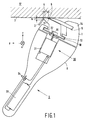
- FIG. 1 is a diagrammatic side view showing a first embodiment of the shaving apparatus in accordance with the invention.
- the shaving apparatus 9 comprises a basic part 8 and a shaving head 1 in accordance with the invention.
- the shaving head 1 is pressed against a skin surface 3 and is moved over the skin surface 3 in a shaving direction y.
- the shaving head 1 serves for severing a hair 2 rooted in the skin 17.
- the shaving head 1 comprises a frame 14 carrying a stationary cutter 5.
- the cutter 5 forms part of a supporting surface 4 for supporting the shaving head 1 on the skin surface 3.
- the cutter 5 has a cutting edge 6 which, in or near the supporting surface 4, extends in a tangential direction x transverse to the shaving direction y.
- the shaving head 1 further comprises a manipulator 10 adapted to move hairs which engage the cutting edge 6 relative to the shaving head 1 in a direction parallel to the tangential direction x.
- the manipulator 10 is movable relative to the cutter 5 in the tangential direction x.
- the manipulator 10 further has recess 13 (see Fig. 4), in the present case formed between teeth 11, for transmitting the movement of the manipulator 10 to the hair 2.
- the teeth 11 extend just before the cutting edge 6 in a direction transverse to the tangential direction x.
- the teeth 11 are so positioned that, as a result of the movement of the shaving head 1 in the shaving direction y, a hair 2 engages a recess 13 between two teeth 11 before it contact the cutting edge 6 of the cutter 5.
- the shaving head 1 is adapted to produce an oscillating movement of the manipulator 10 by means of a guide 12.
- the basic part 8 comprises a drive system 30 for driving the manipulator 10 in the tangential direction x.
- the drive system 30 is adapted to drive the manipulator 10 in a reciprocating fashion with a frequency of 100 Hz.
- the drive system 30 comprises an electric motor 31, which drives an eccentric 32.
- the eccentric 32 engages a groove 15 in the manipulator 10, which groove extends in the shaving direction y. In the tangential direction x the groove 15 accurately fits around the eccentric 32, so that a rotary movement of the eccentric 32 is converted into a reciprocating movement of the manipulator 10 in the tangential direction x.
- the basic part 8 comprises a battery 33 and a switch 34.
- the rotary motor 31 it is possible to use a vibramotor, in which case the eccentric 32 can be dispensed with.
- the cutter 5 and the manipulator 10 each form part of the supporting surface 4.
- a hair 2 can be severed very close to the skin surface 3 and a very short hair can also be moved to and fro in the tangential direction x by the teeth 11 of the manipulator 10.
- the teeth 11 are dimensioned in such a way that the distance d between the ends of the teeth 11 and the cutting edge 6, measured in the shaving direction y, is approximately 250 micrometers. At the location of the cutting edge 6 in the direction z transverse to the supporting surface 4 the teeth 11 have a dimension h of approximately 300 micrometers. Owing to these dimensions hair cuttings readily fall out of the gaps between the teeth 11 and clogging of the gaps between the teeth 11 is avoided.
- the teeth 11 and the cutter 5 are slightly flexible in the direction z, thereby enabling skin contours to be followed to some extent.
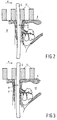
- Figure 2 and Figure 3 both show a sectional view of a hair 2 in a follicle 7 in a skin 17.
- Figure 2 shows the hair 2 in a position in which one of the teeth 11 has pressed the hair 2 in a direction opposite to the tangential direction x. The hair 2 is then wholly pressed against the left side of the follicle 7 in the skin 17. It is clearly visible that the hair 2 has a clearance s in the follicle 7.
- Figure 3 shows the hair 2 in a position in which the hair 2 is wholly pressed against the right-hand side of the follicle 7 in the skin 17 by one of the teeth 11. It has been found that the clearance s of the hair relative to the follicle 7 is of the order of magnitude of some hundreds of micrometers. As a result, the hair 2 can be moved to and fro by the teeth 11 with a comparatively high speed, while the skin 17 follows the movement of the hair 2 only partly or not at all. The latter depends particularly on the transmission between the teeth 11 and the skin surface 3 for movements in the tangential direction x. This transmission can also be produced via the hair 2. However, it has been found that if the drive system 30 (see Figure 1) is adapted to drive the manipulator 10 with a frequency of 100 Hz and an amplitude between 50 and 250 micrometers in the tangential direction x, this yields a weak transmission.
- FIG 4 is a perspective view showing a second embodiment of the shaving apparatus in accordance with the invention.
- the shaving apparatus 109 comprises a shaving head 101.
- the shaving head 101 comprises a manipulator 110 having teeth 111, the distance w between the teeth 111 being approximately 250 micrometers. At their upper sides the teeth 111 have a coating 21 for reducing the friction between the skin surface 3 (see Figure 1) and the manipulator 110.
- the shaving apparatus 109 comprises a basic part 108, which accommodates a drive system for driving the manipulator 110.
- the drive system comprises a piezoelectric element 35 driven by an oscillator 36.
- the oscillator 36 is energized by means of a battery 33 and a switch 34.
- the piezoelectric element At its lower side the piezoelectric element is secured (not shown) in the basic part 108 and at its upper side it has a projection 37 which engages a groove 15 in the manipulator 110 of the shaving head 101.
- the piezoelectric element 35 When the oscillator 36 is energized the piezoelectric element 35 performs an oscillating movement in the tangential direction x. This oscillating movement is transmitted to the manipulator 110 via the projection 37 and the groove 15.
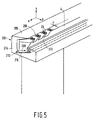
- FIG. 5 is a perspective view showing a part of a second embodiment of the shaving head in accordance with the invention.
- the shaving head 201 comprise a frame 214, a manipulator 210 and a spacer, in the present case formed by ridges 23 for reducing the contact area between the manipulator 210 and the skin (not shown).
- the ridges 23 are situated on the teeth 211 and extend in the tangential direction x.
- the shaving head 201 further comprises a guide 212 for guiding the manipulator 210 relative to the shaving head 201.
- the guide 212 is such that the manipulator 210 is movable in the tangential direction x and is also movable in a direction 280 having a component in the shaving direction y and a component in the direction z transverse to the supporting surface 4.
- the cutter 205 has a cutting edge 206 with a serrated structure whose serrations are shown to a highly enlarged scale and have a dimension t of approximately 40 micrometers.
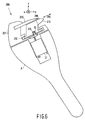
- FIG 6 shows diagrammatically a third embodiment of the shaving apparatus in accordance with the invention.
- the shaving apparatus 209 comprises a basic part 8 as shown in Figure 1 and a shaving head 201 in accordance with the second embodiment of the invention as shown in Figure 5.
- the manipulator 210 has a recess 215 which fits tightly around the eccentric 32.
- the manipulator performs both a reciprocating movement in the tangential direction x and a reciprocating movement in the direction 280.
- the movement in the direction 280 has a component in the direction z, so that the skin is held effectively at some distance from the cutting edge 206. Moreover, this reduces the transmission between the manipulator 210 and the skin.
- the movement in the direction 280 also has a component in the shaving direction y. This promotes the removal of hair cuttings.
- the mass of the manipulator 210 is approximately 20 times as small as the mass of the shaving apparatus 209. This counteracts a movement of the cutter 205 in the tangential direction x relative to the skin as a result of the reaction forces.
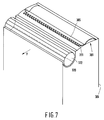
- FIG. 7 is a perspective view of a fourth embodiment of the shaving apparatus in accordance with the invention.
- the shaving apparatus 309 comprises a shaving head 301 and an applicator for applying an agent to the skin during shaving.
- the shaving head 301 comprises a cutter 305 and a manipulator having teeth 311.
- the teeth 311 slightly converge towards their ends to promote the capture of hairs between the teeth 311.
- the shaving apparatus 309 comprises an applicator formed by a roller-shaped porous element 322 arranged in a recess 320 in the shaving apparatus 309.
- the roller 322 can be moistened by holding the shaving apparatus 309 in a water jet.
- the roller 322 contains a substance which can be taken up by water and which has a friction-reducing and/or skin-care effect.
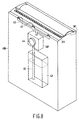
- FIG 8 shows a fifth embodiment of the shaving apparatus in accordance with the invention.
- the shaving apparatus 409 comprises a shaving head 301 as shown in Figure 7.
- the shaving apparatus 409 comprises a reservoir 40 containing a liquid agent for reducing the transmission between the manipulator and the skin.
- the shaving apparatus 409 further comprises dispenser means, in the present case a pump 41 comprising a push-button 44, an inlet tube 45 and a dispenser channel 42.
- a pump 41 comprising a push-button 44, an inlet tube 45 and a dispenser channel 42.
- the manipulator can have a surface with a high friction relative to the hairs.
- the manipulator can move the hairs by imparting vibrations to the skin or the air just above the skin. If desired, the hairs can be moved in the tangential direction by an electrostatic method.
- the shaving head can be adapted for use with an exchangeable cutter, so that a cutter can readily be replaced by a new cutter.
- the shaving head may comprise an adjustment mechanism to adjust the distance between the shaving head and the supporting surface.
Landscapes
- Life Sciences & Earth Sciences (AREA)
- Forests & Forestry (AREA)
- Engineering & Computer Science (AREA)
- Mechanical Engineering (AREA)
- Cosmetics (AREA)
Priority Applications (1)
| Application Number | Priority Date | Filing Date | Title |
|---|---|---|---|
| EP19970201554 EP0855256B1 (fr) | 1996-12-23 | 1997-05-23 | Tête de coupe et rasoir compotant une telle tête |
Applications Claiming Priority (3)
| Application Number | Priority Date | Filing Date | Title |
|---|---|---|---|
| EP96203695 | 1996-12-23 | ||
| EP96203695 | 1996-12-23 | ||
| EP19970201554 EP0855256B1 (fr) | 1996-12-23 | 1997-05-23 | Tête de coupe et rasoir compotant une telle tête |
Publications (2)
| Publication Number | Publication Date |
|---|---|
| EP0855256A1 true EP0855256A1 (fr) | 1998-07-29 |
| EP0855256B1 EP0855256B1 (fr) | 1999-08-04 |
Family
ID=26143482
Family Applications (1)
| Application Number | Title | Priority Date | Filing Date |
|---|---|---|---|
| EP19970201554 Expired - Lifetime EP0855256B1 (fr) | 1996-12-23 | 1997-05-23 | Tête de coupe et rasoir compotant une telle tête |
Country Status (1)
| Country | Link |
|---|---|
| EP (1) | EP0855256B1 (fr) |
Cited By (4)
| Publication number | Priority date | Publication date | Assignee | Title |
|---|---|---|---|---|
| WO2000038869A1 (fr) * | 1998-12-24 | 2000-07-06 | Koninklijke Philips Electronics N.V. | Procede de fabrication d'instrument de coupe pourvu d'une couche auxiliaire |
| WO2001007213A1 (fr) | 1999-07-22 | 2001-02-01 | Koninklijke Philips Electronics N.V. | Tete de rasoir avec element de coupe et manipulateur de poils simultanement orientables |
| WO2001098040A1 (fr) | 2000-06-21 | 2001-12-27 | Koninklijke Philips Electronics N.V. | Appareil a epiler comprenant des supports en plaque positionnes et mobiles l'un par rapport a l'autre |
| US7415768B2 (en) | 2003-09-25 | 2008-08-26 | Braum Gmbh | Shear system for an electric hair removing apparatus |
Families Citing this family (1)
| Publication number | Priority date | Publication date | Assignee | Title |
|---|---|---|---|---|
| CN1347362A (zh) | 1999-12-24 | 2002-05-01 | 皇家菲利浦电子有限公司 | 带有可驱动毛发梳理器和可驱动削毛部件的剃须头 |
Citations (2)
| Publication number | Priority date | Publication date | Assignee | Title |
|---|---|---|---|---|
| US2568047A (en) * | 1948-09-30 | 1951-09-18 | Harold C Anderson | Safety razor |
| US4151644A (en) * | 1976-12-06 | 1979-05-01 | Sperry Rand Corporation | Device for dislodging ingrown facial hairs |
-
1997
- 1997-05-23 EP EP19970201554 patent/EP0855256B1/fr not_active Expired - Lifetime
Patent Citations (2)
| Publication number | Priority date | Publication date | Assignee | Title |
|---|---|---|---|---|
| US2568047A (en) * | 1948-09-30 | 1951-09-18 | Harold C Anderson | Safety razor |
| US4151644A (en) * | 1976-12-06 | 1979-05-01 | Sperry Rand Corporation | Device for dislodging ingrown facial hairs |
Cited By (6)
| Publication number | Priority date | Publication date | Assignee | Title |
|---|---|---|---|---|
| WO2000038869A1 (fr) * | 1998-12-24 | 2000-07-06 | Koninklijke Philips Electronics N.V. | Procede de fabrication d'instrument de coupe pourvu d'une couche auxiliaire |
| US6327784B1 (en) | 1998-12-24 | 2001-12-11 | U.S. Philips Corporation | Method of manufacturing a cutting member having an auxiliary layer |
| CN1131758C (zh) * | 1998-12-24 | 2003-12-24 | 皇家菲利浦电子有限公司 | 具有一层辅助层的切削件及其制造方法 |
| WO2001007213A1 (fr) | 1999-07-22 | 2001-02-01 | Koninklijke Philips Electronics N.V. | Tete de rasoir avec element de coupe et manipulateur de poils simultanement orientables |
| WO2001098040A1 (fr) | 2000-06-21 | 2001-12-27 | Koninklijke Philips Electronics N.V. | Appareil a epiler comprenant des supports en plaque positionnes et mobiles l'un par rapport a l'autre |
| US7415768B2 (en) | 2003-09-25 | 2008-08-26 | Braum Gmbh | Shear system for an electric hair removing apparatus |
Also Published As
| Publication number | Publication date |
|---|---|
| EP0855256B1 (fr) | 1999-08-04 |
Similar Documents
| Publication | Publication Date | Title |
|---|---|---|
| US20010015016A1 (en) | Shaving head and shaving appratus comprising the shaving head | |
| JP7824229B2 (ja) | 電気髭トリマー | |
| JP7425015B2 (ja) | 電気髭トリマー | |
| EP4119313B1 (fr) | Système de coupe pour tondeuse à barbe électrique | |
| CN114981048B (zh) | 电动胡须修剪器 | |
| CN115515767A (zh) | 电动胡须修剪器 | |
| EP3854540B1 (fr) | Tondeuse à barbe électrique | |
| CN115003473A (zh) | 电动胡须修剪器 | |
| JP2021176520A (ja) | 電気髭トリマー | |
| EP0855256B1 (fr) | Tête de coupe et rasoir compotant une telle tête | |
| US6418622B2 (en) | Wet shaver with retractile action | |
| JP3198628U (ja) | 皮膚を準備するための装置を有する除毛装置 | |
| MXPA99005926A (es) | Cabezal afeitador y aparato afeitador que comprende el cabezal afeitador. | |
| CZ225899A3 (cs) | Holicí hlava a holicí strojek | |
| JP7280444B2 (ja) | 複数の鋸歯を持つ毛切断部材を有するカミソリ | |
| US4106190A (en) | Hair clipper | |
| CN210650779U (zh) | 一种剃须刀头 | |
| GB2036630A (en) | Cutting unit for a dry-shaving apparatus |
Legal Events
| Date | Code | Title | Description |
|---|---|---|---|
| PUAI | Public reference made under article 153(3) epc to a published international application that has entered the european phase |
Free format text: ORIGINAL CODE: 0009012 |
|
| GRAG | Despatch of communication of intention to grant |
Free format text: ORIGINAL CODE: EPIDOS AGRA |
|
| GRAH | Despatch of communication of intention to grant a patent |
Free format text: ORIGINAL CODE: EPIDOS IGRA |
|
| 17P | Request for examination filed |
Effective date: 19970523 |
|
| AK | Designated contracting states |
Kind code of ref document: A1 Designated state(s): AT DE ES FR GB IT NL |
|
| RAP3 | Party data changed (applicant data changed or rights of an application transferred) |
Owner name: KONINKLIJKE PHILIPS ELECTRONICS N.V. |
|
| GRAH | Despatch of communication of intention to grant a patent |
Free format text: ORIGINAL CODE: EPIDOS IGRA |
|
| AKX | Designation fees paid |
Free format text: AT DE ES FR GB IT NL |
|
| RBV | Designated contracting states (corrected) |
Designated state(s): AT DE ES FR GB IT NL |
|
| GRAA | (expected) grant |
Free format text: ORIGINAL CODE: 0009210 |
|
| AK | Designated contracting states |
Kind code of ref document: B1 Designated state(s): AT DE ES FR GB IT NL |
|
| REF | Corresponds to: |
Ref document number: 182830 Country of ref document: AT Date of ref document: 19990815 Kind code of ref document: T |
|
| REF | Corresponds to: |
Ref document number: 69700383 Country of ref document: DE Date of ref document: 19990909 |
|
| ITF | It: translation for a ep patent filed | ||
| ET | Fr: translation filed | ||
| REG | Reference to a national code |
Ref country code: ES Ref legal event code: FG2A Ref document number: 2137755 Country of ref document: ES Kind code of ref document: T3 |
|
| PLBE | No opposition filed within time limit |
Free format text: ORIGINAL CODE: 0009261 |
|
| STAA | Information on the status of an ep patent application or granted ep patent |
Free format text: STATUS: NO OPPOSITION FILED WITHIN TIME LIMIT |
|
| 26N | No opposition filed | ||
| PGFP | Annual fee paid to national office [announced via postgrant information from national office to epo] |
Ref country code: ES Payment date: 20010525 Year of fee payment: 5 Ref country code: AT Payment date: 20010525 Year of fee payment: 5 |
|
| PGFP | Annual fee paid to national office [announced via postgrant information from national office to epo] |
Ref country code: NL Payment date: 20010528 Year of fee payment: 5 |
|
| REG | Reference to a national code |
Ref country code: GB Ref legal event code: IF02 |
|
| PG25 | Lapsed in a contracting state [announced via postgrant information from national office to epo] |
Ref country code: AT Free format text: LAPSE BECAUSE OF NON-PAYMENT OF DUE FEES Effective date: 20020523 |
|
| PG25 | Lapsed in a contracting state [announced via postgrant information from national office to epo] |
Ref country code: ES Free format text: LAPSE BECAUSE OF NON-PAYMENT OF DUE FEES Effective date: 20020524 |
|
| PGFP | Annual fee paid to national office [announced via postgrant information from national office to epo] |
Ref country code: FR Payment date: 20020527 Year of fee payment: 6 |
|
| PGFP | Annual fee paid to national office [announced via postgrant information from national office to epo] |
Ref country code: GB Payment date: 20020531 Year of fee payment: 6 |
|
| PGFP | Annual fee paid to national office [announced via postgrant information from national office to epo] |
Ref country code: DE Payment date: 20020719 Year of fee payment: 6 |
|
| PG25 | Lapsed in a contracting state [announced via postgrant information from national office to epo] |
Ref country code: NL Free format text: LAPSE BECAUSE OF NON-PAYMENT OF DUE FEES Effective date: 20021201 |
|
| NLV4 | Nl: lapsed or anulled due to non-payment of the annual fee |
Effective date: 20021201 |
|
| PG25 | Lapsed in a contracting state [announced via postgrant information from national office to epo] |
Ref country code: GB Free format text: LAPSE BECAUSE OF NON-PAYMENT OF DUE FEES Effective date: 20030523 |
|
| PG25 | Lapsed in a contracting state [announced via postgrant information from national office to epo] |
Ref country code: DE Free format text: LAPSE BECAUSE OF NON-PAYMENT OF DUE FEES Effective date: 20031202 |
|
| GBPC | Gb: european patent ceased through non-payment of renewal fee |
Effective date: 20030523 |
|
| PG25 | Lapsed in a contracting state [announced via postgrant information from national office to epo] |
Ref country code: FR Free format text: LAPSE BECAUSE OF NON-PAYMENT OF DUE FEES Effective date: 20040130 |
|
| REG | Reference to a national code |
Ref country code: FR Ref legal event code: ST |
|
| REG | Reference to a national code |
Ref country code: ES Ref legal event code: FD2A Effective date: 20030611 |
|
| PG25 | Lapsed in a contracting state [announced via postgrant information from national office to epo] |
Ref country code: IT Free format text: LAPSE BECAUSE OF NON-PAYMENT OF DUE FEES;WARNING: LAPSES OF ITALIAN PATENTS WITH EFFECTIVE DATE BEFORE 2007 MAY HAVE OCCURRED AT ANY TIME BEFORE 2007. THE CORRECT EFFECTIVE DATE MAY BE DIFFERENT FROM THE ONE RECORDED. Effective date: 20050523 |