EP0855430A2 - Thermoplastische Formmassen - Google Patents
Thermoplastische Formmassen Download PDFInfo
- Publication number
- EP0855430A2 EP0855430A2 EP98101213A EP98101213A EP0855430A2 EP 0855430 A2 EP0855430 A2 EP 0855430A2 EP 98101213 A EP98101213 A EP 98101213A EP 98101213 A EP98101213 A EP 98101213A EP 0855430 A2 EP0855430 A2 EP 0855430A2
- Authority
- EP
- European Patent Office
- Prior art keywords
- polyarylene ether
- weight
- molding composition
- formula
- alkyl
- Prior art date
- Legal status (The legal status is an assumption and is not a legal conclusion. Google has not performed a legal analysis and makes no representation as to the accuracy of the status listed.)
- Granted
Links
Classifications
-
- C—CHEMISTRY; METALLURGY
- C08—ORGANIC MACROMOLECULAR COMPOUNDS; THEIR PREPARATION OR CHEMICAL WORKING-UP; COMPOSITIONS BASED THEREON
- C08G—MACROMOLECULAR COMPOUNDS OBTAINED OTHERWISE THAN BY REACTIONS ONLY INVOLVING UNSATURATED CARBON-TO-CARBON BONDS
- C08G65/00—Macromolecular compounds obtained by reactions forming an ether link in the main chain of the macromolecule
- C08G65/02—Macromolecular compounds obtained by reactions forming an ether link in the main chain of the macromolecule from cyclic ethers by opening of the heterocyclic ring
- C08G65/04—Macromolecular compounds obtained by reactions forming an ether link in the main chain of the macromolecule from cyclic ethers by opening of the heterocyclic ring from cyclic ethers only
- C08G65/06—Cyclic ethers having no atoms other than carbon and hydrogen outside the ring
- C08G65/16—Cyclic ethers having four or more ring atoms
- C08G65/18—Oxetanes
-
- C—CHEMISTRY; METALLURGY
- C08—ORGANIC MACROMOLECULAR COMPOUNDS; THEIR PREPARATION OR CHEMICAL WORKING-UP; COMPOSITIONS BASED THEREON
- C08L—COMPOSITIONS OF MACROMOLECULAR COMPOUNDS
- C08L71/00—Compositions of polyethers obtained by reactions forming an ether link in the main chain; Compositions of derivatives of such polymers
-
- Y—GENERAL TAGGING OF NEW TECHNOLOGICAL DEVELOPMENTS; GENERAL TAGGING OF CROSS-SECTIONAL TECHNOLOGIES SPANNING OVER SEVERAL SECTIONS OF THE IPC; TECHNICAL SUBJECTS COVERED BY FORMER USPC CROSS-REFERENCE ART COLLECTIONS [XRACs] AND DIGESTS
- Y10—TECHNICAL SUBJECTS COVERED BY FORMER USPC
- Y10S—TECHNICAL SUBJECTS COVERED BY FORMER USPC CROSS-REFERENCE ART COLLECTIONS [XRACs] AND DIGESTS
- Y10S525/00—Synthetic resins or natural rubbers -- part of the class 520 series
- Y10S525/906—Polysulfone
Definitions
- the invention relates to improved carboxyl group-modified thermoplastic molding compositions, the use of these Molding compounds for the production of films, fibers and moldings, and the articles produced using the molding compositions.
- Thermoplastic molding compositions based on polyarylene ethers are known from the prior art. Draw such molding compounds stand out for a number of interesting properties, such as good ones Heat resistance, good mechanical strength and low Water absorption, off. For various applications, it is desirable such polyarylene ether molding compositions are very specific to modify.
- modified polyarylene ether molding compositions are from the prior art known which modified polyarylene ether components contain.
- EP-A-0 185 237 describes thermoplastic Molding compounds based on polyamide and polyarylene ether sulfone with good mechanical properties, the polyarylene ether sulfone component by sulfonation with sulfur trioxide, Reaction with carboxylic anhydrides or by copolymerization modified by sulfonic acid and / or carboxyl groups has been.
- a carboxyl group e.g. Bis-4,4- (4-hydroxyphenyl) valeric acid be polymerized.
- Fibers and fillers are indeed another optional ingredient mentions the associated mechanical deterioration Properties and ways to prevent this from happening however not discussed.
- compositions with improved adhesive properties which a Functionalized polyarylene ether components are included, for example known from DE 41 10 460.
- the functionalization is done, for example, by radical grafting of a reactive one Compound which, in addition to a carbon-carbon double or Triple bond, for example, several carboxylic acid groups comprises, on the polyarylene ether chain.
- the disadvantage of this Method also that the functionality of the product only is controllable to a limited extent.
- reactive Compounds are ⁇ , ⁇ -unsaturated dicarboxylic acids or their anhydrides, Called di- and monoesters. Fiber reinforced thermoplastic Molding compounds and those with the incorporation of reinforcing agents related problems are not described therein.
- Polyarylene ethers modified in the same way are described in DE 41 14 450 as an additional component for thermoplastic molding compounds based on polyamide and unmodified polyarylene ether described.
- the molding compounds known from it can also Reinforcing fabrics included. Problems with familiarization of fibrous fillers in these molding compositions are not discussed in this document.
- Modified polyarylene ethers are also from the prior art known, which have anhydride end groups.
- anhydride end groups For example in EP 613 916 the attachment of the anhydride group the polyarylene ether chain described via an ester group.
- anhydride groups can also, like by C.L. Myers, ANTEC '92, 1992, 1, 1420, by implementation Amino-terminated polyaryl ether with an excess Amount of dianhydride take place.
- Anhydride groups can also be attached via an ether bridge the polyarylene ether chain, as described in WO 96/02990, fixed will.
- the polyaryl ethers modified with anhydride groups Molding compositions produced as adhesion promoters have good mechanical properties, the melt stability of the However, products is not satisfactory.
- a first object of the present invention is therefore the provision reinforced thermoplastic polyarylene ether molding compositions with improved mechanical properties.
- Another object of the present invention is thus the provision of thermoplastic polyarylene ether molding compositions, which have improved wettability and also are easier to manufacture.
- the objects of the invention have been achieved by providing molding compounds that are in addition to a Polyarylene ether component with a modified polyarylene ether polymerized units containing carboxyl groups.
- modified polyarylene ethers according to the invention improves wettability of polyarylene ether molding compositions not only lighter, but can also be set much more targeted. Furthermore their production is significant compared to the prior art improved.
- Fiber-reinforced molding compositions according to the invention comprise the essential ones Components of at least one polyarylene ether A), at least a filler or reinforcing material B), as a compatibilizer for components A) and B) at least one modified polyarylene ether C) and, if appropriate, customary additives D).
- Molding compositions according to the invention with improved wettability include as essential components at least one polyarylene ether A), at least one modified polyarylene ether C) and optionally usual additives D).
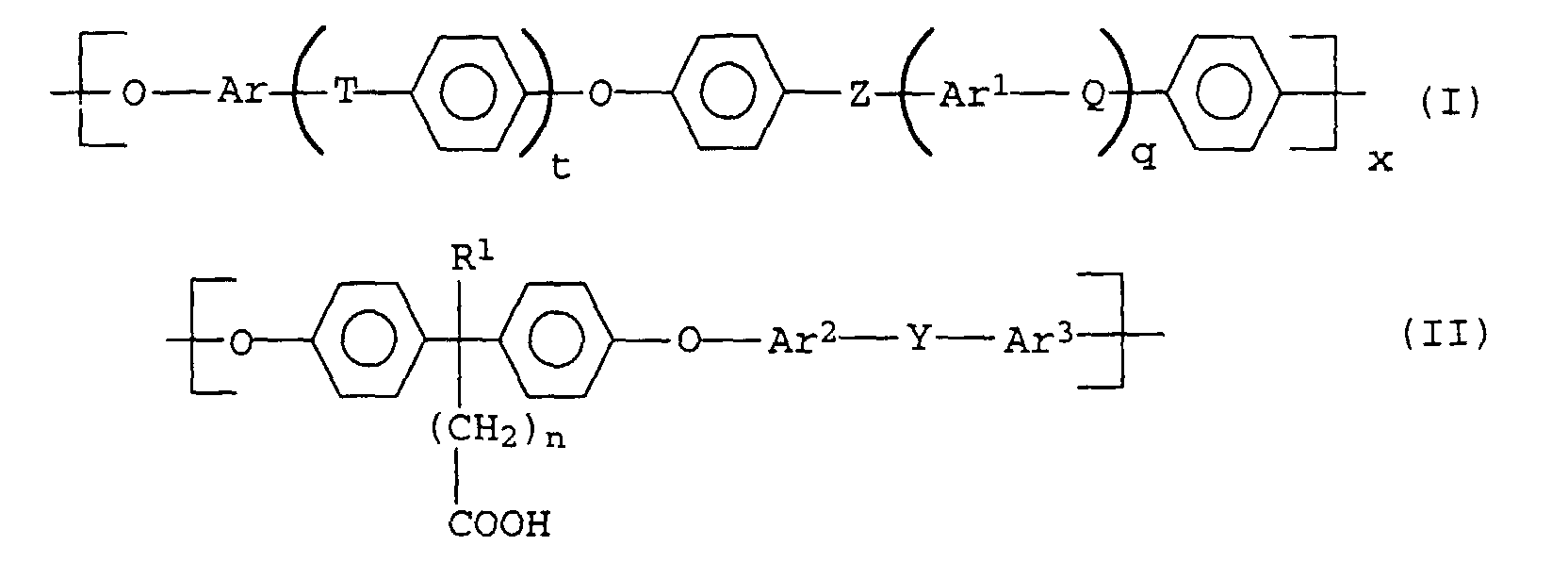
- Polyarylene ether components with units of Formulas I and / or II have the following meanings:
- Alkyl radicals which can be used according to the invention comprise straight-chain or branched, saturated carbon chains having up to 12 carbon atoms.
- the following radicals can be mentioned: C 1 -C 6 -alkyl radicals, such as methyl, ethyl, n-propyl, i-propyl, n-butyl, sec-butyl, 2- or 3-methyl-pentyl; and longer chain residues such as unbranched heptyl, octyl, nonyl, decyl, undecyl, lauryl and the one or more branched analogues thereof.
- alkyl portion of alkoxy groups useful in the present invention is as defined above.
- Cycloalkyl radicals which can be used according to the invention include, in particular, C 3 -C 12 cycloalkyl radicals, such as, for example, cyclopropyl, cyclobutyl, cyclopentyl, cyclohexyl, cycloheptyl, cyclooctyl, cyclopropylmethyl, cyclopropylethyl, cyclopropylpropyl, cyclobutylmethyl, cyclobutylethyl, cyclopentylethyl, propyl, propyl, propyl, , Cyclohexylmethyl, cyclohexyldimethyl, cyclohexyltrimethyl, and the like.
- C 3 -C 12 cycloalkyl radicals such as, for example, cyclopropyl, cyclobutyl, cyclopentyl, cyclohexyl, cycloheptyl, cyclooc
- C 6 -C 18 arylene groups which can be used according to the invention are phenylene groups, such as 1,2-, 1,3- and 1,4-phenylene, biphenylene groups, naphthylene groups, such as 1,6-, 1,7-, 2,6 - and 2,7-naphthylene, as well as the bridging groups derived from anthracene, phenanthrene and naphthacene.
- Polyarylene ethers (component A) which can be used according to the invention are composed of recurring units of the formula I. wherein Ar, Ar 1 , T, Z, Q, t, q and x have the meanings given above. Different units of the formula I can also be present randomly or in blocks in the polyarylene ether.
- Polyarylene ether A which can be used according to the invention can be prepared, for example, in accordance with GB 1 152 035 or US 4,870,153, to which reference is hereby made. Suitable process conditions for the synthesis of polyarylene ethers are described, for example, in EP-A-113 112 and EP-A-135 130.
- the reaction of the monomers in aprotic polar solvents in the presence of anhydrous alkali carbonate is particularly suitable.
- a particularly preferred combination is N-methylpyrrolidone as a solvent and potassium carbonate as a catalyst.
- the reaction in the melt is also preferred.
- suitable polyarylene ethers A are those with at least one of the following recurring structural units I 1 to I 29 :
- Particularly preferred units of the formula I are units of the formulas I 1 and I 2 which can be present individually or in a mixture.
- the polyarylene ethers A can also be copolymers or block copolymers, in which polyarylene ether segments and segments of other thermoplastic Polymers such as polyamides, polyesters, aromatic Polycarbonates, polyester carbonates, polysiloxanes, polyimides or polyetherimides are present.
- the number average molecular weights the block or graft arms in the copolymers are in usually in the range of 1,000 to 30,000 g / mol.
- the blocks are different Structure can be arranged alternately or statistically be.
- the weight fraction of the polyarylene ether in the co or Block copolymers is generally at least 10% by weight.
- the weight fraction of the polyarylene ether can be up to Amount to 97% by weight.
- Copolymers or block copolymers are preferred a weight fraction of polyarylene ether with up to 90% by weight.
- the polyarylene ethers have average molecular weights M n (number average) in the range from 5,000 to 60,000 g / mol and relative viscosities from 0.20 to 0.95 dl / g.
- M n number average
- relative viscosities are measured either in 1% by weight N-methylpyrrolidone solution, in mixtures of phenol and dichlorobenzene or in 96% sulfuric acid at 20 ° C. or 25 ° C. in each case.
- the molding compositions according to the invention contain as component B. fibrous or particulate fillers or reinforcing materials.
- Preferred fibrous fillers or reinforcing materials are carbon fibers, Potassium titanate whiskers, aramid fibers and especially preferably glass fibers. When using glass fibers you can these for better compatibility with the matrix material with a Plain and an adhesion promoter. In general the carbon and glass fibers used have one Diameters in the range from 6 to 20 ⁇ m.
- the incorporation of the glass fibers can take the form of both short glass fibers as well as in the form of endless strands (rovings). in the finished injection molded part is the average length of the glass fibers preferably in the range of 0.05 to 0.5 mm.
- Carbon or glass fibers can also be in the form of fabrics, Mats or glass silk rovings can be used.
- Suitable particulate fillers are amorphous silica, Magnesium carbonate (chalk), powdered quartz, mica, talc, Feldspar, glass balls and in particular calcium silicates such as wollastonite and kaolin (especially calcined kaolin).
- Preferred combinations of fillers are e.g. 20% by weight Glass fibers with 15% by weight wollastonite and 15% by weight glass fibers with 15% by weight wollastonite.
- compatibilizers in the molding compositions according to the invention used are compounds known per se or according to known ones Process can be produced.
- polyarylene ethers modified according to the invention are, for example accessible based on EP-A-0 185 237 and according to by I.W. Parsons et al., In Polymer, 34, 2836 (1993) and T. Koch, H. Ritter, in Macromol. Chem. Phys. 195, 1709 (1994) Method.
- the polyarylene ethers are accordingly obtainable, for example, by polycondensation of compounds of the general formula III wherein R 1 and n have the meanings given above with at least one further, for example chlorine-functionalized aromatic compound, such as bis- (4-chlorophenyl) sulfone, and optionally further hydroxy-functionalized compounds, such as bisphenol A and / or bisphenol S.
- Suitable reaction partners generally known to the person skilled in the art.
- modified polyarylene ethers C can be prepared the methods used for polyarylene ether A are also used be, the solution polymerization in dipolar aprotic Base solvent is preferred.
- n is an integer from 0 to 4.
- the polyarylene ethers C containing acid groups used according to the invention have viscosity numbers of about 15 to 80 ml / g (determined in a 1% strength NMP solution at 25 ° C.).
- the proportion of free acid groups in component C is 0.05 to 25, preferably 0.1 to 20 and in particular 0.1 to 15 mol%, the determination of the proportion of acid groups, as in IW Parsons et al., Polymer, 34, 2836 (1993), by 1 H-NMR.
- the molding compositions according to the invention can also be used as component D. e.g. up to 40% by weight of other additives, such as flame retardants, Dyes, pigments or stabilizers and lubricants.
- the molding compositions according to the invention can be made according to known methods Processes, for example by extrusion.
- thermoplastic molding compositions can e.g. getting produced, by placing the starting components in conventional mixing devices such as screw extruders, preferably twin-screw extruders, Brabender mills or Banbury mills and kneaders and then mixes extruded. Usually the extrudate is after the Extrusion cooled and crushed.
- the order of mixing the components can be varied two or optionally three components can thus be premixed , but it can also all components together be mixed.
- an intensive one Mixing advantageous. These are generally medium Mixing times from 0.2 to 30 minutes at temperatures from 280 to 400 ° C preferably 290 to 390 ° C required.
- the molding compounds containing filler have very good toughness and Strengths on. In addition, they are characterized by their very good Processing and hydrolysis stabilities. They are suitable therefore, for example, for the production of molded parts that are high exposed to mechanical loads or chemical influences are.
- the non-reinforced molding compositions according to the invention can also be used in Form of solutions are manufactured and processed.
- solvents are dichloromethane, chloroform, Chlorobenzene, ortho-dichlorobenzene, dimethylformamide, dimethyl sulfoxide, Dimethylacetamide, N-methylpyrrolidone, cyclohexanone and Tetrahydrofuran.
- the solids content of suitable polymer solutions can fluctuate in another area, but is usually included about 1-80% by weight.
- the viscosity number of the products in 1% solution of N-methylpyrrolidone was determined at 25 ° C.
- the proportion of units with acid groups was determined by 1 H-NMR spectroscopy as described in IW Parsons et al., Polymer 34, 2836 (1993).
- the reaction mixture was under a pressure of 300 mbar constant distillation of the water of reaction and N-methylpyrrolidone first heated to 180 ° C for 1 h and then further at 190 ° C for 6 h implemented.
- the proportion of units with acid groups was increased by means of H-NMR Determined 1.2 mol%, the viscosity number of the product was 38.1 ml / g.
- the reaction mixture was under a pressure of 300 mbar constant distillation of the water of reaction and N-methylpyrrolidone first heated to 180 ° C for 1 h and then further at 190 ° C for 6 h implemented.
- the reaction mixture was under a pressure of 300 mbar constant distillation of the water of reaction and N-methylpyrrolidone first heated to 180 ° C for 1 h and then further at 190 ° C for 6 h implemented.
- the proportion of units with acid groups was increased by means of H-NMR 3.0 mol% determined, the viscosity number of the product was 40.2 ml / g.
- Ultrason S 2010 (commercial product from BASF AG) was used as polyarylene ether A 1 .
- This product is characterized by a viscosity number of 56 ml / g, measured in 1% NMP solution at 25 ° C. It mainly comprises units of the formula I 2 .
- Ultrason E 1010 (commercial product from BASF AG) was used as polyarylene ether A 2 .
- This product is characterized by a viscosity number of 49 ml / g, measured in 1% NMP solution at 25 ° C. It mainly comprises units of the formula I 1 .
- E-glass fiber with a fiber diameter of 10 ⁇ m and a polyurethane size.
- thermoplastic molding compositions 1-5, V1 and V2 were made by Melt extrusion on a ZSK 30 at a housing temperature of 320 ° C (polysulfone molding compounds) or 350 ° C (polyethersulfone molding compounds) assembled. Processing to the test specimens took place at the same melt temperatures.
- the tensile strength and elongation at break of the molding compounds 1-5, V1 and V2 were determined according to ISO 527 on tensile bars.
- the impact strength of the products was determined on ISO rods according to ISO 179 leu.
- the melt stability of the molding compositions was determined by measuring the MVI value of the melt after 4 or 24 minutes of standing at a temperature of 400 ° C. The change that occurs during this time, based on the initial value, is given as a numerical value (in percent).
- the compositions of the molding compositions and the results of the tests are listed in Table 1. Molding compound no.
- V1 1 2nd 3rd V2 4th 5 Component [% by weight] A 1 70 65 60 60 - - - A 2 - - - - 70 65 60 B 30th 30th 30th 30th 30th 30th 30th 30th C 1 - 5 10th - - - - C 2 - - - 10th - - - C 3 - - - - - - 5 10th Impact strength [kJ / m 2 ] 29.7 46.2 50.1 52.1 43 48 51.8 Modulus of elasticity [N / mm 2 ] 8600 8550 8400 8450 9350 9450 9500 Tensile strength [N / mm 2 ] 112 128 131 132 142 153 163 Elongation at break [%] 1.9 2.7 3.1 2.7 2.0 2.3 2.2 MVI [ml / 10 '] 32 37 41 43 37 34 33 Melt stability [%] 21 16 14 13 27 25th 22
Landscapes
- Chemical & Material Sciences (AREA)
- Health & Medical Sciences (AREA)
- Chemical Kinetics & Catalysis (AREA)
- Medicinal Chemistry (AREA)
- Polymers & Plastics (AREA)
- Organic Chemistry (AREA)
- Compositions Of Macromolecular Compounds (AREA)
- Polymers With Sulfur, Phosphorus Or Metals In The Main Chain (AREA)
Abstract
sowie die Verwendung dieser Formmassen zur Herstellung von Filmen, Fasern und Formkörpern sowie die unter Verwendung der Formmassen hergestellten Gegenstände.
Description

wobei das molare Verhältnis von Einheiten der Formel I zu Einheiten der Formel II im Bereich von 0,05:99,95 bis 99,95:0,05 liegt.


| Formmasse Nr. | V1 | 1 | 2 | 3 | V2 | 4 | 5 |
| Komponente [Gew.-%] | |||||||
| A1 | 70 | 65 | 60 | 60 | - | - | - |
| A2 | - | - | - | - | 70 | 65 | 60 |
| B | 30 | 30 | 30 | 30 | 30 | 30 | 30 |
| C1 | - | 5 | 10 | - | - | - | - |
| C2 | - | - | - | 10 | - | - | - |
| C3 | - | - | - | - | - | 5 | 10 |
| Schlagzähigkeit [kJ/m2] | 29,7 | 46,2 | 50,1 | 52,1 | 43 | 48 | 51,8 |
| E-Modul [N/mm2] | 8600 | 8550 | 8400 | 8450 | 9350 | 9450 | 9500 |
| Zugfestigkeit [N/mm2] | 112 | 128 | 131 | 132 | 142 | 153 | 163 |
| Reißdehnung [%] | 1,9 | 2,7 | 3,1 | 2,7 | 2,0 | 2,3 | 2,2 |
| MVI [ml/10'] | 32 | 37 | 41 | 43 | 37 | 34 | 33 |
| Schmelzestabilität [%] | 21 | 16 | 14 | 13 | 27 | 25 | 22 |
| Film | V3 | 6 | 7 | 8 | 9 | V4 |
| Komponente [Gew.-%] | ||||||
| A1 | 100 | 80 | 60 | 40 | 20 | - |
| C2 | - | 20 | 40 | 60 | 80 | 100 |
| Randwinkel [°] | 78,6 | 72,1 | 67,4 | 64,1 | 60,1 | 58,1 |
Claims (10)
- Thermoplastische Formmasse, enthaltend:A) mindestens einen PolyarylenetherB) gegebenenfalls mindestens einen Füll- oder Verstärkungsstoff,
dadurch gekennzeichnet, daß die Formmasse außerdemC) mindestens einen modifizierten, Carboxylgruppen-haltigen Polyarylenether mit wiederkehrenden Strukturelementen der Formeln I und IIumfaßt,
worinx für 0,5 oder 1 steht,t und q unabhängig voneinander für 0, 1, 2 oder 3 stehen,n für eine ganze Zahl von 0 bis 6 steht,Q, T, Y und Z unabhängig voneinander jeweils eine chemische Bindung oder eine Gruppe, ausgewählt unter -O-, -S-, -SO2-, S=O, C=O, -N=N-, RaC=CRb- und -CRcRd-, bedeuten, wobeiRa und Rb unabhängig voneinander jeweils für ein Wasserstoffatom oder eine C1-C12-Alkylgruppe, stehen undRc und Rd unabhängig voneinander jeweils für ein Wasserstoffatom oder eine C1-C12-Alkyl-, C1-C12-Alkoxy- oder C6-C18-Arylgruppe stehen, wobei Rc und Rd gegebenenfalls unabhängig voneinander mit Fluor- und/oder Chloratomen substituiert sind oder gegebenenfalls zusammen mit dem C-Atom an das sie gebunden sind, eine C3-C12-Cycloalkylgruppe bilden, die gegebenenfalls mit einer oder mehreren C1-C6-Alkylgruppen substituiert ist,mit der Maßgabe, daß mindestens eine der Gruppen T, Q und Z für -SO2- oder C=O steht und, wenn t und q für 0 stehen, Z für -SO2- oder C=O steht,Ar, Ar1, Ar2 und Ar3 unabhängig voneinander für C6-C18-Arylengruppen stehen, wobei diese gegebenenfalls mit C1-C12-Alkyl-, C6-C18-Aryl- C1-C12-Alkoxygruppen oder Halogenatomen substituiert sind,R1 für H, C1-C6-Alkyl, oder -(CH2)n-COOH steht; und
wobei das molare Verhältnis von Einheiten der Formel I zu Einheiten der Formel II im Bereich von 0,05:99,95 bis 99,95:0,05 liegt. - Formmasse nach Anspruch 1, dadurch gekennzeichnet, daß der modifizierte Polyarylenether (Komponente C) einen Anteil freier Säuregruppen enthaltende Einheiten der Formel II von etwa 0,05 bis 25 mol-%, bestimmt durch 1H-NMR, aufweist.
- Formmasse nach einem der vorherigen Ansprüche, dadurch gekennzeichnet, daß der modifizierte Polyarylenether C) Strukturelemente der Formel II umfaßt, worin Ar2 und Ar3 jeweils für 1,4-Phenylen, Y für SO2, R1 für C1-C6-Alkyl und n für eine ganze Zahl von 1 bis 6 steht.
- Formmasse nach einem der vorherigen Ansprüche, dadurch gekennzeichnet, daß der Polyarylenether A) aus wiederkehrenden Strukturelementen obiger Formel I aufgebaut ist, wobei Ar, Ar1, T, Q, Z, t und q die oben angegebenen Bedeutungen besitzen.
- Formmasse nach einem der vorherigen Ansprüche, dadurch gekennzeichnet, daß die Einheiten der Formel I in den Komponenten A) und C) unabhängig voneinander ausgewählt sind unter Einheiten der Formel I1 und I2oder Gemischen davon.

- Verstärkte Formmasse nach einem der vorherigen Ansprüche enthaltend, bezogen auf das Gesamtgewicht der Formmasse,a) etwa 1 bis etwa 98 Gew.-% wenigstens eines Polyarylenethers A),b) etwa 1 bis etwa 50 Gew.-% wenigstens eines faser- oder teilchenförmigen Füll- oder Verstärkungsstoffs B),c) etwa 1 bis etwa 98 Gew.-% wenigstens eines modifizierten Polyarylenethers C) undd) 0 bis etwa 30 Gew.-% wenigstens eines weiteren üblichen Zusatzstoffs D).
- Formmasse mit verbesserter Benetzbarkeit durch polare Substanzen enthaltend, bezogen auf das Gesamtgewicht der Formmasse,a) etwa 1 bis etwa 99 Gew.-% wenigstens eines Polyarylenethers A)b) etwa 1 bis etwa 99 Gew.-% wenigstens einer modifizierten Polyarylenethers C) undc) 0 bis etwa 50 Gew.-% wenigstens eines üblichen Zusatzstoffs D).
- Lösung einer Formmasse nach einem der Ansprüche 1 bis 7, enthaltend in einem organischen Lösungsmittel etwa 1 bis etwa 80 Gew.-% der Komponenten A), C) und gegebenenfalls D).
- Verwendung von Formmassen nach einem der vorherigen Ansprüche zur Herstellung von Fasern, Filmen und Formkörpern.
- Fasern, Filme und Formkörper, hergestellt unter Verwendung einer Formmasse nach einem der Ansprüche 1 bis 8.
Applications Claiming Priority (2)
| Application Number | Priority Date | Filing Date | Title |
|---|---|---|---|
| DE19702590A DE19702590A1 (de) | 1997-01-24 | 1997-01-24 | Thermoplastische Formmassen |
| DE19702590 | 1997-01-24 |
Publications (3)
| Publication Number | Publication Date |
|---|---|
| EP0855430A2 true EP0855430A2 (de) | 1998-07-29 |
| EP0855430A3 EP0855430A3 (de) | 1998-08-05 |
| EP0855430B1 EP0855430B1 (de) | 2006-01-18 |
Family
ID=7818294
Family Applications (1)
| Application Number | Title | Priority Date | Filing Date |
|---|---|---|---|
| EP98101213A Expired - Lifetime EP0855430B1 (de) | 1997-01-24 | 1998-01-23 | Thermoplastische Formmassen |
Country Status (5)
| Country | Link |
|---|---|
| US (1) | US6051661A (de) |
| EP (1) | EP0855430B1 (de) |
| AT (1) | ATE316120T1 (de) |
| DE (2) | DE19702590A1 (de) |
| ES (1) | ES2256900T3 (de) |
Cited By (10)
| Publication number | Priority date | Publication date | Assignee | Title |
|---|---|---|---|---|
| US7834134B2 (en) | 2008-08-13 | 2010-11-16 | General Electric Company | Polyarylethers, blends and methods for making |
| US7959808B2 (en) | 2008-10-31 | 2011-06-14 | General Electric Company | Polysulfone membranes methods and apparatuses |
| US7964697B2 (en) | 2008-08-13 | 2011-06-21 | General Electric Company | Polyarylether membranes |
| WO2011107389A1 (de) * | 2010-03-05 | 2011-09-09 | Basf Se | Verbesserte blends aus polyarylenethern und polyarylensulfiden |
| WO2011117153A1 (de) * | 2010-03-23 | 2011-09-29 | Basf Se | Verbesserte blends aus polyarylenethern und polyarylensulfiden |
| EP2390281A1 (de) | 2010-05-26 | 2011-11-30 | Basf Se | Verstärkte thermoplastische Formmassen auf Basis von Polyarylenethern |
| US8703862B2 (en) | 2010-05-26 | 2014-04-22 | Basf Se | Reinforced thermoplastic molding compositions based on polyarylene ethers |
| WO2022248365A1 (en) | 2021-05-26 | 2022-12-01 | Basf Se | Thermoplastic molding composition with high temperature resistance |
| WO2023285137A1 (en) | 2021-07-16 | 2023-01-19 | Basf Se | Thermoplastic molding composition with high temperature resistance comprising a thermotropic polymer |
| WO2023285136A1 (en) | 2021-07-16 | 2023-01-19 | Basf Se | Thermoplastic molding composition with high temperature resistance comprising a polyphenylene sulfide |
Families Citing this family (1)
| Publication number | Priority date | Publication date | Assignee | Title |
|---|---|---|---|---|
| US20100041837A1 (en) * | 2008-08-13 | 2010-02-18 | Gary William Yeager | Polyarylethers, blends and methods for making |
Family Cites Families (20)
| Publication number | Priority date | Publication date | Assignee | Title |
|---|---|---|---|---|
| GB1152035A (en) * | 1965-09-22 | 1969-05-14 | Marconi Co Ltd | Improvements in or relating to D.C. Restoring Circuits |
| FR2040950A5 (de) * | 1969-04-30 | 1971-01-22 | Rhone Poulenc Sa | |
| US3723389A (en) * | 1971-10-27 | 1973-03-27 | Allied Chem | Thermoplastic aromatic poly(ether-sulfones) |
| CA1246295A (en) * | 1982-12-23 | 1988-12-06 | Robert A. Clendinning | Aromatic amorphous thermoplastic terpolymers |
| US4642358A (en) * | 1984-09-27 | 1987-02-10 | General Electric Company | Acyl modified polyphenylene ether composition |
| DE3444339A1 (de) * | 1984-12-05 | 1986-06-05 | Basf Ag, 6700 Ludwigshafen | Thermoplastische formmassen |
| US4879338A (en) * | 1985-02-13 | 1989-11-07 | Raychem Corporation | Poly(aryl ether ketone) compositions |
| EP0235885B1 (de) * | 1986-01-30 | 1992-08-12 | Imperial Chemical Industries Plc | Polymermasse |
| US4870153A (en) * | 1987-10-22 | 1989-09-26 | Amoco Corporation | Novel poly(aryl ether) polymers |
| CA1304537C (en) * | 1987-12-11 | 1992-06-30 | Michael Dominique Guiver | Aromatic polysulfone compounds and their manufacture |
| US5066719A (en) * | 1990-02-06 | 1991-11-19 | General Electric Company | Polyphenylene ether-polyamide compositions from dicarboxylate-capped polyphenylene ethers |
| US5189114A (en) * | 1990-12-31 | 1993-02-23 | General Electric Company | Compatibilization of polyphenylene ether with polyester using polystyrene-polycarbonate copolymer |
| US5612425A (en) * | 1991-03-30 | 1997-03-18 | Basf Aktiengesellschaft | Molding compositions based on modified polyaryl ethers |
| DE4114455A1 (de) * | 1991-05-03 | 1992-11-05 | Basf Ag | Thermoplastische formmasse auf der basis von polyarylethern, polyamiden und modifizierten polyarylethern als haftvermittler |
| DE4121705A1 (de) * | 1991-07-01 | 1993-01-07 | Basf Ag | Thermoplastische formmassen auf der basis von polyarylenethern und teilaromatischen copolyamiden |
| DE4306708A1 (de) * | 1993-03-04 | 1994-09-08 | Basf Ag | Formmassen auf der Grundlage von Polyarylenethern mit Anhydridgruppen |
| US5804629A (en) * | 1993-06-24 | 1998-09-08 | Basf Aktiengesellschaft | Molding materials based on polyarylene ethers |
| DE4400747A1 (de) * | 1994-01-13 | 1995-07-20 | Basf Ag | Blends auf der Basis von Copolyarylenethersulfonen |
| EP0673973A1 (de) * | 1994-03-26 | 1995-09-27 | Basf Aktiengesellschaft | Mischungen auf der Basis von Polyarylenethern und Polyarylensulfiden |
| JP3856831B2 (ja) * | 1995-06-09 | 2006-12-13 | ピービーアイ・パフォーマンス・プロダクツ・インコーポレーテッド | 高充填材入り射出成形用ポリアリールエーテルケトン |
-
1997
- 1997-01-24 DE DE19702590A patent/DE19702590A1/de not_active Withdrawn
-
1998
- 1998-01-22 US US09/012,028 patent/US6051661A/en not_active Expired - Lifetime
- 1998-01-23 EP EP98101213A patent/EP0855430B1/de not_active Expired - Lifetime
- 1998-01-23 ES ES98101213T patent/ES2256900T3/es not_active Expired - Lifetime
- 1998-01-23 AT AT98101213T patent/ATE316120T1/de not_active IP Right Cessation
- 1998-01-23 DE DE59813345T patent/DE59813345D1/de not_active Expired - Lifetime
Cited By (16)
| Publication number | Priority date | Publication date | Assignee | Title |
|---|---|---|---|---|
| US7834134B2 (en) | 2008-08-13 | 2010-11-16 | General Electric Company | Polyarylethers, blends and methods for making |
| US7964697B2 (en) | 2008-08-13 | 2011-06-21 | General Electric Company | Polyarylether membranes |
| US7959808B2 (en) | 2008-10-31 | 2011-06-14 | General Electric Company | Polysulfone membranes methods and apparatuses |
| WO2011107389A1 (de) * | 2010-03-05 | 2011-09-09 | Basf Se | Verbesserte blends aus polyarylenethern und polyarylensulfiden |
| KR101818588B1 (ko) | 2010-03-05 | 2018-01-15 | 바스프 에스이 | 폴리아릴렌 에테르 및 폴리아릴렌 술피드의 개선된 블렌드 |
| WO2011117153A1 (de) * | 2010-03-23 | 2011-09-29 | Basf Se | Verbesserte blends aus polyarylenethern und polyarylensulfiden |
| JP2013526651A (ja) * | 2010-05-26 | 2013-06-24 | ビーエーエスエフ ソシエタス・ヨーロピア | 強化されたポリアリーレンエーテル系熱可塑性成形材料 |
| CN102906172A (zh) * | 2010-05-26 | 2013-01-30 | 巴斯夫欧洲公司 | 基于聚芳醚的增强热塑性模塑组合物 |
| WO2011147758A1 (de) | 2010-05-26 | 2011-12-01 | Basf Se | Verstärkte thermoplastische formmassen auf basis von polyarylenethern |
| US8703862B2 (en) | 2010-05-26 | 2014-04-22 | Basf Se | Reinforced thermoplastic molding compositions based on polyarylene ethers |
| CN102906172B (zh) * | 2010-05-26 | 2015-10-07 | 巴斯夫欧洲公司 | 基于聚芳醚的增强热塑性模塑组合物 |
| EP2390281A1 (de) | 2010-05-26 | 2011-11-30 | Basf Se | Verstärkte thermoplastische Formmassen auf Basis von Polyarylenethern |
| KR101826247B1 (ko) | 2010-05-26 | 2018-02-06 | 바스프 에스이 | 폴리아릴렌 에테르를 기재로 하는 강화된 열가소성 성형 컴파운드 |
| WO2022248365A1 (en) | 2021-05-26 | 2022-12-01 | Basf Se | Thermoplastic molding composition with high temperature resistance |
| WO2023285137A1 (en) | 2021-07-16 | 2023-01-19 | Basf Se | Thermoplastic molding composition with high temperature resistance comprising a thermotropic polymer |
| WO2023285136A1 (en) | 2021-07-16 | 2023-01-19 | Basf Se | Thermoplastic molding composition with high temperature resistance comprising a polyphenylene sulfide |
Also Published As
| Publication number | Publication date |
|---|---|
| DE19702590A1 (de) | 1998-07-30 |
| ATE316120T1 (de) | 2006-02-15 |
| EP0855430A3 (de) | 1998-08-05 |
| DE59813345D1 (de) | 2006-04-06 |
| US6051661A (en) | 2000-04-18 |
| EP0855430B1 (de) | 2006-01-18 |
| ES2256900T3 (es) | 2006-07-16 |
Similar Documents
| Publication | Publication Date | Title |
|---|---|---|
| EP2513191B1 (de) | Verbesserte blends aus polyarylenethern und polyarylensulfiden | |
| EP0840758B1 (de) | Verfahren zur herstellung von verkappten polyarylenethern | |
| EP1242538B1 (de) | Thermoplastische formmassen mit verbessertem verarbeitungsverhalten auf basis von polyarylenethersulfonen und polyamiden | |
| EP2336220A1 (de) | Verbesserte Blends aus Polyarylenethern und Polyarylensulfiden | |
| DE68903181T2 (de) | Polyimidharz-zusammensetzung. | |
| EP0855430B1 (de) | Thermoplastische Formmassen | |
| DE3444339A1 (de) | Thermoplastische formmassen | |
| EP2390281A1 (de) | Verstärkte thermoplastische Formmassen auf Basis von Polyarylenethern | |
| EP0613916B1 (de) | Formmasse auf der Grundlage von Polyarylenethern mit Anhydridendgruppen | |
| EP0855428A1 (de) | Thermoplastische Formmassen mit reduzierter Wasseraufnahme | |
| EP0855429A1 (de) | Thermoplastische Formmassen mit verbesserter Chemikalienresistenz | |
| DE19741467A1 (de) | Polyarylenether und Polyarylensulfide enthaltende Formmassen mit verbesserter Kerbschlagzähigkeit | |
| EP0513488B1 (de) | Formmassen auf Basis modifizierter Polyarylether | |
| EP0518062B1 (de) | In-situ Polymerlegierungen und Mikroverbunde sowie Verfahren zu ihrer Herstellung | |
| EP1105437B1 (de) | Formmassen auf der basis von polyarylenethersulfonen und aliphatischen polyamiden | |
| EP0414124B1 (de) | Mehrkomponentenlegierung mit einer Glastemperatur | |
| EP1446452B1 (de) | Modifizierte epoxidharze | |
| EP0796879B1 (de) | Pfropfcopolymerisate aus Polyarylenethern, Polyamiden und Copolymeren, die cyclische, alpha,beta-ungesättigte Dicarbonsäureanhydride einpolymerisiert enthalten | |
| EP0857745A2 (de) | Verfahren zur Herstellung von Blockcopolymeren | |
| EP0590392A2 (de) | Formmassen auf der Basis von Polyarylethern und schlagzähmodifizierten teilaromatischen Copolyamiden | |
| WO2001064792A1 (de) | Formmassen auf der basis von polyarylenethersulfonen und polyamiden mit piperidinendgruppen | |
| DE19830378A1 (de) | Formmassen aus Polyarylenethersulfonen und epoxidgruppen-haltigen Polyethylenkautschuken | |
| DE19736973A1 (de) | Formmassen auf der Basis von Polyarylenethern und Polyamiden | |
| EP0893477A2 (de) | Thermoplastische Formmassen mit verbesserter Chemikalienresistenz | |
| EP0905193A2 (de) | Polyarylenether, Styrolcopolymerisate und funktionalisierte Polymere enthaltende Formmassen |
Legal Events
| Date | Code | Title | Description |
|---|---|---|---|
| PUAI | Public reference made under article 153(3) epc to a published international application that has entered the european phase |
Free format text: ORIGINAL CODE: 0009012 |
|
| PUAL | Search report despatched |
Free format text: ORIGINAL CODE: 0009013 |
|
| AK | Designated contracting states |
Kind code of ref document: A2 Designated state(s): AT BE DE ES FR GB IT NL |
|
| AX | Request for extension of the european patent |
Free format text: AL;LT;LV;MK;RO;SI |
|
| AK | Designated contracting states |
Kind code of ref document: A3 Designated state(s): AT BE CH DE DK ES FI FR GB GR IE IT LI LU MC NL PT SE |
|
| AX | Request for extension of the european patent |
Free format text: AL;LT;LV;MK;RO;SI |
|
| RHK1 | Main classification (correction) |
Ipc: H04J 14/02 |
|
| RTI1 | Title (correction) | ||
| 17P | Request for examination filed |
Effective date: 19981127 |
|
| AKX | Designation fees paid |
Free format text: AT BE DE ES FR GB IT NL |
|
| RBV | Designated contracting states (corrected) |
Designated state(s): AT BE DE ES FR GB IT NL |
|
| 17Q | First examination report despatched |
Effective date: 20040505 |
|
| GRAP | Despatch of communication of intention to grant a patent |
Free format text: ORIGINAL CODE: EPIDOSNIGR1 |
|
| RIC1 | Information provided on ipc code assigned before grant |
Ipc: 7C 08G 65/40 B Ipc: 7C 08L 71/00 A |
|
| RTI1 | Title (correction) |
Free format text: THERMOPLASTIC MOLDING COMPOSITIONS |
|
| GRAS | Grant fee paid |
Free format text: ORIGINAL CODE: EPIDOSNIGR3 |
|
| GRAA | (expected) grant |
Free format text: ORIGINAL CODE: 0009210 |
|
| AK | Designated contracting states |
Kind code of ref document: B1 Designated state(s): AT BE DE ES FR GB IT NL |
|
| REG | Reference to a national code |
Ref country code: GB Ref legal event code: FG4D Free format text: NOT ENGLISH |
|
| PG25 | Lapsed in a contracting state [announced via postgrant information from national office to epo] |
Ref country code: AT Free format text: LAPSE BECAUSE OF NON-PAYMENT OF DUE FEES Effective date: 20060123 |
|
| REF | Corresponds to: |
Ref document number: 59813345 Country of ref document: DE Date of ref document: 20060406 Kind code of ref document: P |
|
| GBT | Gb: translation of ep patent filed (gb section 77(6)(a)/1977) |
Effective date: 20060504 |
|
| REG | Reference to a national code |
Ref country code: ES Ref legal event code: FG2A Ref document number: 2256900 Country of ref document: ES Kind code of ref document: T3 |
|
| PLBE | No opposition filed within time limit |
Free format text: ORIGINAL CODE: 0009261 |
|
| STAA | Information on the status of an ep patent application or granted ep patent |
Free format text: STATUS: NO OPPOSITION FILED WITHIN TIME LIMIT |
|
| 26N | No opposition filed |
Effective date: 20061019 |
|
| EN | Fr: translation not filed | ||
| PG25 | Lapsed in a contracting state [announced via postgrant information from national office to epo] |
Ref country code: FR Free format text: LAPSE BECAUSE OF FAILURE TO SUBMIT A TRANSLATION OF THE DESCRIPTION OR TO PAY THE FEE WITHIN THE PRESCRIBED TIME-LIMIT Effective date: 20070309 |
|
| PG25 | Lapsed in a contracting state [announced via postgrant information from national office to epo] |
Ref country code: FR Free format text: LAPSE BECAUSE OF FAILURE TO SUBMIT A TRANSLATION OF THE DESCRIPTION OR TO PAY THE FEE WITHIN THE PRESCRIBED TIME-LIMIT Effective date: 20060131 |
|
| PG25 | Lapsed in a contracting state [announced via postgrant information from national office to epo] |
Ref country code: FR Free format text: LAPSE BECAUSE OF FAILURE TO SUBMIT A TRANSLATION OF THE DESCRIPTION OR TO PAY THE FEE WITHIN THE PRESCRIBED TIME-LIMIT Effective date: 20060118 |
|
| REG | Reference to a national code |
Ref country code: DE Ref legal event code: R082 Ref document number: 59813345 Country of ref document: DE |
|
| PGFP | Annual fee paid to national office [announced via postgrant information from national office to epo] |
Ref country code: NL Payment date: 20160125 Year of fee payment: 19 |
|
| PGFP | Annual fee paid to national office [announced via postgrant information from national office to epo] |
Ref country code: ES Payment date: 20160223 Year of fee payment: 19 Ref country code: DE Payment date: 20160331 Year of fee payment: 19 Ref country code: IT Payment date: 20160121 Year of fee payment: 19 |
|
| PGFP | Annual fee paid to national office [announced via postgrant information from national office to epo] |
Ref country code: GB Payment date: 20160129 Year of fee payment: 19 Ref country code: BE Payment date: 20160129 Year of fee payment: 19 |
|
| PG25 | Lapsed in a contracting state [announced via postgrant information from national office to epo] |
Ref country code: BE Free format text: LAPSE BECAUSE OF NON-PAYMENT OF DUE FEES Effective date: 20170131 |
|
| REG | Reference to a national code |
Ref country code: DE Ref legal event code: R119 Ref document number: 59813345 Country of ref document: DE |
|
| REG | Reference to a national code |
Ref country code: NL Ref legal event code: MM Effective date: 20170201 |
|
| GBPC | Gb: european patent ceased through non-payment of renewal fee |
Effective date: 20170123 |
|
| PG25 | Lapsed in a contracting state [announced via postgrant information from national office to epo] |
Ref country code: NL Free format text: LAPSE BECAUSE OF NON-PAYMENT OF DUE FEES Effective date: 20170201 Ref country code: GB Free format text: LAPSE BECAUSE OF NON-PAYMENT OF DUE FEES Effective date: 20170123 Ref country code: DE Free format text: LAPSE BECAUSE OF NON-PAYMENT OF DUE FEES Effective date: 20170801 |
|
| REG | Reference to a national code |
Ref country code: BE Ref legal event code: MM Effective date: 20170131 |
|
| PG25 | Lapsed in a contracting state [announced via postgrant information from national office to epo] |
Ref country code: IT Free format text: LAPSE BECAUSE OF NON-PAYMENT OF DUE FEES Effective date: 20170123 |
|
| REG | Reference to a national code |
Ref country code: ES Ref legal event code: FD2A Effective date: 20180507 |
|
| PG25 | Lapsed in a contracting state [announced via postgrant information from national office to epo] |
Ref country code: ES Free format text: LAPSE BECAUSE OF NON-PAYMENT OF DUE FEES Effective date: 20170124 |