EP0856573A2 - Dieselbrennstoffzusammensetzung mit reduzierter Partikelemission - Google Patents
Dieselbrennstoffzusammensetzung mit reduzierter Partikelemission Download PDFInfo
- Publication number
- EP0856573A2 EP0856573A2 EP98101355A EP98101355A EP0856573A2 EP 0856573 A2 EP0856573 A2 EP 0856573A2 EP 98101355 A EP98101355 A EP 98101355A EP 98101355 A EP98101355 A EP 98101355A EP 0856573 A2 EP0856573 A2 EP 0856573A2
- Authority
- EP
- European Patent Office
- Prior art keywords
- diesel fuel
- ppm
- peaks
- fuel composition
- range
- Prior art date
- Legal status (The legal status is an assumption and is not a legal conclusion. Google has not performed a legal analysis and makes no representation as to the accuracy of the status listed.)
- Withdrawn
Links
Images




Classifications
-
- C—CHEMISTRY; METALLURGY
- C10—PETROLEUM, GAS OR COKE INDUSTRIES; TECHNICAL GASES CONTAINING CARBON MONOXIDE; FUELS; LUBRICANTS; PEAT
- C10L—FUELS NOT OTHERWISE PROVIDED FOR; NATURAL GAS; SYNTHETIC NATURAL GAS OBTAINED BY PROCESSES NOT COVERED BY SUBCLASSES C10G OR C10K; LIQUIFIED PETROLEUM GAS; USE OF ADDITIVES TO FUELS OR FIRES; FIRE-LIGHTERS
- C10L1/00—Liquid carbonaceous fuels
- C10L1/04—Liquid carbonaceous fuels essentially based on blends of hydrocarbons
- C10L1/08—Liquid carbonaceous fuels essentially based on blends of hydrocarbons for compression ignition
Definitions
- the present invention relates to a diesel fuel composition which can yield reduced emissions of particulates (particulate matter) from a diesel engine.
- Particulates are one of the substances emitted from diesel engines which are subject to emission restrictions. Particulates consist principally of carbon particles (soot) and hydrocarbons and partially oxidized products resulting from incomplete combustion. A certain reduction in particulate emissions can be achieved by optimization of the combustion system of the diesel engine, but improvements in the diesel fuel are also required.
- An object of the present invention is to provide a diesel fuel composition with a reduced content of aromatic compounds which can realize further reduction of particulate emissions.
- the ratio of the total area of a group of peaks with a chemical shift in the range of 33 ppm to 50 ppm with respect to the total area of a group of peaks with a chemical shift in the range of 0 ppm to 50 ppm is equal to or less than 30 % in a 13 C nuclear magnetic resonance spectrum (hereinafter referred to as " 13 C-NMR spectrum").
- peaks with chemical shifts in the range of 0 to 50 ppm are due principally to carbon atoms constituting hydrocarbon portions not including unsaturated bonds
- peaks with chemical shifts in the range of 33 to 50 ppm are due principally to tertiary and quaternary carbon atoms within saturated hydrocarbon portions having branches, or carbon atoms adjacent to such atoms.
- the total area of a group of peaks with a chemical shift in the range of 33 to 50 ppm corresponds to the presence or absence of branches, and the number of branches.
- the ratio of the total area of a group of peaks with a chemical shift in the range of 33 to 50 ppm with respect to the total area of the soup of peaks with a chemical shift in the range of 0 to 50 ppm is equal to or less than a specified value, which is specifically equal to or less than 30%, and more preferably equal to or less than 20%
- a specified value which is specifically equal to or less than 30%, and more preferably equal to or less than 20%
- the content of aromatic compounds is preferably equal to or less than 25% by volume, and even more preferably equal to or less than 20% by volume.
- aromatic compounds include aromatic hydrocarbons and additives which include aromatic rings and so forth.
- the aromatic compounds comprise polycyclic aromatic compounds and the content thereof is preferably equal to or less than 5 % by volume.
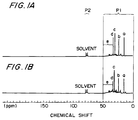
- Figs. 1A and 1B show 13 C-NMR spectra for a first embodiment and a first comparative example.
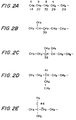
- Figs. 2A to 2E illustrate molecular structures and chemical shifts corresponding to the peaks in the spectra shown in Figs. 1A and 1B.
- Fig. 3 illustrates particulate measurements for the first embodiment and first comparative example.
- Fig. 4 illustrates other particulate measurements for the first embodiment and first comparative example.
- Fig. 5 shows the products of thermal decomposition and their concentrations obtained using a flow reactor, for the first embodiment and first comparative example.
- Fig. 6 shows the products of thermal decomposition and their concentrations obtained using a flow reactor, for different isomers of hexane.
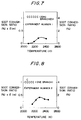
- Fig. 7 is a graph showing the relationship between the initial reaction temperature and soot conversion ratio in Experiment 1 carried out with a shock tube.
- Fig. 8 is a graph showing the relationship between the initial reaction temperature and soot conversion ratio in Experiment 2 carried out with a shock tube.
- Fig. 9 is a graph showing the relationship between the initial reaction temperature and soot conversion ratio in Experiment 3 carried out with a shock tube.
- Fig. 10 is a graph showing the relationship between the initial reaction temperature and soot conversion ratio in Experiment 4 carried out with a shock tube.
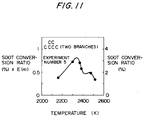
- Fig. 11 is a graph showing the relationship between the initial reaction temperature and soot conversion ratio in Experiment 5 carried out with a shock tube.
- Fig. 12 is a graph comparing the soot conversion ratios at the peaks respectively shown in Figs. 7 to 11.
- Figs. 1A and 1B show 13 C-NMR spectra, Fig. 1A being the spectrum for a diesel fuel composition embodying the present invention (first embodiment), and Fig. 1B the spectrum for a comparative diesel fuel composition (first comparative example).
- the percentage ratio of the total area S2 of the group of peaks e with a chemical shift in the range of 33 to 50 ppm with respect to the total area S1 of the group of peaks P1 with a chemical shift in the range of 0 to 50 ppm is equal to or less than 30%, and preferably equal to or less than 20%. It should be noted that in Figs. 1A and 1B the group of peaks P2 in the spectrum corresponds to the peaks for the solvent.
- the prominent peaks a to d correspond, as shown in Fig. 2A, to particular carbon atoms in unbranching saturated hydrocarbon portions.
- the numerals associated with particular carbon atoms indicate the corresponding chemical shifts.
- Molecular structures belonging to the group of peaks e are not limited to those shown in Figs. 2B to 2E, and many other examples exist. Moreover, this is well known, and is disclosed in the literature (for example, 13 C-NMR Data Book, edited by Fumio Toda and Tokio Oshima).
- saturated hydrocarbon portions having tertiary or quaternary carbon atoms for example hydrocarbons including alkyl groups (C n H 2n+1 ), alkenyl groups (C n H 2n-1 ), alkynyl groups and alkadienyl groups (C n H 2n-3 ), and alkatrienyl groups (C n H 2n-5 ), or the like, produce peaks with a chemical shift in the range of 33 to 50 ppm as above.
- Table 1 shows the ratio of the area of each of the peaks a to d to the total peak area S1 , and the ratio of the total peak area S2 of the group of peaks e to the total peak area S1 for the spectra of Figs. 1A and 1B.
- the proportion of the total peak area for the group of peaks e in the first embodiment of the present invention is 17.7%, whereas the proportion of the total peak area for the group of peaks e in the first comparative example is 30.5%.
- Table 2 shows the properties of the diesel fuel composition of the first embodiment of the present invention and the first comparative example.
- the first comparative example is a commercial product (Sweden Class 1 diesel fuel (Shell Oil)), which with the object of reducing particulate emission has a low content of aromatic compounds and a reduced boiling point, compared with generally available commercial products.
- the diesel fuel composition of the first embodiment with the object of reducing particulate emission also has a low content of aromatic compounds and a reduced boiling point, compared with generally available commercial products, but the content of aromatic compounds is about 10% higher by volume, and in the T50 to T90 range, the diesel fuel composition has boiling points of approximately 23 to 33 °C higher than those of the first comparative example. It should be noted that as a result of investigation of the combustion characteristics of these diesel fuel compositions, no large differences were found in the fuel-air mixture formation and flame development processes, ignition delay and heat release rate in both low and medium load ranges, and there are basically no differences in macroscopic combustion characteristics.
- Figs. 3 and 4 measurements of the amount of particulate matter (PM) emitted under light load are shown in Figs. 3 and 4 for the first embodiment and first comparative example.
- Particulate matter comprises a soluble organic fraction (SOF), which is a component soluble in an organic solvent, and insoluble organic fraction (IOF), which is a component insoluble in an organic solvent and principally comprises soot.
- SOF soluble organic fraction
- IPF insoluble organic fraction
- the particulate measurements may be made using the methods described in the literature, for example in F. Black, SAE Technical Paper 790422.
- Fig. 3 shows the case where the fuel injection timing is at a crank angle of degrees before top dead center
- Fig. 4 shows the case where the fuel injection timing is at a crank angle of 0 degrees, that is to say, at the top dead center.
- the bar indication A shows the results for the first embodiment
- the bar indication B shows the results for the first comparative example.
- the diesel fuel composition of the first embodiment exhibits a greatly reduced amount of particulate material, and particularly of insoluble organic fraction, compared with the diesel fuel composition of the first comparative example. That is to say, although the first comparative example has a highly reduced content of aromatic organic compounds and a highly lowered boiling point, the reduction in particulate emissions is not as effective as that of the first embodiment.
- the products of thermal decomposition of two diesel fuels listed in Table 2 and obtained through a flow reactor were analyzed by a gas chromatography.
- the operating conditions of measurement in the flow reactor were as follows: nitrogen gas was used as the carrier gas, the sample was diluted 50 times by weight, the reaction time (time the gas was retained in the reaction tube) was 0.65 seconds, and the reaction temperature was 850°C.
- Fig. 5 shows the concentrations of the products (acetylene, propadiene, benzene, and toluene) obtained by thermal decomposition of the diesel fuel compositions, using the flow reactor.
- Acetylene, propadiene, and other hydrocarbons with unsaturated bonds, and benzene, toluene, and other aromatic hydrocarbons are the substances which are the origin of the polycyclic aromatic hydrocarbons which are the precursors to particulate matter.
- acetylene, propadiene, benzene, and toluene concentrations of products of thermal decomposition (acetylene, propadiene, benzene, and toluene) are shown in Fig. 6. From Fig. 6, it will be seen that for each of propadiene, benzene, and toluene, as the number of branches increases, these substances which are precursors to polycyclic aromatic hydrocarbons are produced in larger quantities. For acetylene, on the other hand, it will be seen that the number of branches has little effect.
- a shock tube is a widely used device in the field of physical chemistry, as described in the literature (for example, Technopia, World Science Dictionary, published by Kodansha, Vol. 8, pp. 188-189, and M. Frenklach and S. Taki. A Conceptual Model for Soot Formation in Pyrolysis of Aromatic Hydrocarbons. Combustion and Flame 49. pp. 275-282, 1983).
- the shock tube used in this experiment was a stainless steel cylinder (outer diameter 89.1 mm, inner diameter 78.1 mm), and the lengths of the low pressure chamber (driven section) and the high pressure chamber (driver section) were 6 m and 3 m respectively.
- the low pressure chamber and the high pressure chamber were separated with an aluminum diaphragm, and the low pressure chamber and the high pressure chamber were evacuated to a vacuum, after which into the low pressure chamber was introduced as shown in Table 3 a test fuel gas diluted with argon, and the high pressure chamber was charged with helium as a driver gas, respectively at given pressures.
- the diaphragm was ruptured with an impact needle or spontaneously under the pressure of the high pressure chamber, whereby a shock wave was generated.
- a shock wave (the incident shock wave) advancing from the diaphragm toward the end wall of the low pressure chamber at the speed of sound or faster reached the end wall of the low pressure chamber and was reflexed, becoming a reflected shock wave.
- the amount of soot generated by the reaction was measured from the transmissivity of a helium neon laser passing through a pair of optical windows disposed at a distance of 1 cm from the end wall of the low pressure chamber. That is to say, using the fact that the transmissivity is reduced since the helium neon laser is attenuated by scattering by soot particles, the amount of soot can be determined.
- the benchmark used to indicate the amount of soot generated is the "soot conversion ratio" (proportion of the number of carbon atoms which are converted to soot particles to the total number of carbon atoms in the fuel of initial stage) defined by the well-known expression (1) from the measurement of the transmissivity of a helium neon laser. (For example, A.
- Soot conversion ratio (total number of carbon atoms in soot) / (total number of carbon atoms in fuel initially behind reflected shock wave)
- Table 3 shows the composition of the (test fuel) gas charged in the low pressure chamber, the initial reaction temperature, the initial reaction pressure, and the initial carbon concentration behind the reflected shock wave.
- the temperature behind the reflected shock wave was varied by adjusting the pressure of the propulsion gas (helium) charged in the high pressure chamber.
- the proportions of paraffin and oxygen are in a chemical equivalence ratio of 10, and this equivalence ratio is the condition corresponding to the excessively rich mixture portion in a diesel engine.
- Figs. 7 to 11 The results are shown in Figs. 7 to 11.
- the horizontal axis represents the temperature (initial reaction temperature) behind the reflected shock wave
- the vertical axis represents the soot conversion ratio 1 millisecond after the start of the reaction. All the results exhibit characteristics which reach a maximum soot conversion ratio at a particular temperature, that is to say, bell curves.
- Fig. 12 shows a comparison of the peak values of the bell curves shown in Figs. 7 to 11.
- the dimethylbutane (i-hexane with two branches) in experiments number 4 and 5 exhibit progressively higher values of the soot conversion ratio (soot production capacity). That is to say, the soot production capacity increases as the number of branches increases. From comparisons of experiments number 2 and 3 and experiments number 4 and 5, however, the position of the branches has only a small effect on the soot production capacity.
Landscapes
- Chemical & Material Sciences (AREA)
- Oil, Petroleum & Natural Gas (AREA)
- Engineering & Computer Science (AREA)
- Chemical Kinetics & Catalysis (AREA)
- General Chemical & Material Sciences (AREA)
- Organic Chemistry (AREA)
- Compounds Of Alkaline-Earth Elements, Aluminum Or Rare-Earth Metals (AREA)
- Solid Fuels And Fuel-Associated Substances (AREA)
Applications Claiming Priority (3)
| Application Number | Priority Date | Filing Date | Title |
|---|---|---|---|
| JP29569/97 | 1997-01-29 | ||
| JP2956997 | 1997-01-29 | ||
| JP2956997 | 1997-01-29 |
Publications (2)
| Publication Number | Publication Date |
|---|---|
| EP0856573A2 true EP0856573A2 (de) | 1998-08-05 |
| EP0856573A3 EP0856573A3 (de) | 2000-03-08 |
Family
ID=12279765
Family Applications (1)
| Application Number | Title | Priority Date | Filing Date |
|---|---|---|---|
| EP98101355A Withdrawn EP0856573A3 (de) | 1997-01-29 | 1998-01-27 | Dieselbrennstoffzusammensetzung mit reduzierter Partikelemission |
Country Status (1)
| Country | Link |
|---|---|
| EP (1) | EP0856573A3 (de) |
Cited By (2)
| Publication number | Priority date | Publication date | Assignee | Title |
|---|---|---|---|---|
| EP1297100A4 (de) * | 2000-04-20 | 2011-04-20 | Exxonmobil Res & Eng Co | Kraftstoffdestillate mit geringem schwefel- und aromatengehalt |
| EP1297099A4 (de) * | 2000-04-20 | 2011-04-20 | Exxonmobil Res & Eng Co | Kraftstoffe mit niedrigem schwefelgehalt |
Family Cites Families (2)
| Publication number | Priority date | Publication date | Assignee | Title |
|---|---|---|---|---|
| DE69415512T2 (de) * | 1993-03-05 | 1999-05-20 | Mobil Oil Corp., Fairfax, Va. | Dieselbrennstoff mit niedriger emission |
| USH1553H (en) * | 1993-12-20 | 1996-07-02 | Pedersen; Michael J. | Clean diesel fuel and methods of producing clean diesel fuel |
-
1998
- 1998-01-27 EP EP98101355A patent/EP0856573A3/de not_active Withdrawn
Cited By (2)
| Publication number | Priority date | Publication date | Assignee | Title |
|---|---|---|---|---|
| EP1297100A4 (de) * | 2000-04-20 | 2011-04-20 | Exxonmobil Res & Eng Co | Kraftstoffdestillate mit geringem schwefel- und aromatengehalt |
| EP1297099A4 (de) * | 2000-04-20 | 2011-04-20 | Exxonmobil Res & Eng Co | Kraftstoffe mit niedrigem schwefelgehalt |
Also Published As
| Publication number | Publication date |
|---|---|
| EP0856573A3 (de) | 2000-03-08 |
Similar Documents
| Publication | Publication Date | Title |
|---|---|---|
| KR100307244B1 (ko) | 대체연료 | |
| Rakopoulos et al. | Operational and environmental evaluation of diesel engines burning oxygen-enriched intake air or oxygen-enriched fuels: a review | |
| Broustail et al. | Comparison of regulated and non-regulated pollutants with iso-octane/butanol and iso-octane/ethanol blends in a port-fuel injection spark-ignition engine | |
| Wu et al. | Effect of acetone‐n‐butanol‐ethanol (ABE) as an oxygenate on combustion, performance, and emission characteristics of a spark ignition engine | |
| Daniel et al. | Speciation of hydrocarbon and carbonyl emissions of 2, 5-dimethylfuran combustion in a DISI engine | |
| Fridlyand et al. | Low temperature autoignition of 5-membered ring naphthenes: Effects of substitution | |
| JP3782140B2 (ja) | 無鉛ガソリン | |
| JP3744672B2 (ja) | パティキュレート低減用軽油組成物 | |
| JP3600330B2 (ja) | 無鉛ガソリン | |
| Wang et al. | An ignition delay time and kinetic study of 2-methyltetrahydrofuran at high temperatures | |
| Chen et al. | Experimental study on combustion and unregulated emission characteristics of a diesel engine fueled with light hydrocarbon/diesel blends | |
| Yitao et al. | Optimization of gasoline hydrocarbon compositions for reducing exhaust emissions | |
| Apicella et al. | Impact of fuel and lubricant oil on particulate emissions in direct injection spark ignition engines: A comparative study of methane and hydrogen | |
| EP0856573A2 (de) | Dieselbrennstoffzusammensetzung mit reduzierter Partikelemission | |
| Grégoire et al. | Shock‐tube spectroscopic water measurements and detailed kinetics modeling of 1‐pentene and 3‐methyl‐1‐butene | |
| HUT56601A (en) | Fuel composition comprising high energy quadricyclane | |
| Fleming et al. | Methanol as Automotive Fuel Part 1-Straight Methanol | |
| Kumar et al. | Response surface methodology (RSM) in optimization of performance and exhaust emissions of RON 97, RON 98, and RON 100 (Motor Gasoline) and AVGAS 100LL (Aviation Gasoline) in Lycoming O-320 engine | |
| Schönborn et al. | Effects on diesel combustion of the molecular structure of potential synthetic bio-fuel molecules | |
| Setyono et al. | Investigation on Exhaust Emission and Performance of SI-Matic Engine Applied Acetone-Butanol-Ethanol (ABE) Fuel Mixtures | |
| EP1417284A1 (de) | Sauber verbrennender mtbe-freier benzinkraftstoff | |
| JPH11217575A (ja) | パティキュレート低減用軽油 | |
| Dandajeh et al. | Effect of equalising ignition delay on combustion and soot emission characteristics of model fuel blends | |
| Landera et al. | Validation of octane hyperboosting phenomenon in prenol and structurally related olefinic alcohols | |
| Han et al. | In-Cylinder Sampling Analysis of Soot Precursors during Bio-Derived Lactone Combustion in a Single-Cylinder Diesel Engine |
Legal Events
| Date | Code | Title | Description |
|---|---|---|---|
| PUAI | Public reference made under article 153(3) epc to a published international application that has entered the european phase |
Free format text: ORIGINAL CODE: 0009012 |
|
| 17P | Request for examination filed |
Effective date: 19980127 |
|
| AK | Designated contracting states |
Kind code of ref document: A2 Designated state(s): DE FR GB IT |
|
| AX | Request for extension of the european patent |
Free format text: AL;LT;LV;MK;RO;SI |
|
| PUAL | Search report despatched |
Free format text: ORIGINAL CODE: 0009013 |
|
| AK | Designated contracting states |
Kind code of ref document: A3 Designated state(s): AT BE CH DE DK ES FI FR GB GR IE IT LI LU MC NL PT SE |
|
| AX | Request for extension of the european patent |
Free format text: AL;LT;LV;MK;RO;SI |
|
| AKX | Designation fees paid |
Free format text: DE FR GB IT |
|
| 17Q | First examination report despatched |
Effective date: 20010622 |
|
| GRAH | Despatch of communication of intention to grant a patent |
Free format text: ORIGINAL CODE: EPIDOS IGRA |
|
| STAA | Information on the status of an ep patent application or granted ep patent |
Free format text: STATUS: THE APPLICATION IS DEEMED TO BE WITHDRAWN |
|
| 18D | Application deemed to be withdrawn |
Effective date: 20030617 |