EP0857715A1 - Wiedergewinnung von Monomeren aus Polyethylennaphthalat durch Niedrigdruckmethanolyse - Google Patents
Wiedergewinnung von Monomeren aus Polyethylennaphthalat durch Niedrigdruckmethanolyse Download PDFInfo
- Publication number
- EP0857715A1 EP0857715A1 EP98200169A EP98200169A EP0857715A1 EP 0857715 A1 EP0857715 A1 EP 0857715A1 EP 98200169 A EP98200169 A EP 98200169A EP 98200169 A EP98200169 A EP 98200169A EP 0857715 A1 EP0857715 A1 EP 0857715A1
- Authority
- EP
- European Patent Office
- Prior art keywords
- polyester
- alcohol
- reactor
- methanol
- monomers
- Prior art date
- Legal status (The legal status is an assumption and is not a legal conclusion. Google has not performed a legal analysis and makes no representation as to the accuracy of the status listed.)
- Withdrawn
Links
- 229920003207 poly(ethylene-2,6-naphthalate) Polymers 0.000 title claims abstract description 34
- 239000011112 polyethylene naphthalate Substances 0.000 title claims abstract description 34
- 239000000178 monomer Substances 0.000 title claims abstract description 19
- -1 polyethylene naphthalate Polymers 0.000 title claims abstract description 11
- 238000011084 recovery Methods 0.000 title description 13
- 238000006140 methanolysis reaction Methods 0.000 title description 6
- 229920000728 polyester Polymers 0.000 claims abstract description 40
- 238000000034 method Methods 0.000 claims abstract description 38
- 230000008569 process Effects 0.000 claims abstract description 34
- OKKJLVBELUTLKV-UHFFFAOYSA-N Methanol Chemical compound OC OKKJLVBELUTLKV-UHFFFAOYSA-N 0.000 claims description 94
- LYCAIKOWRPUZTN-UHFFFAOYSA-N Ethylene glycol Chemical compound OCCO LYCAIKOWRPUZTN-UHFFFAOYSA-N 0.000 claims description 30
- LFQSCWFLJHTTHZ-UHFFFAOYSA-N Ethanol Chemical compound CCO LFQSCWFLJHTTHZ-UHFFFAOYSA-N 0.000 claims description 15
- IJGRMHOSHXDMSA-UHFFFAOYSA-N Atomic nitrogen Chemical compound N#N IJGRMHOSHXDMSA-UHFFFAOYSA-N 0.000 claims description 10
- 239000000155 melt Substances 0.000 claims description 9
- WGCNASOHLSPBMP-UHFFFAOYSA-N hydroxyacetaldehyde Natural products OCC=O WGCNASOHLSPBMP-UHFFFAOYSA-N 0.000 claims description 8
- GYUVMLBYMPKZAZ-UHFFFAOYSA-N dimethyl naphthalene-2,6-dicarboxylate Chemical compound C1=C(C(=O)OC)C=CC2=CC(C(=O)OC)=CC=C21 GYUVMLBYMPKZAZ-UHFFFAOYSA-N 0.000 claims description 5
- 229910052757 nitrogen Inorganic materials 0.000 claims description 5
- 238000006116 polymerization reaction Methods 0.000 claims description 3
- CURLTUGMZLYLDI-UHFFFAOYSA-N Carbon dioxide Chemical compound O=C=O CURLTUGMZLYLDI-UHFFFAOYSA-N 0.000 claims 2
- KFZMGEQAYNKOFK-UHFFFAOYSA-N Isopropanol Chemical compound CC(C)O KFZMGEQAYNKOFK-UHFFFAOYSA-N 0.000 claims 2
- 229910002092 carbon dioxide Inorganic materials 0.000 claims 1
- 239000001569 carbon dioxide Substances 0.000 claims 1
- 239000007789 gas Substances 0.000 claims 1
- 229910052734 helium Inorganic materials 0.000 claims 1
- 239000001307 helium Substances 0.000 claims 1
- SWQJXJOGLNCZEY-UHFFFAOYSA-N helium atom Chemical compound [He] SWQJXJOGLNCZEY-UHFFFAOYSA-N 0.000 claims 1
- 238000006243 chemical reaction Methods 0.000 description 23
- WOZVHXUHUFLZGK-UHFFFAOYSA-N dimethyl terephthalate Chemical compound COC(=O)C1=CC=C(C(=O)OC)C=C1 WOZVHXUHUFLZGK-UHFFFAOYSA-N 0.000 description 18
- 229920000139 polyethylene terephthalate Polymers 0.000 description 16
- 239000005020 polyethylene terephthalate Substances 0.000 description 16
- 150000005690 diesters Chemical class 0.000 description 10
- 239000000047 product Substances 0.000 description 9
- 230000000704 physical effect Effects 0.000 description 7
- MTHSVFCYNBDYFN-UHFFFAOYSA-N diethylene glycol Chemical compound OCCOCCO MTHSVFCYNBDYFN-UHFFFAOYSA-N 0.000 description 6
- 229920000642 polymer Polymers 0.000 description 6
- 239000002253 acid Substances 0.000 description 4
- 230000015556 catabolic process Effects 0.000 description 4
- 239000007795 chemical reaction product Substances 0.000 description 4
- 239000000356 contaminant Substances 0.000 description 4
- 238000006731 degradation reaction Methods 0.000 description 4
- 238000004821 distillation Methods 0.000 description 4
- 239000011261 inert gas Substances 0.000 description 4
- 239000007788 liquid Substances 0.000 description 4
- 238000004519 manufacturing process Methods 0.000 description 4
- 230000008018 melting Effects 0.000 description 4
- 238000002844 melting Methods 0.000 description 4
- 239000007787 solid Substances 0.000 description 4
- 230000008901 benefit Effects 0.000 description 3
- 239000006227 byproduct Substances 0.000 description 3
- 239000003054 catalyst Substances 0.000 description 3
- 238000002474 experimental method Methods 0.000 description 3
- 239000000463 material Substances 0.000 description 3
- 238000012546 transfer Methods 0.000 description 3
- QNLZIZAQLLYXTC-UHFFFAOYSA-N 1,2-dimethylnaphthalene Chemical compound C1=CC=CC2=C(C)C(C)=CC=C21 QNLZIZAQLLYXTC-UHFFFAOYSA-N 0.000 description 2
- UFWIBTONFRDIAS-UHFFFAOYSA-N Naphthalene Chemical compound C1=CC=CC2=CC=CC=C21 UFWIBTONFRDIAS-UHFFFAOYSA-N 0.000 description 2
- WQDUMFSSJAZKTM-UHFFFAOYSA-N Sodium methoxide Chemical compound [Na+].[O-]C WQDUMFSSJAZKTM-UHFFFAOYSA-N 0.000 description 2
- 230000005587 bubbling Effects 0.000 description 2
- 238000002425 crystallisation Methods 0.000 description 2
- 230000008025 crystallization Effects 0.000 description 2
- 150000002148 esters Chemical class 0.000 description 2
- UHOVQNZJYSORNB-UHFFFAOYSA-N monobenzene Natural products C1=CC=CC=C1 UHOVQNZJYSORNB-UHFFFAOYSA-N 0.000 description 2
- 239000012071 phase Substances 0.000 description 2
- 238000006068 polycondensation reaction Methods 0.000 description 2
- 238000007670 refining Methods 0.000 description 2
- 150000003839 salts Chemical class 0.000 description 2
- 229910001220 stainless steel Inorganic materials 0.000 description 2
- 239000010935 stainless steel Substances 0.000 description 2
- 239000007858 starting material Substances 0.000 description 2
- 238000005809 transesterification reaction Methods 0.000 description 2
- 238000005406 washing Methods 0.000 description 2
- 239000003463 adsorbent Substances 0.000 description 1
- 150000001298 alcohols Chemical class 0.000 description 1
- 125000002947 alkylene group Chemical group 0.000 description 1
- 230000015572 biosynthetic process Effects 0.000 description 1
- 239000012043 crude product Substances 0.000 description 1
- 239000013078 crystal Substances 0.000 description 1
- 238000013461 design Methods 0.000 description 1
- 230000006866 deterioration Effects 0.000 description 1
- BTVWZWFKMIUSGS-UHFFFAOYSA-N dimethylethyleneglycol Natural products CC(C)(O)CO BTVWZWFKMIUSGS-UHFFFAOYSA-N 0.000 description 1
- 230000000694 effects Effects 0.000 description 1
- 238000000605 extraction Methods 0.000 description 1
- 238000001125 extrusion Methods 0.000 description 1
- 238000001914 filtration Methods 0.000 description 1
- 230000006872 improvement Effects 0.000 description 1
- 239000007791 liquid phase Substances 0.000 description 1
- VTHJTEIRLNZDEV-UHFFFAOYSA-L magnesium dihydroxide Chemical compound [OH-].[OH-].[Mg+2] VTHJTEIRLNZDEV-UHFFFAOYSA-L 0.000 description 1
- 229910001862 magnesium hydroxide Inorganic materials 0.000 description 1
- 239000000347 magnesium hydroxide Substances 0.000 description 1
- OJURWUUOVGOHJZ-UHFFFAOYSA-N methyl 2-[(2-acetyloxyphenyl)methyl-[2-[(2-acetyloxyphenyl)methyl-(2-methoxy-2-oxoethyl)amino]ethyl]amino]acetate Chemical compound C=1C=CC=C(OC(C)=O)C=1CN(CC(=O)OC)CCN(CC(=O)OC)CC1=CC=CC=C1OC(C)=O OJURWUUOVGOHJZ-UHFFFAOYSA-N 0.000 description 1
- 239000000203 mixture Substances 0.000 description 1
- 238000012986 modification Methods 0.000 description 1
- 230000004048 modification Effects 0.000 description 1
- RXOHFPCZGPKIRD-UHFFFAOYSA-N naphthalene-2,6-dicarboxylic acid Chemical compound C1=C(C(O)=O)C=CC2=CC(C(=O)O)=CC=C21 RXOHFPCZGPKIRD-UHFFFAOYSA-N 0.000 description 1
- 238000011017 operating method Methods 0.000 description 1
- 150000007524 organic acids Chemical class 0.000 description 1
- 239000002245 particle Substances 0.000 description 1
- 125000001997 phenyl group Chemical group [H]C1=C([H])C([H])=C(*)C([H])=C1[H] 0.000 description 1
- 239000002243 precursor Substances 0.000 description 1
- 238000012545 processing Methods 0.000 description 1
- 238000000746 purification Methods 0.000 description 1
- 230000035484 reaction time Effects 0.000 description 1
- 230000009467 reduction Effects 0.000 description 1
- 239000002002 slurry Substances 0.000 description 1
- 238000003860 storage Methods 0.000 description 1
- 238000003786 synthesis reaction Methods 0.000 description 1
- 230000002277 temperature effect Effects 0.000 description 1
- KKEYFWRCBNTPAC-UHFFFAOYSA-L terephthalate(2-) Chemical compound [O-]C(=O)C1=CC=C(C([O-])=O)C=C1 KKEYFWRCBNTPAC-UHFFFAOYSA-L 0.000 description 1
- 239000004753 textile Substances 0.000 description 1
- 239000012808 vapor phase Substances 0.000 description 1
- 239000002699 waste material Substances 0.000 description 1
- XLYOFNOQVPJJNP-UHFFFAOYSA-N water Substances O XLYOFNOQVPJJNP-UHFFFAOYSA-N 0.000 description 1
Images
Classifications
-
- C—CHEMISTRY; METALLURGY
- C07—ORGANIC CHEMISTRY
- C07C—ACYCLIC OR CARBOCYCLIC COMPOUNDS
- C07C67/00—Preparation of carboxylic acid esters
- C07C67/03—Preparation of carboxylic acid esters by reacting an ester group with a hydroxy group
Definitions
- This invention relates to a process for recovering ester and glycol components from polyethylene naphthalate.
- Polyethylene naphthalate which also is called polyethylene 2,6 naphthalene dicarboxylate polyesters and is abbreviated as PEN, has outstanding physical properties for a number of uses, such as in textile, film and other applications. It has been found to be particularly useful as a film base for magnetic recording materials and the photographic industry has started to use it as a film support in new photographic products.
- PEN as well as its precursor dimethyl 2,6 naphthalene dicarboxylate, abbreviated as NDC, is more costly than other polyesters, such as polyethylene terephthalate, that have been used in these products.
- the polymer is a linear polyester produced from ethylene glycol and dimethyl 2,6 naphthalene dicarboxylate (NDC) using conventional polymerization processes. Due to relatively high cost of the polyester and to minimize the need for disposal it is desirable to recycle and reuse waste PEN.
- NDC dimethyl 2,6 naphthalene dicarboxylate
- the first route is direct recycle. This can be done when the polyester scrap is completely clean or can be cleaned by washing or other means.
- the clean(ed) polyester is used in place of virgin polyester at the appropriate point in the manufacturing process.
- degradation of the polyester can occur during such steps as melting and extrusion due to thermal and shear effects. This results in a deterioration of the physical properties of the polyester, such as a lowering of molecular weight.
- recycle polyester is blended in limited amounts with virgin polyester. Since PEN have relatively high melting and softening temperatures significant degradation of the polyester can be expected.
- additional degradation of properties can occur. For applications such as photographic film and others that require high quality polyester, directly recycled material may not be suitable.
- the second route is depolymerization of the polyester to component monomers, recovering the monomers and then using them to produce new polyester.
- This route has been used for recovery of monomers from polyethylene terephthalate polyester, abbreviated as PET. Recovery techniques are described, for example in U.S. Patents 5,414,022; 4,163,860; 3,907,868; and 3,257,335 and others.
- U.S. Patent 4,163,860 discusses the use of magnesium hydroxide, as a catalyst to convert monomer to dimethyl terephthalate (DMT) in a two-step extended reaction time process at elevated temperatures.
- French Patent 1,081,681 presents a process where PET is first glycolized using ethylene glycol to form low molecular weight oligomers and monomer. The reaction products are then dissolved in methanol. Subsequently, sodium methylate is added to promote the reaction.
- PEN is a polycondensation polymer and, therefore, the molecular weight of the polymer can be reduced by reaction with a monohydric of dihydric alcohol at appropriate reaction conditions.
- the crude products then can be refined by methods such as distillation and crystallization to product starting materials of suitable purity.
- Recovery of polyesters utilizes the chemistry of the polyester reaction. Synthesis and depolymerization paths are controlled by equilibrium considerations due to the reversibility of the reactions.
- a linear polyester is prepared by reacting a difunctional organic acid and a difunctional alcohol.
- a difunctional organic acid for instance dimethyl 2,6 naphthalene dicarboxylate for the naphthalene 2,6 dicarboxylic acid.
- the reaction is carried out at elevated temperature in the presence of an appropriate catalyst. Reaction by-products are removed from the reactor to drive the equilibrium in a direction that will cause the molecular weight of the polyester to increase.
- polyester scrap recovery selected reaction by-products are added to the reactor in order to decrease the molecular weight of the polyester by depolymerization to monomer components.
- the diester form of recovered monomer is preferred, since the diester is more volatile than the acid and is more readily purified.
- the difunctional acid can be substituted for the diester and the reaction product will be water.
- other alcohols may be substituted for methanol to form the diester.
- Monomer has low volatility and cannot be purified by distillation. Washing and extraction however is also difficult due to poor solids crystal structure. Sometimes purification can be achieved using an appropriate adsorbent. Generally it is difficult to purify monomer.
- An alternative depolymerization process consists of reacting the polyester with an alcohol such as methanol to produce the diester. Reaction of PEN with methanol will produce dimethyl(2,6 naphthalene dicarboxylate) (NDC). The diester has a relatively high melting point (about 190°C), however it can be distilled at reduced pressures. Contaminants generally present in the crude NDC as well as thermal degradation during distillation make it difficult to obtain high quality materials.
- a methanolysis process has been commercialized so that polyethylene terephthalate is depolymerized under ambient or relatively low pressures by passing methanol vapor through a molten mass of low molecular weight oligomers where the methanol reacts with the melt producing dimethyl terephthalate. The excess methanol vapor then strips DMT and ethylene glycol products from the melt.
- the process is described in U.S. patents 5,051,528; 5,298,530; 5,432,203 and others. Comparable processes have been developed for recovery of PEN polyester. Due to the significant differences in the physical properties of PET and PEN as well as their depolymerization products, known operating procedures can not be used to recover PEN using the low pressure methanolysis process.
- the present invention provides a process for the depolymerizing of scrap polyethylene naphthalate polyester to monomer components that then can be used to make additional polyester.
- PEN can be depolymerized to the original starting materials consisting of ethylene glycol and dimethyl naphthalene carboxylate using a low pressure methanolysis process. Temperatures of 260° to 290°C are needed to affect the depolymerization. Alcohol ratios are required in the range of 15 to 20 parts by weight to one part of NDC produced. The requirements for excess methanol can be reduced by using inert gas stripping. A relatively high quality crude NDC is produced that requires only minimal refining and enhanced conversion rates are achieved.
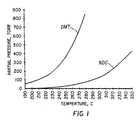
- Figure 1 shows the relationship of vapor pressure and temperature for DMT and NDC.
- This invention is an improvement and modification of a methanolysis recovery process for PET described in U.S. Patent 5,051,528.
- the depolymerization is accomplished at low pressures that range from atmospheric to an elevated pressure that is still below the vapor pressure of methanol at the reaction temperatures.
- the methanol is generally above the critical temperature and no liquid phase is present in the reactor.
- the methanol vapor is bubbled through a melt of low molecular weight oligomers where the methanol reacts with the melt components.
- polyester scrap polymer is continuously added to the reactor at an appropriate rate.
- the reaction proceeds until low molecular weight and higher volatility products are formed consisting of the glycol, diester and, to some extent half ester, that are then stripped from the reactor melt by an excess of methanol vapor bubbling through the melt.
- the scrap feed rate is determined by the rate at which the volatile components leave the reactor. This results in a continuous steady state process.
- the process also separates certain contaminants. Low volatility contaminants as well as catalysts tend to remain in the reactor and are not carried out with the desirable reaction products of the diester and EG.
- polyester chemistry described above is well understood, implementing it in a practical recovery processes is not simple. Complex and sometimes interacting steps of heat and mass transfer must be considered. Some of the required processing steps include heat transfer, transport of two-phase or three-phase systems, crystallization, filtration, distillation, storage, as well as disposal of contaminants and reaction byproducts.
- physical properties of PEN and NDC differ markedly from PET and DMT. Therefore, experience in recovering DMT from PET is not directly translatable to recovery of NDC from PEN. For example, reactor design and process conditions required to recovery PEN will be different than those for PET. Physical properties of the polyester must be taken into consideration in determining suitable recovery conditions for PEN. Table 1a compares selected physical properties of the two polyesters.
- the rate of alcohol flow and temperature of the reaction are critical to this invention.
- the flow rate is at superficial velocity of 2 to 10 ft./min. at standard conditions.
- the lab reactor system used in the experiments consisted of a 11 cm diameter, 30 cm high stainless steel reactor fitted with a three neck ground joint stainless steel reactor cover.
- the reactor was heated using a molten salt bath.
- the reaction methanol was preheated by passing liquid methanol through a coil immersed in the salt bath and then injected at the bottom of the reactor.
- the vapor phase products were passed through a heated line to a jacketed receiver fitted with a condenser. The products were cooled in the receiver where a slurry of solids and liquid was formed.
- the process requires relatively low melt viscosity to operate properly. Therefore, before continuous runs could be started the startup reactor melt had to be prepared. This was accomplished by first glycolizing a sample of PEN scrap using diethylene glycol to reduce the molecular weight. The startup melt was then prepared by stripping the excess diethylene glycol using methanol vapor. This melt then was used in the depolymerization runs for PEN. In subsequent run the melt from the previous run was used for startup.
- the reactor was operated until a steady state condition was achieved. This was accomplished by adjusting the scrap feed rate until a constant reactor melt volume was obtained. The reactor was then run at the chosen operating conditions for sufficient long time to assure a steady state operation.
- PEN depolymerization was carried out using the above procedures except an inert gas consisting of nitrogen was sparged into the reactor melt. The results are listed in Table 2. PEN Depolymerization Using Inert Gas Stripping Temperature °C Temperature Methanol Flow Nitrogen Flow CFH NDC production Rate grams/hr 266 20 8 30
- the process can be operated in a batch mode by first glycolyzing the PEN scrap and then bubbling hot methanol vapor to first separate the excess glycol and then recovering the diester and free glycol fractions. Polyester scrap can also be added batchwise to the partially depleted reactor melt and the mix allowed to reach equilibrium. At this point methanol vapor can be introduced to perform the depolymerization and stripping process steps.
- Methanol can also be added to the reactor as a liquid and then flashed to vapor by the hot reactor melt. Additional energy must be introduced into the reactor to vaporize the methanol.
- the scrap can be fed into the reactor as solid as well as liquid streams.
- PEN can be introduced into reactor as solid particles of appropriate size, as a melt using an extruder or as a reduced molecular weigh melt The latter can be accomplished by reacting the scrap polymer PEN with a portion of the reactor melt, a glycol or with crude NDC. The lower viscosity feed can then be pumped into the reactor using appropriate pumps.
Landscapes
- Chemical & Material Sciences (AREA)
- Organic Chemistry (AREA)
- Polyesters Or Polycarbonates (AREA)
- Separation, Recovery Or Treatment Of Waste Materials Containing Plastics (AREA)
Applications Claiming Priority (2)
| Application Number | Priority Date | Filing Date | Title |
|---|---|---|---|
| US79203197A | 1997-02-03 | 1997-02-03 | |
| US792031 | 1997-02-03 |
Publications (1)
| Publication Number | Publication Date |
|---|---|
| EP0857715A1 true EP0857715A1 (de) | 1998-08-12 |
Family
ID=25155592
Family Applications (1)
| Application Number | Title | Priority Date | Filing Date |
|---|---|---|---|
| EP98200169A Withdrawn EP0857715A1 (de) | 1997-02-03 | 1998-01-22 | Wiedergewinnung von Monomeren aus Polyethylennaphthalat durch Niedrigdruckmethanolyse |
Country Status (2)
| Country | Link |
|---|---|
| EP (1) | EP0857715A1 (de) |
| JP (1) | JPH10218983A (de) |
Families Citing this family (2)
| Publication number | Priority date | Publication date | Assignee | Title |
|---|---|---|---|---|
| US7247742B2 (en) * | 2004-05-20 | 2007-07-24 | Bp Corporation North America Inc. | Recycling polyethylene naphthalate containing materials in a process to produce diesters |
| TWI323737B (en) * | 2005-03-01 | 2010-04-21 | Asahi Kasei Chemicals Corp | Method for producing thermoplastic polymer solution |
Citations (2)
| Publication number | Priority date | Publication date | Assignee | Title |
|---|---|---|---|---|
| WO1989011471A1 (en) * | 1988-05-23 | 1989-11-30 | Eastman Kodak Company | Recovery of dialkyl naphthalene-2,6-dicarboxylates from naphthalene-2,6-dicarboxylic acid-containing polyesters |
| EP0629605A2 (de) * | 1993-06-16 | 1994-12-21 | Teijin Limited | Verfahren zur Gewinnung von Dimethyl naphthalen-2,6-dicarboxylat |
-
1998
- 1998-01-22 EP EP98200169A patent/EP0857715A1/de not_active Withdrawn
- 1998-01-29 JP JP1679298A patent/JPH10218983A/ja active Pending
Patent Citations (2)
| Publication number | Priority date | Publication date | Assignee | Title |
|---|---|---|---|---|
| WO1989011471A1 (en) * | 1988-05-23 | 1989-11-30 | Eastman Kodak Company | Recovery of dialkyl naphthalene-2,6-dicarboxylates from naphthalene-2,6-dicarboxylic acid-containing polyesters |
| EP0629605A2 (de) * | 1993-06-16 | 1994-12-21 | Teijin Limited | Verfahren zur Gewinnung von Dimethyl naphthalen-2,6-dicarboxylat |
Also Published As
| Publication number | Publication date |
|---|---|
| JPH10218983A (ja) | 1998-08-18 |
Similar Documents
| Publication | Publication Date | Title |
|---|---|---|
| Han | Depolymerization of PET bottle via methanolysis and hydrolysis | |
| EP0798336B1 (de) | Verfahren zur Depolymerisation von Polyestern | |
| US5712410A (en) | Gas phase crystallization of dimethyl terephthalate | |
| US20250002676A1 (en) | Processes for recovering dialkyl terephthalates from polyester compositions | |
| US5576456A (en) | Recovery of components from polyester resins | |
| US7235673B2 (en) | Glycolide production process, and glycolic acid oligomer for glycolide production | |
| US20130041053A1 (en) | Process for the Preparation of Polyesters with High Recycle Content | |
| KR960704962A (ko) | 폴리에스테르의 연속 제조방법(continuous polyester process) | |
| WO2013025186A1 (en) | Process for the preparation of polyesters with high recycle content | |
| EP1023369A1 (de) | Depolymerizationsverfahren zur wiedergewinnung von polyestern | |
| US2845412A (en) | Recovery process for polyethylene | |
| EP0666837A1 (de) | Depolymerisation von im wesentlichen amorphen polyestern. | |
| JP2025061431A (ja) | 廃棄ポリエステルのケミカルリサイクルから回収したグリコールの精製プロセス | |
| US5481024A (en) | Process for the preparation of monomeric terephthalic diesters and diols from polyesters | |
| US4613678A (en) | Esterification of aromatic dicarboxylic acids with cyclic alkylene carbonates | |
| US5430174A (en) | Method for recovering dimethyl naphthalene-2,6-dicarboxylate | |
| KR20250093520A (ko) | 폴리(알킬렌 테레프탈레이트)의 재활용 공정 | |
| CA1334295C (en) | Recovery of dialkyl naphthalene-2, 6-dicarboxylates from naphthalene-2, 6-dicarboxylic acid-containing polyesters | |
| US5952520A (en) | Recovery of ester monomer from polyester resins | |
| JPH10218983A (ja) | 低圧メタノリシスを用いたポリエチレンナフタレートからのモノマーの回収プロセス | |
| JP2002060369A (ja) | ポリエステル廃棄物のリサイクル方法 | |
| EP0854130A1 (de) | Rückgewinnung von Monomeren aus Polyethylennaphthalat | |
| EP0857714A1 (de) | Gewinnung von Monomeren aus Polyethylennaphthalat | |
| JP2002060543A (ja) | ポリエステル廃棄物のリサイクル方法 | |
| US3720649A (en) | Method for producing polyesters from benzenedicarboxylic acid and alkylene oxide |
Legal Events
| Date | Code | Title | Description |
|---|---|---|---|
| PUAI | Public reference made under article 153(3) epc to a published international application that has entered the european phase |
Free format text: ORIGINAL CODE: 0009012 |
|
| AK | Designated contracting states |
Kind code of ref document: A1 Designated state(s): DE FR GB IT |
|
| AX | Request for extension of the european patent |
Free format text: AL;LT;LV;MK;RO;SI |
|
| 17P | Request for examination filed |
Effective date: 19990201 |
|
| AKX | Designation fees paid |
Free format text: DE FR GB IT |
|
| RBV | Designated contracting states (corrected) |
Designated state(s): DE FR GB IT |
|
| 17Q | First examination report despatched |
Effective date: 20011112 |
|
| STAA | Information on the status of an ep patent application or granted ep patent |
Free format text: STATUS: THE APPLICATION IS DEEMED TO BE WITHDRAWN |
|
| 18D | Application deemed to be withdrawn |
Effective date: 20020323 |