EP0857724A1 - Sulfonamid-substituierte Verbindungen, Verfahren zu ihrer Herstellung, ihre Verwendung als Medikament oder Diagnostikum - Google Patents
Sulfonamid-substituierte Verbindungen, Verfahren zu ihrer Herstellung, ihre Verwendung als Medikament oder Diagnostikum Download PDFInfo
- Publication number
- EP0857724A1 EP0857724A1 EP98101980A EP98101980A EP0857724A1 EP 0857724 A1 EP0857724 A1 EP 0857724A1 EP 98101980 A EP98101980 A EP 98101980A EP 98101980 A EP98101980 A EP 98101980A EP 0857724 A1 EP0857724 A1 EP 0857724A1
- Authority
- EP
- European Patent Office
- Prior art keywords
- carbon atoms
- hydrogen
- group
- methyl
- alkyl
- Prior art date
- Legal status (The legal status is an assumption and is not a legal conclusion. Google has not performed a legal analysis and makes no representation as to the accuracy of the status listed.)
- Withdrawn
Links
- 0 CC(*)(*C(C*)=C1C)C(*)*1(*)NS(C)(C)C Chemical compound CC(*)(*C(C*)=C1C)C(*)*1(*)NS(C)(C)C 0.000 description 1
Classifications
-
- C—CHEMISTRY; METALLURGY
- C07—ORGANIC CHEMISTRY
- C07D—HETEROCYCLIC COMPOUNDS
- C07D335/00—Heterocyclic compounds containing six-membered rings having one sulfur atom as the only ring hetero atom
- C07D335/04—Heterocyclic compounds containing six-membered rings having one sulfur atom as the only ring hetero atom condensed with carbocyclic rings or ring systems
- C07D335/06—Benzothiopyrans; Hydrogenated benzothiopyrans
-
- A—HUMAN NECESSITIES
- A61—MEDICAL OR VETERINARY SCIENCE; HYGIENE
- A61P—SPECIFIC THERAPEUTIC ACTIVITY OF CHEMICAL COMPOUNDS OR MEDICINAL PREPARATIONS
- A61P1/00—Drugs for disorders of the alimentary tract or the digestive system
-
- A—HUMAN NECESSITIES
- A61—MEDICAL OR VETERINARY SCIENCE; HYGIENE
- A61P—SPECIFIC THERAPEUTIC ACTIVITY OF CHEMICAL COMPOUNDS OR MEDICINAL PREPARATIONS
- A61P43/00—Drugs for specific purposes, not provided for in groups A61P1/00-A61P41/00
-
- A—HUMAN NECESSITIES
- A61—MEDICAL OR VETERINARY SCIENCE; HYGIENE
- A61P—SPECIFIC THERAPEUTIC ACTIVITY OF CHEMICAL COMPOUNDS OR MEDICINAL PREPARATIONS
- A61P9/00—Drugs for disorders of the cardiovascular system
-
- A—HUMAN NECESSITIES
- A61—MEDICAL OR VETERINARY SCIENCE; HYGIENE
- A61P—SPECIFIC THERAPEUTIC ACTIVITY OF CHEMICAL COMPOUNDS OR MEDICINAL PREPARATIONS
- A61P9/00—Drugs for disorders of the cardiovascular system
- A61P9/06—Antiarrhythmics
-
- C—CHEMISTRY; METALLURGY
- C07—ORGANIC CHEMISTRY
- C07C—ACYCLIC OR CARBOCYCLIC COMPOUNDS
- C07C311/00—Amides of sulfonic acids, i.e. compounds having singly-bound oxygen atoms of sulfo groups replaced by nitrogen atoms, not being part of nitro or nitroso groups
- C07C311/01—Sulfonamides having sulfur atoms of sulfonamide groups bound to acyclic carbon atoms
- C07C311/02—Sulfonamides having sulfur atoms of sulfonamide groups bound to acyclic carbon atoms of an acyclic saturated carbon skeleton
- C07C311/07—Sulfonamides having sulfur atoms of sulfonamide groups bound to acyclic carbon atoms of an acyclic saturated carbon skeleton having the nitrogen atom of at least one of the sulfonamide groups bound to a carbon atom of a ring other than a six-membered aromatic ring
-
- C—CHEMISTRY; METALLURGY
- C07—ORGANIC CHEMISTRY
- C07D—HETEROCYCLIC COMPOUNDS
- C07D215/00—Heterocyclic compounds containing quinoline or hydrogenated quinoline ring systems
- C07D215/02—Heterocyclic compounds containing quinoline or hydrogenated quinoline ring systems having no bond between the ring nitrogen atom and a non-ring member or having only hydrogen atoms or carbon atoms directly attached to the ring nitrogen atom
- C07D215/16—Heterocyclic compounds containing quinoline or hydrogenated quinoline ring systems having no bond between the ring nitrogen atom and a non-ring member or having only hydrogen atoms or carbon atoms directly attached to the ring nitrogen atom with hetero atoms or with carbon atoms having three bonds to hetero atoms with at the most one bond to halogen, e.g. ester or nitrile radicals, directly attached to ring carbon atoms
- C07D215/38—Nitrogen atoms
- C07D215/42—Nitrogen atoms attached in position 4
-
- C—CHEMISTRY; METALLURGY
- C07—ORGANIC CHEMISTRY
- C07C—ACYCLIC OR CARBOCYCLIC COMPOUNDS
- C07C2602/00—Systems containing two condensed rings
- C07C2602/02—Systems containing two condensed rings the rings having only two atoms in common
- C07C2602/04—One of the condensed rings being a six-membered aromatic ring
- C07C2602/10—One of the condensed rings being a six-membered aromatic ring the other ring being six-membered, e.g. tetraline
Definitions
- the compounds I contain an acidic or basic group or one basic heterocycle, so are the corresponding, pharmacological and toxicologically acceptable salts the subject of the invention. So can the compounds I which carry one or more -COOH groups, for example as alkali salts, preferably as sodium or potassium salts be used.
- Compounds I which is a basic, protonatable group or carry a basic heterocyclic radical, can also in the form of organic or inorganic, pharmacological and toxicological compatible acid addition salts are used, for example as Hydrochlorides, methanesulfonates, acetates, lactates, maleinates, fumarates, Malates, gluconates etc. Contain the compounds I an acidic and basic group in the same molecule, in addition to those described Salt forms also internal salts, so-called betaines, for the invention.
- Alkyl and alkylene radicals can be straight-chain or branched.
- the compounds of formula I are different by chemical Methods can be produced, which are also part of the invention.
- the sulfonamide is deprotonated to the salt in situ using preferred bases which are themselves not or only slightly alkylated, such as sodium carbonate, potassium carbonate, a sterically hindered amine, e.g. B. dicyclohexylamine, N, N, N-dicyclohexyl-ethylamine or other strong nitrogen bases with low nucleophilicity, for example DBU, N, N ', N''' - triisopropylguanidine etc.
- preferred bases which are themselves not or only slightly alkylated, such as sodium carbonate, potassium carbonate, a sterically hindered amine, e.g. B. dicyclohexylamine, N, N, N-dicyclohexyl-ethylamine or other strong nitrogen bases with low nucleophilicity, for example DBU, N, N ', N''' - triisopropylguanidine etc.
- alkali metal bicarbonates alkali metal hydroxides, such as, for example, LiOH, NaOH or KOH, or alkali metal hydroxides, for example Ca (OH) 2 .
- polar organic solvents such as Dimethylformamide, dimethylacetamide, tetramethylurea, Hexamethylphosphoric triamide, tetrahydrofuran, dimethoxyethane, toluene, a halogenated hydrocarbon such as chloroform or methylene chloride etc.
- polar protic solvents such as water, methanol, ethanol, isopropanol, Ethylene glycol or its oligomers and their corresponding half ethers and ethers.
- the reaction is carried out in a preferred temperature range of -10 to 140 ° C, particularly preferably from 20 to 100 ° C.
- Procedure a) can also be carried out under the conditions of a Two-phase catalysis can be carried out.
- the compounds of the formula II are obtained by methods known from the literature, for example from the corresponding unsaturated compound X by the action of an inorganic or organic peroxide, such as H 2 O 2 , MCPBA, peracetic acid.
- an inorganic or organic peroxide such as H 2 O 2 , MCPBA, peracetic acid.
- halogen is also possible through the reaction of X with NCS, NBS, chlorine or bromine in aqueous solvents. It is advantageous to work in a solvent which is sufficiently inert to these halogenating or oxidizing reagents, for example in DMSO or halogenated hydrocarbons such as chloroform or methylene chloride.
- the reaction is preferably carried out using a polar solvent, preferably in the presence of a base which itself can advantageously be used as a solvent, for example when using triethylamine, in particular pyridine and its homologues.
- Solvents also used are, for example, water, aliphatic alcohols, for example methanol, ethanol, isopropanol, sec. Butanol, ethylene glycol and its monomeric and oligomeric monoalkyl and dialkyl ethers, tetrahydrofuran, dioxane, dialkylated amides such as DMF, DMA, as well as TMU and HMPT.
- the process is carried out at a temperature of from 0 to 160 ° C., preferably from 20 to 100 ° C.
- the amino derivatives of the formula IV are obtained in a manner known per se, preferably by reacting the reactive compounds of the formula II with R (1), R (2), R (5), R (6) and L in the meaning given, either with ammonia or an amine of formula XI R (4) -NH 2 with R (4) in the meaning given.
- the compounds I are related to the class of 4-acylaminochroman derivatives, in particular 2,2-dialkyl-4-acylamino-3-chromanols, which has been intensively worked on in pharmaceutical chemistry in the last decade.
- 4-acylaminochromanes is the cromakalim of formula XII and numerous subsequent preparations derived from this preparation (eg Edwards and Weston, TIPS 11, 417-422 (1990), "Structure Activity Relationships of K + channel openers"
- Cromakalim and other related 4-acylaminochroman derivatives are compounds with a relaxing effect on smooth muscle organs, so that they are used to lower the increased blood pressure due to vascular muscle relaxation and in the treatment of asthma due to the relaxation of the smooth muscles of the airways. All these preparations have in common that they act on the cellular level, for example of smooth muscle cells, and there lead to the opening of certain ATP-sensitive K + channels.
- the increase in negative charge induced in the cell by the emergence of K + ions (“hyperpolarization”) acts via secondary mechanisms of increasing intracellular Ca 2+ and thus cell activation, e.g. B. a muscle contraction.
- the compounds are thus more potent as a new class of active ingredients Inhibitors of stimulated gastric acid secretion.
- the connections of the Formula I are therefore valuable drugs for the treatment of ulcers Stomach and intestinal area, for example the duodenum. she are also suitable due to their strong gastric secretion inhibitors Effect as excellent therapeutic agents for the treatment of Reflux oesophagitis.
- the compounds continue to be characterized by an antidiarrheal Effect from and are therefore used as medicines to treat diarrhea suitable.
- the compounds I can be used as medicaments for treatment and Prevention of all types of arrhythmias including ventricular and supraventricular arrhythmias can be used. You can in particular are used to control reentry arrhythmias, atrial fibrillation and to prevent sudden cardiac death from ventricular fibrillation.
- Medicaments which contain a compound I according to the invention can be taken orally, parenterally, intravenously, rectally or by inhalation, whereby the preferred application of the respective appearance of the Disease is dependent.
- the compounds I can be used alone or can be used together with pharmaceutical auxiliaries, namely in both veterinary and human medicine.
- excipients are suitable for the desired pharmaceutical formulation are known to the expert on the basis of his specialist knowledge.
- Next Solvents, gelling agents, suppository bases, tablet excipients and other active substance carriers can, for example, antioxidants, Dispersing agents, emulsifiers, defoamers, flavoring agents, Preservatives, solubilizers or dyes are used.
- the active compounds with the suitable additives such as carriers, stabilizers or inert Diluent mixed and by the usual methods in the brought suitable dosage forms, such as tablets, coated tablets, Push-fit capsules, aqueous, alcoholic or oily solutions.
- suitable additives such as carriers, stabilizers or inert Diluent mixed and by the usual methods in the brought suitable dosage forms, such as tablets, coated tablets, Push-fit capsules, aqueous, alcoholic or oily solutions.
- an inert carrier can e.g. B. gum arabic, magnesia, magnesium carbonate, Potassium phosphate, milk sugar, glucose or starch, especially corn starch, be used.
- the preparation can be both dry and done as wet granules.
- oily carrier or as a solvent For example, vegetable or animal oils come into consideration, such as Sunflower oil or cod liver oil.
- the active ones are used for subcutaneous or intravenous administration
- Compounds if desired with the usual substances such as Solubilizers, emulsifiers or other auxiliaries in solution, Bring suspension or emulsion.
- solvents such.
- a pharmaceutical formulation for administration in the form of Aerosols or sprays are suitable e.g. B. solutions, suspensions or Emulsions of the active ingredient of formula I in a pharmaceutical harmless solvent, such as in particular ethanol or water, or a mixture of such solvents.
- a pharmaceutical harmless solvent such as in particular ethanol or water, or a mixture of such solvents.
- the wording can be as needed also other pharmaceutical auxiliaries such as surfactants, emulsifiers and Stabilizers and a propellant gas included.
- Such a preparation contains the active ingredient usually in a concentration of 0.1 to 10, in particular from about 0.3 to 3% by weight.
- the dosage of the active ingredient of formula I to be administered and the Frequency of administration depend on the strength and duration of action used connections; but also on the type and strength of the treating disease as well as gender, age, weight and individual responsiveness of the mammal to be treated.
- the daily dose of a compound of formula I is an approximately 75 kg patient at least 0.001 mg, preferably 0.1 mg, in particular at least 10 mg to at most 100 mg, preferably at most 1 g per kg.
- Example 3 b From 5-methanesulfonylamino-7,7-dimethyl-5,6,7,8-tetrahydro-1-naphthalenecarboxylic acid methyl ester (Example 3 b) and 1-iodohexane was analogous to Example 3 c 5- (Hexyl-methanesulfonyl-amino) -7,7-dimethyl-5,6,7,8-tetrahydro-naphthalene-1-carboxylic acid methyl ester preserved as oil.
- Example 5b From 3,3-dimethyl-3,4-dihydro-2H-naphthalin-1-one (Example 5b) can be made analogously
Landscapes
- Chemical & Material Sciences (AREA)
- Organic Chemistry (AREA)
- Health & Medical Sciences (AREA)
- Life Sciences & Earth Sciences (AREA)
- General Health & Medical Sciences (AREA)
- General Chemical & Material Sciences (AREA)
- Medicinal Chemistry (AREA)
- Nuclear Medicine, Radiotherapy & Molecular Imaging (AREA)
- Bioinformatics & Cheminformatics (AREA)
- Pharmacology & Pharmacy (AREA)
- Engineering & Computer Science (AREA)
- Animal Behavior & Ethology (AREA)
- Chemical Kinetics & Catalysis (AREA)
- Public Health (AREA)
- Veterinary Medicine (AREA)
- Cardiology (AREA)
- Heart & Thoracic Surgery (AREA)
- Pharmaceuticals Containing Other Organic And Inorganic Compounds (AREA)
- Acyclic And Carbocyclic Compounds In Medicinal Compositions (AREA)
- Organic Low-Molecular-Weight Compounds And Preparation Thereof (AREA)
- Medicines Containing Antibodies Or Antigens For Use As Internal Diagnostic Agents (AREA)
- Heterocyclic Compounds Containing Sulfur Atoms (AREA)
- Quinoline Compounds (AREA)
Abstract
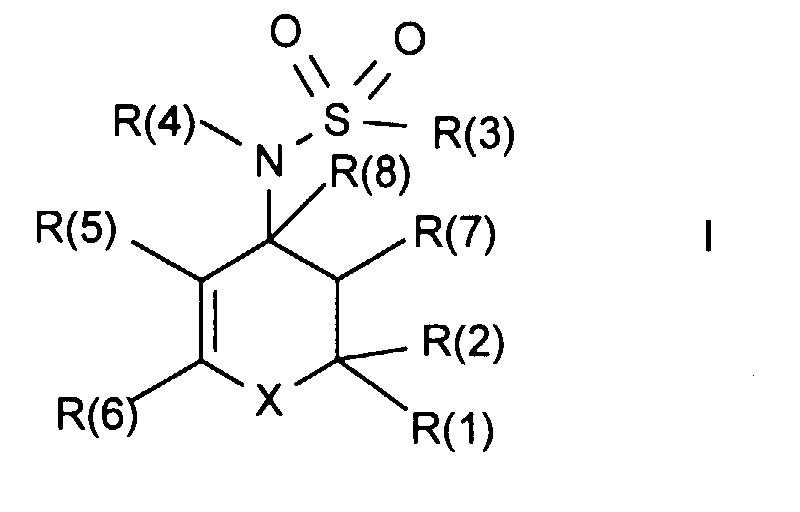
Description

- X
- -[S(O) Null, 1 oder 2]-, -NR(9)-, -[CR(9)R(23)]- oder CO-;
- R(9)
- Wasserstoff oder -(CnH2n)-R(10);
- n
- Null, 1, 2, 3, 4, 5, 6, 7 oder 8;
- R(10)
- Wasserstoff, Cycloalkyl mit 3, 4, 5, 6, 7 oder 8 C-Atomen,
Piperidyl, 1-Pyrrolidinyl, N-Morpholino, N-Methylpiperazino,
CF3, C2F5 oder C3F7;
wobei eine CH2-Gruppe der Gruppe CnH2n ersetzt sein kann durch -O-, -CH = CH-, -C≡C-, -CO-, -CO-O-, -[SONull, 1 oder 2]- oder -NR(11)-; - R(11)
- Wasserstoff, Methyl oder Ethyl;
oder - R(10)
- Pyridyl, Thienyl, Imidazolyl oder Phenyl,
welche unsubstituiert sind oder substituiert mit 1 oder 2 Substituenten ausgewählt aus der Gruppe bestehend aus F, Cl, Br, I, CF3, Methyl, Methoxy, Sulfamoyl, Methylsulfonyl und Methylsulfonylamino;
oder - R(9)
- gemeinsam mit R(1) eine Bindung;
- R(23)
- Wasserstoff, Alkyl mit 1, 2 oder 3 C-Atomen, OH, O-Alkyl mit 1, 2 oder 3 C-Atomen, COOH, COO-Alkyl mit 1, 2 oder 3 C-Atomen oder -CO-R(24);
- R(24)
- Wasserstoff, Methyl oder Ethyl;
- R(1) und R(2)
-
unabhängig voneinander Wasserstoff, CF3, C2F5, C3F7, Alkyl mit 1, 2, 3, 4, 5 oder 6 C-Atomen oder Phenyl,
das unsubstituiert ist oder substituiert mit 1 oder 2 Substituenten ausgewählt aus der Gruppe bestehend aus F, Cl, Br, I, CF3, Methyl, Methoxy, Sulfamoyl und Methylsulfonyl;
- R(1) und R(2)
-
gemeinsam eine Alkylenkette mit 2, 3, 4, 5, 6, 7, 8, 9 oder 10 C-Atomen; - R(3)
- R(12)-CaH2a[NR(13)]m-;
- R(12)
- Wasserstoff oder Cycloalkyl mit 3, 4, 5, 6, 7 oder 8 C-Atomen, CF3, C2F5 oder C3F7;
- a
- Null, 1, 2, 3, 4, 5, 6, 7, 8, 9 oder 10;
- m
- Null oder 1;
- R(13)
- Wasserstoff oder Alkyl mit 1, 2, 3, 4, 5 oder 6 C-Atomen;
oder - R(12) und R(13)
-
gemeinsam eine Alkylengruppe mit 4, 5, 6, 7 oder 8 C-Atomen, wobei eine CH2-Gruppe der Alkylengruppe durch -O-, -[SONull, 1 oder 2]-, -CO- oder -NR(11)- ersetzt sein kann; - R(11)
- Wasserstoff, Methyl oder Ethyl;
- R(4)
- R(14)-CrH2r;
- r
- 1, 2, 3, 4, 5, 6, 7, 8, 9, 10, 11, 12, 13, 14, 15, 16, 17, 18, 19 oder 20;
- R(14)
- Wasserstoff, Cycloalkyl mit 3, 4, 5, 6, 7 oder 8 C-Atomen,
Piperidyl, 1-Pyrrolidinyl, N-Morpholino, N-Methylpiperazino, CF3,
C2F5, C3F7, Pyridyl, Thienyl, Imidazolyl oder Phenyl,
das unsubstituiert ist oder substituiert mit 1 oder 2 Substituenten ausgewählt aus der Gruppe bestehend aus F, Cl, Br, I, CF3, Methyl, Methoxy, Sulfamoyl, Methylsulfonyl und Methylsulfonylamino;
wobei eine CH2-Gruppe der Gruppe CrH2r ersetzt sein kann durch -O-, -CH=CH-, -C≡C-, -CO-, -CO-O-, -CO-NR(11)-, -[SONull, 1 oder 2]- oder -NR(11)-;
- R(3) und R(4)
-
gemeinsam eine Alkylenkette mit 3, 4, 5, 6, 7 oder 8 C-Atomen, wobei eine CH2-Gruppe der Alkylenkette durch -O-, -[SONull, 1 oder 2]-, -CO- oder -NR(11)- ersetzt sein kann; - R(5) und R(6)
-
gemeinsam -CR(15)=CR(16)-CR(17)=CR(18)-, -CR(15)=CR(16)-CR(17)=N-, -CR(15)=CR(16)-N=CR(18)-, -CR(15)=N-CR(17)=N-, -CR(15)=N-N=CR(18)-, -N=CR(16)-CR(17)=N- oder -S-CR(15)=CR(16)-; - R(15), R(16), R(17) und R(18)
-
unabhängig voneinander Wasserstoff, F, Cl, Br, I, Alkyl mit 1, 2, 3 oder 4 C-Atomen, Cycloalkyl mit 3, 4, 5, 6, 7 oder 8 C-Atomen, CN, CF3, C2F5, C3F7, N3, NO2, -CONR(19)R(20), -COOR(21), R(22)-CsH2s-Z- oder Phenyl,
das unsubstituiert ist oder substituiert mit 1 oder 2 Substituenten ausgewählt aus der Gruppe bestehend aus F, Cl, Br, I, CF3, Methyl, Methoxy, Sulfamoyl und Methylsulfonyl; - R(19) und R(20)
-
unabhängig voneinander Wasserstoff oder Alkyl mit 1, 2 oder 3 C-Atomen; - R(21)
- Wasserstoff, Methyl, Ethyl, Phenyl oder
-CuH2u-NR(19)R(20); - u
- 2 oder 3;
wobei das Phenyl unsubstituiert ist oder substituiert mit 1 oder 2 Substituenten ausgewählt aus der Gruppe bestehend aus F, Cl, Br, I, CF3, Methyl, Methoxy, Sulfamoyl oder Methylsulfonyl; - R(22)
- Wasserstoff, Cycloalkyl mit 3, 4, 5, 6, 7 oder 8 C-Atomen,
-COOR(21), Thienyl, Imidazolyl, Pyridyl,
Chinolyl, Isochinolyl, Piperidyl, 1-Pyrrolidinyl, N-Morpholino,
N-Methylpiperazino, CF3, C2F5 oder
C3F7 oder Phenyl,
das unsubstituiert ist oder substituiert mit 1 oder 2 Substituenten ausgewählt aus der Gruppe bestehend aus F, Cl, Br, I, CF3, Methyl, Methoxy, Sulfamoyl oder Methylsulfonyl; - s
- Null, 1, 2, 3, 4, 5 oder 6;
- Z
- -[S(O)Null, 1 oder 2]-, -CO-, -SO2-NR(11)-, -SO2-O-, -O-, -NR(11)- oder -[CO-NR(11)]-;
- R(7)
- Wasserstoff, Hydroxy, Alkoxy mit 1, 2, 3 oder 4 C-Atomen, Acyloxy mit 1, 2, 3 oder 4 C-Atomen, Cl, Br, F, Alkyl mit 1, 2, 3 oder 4 C-Atomen;
- R(8)
- Wasserstoff oder Alkyl mit 1, 2, 3, 4, 5 oder 6 C-Atomen;
- X
- -S(O)Null, 1 oder 2]-, -NR(9)- oder -[CR(9)R(23)]- ;
- R(9)
- Wasserstoff oder (CnH2n)-R(10);
- n
- Null, 1, 2, 3, 4, 5, 6, 7 oder 8;
- R(10)
- Wasserstoff, Cycloalkyl mit 3, 4, 5, 6, 7 oder 8 C-Atomen,
Piperidyl, 1-Pyrrolidinyl, N-Morpholino, N-Methylpiperazino,
CF3, C2F5 oder C3F7;
wobei eine CH2-Gruppe der Gruppe CnH2n ersetzt sein kann durch -O-, -CH=CH-, -C≡C-, -CO-, -CO-O-, -[SONull, 1 oder 2]- oder -NR(11)-; - R(11)
- Wasserstoff, Methyl oder Ethyl;
oder - R(10)
- Pyridyl, Thienyl, Imidazolyl oder Phenyl,
welche unsubstituiert sind oder substituiert mit 1 oder 2 Substituenten ausgewählt aus der Gruppe bestehend aus F, Cl, Br, I, CF3, Methyl, Methoxy, Sulfamoyl, Methylsulfonyl und
Methylsulfonylamino;
oder - R(9)
- gemeinsam mit R(1) eine Bindung;
- R(23)
- Wasserstoff, Alkyl mit 1, 2 oder 3 C-Atomen, OH, O-Alkyl mit 1, 2 oder 3 C-Atomen, COOH, COO-Alkyl mit 1, 2 oder 3 C-Atomen oder -CO-R(24);
- R(24)
- Wasserstoff, Methyl oder Ethyl;
- R(1) und R(2)
-
unabhängig voneinander Wasserstoff, CF3, C2F5, C3F7, Alkyl mit 1, 2, 3, 4, 5 oder 6 C-Atomen oder Phenyl,
das unsubstituiert ist oder substituiert mit 1 oder 2 Substituenten ausgewählt aus der Gruppe bestehend aus F, Cl, Br, I, CF3, Methyl, Methoxy, Sulfamoyl und Methylsulfonyl;
- R(1) und R(2)
-
gemeinsam eine Alkylenkette mit 2, 3, 4, 5, 6, 7, 8, 9 oder 10 C-Atomen; - R(3)
- R(12)-CaH2a[NR(13)]m-;
- R(12)
- Wasserstoff oder Cycloalkyl mit 3, 4, 5, 6, 7 oder 8 C-Atomen, CF3, C2F5 oder C3F7;
- a
- Null, 1, 2, 3, 4, 5, 6, 7, 8, 9 oder 10;
- m
- Null oder 1;
- R(13)
- Wasserstoff oder Alkyl mit 1, 2, 3, 4, 5 oder 6 C-Atomen;
oder - R(12) und R(13)
-
gemeinsam eine Alkylengruppe mit 4, 5, 6, 7 oder 8 C-Atomen, wobei eine CH2-Gruppe der Alkylengruppe durch -O-, -[SONull, 1 oder 2]-, -CO- oder -NR(11)- ersetzt sein kann; R(11) Wasserstoff, Methyl oder Ethyl; - R(4)
- R(14)-CrH2r;
- r
- 1, 2, 3, 4, 5, 6, 7, 8, 9, 10, 11, 12, 13, 14, 15, 16, 17, 18, 19 oder 20;
- R(14)
- Wasserstoff, Cycloalkyl mit 3, 4, 5, 6, 7 oder 8 C-Atomen,
Piperidyl, 1-Pyrrolidinyl, N-Morpholino, N-Methylpiperazino, CF3,
C2F5, C3F7, Pyridyl, Thienyl, Imidazolyl oder Phenyl,
das unsubstituiert ist oder substituiert mit 1 oder 2 Substituenten ausgewählt aus der Gruppe bestehend aus F, Cl, Br, I, CF3, Methyl, Methoxy, Sulfamoyl, Methylsulfonyl und Methylsulfonylamino;
wobei eine CH2-Gruppe der Gruppe CrH2r ersetzt sein kann durch -O-, -CH=CH-, -C≡C-, -CO-, -CO-O-, -CO-NR(11)-, -[SONull, 1 oder 2]- oder -NR(11)-;
- R(3) und R(4)
-
gemeinsam eine Alkylenkette mit 3, 4, 5, 6, 7 oder 8 C-Atomen, wobei eine CH2-Gruppe der Alkylenkette durch -O-, -[SONull, 1 oder 2]-, -CO- oder -NR(11)- ersetzt sein kann; - R(5) und R(6)
-
gemeinsam -CR(15)=CR(16)-CR(17)=CR(18)- oder
-S-CR(15)=CR(16)-; - R(15), R(16), R(17) und R(18)
-
unabhängig voneinander Wasserstoff, F, Cl, Br, I, Alkyl mit 1, 2, 3 oder 4 C-Atomen, Cycloalkyl mit 3, 4, 5, 6, 7 oder 8 C-Atomen, CN, CF3, C2F5, C3F7, N3, NO2, -CONR(19)R(20), -COOR(21), R(22)-CsH2s-Z- oder Phenyl,
das unsubstituiert ist oder substituiert mit 1 oder 2 Substituenten ausgewählt aus der Gruppe bestehend aus F, Cl, Br, I, CF3, Methyl, Methoxy, Sulfamoyl und Methylsulfonyl; - R(19) und R(20)
-
unabhängig voneinander Wasserstoff oder Alkyl mit 1, 2 oder 3 C-Atomen; - R(21)
- Wasserstoff, Methyl, Ethyl, Phenyl oder -CuH2u-NR(19)R(20);
- u
- 2 oder 3;
wobei das Phenyl unsubstituiert ist oder substituiert mit 1 oder 2 Substituenten ausgewählt aus der Gruppe bestehend aus F, Cl, Br, I, CF3, Methyl, Methoxy, Sulfamoyl oder Methylsulfonyl; - R(22)
- Wasserstoff, Cycloalkyl mit 3, 4, 5, 6, 7 oder 8 C-Atomen,
-COOR(21), Thienyl, Imidazolyl, Pyridyl,
Chinolyl, Isochinolyl, Piperidyl, 1-Pyrrolidinyl, N-Morpholino,
N-Methylpiperazino, CF3, C2F5 oder
C3F7 oder Phenyl,
das unsubstituiert ist oder substituiert mit 1 oder 2 Substituenten ausgewählt aus der Gruppe bestehend aus F, Cl, Br, I, CF3, Methyl, Methoxy, Sulfamoyl oder Methylsulfonyl; - s
- Null, 1, 2, 3, 4, 5 oder 6;
- Z
- -[S(O)Null, 1 oder 2]-, -CO-, -SO2-NR(11)-, -SO2-O-, -O-, -NR(11)- oder -[CO-NR(11)]-;
- R(7)
- Wasserstoff, Hydroxy, Alkoxy mit 1, 2, 3 oder 4 C-Atomen, Acyloxy mit 1, 2, 3 oder 4 C-Atomen, Cl, Br, F, Alkyl mit 1, 2, 3 oder 4 C-Atomen;
- R(8)
- Wasserstoff oder Alkyl mit 1, 2, 3, 4, 5 oder 6 C-Atomen.
- X
- -NR(9)- oder -[CR(9)R(23)]-;
- R(9)
- Wasserstoff oder -(CnH2n)-R(10);
- n
- Null, 1, 2, 3, 4, 5, 6, 7 oder 8;
- R(10)
- Wasserstoff, Cycloalkyl mit 3, 4, 5, 6, 7 oder 8 C-Atomen,
Piperidyl, 1-Pyrrolidinyl, N-Morpholino, N-Methylpiperazino,
CF3, C2F5 oder C3F7;
wobei eine CH2-Gruppe der Gruppe CnH2n ersetzt sein kann durch -O-, -CH=CH-, -C≡C-, -CO-, -CO-O-, -[SONull, 1 oder 2]- oder -NR(11)-; - R(11)
- Wasserstoff, Methyl oder Ethyl;
oder - R(10)
- Pyridyl, Thienyl, Imidazolyl oder Phenyl,
welche unsubstituiert sind oder substituiert mit 1 oder 2 Substituenten ausgewählt aus der Gruppe bestehend aus F, Cl, Br, I, CF3, Methyl, Methoxy, Sulfamoyl, Methylsulfonyl und
Methylsulfonylamino;
oder - R(9)
- gemeinsam mit R(1) eine Bindung;
- R(23)
- Wasserstoff, Alkyl mit 1, 2 oder 3 C-Atomen, OH, O-Alkyl mit 1, 2 oder 3 C-Atomen, COOH, COO-Alkyl mit 1, 2 oder 3 C-Atomen oder -CO-R(24);
- R(24)
- Wasserstoff, Methyl oder Ethyl;
- R(1) und R(2)
-
unabhängig voneinander Wasserstoff, CF3, C2F5, C3F7, Alkyl mit 1, 2, 3, 4, 5 oder 6 C-Atomen oder Phenyl,
das unsubstituiert ist oder substituiert mit 1 oder 2 Substituenten ausgewählt aus der Gruppe bestehend aus F, Cl, Br, I, CF3, Methyl, Methoxy, Sulfamoyl und Methylsulfonyl;
- R(1) und R(2)
-
gemeinsam eine Alkylenkette mit 2, 3, 4, 5, 6, 7, 8, 9 oder 10 C-Atomen; - R(3)
- R(12)-CaH2a[NR(13)]m-;
- R(12)
- Wasserstoff oder Cycloalkyl mit 3, 4, 5, 6, 7 oder 8 C-Atomen, CF3, C2F5 oder C3F7;
- a
- Null, 1, 2, 3, 4, 5, 6, 7, 8, 9 oder 10;
- m
- Null oder 1;
- R(13)
- Wasserstoff oder Alkyl mit 1, 2, 3, 4, 5 oder 6 C-Atomen;
oder - R(12) und R(13)
-
gemeinsam eine Alkylengruppe mit 4, 5, 6, 7 oder 8 C-Atomen, wobei eine CH2-Gruppe der Alkylengruppe durch -O-, -[SONull, 1 oder 2]-, -CO- oder -NR(11)- ersetzt sein kann; R(11) Wasserstoff, Methyl oder Ethyl; - R(4)
- R(14)-CrH2r;
- r
- 1, 2, 3, 4, 5, 6, 7, 8, 9 oder 10;
- R(14)
- Wasserstoff, Cycloalkyl mit 3, 4, 5, 6, 7 oder 8 C-Atomen,
Piperidyl, 1-Pyrrolidinyl, N-Morpholino, N-Methylpiperazino, CF3,
C2F5, C3F7, Pyridyl, Thienyl, Imidazolyl oder Phenyl,
das unsubstituiert ist oder substituiert mit 1 oder 2 Substituenten ausgewählt aus der Gruppe bestehend aus F, Cl, Br, I, CF3, Methyl, Methoxy, Sulfamoyl, Methylsulfonyl und Methylsulfonylamino;
wobei eine CH2-Gruppe der Gruppe CrH2r ersetzt sein kann durch -O-, -CH=CH-, -C≡C-, -CO-, -CO-O-, -CO-NR(11)-, -[SONull, 1 oder 2]- oder -NR(11)-;
- R(3) und R(4)
-
gemeinsam eine Alkylenkette mit 3, 4, 5, 6, 7 oder 8 C-Atomen, wobei eine CH2-Gruppe der Alkylenkette durch -O-, -[SONull, 1 oder 2]-, -CO- oder -NR(11)- ersetzt sein kann; - R(5) und R(6)
-
gemeinsam -CR( 15)=CR(16)-CR(17)=CR(18)-; - R(15), R(16), R(17) und R(18)
-
unabhängig voneinander Wasserstoff, F, Cl, Br, I, Alkyl mit 1, 2, 3 oder 4 C-Atomen, Cycloalkyl mit 3, 4, 5, 6, 7 oder 8 C-Atomen, CN, CF3, C2F5, C3F7, N3, NO2, -CONR(19)R(20), -COOR(21), R(22)-CsH2s-Z- oder Phenyl,
das unsubstituiert ist oder substituiert mit 1 oder 2 Substituenten ausgewählt aus der Gruppe bestehend aus F, Cl, Br, I, CF3, Methyl, Methoxy, Sulfamoyl und Methylsulfonyl; - R(19) und R(20)
-
unabhängig voneinander Wasserstoff oder Alkyl mit 1, 2 oder 3 C-Atomen; - R(21)
- Wasserstoff, Methyl, Ethyl, Phenyl oder -CuH2u-NR(19)R(20);
- u
- 2 oder 3;
wobei das Phenyl unsubstituiert ist oder substituiert mit 1 oder 2 Substituenten ausgewählt aus der Gruppe bestehend aus F, Cl, Br, I, CF3, Methyl, Methoxy, Sulfamoyl oder Methylsulfonyl; - R(22)
- Wasserstoff, Cycloalkyl mit 3, 4, 5, 6, 7 oder 8 C-Atomen,
-COOR(21), Thienyl, Imidazolyl, Pyridyl,
Chinolyl, Isochinolyl, Piperidyl, 1-Pyrrolidinyl, N-Morpholino,
N-Methylpiperazino, CF3, C2F5 oder
C3F7 oder Phenyl,
das unsubstituiert ist oder substituiert mit 1 oder 2 Substituenten ausgewählt aus der Gruppe bestehend aus F, Cl, Br, I, CF3, Methyl, Methoxy, Sulfamoyl oder Methylsulfonyl; - s
- Null, 1, 2, 3, 4, 5 oder 6;
- Z
- -[S(O)Null, 1 oder 2]-, -CO-, -SO2-NR(11)-, -SO2-O-, -O-, -NR(11]- oder -[CO-NR(11)]-;
- R(7)
- Wasserstoff, Hydroxy, Alkoxy mit 1, 2, 3 oder 4 C-Atomen, Acyloxy mit 1, 2, 3 oder 4 C-Atomen, Cl, Br, F, Alkyl mit 1, 2, 3 oder 4 C-Atomen;
- R(8)
- Wasserstoff oder Alkyl mit 1, 2, 3, 4, 5 oder 6 C-Atomen;
- X
- -NR(9)- oder -[CR(9)R(23)]-;
- R(9)
- Wasserstoff oder -(CnH2n)-R(10);
- n
- Null, 1, 2, 3, 4, 5, 6, 7 oder 8;
- R(10)
- Wasserstoff, Cycloalkyl mit 3, 4, 5, 6, 7 oder 8 C-Atomen,
Piperidyl, 1-Pyrrolidinyl, N-Morpholino, N-Methylpiperazino,
CF3, C2F5 oder C3F7;
wobei eine CH2-Gruppe der Gruppe CnH2n ersetzt sein kann durch -O-, -CH=CH-, -C≡C-, -CO-, -CO-O-, -[SONull, 1 oder 2]- oder -NR(11)-; - R(11)
- Wasserstoff, Methyl oder Ethyl;
oder - R(10)
- Pyridyl, Thienyl, Imidazolyl oder Phenyl,
welche unsubstituiert sind oder substituiert mit 1 oder 2 Substituenten ausgewählt aus der Gruppe bestehend aus F, Cl, Br, I, CF3, Methyl, Methoxy, Sulfamoyl, Methylsulfonyl und Methylsulfonylamino; - R(23)
- Wasserstoff, Alkyl mit 1, 2 oder 3 C-Atomen, OH, O-Alkyl mit 1, 2 oder 3 C-Atomen, COOH, COO-Alkyl mit 1, 2 oder 3 C-Atomen oder -CO-R(24);
- R(1) und R(2)
-
unabhängig voneinander Wasserstoff, CF3, C2F5, C3F7, Alkyl mit 1, 2, 3, 4, 5 oder 6 C-Atomen oder Phenyl,
das unsubstituiert ist oder substituiert mit 1 oder 2 Substituenten ausgewählt aus der Gruppe bestehend aus F, Cl, Br, I, CF3, Methyl, Methoxy, Sulfamoyl und Methylsulfonyl;
- R(1) und R(2)
-
gemeinsam eine Alkylenkette mit 2, 3, 4, 5, 6, 7, 8, 9 oder 10 C-Atomen; - R(3)
- R(12)-CaH2a[NR(13)]m-;
- R(12)
- Wasserstoff oder Cycloalkyl mit 3, 4, 5, 6, 7 oder 8 C-Atomen, CF3, C2F5 oder C3F7;
- a
- Null, 1, 2, 3, 4, 5, 6, 7, 8, 9 oder 10;
- m
- Null oder 1;
- R(13)
- Wasserstoff oder Alkyl mit 1, 2, 3, 4, 5 oder 6 C-Atomen;
oder - R(12) und R(13)
-
gemeinsam eine Alkylengruppe mit 4, 5, 6, 7 oder 8 C-Atomen,
wobei eine CH2-Gruppe der Alkylengruppe durch -O-, -[SONull, 1 oder 2]-, -CO- oder -NR(11)- ersetzt sein kann; R(11) Wasserstoff, Methyl oder Ethyl; - R(4)
- R(14)-CrH2r;
- r
- 1, 2, 3, 4, 5, 6, 7, 8, 9, 10, 11, 12, 13, 14, 15, 16, 17, 18, 19 oder 20;
- R(14)
- Wasserstoff, Cycloalkyl mit 3, 4, 5, 6, 7 oder 8 C-Atomen,
Piperidyl, 1-Pyrrolidinyl, N-Morpholino, N-Methylpiperazino, CF3,
C2F5, C3F7, Pyridyl, Thienyl, Imidazolyl oder Phenyl,
das unsubstituiert ist oder substituiert mit 1 oder 2 Substituenten ausgewählt aus der Gruppe bestehend aus F, Cl, Br, I, CF3, Methyl, Methoxy, Sulfamoyl, Methylsulfonyl und Methylsulfonylamino;
wobei eine CH2-Gruppe der Gruppe CrH2r ersetzt sein kann durch -O-, -CH=CH-, -C≡C-, -CO-, -CO-O-, -CO-NR(11)-, -[SONull, 1 oder 2]- oder -NR(11)-;
- R(3) und R(4)
-
gemeinsam eine Alkylenkette mit 3, 4, 5, 6, 7 oder 8 C-Atomen, wobei eine CH2-Gruppe der Alkylenkette durch -O-,
-[SONull, 1 oder 2]-, -CO- oder -NR(11)- ersetzt sein kann; - R(5) und R(6)
-
gemeinsam -CR(15)=CR(16)-CR(17)=CR(18)-; - R(15), R(16), R(17) und R(18)
-
unabhängig voneinander Wasserstoff, F, Cl, Br, I, Alkyl mit 1, 2, 3 oder 4 C-Atomen, Cycloalkyl mit 3, 4, 5, 6, 7 oder 8 C-Atomen, CN, CF3, C2F5, C3F7, N3, NO2, -CONR(19)R(20), -COOR(21), R(22)-CsH2s-Z- oder Phenyl,
das unsubstituiert ist oder substituiert mit 1 oder 2 Substituenten ausgewählt aus der Gruppe bestehend aus F, Cl, Br, I, CF3, Methyl, Methoxy, Sulfamoyl und Methylsulfonyl; - R(19) und R(20)
-
unabhängig voneinander Wasserstoff oder Alkyl mit 1, 2 oder 3 C-Atomen; - R(21)
- Wasserstoff, Methyl, Ethyl, Phenyl oder
-CuH2u-NR(19)R(20); - u
- 2 oder 3;
wobei das Phenyl unsubstituiert ist oder substituiert mit 1 oder 2 Substituenten ausgewählt aus der Gruppe bestehend aus F, Cl, Br, I, CF3, Methyl, Methoxy, Sulfamoyl oder Methylsulfonyl; - R(22)
- Wasserstoff, Cycloalkyl mit 3, 4, 5, 6, 7 oder 8 C-Atomen,
-COOR(21), Thienyl, Imidazolyl, Pyridyl,
Chinolyl, Isochinolyl, Piperidyl, 1-Pyrrolidinyl, N-Morpholino,
N-Methylpiperazino, CF3, C2F5 oder
C3F7 oder Phenyl,
das unsubstituiert ist oder substituiert mit 1 oder 2 Substituenten ausgewählt aus der Gruppe bestehend aus F, Cl, Br, I, CF3, Methyl, Methoxy, Sulfamoyl oder Methylsulfonyl; - s
- Null, 1, 2, 3, 4, 5 oder 6;
- Z
- -[S(O)Null, 1 oder 2]-, -CO-, -SO2-NR(11)-, -SO2-O-, -O-, -NR(11)- oder -[CO-NR(11)]-;
- R(7)
- Wasserstoff, Hydroxy, Alkoxy mit 1, 2, 3 oder 4 C-Atomen, Acyloxy mit 1, 2, 3 oder 4 C-Atomen, Cl, Br, F, Alkyl mit 1, 2, 3 oder 4 C-Atomen;
- R(8)
- Wasserstoff oder Alkyl mit 1, 2, 3, 4, 5 oder 6 C-Atomen.
- X
- -NR(9)- oder -[CR(9)R(23)]-;
- R(9)
- Wasserstoff oder -(CnH2n)-R(10);
- n
- Null, 1, 2, 3 oder 4;
- R(10)
- Wasserstoff, Cycloalkyl mit 3, 4, 5, 6, 7 oder 8 C-Atomen,
Piperidyl, 1-Pyrrolidinyl, N-Morpholino, N-Methylpiperazino,
CF3, C2F5 oder C3F7;
wobei eine CH2-Gruppe der Gruppe CnH2n ersetzt sein kann durch -O-, -CH=CH-, -C≡C-, -CO-, -CO-O-, -[SONull, 1 oder 2]- oder -NR(11)-; - R(11)
- Wasserstoff, Methyl oder Ethyl;
oder - R(10)
- Pyridyl, Thienyl, Imidazolyl oder Phenyl,
welche unsubstituiert sind oder substituiert mit 1 oder 2 Substituenten ausgewählt aus der Gruppe bestehend aus F, Cl, Br, I, CF3, Methyl, Methoxy, Sulfamoyl, Methylsulfonyl und
Methylsulfonylamino; - R(23)
- Wasserstoff, Alkyl mit 1, 2 oder 3 C-Atomen, OH, O-Alkyl mit 1, 2 oder 3 C-Atomen, COOH, COO-Alkyl mit 1, 2 oder 3 C-Atomen oder -CO-R(24);
- R(1) und R(2)
-
unabhängig voneinander Wasserstoff, CF3, C2F5, C3F7, Alkyl mit 1 oder 2 C-Atomen;
- R(1) und R(2)
-
gemeinsam eine Alkylenkette mit 2, 3, 4, 5 oder 6 C-Atomen; - R(3)
- R(12)-CaH2a[NR(13)]m-;
- R(12)
- Wasserstoff oder Cycloalkyl mit 3, 4, 5 oder 6 C-Atomen, CF3, C2F5 oder C3F7;
- a
- Null, 1, 2, 3, 4, 5 oder 6;
- m
- Null;
- R(13)
- Wasserstoff oder Alkyl mit 1, 2, 3, 4, 5 oder 6 C-Atomen;
oder - R(12) und R(13)
-
gemeinsam eine Alkylengruppe mit 4, 5, 6, 7 oder 8 C-Atomen, wobei eine CH2-Gruppe der Alkylengruppe durch -O-, -[SONull, 1 oder 2]-, -CO- oder -NR(11)- ersetzt sein kann; R(11) Wasserstoff, Methyl oder Ethyl; - R(4)
- R(14)-CrH2r;
- r
- 1, 2, 3, 4, 5, 6, 7, 8, 9 oder 10;
- R(14)
- Wasserstoff, Cycloalkyl mit 3, 4, 5, 6, 7 oder 8 C-Atomen,
Piperidyl, 1-Pyrrolidinyl, N-Morpholino, N-Methylpiperazino, CF3,
C2F5, C3F7, Pyridyl, Thienyl, Imidazolyl oder Phenyl,
das unsubstituiert ist oder substituiert mit 1 oder 2 Substituenten ausgewählt aus der Gruppe bestehend aus F, Cl, Br, I, CF3, Methyl, Methoxy, Sulfamoyl, Methylsulfonyl und Methylsulfonylamino;
wobei eine CH2-Gruppe der Gruppe CrH2r ersetzt sein kann durch -O-, -CH=CH-, -C≡C-, -CO-, -CO-O-, -CO-NR(11)-, -[SONull, 1 oder 2]- oder -NR(11)-;
- R(3) und R(4)
-
gemeinsam eine Alkylenkette mit 3, 4, 5, 6, 7 oder 8 C-Atomen, wobei eine CH2-Gruppe der Alkylenkette durch -O-, -[SONull, 1 oder 2]-, -CO- oder -NR(11)- ersetzt sein kann; - R(5) und R(6)
-
gemeinsam -CR(15)=CR(16)-CR(17)=CR(18)-; - R(15) und R(18)
-
Wasserstoff; - R(16) und R(17)
-
unabhängig voneinander Wasserstoff, F, Cl, Br, I, Alkyl mit 1, 2, 3 oder 4 C-Atomen, Cycloalkyl mit 3, 4, 5, 6, 7 oder 8 C-Atomen, CN, CF3, C2F5, C3F7, N3, NO2, -CONR(19)R(20), -COOR(21), R(22)-CsH2s-Z- oder Phenyl,
das unsubstituiert ist oder substituiert mit 1 oder 2 Substituenten ausgewählt aus der Gruppe bestehend aus F, Cl, Br, I, CF3, Methyl, Methoxy, Sulfamoyl und Methylsulfonyl; - R(19) und R(20)
-
unabhängig voneinander Wasserstoff oder Alkyl mit 1, 2 oder 3 C-Atomen; - R(21)
- Wasserstoff, Methyl, Ethyl, Phenyl oder -CuH2u-NR(19)R(20);
- u
- 2 oder 3;
wobei das Phenyl unsubstituiert ist oder substituiert mit 1 oder 2 Substituenten ausgewählt aus der Gruppe bestehend aus F, Cl, Br, I, CF3, Methyl, Methoxy, Sulfamoyl oder Methylsulfonyl; - R(22)
- Wasserstoff, Cycloalkyl mit 3, 4, 5, 6, 7 oder 8 C-Atomen,
-COOR(21), Thienyl, Imidazolyl, Pyridyl,
Chinolyl, Isochinolyl, Piperidyl, 1-Pyrrolidinyl, N-Morpholino,
N-Methylpiperazino, CF3, C2F5 oder
C3F7 oder Phenyl,
das unsubstituiert ist oder substituiert mit 1 oder 2 Substituenten ausgewählt aus der Gruppe bestehend aus F, Cl, Br, I, CF3, Methyl, Methoxy, Sulfamoyl oder Methylsulfonyl; - s
- Null, 1, 2, 3, 4, 5 oder 6;
- Z
- -[S(O)Null, 1 oder 2]-, -CO-, -SO2-NR(11)-, -SO2-O-, -O-, -NR(11)- oder -[CO-NR(11)]-;
- R(7)
- Wasserstoff, Hydroxy, Alkoxy mit 1, 2, 3 oder 4 C-Atomen, Acyloxy mit 1, 2, 3 oder 4 C-Atomen, Cl, Br, F, Alkyl mit 1, 2, 3 oder 4 C-Atomen;
- R(8)
- Wasserstoff oder Alkyl mit 1, 2, 3, 4, 5 oder 6 C-Atomen;

mit einem Sulfonamid oder dessen Salz der Formel III

oder daß man

mit einem Sulfonsäure-Derivat der Formel V

oder daß man

oder daß man


Die Amino-Derivate der Formel IV erhält man in an sich literaturbekannter Weise bevorzugt durch Reaktion der reaktiven Verbindungen der Formel II mit R(1), R(2), R(5), R(6) und L in der angegebenen Bedeutung, entweder mit Ammoniak oder einem Amin der Formel XI
Die Herstellung der Sulfonamid-Derivate VI und deren Vorprodukte wurden bereits bei Verfahrensweise b) beschrieben. Die Herstellung der Alkylantien VII erfolgt nach Analogvorschriften der Literatur bzw. wie unter Verfahrensweise a) beschrieben, vorzugsweise aus den entsprechenden Hydroxyverbindungen (Formel VII mit L gleich -OH).
Bevorzugte Substitutionsreaktionen sind

- DMA
- Dimethylacetamid
- HMPT
- Hexamethylphosphorsäuretriamid
- TMU
- Tetramethylharnstoff
- hr
- Stunde(n)
- M
- Mol
- MCPBA
- m-Chlorperbenzoesäure
- mM
- Millimol
- min
- Minuten
- TEA
- Triethylamin
- THF
- Tetrahydrofuran
- NBS
- N-Brom-Succinimid
- NCS
- N-Chlor-Succinimid
- EE
- Ethylacetat


Claims (15)
- Verbindungen der Formel Iworin bedeuten:

- X
- - [SONull, 1 oder 2]-, -NR(9)-, -[CR(9)R(23)]- oder -CO-;
- R(9)
- Wasserstoff oder -(CnH2n)-R(10);
- n
- Null, 1, 2, 3, 4, 5, 6, 7 oder 8;
- R(10)
- Wasserstoff, Cycloalkyl mit 3, 4, 5, 6, 7 oder 8 C-Atomen,
Piperidyl, 1-Pyrrolidinyl, N-Morpholino, N-Methylpiperazino,
CF3, C2F5 oder C3F7;
wobei eine CH2-Gruppe der Gruppe CnH2n ersetzt sein kann durch -O-, -CH=CH-, -C≡C-, -CO-, -CO-O-, -[SONull, 1 oder 2]- oder -NR(11)-; - R(11)
- Wasserstoff, Methyl oder Ethyl;
oder - R(10)
- Pyridyl, Thienyl, Imidazolyl oder Phenyl,
welche unsubstituiert sind oder substituiert mit 1
oder 2 Substituenten ausgewählt aus der Gruppe
bestehend aus F, Cl, Br, I, CF3, Methyl, Methoxy,
Sulfamoyl, Methylsulfonyl und
Methylsulfonylamino;
oder - R(9)
- gemeinsam mit R(1) eine Bindung;
- R(23)
- Wasserstoff, Alkyl mit 1, 2 oder 3 C-Atomen, OH, O-Alkyl mit 1, 2 oder 3 C-Atomen, COOH, COO-Alkyl mit 1, 2 oder 3 C-Atomen oder -CO-R(24);
- R(24)
- Wasserstoff, Methyl oder Ethyl;
- R(1) und R(2)
-
unabhängig voneinander Wasserstoff, CF3, C2F5, C3F7, Alkyl mit 1, 2, 3, 4, 5 oder 6 C-Atomen oder Phenyl,
das unsubstituiert ist oder substituiert mit 1 oder 2 Substituenten ausgewählt aus der Gruppe bestehend aus F, Cl, Br, I, CF3, Methyl, Methoxy, Sulfamoyl und Methylsulfonyl;
- R(1) und R(2)
-
gemeinsam eine Alkylenkette mit 2, 3, 4, 5, 6, 7, 8, 9 oder 10 C-Atomen; - R(3)
- R(12)-CaH2a[NR(13)]m-;
- R(12)
- Wasserstoff oder Cycloalkyl mit 3, 4, 5, 6, 7 oder 8 C-Atomen,
CF3, C2F5 oder C3F7; - a
- Null, 1, 2, 3, 4, 5, 6, 7, 8, 9 oder 10;
- m
- Null oder 1;
- R(13)
- Wasserstoff oder Alkyl mit 1, 2, 3, 4, 5 oder 6 C-Atomen;
oder - R(12) und R(13)
-
gemeinsam eine Alkylengruppe mit 4, 5, 6, 7 oder 8 C-Atomen, wobei eine CH2-Gruppe der Alkylengruppe durch -O-, -[SONull, 1 oder 2]-, -CO- oder -NR(11)- ersetzt sein kann; - R(11)
- Wasserstoff, Methyl oder Ethyl;
- R(4)
- R(14)-CrH2r;
- r
- 1, 2, 3, 4, 5, 6, 7, 8, 9, 10, 11, 12, 13, 14, 15, 16, 17, 18, 19 oder 20;
- R(14)
- Wasserstoff, Cycloalkyl mit 3, 4, 5, 6, 7 oder 8 C-Atomen,
Piperidyl, 1-Pyrrolidinyl, N-Morpholino, N-Methylpiperazino, CF3,
C2F5, C3F7, Pyridyl, Thienyl, Imidazolyl oder Phenyl,
das unsubstituiert ist oder substituiert mit 1 oder 2 Substituenten ausgewählt aus der Gruppe bestehend aus F, Cl, Br, I, CF3, Methyl, Methoxy, Sulfamoyl, Methylsulfonyl und Methylsulfonylamino;
wobei eine CH2-Gruppe der Gruppe CrH2r ersetzt sein kann durch -O-, -CH=CH-, -C≡C-, -CO-, -CO-O-, -CO-NR(11)-, -[SONull, 1 oder 2]- oder -NR(11)-;
- R(3) und R(4)
-
gemeinsam eine Alkylenkette mit 3, 4, 5, 6, 7 oder 8 C-Atomen, wobei eine CH2-Gruppe der Alkylenkette durch -O-, -[SONull, 1 oder 2]-, -CO- oder -NR(11)- ersetzt sein kann; - R(5) und R(6)
-
gemeinsam -CR(15)=CR(16)-CR(17)=CR(18)-, -CR(15)=CR(16)-CR(17)=N-, -CR(15)=CR(16)-N=CR(18)-, -CR(15)=N-CR(17)=N-, -CR(15)=N-N=CR(18)-, -N=CR(16)-CR(17)=N- oder -S-CR(15)=CR(16)-; - R(15), R(16), R(17) und R(18)
-
unabhängig voneinander Wasserstoff, F, Cl, Br, I, Alkyl mit 1, 2, 3 oder 4 C-Atomen, Cycloalkyl mit 3, 4, 5, 6, 7 oder 8 C-Atomen, CN, CF3, C2F5, C3F7, N3, NO2, -CONR(19)R(20), -COOR(21), R(22)-CsH2s-Z- oder Phenyl,
das unsubstituiert ist oder substituiert mit 1 oder 2 Substituenten ausgewählt aus der Gruppe bestehend aus F, Cl, Br, I, CF3, Methyl, Methoxy, Sulfamoyl und Methylsulfonyl; - R(19) und R(20)
-
unabhängig voneinander Wasserstoff oder Alkyl mit 1, 2 oder 3 C-Atomen; - R(21)
- Wasserstoff, Methyl, Ethyl, Phenyl oder
-CuH2u-NR(19)R(20); - u
- 2 oder 3;
wobei das Phenyl unsubstituiert ist oder substituiert mit 1 oder 2 Substituenten ausgewählt aus der Gruppe bestehend aus F, Cl, Br, I, CF3, Methyl, Methoxy, Sulfamoyl oder Methylsulfonyl; - R(22)
- Wasserstoff, Cycloalkyl mit 3, 4, 5, 6, 7 oder 8 C-Atomen,
-COOR(21), Thienyl, Imidazolyl, Pyridyl,
Chinolyl, Isochinolyl, Piperidyl, 1 -Pyrrolidinyl, N-Morpholino,
N-Methylpiperazino, CF3, C2F5 oder
C3F7 oder Phenyl,
das unsubstituiert ist oder substituiert mit 1 oder 2 Substituenten ausgewählt aus der Gruppe bestehend aus F, Cl, Br, I, CF3, Methyl, Methoxy, Sulfamoyl oder Methylsulfonyl; - s
- Null, 1, 2, 3, 4, 5 oder 6;
- Z
- -[S(O)Null, 1 oder 2]-, -CO-, -SO2-NR(11)-, -SO2-O-, -O-, -NR(11)- oder -[CO-NR(11)]-;
- R(7)
- Wasserstoff, Hydroxy, Alkoxy mit 1, 2, 3 oder 4 C-Atomen, Acyloxy mit 1, 2, 3 oder 4 C-Atomen, Cl, Br, F, Alkyl mit 1, 2, 3 oder 4 C-Atomen;
- R(8)
- Wasserstoff oder Alkyl mit 1, 2, 3, 4, 5 oder 6 C-Atomen;
- Verbindungen der Formel I nach Anspruch 1, in welcher bedeuten:
- x
- -[S(O)Null, 1 oder 2]-, -NR(9)- oder -[CR(9)R(23)]- ;
- R(9)
- Wasserstoff oder (CnH2n)-R(10);
- n
- Null, 1, 2, 3, 4, 5, 6, 7 oder 8;
- R(10)
- Wasserstoff, Cycloalkyl mit 3, 4, 5, 6, 7 oder 8 C-Atomen,
Piperidyl, 1-Pyrrolidinyl, N-Morpholino, N-Methylpiperazino,
CF3, C2F5 oder C3F7;
wobei eine CH2-Gruppe der Gruppe CnH2n ersetzt sein kann durch -O-, -C=C-, -C≡C-, -CO-, -CO-O-, -[SONull, 1 oder 2]- oder -NR(11)-; - R(11)
- Wasserstoff, Methyl oder Ethyl;
oder - R(10)
- Pyridyl, Thienyl, Imidazolyl oder Phenyl,
welche unsubstituiert sind oder substituiert mit 1 oder 2 Substituenten ausgewählt aus der Gruppe bestehend aus F, Cl, Br, I, CF3, Methyl, Methoxy, Sulfamoyl, Methylsulfonyl und
Methylsulfonylamino;
oder - R(9)
- gemeinsam mit R(1) eine Bindung;
- R(23)
- Wasserstoff, Alkyl mit 1, 2 oder 3 C-Atomen, OH, O-Alkyl mit 1, 2 oder 3 C-Atomen, COOH, COO-Alkyl mit 1, 2 oder 3 C-Atomen oder -CO-R(24);
- R(24)
- Wasserstoff, Methyl oder Ethyl;
- R(1) und R(2)
-
unabhängig voneinander Wasserstoff, CF3, C2F5, C3F7, Alkyl mit 1, 2, 3, 4, 5 oder 6 C-Atomen oder Phenyl,
das unsubstituiert ist oder substituiert mit 1 oder 2 Substituenten ausgewählt aus der Gruppe bestehend aus F, Cl, Br, I, CF3, Methyl, Methoxy, Sulfamoyl und Methylsulfonyl;
- R(1) und R(2)
-
gemeinsam eine Alkylenkette mit 2, 3, 4, 5, 6, 7, 8, 9 oder 10 C-Atomen; - R(3)
- R(12)-CaH2a[NR(13)]m-;
- R(12)
- Wasserstoff oder Cycloalkyl mit 3, 4, 5, 6, 7 oder 8 C-Atomen, CF3, C2F5 oder C3F7;
- a
- Null, 1, 2, 3, 4, 5, 6, 7, 8, 9 oder 10;
- m
- Null oder 1;
- R(13)
- Wasserstoff oder Alkyl mit 1, 2, 3, 4, 5 oder 6 C-Atomen;
oder - R(12) und R(13)
-
gemeinsam eine Alkylengruppe mit 4, 5, 6, 7 oder 8 C-Atomen, wobei eine CH2-Gruppe der Alkylengruppe durch -O-, -[SONull, 1 oder 2]-, -CO- oder -NR(11)- ersetzt sein kann; - R(11)
- Wasserstoff, Methyl oder Ethyl;
- R(4)
- R(14)-CrH2r;
- r
- 1, 2, 3, 4, 5, 6, 7, 8, 9, 10, 11, 12, 13, 14, 15, 16, 17, 18, 19 oder 20;
- R(14)
- Wasserstoff, Cycloalkyl mit 3, 4, 5, 6, 7 oder 8 C-Atomen,
Piperidyl, 1-Pyrrolidinyl, N-Morpholino, N-Methylpiperazino, CF3,
C2F5, C3F7, Pyridyl, Thienyl, Imidazolyl oder Phenyl,
das unsubstituiert ist oder substituiert mit 1 oder 2 Substituenten ausgewählt aus der Gruppe bestehend aus F, Cl, Br, I, CF3, Methyl, Methoxy, Sulfamoyl, Methylsulfonyl und Methylsulfonylamino;
wobei eine CH2-Gruppe der Gruppe CrH2r ersetzt sein kann durch -O-, -CH=CH-, -C≡C-, -CO-, -CO-O-, -CO-NR(11)-, -[SONull, 1 oder 2]- oder -NR(11)-;
- R(3) und R(4)
-
gemeinsam eine Alkylenkette mit 3, 4, 5, 6, 7 oder 8 C-Atomen, wobei eine CH2-Gruppe der Alkylenkette durch -O-, -[SONull, 1 oder 2]-, -CO- oder -NR(11)- ersetzt sein kann; - R(5) und R(6)
-
gemeinsam -CR(15)=CR(16)-CR(17)=CR(18)- oder
-S-CR(15)=CR(16)-; - R(15), R(16), R(17) und R(18)
-
unabhängig voneinander Wasserstoff, F, Cl, Br, I, Alkyl mit 1, 2, 3 oder 4 C-Atomen, Cycloalkyl mit 3, 4, 5, 6, 7 oder 8 C-Atomen, CN, CF3, C2F5, C3F7, N3, NO2, -CONR(19)R(20), -COOR(21), R(22)-CsH2s-Z- oder Phenyl,
das unsubstituiert ist oder substituiert mit 1 oder 2 Substituenten ausgewählt aus der Gruppe bestehend aus F, Cl, Br, I, CF3, Methyl, Methoxy, Sulfamoyl und
Methylsulfonyl; - R(19) und R(20)
-
unabhängig voneinander Wasserstoff oder Alkyl mit 1, 2 oder 3 C-Atomen; - R(21)
- Wasserstoff, Methyl, Ethyl, Phenyl oder
-CuH2u-NR(19)R(20); - u
- 2 oder 3;
wobei das Phenyl unsubstituiert ist oder substituiert mit 1 oder 2 Substituenten ausgewählt aus der Gruppe bestehend aus F, Cl, Br, I, CF3, Methyl, Methoxy, Sulfamoyl oder Methylsulfonyl; - R(22)
- Wasserstoff, Cycloalkyl mit 3, 4, 5, 6, 7 oder 8 C-Atomen,
-COOR(21), Thienyl, Imidazolyl, Pyridyl,
Chinolyl, Isochinolyl, Piperidyl, 1-Pyrrolidinyl, N-Morpholino,
N-Methylpiperazino, CF3, C2F5 oder
C3F7 oder Phenyl,
das unsubstituiert ist oder substituiert mit 1 oder 2 Substituenten ausgewählt aus der Gruppe bestehend aus F, Cl, Br, I, CF3, Methyl, Methoxy, Sulfamoyl oder Methylsulfonyl; - s
- Null, 1, 2, 3, 4, 5 oder 6;
- Z
- -[S(O)Null, 1 oder 2]-, -CO-, -SO2-NR(11)-, -SO2-O-, -O-, -NR(11)- oder -[CO-NR(11)]-;
- R(7)
- Wasserstoff, Hydroxy, Alkoxy mit 1, 2, 3 oder 4 C-Atomen, Acyloxy mit 1, 2, 3 oder 4 C-Atomen, Cl, Br, F, Alkyl mit 1, 2, 3 oder 4 C-Atomen;
- R(8)
- Wasserstoff oder Alkyl mit 1, 2, 3, 4, 5 oder 6 C-Atomen;
- Verbindungen der Formel 1 nach Ansprüchen 1 oder 2, dadurch gekennzeichnet, daß darin bedeuten:
- X
- -NR(9)- oder -[CR(9)R(23)]-;
- R(9)
- Wasserstoff oder -(CnH2n)-R(10);
- n
- Null 1, 2, 3, 4, 5, 6, 7 oder 8;
- R(10)
- Wasserstoff, Cycloalkyl mit 3, 4, 5, 6, 7 oder 8 C-Atomen,
Piperidyl, 1-Pyrrolidinyl, N-Morpholino, N-Methylpiperazino,
CF3, C2F5 oder C3F7;
wobei eine CH2-Gruppe der Gruppe CnH2n ersetzt sein kann durch -O-, -CH=CH-, -C≡C-, -CO-, -CO-O-, -[SONull, 1 oder 2]- oder -NR(11)-; - R(11)
- Wasserstoff Methyl oder Ethyl;
oder - R(10)
- Pyridyl, Thienyl, Imidazolyl oder Phenyl,
welche unsubstituiert sind oder substituiert mit 1 oder 2 Substituenten ausgewählt aus der Gruppe bestehend aus F, Cl, Br, I, CF3, Methyl, Methoxy, Sulfamoyl, Methylsulfonyl und Methylsulfonylamino;
oder - R(9)
- gemeinsam mit R(1) eine Bindung;
- R(23)
- Wasserstoff, Alkyl mit 1, 2 oder 3 C-Atomen, OH, O-Alkyl mit 1, 2 oder 3 C-Atomen, COOH, COO-Alkyl mit 1, 2 oder 3 C-Atomen oder -CO-R(24);
- R(24)
- Wasserstoff, Methyl oder Ethyl;
- R(1) und R(2)
-
unabhängig voneinander Wasserstoff, CF3, C2F5, C3F7, Alkyl mit 1, 2, 3, 4, 5 oder 6 C-Atomen oder Phenyl,
das unsubstituiert ist oder substituiert mit 1 oder 2 Substituenten ausgewählt aus der Gruppe bestehend aus F, Cl, Br, I, CF3, Methyl, Methoxy, Sulfamoyl und Methylsulfonyl;
- R(1) und R(2)
-
gemeinsam eine Alkylenkette mit 2, 3, 4, 5, 6, 7, 8, 9 oder 10 C-Atomen; - R(3)
- R(12)-CaH2a[NR(13)]m-;
- R(12)
- Wasserstoff oder Cycloalkyl mit 3, 4, 5, 6, 7 oder 8 C-Atomen, CF3, C2F5 oder C3F7;
- a
- Null, 1, 2, 3, 4, 5, 6, 7, 8, 9 oder 10;
- m
- Null oder 1;
- R(13)
- Wasserstoff oder Alkyl mit 1, 2, 3, 4, 5 oder 6 C-Atomen;
oder - R(12) und R(13)
-
gemeinsam eine Alkylengruppe mit 4, 5, 6, 7 oder 8 C-Atomen, wobei eine CH2-Gruppe der Alkylengruppe durch -O-, -[SONull, 1 oder 2]-, -CO- oder -NR(11)- ersetzt sein kann; - R(11)
- Wasserstoff, Methyl oder Ethyl;
- R(4)
- R(14)-CrH2r;
- r
- 1, 2, 3, 4, 5, 6, 7, 8, 9 oder 10;
- R(14)
- Wasserstoff, Cycloalkyl mit 3, 4, 5, 6, 7 oder 8 C-Atomen,
Piperidyl, 1-Pyrrolidinyl, N-Morpholino, N-Methylpiperazino, CF3,
C2F5, C3F7, Pyridyl, Thienyl, Imidazolyl oder Phenyl,
das unsubstituiert ist oder substituiert mit 1 oder 2 Substituenten ausgewählt aus der Gruppe bestehend aus F, Cl, Br, I, CF3, Methyl, Methoxy, Sulfamoyl, Methylsulfonyl und Methylsulfonylamino;
wobei eine CH2-Gruppe der Gruppe CrH2r ersetzt sein kann durch -O-, -CH=CH-, -C≡C-, -CO-, -CO-O-, -CO-NR(11)-, -[SONull, 1 oder 2]- oder -NR(11)-;
- R(3) und R(4)
-
gemeinsam eine Alkylenkette mit 3, 4, 5, 6, 7 oder 8 C-Atomen, wobei eine CH2-Gruppe der Alkylenkette durch -O-, -[SONull, 1 oder 2]-, -CO- oder -NR(11)- ersetzt sein kann; - R(5) und R(6)
-
gemeinsam -CR(15)=CR(16)-CR(17)=CR(18)-; - R(15), R(16), R(17) und R(18)
-
unabhängig voneinander Wasserstoff, F, Cl, Br, I, Alkyl mit 1, 2, 3 oder 4 C-Atomen, Cycloalkyl mit 3, 4, 5, 6, 7 oder 8 C-Atomen, CN, CF3, C2F5, C3F7, N3, NO2, -CONR(19)R(20), -COOR(21), R(22)-CsH2s-Z- oder Phenyl,
das unsubstituiert ist oder substituiert mit 1 oder 2 Substituenten ausgewählt aus der Gruppe bestehend aus F, Cl, Br, I, CF3, Methyl, Methoxy, Sulfamoyl und
Methylsulfonyl; - R(19) und R(20)
-
unabhängig voneinander Wasserstoff oder Alkyl mit 1, 2 oder 3 C-Atomen; - R(21)
- Wasserstoff, Methyl, Ethyl, Phenyl oder
-CuH2u-NR(19)R(20); - u
- 2 oder 3;
wobei das Phenyl unsubstituiert ist oder substituiert mit 1 oder 2 Substituenten ausgewählt aus der Gruppe bestehend aus F, Cl, Br, I, CF3, Methyl, Methoxy, Sulfamoyl oder Methylsulfonyl; - R(22)
- Wasserstoff, Cycloalkyl mit 3, 4, 5, 6, 7 oder 8 C-Atomen,
-COOR(21), Thienyl, Imidazolyl, Pyridyl,
Chinolyl, Isochinolyl, Piperidyl, 1-Pyrrolidinyl, N-Morpholino,
N-Methylpiperazino, CF3, C2F5 oder
C3F7 oder Phenyl,
das unsubstituiert ist oder substituiert mit 1 oder 2 Substituenten ausgewählt aus der Gruppe bestehend aus F, Cl, Br, I, CF3, Methyl, Methoxy, Sulfamoyl oder Methylsulfonyl; - s
- Null, 1, 2, 3, 4, 5 oder 6;
- Z
- -[S(O)Null, 1 oder 2]-, -CO-, -SO2-NR(11)-, -SO2-O-, -O-, -NR(11)- oder -[CO-NR(11)]-;
- R(7)
- Wasserstoff, Hydroxy, Alkoxy mit 1, 2, 3 oder 4 C-Atomen, Acyloxy mit 1, 2, 3 oder 4 C-Atomen, Cl, Br, F, Alkyl mit 1, 2, 3 oder 4 C-Atomen;
- R(8)
- Wasserstoff oder Alkyl mit 1, 2, 3, 4, 5 oder 6 C-Atomen;
- Verbindungen der Formel I nach Ansprüchen 1 bis 3, dadurch gekennzeichnet, daß darin bedeuten:
- X
- -NR(9)- oder -[CR(9)R(23)]-;
- R(9)
- Wasserstoff oder -(CnH2n)-R(10);
- n
- Null, 1, 2, 3, 4, 5, 6, 7 oder 8;
- R(10)
- Wasserstoff, Cycloalkyl mit 3, 4, 5, 6, 7 oder 8 C-Atomen,
Piperidyl, 1-Pyrrolidinyl, N-Morpholino, N-Methylpiperazino,
CF3, C2F5 oder C3F7;
wobei eine CH2-Gruppe der Gruppe CnH2n ersetzt sein kann durch -O-, -CH=CH-, -C≡C-, CO-, -CO-O-, -[SONull, 1 oder 2]- oder -NR(11)-; - R(11)
- Wasserstoff, Methyl oder Ethyl;
oder - R(10)
- Pyridyl, Thienyl, Imidazolyl oder Phenyl,
welche unsubstituiert sind oder substituiert mit 1 oder 2 Substituenten ausgewählt aus der Gruppe bestehend aus F, Cl, Br, I, CF3, Methyl, Methoxy, Sulfamoyl, Methylsulfonyl und
Methylsulfonylamino; - R(23)
- Wasserstoff, Alkyl mit 1, 2 oder 3 C-Atomen, OH, O-Alkyl mit 1, 2 oder 3 C-Atomen, COOH, COO-Alkyl mit 1, 2 oder 3 C-Atomen oder -CO-R(24);
- R(1) und R(2)
-
unabhängig voneinander Wasserstoff, CF3, C2F5, C3F7, Alkyl mit 1, 2, 3, 4, 5 oder 6 C-Atomen oder Phenyl,
das unsubstituiert ist oder substituiert mit 1 oder 2 Substituenten ausgewählt aus der Gruppe bestehend aus F, Cl, Br, I, CF3, Methyl, Methoxy, Sulfamoyl und Methylsulfonyl;
- R(1) und R(2)
-
gemeinsam eine Alkylenkette mit 2, 3, 4, 5, 6, 7, 8, 9 oder 10 C-Atomen; - R(3)
- R(12)-CaH2a[NR(13)]m-;
- R(12)
- Wasserstoff oder Cycloalkyl mit 3, 4, 5, 6, 7 oder 8 C-Atomen, CF3, C2F5 oder C3F7;
- a
- Null, 1, 2, 3, 4, 5, 6, 7, 8, 9 oder 10;
- m
- Null oder 1;
- R(13)
- Wasserstoff oder Alkyl mit 1, 2, 3, 4, 5 oder 6 C-Atomen;
oder - R(12) und R(13)
-
gemeinsam eine Alkylengruppe mit 4, 5, 6, 7 oder 8 C-Atomen, wobei eine CH2-Gruppe der Alkylengruppe durch -O-, -[SONull, 1 oder 2]-, -CO- oder -NR(11)- ersetzt sein kann; - R(11)
- Wasserstoff, Methyl oder Ethyl;
- R(4)
- R(14]-CrH2r;
- r
- 1, 2, 3, 4, 5, 6, 7, 8, 9, 10, 11, 12, 13, 14, 15, 16, 17, 18, 19 oder 20;
- R(14)
- Wasserstoff, Cycloalkyl mit 3, 4, 5, 6, 7 oder 8 C-Atomen,
Piperidyl, 1-Pyrrolidinyl, N-Morpholino, N-Methylpiperazino, CF3,
C2F5, C3F7, Pyridyl, Thienyl, Imidazolyl oder Phenyl,
das unsubstituiert ist oder substituiert mit 1 oder 2 Substituenten ausgewählt aus der Gruppe bestehend aus F, Cl, Br, I, CF3, Methyl, Methoxy, Sulfamoyl, Methylsulfonyl und Methylsulfonylamino;
wobei eine CH2-Gruppe der Gruppe CrH2r ersetzt sein kann durch -O-, -CH=CH-, -C≡C-, -CO-, -CO-O-, -CO-NR(11)-, -[SONull, 1 oder 2]- oder -NR(11)-;
- R(3) und R(4)
-
gemeinsam eine Alkylenkette mit 3, 4, 5, 6, 7 oder 8 C-Atomen, wobei eine CH2-Gruppe der Alkylenkette durch -O-, -[SONull, 1 oder 2]-, -CO- oder -NR(11)- ersetzt sein kann; - R(5) und R(6)
-
gemeinsam -CR(15)=CR(16)-CR(17)=CR(18)-; - R(15), R(16), R(17) und R(18)
-
unabhängig voneinander Wasserstoff, F, Cl, Br, I, Alkyl mit 1, 2, 3 oder 4 C-Atomen, Cycloalkyl mit 3, 4, 5, 6, 7 oder 8 C-Atomen, CN, CF3, C2F5, C3F7, N3, NO2, -CONR(19)R(20), -COOR(21), R(22)-CsH2s-Z- oder Phenyl,
das unsubstituiert ist oder substituiert mit 1 oder 2 Substituenten ausgewählt aus der Gruppe bestehend aus F, Cl, Br, I, CF3, Methyl, Methoxy, Sulfamoyl und
Methylsulfonyl; - R(19) und R(20)
-
unabhängig voneinander Wasserstoff oder Alkyl mit 1, 2 oder 3 C-Atomen; - R(21)
- Wasserstoff, Methyl, Ethyl, Phenyl oder
-CuH2u-NR(19)R(20); - u
- 2 oder 3;
wobei das Phenyl unsubstituiert ist oder substituiert mit 1 oder 2 Substituenten ausgewählt aus der Gruppe bestehend aus F, Cl, Br, I, CF3, Methyl, Methoxy, Sulfamoyl oder Methylsulfonyl; - R(22)
- Wasserstoff, Cycloalkyl mit 3, 4, 5, 6, 7 oder 8 C-Atomen,
-COOR(21), Thienyl, Imidazolyl, Pyridyl,
Chinolyl, Isochinolyl, Piperidyl, 1-Pyrrolidinyl, N-Morpholino,
N-Methylpiperazino, CF3, C2F5 oder
C3F7 oder Phenyl,
das unsubstituiert ist oder substituiert mit 1 oder 2 Substituenten ausgewählt aus der Gruppe bestehend aus F, Cl, Br, I, CF3, Methyl, Methoxy, Sulfamoyl oder Methylsulfonyl; - s
- Null, 1, 2, 3, 4, 5 oder 6;
- Z
- -[S(O)Null, 1 oder 2]-, -CO-, -SO2-NR(11)-, -SO2-O-, -O-, -NR(11)- oder -[CO-NR(11)]-;
- R(7)
- Wasserstoff, Hydroxy, Alkoxy mit 1, 2, 3 oder 4 C-Atomen, Acyloxy mit 1, 2, 3 oder 4 C-Atomen, Cl, Br, F, Alkyl mit 1, 2, 3 oder 4 C-Atomen;
- R(8)
- Wasserstoff oder Alkyl mit 1, 2, 3, 4, 5 oder 6 C-Atomen;
- Verbindungen der Formel I nach Ansprüchen 1 bis 4, dadurch gekennzeichnet, daß darin bedeuten:
- X
- -NR(9)- oder -[CR(9)R(23)]-;
- R(9)
- Wasserstoff oder -(CnH2n)-R(10);
- n
- Null, 1, 2, 3 oder 4;
- R(10)
- Wasserstoff, Cycloalkyl mit 3, 4, 5, 6, 7 oder 8 C-Atomen,
Piperidyl, 1-Pyrrolidinyl, N-Morpholino, N-Methylpiperazino,
CF3, C2F5 oder C3F7;
wobei eine CH2-Gruppe der Gruppe CnH2n ersetzt sein kann durch -O-, -CH=CH-, -C≡C-, -CO-, -CO-O-, -[SONull, 1 oder 2]- oder -NR(11)-; - R(11)
- Wasserstoff, Methyl oder Ethyl;
oder - R(10)
- Pyridyl, Thienyl, Imidazolyl oder Phenyl,
welche unsubstituiert sind oder substituiert mit 1 oder 2 Substituenten ausgewählt aus der Gruppe bestehend aus F, Cl, Br, I, CF3, Methyl, Methoxy, Sulfamoyl, Methylsulfonyl und Methylsulfonylamino; - R(23)
- Wasserstoff, Alkyl mit 1, 2 oder 3 C-Atomen, OH, O-Alkyl mit 1, 2 oder 3 C-Atomen, COOH, COO-Alkyl mit 1, 2 oder 3 C-Atomen oder -CO-R(24);
- R(1) und R(2)
-
unabhängig voneinander Wasserstoff, CF3, C2F5, C3F7, Alkyl mit 1 oder 2 C-Atomen;
- R(1) und R(2)
-
gemeinsam eine Alkylenkette mit 2, 3, 4, 5 oder 6 C-Atomen; - R(3)
- R(12)-CaH2a[NR(13)]m-;
- R(12)
- Wasserstoff oder Cycloalkyl mit 3, 4, 5 oder 6 C-Atomen, CF3,
C2F5 oder C3F7; - a
- Null, 1, 2, 3, 4, 5 oder 6;
- m
- Null;
- R(13)
- Wasserstoff oder Alkyl mit 1, 2, 3, 4, 5 oder 6 C-Atomen;
oder - R(12) und R(13)
-
gemeinsam eine Alkylengruppe mit 4, 5, 6, 7 oder 8 C-Atomen, wobei eine CH2-Gruppe der Alkylengruppe durch -O-, -[SONull, 1 oder 2]-, -CO- oder -NR(11)- ersetzt sein kann; - R(11)
- Wasserstoff, Methyl oder Ethyl;
- R(4)
- R(14)-CrH2r;
- r
- 1, 2, 3, 4, 5, 6, 7, 8, 9 oder 10;
- R(14)
- Wasserstoff, Cycloalkyl mit 3, 4, 5, 6, 7 oder 8 C-Atomen,
Piperidyl, 1-Pyrrolidinyl, N-Morpholino, N-Methylpiperazino, CF3,
C2F5, C3F7, Pyridyl, Thienyl, Imidazolyl oder Phenyl,
das unsubstituiert ist oder substituiert mit 1 oder 2 Substituenten ausgewählt aus der Gruppe bestehend aus F, Cl, Br, I, CF3, Methyl, Methoxy, Sulfamoyl, Methylsulfonyl und Methylsulfonylamino; wobei eine CH2-Gruppe der Gruppe CrH2r ersetzt sein kann durch -O-, -CH=CH-, -C≡C-, -CO-, -CO-O-, -CO-NR(11)-, -[SONull, 1 oder 2]- oder -NR(11)-;
- R(3) und R(4)
-
gemeinsam eine Alkylenkette mit 3, 4, 5, 6, 7 oder 8 C-Atomen, wobei eine CH2-Gruppe der Alkylenkette durch -O-, -[SONull, 1 oder 2]-, -CO- oder -NR(11)- ersetzt sein kann; - R(5) und R(6)
-
gemeinsam -CR( 15)=CR(16)-CR(17)=CR(18)-; - R(15) und R(18)
-
Wasserstoff; - R(16) und R(17)
-
unabhängig voneinander Wasserstoff, F, Cl, Br, I, Alkyl mit 1, 2, 3 oder 4 C-Atomen, Cycloalkyl mit 3, 4, 5, 6, 7 oder 8 C-Atomen, CN, CF3, C2F5, C3F7, N3, NO2, -CONR(19)R(20), -COOR(21), R(22)-CsH2s-Z- oder Phenyl,
das unsubstituiert ist oder substituiert mit 1 oder 2 Substituenten ausgewählt aus der Gruppe bestehend aus F, Cl, Br, I, CF3, Methyl, Methoxy, Sulfamoyl und
Methylsulfonyl; - R(19) und R(20)
-
unabhängig voneinander Wasserstoff oder Alkyl mit 1, 2 oder 3 C-Atomen; - R(21)
- Wasserstoff, Methyl, Ethyl, Phenyl oder
-CuH2u-NR(19)R(20); - u
- 2 oder 3;
wobei das Phenyl unsubstituiert ist oder substituiert mit 1 oder 2 Substituenten ausgewählt aus der Gruppe bestehend aus F, Cl, Br, I, CF3, Methyl, Methoxy, Sulfamoyl oder Methylsulfonyl; - R(22)
- Wasserstoff, Cycloalkyl mit 3, 4, 5, 6, 7 oder 8 C-Atomen,
-COOR(21), Thienyl, Imidazolyl, Pyridyl,
Chinolyl, Isochinolyl, Piperidyl, 1-Pyrrolidinyl, N-Morpholino,
N-Methylpiperazino, CF3, C2F5 oder
C3F7 oder Phenyl,
das unsubstituiert ist oder substituiert mit 1 oder 2 Substituenten ausgewählt aus der Gruppe bestehend aus F, Cl, Br, I, CF3, Methyl, Methoxy, Sulfamoyl oder Methylsulfonyl; - s
- Null, 1, 2, 3, 4, 5 oder 6;
- Z
- -[S(O)Null, 1 oder 2]-, -CO-, -SO2-NR(11)-, -SO2-O-, -O-, -NR(11)- oder -[CO-NR(11)]-;
- R(7)
- Wasserstoff, Hydroxy, Alkoxy mit 1, 2, 3 oder 4 C-Atomen, Acyloxy mit 1, 2, 3 oder 4 C-Atomen, Cl, Br, F, Alkyl mit 1, 2, 3 oder 4 C-Atomen;
- R(8)
- Wasserstoff oder Alkyl mit 1, 2, 3, 4, 5 oder 6 C-Atomen.
- Verwendung einer Verbindung I nach einem oder mehreren der Ansprüche 1 bis 5 zur Herstellung eines Medikaments mit K+-Kanal blockierenden Wirkung zur Behandlung oder Prophylaxe von Krankheiten.
- Verwendung einer Verbindung I nach einem oder mehreren der Ansprüche 1 bis 5 zur Herstellung eines Medikaments zur Behandlung oder Prophylaxe von Herzrhythmusstörungen, die durch Aktionspotential-Verlängerung behoben werden können.
- Verwendung einer Verbindung I nach einem oder mehreren der Ansprüche 1 bis 5 zur Herstellung eines Medikaments zur Behandlung oder Prophylaxe von atrieller Fibrillation oder atriellem Flattern.
- Verwendung einer Verbindung I nach einem oder mehreren der Ansprüche 1 bis 5 zur Herstellung eines Medikaments zur Behandlung oder Prophylaxe der stimulierten Magensäuresekretion aus.
- Verwendung einer Verbindung I nach einem oder mehreren der Ansprüche 1 bis 5 zur Herstellung eines Medikaments zur Behandlung oder Prophylaxe von Ulcera des Magens und des intestinalen Bereiches.
- Verwendung einer Verbindung I nach einem oder mehreren der Ansprüche 1 bis 5 zur Herstellung eines Medikaments zur Behandlung oder Prophylaxe der Refluxoesophagitis.
- Verwendung einer Verbindung I nach einem oder mehreren der Ansprüche 1 bis 5 zur Herstellung eines Medikaments zur Behandlung oder Prophylaxe der Diarrhoe.
- Verwendung einer Verbindung I nach einem oder mehreren der Ansprüche 1 bis 5 zur Herstellung eines Medikaments zur Behandlung oder Prophylaxe aller Typen von Arrhythmien einschließlich ventrikulärer und supraventrikulärer Arrhythmien.
- Verwendung einer Verbindung I nach einem oder mehreren der Ansprüche 1 bis 5 zur Herstellung eines Medikaments zur Behandlung oder Prophylaxe von Reentry-Arrhythmien und zur Verhinderung des plötzlichen Herztodes infolge von Kammerflimmern.
- Heilmittel, enthaltend eine wirksame Menge einer Verbindung der Formel I nach Ansprüchen 1 bis 5.
Applications Claiming Priority (2)
| Application Number | Priority Date | Filing Date | Title |
|---|---|---|---|
| DE19705133A DE19705133A1 (de) | 1997-02-11 | 1997-02-11 | Sulfonamid-substituierte Verbindungen, Verfahren zu ihrer Herstellung, ihre Verwendung als Medikament oder Diagnostikum sowie sie enthaltendes Medikament |
| DE19705133 | 1997-02-11 |
Publications (1)
| Publication Number | Publication Date |
|---|---|
| EP0857724A1 true EP0857724A1 (de) | 1998-08-12 |
Family
ID=7819888
Family Applications (1)
| Application Number | Title | Priority Date | Filing Date |
|---|---|---|---|
| EP98101980A Withdrawn EP0857724A1 (de) | 1997-02-11 | 1998-02-05 | Sulfonamid-substituierte Verbindungen, Verfahren zu ihrer Herstellung, ihre Verwendung als Medikament oder Diagnostikum |
Country Status (22)
| Country | Link |
|---|---|
| US (1) | US6087399A (de) |
| EP (1) | EP0857724A1 (de) |
| JP (1) | JPH10218855A (de) |
| KR (1) | KR19980071212A (de) |
| CN (1) | CN1193012A (de) |
| AR (1) | AR011115A1 (de) |
| AU (1) | AU727216B2 (de) |
| BR (1) | BR9800596A (de) |
| CA (1) | CA2227930A1 (de) |
| CZ (1) | CZ38598A3 (de) |
| DE (1) | DE19705133A1 (de) |
| HR (1) | HRP980066B1 (de) |
| HU (1) | HUP9800277A3 (de) |
| ID (1) | ID21266A (de) |
| IL (1) | IL123229A (de) |
| NO (1) | NO311567B1 (de) |
| NZ (1) | NZ329716A (de) |
| PL (1) | PL324768A1 (de) |
| SK (1) | SK17698A3 (de) |
| TR (1) | TR199800195A2 (de) |
| TW (1) | TW450967B (de) |
| ZA (1) | ZA981063B (de) |
Cited By (1)
| Publication number | Priority date | Publication date | Assignee | Title |
|---|---|---|---|---|
| US7582654B2 (en) | 2002-04-19 | 2009-09-01 | Bristol-Myers Squibb Company | Heterocyclo inhibitors of potassium channel function |
Families Citing this family (3)
| Publication number | Priority date | Publication date | Assignee | Title |
|---|---|---|---|---|
| DE69636707T2 (de) * | 1995-02-09 | 2007-09-13 | Canon K.K. | Druckersystem, Datenverarbeitungsgerät und Datenverarbeitungsverfahren |
| KR100720844B1 (ko) | 1998-07-08 | 2007-05-25 | 사노피-아벤티스 도이칠란트 게엠베하 | 황 치환된 설포닐아미노카복실산 n-아릴아미드, 이의 제조방법, 및 이를 함유하는 약제학적 제제 |
| JP2009026126A (ja) * | 2007-07-20 | 2009-02-05 | Nec Electronics Corp | 半導体装置 |
Citations (2)
| Publication number | Priority date | Publication date | Assignee | Title |
|---|---|---|---|---|
| WO1995014669A1 (en) * | 1993-11-29 | 1995-06-01 | Merrell Pharmaceuticals Inc. | Novel benzenesulfonylimine derivatives as inhibitors of il-1 action |
| EP0807629A1 (de) * | 1996-05-15 | 1997-11-19 | Hoechst Aktiengesellschaft | Sulfonamid-substituierte Chromane, Verfahren zu ihrer Herstellung, ihre Verwendung als Medikament oder Diagnostikum sowie sie enthaltendes Medikament |
Family Cites Families (2)
| Publication number | Priority date | Publication date | Assignee | Title |
|---|---|---|---|---|
| JPS57183751A (en) * | 1981-03-12 | 1982-11-12 | Bayer Ag | Tetrachlorophthalamic acids, manufacture and use as bactericide |
| EP0386839B1 (de) * | 1989-03-08 | 1997-01-15 | Merck Sharp & Dohme Ltd. | Tetrahydroquinolin-Derivate, verwendbar bei neurodegenerativen Krankheiten |
-
1997
- 1997-02-11 DE DE19705133A patent/DE19705133A1/de not_active Withdrawn
-
1998
- 1998-01-27 CA CA002227930A patent/CA2227930A1/en not_active Abandoned
- 1998-02-05 EP EP98101980A patent/EP0857724A1/de not_active Withdrawn
- 1998-02-09 CZ CZ98385A patent/CZ38598A3/cs unknown
- 1998-02-09 IL IL12322998A patent/IL123229A/en not_active IP Right Cessation
- 1998-02-09 TR TR1998/00195A patent/TR199800195A2/xx unknown
- 1998-02-09 NZ NZ329716A patent/NZ329716A/xx unknown
- 1998-02-09 SK SK176-98A patent/SK17698A3/sk unknown
- 1998-02-09 AR ARP980100549A patent/AR011115A1/es unknown
- 1998-02-09 ID IDP980154A patent/ID21266A/id unknown
- 1998-02-10 AU AU53860/98A patent/AU727216B2/en not_active Ceased
- 1998-02-10 CN CN98106455A patent/CN1193012A/zh not_active Withdrawn
- 1998-02-10 NO NO19980564A patent/NO311567B1/no not_active IP Right Cessation
- 1998-02-10 JP JP10028635A patent/JPH10218855A/ja not_active Ceased
- 1998-02-10 HU HU9800277A patent/HUP9800277A3/hu unknown
- 1998-02-10 ZA ZA981063A patent/ZA981063B/xx unknown
- 1998-02-10 KR KR1019980003769A patent/KR19980071212A/ko not_active Withdrawn
- 1998-02-10 HR HR980066A patent/HRP980066B1/xx not_active IP Right Cessation
- 1998-02-11 BR BR9800596A patent/BR9800596A/pt not_active IP Right Cessation
- 1998-02-11 PL PL98324768A patent/PL324768A1/xx unknown
- 1998-03-02 TW TW087101663A patent/TW450967B/zh not_active IP Right Cessation
-
1999
- 1999-04-27 US US09/299,726 patent/US6087399A/en not_active Expired - Fee Related
Patent Citations (2)
| Publication number | Priority date | Publication date | Assignee | Title |
|---|---|---|---|---|
| WO1995014669A1 (en) * | 1993-11-29 | 1995-06-01 | Merrell Pharmaceuticals Inc. | Novel benzenesulfonylimine derivatives as inhibitors of il-1 action |
| EP0807629A1 (de) * | 1996-05-15 | 1997-11-19 | Hoechst Aktiengesellschaft | Sulfonamid-substituierte Chromane, Verfahren zu ihrer Herstellung, ihre Verwendung als Medikament oder Diagnostikum sowie sie enthaltendes Medikament |
Cited By (1)
| Publication number | Priority date | Publication date | Assignee | Title |
|---|---|---|---|---|
| US7582654B2 (en) | 2002-04-19 | 2009-09-01 | Bristol-Myers Squibb Company | Heterocyclo inhibitors of potassium channel function |
Also Published As
| Publication number | Publication date |
|---|---|
| HUP9800277A2 (hu) | 1999-06-28 |
| CN1193012A (zh) | 1998-09-16 |
| MX9801121A (es) | 1998-08-30 |
| IL123229A (en) | 2002-04-21 |
| CA2227930A1 (en) | 1998-08-11 |
| ID21266A (id) | 1999-05-12 |
| JPH10218855A (ja) | 1998-08-18 |
| HRP980066B1 (en) | 2002-06-30 |
| CZ38598A3 (cs) | 1998-08-12 |
| SK17698A3 (en) | 1998-09-09 |
| HU9800277D0 (en) | 1998-04-28 |
| NO980564D0 (no) | 1998-02-10 |
| KR19980071212A (ko) | 1998-10-26 |
| NO311567B1 (no) | 2001-12-10 |
| TW450967B (en) | 2001-08-21 |
| NZ329716A (en) | 2000-01-28 |
| IL123229A0 (en) | 1998-09-24 |
| PL324768A1 (en) | 1998-08-17 |
| TR199800195A2 (xx) | 1998-09-21 |
| ZA981063B (en) | 1998-08-11 |
| DE19705133A1 (de) | 1998-08-13 |
| US6087399A (en) | 2000-07-11 |
| HUP9800277A3 (en) | 2000-01-28 |
| AU727216B2 (en) | 2000-12-07 |
| AU5386098A (en) | 1998-08-13 |
| NO980564L (no) | 1998-08-12 |
| AR011115A1 (es) | 2000-08-02 |
| BR9800596A (pt) | 1999-07-20 |
| HRP980066A2 (en) | 1998-10-31 |
Similar Documents
| Publication | Publication Date | Title |
|---|---|---|
| EP1399423B9 (de) | Anthranilsäureamide mit heteroarylsulfonyl-seitenkette und ihre verwendung als antiarrhythmische wirkstoffe | |
| EP0807629B1 (de) | Sulfonamid-substituierte Chromane, Verfahren zu ihrer Herstellung, ihre Verwendung als Medikament oder Diagnostikum sowie sie enthaltendes Medikament | |
| EP0771788B1 (de) | Substituierte Sulfonimidamide, Verfahren zu ihrer Herstellung, ihre Verwendung als Medikament oder Diagnostikum sowie sie enthaltendes Medikament | |
| EP0906911B1 (de) | Sulfonamid-substituierte Chromane (K+Kanal-Blocker), Verfahren zu ihrer Herstellung, ihre Verwendung als Medikament sowie sie enthaltende pharmazeutische Zubereitungen | |
| EP0913396B1 (de) | Sulfonamid-substituierte Benzopyranderivate, Verfahren zu ihrer Herstellung, ihre Verwendung als Medikament sowie sie enthaltende pharmazeutische Zubereitungen | |
| EP0861836B1 (de) | Sulfonamid-substituierte anellierte 7-Ring-Verbindungen mit Kaliumkanal blockierender Wirkung | |
| EP1097140B1 (de) | Imidazolderivate mit biphenylsulfonylsubstitution, verfahren zu ihrer herstellung, ihre verwendung als medikament oder diagnostikum sowie sie enthaltendes medikament | |
| EP0915087B1 (de) | Sulfonamid-substituierte anellierte 5-Ring-Verbindungen, ihre Verwendung als Medikament sowie sie enthaltende pharmazeutische Zubereitungen | |
| DE19706675A1 (de) | Sulfonamid-substituierte Chromane, Verfahren zu ihrer Herstellung, ihre Verwendung als Medikament oder Diagnostikum sowie sie enthaltendes Medikament | |
| DE4328352A1 (de) | Substituierte N,N'-Di-benzoylguanidine, Verfahren zu ihrer Herstellung, ihre Verwendung als Medikament oder Diagnostikum sowie sie enthaltendes Medikament | |
| EP1097141B1 (de) | Imidazolderivate mit biphenylsulfonylsubstitution, verfahren zu ihrer herstellung, ihre verwendung als medikament oder diagnostikum | |
| EP0895994A2 (de) | Sulfonamid-substituierte Pyranopyridine, Verfahren zu ihrer Herstellung, ihre Verwendung als Medikament oder Diagnostikum sowie sie enthaltendes Medikament | |
| DE19804251A1 (de) | Biphenylsulfonylcyanamide, Verfahren zu ihrer Herstellung und ihre Verwendung als Medikament | |
| DE19742509A1 (de) | Sulfonamid-substituierte Chromane, Verfahren zu ihrer Herstellung, ihre Verwendung als Medikament oder Diagnostikum sowie sie enthaltende pharmazeutische Zubereitungen | |
| EP0847996B1 (de) | Sulfonamid-substituierte Verbindungen als K-Kanal-Blocker | |
| DE19705133A1 (de) | Sulfonamid-substituierte Verbindungen, Verfahren zu ihrer Herstellung, ihre Verwendung als Medikament oder Diagnostikum sowie sie enthaltendes Medikament | |
| DE19820064A1 (de) | Substituierte Sulfonylcyanamide, Verfahren zu ihrer Herstellung und ihre Verwendung als Medikament | |
| DE19747889A1 (de) | Sulfonamid-substituierte Verbindungen, Verfahren zu ihrer Herstellung, ihre Verwendung als Medikament oder Diagnostikum sowie sie enthaltendes Medikament | |
| WO1998037083A1 (de) | Sulfonamid-substituierte thiophene, verfahren zu ihrer herstellung, ihre verwendung als medikament oder diagnostikum sowie sie enthaltendes medikament | |
| DE19733779A1 (de) | Sulfonamid-substituierte Verbindungen, Verfahren zu ihrer Herstellung, ihre Verwendung als Medikament oder Diagnostikum sowie sie enthaltendes Medikament | |
| DE19619614A1 (de) | Sulfonamid-substituierte Chromane, Verfahren zu ihrer Herstellung, ihre Verwendung als Medikament oder Diagnostikum sowie sie enthaltendes Medikament | |
| DE19639462A1 (de) | Sulfonamid-substituierte Chromane, Verfahren zu ihrer Herstellung, ihre Verwendung als Medikament oder Diagnostikum sowie sie enthaltendes Medikament | |
| DE19652213A1 (de) | Sulfonamid-substituierte Verbindungen, Verfahren zu ihrer Herstellung, ihre Verwendung als Medikament oder Diagnostikum sowie sie enthaltendes Medikament | |
| DE19730326A1 (de) | Sulfonamid-substituierte Verbindungen, Verfahren zu ihrer Herstellung, ihre Verwendung als Medikament oder Diagnostikum sowie sie enthaltende pharmazeutische Zubereitungen |
Legal Events
| Date | Code | Title | Description |
|---|---|---|---|
| PUAI | Public reference made under article 153(3) epc to a published international application that has entered the european phase |
Free format text: ORIGINAL CODE: 0009012 |
|
| AK | Designated contracting states |
Kind code of ref document: A1 Designated state(s): AT BE CH DE DK ES FI FR GB GR IE IT LI LU NL PT SE |
|
| AX | Request for extension of the european patent |
Free format text: AL;LT;LV;MK;RO;SI |
|
| 17P | Request for examination filed |
Effective date: 19990212 |
|
| AKX | Designation fees paid |
Free format text: AT BE CH DE DK ES FI FR GB GR IE IT LI LU NL PT SE |
|
| AXX | Extension fees paid |
Free format text: SI PAYMENT 19990212 |
|
| RBV | Designated contracting states (corrected) |
Designated state(s): AT BE CH DE DK ES FI FR GB GR IE IT LI LU NL PT SE |
|
| 17Q | First examination report despatched |
Effective date: 20020125 |
|
| STAA | Information on the status of an ep patent application or granted ep patent |
Free format text: STATUS: THE APPLICATION HAS BEEN WITHDRAWN |
|
| 18W | Application withdrawn |
Withdrawal date: 20021024 |