EP0857771B1 - Composition aqueuse adhésive, procédé de collage et article lié au moyen de cette composition - Google Patents
Composition aqueuse adhésive, procédé de collage et article lié au moyen de cette composition Download PDFInfo
- Publication number
- EP0857771B1 EP0857771B1 EP98101965A EP98101965A EP0857771B1 EP 0857771 B1 EP0857771 B1 EP 0857771B1 EP 98101965 A EP98101965 A EP 98101965A EP 98101965 A EP98101965 A EP 98101965A EP 0857771 B1 EP0857771 B1 EP 0857771B1
- Authority
- EP
- European Patent Office
- Prior art keywords
- weight
- group
- monomer
- parts
- component
- Prior art date
- Legal status (The legal status is an assumption and is not a legal conclusion. Google has not performed a legal analysis and makes no representation as to the accuracy of the status listed.)
- Expired - Lifetime
Links
- 239000000203 mixture Substances 0.000 title claims description 57
- 230000001070 adhesive effect Effects 0.000 title claims description 37
- 239000000853 adhesive Substances 0.000 title claims description 35
- 238000000034 method Methods 0.000 title claims description 10
- 239000000178 monomer Substances 0.000 claims description 45
- 229920001971 elastomer Polymers 0.000 claims description 35
- 239000000806 elastomer Substances 0.000 claims description 33
- 229920001577 copolymer Polymers 0.000 claims description 22
- 125000004432 carbon atom Chemical group C* 0.000 claims description 20
- 125000000217 alkyl group Chemical group 0.000 claims description 18
- 238000009833 condensation Methods 0.000 claims description 17
- XLYOFNOQVPJJNP-UHFFFAOYSA-N water Substances O XLYOFNOQVPJJNP-UHFFFAOYSA-N 0.000 claims description 16
- 239000003960 organic solvent Substances 0.000 claims description 15
- XDLMVUHYZWKMMD-UHFFFAOYSA-N 3-trimethoxysilylpropyl 2-methylprop-2-enoate Chemical compound CO[Si](OC)(OC)CCCOC(=O)C(C)=C XDLMVUHYZWKMMD-UHFFFAOYSA-N 0.000 claims description 14
- 230000005494 condensation Effects 0.000 claims description 12
- 229910052751 metal Inorganic materials 0.000 claims description 11
- 239000002184 metal Substances 0.000 claims description 11
- 229920000642 polymer Polymers 0.000 claims description 11
- 125000004435 hydrogen atom Chemical group [H]* 0.000 claims description 10
- NKSJNEHGWDZZQF-UHFFFAOYSA-N ethenyl(trimethoxy)silane Chemical group CO[Si](OC)(OC)C=C NKSJNEHGWDZZQF-UHFFFAOYSA-N 0.000 claims description 8
- 125000000962 organic group Chemical group 0.000 claims description 8
- KBQVDAIIQCXKPI-UHFFFAOYSA-N 3-trimethoxysilylpropyl prop-2-enoate Chemical compound CO[Si](OC)(OC)CCCOC(=O)C=C KBQVDAIIQCXKPI-UHFFFAOYSA-N 0.000 claims description 6
- PPBRXRYQALVLMV-UHFFFAOYSA-N Styrene Chemical compound C=CC1=CC=CC=C1 PPBRXRYQALVLMV-UHFFFAOYSA-N 0.000 claims description 6
- 125000003545 alkoxy group Chemical group 0.000 claims description 6
- 125000003277 amino group Chemical group 0.000 claims description 6
- 229940088644 n,n-dimethylacrylamide Drugs 0.000 claims description 6
- YLGYACDQVQQZSW-UHFFFAOYSA-N n,n-dimethylprop-2-enamide Chemical compound CN(C)C(=O)C=C YLGYACDQVQQZSW-UHFFFAOYSA-N 0.000 claims description 6
- 239000012736 aqueous medium Substances 0.000 claims description 5
- 239000002131 composite material Substances 0.000 claims description 5
- FWDBOZPQNFPOLF-UHFFFAOYSA-N ethenyl(triethoxy)silane Chemical compound CCO[Si](OCC)(OCC)C=C FWDBOZPQNFPOLF-UHFFFAOYSA-N 0.000 claims description 5
- DOYKFSOCSXVQAN-UHFFFAOYSA-N 3-[diethoxy(methyl)silyl]propyl 2-methylprop-2-enoate Chemical compound CCO[Si](C)(OCC)CCCOC(=O)C(C)=C DOYKFSOCSXVQAN-UHFFFAOYSA-N 0.000 claims description 4
- UDWIZRDPCQAYRF-UHFFFAOYSA-N 3-[diethoxy(methyl)silyl]propyl prop-2-enoate Chemical compound CCO[Si](C)(OCC)CCCOC(=O)C=C UDWIZRDPCQAYRF-UHFFFAOYSA-N 0.000 claims description 4
- LZMNXXQIQIHFGC-UHFFFAOYSA-N 3-[dimethoxy(methyl)silyl]propyl 2-methylprop-2-enoate Chemical compound CO[Si](C)(OC)CCCOC(=O)C(C)=C LZMNXXQIQIHFGC-UHFFFAOYSA-N 0.000 claims description 4
- MCDBEBOBROAQSH-UHFFFAOYSA-N 3-[dimethoxy(methyl)silyl]propyl prop-2-enoate Chemical compound CO[Si](C)(OC)CCCOC(=O)C=C MCDBEBOBROAQSH-UHFFFAOYSA-N 0.000 claims description 4
- URDOJQUSEUXVRP-UHFFFAOYSA-N 3-triethoxysilylpropyl 2-methylprop-2-enoate Chemical compound CCO[Si](OCC)(OCC)CCCOC(=O)C(C)=C URDOJQUSEUXVRP-UHFFFAOYSA-N 0.000 claims description 4
- XDQWJFXZTAWJST-UHFFFAOYSA-N 3-triethoxysilylpropyl prop-2-enoate Chemical compound CCO[Si](OCC)(OCC)CCCOC(=O)C=C XDQWJFXZTAWJST-UHFFFAOYSA-N 0.000 claims description 4
- 125000004183 alkoxy alkyl group Chemical group 0.000 claims description 4
- -1 alkyl methacrylate Chemical compound 0.000 claims description 4
- 150000003863 ammonium salts Chemical group 0.000 claims description 4
- ZLNAFSPCNATQPQ-UHFFFAOYSA-N ethenyl-dimethoxy-methylsilane Chemical compound CO[Si](C)(OC)C=C ZLNAFSPCNATQPQ-UHFFFAOYSA-N 0.000 claims description 4
- WOXXJEVNDJOOLV-UHFFFAOYSA-N ethenyl-tris(2-methoxyethoxy)silane Chemical compound COCCO[Si](OCCOC)(OCCOC)C=C WOXXJEVNDJOOLV-UHFFFAOYSA-N 0.000 claims description 4
- UMFJXASDGBJDEB-UHFFFAOYSA-N triethoxy(prop-2-enyl)silane Chemical compound CCO[Si](CC=C)(OCC)OCC UMFJXASDGBJDEB-UHFFFAOYSA-N 0.000 claims description 4
- LFRDHGNFBLIJIY-UHFFFAOYSA-N trimethoxy(prop-2-enyl)silane Chemical compound CO[Si](OC)(OC)CC=C LFRDHGNFBLIJIY-UHFFFAOYSA-N 0.000 claims description 4
- SMZOUWXMTYCWNB-UHFFFAOYSA-N 2-(2-methoxy-5-methylphenyl)ethanamine Chemical compound COC1=CC=C(C)C=C1CCN SMZOUWXMTYCWNB-UHFFFAOYSA-N 0.000 claims description 3
- NIXOWILDQLNWCW-UHFFFAOYSA-N 2-Propenoic acid Natural products OC(=O)C=C NIXOWILDQLNWCW-UHFFFAOYSA-N 0.000 claims description 3
- SJECZPVISLOESU-UHFFFAOYSA-N 3-trimethoxysilylpropan-1-amine Chemical compound CO[Si](OC)(OC)CCCN SJECZPVISLOESU-UHFFFAOYSA-N 0.000 claims description 3
- CERQOIWHTDAKMF-UHFFFAOYSA-N Methacrylic acid Chemical compound CC(=C)C(O)=O CERQOIWHTDAKMF-UHFFFAOYSA-N 0.000 claims description 3
- BOTDANWDWHJENH-UHFFFAOYSA-N Tetraethyl orthosilicate Chemical compound CCO[Si](OCC)(OCC)OCC BOTDANWDWHJENH-UHFFFAOYSA-N 0.000 claims description 3
- QRWZCJXEAOZAAW-UHFFFAOYSA-N n,n,2-trimethylprop-2-enamide Chemical compound CN(C)C(=O)C(C)=C QRWZCJXEAOZAAW-UHFFFAOYSA-N 0.000 claims description 3
- DFENKTCEEGOWLB-UHFFFAOYSA-N n,n-bis(methylamino)-2-methylidenepentanamide Chemical compound CCCC(=C)C(=O)N(NC)NC DFENKTCEEGOWLB-UHFFFAOYSA-N 0.000 claims description 3
- JMCVCHBBHPFWBF-UHFFFAOYSA-N n,n-diethyl-2-methylprop-2-enamide Chemical compound CCN(CC)C(=O)C(C)=C JMCVCHBBHPFWBF-UHFFFAOYSA-N 0.000 claims description 3
- OVHHHVAVHBHXAK-UHFFFAOYSA-N n,n-diethylprop-2-enamide Chemical compound CCN(CC)C(=O)C=C OVHHHVAVHBHXAK-UHFFFAOYSA-N 0.000 claims description 3
- QNILTEGFHQSKFF-UHFFFAOYSA-N n-propan-2-ylprop-2-enamide Chemical compound CC(C)NC(=O)C=C QNILTEGFHQSKFF-UHFFFAOYSA-N 0.000 claims description 3
- LFQCEHFDDXELDD-UHFFFAOYSA-N tetramethyl orthosilicate Chemical compound CO[Si](OC)(OC)OC LFQCEHFDDXELDD-UHFFFAOYSA-N 0.000 claims description 3
- BPSIOYPQMFLKFR-UHFFFAOYSA-N trimethoxy-[3-(oxiran-2-ylmethoxy)propyl]silane Chemical compound CO[Si](OC)(OC)CCCOCC1CO1 BPSIOYPQMFLKFR-UHFFFAOYSA-N 0.000 claims description 3
- DPBJAVGHACCNRL-UHFFFAOYSA-N 2-(dimethylamino)ethyl prop-2-enoate Chemical compound CN(C)CCOC(=O)C=C DPBJAVGHACCNRL-UHFFFAOYSA-N 0.000 claims description 2
- OMIGHNLMNHATMP-UHFFFAOYSA-N 2-hydroxyethyl prop-2-enoate Chemical compound OCCOC(=O)C=C OMIGHNLMNHATMP-UHFFFAOYSA-N 0.000 claims description 2
- JNDVNJWCRZQGFQ-UHFFFAOYSA-N 2-methyl-N,N-bis(methylamino)hex-2-enamide Chemical compound CCCC=C(C)C(=O)N(NC)NC JNDVNJWCRZQGFQ-UHFFFAOYSA-N 0.000 claims description 2
- YQIGLEFUZMIVHU-UHFFFAOYSA-N 2-methyl-n-propan-2-ylprop-2-enamide Chemical compound CC(C)NC(=O)C(C)=C YQIGLEFUZMIVHU-UHFFFAOYSA-N 0.000 claims description 2
- HRPVXLWXLXDGHG-UHFFFAOYSA-N Acrylamide Chemical group NC(=O)C=C HRPVXLWXLXDGHG-UHFFFAOYSA-N 0.000 claims description 2
- NLHHRLWOUZZQLW-UHFFFAOYSA-N Acrylonitrile Chemical compound C=CC#N NLHHRLWOUZZQLW-UHFFFAOYSA-N 0.000 claims description 2
- WOBHKFSMXKNTIM-UHFFFAOYSA-N Hydroxyethyl methacrylate Chemical compound CC(=C)C(=O)OCCO WOBHKFSMXKNTIM-UHFFFAOYSA-N 0.000 claims description 2
- GYCMBHHDWRMZGG-UHFFFAOYSA-N Methylacrylonitrile Chemical compound CC(=C)C#N GYCMBHHDWRMZGG-UHFFFAOYSA-N 0.000 claims description 2
- XTXRWKRVRITETP-UHFFFAOYSA-N Vinyl acetate Chemical compound CC(=O)OC=C XTXRWKRVRITETP-UHFFFAOYSA-N 0.000 claims description 2
- 125000005250 alkyl acrylate group Chemical group 0.000 claims description 2
- 150000001350 alkyl halides Chemical class 0.000 claims description 2
- 125000003700 epoxy group Chemical group 0.000 claims description 2
- FQPSGWSUVKBHSU-UHFFFAOYSA-N methacrylamide Chemical compound CC(=C)C(N)=O FQPSGWSUVKBHSU-UHFFFAOYSA-N 0.000 claims description 2
- 125000002496 methyl group Chemical group [H]C([H])([H])* 0.000 claims description 2
- 150000003242 quaternary ammonium salts Chemical class 0.000 claims description 2
- 239000007870 radical polymerization initiator Substances 0.000 claims description 2
- 230000000379 polymerizing effect Effects 0.000 claims 1
- QTBSBXVTEAMEQO-UHFFFAOYSA-N Acetic acid Chemical compound CC(O)=O QTBSBXVTEAMEQO-UHFFFAOYSA-N 0.000 description 39
- 239000003054 catalyst Substances 0.000 description 8
- 239000000463 material Substances 0.000 description 8
- ZWEHNKRNPOVVGH-UHFFFAOYSA-N 2-Butanone Chemical compound CCC(C)=O ZWEHNKRNPOVVGH-UHFFFAOYSA-N 0.000 description 6
- CSCPPACGZOOCGX-UHFFFAOYSA-N Acetone Chemical compound CC(C)=O CSCPPACGZOOCGX-UHFFFAOYSA-N 0.000 description 6
- LFQSCWFLJHTTHZ-UHFFFAOYSA-N Ethanol Chemical compound CCO LFQSCWFLJHTTHZ-UHFFFAOYSA-N 0.000 description 6
- LYCAIKOWRPUZTN-UHFFFAOYSA-N Ethylene glycol Chemical compound OCCO LYCAIKOWRPUZTN-UHFFFAOYSA-N 0.000 description 6
- PEDCQBHIVMGVHV-UHFFFAOYSA-N Glycerine Chemical compound OCC(O)CO PEDCQBHIVMGVHV-UHFFFAOYSA-N 0.000 description 6
- KFZMGEQAYNKOFK-UHFFFAOYSA-N Isopropanol Chemical compound CC(C)O KFZMGEQAYNKOFK-UHFFFAOYSA-N 0.000 description 6
- OKKJLVBELUTLKV-UHFFFAOYSA-N Methanol Chemical compound OC OKKJLVBELUTLKV-UHFFFAOYSA-N 0.000 description 6
- DNIAPMSPPWPWGF-UHFFFAOYSA-N Propylene glycol Chemical compound CC(O)CO DNIAPMSPPWPWGF-UHFFFAOYSA-N 0.000 description 6
- 239000008367 deionised water Substances 0.000 description 6
- 229910021641 deionized water Inorganic materials 0.000 description 6
- NROKBHXJSPEDAR-UHFFFAOYSA-M potassium fluoride Chemical compound [F-].[K+] NROKBHXJSPEDAR-UHFFFAOYSA-M 0.000 description 6
- 229920000459 Nitrile rubber Polymers 0.000 description 5
- 238000000576 coating method Methods 0.000 description 5
- 238000013329 compounding Methods 0.000 description 5
- 238000006116 polymerization reaction Methods 0.000 description 5
- 229920002379 silicone rubber Polymers 0.000 description 5
- XEEYBQQBJWHFJM-UHFFFAOYSA-N Iron Chemical compound [Fe] XEEYBQQBJWHFJM-UHFFFAOYSA-N 0.000 description 4
- WYURNTSHIVDZCO-UHFFFAOYSA-N Tetrahydrofuran Chemical compound C1CCOC1 WYURNTSHIVDZCO-UHFFFAOYSA-N 0.000 description 4
- 238000006243 chemical reaction Methods 0.000 description 4
- 239000011248 coating agent Substances 0.000 description 4
- 230000007062 hydrolysis Effects 0.000 description 4
- 238000006460 hydrolysis reaction Methods 0.000 description 4
- OZAIFHULBGXAKX-UHFFFAOYSA-N 2-(2-cyanopropan-2-yldiazenyl)-2-methylpropanenitrile Chemical compound N#CC(C)(C)N=NC(C)(C)C#N OZAIFHULBGXAKX-UHFFFAOYSA-N 0.000 description 3
- 229910000831 Steel Inorganic materials 0.000 description 3
- XLOMVQKBTHCTTD-UHFFFAOYSA-N Zinc monoxide Chemical compound [Zn]=O XLOMVQKBTHCTTD-UHFFFAOYSA-N 0.000 description 3
- 230000015572 biosynthetic process Effects 0.000 description 3
- 230000000052 comparative effect Effects 0.000 description 3
- 150000001875 compounds Chemical class 0.000 description 3
- 238000001035 drying Methods 0.000 description 3
- 229920001973 fluoroelastomer Polymers 0.000 description 3
- 239000011521 glass Substances 0.000 description 3
- 150000002739 metals Chemical class 0.000 description 3
- PHQOGHDTIVQXHL-UHFFFAOYSA-N n'-(3-trimethoxysilylpropyl)ethane-1,2-diamine Chemical compound CO[Si](OC)(OC)CCCNCCN PHQOGHDTIVQXHL-UHFFFAOYSA-N 0.000 description 3
- 229920003023 plastic Polymers 0.000 description 3
- 239000004033 plastic Substances 0.000 description 3
- 239000003505 polymerization initiator Substances 0.000 description 3
- 235000003270 potassium fluoride Nutrition 0.000 description 3
- 239000011698 potassium fluoride Substances 0.000 description 3
- 125000005372 silanol group Chemical group 0.000 description 3
- 239000010959 steel Substances 0.000 description 3
- 238000003786 synthesis reaction Methods 0.000 description 3
- WYTZZXDRDKSJID-UHFFFAOYSA-N (3-aminopropyl)triethoxysilane Chemical compound CCO[Si](OCC)(OCC)CCCN WYTZZXDRDKSJID-UHFFFAOYSA-N 0.000 description 2
- RYHBNJHYFVUHQT-UHFFFAOYSA-N 1,4-Dioxane Chemical compound C1COCCO1 RYHBNJHYFVUHQT-UHFFFAOYSA-N 0.000 description 2
- SBASXUCJHJRPEV-UHFFFAOYSA-N 2-(2-methoxyethoxy)ethanol Chemical compound COCCOCCO SBASXUCJHJRPEV-UHFFFAOYSA-N 0.000 description 2
- XMNIXWIUMCBBBL-UHFFFAOYSA-N 2-(2-phenylpropan-2-ylperoxy)propan-2-ylbenzene Chemical compound C=1C=CC=CC=1C(C)(C)OOC(C)(C)C1=CC=CC=C1 XMNIXWIUMCBBBL-UHFFFAOYSA-N 0.000 description 2
- XNWFRZJHXBZDAG-UHFFFAOYSA-N 2-METHOXYETHANOL Chemical compound COCCO XNWFRZJHXBZDAG-UHFFFAOYSA-N 0.000 description 2
- ZNQVEEAIQZEUHB-UHFFFAOYSA-N 2-ethoxyethanol Chemical compound CCOCCO ZNQVEEAIQZEUHB-UHFFFAOYSA-N 0.000 description 2
- 244000043261 Hevea brasiliensis Species 0.000 description 2
- VEXZGXHMUGYJMC-UHFFFAOYSA-N Hydrochloric acid Chemical compound Cl VEXZGXHMUGYJMC-UHFFFAOYSA-N 0.000 description 2
- VVQNEPGJFQJSBK-UHFFFAOYSA-N Methyl methacrylate Chemical compound COC(=O)C(C)=C VVQNEPGJFQJSBK-UHFFFAOYSA-N 0.000 description 2
- AFCARXCZXQIEQB-UHFFFAOYSA-N N-[3-oxo-3-(2,4,6,7-tetrahydrotriazolo[4,5-c]pyridin-5-yl)propyl]-2-[[3-(trifluoromethoxy)phenyl]methylamino]pyrimidine-5-carboxamide Chemical compound O=C(CCNC(=O)C=1C=NC(=NC=1)NCC1=CC(=CC=C1)OC(F)(F)F)N1CC2=C(CC1)NN=N2 AFCARXCZXQIEQB-UHFFFAOYSA-N 0.000 description 2
- PXHVJJICTQNCMI-UHFFFAOYSA-N Nickel Chemical compound [Ni] PXHVJJICTQNCMI-UHFFFAOYSA-N 0.000 description 2
- NBIIXXVUZAFLBC-UHFFFAOYSA-N Phosphoric acid Chemical compound OP(O)(O)=O NBIIXXVUZAFLBC-UHFFFAOYSA-N 0.000 description 2
- GWEVSGVZZGPLCZ-UHFFFAOYSA-N Titan oxide Chemical compound O=[Ti]=O GWEVSGVZZGPLCZ-UHFFFAOYSA-N 0.000 description 2
- 150000001242 acetic acid derivatives Chemical class 0.000 description 2
- 239000002253 acid Substances 0.000 description 2
- 239000000654 additive Substances 0.000 description 2
- 150000001298 alcohols Chemical class 0.000 description 2
- YHWCPXVTRSHPNY-UHFFFAOYSA-N butan-1-olate;titanium(4+) Chemical compound [Ti+4].CCCC[O-].CCCC[O-].CCCC[O-].CCCC[O-] YHWCPXVTRSHPNY-UHFFFAOYSA-N 0.000 description 2
- CQEYYJKEWSMYFG-UHFFFAOYSA-N butyl acrylate Chemical compound CCCCOC(=O)C=C CQEYYJKEWSMYFG-UHFFFAOYSA-N 0.000 description 2
- 239000006229 carbon black Substances 0.000 description 2
- 238000006482 condensation reaction Methods 0.000 description 2
- 238000001816 cooling Methods 0.000 description 2
- XXJWXESWEXIICW-UHFFFAOYSA-N diethylene glycol monoethyl ether Chemical compound CCOCCOCCO XXJWXESWEXIICW-UHFFFAOYSA-N 0.000 description 2
- XBDQKXXYIPTUBI-UHFFFAOYSA-N dimethylselenoniopropionate Natural products CCC(O)=O XBDQKXXYIPTUBI-UHFFFAOYSA-N 0.000 description 2
- 238000003912 environmental pollution Methods 0.000 description 2
- 238000001879 gelation Methods 0.000 description 2
- 238000010438 heat treatment Methods 0.000 description 2
- 229910052742 iron Inorganic materials 0.000 description 2
- 238000004519 manufacturing process Methods 0.000 description 2
- 239000002609 medium Substances 0.000 description 2
- BDAGIHXWWSANSR-UHFFFAOYSA-N methanoic acid Natural products OC=O BDAGIHXWWSANSR-UHFFFAOYSA-N 0.000 description 2
- 229920003052 natural elastomer Polymers 0.000 description 2
- 229920001194 natural rubber Polymers 0.000 description 2
- 229920001084 poly(chloroprene) Polymers 0.000 description 2
- XXQBEVHPUKOQEO-UHFFFAOYSA-N potassium superoxide Chemical compound [K+].[K+].[O-][O-] XXQBEVHPUKOQEO-UHFFFAOYSA-N 0.000 description 2
- 238000003825 pressing Methods 0.000 description 2
- 239000000047 product Substances 0.000 description 2
- 238000010992 reflux Methods 0.000 description 2
- 239000005060 rubber Substances 0.000 description 2
- 238000012360 testing method Methods 0.000 description 2
- FPGGTKZVZWFYPV-UHFFFAOYSA-M tetrabutylammonium fluoride Chemical compound [F-].CCCC[N+](CCCC)(CCCC)CCCC FPGGTKZVZWFYPV-UHFFFAOYSA-M 0.000 description 2
- YLQBMQCUIZJEEH-UHFFFAOYSA-N tetrahydrofuran Natural products C=1C=COC=1 YLQBMQCUIZJEEH-UHFFFAOYSA-N 0.000 description 2
- 235000014692 zinc oxide Nutrition 0.000 description 2
- 239000011787 zinc oxide Substances 0.000 description 2
- KOMNUTZXSVSERR-UHFFFAOYSA-N 1,3,5-tris(prop-2-enyl)-1,3,5-triazinane-2,4,6-trione Chemical compound C=CCN1C(=O)N(CC=C)C(=O)N(CC=C)C1=O KOMNUTZXSVSERR-UHFFFAOYSA-N 0.000 description 1
- UBRWPVTUQDJKCC-UHFFFAOYSA-N 1,3-bis(2-tert-butylperoxypropan-2-yl)benzene Chemical compound CC(C)(C)OOC(C)(C)C1=CC=CC(C(C)(C)OOC(C)(C)C)=C1 UBRWPVTUQDJKCC-UHFFFAOYSA-N 0.000 description 1
- MPPPKRYCTPRNTB-UHFFFAOYSA-N 1-bromobutane Chemical compound CCCCBr MPPPKRYCTPRNTB-UHFFFAOYSA-N 0.000 description 1
- ZNRLMGFXSPUZNR-UHFFFAOYSA-N 2,2,4-trimethyl-1h-quinoline Chemical compound C1=CC=C2C(C)=CC(C)(C)NC2=C1 ZNRLMGFXSPUZNR-UHFFFAOYSA-N 0.000 description 1
- OAYXUHPQHDHDDZ-UHFFFAOYSA-N 2-(2-butoxyethoxy)ethanol Chemical compound CCCCOCCOCCO OAYXUHPQHDHDDZ-UHFFFAOYSA-N 0.000 description 1
- POAOYUHQDCAZBD-UHFFFAOYSA-N 2-butoxyethanol Chemical compound CCCCOCCO POAOYUHQDCAZBD-UHFFFAOYSA-N 0.000 description 1
- NQBXSWAWVZHKBZ-UHFFFAOYSA-N 2-butoxyethyl acetate Chemical compound CCCCOCCOC(C)=O NQBXSWAWVZHKBZ-UHFFFAOYSA-N 0.000 description 1
- ZYAASQNKCWTPKI-UHFFFAOYSA-N 3-[dimethoxy(methyl)silyl]propan-1-amine Chemical compound CO[Si](C)(OC)CCCN ZYAASQNKCWTPKI-UHFFFAOYSA-N 0.000 description 1
- OSWFIVFLDKOXQC-UHFFFAOYSA-N 4-(3-methoxyphenyl)aniline Chemical compound COC1=CC=CC(C=2C=CC(N)=CC=2)=C1 OSWFIVFLDKOXQC-UHFFFAOYSA-N 0.000 description 1
- LLQHSBBZNDXTIV-UHFFFAOYSA-N 6-[5-[[4-[2-(2,3-dihydro-1H-inden-2-ylamino)pyrimidin-5-yl]piperazin-1-yl]methyl]-4,5-dihydro-1,2-oxazol-3-yl]-3H-1,3-benzoxazol-2-one Chemical compound C1C(CC2=CC=CC=C12)NC1=NC=C(C=N1)N1CCN(CC1)CC1CC(=NO1)C1=CC2=C(NC(O2)=O)C=C1 LLQHSBBZNDXTIV-UHFFFAOYSA-N 0.000 description 1
- 239000004342 Benzoyl peroxide Substances 0.000 description 1
- OMPJBNCRMGITSC-UHFFFAOYSA-N Benzoylperoxide Chemical compound C=1C=CC=CC=1C(=O)OOC(=O)C1=CC=CC=C1 OMPJBNCRMGITSC-UHFFFAOYSA-N 0.000 description 1
- 229910001369 Brass Inorganic materials 0.000 description 1
- 229910000906 Bronze Inorganic materials 0.000 description 1
- RYGMFSIKBFXOCR-UHFFFAOYSA-N Copper Chemical compound [Cu] RYGMFSIKBFXOCR-UHFFFAOYSA-N 0.000 description 1
- MQIUGAXCHLFZKX-UHFFFAOYSA-N Di-n-octyl phthalate Natural products CCCCCCCCOC(=O)C1=CC=CC=C1C(=O)OCCCCCCCC MQIUGAXCHLFZKX-UHFFFAOYSA-N 0.000 description 1
- GRYLNZFGIOXLOG-UHFFFAOYSA-N Nitric acid Chemical compound O[N+]([O-])=O GRYLNZFGIOXLOG-UHFFFAOYSA-N 0.000 description 1
- 235000021355 Stearic acid Nutrition 0.000 description 1
- HCHKCACWOHOZIP-UHFFFAOYSA-N Zinc Chemical compound [Zn] HCHKCACWOHOZIP-UHFFFAOYSA-N 0.000 description 1
- UKLDJPRMSDWDSL-UHFFFAOYSA-L [dibutyl(dodecanoyloxy)stannyl] dodecanoate Chemical compound CCCCCCCCCCCC(=O)O[Sn](CCCC)(CCCC)OC(=O)CCCCCCCCCCC UKLDJPRMSDWDSL-UHFFFAOYSA-L 0.000 description 1
- 235000011054 acetic acid Nutrition 0.000 description 1
- 150000001336 alkenes Chemical class 0.000 description 1
- 229910052782 aluminium Inorganic materials 0.000 description 1
- XAGFODPZIPBFFR-UHFFFAOYSA-N aluminium Chemical compound [Al] XAGFODPZIPBFFR-UHFFFAOYSA-N 0.000 description 1
- 229910000147 aluminium phosphate Inorganic materials 0.000 description 1
- 239000002518 antifoaming agent Substances 0.000 description 1
- 235000019400 benzoyl peroxide Nutrition 0.000 description 1
- BJQHLKABXJIVAM-UHFFFAOYSA-N bis(2-ethylhexyl) phthalate Chemical compound CCCCC(CC)COC(=O)C1=CC=CC=C1C(=O)OCC(CC)CCCC BJQHLKABXJIVAM-UHFFFAOYSA-N 0.000 description 1
- 239000010951 brass Substances 0.000 description 1
- 239000010974 bronze Substances 0.000 description 1
- 230000001680 brushing effect Effects 0.000 description 1
- 229920005549 butyl rubber Polymers 0.000 description 1
- 239000012986 chain transfer agent Substances 0.000 description 1
- 238000007796 conventional method Methods 0.000 description 1
- 229910052802 copper Inorganic materials 0.000 description 1
- 239000010949 copper Substances 0.000 description 1
- KUNSUQLRTQLHQQ-UHFFFAOYSA-N copper tin Chemical compound [Cu].[Sn] KUNSUQLRTQLHQQ-UHFFFAOYSA-N 0.000 description 1
- 239000012975 dibutyltin dilaurate Substances 0.000 description 1
- OTARVPUIYXHRRB-UHFFFAOYSA-N diethoxy-methyl-[3-(oxiran-2-ylmethoxy)propyl]silane Chemical compound CCO[Si](C)(OCC)CCCOCC1CO1 OTARVPUIYXHRRB-UHFFFAOYSA-N 0.000 description 1
- SLQTWNAJXFHMHM-UHFFFAOYSA-N dimethoxy-methyl-[2-(7-oxabicyclo[4.1.0]heptan-4-yl)ethyl]silane Chemical compound C1C(CC[Si](C)(OC)OC)CCC2OC21 SLQTWNAJXFHMHM-UHFFFAOYSA-N 0.000 description 1
- WHGNXNCOTZPEEK-UHFFFAOYSA-N dimethoxy-methyl-[3-(oxiran-2-ylmethoxy)propyl]silane Chemical compound CO[Si](C)(OC)CCCOCC1CO1 WHGNXNCOTZPEEK-UHFFFAOYSA-N 0.000 description 1
- 238000007598 dipping method Methods 0.000 description 1
- WNAHIZMDSQCWRP-UHFFFAOYSA-N dodecane-1-thiol Chemical compound CCCCCCCCCCCCS WNAHIZMDSQCWRP-UHFFFAOYSA-N 0.000 description 1
- 230000000694 effects Effects 0.000 description 1
- 230000007613 environmental effect Effects 0.000 description 1
- 239000000945 filler Substances 0.000 description 1
- 150000002222 fluorine compounds Chemical class 0.000 description 1
- 229920005560 fluorosilicone rubber Polymers 0.000 description 1
- 235000019253 formic acid Nutrition 0.000 description 1
- 235000011167 hydrochloric acid Nutrition 0.000 description 1
- JEIPFZHSYJVQDO-UHFFFAOYSA-N iron(III) oxide Inorganic materials O=[Fe]O[Fe]=O JEIPFZHSYJVQDO-UHFFFAOYSA-N 0.000 description 1
- 150000002736 metal compounds Chemical class 0.000 description 1
- 239000007769 metal material Substances 0.000 description 1
- BFXIKLCIZHOAAZ-UHFFFAOYSA-N methyltrimethoxysilane Chemical compound CO[Si](C)(OC)OC BFXIKLCIZHOAAZ-UHFFFAOYSA-N 0.000 description 1
- 239000012046 mixed solvent Substances 0.000 description 1
- 238000002156 mixing Methods 0.000 description 1
- INJVFBCDVXYHGQ-UHFFFAOYSA-N n'-(3-triethoxysilylpropyl)ethane-1,2-diamine Chemical compound CCO[Si](OCC)(OCC)CCCNCCN INJVFBCDVXYHGQ-UHFFFAOYSA-N 0.000 description 1
- MQWFLKHKWJMCEN-UHFFFAOYSA-N n'-[3-[dimethoxy(methyl)silyl]propyl]ethane-1,2-diamine Chemical compound CO[Si](C)(OC)CCCNCCN MQWFLKHKWJMCEN-UHFFFAOYSA-N 0.000 description 1
- 229910052759 nickel Inorganic materials 0.000 description 1
- 229910017604 nitric acid Inorganic materials 0.000 description 1
- QIQXTHQIDYTFRH-UHFFFAOYSA-N octadecanoic acid Chemical compound CCCCCCCCCCCCCCCCCC(O)=O QIQXTHQIDYTFRH-UHFFFAOYSA-N 0.000 description 1
- OQCDKBAXFALNLD-UHFFFAOYSA-N octadecanoic acid Natural products CCCCCCCC(C)CCCCCCCCC(O)=O OQCDKBAXFALNLD-UHFFFAOYSA-N 0.000 description 1
- JRZJOMJEPLMPRA-UHFFFAOYSA-N olefin Natural products CCCCCCCC=C JRZJOMJEPLMPRA-UHFFFAOYSA-N 0.000 description 1
- 238000012856 packing Methods 0.000 description 1
- 150000002978 peroxides Chemical class 0.000 description 1
- 239000000049 pigment Substances 0.000 description 1
- 239000004014 plasticizer Substances 0.000 description 1
- 229920002857 polybutadiene Polymers 0.000 description 1
- 229920005862 polyol Polymers 0.000 description 1
- 150000003077 polyols Chemical class 0.000 description 1
- 239000002244 precipitate Substances 0.000 description 1
- 235000019260 propionic acid Nutrition 0.000 description 1
- IUVKMZGDUIUOCP-BTNSXGMBSA-N quinbolone Chemical compound O([C@H]1CC[C@H]2[C@H]3[C@@H]([C@]4(C=CC(=O)C=C4CC3)C)CC[C@@]21C)C1=CCCC1 IUVKMZGDUIUOCP-BTNSXGMBSA-N 0.000 description 1
- 239000011541 reaction mixture Substances 0.000 description 1
- 239000012744 reinforcing agent Substances 0.000 description 1
- 239000004945 silicone rubber Substances 0.000 description 1
- 239000002904 solvent Substances 0.000 description 1
- 238000005507 spraying Methods 0.000 description 1
- 229910001220 stainless steel Inorganic materials 0.000 description 1
- 239000010935 stainless steel Substances 0.000 description 1
- 239000008117 stearic acid Substances 0.000 description 1
- 150000003464 sulfur compounds Chemical class 0.000 description 1
- 229920003051 synthetic elastomer Polymers 0.000 description 1
- 239000005061 synthetic rubber Substances 0.000 description 1
- ZQZCOBSUOFHDEE-UHFFFAOYSA-N tetrapropyl silicate Chemical compound CCCO[Si](OCCC)(OCCC)OCCC ZQZCOBSUOFHDEE-UHFFFAOYSA-N 0.000 description 1
- 239000002562 thickening agent Substances 0.000 description 1
- 239000004408 titanium dioxide Substances 0.000 description 1
- CPUDPFPXCZDNGI-UHFFFAOYSA-N triethoxy(methyl)silane Chemical compound CCO[Si](C)(OCC)OCC CPUDPFPXCZDNGI-UHFFFAOYSA-N 0.000 description 1
- UDUKMRHNZZLJRB-UHFFFAOYSA-N triethoxy-[2-(7-oxabicyclo[4.1.0]heptan-4-yl)ethyl]silane Chemical compound C1C(CC[Si](OCC)(OCC)OCC)CCC2OC21 UDUKMRHNZZLJRB-UHFFFAOYSA-N 0.000 description 1
- JXUKBNICSRJFAP-UHFFFAOYSA-N triethoxy-[3-(oxiran-2-ylmethoxy)propyl]silane Chemical compound CCO[Si](OCC)(OCC)CCCOCC1CO1 JXUKBNICSRJFAP-UHFFFAOYSA-N 0.000 description 1
- QQQSFSZALRVCSZ-UHFFFAOYSA-N triethoxysilane Chemical compound CCO[SiH](OCC)OCC QQQSFSZALRVCSZ-UHFFFAOYSA-N 0.000 description 1
- DQZNLOXENNXVAD-UHFFFAOYSA-N trimethoxy-[2-(7-oxabicyclo[4.1.0]heptan-4-yl)ethyl]silane Chemical compound C1C(CC[Si](OC)(OC)OC)CCC2OC21 DQZNLOXENNXVAD-UHFFFAOYSA-N 0.000 description 1
- YUYCVXFAYWRXLS-UHFFFAOYSA-N trimethoxysilane Chemical compound CO[SiH](OC)OC YUYCVXFAYWRXLS-UHFFFAOYSA-N 0.000 description 1
- 238000004073 vulcanization Methods 0.000 description 1
- 229910052725 zinc Inorganic materials 0.000 description 1
- 239000011701 zinc Substances 0.000 description 1
Classifications
-
- C—CHEMISTRY; METALLURGY
- C09—DYES; PAINTS; POLISHES; NATURAL RESINS; ADHESIVES; COMPOSITIONS NOT OTHERWISE PROVIDED FOR; APPLICATIONS OF MATERIALS NOT OTHERWISE PROVIDED FOR
- C09J—ADHESIVES; NON-MECHANICAL ASPECTS OF ADHESIVE PROCESSES IN GENERAL; ADHESIVE PROCESSES NOT PROVIDED FOR ELSEWHERE; USE OF MATERIALS AS ADHESIVES
- C09J183/00—Adhesives based on macromolecular compounds obtained by reactions forming in the main chain of the macromolecule a linkage containing silicon, with or without sulfur, nitrogen, oxygen, or carbon only; Adhesives based on derivatives of such polymers
- C09J183/10—Block or graft copolymers containing polysiloxane sequences
-
- C—CHEMISTRY; METALLURGY
- C08—ORGANIC MACROMOLECULAR COMPOUNDS; THEIR PREPARATION OR CHEMICAL WORKING-UP; COMPOSITIONS BASED THEREON
- C08F—MACROMOLECULAR COMPOUNDS OBTAINED BY REACTIONS ONLY INVOLVING CARBON-TO-CARBON UNSATURATED BONDS
- C08F8/00—Chemical modification by after-treatment
- C08F8/42—Introducing metal atoms or metal-containing groups
-
- C—CHEMISTRY; METALLURGY
- C08—ORGANIC MACROMOLECULAR COMPOUNDS; THEIR PREPARATION OR CHEMICAL WORKING-UP; COMPOSITIONS BASED THEREON
- C08G—MACROMOLECULAR COMPOUNDS OBTAINED OTHERWISE THAN BY REACTIONS ONLY INVOLVING UNSATURATED CARBON-TO-CARBON BONDS
- C08G77/00—Macromolecular compounds obtained by reactions forming a linkage containing silicon with or without sulfur, nitrogen, oxygen or carbon in the main chain of the macromolecule
- C08G77/42—Block-or graft-polymers containing polysiloxane sequences
- C08G77/442—Block-or graft-polymers containing polysiloxane sequences containing vinyl polymer sequences
-
- C—CHEMISTRY; METALLURGY
- C08—ORGANIC MACROMOLECULAR COMPOUNDS; THEIR PREPARATION OR CHEMICAL WORKING-UP; COMPOSITIONS BASED THEREON
- C08F—MACROMOLECULAR COMPOUNDS OBTAINED BY REACTIONS ONLY INVOLVING CARBON-TO-CARBON UNSATURATED BONDS
- C08F220/00—Copolymers of compounds having one or more unsaturated aliphatic radicals, each having only one carbon-to-carbon double bond, and only one being terminated by only one carboxyl radical or a salt, anhydride ester, amide, imide or nitrile thereof
- C08F220/02—Monocarboxylic acids having less than ten carbon atoms; Derivatives thereof
- C08F220/10—Esters
- C08F220/34—Esters containing nitrogen, e.g. N,N-dimethylaminoethyl (meth)acrylate
-
- C—CHEMISTRY; METALLURGY
- C08—ORGANIC MACROMOLECULAR COMPOUNDS; THEIR PREPARATION OR CHEMICAL WORKING-UP; COMPOSITIONS BASED THEREON
- C08F—MACROMOLECULAR COMPOUNDS OBTAINED BY REACTIONS ONLY INVOLVING CARBON-TO-CARBON UNSATURATED BONDS
- C08F220/00—Copolymers of compounds having one or more unsaturated aliphatic radicals, each having only one carbon-to-carbon double bond, and only one being terminated by only one carboxyl radical or a salt, anhydride ester, amide, imide or nitrile thereof
- C08F220/02—Monocarboxylic acids having less than ten carbon atoms; Derivatives thereof
- C08F220/52—Amides or imides
- C08F220/54—Amides, e.g. N,N-dimethylacrylamide or N-isopropylacrylamide
-
- C—CHEMISTRY; METALLURGY
- C08—ORGANIC MACROMOLECULAR COMPOUNDS; THEIR PREPARATION OR CHEMICAL WORKING-UP; COMPOSITIONS BASED THEREON
- C08F—MACROMOLECULAR COMPOUNDS OBTAINED BY REACTIONS ONLY INVOLVING CARBON-TO-CARBON UNSATURATED BONDS
- C08F220/00—Copolymers of compounds having one or more unsaturated aliphatic radicals, each having only one carbon-to-carbon double bond, and only one being terminated by only one carboxyl radical or a salt, anhydride ester, amide, imide or nitrile thereof
- C08F220/02—Monocarboxylic acids having less than ten carbon atoms; Derivatives thereof
- C08F220/52—Amides or imides
- C08F220/54—Amides, e.g. N,N-dimethylacrylamide or N-isopropylacrylamide
- C08F220/60—Amides, e.g. N,N-dimethylacrylamide or N-isopropylacrylamide containing nitrogen in addition to the carbonamido nitrogen
-
- C—CHEMISTRY; METALLURGY
- C08—ORGANIC MACROMOLECULAR COMPOUNDS; THEIR PREPARATION OR CHEMICAL WORKING-UP; COMPOSITIONS BASED THEREON
- C08F—MACROMOLECULAR COMPOUNDS OBTAINED BY REACTIONS ONLY INVOLVING CARBON-TO-CARBON UNSATURATED BONDS
- C08F2810/00—Chemical modification of a polymer
- C08F2810/30—Chemical modification of a polymer leading to the formation or introduction of aliphatic or alicyclic unsaturated groups
Definitions
- This invention relates to an aqueous adhesive composition suited for the bonding of various adherends, in particular, elastomers.
- adhesives or adhesive compositions it is desirable for adhesives or adhesive compositions to be able to bond various materials such as metals, glasses, plastics and elastomers one another, equally and firmly.
- materials such as metals, glasses, plastics and elastomers one another, equally and firmly.
- elastomers which are various and different in types depending on, e.g., how to cure, it is difficult to develop adhesives or adhesive compositions that can bond them to other adherends equally and firmly. Even though developed, they have problems from other aspects, e.g., environmental pollution. That is, among elastomers, most natural-rubber compositions, for example, are cured using various sulfur compounds.
- Elastomers such as silicone rubbers, nitrile-butadiene rubbers and fluoroelastomers are cured using polyols or peroxides, and are called non-sulfur-curable types. These non-sulfur-curable elastomers are used in seals and gaskets as high-performance special elastomers endurable to sever conditions, and are industrially very useful materials. However, even if any adhesives or adhesive compositions that can effectively bond sulfur-curable elastomers are used to bond such non-sulfur-curable elastomers, they do not necessarily exhibit equal adhesive performance. This is because commonly the non-sulfur-curable elastomers can be bonded with difficulty, compared with sulfur-curable elastomers.
- U.S. Patent No. 3,022,196 discloses an example of an adhesive composition developed for use in the bonding of peroxide-curable silicone rubbers which are non-sulfur-curable elastomers.
- This adhesive composition has superior adhesion, heat resistance and oil resistance, but is only soluble in organic solvents because it is comprised chiefly of a mixture of water-insoluble, vinyltriethoxysilane and ⁇ -aminopropyltriethoxysilane (mixing ratio: about 5:1 in weight ratio). That is, this composition is of an organic type.
- Use of organic solvents, in particular, volatile solvents tends to cause environmental pollution.
- Japanese Patent Publication (kokai) No. 5-86335 discloses another example of an aqueous adhesive composition for use in peroxide-curable elastomers.
- This adhesive composition though containing no organic solvent, is comprised chiefly of a mixture of an alkoxysilane and an unsaturated acid having corrosive properties.
- adherends which tend to rust, such as iron and steel, bonded surfaces may corrode to attain no sufficient adhesion.
- this adhesive composition has not reached the level comparable to organic solvent type adhesive compositions in respect of adhesion to adherends, heat resistance and oil resistance.
- an object of the present invention is to provide an aqueous adhesive composition that is useful for bonding various adherends, in particular, can firmly bond non-sulfur-curable elastomers, and moreover has adhesion, heat resistance and oil resistance equivalent to organic solvent type adhesive compositions and an environmental safety; and a bonding process and a bonded article, carried out and obtained using such an adhesive composition.
- an aqueous adhesive composition comprising:
- the present invention also provides a bonding process comprising the steps of applying the above adhesive composition to the interface between adherends, and subsequently applying heat and pressure to the whole to bond the adherends.
- the present invention still also provides an elastomer-metal bonded article prepared by the above bonding process, using an elastomer and a metal as the adherends.
- the adhesive composition of the present invention is aqueous, it has an environment safety and also can firmly bond various adherends such as metals, elastomers, glasses and plastics, in particular, non-sulfur-curable elastomers such as polyol-curable elastomers and peroxide-curable elastomers, and moreover it has adhesion, heat resistance and oil resistance equivalent to organic solvent type adhesive compositions. Accordingly, it can be effectively used to bond two different adherends, in particular, to bond elastomer adherends as exemplified by complicatedly hole-processed or groove-processed industrial rubber parts such as oil seals, gaskets, packings and valves, to metal adherends.
- an organic solvent compatible with water may be mixed in the water when used.
- Such an organic solvent may include methanol, ethanol, isopropanol, acetone, methyl ethyl ketone, dioxane, tetrahydrofuran, ethylene glycol, propylene glycol, glycerol, methylcarbitol, ethylcarbitol, methyl cellosolve, ethyl cellosolve, acetic acid, and acetates of the above alcohols. Any of these organic solvents may be used alone or in combination of two or more.
- the organic solvent may preferably be in a proportion of less than 50% by weight of the organic solvent-water mixture.
- the component-(A) unsaturated monomer represented by the general formula (1) used in the synthesis of the above copolymer, it may include acrylamide, methacrylamide, N,N-dimethylacrylamide, N,N-dimethylmethacrylamide, N-isopropylacrylamide, N-isopropylmethacrylamide, N,N-diethylacrylamide, N,N-diethylmethacrylamide, N,N-dimethylaminopropylacrylamide, N,N-dimethylaminopropylmethacrylamide, N,N-dimethylaminoethyl acrylate, acryloylmorphorine, and quaternary ammonium salts comprising any of these to which an alkyl halide has been added.
- N,N-dimethylacrylamide, N,N-dimethylmethacrylamide, N,N-diethylacrylamide and N,N-diethylmethacrylamide are preferred in view of a good adhesion of the resultant adhesive composition.
- the component-(A) unsaturated monomer used in polymerization may be in an amount of from 99.5 to 50% by weight, and preferably from 75 to 60% by weight, based on the total weight of the monomers (A), (B) and (C). If the component-(A) unsaturated monomer is present in an amount less than 50% by weight, the resultant composition may have low water-solubility and adhesion. If it is present in an amount more than 99.5% by weight, the composition may have an insufficient adhesion.
- component-(B) alkoxysilane monomer represented by the general formula (2) used in the synthesis of the above copolymer, it may include vinyltrimethoxysilane, vinyltriethoxysilane, vinyltri(methoxyethoxy)silane, vinylmethyldimethoxysilane, allyltrimethoxysilane, allyltriethoxysilane, ⁇ -acryloyloxypropyltrimethoxysilane, ⁇ -acryloyloxypropyltriethoxysilane, ⁇ -acryloyloxypropylmethyldimethoxysilane, ⁇ -acryloyloxypropylmethyldiethoxysilane, ⁇ -methacryloyloxypropyltrimethoxysilane, ⁇ -methacryloyloxypropyltriethoxysilane, ⁇ -methacryloyloxypropylmethyldimethoxysilane and ⁇ -methacryloyloxy
- vinyltrimethoxysilane, ⁇ -acryloyloxypropyltrimethoxysilane and ⁇ -methacryloyloxypropyltrimethoxysilane are preferred in view of a good adhesion of the resultant adhesive composition.
- the component-(B) alkoxysilane monomer used in polymerization may be in an amount of from 0.5 to 50% by weight, and preferably from 3 to 30% by weight, based on the total weight of the monomers (A), (B) and (C). If the component-(B) alkoxysilane monomer is present in an amount less than 0.5% by weight, like the above component-(A) unsaturated monomer, the resultant composition may have an insufficient adhesion. If it is present in an amount more than 50% by weight, the composition may have a low water-solubility.
- component-(C) ethylenically unsaturated monomer other than the above monomers (A) and (B), used in the synthesis of the above copolymer it may include vinyl acetate, alkyl acrylates, alkyl methacrylates, styrene, acrylonitrile, methacrylonitrile, acrylic acid, methacrylic acid, 2-hydroxyethyl acrylate and 2-hydroxyethyl methacrylate. Any of these may be used alone or in combination of two or more. Of these examples, acrylic acid and methacrylic acid are preferred in view of a good copolymerizability and good water-solubility of the resultant composition.
- the component-(C) ethylenically unsaturated monomer used in polymerization may be in an amount of from 49.5 to 0% by weight, and preferably from 35 to 0% by weight, based on the total weight of the monomers (A), (B) and (C).
- the component-(D) alkoxysilane represented by the general formula (3) may include vinyltrimethoxysilane, vinyltriethoxysilane, vinyltri(methoxyethoxy)silane, vinylmethyldimethoxysilane, allyltrimethoxysilane, allyltriethoxysilane, ⁇ -acryloyloxypropyltrimethoxysilane, ⁇ -acryloyloxypropyltriethoxysilane, ⁇ -acryloyloxypropylmethyldimethoxysilane, ⁇ -acryloyloxypropylmethyldiethoxysilane, ⁇ -methacryloyloxypropyltrimethoxysilane, ⁇ -methacryloyloxypropyltriethoxysilane, ⁇ -methacryloyloxypropylmethyldimethoxysilane and ⁇ -methacryloyloxypropylmethyldimethoxysilane and ⁇ -methacrylo
- vinyltrimethoxysilane, ⁇ -acryloyloxypropyltrimethoxysilane and ⁇ -methacryloyloxypropyltrimethoxysilane are preferred in view of a good adhesion of the resultant adhesive composition.
- alkoxysilane of the component (E) having the general formula (4) which is subjected to hrdrolysis-condensation together with said copolymer include ⁇ -aminopropyltrimethoxysilane, ⁇ -aminopropylmethyldimethoxysilane, ⁇ -aminopropyltriethoxysilane, N-( ⁇ -aminoethyl)- ⁇ -aminopropyltrimethoxysilane, N-( ⁇ -aminoethyl)- ⁇ -aminopropylmethyldimethoxysilane, N-( ⁇ -aminoethyl)- ⁇ -aminopropyltriethoxysilane, ⁇ -(3,4-epoxycyclohexyl) ethyltrimethoxysilane, ⁇ -(3,4-epoxycyclohexyl)ethylmethyldimethoxysilane, ⁇ -(
- ⁇ -aminopropyltrimethoxysilane N-( ⁇ -aminoethyl)- ⁇ -aminopropyltrimethoxysilane, ⁇ -glycidoxypropyltrimethoxysilane, tetramethoxysilane and tetraethoxysilane because the adhesive composition exhibits good adhesion.
- a polymerization initiator is added to a medium, and then a mixture of these monomers in the stated quantities is dropwise added at 60 to 90° C over a period of 1 to 5 hours to carry out polymerization. If necessary, a chain transfer agent such as dodecyl mercaptan is previously added in order to control molecular weight.
- an organic solvent may be used as the medium used in the polymerization.
- an organic solvent may include methanol, ethanol, isopropanol, acetone, methyl ethyl ketone, dioxane, tetrahydrofuran, ethylene glycol, propylene glycol, glycerol, methylcarbitol, ethylcarbitol, methyl cellosolve, ethyl cellosolve, acetic acid, and acetates of the above alcohols. Any of these organic solvents may be used alone or in combination of two or more.
- the polymerization initiator may include, e.g., radical polymerization initiators such as azobisisobutylonitrile, benzoyl peroxide, 2,2-azobisaminodipropanoates, ammonium peroxide and potassium peroxide.
- radical polymerization initiators such as azobisisobutylonitrile, benzoyl peroxide, 2,2-azobisaminodipropanoates, ammonium peroxide and potassium peroxide.
- the component-(D) alkoxysilane and the component-(E) alkoxysilane are subjected to hydrolysis-condensation reaction.
- the component-(D) alkoxysilane, the component-(E) alkoxysilane and water are added to the copolymer to carry out reaction at room temperature to 80°C for 2 to 5 hours.
- the component-(D) alkoxysilane may be used in an amount of 10 to 200 parts by weight, and preferably 20 to 150 parts by weight, based on 100 parts by weight of the copolymer.
- the resultant adhesive composition may have an insufficient adhesion. If it is present in an amount more than 200 parts by weight, the composition tends to cause gelation.
- the alkoxyl groups of the component-(D) alkoxysilane and the component-(E) alkoxysilane and the alkoxyl groups of the copolymer cause hydrolysis to form silanol groups. As soon as the silanol groups are formed, the silanol groups mutually undergo condensation to form the condensation polymer.
- the component-(E) alkoxysilane needs to be used in an amount of 0 to 100 parts by weight, preferably 0 to 80 parts by weight per 100 parts by weight of said copolymer.
- the amount of the alkoxysilane of the component-(E) exceeds 100 parts by weight, adhesion obtained is insufficient and gelation of the composition is caused.
- the water necessary for this hydrolysis-condensation reaction may preferably be used in an amount ranging from 0.2 to 0.9 time the amount of all of the alkoxyl groups in the copolymer, component-(D) alkoxysilane, and component-(E) alkoxysilane in mole. If this water is present in too large a quantity, the reaction mixture tends to gel during the reaction, making it difficult to control the reaction in some cases. If it is present in too small a quantity, the resultant composition may have a low water-solubility.
- a hydrolysis catalyst may also be used as an optional component in this reaction.
- the hydrolysis catalyst may include acid compounds such as acetic acid, hydrochloric acid, formic acid, propionic acid and nitric acid; metal compounds such as tetrabutyl titanate, dibutyltin dilaurate and acetylacetonatoaluminum; and fluorine compounds such as potassium fluoride and tetrabutylammonium fluoride.
- acid compounds such as acetic acid, hydrochloric acid, formic acid, propionic acid and nitric acid
- metal compounds such as tetrabutyl titanate, dibutyltin dilaurate and acetylacetonatoaluminum
- fluorine compounds such as potassium fluoride and tetrabutylammonium fluoride.
- condensation polymer thus obtained exhibits a good water-solubility. Accordingly, this condensation polymer may be dissolved in the aqueous medium as described above, in an appropriate concentration to obtain the aqueous adhesive composition of the present invention.
- additives such as a plasticizer, a filler, a pigment, a reinforcing agent, a film-forming auxiliary, an anti-foaming agent and an anti-thickening agent may be added so long as the object and effect of the present invention are not damaged. Any of these may be added alone or in combination of two or more.
- the additives may typically include titanium dioxide, carbon black, zinc oxide, butyl cellosolve, butyl carbitol and butyl cellosolve acetate.
- the above aqueous adhesive composition is applied on at least one of the same type or different types of articles to be bonded each other (adherends) or, if necessary, it is diluted with water or an aqueous mixed solvent of water and an organic solvent compatible with the water and then the dilute coating solution is coated, followed by drying.
- the coating solution may suitably be in a concentration (content of all effective components) ranging usually from about 1 to 25% by weight, and preferably from about 2 to 15% by weight.
- the composition or coating solution may be coated by any conventional coating process such as spraying, dipping, brushing or wiping. After coating, the drying is carried out at a temperature ranging usually from room temperature to 150°C.
- one adherend thus coated is superposed on the other adherend, and the adherends thus superposed are heated under application of a pressure.
- Conditions for the pressing and heating may differ depending on the type and thickness of adherends and, when unvulcanized elastomers are used as adherends, on the rate of curing.
- the time for this pressing and heating may differ depending on the curing rate and thickness of elastomers in the case of these adherends, and may usually be 3 to 60 minutes.
- an elastomer-metal bonded composite is obtained.
- the adherends to be bonded by the process of the present invention may include elastomers, glasses, cloths, plastics and metals.
- the two adherends to be bonded may be the same or different materials, where the composition of the present invention can exhibit good adhesive properties and can be characterized in that it is effective also for the combination of elastomers, in particular, non-sulfur-curable type polyol-curable or peroxide-curable elastomers with metallic materials such as iron, steel (inclusive of stainless steel), lead, aluminum, copper, brass, bronze, nickel and zinc. Such combination has been hitherto difficult.
- the non-sulfur-curable elastomers may include natural rubbers, olefin type synthetic rubbers such as polychloroprenes, polybutadienes, neoprenes, butyl rubbers, butyl bromide rubbers, nitrile rubbers and nitrile-butadiene rubbers, silicone rubbers, and fluoroelastomers.
- the present invention is effective for polyol-curable or peroxide-curable elastomers such as nitrile-butadiene rubbers, silicone rubbers and fluoroelastomers.
- peroxide-curable elastomers of the following Compounding Examples were prepared by conventional methods.
- "part(s)” is “part(s) by weight” in all occurrences.
- Silicone rubber (KE555U, available from Shin-Etsu Chemical Co., Ltd.) 100 parts Dicumyl peroxide 0.6 part
- Fluorosilicone rubber (FE2611U, available from Shin-Etsu Chemical Co., Ltd.) 100 parts Dicumyl peroxide 0.6 part
- Nitrile-butadiene rubber (NIPOLE DN302, available from Nippon Zeon Co., Ltd.) 100 parts FEF carbon black 60 parts Zinc white 5 parts Stearic acid 1 part 2,2,4-Trimethyl-1,2-dihydroquinone 1 part Dioctyl phthalate 5 parts Triallyl isocyanurate 0.8 part 1,3-bis(t-Butylperoxyisopropyl)benzene 6 parts
- Example 1 2 3 4 Materials A N,N-dimethylacrylamide: (parts) 50 40 35 35 B ⁇ -Methacryloyloxypropyltrimethoxysilane:(parts) 5 5 10 10 C Methyl methacrylate: (parts) - 10 - - Butyl acrylate: (parts) - - 10 - Methacrylic acid: (parts) - - - 5 Styrene: (parts) - - - 5 D ⁇ -Methacryloyloxypropyltrimethoxysilane:(parts) 22.5 17.5 17.5 17.5 Deionized water:(parts) 3.5 3 3 3 3 3 3 3 3 3 3 3 3 3 3 3 3 3 3 3 3 3 3 3 3 3 3 3 3 3 3 3 3 3 3 3 3 3 3 3 3 3 3 3 3 3 3 3 3 3 3 3 3 3 3 3 3 3 3 3 3 3 3 3 3 3 3 3 3 3 3 3 3 3 3 3 3 3 3 3 3 3
- Aqueous 10% solutions of the adhesive compositions were each brush-coated on a soft steel sheet having been sandblasted, followed by drying at 105°C for 10 minutes.
- Unvulcanized elastomer sheets of 3 mm thick according to Compounding Examples 1 to 3 were each superposed thereon, followed by vulcanization under pressure at 165°C for 10 minutes.
- the resultant bonded composites were immediately put to a 90°C peel test according to JIS K-6301. After the bonding, the bonded composites were left for 2 days under conditions of 200°C, and thereafter put to the same peel test as the above to evaluate heat-resistance adhesive properties. Results of these are shown in Table 5.
Landscapes
- Chemical & Material Sciences (AREA)
- Chemical Kinetics & Catalysis (AREA)
- Organic Chemistry (AREA)
- Health & Medical Sciences (AREA)
- Medicinal Chemistry (AREA)
- Polymers & Plastics (AREA)
- General Chemical & Material Sciences (AREA)
- Adhesives Or Adhesive Processes (AREA)
Claims (13)
- Composition aqueuse adhésive comprenant :un polymère de condensation obtenu en soumettant i) 100 parties en poids d'un copolymère constitué essentiellement de 99,5 % en poids à 50 % en poids du monomère (A) suivant, de 0,5 % en poids à 50 % en poids du monomère (B) suivant et de 0 % en poids à 49,5 % en poids du monomère (C) suivant, ii) de 10 parties en poids à 200 parties en poids de l'alkoxysilane (D) suivant et iii) de 0 partie en poids à 100 parties en poids de l'alkoxysilane (E) suivant pour l'hydrolyse-condensation ; etun milieu aqueux, qui contient ledit polymère de condensation :(A) un monomère insaturé représenté par la formule générale (1) :dans laquelle R1 représente un atome d'hydrogène ou un groupe méthyle ; et Q représente -OR2 ou -NR3R4 où R2 représente un groupe organique monovalent contenant au moins un groupe amine ou un groupe sel d'ammonium, et R3 et R4 représentent chacun un atome d'hydrogène, un groupe alkyle ayant de 1 à 6 atomes de carbone ou un groupe organique monovalent contenant au moins un groupe amine ou un groupe sel d'ammonium ;
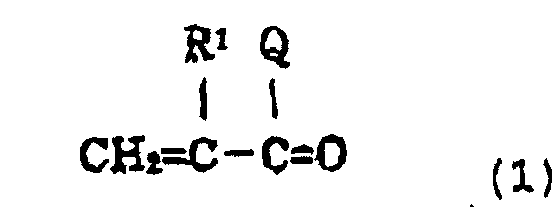 (B) un monomère d'alkoxysilane représenté par la formule générale (2) :(C) un monomère ayant une insaturation éthylénique autre que les composants (A) et (B) susmentionnés ;(D) un alkoxysilane représenté par la formule générale (3) :(E) un alkoxysilane représenté par la formule générale (4) :
 - Composition selon la revendication 1, dans laquelle le composant monomère (A) est choisi dans le groupe constitué par l'acrylamide, le méthacrylamide, le N-N-diméthylacrylamide, le N,N-diméthylméthacrylamide, le N-isopropylacrylamide, le N-isopropylméthacrylamide, le N,N-diéthylacrylamide, le N,N-diéthylméthacrylamide, le N,N-diméthylaminopropylacrylamide, le N,N-diméthylaminopropylméthacrylamide, l'acrylate de N,N-diméthylaminoéthyle, l'acxyloylmorphorine et un sel d'ammonium quaternaire comprenant l'un de ceux-ci auquel un halogénure d'alkyle a été ajouté.
- Composition selon la revendication 1 ou 2, dans laquelle le composant monomère (B) est choisi dans le groupe constitué par le vinyltriméthoxysilane, le vinyltriéthoxysilane, le vinyltri(méthoxyéthoxy)silane, le vinylméthyldiméthoxysilane, l'allyltriméthoxysilane, l'allystriéthoxysilane, le γ-acryloyloxypropyltriméthoxysilane, le γ-acryloloxypropyltriéthoxysilane, le γ-acryloyloxypropylméthyldiméthoxysilane, le γ-acryloyloxypropylméthyldiéthoxysilane, le γ-méthacryloyloxypropyltriméthoxysilane, le γ-méthacryloyloxypropyltriéthoxysilane, le γ-méthacryloyloxypxopylméthyldiméthoxysilane et le γ-méthacryloyloxypropylméthyldiéthoxysilane.
- Composition selon l'une quelconque des revendications précédentes, dans laquelle le composant monomère (C) est choisi dans le groupe constitué par l'acétate de vinyle, un acrylate d'alkyle, un méthacrylate d'alkyle, le styrène, l'acrylonitrile, le méthacrylonitrile, l'acide acrylique, l'acide méthacrylique, l'acrylate de 2-hydroxyéthyle et le méthacrylate de 2-hydroxyéthyle.
- Composition selon l'une quelconque des revendications précédentes, dans laquelle le composant monomère (A), le composant monomère (B) et le composant monomère (C) sont présents en une quantité allant de 95 % en poids à 60 % en poids, de 3 % en poids à 30% en poids et de 35 % en poids à 0 % en poids, respectivement, sur la base du poids total des monomères (A), (B) et (C).
- Composition selon l'une quelconque des revendications précédentes, dans laquelle le composant monomère (D) est choisi dans le groupe constitué par le vinyltriméthoxysilane, le vinyltriéthoxysilane, le vinyltri(méthoxyéthoxy)silane, le vinylméthyldiméthoxysilane, l'allyltriméthoxysilane, l'allyltriéthoxysilane, le γ-acryloyloxypropyltriméthoxysilane, le γ-acryloloxypropyltriéthoxysilane, le γ-acryloyloxypropylméthyldiméthoxysilane, le γ-acryloyloxypropylméthyldiéthoxysilane, le γ-méthacryloyloxypxopyltriméthoxysilane, le γ-méthacryloyloxypropyltriéthoxysilane, le γ-méthacryloyloxypropylméthyldiméthoxysilane et le γ-méthacryloyloxypropylméthyldiéthoxysilane.
- Composition selon l'une quelconque des revendications précédentes, dans laquelle le composant monomère (E) est choisi dans le groupe constitué par le γ-aminopropyltriméthoxysilane, le N-(β-aminoéthyl)-γ-aminopropyltriméthoxysilane, le γ-glycidoxypropyltriméthoxysilane, le tétraméthoxysilane et le tétraéthoxysilane.
- Composition selon l'une quelconque des revendications précédentes, dans laquelle ledit copolymère est obtenu en polymérisant les monomères (A) et (B) et éventuellement le monomère (C) dans un solvant organique en présence d'un initiateur de polymérisation radicalaire.
- Composition selon l'une quelconque des revendications précédentes, dans laquelle ledit polymère de condensation est obtenu en faisant réagir 100 parties en poids du copolymère avec de 20 parties en poids à 150 parties en poids du monomère (D) et de 0 partie en poids à 80 parties en poids du monomère (E).
- Composition selon l'une quelconque des revendications précédentes, dans laquelle ladite hydrolyse-condensation est réalisée en utilisant de l'eau en une quantité qui va de 0,2 à 0,9 fois la quantité en mole de tous les groupes alkoxyle du copolymère, du composant alkoxysilane (D) et du composant alkoxysilane (E).
- Procédé de liaison comprenant les étapes consistant à :appliquer la composition adhésive selon la revendication 1 à l'interface entre les deux surfaces adhésives à superposer face à face, et ;appliquer ensuite de la chaleur et de la pression à l'ensemble des surfaces adhésives superposées, afin de lier les surfaces adhésives pour obtenir un composite lié.
- Procédé selon la revendication 11, dans lequel l'une des surfaces adhésives est constituée d'un élastomère non vulcanisé et l'autre surface adhésive est constituée d'un métal.
- Composite élastomère-métal lié produit par le procédé selon la revendication 11 ou 12.
Applications Claiming Priority (3)
| Application Number | Priority Date | Filing Date | Title |
|---|---|---|---|
| JP36984/97 | 1997-02-05 | ||
| JP3698497 | 1997-02-05 | ||
| JP3698497 | 1997-02-05 |
Publications (3)
| Publication Number | Publication Date |
|---|---|
| EP0857771A2 EP0857771A2 (fr) | 1998-08-12 |
| EP0857771A3 EP0857771A3 (fr) | 1999-10-27 |
| EP0857771B1 true EP0857771B1 (fr) | 2004-08-11 |
Family
ID=12485027
Family Applications (1)
| Application Number | Title | Priority Date | Filing Date |
|---|---|---|---|
| EP98101965A Expired - Lifetime EP0857771B1 (fr) | 1997-02-05 | 1998-02-05 | Composition aqueuse adhésive, procédé de collage et article lié au moyen de cette composition |
Country Status (3)
| Country | Link |
|---|---|
| US (1) | US6051097A (fr) |
| EP (1) | EP0857771B1 (fr) |
| DE (1) | DE69825508T2 (fr) |
Families Citing this family (11)
| Publication number | Priority date | Publication date | Assignee | Title |
|---|---|---|---|---|
| EP1223629B1 (fr) * | 1999-07-13 | 2018-09-12 | Nok Corporation | Joint pour pile a combustible et son procede de formage |
| US7507453B2 (en) * | 2000-10-31 | 2009-03-24 | International Imaging Materials, Inc | Digital decoration and marking of glass and ceramic substrates |
| US6990904B2 (en) * | 2000-10-31 | 2006-01-31 | International Imaging Materials, Inc | Thermal transfer assembly for ceramic imaging |
| US6796733B2 (en) | 2000-10-31 | 2004-09-28 | International Imaging Materials Inc. | Thermal transfer ribbon with frosting ink layer |
| US6854386B2 (en) * | 2000-10-31 | 2005-02-15 | International Imaging Materials Inc. | Ceramic decal assembly |
| US7569634B2 (en) | 2002-02-14 | 2009-08-04 | The Glidden Company | Curable adhesive composition, adhesive kit and method of adhering substrates |
| US7211616B2 (en) * | 2002-02-14 | 2007-05-01 | The Glidden Company | Moisture curable adhesive |
| US6908240B1 (en) * | 2003-12-16 | 2005-06-21 | International Imaging Materials, Inc | Thermal printing and cleaning assembly |
| US20070048349A1 (en) * | 2005-08-29 | 2007-03-01 | Bausch & Lomb Incorporated | Surface-modified medical devices and methods of making |
| US7829162B2 (en) * | 2006-08-29 | 2010-11-09 | international imagining materials, inc | Thermal transfer ribbon |
| US8536087B2 (en) | 2010-04-08 | 2013-09-17 | International Imaging Materials, Inc. | Thermographic imaging element |
Family Cites Families (6)
| Publication number | Priority date | Publication date | Assignee | Title |
|---|---|---|---|---|
| US4721750A (en) * | 1987-03-13 | 1988-01-26 | Toshiba Silicone Company, Ltd. | Primer composition |
| IE892033L (en) * | 1988-07-07 | 1990-01-07 | Smc Patents Ltd | Aqueous emulsion copolymers with siloxane functionality |
| US5178675A (en) * | 1991-03-22 | 1993-01-12 | Lord Corporation | Alkoxy silane adhesive compositions |
| JP2647293B2 (ja) * | 1991-11-11 | 1997-08-27 | 信越化学工業株式会社 | 接着性および経時安定性の良好なシリル基含有共重合体のエマルジョン組成物からなる接着向上剤 |
| JPH06318683A (ja) * | 1993-05-01 | 1994-11-15 | Toshiba Corp | 半導体記憶装置及びその製造方法 |
| JP3224631B2 (ja) * | 1993-05-12 | 2001-11-05 | 積水化学工業株式会社 | 室温硬化性組成物 |
-
1998
- 1998-02-04 US US09/018,835 patent/US6051097A/en not_active Expired - Fee Related
- 1998-02-05 EP EP98101965A patent/EP0857771B1/fr not_active Expired - Lifetime
- 1998-02-05 DE DE69825508T patent/DE69825508T2/de not_active Expired - Lifetime
Also Published As
| Publication number | Publication date |
|---|---|
| DE69825508D1 (de) | 2004-09-16 |
| EP0857771A2 (fr) | 1998-08-12 |
| DE69825508T2 (de) | 2005-01-05 |
| EP0857771A3 (fr) | 1999-10-27 |
| US6051097A (en) | 2000-04-18 |
Similar Documents
| Publication | Publication Date | Title |
|---|---|---|
| EP0857771B1 (fr) | Composition aqueuse adhésive, procédé de collage et article lié au moyen de cette composition | |
| EP0736050B1 (fr) | Composition d'etancheite a base de polymere acrylique modifie durcissable a l'humidite | |
| JP5552419B2 (ja) | 硬化性組成物 | |
| JPH0455444B2 (fr) | ||
| JP5496440B2 (ja) | 常温硬化型塗料及びそれらが塗布されたゴム製品 | |
| JP2005533923A5 (fr) | ||
| EP0604851A1 (fr) | Composition de polymère acrylique fonctionnalisé par un alkoxysilane | |
| JP3953995B2 (ja) | 1液型硬化性組成物 | |
| JP5499059B2 (ja) | 接着剤組成物 | |
| JPS5978220A (ja) | 室温硬化性弾性組成物 | |
| JP3914324B2 (ja) | 水性接着剤組成物、並びにそれを用いた接着方法および接着物 | |
| CN102898568A (zh) | 聚氯丁二烯胶乳及其制造方法、以及水系粘接剂 | |
| JP5370369B2 (ja) | 硬化性組成物 | |
| US12037509B2 (en) | Primer composition for bonding silicone resin and polyolefin resin, and method for bonding silicone resin and polyolefin resin | |
| JP2688466B2 (ja) | アクリルシリコーンゴム組成物及びその硬化物 | |
| JP2005281638A (ja) | 硬化性組成物およびその製造方法 | |
| JP4339531B2 (ja) | ポリイソブチレン系シーリング材用プライマー組成物 | |
| JP2004124092A (ja) | 硬化性組成物 | |
| JP2000159964A (ja) | シーリング材組成物 | |
| KR101717183B1 (ko) | 가스켓 일체형 실린더 헤드 커버 모듈 | |
| JP2003048921A (ja) | 架橋性シリル基含有重合体の製造方法、および硬化性組成物 | |
| JPH07278411A (ja) | エラストマー組成物 | |
| CN113272343B (zh) | 氯丁二烯接枝共聚物胶乳的制造方法、包含该氯丁二烯接枝共聚物胶乳的粘接剂及粘接方法 | |
| JP3526663B2 (ja) | エポキシ基を有するエラストマー組成物 | |
| CN119220185A (zh) | 粘合剂组合物及膜片 |
Legal Events
| Date | Code | Title | Description |
|---|---|---|---|
| PUAI | Public reference made under article 153(3) epc to a published international application that has entered the european phase |
Free format text: ORIGINAL CODE: 0009012 |
|
| AK | Designated contracting states |
Kind code of ref document: A2 Designated state(s): DE FR GB |
|
| AX | Request for extension of the european patent |
Free format text: AL;LT;LV;MK;RO;SI |
|
| PUAL | Search report despatched |
Free format text: ORIGINAL CODE: 0009013 |
|
| AK | Designated contracting states |
Kind code of ref document: A3 Designated state(s): AT BE CH DE DK ES FI FR GB GR IE IT LI LU MC NL PT SE |
|
| AX | Request for extension of the european patent |
Free format text: AL;LT;LV;MK;RO;SI |
|
| 17P | Request for examination filed |
Effective date: 20000405 |
|
| AKX | Designation fees paid |
Free format text: DE FR GB |
|
| GRAP | Despatch of communication of intention to grant a patent |
Free format text: ORIGINAL CODE: EPIDOSNIGR1 |
|
| GRAS | Grant fee paid |
Free format text: ORIGINAL CODE: EPIDOSNIGR3 |
|
| GRAA | (expected) grant |
Free format text: ORIGINAL CODE: 0009210 |
|
| AK | Designated contracting states |
Kind code of ref document: B1 Designated state(s): DE FR GB |
|
| REG | Reference to a national code |
Ref country code: GB Ref legal event code: FG4D |
|
| REF | Corresponds to: |
Ref document number: 69825508 Country of ref document: DE Date of ref document: 20040916 Kind code of ref document: P |
|
| PLBE | No opposition filed within time limit |
Free format text: ORIGINAL CODE: 0009261 |
|
| STAA | Information on the status of an ep patent application or granted ep patent |
Free format text: STATUS: NO OPPOSITION FILED WITHIN TIME LIMIT |
|
| ET | Fr: translation filed | ||
| 26N | No opposition filed |
Effective date: 20050512 |
|
| PGFP | Annual fee paid to national office [announced via postgrant information from national office to epo] |
Ref country code: DE Payment date: 20110208 Year of fee payment: 14 Ref country code: FR Payment date: 20110218 Year of fee payment: 14 |
|
| PGFP | Annual fee paid to national office [announced via postgrant information from national office to epo] |
Ref country code: GB Payment date: 20110209 Year of fee payment: 14 |
|
| GBPC | Gb: european patent ceased through non-payment of renewal fee |
Effective date: 20120205 |
|
| REG | Reference to a national code |
Ref country code: FR Ref legal event code: ST Effective date: 20121031 |
|
| REG | Reference to a national code |
Ref country code: DE Ref legal event code: R119 Ref document number: 69825508 Country of ref document: DE Effective date: 20120901 |
|
| PG25 | Lapsed in a contracting state [announced via postgrant information from national office to epo] |
Ref country code: FR Free format text: LAPSE BECAUSE OF NON-PAYMENT OF DUE FEES Effective date: 20120229 Ref country code: GB Free format text: LAPSE BECAUSE OF NON-PAYMENT OF DUE FEES Effective date: 20120205 |
|
| PG25 | Lapsed in a contracting state [announced via postgrant information from national office to epo] |
Ref country code: DE Free format text: LAPSE BECAUSE OF NON-PAYMENT OF DUE FEES Effective date: 20120901 |