EP0858181A1 - Verfahren zum Diversity-Entzerrung in einem Funkempfänger mit einer bestimmten Anzahl von Empfangskanäle und entsprechender Empfänger - Google Patents
Verfahren zum Diversity-Entzerrung in einem Funkempfänger mit einer bestimmten Anzahl von Empfangskanäle und entsprechender Empfänger Download PDFInfo
- Publication number
- EP0858181A1 EP0858181A1 EP98400143A EP98400143A EP0858181A1 EP 0858181 A1 EP0858181 A1 EP 0858181A1 EP 98400143 A EP98400143 A EP 98400143A EP 98400143 A EP98400143 A EP 98400143A EP 0858181 A1 EP0858181 A1 EP 0858181A1
- Authority
- EP
- European Patent Office
- Prior art keywords
- filter
- space
- equalization
- channel
- channels
- Prior art date
- Legal status (The legal status is an assumption and is not a legal conclusion. Google has not performed a legal analysis and makes no representation as to the accuracy of the status listed.)
- Withdrawn
Links
- 238000000034 method Methods 0.000 title claims abstract description 38
- 230000005540 biological transmission Effects 0.000 claims abstract description 30
- 239000011159 matrix material Substances 0.000 claims abstract description 11
- 238000001914 filtration Methods 0.000 claims description 9
- 230000008569 process Effects 0.000 claims description 7
- 238000004364 calculation method Methods 0.000 claims description 4
- 230000002123 temporal effect Effects 0.000 claims description 4
- 230000017105 transposition Effects 0.000 claims 1
- 238000004891 communication Methods 0.000 abstract description 8
- 230000003044 adaptive effect Effects 0.000 description 13
- 230000006870 function Effects 0.000 description 10
- 238000012545 processing Methods 0.000 description 7
- 239000013598 vector Substances 0.000 description 6
- 238000005562 fading Methods 0.000 description 5
- 230000008901 benefit Effects 0.000 description 4
- 230000004044 response Effects 0.000 description 3
- 238000012549 training Methods 0.000 description 3
- 230000006978 adaptation Effects 0.000 description 2
- 230000015556 catabolic process Effects 0.000 description 2
- 230000001413 cellular effect Effects 0.000 description 2
- 230000001427 coherent effect Effects 0.000 description 2
- 238000006731 degradation reaction Methods 0.000 description 2
- 238000010586 diagram Methods 0.000 description 2
- 230000002452 interceptive effect Effects 0.000 description 2
- 241001137307 Cyprinodon variegatus Species 0.000 description 1
- 238000005311 autocorrelation function Methods 0.000 description 1
- 230000008859 change Effects 0.000 description 1
- 238000010276 construction Methods 0.000 description 1
- 238000005314 correlation function Methods 0.000 description 1
- 238000003780 insertion Methods 0.000 description 1
- 230000037431 insertion Effects 0.000 description 1
- 238000005457 optimization Methods 0.000 description 1
- 210000000056 organ Anatomy 0.000 description 1
- 230000005855 radiation Effects 0.000 description 1
- 230000033764 rhythmic process Effects 0.000 description 1
- 239000002689 soil Substances 0.000 description 1
- 230000007480 spreading Effects 0.000 description 1
- 230000002747 voluntary effect Effects 0.000 description 1
Images

Classifications
-
- H—ELECTRICITY
- H04—ELECTRIC COMMUNICATION TECHNIQUE
- H04B—TRANSMISSION
- H04B7/00—Radio transmission systems, i.e. using radiation field
- H04B7/02—Diversity systems; Multi-antenna system, i.e. transmission or reception using multiple antennas
- H04B7/04—Diversity systems; Multi-antenna system, i.e. transmission or reception using multiple antennas using two or more spaced independent antennas
- H04B7/08—Diversity systems; Multi-antenna system, i.e. transmission or reception using multiple antennas using two or more spaced independent antennas at the receiving station
- H04B7/0891—Space-time diversity
-
- H—ELECTRICITY
- H04—ELECTRIC COMMUNICATION TECHNIQUE
- H04B—TRANSMISSION
- H04B7/00—Radio transmission systems, i.e. using radiation field
- H04B7/02—Diversity systems; Multi-antenna system, i.e. transmission or reception using multiple antennas
- H04B7/04—Diversity systems; Multi-antenna system, i.e. transmission or reception using multiple antennas using two or more spaced independent antennas
- H04B7/08—Diversity systems; Multi-antenna system, i.e. transmission or reception using multiple antennas using two or more spaced independent antennas at the receiving station
- H04B7/0837—Diversity systems; Multi-antenna system, i.e. transmission or reception using multiple antennas using two or more spaced independent antennas at the receiving station using pre-detection combining
- H04B7/0842—Weighted combining
- H04B7/0845—Weighted combining per branch equalization, e.g. by an FIR-filter or RAKE receiver per antenna branch
-
- H—ELECTRICITY
- H04—ELECTRIC COMMUNICATION TECHNIQUE
- H04L—TRANSMISSION OF DIGITAL INFORMATION, e.g. TELEGRAPHIC COMMUNICATION
- H04L25/00—Baseband systems
- H04L25/02—Details ; arrangements for supplying electrical power along data transmission lines
- H04L25/0202—Channel estimation
- H04L25/0204—Channel estimation of multiple channels
-
- H—ELECTRICITY
- H04—ELECTRIC COMMUNICATION TECHNIQUE
- H04L—TRANSMISSION OF DIGITAL INFORMATION, e.g. TELEGRAPHIC COMMUNICATION
- H04L25/00—Baseband systems
- H04L25/02—Details ; arrangements for supplying electrical power along data transmission lines
- H04L25/03—Shaping networks in transmitter or receiver, e.g. adaptive shaping networks
- H04L25/03006—Arrangements for removing intersymbol interference
- H04L25/03178—Arrangements involving sequence estimation techniques
Definitions
- the present invention relates to a method for multi-channel equalization in a radio receiver, enabling reception of a digital radio signal of the linear modulation type series (or similar), on at least two channels in the presence of several propagation paths, also called multipaths, and in the presence of interfering sources, also called jammers.
- the invention also relates to a radio receiver multi-channel using such a method.
- the transmitted signal comes from modulation in phase and / or amplitude of a carrier by a series of symbols including a part, known to the receiver, is called "sequences learning".
- the channel can be that of transmissions in the range of high frequencies, HF, allowing long distance communications (hundreds to thousands of kilometers).
- the multi-routes of the HF channel are due to multiple signal reflections on the ionospheric layers of the atmosphere and the soil.
- the channel can also be that of transmissions in the very high frequency range, UHF, which is used in mobile radio communications (GSM for example).
- the multi-routes of the canal radiomobile are due to multiple reflections on building surfaces and on the terrestrial relief.
- interference it can be voluntary (broadband interference for example) or involuntary (other transmission signals using the same frequency band).
- An adaptive antenna is a antenna which detects sources of interference automatically, constructing holes in their direction in its diagram of radiation, while improving the reception of the useful source, without a priori knowledge of interference and from information minimum on the useful signal.
- an adaptive antenna is able to respond automatically to a changing environment.
- Multichannel equalizers are thus obtained comprising a spatial part, composed of different filters arranged on each of the reception channels, and a temporal part arranged at the output of the part spatial.
- Receivers jointly processing signals from multiple antennas have already been proposed to combat the selective "fading" generated by multi-routes, in an unscrambled environment; these are the equalizers at spatial diversity.
- the most often used include either a Viterbi algorithm or a DFE structure minimizing the Average Quadratic Error (EQM) between a output obtained and a desired output.
- EQM Average Quadratic Error
- the impulse response of the transmission channel is estimated from the symbols known and symbols decided progressively by the equalizer.
- DFE-structured spatial diversity equalizers are available in the article by P. Balaban & J. Salz and in an article by K.E. Scott and S.T. Nichols, titled "Antenna Diversity with Multichannel Adaptive Equalization in Digital Radio ", Proc. of International Conf. on Com., ICC'91, New York, USA, June 1991.
- this processing can only be applied to transmission including the temporal spreading of the multipaths relative to the symbol duration is reduced, which is generally not the case in HF broadband transmissions in the GSM system.
- the number of coefficients to be adapted is too large for the adaptation algorithm can converge on a known sequence learning.
- the other spatial diversity equalizers presented depend on the estimation of the transmission channel hardly achievable in presence of interference.
- these equalizers do not include a function interference rejection.
- the subject of the invention is also a receiver implementing the above process.
- the method according to the invention has the advantage that it allows a setting implementation of a new multi-sensor equalizer, having a power of less computation than the aforementioned equalizers while being optimal when the noise is white temporally and allowing an effective rejection of jammers.
- the method according to the invention is based on a channel estimation performed on each of the input channels of a multichannel receiver which allows the calculation of the coefficients of a spatio-temporal filter acting on the input data.
- the output of this filter is processed by an equalizer one-dimensional symbol rhythm, which decides which symbols are transmitted.
- the latter can in particular be an equalizer based on the algorithm of Viterbi, or a DFE type equalizer.
- the process jointly performs the following functions, namely a jammer rejection function, a gain optimization function in the direction of the various useful journeys, with a re-phasing of these and a function of reducing the distortions generated by the multipath associated with the useful signal.
- the first two functions are performed by the filter spatio-temporal, the third by the equalizer placed at the exit of this one.
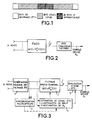
- the transmitted symbols can be constituted as shown in FIG. 1 by bursts of 148 symbols, broken down into two 3-bit stuffing sequences at each end, a learning sequence, composed of 26 known bits, placed in middle of frame and two sequences of 58 bits of information.
- the data d n representing the sequence (d n ) of the bits to be transmitted are differentially coded before being modulated.
- GMSK modulation used is of the type described in the article by M. P.A. LAURENT entitled “Exact and approximate construction of digital phase modulation by superposition of amplitude modulated pulse (AMP) "and published in IEEE Trans Comm. Vol. 34 (1986) pp 150-160.
- the sequence (s n ) constitutes the sequence of symbols transmitted.
- Demodulation consists in determining the sequence (s n ) then in going up again following the transmitted bits (d n ).
- the transmitted signal z (t) arrives on a reception network comprising K sensors, after its passage in the radiomobile propagation channel.
- Ts is the symbol period
- the decision-making body is based on the Viterbi algorithm as described in the article by JG PROAKIS, "Adaptive Equalization for TDMA Digital Mobile Radio", IEEE Trans. on Vehicular Techn., vol 40, n ° 2, May 1991.
- This algorithm makes it possible, from the sequence (y n ) obtained at the output of the "FAST" filter, to find the sequence (s k0 n ) of index k 0 which minimizes the probability of decision error on the sequence of symbols transmitted, or even equivalent which maximizes the following criterion:
- the Viterbi algorithm works from the output signal of the "FAST" filter y n and the coefficients ⁇ n .
- the matrix R b is estimated using a channel estimation algorithm performed on each of the input channels.
- the different processing steps to be implemented are shown in the flow diagram of FIG. 3.
- the first step which is shown at 1 in Figure 3 consists to digitize the signals applied to the sensors, to transpose to baseband and then filter them through a reception filter.
- Step 2 synchronizes the receiver on the symbols received. This can be carried out as described in the request for Applicant's patent filed on January 21, 1994 entitled “synchronization in the presence of jammers and multipaths" and published under the number 2 715 488, or any other process allowing a synchronization in the presence of jammers and multipaths.
- Step 3 aims to perform n spatio-temporal filters when the noise is temporally white. It requires the estimation of the useful channel G (t) and of the noise correlation matrix R b . This estimate is made in step 4 by performing the following estimates:
- a first estimate consists in estimating the transmission channel on each of the input channels:
- G k the vector constituted from the time samples of the propagation channel on the channel k:
- G k (g k (0), ..., g k [(L-1) Te]) T .
- g k (t) represents the channel obtained on channel k and noting: S (n Te), ..., ⁇ s (n Te) s [(n-L + 1) Te] ⁇ T
- the vector formed using the symbols known from the training sequence the signal received by the antenna k is written:
- x k (n Te) G k H S (n Te) + b k (n Te).
- a second estimate consists in estimating samples of noise on each of the input channels:
- a third estimate consists in estimating the noise correlation matrix R and b :
- the noise correlation matrix is obtained from the noise samples estimated B and (nTe) by the conventional estimator not biased by the relation:
- the coefficients of the filter are obtained either by solving all the linear systems contained in equation (14), or by inverting the matrix R b by any method appropriate to the inversion of the Hermitian matrices and in particular the pivot method of Gauss.
- R and b W and (iTe) G and (iTe).
- Step 5 consists in calculating the coefficients used by the Viterbi equalizer:
- the coefficients ⁇ n used by the Viterbi algorithm are obtained by formula (6). These are also expressed as a function of the vectors G and (iTe) and W and (iTe) according to the relation:
- the factor 2n is due to the fact that the coefficients used by the algorithm of Viterbi are calculated at the symbol rate).
- FIG. 4 An embodiment of a receiver for implementing the process according to the invention is shown in FIG. 4. This comprises a first block 6 for digitizing the signal applied to each of the K channels reception. A second one-dimensional equalization block coupled to the first block 6 via a third space filtering block temporal 8. A fourth block 9 ensures the calculation of the coefficients of the block of spatio-temporal filter 8 as well as those characterizing the useful channel at the input of the one-dimensional equalization block 7. Finally a fifth block 10 ensures synchronization of signals between the different blocks.
- the equalization block 7 can be programmed to recover the symbols transmitted while minimizing the probability of decision error according to the Viterbi algorithm.
- the coefficients ⁇ n which are to be taken into account to execute the Viterbi algorithm are those defined by the relation (15).
Landscapes
- Engineering & Computer Science (AREA)
- Computer Networks & Wireless Communication (AREA)
- Signal Processing (AREA)
- Cable Transmission Systems, Equalization Of Radio And Reduction Of Echo (AREA)
- Filters That Use Time-Delay Elements (AREA)
- Radio Transmission System (AREA)
Applications Claiming Priority (2)
| Application Number | Priority Date | Filing Date | Title |
|---|---|---|---|
| FR9700787A FR2758926B1 (fr) | 1997-01-24 | 1997-01-24 | Procede d'egalisation multicapteurs dans un recepteur radioelectrique comportant un nombre determine de voies de reception et recepteur correspondant |
| FR9700787 | 1997-01-24 |
Publications (1)
| Publication Number | Publication Date |
|---|---|
| EP0858181A1 true EP0858181A1 (de) | 1998-08-12 |
Family
ID=9502958
Family Applications (1)
| Application Number | Title | Priority Date | Filing Date |
|---|---|---|---|
| EP98400143A Withdrawn EP0858181A1 (de) | 1997-01-24 | 1998-01-23 | Verfahren zum Diversity-Entzerrung in einem Funkempfänger mit einer bestimmten Anzahl von Empfangskanäle und entsprechender Empfänger |
Country Status (3)
| Country | Link |
|---|---|
| US (1) | US6118832A (de) |
| EP (1) | EP0858181A1 (de) |
| FR (1) | FR2758926B1 (de) |
Cited By (1)
| Publication number | Priority date | Publication date | Assignee | Title |
|---|---|---|---|---|
| WO2001020809A1 (en) * | 1999-09-13 | 2001-03-22 | Ericsson Inc. | Carrier to interference ratio estimation for a wireless communication channel |
Families Citing this family (35)
| Publication number | Priority date | Publication date | Assignee | Title |
|---|---|---|---|---|
| AT408933B (de) * | 1996-05-20 | 2002-04-25 | Josef Dipl Ing Fuhl | Verfahren und vorrichtung zur erhöhung der teilnehmerkapazität von zellularen mobilfunknetzen |
| EP0974200A1 (de) * | 1998-02-12 | 2000-01-26 | Koninklijke Philips Electronics N.V. | Verafhren und vorrichtung zur nichtlinearen wahrscheinlichkeitsfolgeschätzung |
| US6442130B1 (en) | 1999-01-21 | 2002-08-27 | Cisco Technology, Inc. | System for interference cancellation |
| FR2806499B1 (fr) * | 2000-03-20 | 2003-10-10 | Thomson Csf | Procede d'estimation d'une matrice de correlation de signaux interferents recus par un reseau de capteurs |
| CN1169383C (zh) * | 2000-03-27 | 2004-09-29 | 株式会社Ntt杜可莫 | 空间的和时间的均衡器以及均衡方法 |
| US6650716B1 (en) * | 2000-07-24 | 2003-11-18 | Nortel Networks Limited | Space-time receiver structure for digital communication systems |
| FR2819357B1 (fr) * | 2001-01-09 | 2016-02-12 | Thomson Csf | Procede et recepteur autodidacte pour determiner les parametres spatio-temporels d'un canal de propagation |
| EP1358629A1 (de) * | 2001-01-26 | 2003-11-05 | Koninklijke Philips Electronics N.V. | Räumlich-zeitliche filtereinheit und bildanzeigevorrichtung mit einer solchen räumlichzeitlichen filtereinheit |
| FR2820580B1 (fr) | 2001-02-02 | 2004-06-04 | Thomson Csf | Procede pour estimer les parametres d'un canal de propagation |
| FR2821502A1 (fr) * | 2001-02-27 | 2002-08-30 | Thomson Csf | Procede et dispositif d'estimation d'un canal de propagation a partir de ses statistiques |
| US6990059B1 (en) | 2001-09-05 | 2006-01-24 | Cisco Technology, Inc. | Interference mitigation in a wireless communication system |
| US7855948B2 (en) * | 2001-09-05 | 2010-12-21 | Cisco Technology, Inc. | Interference mitigation in a wireless communication system |
| US7161974B2 (en) * | 2001-09-10 | 2007-01-09 | Sasken Communication Technologies Ltd. | Method for 2D antenna rake combining in a code division multiplication access system |
| FI20020953A0 (fi) * | 2002-05-21 | 2002-05-21 | Nokia Corp | Kanavaestimointi hajaspektrijärjestelmässä |
| EP1512025B1 (de) * | 2002-06-11 | 2007-03-28 | Worcester Polytechnic Institute | Rekonfigurierbares geolokationssystem |
| ATE313899T1 (de) * | 2002-06-27 | 2006-01-15 | Siemens Ag | Verfahren zur ermittlung von nutzsignalparametern und störsignalparametern aus einem empfangssignal eines funkkommunikationssystems |
| EP1376961A1 (de) * | 2002-06-27 | 2004-01-02 | Siemens Aktiengesellschaft | Verfahren zur Ermittlung von Nutzsignalparametern und Störsignalparametern aus einem Empfangssignal eines Funkkommunikationssystems |
| US6920193B2 (en) * | 2002-12-19 | 2005-07-19 | Texas Instruments Incorporated | Wireless receiver using noise levels for combining signals having spatial diversity |
| CN100576772C (zh) | 2002-12-27 | 2009-12-30 | Nxp股份有限公司 | 具有智能天线的移动终端及其方法 |
| CN100492937C (zh) * | 2002-12-27 | 2009-05-27 | Nxp股份有限公司 | 具有多天线的移动终端及其方法 |
| CN1203637C (zh) | 2003-01-07 | 2005-05-25 | 大唐移动通信设备有限公司 | 时隙cdma系统噪声空间相关特性估计方法 |
| US6834928B2 (en) * | 2003-04-19 | 2004-12-28 | Hewlett-Packard Development Company, L.P. | Determination of media advancement based on one pixel-wide media images |
| US6846058B2 (en) * | 2003-04-19 | 2005-01-25 | Hewlett-Packard Development Company, L.P. | Media positioning with differently accurate sensors |
| US7724851B2 (en) * | 2004-03-04 | 2010-05-25 | Bae Systems Information And Electronic Systems Integration Inc. | Receiver with multiple collectors in a multiple user detection system |
| WO2007027839A2 (en) * | 2005-09-01 | 2007-03-08 | University Of Florida Research Foundation, Inc. | Device and methods for enhanced matched filtering based on correntropy |
| US20080188253A1 (en) * | 2007-01-31 | 2008-08-07 | Ntt Docomo, Inc. | Method and system for wireless design subject to interference constraints |
| EP2243227A1 (de) * | 2008-01-03 | 2010-10-27 | France Telecom | Kommunikation über den rückweg von einem endgerät an einen sender zur verminderung insbesondere von interferenzen zwischen strahlen des senders |
| FR2962615B1 (fr) * | 2010-07-06 | 2013-03-22 | Univ Bretagne Occidentale | Procede et dispositif d'analyse de train binaire et de reconstruction en aveugle de codes correcteurs d'erreurs |
| KR102063140B1 (ko) | 2011-10-27 | 2020-02-11 | 인텔 코포레이션 | 블록 기반 파고율 저감 |
| RU2012102842A (ru) | 2012-01-27 | 2013-08-10 | ЭлЭсАй Корпорейшн | Инкрементное обнаружение преамбулы |
| US9923595B2 (en) | 2013-04-17 | 2018-03-20 | Intel Corporation | Digital predistortion for dual-band power amplifiers |
| US9813223B2 (en) | 2013-04-17 | 2017-11-07 | Intel Corporation | Non-linear modeling of a physical system using direct optimization of look-up table values |
| FR3046311B1 (fr) | 2015-12-29 | 2017-12-29 | Thales Sa | Procede de lutte anti-interference adaptatif dans un recepteur multi-voies |
| FR3061617A1 (fr) * | 2016-12-29 | 2018-07-06 | Thales | Procede de lutte anti-interferences par filtrage spatial ou filtrage spatio-temporel dans un recepteur multi-voies |
| US10985846B2 (en) * | 2017-04-13 | 2021-04-20 | Nippon Telegraph And Telephone Corporation | Signal separating apparatus and signal separating method |
Citations (1)
| Publication number | Priority date | Publication date | Assignee | Title |
|---|---|---|---|---|
| EP0669729A1 (de) * | 1994-02-25 | 1995-08-30 | Thomson-Csf | Verfahren zur Durchführung von einer mehrkanalen Entzerrung in einem Rundfunkempfänger bei Störungen und Mehrwegeausbreitung |
Family Cites Families (9)
| Publication number | Priority date | Publication date | Assignee | Title |
|---|---|---|---|---|
| FR669729A (fr) * | 1929-02-16 | 1929-11-20 | Perfectionnements aux comparateurs optiques | |
| US5828658A (en) * | 1991-12-12 | 1998-10-27 | Arraycomm, Inc. | Spectrally efficient high capacity wireless communication systems with spatio-temporal processing |
| FR2715488B1 (fr) * | 1994-01-21 | 1996-03-22 | Thomson Csf | Procédé et dispositif permettant à un modem de se synchroniser sur un transmetteur de données numériques par voie hertzienne en présence de brouilleurs. |
| JPH0846557A (ja) * | 1994-07-26 | 1996-02-16 | Alpine Electron Inc | アンテナダイバーシティシステム |
| FR2732490B1 (fr) * | 1995-03-28 | 1997-04-25 | Thomson Csf | Procede de reception multicapteur d'une station de base d'un reseau de communication echangeant des donnees avec des mobiles, et dispositif pour sa mise en oeuvre |
| DE19604772C2 (de) * | 1996-02-09 | 2002-08-29 | Siemens Ag | Verfahren zur Parametrierung einer Empfangseinrichtung, sowie entsprechende Empfangseinrichtung und Funkstation |
| US5848105A (en) * | 1996-10-10 | 1998-12-08 | Gardner; William A. | GMSK signal processors for improved communications capacity and quality |
| US5870430A (en) * | 1996-12-26 | 1999-02-09 | Thomson-Csf | Process for multi-sensor equalisation in a radio receiver in the presence of interference and multiple propagation paths |
| US5973638A (en) * | 1998-01-30 | 1999-10-26 | Micronetics Wireless, Inc. | Smart antenna channel simulator and test system |
-
1997
- 1997-01-24 FR FR9700787A patent/FR2758926B1/fr not_active Expired - Lifetime
-
1998
- 1998-01-23 US US09/012,462 patent/US6118832A/en not_active Expired - Lifetime
- 1998-01-23 EP EP98400143A patent/EP0858181A1/de not_active Withdrawn
Patent Citations (1)
| Publication number | Priority date | Publication date | Assignee | Title |
|---|---|---|---|---|
| EP0669729A1 (de) * | 1994-02-25 | 1995-08-30 | Thomson-Csf | Verfahren zur Durchführung von einer mehrkanalen Entzerrung in einem Rundfunkempfänger bei Störungen und Mehrwegeausbreitung |
Non-Patent Citations (1)
| Title |
|---|
| VILA P. ET AL.: "MLSE ANTENNA DIVERSITY EQUALIZATION OF A JAMMED FREQUENCY-SELECTIVE FADING CHANNEL", SIGNAL PROCESSING VII: THEORIES AND APPLICATIONS, PROCEEDINGS OF EUSIPCO 94, vol. 3, 13 September 1994 (1994-09-13) - 16 September 1994 (1994-09-16), EDINBURGH, UK, pages 1516 - 1519, XP000677064 * |
Cited By (2)
| Publication number | Priority date | Publication date | Assignee | Title |
|---|---|---|---|---|
| WO2001020809A1 (en) * | 1999-09-13 | 2001-03-22 | Ericsson Inc. | Carrier to interference ratio estimation for a wireless communication channel |
| US6463105B1 (en) | 1999-09-13 | 2002-10-08 | Ericsson Inc. | Methods and systems for estimation of the carrier to interference ratio for a wireless communication channel |
Also Published As
| Publication number | Publication date |
|---|---|
| FR2758926B1 (fr) | 1999-04-30 |
| US6118832A (en) | 2000-09-12 |
| FR2758926A1 (fr) | 1998-07-31 |
Similar Documents
| Publication | Publication Date | Title |
|---|---|---|
| EP0858181A1 (de) | Verfahren zum Diversity-Entzerrung in einem Funkempfänger mit einer bestimmten Anzahl von Empfangskanäle und entsprechender Empfänger | |
| EP0867079B1 (de) | Verfahren und anordnung zur entzerrung von mehrfachantennensignalen für mehrfachelementempfang in gegenwart von störungen und mehrwegausbreitungen | |
| EP2115980B1 (de) | Symbolverarbeitung in einer bidirektionalen kommunikation mittels zeitumkehr | |
| CA2172672C (fr) | Procede de reception multicapteur d'une station de base fixe d'un reseau de communication echangeant des donnees avec des mobiles, et dispositif pour sa mise en oeuvre | |
| EP2220803B1 (de) | Störminderung bei einem ofdm-signal mit gewichtungsvektorbildung in untervektorräumen | |
| WO2002023841A1 (fr) | Procede d'estimation optimale d'un canal de propagation reposant uniquement sur les symboles pilotes et estimateur correspondant | |
| EP3188426B1 (de) | Adaptives verfahren zur anwendung von entstörungsmassnahmen in einem mehrweg-empfänger | |
| EP0991952B1 (de) | Verfahren zur funkpeilung und zusammenwirkendes übertragungsgerät | |
| FR2715523A1 (fr) | Récepteur et procédé de réception pour un système d'accès multiple par répartition par code. | |
| EP3343784B1 (de) | Verfahren zur anwendung von entstörungsmassnahmen durch räumliche oder räumlich-zeitliche filterung in einem mehrweg-empfänger | |
| EP0576359B1 (de) | Verfahren und Einrichtung zur entscheidungsrückgekoppelten Entzerrung für die blockweise Übertragung von Informationssymbolen | |
| WO2008062131A1 (fr) | Procedes et modules d'emission/reception pour un systeme multi-antennes multi-porteuses a sequence d'apprentissage | |
| EP1050973A1 (de) | Verfahren zur gleichzeitige Erfassung von einem CDMA-Kodesatz | |
| EP1185004A1 (de) | Verfahren zum gemeinsamen Einfallswinkel- und Kanalschätzung | |
| EP1391095B1 (de) | Verfahren zur schätzung der übertragungsfunktion eines mehrträger-signalübertragungskanals und eines entsprechenden empfängers | |
| EP0669729B1 (de) | Verfahren zur Durchführung von einer mehrkanalen Entzerrung in einem Rundfunkempfänger bei Störungen und Mehrwegeausbreitung | |
| EP0708544A1 (de) | Einrichtung zur Erkennung der von einem empfangenen Signal getragenen Information | |
| EP1283605A1 (de) | Verfahren zur Erhöhung der Datenrate in einem Kommunikationssystem mit N Sendern und M Empfängern | |
| FR3091963A1 (fr) | Procédé de réception d’un signal SOQPSK-TG en décomposition PAM | |
| EP1221792A1 (de) | Verfahren und Empfänger zur adaptiven Schätzung der Raum-Zeit-Parametern eines Kanal | |
| EP1299969A1 (de) | Datenübertragungssystem und -verfahren mit raum-zeit-kodierung | |
| EP1774660A1 (de) | Verfahren zur entwicklung eines digitalen empfangsfilters und dazugehörige empfangsvorrichtung | |
| FR2735635A1 (fr) | Procede permettant une egalisation multicapteur dans un recepteur radioelectrique, en presence d'interferences et de multitrajets de propagation | |
| FR2810175A1 (fr) | Systemes et procedes de transmission numerique a codage espace-temps | |
| FR2871966A1 (fr) | Procede et dispositif de traitement de signal dans un recepteur de radiocommunication |
Legal Events
| Date | Code | Title | Description |
|---|---|---|---|
| PUAI | Public reference made under article 153(3) epc to a published international application that has entered the european phase |
Free format text: ORIGINAL CODE: 0009012 |
|
| AK | Designated contracting states |
Kind code of ref document: A1 Designated state(s): BE CH DE DK ES FI FR GB IT LI NL SE |
|
| AX | Request for extension of the european patent |
Free format text: AL;LT;LV;MK;RO;SI |
|
| 17P | Request for examination filed |
Effective date: 19981214 |
|
| AKX | Designation fees paid |
Free format text: BE CH DE DK ES FI FR GB IT LI NL SE |
|
| RBV | Designated contracting states (corrected) |
Designated state(s): BE CH DE DK ES FI FR GB IT LI NL SE |
|
| RAP1 | Party data changed (applicant data changed or rights of an application transferred) |
Owner name: THALES Owner name: FRANCE TELECOM |
|
| 17Q | First examination report despatched |
Effective date: 20071112 |
|
| STAA | Information on the status of an ep patent application or granted ep patent |
Free format text: STATUS: THE APPLICATION IS DEEMED TO BE WITHDRAWN |
|
| 18D | Application deemed to be withdrawn |
Effective date: 20080523 |