EP0858701B1 - Procedes cryptographiques permettant de demontrer des formules applicables a partir d'une logique de proposition - Google Patents
Procedes cryptographiques permettant de demontrer des formules applicables a partir d'une logique de proposition Download PDFInfo
- Publication number
- EP0858701B1 EP0858701B1 EP96933663A EP96933663A EP0858701B1 EP 0858701 B1 EP0858701 B1 EP 0858701B1 EP 96933663 A EP96933663 A EP 96933663A EP 96933663 A EP96933663 A EP 96933663A EP 0858701 B1 EP0858701 B1 EP 0858701B1
- Authority
- EP
- European Patent Office
- Prior art keywords
- computing
- formula
- numbers
- mod
- challenge
- Prior art date
- Legal status (The legal status is an assumption and is not a legal conclusion. Google has not performed a legal analysis and makes no representation as to the accuracy of the status listed.)
- Expired - Lifetime
Links
- 238000000034 method Methods 0.000 title abstract description 123
- 230000004044 response Effects 0.000 claims description 78
- 238000012937 correction Methods 0.000 claims description 44
- 230000005540 biological transmission Effects 0.000 claims description 7
- 238000012795 verification Methods 0.000 description 16
- 230000014509 gene expression Effects 0.000 description 9
- 239000011159 matrix material Substances 0.000 description 7
- 238000003860 storage Methods 0.000 description 7
- 230000009471 action Effects 0.000 description 4
- 230000008901 benefit Effects 0.000 description 4
- 238000007430 reference method Methods 0.000 description 4
- 238000006467 substitution reaction Methods 0.000 description 4
- 230000003466 anti-cipated effect Effects 0.000 description 3
- 238000013459 approach Methods 0.000 description 3
- 238000010276 construction Methods 0.000 description 3
- 238000013461 design Methods 0.000 description 3
- 239000000796 flavoring agent Substances 0.000 description 3
- 235000019634 flavors Nutrition 0.000 description 3
- 230000006870 function Effects 0.000 description 3
- 238000012360 testing method Methods 0.000 description 3
- 230000006978 adaptation Effects 0.000 description 2
- 230000001419 dependent effect Effects 0.000 description 2
- 230000007246 mechanism Effects 0.000 description 2
- 238000012986 modification Methods 0.000 description 2
- 230000004048 modification Effects 0.000 description 2
- 230000008569 process Effects 0.000 description 2
- 230000009118 appropriate response Effects 0.000 description 1
- 230000003190 augmentative effect Effects 0.000 description 1
- 238000010923 batch production Methods 0.000 description 1
- 239000003795 chemical substances by application Substances 0.000 description 1
- 210000001072 colon Anatomy 0.000 description 1
- 238000004891 communication Methods 0.000 description 1
- 230000000593 degrading effect Effects 0.000 description 1
- 238000011161 development Methods 0.000 description 1
- 238000009826 distribution Methods 0.000 description 1
- 230000000694 effects Effects 0.000 description 1
- 230000003993 interaction Effects 0.000 description 1
- 238000005457 optimization Methods 0.000 description 1
- 238000012805 post-processing Methods 0.000 description 1
- 238000012545 processing Methods 0.000 description 1
Images


Classifications
-
- H—ELECTRICITY
- H04—ELECTRIC COMMUNICATION TECHNIQUE
- H04L—TRANSMISSION OF DIGITAL INFORMATION, e.g. TELEGRAPHIC COMMUNICATION
- H04L9/00—Cryptographic mechanisms or cryptographic arrangements for secret or secure communications; Network security protocols
- H04L9/32—Cryptographic mechanisms or cryptographic arrangements for secret or secure communications; Network security protocols including means for verifying the identity or authority of a user of the system or for message authentication, e.g. authorization, entity authentication, data integrity or data verification, non-repudiation, key authentication or verification of credentials
- H04L9/3218—Cryptographic mechanisms or cryptographic arrangements for secret or secure communications; Network security protocols including means for verifying the identity or authority of a user of the system or for message authentication, e.g. authorization, entity authentication, data integrity or data verification, non-repudiation, key authentication or verification of credentials using proof of knowledge, e.g. Fiat-Shamir, GQ, Schnorr, ornon-interactive zero-knowledge proofs
-
- H—ELECTRICITY
- H04—ELECTRIC COMMUNICATION TECHNIQUE
- H04L—TRANSMISSION OF DIGITAL INFORMATION, e.g. TELEGRAPHIC COMMUNICATION
- H04L9/00—Cryptographic mechanisms or cryptographic arrangements for secret or secure communications; Network security protocols
- H04L9/30—Public key, i.e. encryption algorithm being computationally infeasible to invert or user's encryption keys not requiring secrecy
- H04L9/3006—Public key, i.e. encryption algorithm being computationally infeasible to invert or user's encryption keys not requiring secrecy underlying computational problems or public-key parameters
- H04L9/302—Public key, i.e. encryption algorithm being computationally infeasible to invert or user's encryption keys not requiring secrecy underlying computational problems or public-key parameters involving the integer factorization problem, e.g. RSA or quadratic sieve [QS] schemes
-
- H—ELECTRICITY
- H04—ELECTRIC COMMUNICATION TECHNIQUE
- H04L—TRANSMISSION OF DIGITAL INFORMATION, e.g. TELEGRAPHIC COMMUNICATION
- H04L9/00—Cryptographic mechanisms or cryptographic arrangements for secret or secure communications; Network security protocols
- H04L9/32—Cryptographic mechanisms or cryptographic arrangements for secret or secure communications; Network security protocols including means for verifying the identity or authority of a user of the system or for message authentication, e.g. authorization, entity authentication, data integrity or data verification, non-repudiation, key authentication or verification of credentials
- H04L9/3271—Cryptographic mechanisms or cryptographic arrangements for secret or secure communications; Network security protocols including means for verifying the identity or authority of a user of the system or for message authentication, e.g. authorization, entity authentication, data integrity or data verification, non-repudiation, key authentication or verification of credentials using challenge-response
-
- H—ELECTRICITY
- H04—ELECTRIC COMMUNICATION TECHNIQUE
- H04L—TRANSMISSION OF DIGITAL INFORMATION, e.g. TELEGRAPHIC COMMUNICATION
- H04L2209/00—Additional information or applications relating to cryptographic mechanisms or cryptographic arrangements for secret or secure communication H04L9/00
- H04L2209/04—Masking or blinding
- H04L2209/043—Masking or blinding of tables, e.g. lookup, substitution or mapping
-
- H—ELECTRICITY
- H04—ELECTRIC COMMUNICATION TECHNIQUE
- H04L—TRANSMISSION OF DIGITAL INFORMATION, e.g. TELEGRAPHIC COMMUNICATION
- H04L2209/00—Additional information or applications relating to cryptographic mechanisms or cryptographic arrangements for secret or secure communication H04L9/00
- H04L2209/12—Details relating to cryptographic hardware or logic circuitry
Definitions
- This invention relates to secure cryptographic methods for demonstrating characteristics of privately held data and more specifically to methods for demonstrating formulas from propositional logic without revealing additional information.
- US Patent 5,521,980 issued on May 28, 1996 , by the present applicant, describes and claims apparatus for demonstrating characteristics of privately held data without revealing additional information.
- a prover party holding one or more secrets, can securely demonstrate a relation that is linear in the secrets.
- a special case of demonstrating a linear relation pertains to demonstrating that a secret has a certain value.
- the privately held data represents a set of credentials that have been issued by some authorized party, and the prover party demonstrates that its credentials have a particular value or that a linear relation applies to the credentials, without revealing additional information.
- the prover party can demonstrate in this manner that it has or does not have that credential, by demonstrating that the secret representing the credential is one or zero, respectively.
- it can demonstrate possession of exactly one of two such credentials, by demonstrating that the sum of the respective secrets equals 1.
- possession of exactly l ⁇ 0 out of k ⁇ l credentials can be demonstrated.
- the method for demonstrating possession of exactly l out of k credentials only applies to yes/no credentials, and does not allow one to demonstrate that one has at least l out of k credentials.
- US Patent 5,521,980 also describes a method for enabling the set of credentials, or part thereof, to be computed by the verifier party in case the prover party demonstrates the exact same linear relation more than once (or, more generally, more times than a predetermined limit). This method requires the prover party to know beforehand which particular linear relation it will have to demonstrate, which is often not desirable. Furthermore it would be desirable to have a method whereby the verifier party is able to compute the set of credentials, or a part thereof, in case the prover party demonstrates any two formulas from propositional logic (i.e., not necessarily the same) for the set of credentials, or any two formulas out of a special category of all such formulas.
- the verifier party can pass on its conviction that the prover party knows a set of secrets, but not any information about the formula that has been demonstrated by the prover party; in other cases the verifier party may need to be able to pass on its conviction that the prover party knows a set of secrets, and that the prover party has demonstrated one formula out of a subclass of formulas, without convincing of which one; and in still other cases the verifier party may need to be able to pass on its conviction that the prover party knows a set of secrets, as well as its conviction of the particular formula that the prover party has demonstrated.
- the present invention provides an apparatus for a prover party to demonstrate to a verifier party a property of a first vector of numbers, ( x 1 ,..., x k ), said numbers representing privately held data, without revealing to said verifier party more about said first vector of numbers than the validity of said property, said property being a formula that is characterized by connecting linear relations by one or more logical connectives, said apparatus comprising:
- the present invention provides an apparatus for a prover party to demonstrate to a verifier party a property of a first vector of numbers, ( x 1 , ... , x k ), said numbers representing privately held data, without revealing to said verifier party more about said first vector of numbers than the validity of said property, said property being a formula that is characterized by connecting linear relations by one or more logical connectives, said apparatus comprising:
- FIGS. 1 to 6 While it is believed that the notation of FIGS. 1 to 6 would be clear to those of ordinary skill in the art, it is first reviewed here for definiteness.
- the figures describe protocols between a prover party and a verifier party, denoted in the figures and in the accompanying descriptions by P and V , respectively.
- the actions performed by the parties are grouped together into flowchart boxes.
- the party performing the actions described in a flowchart box is indicated at the top of the column that the box is in.
- Each line in a box describes a step, such as a computation, a transmittal or a storage action.
- Flowcharts must be read box by box, in accordance with the attached numbers, and, within boxes, line by line.
- the term "party” indicates an entity, and might sometimes be regarded as an agent who performs a step or a collection of steps in a protocol.
- any box or collection of boxes from the figures could be realized by hard-wired and dedicated combinatorial logic, or by some sort of suitably programmed machine, a microprocessor for instance, such as are well-known in the art, just as long as it is able to perform the storage, input/output and transformational steps (possibly apart from the random source functions) described by the corresponding box or boxes.
- ⁇ R indicates that the number or numbers on its left-hand side are chosen from the set on its right-hand side according to a probability distribution that is substantially uniform and independent.
- a physical random number generator can be used, possibly in conjunction with additional post-processing, or a deterministic pseudo-random number generator. In the latter case all random numbers generated by a device may be derived from a single secret, for example by diversifying the secret by a sequence number and/or type specifier indicative of the random number to be generated.
- the word "Send,” followed by a colon and at least one number, indicates that the at least one number is sent by the party performing the actions, described in the corresponding box, to the other party, indicated by the connections between the flowchart boxes.
- Z l denotes the set of of numbers ⁇ 0, ... , l -1 ⁇ , called the ring of integers modulo l .
- any other set of representatives can be taken instead, as will be clear to those of ordinary skill in the art.
- Addition and multiplication of elements in Z l are defined modulo l .
- ⁇ and ⁇ denote product and sum, respectively, and they are always indexed.
- the standard (horizontal, vertical or diagonal) ellipsis notation from mathematics is used in cases where one or more numbers are formed according to the same rule, which can be logically inferred from the information preceding and succeeding the ellipsis.
- the notation in the first three lines of Box 13 is to be interpreted as follows: if k - l equals 1, then only a single relation is defined, namely that shown for r 1 ; if k - l is greater than 1, then r 2 is computed as r 2 ⁇ cx ⁇ (2) + ⁇ 2 mod q and so on; and in the special case that k - l is zero, no relation is defined.
- the notation in the fourth line of Box 13 is to be interpreted as follows: if k - l equals 1, then only a single number is sent, namely r 1 ; if k - l is greater than 1, the numbers r 1 up to and including r k - l are sent; and in the special case that k - l is zero, nothing is sent.
- FIGS. 1 to 6 describe preferred embodiments based on the so-called Discrete Log assumption, well-known in the art.
- G q a group is determined, denoted here by G q , that contains q numbers, where q is a large prime number.
- G q a group is determined, denoted here by G q , that contains q numbers, where q is a large prime number.
- G q a group
- G q contains q numbers, where q is a large prime number.
- the group operation in G q is assumed to be multiplication.
- Efficient algorithms should be available for recognizing, generating, testing equivalence of, and multiplying numbers in G q , but not for computing discrete logarithms.
- An expression involving a number in G q and no explicit modulo operator indicates a computation in G q .
- the modulo operator is denoted explicitly.
- k ⁇ 2 so-called generators, g 1 , ... , g k , all in G q and unequal to 1, are selected.
- At least P cannot feasibly compute a representation of 1 with respect to ( g 1 ,..., g k ) that differs from the all-zero representation (0, ..., 0).
- the generators, g 1 , ..., g k can, for example, be generated at random by a party trusted by V , or by V itself; this party may also specify the group G q .
- the vector ( x 1 ,..., x k ) is from now on referred to as the set of secrets of P .
- the inventive methods enable the P to demonstrate properties of its set of secrets, the properties being described by satisfiable formulas from propositional logic, atomic propositions being linear equations in the secrets.
- the inventive methods require P to demonstrate knowledge of a representation of a number with respect to a vector of generators, the number and each generator being a product of powers of generators in the set ⁇ h , g 1 , ... , g k ⁇ , and the particular definition of products specifying the formula to be demonstrated.
- the protocol described by Figure 18 of US patent 5,521,980 is used throughout; from now on it is referred to as "the basic proof of knowledge.” This particular choice for proving knowledge of a representation is believed to be preferred in most applications.
- inventive techniques can be implemented based on any other proof of knowledge of a representation that has the well-known characteristics of being complete and sound and that is (believed to be) witness hiding; some such alternatives may be simple variations, perhaps arrived at by interchanging some or all of the exponents (such as the position of the challenges and the responses) in the verification relation for the verifier party, while others may depend on entirely different approaches.
- the number of modular multiplications in G q needed to evaluate the product of powers then never needs to exceed twice the binary length of q .
- Also known in the art are ways to trade off between the storage space for the table and the number of required modular multiplications (for example by considering groups of exponent bits instead of single bits), and ways to further improve computational efficiency.
- Y k all in Z n * and preferably of large order, are decided on.
- Y k , v must be such that it is believed infeasible for at least P to compute a representation of 1, with respect to ( Y 1 ,..., Y k , v ), that differs from the "trivial" representation (0,..., 0,1).
- This requirement is easy to meet: a party that knows the factorization of n can easily generate at random numbers of order ⁇ ( n ) (the highest possible order in Z n * )
- n is the product of two hard primes, well-known in the art, then a random choice in Z n * has high order with overwhelming probability.
- any other suitable method may be used as well.
- FIG. 1 a flowchart of a first protocol for demonstrating that a system of linear relations applies to a set of secrets, without revealing additional information about the secrets, will now be described in detail.
- P knows a representation ( x 1 , ... , x k ) of a number h in G q with respect to ( g 1 , ..., g k ); this representation is its set of secrets.
- the number, h is a commitment of P on its set of secrets.
- a system of linear relations contains dependent relations, it can be reduced to a system of independent linear relations, denoted in number by l here; then the matrix of coefficients can be brought into so-called row canonical form (also known as row echelon form); and finally, by applying a suitable permutation ⁇ ( ⁇ ), the columns of the matrix of coefficients can be interchanged, arriving at the system displayed above.
- row canonical form also known as row echelon form
- any predetermined arrangement of the numbers ⁇ ij , for 1 ⁇ i ⁇ l and 1 ⁇ j ⁇ k-l , and the numbers b , for 1 ⁇ i ⁇ l , can be used to describe the formula F, possibly in combination with additional bits that specify that F is a formula consisting of a system of linear relations (i.e., F has only "AND" connectives).
- F has only "AND" connectives.
- how much additional bits are needed to specify F depends on the set of formulas from which P is allowed to pick an F for demonstration.
- P and V can evaluate all products of powers in the proof by evaluating products of powers of the numbers in the set ⁇ h, g 1 ,..., g k ⁇ .
- P and V can hence efficiently apply, say, the simultaneous repeated squaring technique, by making use of one pre-computed table whose 2 k +1 - 1 entries consist of the products of the numbers in the non-empty subsets of ⁇ h , g 1 , ... , g k ⁇ .
- the protocol steps are as follows.
- Box 11 first shows P generating k - l random numbers, w 1 ,..., w k-l , all in Z q
- the number ⁇ may be called an initial witness, in line with terminology commonly used in the art for three-move proofs of knowledge.
- the third line shows P sending h , a digital certificate (denoted by cert( h )) of a certification authority on h. and ⁇ to V .
- the certificate may also be on such information as an identity description of P and an expiration date, but such information is not explicitly shown because it is unrelated to the inventive technique.
- V may be able to retrieve h and the certificate from a public-key directory or the like, or a certificate is not needed at all because V can check the validity of h in another way. In any case, it will be clear that if the protocol is to be repeated several times, h and the certificate need only be sent at most once to V .
- the first line of Box 12 shows V generating a challenge number c in Z 2 t
- the second line shows V sending c to P .
- c can be chosen, each of which makes an important distinction for the inventive method: depending on the manner in which c is generated, the protocol is zero-knowledge, witness hiding or a signed proof (the latter can come in many flavors). This is described in detail shortly, after the description of Box 13 and Box 14.
- the first three lines of Box 13 show P computing k - l response numbers, all in Z q , and denoted by r 1 , ... , r k - l .
- the fourth line shows P sending the k - l response numbers to V .
- the first three lines of Box 14 show V computing l numbers, r k - l +1 , ... , ⁇ k .
- the fourth line shows V verifying the k - l responses provided by P . If the verification holds, then V accepts the proof. If V accepts then the probability that P has been cheating successfully is 1/2 t for truly random c , and should be close to it when c is computed as a one-way hash of at least a .
- P hereto computes a as g 1 2 ⁇ w 1 + 3 ⁇ w 2 , g 2 6 ⁇ w 2 ⁇ g 3 w 1 ⁇ g 4 w 2 ⁇ g 5 w 3 , for random w 1 , w 2 and w 3 in Z q and provides responses r 1 ⁇ cx 3 + w 1 mod q , r 2 ⁇ cx 4 + w 2 mod q and r 3 ⁇ cx 5 + w 3 mod q , responsive to a challenge c .
- V verifies the responses by checking whether a equals h - c ⁇ g 1 5 ⁇ c + 2 ⁇ r 1 + 3 ⁇ r 2 ⁇ g 2 - 7 ⁇ c + 6 ⁇ r 2 ⁇ g 3 r 1 ⁇ g 4 r 2 ⁇ g 5 r 3 [End of example 1]
- the second manner is to chose c at random from a large set (i.e., t is large). In this case no repetition of the protocol steps is needed to convince V with high probability. Although the protocol is believed not to be zero-knowledge, it is believed to be infeasible for V to learn additional information about the secrets of P .
- the protocol can be proved to be witness hiding.
- the protocol can be made zero-knowledge by having V start the protocol, by sending to P a commitment on its challenge c ; V must then open the commitment in Box 12 (this ensures that V cannot compute c depending on the information provided by P in box 11).
- An example of a suitable commitment is g i c ⁇ h s , for a random s in Z q and a generators g i from the set of generators used by P and V .
- the demonstration can be performed as a signed proof, meaning that V can subsequently demonstrate to other parties that it has performed the protocol with P , by showing the transcript of the protocol execution.
- the challenge c must be computed as a hash (implying that t is large) of certain information; the hash-function should preferably be collision-intractable, and to prevent combining of old signed proofs into new ones several algebraic relations in terms of the hashfunction should be infeasible to compute.
- the information that is hashed in order to compute c should comprise at least a .
- h may be hashed along: h ; a digital certificate on h (in particular that shown in the third line of Box 11 ; in case h can be verified in another way to correspond to P , the certificate may be omitted); a message for V (the signed proof then serves as a digital signature of P on that message); additional information such as an expiration date; and. a description of the formula F that is demonstrated by P .
- the following information suffices to constitute the signed proof: h , ( r 1, ...
- the signed proof may be convincing that one out of a restricted set of formulas applies to the set of secrets of P , without revealing which one. From the above description it is believed to be clear to those of ordinary skill in the art how these various forms of signed proofs can be constructed, and that different forms of signed proof may each have their own merits, depending on the application in which a signed proof is to be used.
- P and V could have taken ⁇ ⁇ g 1 w 1 ⁇ g 2 w 2 for random w 1 and w 2 , and A ⁇ x 2 + w 2 / c mod q .
- P may be able to compute c by itself in case of a signed proof (and it then does not need to supply a to V ); this depends on whether the additional information to be included in the hashvalue is available to P . and on whether P is allowed to know c . Namely, if V provides P with the information that it wants to be hashed along in the computation of c , then P can compute c by itself; in particular, if P can determine by itself all the information that needs to be hashed, no interaction with V is needed. If, on the other hand, V wants to hash along a message that must remain unknown to P , or V wants to blind the signed proof, then V should compute c by itself.
- V computes blinded forms of r 1 ⁇ ,...., r k - l ⁇ of r 1 ,..., r k - l , according to r i ⁇ ⁇ r i + ⁇ i mod q , for all 1 ⁇ i ⁇ k - l .
- the signed proof is then formed by: h , ( r 1 ⁇ , ... , r k - l ⁇ ), c ', and any information hashed in order to compute c ', with the possible exception of a ' (it suffices to include only one of c ' and a '; the former results in a more compact signed proof).
- the protocol for demonstrating F can be made non-transferable, meaning that V cannot in real-time divert the protocol execution to another party in order to convince that party (as is welll-known, zero-knowledge does not suffice to prevent this so-called man-in-the-middle attack).
- inventive technique can be combined with a technique known in the art (See, Jakobsson. M., Sako, K. and Impagliazzo, R., "Designated verifier proofs and their applications," Advances in Cryptology - EUROCRYPT '96. Lecture Notes in Computer Science, Springer-Verlag, 1996 ).
- P can consist of two (or more) parties, not necessarily acting in the same interest.
- a typical example is for P to be computer equipment held by a person, with P consisting of a tamper-resistant computing device T (typically a smart card or the like) acting in the interest of an issuer of T, and a user-controlled personal computer U acting in the interest of the person, and T and U configured such that all flow of information to and from T must pass through U.
- T knows x 5 and U knows ( x 1 ,..., x 4 ).
- T should generate w 3 and provide U with ⁇ 1 ⁇ g 5 w 5 and U should generate w 1 and w 2 and multiply ⁇ 1 by g 1 2 ⁇ w 1 + 3 ⁇ w 2 ⁇ g 2 6 ⁇ w 2 ⁇ g 3 w 1 ⁇ g 4 w 2 to obtain a ;
- U can then compute r 1 and r 2 , while T has to provide r 3 .
- U can furthermore prevent subliminal channels from T to V and vice versa, and in fact even the development of random numbers known to both T and V.
- U can hereto add a random number t in Z q to the challenge, c, before passing it on to T (to prevent inflow), and add a random number u in Z q to r 3 before passing it on to V (to prevent outflow); correspondingly, U can then multiply a in addition by g 5 u ⁇ g 5 x 5 t before passing it to V.
- the inventive technique of FIG. 1 can also be based on the difficulty of computing RSA-roots.
- P having to prove the same system of linear relations, but then with all equations modulo v instead of modulo q , and having committed to a set of secrets ( x 1 ,..., x k ) by using h ⁇ Y 1 x 1 ⁇ Y k x k ⁇ x k + 1 ⁇ mo d n for a number x k +1 in Z n *
- x k +1 may, or may not have been chosen secret and at random; in the latter case it can be taken equal to 1, for computational efficiency.
- FIG. 2 a flowchart of a second protocol for demonstrating that a system of linear relations applies to a set of secrets, without revealing additional information about the secrets, will now be described in detail.
- P knows a representation ( x 1 , ... , x k ) of a number h in G q with respect to ( g 1, .... g k ).
- the matrix of coefficients ⁇ ij for 1 ⁇ i ⁇ l and 1 ⁇ j ⁇ k , does not need to be in row canonical form.
- the protocol steps for demonstrating this formula F are as follows.
- Box 21 first shows P generating k random numbers, w 1 , ... , w k , all in Z q
- the second line shows P computing a number ⁇ in G q , in such a manner that ( w 1 , ..., w k ) is a representation of a with respect to ( g 1 , ... , g k ).
- the number a may be called an initial witness.
- the next three lines show P computing l numbers, e 1 ,..., e l , all in Z q in accordance with the system of linear relations.
- the sixth line shows P sending h , a digital certificate on h , and a to V ; the remarks made for Box 11 apply here also.
- the first line of Box 22 shows V generating a challenge number c in Z 2 t and the second line shows V sending c to P .
- the first three lines of Box 23 show P computing k response numbers, all in Z q and denoted by r 1 ,..., r k .
- the fourth line shows P sending the k response numbers to V .
- the first four lines of Box 24 show V verifying the k responses, r 1 , ... , r k , by checking l + 1 verification relations. If all verifications hold, then V accepts.
- this method requires more information to be transmitted from P to V .
- an advantage is that the computation of a does not depend on the particular system of linear relations that is to be demonstrated.
- P can compute a in advance, before knowing the system of relations that is to demonstrated; only the computation of e 1 , ... , e l is dependent of the particular system to be demonstrated, but the required computation time for this is negligible in comparison to that for a .
- inventive method of FIG. 2 is also an adaptation of the method of FIG. 1 . It has the same advantage as FIG. 2 , while having somewhat greater communication efficiency.
- inventive technique of FIG. 5 serves an additional goal, namely to prevent P from performing the demonstration more than once, but this extra feature is not of relevance here; for the present discussion, P in FIG. 5 could just as well be allowed to choose a freely each time the proof with respect to h is performed.
- the following changes to Box 23 and Box 24 ensure that the method of FIG. 2 becomes equally efficient to that of FIG.
- V can restrict the set of formulas that P will be able to perform to a subclass, by requiring the numbers ( e 1 , ... , e l ) sent by P in Box 21 to satisfy certain restrictions.
- the numbers ( e 1 , ..., e l ) can be thought of as correction factors for adjusting a , in order to ensure that the adjusted form of a can be used to demonstrate a particular formula.
- P 's computation of a will be able to anticipate only a subset of possible formulas.
- the protocol of FIG. 1 can be thought of as the extreme case where V does not allow P to use any correction factors: P hence must compute a in direct correspondence to the formula F.
- FIG. 3 a flowchart of a protocol for demonstrating that a linear relation does not apply to a set of secrets, without revealing additional information about the secrets, will now be described in detail.
- any linear inequality can be written in this form, for a suitable permutation, ⁇ ( ⁇ ), of ⁇ 1,..., k ⁇ . Moreover ⁇ ( ⁇ ) can always be defined to interchange at most two elements and leave the rest unchanged.
- x ⁇ (1) is equal to ( ⁇ 1 + ⁇ 2 x ⁇ (2) + ⁇ + ⁇ k x ⁇ ( k ) ) - ⁇ mod q , for a nonzero ⁇ in Z q .
- the inventive technique consists of P demonstrating that it knows a representation of the number, g ⁇ (1), with respect to g ⁇ 1 ⁇ 1 ⁇ h - 1 , g ⁇ 1 ⁇ 2 ⁇ g ⁇ 2 , ... , g ⁇ 1 ⁇ k ⁇ g ⁇ k .
- Box 31 first shows P generating k random numbers, ⁇ l ,..., ⁇ k , all in Z q
- the second line shows P computing a number a in Gq, in such a manner that P knows a randomly generated representation of a with respect to g ⁇ 1 ⁇ 1 ⁇ h - 1 , g ⁇ 1 ⁇ 2 ⁇ g ⁇ 2 , ... , g ⁇ 1 ⁇ k ⁇ g ⁇ k , namely, ( ⁇ l ,..., ⁇ k ).
- the number a may be called an initial witness.
- the third line shows P sending h , a digital certificate on h , and a to V ; the remarks made for Box 11 apply here also.
- the first line of Box 32 shows V generating a challenge number c in Z 2 t and the second line shows V sending c to P .
- Box 33 first shows P computing a difference number ⁇ , which is non-zero if the inequality holds.
- the second line shows P computing the inverse modulo q of ⁇ , denoted by ⁇ .
- the next four lines show P computing ⁇ response numbers, all in Z q and denoted by r 1 ,..., r ⁇ .
- the seventh line shows P sending the k response numbers to V .
- Box 34 shows V verifying the k responses, r 1 ,..., r k . If the verification holds, then V accepts the proof.
- P computes a as h - ⁇ 1 g 1 21 ⁇ ⁇ 1 + 11 ⁇ ⁇ 2 g 2 - 7 ⁇ ⁇ 1 + 6 ⁇ ⁇ 2 g 3 8 ⁇ ⁇ 1 + 4 ⁇ ⁇ 2 g 4 ⁇ 2 g 5 ⁇ 3 , for random ⁇ 1 , ⁇ 2 and ⁇ 3 in Z q , and provides responses r 1 ⁇ c ⁇ + ⁇ 1 mod q , r 2 ⁇ c ⁇ x 4 + ⁇ 2 mod q and r 3 ⁇ c ⁇ x 5 + ⁇ 3 mod q responsive to a challenge c.
- V verifies the responses by checking whether a is equal to h - r 1 ⁇ g 1 - 2 ⁇ c + 21 ⁇ r 1 + 11 ⁇ r 2 ⁇ g 2 - 7 ⁇ r 1 + 6 ⁇ r 2 ⁇ g 3 - c + 8 ⁇ r 1 + 4 ⁇ r 2 ⁇ g 4 r 2 ⁇ g 5 r 3
- P can consist of U and T , with T knowing x 5 and U knowing ( x 1 , x 2 , x 3 , x 4 ): in the computation of a , ⁇ 3 must then be generated by T , and g 5 w ⁇ 3 must be provided to U by T so that U can compute a .
- T can consist of U and T , with T knowing x 5 and U knowing ( x 1 , x 2 , x 3 , x 4 ): in the computation of a , ⁇ 3 must then be generated by T , and g 5 w ⁇ 3 must be provided to U by T so that U can compute a .
- T can consist of U and T , with T knowing x 5 and U knowing ( x 1 , x 2 , x 3 , x 4 ): in the computation of a , ⁇ 3 must then be generated by T , and g 5 w ⁇ 3 must be provided to U by T so that U can compute a
- FIG. 1 and FIG. 3 allow P to demonstrate any satisfiable formula that consists of an arbitrary number of "AND” and "NOT” logical connectives.
- the demonstration can be divided into several sub-formula proofs, which may be performed in parallel and responsive to the same challenge. For example, to demonstrate the formula " S 1 AND S 2 AND S 3 AND S 4 AND (NOT S 5 ) AND (NOT S 6 )," where S 1 , ..., S 6 are linear relations such that the formula is satisfiable, two sub-formula proofs can be performed.
- P can demonstrate " S 1 AND S 2 AND S 3 AND S 4 AND (NOT S 5 )" and “NOT S 6 ;” or it can demonstrate “ S 1 AND S 2 AND (NOT S 5 )” and “ S 3 AND S 4 AND (NOT S 6 );” and so on.
- the inventive technique for demonstrating any satisfiable formula from propositional logic that has "AND” and "NOT” logical connectives can also be based on the difficulty of computing RSA-roots. Assume that P has to prove the same inequality as for FIG. 3 , but then modulo ⁇ instead of modulo q , and has committed to ( x 1 ,..., x k ) by using h ⁇ Y 1 x 1 ⁇ Y k x k ⁇ x k + 1 ⁇ mod n for a number x k +1 in Z n *
- the inventive technique for demonstrating one inequality then consists of letting P demonstrate that it knows a representation of the number, Y ⁇ (1) , with respect to Y ⁇ 1 ⁇ 1 ⁇ h - 1 mod n , Y ⁇ 1 ⁇ 2 ⁇ Y ⁇ 2 mod n , ... , Y ⁇ 1 ⁇ k ⁇ Y ⁇ k mod n , ⁇
- a ⁇ ( a div ⁇ ) + a mod ⁇ .
- FIG. 4 a flowchart of a protocol for demonstrating that at least one of two linear relations applies to a set of secrets, without revealing additional information about the secrets, will now be described in detail.
- P performs the basic proof of knowledge.
- V in the protocol sends to P a random challenge c
- P uses challenges c 1 and c 2 such that, say, the bitwise exclusive-or of c 1 and c 2 is equal to c .
- the first two lines of Box 41 show P computing a number a 1 , as specified above.
- the third and-fourth lines show P generating at random a self-chosen challenge c 2 , and k - 1 self-chosen responses, s 2 ,..., s k .
- P then computes a number a 2 , based on c 2 and s 2 ,..., s k .
- P sends h , a digital certificate on h , and a 1 and a 2 to V ; the remarks made for Box 11 apply here also.
- the numbers a 1 and a 2 may be called initial witnesses.
- the first line of Box 42 shows V generating a challenge number c in Z 2 t . and the second line shows V sending c to P .
- Box 4 3 first shows P computing challenge c 1 , from the self-chosen challenge c 2 and the challenge c , by taking their bitwise exclusive-or (denoted by ⁇ ). For the resulting challenge, c 1 , P then computes k - 1 responses, r 2 ,..., r k , as shown in the next three lines. As shown in the fifth line, P then sends to V the two challenges, the response set for the first linear relation, and the self-chosen response set for the second linear relation.
- Box 44 first shows V verifying that P used two challenges, c 1 and c 2 , whose bitwise exclusive-or equals c ; this guarantees to V that P could have generated only one of c 1 , c 2 , by itself.
- the second line shows V verifying the response set for the first linear relation, with respect to challenge c 1 .
- the third line shows V verifying the response set for the second linear relation, with respect to challenge c 2 . If all three verifications hold, then V accepts the proof.
- c 1 , c 2 need not be transmitted by P in Box 43 , as V can compute it by itself.
- FIGS. 1 , 3 and 4 can be combined in order to demonstrate arbitrary satisfiable formulas from propositional logic, where the atomic propositions are linear relations over Z q .
- a formula F can be expressed in the format " Q 1 AND Q 2 AND ⁇ AND Q l ,” where sub-formula Q i has the format " R 1 i OR R 2i OR ⁇ OR R li ;" and each of subsub-formulas R 1 i , R 2i , ⁇ , R li is a formula from propositional logic that connects linear relations over Z q by "AND” connectives, at most one "NOT” connective, and no other logical connectives.
- P can then demonstrate the formula F to V by separately proving sub-formula Q 1 and sub-formula Q 2 .
- Q 1 P can demonstrate knowledge of a representation of g 1 2 ⁇ g 3 with respect to ( h - 1 ⁇ g 1 21 ⁇ g 2 - 7 , g 3 8 , g 1 11 ⁇ g 2 6 ⁇ g 3 4 ⁇ g 4 , g 5 ) (cf. example 2), or knowledge of a representation of g 1 with respect to ( h - 1 ⁇ g 1 17 ⁇ g 2 2 , g 1 15 ⁇ g 2 3 ⁇ g 4 , g 3 , g 5 ) or both.
- P must demonstrate knowledge of a representation of g 1 g 4 with respect to ( h - 1 ⁇ g 1 10 ⁇ g 4 7 , g 1 ⁇ g 2 , g 1 - 3 ⁇ g 3 ⁇ g 4 - 3 , g 5 ).
- c can be taken equal to c 3 , so that only one challenge is needed from V .
- the hash should or need not operate on a description of F, or perhaps only on partial information about F.
- the inventive technique can more generally be used to demonstrate knowledge of at least m out of l ⁇ m representations.
- P simulates the proof of knowledge for the at most l - m linear relations that do not hold, by generating self-chosen challenge values and response sets; and P performs a genuine proof of knowledge for the linear relations that do hold.
- P can perform genuine proofs of knowledge for exactly m relations that hold, and simulate the proof for the l - m remaining relations, regardless of whether one of these holds as well.
- the l challenge values must then be forced to be such that P can choose any l - m freely, but not more, without revealing which it has chosen freely.
- any satisfiable formula can be demonstrated by applying the inventive technique for demonstrating a formula consisting of zero or more "AND" connectives and at most one "NOT” connective, and the inventive technique for demonstrating knowledge of 1 out of l representations.
- the technique for proving knowledge of m ⁇ 2 representations out of l can be used to improve efficiency.
- V can process the l verifications simultaneously, similar a batch-processing technique known in the art for verifying DSA signatures (See, Naccache, D., M'Ra ⁇ hi, D., Vaudenay, S. and Raphaeli, D., "Can D.S.A. be Improved? - Complexity Trade-Offs with the Digital Signature Standard -," Advances in Cryptology -EUROCRYPT '94, Lecture Notes in Computer Science, Springer-Verlag, 1995, pp. 77-85 ).
- a i ⁇ ?
- the inventive method of FIG. 4 is related to a method known in the art (See, Cramer, R., Damgard, I., and Schoenmakers, B., "Proofs of Partial Knowledge and Simplified Design of Witness Hiding Protocols," Advance in Cryptology - CRYPTO '94, Lecture Notes in Computer Science, Springer-Verlag, 1995 ).
- the methods differ in two important respects.
- the reference method applies only to situations in which P demonstrates knowledge of m out of l ⁇ m subsets of k secret keys, each of which corresponds to one of k public keys.
- F "( S 1 AND (NOT S 2 ) AND (NOT S 3 )) OR ( S 4 AND S 5 AND (NOT S 6 ) AND (NOT S 7 )).
- the four challenges must be such that P can either choose c 1 , c 2 by itself but not c 3 , c 4 , or can choose c 3 , c 4 by itself but not c 1 , c 2 .
- P can then perform a genuine proof of knowledge, and the " R 11 AND R 21 " part, which may not be true, can be simulated by using self-chosen responses and self-chosen challenges c 1 , c 2 .
- FIG. 5 a flowchart of a protocol for demonstrating that a system of linear relations applies to a set of secrets, without revealing additional information about the secrets unless performed more than once, will now be described in detail.
- P at the outset knows a representation ( x 1 ,..., x k ) of a number h in G q with respect to ( g l ,..., g k ).
- the inventive technique enables P to demonstrate to V that its representation satisfies the l ⁇ 1 independent linear relations that have been described with respect to FIG. 1 . such that the demonstration cannot be performed responsive to two different challenges without revealing the entire representation of P .
- the technique is as follows.
- the first three lines of Box 51 show P computing computing l correction factors, e 1 ,..., e l , all in Z q
- P then sends ( h , a ), a digital certificate on ( h , a ), and the l correction factors to V .
- V may be able to retrieve ( h , a ) and the certificate from a public-key directory or the like, or a certificate is not needed because V can check the correctness of ( h , a ) in some other way.
- the first line of Box 52 shows V generating a challenge number c in Z 2 t , and the second line shows V sending c to P .
- the first three lines of Box 53 show P computing k - l response numbers, ( r 1 ,..., r k-l ), and the fourth line shows P sending these to V . -
- the first three lines of Box 54 show V computing l numbers, r k - l +1 ,..., r k .
- the fourth line shows V verifying the k - l responses provided by P . If the verification holds, then V accepts the proof. Not shown is V storing ( h , a ), c , and ( r 1 ,..., r k ) in a database. (Alternatively, only a hash of ( h , a ) is stored, instead of (h, a).
- V could access the database directly in Box 52 , to check whether P has already used the same ( h , a ) before; in that case only ( h , a ) (or only h or a hash of it, depending on the application) needs to be stored in the database.
- the inventive technique of FIG. 5 is especially concerned with situations in which such on-line checking may not (always) be feasible. This is plausible when V is distributed, and many demonstrations are performed by prover parties.
- Still greater database storage efficiency may be achieved by storing only part of ( h , a ), or a one-way hash of h or ( h , a ), in order to check for collisions.
- the central party may prefer to require V to perform a signed proof with P .
- the challenge c in Box 52 can be determined as a one-way hashvalue of at least a , a description of the formula demonstrated, the vector ( e 1 ,..., e l ), and possibly also h and additional information (such as time and date of the protocol execution, the identity of the holder of V , and so on).
- V sends the transcript of.the protocol execution to the central party, it must also send along the description of the formula that has been demonstrated.
- the protocol in FIG. 5 enables P to perform any system of linear relations, without needing to know the system in advance.
- P should only be allowed to demonstrate one particular system of linear relations, such that when performed twice the representation is revealed, no correction factors should be allowed in the protocol; this requires P to compute a of the appropriate form right from the start (cf. Box 11). More generally, as already detailed in the description of FIG.
- V may impose restrictions on the number and form of the correction factors that P may use; in this manner it can be ensured that P can demonstrate any one of a restricted set of formulas without revealing additional information, while the set of secrets of P can be computed if it performs any two formulas from the restricted set for the same ( h , a ).
- the certifying party can encode the number and the form of correction factors that P is allowed to use into the certificate, or into one of the x i 's.
- An exemplary such application is an off-line electronic cash system, as described in US patent 5,521,980 , where ( h , a ) represents a digital coin.
- the numbers x 1 ,..., x k may represent characteristics of P , such as income category etcetera, some of which P can choose to reveal to V (the merchant) in order to get a discount; V may prefer not to reveal the income category of P to the central party (the bank), so as to protect the privacy of its customers.
- the protocol of FIG. 5 does not allow P to demonstrate formulas from propositional logic that have zero or more "AND” connectives and one "NOT” connective, in such a manner that additional information about its secrets is revealed if and only if demonstrating more than a predetermined number of times.
- FIG. 6 a flowchart of a protocol for demonstrating that a satisfiable formula applies to a set of secrets, the formula connecting linear relations by zero or more "AND” connectives and at most one "NOT” connective, without revealing additional information about the secrets unless performed more than once, will now be described in detail.
- the first line of Box 61 shows P computing a random number w 0 in Z q , which it will use to adjust the exponent corresponding to h.
- the next four lines show P computing computing l + 1 correction factors, e 0 , e 1 , ... , e l , all in Z q .
- P then sends ( h, a ).
- the l + 1 correction factors to ⁇ the remarks made for Box 51 apply here also.
- the first line of Box 62 shows V generating a challenge number c in Z 2 ⁇ t
- the second line shows V sending c to P.
- the first line of Box 63 shows P computing the multiplicative inverse, ⁇ , of the difference number ⁇ .
- the difference number can be computed by P from one of the l linear equations that are specified by the matrix relation.
- the next four lines show P computing k - l + 1 response numbers, and the sixth line shows P sending the response numbers to V.
- the first five lines of Box 64 show V computing n umbers, r k - l +1 , ..., r k (the descriptions of the computations for r k - l +1 and r k take up two lines each in the figure, which is only for display convenience).
- the sixth line shows V verifying the k - l + 1 responses provided by P. If the verification holds, then V accepts the proof. Not shown is V storing ( h, a) , c , and ( e 0 - r 0 mod q , r 1 , ... , r k ) in a database
- the inventive technique is particularly useful in case a central party maintains the database; in case P performs a second demonstration with respect to ( h, a ), responsive to different challenge, the representation ( x 1 , ... , x k ) can be computed afterwards by the party controlling the database (and, instead of storing ( e 0 - r 0 mod q , r 1 , ... , r k ), it suffices to store ( r 1 ( e 0 - r 0 ) - mod q, ...
- P can be enabled to demonstrate any satisfiable formula from propositional logic, atomic propositions being linear relations over Z q , in such a manner that more than one such demonstration reveals ( x 1 , ... , x k ).
- Any satisfiable formula from propositional logic that has "AND” connectives, more than one "NOT” connective, and no “OR” connectives, can be split into several separate proofs for sub-formulas, such that each proof for a sub-formula can be dealt with as in FIG. 5 or 6 (cf. the description of FIG. 3 ).
- the proofs for the sub-formulas can all be performed in parallel, responsive to a single challenge c .
- the proof of the i -th sub-formulas requires P to send a number a i , in the same way as P has to send a number a in Boxes 51 and 61 .
- the challenge c of V must now be computed as a one-way hashvalue of at least ( a 1 , ... , a m ).
- z k is a linear combination involving correction factors, response numbers of each of the i sub-formula proofs, the challenge value, and coefficients that specify the formula demonstrated by P ; and, by storing the challenge value and ( z 1 / z 0 mod q, ... , z k / z 0 mod q), the database maintaining party can compute the representation, ( x 1 , ... , x k ), in case P performs two demonstrations with respect to ( h, a ).
- Arbitrary satisfiable formulas from propositional logic can also involve "OR" connectives.
- inventive technique for demonstrating arbitrary formulas that has been described in relation to FIG. 4 can be applied, together with the inventive technique described in the preceding paragraph for ensuring that any two demonstrations reveal ( x 1, ...., x k ).
- the formula to be proven by P is split up into sub-formula proofs, say m in total, each of which can be performed responsive to a challenge number.
- the m challenge numbers must be determined by P from a single challenge value of V (a one-way hashvalue in case of a signed proof), subject to restrictions that are in accordance with the formula that P has to demonstrate (cf. example 3).
- a i is a number sent by P in the i -th sub-formula proof (playing the same role as a in Box 61 ).
- the exponent v need not necessarily be a prime; for example, v can instead be taken to be the product of two primes.
- the secrets of P then are in a ring that has zero divisors, and by taking v to be the product of two large primes it can be made infeasible for P to find zero-divisors, and sometimes it may be useful that zero-divisors can be found.
- Other variations and substitutions have been indicated and sometimes described in detail in the text.
- x k are encoded into h by the certificate issuing authority, while the certificate and ( h, a ) are hidden from the certificate issuing authority: and, when V is convinced that P knows representations of each of two numbers, h 1 and h 2 , with respect to ( g 1 , ... , g k ), linear relations can be demonstrated for the numbers in the two representations, by applying the inventive techniques to the quotient h 1 ⁇ h 2 - 1 .
- an undeniable signature on a message m can be taken to be any linear relation involving two of the numbers x 1 , x 2 , x 3 , such that m is one of the coefficients of the linear relation (for example, x 1 + mx 2 mod q can be taken).
- the method of FIG. 1 can be used; and to deny a signature, the method of FIG. 3 can be used.
- the zero-knowledge variation of the protocol should be used, which as described requires either a repetition of the four steps for small challenges, or a five-step protocol in which the first step is a commitment of V on its challenge.
- this method improves significantly upon an undeniable signature scheme well-known in the art (see, Chaum, D., Heyst, E., and Pfitzmann, B. "Cryptographically undeniable signatures, unconditionally secure for the signer," Advances in Cryptology-Crypto '91, Lecture Notes in Computer Science 576, Springer-Verlag, pp. 470-484 ).
- the same construction can be based on the difficulty of computing RSA-roots, as will be clear to those of ordinary skill in the art.
Landscapes
- Engineering & Computer Science (AREA)
- Computer Security & Cryptography (AREA)
- Computer Networks & Wireless Communication (AREA)
- Signal Processing (AREA)
- Computing Systems (AREA)
- Theoretical Computer Science (AREA)
- Storage Device Security (AREA)
- Complex Calculations (AREA)
- Image Processing (AREA)
- Lasers (AREA)
- Cosmetics (AREA)
Abstract
Claims (36)
- Appareil permettant à une partie démonstratrice de démontrer à une partie vérificatrice une propriété d'un premier vecteur de nombres , (x 1, ..., xk ), lesdits nombres représentant des données détenues confidentiellement, sans en révéler plus à ladite partie vérificatrice au sujet dudit premier vecteur de nombres que la validité de ladite propriété, ladite propriété étant une formule qui est caractérisée en connectant des relations linéaires par un ou plusieurs connecteurs logiques, ledit appareil comprenant :un moyen de calcul pour calculer
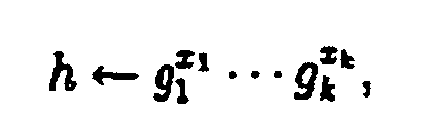
où g1 , ..., gk sont des nombres dans un groupe d'ordre q dans lequel il est impossible de calculer des logarithmes discrets ;un moyen de formation de réponse pour calculer une ou plusieurs réponses en réponse à un défi, lesdites réponses prouvant que ladite partie démonstratrice connaît une représentation d'un premier nombre relatif à un second vecteur de nombres, ledit premier nombre et chacun des nombres dans ledit second vecteur de nombres étant un produit de puissances de nombres dans l'ensemble, {h, g 1, ..., gk } et leurs inverses ; etun moyen de transmission pour transmettre à ladite partie vérificatrice des signaux représentatifs desdites réponses. - Appareil selon la revendication 1, dans lequel ladite formule est représentée par un système de l < k relations linéaires indépendantes,

où n(.) est une permutation de {1, ..., k}, et ledit premier nombre est
et ledit second vecteur de nombres est
- Appareil selon la revendication 1, dans lequel ladite formule est représentée par une inégalité linéaire,

où π(·) est une permutation de {1, ..., k}, et ledit premier nombre est gπ(1)' et ledit second vecteur de nombres est
- Appareil selon la revendication 1, dans lequel ladite formule est représentée par un système consistant en au moins une relation linéaire indépendante et exactement une inégalité linéaire,

où π(·) est une permutation de {1, ..., k}, et ∈ désigne un nombre de différence non nul dans Zq et ledit premier nombre est
et ledit second vecteur de nombres est
- Appareil selon l'une des revendications 2 à 4, dans lequel ladite formule est une sous-formule d'une formule plus grande, et ladite formule plus grande connecte ladite sous-formule au reste de ladite formule plus grande au moyen d'un connecteur logique "OR" ou "AND".
- Appareil selon la revendication 1, dans lequel ladite formule est représentée par "R 1 OR ... OR R1 " et chaque sous-formule Ri , pour 1 ≤ i ≤ l, connecte les relations linéaires par zéro ou d'autres connecteurs logiques "AND" et au plus un connecteur logique "NOT".
- Appareil selon la revendication 1, dans lequel ladite formule comporte au moins un connecteur logique "OR", ledit appareil comprenant en outre un moyen de simulation pour simuler, au moyen de défis auto-choisis et de réponses auto-choisies, que ladite partie démonstratrice connaît une représentation d'un second nombre relativement à un troisième vecteur de nombres.
- Appareil selon la revendication 1, dans lequel ladite formule est représentée par

où π(.) et ρ(.) sont des permutations de {1, ..., k}. - Appareil selon l'une quelconque des revendications 2 à 8, ledit appareil comprenant en outre :un moyen de génération de nombres aléatoires pour générer au moins un pseudo ou vrai nombre aléatoire dans Z q ; etun moyen de calcul de témoin initial pour calculer au moins un témoin initial dans ledit groupe.
- Appareil selon la revendication 9, ledit défi étant formé en appliquant une fonction de hachage unidirectionnelle au moins au résultat dudit moyen de calcul de témoin initial.
- Appareil selon la revendication 10, ladite fonction de hachage unidirectionnelle étant en outre appliquée à une description partielle de ladite formule.
- Appareil selon la revendication 10, ladite fonction de hachage unidirectionnelle étant en outre appliquée à une description qui identifie de manière unique ladite formule.
- Appareil selon la revendication 9, ledit appareil comprenant en outre un moyen de calcul de facteur de correction pour calculer au moins un facteur de correction dans Z q , et ledit moyen de transmission transmettant également à ladite partie vérificatrice des signaux représentatifs dudit au moins un facteur de correction.
- Appareil selon la revendication 1, ledit appareil comprenant en outre :un moyen de génération de nombres aléatoires pour générer au moins un pseudo ou vrai nombre aléatoire dans Z q ;un moyen de calcul de témoin initial pour calculer au moins un témoin initial dans ledit groupe ; etun moyen de calcul de facteur de correction pour calculer au moins un facteur de correction dans ZS q ,et ledit défi étant calculé en appliquant une fonction de hachage unidirectionnelle à au moins h, ledit témoin initial, la sortie dudit moyen de calcul de facteur de correction, et une description de ladite formule.
- Appareil selon la revendication 1, au moins ledit moyen de formation de réponse étant exploité par deux parties qui connaissant ledit premier vecteur de nombres ensemble mais pas individuellement.
- Appareil selon la revendication 2, ledit appareil comprenant en outre :un moyen de génération de nombres aléatoires pour générer k - l pseudos ou vrais nombres aléatoires, w 1, ..., wk-l , chacun dans Z q ; etun moyen de calcul de témoin initial pour calculer
 et ledit moyen de formation de réponse calculant lesdites réponses en fonction de ri ← cx π(i) + wi mod q 1 pour 1 ≤ i ≤ k -l, où c désigne ledit défi.
 - Appareil selon la revendication 2, ledit appareil comprenant en outre :un moyen de génération de nombres aléatoires pour générer au moins k - l + z pseudos ou vrais nombres aléatoires, chacun dans Z q , où 1 ≤ z ≤ l ;un moyen de calcul de témoin initial pour calculer un témoin initial, a, à partir desdits au moins k - l + z nombres aléatoires ; etun moyen de génération de facteur de correction pour calculer z facteurs de correction, chacun dans Z q .
- Appareil selon la revendication 2, ledit appareil comprenant en outre :un moyen de génération de nombres aléatoires pour générer k pseudos ou vrais nombres aléatoires, w 1, ..., wk chacun dans Zq ;un moyen de calcul de témoin initial pour calculer
 et un moyen de génération de facteur de correction pour calculer l facteurs de correction, e 1, ..., ei , selon
pour 1 ≤ j ≤ l. - Appareil selon la revendication 3, ledit appareil comprenant en outre :un moyen de génération de nombres aléatoires pour générer k pseudos ou vrais nombres aléatoires, w 1, ..., wk , chacun dans Zq ; etun moyen de calcul de témoin initial pour calculer
 et ledit moyen de formation de réponse calculant lesdites réponses en fonction de ri ← cδ + wi mod q et ri ← cx π(1) δ + wi mod q pour 2 ≤ i ≤ l, où δ est égal à
et c désigne ledit défi. - Appareil selon la revendication 4, ledit appareil comprenant en outre :un moyen de génération de nombres aléatoires pour générer k + 1 pseudos ou vrais nombres aléatoires, (w0 , ..., wk ), chacun dans Zq ;un moyen de calcul de témoin initial pour calculer

etun moyen de génération de facteur de correction pour calculer l + 1 facteurs de correction, e0 , ..., e1 , en fonction de e0 ← w0 etet ledit moyen de formation de réponse calculant ladite réponse en fonction de r0 ← cδ + w0 mod q et ri ← cx π(1) δ + w π(i) mod q pour 1 ≤ i ≤ k - l, où δ est égal à ∈-1 mod q et c désigne ledit défi.
- Appareil selon la revendication 8, ledit appareil comprenant en outre :un moyen de génération de nombres aléatoires pour générer k - 1 pseudos ou vrais nombres aléatoires, (w2 , ..., wk ), chacun dans Zq ;un moyen de calcul de témoin initial pour calculer
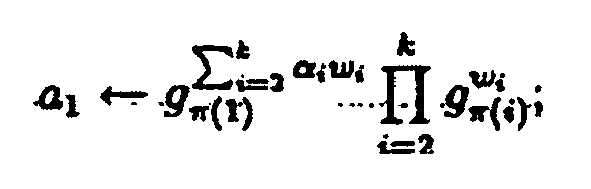 un moyen de simulation de défi pour générer un pseudo ou vrai défi auto-choisi aléatoire, c2 ;un moyen de simulation de réponse pour générer k - 1 pseudos ou vraies réponses auto-choisies aléatoires, s2 , ..., sk ; etun moyen de simulation de témoin initial pour calculer
 et ledit moyen de formation de réponse calculant lesdites réponses en fonction de ri ← c1x π(l) + wi mod q, pour 2 ≤ i ≤ k, où c 1 est déterminé de façon exclusive à partir dudit défit et de c 2.
 - Appareil permettant à une partie démonstratrice de démontrer à une partie vérificatrice une propriété d'un premier vecteur de nombres , (x 1, ..., xk ), lesdits nombres représentant des données détenues confidentiellement, sans en révéler plus à ladite partie vérificatrice au sujet dudit premier vecteur de nombres que la validité de ladite propriété, ladite propriété étant une formule qui est caractérisée en connectant des relations linéaires par un ou plusieurs connecteurs logiques, ledit appareil comprenant :un moyen de calcul pour calculer

où n est le produit d'au moins deux nombres premiers distincts, ν est un nombre entier, Y 1, ..., Yk sont des pseudos ou vrais nombres aléatoires d'un ordre sensiblement élevé dans le groupe
 un moyen de formation de réponse pour calculer une ou plusieurs réponses en réponse à un défi, lesdites réponses prouvant que ladite partie démonstratrice connaît une représentation d'un premier nombre relatif à un second vecteur de nombres, ledit premier nombre et tous les nombres, sauf v, dans ledit second vecteur de nombres étant un produit de puissances de nombres dans l'ensemble, {h, Y 1, ..., Yk } et leurs inverses ; etun moyen de transmission pour transmettre à ladite partie vérificatrice des signaux représentatifs desdites réponses.
 - Appareil selon la revendication 22, dans lequel ladite formule est représentée par un système de l < k relations linéaires indépendantes,

où π(.) est une permutation de { 1, ..., k}, et ledit premier nombre est
et ledit second vecteur de nombres est
- Appareil selon la revendication 22, dans lequel ladite formule est représentée par l'inégalité linéaire,

où π(.) est une permutation de { 1, ..., k}, et ledit premier nombre est Y π(1 ), et ledit second vecteur de nombres est
- Appareil selon la revendication 22, dans lequel ladite formule est représentée par un système consistant en au moins une relation linéaire indépendante et exactement une inégalité linéaire,

où π(.) est une permutation de {1, .. , k}, et ε désigne un nombre de différences non nul dans Z v et ledit premier nombre est
et ledit second vecteur de nombres est
- Appareil selon l'une des revendications 23 à 25, dans lequel ladite formule est une sous-formule d'une formule plus grande, et ladite formule plus grande connecte ladite sous-formule au reste de ladite formule plus grande au moyen d'un connecteur logique "OR" ou "AND.
- Appareil selon la revendication 22, dans lequel ladite formule est représentée par "R 1 OR ... OR R1 " et chaque sous-formule Ri , pour 1 ≤ i ≤ l, connecte les relations linéaires par zéro ou d'autres connecteurs logiques "AND" et au plus un connecteur logique "NOT".
- Appareil selon la revendication 22, dans lequel ladite formule comporte au moins un connecteur logique "OR", ledit appareil comprenant en outre un moyen de simulation pour simuler, au moyen de défis auto-choisis et de réponses auto-choisies, que ladite partie démonstratrice connaît une représentation d'un second nombre relativement à un troisième vecteur de nombres.
- Appareil selon la revendication 22, dans lequel ladite formule est représentée par

où π(.) et ρ(.) sont des permutations de { 1, ..., k}. - Appareil selon l'une quelconque des revendications 23 à 29, ledit appareil comprenant en outre :un moyen de génération de nombres aléatoires pour générer au moins un pseudo ou vrai nombre aléatoire dans Zv et un pseudo ou vrai nombre aléatoire dans
 un moyen de calcul de témoin initial pour calculer au moins un témoin initial dans
- Appareil selon la revendication 30, ledit défi étant formé en appliquant une fonction de hachage unidirectionnelle au moins au résultat dudit moyen de calcul de témoin initial.
- Appareil selon la revendication 31, ladite fonction de hachage unidirectionnelle étant en outre appliquée à une description partielle de ladite formule.
- Appareil selon la revendication 31, ladite fonction de hachage unidirectionnelle étant en outre appliquée à une description qui identifie de manière unique ladite formule.
- Appareil selon la revendication 30, ledit appareil comprenant en outre un moyen de calcul de facteur de correction pour calculer au moins un facteur de correction, et ledit moyen de transmission transmettant également à ladite partie vérificatrice des signaux représentatifs dudit au moins un facteur de correction.
- Appareil selon la revendication 34, ledit appareil comprenant en outre :un moyen de génération de nombres aléatoires pour générer au moins un pseudo ou vrai nombre aléatoire dans
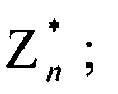 un moyen de calcul de témoin initial pour calculer au moins un témoin initial dans ledit groupe ; etun moyen de calcul de facteur de correction pour calculer au moins un facteur de correction dans Z v ,et ledit défi étant calculé en appliquant une fonction de hachage unidirectionnelle à au moins h, ledit témoin initial, la sortie dudit moyen de calcul de facteur de correction, et une description de ladite formule.
 - Appareil selon la revendication 22, au moins ledit moyen de formation de réponse étant exploité par deux parties qui connaissant ledit premier vecteur de nombres ensemble mais pas individuellement.
Applications Claiming Priority (3)
| Application Number | Priority Date | Filing Date | Title |
|---|---|---|---|
| NL1001568 | 1995-11-03 | ||
| NL1001568 | 1995-11-03 | ||
| PCT/NL1996/000413 WO1997016903A1 (fr) | 1995-11-03 | 1996-10-23 | Procedes cryptographiques permettant de demontrer des formules applicables a partir d'une logique de proposition |
Publications (2)
| Publication Number | Publication Date |
|---|---|
| EP0858701A1 EP0858701A1 (fr) | 1998-08-19 |
| EP0858701B1 true EP0858701B1 (fr) | 2012-07-04 |
Family
ID=19761802
Family Applications (1)
| Application Number | Title | Priority Date | Filing Date |
|---|---|---|---|
| EP96933663A Expired - Lifetime EP0858701B1 (fr) | 1995-11-03 | 1996-10-23 | Procedes cryptographiques permettant de demontrer des formules applicables a partir d'une logique de proposition |
Country Status (5)
| Country | Link |
|---|---|
| EP (1) | EP0858701B1 (fr) |
| JP (1) | JPH11514752A (fr) |
| AU (1) | AU724414B2 (fr) |
| CA (1) | CA2236544C (fr) |
| WO (1) | WO1997016903A1 (fr) |
Families Citing this family (1)
| Publication number | Priority date | Publication date | Assignee | Title |
|---|---|---|---|---|
| JP5606344B2 (ja) | 2011-01-25 | 2014-10-15 | 三菱電機株式会社 | 署名処理システム、鍵生成装置、署名装置、検証装置、署名処理方法及び署名処理プログラム |
Family Cites Families (3)
| Publication number | Priority date | Publication date | Assignee | Title |
|---|---|---|---|---|
| EP0383985A1 (fr) * | 1989-02-24 | 1990-08-29 | Claus Peter Prof. Dr. Schnorr | Procédé d'identification d'abonnées ainsi que de génération et de vérification de signatures électroniques dans un système d'échange de données |
| NL9301348A (nl) * | 1993-08-02 | 1995-03-01 | Stefanus Alfonsus Brands | Elektronisch betalingssysteem. |
| FR2714780B1 (fr) * | 1993-12-30 | 1996-01-26 | Stern Jacques | Procédé d'authentification d'au moins un dispositif d'identification par un dispositif de vérification. |
-
1996
- 1996-10-23 AU AU72298/96A patent/AU724414B2/en not_active Ceased
- 1996-10-23 CA CA002236544A patent/CA2236544C/fr not_active Expired - Fee Related
- 1996-10-23 JP JP9517238A patent/JPH11514752A/ja not_active Ceased
- 1996-10-23 WO PCT/NL1996/000413 patent/WO1997016903A1/fr not_active Ceased
- 1996-10-23 EP EP96933663A patent/EP0858701B1/fr not_active Expired - Lifetime
Also Published As
| Publication number | Publication date |
|---|---|
| AU724414B2 (en) | 2000-09-21 |
| AU7229896A (en) | 1997-05-22 |
| WO1997016903A1 (fr) | 1997-05-09 |
| EP0858701A1 (fr) | 1998-08-19 |
| CA2236544A1 (fr) | 1997-05-09 |
| CA2236544C (fr) | 2006-01-10 |
| JPH11514752A (ja) | 1999-12-14 |
Similar Documents
| Publication | Publication Date | Title |
|---|---|---|
| US5606617A (en) | Secret-key certificates | |
| Fiat et al. | How to prove yourself: Practical solutions to identification and signature problems | |
| Poupard et al. | Security analysis of a practical “on the fly” authentication and signature generation | |
| Neff | A verifiable secret shuffle and its application to e-voting | |
| US4947430A (en) | Undeniable signature systems | |
| AU592207B2 (en) | Method, apparatus and article for identification and signature | |
| US5493614A (en) | Private signature and proof systems | |
| CN102318260B (zh) | 密钥协商协议的加速 | |
| Pointcheval | Strengthened security for blind signatures | |
| Ogata et al. | The security of the FDH variant of Chaum's undeniable signature scheme | |
| Neff | Verifiable mixing (shuffling) of ElGamal pairs | |
| WO2002077929A2 (fr) | Melanges secrets verifiables et leur application au vote electronique | |
| JPH0863533A (ja) | 部分的に互換性のある準同形を使用する保安電子投票の方法および装置 | |
| Au et al. | Compact e-cash from bounded accumulator | |
| TW201320701A (zh) | 資訊處理裝置、資訊處理方法及程式 | |
| US6959085B1 (en) | Secure user identification based on ring homomorphisms | |
| US6320966B1 (en) | Cryptographic methods for demonstrating satisfiable formulas from propositional logic | |
| US6148084A (en) | Restrictedly blindable certificates on secret keys | |
| Blanton | Improved conditional e-payments | |
| CA2236544C (fr) | Procedes cryptographiques permettant de demontrer des formules applicables a partir d'une logique de proposition | |
| Guajardo et al. | Anonymous credential schemes with encrypted attributes | |
| EP4646814B1 (fr) | Procédé cryptographique pour mettre en évidence qu'un vecteur est binaire | |
| Lu | Smartbean: transparent, concretely efficient, polynomial commitment scheme with logarithmic verification and communication costs that runs on any group | |
| Wang et al. | The design of a novel e-cash system with the fairness property and its implementation in wireless communications | |
| GOLUMBEANU et al. | ELLIPTIC CURVES DIFFERENTIATION WITH APPLICATION TO GROUP SIGNATURE SCHEME. |
Legal Events
| Date | Code | Title | Description |
|---|---|---|---|
| PUAI | Public reference made under article 153(3) epc to a published international application that has entered the european phase |
Free format text: ORIGINAL CODE: 0009012 |
|
| 17P | Request for examination filed |
Effective date: 19980417 |
|
| AK | Designated contracting states |
Kind code of ref document: A1 Designated state(s): AT BE CH DE DK ES FI FR GB GR IE IT LI LU MC NL PT SE |
|
| 17Q | First examination report despatched |
Effective date: 20071113 |
|
| RAP1 | Party data changed (applicant data changed or rights of an application transferred) |
Owner name: BRANDS, STEFANUS ALFONSUS |
|
| RIN1 | Information on inventor provided before grant (corrected) |
Inventor name: BRANDS, STEFANUS ALFONSUS |
|
| RAP1 | Party data changed (applicant data changed or rights of an application transferred) |
Owner name: BRANDS, STEFANUS ALFONSUS |
|
| RIN1 | Information on inventor provided before grant (corrected) |
Inventor name: BRANDS, STEFANUS ALFONSUS |
|
| RAP1 | Party data changed (applicant data changed or rights of an application transferred) |
Owner name: MICROSOFT CORPORATION |
|
| RIN1 | Information on inventor provided before grant (corrected) |
Inventor name: BRANDS, STEFANUS ALFONSUS |
|
| GRAP | Despatch of communication of intention to grant a patent |
Free format text: ORIGINAL CODE: EPIDOSNIGR1 |
|
| GRAS | Grant fee paid |
Free format text: ORIGINAL CODE: EPIDOSNIGR3 |
|
| GRAA | (expected) grant |
Free format text: ORIGINAL CODE: 0009210 |
|
| AK | Designated contracting states |
Kind code of ref document: B1 Designated state(s): AT BE CH DE DK ES FI FR GB GR IE IT LI LU MC NL PT SE |
|
| REG | Reference to a national code |
Ref country code: GB Ref legal event code: FG4D |
|
| REG | Reference to a national code |
Ref country code: CH Ref legal event code: EP |
|
| REG | Reference to a national code |
Ref country code: AT Ref legal event code: REF Ref document number: 565497 Country of ref document: AT Kind code of ref document: T Effective date: 20120715 |
|
| REG | Reference to a national code |
Ref country code: IE Ref legal event code: FG4D |
|
| REG | Reference to a national code |
Ref country code: NL Ref legal event code: T3 |
|
| REG | Reference to a national code |
Ref country code: DE Ref legal event code: R096 Ref document number: 69638510 Country of ref document: DE Effective date: 20120823 |
|
| REG | Reference to a national code |
Ref country code: AT Ref legal event code: MK05 Ref document number: 565497 Country of ref document: AT Kind code of ref document: T Effective date: 20120704 |
|
| PG25 | Lapsed in a contracting state [announced via postgrant information from national office to epo] |
Ref country code: BE Free format text: LAPSE BECAUSE OF FAILURE TO SUBMIT A TRANSLATION OF THE DESCRIPTION OR TO PAY THE FEE WITHIN THE PRESCRIBED TIME-LIMIT Effective date: 20120704 Ref country code: FI Free format text: LAPSE BECAUSE OF FAILURE TO SUBMIT A TRANSLATION OF THE DESCRIPTION OR TO PAY THE FEE WITHIN THE PRESCRIBED TIME-LIMIT Effective date: 20120704 Ref country code: AT Free format text: LAPSE BECAUSE OF FAILURE TO SUBMIT A TRANSLATION OF THE DESCRIPTION OR TO PAY THE FEE WITHIN THE PRESCRIBED TIME-LIMIT Effective date: 20120704 |
|
| PG25 | Lapsed in a contracting state [announced via postgrant information from national office to epo] |
Ref country code: PT Free format text: LAPSE BECAUSE OF FAILURE TO SUBMIT A TRANSLATION OF THE DESCRIPTION OR TO PAY THE FEE WITHIN THE PRESCRIBED TIME-LIMIT Effective date: 20121105 Ref country code: SE Free format text: LAPSE BECAUSE OF FAILURE TO SUBMIT A TRANSLATION OF THE DESCRIPTION OR TO PAY THE FEE WITHIN THE PRESCRIBED TIME-LIMIT Effective date: 20120704 Ref country code: GR Free format text: LAPSE BECAUSE OF FAILURE TO SUBMIT A TRANSLATION OF THE DESCRIPTION OR TO PAY THE FEE WITHIN THE PRESCRIBED TIME-LIMIT Effective date: 20121005 |
|
| PG25 | Lapsed in a contracting state [announced via postgrant information from national office to epo] |
Ref country code: ES Free format text: LAPSE BECAUSE OF FAILURE TO SUBMIT A TRANSLATION OF THE DESCRIPTION OR TO PAY THE FEE WITHIN THE PRESCRIBED TIME-LIMIT Effective date: 20121015 Ref country code: DK Free format text: LAPSE BECAUSE OF FAILURE TO SUBMIT A TRANSLATION OF THE DESCRIPTION OR TO PAY THE FEE WITHIN THE PRESCRIBED TIME-LIMIT Effective date: 20120704 |
|
| PLBE | No opposition filed within time limit |
Free format text: ORIGINAL CODE: 0009261 |
|
| STAA | Information on the status of an ep patent application or granted ep patent |
Free format text: STATUS: NO OPPOSITION FILED WITHIN TIME LIMIT |
|
| REG | Reference to a national code |
Ref country code: NL Ref legal event code: V1 Effective date: 20130501 |
|
| PG25 | Lapsed in a contracting state [announced via postgrant information from national office to epo] |
Ref country code: IT Free format text: LAPSE BECAUSE OF FAILURE TO SUBMIT A TRANSLATION OF THE DESCRIPTION OR TO PAY THE FEE WITHIN THE PRESCRIBED TIME-LIMIT Effective date: 20120704 Ref country code: MC Free format text: LAPSE BECAUSE OF NON-PAYMENT OF DUE FEES Effective date: 20121031 |
|
| REG | Reference to a national code |
Ref country code: CH Ref legal event code: PL |
|
| 26N | No opposition filed |
Effective date: 20130405 |
|
| GBPC | Gb: european patent ceased through non-payment of renewal fee |
Effective date: 20121023 |
|
| REG | Reference to a national code |
Ref country code: IE Ref legal event code: MM4A |
|
| REG | Reference to a national code |
Ref country code: FR Ref legal event code: ST Effective date: 20130628 |
|
| PG25 | Lapsed in a contracting state [announced via postgrant information from national office to epo] |
Ref country code: IE Free format text: LAPSE BECAUSE OF NON-PAYMENT OF DUE FEES Effective date: 20121023 Ref country code: LI Free format text: LAPSE BECAUSE OF NON-PAYMENT OF DUE FEES Effective date: 20121031 Ref country code: GB Free format text: LAPSE BECAUSE OF NON-PAYMENT OF DUE FEES Effective date: 20121023 Ref country code: DE Free format text: LAPSE BECAUSE OF NON-PAYMENT OF DUE FEES Effective date: 20130501 Ref country code: CH Free format text: LAPSE BECAUSE OF NON-PAYMENT OF DUE FEES Effective date: 20121031 |
|
| REG | Reference to a national code |
Ref country code: DE Ref legal event code: R097 Ref document number: 69638510 Country of ref document: DE Effective date: 20130405 |
|
| REG | Reference to a national code |
Ref country code: DE Ref legal event code: R119 Ref document number: 69638510 Country of ref document: DE Effective date: 20130501 |
|
| PG25 | Lapsed in a contracting state [announced via postgrant information from national office to epo] |
Ref country code: NL Free format text: LAPSE BECAUSE OF NON-PAYMENT OF DUE FEES Effective date: 20130501 Ref country code: FR Free format text: LAPSE BECAUSE OF NON-PAYMENT OF DUE FEES Effective date: 20121031 |
|
| PG25 | Lapsed in a contracting state [announced via postgrant information from national office to epo] |
Ref country code: LU Free format text: LAPSE BECAUSE OF NON-PAYMENT OF DUE FEES Effective date: 20121023 |
|
| REG | Reference to a national code |
Ref country code: GB Ref legal event code: 732E Free format text: REGISTERED BETWEEN 20150312 AND 20150318 |