EP0859343A2 - Procédé et dispositif pour examiner des documents - Google Patents
Procédé et dispositif pour examiner des documents Download PDFInfo
- Publication number
- EP0859343A2 EP0859343A2 EP98300495A EP98300495A EP0859343A2 EP 0859343 A2 EP0859343 A2 EP 0859343A2 EP 98300495 A EP98300495 A EP 98300495A EP 98300495 A EP98300495 A EP 98300495A EP 0859343 A2 EP0859343 A2 EP 0859343A2
- Authority
- EP
- European Patent Office
- Prior art keywords
- document
- defect
- factors
- representing
- hole
- Prior art date
- Legal status (The legal status is an assumption and is not a legal conclusion. Google has not performed a legal analysis and makes no representation as to the accuracy of the status listed.)
- Withdrawn
Links
Images

Classifications
-
- G—PHYSICS
- G07—CHECKING-DEVICES
- G07D—HANDLING OF COINS OR VALUABLE PAPERS, e.g. TESTING, SORTING BY DENOMINATIONS, COUNTING, DISPENSING, CHANGING OR DEPOSITING
- G07D7/00—Testing specially adapted to determine the identity or genuineness of valuable papers or for segregating those which are unacceptable, e.g. banknotes that are alien to a currency
- G07D7/06—Testing specially adapted to determine the identity or genuineness of valuable papers or for segregating those which are unacceptable, e.g. banknotes that are alien to a currency using wave or particle radiation
- G07D7/12—Visible light, infrared or ultraviolet radiation
-
- G—PHYSICS
- G07—CHECKING-DEVICES
- G07D—HANDLING OF COINS OR VALUABLE PAPERS, e.g. TESTING, SORTING BY DENOMINATIONS, COUNTING, DISPENSING, CHANGING OR DEPOSITING
- G07D7/00—Testing specially adapted to determine the identity or genuineness of valuable papers or for segregating those which are unacceptable, e.g. banknotes that are alien to a currency
- G07D7/181—Testing mechanical properties or condition, e.g. wear or tear
- G07D7/185—Detecting holes or pores
Definitions
- This invention relates generally to a method and apparatus for screening documents, and has application to a method and apparatus for screening bank notes for defects to determine their suitability for dispensing by automated teller machines (ATMs).
- ATMs automated teller machines
- bank notes may acquire defects such as holes and tears and, as such defects accumulate, a point is reached when a note becomes unsuitable for dispensing to bank customers by an ATM. It is accordingly common practice to employ bank note screening apparatus to test bank notes for defects prior to loading into a storage cassette of an ATM for subsequent dispensing. Also some ATMs are equipped with screening devices which test deposited notes for suitability for further circulation.
- Known bank note screening systems such as that disclosed in US Patent No. 4,984,280, include a scanner, typically employing photoelectric detection of transmitted light, for determining the condition of a note.
- a disadvantage of known systems of this kind is that they do not specifically determine the suitability of bank notes for handling by the cash dispensing mechanism of an ATM.
- a method of screening documents comprising the steps of scanning a document to detect defects in the document and to provide data representing the significance of such defects, characterized by the steps of developing, from said data, factors representing the configuration of each defect, and computing, from the factors developed for each defect detected in the document, a damage index for the entire document on the basis of which a determination is made as to whether or not to reject the document.
- factors representing the configuration of each defect is meant two or more factors respectively representing the size, location, shape and orientation of each defect.
- a document screening apparatus comprising a defect detector, document feeding means adapted to present documents for screening to said defect detector, the defect detector being adapted to develop, for each document presented thereto, data representing the significance of defects in the document, characterized by data processing means arranged to derive, from said data, factors representing the configuration of each detected defect, and arranged, in response to the factors developed for each defect in the document, to compute a damage index for the document on the basis of which a determination is made as to whether or not to reject the document.
- defects in the form of holes in bank notes are detected.
- a method and apparatus in accordance with the invention can be used to detect other types of defects, such as tears, in documents.
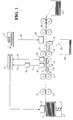
- bank notes 1 for screening are fed from an input hopper 2 to scanner feed rolls 3 by pick means 4 operated under the control of data processing means 5 to feed one note at a time to a scanner 6.
- the scanner 6 includes a support table 7 in which is formed a scanning slit 8 through which a light source 9, typically a linear fluorescent lamp, directs light on to a scanned note 1'.
- the scanner 6 also includes a linear detector 10 incorporating a charged coupled device (CCD) light detector arranged to receive light transmitted through the note 1' and to transmit on an output line 11 a pattern of signals representing the light transmitted by each of a number of pixel areas linearly located across the width of the note 1'.
- CCD charged coupled device
- a threshold circuit 12 to develop on an input line 13 a series of binary signals indicating whether a particular pixel corresponds to a hole in the note 1' or not.
- These binary signals are applied to the data processing means 5 wherein they are combined with note location signals received over a line 14 from note sensing means 15, positioned adjacent the note transport mechanism, to produce data locating each pixel two dimensionally on the scanned note 1'.
- This data is applied to an image processor 17, formed by further data processing means, which develops contour signals from the pixel data for each hole detected and computes shape, rotation, size and location factors for each hole.
- the image processor 17 computes a damage index for the entire note, this damage index being dependent on the shape, rotation, size and location of the or each hole detected during the scanning of the note, as will be explained in more detail later.
- the image processor 17 applies a signal to a line 18 if the computed damage index exceeds a predetermined threshold.
- a divert member 19 is positioned in the output path of the scanner 6 so as normally to allow scanned bank notes to pass along an accept path 20 to an accept hopper 21. However, when actuated by an associated actuator 22 the divert number 19 is moved into a position shown in chain outline in Fig. 1 in which it deflects the scanned note along a reject path 23 to a reject hopper 24.
- the actuator 22 is connected to operate under the control of signals on the line 18, and accordingly when a scanned note exhibits a damage index higher than the predetermined threshold it is deflected into the reject hopper 24.
- Fig. 2 shows in greater detail the operations performed in the image processor 17.
- the output from the threshold circuit 12 is processed by the data processing means 5 to produce a digital map of the scanned note.
- Data representing this digital map is applied to the image processor 17 which makes a computation at step 25 of the total number of holes detected. This computation involves analysing pixel arrays corresponding to holes. The following algorithm is applied:
- each hole identified in step 25 is examined in turn. First a simple count is made of the number of pixels associated with the hole being examined to provide a measure of the dimension (i.e. size) of the hole which is registered at step 27 as the dimension factor DF. Then, by a process of sampling of the individual pixels representing the hole, a location factor LF is developed representing the position of the hole on the note. This is registered at step 28.
- the periphery of each hole is identified by selecting those pixels which occur at the transition between pixels corresponding to hole free portions of the note and those corresponding to the hole.
- the centroid of the hole is located by averaging the x and y co-ordinate values of the pixels associated with the hole.
- contour signals are then developed which describe the shape of the contour by a series of signals representing the distance between the sampling points and the centroid of the contour at particular angles. These distances form a one dimensional function of angle as the angle goes from 0 to 360 degrees.
- the contour signals are stored and normalised and are then transformed at step 30 to produce a set of transform coefficients which represent the shape of the hole in a condensed form. For example, in known manner, by using a Fourier transform a shape description can be changed from a large number of amplitude values to a relatively small number of coefficients.
- the present embodiment of the invention in addition to providing for the application of a Fourier transform to produce coefficients at step 30, also takes advantage of certain properties of functions known as Wavelets to produce coefficients which, for some categories of defect, have been found to represent the shape more efficiently than coefficients developed using a Fourier transform.
- Wavelets The properties of Wavelets are described generally in the papers entitled “Wavelets and Dilation Equations: A Brief Introduction” by Gilbert Strang in SIAM Review, Vol. 31, No 4, pp 614 - 627, December 1989 and "Texture Classification and Segmentation using Wavelet Frames” by Michael Republic in IEEE Transactions on Image Processing, Vol. 4, No. 11, pp. 1549 - 1560, dated November 1995.
- shape factors are obtained which are independent of the size, orientation and positioning of the defects.
- step 30 a decision is made to use coefficients developed by a Fourier Transform or a Wavelet Transform. This process is described later.
- the selected coefficients are used at step 31 as the input to a neural network as described later to develop a shape factor which is registered at step 32. Also at step 31 the distance values developed at step 29 are compared with those of a reference shape using the process of convolution to derive a measure of the orientation of the hole. This measure is registered at step 33 as the rotation factor.
- DI i w i1 SF i + w i2 DF i + w i3 LF i + w i4 RF i
- the series of steps 26 to 33 is carried out for each detected hole in turn, and the damage index for that hole is then computed. For example, the damage index for the (i+1)th hole is computed at step 34(i+1), and the damage index for the (i+2)th hole is computed at step 34(i+2).
- GDI global damage index
- the dimension factor (DF) for each hole is directly proportional to the size of the hole.
- the factor DF is a measurement of the number of pixels for each hole.
- the location factor (LF) is relatively high for an edge defect, but is normally relatively low for an inner hole.
- LF location factor
- holes of different shape may be of the same size
- their shape factors may be different.
- an elongated hole is more likely to reduce the stiffness of a note than does a circular hole, particularly if it is near an edge of the note, and so is more likely to cause problems as regards transportation than a circular hole.
- the factor SF is higher for an elongated hole than for a circular hole. It should be understood that the factor SF is essentially independent of the size, rotation and positioning of a hole.
- the image processor 17 employs a pattern recognition approach for identifying each type of shape.
- the damage index (DI) for holes of a certain shape can vary significantly in dependence on the rotation of a hole with reference to the stored image of a hole of essentially the same shape.
- DI damage index
- Fig. 3 in which is shown a bank note 1" having two "C"-shaped holes 36 and 37 therein, the hole 36 for which the central tongue of paper is pointing in the direction of feed indicated by the arrow is more likely to interfere with the transport mechanism and to cause tearing of the note 1" than is the hole 37 which is rotated through 180° with reference to the hole 36.
- the rotation index (RI) is significantly higher for the hole 36 than for the hole 37.
- the image processor 17 there are stored digital images of various reference shapes corresponding to the shapes of holes likely to be found in a bank note.
- the stored shapes are used for determining the rotation factor (RF) for each hole.
- the stored shapes enable appropriate selection of a Fourier transform or a Wavelet transform at step 31.
- Holes in bank notes may be widely different shapes, ranging from neat circular holes with a clean sharp edge to a ragged hole with a very ill-defined edge.
- the Fourier transform is found to provide a more condensed set of coefficients to describe the shape of the hole and is generally more efficient, whereas for others the Wavelet transform is more efficient.
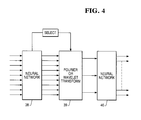
- the image processor 17 includes a neural network 38 connected to receive the distance values developed at step 29 and to pass these values for transformation at processing means 39 using a Fourier transform or a Wavelet transform according to the likely efficiency of the transform based on efficiencies previously calculated for reference holes and stored in the network 38.
- the neural network 38 makes a selection as to whether the processing means 39 will apply a Fourier transform or a Wavelet transform to the distance values applied to the processing means 39.
- the coefficients developed in the processing means 39 by the selected transform process are applied to a further neural network 40 which develops a shape factor, typically a value between 0 and 10, which represents the shape of the hole as determined by the neural network 40 after comparison with shapes stored therein from previously processed transformation results.
- the orientation of the hole in relation to that of its previously stored reference counterpart is measured angularly to obtain the rotation factor at step 33.
- This step is performed by rotating the hole image in relation to that of the reference hole to minimise the difference between the holes, using the mathematical operation of convolution.
- a rotation factor typically between 0 and 10 is assigned to the hole, the factor RF being dependent on the amount of rotation.
- OWT Overcomplete Haar Wavelet Transformation
Landscapes
- Physics & Mathematics (AREA)
- General Physics & Mathematics (AREA)
- Health & Medical Sciences (AREA)
- General Health & Medical Sciences (AREA)
- Toxicology (AREA)
- Image Analysis (AREA)
- Investigating Materials By The Use Of Optical Means Adapted For Particular Applications (AREA)
- Inspection Of Paper Currency And Valuable Securities (AREA)
- Image Processing (AREA)
- Financial Or Insurance-Related Operations Such As Payment And Settlement (AREA)
Applications Claiming Priority (2)
| Application Number | Priority Date | Filing Date | Title |
|---|---|---|---|
| GB9703191 | 1997-02-15 | ||
| GBGB9703191.8A GB9703191D0 (en) | 1997-02-15 | 1997-02-15 | Method and apparatus for screening documents |
Publications (2)
| Publication Number | Publication Date |
|---|---|
| EP0859343A2 true EP0859343A2 (fr) | 1998-08-19 |
| EP0859343A3 EP0859343A3 (fr) | 1999-01-27 |
Family
ID=10807755
Family Applications (1)
| Application Number | Title | Priority Date | Filing Date |
|---|---|---|---|
| EP98300495A Withdrawn EP0859343A3 (fr) | 1997-02-15 | 1998-01-26 | Procédé et dispositif pour examiner des documents |
Country Status (5)
| Country | Link |
|---|---|
| US (1) | US6236745B1 (fr) |
| EP (1) | EP0859343A3 (fr) |
| JP (1) | JPH10334224A (fr) |
| GB (1) | GB9703191D0 (fr) |
| ZA (1) | ZA98989B (fr) |
Cited By (3)
| Publication number | Priority date | Publication date | Assignee | Title |
|---|---|---|---|---|
| CN103377509A (zh) * | 2012-04-30 | 2013-10-30 | Ncr公司 | 缺损分类 |
| EP2153423B1 (fr) * | 2007-06-01 | 2018-09-26 | KBA-NotaSys SA | Authentification de documents de sécurité, en particulier de billets de banque |
| CN119269634A (zh) * | 2024-10-15 | 2025-01-07 | 江苏省特种设备安全监督检验研究院 | 一种基于超声相控阵的管道内检测系统及方法 |
Families Citing this family (11)
| Publication number | Priority date | Publication date | Assignee | Title |
|---|---|---|---|---|
| US6978036B2 (en) * | 1998-07-31 | 2005-12-20 | Digimarc Corporation | Tamper-resistant authentication techniques for identification documents |
| JP4180715B2 (ja) * | 1998-12-14 | 2008-11-12 | 株式会社東芝 | 印刷物の汚損度判別装置 |
| US7239424B1 (en) * | 2000-09-08 | 2007-07-03 | Ricoh Co., Ltd. | Wavelet-based image processing path |
| US7185388B2 (en) * | 2002-08-06 | 2007-03-06 | Harper Brush Works, Inc. | Power wave floor squeegee and handle connector |
| US6993185B2 (en) | 2002-08-30 | 2006-01-31 | Matsushita Electric Industrial Co., Ltd. | Method of texture-based color document segmentation |
| KR100751855B1 (ko) | 2006-03-13 | 2007-08-23 | 노틸러스효성 주식회사 | 웨이블렛 변환을 이용한 권종인식방법 |
| KR101276063B1 (ko) * | 2008-09-09 | 2013-06-14 | 삼성전자주식회사 | 화상형성장치, 화상형성시스템 및 그 제어방법 |
| US20120019841A1 (en) * | 2010-07-20 | 2012-01-26 | Schaertel David M | Document scanner |
| US20120019874A1 (en) * | 2010-07-20 | 2012-01-26 | Schaertel David M | Method for document scanning |
| US10371622B2 (en) | 2013-03-14 | 2019-08-06 | Inguran, Llc | Device for high throughput sperm sorting |
| US9336638B2 (en) * | 2014-03-25 | 2016-05-10 | Ncr Corporation | Media item validation |
Family Cites Families (19)
| Publication number | Priority date | Publication date | Assignee | Title |
|---|---|---|---|---|
| IT956011B (it) | 1972-05-31 | 1973-10-10 | S F A Soc Di Fisica Applicata | Selezionatrice automatica di banco note usate con dispositivi di indi viduazione falsi e con caselle di raccolta per le banconote selezio nate a seconda se false da inviare alla distruzione o da rimettere in circolazione |
| CH626460A5 (fr) * | 1978-12-01 | 1981-11-13 | Radioelectrique Comp Ind | |
| US4429991A (en) * | 1981-08-17 | 1984-02-07 | The Perkin-Elmer Corporation | Method for detecting physical anomalies of U.S. currency |
| JPS5882107A (ja) * | 1981-10-27 | 1983-05-17 | ドウ・ラ・リユ・システムズ・リミテイド | シ−トの状態を検出する方法及び装置 |
| GB2109923B (en) | 1981-11-13 | 1985-05-22 | De La Rue Syst | Optical scanner |
| JPH0614384B2 (ja) | 1987-04-13 | 1994-02-23 | ローレルバンクマシン株式会社 | 紙幣判別装置 |
| US4984280A (en) | 1988-06-08 | 1991-01-08 | Laurel Bank Machines Co., Ltd. | Bill discriminating apparatus |
| GB8916033D0 (en) * | 1989-07-13 | 1989-08-31 | De La Rue Syst | Sheet inspection apparatus |
| JP2789491B2 (ja) * | 1990-05-31 | 1998-08-20 | 株式会社リコー | 読取装置 |
| US5796410A (en) * | 1990-06-12 | 1998-08-18 | Lucent Technologies Inc. | Generation and use of defective images in image analysis |
| CH684222A5 (de) | 1992-03-10 | 1994-07-29 | Mars Inc | Einrichtung zur Klassifizierung eines Musters, insbesondere von einer Banknote oder von einer Münze. |
| FI95888C (fi) * | 1993-04-26 | 1996-04-10 | Valtion Teknillinen | Menetelmä painatuksen laadun valvomiseksi |
| US5729623A (en) * | 1993-10-18 | 1998-03-17 | Glory Kogyo Kabushiki Kaisha | Pattern recognition apparatus and method of optimizing mask for pattern recognition according to genetic algorithm |
| GB2284293B (en) | 1993-11-30 | 1998-06-03 | Mars Inc | Article classifying method and apparatus |
| EP0667594A3 (fr) * | 1994-02-14 | 1995-08-23 | International Business Machines Corporation | Appareil et méthode d'analyse de la qualité d'une image |
| US5692065A (en) * | 1994-08-18 | 1997-11-25 | International Business Machines Corporation | Apparatus and method for determining image quality |
| US5533144A (en) * | 1994-10-17 | 1996-07-02 | Xerox Corporation | Anti-counterfeit pattern detector and method |
| US5815198A (en) * | 1996-05-31 | 1998-09-29 | Vachtsevanos; George J. | Method and apparatus for analyzing an image to detect and identify defects |
| US5959290A (en) * | 1998-01-08 | 1999-09-28 | Xerox Corporation | Image input device and method for providing scanning artifact detection |
-
1997
- 1997-02-15 GB GBGB9703191.8A patent/GB9703191D0/en active Pending
- 1997-08-28 US US08/919,650 patent/US6236745B1/en not_active Expired - Lifetime
-
1998
- 1998-01-26 EP EP98300495A patent/EP0859343A3/fr not_active Withdrawn
- 1998-02-06 ZA ZA9800989A patent/ZA98989B/xx unknown
- 1998-02-12 JP JP2955798A patent/JPH10334224A/ja active Pending
Cited By (6)
| Publication number | Priority date | Publication date | Assignee | Title |
|---|---|---|---|---|
| EP2153423B1 (fr) * | 2007-06-01 | 2018-09-26 | KBA-NotaSys SA | Authentification de documents de sécurité, en particulier de billets de banque |
| CN103377509A (zh) * | 2012-04-30 | 2013-10-30 | Ncr公司 | 缺损分类 |
| EP2660787A1 (fr) * | 2012-04-30 | 2013-11-06 | NCR Corporation | Catégorisation de défaut dans une image digitale |
| US8983168B2 (en) | 2012-04-30 | 2015-03-17 | Ncr Corporation | System and method of categorising defects in a media item |
| CN103377509B (zh) * | 2012-04-30 | 2016-12-21 | Ncr公司 | 介质验证器和对缺损进行分类的方法 |
| CN119269634A (zh) * | 2024-10-15 | 2025-01-07 | 江苏省特种设备安全监督检验研究院 | 一种基于超声相控阵的管道内检测系统及方法 |
Also Published As
| Publication number | Publication date |
|---|---|
| GB9703191D0 (en) | 1997-04-02 |
| ZA98989B (en) | 1999-08-06 |
| US6236745B1 (en) | 2001-05-22 |
| JPH10334224A (ja) | 1998-12-18 |
| EP0859343A3 (fr) | 1999-01-27 |
Similar Documents
| Publication | Publication Date | Title |
|---|---|---|
| US6236745B1 (en) | Method and apparatus for screening documents | |
| US4464786A (en) | System for identifying currency note | |
| US6774986B2 (en) | Apparatus and method for correlating a suspect note deposited in an automated banking machine with the depositor | |
| JP4286790B2 (ja) | 紙葉類識別方法及び紙葉類識別装置 | |
| EP1519796B1 (fr) | Chronomarquage d'objets postaux par signature d'image et machine de tri postal associee | |
| Nölle et al. | Dagobert-A New Coin Recognition and Sorting System. | |
| EP2660787B1 (fr) | Catégorisation de défaut dans une image digitale | |
| CN1122244C (zh) | 纸币识别装置、以及认证文件的装置和方法 | |
| WO2017197884A1 (fr) | Procédé et système de gestion de billets de banque | |
| EP0766208A1 (fr) | Procédé et dispositif de balayage de billets de banque | |
| EP0067898A1 (fr) | Système d'identification de billets de banque | |
| WO2002033665A1 (fr) | Identification de coupure | |
| JP3366438B2 (ja) | 紙葉類の種類識別方法 | |
| JP2012064039A (ja) | 紙葉類処理装置、及び紙葉類処理方法 | |
| KR101001691B1 (ko) | 웨이블렛 변환을 이용한 권종인식방법 | |
| WO2009066297A2 (fr) | Procédé de vérification du contenu de liasses de papier-monnaie | |
| CN100517396C (zh) | 在检验货币中用于处理信号的方法和装置 | |
| US20070145118A1 (en) | Sheet processing method and sheet processing apparatus | |
| US20150117746A1 (en) | Defect categorization | |
| JP5976477B2 (ja) | 文字読取装置、及び紙葉類処理装置 | |
| JP2022099670A (ja) | 紙葉類処理装置、紙葉類処理方法及びプログラム | |
| JP3187698B2 (ja) | 紙葉類認識装置 | |
| JP2641079B2 (ja) | 紙幣判別装置 | |
| JP3583979B2 (ja) | 検査対象の種別判定方法 | |
| KR100602544B1 (ko) | 용지류 식별 방법 및 용지류 식별 장치 |
Legal Events
| Date | Code | Title | Description |
|---|---|---|---|
| PUAI | Public reference made under article 153(3) epc to a published international application that has entered the european phase |
Free format text: ORIGINAL CODE: 0009012 |
|
| AK | Designated contracting states |
Kind code of ref document: A2 Designated state(s): DE ES FR GB IT |
|
| PUAL | Search report despatched |
Free format text: ORIGINAL CODE: 0009013 |
|
| RIN1 | Information on inventor provided before grant (corrected) |
Inventor name: HEWIT, JAMES R. Inventor name: HAIBO CHEN |
|
| AK | Designated contracting states |
Kind code of ref document: A3 Designated state(s): AT BE CH DE DK ES FI FR GB GR IE IT LI LU MC NL PT SE |
|
| 17P | Request for examination filed |
Effective date: 19990727 |
|
| AKX | Designation fees paid |
Free format text: DE ES FR GB IT |
|
| 17Q | First examination report despatched |
Effective date: 20020102 |
|
| GRAH | Despatch of communication of intention to grant a patent |
Free format text: ORIGINAL CODE: EPIDOS IGRA |
|
| GRAH | Despatch of communication of intention to grant a patent |
Free format text: ORIGINAL CODE: EPIDOS IGRA |
|
| STAA | Information on the status of an ep patent application or granted ep patent |
Free format text: STATUS: THE APPLICATION IS DEEMED TO BE WITHDRAWN |
|
| 18D | Application deemed to be withdrawn |
Effective date: 20030801 |