EP0859376A2 - Polymer-Isolator - Google Patents
Polymer-Isolator Download PDFInfo
- Publication number
- EP0859376A2 EP0859376A2 EP98301061A EP98301061A EP0859376A2 EP 0859376 A2 EP0859376 A2 EP 0859376A2 EP 98301061 A EP98301061 A EP 98301061A EP 98301061 A EP98301061 A EP 98301061A EP 0859376 A2 EP0859376 A2 EP 0859376A2
- Authority
- EP
- European Patent Office
- Prior art keywords
- line side
- side portion
- rubber
- polymer insulator
- insulation overcoat
- Prior art date
- Legal status (The legal status is an assumption and is not a legal conclusion. Google has not performed a legal analysis and makes no representation as to the accuracy of the status listed.)
- Withdrawn
Links
Images


Classifications
-
- H—ELECTRICITY
- H01—ELECTRIC ELEMENTS
- H01B—CABLES; CONDUCTORS; INSULATORS; SELECTION OF MATERIALS FOR THEIR CONDUCTIVE, INSULATING OR DIELECTRIC PROPERTIES
- H01B17/00—Insulators or insulating bodies characterised by their form
- H01B17/32—Single insulators consisting of two or more dissimilar insulating bodies
- H01B17/325—Single insulators consisting of two or more dissimilar insulating bodies comprising a fibre-reinforced insulating core member
Definitions
- the present invention relates to a polymer insulator having an FRP rod, an insulation overcoat member made of rubber which is arranged on an outer surface of said FRP rod, and securing metal fittings which are secured and fixed to both ends of said FRP rod, and especially relates to a polymer insulator having a long life.
- Fig. 4 is a partial cross sectional view showing one embodiment of a known polymer insulator.
- a polymer insulator 51 comprises an FRP rod 52, an insulation overcoat member 53 made of rubber such as silicone rubber which is arranged on an outer surface of the FRP rod 52, and securing metal fittings 54 which are secured and fixed to both ends of the FRP rod 52.
- all the insulation overcoat member 53 is made of the same insulation overcoat member forming material and has a uniform thickness not only at a line side portion thereof to which a high stress of electric field is applied but also at an earth side portion thereof.
- An object of the invention is to eliminate the drawbacks mentioned above and to provide a polymer insulator which achieves a long life by reducing an influence of a high stress of electric field at a line side portion.
- a polymer insulator having an FRP rod, an insulation overcoat member made of rubber which is arranged on an outer surface of said FRP rod, and securing metal fittings which are secured and fixed to both ends of said FRP rod, comprises: a reinforcing portion which is arranged on a line side portion of said insulation overcoat member to which a high stress of electric field is applied.
- the reinforcing portion extends from the metal fitting at one end to at least the second shed along the insulator from that end, more preferably to the third shed.
- a polymer insulator having an FRP rod, an insulation overcoat member made of rubber which is arranged on an outer surface of said FRP rod, and securing metal fittings which are secured and fixed to both ends of said FRP rod comprises: a construction such that a line side portion of said insulation overcoat member, to which a high stress of electric field is applied, is made of a low temperature vulcanizing rubber.
- a polymer insulator having an FRP rod, an insulation overcoat member made of rubber which is arranged on an outer surface of said FRP rod, and securing metal fittings which are secured and fixed to both ends of said FRP rod comprises: a construction such that a line side portion of said insulation overcoat member, to which a high stress of electric field is applied, is made of a high elastic rubber.
- the reinforcing portion is arranged on the line side portion of the insulation overcoat member to which a high stress of electric field is applied during an actual use in which a power is applied to the polymer insulator. Therefore, an electric field stress enduring property can be improved and a stress of electric field can be reduced, so that it is possible to delay a crack generation at the line side portion. Moreover, even if a crack generates, a time interval till the thus generated crack reaches to the FRP rod can be increased, and a crack propagating speed can be reduced. As a result, it is possible to achieve a long life of the polymer insulator.
- the line side portion of the insulation overcoat member, to which a high stress of electric field is applied during an actual use in which a power is applied to the polymer insulator is made of a low temperature vulcanizing rubber. Therefore, since a temperature difference between a temperature of 60-80°C necessary for vulcanizing and a room temperature can be decreased, a shrinkage of rubber at the line side portion due to the temperature difference can be reduced and thus a residual stress is not liable to be generated at the line side portion.
- the line side portion of the insulation overcoat member, to which a high stress of electric field is applied during an actual use in which a power is applied to the polymer insulator is made of a high elastic rubber.
- the line side portion can be easily trace a rubber shrinkage due to a decrease of temperature from a high temperature of 170°C necessary for vulcanizing to a room temperature, and thus a residual stress is not liable to be generated at the line side portion.
- a crack is not liable to be generated at the line side portion of the insulation overcoat member, and thus it is possible to achieve a long life of the polymer insulator.
- the portion which is of the low temperature vulcanizing rubber, or is of the high electric rubber preferably extends from the end fitting to at least the second shed from the end, more preferably the third shed.
- the reason why a crack is generated at the line side portion of the insulation overcoat member is estimated as follows. That is to say, in a method of manufacturing the polymer insulator according to the invention, at first, the FRP rod is set in a metal mold, and silicone rubber for forming the insulation overcoat member is injected into a space between the FRP rod and the metal mold. Then, the metal mold is heated to a temperature of about 170°C to vulcanize silicone rubber, and after the vulcanization the metal mold is cooled from 170°C to a room temperature. During this cooling, a large temperature variation from 170°C to a room temperature is applied to the FRP rod and silicone rubber.
- the FRP rod is not shrunk so much in an axial direction, but silicone rubber is shrunk much in an axial direction. Since silicone rubber is firmly connected to the FRP rod by the vulcanization, silicone rubber does not trace such a shrinkage in silicone rubber, and thus a residual stress is generated in silicone rubber. In addition to the residual stress, a high stress of electric field due to a long term power supply is applied to the line side portion of the insulation overcoat member, and further the line side portion of the insulation overcoat member is exposed to severe conditions such that ultraviolet rays due to sun shine are applied thereto or a corona discharge after rain fall is also applied thereto.
- Any suitable elastomeric material may be used as the rubber employed in the invention.
- Fig. 1 is a partial cross sectional view showing one embodiment of a polymer insulator according to a first aspect of the invention.
- a polymer insulator 1 comprises an FRP rod 2, an insulation overcoat member 3 made of rubber such as silicone rubber which is arranged on an outer surface of the FRP rod 2, and securing metal fittings 4 which are secured and fixed to both ends of the FRP rod 2.
- the insulation overcoat member 3 is constructed by a sheath portion 5 and a plurality of sheds 6. These constructions are the same as those of the known polymer insulator.
- a different point from the known polymer insulator is that a reinforcing portion 11 is arranged on a line side portion of the insulation overcoat member 3.
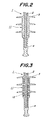
- Figs. 2 and 3 are cross sectional views respectively showing one detail construction of a line side of the polymer insulator according to the invention.
- the reinforcing portion 11 having various constructions is arranged on a specific line side portion of the insulation overcoat member 3 to which a high stress of electric field is applied.
- the reinforcing portion 11 is constructed in such a manner that a thickness of the line side portion is exclusively thicker than that of the sheath portion 5 of the insulation overcoat member 3 other than the line side portion. In this case, an electric field stress enduring property can be improved.
- the reinforcing portion 11 having a different thickness can be manufactured according to a known manufacturing method if a shape of the metal mold is varied correspondingly.
- the present applicant discloses a similar technique in Japanese Patent Laid-Open Publication No.7-272558 (JP-A-7-272558) in which a thickness of a specific part of the sheath portion in the insulation overcoat member 3 is made thicker than that of the other portion in the insulation overcoat member 3.
- JP-A-7-272558 since an end portion of the insulation overcoat member covers an end of the securing metal fitting, a flashover through the end portion of the insulation overcoat member which covers the end of the securing metal fitting is liable to be generated. Therefore, in order to improve a flashover enduring property, a thickness of the specific part of the sheath portion is made thicker.
- the technique disclosed in JP-A-7-272558 is thought to be similar with the present invention at first glance, but it is a fundamentally different technique as compared with the present invention.
- the reinforcing portion is constructed in such a manner that a reinforcing ring 12 is arranged exclusively on the line side portion of the insulation overcoat member 3.
- a reinforcing ring 12 use is made of a rubber ring made of the same silicone rubber as that of the insulation overcoat member 3 or an another kinds of rubbers, which functions to reduce an electric field stress, or a metal ring such as stainless steel which functions to not only reduce an electric field stress but also prevent an affection of ultraviolet rays.
- the reinforcing ring 12 can be constructed by a pair of divided ring pieces. In this case, the reinforcing ring 12 can be attached later on to the polymer insulator during in-use or the polymer insulator which is manufactured according to the known manufacturing method so as to form the reinforcing portion 11, and thus this construction is preferable.
- the reinforcing portion 11 is arranged exclusively on the line side portion of the insulation overcoat member 3.
- a portion to which the reinforcing portion 11 is arranged may be arbitrarily determined with respect to respective polymer insulators 1 corresponding to size, shape or the like of the polymer insulator 1.
- the portion to which the reinforcing portion 11 is arranged may be set in a range on the insulation overcoat member 3 defined from an end of the insulation overcoat member 3, to which the securing metal fitting 4 positioned at a line side is connected, to a second or a third shed 6 from this end.
- the reason why the reinforcing portion 11 is exclusively arranged on the line side portion of the insulation overcoat member 3 is that an electric field stress of the line side portion during a power supply condition in an actual use is extremely larger than that of an earth side portion of the insulation overcoat member 3, while an affection of ultraviolet rays is uniform at both of the line side portion and the earth side portion.
- the line side portion of the insulation overcoat member 3 (corresponding to the reinforcing portion 11 in Fig-1), to which a high stress of electric field is applied during a power supply condition in an actual use, is made of a low temperature vulcanizing rubber which is different from the other portion of the insulation overcoat member 3.
- a low temperature vulcanizing rubber use is made of a liquid type rubber of an addition polymerization type using platinum as a catalyst or a condensation polymerization type, or a Millable rubber.
- a portion of the insulation overcoat member 3 other than the line side portion is formed by vulcanizing a normal silicone rubber or the like at a high temperature. Then, the line side portion of the insulation overcoat member 3 is formed by vulcanizing a low temperature vulcanizing rubber at a room temperature or a temperature of 60-80°C. In this case, a residual stress in the line side portion becomes zero or an extremely smaller value than that of the insulation overcoat member 3 other than the line side portion. Therefore, it is possible to prevent a crack generation in the line side portion and to achieve a long life of the polymer insulator 1.
- the line side portion of the insulation overcoat member 3 (corresponding to the forcing portion 11 in Fig. 1), to which a high stress of electric field is applied during a power supply condition in an actual use, is made of a high elastic rubber.
- silicone rubber used for the polymer insulator includes silicone polymer, silica (SiO 2 ), filling agent (such as ATH) and so on.
- a high elastic rubber used in the third aspect of the invention is obtained by increasing an amount of silicone polymer in this normal silicone rubber.
- the polymer insulator 1 according to the third aspect of the invention can be obtained by first forming a portion of the insulation overcoat member 3 other than the line side portion by vulcanizing a normal silicone rubber of the like and secondly forming the line side portion of the insulation overcoat member 3 by vulcanizing a high elastic rubber. Also in this case, a residual stress is not liable to be generated in the line side portion of the insulation overcoat member 3, and thus a crack generation in the line side portion can be prevented. Therefore, it is possible to achieve a long life of the polymer insulator 1.
- the reinforcing portion is arranged on the line side portion of the insulation overcoat member, to which a high stress of electric field is applied during a power supply condition in an actual use (first aspect of the invention), it is possible to improve an electric field stress enduring property and to reduce an electric field stress.
- the line side portion is made of a low temperature vulcanizing rubber (second aspect of the invention) or a high elastic rubber (third aspect of the invention), it is possible to reduce a residual stress in the line side portion of the insulation overcoat member. Therefore, a crack generation in the line side portion of the insulation overcoat member can be delayed.
- a crack generates, a time interval till a crack reaches to the FRP rod can be increased, and thus it is possible to reduce a crack propagating speed. As a result, it is possible to achieve a long life of the polymer insulator.
Landscapes
- Insulators (AREA)
- Insulating Bodies (AREA)
Applications Claiming Priority (2)
| Application Number | Priority Date | Filing Date | Title |
|---|---|---|---|
| JP2868797A JPH10228826A (ja) | 1997-02-13 | 1997-02-13 | ポリマー碍子 |
| JP28687/97 | 1997-02-13 |
Publications (2)
| Publication Number | Publication Date |
|---|---|
| EP0859376A2 true EP0859376A2 (de) | 1998-08-19 |
| EP0859376A3 EP0859376A3 (de) | 1999-02-03 |
Family
ID=12255406
Family Applications (1)
| Application Number | Title | Priority Date | Filing Date |
|---|---|---|---|
| EP98301061A Withdrawn EP0859376A3 (de) | 1997-02-13 | 1998-02-13 | Polymer-Isolator |
Country Status (3)
| Country | Link |
|---|---|
| EP (1) | EP0859376A3 (de) |
| JP (1) | JPH10228826A (de) |
| CA (1) | CA2229363A1 (de) |
Cited By (2)
| Publication number | Priority date | Publication date | Assignee | Title |
|---|---|---|---|---|
| CN103680776A (zh) * | 2013-11-13 | 2014-03-26 | 国家电网公司 | 一种高压线路安全绝缘子 |
| CN111785420A (zh) * | 2020-05-29 | 2020-10-16 | 浙江元通线缆制造有限公司 | 一种高压硅橡胶软电缆及其加工工艺 |
Family Cites Families (2)
| Publication number | Priority date | Publication date | Assignee | Title |
|---|---|---|---|---|
| FR2657721B1 (fr) * | 1990-01-26 | 1992-05-15 | Dervaux Ets | Isolateur composite et son procede de fabrication. |
| JP2723468B2 (ja) * | 1994-03-28 | 1998-03-09 | 日本碍子株式会社 | ポリマー碍子 |
-
1997
- 1997-02-13 JP JP2868797A patent/JPH10228826A/ja not_active Withdrawn
-
1998
- 1998-02-12 CA CA 2229363 patent/CA2229363A1/en not_active Abandoned
- 1998-02-13 EP EP98301061A patent/EP0859376A3/de not_active Withdrawn
Cited By (3)
| Publication number | Priority date | Publication date | Assignee | Title |
|---|---|---|---|---|
| CN103680776A (zh) * | 2013-11-13 | 2014-03-26 | 国家电网公司 | 一种高压线路安全绝缘子 |
| CN103680776B (zh) * | 2013-11-13 | 2016-04-27 | 国家电网公司 | 一种高压线路安全绝缘子 |
| CN111785420A (zh) * | 2020-05-29 | 2020-10-16 | 浙江元通线缆制造有限公司 | 一种高压硅橡胶软电缆及其加工工艺 |
Also Published As
| Publication number | Publication date |
|---|---|
| JPH10228826A (ja) | 1998-08-25 |
| CA2229363A1 (en) | 1998-08-13 |
| EP0859376A3 (de) | 1999-02-03 |
Similar Documents
| Publication | Publication Date | Title |
|---|---|---|
| US4267403A (en) | Electric line insulator made of organic material and having an inner semi-conductive part extending between end anchor fittings | |
| US4312123A (en) | Methods of making high voltage electrical insulators and oil-less bushings | |
| US5291366A (en) | Surge voltage arrester | |
| CA2247925C (en) | Polymeric weathershed surge arrester and method | |
| GB2105528A (en) | Method of manufacturing a composite type stay insulator, and an insulator obtained by the method | |
| HU217760B (hu) | Túlfeszültség-levezető | |
| US6031186A (en) | Solid polymer insulators with eye and clevis ends | |
| EP0859376A2 (de) | Polymer-Isolator | |
| US6307157B1 (en) | Composite insulators and a process for producing the same | |
| CA1121474A (en) | High voltage electric insulators made of resins-bonded glass-fibers and organic material, and process for manufacturing same | |
| US5783128A (en) | Production of composite insulators | |
| US6472604B2 (en) | Seal construction of polymer insulator | |
| RU2107349C1 (ru) | Опорно-изоляционная конструкция | |
| US5011717A (en) | Explosion preventing porcelain hollow insulator | |
| EP0949638B1 (de) | Isolator für elektrische Übertragungs- und Verteilungsleitungen, mit verbessertem Wiederstand gehen Biegespannungen | |
| US6248270B1 (en) | Method for repairing a damaged shed portion of a composite insulator | |
| CN1197207A (zh) | 悬垂式绝缘子的可靠性评价方法 | |
| AU772038B2 (en) | A method of manufacturing a rod insulator | |
| GB2169677A (en) | An insulating reamer bolt | |
| US6004416A (en) | Shed-formed profile insulating covering and manufacturing method thereof | |
| JP3004803B2 (ja) | 光ファイバ複合碍子およびその製造方法 | |
| WO1992017889A1 (en) | Corrosion protected cap and pin insulator and method of making | |
| GB2170360A (en) | High voltage resistant members and method for producing same | |
| RU2107348C1 (ru) | Опорно-изоляционная конструкция | |
| Gorur et al. | Mechanical and electrical issues concerning the use of composite materials for the supporting core in transmission line conductors |
Legal Events
| Date | Code | Title | Description |
|---|---|---|---|
| PUAI | Public reference made under article 153(3) epc to a published international application that has entered the european phase |
Free format text: ORIGINAL CODE: 0009012 |
|
| AK | Designated contracting states |
Kind code of ref document: A2 Designated state(s): DE FR GB |
|
| AX | Request for extension of the european patent |
Free format text: AL;LT;LV;MK;RO;SI |
|
| PUAL | Search report despatched |
Free format text: ORIGINAL CODE: 0009013 |
|
| AK | Designated contracting states |
Kind code of ref document: A3 Designated state(s): AT BE CH DE DK ES FI FR GB GR IE IT LI LU MC NL PT SE |
|
| AX | Request for extension of the european patent |
Free format text: AL;LT;LV;MK;RO;SI |
|
| AKX | Designation fees paid |
Free format text: DE FR GB |
|
| STAA | Information on the status of an ep patent application or granted ep patent |
Free format text: STATUS: THE APPLICATION IS DEEMED TO BE WITHDRAWN |
|
| 18D | Application deemed to be withdrawn |
Effective date: 19990804 |