EP0859653B1 - Procede pour faire reagir chimiquement des substances dans une colonne de reaction - Google Patents
Procede pour faire reagir chimiquement des substances dans une colonne de reaction Download PDFInfo
- Publication number
- EP0859653B1 EP0859653B1 EP96945840A EP96945840A EP0859653B1 EP 0859653 B1 EP0859653 B1 EP 0859653B1 EP 96945840 A EP96945840 A EP 96945840A EP 96945840 A EP96945840 A EP 96945840A EP 0859653 B1 EP0859653 B1 EP 0859653B1
- Authority
- EP
- European Patent Office
- Prior art keywords
- reaction
- process according
- stripping gas
- separated
- reaction column
- Prior art date
- Legal status (The legal status is an assumption and is not a legal conclusion. Google has not performed a legal analysis and makes no representation as to the accuracy of the status listed.)
- Expired - Lifetime
Links
- 238000006243 chemical reaction Methods 0.000 title claims description 93
- 238000000034 method Methods 0.000 title claims description 42
- 239000000126 substance Substances 0.000 title claims description 31
- 239000007789 gas Substances 0.000 claims description 81
- 239000003054 catalyst Substances 0.000 claims description 27
- 230000008569 process Effects 0.000 claims description 26
- VLKZOEOYAKHREP-UHFFFAOYSA-N n-Hexane Chemical compound CCCCCC VLKZOEOYAKHREP-UHFFFAOYSA-N 0.000 claims description 24
- 239000007788 liquid Substances 0.000 claims description 18
- UHOVQNZJYSORNB-UHFFFAOYSA-N Benzene Chemical compound C1=CC=CC=C1 UHOVQNZJYSORNB-UHFFFAOYSA-N 0.000 claims description 15
- 229910052739 hydrogen Inorganic materials 0.000 claims description 14
- -1 C22 alcohols Chemical class 0.000 claims description 13
- 238000005886 esterification reaction Methods 0.000 claims description 13
- YXFVVABEGXRONW-UHFFFAOYSA-N Toluene Chemical compound CC1=CC=CC=C1 YXFVVABEGXRONW-UHFFFAOYSA-N 0.000 claims description 12
- 239000001257 hydrogen Substances 0.000 claims description 12
- UFHFLCQGNIYNRP-UHFFFAOYSA-N Hydrogen Chemical compound [H][H] UFHFLCQGNIYNRP-UHFFFAOYSA-N 0.000 claims description 11
- 230000032050 esterification Effects 0.000 claims description 11
- 230000002378 acidificating effect Effects 0.000 claims description 8
- 150000001733 carboxylic acid esters Chemical class 0.000 claims description 7
- 239000003795 chemical substances by application Substances 0.000 claims description 6
- 239000000203 mixture Substances 0.000 claims description 5
- 239000011949 solid catalyst Substances 0.000 claims description 5
- 239000002253 acid Substances 0.000 claims description 4
- 150000001735 carboxylic acids Chemical class 0.000 claims description 4
- 239000011541 reaction mixture Substances 0.000 claims description 4
- 239000007787 solid Substances 0.000 claims description 4
- 150000001298 alcohols Chemical class 0.000 claims description 3
- 229930195733 hydrocarbon Natural products 0.000 claims description 2
- 150000002430 hydrocarbons Chemical class 0.000 claims description 2
- 125000003158 alcohol group Chemical group 0.000 claims 1
- 239000007859 condensation product Substances 0.000 claims 1
- 238000006482 condensation reaction Methods 0.000 claims 1
- 238000005984 hydrogenation reaction Methods 0.000 claims 1
- 238000006317 isomerization reaction Methods 0.000 claims 1
- XLYOFNOQVPJJNP-UHFFFAOYSA-N water Substances O XLYOFNOQVPJJNP-UHFFFAOYSA-N 0.000 description 27
- 239000000376 reactant Substances 0.000 description 21
- 239000000047 product Substances 0.000 description 20
- IJGRMHOSHXDMSA-UHFFFAOYSA-N Atomic nitrogen Chemical compound N#N IJGRMHOSHXDMSA-UHFFFAOYSA-N 0.000 description 17
- 235000014113 dietary fatty acids Nutrition 0.000 description 17
- 229930195729 fatty acid Natural products 0.000 description 17
- 239000000194 fatty acid Substances 0.000 description 17
- 238000002474 experimental method Methods 0.000 description 14
- 150000004665 fatty acids Chemical class 0.000 description 13
- 239000007791 liquid phase Substances 0.000 description 11
- 238000009835 boiling Methods 0.000 description 10
- 229910052757 nitrogen Inorganic materials 0.000 description 8
- 150000002191 fatty alcohols Chemical class 0.000 description 7
- 239000000463 material Substances 0.000 description 7
- LFQSCWFLJHTTHZ-UHFFFAOYSA-N Ethanol Chemical compound CCO LFQSCWFLJHTTHZ-UHFFFAOYSA-N 0.000 description 6
- 239000004744 fabric Substances 0.000 description 5
- 238000000926 separation method Methods 0.000 description 5
- 230000000694 effects Effects 0.000 description 4
- 230000035484 reaction time Effects 0.000 description 4
- 238000000066 reactive distillation Methods 0.000 description 4
- OKKJLVBELUTLKV-UHFFFAOYSA-N Methanol Chemical compound OC OKKJLVBELUTLKV-UHFFFAOYSA-N 0.000 description 3
- MLIREBYILWEBDM-UHFFFAOYSA-N cyanoacetic acid Chemical compound OC(=O)CC#N MLIREBYILWEBDM-UHFFFAOYSA-N 0.000 description 3
- 238000005755 formation reaction Methods 0.000 description 3
- 238000004519 manufacturing process Methods 0.000 description 3
- 239000000546 pharmaceutical excipient Substances 0.000 description 3
- 239000007858 starting material Substances 0.000 description 3
- 238000012360 testing method Methods 0.000 description 3
- 230000007306 turnover Effects 0.000 description 3
- 238000011144 upstream manufacturing Methods 0.000 description 3
- 238000009834 vaporization Methods 0.000 description 3
- 230000008016 vaporization Effects 0.000 description 3
- CSCPPACGZOOCGX-UHFFFAOYSA-N Acetone Chemical compound CC(C)=O CSCPPACGZOOCGX-UHFFFAOYSA-N 0.000 description 2
- 238000006000 Knoevenagel condensation reaction Methods 0.000 description 2
- OFOBLEOULBTSOW-UHFFFAOYSA-N Malonic acid Chemical compound OC(=O)CC(O)=O OFOBLEOULBTSOW-UHFFFAOYSA-N 0.000 description 2
- LRHPLDYGYMQRHN-UHFFFAOYSA-N N-Butanol Chemical compound CCCCO LRHPLDYGYMQRHN-UHFFFAOYSA-N 0.000 description 2
- 150000007513 acids Chemical class 0.000 description 2
- 150000001299 aldehydes Chemical class 0.000 description 2
- 238000005882 aldol condensation reaction Methods 0.000 description 2
- 229910052784 alkaline earth metal Inorganic materials 0.000 description 2
- 230000008901 benefit Effects 0.000 description 2
- HUMNYLRZRPPJDN-UHFFFAOYSA-N benzaldehyde Chemical compound O=CC1=CC=CC=C1 HUMNYLRZRPPJDN-UHFFFAOYSA-N 0.000 description 2
- 230000015572 biosynthetic process Effects 0.000 description 2
- IISBACLAFKSPIT-UHFFFAOYSA-N bisphenol A Chemical compound C=1C=C(O)C=CC=1C(C)(C)C1=CC=C(O)C=C1 IISBACLAFKSPIT-UHFFFAOYSA-N 0.000 description 2
- 239000007795 chemical reaction product Substances 0.000 description 2
- 238000009833 condensation Methods 0.000 description 2
- 230000005494 condensation Effects 0.000 description 2
- 230000007423 decrease Effects 0.000 description 2
- 150000002081 enamines Chemical class 0.000 description 2
- 150000002148 esters Chemical class 0.000 description 2
- 238000001704 evaporation Methods 0.000 description 2
- 230000008020 evaporation Effects 0.000 description 2
- 230000002349 favourable effect Effects 0.000 description 2
- 238000011049 filling Methods 0.000 description 2
- FUZZWVXGSFPDMH-UHFFFAOYSA-N hexanoic acid Chemical compound CCCCCC(O)=O FUZZWVXGSFPDMH-UHFFFAOYSA-N 0.000 description 2
- KQNPFQTWMSNSAP-UHFFFAOYSA-N isobutyric acid Chemical compound CC(C)C(O)=O KQNPFQTWMSNSAP-UHFFFAOYSA-N 0.000 description 2
- 150000002576 ketones Chemical class 0.000 description 2
- 238000011068 loading method Methods 0.000 description 2
- 238000012856 packing Methods 0.000 description 2
- 239000012071 phase Substances 0.000 description 2
- 230000004044 response Effects 0.000 description 2
- 238000003786 synthesis reaction Methods 0.000 description 2
- LBLYYCQCTBFVLH-UHFFFAOYSA-N 2-Methylbenzenesulfonic acid Chemical compound CC1=CC=CC=C1S(O)(=O)=O LBLYYCQCTBFVLH-UHFFFAOYSA-N 0.000 description 1
- IYXGSMUGOJNHAZ-UHFFFAOYSA-N Ethyl malonate Chemical compound CCOC(=O)CC(=O)OCC IYXGSMUGOJNHAZ-UHFFFAOYSA-N 0.000 description 1
- ISWSIDIOOBJBQZ-UHFFFAOYSA-N Phenol Chemical compound OC1=CC=CC=C1 ISWSIDIOOBJBQZ-UHFFFAOYSA-N 0.000 description 1
- 239000003377 acid catalyst Substances 0.000 description 1
- 230000002411 adverse Effects 0.000 description 1
- 238000005575 aldol reaction Methods 0.000 description 1
- 239000003513 alkali Substances 0.000 description 1
- 150000001342 alkaline earth metals Chemical class 0.000 description 1
- 150000001408 amides Chemical class 0.000 description 1
- 150000001412 amines Chemical class 0.000 description 1
- 239000006079 antiknock agent Substances 0.000 description 1
- 239000012752 auxiliary agent Substances 0.000 description 1
- 239000002585 base Substances 0.000 description 1
- 229940106691 bisphenol a Drugs 0.000 description 1
- 239000001273 butane Substances 0.000 description 1
- 239000006227 byproduct Substances 0.000 description 1
- 239000003990 capacitor Substances 0.000 description 1
- 150000004649 carbonic acid derivatives Chemical class 0.000 description 1
- 150000001728 carbonyl compounds Chemical class 0.000 description 1
- 150000003857 carboxamides Chemical class 0.000 description 1
- 150000001732 carboxylic acid derivatives Chemical class 0.000 description 1
- 230000003197 catalytic effect Effects 0.000 description 1
- 230000000295 complement effect Effects 0.000 description 1
- 239000002537 cosmetic Substances 0.000 description 1
- 230000008878 coupling Effects 0.000 description 1
- 238000010168 coupling process Methods 0.000 description 1
- 238000005859 coupling reaction Methods 0.000 description 1
- 230000003247 decreasing effect Effects 0.000 description 1
- 239000003599 detergent Substances 0.000 description 1
- VUWPIBNKJSEYIN-UHFFFAOYSA-N diethyl 2-benzylidenepropanedioate Chemical compound CCOC(=O)C(C(=O)OCC)=CC1=CC=CC=C1 VUWPIBNKJSEYIN-UHFFFAOYSA-N 0.000 description 1
- 238000004821 distillation Methods 0.000 description 1
- 238000011143 downstream manufacturing Methods 0.000 description 1
- 239000003814 drug Substances 0.000 description 1
- 238000001035 drying Methods 0.000 description 1
- 230000008030 elimination Effects 0.000 description 1
- 238000003379 elimination reaction Methods 0.000 description 1
- 150000002170 ethers Chemical class 0.000 description 1
- XYIBRDXRRQCHLP-UHFFFAOYSA-N ethyl acetoacetate Chemical compound CCOC(=O)CC(C)=O XYIBRDXRRQCHLP-UHFFFAOYSA-N 0.000 description 1
- 125000004494 ethyl ester group Chemical group 0.000 description 1
- 239000000446 fuel Substances 0.000 description 1
- 230000005484 gravity Effects 0.000 description 1
- 125000000623 heterocyclic group Chemical group 0.000 description 1
- VJPSWMOFFDCCDZ-UHFFFAOYSA-N hexane;phenylmethanamine Chemical compound CCCCCC.NCC1=CC=CC=C1 VJPSWMOFFDCCDZ-UHFFFAOYSA-N 0.000 description 1
- 150000002431 hydrogen Chemical class 0.000 description 1
- 239000000543 intermediate Substances 0.000 description 1
- 239000013067 intermediate product Substances 0.000 description 1
- 238000009533 lab test Methods 0.000 description 1
- 125000000325 methylidene group Chemical group [H]C([H])=* 0.000 description 1
- IJDNQMDRQITEOD-UHFFFAOYSA-N n-butane Chemical compound CCCC IJDNQMDRQITEOD-UHFFFAOYSA-N 0.000 description 1
- OFBQJSOFQDEBGM-UHFFFAOYSA-N n-pentane Natural products CCCCC OFBQJSOFQDEBGM-UHFFFAOYSA-N 0.000 description 1
- QNGNSVIICDLXHT-UHFFFAOYSA-N para-ethylbenzaldehyde Natural products CCC1=CC=C(C=O)C=C1 QNGNSVIICDLXHT-UHFFFAOYSA-N 0.000 description 1
- IUGYQRQAERSCNH-UHFFFAOYSA-N pivalic acid Chemical compound CC(C)(C)C(O)=O IUGYQRQAERSCNH-UHFFFAOYSA-N 0.000 description 1
- 238000002360 preparation method Methods 0.000 description 1
- 238000004886 process control Methods 0.000 description 1
- 230000001737 promoting effect Effects 0.000 description 1
- 230000036632 reaction speed Effects 0.000 description 1
- SMQUZDBALVYZAC-UHFFFAOYSA-N salicylaldehyde Chemical class OC1=CC=CC=C1C=O SMQUZDBALVYZAC-UHFFFAOYSA-N 0.000 description 1
- 150000003335 secondary amines Chemical class 0.000 description 1
- 238000007086 side reaction Methods 0.000 description 1
- 239000011973 solid acid Substances 0.000 description 1
- 238000012619 stoichiometric conversion Methods 0.000 description 1
- 239000000725 suspension Substances 0.000 description 1
- 238000005809 transesterification reaction Methods 0.000 description 1
- 238000012546 transfer Methods 0.000 description 1
- 239000012808 vapor phase Substances 0.000 description 1
Images
Classifications
-
- B—PERFORMING OPERATIONS; TRANSPORTING
- B01—PHYSICAL OR CHEMICAL PROCESSES OR APPARATUS IN GENERAL
- B01D—SEPARATION
- B01D3/00—Distillation or related exchange processes in which liquids are contacted with gaseous media, e.g. stripping
- B01D3/34—Distillation or related exchange processes in which liquids are contacted with gaseous media, e.g. stripping with one or more auxiliary substances
-
- B—PERFORMING OPERATIONS; TRANSPORTING
- B01—PHYSICAL OR CHEMICAL PROCESSES OR APPARATUS IN GENERAL
- B01D—SEPARATION
- B01D3/00—Distillation or related exchange processes in which liquids are contacted with gaseous media, e.g. stripping
- B01D3/009—Distillation or related exchange processes in which liquids are contacted with gaseous media, e.g. stripping in combination with chemical reactions
-
- B—PERFORMING OPERATIONS; TRANSPORTING
- B01—PHYSICAL OR CHEMICAL PROCESSES OR APPARATUS IN GENERAL
- B01J—CHEMICAL OR PHYSICAL PROCESSES, e.g. CATALYSIS OR COLLOID CHEMISTRY; THEIR RELEVANT APPARATUS
- B01J8/00—Chemical or physical processes in general, conducted in the presence of fluids and solid particles; Apparatus for such processes
- B01J8/02—Chemical or physical processes in general, conducted in the presence of fluids and solid particles; Apparatus for such processes with stationary particles, e.g. in fixed beds
-
- B—PERFORMING OPERATIONS; TRANSPORTING
- B01—PHYSICAL OR CHEMICAL PROCESSES OR APPARATUS IN GENERAL
- B01J—CHEMICAL OR PHYSICAL PROCESSES, e.g. CATALYSIS OR COLLOID CHEMISTRY; THEIR RELEVANT APPARATUS
- B01J8/00—Chemical or physical processes in general, conducted in the presence of fluids and solid particles; Apparatus for such processes
- B01J8/02—Chemical or physical processes in general, conducted in the presence of fluids and solid particles; Apparatus for such processes with stationary particles, e.g. in fixed beds
- B01J8/04—Chemical or physical processes in general, conducted in the presence of fluids and solid particles; Apparatus for such processes with stationary particles, e.g. in fixed beds the fluid passing successively through two or more beds
- B01J8/0446—Chemical or physical processes in general, conducted in the presence of fluids and solid particles; Apparatus for such processes with stationary particles, e.g. in fixed beds the fluid passing successively through two or more beds the flow within the beds being predominantly vertical
- B01J8/0449—Chemical or physical processes in general, conducted in the presence of fluids and solid particles; Apparatus for such processes with stationary particles, e.g. in fixed beds the fluid passing successively through two or more beds the flow within the beds being predominantly vertical in two or more cylindrical beds
- B01J8/0453—Chemical or physical processes in general, conducted in the presence of fluids and solid particles; Apparatus for such processes with stationary particles, e.g. in fixed beds the fluid passing successively through two or more beds the flow within the beds being predominantly vertical in two or more cylindrical beds the beds being superimposed one above the other
-
- C—CHEMISTRY; METALLURGY
- C07—ORGANIC CHEMISTRY
- C07C—ACYCLIC OR CARBOCYCLIC COMPOUNDS
- C07C45/00—Preparation of compounds having >C = O groups bound only to carbon or hydrogen atoms; Preparation of chelates of such compounds
- C07C45/61—Preparation of compounds having >C = O groups bound only to carbon or hydrogen atoms; Preparation of chelates of such compounds by reactions not involving the formation of >C = O groups
- C07C45/67—Preparation of compounds having >C = O groups bound only to carbon or hydrogen atoms; Preparation of chelates of such compounds by reactions not involving the formation of >C = O groups by isomerisation; by change of size of the carbon skeleton
- C07C45/68—Preparation of compounds having >C = O groups bound only to carbon or hydrogen atoms; Preparation of chelates of such compounds by reactions not involving the formation of >C = O groups by isomerisation; by change of size of the carbon skeleton by increase in the number of carbon atoms
- C07C45/72—Preparation of compounds having >C = O groups bound only to carbon or hydrogen atoms; Preparation of chelates of such compounds by reactions not involving the formation of >C = O groups by isomerisation; by change of size of the carbon skeleton by increase in the number of carbon atoms by reaction of compounds containing >C = O groups with the same or other compounds containing >C = O groups
- C07C45/74—Preparation of compounds having >C = O groups bound only to carbon or hydrogen atoms; Preparation of chelates of such compounds by reactions not involving the formation of >C = O groups by isomerisation; by change of size of the carbon skeleton by increase in the number of carbon atoms by reaction of compounds containing >C = O groups with the same or other compounds containing >C = O groups combined with dehydration
-
- C—CHEMISTRY; METALLURGY
- C07—ORGANIC CHEMISTRY
- C07C—ACYCLIC OR CARBOCYCLIC COMPOUNDS
- C07C67/00—Preparation of carboxylic acid esters
- C07C67/03—Preparation of carboxylic acid esters by reacting an ester group with a hydroxy group
-
- C—CHEMISTRY; METALLURGY
- C07—ORGANIC CHEMISTRY
- C07C—ACYCLIC OR CARBOCYCLIC COMPOUNDS
- C07C67/00—Preparation of carboxylic acid esters
- C07C67/08—Preparation of carboxylic acid esters by reacting carboxylic acids or symmetrical anhydrides with the hydroxy or O-metal group of organic compounds
-
- Y—GENERAL TAGGING OF NEW TECHNOLOGICAL DEVELOPMENTS; GENERAL TAGGING OF CROSS-SECTIONAL TECHNOLOGIES SPANNING OVER SEVERAL SECTIONS OF THE IPC; TECHNICAL SUBJECTS COVERED BY FORMER USPC CROSS-REFERENCE ART COLLECTIONS [XRACs] AND DIGESTS
- Y02—TECHNOLOGIES OR APPLICATIONS FOR MITIGATION OR ADAPTATION AGAINST CLIMATE CHANGE
- Y02P—CLIMATE CHANGE MITIGATION TECHNOLOGIES IN THE PRODUCTION OR PROCESSING OF GOODS
- Y02P20/00—Technologies relating to chemical industry
- Y02P20/10—Process efficiency
Definitions
- the invention relates to a process in a chemical reaction column Implementation of substances whose reaction is due to an unfavorable equilibrium Formation reaction or an upstream equilibrium is limited, during the Implementation by one or more auxiliaries continuously one or more substances to be removed are removed from the reaction mixture.
- the separation of the water of reaction is always caused by a reactant, which usually has to be supplied in large excess.
- the temperature required for the separation is therefore necessarily the same or greater than the boiling temperature of the reactants under the given pressure conditions.
- the reactants in this case are the excipient and another substance, whereby in the case the esterification of the alcohol, whom it is used in excess, at the same time as Reactant for the esterification reaction and as an auxiliary for removing the Water of reaction is used.
- Use ratio of the reactants must be determined.
- a well known embodiment of the prior art is the one stage guided esterification with the aid of an entrainer using the Azeotrope formation, see e.g. Organikum, VEB German Publishing House of Sciences, Berlin 1977, pp. 71-73.
- processes for the preparation of esters from carboxylic acids and Alcohols with continuous removal of the condensation water with entraining agents such as benzene, methanol and butyl alcohol in a column are from DE 976 413-B known.
- butane is used as an entrainer.
- WO 94/19079 describes a process for the production of Bisphenol-A from acetone and phenol with elimination of water disclosed.
- the water of reaction formed is by a internal stripping gas discharged.
- WO 94/19079 uses a reactor that contains a liquid Catalyst or a particulate catalyst in Suspension and bottoms in the reactor itself, downcomers and / or containment sieves.
- the invention has for its object to provide a method for Equilibrium fractions favorably influence sales and especially one formed substance to be separated off continuously by an auxiliary in a column, gentle and particularly effective to remove.
- this object is achieved by a method in a Reaction column for the chemical conversion of substances, the reaction of which by a unfavorable equilibrium of the educational reaction or an upstream Equilibrium is limited, during the implementation by one or more Auxiliaries continuously one or more substances to be separated from the Reaction mixture can be removed by passing through the reaction column in which a Solid catalyst is in the form of a fixed bed, a stripping gas, namely a Permanent gas or a mixture of permanent gases as an auxiliary, conducts and temperature and pressure so that all starting materials as liquids to or as solutions of Solids and the substance or substances to be separated predominantly gaseous / vaporous are present in the reaction column.
- the stripping gas is preferably countercurrent to Liquid flow led. Stripping and implementation take place simultaneously in the Reaction column instead.
- the catalyst can be in the form of an ordered packing or disorderly fill.
- the continuously supplied auxiliary substance is a permanent gas.
- Permanent gases in the sense of the invention are gases which can no longer be liquefied at temperatures above -30 ° C. Permanent gases in the sense of the invention are gases which consist of 5 or fewer atomic molecules and mixtures thereof. These can also include C1 hydrocarbons. However, substances whose molecules consist of only one element, such as nitrogen (N 2 ) or hydrogen (H 2 ), are particularly suitable, and hydrogen is particularly preferred. These permanent gases serve as stripping gas for the product to be separated.
- N 2 nitrogen
- H 2 hydrogen
- These permanent gases serve as stripping gas for the product to be separated.
- the difference to a conventional entrainer is that the stripping gas is already in gaseous form, while the entrainer itself must first be converted to the gas state. This requires a corresponding amount of heat of vaporization. It is also necessary to ensure that the product to be removed from the equilibrium is also in the gas phase. In the present case, this can also be partially liquid.
- the method according to the invention is always advantageous, if not all reacting substances or products can be heated to the boiling point because they then decompose or disruptive side reactions occur. In such cases, the reactive distillation known from the prior art cannot be used because the reactants would decompose. This is why this new method is suitable especially for all conversions of natural or temperature sensitive substances, where the constant removal of a low molecular reaction product is favorable affects the course of the reaction, but not the reactants or valuable products themselves may be heated to the boiling point.
- the catalyst is a fixed bed catalyst.
- the Reactive column operated in the trickle regime. Then about 30-60% by volume is preferably 50 Vol.% Of the reaction column used as free gas space by the stripping gas, while 30 up to 50 vol.% preferably 40 vol.% of the column of the solid, namely the fixed bed catalyst, to be taken.
- the trickling down liquid takes the rest, preferably 10% by volume or less, of the reaction space. High catalyst concentrations can be used regardless of other operating parameters Ranges can be set. The ratio is compared to the prior art Catalyst to liquid phase surprisingly high.
- the residence time of the liquid phase can be increased by the Gas velocity of the stripping gas can be set. At higher volume speeds of the stripping gas, the residence time of the liquid phase is high. Of the Stripping gas throughput is great without adversely affecting process control Ranges adjustable.
- the effect of the stripping gas can be modified by another auxiliary.
- This additional aid is a conventional tractor such as benzene, toluene or Hexane, particularly preferably hexane.
- the stripping gas removes the separable material together with the tractor operating under the conditions of Stripping column is in gaseous form.
- the proportion of permanent gas in the reaction column exceeds 80 mol% of the auxiliaries used, while the proportion of the tractor accordingly forms the 100% complementary part.
- the mole fraction of the tractor is over at least a factor of 4 smaller than the proportion of permanent gases in the reaction column.
- At least one of the products - the substance to be separated - is among the Reaction conditions of the reaction stripper can be evaporated, or can be by Transfer stripping gas to the vapor phase.
- the reaction is an equilibrium reaction or is influenced in its course by an upstream equilibrium. Examples are the following types of reactions:
- Knoevenagel condensation is a special case of the aldol reaction with subsequent aldol condensation.
- methylene components with a particularly high CH acidity such.
- the reactants are sensitive to temperature and boil higher than the auxiliary.
- the water to be separated (substance to be separated) is removed by the stripping gas or the water to be separated off forms an azeotrope with an additional tractor such as hexane, benzene or toluene, but preferably hexane, in which If the permanent gas, together with the tractor and water, leaves the reaction stripper overhead.
- the product benzalmalonic acid diethyl ester is the highest boiling substance (186 ° C at 18 Torr). This leaves the column at the bottom. Reactants Sdp.
- Catalyst Auxiliary Benzaldehyde 177 ° C Bases, eg basic ion exchangers, carbonates of the alkali and alkaline earth metals Stripping gas or stripping gas + hexane Diethyl malonate 94-96 ° C / 11 torr
- Enamines are formed when aldehydes and ketones are reacted with secondary amines. This is an important route to obtain intermediates for organic synthesis. An important area of application is the generation of heterocycles (if appropriate reactants are used).
- the product ß-benzylaminocrotonic acid ethyl ester (boiling point 140 ° C at 0.5 Torr) is the highest boiling substance.
- Stripping gas or stripping gas together with a tractor as auxiliary material transport the water (material to be separated) to the head of the apparatus.
- the product leaves the reaction stripper at the bottom.
- the formation of the acid amide is promoted by the continuous removal of the water (substance to be separated) in the reaction stripper.
- the auxiliary agent enriched with water leaves the apparatus at the top, the product is drained off at the bottom.
- Reactants Catalyst Auxiliary Isobutyric acid or pivalic acid with hydroxybenzaldehyde Acids, e.g. B. acidic ion exchanger Hydrogen as stripping gas, optionally together with benzene, toluene or preferably hexane
- An advantage of the method according to the invention is that, when using permanent gases as auxiliary materials, simpler coolers can often be used in the condensers, since the physical data of the permanent gases causing separation of the substances are in many cases far removed from the material data of the substances to be separated (boiling point, heat of condensation) , Heat of vaporization). This also saves energy costs for preheating, because only the heat needed to raise the temperature of the gas to the reaction temperature needs to be introduced, but not the heat of vaporization of a liquid tractor.
- Reactants Catalyst Auxiliary Fatty acid C6-C22, preferably C8-C22 Acids, e.g. B. acidic ion exchanger Hydrogen or nitrogen as stripping gas, possibly together with hexane (azeotrope) Fatty alcohols C1-C22, preferably C8-C22
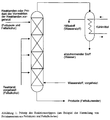
- a particularly advantageous variant of the method is shown in Figure 1.
- a mixture of the reactants is fed into the upper part of the reaction stripper.
- the filling can be made a solid or supported catalyst as well as at least one partially inert Pack consist.
- the product to be separated is evaporated and is evaporated by a preferably from the bottom in countercurrent flow of excipients from the Reaction zone removed.
- the auxiliary material enriched with the substance to be separated leaves the reaction stripper overhead.
- the condensate to be separated Substance can be the auxiliary or the device or a downstream Process step are supplied as a reactant.
- the desired liquid The reaction product leaves the reaction stripper at the bottom.
- the reaction can be achieved by removing the water of reaction with an auxiliary in favor of the desired product e.g. Let fatty acid esters run off. After Figure 1 shows a mixture of e.g. Fatty acid with fatty alcohol in the upper part the reaction stripper.
- the starting materials can also be used in a preliminary reaction partially converted, with the advantage of one for the same turnover in the column need shorter column length of the reaction stripper.
- the product of the pre-reaction in this case is introduced into the reaction stripper.
- the temperature and pressure in the reaction stripper are set so that both Reactants as well as the product (e.g. fatty acid esters) are liquid, the one to be separated Component e.g. However, water has already evaporated and is mainly in vapor form.
- the stripping gas flows from below, e.g. preheated, dry hydrogen into the system. This flows up to the head of the reaction stripper. On his way there he takes the component to be separated e.g. Water with.
- the one to be separated Component e.g. Hydrogen-enriched hydrogen leaves the apparatus on the head. From there it arrives in a capacitor in which it is separated from the component to be separated, e.g. Water is separated.
- the hydrogen can be returned to the reaction stripper be directed or used for another purpose. Feeding a the reactants, preferably the alcohol, can also be introduced into the reaction stripper by a Side feed. This results in an additional possibility with which the mentioned reaction can be shifted towards the products.
- a special feature of the The process according to the invention is that the starting materials, e.g. the carboxylic acid, or in the case the transesterification of the carboxylic acid esters, and the alcohol, advantageously equimolar can be used. However, if there is an over-stoichiometric conversion should, the alcohol is added in excess.
- the product e.g. the fatty acid ester derived in the lower part of the column.
- the reaction stripper is equipped with a solid catalyst. This allows the Reaction speed of the reaction accelerated by stripping alone can be further increased.
- This catalyst is convenient to use acidic catalysts such.
- water-sensitive catalysts - if e.g. the water of reaction from the catalyst is adsorbed - can reactivate the after several cycles to increase sales Catalyst done by drying.
- the operating conditions for the operating temperatures are in the range from 20 to 300 ° C, preferably 100-230 ° C, and the operating pressure in the range from negative pressure to 50 bar, preferably 1.5 - 15 bar.
- the cross-sectional loading of the liquid phase ⁇ 0.48 kg / m 2 s surprisingly has no discernible influence on the fatty acid conversion, while in the range of> 0.48 kg / m 2 s, the conversion decreases as the cross-sectional loading increases .
- fatty acid and fatty alcohol were introduced in a batch reactor and the esterification reaction is carried out in the presence of a suitable catalyst.
- the acid catalyst (ion exchanger) was in the form of Raschig rings as a fixed bed in introduced the reactor.
- the reaction volume of approx. 400 ml approx. 85 ml of solid catalyst introduced.
- the volume of the liquid phase was approximately 230 ml
- the rest is the volume of the stripping gas. Nitrogen was used as the stripping gas.
- Of the Set reactor simulates a section in a column-shaped reactive stripper.
- a laboratory reactive stripper was developed to demonstrate the function of the stripping method according to the invention in a column.
- a fixed catalyst bed with a length of about 1 m from acidic ion exchangers in the form of Raschig rings was used as the catalyst in the first experiments.
- the volume of the catalytic Raschig ring packing was approx. 5 l.
- Fatty acid and fatty alcohol were metered in equimolar to the head of the apparatus.
- the stripping gas was introduced from below - in countercurrent. In the first experiments, nitrogen was used as the stripping gas.
- Cross-sectional exposure with liquid phase (fatty acid + alcohol) 0.24 kg / (m 2 s) 1.
Landscapes
- Chemical & Material Sciences (AREA)
- Organic Chemistry (AREA)
- Chemical Kinetics & Catalysis (AREA)
- Organic Low-Molecular-Weight Compounds And Preparation Thereof (AREA)
- Physical Or Chemical Processes And Apparatus (AREA)
- Degasification And Air Bubble Elimination (AREA)
- Devices And Processes Conducted In The Presence Of Fluids And Solid Particles (AREA)
Claims (13)
- Procédé dans une colonne de réaction pour la transformation chimique de matières, dont la réaction est limitée par un état d'équilibre défavorable de la réaction de formation ou par un équilibre préétabli, dans lequel une ou plusieurs matières à séparer sont éliminées de manière continue du mélange réactionnel pendant la transformation au moyen d'un ou de plusieurs agents auxiliaires, caractérisé en ce que, par la colonne de réaction, dans laquelle un catalyseur solide est agencé dans un lit fixe :on conduit un gaz de stripping, à savoir un gaz permanent ou un mélange de gaz permanents en tant qu'agent auxiliaire, eton règle la température et la pression de sorte que tous les éduits sont présents dans la colonne de réaction sous forme de liquides ou sous forme de solutions de solides et la ou les matières à séparer sont principalement présentes sous forme gazeuse/vapeur.
- Procédé suivant la revendication 1, caractérisé en ce qu'on utilise de l'hydrogène comme gaz de stripping.
- Procédé suivant l'une des revendications précédentes, caractérisé en ce qu'on utilise en outre pour l'élimination de la matière à séparer un agent d'entraínement.
- Procédé suivant la revendication 3, caractérisé en ce que la matière à séparer est en outre éliminée par des hydrocarbures comme l'hexane, le benzène et/ou le toluène, de manière particulièrement préférée l'hexane, en tant qu'agent d'entraínement.
- Procédé suivant l'une des revendications précédentes, caractérisé en ce que la réaction à réaliser est une réaction de condensation et en ce que le produit de condensation à séparer a une masse molaire inférieure à 100 g/mole.
- Procédé suivant la revendication 5, caractérisé en ce qu'on estérifie des acides carboxyliques avec des alcools en esters d'acide carboxylique.
- Procédé suivant la revendication 5, caractérisé en ce qu'on transestérifie des esters d'acide carboxylique avec des alcools en esters d'acide carboxylique.
- Procédé suivant la revendication 6, caractérisé en ce qu'on estérifie des acides carboxyliques en C6 à C22, en particulier en C8 à C22, avec des alcools en C1 à C22, en particulier en C8 à C22, en esters d'acide carboxylique.
- Procédé suivant la revendication 7, caractérisé en ce qu'on transestérifie des esters d'acide carboxylique avec un groupement acide en C6 à C22, en particulier en C8 à C22 et un groupement alcool en C1 à C4 avec des alcools en C6 à C22, en particulier en C8 à C22, en esters d'acide carboxylique.
- Procédé suivant l'une des revendications précédentes, caractérisé en ce qu'on utilise dans la colonne de réaction un catalyseur solide acide.
- Procédé suivant l'une des revendications précédentes, caractérisé en ce que l'hydrogénation de doubles liaisons s'effectue simultanément dans la colonne de réaction en utilisant de l'hydrogène comme gaz permanent avec l'aide de catalyseurs connus en soi.
- Procédé suivant les revendications 6 à 11, caractérisé en ce qu'on utilise dans la colonne de réaction un catalyseur multifonctionnel qui assiste les réactions d'estérification et d'hydrogénation et/ou d'isomérisation.
- Procédé suivant l'une des revendications précédentes, caractérisé en ce qu'on conduit le gaz de stripping, le cas échéant conjointement avec l'agent d'entraínement, à contre-courant du bas vers le haut à travers la colonne de réaction, en ce qu'on sépare dans un condenseur la matière à séparer du gaz de stripping et, le cas échéant, de l'agent d'entraínement, en ce que le gaz de stripping et, le cas échéant, l'agent d'entraínement ou une partie de ces derniers sont ramenés dans la colonne de réaction.
Applications Claiming Priority (3)
| Application Number | Priority Date | Filing Date | Title |
|---|---|---|---|
| DE19541213A DE19541213A1 (de) | 1995-11-04 | 1995-11-04 | Verfahren zur chemischen Umsetzung von Stoffen in einer Reaktionskolonne |
| DE19541213 | 1995-11-04 | ||
| PCT/DE1996/002056 WO1997016243A2 (fr) | 1995-11-04 | 1996-10-26 | Procede pour faire reagir chimiquement des substances dans une colonne de reaction |
Publications (2)
| Publication Number | Publication Date |
|---|---|
| EP0859653A2 EP0859653A2 (fr) | 1998-08-26 |
| EP0859653B1 true EP0859653B1 (fr) | 1999-08-04 |
Family
ID=7776677
Family Applications (1)
| Application Number | Title | Priority Date | Filing Date |
|---|---|---|---|
| EP96945840A Expired - Lifetime EP0859653B1 (fr) | 1995-11-04 | 1996-10-26 | Procede pour faire reagir chimiquement des substances dans une colonne de reaction |
Country Status (6)
| Country | Link |
|---|---|
| US (1) | US6069261A (fr) |
| EP (1) | EP0859653B1 (fr) |
| JP (1) | JPH11514298A (fr) |
| DE (2) | DE19541213A1 (fr) |
| TW (1) | TW467893B (fr) |
| WO (1) | WO1997016243A2 (fr) |
Families Citing this family (30)
| Publication number | Priority date | Publication date | Assignee | Title |
|---|---|---|---|---|
| DE19643165A1 (de) * | 1995-07-10 | 1998-04-23 | Vincent Simon Ellis | Verfahren zur Durchführung von durch ein Gleichgewicht gekennzeichneten Reaktionen |
| EP1300387A1 (fr) * | 2001-10-05 | 2003-04-09 | Haltermann GmbH | Procédé de préparation d'esters d'acides hydroxy carboxyliques |
| DE10155241C1 (de) * | 2001-11-09 | 2003-07-03 | Gmk Ges Fuer Motoren Und Kraft | Verfahren zur Herstellung von Kraftstoffen aus sauren Fetten und Anlage zu dessen Durchführung |
| DE10238140A1 (de) * | 2002-08-15 | 2004-02-26 | Basf Ag | Kontinuierliches Verfahren zur Herstellung von Carbonylverbindungen |
| TWI324592B (en) * | 2002-11-28 | 2010-05-11 | Sulzer Chemtech Ag | A method for the esterification of a fatty acid |
| EP1424115B1 (fr) * | 2002-11-28 | 2016-01-13 | Sulzer Chemtech AG | Procédé d'estérification d'un acide gras |
| EP2215193A4 (fr) * | 2007-11-30 | 2012-08-29 | Ca Minister Natural Resources | Estérification en phase vapeur d'acides gras libres |
| US10414839B2 (en) | 2010-10-20 | 2019-09-17 | Sirrus, Inc. | Polymers including a methylene beta-ketoester and products formed therefrom |
| US9828324B2 (en) | 2010-10-20 | 2017-11-28 | Sirrus, Inc. | Methylene beta-diketone monomers, methods for making methylene beta-diketone monomers, polymerizable compositions and products formed therefrom |
| US9279022B1 (en) | 2014-09-08 | 2016-03-08 | Sirrus, Inc. | Solution polymers including one or more 1,1-disubstituted alkene compounds, solution polymerization methods, and polymer compositions |
| US9249265B1 (en) | 2014-09-08 | 2016-02-02 | Sirrus, Inc. | Emulsion polymers including one or more 1,1-disubstituted alkene compounds, emulsion methods, and polymer compositions |
| EP2768897B1 (fr) | 2011-10-19 | 2019-01-23 | Sirrus, Inc. | Procédés de production des monomères de bêta-dicétone de méthylène |
| CA2869112A1 (fr) | 2012-03-30 | 2013-10-03 | Bioformix Inc. | Articles stratifies et composites et systemes polymerisables pour les produire |
| CA2869108A1 (fr) | 2012-03-30 | 2013-10-03 | Bioformix Inc. | Procedes d'activation de compositions polymerisables, systemes polymerisables, et produits formes |
| US9234107B2 (en) | 2012-03-30 | 2016-01-12 | Sirrus, Inc. | Ink coating formulations and polymerizable systems for producing the same |
| WO2013181600A2 (fr) | 2012-06-01 | 2013-12-05 | Bioformix Inc. | Matériau optique et objets formés à partir de celui-ci |
| WO2014078689A1 (fr) | 2012-11-16 | 2014-05-22 | Bioformix Inc. | Systèmes et procédés de liaison de matières plastiques |
| CN105164797B (zh) | 2012-11-30 | 2019-04-19 | 瑟拉斯公司 | 用于电子应用的复合组合物 |
| EP2943462B1 (fr) | 2013-01-11 | 2018-06-27 | Sirrus, Inc. | Procédé d'obtention de malonate de méthylène par l'intermédiaire de la voie du bis(hydroxyméthyl)malonate |
| US9328054B1 (en) | 2013-09-27 | 2016-05-03 | Travis Danner | Method of alcoholisis of fatty acids and fatty acid gyicerides |
| US9416091B1 (en) | 2015-02-04 | 2016-08-16 | Sirrus, Inc. | Catalytic transesterification of ester compounds with groups reactive under transesterification conditions |
| US9315597B2 (en) | 2014-09-08 | 2016-04-19 | Sirrus, Inc. | Compositions containing 1,1-disubstituted alkene compounds for preparing polymers having enhanced glass transition temperatures |
| US10501400B2 (en) | 2015-02-04 | 2019-12-10 | Sirrus, Inc. | Heterogeneous catalytic transesterification of ester compounds with groups reactive under transesterification conditions |
| US9334430B1 (en) | 2015-05-29 | 2016-05-10 | Sirrus, Inc. | Encapsulated polymerization initiators, polymerization systems and methods using the same |
| US9217098B1 (en) | 2015-06-01 | 2015-12-22 | Sirrus, Inc. | Electroinitiated polymerization of compositions having a 1,1-disubstituted alkene compound |
| US9518001B1 (en) | 2016-05-13 | 2016-12-13 | Sirrus, Inc. | High purity 1,1-dicarbonyl substituted-1-alkenes and methods for their preparation |
| US9617377B1 (en) | 2016-06-03 | 2017-04-11 | Sirrus, Inc. | Polyester macromers containing 1,1-dicarbonyl-substituted 1 alkenes |
| US10196481B2 (en) | 2016-06-03 | 2019-02-05 | Sirrus, Inc. | Polymer and other compounds functionalized with terminal 1,1-disubstituted alkene monomer(s) and methods thereof |
| US10428177B2 (en) | 2016-06-03 | 2019-10-01 | Sirrus, Inc. | Water absorbing or water soluble polymers, intermediate compounds, and methods thereof |
| US9567475B1 (en) | 2016-06-03 | 2017-02-14 | Sirrus, Inc. | Coatings containing polyester macromers containing 1,1-dicarbonyl-substituted 1 alkenes |
Family Cites Families (8)
| Publication number | Priority date | Publication date | Assignee | Title |
|---|---|---|---|---|
| US3124526A (en) * | 1964-03-10 | Rhigh boiling | ||
| US2384793A (en) * | 1942-08-07 | 1945-09-18 | Sun Oil Co | Method of esterification |
| BE517860A (fr) * | 1952-02-23 | |||
| DE4234779A1 (de) * | 1992-10-15 | 1994-04-21 | Veba Oel Ag | Trägerkatalysator und Verwendung desselben |
| WO1994019079A1 (fr) * | 1993-02-17 | 1994-09-01 | China Petro-Chemical Corporation | Appareil et procede d'extraction reactive suspendue a plusieurs etages |
| US5321163A (en) * | 1993-09-09 | 1994-06-14 | Chemical Research & Licensing Company | Multi-purpose catalytic distillation column and eterification process using same |
| HUT71029A (en) * | 1994-03-04 | 1995-11-28 | Glitsch | Chemical process tower, catalytic unit and method for locating of contact substance |
| US5449501A (en) * | 1994-03-29 | 1995-09-12 | Uop | Apparatus and process for catalytic distillation |
-
1995
- 1995-11-04 DE DE19541213A patent/DE19541213A1/de not_active Ceased
-
1996
- 1996-10-26 JP JP9516981A patent/JPH11514298A/ja not_active Ceased
- 1996-10-26 DE DE59602660T patent/DE59602660D1/de not_active Expired - Fee Related
- 1996-10-26 US US09/068,177 patent/US6069261A/en not_active Expired - Fee Related
- 1996-10-26 WO PCT/DE1996/002056 patent/WO1997016243A2/fr not_active Ceased
- 1996-10-26 EP EP96945840A patent/EP0859653B1/fr not_active Expired - Lifetime
-
1997
- 1997-04-30 TW TW086105716A patent/TW467893B/zh not_active IP Right Cessation
Also Published As
| Publication number | Publication date |
|---|---|
| WO1997016243A3 (fr) | 1997-07-17 |
| DE59602660D1 (de) | 1999-09-09 |
| JPH11514298A (ja) | 1999-12-07 |
| EP0859653A2 (fr) | 1998-08-26 |
| WO1997016243A2 (fr) | 1997-05-09 |
| TW467893B (en) | 2001-12-11 |
| DE19541213A1 (de) | 1997-05-07 |
| US6069261A (en) | 2000-05-30 |
Similar Documents
| Publication | Publication Date | Title |
|---|---|---|
| EP0859653B1 (fr) | Procede pour faire reagir chimiquement des substances dans une colonne de reaction | |
| EP0334154B1 (fr) | Procédé pour l'estérification continueuse d'acides gras | |
| EP2004590B1 (fr) | Procede de fabrication d'un ester alkylique d'acide carboxylique | |
| EP4288400B1 (fr) | Procédé de production économique en énergie d'alcoolates alcalimétales | |
| EP1383727A1 (fr) | Procede d'extraction continue d'acide (meth)acrylique | |
| DE69623543T2 (de) | Verfahren zur Reinigung von einem Acrolein enthaltenden Gasstromes | |
| DE69902609T2 (de) | Verfahren zum kontinuierlichen Herstellen von Acryl-oder Methacrylsäureester | |
| WO2001034545A2 (fr) | Procede de production d'acide formique | |
| DE10251328B4 (de) | Extraktionsverfahren zur Gewinnung von Acrylsäure | |
| EP2046702A1 (fr) | Procédé de reconditionnement de produits d'hydrogénation contenant un solvant | |
| DE69715882T2 (de) | Verfahren zur Herstellung von Amiden gesättigter aliphatischer Carbonsäuren | |
| EP2560943A2 (fr) | Procédé de production d'esters d'acides carboxyliques par distillation réactive | |
| EP1853546B1 (fr) | Procede continu de production de cyclohexyl (meth)acrylate | |
| EP3555038B1 (fr) | Procédé de production par distillation de cyclohexyl(méth)acrylate pur | |
| EP1838405B1 (fr) | Procede de production d'anhydride phtalique conforme aux specifications | |
| DE68911949T2 (de) | Reinigung von Alkylglyyoxalat in einer kontinuierlichen Säule mittels azeotropischer Destillation. | |
| EP3931175B1 (fr) | Procédé pour le retraitement d'esters d'acide benzènepolycarboxylique et leur utilisation pour la production d'esters d'acide cyclohexanepolycarboxylique | |
| EP1056708A1 (fr) | Procede de separation de l'anhydride d'acide maleique par desorption a partir de melanges contenant de l'anhydride d'acide maleique | |
| EP1233012B1 (fr) | Procédé pour produire de l'anhydride phtalique conforme aux specifications | |
| EP4436948B1 (fr) | Procédé de production de 2-octyl(méth)acrylate | |
| WO2024125775A1 (fr) | Procédé amélioré pour préparer des composés d'alcoolates métalliques | |
| EP4634150A1 (fr) | Procédé de préparation en continu de (méth)acrylate de tert-butyle | |
| EP2205547A2 (fr) | Procede d'oxydation d'alcools cycloaliphatiques, de cetones cycloaliphatiques ou de leurs melanges avec de l'acide nitrique aqueux, et recuperation des acides dicarboxyliques | |
| DE102008009992A1 (de) | Verfahren zur Oxidation von cycloaliphatischen Alkoholen, cycloaliphatischen Ketonen oder deren Gemische mit wässriger Salpetersäure und Aufarbeitung der Dicarbonsäuren | |
| DE102007050713A1 (de) | Verfahren zur Oxidation von cycloaliphatischen Alkoholen, cycloaliphatischen Ketonen oder deren Gemische mit wässriger Salpetersäure und Aufarbeitung der Dicarbonsäuren |
Legal Events
| Date | Code | Title | Description |
|---|---|---|---|
| PUAI | Public reference made under article 153(3) epc to a published international application that has entered the european phase |
Free format text: ORIGINAL CODE: 0009012 |
|
| 17P | Request for examination filed |
Effective date: 19980306 |
|
| AK | Designated contracting states |
Kind code of ref document: A2 Designated state(s): BE DE ES FR GB IT NL |
|
| GRAG | Despatch of communication of intention to grant |
Free format text: ORIGINAL CODE: EPIDOS AGRA |
|
| 17Q | First examination report despatched |
Effective date: 19981120 |
|
| GRAG | Despatch of communication of intention to grant |
Free format text: ORIGINAL CODE: EPIDOS AGRA |
|
| GRAH | Despatch of communication of intention to grant a patent |
Free format text: ORIGINAL CODE: EPIDOS IGRA |
|
| GRAH | Despatch of communication of intention to grant a patent |
Free format text: ORIGINAL CODE: EPIDOS IGRA |
|
| GRAA | (expected) grant |
Free format text: ORIGINAL CODE: 0009210 |
|
| AK | Designated contracting states |
Kind code of ref document: B1 Designated state(s): BE DE ES FR GB IT NL |
|
| PG25 | Lapsed in a contracting state [announced via postgrant information from national office to epo] |
Ref country code: ES Free format text: THE PATENT HAS BEEN ANNULLED BY A DECISION OF A NATIONAL AUTHORITY Effective date: 19990804 |
|
| GBT | Gb: translation of ep patent filed (gb section 77(6)(a)/1977) |
Effective date: 19990805 |
|
| REF | Corresponds to: |
Ref document number: 59602660 Country of ref document: DE Date of ref document: 19990909 |
|
| ET | Fr: translation filed | ||
| ITF | It: translation for a ep patent filed | ||
| PLBQ | Unpublished change to opponent data |
Free format text: ORIGINAL CODE: EPIDOS OPPO |
|
| PLBI | Opposition filed |
Free format text: ORIGINAL CODE: 0009260 |
|
| PLBF | Reply of patent proprietor to notice(s) of opposition |
Free format text: ORIGINAL CODE: EPIDOS OBSO |
|
| 26 | Opposition filed |
Opponent name: BASF AKTIENGESELLSCHAFT Effective date: 20000504 |
|
| NLR1 | Nl: opposition has been filed with the epo |
Opponent name: BASF AKTIENGESELLSCHAFT |
|
| PLBF | Reply of patent proprietor to notice(s) of opposition |
Free format text: ORIGINAL CODE: EPIDOS OBSO |
|
| PLBF | Reply of patent proprietor to notice(s) of opposition |
Free format text: ORIGINAL CODE: EPIDOS OBSO |
|
| RAP2 | Party data changed (patent owner data changed or rights of a patent transferred) |
Owner name: SASOL GERMANY GMBH |
|
| NLT2 | Nl: modifications (of names), taken from the european patent patent bulletin |
Owner name: SASOL GERMANY GMBH |
|
| PLBO | Opposition rejected |
Free format text: ORIGINAL CODE: EPIDOS REJO |
|
| REG | Reference to a national code |
Ref country code: GB Ref legal event code: IF02 |
|
| PLBN | Opposition rejected |
Free format text: ORIGINAL CODE: 0009273 |
|
| STAA | Information on the status of an ep patent application or granted ep patent |
Free format text: STATUS: OPPOSITION REJECTED |
|
| 27O | Opposition rejected |
Effective date: 20011128 |
|
| NLR2 | Nl: decision of opposition | ||
| NLS | Nl: assignments of ep-patents |
Owner name: SASOL GERMANY GMBH |
|
| NLT1 | Nl: modifications of names registered in virtue of documents presented to the patent office pursuant to art. 16 a, paragraph 1 |
Owner name: RWE DEA AG |
|
| REG | Reference to a national code |
Ref country code: GB Ref legal event code: 732E |
|
| REG | Reference to a national code |
Ref country code: FR Ref legal event code: TP Ref country code: FR Ref legal event code: CD |
|
| PGFP | Annual fee paid to national office [announced via postgrant information from national office to epo] |
Ref country code: NL Payment date: 20071029 Year of fee payment: 12 |
|
| PGFP | Annual fee paid to national office [announced via postgrant information from national office to epo] |
Ref country code: IT Payment date: 20071026 Year of fee payment: 12 |
|
| PGFP | Annual fee paid to national office [announced via postgrant information from national office to epo] |
Ref country code: BE Payment date: 20071029 Year of fee payment: 12 |
|
| PGFP | Annual fee paid to national office [announced via postgrant information from national office to epo] |
Ref country code: GB Payment date: 20071022 Year of fee payment: 12 Ref country code: FR Payment date: 20071019 Year of fee payment: 12 |
|
| PGFP | Annual fee paid to national office [announced via postgrant information from national office to epo] |
Ref country code: DE Payment date: 20071219 Year of fee payment: 12 |
|
| PLAB | Opposition data, opponent's data or that of the opponent's representative modified |
Free format text: ORIGINAL CODE: 0009299OPPO |
|
| BERE | Be: lapsed |
Owner name: *RWE-DEA A.G. FUR MINERALOEL UND CHEMIE Effective date: 20081031 |
|
| GBPC | Gb: european patent ceased through non-payment of renewal fee |
Effective date: 20081026 |
|
| NLV4 | Nl: lapsed or anulled due to non-payment of the annual fee |
Effective date: 20090501 |
|
| REG | Reference to a national code |
Ref country code: FR Ref legal event code: ST Effective date: 20090630 |
|
| PG25 | Lapsed in a contracting state [announced via postgrant information from national office to epo] |
Ref country code: NL Free format text: LAPSE BECAUSE OF NON-PAYMENT OF DUE FEES Effective date: 20090501 |
|
| PG25 | Lapsed in a contracting state [announced via postgrant information from national office to epo] |
Ref country code: IT Free format text: LAPSE BECAUSE OF NON-PAYMENT OF DUE FEES Effective date: 20081026 Ref country code: DE Free format text: LAPSE BECAUSE OF NON-PAYMENT OF DUE FEES Effective date: 20090501 |
|
| PG25 | Lapsed in a contracting state [announced via postgrant information from national office to epo] |
Ref country code: BE Free format text: LAPSE BECAUSE OF NON-PAYMENT OF DUE FEES Effective date: 20081031 |
|
| PG25 | Lapsed in a contracting state [announced via postgrant information from national office to epo] |
Ref country code: FR Free format text: LAPSE BECAUSE OF NON-PAYMENT OF DUE FEES Effective date: 20081031 |
|
| PG25 | Lapsed in a contracting state [announced via postgrant information from national office to epo] |
Ref country code: GB Free format text: LAPSE BECAUSE OF NON-PAYMENT OF DUE FEES Effective date: 20081026 |