EP0860769A2 - Vorrichtung und Verfahren zur Verarbeitung von Druckdaten - Google Patents
Vorrichtung und Verfahren zur Verarbeitung von Druckdaten Download PDFInfo
- Publication number
- EP0860769A2 EP0860769A2 EP98101198A EP98101198A EP0860769A2 EP 0860769 A2 EP0860769 A2 EP 0860769A2 EP 98101198 A EP98101198 A EP 98101198A EP 98101198 A EP98101198 A EP 98101198A EP 0860769 A2 EP0860769 A2 EP 0860769A2
- Authority
- EP
- European Patent Office
- Prior art keywords
- page
- data
- pages
- data format
- format
- Prior art date
- Legal status (The legal status is an assumption and is not a legal conclusion. Google has not performed a legal analysis and makes no representation as to the accuracy of the status listed.)
- Granted
Links
Images





Classifications
-
- G—PHYSICS
- G06—COMPUTING OR CALCULATING; COUNTING
- G06F—ELECTRIC DIGITAL DATA PROCESSING
- G06F3/00—Input arrangements for transferring data to be processed into a form capable of being handled by the computer; Output arrangements for transferring data from processing unit to output unit, e.g. interface arrangements
- G06F3/12—Digital output to print unit, e.g. line printer, chain printer
- G06F3/1297—Printer code translation, conversion, emulation, compression; Configuration of printer parameters
Definitions
- the present invention relates to an apparatus for and a method of processing printing data of printed matter formed by a plurality of pages.
- a part of the plurality of pages is generally outputted as a single plate (or film), to be printed.
- the respective ones of the plurality of pages are formed independently of each other and composited with each other through the so-called assembling, to be outputted as a single plate.
- Fig. 10 is adapted to illustrate first exemplary conventional composition processing. For convenience of illustration, it is assumed here that two pages are composited with each other.
- Terminals 101 of a composition processor form printing data (hereinafter referred to as "page data") expressing the respective ones of a plurality of pages.
- page data printing data
- the page data are in the following three data formats:
- the pages formed by an operator through the terminals 101 are generally expressed in page description data. Strictly, the operator forms an original expressed in page description data through the terminals 101 so that the original is split into the respective pages, while it is assumed that the pages are formed through the terminals 101, in order to simplify the illustration.
- An assembler 102 composites two pages which are expressed in page description data with each other. This assembler 102 merely composes a single plate from two pages, and the composed plate is expressed in page description data. Whether the two terminals 101 form pages respectively or either terminal 101 forms two pages, the respective pages are formed independently of each other, to be composited with each other through the assembler 102.
- An interpreter 103 converts the composed plate to intermediate data, which in turn is further converted to raster data through a renderer 104.
- a recorder 105 outputs the plate expressed in the raster data, which can be outputted as printed matter, to complete the series of processing.
- Fig. 11 is adapted to illustrate second exemplary conventional composition processing.
- two terminals 101 form pages in a page description data, which in turn are converted from intermediate data to raster data independently of each other through interpreters 103 and renderers 104 respectively.
- An assembler 102 composes a single plate from the two pages expressed in the raster data.
- a recorder 105 outputs the composed plate, which is expressed in raster data similarly to the aforementioned first conventional example.
- the difference between the first and second conventional examples resides in that whether the pages are composited with each other in a page description data format or a raster data format, and the modes of the plates finally inputted in the recorders 105 are identical to each other.
- the first conventional example converts the data format of the plate after page composition, and hence the quantity of converted data is increased to require a long time for the processing.
- the composition processor may comprise a plurality of CPUs for performing the processing in a split manner, while it is difficult to split the composed plate formed by single data. If the pages forming the plate are prepared in different periods, further, the processing cannot be started until all pages are prepared, and hence the throughput of the overall unit cannot be improved. If the pages are formed in different data formats (when a certain terminal 101 forms a page of a raster data format, for example), further, the pages cannot be composited with each other unless the data formats thereof are equalized with each other.
- the second conventional example composites the pages expressed in raster data with each other.
- the information quantity of raster data is so large that a long time is required for compositing pages expressed in the raster data with each other, and hence it is difficult to improve the throughput as a result.
- pages once composited with each other may be corrected later.
- page data When page data are corrected, all processing must be performed again in both conventional examples, to remarkably reduce workability.
- the present invention is directed to an apparatus for obtaining printing data for printed matter by compositing a plurality of pages with each other.
- the apparatus is adapted to obtain printing data for printed matter by compositing a plurality of pages with each other.
- the plurality of pages are classified into a first part to be composed in a page description data format, a second part to be composed in an intermediate data format, and a third part to be composed in a raster data format.
- the apparatus comprises data format conversion means comprising first conversion means for converting the page description data format to the intermediate data format, and second conversion means for converting the intermediate data format to the raster data format, control means comprising first control means for acquiring a first page group expressed in the page description format from the first part of the plurality of pages, second control means for controlling the data format conversion means thereby converting the second part of the plurality of pages to a second page group expressed in the intermediate data format, and third control means for controlling the data format conversion means thereby converting the third part of the plurality of pages to a third page group expressed in the raster data format, and data composition means comprising first composition means for compositing the first page group, second composition means for compositing the second page group, and third composition means for compositing the third group, for obtaining the printing data from the first to third page groups.
- the first to third composition means are operable independently of each other.
- Composition of a plurality of pages and data format conversion can be dispersively performed, whereby the quantity of data in individual processing is not remarkably increased, the processing can be performed in a short time, and the throughput can be improved.
- the apparatus further comprises means for replacing a specified page of the printing data obtained by the data composition means with a new page.
- the present invention is also directed to a method of obtaining printing data for printed matter by compositing a plurality of pages with each other.
- an object of the present invention is to provide an apparatus for and a method of processing printing data having high throughput, which can process data in a short time.
- Another object of the present invention is to provide an apparatus for and a method of processing printing data which can readily correct data to be corrected later.
- Fig. 1 illustrates an exemplary structure of a system into which a printing data processor 20 according to the present invention is assembled.
- Five terminals 10 and the data processor (printing data processor) 20 form a network through a data line 5.
- the terminals 10, which are desktop computers, have functions of forming originals on the basis of instructions by an operator.
- Printer drivers 11 output the originals formed by the terminals 10 in the data format of page description data.
- the format of the data outputted from the terminals 10 is not restricted to the page description data format, but the terminals 10 may preserve previously formed raster data or intermediate data in magnetic disks or the like for outputting the same.
- the terminals 10 may be workstations, and the number thereof is not restricted to five but at least one terminal 10 may be provided.
- the data processor 20 has a function of splitting the plurality of originals formed by the terminals 10 into pages, composing a single plate from the plurality of pages, and transferring the same to an output unit 80 as raster data.
- the data processor 20, which is connected with the output unit 80, comprises a magnetic disk 15.
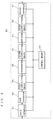
- Fig. 2 is a functional block diagram schematically showing the structure of the data processor 20 according to the present invention.
- the data processor 20 comprises an input interface 21, a page separator 22, first composition means 30, an interpreter 23, second composition means 31, a renderer 24, third composition means 32 and an output interface 25, for feeding the data of the originals transferred from the respective terminals 10 in this order and outputting the same to the output unit 80.
- the input and output interfaces 21 and 25 are employed for connection with the terminals 10 and the output unit 80 respectively.
- the page separator 22 is a processing part for splitting the originals formed in the terminals 10 into pages.
- the first, second and third composition means 30, 31 and 32 are processing parts for compositing the pages expressed in page description data, intermediate data and raster data with each other respectively.
- the interpreter 23 is a processing part for converting the page description data to the intermediate data
- the renderer 24 is a processing part for converting the intermediate data to the raster data.
- the data processor 20 is further provided therein with control means 40 for controlling the respective processing parts. While the control means 40 is formed by a CPU, the number of such CPU is not restricted to one but a plurality of CPUs are preferably provided. If the control means 40 is formed by a plurality of CPUs, these CPUs can deal with pages forming a single plate, to result in improvement of the throughput.
- the magnetic disk 15 stores processing software for the data processor 20, as well as page data of various data formats described later and operational information of the data processor 20.
- Fig. 7 is a flow chart showing the procedure of the page composition in the data processor 20.
- Fig. 3 is adapted to illustrate a state of the data processor 20 processing a plurality of page data.
- Fig. 4 is a conceptual diagram showing exemplary composition of a plurality of pages.
- the data processor 20 first performs page splitting, in order to unify the sizes of the pages forming printed matter. Namely, the page separator 22 splits the originals formed in the terminals 10 and transferred to the data processor 20, so that the split pages are composited with each other.
- the data processor 20 composites five pages, i.e., first to fifth pages with each other, as shown in Fig. 3.
- the page separator 22 separates originals (first to fourth pages in Fig. 3) expressed in page description data, and data (fifth page in Fig. 3) transferred as raster data from the beginning is not split since the same is already page unit data. These five pages may be transferred from a single or different terminals 10.
- the data format is not converted by the page splitting.
- the control means 40 first determines whether or not the page data of the object pages are in a processable data format at a step S1 (Fig. 7).
- the operator previously specifies the data formats for compositing the respective pages with each other, and the current data formats of the respective pages can be determined through identifiers. This is now described with reference to Figs. 5 and 6.
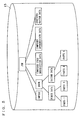
- Fig. 5 illustrates an exemplary hierarchical structure of the data stored in the magnetic disk 15
- Fig. 6 illustrates principal part of page management data provided as part of the page data.
- the magnetic disk 15 stores job data, impose data, book data, page data, parts data, composed page description data, composed intermediate data and composed raster data in the hierarchical structure shown in Fig. 5.
- the job data indicate operational information of the data processor 20, and the operator previously specifies and records in what data formats the respective pages must be composited with each other in the job data.
- the impose data records page arrangement information after the page composition, i.e., assembling information.
- the book data, the page data and the parts data indicate the printed matter which is the final product, the pages forming the printed matter, and parts described on the pages respectively. While Fig. 5 shows only the data of the first and second pages for convenience of illustration, the magnetic disk 15 stores data of all pages forming the printed matter as the page data. The page management data shown in Fig. 6 are recorded in part of the page data.
- the principal part of the page management data is formed by "keys” indicating the attributes of the pages and "values” thereof, as shown in Fig. 6.
- the "keys” include "type", “data format”, "date” and the like, for example.
- the control means 40 recognizes the "data format” of the page management data as the identifier indicating the current data format. In case of Fig. 6, therefore, the control means 40 determines that the data format of this page is the page description data format. If the data format of the page is converted, the "values" are also changed following this.
- control means 40 compares "the data formats for compositing the pages" recorded in the job data with the "data formats” determined from the page management data at the step S1.
- the control means 40 determines that the first page is in a processable data format at the step S1, and advances to a step S3.
- control means 40 determines whether or not the processing is performed as to all pages included in the book data. Only the first page is processed in this case and hence the control means 40 advances to a step S5 to increment the number of the processed page to 2. Thereafter the control means 40 returns to the step S1 again, for processing the second page.
- the control means 40 also determines the second page as processable since the data format for compositing the same matches with the current data format, and performs a process similar to the above.
- the control means 40 determines the third page as unprocessable since the data format for compositing the same is "intermediate data" and the currently determined data format is "page description”, and advances to a step S2 for converting the data format of the third page to that for compositing the same.
- the interpreter 23 performs this processing for converting the page description data to the intermediate data.
- the control means 40 advances to the step S3, for performing processing similar to the above.
- the control means 40 determines the fourth page as unprocessable since the data format for compositing the same is "raster data" and the currently determined data format is "page description data”, and returns to the step S2 for converting the data format of the fourth page.
- the interpreter 23 converts the page description data to the intermediate data
- the renderer 24 converts the intermediate data to the raster data.
- the control means 40 advances to the step S3 for performing processing similar to the above.
- control means 40 determines the fifth page as processable since the data format for compositing the same is "raster data" and the currently determined data format is also "raster data”, and advances to the step S3 without converting the data format.
- the control means 40 repeats a procedure similar to the above for completely processing all pages of the printed matter to be processed, and then advances to a step S4.
- the first, second and third composition means 30, 31 and 32 perform the composition in response to the data formats of the pages to be composited with each other.
- the first composition means 30 composites the first and second pages expressed in the page description data to form a plate. Arrangement of the pages in the composition is decided in accordance with the impose data.
- the interpreter 23 converts the plate composed in the first composition means 30, which is in the page description data, to intermediate data.
- the second composition means 31 composites the plate converted to the intermediate data with the third page.
- Arrangement of the third page is also decided in accordance with the impose data.
- the renderer 24 converts a plate composed in the intermediate data format to raster data.
- the third composition means 32 composites the plate converted to the raster data with the fourth and fifth pages. Also in this case, arrangement of the pages is decided in accordance with the impose data.
- a single plate is composed from the first to fifth pages, as shown in Fig. 4.
- the composed plate is transferred to the output unit 80 through the output interface 25, to be outputted.
- the feature of the aforementioned processing resides in that the composition of the plurality of pages and the data format conversion are dispersively performed. Due to the dispersion of the composition and the data format conversion, the quantity of data in individual processing is not remarkably increased, whereby short time processing is enabled. Particularly when the control means 40 comprises a plurality of CPUs, the throughput can be remarkably improved since each CPU can deal with each processing.
- composition and the data format conversion are dispersively performed also when the pages are formed in different periods or in different data formats, whereby the throughput is not remarkably reduced.
- the data format of only the fifth page is different in the above example. Even if formation of the fourth page is delayed in the above, data format conversion of the first to third pages and composition by the first and second composition means 30 and 31 are possible.
- the first to fourth pages expressed in the page description data can be composited with each other in any composition means as shown in Fig. 3, when the data format for compositing the same recorded in the job data is converted to another format.
- the first to fourth pages it is also possible to specify the first to fourth pages to be composited with each other in the raster data format.
- the third composition means 32 composites all pages with each other similarly to the second conventional example, and improvement of the throughput cannot be expected as a result.
- it is preferable to disperse the composition if possible.
- the pages composited with each other in the aforementioned manner may be corrected in general. For example, parts data forming the pages may be changed later. In this case, the data processor 20 performs page replacement. This page replacement is now described.
- Fig. 8 is a flow chart showing an exemplary procedure of the page replacement.
- originals for printed matter are partially corrected and the corrected originals are inputted in the data processor 20 from any terminal 10. Therefore, pages (hereinafter referred to as "corrected pages") related to the corrected originals split by the page separator 22 include unchanged and changed pages.
- the control means 40 compares each corrected page to be processed with the original page corresponding thereto, and makes a determination as to presence/absence of difference. If the corrected page is identical to the original page, the control means 40 advances to a step S84 for determining whether or not the processing is performed on all pages included in book data. If any unprocessed page remains, the control means 40 increments the page number (step S85), and returns to the step S81.
- the control means 40 advances to a step S82, for erasing the original page corresponding to the corrected page.
- the control means 40 may not necessarily erase the original page but may overwrite or insert the corrected page on or in the original page.
- the control means 40 advances to a step S83, for converting the page data of the corrected page to a data format for compositing the same.
- This conversion is adapted to convert the page data to the data format for compositing the same previously specified and recorded by the operator in the job data, identically to the processing at the step S2 shown in Fig. 7.
- the control means 40 directly advances to a step S84 without converting the data format.
- the control means 40 repeats the aforementioned procedure for completing the processing on all pages included in the book data, and then advances to a step S86 for compositing the corrected pages with each other in accordance with the impose data.
- This processing is identical to that at the step S4 in Fig. 7. If the corrected page is converted to raster data, for example, the third composition means 32 composites the plate with this page.
- the step S86 only the corrected pages determined as being different from the original pages at the step S81 are composited.
- Fig. 9 is a flow chart showing another exemplary procedure of page replacement.
- printed matter is partially corrected and only the corrected part is inputted in the data processor 20. Therefore, corrected pages include only changed pages.
- control means 40 erases an original page corresponding to each corrected page. This processing is identical to that at the step S82 in Fig. 8.
- the control means 40 may not necessarily erase the original page but may overwrite or insert the corrected page on or in the original page.
- control means 40 advances to a step S92, for converting the page data of the corrected page to a data format for compositing the same.
- This conversion is adapted to convert the page data to the data format for compositing the same previously specified and recorded by the operator in the job data, identically to that at the step S2 shown in Fig. 7.
- the control means 40 performs no conversion when the data format of the corrected page is identical to that for compositing the same, similarly to the above.
- control means 40 advances to a step S93, and determines whether or not all corrected pages are processed. If the determination is of NO, the control means 40 increments the number of the corrected pages (step S95), and returns to the step S91.
- control means 40 advances to a step S94, and composites the corrected pages in accordance with the impose data. If the corrected page is converted to intermediate data, for example, the second composition means 31 composites the plate with this page, identically to the processing at the step S4 in Fig. 7.
- Either processing shown in Fig. 8 or 9 is adapted to re-composite only differences around correction in common. Not the entire processing is repeated but only the pages changed by correction are re-composited, whereby the pages can be readily corrected without reducing the workability.
Landscapes
- Engineering & Computer Science (AREA)
- Theoretical Computer Science (AREA)
- Human Computer Interaction (AREA)
- Physics & Mathematics (AREA)
- General Engineering & Computer Science (AREA)
- General Physics & Mathematics (AREA)
- Record Information Processing For Printing (AREA)
- Editing Of Facsimile Originals (AREA)
Applications Claiming Priority (3)
| Application Number | Priority Date | Filing Date | Title |
|---|---|---|---|
| JP40730/97 | 1997-02-25 | ||
| JP04073097A JP3361951B2 (ja) | 1997-02-25 | 1997-02-25 | 印刷データ処理装置および方法 |
| JP4073097 | 1997-02-25 |
Publications (3)
| Publication Number | Publication Date |
|---|---|
| EP0860769A2 true EP0860769A2 (de) | 1998-08-26 |
| EP0860769A3 EP0860769A3 (de) | 2001-08-16 |
| EP0860769B1 EP0860769B1 (de) | 2009-08-19 |
Family
ID=12588753
Family Applications (1)
| Application Number | Title | Priority Date | Filing Date |
|---|---|---|---|
| EP98101198A Expired - Lifetime EP0860769B1 (de) | 1997-02-25 | 1998-01-23 | Vorrichtung und Verfahren zur Verarbeitung von Druckdaten |
Country Status (4)
| Country | Link |
|---|---|
| US (1) | US6076120A (de) |
| EP (1) | EP0860769B1 (de) |
| JP (1) | JP3361951B2 (de) |
| DE (1) | DE69841066D1 (de) |
Cited By (6)
| Publication number | Priority date | Publication date | Assignee | Title |
|---|---|---|---|---|
| WO2001079984A1 (en) * | 2000-04-14 | 2001-10-25 | Picsel (Research) Limited | Digital document processing |
| US6781600B2 (en) | 2000-04-14 | 2004-08-24 | Picsel Technologies Limited | Shape processor |
| US6925597B2 (en) | 2000-04-14 | 2005-08-02 | Picsel Technologies Limited | Systems and methods for digital document processing |
| US7009626B2 (en) | 2000-04-14 | 2006-03-07 | Picsel Technologies Limited | Systems and methods for generating visual representations of graphical data and digital document processing |
| EP1465054A3 (de) * | 2003-04-04 | 2009-01-07 | Xerox Corporation | System für paralleles Drucken |
| US7576730B2 (en) | 2000-04-14 | 2009-08-18 | Picsel (Research) Limited | User interface systems and methods for viewing and manipulating digital documents |
Families Citing this family (11)
| Publication number | Priority date | Publication date | Assignee | Title |
|---|---|---|---|---|
| US6441919B1 (en) * | 1998-09-02 | 2002-08-27 | Adobe Systems Incorporated | Integrated rendering and compositing in variable printing |
| US6724496B1 (en) * | 1999-10-29 | 2004-04-20 | Hewlett-Packard Development Company, L.P. | Remote print job processing |
| US6894804B2 (en) * | 2001-10-03 | 2005-05-17 | Toshiba Tec Kabushiki Kaisha | Method to dynamically perform document layout functions |
| US7259881B2 (en) * | 2001-10-03 | 2007-08-21 | Kabushiki Kaisha Toshiba | Method of monitoring multiple controller families |
| US7133152B2 (en) * | 2002-02-28 | 2006-11-07 | Kabushiki Kaisha Toshiba | Post RIP paper conversion |
| US7164492B2 (en) * | 2002-03-07 | 2007-01-16 | Kabushiki Kaisha Toshiba | Automatic facsimile document resizing |
| US7245392B2 (en) * | 2002-03-08 | 2007-07-17 | Kabushiki Kaisha Toshiba | Method for generating a fax cover page |
| US7839419B2 (en) * | 2003-10-23 | 2010-11-23 | Microsoft Corporation | Compositing desktop window manager |
| US7817163B2 (en) * | 2003-10-23 | 2010-10-19 | Microsoft Corporation | Dynamic window anatomy |
| US8166217B2 (en) * | 2004-06-28 | 2012-04-24 | Marvell International Ltd. | System and method for reading and writing data using storage controllers |
| US20080077555A1 (en) * | 2006-09-22 | 2008-03-27 | Miller Frank W | Variable data workflow system and method |
Family Cites Families (6)
| Publication number | Priority date | Publication date | Assignee | Title |
|---|---|---|---|---|
| JP3092711B2 (ja) * | 1990-09-11 | 2000-09-25 | キヤノン株式会社 | 出力制御装置及び方法 |
| JP3666888B2 (ja) * | 1992-04-29 | 2005-06-29 | キヤノン株式会社 | カラー処理装置およびその方法 |
| US5602976A (en) * | 1993-02-23 | 1997-02-11 | Adobe Systems Incorporated | Method and apparatus for saving printer memory |
| US5495561A (en) * | 1993-06-21 | 1996-02-27 | Taligent, Inc. | Operating system with object-oriented printing interface |
| US5566278A (en) * | 1993-08-24 | 1996-10-15 | Taligent, Inc. | Object oriented printing system |
| US5919249A (en) * | 1996-08-07 | 1999-07-06 | Adobe Systems Incorporated | Multiplexed output movie rendering |
-
1997
- 1997-02-25 JP JP04073097A patent/JP3361951B2/ja not_active Expired - Fee Related
-
1998
- 1998-01-23 EP EP98101198A patent/EP0860769B1/de not_active Expired - Lifetime
- 1998-01-23 DE DE69841066T patent/DE69841066D1/de not_active Expired - Lifetime
- 1998-02-24 US US09/028,644 patent/US6076120A/en not_active Expired - Fee Related
Cited By (17)
| Publication number | Priority date | Publication date | Assignee | Title |
|---|---|---|---|---|
| CN1924794B (zh) * | 2000-04-14 | 2012-03-21 | 三星电子株式会社 | 数字文件处理系统、数据处理系统和外围设备 |
| US7576730B2 (en) | 2000-04-14 | 2009-08-18 | Picsel (Research) Limited | User interface systems and methods for viewing and manipulating digital documents |
| US6925597B2 (en) | 2000-04-14 | 2005-08-02 | Picsel Technologies Limited | Systems and methods for digital document processing |
| US7009624B2 (en) | 2000-04-14 | 2006-03-07 | Picsel Research Limited | Shape processor |
| US7009626B2 (en) | 2000-04-14 | 2006-03-07 | Picsel Technologies Limited | Systems and methods for generating visual representations of graphical data and digital document processing |
| US7036076B2 (en) | 2000-04-14 | 2006-04-25 | Picsel Technologies Limited | Systems and methods for digital document processing |
| US7055095B1 (en) | 2000-04-14 | 2006-05-30 | Picsel Research Limited | Systems and methods for digital document processing |
| US7450114B2 (en) | 2000-04-14 | 2008-11-11 | Picsel (Research) Limited | User interface systems and methods for manipulating and viewing digital documents |
| US6781600B2 (en) | 2000-04-14 | 2004-08-24 | Picsel Technologies Limited | Shape processor |
| US9778836B2 (en) | 2000-04-14 | 2017-10-03 | Samsung Electronics Co., Ltd. | User interface systems and methods for manipulating and viewing digital documents |
| US8593436B2 (en) | 2000-04-14 | 2013-11-26 | Samsung Electronics Co., Ltd. | User interface systems and methods for manipulating and viewing digital documents |
| US8056006B2 (en) | 2000-04-14 | 2011-11-08 | Samsung Electronics Co., Ltd. | Systems and methods for digital document processing |
| WO2001079984A1 (en) * | 2000-04-14 | 2001-10-25 | Picsel (Research) Limited | Digital document processing |
| US8358290B2 (en) | 2000-04-14 | 2013-01-22 | Samsung Electronics Co., Ltd. | User interface systems and methods for manipulating and viewing digital documents |
| US8325372B2 (en) | 2003-04-04 | 2012-12-04 | Xerox Corporation | Parallel printing system |
| EP1465054A3 (de) * | 2003-04-04 | 2009-01-07 | Xerox Corporation | System für paralleles Drucken |
| US7872767B2 (en) | 2003-04-04 | 2011-01-18 | Xerox Corporation | Parallel printing system |
Also Published As
| Publication number | Publication date |
|---|---|
| JPH10240473A (ja) | 1998-09-11 |
| EP0860769B1 (de) | 2009-08-19 |
| EP0860769A3 (de) | 2001-08-16 |
| DE69841066D1 (de) | 2009-10-01 |
| JP3361951B2 (ja) | 2003-01-07 |
| US6076120A (en) | 2000-06-13 |
Similar Documents
| Publication | Publication Date | Title |
|---|---|---|
| US6076120A (en) | System for compositing a plurality of pages said pages being classified into three parts each part to be composed in a different data format | |
| CN101387945B (zh) | 打印控制装置和打印控制方法 | |
| US8243325B2 (en) | Method for prepress-time color match verification and correction | |
| US6549654B1 (en) | Image processing method and apparatus and storage medium storing processes of executing the method | |
| US8743421B1 (en) | System and method for spot color correction | |
| US7106474B1 (en) | Color management system using measured device data | |
| WO1996001467A1 (en) | Method and system for embedding a device profile into a document and extracting a device profile from a document in a color management system | |
| US20020063877A1 (en) | Print driver system having a user interface and a method for processing raster data | |
| CN100355580C (zh) | 图像处理装置和用于该图像处理装置的图像处理方法 | |
| US6429950B1 (en) | Method and apparatus for applying object characterization pixel tags to image data in a digital imaging device | |
| CN100428207C (zh) | 信息处理装置及其方法 | |
| US7203898B2 (en) | Document processing method and apparatus | |
| EP0738956B1 (de) | Durch Server verbesserter Drucker in einer Umgebung von logischen Druckern | |
| CN102999303B (zh) | 信息处理装置以及控制信息处理装置的方法 | |
| CN102707907A (zh) | 具有框架的装置及打印机 | |
| US5915075A (en) | Image processing apparatus for converting input color chart data into color data for an output device | |
| US6912066B2 (en) | Image processing method and apparatus for performing processing according to the type of rendering command, and program implementing image processing method | |
| US7333228B2 (en) | Print control system and computer program stored in a computer readable medium | |
| JP2008028917A (ja) | 描画装置 | |
| JP3730022B2 (ja) | 印刷データ処理装置、印刷データ処理方法および記録媒体 | |
| CN101841619A (zh) | 图像处理设备和图像处理方法 | |
| JP2000132398A (ja) | 画像処理装置および画像処理装置のプログラム転送方法およびコンピュータが読み出し可能なプログラムを格納した記憶媒体 | |
| CN106161869B (zh) | 输出处理系统和输出处理设备 | |
| US20060227146A1 (en) | Systems and methods for media production color management | |
| US5964864A (en) | Information processing apparatus for separately processing code information and pattern information |
Legal Events
| Date | Code | Title | Description |
|---|---|---|---|
| PUAI | Public reference made under article 153(3) epc to a published international application that has entered the european phase |
Free format text: ORIGINAL CODE: 0009012 |
|
| AK | Designated contracting states |
Kind code of ref document: A2 Designated state(s): DE FR GB |
|
| AX | Request for extension of the european patent |
Free format text: AL;LT;LV;MK;RO;SI |
|
| PUAL | Search report despatched |
Free format text: ORIGINAL CODE: 0009013 |
|
| AK | Designated contracting states |
Kind code of ref document: A3 Designated state(s): AT BE CH DE DK ES FI FR GB GR IE IT LI LU MC NL PT SE |
|
| AX | Request for extension of the european patent |
Free format text: AL;LT;LV;MK;RO;SI |
|
| 17P | Request for examination filed |
Effective date: 20020118 |
|
| AKX | Designation fees paid |
Free format text: DE FR GB |
|
| 17Q | First examination report despatched |
Effective date: 20050316 |
|
| GRAP | Despatch of communication of intention to grant a patent |
Free format text: ORIGINAL CODE: EPIDOSNIGR1 |
|
| GRAS | Grant fee paid |
Free format text: ORIGINAL CODE: EPIDOSNIGR3 |
|
| GRAA | (expected) grant |
Free format text: ORIGINAL CODE: 0009210 |
|
| RIN1 | Information on inventor provided before grant (corrected) |
Inventor name: HATAYAMA, FUMIHIRO |
|
| AK | Designated contracting states |
Kind code of ref document: B1 Designated state(s): DE FR GB |
|
| REG | Reference to a national code |
Ref country code: GB Ref legal event code: FG4D |
|
| REF | Corresponds to: |
Ref document number: 69841066 Country of ref document: DE Date of ref document: 20091001 Kind code of ref document: P |
|
| PGFP | Annual fee paid to national office [announced via postgrant information from national office to epo] |
Ref country code: FR Payment date: 20100212 Year of fee payment: 13 |
|
| PLBE | No opposition filed within time limit |
Free format text: ORIGINAL CODE: 0009261 |
|
| STAA | Information on the status of an ep patent application or granted ep patent |
Free format text: STATUS: NO OPPOSITION FILED WITHIN TIME LIMIT |
|
| PGFP | Annual fee paid to national office [announced via postgrant information from national office to epo] |
Ref country code: GB Payment date: 20100126 Year of fee payment: 13 Ref country code: DE Payment date: 20100129 Year of fee payment: 13 |
|
| 26N | No opposition filed |
Effective date: 20100520 |
|
| GBPC | Gb: european patent ceased through non-payment of renewal fee |
Effective date: 20110123 |
|
| REG | Reference to a national code |
Ref country code: FR Ref legal event code: ST Effective date: 20110930 |
|
| PG25 | Lapsed in a contracting state [announced via postgrant information from national office to epo] |
Ref country code: FR Free format text: LAPSE BECAUSE OF NON-PAYMENT OF DUE FEES Effective date: 20110131 |
|
| PG25 | Lapsed in a contracting state [announced via postgrant information from national office to epo] |
Ref country code: GB Free format text: LAPSE BECAUSE OF NON-PAYMENT OF DUE FEES Effective date: 20110123 |
|
| REG | Reference to a national code |
Ref country code: DE Ref legal event code: R119 Ref document number: 69841066 Country of ref document: DE Effective date: 20110802 |
|
| REG | Reference to a national code |
Ref country code: DE Ref legal event code: R082 Ref document number: 69841066 Country of ref document: DE Representative=s name: KILIAN KILIAN & PARTNER, DE |
|
| PG25 | Lapsed in a contracting state [announced via postgrant information from national office to epo] |
Ref country code: DE Free format text: LAPSE BECAUSE OF NON-PAYMENT OF DUE FEES Effective date: 20110802 |