EP0861007B1 - Procédé d'acheminement d'appels dans un système de communication - Google Patents
Procédé d'acheminement d'appels dans un système de communication Download PDFInfo
- Publication number
- EP0861007B1 EP0861007B1 EP98102923A EP98102923A EP0861007B1 EP 0861007 B1 EP0861007 B1 EP 0861007B1 EP 98102923 A EP98102923 A EP 98102923A EP 98102923 A EP98102923 A EP 98102923A EP 0861007 B1 EP0861007 B1 EP 0861007B1
- Authority
- EP
- European Patent Office
- Prior art keywords
- subscriber
- connection
- external
- call
- terminal
- Prior art date
- Legal status (The legal status is an assumption and is not a legal conclusion. Google has not performed a legal analysis and makes no representation as to the accuracy of the status listed.)
- Expired - Lifetime
Links
- 238000004891 communication Methods 0.000 title claims abstract description 41
- 238000000034 method Methods 0.000 title claims abstract description 36
- 230000015654 memory Effects 0.000 claims abstract description 17
- 230000006870 function Effects 0.000 claims description 5
- 238000012545 processing Methods 0.000 claims description 5
- 230000008878 coupling Effects 0.000 claims 1
- 238000010168 coupling process Methods 0.000 claims 1
- 238000005859 coupling reaction Methods 0.000 claims 1
- 238000005516 engineering process Methods 0.000 description 8
- 230000011664 signaling Effects 0.000 description 5
- 239000008186 active pharmaceutical agent Substances 0.000 description 3
- 230000005540 biological transmission Effects 0.000 description 2
- 238000013500 data storage Methods 0.000 description 2
- 239000011159 matrix material Substances 0.000 description 2
- 238000013475 authorization Methods 0.000 description 1
- 238000011161 development Methods 0.000 description 1
- 238000010586 diagram Methods 0.000 description 1
- 230000000977 initiatory effect Effects 0.000 description 1
- 230000002093 peripheral effect Effects 0.000 description 1
- 238000003825 pressing Methods 0.000 description 1
- 230000003936 working memory Effects 0.000 description 1
Images
Classifications
-
- H—ELECTRICITY
- H04—ELECTRIC COMMUNICATION TECHNIQUE
- H04Q—SELECTING
- H04Q3/00—Selecting arrangements
- H04Q3/58—Arrangements providing connection between main exchange and sub-exchange or satellite
- H04Q3/62—Arrangements providing connection between main exchange and sub-exchange or satellite for connecting to private branch exchanges
- H04Q3/625—Arrangements in the private branch exchange
-
- H—ELECTRICITY
- H04—ELECTRIC COMMUNICATION TECHNIQUE
- H04M—TELEPHONIC COMMUNICATION
- H04M3/00—Automatic or semi-automatic exchanges
- H04M3/42—Systems providing special services or facilities to subscribers
- H04M3/54—Arrangements for diverting calls for one subscriber to another predetermined subscriber
- H04M3/546—Arrangements for diverting calls for one subscriber to another predetermined subscriber in private branch exchanges
-
- H—ELECTRICITY
- H04—ELECTRIC COMMUNICATION TECHNIQUE
- H04Q—SELECTING
- H04Q2213/00—Indexing scheme relating to selecting arrangements in general and for multiplex systems
- H04Q2213/13097—Numbering, addressing
-
- H—ELECTRICITY
- H04—ELECTRIC COMMUNICATION TECHNIQUE
- H04Q—SELECTING
- H04Q2213/00—Indexing scheme relating to selecting arrangements in general and for multiplex systems
- H04Q2213/13103—Memory
-
- H—ELECTRICITY
- H04—ELECTRIC COMMUNICATION TECHNIQUE
- H04Q—SELECTING
- H04Q2213/00—Indexing scheme relating to selecting arrangements in general and for multiplex systems
- H04Q2213/13141—Hunting for free outlet, circuit or channel
-
- H—ELECTRICITY
- H04—ELECTRIC COMMUNICATION TECHNIQUE
- H04Q—SELECTING
- H04Q2213/00—Indexing scheme relating to selecting arrangements in general and for multiplex systems
- H04Q2213/13152—Callback
-
- H—ELECTRICITY
- H04—ELECTRIC COMMUNICATION TECHNIQUE
- H04Q—SELECTING
- H04Q2213/00—Indexing scheme relating to selecting arrangements in general and for multiplex systems
- H04Q2213/13173—Busy signals
-
- H—ELECTRICITY
- H04—ELECTRIC COMMUNICATION TECHNIQUE
- H04Q—SELECTING
- H04Q2213/00—Indexing scheme relating to selecting arrangements in general and for multiplex systems
- H04Q2213/13204—Protocols
-
- H—ELECTRICITY
- H04—ELECTRIC COMMUNICATION TECHNIQUE
- H04Q—SELECTING
- H04Q2213/00—Indexing scheme relating to selecting arrangements in general and for multiplex systems
- H04Q2213/1322—PBX
Definitions
- Communication systems are used to connect end devices with each other and to connect such end devices to others Communication networks, e.g. connected to public networks Terminals.
- Communication networks e.g. connected to public networks Terminals.
- a communication system in principle from a variety of switching technology
- Functional units and a programmable data processing device with a system memory and at least a system processor. This controls the functional units and monitors all switching processes.
- the purpose of the data processing device with information about the operating status of the functional units and about Changes in state, in particular via inputs to the connected End devices, informed. It can therefore if necessary corresponding control instructions and reports immediately create and output.
- US Pat. No. 5,109,405 describes a method at which a participant of a communication system specify can only allow certain callers to to reach him immediately or that for certain callers the connection to an announcement system is to take place.
- the relevant internal participant has regarding the different Treatment of connection requests addressed to him the possibility of a list with the identifiers (e.g. phone numbers) of the calling subscribers affected by this to create. Based on these identifiers, it is decided whether the incoming call is put through or forwarded becomes.
- the Essential to the invention is that it is an extension subscriber enables the phone number of an external Participant to whom no connection is desired has come along with one of his own subscriber positions or its identifier defining its terminal into a Save list. Provided that at a incoming with respect to the extension communication system Connection the complete number of the calling party external participant is available checks whether this current phone number in this list is included. If this is the case, the external participant not to the extension subscriber that he actually wants but first to the participant who Has made an entry in the list. This prioritized Assignment can, for example, in the sense of a redirection be made. The entry in the list is special useful for external participants, of whom known is that they have more frequent calls to participants build this extension communication system.
- the number is also the one originally requested by the external participant Target participant saved. This then according to the invention the possibility of fully automatic after the completion of the forcibly allocated call connection to the external To convey this original target participant.
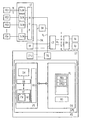
- the single figure shows a schematic representation a communication system with switching components and connected end devices, as well as external Terminals.
- KS Central component of the private communication system KS is a central one Koppelfeld KF, over the terminals - of which telephone terminals FE1-FEx are indicated schematically - with each other or with to a public communication system leading lines AL are connectable.
- the central switching matrix is under the control influence of a central system control ST, which besides the central processor CPU a storage device SPE and contains a clock unit TG.
- the central processor controls all mediation processes and ensures preparation and allocation of tax data. These tasks can also be done on several processors can be divided.
- Access to one Local line AL takes place via the interface LS.
- This Interface includes, for example, an ISDN part, the e.g. be designed as a standardized SO interface can.
- the periphery of the communication system is expanded by a signaling unit SE, which is used to supply characters of the communication system is present.
- line connection devices symbolized by the line connection device LT available. These each contain subscriber line modules SLM.
- the subscriber line modules are via subscriber lines ASL with one of the communication terminals FE connected. They are basically for either Connection of analog or for the connection of digital Communication terminals provided.
- the message transmission takes place in the case of digital communication terminals Message channels N and the signaling is via a additional channel S transmitted.
- the from the respective communication terminal supplied digital voice information become a switching matrix KF via a multiplexing device MUX passed.
- the mediation are controlled Line connection devices LT from the system control ST.
- Each line connection device is via a signaling channel SK connected to the system control. About this Signaling channel the information e.g. with help the well-known HDLC transmission procedure.
- the clock signals offered by the system controller are over distributes a clock line TL to the line connection devices.
- the unit TG symbolizes that through it the clock signals are made available.
- the system processor CPU of the system control ST has access to the information stored in the storage device SPE.
- This storage device is basically in the program memory PS and divided into the data storage DS.
- the program memory PS include the operating system BS and those to him regarding peripheral technology, operational technology, of security technology and switching technology Programs saved.
- the operating system BS coordinates the variety typical for the communication system KS of quasi-simultaneous and also to be done Individual tasks. Its main job is in Dependency on arriving or within the control panel formed incentives to the system processor CPU that the Actual system control unit is processing instructions assign. These involve a reaction on the incentives in question. For every possible incentive there is therefore an incentive-specific one in the system control Processing instructions available as the respective Program module is stored in the program memory PS.
- the switching program module VT indicated for the other modules.
- With LM is denotes a module assigned to the switching technology, this symbolic for the implementation of the individual performance features existing program modules.
- the memory part DS is the sub-unit of the database Area KD indicated.
- the data storage DS is used, among other things, for recording of temporary data for program sequence control. It will in it data is also transferred, which during a through a Terminal initiated connection establishment or when using of a service or a feature become.
- Storage section are all on the respective terminal related data stored. So it is both the current one mediation state - for example whether the concerned participant has lifted the handset whether he is called etc. - as storage information for the controller removable. Likewise, the specified storage locations services or features used in each case stored. These memory sections are considered dynamic View database for the individual devices.
- each of these end devices there is a dedicated to its control appropriate terminal program module available, in association with the program memory PS by the module DH is symbolized.
- Each of these existing modules DH offers a uniform system interface to the switching technology Structure level through the switching procedure program module VT is represented.
- the exchange of information between the two named structure and control levels is carried out using defined messages, for example via the indicated software bus structure SB be transmitted. This can be an integral part of the Operating system.
- the participant of the terminal FE1 has the Possibility of using a specified procedure to call the number of the subscriber desired by him or that of the assigned subscriber Store terminal Ex in a central list FL.
- the procedure can be carried out, for example, by actuating a corresponding function key or by dialing one predetermined combination of digits with the following dial-in the call number of the external subscriber.
- This Call number symbolized by the reference symbol REx is accordingly in a free line of the total for this list FL envisaged memory area.
- Identification KFE1 for the terminal FE1 of the internal subscriber is particularly useful if he knows that the the person you want to talk to usually others to the Communication system KS calls connected devices.
- the internal participant (Terminal device FE2) characteristic election information are in Target system KS in a specified area of the working memory initially cached to fundamentally for it the follow-up functions required in this context To have available.
- This connection can be established in the context of a Connection establishment procedure already implemented in the system be made. This connection establishment is e.g. by initiating a redirection procedure accordingly or to implement a callback procedure. For example the connection establishment procedure for the originally intended This causes target participants in the sense of a recall that the connection addresses of the internal target subscriber and the assigned external line as the addresses a calling and a recalling subscriber of the corresponding Program control for the implementation of recall procedures be handed over. Upon completion of the compulsory assigned conversation about the participation of the terminal After this call, FE1 becomes the busy line to the external participant first on hold transferred.
- connection to the original target device of the terminal For example, FE2 can also be activated by pressing according to the function key provided.
- connection to the originally desired target participant could also end after the forcibly allocated call connection by the beneficiary participant in the frame a handover.
Landscapes
- Engineering & Computer Science (AREA)
- Physics & Mathematics (AREA)
- Astronomy & Astrophysics (AREA)
- General Physics & Mathematics (AREA)
- Computer Networks & Wireless Communication (AREA)
- Signal Processing (AREA)
- Telephonic Communication Services (AREA)
- Mobile Radio Communication Systems (AREA)
- Exchange Systems With Centralized Control (AREA)
- Data Exchanges In Wide-Area Networks (AREA)
Claims (12)
- Procédé pour un système de communication (KS) en vue de la commutation de terminaux de communication raccordés (FE1 à FEx) entre eux et avec des terminaux de communication externes (Ex, Ey), dans lequel il est prévu une commande de système (ST) qui met en oeuvre la coordination et la commande de technique de commutation et qui comporte une mémoire de système (SPE) pour la mémorisation de modules de programme et de données concernant entre autres des informations propres à la liaison et des informations d'identification à entrer du côté de l'abonné et au moins un processeur de système (CPU) auquel, sous le contrôle d'un système d'exploitation (BS), les modules de programme sont attribués pour être exécutés,
un abonné du système de communication (KS) peut entrer le numéro d'appel complet d'un abonné externe et un identificateur déterminant le terminal (FE1) de l'abonné du système de communication qui sont enregistrés ensemble dans une zone (FL) de la mémoire de système,
à chaque demande de liaison externe entrante, à la suite de laquelle l'information complète de numéro d'appel du terminal concerné (Ex) de l'abonné externe est transmise automatiquement au système de communication (KS), on vérifie dans la zone de mémoire si celle-ci contient ce numéro d'appel, et
lorsqu'une coïncidence est constatée, un programme séquentiel installé dans la commande de système (ST) établit la liaison non pas directement vers l'abonné souhaité mais vers le terminal (FE1) déterminé par l'identificateur mémorisé et en association avec l'information de numéro d'appel. - Procédé selon la revendication 1,
caractérisé par le fait que, lorsque cet abonné favorisé n'accepte pas l'appel, on établit immédiatement après cette constatation une liaison vers le terminal (FE2) initial, déterminé par l'information de sélection reçue et mémorisé en conséquence, de l'abonné souhaité. - Procédé selon la revendication 1,
caractérisé par le fait qu'un programme séquentiel installé dans la commande de système (ST) fait en sorte que la procédure d'établissement de liaison vers le terminal (FE1) de l'abonné favorisé soit effectuée dans le sens d'une procédure de liaison déjà installée, par exemple une procédure de renvoi ou une procédure de rappel. - Procédé selon la revendication 1,
caractérisé par le fait qu'aussi bien l'information de numéro d'appel transmise de l'abonné externe (Ex) qu'une adresse de raccordement ou des informations de sélection du terminal (FE2) de l'abonné destinataire interne initialement souhaité sont enregistrées dans une zone de mémoire définie, après une évaluation appropriée et en association avec cette information de numéro d'appel de l'abonné externe, de telle sorte qu'une liaison peut être établie de l'abonné externe vers l'abonné destinataire initialement souhaité soit automatiquement soit par une tâche d'abonné correspondante. - Procédé selon la revendication 3,
caractérisé par le fait que la procédure d'établissement de liaison vers l'abonné destinataire initial est déclenchée dans le sens d'un rappel par le fait que des adresses de raccordement de l'abonné destinataire interne et d'une ligne externe (AL) respectivement occupée sont transmises comme adresses d'un abonné appelant et d'un abonné rappelant à la commande de programme (PS) pour la réalisation de procédures de rappel. - Procédé selon l'une des revendications 3 à 5,
caractérisé par le fait que, après la liaison de conversation forcément attribuée vers le terminal (FE1) de l'abonné favorisé, après la fin de cette conversation, une ligne occupée vers l'abonné externe (Ex) est mise en état de garde, une liaison vers l'abonné destinataire initial est automatiquement établie et, avec l'information de signalisation, la liaison vers l'abonné externe (Ex) est interconnectée. - Procédé selon la revendication 1,
caractérisé par le fait que la liaison vers le terminal (FE2) de l'abonné destinataire initialement souhaité, après que l'abonné favorisé a mis fin à la liaison de conversation forcément attribuée, est commutée par cet abonné dans le cadre d'un transfert de communication. - Procédé selon la revendication 1,
caractérisé par le fait que, après la fin de la liaison de conversation entre l'abonné externe et l'abonné favorisé et après l'établissement consécutif de la liaison entre l'abonné externe et l'abonné destinataire initial, les données mémorisées à ce sujet sont effacées. - Procédé selon la revendication 1,
caractérisé par le fait que le numéro d'appel de l'abonné externe et le numéro d'appel de l'abonné destinataire souhaité sont affichés sur le dispositif d'affichage du poste d'abonné favorisé. - Procédé selon la revendication 1,
caractérisé par le fait que la mémorisation du numéro d'appel d'un abonné externe est déclenchée par un abonné interne par la composition d'un indicatif prédéterminé ou d'une combinaison d'indicatifs prédéterminée ou par l'actionnement d'une touche de fonction. - Procédé selon la revendication 1,
caractérisé par le fait que, si une liaison de conversation avec le terminal favorisé (FE1) ne se produit pas, un programme séquentiel installé dans la commande de système fait qu'une liaison vers un système de mémoire vocale s'effectue, qu'un message vocal préalablement mémorisé sélectivement par l'abonné interne favorisé dans ce système de mémoire vocale pour l'abonné externe déterminé peut être lu lors d'un appel entrant de cet abonné externe déterminé et être transmis à ce dernier. - Procédé selon la revendication 11,
caractérisé par le fait que, dans le système de mémoire vocale, par une comparaison de l'information de numéro d'appel transmise de l'abonné externe avec des informations de numéro d'appel couplées à des messages vocaux, le message vocal respectivement actuel est sélectionné de telle sorte que, lorsqu'une coïncidence est constatée, l'émission individuelle ciblée du message vocal prédéterminé par le couplage est provoquée.
Applications Claiming Priority (2)
| Application Number | Priority Date | Filing Date | Title |
|---|---|---|---|
| DE19706782 | 1997-02-20 | ||
| DE19706782A DE19706782C2 (de) | 1997-02-20 | 1997-02-20 | Verfahren für ein Kommunikationssystem |
Publications (3)
| Publication Number | Publication Date |
|---|---|
| EP0861007A2 EP0861007A2 (fr) | 1998-08-26 |
| EP0861007A3 EP0861007A3 (fr) | 2000-04-12 |
| EP0861007B1 true EP0861007B1 (fr) | 2004-06-16 |
Family
ID=7820968
Family Applications (1)
| Application Number | Title | Priority Date | Filing Date |
|---|---|---|---|
| EP98102923A Expired - Lifetime EP0861007B1 (fr) | 1997-02-20 | 1998-02-19 | Procédé d'acheminement d'appels dans un système de communication |
Country Status (3)
| Country | Link |
|---|---|
| EP (1) | EP0861007B1 (fr) |
| AT (1) | ATE269624T1 (fr) |
| DE (2) | DE19706782C2 (fr) |
Family Cites Families (4)
| Publication number | Priority date | Publication date | Assignee | Title |
|---|---|---|---|---|
| US5109405A (en) * | 1988-07-11 | 1992-04-28 | Dytel Corporation | Automated call screening |
| CA2058814C (fr) * | 1991-02-27 | 1996-04-09 | David Glenn Carlson | Methode et appareil souples pour optimiser l'acceptation et l'acheminement des appels telephoniques |
| EP0520483B1 (fr) * | 1991-06-28 | 1995-01-04 | Siemens Aktiengesellschaft | Procédé et arrangement pour réaliser des connexions téléphoniques |
| US5537470A (en) * | 1994-04-06 | 1996-07-16 | At&T Corp. | Method and apparatus for handling in-bound telemarketing calls |
-
1997
- 1997-02-20 DE DE19706782A patent/DE19706782C2/de not_active Expired - Fee Related
-
1998
- 1998-02-19 DE DE59811555T patent/DE59811555D1/de not_active Expired - Fee Related
- 1998-02-19 EP EP98102923A patent/EP0861007B1/fr not_active Expired - Lifetime
- 1998-02-19 AT AT98102923T patent/ATE269624T1/de not_active IP Right Cessation
Also Published As
| Publication number | Publication date |
|---|---|
| EP0861007A2 (fr) | 1998-08-26 |
| DE19706782A1 (de) | 1998-09-03 |
| DE19706782C2 (de) | 1999-01-21 |
| ATE269624T1 (de) | 2004-07-15 |
| DE59811555D1 (de) | 2004-07-22 |
| EP0861007A3 (fr) | 2000-04-12 |
Similar Documents
| Publication | Publication Date | Title |
|---|---|---|
| DE69325562T2 (de) | Nicht-überwachte Konferenz, durch Telefonendgerät geregelt | |
| EP0306693A1 (fr) | Système de communication numérique à structure modulaire | |
| EP0813330A2 (fr) | Procédé d'établissement de connexion, central de commutation, processeur de service et réseau de communication | |
| EP0304652B1 (fr) | Méthode pour un central téléphonique commandé par programme dans lequel des caractéristiques de service concernant la réalisation d'une connexion de parole sont introduites à partir d'un poste d'abonné | |
| EP0535601B1 (fr) | Procédé pour l'établissement de connexions de conférence dans un système de communication à commande par processeur | |
| EP0557777B1 (fr) | Système de télécommunication commandé par programme avec option de rappel automatique | |
| EP0720399B1 (fr) | Méthode de commande du mode de fonctionnement d'un appareil mobile associé à un système de communication à commande programmée | |
| EP0585480A1 (fr) | Méthode et dispositif pour établir des connexions de conférence dans un central téléphonique commandé par calculation | |
| EP0529343B1 (fr) | Méthode d'établir une liaison de communication entre un terminal de communication, connectée à un central de communication, et plusieurs terminaux | |
| DE19706782C2 (de) | Verfahren für ein Kommunikationssystem | |
| DE19953221A1 (de) | Verfahren, Netzwerkeinrichtung und Vermittlungsstelle zur Übermittlung einer individuellen, einen Anrufer identifizierenden Nachricht an einen angerufenen Teilnehmer | |
| EP0535602A2 (fr) | Système de communication avec commande programmée dans lequel une demande de connexion est signalée simultanément dans plusieurs terminaux de communication | |
| DE10122171B4 (de) | Anzeige der Uhrzeit, des Datums und der Abgangsnummer an einen anrufenden Teilnehmer | |
| EP0866594B1 (fr) | Système de communication, en particulier système de communication privé à commande par programme dans lequel une fonction de calendrier est réalisée | |
| EP0707404B1 (fr) | Procédé pour la réception des appels dans un système de communication | |
| DE4232861C1 (de) | Verfahren zur Steuerung von Verbindungsprozeduren in einer programmgesteuerten Nebenstellenanlage mit daran angeschlossenen Mobilendgeräten | |
| EP0689336A2 (fr) | Autocommutateur téléphonique comportant un dispositif de mémorisation de signaux vocaux | |
| DE19706780A1 (de) | Kommunikationssystem, das die Möglichkeit der Anrufumleitung bietet | |
| DE4006048C2 (fr) | ||
| DE4232862C1 (de) | Verfahren für die Auswertung betriebstechnischer Dateninformationen bei einer programmgesteuerten Nebenstellenanlage mit daran angeschlossenen Mobilendgeräten | |
| DE19818513B4 (de) | Verfahren zum Aufbau einer Verbindung durch ein an ein Kommunikationssystem angeschlossenes Endgerät | |
| DE19734932C2 (de) | Verfahren für ein Kommunikationssystem mit Zugriffmöglichkeit auf einen Sprachspeicher | |
| EP0352700B1 (fr) | Méthode pour réaliser une procédure de commande de service spécifique dans un système de communication commandé par calculateur en particulier un système de communication à touches avec la possibilité de branchement sur une connexion existante | |
| EP0897239A2 (fr) | Sytème de communication commandé par programme avec accès à une mémoire de parole | |
| DE19844672B4 (de) | Programmgesteuertes Kommunikationssystem zur Vermittlung von daran angeschlossenen analogen und digitalen Kommunikationsendgeräten |
Legal Events
| Date | Code | Title | Description |
|---|---|---|---|
| PUAI | Public reference made under article 153(3) epc to a published international application that has entered the european phase |
Free format text: ORIGINAL CODE: 0009012 |
|
| AK | Designated contracting states |
Kind code of ref document: A2 Designated state(s): AT BE CH DE FI FR GB LI NL |
|
| AX | Request for extension of the european patent |
Free format text: AL;LT;LV;MK;RO;SI |
|
| PUAL | Search report despatched |
Free format text: ORIGINAL CODE: 0009013 |
|
| AK | Designated contracting states |
Kind code of ref document: A3 Designated state(s): AT BE CH DE DK ES FI FR GB GR IE IT LI LU MC NL PT SE |
|
| AX | Request for extension of the european patent |
Free format text: AL;LT;LV;MK;RO;SI |
|
| RIC1 | Information provided on ipc code assigned before grant |
Free format text: 7H 04Q 3/62 A, 7H 04M 3/54 B, 7H 04M 3/48 B |
|
| 17P | Request for examination filed |
Effective date: 20000510 |
|
| AKX | Designation fees paid |
Free format text: AT BE CH DE FI FR GB LI NL |
|
| 17Q | First examination report despatched |
Effective date: 20021128 |
|
| RTI1 | Title (correction) |
Free format text: METHOD FOR CALL ROUTING IN A COMMUNICATIONS SYSTEM |
|
| GRAP | Despatch of communication of intention to grant a patent |
Free format text: ORIGINAL CODE: EPIDOSNIGR1 |
|
| RTI1 | Title (correction) |
Free format text: METHOD FOR CALL ROUTING IN A COMMUNICATIONS SYSTEM |
|
| GRAS | Grant fee paid |
Free format text: ORIGINAL CODE: EPIDOSNIGR3 |
|
| GRAA | (expected) grant |
Free format text: ORIGINAL CODE: 0009210 |
|
| AK | Designated contracting states |
Kind code of ref document: B1 Designated state(s): AT BE CH DE FI FR GB LI NL |
|
| PG25 | Lapsed in a contracting state [announced via postgrant information from national office to epo] |
Ref country code: NL Free format text: LAPSE BECAUSE OF FAILURE TO SUBMIT A TRANSLATION OF THE DESCRIPTION OR TO PAY THE FEE WITHIN THE PRESCRIBED TIME-LIMIT Effective date: 20040616 Ref country code: FI Free format text: LAPSE BECAUSE OF FAILURE TO SUBMIT A TRANSLATION OF THE DESCRIPTION OR TO PAY THE FEE WITHIN THE PRESCRIBED TIME-LIMIT Effective date: 20040616 |
|
| REG | Reference to a national code |
Ref country code: GB Ref legal event code: FG4D Free format text: NOT ENGLISH |
|
| REG | Reference to a national code |
Ref country code: CH Ref legal event code: EP |
|
| REF | Corresponds to: |
Ref document number: 59811555 Country of ref document: DE Date of ref document: 20040722 Kind code of ref document: P |
|
| GBT | Gb: translation of ep patent filed (gb section 77(6)(a)/1977) |
Effective date: 20040812 |
|
| NLV1 | Nl: lapsed or annulled due to failure to fulfill the requirements of art. 29p and 29m of the patents act | ||
| PG25 | Lapsed in a contracting state [announced via postgrant information from national office to epo] |
Ref country code: AT Free format text: LAPSE BECAUSE OF NON-PAYMENT OF DUE FEES Effective date: 20050219 |
|
| PG25 | Lapsed in a contracting state [announced via postgrant information from national office to epo] |
Ref country code: LI Free format text: LAPSE BECAUSE OF NON-PAYMENT OF DUE FEES Effective date: 20050228 Ref country code: CH Free format text: LAPSE BECAUSE OF NON-PAYMENT OF DUE FEES Effective date: 20050228 Ref country code: BE Free format text: LAPSE BECAUSE OF NON-PAYMENT OF DUE FEES Effective date: 20050228 |
|
| ET | Fr: translation filed | ||
| PLBE | No opposition filed within time limit |
Free format text: ORIGINAL CODE: 0009261 |
|
| STAA | Information on the status of an ep patent application or granted ep patent |
Free format text: STATUS: NO OPPOSITION FILED WITHIN TIME LIMIT |
|
| 26N | No opposition filed |
Effective date: 20050317 |
|
| BERE | Be: lapsed |
Owner name: *SIEMENS A.G. Effective date: 20050228 |
|
| REG | Reference to a national code |
Ref country code: CH Ref legal event code: PL |
|
| PGFP | Annual fee paid to national office [announced via postgrant information from national office to epo] |
Ref country code: FR Payment date: 20060220 Year of fee payment: 9 |
|
| PGFP | Annual fee paid to national office [announced via postgrant information from national office to epo] |
Ref country code: DE Payment date: 20060424 Year of fee payment: 9 |
|
| GBPC | Gb: european patent ceased through non-payment of renewal fee |
Effective date: 20070219 |
|
| REG | Reference to a national code |
Ref country code: FR Ref legal event code: ST Effective date: 20071030 |
|
| BERE | Be: lapsed |
Owner name: *SIEMENS A.G. Effective date: 20050228 |
|
| PG25 | Lapsed in a contracting state [announced via postgrant information from national office to epo] |
Ref country code: DE Free format text: LAPSE BECAUSE OF NON-PAYMENT OF DUE FEES Effective date: 20070901 |
|
| PG25 | Lapsed in a contracting state [announced via postgrant information from national office to epo] |
Ref country code: GB Free format text: LAPSE BECAUSE OF NON-PAYMENT OF DUE FEES Effective date: 20070219 Ref country code: FR Free format text: LAPSE BECAUSE OF NON-PAYMENT OF DUE FEES Effective date: 20070228 |
|
| PGFP | Annual fee paid to national office [announced via postgrant information from national office to epo] |
Ref country code: GB Payment date: 20060209 Year of fee payment: 9 |