EP0861449B1 - Hochauflösendes seismisches verfahren mit einer vielzahl von schwingungsquellen - Google Patents
Hochauflösendes seismisches verfahren mit einer vielzahl von schwingungsquellen Download PDFInfo
- Publication number
- EP0861449B1 EP0861449B1 EP96936034A EP96936034A EP0861449B1 EP 0861449 B1 EP0861449 B1 EP 0861449B1 EP 96936034 A EP96936034 A EP 96936034A EP 96936034 A EP96936034 A EP 96936034A EP 0861449 B1 EP0861449 B1 EP 0861449B1
- Authority
- EP
- European Patent Office
- Prior art keywords
- minimum phase
- band pass
- vibrator
- vibratory
- pass filtered
- Prior art date
- Legal status (The legal status is an assumption and is not a legal conclusion. Google has not performed a legal analysis and makes no representation as to the accuracy of the status listed.)
- Expired - Lifetime
Links
- 238000000034 method Methods 0.000 title claims description 46
- 230000033001 locomotion Effects 0.000 claims description 37
- 238000012546 transfer Methods 0.000 claims description 10
- 238000007781 pre-processing Methods 0.000 claims description 9
- 238000001914 filtration Methods 0.000 claims description 8
- 238000002310 reflectometry Methods 0.000 claims description 6
- 238000012421 spiking Methods 0.000 claims description 6
- 230000003068 static effect Effects 0.000 claims description 6
- 238000012937 correction Methods 0.000 claims description 5
- 230000001364 causal effect Effects 0.000 claims description 3
- 238000012545 processing Methods 0.000 description 16
- 230000006870 function Effects 0.000 description 11
- 230000004044 response Effects 0.000 description 10
- 238000006243 chemical reaction Methods 0.000 description 8
- 238000000926 separation method Methods 0.000 description 5
- 241000272165 Charadriidae Species 0.000 description 4
- 230000002596 correlated effect Effects 0.000 description 4
- 238000013459 approach Methods 0.000 description 3
- 230000001133 acceleration Effects 0.000 description 2
- 238000010586 diagram Methods 0.000 description 2
- 238000000819 phase cycle Methods 0.000 description 2
- 238000012790 confirmation Methods 0.000 description 1
- 230000001276 controlling effect Effects 0.000 description 1
- 230000000875 corresponding effect Effects 0.000 description 1
- 230000008878 coupling Effects 0.000 description 1
- 238000010168 coupling process Methods 0.000 description 1
- 238000005859 coupling reaction Methods 0.000 description 1
- 230000007812 deficiency Effects 0.000 description 1
- 230000000694 effects Effects 0.000 description 1
- 238000005516 engineering process Methods 0.000 description 1
- 238000005191 phase separation Methods 0.000 description 1
- 230000003595 spectral effect Effects 0.000 description 1
- 238000012360 testing method Methods 0.000 description 1
- 230000002087 whitening effect Effects 0.000 description 1
Images


Classifications
-
- G—PHYSICS
- G01—MEASURING; TESTING
- G01V—GEOPHYSICS; GRAVITATIONAL MEASUREMENTS; DETECTING MASSES OR OBJECTS; TAGS
- G01V1/00—Seismology; Seismic or acoustic prospecting or detecting
- G01V1/02—Generating seismic energy
- G01V1/04—Details
-
- G—PHYSICS
- G01—MEASURING; TESTING
- G01V—GEOPHYSICS; GRAVITATIONAL MEASUREMENTS; DETECTING MASSES OR OBJECTS; TAGS
- G01V1/00—Seismology; Seismic or acoustic prospecting or detecting
- G01V1/28—Processing seismic data, e.g. for interpretation or for event detection
-
- G—PHYSICS
- G01—MEASURING; TESTING
- G01V—GEOPHYSICS; GRAVITATIONAL MEASUREMENTS; DETECTING MASSES OR OBJECTS; TAGS
- G01V2210/00—Details of seismic processing or analysis
- G01V2210/20—Trace signal pre-filtering to select, remove or transform specific events or signal components, i.e. trace-in/trace-out
Definitions
- the present invention pertains to seismic data processing and more particularly to pre-processing seismic data in which data generated by multiple vibrating sources is received and prepared for high resolution or high fidelity data processing.
- a large mass is placed in contact with the ground.
- a force is applied by reversing hydraulic flow in a chamber in a reaction mass that is suspended by a piston and rod assembly that is attached to a stilt structure at a cross member.
- the reaction mass motion is measured by an accelerometer mounted on the reaction mass itself.
- the motion of a baseplate, which is actually coupled to the ground, is measured by an accelerometer mounted on the stilt structure cross member.
- a reference sweep signal is an ideal signal which the vibrator is told to put into the ground, which is often quite different from the actual signal which is generated.
- An estimate for the applied force is the mass weighted sum of the acceleration of the baseplate used in the vibrating source and the acceleration of the reaction mass used in the vibrator structure, called the ground force.
- the mass weighted sum of the two signals, one from the baseplate and one from its reaction mass, is used in a feedback loop to tell the actuator how close it is to the reference sweep. With this system it is assumed that the force injected into the ground is the same as the reference sweep. However, as stated previously, the actual signal is often very different from the reference sweep signal. In US-A-4646274, this mass weighted sum is recorded simultaneously with the reflected seismic signal, and used to generate an inverse filter.
- the force put into the ground can be viewed either in the time domain or in the frequency domain.
- the impulse response of the earth can be viewed either in the time domain or the frequency domain.
- the time derivative of the force put into the ground is convolved with the impulse response of the earth in the time domain while the time derivative of the force is multiplied by the impulse response of the earth in the frequency domain.
- a signal representing the derivative of the ground force convolved with the impulse response of the earth is detected by geophones or receivers located on the surface of the earth. This signal is detected after it has been reflected by an interface existing between two subsurface layers having different impedances.
- the detected signal is correlated with the reference sweep signal fed to the actuator. This correlation works fine to compress the force portion of the detected signal in a known way as long as the force put into the ground is the same as the reference sweep signal. Since it is rarely the same, an accurate estimate of the impulse response of the earth is seldom achieved.
- Correlation in the frequency domain requires that the data be multiplied by the time reverse of whatever signal with which the correlation is being done. Since the reference signal is only an estimate of the actual ground force, the result is that unknowns remain in the data. In the case of correlation of the signal with the reference, the unknown does less damage to the result as long as the amplitude and phase errors of the reference signal are small, but it still adds error.
- the present invention provides a method for recording and pre-processing high resolution vibratory source data which includes measuring the motion or motions of the vibrators.
- pairs of accelerometers are used in each of two positions on a large mass so that the outputs may be compared and a determination may be made whether the signal generated is suitable for use in further processing.
- the measured motion or motions of the vibrators are related to the actual vibrator applied force by a transfer function of a minimum phase, causal, linear system. These measured motions are used to separate received signals. Further, these signals are used in an inversion operation to process the received data.
- the method of the present invention relates the actual vibrator output with the measured vibrator motion or motions.
- the vibrators are energized with a predetermined pattern. This pattern is used along with the measured motion or motions of the source to separate the received data according to the source used to generate the detector motion.
- a ratio is determined by dividing the vibratory seismic data by the measured motion or motions of each of the vibrators to remove the unknown applied force leaving the earth reflectivity times a time derivative, divided by a minimum phase function.
- Minimum phase deconvolution is performed to remove the time derivative divided by the transfer function of minimum phase.
- the method may also include the steps of shot ensemble deconvolution, receiver ensemble deconvolution, statics correction, F-K filtering for noise, receiver deconvolution, zero phase spiking deconvolution and model dephasing.
- Figure 1 is a drawing illustrating a typical seismic data gathering procedure.
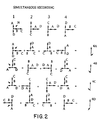
- Figure 2 is a vector representation of the phase sequence employed to separate simultaneously acquired sweeps.
- Figure 3 is a block diagram of a flow chart illustrating a preprocessing method for data generated by multiple vibratory sources.
- a simple vibrator may be used in the present invention.
- a large mass is placed in contact with the ground.
- a force is applied by reversing hydraulic flow in a chamber in a reaction mass that is suspended by a piston and rod assembly that is attached to a stilt structure at a cross member.
- the reaction mass motion is measured by a pair of accelerometers mounted on the reaction mass itself.
- the motion of a baseplate, which is actually coupled to the ground, is measured by an additional pair of accelerometers mounted on the stilt structure cross member.
- a signal directly related to the actual signal that the vibrator is sending into the ground is used in pre-processing.
- the vibrator motion or motions are measured to provide a signal that is used to process the data.
- the data is not correlated with a theoretical sweep signal but the data is divided by a minimum phase relative of the actual transmitted signal in the frequency domain, which removes the actual transmitted signal from the determination.
- data is basically divided by the vibrator ground force multiplied by a transfer function of minimum phase, removing the vibrator force from the data. This leaves the earth reflectivity multiplied by a time derivative divided by a minimum phase transfer function, which ratio is then removed by minimum phase deconvolution.
- FIG. 1 is a system diagram illustrating the data gathering process of the present invention.
- Vibrators 18, 20, 22 and 24 with two pairs of accelerometers 26, 28, 30 and 32, as described above, that measure the actual signal that is generated into the earth are located on trucks 34, 36, 38 and 40, respectively.
- the signals are then transmitted via radio link 42 to master vibrator memory 44 where they are checked to determine their reliability and are stored for comparison at a later time.
- the signals that are generated into the earth by vibrators 18, 20, 22 and 24 are reflected off the interface between subsurface impedance Im 1 and Im 2 at various points, I 1 , I 2 , ... etc. along the interface. These reflected signals are detected by geophones D 1 , D 2 , D 3 and D 4 , respectively.
- the signals generated by vibrators 18, 20, 22 and 24 on trucks 34, 36, 38 and 40 are transmitted to recorder 46 for transfer to tape 48 for combination with raw seismic data received from geophones D 1 , D 2 , D 3 and D 4 .
- the received data signals and the raw seismic data stored on a tape 48 can be transferred to computers at other locations.
- the measured signals are representative of the actual signals that are generated into the surface of the earth through vibratory source technique. These measured signals are minimum phase relatives of the actual signals that are generated into the earth by this technique. In prior art applications, most processing is done with the reference sweep signal which is the signal intended to be generated into the surface of the earth. In the present invention, a signal which is minimum phase related to the actual force generated into the earth is measured and taken from the vibrator source directly. Thus, a relative of the actual signal is used in the process instead of a theoretical signal.
- High Fidelity Vibratory Seismic, HFVS, recording vibratory motion and processing the recorded seismic data is done in such a way that the unknown actual applied force does not need to be known.
- An important factor is that the measured quantity is directly proportional to the actual force applied. In this manner, the actual force can be eliminated by division.
- a reference signal x is fed to an actuator which puts a signal, the true vibrator output, into the ground.
- the true vibrator output travels through the earth, it is multiplied by the impulse response of the earth in the frequency domain or convolved with the impulse response in the time domain. It is this convolution product, the time derivative of the actual signal convolved with the impulse response of the earth that is correlated with the reference sweep signal. This process is correct if and only if the reference sweep signal is equal to the true vibrator output.
- the present invention takes a different approach than conventional processing.
- the present invention recognizes that the motions measured on the vibrator are merely related to the actual output force or signal that is put into the ground.
- the measured signal is related to the actual ground by a minimum phase transfer function in the frequency domain.
- the minimum phase transfer function may be removed by minimum phase deconvolution.
- the present invention performs an inversion operation instead of the correlation process of conventional processing.
- the detected seismic data is represented in the frequency domain by the product of the time derivative of the actual force with the reflectivity of the earth.
- the ratio of the measured seismic motion to the measured motion of the vibrator can be computed. This ratio eliminates the unknown actual output force.
- a scaling factor is also required to preserve total energy through the inverse filtering process.
- the resulting seismogram is represented by the ratio of the measured seismic motion to the measured motion of the vibrator and is the desired answer, the earth reflectivity, convolved with a minimum phase function. It is a property of minimum phase functions that their derivative and their reciprocal are also minimum phase.
- the seismogram can be further processed with minimum phase deconvolution to obtain the impulse response of the earth in the frequency domain.
- the ratio of the measured seismic motion to the measured motion of the vibrator seismogram is the band limited impulse seismogram. It is causal and minimum phase related to the earth response.
- Figure 2 illustrates a phase sequence employed to separate the simultaneously acquired sweeps.
- the method of solution illustrated does not cross couple the vibrators by making A cancel B for instance but it does require that A done at 0 degrees plus another A done at 180 degrees must add to zero in the solution for B.
- the phase feedback loop and the amplitude control were not capable of guaranteeing the latter condition. Of more difficulty is to cause a sweep done at 0 degrees to cancel when added to one done at 90 degrees and with 90 degrees of phase added.
- the necessary processing signals can be encoded in a similar fashion and the individual vibrator motions can be extracted. This means that only one signal needs to be telemetered to the recorder for each sweep sequence.
- FIG. 3 a flow chart of the method of present invention is illustrated in block form. This method may be performed on any digital computer or work station currently in use in the art.
- Data stored on tape 48 is received.
- Data received may be of any type of seismic data generated using vibratory source techniques.
- the received data is separated. This process begins when the seismic energy responsible for the data is first generated. There are several methods for generating seismic data to permit separation of the detected data which have been discussed previously. Any of the previous methods along with any methods currently in use in the art may be used to separate the received data, however, the preferred embodiment with the phase separation previously described.
- the inversion process is performed on the received data with the measured signals. This represents a significant difference between the present invention and conventional processing.
- conventional processing the received data is convolved with signals that are assumed to be generated into the earth's surface.
- an inversion process is used which eliminates certain assumptions which have been described previously.
- This model trace is basically a trace with a spike to record the phase and amplitude of the original data and will be used later to remove phase errors introduced in the pre-processing method of the present invention.
- the results of block 54 undergoes shot deconvolution.
- a Wiener-Levinson spiking deconvolution is used in the present invention, however, any deconvolution which uses a common shot gather format to remove the effects due to variations between individual shots may be used.
- source statics correction is performed on the data.
- the same gather for statics correction and for FK filtering is used, a constant receiver location gather to remove source statics.
- FK filtering is performed using a constant receiver location variable shot gather to remove ground roll.
- receiver deconvolution is performed on the data, which is also, preferably, a Wiener-Levinson spiking ensemble deconvolution. This is a common receiver gather to remove receiver noise, however, any deconvolution that is directed to the removal of receiver noise is acceptable.
- the data undergoes zero phase spiking deconvolution. This is a spectral whitening deconvolution to remove monochromatic noise.
- model dephasing is done.
- the model trace which was generated at block 56 to record the original phase and amplitude is used to remove any phase errors introduced by the previous processing steps.
- the method of the present invention has completed the pre-processing and conventional processing may commence after block 68.
- the method of the present invention for recording and pre-processing high resolution vibratory source data includes the steps of division with measured signals, receiver and shot ensemble deconvolution, statics correction, F-K filtering for noise, zero phase spiking deconvolution and model dephasing.
- an actual vibrator signal related to what the vibrator is sending into the ground is used in pre-processing.
- the vibrator motion is measured to provide a signal that is used to process the data.
- the data is divided by the actual transmitted signal in the frequency domain.
Landscapes
- Engineering & Computer Science (AREA)
- Remote Sensing (AREA)
- Physics & Mathematics (AREA)
- Life Sciences & Earth Sciences (AREA)
- Acoustics & Sound (AREA)
- Environmental & Geological Engineering (AREA)
- Geology (AREA)
- General Life Sciences & Earth Sciences (AREA)
- General Physics & Mathematics (AREA)
- Geophysics (AREA)
- Geophysics And Detection Of Objects (AREA)
- Measurement Of Mechanical Vibrations Or Ultrasonic Waves (AREA)
- Apparatuses For Generation Of Mechanical Vibrations (AREA)
Claims (7)
- Verfahren zum Aufzeichnen und Vorverarbeiten von hochgradig wiedergabetreuen seismischen Vibrationsdatensignalen, die von mehreren seismischen Vibrationsquellen erzeugt werden, wobei die seismischen Datensignale von seismischen Detektoren empfangen werden,
gekennzeichnet durchMessen der Bewegung jeder der Vibrationsquellen, die mit einer von der Vibrationseinrichtung ausgeübten Kraft, die mit einer Übertragungsfunktion eines kausalen linearen Systems mit minimaler Phase multipliziert ist, in Beziehung steht;Herstellen einer Beziehung zwischen dem Ist-Vibrationseinrichtungsausgang und der gemessenen Vibrationseinrichtungsbewegung;Separieren der seismischen Vibrationsdatensignale nach der erzeugenden Quelle;Bestimmen eines Verhältnisses durch Dividieren der seismischen Vibrationsdatensignale durch die gemessene Bewegung jeder Vibrationsquelle, um die unbekannte ausgeübte Kraft zu beseitigen, um die Reflexionskraft der Erde, die mit einer durch eine minimale Phasenfunktion dividierten Zeitableitung multipliziert ist, übrig zu lassen;Ausführen einer Minimalphasen-Bandpaßfilterung des sich ergebenden Verhältnisses; undAusführen einer Rückwärtsfaltung an dem Verhältnis, an dem die Minimalphasen-Bandpaßfilterung ausgeführt worden ist, um die durch die Übertragungsfunktion mit minimaler Phasenfunktion dividierte Zeitableitung zu beseitigen. - Verfahren nach Anspruch 1, ferner gekennzeichnet durch:Ausführen einer Schußgesamtheit-Rückwärtsfaltung an dem Verhältnis, an dem die Minimalphasen-Bandpaßfilterung ausgeführt worden ist.
- Verfahren nach Anspruch 1, ferner gekennzeichnet durch:Ausführen einer Empfängergesamtheit-Rückwärtsfaltung an dem Verhältnis, an dem die Minimalphasen-Bandpaßfilterung ausgeführt worden ist.
- Verfahren nach Anspruch 1, ferner gekennzeichnet durch:Ausführen einer Statikkorrektur an dem Verhältnis, an dem die Minimalphasen-Bandpaßfilterung ausgeführt worden ist.
- Verfahren nach Anspruch 1, ferner gekennzeichnet durch:Ausführen einer F-K-Filterung des Rauschens an dem Verhältnis, an dem die Minimalphasen-Bandpaßfilterung ausgeführt worden ist.
- Verfahren nach Anspruch 1, ferner gekennzeichnet durch:Ausführen einer Nullphasen-Impulsspitzen-Rückwärtsfaltung an dem Verhältnis, an dem die Minimalphasen-Bandpaßfilterung ausgeführt worden ist.
- Verfahren nach Anspruch 1, ferner gekennzeichnet durch:Erzeugen einer Modellspur aus den seismischen Vibrationsdatensignalen, die durch mehrere seismische Vibrationsquellen erzeugt werden; undAusführen einer Modell-Phasenverschiebung unter Verwendung der Modellspur an dem Verhältnis, an dem die Minimalphasen-Bandpaßfilterung ausgeführt worden ist.
Applications Claiming Priority (3)
| Application Number | Priority Date | Filing Date | Title |
|---|---|---|---|
| US555654 | 1995-11-13 | ||
| US08/555,654 US5715213A (en) | 1995-11-13 | 1995-11-13 | High fidelity vibratory source seismic method using a plurality of vibrator sources |
| PCT/US1996/015574 WO1997018489A1 (en) | 1995-11-13 | 1996-09-27 | High fidelity vibratory source seismic method using a plurality of vibrator sources |
Publications (3)
| Publication Number | Publication Date |
|---|---|
| EP0861449A1 EP0861449A1 (de) | 1998-09-02 |
| EP0861449A4 EP0861449A4 (de) | 2000-12-27 |
| EP0861449B1 true EP0861449B1 (de) | 2002-11-20 |
Family
ID=24218109
Family Applications (1)
| Application Number | Title | Priority Date | Filing Date |
|---|---|---|---|
| EP96936034A Expired - Lifetime EP0861449B1 (de) | 1995-11-13 | 1996-09-27 | Hochauflösendes seismisches verfahren mit einer vielzahl von schwingungsquellen |
Country Status (9)
| Country | Link |
|---|---|
| US (1) | US5715213A (de) |
| EP (1) | EP0861449B1 (de) |
| CN (1) | CN1166962C (de) |
| AR (1) | AR004128A1 (de) |
| CA (1) | CA2234846C (de) |
| DE (1) | DE69624932T2 (de) |
| DZ (1) | DZ2121A1 (de) |
| NO (1) | NO312696B1 (de) |
| WO (1) | WO1997018489A1 (de) |
Families Citing this family (69)
| Publication number | Priority date | Publication date | Assignee | Title |
|---|---|---|---|---|
| GB2381313B (en) * | 2001-07-18 | 2005-01-05 | Westerngeco Ltd | A method of processing geophysical data |
| FR2843202B1 (fr) * | 2002-08-05 | 2004-09-10 | Inst Francais Du Petrole | Methode pour former un modele representatif de la distribution d'une grandeur physique dans une zone souterraine, affranchi de l'effet de bruits correles entachant des donnees d'exploration |
| EP1609002B1 (de) | 2003-04-01 | 2011-11-30 | ExxonMobil Upstream Research Company | Geformte hochfrequenz-vibrationsquelle |
| US20060164916A1 (en) * | 2003-08-11 | 2006-07-27 | Krohn Christine E | Method for continuous sweepting and separtion of multiple seismic vibrators |
| US7508733B2 (en) * | 2003-11-14 | 2009-03-24 | Schlumberger Technology Corporation | High-frequency processing of seismic vibrator data |
| US8208341B2 (en) * | 2003-11-14 | 2012-06-26 | Schlumberger Technology Corporation | Processing of combined surface and borehole seismic data |
| US20060248954A1 (en) * | 2005-04-26 | 2006-11-09 | Snieder Roelof K | System for and method of monitoring structural integrity of a structure |
| AU2006297766B2 (en) * | 2005-09-19 | 2011-04-28 | Exxonmobil Upstream Research Company | Method for performing controlled source electromagnetic surveying with multiple transmitters |
| US9279897B2 (en) * | 2005-12-12 | 2016-03-08 | Hannes Zuercher | Locating oil or gas passively by observing a porous oil and gas saturated system giving off its characteristic resonance response to ambient background noise, including optional differentiation of oil, locatinggas and water |
| WO2007130551A2 (en) | 2006-05-03 | 2007-11-15 | Exxonmobil Upstream Research Company | Data adaptive vibratory source acquisition method |
| US7885143B2 (en) | 2006-07-05 | 2011-02-08 | Westerngeco L.L.C. | Seismic acquisition system |
| US7295490B1 (en) | 2006-07-20 | 2007-11-13 | Conocophillips Company | System and method of phase encoding for high fidelity vibratory seismic data |
| CA2663662C (en) * | 2006-09-13 | 2016-07-05 | Exxonmobil Upstream Research Company | Rapid inversion of electromagnetic reconnaissance survey data |
| RU2435215C2 (ru) | 2006-09-28 | 2011-11-27 | Эксонмобил Апстрим Рисерч Компани | Итеративная инверсия данных от одновременных геофизических источников |
| US8000168B2 (en) * | 2006-12-08 | 2011-08-16 | Conocophillips Company | Dynamic source parameter selection for seismic vibrator data acquisition |
| US8020428B2 (en) * | 2007-04-04 | 2011-09-20 | Colorado School Of Mines | System for and method of monitoring properties of a fluid flowing through a pipe |
| US8248886B2 (en) * | 2007-04-10 | 2012-08-21 | Exxonmobil Upstream Research Company | Separation and noise removal for multiple vibratory source seismic data |
| WO2009023072A1 (en) * | 2007-08-10 | 2009-02-19 | Exxonmobil Upstream Research Company | Bottom referenced vibratory sources for shallow water acquisition |
| EP2176688A1 (de) * | 2007-08-10 | 2010-04-21 | ExxonMobil Upstream Research Company | Untersee-erfassung seismischer daten |
| US7869304B2 (en) * | 2007-09-14 | 2011-01-11 | Conocophillips Company | Method and apparatus for pre-inversion noise attenuation of seismic data |
| US7639567B2 (en) * | 2007-09-17 | 2009-12-29 | Ion Geophysical Corporation | Generating seismic vibrator signals |
| CN101334483B (zh) * | 2008-06-13 | 2011-01-26 | 徐基祥 | 一种在地震数据处理中衰减瑞雷波散射噪声的方法 |
| AU2009282330B2 (en) * | 2008-08-11 | 2013-10-10 | Exxonmobil Upstream Research Company | Estimation of soil properties using waveforms of seismic surface waves |
| US8553496B2 (en) * | 2010-02-09 | 2013-10-08 | Ion Geophysical Corporation | Seismic source separation |
| US8537638B2 (en) * | 2010-02-10 | 2013-09-17 | Exxonmobil Upstream Research Company | Methods for subsurface parameter estimation in full wavefield inversion and reverse-time migration |
| US8223587B2 (en) * | 2010-03-29 | 2012-07-17 | Exxonmobil Upstream Research Company | Full wavefield inversion using time varying filters |
| US9529102B2 (en) | 2010-04-30 | 2016-12-27 | Conocophillips Company | Caterpillar-style seismic data acquisition using autonomous, continuously recording seismic data recorders |
| US8694299B2 (en) | 2010-05-07 | 2014-04-08 | Exxonmobil Upstream Research Company | Artifact reduction in iterative inversion of geophysical data |
| US8756042B2 (en) | 2010-05-19 | 2014-06-17 | Exxonmobile Upstream Research Company | Method and system for checkpointing during simulations |
| US8767508B2 (en) | 2010-08-18 | 2014-07-01 | Exxonmobil Upstream Research Company | Using seismic P and S arrivals to determine shallow velocity structure |
| US8437998B2 (en) | 2010-09-27 | 2013-05-07 | Exxonmobil Upstream Research Company | Hybrid method for full waveform inversion using simultaneous and sequential source method |
| BR112013002842A2 (pt) | 2010-09-27 | 2016-06-07 | Exxonmobil Upstream Res Co | codificação de fonte e separação de fonte simultâneas como uma solução prática para inversão de campo de onda completa |
| CA2815054C (en) | 2010-12-01 | 2017-05-16 | Exxonmobil Upstream Research Company | Simultaneous source inversion for marine streamer data with cross-correlation objective function |
| US9551798B2 (en) * | 2011-01-21 | 2017-01-24 | Westerngeco L.L.C. | Seismic vibrator to produce a continuous signal |
| AU2012233133B2 (en) | 2011-03-30 | 2014-11-20 | Exxonmobil Upstream Research Company | Convergence rate of full wavefield inversion using spectral shaping |
| CA2825469C (en) | 2011-03-31 | 2017-06-13 | Exxonmobil Upstream Research Company | Method of wavelet estimation and multiple prediction in full wavefield inversion |
| WO2012158545A2 (en) | 2011-05-13 | 2012-11-22 | Conocophillips Company | Seismic true estimated wavelet |
| CN102323619B (zh) * | 2011-05-25 | 2013-06-12 | 中国石油集团川庆钻探工程有限公司 | 基于多核处理器的线性去噪的方法 |
| US8949030B2 (en) | 2011-07-29 | 2015-02-03 | Westerngeco L.L.C. | Attenuating sea-surface ghost wave effects in seismic data |
| EP2751710B1 (de) | 2011-09-02 | 2017-08-02 | Exxonmobil Upstream Research Company | Verwendung von projektion auf konvexe datensätze zur begrenzung von full-wavefield-inversion |
| US9176930B2 (en) | 2011-11-29 | 2015-11-03 | Exxonmobil Upstream Research Company | Methods for approximating hessian times vector operation in full wavefield inversion |
| US9274239B2 (en) | 2012-01-13 | 2016-03-01 | Westerngeco L.L.C. | Wavefield deghosting |
| RU2612896C2 (ru) * | 2012-03-08 | 2017-03-13 | Эксонмобил Апстрим Рисерч Компани | Ортогональное кодирование источника и приемника |
| MY178811A (en) | 2012-11-28 | 2020-10-20 | Exxonmobil Upstream Res Co | Reflection seismic data q tomography |
| CA2909105C (en) | 2013-05-24 | 2018-08-28 | Ke Wang | Multi-parameter inversion through offset dependent elastic fwi |
| US10459117B2 (en) | 2013-06-03 | 2019-10-29 | Exxonmobil Upstream Research Company | Extended subspace method for cross-talk mitigation in multi-parameter inversion |
| US9702998B2 (en) | 2013-07-08 | 2017-07-11 | Exxonmobil Upstream Research Company | Full-wavefield inversion of primaries and multiples in marine environment |
| CA2913496C (en) | 2013-08-23 | 2018-08-14 | Exxonmobil Upstream Research Company | Simultaneous sourcing during both seismic acquisition and seismic inversion |
| US10036818B2 (en) | 2013-09-06 | 2018-07-31 | Exxonmobil Upstream Research Company | Accelerating full wavefield inversion with nonstationary point-spread functions |
| MA39844A (fr) | 2014-04-04 | 2017-02-08 | Conocophillips Co | Procédé de séparation de données de source sismique |
| US9910189B2 (en) | 2014-04-09 | 2018-03-06 | Exxonmobil Upstream Research Company | Method for fast line search in frequency domain FWI |
| US10379235B2 (en) | 2014-05-01 | 2019-08-13 | Conocophillips Company | Deterministic phase correction and application |
| WO2015171215A1 (en) | 2014-05-09 | 2015-11-12 | Exxonmobil Upstream Research Company | Efficient line search methods for multi-parameter full wavefield inversion |
| US10185046B2 (en) | 2014-06-09 | 2019-01-22 | Exxonmobil Upstream Research Company | Method for temporal dispersion correction for seismic simulation, RTM and FWI |
| CN106662664A (zh) | 2014-06-17 | 2017-05-10 | 埃克森美孚上游研究公司 | 快速粘声波和粘弹性全波场反演 |
| US10838092B2 (en) | 2014-07-24 | 2020-11-17 | Exxonmobil Upstream Research Company | Estimating multiple subsurface parameters by cascaded inversion of wavefield components |
| US10422899B2 (en) | 2014-07-30 | 2019-09-24 | Exxonmobil Upstream Research Company | Harmonic encoding for FWI |
| US10386511B2 (en) | 2014-10-03 | 2019-08-20 | Exxonmobil Upstream Research Company | Seismic survey design using full wavefield inversion |
| CA2961572C (en) | 2014-10-20 | 2019-07-02 | Exxonmobil Upstream Research Company | Velocity tomography using property scans |
| AU2015363241A1 (en) | 2014-12-18 | 2017-06-29 | Exxonmobil Upstream Research Company | Scalable scheduling of parallel iterative seismic jobs |
| US10520618B2 (en) | 2015-02-04 | 2019-12-31 | ExxohnMobil Upstream Research Company | Poynting vector minimal reflection boundary conditions |
| SG11201704620WA (en) | 2015-02-13 | 2017-09-28 | Exxonmobil Upstream Res Co | Efficient and stable absorbing boundary condition in finite-difference calculations |
| RU2017132164A (ru) | 2015-02-17 | 2019-03-18 | Эксонмобил Апстрим Рисерч Компани | Многоэтапный процесс инверсии полного волнового поля, при выполнении которого образуют массив свободных от многократных волн данных |
| WO2016195774A1 (en) | 2015-06-04 | 2016-12-08 | Exxonmobil Upstream Research Company | Method for generating multiple free seismic images |
| US10838093B2 (en) | 2015-07-02 | 2020-11-17 | Exxonmobil Upstream Research Company | Krylov-space-based quasi-newton preconditioner for full-wavefield inversion |
| US10317875B2 (en) * | 2015-09-30 | 2019-06-11 | Bj Services, Llc | Pump integrity detection, monitoring and alarm generation |
| CN108139499B (zh) | 2015-10-02 | 2020-02-14 | 埃克森美孚上游研究公司 | Q-补偿的全波场反演 |
| KR102021276B1 (ko) | 2015-10-15 | 2019-09-16 | 엑손모빌 업스트림 리서치 캄파니 | 진폭 보존을 갖는 fwi 모델 도메인 각도 스택들 |
| US10768324B2 (en) | 2016-05-19 | 2020-09-08 | Exxonmobil Upstream Research Company | Method to predict pore pressure and seal integrity using full wavefield inversion |
Family Cites Families (12)
| Publication number | Priority date | Publication date | Assignee | Title |
|---|---|---|---|---|
| US4348749A (en) * | 1975-06-30 | 1982-09-07 | Mobil Oil Corporation | Phase correcting seismic traces |
| US4184144A (en) * | 1977-11-21 | 1980-01-15 | Exxon Production Research Company | Measurement and control of the output force of a seismic vibrator |
| US4675851A (en) * | 1982-09-09 | 1987-06-23 | Western Geophysical Co. | Method for seismic exploration |
| US4545039A (en) * | 1982-09-09 | 1985-10-01 | Western Geophysical Co. Of America | Methods for seismic exploration |
| US4646274A (en) * | 1983-12-21 | 1987-02-24 | Atlantic Richfield Company | Method and apparatus for correcting distorted seismic data |
| US4715020A (en) * | 1986-10-29 | 1987-12-22 | Western Atlas International, Inc. | Simultaneous performance of multiple seismic vibratory surveys |
| US4707812A (en) * | 1985-12-09 | 1987-11-17 | Atlantic Richfield Company | Method of suppressing vibration seismic signal correlation noise |
| DE3604712A1 (de) * | 1986-02-14 | 1987-08-20 | Prakla Seismos Ag | Verfahren und einrichtung zur bestimmung des auftretens von umlagerungsvorgaengen im boden |
| US4982374A (en) * | 1989-10-23 | 1991-01-01 | Halliburton Geophysical Services, Inc. | Method of source coding and harmonic cancellation for vibrational geophysical survey sources |
| US5173879A (en) * | 1992-06-25 | 1992-12-22 | Shell Oil Company | Surface-consistent minimum-phase deconvolution |
| US5400299A (en) * | 1993-08-20 | 1995-03-21 | Exxon Production Research Company | Seismic vibrator signature deconvolution |
| US5550786A (en) * | 1995-05-05 | 1996-08-27 | Mobil Oil Corporation | High fidelity vibratory source seismic method |
-
1995
- 1995-11-13 US US08/555,654 patent/US5715213A/en not_active Expired - Lifetime
-
1996
- 1996-09-27 WO PCT/US1996/015574 patent/WO1997018489A1/en not_active Ceased
- 1996-09-27 CA CA002234846A patent/CA2234846C/en not_active Expired - Lifetime
- 1996-09-27 CN CNB96198242XA patent/CN1166962C/zh not_active Expired - Lifetime
- 1996-09-27 EP EP96936034A patent/EP0861449B1/de not_active Expired - Lifetime
- 1996-09-27 DE DE69624932T patent/DE69624932T2/de not_active Expired - Lifetime
- 1996-10-25 AR ARP960104937A patent/AR004128A1/es unknown
- 1996-11-06 DZ DZ960165A patent/DZ2121A1/fr active
-
1998
- 1998-05-12 NO NO19982143A patent/NO312696B1/no not_active IP Right Cessation
Also Published As
| Publication number | Publication date |
|---|---|
| NO982143D0 (no) | 1998-05-12 |
| DE69624932T2 (de) | 2003-03-27 |
| NO312696B1 (no) | 2002-06-17 |
| EP0861449A4 (de) | 2000-12-27 |
| CN1209202A (zh) | 1999-02-24 |
| CA2234846C (en) | 2001-05-15 |
| CN1166962C (zh) | 2004-09-15 |
| AR004128A1 (es) | 1998-09-30 |
| CA2234846A1 (en) | 1997-05-22 |
| US5715213A (en) | 1998-02-03 |
| NO982143L (no) | 1998-05-12 |
| DE69624932D1 (de) | 2003-01-02 |
| WO1997018489A1 (en) | 1997-05-22 |
| DZ2121A1 (fr) | 2002-07-23 |
| EP0861449A1 (de) | 1998-09-02 |
Similar Documents
| Publication | Publication Date | Title |
|---|---|---|
| EP0861449B1 (de) | Hochauflösendes seismisches verfahren mit einer vielzahl von schwingungsquellen | |
| EP0824709B1 (de) | Signaltreues seismisches verfahren mit einer schwingungsquelle | |
| EP0861450B1 (de) | Mehrfach vibrator einstufiger inversion trennungsverfahren | |
| CA2234938C (en) | High fidelity vibratory source seismic method for use in vertical seismic profile data gathering with a plurality of vibratory seismic energy sources | |
| CA2277119C (en) | Seismic data acquisition and processing using non-linear distortion in a groundforce signal | |
| CN100487490C (zh) | 处理数据的方法 | |
| US4646274A (en) | Method and apparatus for correcting distorted seismic data | |
| US5721710A (en) | High fidelity vibratory source seismic method with source separation | |
| EP0534648A1 (de) | Verfahren zur seismischen Exploration auf See | |
| MXPA06001607A (es) | Metodo para exploracion y separacion continuas de multiples vibradores sismicos. | |
| US20030031091A1 (en) | Method, system, and apparatus for processing seismic data by means of the time-varying optimum offset concept | |
| US5963507A (en) | Method for improving the accuracy of ocean bottom reflectivity estimations using the inverse backus filter | |
| EP0958512B1 (de) | Anlage und verfahren zur kapazitätskorrektur von hydrophonen | |
| EP0288154B1 (de) | Verfahren zur Abschätzung von Scherwellenreflexionsmesswerten aus erfassten Kompressionswellenreflexionsmesswerten | |
| US5233569A (en) | Modified residual migration of seismic data | |
| CA2235411C (en) | Plural vibrator single step inversion separation method | |
| US6028821A (en) | Process for separating waves in borehole seismics for walkway-type acquisitions | |
| HK1015886A (en) | Plural vibrator single step inversion separation method |
Legal Events
| Date | Code | Title | Description |
|---|---|---|---|
| PUAI | Public reference made under article 153(3) epc to a published international application that has entered the european phase |
Free format text: ORIGINAL CODE: 0009012 |
|
| 17P | Request for examination filed |
Effective date: 19980515 |
|
| AK | Designated contracting states |
Kind code of ref document: A1 Designated state(s): DE FR GB NL |
|
| A4 | Supplementary search report drawn up and despatched |
Effective date: 20001115 |
|
| AK | Designated contracting states |
Kind code of ref document: A4 Designated state(s): DE FR GB NL |
|
| RAP1 | Party data changed (applicant data changed or rights of an application transferred) |
Owner name: EXXONMOBIL OIL CORPORATION |
|
| GRAG | Despatch of communication of intention to grant |
Free format text: ORIGINAL CODE: EPIDOS AGRA |
|
| 17Q | First examination report despatched |
Effective date: 20020206 |
|
| GRAG | Despatch of communication of intention to grant |
Free format text: ORIGINAL CODE: EPIDOS AGRA |
|
| GRAH | Despatch of communication of intention to grant a patent |
Free format text: ORIGINAL CODE: EPIDOS IGRA |
|
| GRAH | Despatch of communication of intention to grant a patent |
Free format text: ORIGINAL CODE: EPIDOS IGRA |
|
| GRAA | (expected) grant |
Free format text: ORIGINAL CODE: 0009210 |
|
| AK | Designated contracting states |
Kind code of ref document: B1 Designated state(s): DE FR GB NL |
|
| REG | Reference to a national code |
Ref country code: GB Ref legal event code: FG4D |
|
| REF | Corresponds to: |
Ref document number: 69624932 Country of ref document: DE Date of ref document: 20030102 |
|
| ET | Fr: translation filed | ||
| PLBE | No opposition filed within time limit |
Free format text: ORIGINAL CODE: 0009261 |
|
| STAA | Information on the status of an ep patent application or granted ep patent |
Free format text: STATUS: NO OPPOSITION FILED WITHIN TIME LIMIT |
|
| 26N | No opposition filed |
Effective date: 20030821 |
|
| REG | Reference to a national code |
Ref country code: FR Ref legal event code: PLFP Year of fee payment: 20 |
|
| PGFP | Annual fee paid to national office [announced via postgrant information from national office to epo] |
Ref country code: FR Payment date: 20150624 Year of fee payment: 20 |
|
| PGFP | Annual fee paid to national office [announced via postgrant information from national office to epo] |
Ref country code: GB Payment date: 20150825 Year of fee payment: 20 |
|
| PGFP | Annual fee paid to national office [announced via postgrant information from national office to epo] |
Ref country code: DE Payment date: 20150930 Year of fee payment: 20 |
|
| PGFP | Annual fee paid to national office [announced via postgrant information from national office to epo] |
Ref country code: NL Payment date: 20150930 Year of fee payment: 20 |
|
| REG | Reference to a national code |
Ref country code: DE Ref legal event code: R071 Ref document number: 69624932 Country of ref document: DE |
|
| REG | Reference to a national code |
Ref country code: NL Ref legal event code: MK Effective date: 20160926 |
|
| REG | Reference to a national code |
Ref country code: GB Ref legal event code: PE20 Expiry date: 20160926 |
|
| PG25 | Lapsed in a contracting state [announced via postgrant information from national office to epo] |
Ref country code: GB Free format text: LAPSE BECAUSE OF EXPIRATION OF PROTECTION Effective date: 20160926 |