EP0861855B1 - Lichtabsorbierendes polymer, verfahren zu dessen synthese und filmbildende zusammensetzung und antireflektionsfilm der unter verwendung dieses polymers hergestellt wird - Google Patents
Lichtabsorbierendes polymer, verfahren zu dessen synthese und filmbildende zusammensetzung und antireflektionsfilm der unter verwendung dieses polymers hergestellt wird Download PDFInfo
- Publication number
- EP0861855B1 EP0861855B1 EP97940386A EP97940386A EP0861855B1 EP 0861855 B1 EP0861855 B1 EP 0861855B1 EP 97940386 A EP97940386 A EP 97940386A EP 97940386 A EP97940386 A EP 97940386A EP 0861855 B1 EP0861855 B1 EP 0861855B1
- Authority
- EP
- European Patent Office
- Prior art keywords
- group
- substituted
- formula
- represented
- polymer
- Prior art date
- Legal status (The legal status is an assumption and is not a legal conclusion. Google has not performed a legal analysis and makes no representation as to the accuracy of the status listed.)
- Expired - Lifetime
Links
- 229920000642 polymer Polymers 0.000 title claims description 116
- 239000000203 mixture Substances 0.000 title claims description 35
- 238000000034 method Methods 0.000 title description 22
- 230000002194 synthesizing effect Effects 0.000 title description 3
- 230000005855 radiation Effects 0.000 claims description 71
- 239000006117 anti-reflective coating Substances 0.000 claims description 54
- 150000001875 compounds Chemical class 0.000 claims description 52
- 125000004435 hydrogen atom Chemical group [H]* 0.000 claims description 21
- 125000003277 amino group Chemical group 0.000 claims description 18
- 125000000217 alkyl group Chemical group 0.000 claims description 15
- 125000000962 organic group Chemical group 0.000 claims description 15
- 125000001997 phenyl group Chemical group [H]C1=C([H])C([H])=C(*)C([H])=C1[H] 0.000 claims description 15
- 125000004018 acid anhydride group Chemical group 0.000 claims description 14
- 125000002887 hydroxy group Chemical group [H]O* 0.000 claims description 14
- 229910052757 nitrogen Inorganic materials 0.000 claims description 13
- 125000004433 nitrogen atom Chemical group N* 0.000 claims description 13
- 125000002947 alkylene group Chemical group 0.000 claims description 11
- 125000004432 carbon atom Chemical group C* 0.000 claims description 10
- 229920001577 copolymer Polymers 0.000 claims description 10
- 125000004122 cyclic group Chemical group 0.000 claims description 10
- 125000001570 methylene group Chemical group [H]C([H])([*:1])[*:2] 0.000 claims description 10
- 125000004430 oxygen atom Chemical group O* 0.000 claims description 9
- 229910052717 sulfur Inorganic materials 0.000 claims description 8
- 125000004434 sulfur atom Chemical group 0.000 claims description 8
- 125000001931 aliphatic group Chemical group 0.000 claims description 7
- 125000002915 carbonyl group Chemical group [*:2]C([*:1])=O 0.000 claims description 7
- FPYJFEHAWHCUMM-UHFFFAOYSA-N maleic anhydride Chemical compound O=C1OC(=O)C=C1 FPYJFEHAWHCUMM-UHFFFAOYSA-N 0.000 claims description 7
- 125000000449 nitro group Chemical group [O-][N+](*)=O 0.000 claims description 7
- 125000005740 oxycarbonyl group Chemical group [*:1]OC([*:2])=O 0.000 claims description 7
- 125000005843 halogen group Chemical group 0.000 claims description 6
- 125000003118 aryl group Chemical group 0.000 claims description 5
- 125000002843 carboxylic acid group Chemical group 0.000 claims description 5
- 125000003545 alkoxy group Chemical group 0.000 claims description 4
- 125000000623 heterocyclic group Chemical group 0.000 claims description 4
- 125000003178 carboxy group Chemical group [H]OC(*)=O 0.000 claims description 3
- 125000005415 substituted alkoxy group Chemical group 0.000 claims description 3
- 125000000547 substituted alkyl group Chemical group 0.000 claims description 3
- 239000000243 solution Substances 0.000 description 45
- 239000002904 solvent Substances 0.000 description 28
- 238000000576 coating method Methods 0.000 description 27
- 239000000758 substrate Substances 0.000 description 27
- ZMXDDKWLCZADIW-UHFFFAOYSA-N N,N-Dimethylformamide Chemical compound CN(C)C=O ZMXDDKWLCZADIW-UHFFFAOYSA-N 0.000 description 24
- 229920002120 photoresistant polymer Polymers 0.000 description 24
- 239000011248 coating agent Substances 0.000 description 23
- 238000006243 chemical reaction Methods 0.000 description 16
- JHIVVAPYMSGYDF-UHFFFAOYSA-N cyclohexanone Chemical compound O=C1CCCCC1 JHIVVAPYMSGYDF-UHFFFAOYSA-N 0.000 description 16
- 239000000975 dye Substances 0.000 description 14
- ARXJGSRGQADJSQ-UHFFFAOYSA-N 1-methoxypropan-2-ol Chemical compound COCC(C)O ARXJGSRGQADJSQ-UHFFFAOYSA-N 0.000 description 12
- 230000003667 anti-reflective effect Effects 0.000 description 12
- 230000015572 biosynthetic process Effects 0.000 description 11
- 238000004519 manufacturing process Methods 0.000 description 11
- XUIMIQQOPSSXEZ-UHFFFAOYSA-N Silicon Chemical compound [Si] XUIMIQQOPSSXEZ-UHFFFAOYSA-N 0.000 description 10
- 238000010521 absorption reaction Methods 0.000 description 10
- 238000011161 development Methods 0.000 description 10
- LZCLXQDLBQLTDK-UHFFFAOYSA-N ethyl 2-hydroxypropanoate Chemical compound CCOC(=O)C(C)O LZCLXQDLBQLTDK-UHFFFAOYSA-N 0.000 description 10
- 239000010703 silicon Substances 0.000 description 10
- 229910052710 silicon Inorganic materials 0.000 description 10
- 235000012431 wafers Nutrition 0.000 description 10
- ZWEHNKRNPOVVGH-UHFFFAOYSA-N 2-Butanone Chemical compound CCC(C)=O ZWEHNKRNPOVVGH-UHFFFAOYSA-N 0.000 description 9
- KFZMGEQAYNKOFK-UHFFFAOYSA-N Isopropanol Chemical compound CC(C)O KFZMGEQAYNKOFK-UHFFFAOYSA-N 0.000 description 8
- LLHKCFNBLRBOGN-UHFFFAOYSA-N propylene glycol methyl ether acetate Chemical compound COCC(C)OC(C)=O LLHKCFNBLRBOGN-UHFFFAOYSA-N 0.000 description 8
- WGTYBPLFGIVFAS-UHFFFAOYSA-M tetramethylammonium hydroxide Chemical compound [OH-].C[N+](C)(C)C WGTYBPLFGIVFAS-UHFFFAOYSA-M 0.000 description 8
- 230000000052 comparative effect Effects 0.000 description 7
- 125000001142 dicarboxylic acid group Chemical group 0.000 description 7
- 239000007787 solid Substances 0.000 description 7
- 238000003786 synthesis reaction Methods 0.000 description 7
- SVGUNYFQHHUNDJ-UHFFFAOYSA-N (6-fluoro-1-benzothiophen-2-yl)boronic acid Chemical compound C1=C(F)C=C2SC(B(O)O)=CC2=C1 SVGUNYFQHHUNDJ-UHFFFAOYSA-N 0.000 description 6
- PPBRXRYQALVLMV-UHFFFAOYSA-N Styrene Chemical compound C=CC1=CC=CC=C1 PPBRXRYQALVLMV-UHFFFAOYSA-N 0.000 description 6
- 230000021615 conjugation Effects 0.000 description 6
- 239000011541 reaction mixture Substances 0.000 description 6
- 238000003756 stirring Methods 0.000 description 6
- 229940116333 ethyl lactate Drugs 0.000 description 5
- 238000002474 experimental method Methods 0.000 description 5
- 238000005227 gel permeation chromatography Methods 0.000 description 5
- 239000000463 material Substances 0.000 description 5
- 239000000126 substance Substances 0.000 description 5
- 238000005160 1H NMR spectroscopy Methods 0.000 description 4
- YEJRWHAVMIAJKC-UHFFFAOYSA-N 4-Butyrolactone Chemical compound O=C1CCCO1 YEJRWHAVMIAJKC-UHFFFAOYSA-N 0.000 description 4
- IAZDPXIOMUYVGZ-WFGJKAKNSA-N Dimethyl sulfoxide Chemical compound [2H]C([2H])([2H])S(=O)C([2H])([2H])[2H] IAZDPXIOMUYVGZ-WFGJKAKNSA-N 0.000 description 4
- LFQSCWFLJHTTHZ-UHFFFAOYSA-N Ethanol Chemical compound CCO LFQSCWFLJHTTHZ-UHFFFAOYSA-N 0.000 description 4
- WHXSMMKQMYFTQS-UHFFFAOYSA-N Lithium Chemical compound [Li] WHXSMMKQMYFTQS-UHFFFAOYSA-N 0.000 description 4
- 229920003171 Poly (ethylene oxide) Polymers 0.000 description 4
- 238000004458 analytical method Methods 0.000 description 4
- 238000007334 copolymerization reaction Methods 0.000 description 4
- 229910052744 lithium Inorganic materials 0.000 description 4
- 238000005259 measurement Methods 0.000 description 4
- 239000000178 monomer Substances 0.000 description 4
- 239000000047 product Substances 0.000 description 4
- 238000012360 testing method Methods 0.000 description 4
- YNCLZTCBPOLWBJ-UHFFFAOYSA-N 1-(n-methyl-2,4-dinitroanilino)ethanol Chemical compound CC(O)N(C)C1=CC=C([N+]([O-])=O)C=C1[N+]([O-])=O YNCLZTCBPOLWBJ-UHFFFAOYSA-N 0.000 description 3
- -1 amino aromatic compound Chemical class 0.000 description 3
- 239000007864 aqueous solution Substances 0.000 description 3
- 150000001555 benzenes Chemical group 0.000 description 3
- 238000001312 dry etching Methods 0.000 description 3
- 238000005886 esterification reaction Methods 0.000 description 3
- 238000005530 etching Methods 0.000 description 3
- 230000010354 integration Effects 0.000 description 3
- 238000000059 patterning Methods 0.000 description 3
- 229920006254 polymer film Polymers 0.000 description 3
- 239000010453 quartz Substances 0.000 description 3
- VYPSYNLAJGMNEJ-UHFFFAOYSA-N silicon dioxide Inorganic materials O=[Si]=O VYPSYNLAJGMNEJ-UHFFFAOYSA-N 0.000 description 3
- 0 C*(C)N(c(c([N+]([O-])=O)c1)ccc1[N+]([O-])=O)N Chemical compound C*(C)N(c(c([N+]([O-])=O)c1)ccc1[N+]([O-])=O)N 0.000 description 2
- IAZDPXIOMUYVGZ-UHFFFAOYSA-N Dimethylsulphoxide Chemical compound CS(C)=O IAZDPXIOMUYVGZ-UHFFFAOYSA-N 0.000 description 2
- OFOBLEOULBTSOW-UHFFFAOYSA-N Propanedioic acid Natural products OC(=O)CC(O)=O OFOBLEOULBTSOW-UHFFFAOYSA-N 0.000 description 2
- UIIMBOGNXHQVGW-UHFFFAOYSA-M Sodium bicarbonate Chemical compound [Na+].OC([O-])=O UIIMBOGNXHQVGW-UHFFFAOYSA-M 0.000 description 2
- 239000004809 Teflon Substances 0.000 description 2
- 229920006362 Teflon® Polymers 0.000 description 2
- HEDRZPFGACZZDS-MICDWDOJSA-N Trichloro(2H)methane Chemical compound [2H]C(Cl)(Cl)Cl HEDRZPFGACZZDS-MICDWDOJSA-N 0.000 description 2
- 150000008065 acid anhydrides Chemical class 0.000 description 2
- 239000003513 alkali Substances 0.000 description 2
- 125000003368 amide group Chemical group 0.000 description 2
- 150000001412 amines Chemical class 0.000 description 2
- JCJNNHDZTLRSGN-UHFFFAOYSA-N anthracen-9-ylmethanol Chemical compound C1=CC=C2C(CO)=C(C=CC=C3)C3=CC2=C1 JCJNNHDZTLRSGN-UHFFFAOYSA-N 0.000 description 2
- 150000001732 carboxylic acid derivatives Chemical class 0.000 description 2
- 238000000572 ellipsometry Methods 0.000 description 2
- 238000005516 engineering process Methods 0.000 description 2
- 238000011156 evaluation Methods 0.000 description 2
- 238000010438 heat treatment Methods 0.000 description 2
- 125000005462 imide group Chemical group 0.000 description 2
- VZCYOOQTPOCHFL-UPHRSURJSA-N maleic acid Chemical compound OC(=O)\C=C/C(O)=O VZCYOOQTPOCHFL-UPHRSURJSA-N 0.000 description 2
- 239000011976 maleic acid Substances 0.000 description 2
- XJRBAMWJDBPFIM-UHFFFAOYSA-N methyl vinyl ether Chemical compound COC=C XJRBAMWJDBPFIM-UHFFFAOYSA-N 0.000 description 2
- 238000002156 mixing Methods 0.000 description 2
- 239000003921 oil Substances 0.000 description 2
- 238000000206 photolithography Methods 0.000 description 2
- 239000002861 polymer material Substances 0.000 description 2
- 238000012545 processing Methods 0.000 description 2
- 238000000425 proton nuclear magnetic resonance spectrum Methods 0.000 description 2
- 239000012487 rinsing solution Substances 0.000 description 2
- 230000003595 spectral effect Effects 0.000 description 2
- VZCYOOQTPOCHFL-UHFFFAOYSA-N trans-butenedioic acid Natural products OC(=O)C=CC(O)=O VZCYOOQTPOCHFL-UHFFFAOYSA-N 0.000 description 2
- 239000002699 waste material Substances 0.000 description 2
- XLYOFNOQVPJJNP-UHFFFAOYSA-N water Substances O XLYOFNOQVPJJNP-UHFFFAOYSA-N 0.000 description 2
- LHENQXAPVKABON-UHFFFAOYSA-N 1-methoxypropan-1-ol Chemical compound CCC(O)OC LHENQXAPVKABON-UHFFFAOYSA-N 0.000 description 1
- RTBFRGCFXZNCOE-UHFFFAOYSA-N 1-methylsulfonylpiperidin-4-one Chemical compound CS(=O)(=O)N1CCC(=O)CC1 RTBFRGCFXZNCOE-UHFFFAOYSA-N 0.000 description 1
- SHZZSCLMMWLSRF-UHFFFAOYSA-N 2-n-(2,4-dinitrophenyl)benzene-1,2-diamine Chemical compound NC1=CC=CC=C1NC1=CC=C([N+]([O-])=O)C=C1[N+]([O-])=O SHZZSCLMMWLSRF-UHFFFAOYSA-N 0.000 description 1
- NIXOWILDQLNWCW-UHFFFAOYSA-M Acrylate Chemical compound [O-]C(=O)C=C NIXOWILDQLNWCW-UHFFFAOYSA-M 0.000 description 1
- VYZAHLCBVHPDDF-UHFFFAOYSA-N Dinitrochlorobenzene Chemical compound [O-][N+](=O)C1=CC=C(Cl)C([N+]([O-])=O)=C1 VYZAHLCBVHPDDF-UHFFFAOYSA-N 0.000 description 1
- CERQOIWHTDAKMF-UHFFFAOYSA-M Methacrylate Chemical compound CC(=C)C([O-])=O CERQOIWHTDAKMF-UHFFFAOYSA-M 0.000 description 1
- FXHOOIRPVKKKFG-UHFFFAOYSA-N N,N-Dimethylacetamide Chemical compound CN(C)C(C)=O FXHOOIRPVKKKFG-UHFFFAOYSA-N 0.000 description 1
- SECXISVLQFMRJM-UHFFFAOYSA-N N-Methylpyrrolidone Chemical compound CN1CCCC1=O SECXISVLQFMRJM-UHFFFAOYSA-N 0.000 description 1
- OPKOKAMJFNKNAS-UHFFFAOYSA-N N-methylethanolamine Chemical compound CNCCO OPKOKAMJFNKNAS-UHFFFAOYSA-N 0.000 description 1
- NINIDFKCEFEMDL-UHFFFAOYSA-N Sulfur Chemical group [S] NINIDFKCEFEMDL-UHFFFAOYSA-N 0.000 description 1
- NRTOMJZYCJJWKI-UHFFFAOYSA-N Titanium nitride Chemical compound [Ti]#N NRTOMJZYCJJWKI-UHFFFAOYSA-N 0.000 description 1
- QYKIQEUNHZKYBP-UHFFFAOYSA-N Vinyl ether Chemical compound C=COC=C QYKIQEUNHZKYBP-UHFFFAOYSA-N 0.000 description 1
- 239000002253 acid Substances 0.000 description 1
- 239000002318 adhesion promoter Substances 0.000 description 1
- 230000002411 adverse Effects 0.000 description 1
- JFCQEDHGNNZCLN-UHFFFAOYSA-N anhydrous glutaric acid Natural products OC(=O)CCCC(O)=O JFCQEDHGNNZCLN-UHFFFAOYSA-N 0.000 description 1
- YUENFNPLGJCNRB-UHFFFAOYSA-N anthracen-1-amine Chemical compound C1=CC=C2C=C3C(N)=CC=CC3=CC2=C1 YUENFNPLGJCNRB-UHFFFAOYSA-N 0.000 description 1
- 150000001491 aromatic compounds Chemical group 0.000 description 1
- QVGXLLKOCUKJST-UHFFFAOYSA-N atomic oxygen Chemical compound [O] QVGXLLKOCUKJST-UHFFFAOYSA-N 0.000 description 1
- 239000003795 chemical substances by application Substances 0.000 description 1
- 238000005229 chemical vapour deposition Methods 0.000 description 1
- 238000004040 coloring Methods 0.000 description 1
- 230000007423 decrease Effects 0.000 description 1
- 230000007547 defect Effects 0.000 description 1
- 230000006866 deterioration Effects 0.000 description 1
- 150000001991 dicarboxylic acids Chemical class 0.000 description 1
- 238000004090 dissolution Methods 0.000 description 1
- 238000001035 drying Methods 0.000 description 1
- 238000010894 electron beam technology Methods 0.000 description 1
- 125000004185 ester group Chemical group 0.000 description 1
- 125000001495 ethyl group Chemical group [H]C([H])([H])C([H])([H])* 0.000 description 1
- 239000007789 gas Substances 0.000 description 1
- VANNPISTIUFMLH-UHFFFAOYSA-N glutaric anhydride Chemical compound O=C1CCCC(=O)O1 VANNPISTIUFMLH-UHFFFAOYSA-N 0.000 description 1
- 230000005484 gravity Effects 0.000 description 1
- 125000005842 heteroatom Chemical group 0.000 description 1
- 150000002484 inorganic compounds Chemical class 0.000 description 1
- 229910010272 inorganic material Inorganic materials 0.000 description 1
- 150000002576 ketones Chemical class 0.000 description 1
- 229910000000 metal hydroxide Inorganic materials 0.000 description 1
- 150000004692 metal hydroxides Chemical class 0.000 description 1
- 125000002496 methyl group Chemical group [H]C([H])([H])* 0.000 description 1
- 239000011368 organic material Substances 0.000 description 1
- 229920000620 organic polymer Polymers 0.000 description 1
- 229910052760 oxygen Inorganic materials 0.000 description 1
- 239000001301 oxygen Substances 0.000 description 1
- 150000004986 phenylenediamines Chemical class 0.000 description 1
- 239000000843 powder Substances 0.000 description 1
- 239000002244 precipitate Substances 0.000 description 1
- 238000002360 preparation method Methods 0.000 description 1
- 125000002924 primary amino group Chemical group [H]N([H])* 0.000 description 1
- 238000002310 reflectometry Methods 0.000 description 1
- 238000011160 research Methods 0.000 description 1
- 238000007761 roller coating Methods 0.000 description 1
- 238000000926 separation method Methods 0.000 description 1
- 150000004756 silanes Chemical class 0.000 description 1
- 229910000030 sodium bicarbonate Inorganic materials 0.000 description 1
- 235000017557 sodium bicarbonate Nutrition 0.000 description 1
- 238000004528 spin coating Methods 0.000 description 1
- 125000000542 sulfonic acid group Chemical group 0.000 description 1
- 239000006228 supernatant Substances 0.000 description 1
- 239000004094 surface-active agent Substances 0.000 description 1
- 238000001771 vacuum deposition Methods 0.000 description 1
- 238000005406 washing Methods 0.000 description 1
Images

Classifications
-
- C—CHEMISTRY; METALLURGY
- C08—ORGANIC MACROMOLECULAR COMPOUNDS; THEIR PREPARATION OR CHEMICAL WORKING-UP; COMPOSITIONS BASED THEREON
- C08F—MACROMOLECULAR COMPOUNDS OBTAINED BY REACTIONS ONLY INVOLVING CARBON-TO-CARBON UNSATURATED BONDS
- C08F222/00—Copolymers of compounds having one or more unsaturated aliphatic radicals, each having only one carbon-to-carbon double bond, and at least one being terminated by a carboxyl radical and containing at least one other carboxyl radical in the molecule; Salts, anhydrides, esters, amides, imides, or nitriles thereof
- C08F222/04—Anhydrides, e.g. cyclic anhydrides
- C08F222/06—Maleic anhydride
-
- C—CHEMISTRY; METALLURGY
- C08—ORGANIC MACROMOLECULAR COMPOUNDS; THEIR PREPARATION OR CHEMICAL WORKING-UP; COMPOSITIONS BASED THEREON
- C08F—MACROMOLECULAR COMPOUNDS OBTAINED BY REACTIONS ONLY INVOLVING CARBON-TO-CARBON UNSATURATED BONDS
- C08F216/00—Copolymers of compounds having one or more unsaturated aliphatic radicals, each having only one carbon-to-carbon double bond, and at least one being terminated by an alcohol, ether, aldehydo, ketonic, acetal or ketal radical
- C08F216/12—Copolymers of compounds having one or more unsaturated aliphatic radicals, each having only one carbon-to-carbon double bond, and at least one being terminated by an alcohol, ether, aldehydo, ketonic, acetal or ketal radical by an ether radical
- C08F216/14—Monomers containing only one unsaturated aliphatic radical
-
- C—CHEMISTRY; METALLURGY
- C08—ORGANIC MACROMOLECULAR COMPOUNDS; THEIR PREPARATION OR CHEMICAL WORKING-UP; COMPOSITIONS BASED THEREON
- C08F—MACROMOLECULAR COMPOUNDS OBTAINED BY REACTIONS ONLY INVOLVING CARBON-TO-CARBON UNSATURATED BONDS
- C08F8/00—Chemical modification by after-treatment
- C08F8/30—Introducing nitrogen atoms or nitrogen-containing groups
-
- C—CHEMISTRY; METALLURGY
- C08—ORGANIC MACROMOLECULAR COMPOUNDS; THEIR PREPARATION OR CHEMICAL WORKING-UP; COMPOSITIONS BASED THEREON
- C08F—MACROMOLECULAR COMPOUNDS OBTAINED BY REACTIONS ONLY INVOLVING CARBON-TO-CARBON UNSATURATED BONDS
- C08F8/00—Chemical modification by after-treatment
- C08F8/34—Introducing sulfur atoms or sulfur-containing groups
-
- C—CHEMISTRY; METALLURGY
- C09—DYES; PAINTS; POLISHES; NATURAL RESINS; ADHESIVES; COMPOSITIONS NOT OTHERWISE PROVIDED FOR; APPLICATIONS OF MATERIALS NOT OTHERWISE PROVIDED FOR
- C09D—COATING COMPOSITIONS, e.g. PAINTS, VARNISHES OR LACQUERS; FILLING PASTES; CHEMICAL PAINT OR INK REMOVERS; INKS; CORRECTING FLUIDS; WOODSTAINS; PASTES OR SOLIDS FOR COLOURING OR PRINTING; USE OF MATERIALS THEREFOR
- C09D129/00—Coating compositions based on homopolymers or copolymers of compounds having one or more unsaturated aliphatic radicals, each having only one carbon-to-carbon double bond, and at least one being terminated by an alcohol, ether, aldehydo, ketonic, acetal, or ketal radical; Coating compositions based on hydrolysed polymers of esters of unsaturated alcohols with saturated carboxylic acids; Coating compositions based on derivatives of such polymers
- C09D129/10—Homopolymers or copolymers of unsaturated ethers
-
- C—CHEMISTRY; METALLURGY
- C09—DYES; PAINTS; POLISHES; NATURAL RESINS; ADHESIVES; COMPOSITIONS NOT OTHERWISE PROVIDED FOR; APPLICATIONS OF MATERIALS NOT OTHERWISE PROVIDED FOR
- C09D—COATING COMPOSITIONS, e.g. PAINTS, VARNISHES OR LACQUERS; FILLING PASTES; CHEMICAL PAINT OR INK REMOVERS; INKS; CORRECTING FLUIDS; WOODSTAINS; PASTES OR SOLIDS FOR COLOURING OR PRINTING; USE OF MATERIALS THEREFOR
- C09D135/00—Coating compositions based on homopolymers or copolymers of compounds having one or more unsaturated aliphatic radicals, each having only one carbon-to-carbon double bond, and at least one being terminated by a carboxyl radical, and containing at least another carboxyl radical in the molecule, or of salts, anhydrides, esters, amides, imides or nitriles thereof; Coating compositions based on derivatives of such polymers
- C09D135/02—Homopolymers or copolymers of esters
-
- C—CHEMISTRY; METALLURGY
- C09—DYES; PAINTS; POLISHES; NATURAL RESINS; ADHESIVES; COMPOSITIONS NOT OTHERWISE PROVIDED FOR; APPLICATIONS OF MATERIALS NOT OTHERWISE PROVIDED FOR
- C09D—COATING COMPOSITIONS, e.g. PAINTS, VARNISHES OR LACQUERS; FILLING PASTES; CHEMICAL PAINT OR INK REMOVERS; INKS; CORRECTING FLUIDS; WOODSTAINS; PASTES OR SOLIDS FOR COLOURING OR PRINTING; USE OF MATERIALS THEREFOR
- C09D5/00—Coating compositions, e.g. paints, varnishes or lacquers, characterised by their physical nature or the effects produced; Filling pastes
- C09D5/32—Radiation-absorbing paints
-
- G—PHYSICS
- G03—PHOTOGRAPHY; CINEMATOGRAPHY; ANALOGOUS TECHNIQUES USING WAVES OTHER THAN OPTICAL WAVES; ELECTROGRAPHY; HOLOGRAPHY
- G03F—PHOTOMECHANICAL PRODUCTION OF TEXTURED OR PATTERNED SURFACES, e.g. FOR PRINTING, FOR PROCESSING OF SEMICONDUCTOR DEVICES; MATERIALS THEREFOR; ORIGINALS THEREFOR; APPARATUS SPECIALLY ADAPTED THEREFOR
- G03F7/00—Photomechanical, e.g. photolithographic, production of textured or patterned surfaces, e.g. printing surfaces; Materials therefor, e.g. comprising photoresists; Apparatus specially adapted therefor
- G03F7/004—Photosensitive materials
- G03F7/09—Photosensitive materials characterised by structural details, e.g. supports, auxiliary layers
- G03F7/091—Photosensitive materials characterised by structural details, e.g. supports, auxiliary layers characterised by antireflection means or light filtering or absorbing means, e.g. anti-halation, contrast enhancement
Definitions
- This invention relates to a radiation absorbing polymer which absorbs the predetermined wavelength radiation, comprised of a polymer having chemically bonded thereto an organic chromophore, a film forming composition containing the radiation absorbing polymer, an antireflective coating formed from the film forming composition and, more particularly, to an antireflective coating being useful upon manufacturing integrated circuit elements by photo-lithography and to a process for preparing a novel polymer containing a radiation-absorbing chromophore compound.
- photo-lithographic process is essential.
- patterning technology to form still finer patterns by the photo-lithographic process has been studied and, in recent years, such studies have lead to development of a technology enabling submicron-ordered fine patterning.
- a photoresist is applied to a substrate, a latent image of a mask pattern is created in the photoresist using a reduction projection exposure apparatus, then the latent image is developed using a proper developer solution to obtain a patterned resist with the desired width and pattern.
- a general resist patterning process using the above-described organic antireflective layer is conducted in the following manner. Firstly, a solution for forming the antireflective layer is applied to a substrate and baked to thereby make the antireflective layer insoluble in a solvent for photoresist. Secondly, a photoresist coating is formed on the antireflective coating and, after subjecting to processes of exposure, development, etc., there is obtained a resist pattern on the antireflective layer. Then, the antireflective coating of the resist-free areas where the originally applied resist layer has been removed by the development is removed by dry etching.
- the solvent for photoresist composition when the antireflective coating and the photoresist layer are formed by using the same coating apparatus as is often conducted, the solvent for photoresist composition must fully be washed off from the coating apparatus before coating the antireflective coating composition. Otherwise, materials for forming the antireflective coating might be precipitated due to the influence of mixing of the antireflective coating composition and remaining photoresist solution upon coating the antireflective coating composition. The precipitate thus formed might close up pipes for waste liquor, or might scatter as fine powder and deposit on the resist surface coated or antireflective coating surface, resulting in deterioration of quality such as deformation of resist pattern.
- two pipe lines for feeding a solvent for washing backside and periphery of substrate might, in some cases, be required; one line for antireflective coating, and the other line for resist.
- an antireflective composition using a polymer described in the aforesaid Japanese Laid-open Patent Publication No. H6-75378 wherein an amino aromatic compound is chemically bonded to a polymer skeleton having acid anhydride groups there involves a problem that, since the composition well dissolves in cyclohexanone and scarcely dissolves in a solvent for resist, there is a disadvantage that edge rinsing is hard to be conducted by using the same coating apparatus as is used for coating the resist.
- an antireflective coating composition containing a low molecular weight dye dispersed in a polymer has also been developed.
- Such composition often causes unevenness in coating thickness when coated on a surface of a substrate with difference in level, thus these problems are being desired to be improved.
- FR-A-2 156 309 relates to a light sensitive mixture which is employed for preparing a printing plate.
- the polymer may be derived from maleic acid or maleic acid anhydride units with comonomers which can be selected from a large variety.
- the acid groups of the maleic acid (anhydride) are partially esterified with an aromatic hydroxyl-containing compound as illustrated by formula (I). This compound further bears a nitro residue.
- US 3.597.468 relates to coloured amine reacted polymers which are used for hair colouring purposes.
- a methylvinylether-maleic anhydride copolymer is reacted with specific light absorbing aromatic compounds bearing hydroxyl or amino groups, see examples 1 to 6.
- a radiation absorbing polymer which has a strong radiation absorbing property for predetermined wavelength radiation and shows excellent photo-lithographic processability, which is soluble in the same solvent as that used for photoresist, and which can form a uniform coating in thickness on a substrate with complicated uneven surface; a film forming composition containing the radiation absorbing polymer; and an antireflective coating formed from the film forming composition and having good properties.
- an object of the present invention to provide a radiation absorbing polymer adapted for forming an antireflective coating which shows high solubility for a solvent for photoresist, good uniformity coating thickness on a uneven surface, high antireflectivity, good adhesion, good dry etch-ability and good heat resistance, which enables one to form a resist pattern with excellent resolution, and to provide a process for preparing the polymer.
- Another object of the present invention is to provide an antireflective coating which shows high antireflectivity, good adhesion, good dry etch-ability and good heat resistance, which enables one to form a resist pattern with excellent resolution through improved manufacturing steps.
- a further object of the present invention is to provide a film forming composition adapted for forming the antireflective coating which can form an uniform antireflective coating in thickness even on a surface of a substrate with difference in level.
- the radiation absorbing polymer having the above-described properties is comprised of a first radiation absorbing polymer which is obtained by the esterification reaction between a polymer containing as a main chain a recurring unit having dicarboxylic acid group or acid anhydride group and an organic chromophore compound containing a hydroxyl group isolated from a conjugation system and which has absorption at the predetermined wavelength, or is comprised of a second radiation absorbing polymer which is obtained by amidizing and/or imidizing the remaining carboxylic acid group and/or acid anhydride group bound to the main chain of the first radiation absorbing polymer with an amino group-having compound and which absorbs the predetermined wavelength radiation.
- the present invention further includes a film forming composition containing the above-described radiation absorbing polymer and an antireflective coating formed by using the film forming composition. Additionally, formation of the film containing these radiation absorbing polymers on, for example, a substrate is conducted by dissolving the polymer in a proper solvent and applying the solution on the substrate according to a generally known method.
- the film forming composition may contain, in addition to the above-described radiation absorbing polymers, a low molecular compound or compounds or other polymers than that of the present invention.
- the first radiation absorbing polymer of the present invention capable of absorbing the predetermined wavelength radiation, which is obtainable by the esterification reaction between a polymer containing as a main chain a recurring unit having dicarboxylic acid group or acid anhydride group and an organic chromophore compound containing a hydroxyl group isolated from a conjugation system, is a polymer which contains at least both a recurring unit represented by the following general formula 1 and a recurring unit represented by the following general formula 2: wherein R 1 and R 2 represent independently a hydrogen atom, an alkyl group or other organic group, X represents a methylene group or a straight, branched or cyclic alkylene group containing at least two carbon atoms, Ar is an organic chromophore which absorbs the predetermined wavelength radiation and represents a substituted or non-substituted benzene ring, a heterocyclic ring or a condensed ring which is bonded to X directly or through an oxygen atom,
- the above-described first radiation absorbing polymer can be obtained, for example, by esterifying a copolymer prepared by copolymerization of a monomer having a dicarboxylic acid group or an acid anhydride group and a monomer capable of forming the recurring unit of the above formula 2, with an organic chromophore compound represented by the following formula 4 and containing a hydroxyl group isolated from conjugation system: Ar-X-OH (4) wherein x and Ar is the same as defined with respect to the above formula 1.
- X in the above formula 1 or 4 is preferably exemplified by -CH2-, -CH2CH2-, -CH2CH2CH2- or -CH2CH(CH3)-.
- Examples of the monomer to be used for forming the above-described recurring unit having a dicarboxylic acid group or an acid anhydride group include dicarboxylic acids or acid anhydrides such as maleic acid, maleic anhydride, and derivatives thereof, glutaric acid, glutaric anhydride and derivatives thereof, etc. Of these, acid anhydrides are preferred and maleic anhydride is particularly preferred.
- the recurring unit of the above formula 2 can be obtained from monomers such as styrene, vinyl ether, acrylate, methacrylate or derivatives thereof, preferably styrene or alkyl vinyl ether, more preferably methyl vinyl ether.
- This recurring unit serves to improve solubility of the radiation absorbing polymer for solvents and provide a good film forming property when formed into an antirefletcive coating.
- the first radiation absorbing polymer of the present invention preferably has a molecular weight of from about 300 to about a million and contains the recurring unit represented by the formula 1 in a content of at least 5 mol % based on the total recurring units.
- One example of synthesizing the first radiation absorbing polymer from a polymer containing dicarboxylic acid group or acid anhydride group is by the esterification reaction between a copolymer containing at least both the recurring unit represented by the following formula 3 or 3' and the recurring unit represented by the following formula 2 and an organic chromophore compound which can absorb the predetermined wavelength radiation represented by the following formula 4: wherein R 1 and R 2 are the same as defined with respect to the above formula 1: wherein R 3 , R 4 and Y are the same as defined with respect to the above formula 2: Ar-X-OH (4) wherein X and Ar are the same as defined with respect to the above formula 1.
- copolymer containing the recurring units of formulae 3 and 4 there are illustrated, for example, copolymers between maleic anhydride and alkyl vinyl ether or styrene, the copolymer between maleic anhydride and methyl vinyl ether represented by the following formula 9 being particularly preferred.
- the copolymer represented by formula 9 preferably has a number average molecular weight of from about 300 to about 10 millions, particularly from 10,000 to 3 millions.
- the recurring unit represented by the following formula 10 is formed by the reaction between the recurring unit of the above formula 9 containing an acid anhydride group and the compound represented by the above formula 4.
- the organic chromophore compound of the present invention represented by the above formula 4 and containing a hydroxyl group isolated from conjugation system is a compound wherein the hydroxyl group is bonded to an organic chromophore which absorbs the predetermined wavelength radiation through at least one alkylene group.
- an organic chromophore which absorbs the predetermined wavelength radiation through at least one alkylene group.
- the chromophore itself, but those which strongly absorb radiation of the exposure wavelength region to be used for imagewise exposure of a photoresist and which show good solubility, good etch-ability and no influence on the resist are preferable.
- Preferable organic chromophore compounds are those compounds, which are represented by the following formula 5 or 6: wherein X represents a methylene group or a straight, branched or cyclic alkylene group containing at least 2 carbon atoms, Z represents an oxygen atom, a nitrogen atom or a sulfur atom, R 5 exists only when Z represents a nitrogen atom and, when it exists, R 5 represents a hydrogen atom, an alkyl group or other organic group, R 6 represents a hydrogen atom, an alkyl group, an alkoxy group, a halogen atom, a hydroxyl group, an amino group, a nitro group, a halogenated alkyl group, a substituted carbonyl group, a substituted or non-substituted oxycarbonyl group, a substituted or non-substituted phenyl group or other organic group, m represents 0 or an integer of 1 to 4 and, when a plurality of R 6 groups exist on the ring
- preferable ones are those compounds represented by the following formula 11: wherein R 9 represents a hydrogen atom or an alkyl group, and n represents an integer of 1 or more.
- Preferable examples of the compound represented by formula 6 are those compounds represented by the following formulae (VIII) and (IX);
- carboxylic acid group and/or acid anhydride group remaining in main chain of the first radiation absorbing polymer are amidized and/or imidized with a compound of the following formula 7 having a reactive amino group to obtain a second radiation absorbing polymer having amide groups and/or imide groups in addition to ester groups.
- Ar 2 -X 1 -NH 2 (7) wherein Ar 2 represents a substituted or non-substituted benzene ring, hetero ring or condensed ring bonded to X 1 directly or through an oxygen atom, a nitrogen atom or a sulfur atom if necessary, and X 1 represents a direct linkage, a methylene group or a straight, branched or cyclic alkylene group containing at least 2 carbon atoms.
- R 10 which exists when Z represents a nitrogen atom, in this case represents a hydrogen atom, an alkyl group or other organic group
- h represents an integer of 1 to 4
- R 8 represents a hydrogen atom, a halogen atom, a hydroxyl group, an amino group, a nitro group, a sulfonic acid group or an organic group and, when a plurality of R 6 exist on the ring, R 8 's may be the same or different from each other or may be connected to each other to form an aliphatic ring or an aromatic ring.
- aminoanthracene is preferred as materials for KrF eximer laser antireflective coatings due to their strong absorption for a KrF eximer laser (248 nm).
- the compounds having an reactive amino group may not necessarily have absorption in the predetermined region, since those which can improve polymer properties such as film forming property besides improving radiation absorbing property of a resulting polymer may also be used.
- the film forming composition of the present invention contains the above-described radiation absorbing polymer and is usually prepared by dissolving the radiation absorbing polymer in a proper solvent mainly to utilize as a bottom reflection-preventing coating upon manufacture of integrated circuits.
- the radiation absorbing polymer of the present invention for manufacturing the integrated circuits, those which have a strong absorption in the wavelength region of from 180 to 450 nm are preferred for exposure source of UV or deep UV. Therefore, compounds represented by the above formula 4 and, if necessary, compounds represented by formula 7 are selected so that the resulting radiation absorbing polymer can absorb radiation of 180 to 450 nm in wavelength.
- Use of such polymer capable of strongly absorbing radiation of such wavelengths enables absorption of radiation used for exposure by the antireflective coating, thereby reflection of exposure radiation from the substrate being prevented and defect-free resist pattern being formed.
- solvents for obtaining the film forming composition there are illustrated methyl ethyl ketone (MEK), ⁇ -butyrolactone, dimethylacetamide, dimethylformamide, dimethyl sulfoxide, N-methylpyrrolidone, ethyl lactate (EL), methoxypropanol (PGME), propylene glycol monomethyl ether acetate (PGMEA), cyclohexanone and mixtures thereof.
- solvents to be used in this invention are not limited only to them. Of these solvents, ⁇ -butyrolactone, EL, PGME, PGMEA, and a mixture of PGME and PGMEA are particularly preferred. Concentration of the radiation absorbing polymer in the composition is 20 % by weight or less.
- conventionally known low molecular compounds such as radiation absorbing compounds, adhesion promoters, etc. or polymer materials may optionally be added to the composition.
- the low molecular compounds surfactants or silane series leveling agents may be used in small amounts for adjusting adhesion to a substrate and coating properties.
- solubility of the baked coating for a resist solvent is further reduced.
- the compound having a reactive amino group it is added in an amount of preferably 0.1 to 1.0 part by weight based on 1 part by weight of the radiation absorbing polymer.
- molar ratio of the reactive amino group to sum of the remaining acid anhydride groups and/or dicarboxylic acid groups is about 1:1.
- solubility of the coating decreases by the addition of the compound having a reactive amino group is not clear. However, it may be attributed to the reaction of the carboxylic acid groups or acid anhydride groups remaining in the polymer with the compound having a reactive amino group, which, however, is not to be construed as limiting the present invention.
- the thus prepared film forming composition is applied to a substrate in a dry film thickness of 500 to 50,000 ⁇ by spin coating, cast coating, roller coating or the like, then baked to make it insoluble in a photoresist solvent.
- the baking is conducted at a temperature of, for example, about 90 to about 250 °C, preferably 180 to 200 °C.
- a photoresist is applied to the antireflective coating thus formed on the substrate in a predetermined thickness, then prebaked to form a photoresist layer.
- Solvents to be used for the photoresist include EL, PGMEA and ketones, though not being limited only to them.
- As the photoresist either positive working or negative working photoresists may be used.
- Prebaking temperature varies depending upon the kind of photoresist to be used, but is usually about 30 to about 200 °C.
- kind of radiation for exposure of the photoresist can be selected from among visible lights, UV rays, deep UV rays, X-rays, electron beams, etc., but as the radiation absorbing polymer to be used for forming the antireflective coating, those polymers which absorb the radiation of wavelengths required for exposure, as has been described hereinbefore are selected.
- the photoresist is subjected to development optionally after post-exposure baking, thus a resist pattern being formed.
- the antireflective coating is dry etched using gas plasma such as oxygen plasma thereby to form a resist pattern that serves to process or treat the substrate.
- the developer solution there may be used known ones such as an alkaline aqueous solution or an alkali aqueous solution which contains a metal hydroxide, an organic amine or the like dissolved therein.
- the radiation absorbing polymer of the present invention shows a good absorption for radiation of predetermined wavelengths, can form an antireflective coating having a good adhesion to substrate, and is soluble in a solvent for a photoresist. Therefore, in practicing such photo-lithographic process, it enables one to use the same coating apparatus, the same waste liquor apparatus and the same rinsing solution as those for the resist, thus unnecessary equipment and unnecessary processes being eliminated. Hence, the polymer is greatly advantageous for users.
- the radiation absorbing polymer of this invention is soluble in a solvent for resist, it becomes insoluble in the solvent for resist as well as aqueous alkali developers for resist upon being heated at a proper temperature after being formed into a coating on the substrate as described above. Therefore, it is not easily removed during wet development of the resist.
- this coating can be formed easily and can be removed with ease by dry etching using the resist pattern as an etching mask.
- the polymer has the advantage that it can be used with ease, and the thus formed antireflective coating shows good properties.
- the antireflective coating formed has a uniform thickness coating even on a substrate with different surface in level, that is, it shows a good coverage property. And it can be uniformly removed by etching.
- the compounds of the present invention represented by the above formula 5 may be easily prepared, for example, by reaction of the compound of formula 15 and the compound of formula 16: wherein R 6 and m are the same as defined for the above formula 5; wherein X, Z and R 5 are the same as defined for the above formula 5.
- Fig. 1 is a graph comparing coverage property of the antireflective coating formed from the solution of the film forming composition of the present invention with that of an antireflective coating formed from a known antireflective film forming solution.
- the polymer had a solid absorptivity of 16 at 365 nm by UV measurement in dimethylformamide (DMF).
- the solid absorptivity was calculated by the formula of A/(C x d), wherein C represents concentration (mg/g) of the solution for UV measurement, d represents specific gravity of the solvent, and A represents absorptivity at 365 nm.
- N-(2,4-dinitrophenyl)-N-methylaminoethanol was dissolved in 300 g of cyclohexanone, while stirring and 27.4 g of powdery poly-(maleic anhydride-co-methyl vinyl ether) commercially available from Aldrich Company (the same as used in Example 1) was gradually added thereto. After completion of the addition, the reaction mixture was heated up to 140 °C and, after 4-hour reaction, the reaction solution was cooled to 90 °C or less. Subsequently, 8.2 g of N-(2,4-dinitrophenyl)phenylenediamine (Disperse Yellow 9, DSY-9) was added thereto, and the reaction solution was heated at 140 °C for about one hour.
- reaction solution was cooled to room temperature, and the reaction solution was reprecipitated from isopropanol in a conventional manner to obtain a solid polymer.
- the polymer had a solid absorptivity of 26 at 365 nm by UV measurement in DMF.
- An AZ-BARLi solution for forming antireflective coating commercially available from Hoechst Co. (polymers contained in this solution being scarcely soluble in solvents usually used for resists) was spin-coated on a quartz substrate and a silicon wafer under proper conditions, and the thus-obtained films were used as comparative samples.
- the film forming solutions A, B, C and D obtained in Example 3 were respectively spin-coated on quartz substrates and silicon wafers at a rotation of 3,000 rpm, and the resulting polymer films were used for the subsequent experiments.
- the film forming solutions A, B, C, D, AZ-BARLi and, further, other known antireflection film forming solution were respectively coated in the same manner as in Comparative Example 1 and Example 4 on silicon wafers having a previously formed pattern of 1.0 ⁇ m in height and 1 ⁇ m, 3 ⁇ m and 5 ⁇ m in pattern gaps, followed by baking on a hot plate at 100 °C to form 1500 ⁇ antireflective coatings.
- the coatings of the present invention showed about the same excellent coverage property as that of AZ-BARLi.
- the polymer films on the quartz plates obtained in Comparative Example 1 and Example 4 were baked at 200 °C for 90 seconds, and absorptivity at 365 nm of each film was measured using a spectrometer.
- the antireflective coatings obtained from the film forming solutions A, B, C and D of the present invention had an absorptivity per unit thickness of 70 to 105, taking that of the coating formed from AZ-BARLi as 100.
- Resist solvents (MEK, EL, PGMEA and PGME) and a developer solution (2.4 wt % aqueous solution of tetramethylammonium hydroxide) were respectively dropped onto films formed by coating the film forming solutions A, B, C and D on silicon wafers and baked at 100 °C, 150 °C, 180 °C or 200 °C and, after a predetermined period of time, the solutions on the films were wiped off to check the reduction in thickness of the films.
- reduction in thickness was prevented by baking the antireflective films or coatings of the present invention at proper temperatures (180 °C or above).
- the antireflective coatings of the present invention which are soluble in resist solvents show, after being baked at suitable temperatures, no change of the antireflective coatings themselves upon formation of a resist film or upon development.
- the film forming composition solution D of the present invention was coated on a silicon wafer in a dry thickness of 1,500 ⁇ and, after baking at 200 °C for 90 seconds, a highly sensitive i-line resist AZ-7800 made by Hoechst Co. was coated thereon in a baked thickness of 1.07 ⁇ m, followed by patterned exposure and development to form a resist pattern on the antireflective coating. Similarly, a resist pattern was formed under the same conditions on a silicon wafer not having thereon the antireflective coating using AZ-7800.
- TMAH tetramethylammonium hydroxide
- Antireflective films were obtained in the same thickness using the polymer composition of the present-invention and AZ-BARLi, respectively, baked at 200 °C, then subjected to etchability-comparing test using a dry etching apparatus. As a result, it was found that the polymer film of the present invention showed the same, or more, etching rate as AZ-BARLi.
- the thus-obtained polymer was dissolved in cyclohexanone, and the solution was filtered through a 0.1-micron, Teflon-coated filter, coated on a silicon wafer, and baked at 220 °C for 60 seconds.
- Spectral ellipsometry of the thus-obtained film revealed that the film had a refractive index of 1.59 at 248 nm and a k value (imaginary number portion of the refractive index of the film) of 0.42.
- a polymer having a strong absorption for KrF wavelengths was obtained in the same synthesizing manner as in Example 11 using 174 g of poly(maleic acid-co-methyl vinyl ether) (number average molecular weight: about 20,000; copolymerization ratio: 1:1) in place of poly(maleic anhydride-co-methyl vinyl ether) used in Example 11.
- GPC analysis using lithium chloride-added dimethylformamide as flowing phase and polyethylene oxide as a standard substance revealed that weight average molecular weight of the polymer, Mw, was 75,000, number average molecular weight, Mn, was 24,200, and the polydispersity, Mw/Mn, was 3.1.
- the thus-obtained polymer was dissolved in cyclohexanone, and the solution was filtered through a 0.1-micron, Teflon-coated filter, coated on a silicon wafer, and baked at 220 °C for 60 seconds.
- Spectral ellipsometry of the thus-obtained film revealed that the film had a refractive index of 1.59 at 248 nm and a k value of 0.40.
- the polymer material of the present invention can also provide a material adapted for KrF wavelength exposure by selecting a proper radiation absorbing dye.
- the radiation absorbing polymers in accordance with the present invention and the film forming compositions containing them may be utilized as materials for forming an antireflective coating on the substrate upon formation of fine resist images utilizing photolithography as in the field of manufacturing integrated circuit elements.
Landscapes
- Chemical & Material Sciences (AREA)
- Organic Chemistry (AREA)
- Engineering & Computer Science (AREA)
- Chemical Kinetics & Catalysis (AREA)
- Medicinal Chemistry (AREA)
- Polymers & Plastics (AREA)
- Health & Medical Sciences (AREA)
- General Chemical & Material Sciences (AREA)
- Life Sciences & Earth Sciences (AREA)
- Materials Engineering (AREA)
- Wood Science & Technology (AREA)
- Architecture (AREA)
- Structural Engineering (AREA)
- Physics & Mathematics (AREA)
- General Physics & Mathematics (AREA)
- Exposure Of Semiconductors, Excluding Electron Or Ion Beam Exposure (AREA)
- Addition Polymer Or Copolymer, Post-Treatments, Or Chemical Modifications (AREA)
- Paints Or Removers (AREA)
- Materials For Photolithography (AREA)
Claims (9)
- Ein strahlungsabsobierendes Polymer, das Strahlung einer vorbestimmten Wellenlänge absorbiert, umfassend zumindest eine Wiederholeinheit dargestellt durch die Formel 1 und eine Wiederholeinheit dargestellt durch die Formel 2,

R1 und R2 unabhängig ein Wasserstoffatom, eine Alkylgruppe oder andere organische Gruppe darstellen, X eine Methylengruppe oder eine lineare, verzweigte oder zyklische Alkylengruppe mit mindestens zwei Kohlenstoffatomen darstellt, Ar ein organischer Chromophor ist, der die Strahlung vorbestimmter Wellenlänge absorbiert und einen substituierten oder nicht substituierten Benzolring, einen heterozyklischen Ring oder einen kondensierten Ring, der an X direkt oder gegebenenfalls durch ein Sauerstoffatom, ein Stickstoffatom oder ein Schwefelatom gebunden ist, darstellt,
und n 0 oder eine ganze Zahl von 1 oder mehr ist,
R3 und R4 unabhängig ein Wasserstoffatom, eine Alkylgruppe, eine Carboxylgruppe oder andere organische Gruppe darstellen und Y ein Wasserstoffatom, eine substituierte oder nicht substituierte Alkoxylgruppe, eine substituierte oder nicht substituierte Alkylgruppe, eine substituierte Carbonylgruppe, eine substituierte oder nicht substituierte Oxycarbonylgruppe oder eine substituierte oder nicht substituierte Phenylgruppe darstellt,
und das erhalten wird durch weiteres Amidieren und/oder Imidieren der Carbonsäuregruppe und/oder Säureanhydridgruppe, die an die Hauptkette in dem strahlungsabsorbierenden Polymer gebunden ist, mit Verbindungen, die eine reaktive Aminogruppe aufweisen, wie durch die Formel 7 dargestellt:
Ar2-X1-NH2 (7)
worin,
Ar2 einen substituierten oder nicht substituierten Benzolring, heterozyklischen Ring oder kondensierten Ring, der an X1 direkt oder gegebenenfalls durch ein Sauerstoffatom, ein Stickstoffatom oder ein Schwefelatom gebunden ist, darstellt und
X1 eine direkte Bindung, eine Methylengruppe oder eine lineare, verzweigte oder zyklische Alkylengruppe mit mindestens zwei Kohlenstoffatomen darstellt. - Ein strahlungsabsorbierendes Polymer gemäß Anspruch 1, wobei besagtes Polymer durch Reaktion des Copolymers, umfassend mindestens eine Wiederholeinheit dargestellt durch Formel 3 oder 3' und eine Wiederholeinheit dargestellt durch Formel 2, mit einer Verbindung dargestellt durch Formel 4, welche die Strahlung vorbestimmter Wellenlänge absorbiert, erhalten wird,
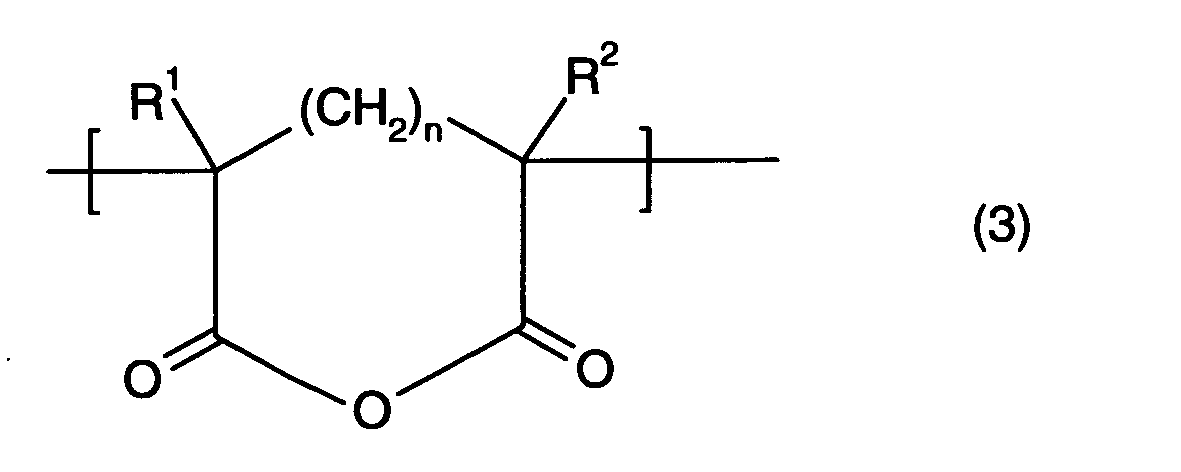

R1 und R2 unabhängig ein Wasserstoffatom, eine Alkylgruppe oder andere organische Gruppe darstellen und n 0 oder eine ganze Zahl von 1 oder mehr ist,
R3 und R4 unabhängig ein Wasserstoffatom, eine Alkylgruppe, eine Carboxylgruppe oder andere organische Gruppe darstellen und Y ein Wasserstoffatom, eine substituierte oder nicht substituierte Akoxylgruppe, eine substituierte oder nicht substituierte Alkylgruppe, eine substituierte Carbonylgruppe, eine substituierte oder nicht substituierte Oxycarbonylgruppe oder eine substituierte oder nicht substituierte Phenylgruppe darstellen,
Ar-X-OH (4)
worin
X eine Methylengruppe oder eine lineare, verzweigte oder zyklische Alkylengruppe mit mindestens zwei Kohlenstoffatomen darstellt und Ar ein organischer Chromophor ist, der die Strahlung vorbestimmter Wellenlänge absorbiert, und einen substituierten oder nicht substituierten Benzolring, heterozyklischen Ring oder kondensierten Ring, der an X direkt oder gegebenenfalls durch ein Sauerstoffatom, ein Stickstoffatom oder ein Schwefelatom gebunden ist, darstellt. - Ein strahlungsabsorbierendes Polymer gemäß Anspruch 2, worin besagte Verbindung, dargestellt durch Formel 4, welche Strahlung vorbestimmter Wellenlänge absorbiert, eine Verbindung dargestellt durch die Formel 5 ist:

X eine Methylengruppe oder eine lineare, verzweigte oder zyklische Alkylengruppe mit mindestens zwei Kolenstoffatomen ist, Z ein Sauerstoffatom, ein Stickstoffatom oder ein Schwefelatom darstellt, R5 nur in dem Fall, wenn Z ein Stickstoffatom ist, existiert und in diesem Fall R5 ein Wasserstoffatom, eine Alkylgruppe oder andere organische Gruppe darstellt, R6 ein Wasserstoffatom, eine Alkylgruppe, eine Alkoxylgruppe, ein Halogenatom, eine Hydroxylgruppe, eine Aminogruppe, eine Nitrogruppe, eine halogenierte Alkylgruppe, eine substituierte Carbonylgruppe, eine substituierte oder nicht substituierte Oxycarbonylgruppe, eine substituierte oder nicht substituierte Phenylgruppe oder andere organische Gruppe darstellt, und m 0 oder eine ganze Zahl von 1 bis 4 ist; und im Fall, dass verschiedene R6 an dem Ring vorhanden sind, diese gleich oder verschieden sein können und durch Verbindung miteinander einen aliphatischen oder aromatischen Ring bilden können. - Ein strahlungsabsorbierendes Polymer gemäß Anspruch 2, wobei besagte, durch die Formel 4 dargestellte Verbindung eine Verbindung dargestellt durch die Formel 6 ist:

X eine Methylengruppe oder eine lineare, verzweigte oder zyklische Alkylengruppe mit mindestens zwei Kohlenstoffatomen darstellt, p 0 oder eine ganze Zahl von 1 bis 7 ist, R7 ein Wasserstoffatom, eine Alkylgruppe, eine Alkoxylgruppe, ein Halogenatom, eine Hydroxylgruppe, eine Aminogruppe, eine Nitrogruppe, eine substituierte Carbonylgruppe, eine substituierte oder nicht substituierte Oxycarbonylgruppe, eine substituierte oder nicht substituierte Phenylgruppe oder andere organische Gruppe darstellt und im Fall, dass verschiedene R7 an dem Ring vorhanden sind, diese gleich oder verschieden sein können und durch Verbindung miteinander einen aliphatischen oder aromatischen Ring bilden können. - Ein strahlungsabsorbierendes Polymer gemäß Anspruch 2, 3 oder 4, worin besagtes Copolymer ein Maleinanhydrid/Methylvinylethercopolymer enthält.
- Ein strahlungsabsorbierendes Polymer gemäß Anspruch 1, worin besagte Verbindung, die eine reaktive Aminogruppe aufweist, eine Verbindung dargestellt durch die Formel 8 ist:

R8 ein Wasserstoffatom, ein Halogenatom, eine Hydoxylgruppe, eine Aminogruppe, eine Nitrogruppe oder andere organische Gruppe darstellt und h eine ganz Zahl von 1 bis 4 ist. - Eine filmbildende Zusammensetzung, die das in den Ansprüchen 1 bis 6 genannte strahlungsabsorbierende Polymer enthält.
- Eine filmbildende Zusammensetzung gemäß Anspruch 7, worin besagte filmbildende Zusammensetzung weiterhin die Verbindung mit einer reaktiven Aminogruppe, dargestellt durch die Formel 7 in Anspruch 1, enthält.
- Eine Antireflektionsbeschichtung, die aus einer in den Ansprüchen 7 und 8 genannten filmbildenden Zusammensetzungen gebildet wird.
Applications Claiming Priority (3)
| Application Number | Priority Date | Filing Date | Title |
|---|---|---|---|
| JP26790796 | 1996-09-18 | ||
| JP267907/96 | 1996-09-18 | ||
| PCT/JP1997/003255 WO1998012238A1 (fr) | 1996-09-18 | 1997-09-16 | Polymer absorbant la lumiere, procede de synthese de ce polymere, et composition filmogene et film antireflexion prepares au moye n de ce polymere |
Publications (3)
| Publication Number | Publication Date |
|---|---|
| EP0861855A1 EP0861855A1 (de) | 1998-09-02 |
| EP0861855A4 EP0861855A4 (de) | 2004-12-01 |
| EP0861855B1 true EP0861855B1 (de) | 2006-06-21 |
Family
ID=17451282
Family Applications (1)
| Application Number | Title | Priority Date | Filing Date |
|---|---|---|---|
| EP97940386A Expired - Lifetime EP0861855B1 (de) | 1996-09-18 | 1997-09-16 | Lichtabsorbierendes polymer, verfahren zu dessen synthese und filmbildende zusammensetzung und antireflektionsfilm der unter verwendung dieses polymers hergestellt wird |
Country Status (8)
| Country | Link |
|---|---|
| US (1) | US6184305B1 (de) |
| EP (1) | EP0861855B1 (de) |
| JP (1) | JP4145959B2 (de) |
| KR (1) | KR100491198B1 (de) |
| CN (1) | CN1150219C (de) |
| DE (1) | DE69736168T2 (de) |
| TW (1) | TW446719B (de) |
| WO (1) | WO1998012238A1 (de) |
Families Citing this family (8)
| Publication number | Priority date | Publication date | Assignee | Title |
|---|---|---|---|---|
| JP4165922B2 (ja) * | 1998-03-17 | 2008-10-15 | Azエレクトロニックマテリアルズ株式会社 | 光吸収性ポリマーおよびその反射防止膜への応用 |
| TW457403B (en) | 1998-07-03 | 2001-10-01 | Clariant Int Ltd | Composition for forming a radiation absorbing coating containing blocked isocyanate compound and anti-reflective coating formed therefrom |
| US6316165B1 (en) | 1999-03-08 | 2001-11-13 | Shipley Company, L.L.C. | Planarizing antireflective coating compositions |
| US7018779B2 (en) * | 2003-01-07 | 2006-03-28 | International Business Machines Corporation | Apparatus and method to improve resist line roughness in semiconductor wafer processing |
| IT1392389B1 (it) * | 2008-12-19 | 2012-03-02 | Eni Spa | Polimeri immidizzati contenenti gruppi luminescenti e metodo per il loro ottenimento |
| JP6244907B2 (ja) * | 2013-01-15 | 2017-12-13 | 株式会社リコー | 水性インク、インクカートリッジ |
| KR101718102B1 (ko) * | 2014-12-12 | 2017-04-04 | 최상준 | 새로운 반사방지막(Bottom anti-reflective coating)용 고분자 및 이를 이용한 조성물 |
| CN108709549B (zh) * | 2018-05-29 | 2020-11-03 | 东南大学 | 一种基于纳米光栅的单片集成陀螺仪及其加工方法 |
Family Cites Families (18)
| Publication number | Priority date | Publication date | Assignee | Title |
|---|---|---|---|---|
| US3597468A (en) * | 1965-09-06 | 1971-08-03 | Oreal | Colored amine reacted polymers |
| DE2150691C2 (de) * | 1971-10-12 | 1982-09-09 | Basf Ag, 6700 Ludwigshafen | Lichtempfindliches Gemisch und Verwendung eines lichtempfindlichen Gemisches zur Herstellung einer Flachdruckplatte |
| US4910122A (en) | 1982-09-30 | 1990-03-20 | Brewer Science, Inc. | Anti-reflective coating |
| FR2596400B1 (fr) * | 1986-03-28 | 1988-08-26 | Oreal | Nouveaux polymeres capables d'absorber le rayonnement ultraviolet, leur preparation et leur application notamment en cosmetologie |
| JPH06828B2 (ja) * | 1986-10-15 | 1994-01-05 | 宇部興産株式会社 | 光硬化性組成物 |
| JPS63314205A (ja) * | 1987-06-16 | 1988-12-22 | Ube Ind Ltd | 光硬化性組成物 |
| DE3733158A1 (de) * | 1987-10-01 | 1989-04-20 | Basf Ag | Verfahren zur herstellung von copolymerisaten aus maleinsaeuremonoalkylestern und vinylalkylethern |
| US5147968A (en) * | 1988-05-13 | 1992-09-15 | The Ohio State University Research Foundation | Electromagnetic radiation absorbers and modulators comprising polyaniline |
| US4963160A (en) * | 1989-03-14 | 1990-10-16 | Ciba-Geigy Corporation | Reactive uv absorbing compositions and method of preparing lenses therefrom |
| US5057399A (en) | 1989-03-31 | 1991-10-15 | Tony Flaim | Method for making polyimide microlithographic compositions soluble in alkaline media |
| JP2657266B2 (ja) * | 1989-04-28 | 1997-09-24 | 直哉 緒方 | 有機非線形光学材料 |
| FR2690453B1 (fr) * | 1992-04-25 | 1995-11-03 | Sandoz Sa | Nouveaux composes polymeres ayant des proprietes optiques non lineaires. |
| JPH05320227A (ja) * | 1992-05-22 | 1993-12-03 | Seiko Epson Corp | 感光性高分子製造方法 |
| US5294680A (en) * | 1992-07-24 | 1994-03-15 | International Business Machines Corporation | Polymeric dyes for antireflective coatings |
| WO1994012912A1 (en) | 1992-11-25 | 1994-06-09 | Hoechst Celanese Corporation | Metal ion reduction in bottom anti-reflective coatings for photoresists |
| US5731385A (en) * | 1993-12-16 | 1998-03-24 | International Business Machines Corporation | Polymeric dyes for antireflective coatings |
| TW290558B (de) * | 1994-04-28 | 1996-11-11 | Nissan Chemical Ind Ltd | |
| US5525457A (en) | 1994-12-09 | 1996-06-11 | Japan Synthetic Rubber Co., Ltd. | Reflection preventing film and process for forming resist pattern using the same |
-
1997
- 1997-09-16 CN CNB971912750A patent/CN1150219C/zh not_active Expired - Fee Related
- 1997-09-16 JP JP51450298A patent/JP4145959B2/ja not_active Expired - Fee Related
- 1997-09-16 WO PCT/JP1997/003255 patent/WO1998012238A1/ja not_active Ceased
- 1997-09-16 EP EP97940386A patent/EP0861855B1/de not_active Expired - Lifetime
- 1997-09-16 KR KR10-1998-0703644A patent/KR100491198B1/ko not_active Expired - Fee Related
- 1997-09-16 DE DE69736168T patent/DE69736168T2/de not_active Expired - Lifetime
- 1997-09-17 TW TW086113440A patent/TW446719B/zh not_active IP Right Cessation
-
1998
- 1998-05-15 US US09/079,565 patent/US6184305B1/en not_active Expired - Fee Related
Also Published As
| Publication number | Publication date |
|---|---|
| CN1150219C (zh) | 2004-05-19 |
| WO1998012238A1 (fr) | 1998-03-26 |
| KR19990067617A (ko) | 1999-08-25 |
| CN1205013A (zh) | 1999-01-13 |
| EP0861855A1 (de) | 1998-09-02 |
| TW446719B (en) | 2001-07-21 |
| US6184305B1 (en) | 2001-02-06 |
| KR100491198B1 (ko) | 2005-10-12 |
| JP4145959B2 (ja) | 2008-09-03 |
| DE69736168D1 (de) | 2006-08-03 |
| EP0861855A4 (de) | 2004-12-01 |
| DE69736168T2 (de) | 2007-05-03 |
Similar Documents
| Publication | Publication Date | Title |
|---|---|---|
| US6329117B1 (en) | Antireflection or light-absorbing coating composition and polymer therefor | |
| EP1738225B1 (de) | Positiv arbeitende fotoabbildbare antireflex-unterbeschichtung | |
| US6803168B1 (en) | Composition for anti-reflective coating or radiation absorbing coating and compounds used in the composition | |
| US6187506B1 (en) | Antireflective coating for photoresist compositions | |
| US6737492B2 (en) | Radiation absorbing polymer, composition for radiation absorbing coating, radiation absorbing coating and application thereof as anti-reflective coating | |
| EP0982320B1 (de) | Lichtabsorbierende polymere und deren anwendung in antireflektionsfilmen | |
| JPWO1998054619A1 (ja) | 反射防止膜又は光吸収膜用組成物及びこれに用いる化合物 | |
| EP0916683B1 (de) | Licht-absorbierendes polymer, zusammensetzung die licht-absorbierende beschichtungen bildet, licht-absorbierende beschichtungen und daraus hergestellte antireflektionsbeschichtungen | |
| US6184305B1 (en) | Radiation absorbing polymer and synthesis thereof | |
| JPH0978031A (ja) | 反射防止膜材料 | |
| JPWO1998012238A1 (ja) | 光吸収性ポリマー、その合成方法、そのポリマーを用いた皮膜形成組成物および反射防止膜 | |
| JPS5983156A (ja) | 微細画像形成法 |
Legal Events
| Date | Code | Title | Description |
|---|---|---|---|
| PUAI | Public reference made under article 153(3) epc to a published international application that has entered the european phase |
Free format text: ORIGINAL CODE: 0009012 |
|
| AK | Designated contracting states |
Kind code of ref document: A1 Designated state(s): BE DE FR GB IT NL |
|
| 17P | Request for examination filed |
Effective date: 19980928 |
|
| RAP1 | Party data changed (applicant data changed or rights of an application transferred) |
Owner name: CLARIANT FINANCE (BVI) LIMITED |
|
| A4 | Supplementary search report drawn up and despatched |
Effective date: 20041020 |
|
| RAP1 | Party data changed (applicant data changed or rights of an application transferred) |
Owner name: AZ ELECTRONIC MATERIALS USA CORP. |
|
| 17Q | First examination report despatched |
Effective date: 20050210 |
|
| GRAP | Despatch of communication of intention to grant a patent |
Free format text: ORIGINAL CODE: EPIDOSNIGR1 |
|
| GRAS | Grant fee paid |
Free format text: ORIGINAL CODE: EPIDOSNIGR3 |
|
| GRAA | (expected) grant |
Free format text: ORIGINAL CODE: 0009210 |
|
| AK | Designated contracting states |
Kind code of ref document: B1 Designated state(s): BE DE FR GB IT NL |
|
| PG25 | Lapsed in a contracting state [announced via postgrant information from national office to epo] |
Ref country code: NL Free format text: LAPSE BECAUSE OF FAILURE TO SUBMIT A TRANSLATION OF THE DESCRIPTION OR TO PAY THE FEE WITHIN THE PRESCRIBED TIME-LIMIT Effective date: 20060621 Ref country code: BE Free format text: LAPSE BECAUSE OF FAILURE TO SUBMIT A TRANSLATION OF THE DESCRIPTION OR TO PAY THE FEE WITHIN THE PRESCRIBED TIME-LIMIT Effective date: 20060621 |
|
| REG | Reference to a national code |
Ref country code: GB Ref legal event code: FG4D |
|
| REF | Corresponds to: |
Ref document number: 69736168 Country of ref document: DE Date of ref document: 20060803 Kind code of ref document: P |
|
| NLV1 | Nl: lapsed or annulled due to failure to fulfill the requirements of art. 29p and 29m of the patents act | ||
| ET | Fr: translation filed | ||
| PLBE | No opposition filed within time limit |
Free format text: ORIGINAL CODE: 0009261 |
|
| STAA | Information on the status of an ep patent application or granted ep patent |
Free format text: STATUS: NO OPPOSITION FILED WITHIN TIME LIMIT |
|
| GBPC | Gb: european patent ceased through non-payment of renewal fee |
Effective date: 20060921 |
|
| 26N | No opposition filed |
Effective date: 20070322 |
|
| PG25 | Lapsed in a contracting state [announced via postgrant information from national office to epo] |
Ref country code: GB Free format text: LAPSE BECAUSE OF NON-PAYMENT OF DUE FEES Effective date: 20060921 |
|
| REG | Reference to a national code |
Ref country code: DE Ref legal event code: R082 Ref document number: 69736168 Country of ref document: DE Representative=s name: PATENTANWAELTE ISENBRUCK BOESL HOERSCHLER LLP, DE |
|
| REG | Reference to a national code |
Ref country code: FR Ref legal event code: TP Owner name: MERCK PATENT GMBH, DE Effective date: 20150204 |
|
| REG | Reference to a national code |
Ref country code: DE Ref legal event code: R082 Ref document number: 69736168 Country of ref document: DE Representative=s name: PATENTANWAELTE ISENBRUCK BOESL HOERSCHLER LLP, DE Effective date: 20150223 Ref country code: DE Ref legal event code: R081 Ref document number: 69736168 Country of ref document: DE Owner name: MERCK PATENT GMBH, DE Free format text: FORMER OWNER: AZ ELECTRONIC MATERIALS USA CORP., SOMERVILLE, N.J., US Effective date: 20150223 |
|
| REG | Reference to a national code |
Ref country code: FR Ref legal event code: PLFP Year of fee payment: 19 |
|
| REG | Reference to a national code |
Ref country code: FR Ref legal event code: PLFP Year of fee payment: 20 |
|
| PGFP | Annual fee paid to national office [announced via postgrant information from national office to epo] |
Ref country code: IT Payment date: 20160921 Year of fee payment: 20 Ref country code: DE Payment date: 20160913 Year of fee payment: 20 |
|
| PGFP | Annual fee paid to national office [announced via postgrant information from national office to epo] |
Ref country code: FR Payment date: 20160816 Year of fee payment: 20 |
|
| REG | Reference to a national code |
Ref country code: DE Ref legal event code: R071 Ref document number: 69736168 Country of ref document: DE |