EP0862370B1 - Purification de gaz de torrefaction - Google Patents
Purification de gaz de torrefaction Download PDFInfo
- Publication number
- EP0862370B1 EP0862370B1 EP96919698A EP96919698A EP0862370B1 EP 0862370 B1 EP0862370 B1 EP 0862370B1 EP 96919698 A EP96919698 A EP 96919698A EP 96919698 A EP96919698 A EP 96919698A EP 0862370 B1 EP0862370 B1 EP 0862370B1
- Authority
- EP
- European Patent Office
- Prior art keywords
- exhaust
- gases
- exhaust gases
- roasting
- stream
- Prior art date
- Legal status (The legal status is an assumption and is not a legal conclusion. Google has not performed a legal analysis and makes no representation as to the accuracy of the status listed.)
- Revoked
Links
- 239000007789 gas Substances 0.000 title claims abstract description 118
- 238000000746 purification Methods 0.000 title 1
- 238000002485 combustion reaction Methods 0.000 claims abstract description 54
- 238000000034 method Methods 0.000 claims abstract description 27
- 241000533293 Sesbania emerus Species 0.000 claims abstract description 21
- 239000003344 environmental pollutant Substances 0.000 claims abstract description 17
- 231100000719 pollutant Toxicity 0.000 claims abstract description 17
- 238000013022 venting Methods 0.000 claims abstract description 7
- 230000003197 catalytic effect Effects 0.000 claims description 13
- 239000002245 particle Substances 0.000 claims description 8
- 238000010791 quenching Methods 0.000 claims description 8
- 239000007787 solid Substances 0.000 claims description 8
- 230000000171 quenching effect Effects 0.000 claims description 7
- 239000002737 fuel gas Substances 0.000 abstract 1
- 230000001105 regulatory effect Effects 0.000 description 12
- 239000000446 fuel Substances 0.000 description 3
- 235000010627 Phaseolus vulgaris Nutrition 0.000 description 2
- 244000046052 Phaseolus vulgaris Species 0.000 description 2
- 230000001276 controlling effect Effects 0.000 description 2
- 238000005265 energy consumption Methods 0.000 description 2
- 230000007613 environmental effect Effects 0.000 description 2
- VNWKTOKETHGBQD-UHFFFAOYSA-N methane Chemical compound C VNWKTOKETHGBQD-UHFFFAOYSA-N 0.000 description 2
- 239000000203 mixture Substances 0.000 description 2
- XLYOFNOQVPJJNP-UHFFFAOYSA-N water Substances O XLYOFNOQVPJJNP-UHFFFAOYSA-N 0.000 description 2
- OKTJSMMVPCPJKN-UHFFFAOYSA-N Carbon Chemical compound [C] OKTJSMMVPCPJKN-UHFFFAOYSA-N 0.000 description 1
- 230000009172 bursting Effects 0.000 description 1
- 229910052799 carbon Inorganic materials 0.000 description 1
- 238000004140 cleaning Methods 0.000 description 1
- 239000000567 combustion gas Substances 0.000 description 1
- 239000000356 contaminant Substances 0.000 description 1
- 238000010586 diagram Methods 0.000 description 1
- 230000000694 effects Effects 0.000 description 1
- 239000012530 fluid Substances 0.000 description 1
- 239000003517 fume Substances 0.000 description 1
- 238000010348 incorporation Methods 0.000 description 1
- 238000009434 installation Methods 0.000 description 1
- 238000004519 manufacturing process Methods 0.000 description 1
- 239000003345 natural gas Substances 0.000 description 1
- 239000000126 substance Substances 0.000 description 1
Images
Classifications
-
- A—HUMAN NECESSITIES
- A23—FOODS OR FOODSTUFFS; TREATMENT THEREOF, NOT COVERED BY OTHER CLASSES
- A23N—MACHINES OR APPARATUS FOR TREATING HARVESTED FRUIT, VEGETABLES OR FLOWER BULBS IN BULK, NOT OTHERWISE PROVIDED FOR; PEELING VEGETABLES OR FRUIT IN BULK; APPARATUS FOR PREPARING ANIMAL FEEDING- STUFFS
- A23N12/00—Machines for cleaning, blanching, drying or roasting fruits or vegetables, e.g. coffee, cocoa, nuts
- A23N12/08—Machines for cleaning, blanching, drying or roasting fruits or vegetables, e.g. coffee, cocoa, nuts for drying or roasting
-
- A—HUMAN NECESSITIES
- A23—FOODS OR FOODSTUFFS; TREATMENT THEREOF, NOT COVERED BY OTHER CLASSES
- A23F—COFFEE; TEA; THEIR SUBSTITUTES; MANUFACTURE, PREPARATION, OR INFUSION THEREOF
- A23F5/00—Coffee; Coffee substitutes; Preparations thereof
- A23F5/04—Methods of roasting coffee
Definitions
- This invention relates to a process for operating a coffee roaster and treating the exhaust gases from the coffee roaster so as to reduce pollutants in the exhaust gases ultimately discharged to the atmosphere.
- the pollutants in the exhaust gases are reduced sufficiently to meet legislation concerning pollutants in exhaust gases.
- Spain is an example of a country in which the NOx content of the exhaust gases is restricted.
- exhaust gases from coffee roasters may contain a maximum: solids particle content of 150 mg/N m 3 , CO content of 500 ppm, NOx content of 300 ppm, and an opacity level of 2.
- TOC total organic carbon
- exhaust gases from coffee roasters may contain a maximum: solids particle content of 150 mg/N m 3 , CO content of 50 mg/N m 3 , TOC content of 50 mg/N m 3 .
- solids particle content of 150 mg/N m 3
- CO content of 50 mg/N m 3
- TOC content of 50 mg/N m 3
- NOx content of the exhaust gases there is no limit on the NOx content of the exhaust gases.
- coffee roasters comprise a fuel burner (the fuel usually being natural gas or oil) which receives and heats air introduced from the ambient.
- the heated air, mixed with the combusted gas, is usually at a temperature of about 370 to 450°C and is directed to a roasting chamber, usually in the form of a rotary cylinder or tumbler, which contains the green coffee beans.
- the heated air and combusted gases then roast the coffee beans.
- the exhaust gases from the roasting chamber are usually at a temperature of about 150°C. They are usually directed to a cyclone separator to remove entrained solid particles and are then vented; often without treatment. With this basic system, the pollutant levels in the exhaust gases will very often exceed the levels set in the relevant legislation.
- catalytic converter into the system prior to venting of the exhaust gases.
- the use of a catalytic converter is the most appropriate solution in countries where the legislation does not place any limit on NOx content since the use of catalytic converters results in production of NOx.
- the catalytic converter reduces CO levels, it actually increases NOx levels.
- this invention provides a process for operating a coffee roaster to obtain reduced levels of pollutants in exhaust gases vented from the coffee roaster, the process comprising:
- the level of pollutants in the exhaust gases ultimately vented to the atmosphere may be reduced significantly. Further the temperature at which the secondary combustion takes place may be much lower than required in conventional systems. This enables venting of the exhaust gases at much lower temperatures. Also, incorporation of catalytic treatment is greatly facilitated.
- the recycle stream preferably comprises about 60% to about 80% by volume of the exhaust gases extracted from roasting chamber; more preferably about 65% to about 75%.
- the recycle stream is closed and all exhaust gases extracted from the roasting chamber are directed to the exhaust stream.
- the process further comprises the step of removing entrained solid particles from the exhaust gases extracted from the roasting chamber prior to splitting of the exhaust gases into the recycle and exhaust streams.
- the secondary combustion preferably takes place at a temperature in the range of about 200°C to about 350°C.
- the process may further comprise subjecting the exhaust gases in the exhaust stream to catalytic treatment to reduce CO levels.
- the process may be controlled automatically by means of a control system which determines and regulates the volume flow rates in the recycle stream and the exhaust stream.
- the flow rates may be regulated, for example, by adjustment of a regulating valve in the recycle stream.
- this invention provides a coffee roasting system, the system comprising:
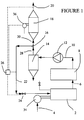
- fresh combustion gases 4 are drawn into a burner 34 and combusted in a combustion chamber 2 of a coffee master in a conventional manner.
- Recycled exhaust gases in a recycle stream 22 are also introduced into the combustion chamber 2 in a manner described below.
- the temperature in the combustion chamber 2 is a temperature suitable for producing gases for roasting coffee beans; for example from about 220°C to about 600°C. Usually the temperature is in the region of about 400°C to about 500°C.
- the combusted gases 6 leaving the combustion chamber 2 are all directed to a roasting chamber 8 which, in use, contains green coffee beans to be roasted. Because the combusted gases 6 are at a temperature of about 220°C to about 600°C, they cause the green coffee beans to be roasted.
- the exhaust gases 10 from the roasting chamber 8 are compressed in a compressor 12 and are directed to a cyclone separator 14. Entrained solid particles in the exhaust gases 10 are removed from the bottom of the cyclone separator 14.
- the gases 28 leaving the top of the cyclone separator 14 are directed to a flow splitter 16 for splitting the gases 28 into the recycle stream 22 and an exhaust stream 30.
- the flow splitter 16 is conveniently a Y or T junction.
- the exhaust gases in the recycle stream 22 are returned to the combustion chamber 2.
- a regulating valve 24 regulates the flow of the exhaust gases in the recycle stream 22 and hence the split between the recycle stream 22 and the exhaust stream 30.
- the regulating valve 24 need not be positioned in the recycle stream 22; it may be positioned in the exhaust stream 30.
- the flow splitter 16 may include flow regulation means.
- the exhaust gases in the exhaust stream 30 are directed to a secondary combustion chamber 18 in which they are further combusted; for example by means of a suitable burner 36.
- the temperature in the secondary combustion chamber 18 may conveniently be in the range of about 200°C to about 350°C.
- the gases 20 leaving the secondary combustion chamber 18 are vented; for example through a chimney (not shown).
- a catalytic converter (not shown) may be connected after the secondary combustion chamber 18. Since the gases 20 leaving the secondary combustion chamber 18 are usually at a temperature not exceeding about 350°C, a catalytic converter (not shown) may be readily connected after the secondary combustion chamber 18. If desired, a filter (for example a self-cleaning filter) may be positioned prior to the catalytic converter.
- the regulating valve 24 is shut, preventing the flow of the exhaust gases in the recycle stream 22 into the combustion chamber 2.
- a quenching fluid is simultaneously sprayed on the roasted beans in the roasting chamber 8 to rapidly lower their temperature to below roasting temperatures. All gases given off during this stage pass through the compressor 12 and the cyclone separator 14 as described above. However, since the regulating valve 24 is shut, the gases 28 leaving the cyclone separator 14 are all directed through the flow splitter 16 to the secondary combustion chamber 18.
- the entire system is controlled and regulated automatically by means of a controller 26.
- the controller 26 monitors the temperature and flow rate of the gases 20 leaving the secondary combustion chamber 18 and the temperature and flow rate of the exhaust gases in the recycle stream 22. From these parameters the controller 26 is able to determine the volumetric flow rate split between the recycle stream 22 and the exhaust stream 30. If the volumetric flow rate split deviates from a desired split, the controller 26 appropriately regulates the regulating valve 24 to obtain the desired split. Clearly, the same result may be achieved by having the controller 26 monitor other parameters; such as the flow rate in the exhaust stream 30 for example. Once the coffee beans are to be quenched, the controller 26 shuts the regulating valve 24; reopening it upon start-up of the next roasting cycle.
- controller 26 regulates the burner 36 in response to changes in the temperature of the gases 20 leaving the secondary combustion chamber 18 to obtain a constant temperature. This provides the advantage that exhaust gases at a constant, low temperature may be fed to a catalytic converter. Also, any legislative restrictions may be met. It is also possible for the controller 26 to regulate the burner 34 in the combustion chamber 2 to achieve the same effect.
- Suitable controllers are commercially available; for example from the Allen-Bradley corporation.
- the process has the significant advantage that the exhaust gases are substantially transparent and have low levels of CO and NOx.
- a typical analysis of exhaust gases vented by the process (without catalytic treatment) is as follows: Opacity transparent CO 357 ppm NOx less than 50 mg/N m 3 Temperature about 240°C
- the controller 26 may also be used to ensure the safety of the system. For example, if the temperature of the exhaust gases in the recycle stream were to become higher than a safe maximum, an unacceptable fire risk may arise. If this should occur, the controller 26 may shut the regulation valve 24 and stop the burners.
- a batch of 240 kg of green coffee beans being a blend of robusta/ Brazil/milds in proportions of 30/40/30% by weight, are placed in the roasting chamber of a coffee roaster.
- the burner of the combustion chamber is fired up and all the exhaust gases from the combustion chamber are directed into the roasting chamber
- the temperature of the gases entering the roasting chamber is 450°C while the temperature of the exhaust gases leaving the rotary chamber is about 150°C, the coffee beans reaching a temperature of 210°C.
- the exhaust gases from the roasting chamber are compressed and directed through a cyclone separator.
- the gases leaving the cyclone separator are divided in a flow splitter into a recycle stream comprising 70% of the gases and an exhaust stream comprising 30% of the gases.
- the split is controlled automatically by a control system which regulates a regulating valve in the recycle stream.
- the exhaust stream is directed to a secondary combustion chamber in which the gas is further combusted at about 350°C using a secondary burner which is supplied with fuel and fresh air.
- the exhaust gases from the secondary combustion chamber are at a temperature of 301°C and are vented to the atmosphere. These gases contain the following contaminants: solid particles undetectable CO 394 mg/N m 3 NOx 57 mg/N m 3 TOC undetectable
- the control system records the temperature of the vented gases discharged and the temperature of the recycled exhaust gases.
- the control system shuts the regulating valve and the recycle of gases to the combustion chamber is terminated. Also about 30 litres of water is sprayed inside the roasting chamber to quench the roasting process. Since the regulating valve is closed, all exhaust gases leaving the roasting chamber are directed to the secondary combustion chamber where they are combusted. The temperature of the exhaust gases from the secondary combustion chamber remains at about 301°C
Landscapes
- Life Sciences & Earth Sciences (AREA)
- Chemical & Material Sciences (AREA)
- Engineering & Computer Science (AREA)
- Food Science & Technology (AREA)
- Polymers & Plastics (AREA)
- Tea And Coffee (AREA)
- Incineration Of Waste (AREA)
- Apparatuses For Bulk Treatment Of Fruits And Vegetables And Apparatuses For Preparing Feeds (AREA)
- Meat, Egg Or Seafood Products (AREA)
- Glass Compositions (AREA)
- Solid-Sorbent Or Filter-Aiding Compositions (AREA)
Claims (8)
- Procédé pour faire fonctionner un torréfacteur à café pour obtenir des taux réduits de polluants dans les gaz d'échappement évacués du torréfacteur à café, le procédé comprenant :le fait de faire brûler des gaz dans une chambre de combustion et d'envoyer tous les gaz brûlés dans une chambre de torréfaction pour torréfier des grains de café dans la chambre de torréfaction ;le fait d'extraire des gaz d'échappement de la chambre de torréfaction et de séparer les gaz d'échappement en un courant de recyclage et un courant d'échappement, le courant de recyclage comprenant la plus grande partie des gaz d'échappement et étant renvoyé dans la chambre de combustion ; etle fait de soumettre le courant d'échappement à une combustion secondaire avant de purger le courant d'échappement ; la combustion secondaire s'effectuant à une température dans l'intervalle d'environ 200 °C à environ 350 °C.
- Procédé selon la revendication 1, dans lequel le courant de recyclage comprend environ 60 % à environ 80 % en volume des gaz d'échappement extraits de la chambre de torréfaction.
- Procédé pour faire fonctionner un torréfacteur à café pour obtenir des taux réduits de polluants dans les gaz d'échappement évacués du torréfacteur à café, le procédé comprenant :le fait de faire brûler des gaz dans une chambre de combustion et d'envoyer tous les gaz brûlés dans une chambre de torréfaction pour torréfier des grains de café dans la chambre de torréfaction ;le fait d'extraire des gaz d'échappement de la chambre de torréfaction et de séparer les gaz d'échappement en un courant de recyclage et un courant d'échappement avec une division constante du débit volumique, le courant de recyclage comprenant environ 60 % à environ 80 % en volume des gaz d'échappement et étant renvoyé dans la chambre de combustion ; etle fait de soumettre le courant d'échappement à une combustion secondaire avant de purger le courant d'échappement.
- Procédé selon la revendication 3, dans lequel la combustion secondaire s'effectue à une température dans l'intervalle d'environ 200 °C à environ 350 °C.
- Procédé selon l'une quelconque des revendications 1 à 4, dans lequel, lorsqu'on a mis fin à la torréfaction en refroidissant brusquement les grains de café, on ferme le courant de recyclage et on envoie tous les gaz d'échappement extraits de la chambre de torréfaction dans le courant d'échappement.
- Procédé selon la revendication 5, dans lequel le procédé comprend en outre l'étape consistant à éliminer des particules solides entraínées des gaz d'échappement extraits de la chambre de torréfaction avant la division des gaz d'échappement en courant de recyclage et courant d'échappement.
- Procédé selon l'une quelconque des revendications 1 à 6, comprenant en outre le fait de soumettre les gaz d'échappement présents dans le courant d'échappement à un traitement catalytique pour réduire les taux de CO après la combustion secondaire.
- Système de torréfaction du café, le système comprenant :une chambre de combustion qui contient un brûleur pour brûler les gaz ;une chambre de torréfaction pour torréfier les grains de café, la chambre de torréfaction étant reliée à la chambre de combustion pour recevoir tous les gaz brûlés produits dans la chambre de combustion ;des moyens de division du courant pour diviser les gaz d'échappement reçus de la chambre de torréfaction en un courant de recyclage et un courant d'échappement, le courant de recyclage étant renvoyé dans la chambre de combustion ;une chambre de combustion secondaire qui contient un brûleur pour brûler les gaz d'échappement Présents dans le courant d'échappement à une température dans l'intervalle d'environ 200 °C à environ 350 °C ;des moyens de compresseur pour faire circuler un courant de gaz à travers le système ; etdes moyens de réglage pour régler l'écoulement de gaz d'échappement dans le courant de recyclage et le courant d'échappement et pour fermer le courant de recyclage au cours du refroidissement brusque des grains de café.
Applications Claiming Priority (3)
| Application Number | Priority Date | Filing Date | Title |
|---|---|---|---|
| ES9500875 | 1995-05-08 | ||
| ES9500087 | 1995-05-08 | ||
| PCT/EP1996/001903 WO1996035335A1 (fr) | 1995-05-08 | 1996-05-08 | Purification de gaz de torrefaction |
Publications (2)
| Publication Number | Publication Date |
|---|---|
| EP0862370A1 EP0862370A1 (fr) | 1998-09-09 |
| EP0862370B1 true EP0862370B1 (fr) | 1999-08-04 |
Family
ID=8290288
Family Applications (1)
| Application Number | Title | Priority Date | Filing Date |
|---|---|---|---|
| EP96919698A Revoked EP0862370B1 (fr) | 1995-05-08 | 1996-05-08 | Purification de gaz de torrefaction |
Country Status (12)
| Country | Link |
|---|---|
| US (1) | US5928697A (fr) |
| EP (1) | EP0862370B1 (fr) |
| JP (1) | JPH11504518A (fr) |
| KR (1) | KR100404776B1 (fr) |
| AT (1) | ATE182747T1 (fr) |
| AU (1) | AU695667B2 (fr) |
| BR (1) | BR9608261A (fr) |
| CA (1) | CA2218123A1 (fr) |
| DE (1) | DE69603620T2 (fr) |
| ES (1) | ES2136417T3 (fr) |
| MX (1) | MX9708517A (fr) |
| WO (1) | WO1996035335A1 (fr) |
Cited By (1)
| Publication number | Priority date | Publication date | Assignee | Title |
|---|---|---|---|---|
| DE102004038730B3 (de) * | 2004-08-10 | 2006-02-23 | Probat-Werke Von Gimborn Maschinenfabrik Gmbh | Röstvorrichtung für pflanzliches Schüttgut sowie Verfahren zum Betreiben einer Röstvorrichtung für pflanzliches Schüttgut |
Families Citing this family (17)
| Publication number | Priority date | Publication date | Assignee | Title |
|---|---|---|---|---|
| ES2137857B1 (es) * | 1997-07-08 | 2000-08-16 | Vittoria Intercomercial S L | Aparato para el tueste de cafe y similares. |
| US7285300B1 (en) * | 1997-11-11 | 2007-10-23 | Group 32 Development & Engineering, Inc. | Roasting system |
| US20020164409A1 (en) | 2001-05-02 | 2002-11-07 | Raffael Sandolo | Coffee roasting apparatus and method |
| US6382087B1 (en) | 2001-07-31 | 2002-05-07 | Sadamu Iiyama | Coffee bean roaster with recirculated, filtered exhaust airflow |
| EP1442262B1 (fr) | 2001-10-10 | 2015-12-23 | Joseph Behm | Torréfacteur de café en petites quantités et four de comptoir |
| DE10156887C1 (de) | 2001-11-20 | 2003-04-17 | Gimborn Probat Werke | Verfahren zum Rösten von schüttfähigen Lebensmitteln mit Heißluft sowie Vorrichtung zur Durchführung desselben |
| DE102007006268B3 (de) * | 2007-02-08 | 2008-05-29 | Probat-Werke Von Gimborn Maschinenfabrik Gmbh | Vorrichtung und Verfahren zur Wärmebehandlung eines schüttfähigen pflanzlichen Gutes |
| US7998515B2 (en) * | 2007-06-06 | 2011-08-16 | Group 32 Development And Engineering, Inc. | Method and apparatus for preventing the discharge of powdery caffeine during coffee roasting |
| IT1393389B1 (it) * | 2008-10-24 | 2012-04-20 | Bar System Europ Srl | Apparecchiatura per la tostatura di chicchi di caffe' e semi commestibili in genere |
| JP6173395B2 (ja) * | 2015-08-26 | 2017-08-02 | 山本 裕之 | 焙煎されたコーヒー豆の製造方法、コーヒー豆の焙煎装置、及び焙煎されたコーヒー豆から発生する一酸化炭素の量を決定する方法 |
| US10362798B2 (en) | 2017-04-13 | 2019-07-30 | Bellwether Coffee Co. | Roasting system with clean emissions and high thermal efficiency |
| US10602764B2 (en) | 2017-04-13 | 2020-03-31 | Bellwether Coffee Co. | Roasting system with clean emissions and high thermal efficiency |
| CA3116837A1 (fr) | 2018-10-26 | 2020-04-30 | Societe Des Produits Nestle S.A. | Appareil et procede de torrefaction de grains de cafe |
| CN111121066A (zh) * | 2018-10-31 | 2020-05-08 | 上海酒店设备工程成套南翔厂有限公司 | 咖啡炉气净化装置及其使用方法 |
| US20230024471A1 (en) * | 2019-12-31 | 2023-01-26 | Societe Des Produits Nestle S.A. | Method to select the smoke treating unit of a roasting apparatus |
| KR20230009382A (ko) * | 2020-05-11 | 2023-01-17 | 소시에떼 데 프로듀이 네슬레 소시에떼아노님 | 커피 콩을 로스팅하는 방법 |
| DE202021001398U1 (de) | 2021-04-16 | 2021-06-09 | Dutch Master Roasters | Röstmaschine |
Family Cites Families (8)
| Publication number | Priority date | Publication date | Assignee | Title |
|---|---|---|---|---|
| DE2143713A1 (de) * | 1971-09-01 | 1973-03-08 | Gothot Maschf | Verfahren und vorrichtung zum roesten von kaffee |
| DE2207803A1 (de) * | 1972-02-18 | 1973-08-23 | Gimborn Probat Werke | Roestverfahren und roestmaschine zu dessen durchfuehrung |
| DE2354780B2 (de) * | 1973-11-02 | 1980-02-14 | Fabrik Fuer Pat. Sicherheits-Roester G.W. Barth Ludwigsburg, 7140 Ludwigsburg | Röstverfahren und Röstmaschine zu dessen Durchführung |
| US3841826A (en) * | 1974-01-30 | 1974-10-15 | Blaw Knox Food Chemical | Process and apparatus for continuously roasting bean-like materials |
| IT1158395B (it) * | 1982-06-08 | 1987-02-18 | Vittoria Spa Off | Impianto automatico e ad elevata resa termica per la tostatura del caffe' o di altri prodotti |
| JPH01141550A (ja) * | 1987-11-27 | 1989-06-02 | Kondo Unyu Kiko Kk | 豆の焙煎方法と焙煎装置 |
| US5334012A (en) * | 1990-12-27 | 1994-08-02 | Astec Industries, Inc. | Combustion chamber having reduced NOx emissions |
| FR2782673B1 (fr) * | 1998-09-02 | 2000-11-24 | Neopost Ind | Plieuse/insereuse a chemin d'encarts separe |
-
1996
- 1996-05-08 KR KR1019970707900A patent/KR100404776B1/ko not_active Expired - Fee Related
- 1996-05-08 BR BR9608261A patent/BR9608261A/pt not_active IP Right Cessation
- 1996-05-08 ES ES96919698T patent/ES2136417T3/es not_active Expired - Lifetime
- 1996-05-08 AU AU58150/96A patent/AU695667B2/en not_active Expired
- 1996-05-08 US US08/945,844 patent/US5928697A/en not_active Expired - Lifetime
- 1996-05-08 WO PCT/EP1996/001903 patent/WO1996035335A1/fr not_active Ceased
- 1996-05-08 DE DE69603620T patent/DE69603620T2/de not_active Revoked
- 1996-05-08 AT AT96919698T patent/ATE182747T1/de not_active IP Right Cessation
- 1996-05-08 EP EP96919698A patent/EP0862370B1/fr not_active Revoked
- 1996-05-08 MX MX9708517A patent/MX9708517A/es unknown
- 1996-05-08 CA CA002218123A patent/CA2218123A1/fr not_active Abandoned
- 1996-05-08 JP JP8533739A patent/JPH11504518A/ja active Pending
Cited By (2)
| Publication number | Priority date | Publication date | Assignee | Title |
|---|---|---|---|---|
| DE102004038730B3 (de) * | 2004-08-10 | 2006-02-23 | Probat-Werke Von Gimborn Maschinenfabrik Gmbh | Röstvorrichtung für pflanzliches Schüttgut sowie Verfahren zum Betreiben einer Röstvorrichtung für pflanzliches Schüttgut |
| WO2006018401A1 (fr) | 2004-08-10 | 2006-02-23 | Probat-Werke Von Gimborn Maschinenfabrik Gmbh | Dispositif de torrefaction pour matiere vegetale en vrac et procede permettant de faire fonctionner un dispositif de torrefaction pour de la matiere vegetale en vrac |
Also Published As
| Publication number | Publication date |
|---|---|
| WO1996035335A1 (fr) | 1996-11-14 |
| EP0862370A1 (fr) | 1998-09-09 |
| US5928697A (en) | 1999-07-27 |
| AU5815096A (en) | 1996-11-29 |
| KR100404776B1 (ko) | 2004-12-23 |
| KR19990008373A (ko) | 1999-01-25 |
| DE69603620D1 (de) | 1999-09-09 |
| CA2218123A1 (fr) | 1996-11-14 |
| JPH11504518A (ja) | 1999-04-27 |
| AU695667B2 (en) | 1998-08-20 |
| ATE182747T1 (de) | 1999-08-15 |
| MX9708517A (es) | 1998-02-28 |
| BR9608261A (pt) | 1999-02-02 |
| DE69603620T2 (de) | 1999-12-02 |
| ES2136417T3 (es) | 1999-11-16 |
Similar Documents
| Publication | Publication Date | Title |
|---|---|---|
| AU695667B2 (en) | Purification of roaster gases | |
| MXPA97008517A (en) | Purification of tosta gases | |
| US5697167A (en) | Method for drying a substance, in particular wood shavings | |
| US10690409B2 (en) | Method for continuously drying bulk goods, in particular wood fibers and/or wood chips | |
| US4037330A (en) | Method and means for dry cooling bulk materials | |
| US4329180A (en) | Method and apparatus for calcining fine-grained material and for generating coal dust | |
| DE2325468A1 (de) | Vorrichtung zum sintern von zement und aehnlichen stoffen | |
| CN105838401A (zh) | 煤粉热解污染物处理方法、系统及锅炉燃烧系统 | |
| CA3053978C (fr) | Appareil et procede de sechage continu de produits en vrac, en particulier de copeaux de bois et/ou de fibres de bois, comprenant un echangeur de chaleur | |
| WO2018157948A1 (fr) | Appareil et procédé de séchage continu de produits en vrac, en particulier de copeaux de bois et/ou de fibres de bois comprenant un générateur de gaz chaud à particules solides | |
| CA1092811A (fr) | Procede et installation de traitement thermique pour materiaux a fines particules | |
| NO149119B (no) | Fremgangsmaate og innretning for toerking og finmaling av kull | |
| EP0571496B1 (fr) | Procede permettant de bruler un combustible particulaire et utilisation dudit procede pour bruler des boues | |
| US5628877A (en) | Method and device for producing a solid fuel from combustible waste | |
| TW274054B (fr) | ||
| RU2144498C1 (ru) | Способ получения высокочистых аморфных диоксида кремния и углерода из рисовой шелухи | |
| WO2018157949A1 (fr) | Appareil et procédé de séchage continu de produits en vrac, en particulier de copeaux de bois et/ou de fibres de bois comprenant un brûleur multicombustible doté d'un système de refroidissement de moufle | |
| CA1040478A (fr) | Methode et appareil pour la torrefaction ou le grillage en continu de feves | |
| CN111121066A (zh) | 咖啡炉气净化装置及其使用方法 | |
| JPS598385B2 (ja) | 粉砕褐炭の熱処理方法および装置 | |
| EP2496100A1 (fr) | Usine de torréfaction à récupération des gaz par oxydation | |
| RU2119521C1 (ru) | Способ и установка для термической переработки твердого углеродсодержащего сырья с получением сорбента | |
| JPS5743911A (en) | System for recovering power from pressure of blast furnace top gas | |
| RU1792439C (ru) | Способ управлени процессом газоочистки при термообработке фосфоритных окатышей | |
| HU230589B1 (hu) | Eljárás és berendezés füstgázok kéntelenítésére és dioxinmentesítésére |
Legal Events
| Date | Code | Title | Description |
|---|---|---|---|
| PUAI | Public reference made under article 153(3) epc to a published international application that has entered the european phase |
Free format text: ORIGINAL CODE: 0009012 |
|
| 17P | Request for examination filed |
Effective date: 19971208 |
|
| AK | Designated contracting states |
Kind code of ref document: A1 Designated state(s): AT BE CH DE DK ES FI FR GB GR IE IT LI LU NL PT SE |
|
| GRAG | Despatch of communication of intention to grant |
Free format text: ORIGINAL CODE: EPIDOS AGRA |
|
| GRAG | Despatch of communication of intention to grant |
Free format text: ORIGINAL CODE: EPIDOS AGRA |
|
| GRAG | Despatch of communication of intention to grant |
Free format text: ORIGINAL CODE: EPIDOS AGRA |
|
| GRAH | Despatch of communication of intention to grant a patent |
Free format text: ORIGINAL CODE: EPIDOS IGRA |
|
| 17Q | First examination report despatched |
Effective date: 19981002 |
|
| GRAH | Despatch of communication of intention to grant a patent |
Free format text: ORIGINAL CODE: EPIDOS IGRA |
|
| GRAA | (expected) grant |
Free format text: ORIGINAL CODE: 0009210 |
|
| AK | Designated contracting states |
Kind code of ref document: B1 Designated state(s): AT BE CH DE DK ES FI FR GB GR IE IT LI LU NL PT SE |
|
| PG25 | Lapsed in a contracting state [announced via postgrant information from national office to epo] |
Ref country code: SE Free format text: LAPSE BECAUSE OF FAILURE TO SUBMIT A TRANSLATION OF THE DESCRIPTION OR TO PAY THE FEE WITHIN THE PRESCRIBED TIME-LIMIT Effective date: 19990804 Ref country code: NL Free format text: LAPSE BECAUSE OF FAILURE TO SUBMIT A TRANSLATION OF THE DESCRIPTION OR TO PAY THE FEE WITHIN THE PRESCRIBED TIME-LIMIT Effective date: 19990804 Ref country code: FI Free format text: LAPSE BECAUSE OF NON-PAYMENT OF DUE FEES Effective date: 19990804 Ref country code: BE Free format text: LAPSE BECAUSE OF FAILURE TO SUBMIT A TRANSLATION OF THE DESCRIPTION OR TO PAY THE FEE WITHIN THE PRESCRIBED TIME-LIMIT Effective date: 19990804 Ref country code: AT Free format text: LAPSE BECAUSE OF FAILURE TO SUBMIT A TRANSLATION OF THE DESCRIPTION OR TO PAY THE FEE WITHIN THE PRESCRIBED TIME-LIMIT Effective date: 19990804 |
|
| REF | Corresponds to: |
Ref document number: 182747 Country of ref document: AT Date of ref document: 19990815 Kind code of ref document: T |
|
| REG | Reference to a national code |
Ref country code: CH Ref legal event code: EP |
|
| REF | Corresponds to: |
Ref document number: 69603620 Country of ref document: DE Date of ref document: 19990909 |
|
| ET | Fr: translation filed | ||
| REG | Reference to a national code |
Ref country code: IE Ref legal event code: FG4D |
|
| ITF | It: translation for a ep patent filed | ||
| PG25 | Lapsed in a contracting state [announced via postgrant information from national office to epo] |
Ref country code: DK Free format text: LAPSE BECAUSE OF FAILURE TO SUBMIT A TRANSLATION OF THE DESCRIPTION OR TO PAY THE FEE WITHIN THE PRESCRIBED TIME-LIMIT Effective date: 19991104 |
|
| PG25 | Lapsed in a contracting state [announced via postgrant information from national office to epo] |
Ref country code: GR Free format text: LAPSE BECAUSE OF FAILURE TO SUBMIT A TRANSLATION OF THE DESCRIPTION OR TO PAY THE FEE WITHIN THE PRESCRIBED TIME-LIMIT Effective date: 19991105 |
|
| REG | Reference to a national code |
Ref country code: ES Ref legal event code: FG2A Ref document number: 2136417 Country of ref document: ES Kind code of ref document: T3 |
|
| REG | Reference to a national code |
Ref country code: PT Ref legal event code: SC4A Free format text: AVAILABILITY OF NATIONAL TRANSLATION Effective date: 19990830 |
|
| NLV1 | Nl: lapsed or annulled due to failure to fulfill the requirements of art. 29p and 29m of the patents act | ||
| PG25 | Lapsed in a contracting state [announced via postgrant information from national office to epo] |
Ref country code: LU Free format text: LAPSE BECAUSE OF NON-PAYMENT OF DUE FEES Effective date: 20000508 Ref country code: IE Free format text: LAPSE BECAUSE OF NON-PAYMENT OF DUE FEES Effective date: 20000508 |
|
| PLBQ | Unpublished change to opponent data |
Free format text: ORIGINAL CODE: EPIDOS OPPO |
|
| PLBI | Opposition filed |
Free format text: ORIGINAL CODE: 0009260 |
|
| PLBF | Reply of patent proprietor to notice(s) of opposition |
Free format text: ORIGINAL CODE: EPIDOS OBSO |
|
| 26 | Opposition filed |
Opponent name: SARA LEE/DE N.V. Effective date: 20000504 |
|
| PLBF | Reply of patent proprietor to notice(s) of opposition |
Free format text: ORIGINAL CODE: EPIDOS OBSO |
|
| REG | Reference to a national code |
Ref country code: IE Ref legal event code: MM4A |
|
| PGFP | Annual fee paid to national office [announced via postgrant information from national office to epo] |
Ref country code: DE Payment date: 20010430 Year of fee payment: 6 |
|
| PGFP | Annual fee paid to national office [announced via postgrant information from national office to epo] |
Ref country code: FR Payment date: 20010518 Year of fee payment: 6 |
|
| PGFP | Annual fee paid to national office [announced via postgrant information from national office to epo] |
Ref country code: ES Payment date: 20010530 Year of fee payment: 6 |
|
| REG | Reference to a national code |
Ref country code: GB Ref legal event code: IF02 |
|
| RDAH | Patent revoked |
Free format text: ORIGINAL CODE: EPIDOS REVO |
|
| PGFP | Annual fee paid to national office [announced via postgrant information from national office to epo] |
Ref country code: PT Payment date: 20020423 Year of fee payment: 7 |
|
| PGFP | Annual fee paid to national office [announced via postgrant information from national office to epo] |
Ref country code: GB Payment date: 20020508 Year of fee payment: 7 |
|
| RDAG | Patent revoked |
Free format text: ORIGINAL CODE: 0009271 |
|
| STAA | Information on the status of an ep patent application or granted ep patent |
Free format text: STATUS: PATENT REVOKED |
|
| PGFP | Annual fee paid to national office [announced via postgrant information from national office to epo] |
Ref country code: CH Payment date: 20020517 Year of fee payment: 7 |
|
| 27W | Patent revoked |
Effective date: 20020110 |
|
| GBPR | Gb: patent revoked under art. 102 of the ep convention designating the uk as contracting state |
Free format text: 20020110 |
|
| REG | Reference to a national code |
Ref country code: CH Ref legal event code: PL |
|
| REG | Reference to a national code |
Ref country code: PT Ref legal event code: MF4A Effective date: 20020712 |