EP0862818B1 - Indirekter submillimeterheterodynempfänger und verfahren - Google Patents
Indirekter submillimeterheterodynempfänger und verfahren Download PDFInfo
- Publication number
- EP0862818B1 EP0862818B1 EP96942766A EP96942766A EP0862818B1 EP 0862818 B1 EP0862818 B1 EP 0862818B1 EP 96942766 A EP96942766 A EP 96942766A EP 96942766 A EP96942766 A EP 96942766A EP 0862818 B1 EP0862818 B1 EP 0862818B1
- Authority
- EP
- European Patent Office
- Prior art keywords
- frequency
- optical
- mixer element
- cavity
- frequencies
- Prior art date
- Legal status (The legal status is an assumption and is not a legal conclusion. Google has not performed a legal analysis and makes no representation as to the accuracy of the status listed.)
- Expired - Lifetime
Links
- 238000000034 method Methods 0.000 title claims description 29
- 230000003287 optical effect Effects 0.000 claims description 170
- 238000002156 mixing Methods 0.000 claims description 38
- 239000004065 semiconductor Substances 0.000 claims description 27
- 229910052751 metal Inorganic materials 0.000 claims description 26
- 239000002184 metal Substances 0.000 claims description 26
- 239000000463 material Substances 0.000 claims description 19
- 230000004888 barrier function Effects 0.000 claims description 9
- 230000005670 electromagnetic radiation Effects 0.000 claims description 9
- 238000012545 processing Methods 0.000 claims description 8
- 238000006243 chemical reaction Methods 0.000 claims description 7
- 230000001427 coherent effect Effects 0.000 claims description 5
- 238000011105 stabilization Methods 0.000 description 15
- 230000006641 stabilisation Effects 0.000 description 14
- 239000000758 substrate Substances 0.000 description 14
- 229910001218 Gallium arsenide Inorganic materials 0.000 description 9
- 238000001228 spectrum Methods 0.000 description 9
- 238000010586 diagram Methods 0.000 description 8
- 238000010521 absorption reaction Methods 0.000 description 7
- VYPSYNLAJGMNEJ-UHFFFAOYSA-N Silicium dioxide Chemical compound O=[Si]=O VYPSYNLAJGMNEJ-UHFFFAOYSA-N 0.000 description 6
- 238000005516 engineering process Methods 0.000 description 5
- 238000012423 maintenance Methods 0.000 description 5
- 229910000980 Aluminium gallium arsenide Inorganic materials 0.000 description 4
- 239000003381 stabilizer Substances 0.000 description 4
- 229910019655 synthetic inorganic crystalline material Inorganic materials 0.000 description 4
- 230000007704 transition Effects 0.000 description 4
- 229910000530 Gallium indium arsenide Inorganic materials 0.000 description 3
- 230000003321 amplification Effects 0.000 description 3
- 238000003491 array Methods 0.000 description 3
- 238000010168 coupling process Methods 0.000 description 3
- 238000001914 filtration Methods 0.000 description 3
- 239000001307 helium Substances 0.000 description 3
- 229910052734 helium Inorganic materials 0.000 description 3
- 238000003199 nucleic acid amplification method Methods 0.000 description 3
- 230000003071 parasitic effect Effects 0.000 description 3
- 239000012071 phase Substances 0.000 description 3
- 235000012239 silicon dioxide Nutrition 0.000 description 3
- 239000000377 silicon dioxide Substances 0.000 description 3
- CURLTUGMZLYLDI-UHFFFAOYSA-N Carbon dioxide Chemical compound O=C=O CURLTUGMZLYLDI-UHFFFAOYSA-N 0.000 description 2
- 229910052581 Si3N4 Inorganic materials 0.000 description 2
- 238000007792 addition Methods 0.000 description 2
- 230000008878 coupling Effects 0.000 description 2
- 238000005859 coupling reaction Methods 0.000 description 2
- 238000001514 detection method Methods 0.000 description 2
- 239000000835 fiber Substances 0.000 description 2
- 238000002347 injection Methods 0.000 description 2
- 239000007924 injection Substances 0.000 description 2
- 238000004519 manufacturing process Methods 0.000 description 2
- 238000001451 molecular beam epitaxy Methods 0.000 description 2
- 238000001020 plasma etching Methods 0.000 description 2
- 230000008569 process Effects 0.000 description 2
- 230000004044 response Effects 0.000 description 2
- HQVNEWCFYHHQES-UHFFFAOYSA-N silicon nitride Chemical compound N12[Si]34N5[Si]62N3[Si]51N64 HQVNEWCFYHHQES-UHFFFAOYSA-N 0.000 description 2
- 230000003595 spectral effect Effects 0.000 description 2
- 238000010183 spectrum analysis Methods 0.000 description 2
- 230000005641 tunneling Effects 0.000 description 2
- 229910052779 Neodymium Inorganic materials 0.000 description 1
- 230000002411 adverse Effects 0.000 description 1
- JNDMLEXHDPKVFC-UHFFFAOYSA-N aluminum;oxygen(2-);yttrium(3+) Chemical compound [O-2].[O-2].[O-2].[Al+3].[Y+3] JNDMLEXHDPKVFC-UHFFFAOYSA-N 0.000 description 1
- 229910002092 carbon dioxide Inorganic materials 0.000 description 1
- 239000001569 carbon dioxide Substances 0.000 description 1
- 238000005229 chemical vapour deposition Methods 0.000 description 1
- 238000000151 deposition Methods 0.000 description 1
- 238000011161 development Methods 0.000 description 1
- 230000018109 developmental process Effects 0.000 description 1
- 239000003989 dielectric material Substances 0.000 description 1
- 230000002708 enhancing effect Effects 0.000 description 1
- 238000000407 epitaxy Methods 0.000 description 1
- 238000005530 etching Methods 0.000 description 1
- 238000001413 far-infrared spectroscopy Methods 0.000 description 1
- 239000007789 gas Substances 0.000 description 1
- 230000007774 longterm Effects 0.000 description 1
- 238000001465 metallisation Methods 0.000 description 1
- 239000000203 mixture Substances 0.000 description 1
- 238000012986 modification Methods 0.000 description 1
- 230000004048 modification Effects 0.000 description 1
- QEFYFXOXNSNQGX-UHFFFAOYSA-N neodymium atom Chemical compound [Nd] QEFYFXOXNSNQGX-UHFFFAOYSA-N 0.000 description 1
- 239000013307 optical fiber Substances 0.000 description 1
- 238000001579 optical reflectometry Methods 0.000 description 1
- 125000002524 organometallic group Chemical group 0.000 description 1
- 230000010355 oscillation Effects 0.000 description 1
- 238000000059 patterning Methods 0.000 description 1
- 230000010287 polarization Effects 0.000 description 1
- 238000005086 pumping Methods 0.000 description 1
- 238000002310 reflectometry Methods 0.000 description 1
- 238000005057 refrigeration Methods 0.000 description 1
- 239000000523 sample Substances 0.000 description 1
- 238000004544 sputter deposition Methods 0.000 description 1
- 239000002887 superconductor Substances 0.000 description 1
- 238000000927 vapour-phase epitaxy Methods 0.000 description 1
- 229910019901 yttrium aluminum garnet Inorganic materials 0.000 description 1
Images


Classifications
-
- H—ELECTRICITY
- H04—ELECTRIC COMMUNICATION TECHNIQUE
- H04B—TRANSMISSION
- H04B10/00—Transmission systems employing electromagnetic waves other than radio-waves, e.g. infrared, visible or ultraviolet light, or employing corpuscular radiation, e.g. quantum communication
- H04B10/60—Receivers
-
- H—ELECTRICITY
- H04—ELECTRIC COMMUNICATION TECHNIQUE
- H04B—TRANSMISSION
- H04B10/00—Transmission systems employing electromagnetic waves other than radio-waves, e.g. infrared, visible or ultraviolet light, or employing corpuscular radiation, e.g. quantum communication
- H04B10/60—Receivers
- H04B10/61—Coherent receivers
- H04B10/64—Heterodyne, i.e. coherent receivers where, after the opto-electronic conversion, an electrical signal at an intermediate frequency [IF] is obtained
Definitions
- the invention relates to a space-flight-compatible coherent receiver for submillimeter and far-infrared electromagnetic radiation and methods for utilizing such receiver.
- the invention further relates to the mixer element used within such receiver.
- FIG. 1 illustrates the basic configuration of the conventional heterodyne receiver in radio telescopes, see "Submillimeter Receivers for Radio Astronomy" by R. Blundell and C. E. Tong, Proceedings of the IEEE, Vol. 80, No. 11, November 1992, pp. 1702-1720.
- the receiver is divided into several subsystems, input optics 10 , local oscillator (LO) 20 , diplexer 30 , mixer element 40, and electronics 50.
- LO local oscillator
- Input optics 10 for example a telescope, contains several reflectors to focus an extremely weak input signal at frequency F S into a beam directed at diplexer 30.
- Local oscillator 20 produces an intense beam at frequency F LO also directed at diplexer 30.
- Diplexer 30, for example a Martin-Puplett interferometer, combines the two beams at frequencies F S and F LO into one beam directed at mixer element 40.
- the two signals at frequencies F S and F LO are injected into mixer element 40 as oscillating electrical currents by an antenna, usually integrated with or connected directly to mixer element 40 .
- the output of mixer element 40 is connected to electronics 50 for further signal processing, such as amplification, filtration, and/or spectral analysis.
- mixer element 40 is usually one of the following devices: (1) semiconductor Schottky-barrier diodes (SBD), see “GaAs Schottky Diodes for THz Mixing Applications” by T. W. Crowe, R. J. Mattauch, H. P. Röser et al , Proceedings of the IEEE, Vol. 80, No. 11, November 1992, pp. 1827-1841; (2) liquid-helium-cooled superconductor-insulator-superconductor (SIS) junctions, see “Submillimeter-Wave Detection with Superconducting Tunnel Diodes” by M. J. Wengler, Proceedings of the IEEE, Vol. 80, No.
- SBD semiconductor Schottky-barrier diodes
- SIS liquid-helium-cooled superconductor-insulator-superconductor
- SIS devices can be used as mixer element 40 for frequency F S up to 1 THz, and require up to 10 ⁇ W of LO pump power per device.
- SBD devices are used as mixer element 40 exclusively for frequency F S over 1 THz, while requiring up to 1 mW of LO pump power per device.
- Input beam at frequencies F S and F LO can be waveguide-coupled to the SIS or SBD devices for frequency F S ⁇ 1 THz, while quasi-optical coupling techniques are used exclusively for frequency F S > 1 THz, see "Quasi-Optical Techniques" by P. F. Goldsmith, Proceedings of the IEEE, Vol. 80, No. 11, November 1992, pp. 1729-1747.
- Local oscillator 20 is selected from the following submillimeter-wave sources: (1) optically-pumped far-infrared laser (OPFIRL), see “Optically Pumped Submillimeter Laser Heterodyne Receivers: Astrophysical Observations and Recent Technical Developments” by G. Chin, Proceedings of the IEEE, Vol. 80, No. 11, November 1992, pp. 1788-1799; (2) optical photomixing in low-temperature-grown (LTG) GaAs photoconductor, see “Photomixing up to 3.8 THz in low-temperature-grown GaAs" by E. R. Brown, K. A. McIntosh, K. B. Nichols, and C. L. Dennis, Applied Physics Letters, Vol. 66, No.
- OPFIRL optically-pumped far-infrared laser
- LTG low-temperature-grown GaAs photoconductor
- Another objects of the invention are to provide versatile coherent receivers useful for submillimeter and far-infrared spectroscopy.
- the invention provides coherent receivers that can be made quite inexpensively for many cost-sensitive applications with less-demanding requirements.
- the invention would allow THz spectrometers to be as popular in laboratories as radio spectrum analyzers.
- a coherent receiver for electromagnetic radiation comprising:
- a method for receiving electromagnetic radiation at a frequency F S lower than approximately 10 13 Hz comprising:
- FIG. 2 illustrates the basic configuration of a submillimeter indirect heterodyne receiver according to the invention.
- the receiver is divided into several subsystems, input optics 10, optical local oscillator (LO) 100, mixer element 60, and electronics 50.
- Submillimeter-wave is loosely defined as the frequency range from 100 GHz to 10 THz.
- Optical-wave is loosely defined as the wavelength range from 10 ⁇ m to 0.1 ⁇ m.
- Input optics 10 for example a telescope, contains several reflectors to focus an extremely weak input signal, for example 50 pW, at frequency F S into a beam directed at mixer element 60.
- the signal at frequency F S is injected into mixer element 60 as an oscillating electrical current by an antenna, usually integrated with or connected directly to mixer element 60.
- Optical LO 100 produces an intense optical beam, for example 1 mW, centered around frequency F O , strongly amplitude-modulated at frequency F LO , preferably at 100% modulation, and optically coupled into mixer element 60, where F O >> F S and F O >> F LO , or F O > 10 F S and F O > 10 F LO .
- mixer element 60 By mixing in a nonlinear mixer element responsive simultaneously to frequencies F S , F O , and F LO , mixer element 60 produces an output signal at a lower frequency F IF that is equal to the difference between F S and F LO .
- the output of mixer element 60 is connected electrically to electronics 50 for further signal processing, such as amplification, filtration, and/or spectral analysis.
- the diplexer required by the conventional heterodyne receiver is eliminated, since the input signal at frequency F S and the LO signal at frequency F O are injected into mixer element 60 through entirely different paths.
- optical LO 100 is used in the indirect heterodyne receiver instead of a conventional LO, the LO power coupling losses suffered in the conventional heterodyne receiver have been eliminated, including the power losses from passing through the diplexer, the inefficient conversion of electromagnetic wave into electrical current by an antenna, and the resistive and reflective losses from the series resistance and the impedance mismatch between the antenna and the mixer element.
- power output from optical LO 100 is injected directly into the mixing section of mixer element 60 without any intermediate conversion that results in power loss.
- FIG. 3a illustrates an optical LO for the indirect heterodyne receiver.
- the optical output at frequency F O from a single-frequency laser 102, or any other nearly-monochromatic-light source, is amplitude-modulated by an electro-optical modulator 120 driven electrically at frequency F LO by an electrical oscillator 122, to produce an output power spectrum as shown with two side peaks spaced apart by F LO from the main peak at F O .
- vertical axis p is power
- horizontal axis f is frequency.
- This optical LO is currently suitable only for F LO ⁇ 100 GHz, since no electro-optical modulator is available for modulation frequencies above 100 GHz.
- FIG. 3b illustrates the preferred optical LO for the indirect heterodyne receiver.
- Two optical outputs at frequencies F O1 and F O2 from two single-frequency lasers 104 and 106, or any other two nearly-monochromatic-light sources, are combined in an optical beam combiner 124 to produce an output power spectrum as shown with two main peaks at F O1 and F O2 of the same optical polarization, spaced apart by F LO , and centered around F O .
- vertical axis p is power
- horizontal axis f is frequency.
- Two lasers 104 and 106 can be any two nearly-monochromatic-light sources, such as semiconductor lasers, argon-ion lasers, dye lasers, neodymium:yttrium aluminum garnet (Nd:YAG) lasers, or carbon dioxide lasers, to name a few.
- these two lasers 104 and 106 should be based entirely on solid-state technology, including semiconductor lasers based on the InGaAs/InGaAsP/InP, InGaP/InAlP/GaAs, or InGaAs/AlGaAs/GaAs material systems, erbium-doped fiber lasers pumped by InGaAs/AlGaAs/GaAs semiconductor lasers, or Nd:YAG lasers pumped by AlGaAs/GaAs semiconductor lasers.
- Changing frequency F LO is as simple as tuning the lasing frequency of one or both lasers 104 and 106 to achieve the proper frequency spacing F LO .
- Widely-tunable lasers include semiconductor lasers, erbium-doped fiber lasers, or dye lasers.
- a tuning range of 500 GHz in F LO requires a wavelength shift of only 4 nm for an InGaAsP/InP semiconductor laser operating at the wavelength of 1.55 ⁇ m for telecommunication. This small wavelength shift is easily and reproducibly achieved by changing the operating temperature and/or operating current of a semiconductor laser.
- Other tuning techniques include rotating gratings or adjusting optical filters inside a laser cavity to select different lasing frequencies.
- FIG. 3c illustrates another optical LO for the indirect heterodyne receiver, where a laser 108 simultaneously produces optical outputs at frequencies F O1 and F O2 .
- One candidate for laser 108 could be a multi-mode Fabry-Perot laser simultaneously lasing at adjacent modes of the laser cavity where F LO would be equal to the mode spacing (free spectral range).
- a multi-mode laser introduces several difficulties, including amplitude mismatch between optical outputs at F O1 and F O2 , and large linewidth at frequency F LO when lasing occurs at more than two modes.
- a multi-mode laser would be useful where the receiver specification does not require narrow linewidth or stable operation.
- laser 108 could be a laser specifically designed to sustain two selectable lasing modes, usually realized by incorporating an optically-birefringent beam-splitter and a movable grating to select two different lasing modes within a laser.
- this type of laser does not offer the flexibility or the ease of use as offered by the two-laser optical LO illustrated in FIG. 3b .
- FIG. 4a illustrates the basic mixer element 60 for use in the indirect heterodyne receiver.
- Mixer element 60 comprises: a Schottky barrier 62, a lightly-n-doped ( N ) semiconductor mixing section 64 with thickness t, a metal contact 66, and a heavily-n-doped ( N+ ) contact section 68.
- a metal wire 70 (Anode) and a heavily-n-doped ( N+ ) semiconductor substrare 72 (Cathode) are shown.
- optical output at frequency F O from optical LO 100 could be injected into mixer element 60 are indicated in the diagram, one path through substrate 72 and another from the side of mixer element 60 .
- substrate 72 is transparent at frequency F O or it is removed or etched away during fabrication of mixer element 60.
- Optical output from optical LO 100 can be carried by an external optical fiber or a waveguide integrated with mixer element 60 on substrate 72.
- Mixing section 64 comprises semiconductor materials optically absorbing at frequency F O
- contact section 68 comprises semiconductor materials optically transparent at frequency F O .
- Input signal at frequency F S and output signal at frequency F 1F are electrically conducted into and out of mixer element 60 through metal wire 70.
- the signal at frequency F S is injected into mixer element 60 as an oscillating electrical current by an antenna, usually integrated with or connected directly to mixer element 60.
- An antenna usually integrated with or connected directly to mixer element 60.
- Two suitable antennas for mixer element 60 are shown in FIGs. 4b and 4c , for more details and other alternatives see references by R. Blundell and C. E. Tong, by T. W. Crowe et al . by M. J. Wengler, and by A. V. Raisänen as cited earlier for the conventional heterodyne receiver.
- a long-wire traveling-wave antenna 74 as an extension of metal wire 70 is placed in a corner-cube assembly 76.
- One of the two reflectors in assembly 76 is removed from the drawing to reveal an output connection 78 for the output signal at frequency F IF .
- the input signal at frequency F S is directed to assembly 76 by input optics 10 and then reflected onto antenna 74 by the reflectors in assembly 76.
- Antenna 74 converts the incident electromagnetic radiation at frequency F S into an oscillating electrical current at frequency F S .
- the optical output at frequency F O from optical LO 100 is injected directly into mixer element 60 through the substrate (bottom side) of mixer element 60.
- a patterned metal film that is integrated with mixer element 60 simultaneously functions as an antenna 74 and metal wire 70 .
- the output connections 78 for the output signal at frequency F IF are as indicated.
- the input signal at frequency F S is directed onto antenna 74 by input optics 10.
- Antenna 74 converts the incident electromagnetic radiation at frequency F S into an oscillating electrical current at frequency F S .
- the optical output at frequency F O from optical LO 100 is injected directly into mixer element 60 through the substrate (bottom side) of mixer element 60.
- Optical input at F O generates electron-hole pairs in mixing section 64 in proportion to the amplitude modulation at F LO .
- the electron-hole pairs directly mix with the electrical input signal at frequency F S in mixing section 64 and Schottky barrier 62 to produce an electrical output signal at a lower frequency F IF .
- a forward-bias current through mixer element 60 is maintained through metal wire 70 for proper operation, although this bias current may be reduced or even completely eliminated in certain conditions since the optical input at frequency F O also generates a net direct current bias in mixer element 60 that is proportional to the average power of the optical input.
- Typical device area measured at mixing section 64 for a mixer element 60 operating at frequencies F S , F LO ⁇ 1 THz is around 0.5 ⁇ 2 ⁇ m 2 .
- Typical doping levels for N+ contact section 68 and N+ substrate 72 are 1 ⁇ 5 x 10 18 /cm 3 or higher.
- One critical parameter for mixer element 60 is the thickness t of mixing section 64 . If thickness t is too large for frequencies F S and F LO , the series resistance would increase significantly while unnecessary optical LO power at F O would be absorbed without contributing to the mixing process. If thickness t is too small for frequencies F S and F LO , the junction capacitance associated with mixer element 60 would increase while optical LO power absorption would be reduced, thereby requring a much more intense optical LO beam at frequency F O . Maximum limit of thickness t is determined by the transit time required by electrons to pass through mixing section 64.
- mixer element 60 is similar to a conventional photodiode, see "Ultrawide-Band Long-Wavelength p-i-n Photodetectors" by J. E. Bowers and C. A. Burrus, Journal of Lightwave Technology, Vol. LT-5, No. 10, October 1987, pp. 1339-1350.
- Another critical parameter for mixer element 60 is the average doping level of mixing section 64 . If the average doping level is too high for a thickness t , the junction capacitance would increase significantly while the mixing process is degraded, where Schottky barrier 62 becomes less ideal. If the average doping level is too low for a thickness t , the series resistance and mixer thermal noise would increase. Minimum average doping level d m required for satisfactory operation of mixer element 60 is determined by equating the approximate depletion width w d of Schottky barrier 62 at zero-bias condition, i.e.
- mixing section 64 optimally should be 100 nm thick and doped to an average level of 8 x 10 16 /cm 3 or higher.
- the minimum doping level constraint for mixer element 60 is different from conventional photodiodes, where the doping level constraint is a maximum level not to be exceeded that results in a fully depleted active region in a photodiode.
- Mixer element 60 can be fabricated by applying well-known epitaxial techniques such as molecular beam epitaxy (MBE) or organometallic vapor-phase epitaxy (OMVPE).
- MBE molecular beam epitaxy
- OMVPE organometallic vapor-phase epitaxy
- the trapezoidal shape shown in FIG. 4a of mixing section 64 and contact section 68 can be formed either naturally by selective epitaxy within openings of a dielectric mask, or by physically patterning planar epitaxial layers using etching techniques such as reactive-ion etching (RIE).
- RIE reactive-ion etching
- Mixing section 64 can be composed of one semiconductor material absorbing at F O such as In 0.53 Ga 0.47 As, or multiple layers and/or graded layers that are absorbing or nonabsorbing such as multiple quantum-well structures of strained In 0.2 Ga 0.8 As wells in GaAs fabricated by MBE or OMVPE techniques. Same considerations apply to contact section 68, except that the semiconductor materials should be nonabsorbing at frequency
- optical LO 100 For the indirect heterodyne receiver described thus far to have stable and single-frequency performance capable of resolving extremely-narrow-linewidth signals with tunable and reproducible frequency, optical LO 100 must be stabilized.
- frequency spacing F LO For the preferred optical LO configuration illustrated in FIG. 3b, frequency spacing F LO must be maintained at a precise and stable value. For example, if laser 104 drifts slightly in lasing wavelength by 0.1 nm from 1.55 ⁇ m while laser 106 remains stable, this drift would result in a frequency shift of 12.5 GHz in F LO .
- An especially advantageous stabilization configuration is to lock both lasers 104 and 106 to an optical Fabry-Perot reference cavity 170 with cavity length L r , usually of high finesse, as shown in FIG. 5. Also shown in FIG. 5 is a laser-stabilization system commonly referred to as the Pound-Drever technique, see “Laser Phase and Frequency Stabilization Using an Optical Resonator” by R. W. P. Drever et al , Applied Physics B, Vol. 31, 1983, pp. 97-105.
- optical output of laser 104 is directed through an optical isolator 130 to prevent unwanted optical feedback that would adversely affect laser oscillation.
- Output from isolator 130 is divided into two portions by an optical beam splitter 126. One portion is directed into an optical beam combiner 124 to form the optical LO output. Another portion is directed through an electro-optical phase-modulator 140, then through an optical beam combiner and directional coupler 128, and finally into reference cavity 170. The reflected optical beam from reference cavity 170 is directed into an optical detector 150 through coupler 128. The electrical output from detector 150 is directed into an electronic stabilizer circuit 160 for filtering, phase-sensitive heterodyne detection, and servo feedback to control laser 104 according to the Pound-Drever technique.
- Similar configuration also applies to laser 106 with separate isolator 130, optical beam splitter 126, electro-optical phase-modulator 142, and electronic stabilizer circuit 162, while sharing detector 150, coupler 128, cavity 170, and combiner 124.
- Modulators 140 and 142 are electrically driven by stabilizer circuits 160 and 162 respectively at two different frequencies larger than the mode linewidth of cavity 170 to allow distinction between two feedback signals in the electrical output of detector 150.
- Most of these components, including lasers 104 and 106, isolators 130, beam splitters 126, electro-optical modulators 140 and 142, detector 150, beam combiner and directional coupler 128, and beam combiner 124 can be integrated onto a semiconductor wafer using well-known techniques of integrated optics.
- the Pound-Drever technique locks a laser to the center of a mode of a reference cavity.
- laser parameters For servo-feedback of lasers 104 and 106 by stabilizer circuits 160 and 162, several laser parameters may be adjusted. For semiconductor lasers, operating temperature and current can be adjusted. For Nd:YAG lasers pumped by diode lasers, temperature of gain medium, pumping power incident on gain medium, and laser cavity length can be adjusted. Additional control elements can also be incorporated into a laser cavity, such as an electro-optical phase-modulator.
- mixing section 64 of mixer element 60 has to be quite thin, limited by t m as discussed earlier. This results in inefficient absorption of incident optical LO power. Most incident optical LO power travels through mixing section 64 without being absorbed and therefore wasted. Absorption in mixing section 64, or in any other photosensitive devices such as a PIN diode or a photoconductive device, can be enhanced dramatically by the addition of optical reflectors. Several enhanced mixers are shown in FIGs. 6a, 6b, 6c, 6d, and 6e. The incident directions of optical LO power at frequency F O are indicated by the arrows.
- an optical reflector 80 is located on one side of mixer element 60 represented by a trapezoidal symbol.
- the incident optical LO power passes through mixer element 60 twice, thereby enhancing the optical absorption by a factor of two.
- mixer element 60 is positioned inside a short Fabry-Perot cavity with cavity length L e , formed by two optical reflectors 80 and 82, where L e is equal to several half-wavelengths at frequency F O and less than one half-wavelength at frequency F LO .
- FIG. 7b illustrates the operating condition for enhanced mixer 92, where the two lasing modes at frequencies F O1 and F O2 are centered in a cavity mode of the short Fabry-Perot cavity with linewidth ⁇ f e > F LO .
- FIG. 7c illustrates the optical intensity profile versus distance inside enhanced mixer 92 at the operating condition, where the high intensity inside the short Fabry-Perot cavity increases the total optical LO power absorbed by mixer element 60 many times.
- two optical reflectors 82 and 84 form a long Fabry-Perot cavity with cavity length L r , adjacent to mixer element 60.
- Optical absorption of mixer element 60 is not enhanced, but a cavity suitable for use as a reference cavity is created.
- mixer element 60 is positioned inside a long Fabry-Perot cavity with cavity length L r , formed by two optical reflectors 80 and 84, where L r is equal to or more than one half-wavelength at frequency F LO and optical absorption of mixer element 60 is enhanced many times.
- L r is equal to or more than one half-wavelength at frequency F LO and optical absorption of mixer element 60 is enhanced many times.
- the maximum finesse available from this long cavity is significantly reduced by the absorptive mixer element 60, making this long cavity less satisfactory for use as a reference cavity.
- mixer element 60 is positioned inside a short Fabry-Perot cavity with cavity length L e in tandem with a long Fabry-Perot cavity with cavity length L r , formed by three optical reflectors 80, 82, and 84, where L e is equal to several half-wavelengths at frequency F O and less than one half-wavelength at frequency F LO , and L r is equal to or more than one half-wavelength at frequency F LO .
- Operating condition illustrated in FIG. 7b also applies to enhanced mixer 98.
- FIG. 7b also applies to enhanced mixer 98.
- FIG. 7d illustrates the optical intensity profile versus distance inside enhanced mixer 98 at the operating condition, where the high intensity inside the short Fabry-Perot cavity increases the total optical LO power absorbed by mixer element 60 many times.
- the intensity profile also shows that the highest finesse available from the long cavity is unaffected by the absorptive mixer element 60 , making this long Fabry-Perot cavity ideal as a reference cavity for optical LO stabilization.
- FIG. 8a illustrates one specific embodiment of enhanced mixer 98.
- optical reflectors 80, 82, and 84 are stacks of layers of material optically transparent at frequency F O .
- the layers are quarter-wavelength thick in optical thicknesses and alternating in indices of refraction.
- the number of layers in each stack is determined by the optical reflectivity required for each optical reflector 80, 82, or 84.
- Optical reflector 80 is divided into two different sections.
- Metal contact 66, a part of mixer element 60, also functions as optical reflector 80 over mixer element 60.
- optical reflector 80 is made of two materials with different indices of refraction n 1 and n 2 , for example silicon nitride and silicon dioxide with indices of refraction 2.0 and 1.46, deposited by chemical vapor deposition or sputtering.
- Optical reflector 82 is made of two materials with different indices of refraction n 3 and n 4 , for example InGaAsP and InP with indices of refraction 3.55 and 3.17 at 1.55 ⁇ m wavelength deposited by OMVPE.
- the long cavity comprises a transparent substrate 72 with index of refraction n 5 , for example InP with index of refraction 3.17 at 1.55 ⁇ m wavelength.
- Optical reflector 84 is made of two materials with different indices of refraction n 6 and n 7 , for example silicon dioxide and silicon nitride. Reflector 84 is curved to allow focusing of incident optical LO beam into a small spot at mixer element 60 and to decrease optical losses from diffraction in the long Fabry-Perot cavity.
- the incident direction of optical LO power at frequency F O is indicated by an arrow.
- FIG. 8b illustrates another specific embodiment of enhanced mixer 98 .
- optical reflectors 80, 82, and 84 are layers of metal film of various thicknesses depending on the reflectivity required, designated by m .
- An extended metal contact for mixer element 60 also functions as optical reflector 80.
- a layer of transparent dielectric material with index of refraction n 8 for example silicon dioxide, is deposited on the semiconductor surface, except over mixer element 60, to isolate the extended metal contact and to reduce parasitic capacitance.
- An extended contact section 68 with index of refraction n 9 for example AlGaAs, is deposited on substrate 72, for example GaAs, to allow electrical contact and to support mixer element 60. Substrate 72 is etched away completely from the underside of mixer element 60 .
- Reflector 82 is formed on extended contact section 68 by depositing a layer of metal film, which also serves as electrical contact and heat sink. A layer of metal film deposited on a focusing lens 86 serves as reflector 84. Reflector 84 is curved to allow focusing of incident optical LO beam into a small spot at mixer element 60 and to decrease optical losses from diffraction in the long Fabry-Perot cavity. Open space with index of refraction n 10 between optical reflectors 82 and 84 serves as the cavity for the long Fabry-Perot cavity.
- the incident direction of optical LO power at frequency F O is indicated by an arrow.
- optical reflectors 80, 82 , and 84 can be selected from these two examples to form new combinations.
- Other fabrication procedures may be devised by those well-versed in the art to form other equivalent structures.
- Additional elements such as an electro-optic phase-modulator can be integrated into the short Fabry-Perot cavity or long Fabry-Perot cavity to allow electrical tuning of cavity resonance modes.
- Lens 86 can be mounted on piezo-electric actuators to allow external tuning of the long Fabry-Perot cavity resonance modes, for example to allow locking to an external atomic transition line for the stabilization of the reference cavity.
- Optical amplification elements can also be integrated into the short Fabry-Perot cavity or long Fabry-Perot cavity to allow enhancement of incident optical LO power.
- enhancement cavity refers to the short Fabry-Perot cavity suitable for increasing the optical absorption in mixer element 60 and reference cavity refers to the long Fabry-Perot cavity suitable for optical LO stabilization.
- an enhanced mixer 98 is applied to the indirect heterodyne receiver with a stabilized optical LO source.
- the stabilized optical LO source is the same as in FIG. 5, except that the two optical beam splitters 126 and the optical beam combiner 124 for producing a separate optical LO output are eliminated.
- the optical output from optical beam combiner and directional coupler 128 is directly injected into enhanced mixer 98 with integrated reference cavity and enhancement cavity. Optical reflection from the reference cavity is directed through coupler 128 into detector 150 for optical LO stabilization.
- Mixer element 60 mixes the optical input at frequencies F O1 and F O2 from stabilized optical LO source with an incident weak signal at frequency F S to produce an output signal at a lower frequency F IF .
- the indirect heterodyne receiver with enhanced mixer has several unique advantages. No optical power is wasted for a separate reference cavity and a separate optical LO output. All available laser power is directed through the integrated reference cavity to allow for maximum frequency stability, since the effectiveness of the laser servo-feedback depends on the strength and the signal to noise ratio of the reflected signal. Alignment for optical LO power injection into the reference cavity and the mixer element can be done in one step instead of separate alignments. In addition to frequency mixing, the mixer element can also serve as a detector for aligning incident optical LO beam and for locating Fabry-Perot modes for optical LO stabilization. Radio-frequency phase-modulations introduced for optical LO stabilization is reflected back to detector 150 by the integrated reference cavity.
- the integrated reference cavity also shields the mixer element from any instantaneous frequency shift, amplitude noise, or phase noise from the optical LO source, because the optical LO source contributes only a small amount of incident power compared to the total average power stored inside the cavity at any one moment in time.
- the result is a receiver that is power efficient, frequency stable, simple to use, low noise, and extremely compact and light weight.
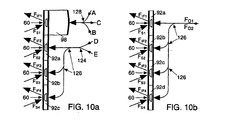
- FIG. 10a illustrates a multiple-receiver array comprising a "master" enhanced mixer 98 with integrated reference cavity for optical LO stabilization and three “slave” enhanced mixers 92a, 92b, and 92c, all driven by the same stabilized optical LO source shown in FIG. 9 with the appropriate connections indicated by letters A, B, C, D, and E. Additional optical beam combiner 124 and optical beam splitters 126 are incorporated to distribute optical LO power among mixers 92a, 92b, and 92c.
- FIG. 10b illustrates a multiple-receiver array driven by the stabilized optical LO source shown in FIG. 5.
- Additional optical beam splitters 126 are incorporated to distribute optical LO power among enhanced mixers 92a, 92b, 92c, and 92d. These multiple-receiver arrays are useful for applications where a large number of receivers would operate simultaneously to form an image or a phased array.
- an antenna can be integrated directly as a part of the metal contact as shown.
- Lasers for optical LO can be stabilized using the transmitted beam from the Fabry-Perot reference cavity instead of the reflected beam. Lasers can be locked to the side of the cavity mode instead of the center as in the Pound-Drever technique.
Landscapes
- Physics & Mathematics (AREA)
- Electromagnetism (AREA)
- Engineering & Computer Science (AREA)
- Computer Networks & Wireless Communication (AREA)
- Signal Processing (AREA)
- Optical Communication System (AREA)
Claims (20)
- Koherenzverstärker für elektromagnetische Strahlung, mit:dadurch gekennzeichnet, dass die lokale Oszillatoreinrichtung eine optische lokale Oszillatoreinrichtung (100) ist, um ein optisches Signal mit einer Frequenz FO von größer als etwa 3 x 10¹³ Hz zu erzeugen, dass das optische Signal mit einer Frequenz FLO von kleiner als etwa 1013 Hz amplitudenmoduliert ist, und dass die Mischerelementeinrichtung (60) gleichzeitig auf die Frequenzen FS, FO und FLO anspricht, wobei das Eingangssignal und das optische Signal auf verschiedenen Wegen der Mischerelementeinrichtung zugeführt werden, um das Ausgangssignal mit einer Frequenz FIF zu erzeugen, die im wesentlichen gleich der Differenz zwischen den Frequenzen FS und FLO ist, und wobei das optische Signal ohne Zwischenkonvertierung der Mischerelementeinrichtung zugeführt wird.einer optischen Eingangseinrichtung (10) zum Sammeln eines Eingangssignals elektromagnetischer Strahlung mit einer Frequenz FS von kleiner als etwa 1013 Hz,einer lokalen Oszillatoreinrichtung,einer Mischerelementeinrichtung, undeiner elektronischen Einrichtung (50), die mit der Mischerelementeinrichtung verbunden ist, um ein Ausgangssignal zu verarbeiten,
- Empfänger nach Anspruch 1, bei dem die optische lokale Oszillatoreinrichtung zwei nahezu monochromatische Lichtquellen (104, 106) mit zwei Frequenzen FO1 und FO2 aufweist, die einen Frequenzabstand mit der Frequenz FLO haben und die bezüglich der Frequenz um die Frequenz FO zentriert sind.
- Empfänger nach Anspruch 2, bei dem die Lichtquellen mit den Frequenzen FO1 und FO2 durch Synchronisieren auf zwei Hohlraum-Betriebsarten von einem optischen Referenz-Resonanzhohlraum stabilisiert sind.
- Empfänger nach Anspruch 1, bei dem die Mischerelementeinrichtung (60) aufweist:einen Metallkontakt (66),einen Mischabschnitt (64) mit einer Dicke t und einer durchschnittlichen Dotierungskonzentration d, wobei der Mischabschnitt Halbleitermaterialien enthält, die bei der Frequenz FO optisch absorbieren,eine Schottky-Übergang (62), der durch den Metallkontakt und den Mischabschnitt gebildet ist, undeinen Kontaktabschnitt (68), der Halbleitermaterialien enthält, die bei der Frequenz FO optisch transparent sind, wobei der Kontaktabschnitt zu dem Mischabschnitt benachbart ist.
- Empfänger nach Anspruch 4, bei dem die optische lokale Oszillatoreinrichtung zwei nahezu monochromatische Lichtquellen mit zwei Frequenzen FO1 und FO2 aufweist, die einen Frequenzabstand mit der Frequenz FLO haben und die bezüglich der Frequenz um die Frequenz FO zentriert sind.
- Empfänger nach Anspruch 5, bei dem die Lichtquellen mit den Frequenzen FO1 und FO2 durch Synchronisieren auf zwei Hohlraum-Betriebsarten von einem optischen Referenz-Resonanzhohlraum stabilisiert sind.
- Empfänger nach Anspruch 4, bei dem die Dicke t kleiner ist als tm = vn/FLO, wobei vn die maximale Elektronendriftgeschwindigkeit der Halbleitermaterialien in dem Mischabschnitt ist und die durchschnittliche Dotierungskonzentration d größer als dm = (2εsVbi)/qtm2 ist, wobei εs die Dielektrizitätskonstante der Halbleitermaterialien in dem Mischabschnitt, Vbi das innere Potential von dem Schottky-Übergang und q die elektrische Ladung eines Elektrons ist.
- Empfänger nach Anspruch 7, bei dem die optische lokale Oszillatoreinrichtung zwei nahezu monochromatische Lichtquellen mit zwei Frequenzen FO1 und FO2 aufweist, die einen Frequenzabstand mit der Frequenz FLO haben und die bezüglich der Frequenz um die Frequenz FO zentriert sind.
- Empfänger nach Anspruch 8, bei dem die Lichtquellen mit den Frequenzen FO1 und FO2 durch Synchronisieren auf zwei Hohlraum-Betriebsarten von einem optischen Referenz-Resonanzhohlraum stabilisiert sind.
- Empfänger nach Anspruch 7, bei dem sich die Mischerelementeinrichtung in einem optischen Anreicherungsresonanzhohlraum befindet, wobei die optische Gesamtleistung, die durch die Mischerelementeinrichtung von dem optischen Signal mit der Frequenz FO absorbiert wird, erhöht wird.
- Empfänger nach Anspruch 10, bei dem die optische lokale Oszillatoreinrichtung zwei nahezu monochromatische Lichtquellen mit zwei Frequenzen FO1 und FO2 aufweist, die einen Frequenzabstand mit der Frequenz FLO haben und die bezüglich der Frequenz um die Frequenz FO zentriert sind.
- Empfänger nach Anspruch 11, bei dem die Lichtquellen mit den Frequenzen FO1 und FO2 durch Synchronisieren auf zwei Hohlraum-Betriebsarten von einem optischen Referenz-Resonanzhohlraum stabilisiert sind.
- Empfänger nach Anspruch 12, bei der der optische Referenz-Resonanzhohlraum mit der Mischerelementeinrichtung integriert ist, wobei das optische Signal über den optischen Referenz-Resonanzhohlraum der Mischerelementeinrichtung zugeführt wird.
- Verfahren zum Empfangen von elektromagnetischer Strahlung mit einer Frequenz FS von kleiner als etwa 1013 Hz, mit:dadurch gekennzeichnet, dass das Verfahren außerdem die Schritte umfasst:Vorsehen einer optischen Eingangseinrichtung (10), um ein Eingangssignal mit der Frequenz FS zu sammeln,Vorsehen einer lokalen Oszillatoreinrichtung,Vorsehen einer Mischerelementeinrichtung, undVorsehen einer elektronischen Einrichtung (50), die mit der Mischerelementeinrichtung verbunden ist, um ein Ausgangssignal zu verarbeiten,Verwenden der lokalen Oszillatoreinrichtung (100), um ein optisches Signal mit einer Frequenz FO von größer als etwa 3 x 10¹³ Hz zu erzeugen, wobei das optische Signal mit einer Frequenz FLO von kleiner als etwa 1013 Hz amplitudenmoduliert ist,Bewirken, dass die Mischerelementeinrichtung (60) gleichzeitig auf die Frequenzen FS, FO und FLO anspricht,Zuführen, auf verschiedenen Wegen, des Eingangssignals und des optischen Signals in die Mischerelementeinrichtung, um das Ausgangssignal mit einer Frequenz FIF zu erzeugen, die im wesentlichen gleich der Differenz zwischen den Frequenzen FS und FLO ist,Zuführen des optischen Signals ohne Zwischenkonvertierung in die Mischerelementeinrichtung, undVerarbeiten des Ausgangssignals mit der Frequenz FIF unter Verwendung der elektronischen Einrichtung.
- Verfahren nach Anspruch 14, bei dem das optische Signal erzeugt wird, indem die optische lokale Oszillatoreinrichtung vorgesehen wird, die zwei nahezu monochromatische Lichtquellen mit zwei Frequenzen FO1 und FO2 aufweist, die einen Frequenzabstand mit der Frequenz FLO haben und die bezüglich der Frequenz um die Frequenz FO zentriert sind.
- Verfahren nach Anspruch 14, bei dem das Eingangssignal und das optische Signal der Mischerelementeinrichtung zugeführt wird, die aufweist:einen Metallkontakt,einen Mischabschnitt mit einer Dicke t und einer durchschnittlichen Dotierungskonzentration d, wobei der Mischabschnitt Halbleitermaterialien enthält, die bei der Frequenz FO optisch absorbieren,einen Schottky-Übergang, der durch den Metallkontakt und den Mischabschnitt gebildet ist, undeinen Kontaktabschnitt, der Halbleitermaterialien enthält, die bei der Frequenz FO optisch transparent sind, wobei der Kontaktabschnitt zu dem Mischabschnitt benachbart ist.
- Verfahren nach Anspruch 16, bei dem das optische Signal erzeugt wird, indem die optische lokale Oszillatoreinrichtung vorgesehen wird, die zwei nahezu monochromatische Lichtquellen mit zwei Frequenzen FO1 und FO2 aufweist, die einen Frequenzabstand mit der Frequenz FLO haben und die bezüglich der Frequenz um die Frequenz FO zentriert sind.
- Verfahren nach Anspruch 17, bei dem das optische Signal durch Synchronisieren der Lichtquellen mit den Frequenzen FO1 und FO2 auf zwei Hohlraum-Betriebsarten von einem optischen Referenz-Resonanzhohlraum stabilisiert ist.
- Verfahren nach Anspruch 17, bei dem der Mischabschnitt der Mischelementeinrichtung eine Dicke t hat, die kleiner ist als tm = vn/FLO, wobei vn die maximale Elektronendriftgeschwindigkeit der Halbleitermaterialien in dem Mischabschnitt ist, und die durchschnittliche Dotierungskonzentration d größer als dm = (2εsVbi)/qtm2 ist, wobei εs die Dielektrizitätskonstante der Halbleitermaterialien in dem Mischabschnitt, Vbi das innere Potential von dem Schottky-Übergang und q die elektrische Ladung eines Elektrons ist.
- Verfahren nach Anspruch 19, bei dem die optische Gesamtleistung, die durch die Mischerelementeinrichtung von dem optischen Signal mit der Frequenz FO absorbiert wird, erhöht wird, indem die Mischerelementeinrichtung in einem optischen Anreicherungsresonanzhohlraum angeordnet wird.
Applications Claiming Priority (3)
| Application Number | Priority Date | Filing Date | Title |
|---|---|---|---|
| US08/560,793 US5796506A (en) | 1995-11-21 | 1995-11-21 | Submillimeter indirect heterodyne receiver and mixer element |
| US560793 | 1995-11-21 | ||
| PCT/US1996/018442 WO1997019527A1 (en) | 1995-11-21 | 1996-11-18 | Submillimeter indirect heterodyne receiver and mixer element |
Publications (3)
| Publication Number | Publication Date |
|---|---|
| EP0862818A1 EP0862818A1 (de) | 1998-09-09 |
| EP0862818A4 EP0862818A4 (de) | 2000-06-07 |
| EP0862818B1 true EP0862818B1 (de) | 2003-08-06 |
Family
ID=24239401
Family Applications (1)
| Application Number | Title | Priority Date | Filing Date |
|---|---|---|---|
| EP96942766A Expired - Lifetime EP0862818B1 (de) | 1995-11-21 | 1996-11-18 | Indirekter submillimeterheterodynempfänger und verfahren |
Country Status (6)
| Country | Link |
|---|---|
| US (1) | US5796506A (de) |
| EP (1) | EP0862818B1 (de) |
| JP (1) | JP2000501195A (de) |
| CA (1) | CA2237661A1 (de) |
| DE (1) | DE69629386T2 (de) |
| WO (1) | WO1997019527A1 (de) |
Families Citing this family (26)
| Publication number | Priority date | Publication date | Assignee | Title |
|---|---|---|---|---|
| US5847853A (en) * | 1995-12-29 | 1998-12-08 | Micron Technology, Inc. | Modulation and demodulation of light to facilitate transmission of information |
| US6700550B2 (en) | 1997-01-16 | 2004-03-02 | Ambit Corporation | Optical antenna array for harmonic generation, mixing and signal amplification |
| WO2002015416A2 (en) * | 2000-08-17 | 2002-02-21 | Terabit Communications, L.L.C. | High-speed communications system |
| US7085499B2 (en) * | 2001-11-15 | 2006-08-01 | Hrl Laboratories, Llc | Agile RF-lightwave waveform synthesis and an optical multi-tone amplitude modulator |
| TW588518B (en) * | 2001-11-15 | 2004-05-21 | Hrl Lab Llc | Agile spread waveform generator |
| US6963442B2 (en) * | 2002-04-17 | 2005-11-08 | Hrl Laboratories, Llc | Low-noise, switchable RF-lightwave synthesizer |
| WO2003090326A1 (en) * | 2002-04-17 | 2003-10-30 | Hrl Laboratories, Llc | Method and apparatus for producing an optical output |
| US6900942B2 (en) * | 2002-08-20 | 2005-05-31 | Veridian Systems | Wide field-of-view (FOV) coherent beam combiner/detector |
| US7092645B1 (en) * | 2002-12-13 | 2006-08-15 | Rockwell Collins, Inc. | Electro optical microwave communications system |
| US7499653B2 (en) * | 2003-07-14 | 2009-03-03 | Hrl Laboratories, Llc | Multiple wavelength photonic oscillator |
| US7521680B1 (en) * | 2003-12-05 | 2009-04-21 | Eric Dean Rosenthal | Electromagnetic spectral-based imaging devices and methods |
| US7822082B2 (en) * | 2004-01-27 | 2010-10-26 | Hrl Laboratories, Llc | Wavelength reconfigurable laser transmitter tuned via the resonance passbands of a tunable microresonator |
| US7277526B2 (en) * | 2004-04-09 | 2007-10-02 | Lyncean Technologies, Inc. | Apparatus, system, and method for high flux, compact compton x-ray source |
| US7473914B2 (en) * | 2004-07-30 | 2009-01-06 | Advanced Energy Systems, Inc. | System and method for producing terahertz radiation |
| US7412175B2 (en) * | 2005-06-20 | 2008-08-12 | The United States Of America As Represented By The Administrator Of The National Aeronautics And Space Administration | Interferometric polarization control |
| US7649665B2 (en) | 2005-08-24 | 2010-01-19 | The Trustees Of Boston College | Apparatus and methods for optical switching using nanoscale optics |
| US7943847B2 (en) | 2005-08-24 | 2011-05-17 | The Trustees Of Boston College | Apparatus and methods for solar energy conversion using nanoscale cometal structures |
| US7634162B2 (en) | 2005-08-24 | 2009-12-15 | The Trustees Of Boston College | Apparatus and methods for nanolithography using nanoscale optics |
| US7754964B2 (en) | 2005-08-24 | 2010-07-13 | The Trustees Of Boston College | Apparatus and methods for solar energy conversion using nanocoax structures |
| US7589880B2 (en) | 2005-08-24 | 2009-09-15 | The Trustees Of Boston College | Apparatus and methods for manipulating light using nanoscale cometal structures |
| GB2438215B (en) * | 2006-05-19 | 2011-06-08 | Teraview Ltd | A THz investigation apparatus and method |
| US20080105820A1 (en) * | 2006-11-07 | 2008-05-08 | Cormack Robert H | Resonant structures for electromagnetic energy detection system and associated methods |
| JP4755965B2 (ja) * | 2006-11-17 | 2011-08-24 | 株式会社アルバック | 水晶振動子を使用した液状物の撹拌方法 |
| JP5471614B2 (ja) * | 2010-03-05 | 2014-04-16 | 日本電気株式会社 | 計測装置 |
| KR101607156B1 (ko) | 2015-03-24 | 2016-03-29 | 한국원자력연구원 | 고주파 전자가속기의 자동 주파수 검출 장치 및 그 방법 |
| EP3964811B1 (de) | 2020-09-07 | 2024-12-11 | Imec VZW | Schaltung zur optoelektronischen abwärtsumwandlung von thz-signalen |
Family Cites Families (15)
| Publication number | Priority date | Publication date | Assignee | Title |
|---|---|---|---|---|
| US3196274A (en) * | 1961-12-12 | 1965-07-20 | Bell Telephone Labor Inc | Light beam demodulator |
| US3132258A (en) * | 1963-03-29 | 1964-05-05 | Wolfgang W Gaertner | Parametric amplifier using photo-cell reactance |
| US3404279A (en) * | 1965-04-05 | 1968-10-01 | Mc Donnell Douglas Corp | Modulated light detector |
| US3379888A (en) * | 1966-06-28 | 1968-04-23 | Gen Instrument Corp | Photodiode mixing in multiplication region |
| US3970839A (en) * | 1970-08-10 | 1976-07-20 | Massachusetts Institute Of Technology | Generating and using coherent optical radiation |
| US3755678A (en) * | 1970-08-10 | 1973-08-28 | Massachusetts Inst Technology | Apparatus and processes for detection, generation and frequency measurements of electro-magnetic radiation in the infrared and visible domain |
| US4020341A (en) * | 1973-08-20 | 1977-04-26 | Massachusetts Institute Of Technology | Generating and using coherent optical radiation |
| US4156135A (en) * | 1976-11-11 | 1979-05-22 | The United States Of America As Represented By The Secretary Of The Army | Electronic heterodyning in an optical detector |
| US4805237A (en) * | 1985-04-08 | 1989-02-14 | Hewlett-Packard Company | Parametric diode amplifier |
| US4856095A (en) * | 1987-05-28 | 1989-08-08 | The United States Of America As Represented By The Secretary Of The Navy | OPFET demodulator-donwconverter for detecting microwave modulated optical signals |
| DE4019224A1 (de) * | 1990-06-15 | 1991-12-19 | Standard Elektrik Lorenz Ag | Funk-nachrichtenuebertragungssystem, insbesondere zellulares mobilfunksystem |
| JP2824875B2 (ja) * | 1991-07-16 | 1998-11-18 | 科学技術振興事業団 | 光復調器 |
| US5379309A (en) * | 1993-08-16 | 1995-01-03 | California Institute Of Technology | High frequency source having heterodyned laser oscillators injection-locked to a mode-locked laser |
| US5401953A (en) * | 1993-09-23 | 1995-03-28 | The United States Of America As Represented By The Administrator Of The National Aeronautics And Space Administration | Optically-switched submillimeter-wave oscillator and radiator having a switch-to-switch propagation delay |
| US5526158A (en) * | 1994-12-22 | 1996-06-11 | Trw Inc. | Low-bias heterodyne fiber-optic communication link |
-
1995
- 1995-11-21 US US08/560,793 patent/US5796506A/en not_active Expired - Fee Related
-
1996
- 1996-11-18 CA CA002237661A patent/CA2237661A1/en not_active Abandoned
- 1996-11-18 JP JP9519817A patent/JP2000501195A/ja active Pending
- 1996-11-18 EP EP96942766A patent/EP0862818B1/de not_active Expired - Lifetime
- 1996-11-18 WO PCT/US1996/018442 patent/WO1997019527A1/en not_active Ceased
- 1996-11-18 DE DE69629386T patent/DE69629386T2/de not_active Expired - Fee Related
Also Published As
| Publication number | Publication date |
|---|---|
| US5796506A (en) | 1998-08-18 |
| DE69629386D1 (de) | 2003-09-11 |
| EP0862818A4 (de) | 2000-06-07 |
| DE69629386T2 (de) | 2004-06-24 |
| CA2237661A1 (en) | 1997-05-29 |
| JP2000501195A (ja) | 2000-02-02 |
| EP0862818A1 (de) | 1998-09-09 |
| WO1997019527A1 (en) | 1997-05-29 |
Similar Documents
| Publication | Publication Date | Title |
|---|---|---|
| EP0862818B1 (de) | Indirekter submillimeterheterodynempfänger und verfahren | |
| Simonis et al. | Optical generation, distribution, and control of microwaves using laser heterodyne | |
| Seeds et al. | Microwave photonics | |
| Yao et al. | Multiloop optoelectronic oscillator | |
| US6873631B2 (en) | Integrated opto-electronic oscillators having optical resonators | |
| Hyodo et al. | Generation of millimetre-wave radiation using a dual-longitudinal-mode microchip laser | |
| Fan et al. | Optical generation of a megahertz-linewidth microwave signal using semiconductor lasers and a discriminator-aided phase-locked loop | |
| Mayorga et al. | First in-field application of a full photonic local oscillator to terahertz astronomy | |
| Nagatsuma | Generating millimeter and terahertz waves | |
| Ito et al. | Photonic millimetre-and sub-millimetre-wave generation using J-band rectangular-waveguide-output uni-travelling-carrier photodiode module | |
| Ito et al. | 11 dBm photonic millimetre-wave generation at 100 GHz using uni-travelling-carrier photodiodes | |
| Lee et al. | SOA‐Integrated dual‐mode laser and PIN‐photodiode for compact CW terahertz system | |
| Ueda et al. | W-band waveguide photomixer using a uni-traveling-carrier photodiode with 2-mW output | |
| US5062155A (en) | Modulated light wave demodulator | |
| Suto et al. | Raman amplification in GaP-AlxGa1-xP waveguides for light frequency discrimination | |
| Mikkelsen et al. | Temperature-dependent gain and noise of 1.5 μm laser amplifiers | |
| Wrixon et al. | Low noise Schottky barrier diode mixers for wavelengths< 1 mm | |
| Langley et al. | Optical phase-locked loop signal sources for phased-array communications antennas | |
| Offermans et al. | Towards THz beam steering with integrated phased photomixer arrays | |
| Furuhama et al. | Present status of optical ISL studies in Japan | |
| Ito et al. | Broadband photonic terahertz-wave emitter based on planar-antenna-integrated UTC-PD | |
| US12247835B2 (en) | Stabilized frequency generator | |
| Ali et al. | Optical mixing to 211 GHz using 50 nm gate pseudomorphic high electron mobility transistors | |
| Georges et al. | Broadband microwave fiber-optic links with RF phase control for phased-array antennas | |
| Brown et al. | Terahertz photomixing in low-temperature-grown GaAs |
Legal Events
| Date | Code | Title | Description |
|---|---|---|---|
| PUAI | Public reference made under article 153(3) epc to a published international application that has entered the european phase |
Free format text: ORIGINAL CODE: 0009012 |
|
| 17P | Request for examination filed |
Effective date: 19980610 |
|
| AK | Designated contracting states |
Kind code of ref document: A1 Designated state(s): BE CH DE FR GB LI NL |
|
| A4 | Supplementary search report drawn up and despatched |
Effective date: 20000420 |
|
| AK | Designated contracting states |
Kind code of ref document: A4 Designated state(s): BE CH DE FR GB LI NL |
|
| RIC1 | Information provided on ipc code assigned before grant |
Free format text: 7H 04B 10/148 A |
|
| 17Q | First examination report despatched |
Effective date: 20020320 |
|
| GRAH | Despatch of communication of intention to grant a patent |
Free format text: ORIGINAL CODE: EPIDOS IGRA |
|
| RTI1 | Title (correction) |
Free format text: SUBMILLIMETER INDIRECT HETERODYNE RECEIVER AND METHOD |
|
| GRAH | Despatch of communication of intention to grant a patent |
Free format text: ORIGINAL CODE: EPIDOS IGRA |
|
| GRAA | (expected) grant |
Free format text: ORIGINAL CODE: 0009210 |
|
| AK | Designated contracting states |
Designated state(s): BE CH DE FR GB LI NL |
|
| PG25 | Lapsed in a contracting state [announced via postgrant information from national office to epo] |
Ref country code: NL Free format text: LAPSE BECAUSE OF FAILURE TO SUBMIT A TRANSLATION OF THE DESCRIPTION OR TO PAY THE FEE WITHIN THE PRESCRIBED TIME-LIMIT Effective date: 20030806 Ref country code: LI Free format text: LAPSE BECAUSE OF FAILURE TO SUBMIT A TRANSLATION OF THE DESCRIPTION OR TO PAY THE FEE WITHIN THE PRESCRIBED TIME-LIMIT Effective date: 20030806 Ref country code: CH Free format text: LAPSE BECAUSE OF FAILURE TO SUBMIT A TRANSLATION OF THE DESCRIPTION OR TO PAY THE FEE WITHIN THE PRESCRIBED TIME-LIMIT Effective date: 20030806 Ref country code: BE Free format text: LAPSE BECAUSE OF FAILURE TO SUBMIT A TRANSLATION OF THE DESCRIPTION OR TO PAY THE FEE WITHIN THE PRESCRIBED TIME-LIMIT Effective date: 20030806 |
|
| REG | Reference to a national code |
Ref country code: GB Ref legal event code: FG4D |
|
| REG | Reference to a national code |
Ref country code: CH Ref legal event code: EP |
|
| REF | Corresponds to: |
Ref document number: 69629386 Country of ref document: DE Date of ref document: 20030911 Kind code of ref document: P |
|
| NLV1 | Nl: lapsed or annulled due to failure to fulfill the requirements of art. 29p and 29m of the patents act | ||
| REG | Reference to a national code |
Ref country code: CH Ref legal event code: PL |
|
| ET | Fr: translation filed | ||
| PLBE | No opposition filed within time limit |
Free format text: ORIGINAL CODE: 0009261 |
|
| STAA | Information on the status of an ep patent application or granted ep patent |
Free format text: STATUS: NO OPPOSITION FILED WITHIN TIME LIMIT |
|
| 26N | No opposition filed |
Effective date: 20040507 |
|
| PGFP | Annual fee paid to national office [announced via postgrant information from national office to epo] |
Ref country code: DE Payment date: 20070102 Year of fee payment: 11 |
|
| PG25 | Lapsed in a contracting state [announced via postgrant information from national office to epo] |
Ref country code: DE Free format text: LAPSE BECAUSE OF NON-PAYMENT OF DUE FEES Effective date: 20080603 |
|
| PGFP | Annual fee paid to national office [announced via postgrant information from national office to epo] |
Ref country code: GB Payment date: 20091125 Year of fee payment: 14 Ref country code: FR Payment date: 20091201 Year of fee payment: 14 |
|
| GBPC | Gb: european patent ceased through non-payment of renewal fee |
Effective date: 20101118 |
|
| REG | Reference to a national code |
Ref country code: FR Ref legal event code: ST Effective date: 20110801 |
|
| PG25 | Lapsed in a contracting state [announced via postgrant information from national office to epo] |
Ref country code: FR Free format text: LAPSE BECAUSE OF NON-PAYMENT OF DUE FEES Effective date: 20101130 |
|
| PG25 | Lapsed in a contracting state [announced via postgrant information from national office to epo] |
Ref country code: GB Free format text: LAPSE BECAUSE OF NON-PAYMENT OF DUE FEES Effective date: 20101118 |