EP0862832B1 - Taktrückgewinnungsanordnung und -verfahren für mpeg-datensignale - Google Patents
Taktrückgewinnungsanordnung und -verfahren für mpeg-datensignale Download PDFInfo
- Publication number
- EP0862832B1 EP0862832B1 EP96940599A EP96940599A EP0862832B1 EP 0862832 B1 EP0862832 B1 EP 0862832B1 EP 96940599 A EP96940599 A EP 96940599A EP 96940599 A EP96940599 A EP 96940599A EP 0862832 B1 EP0862832 B1 EP 0862832B1
- Authority
- EP
- European Patent Office
- Prior art keywords
- network
- mpeg
- clock
- data
- network interface
- Prior art date
- Legal status (The legal status is an assumption and is not a legal conclusion. Google has not performed a legal analysis and makes no representation as to the accuracy of the status listed.)
- Expired - Lifetime
Links
Images





Classifications
-
- H—ELECTRICITY
- H04—ELECTRIC COMMUNICATION TECHNIQUE
- H04N—PICTORIAL COMMUNICATION, e.g. TELEVISION
- H04N7/00—Television systems
- H04N7/10—Adaptations for transmission by electrical cable
-
- H—ELECTRICITY
- H04—ELECTRIC COMMUNICATION TECHNIQUE
- H04N—PICTORIAL COMMUNICATION, e.g. TELEVISION
- H04N7/00—Television systems
- H04N7/10—Adaptations for transmission by electrical cable
- H04N7/106—Adaptations for transmission by electrical cable for domestic distribution
-
- H—ELECTRICITY
- H04—ELECTRIC COMMUNICATION TECHNIQUE
- H04J—MULTIPLEX COMMUNICATION
- H04J3/00—Time-division multiplex systems
- H04J3/02—Details
- H04J3/06—Synchronising arrangements
-
- H—ELECTRICITY
- H04—ELECTRIC COMMUNICATION TECHNIQUE
- H04J—MULTIPLEX COMMUNICATION
- H04J3/00—Time-division multiplex systems
- H04J3/02—Details
- H04J3/06—Synchronising arrangements
- H04J3/062—Synchronisation of signals having the same nominal but fluctuating bit rates, e.g. using buffers
-
- H—ELECTRICITY
- H04—ELECTRIC COMMUNICATION TECHNIQUE
- H04N—PICTORIAL COMMUNICATION, e.g. TELEVISION
- H04N21/00—Selective content distribution, e.g. interactive television or video on demand [VOD]
- H04N21/40—Client devices specifically adapted for the reception of or interaction with content, e.g. set-top-box [STB]; Operations thereof
- H04N21/47—End-user applications
Definitions
- the present invention relates to multimedia digital networks, and more particularly, to the recovery and locking of the clock of a video data stream received at a digital home network for conversion for use or display by in-home products, such as televisions.
- Set-top boxes are multi-media computers that augment the use of televisions.
- a conventional set-top box has an external network interface module that connects the set-top box to the external network and data provider.
- the network interface module has to perform a number of sophisticated functions, such as interfacing to a specific external network, tuning, demodulation, error correcting, video descrambling, recovery of MPEG clock, and encryption and decryption specific to the external network. Consequently, the network interface module is a relatively expensive component of set-top boxes. This expense would be necessary even when a single television is present in the house. However, most homes contain multiple televisions, and providing each with its own set-top box and associated network interface module is a duplication of expensive components.
- MPEG clock recovery MPEG-1 and MPEG-2 being different accepted standards for transmitting digitized video data.
- MPEG data is a continuous stream of data normally clocked at 27 MHz.
- the network interface unit is coupled by a bus to the set-top electronics, there is little or no danger of degradation of the video signal due to jitter, since a local bus will not introduce substantial jitter.
- the video data is placed onto a shared network and distributed through a hub, jitter is likely to be introduced by the home network since the video data may be buffered behind other data at certain points in the network. The higher the jitter, the more difficult it is to recover the clock at the set-top electronics as required.
- the MPEG clock is recovered first at a network interface unit coupled to an external network.
- a frequency synthesizer at the network interface unit locks the recovered MPEG clock to an internal network clock, such as an Ethernet clock.
- the MPEG clock may be 27 MHz
- the Ethernet clock may be 10 MHz.
- the packets of data are transmitted from the network interface unit to the set-top electronics, the packets are locked to the recovered MPEG clock at 27 MHz.
- another synthesizer regenerates the 27 MHz clock from the locked version of the clock that is sent with the data packets over the internal network.
- the present invention provides the advantage of allowing transmission of MPEG video data over a relatively inexpensive home network, such as Ethernet, without incurring jitter.
- a further advantage of the present invention is that once the signal is locked to the recovered MPEG clock, it is easier and faster for any set-top electronics unit to lock onto the signal.
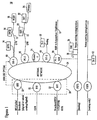
- Figure 1 is a schematic depiction of a home multimedia network 10 constructed in accordance with an embodiment of the present invention.
- This embodiment is exemplary only, however, as the network 10 may be configured in any of a number of different ways within the scope of the invention, and include different devices coupled to the network 10.
- the invention is not limited to networks located in homes, but is applicable to networks installed in other types of structures, such as offices, apartment buildings, etc. For purposes of illustration, however, the exemplary embodiment will be described in the context of a home installation.
- the network 10 is a digital network that provides connectivity of different types of equipment to the world outside the home.
- This equipment can be, for example, analog television 12, digital television 14, digital VCR 16, digital camcorder 18, personal computers 20, audio equipment 22, printers 24, facsimile machines 26, and telephones 28, among others.
- the network 10 also connects the digital video, digital audio, computer and telephone equipment together internally in the home. This unifies communication and control within the home, making the full power of the external network connections or internal data sources available to any terminal on the network 10.
- the different external networks may carry different types of signals. These may be, for example, broadcast signals (digital or mixed analog/digital) carried on hybrid fiber coax or cable. Other types of signals are ISDN, broadcast/digital satellite service, FTTC, FTTH, ADSL, and others. At least the following data types may be carried: compressed video, compressed audio, compressed internet WWW graphics and data, internet e-mail and other data, computer file data and control message data.
- broadcast signals digital or mixed analog/digital
- Other types of signals are ISDN, broadcast/digital satellite service, FTTC, FTTH, ADSL, and others.
- At least the following data types may be carried: compressed video, compressed audio, compressed internet WWW graphics and data, internet e-mail and other data, computer file data and control message data.
- Logically all terminals in the home network 10 receive equal access to the network interface units 32 and a user would be unaware of the physical sighting of them.
- the number of network interface units 32 that are required is determined by the number of streams required per home, e.g. the number of different program channels (i.e., video, audio, and other) required simultaneously, not by the number of terminal units in a home.
- cable or antenna television is retained unmodified with distribution by regular in-home coax (plain old television, or POTV).
- POTS plain old telephone service
- POTS plain old telephone service
- the digital signals are distributed throughout the home over an internal network 34.
- the internal network 34 is essentially Ethernet of type 10base-T or 100base-T twisted pair but a special switch hub is employed to make the network scalable to any number of terminal units each able to receive high bit-rate video.
- the home network 10 connects those computers, or products with embedded computers, that can support the networking bandwidth, protocols, routing, buffering and addressing. Other high bandwidth products that do not support this complex functionality must attach to such a host unit either directly or via a local peripheral network to achieve interoperability.
- Examples of computers or products with embedded computers located on the home network 10, functioning as end user devices, include: the network interface units's I/O computers performing external network to home network conversion and conditioning; computers, such as the set-top electronics (STE); PC's; workstations; high end printers; and special computers providing gateway/control functions.
- Other end user devices that can be coupled to the network 10 include video products: digital compressed (MPEG) and uncompressed video equipment; digital video camcorder products; digital video tape recording products and digital tv display products and analog tv display and recording products.
- Audio products that can be coupled to the network 10 include: digital compressed (MPEG) and uncompressed audio equipment; HIFI stereo; digital audio tape recording products.
- Other types of products that can connect to the network 10 are data products, such as printers and other peripherals.
- Still further products that can be controlled through the network 10 include home automation and appliances: central heating/AC, security controller, microwave oven and other kitchen equipment, lighting, sprinkler and other power control.
- Certain embodiments of the home network 10 include one or more local peripheral networks 15 that provide local connection for future very high bit rate, motion-JPEG or I-frame-only-MPEG video devices, audio devices, printers and such peripherals. These devices need continuous local digital connection at a high bandwidth, where the data transfer is continuous from, for example, digital camera to digital VCR. Accommodating such devices directly on the internal network 34 would require greater network bandwidth over the entire network 34 than normally needed. Instead, the local peripheral network 15 is normally connected by gateway to the internal network 34 for interoperability. However, in certain other embodiments of the invention, the home network 10 is provided with hardware and software that accommodates the high speed devices so that a local peripheral network 15 is not necessary.
- a home automation network 17 is provided for home automation.
- This home automation network 17 may run on the power line or other low bit rate network for controlling appliances, home security systems, lighting, etc. This spur originates from a control computer 20 located within the home.
- FIG. 2 An exemplary model of the installation of the home network 10 of the present invention within a house 36 is depicted in Figure 2.
- the home network 10 is a long range backbone capable of up to 100m cable runs, for example, from a switched hub 38 that forms part of the internal network 34.
- the entrance unit 30 with its multiple network interface units 32 are located in a utility area of the house, along with the switched hub 38.
- Twisted pair cable is run to each room of the house 36 and terminates at a wall socket.
- Cat-5 twisted pair (for 100 Mbits/s), for example, may be used when doing an installation, as the majority of the cost is labor.
- twisted pair cable is small enough that it may be customer fitted under a carpet edge. A user in the home will connect a computer product in a room by plugging the Ethernet port of the computer product to the Ethernet wall socket.
- the hub 38 is depicted as a separate device, but in other embodiments the hub 38 is integrated into one or more of the network interface units 32.
- the hub 38 provides the connectivity to all areas of the house and the one or more network interface units 32. Upgrading, expanding both the aggregate bandwidth and connectivity of the internal network 34, is accomplished by additional plugging or changing to a larger hub. The hub will be discussed in more detail later.
- the present invention separates the functionality of the network interface units 32 from the set-top electronics 40.
- a set-top box contains a network interface unit whose components are internally connected by a bus to the set-top electronics components.
- the present invention provides a separation of the network interface units 32 and the set-top electronics 40, with the internal network 34 interposed therebetween. This arrangement permits multiple set-top electronics to be distributed throughout the home 36 less expensively, since the electronics of a network interface unit do not have to be duplicated for each set-top electronics.
- having separate network interface units 32 coupled to different external networks and to a common internal network 34 frees the homeowner from being forced to receive all programming from a single source, such as the telephone or cable company.
- the separation also allows the homeowner to add, drop or change services simply by changing one of the network interface units 32, without the need for replacing all of the set-top electronics 40 throughout the home 36.
- a "master" set-top box is provided with multiple network interface units.
- this embodiment is logically the same as described above, as the network interface units are connected in this embodiment to the internal network, and not by a bus to the set-top electronics.
- FIG. 3 is a logical view of the home network 10 of the present invention.
- the multi-port switched hub 38 forms the center of the network connections.
- a traditional, commercially available packet switched hub is employed.
- the switched hub 38 is a combination of networked ports and ports that are direct (circuit) switched for the duration of a session.
- the direct connected ports (and systems) can be phase locked via the network (coded) clock.
- the switched hub 38 therefore comprises a relatively simple and inexpensive hub 42 and a direct circuit crossbar 44.
- the hub 42 in certain preferred embodiments, may be a commercially available device, such as Am79C981 manufactured by Advanced Micro Devices, of sunnyvale, California. Details of the direct circuit crossbar 44 will be described later with respect to Figure 7.
- a star topology as defined by Ethernet 10/100base-T is used in conjunction with the switching hub 38.
- the switching hub 38 provides fan out to most rooms in the house 36.
- the switched hub 38 enables special treatment for the heavily asymmetric traffic, e.g., compressed digital video and internet data by directly routing these cases from transmitter to receiver.
- This traffic is thus separated from the internal network 34 and allows an overall aggregate bandwidth to be limited only by the expandability of the hub 38, although it will remain limited by the 10Mbits/s per branch.
- Use of 100base-T technology instead of 10base-T technology will uprate the network if required.
- the switching hub's direct synchronous (Manchester or block encoded) connections are used primarily for the transmission of MPEG video where a continuous, high bit rate, long duration connection is required.
- High bit rate video in compressed form can be as high as 8 Mbits/sec and is needed for live video and high action movies and sports.
- Low bit-rate video is 1.5 Mbits/sec.
- MPEG digital video is retained throughout the network 10. Conversion to real video takes place only at the display device (e.g., television 12) or the set-top electronics 40.
- Two separate direct circuits are depicted as examples in Figure 3.
- the network interface unit 32 that is coupled to an ISDN network is directly connected through the direct circuit crossbar 44 to the personal computer 20 of the local peripheral network 15.
- Another, separate direct circuit is provided by the direct circuit crossbar 44 between a different network interface unit 32 (coupled to hybrid fiber coax, for example) and the set-top electronics 40 coupled to the television 12. Those devices that are not directly connected through the direct circuit crossbar 44 remain attached to the hub 42 and are thus networked.
- An advantage of directly switched paths is that potential delays in obtaining access to the network 34 (and possibly upsetting the delicate clock reference timing carried in the MPEG stream) are avoided altogether.
- the hub 38 in certain preferred embodiments, is required to be "full-duplex aware" meaning that a directly routed path connects only a transmitter terminal "up" path only to a receive terminal “down” path.
- the path down to the transmitter and path up to the receiver are not affected by the direct circuit and would normally be attached to the network, i.e., attached to all the remaining terminal paths connected together.
- the MPEG clock recovery is performed at the network interface units 32, as described later. With the MPEG clock recovery at the network interface units 32, and the establishment of a direct circuit to the home network destination, jitter in the signal received at the destination (such as the television 12) is substantially eliminated. Direct circuit capability works well for the heavily asymmetric point to point traffic expected in the entertainment (video) home scenario.
- hybrid fiber coax For analog only services, e.g., transitional cable TV, this is not considered part of the digital network.
- mixed digital/analog services such as hybrid fiber coax (HFC) and newer forms of mixed cable TV, this is considered a transitional state and dealt with as a temporary add-on to the all digital system of the present invention.
- the signal from the hybrid fiber coax is provided directly to a set-top electronics 40 or to a network interface unit 32/set-top electronics 40 combination. Two ports are required to connect to the home network 10, one for the network interface unit 32 and one for the set-top electronics 40.
- a bypass is provided in certain preferred embodiments to link the analog signals across to the audio/video circuits of the set-top electronics 40.
- the home network 10 is controlled via hand held commander or computer keyboard to software running at the local terminals, such as the personal computers 20, or set-top electronics 40. Control software local to each home terminal manages source availability, source selection, path management by communication with the network interface units 32 and external gateways. The external network protocols are buffered in the network interface units 32 to provide a standard interface to the terminals on the home network 10.
- Figure 8 depicts one an example of a user interface. In this embodiment, the home network 10 is transparent and the user is only aware of it indirectly from the number of connected services.
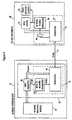
- Figure 4 is a block diagram depicting a single network interface unit 32 coupled by the internal network 34 to a single set-top electronics unit 40. The remaining portions of the home network 10, including the switching hub 38, are not shown in Figure 4 for purposes of illustration and explanation.
- the network interface unit 32 has one or more network interface modules 50 that interface the network interface unit 32 to a particular external network.
- the network interface module 50 provides an interface to an external network that carries MPEG video data.
- the MPEG video data is provided to an internal network interface device 52 that prepares the data for transport over the internal network 34.
- the internal network 34 is an Ethernet network, so that the internal network interface device 52 is an Ethernet interface device.
- the architecture of the present invention assumes that for some networks a first stage demultiplexing at the network interface unit 32 is necessary to stay within a definable bandwidth limit (one stream) rather than an arbitrary bandwidth set by the construction of the incoming stream (multiple streams).
- a definable bandwidth limit one stream
- MPEG-2 MPEG-2 video
- decoding is preferably only performed at the display terminal or computer.
- the network interface module 50 buffers the home network hardware and software from the peculiarities of the attached external network. Multiple different programs require multiple network interface crossbar connections whether from one or multiple providers. In certain embodiments, a dual module is provided with two connections to the crossbar, providing two programs received from the same external network.
- the MPEG transport chip 54 performs the MPEG clock recovery and provides the recovered 27 MHz clock and the selected program to an internal network connection 56.
- the 27 MHz clock is received by an MPEG to network synthesizer 58 and converted to a 10 MHz clock, for example, when the internal network 34 is a 10base-T Ethernet network.
- the 10 MHz clock, as well as the selected program, are provided to a conventional transceiver 60 (such as an Ethernet transceiver) connected to the internal network 34.
- the synthesizer 58 acts to lock the Ethernet clock to the recovered MPEG clock.
- the set-top electronics 40 is locked to the recovered MPEG data at 27 MHz.
- the 27 Mhz clock is regenerated from the Ethernet 10 MHz clock by another synthesizer.
- the data is received in the set-top electronics 40 by a network interface device 62 that includes a network interface 64.
- the 10 MHz clock recovered by the network interface 64 from the data stream off the network 34 is gated through gate 66 to a network to MPEG synthesizer 68. Gating is needed so that the locking function is performed only when there is a packet of data present.
- the 10 MHz clock is converted to a 27 MHz clock provided to an MPEG decoder 70 and a video decoder/encoder 72.
- the selected program is provided by the network interface 64 to the MPEG decoder 70, which decodes the MPEG data and provides it to the video decoder/encoder 72.
- the data stream is converted by the video encoder 72 to a format (e.g., NTSC or SVideo) suitable for use by a display device, such as a television.
- a format e.g., NTSC or SVideo
- the video decoder os for the case (HFC) where there may be an NTSC analog signal to digitize and merge with on-board graphics hardware.
- the network 34 in Figure 4 is depicted schematically, and it should be understood from the previous description that the video data may be placed on the network 34 through the hub 42, but that a direct circuit of the network interface unit 32 and the set-top electronics 40 through the direct circuit crossbar 44 of the network 34 is preferred to provide a jitter free transfer of video data.
- FIG 5 is a more detailed diagram of an exemplary embodiment of the network interface device 62 of the set-top electronics 40 depicted in Figure 4.
- the network interface device 62 includes the network synthesizer 68 coupled to a program logic device operating as the gating device 66.
- the network synthesizer 68 may be implemented by a commercially available chip, such as the MC145151 manufactured by Motorola.
- the program logic device 66 may be implemented by a commercially available chip, such as the MC7958, also manufactured by Motorola.
- a voltage controlled crystal oscillator 80 operates at 27 MHz and provides its signal to the program logic device 62, which gates the 10 MHz signal to the synthesizer 68 when there is a received data packet.
- the synthesizer divides down the 10 MHz and 27 MHz frequencies to a common frequency which is fed into a phase detector of the synthesizer 68.
- the output of the phase detector of the synthesizer 68 is provided as a control signal to the voltage controlled crystal oscillator 80 to adjust the local frequency up or down to lock to the incoming Ethernet frequency.
- the signal informing the program logic device 66 of the receipt of a data packet, and the 10 MHz clock, are provided by a serial interface adapter 82 serving as a receive enable.
- a commercially available product suitable for the serial interface adapter is Am7992B, manufactured by Advanced Micro Devices.
- the data stream is received through a transformer/filter 84, such as one commercially available from Pulse Engineering, the PE68026. Collision information is also received through another transformer/filter 86, which can be the same type of transformer/filter as 84.
- the received data is provided to a first network transceiver 88 , such as a twisted pair Ethernet transceiver plus (Am79C100).
- the output of the first network transceiver 88 (the received data) is made available to the receive enable 82 and a controller 90.
- the controller 90 may be a commercially available product, such as the single-chip Ethernet controller Am79C970 (manufactured by Advanced Micro Devices).
- the controller 90 is coupled to a bus 92, such as a peripheral component interconnect (PCI) bus, for providing the received data from the network 34 to the MPEG decoder 70 of the set-top electronics 40.
- PCI peripheral component interconnect
- a second network transceiver 92 is coupled to the controller 90, and may be implemented by the same type of transceiver as 88.
- the second network transceiver 92 provides the transmit path for data from the controller 90 to the network 34 through the transformer/filter 84.
- Collision information is routed through transformer/filter 86 and the second transceiver 92 to the controller 90.
- FIG 6 is a more detailed diagram of the internal network connection 56, which has an MPEG to network synthesizer 58 that synthesizes the 10 MHz clock from the 27 MHz MPEG clock recovered by the MPEG transport chip 54 (see Figure 4).
- a crystal oscillator 96 is coupled to the synthesizer 58 to provide a 10 MHz signal.
- the crystal oscillator 96 is a 20 MHz oscillator, and the frequency generated by the synthesizer is 20 MHz, which is then simply divided to 10 MHz at the receiver (the set-top electronics 40).
- a commercially available synthesizer is the MC145145-2, manufactured by Motorola.
- the 10 MHz clock is provided to a microprocessor interface 98, which serves as interface for a microprocessor 100.
- the microprocessor interface 98 with the microprocessor 100, form the transceiver 60 that connects to the internal network 34 through a transformer/filter 102.
- the microprocessor interface 98 may be, for example, a MC68160 chip manufactured by Motorola, and the microprocessor may be a MC68EN360, also manufactured by Motorola.
- the transformer/filter 102 may be the same type as transformer/filters 84, 86 of Figure 5.
- the network interface unit 32 is responsible for performing external network specific interfacing, tuning demodulation, and error correction. It provides external network specific video descrambling and encryption/decryption (credit card number, user password, etc.).
- the network interface unit 32 also provides an external network specific program guide. Additionally, it performs MPEG transport demultiplexing to a single stream and MPEG reference clock recovery.
- the network interface unit provides home network Ethernet interfacing and MPEG/Ethernet clock locking. It also provides the software to support the external network and home network protocols for multiple streams and multiple users.
- the network interface unit also has the software to act as the gateway for the home network and control the buffering of data as necessary.
- the set-top electronics 40 essentially acts as an application computer with audio, video, graphic and analog television interface, in preferred embodiments.
- the set-top electronics provides the home network specific interfacing and data buffering as necessary. It provides Ethernet clock/MPEG clock locking in preferred embodiments.
- the set-top electronics 40 decodes MPEG video and audio to recover digital audio/video. It performs digital to analog conversion for audio and video, and supports commands from an infrared remote control.
- the set-top electronics 40 provides support for analog video input (NTSC). It interfaces printers, game ports, etc., and supports boot level operating system and is able to down load a full system from an external network.
- the set-top electronics 40 supports application programs and communications through the network interface units to a network provider and program video server.
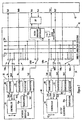
- Figure 7 is a block diagram depicting in more detail an exemplary embodiment of the hub 42 and direct circuit crossbar 44 arrangement of the present invention and its connection with a network interface unit 32 and set-top electronics 40.
- the direct circuit crossbar 44 and 42 selectively provide either a direct circuit between a particular network interface unit 32 and a set-top electronics 40, or a simple network connection through the hub 42 for these units.
- only portions of the network interface unit 32 and the set-top electronics 40 are depicted, for purposes of illustration and explanation.
- the hub 42 is a relatively simple and inexpensive hub, since it does not include any sort of packet routing switch or store and forward switch. There is no intelligence that examines the traffic and dynamically switches the hub according to the transmit and receive addresses as in hubs that have packet routing switches.
- any number of directly connected pairs may be connected by the direct circuit crossbar 44, depending on the size of the crossbar 44.
- the network interface unit 32 and the set-top electronics 40 are each shown with five pin positions or connections, each of the connections being a pair. This coincides with a conventional telephone plug, the telephone RJ45, which has ten pin positions.
- the internal network 34 provides the connection between the network interface units 32, the set-top electronics 40 and the direct circuit crossbar 44.
- the internal network 34 is 10 or 100base-T Ethernet.
- a microprocessor 110 serves as the controller for the direct circuit crossbar 44 and controls the positions of the switches 108 in response to user commands that require a direct circuit to perform. For example, a user may choose to watch a movie from a video on demand service and therefore makes this selection on a hand-held remote control.
- the microprocessor 110 in response to this selection, will then change the positions of the switches 108 to establish a direct circuit between the network interface unit 32 that is connected to the external network that carries the video on demand service, and the set-top electronics 40 that is coupled to the television receiver on which the user desires to view the movie.
- switch 108a is moved to its illustrated position to connect the transmit lines of transceiver 88 of the network interface unit 32 to line 112 of the direct circuit crossbar 44.
- the transmit lines of transceiver 88 are no longer connected to the network at the Txl port of the hub 42.
- the receive lines of the transceiver 92 of the set-top electronics 40 are connected through switch 108g to the same line 112 of the direct circuit crossbar 44.
- the direct circuit established by the direct circuit crossbar 44 provides an excellent pathway for data from the network interface unit 32 to the set-top electronics 40, it may occur that not all of the data coming into the network interface unit 32 is meant for the set-top electronics 40. For example, it is possible that e-mail is received over this particular network interface unit 32, and the homeowner wants e-mail to be directed to a personal computer, and not to a television. However, there is no connection to the network 34 due to the direct circuit once a direct circuit is established.
- the set-top electronics 40 examines the addresses of the data packets it receives and performs a routing function for data that is not meant for this set-top electronics 40. The data is rerouted by the set-top electronics 40 onto the network 34 through the hub 42. This re-routing by the end point connection (the set-top electronics 40 in this example) avoids the need for the system to use an expensive and complicated router.
- the set-top electronics 40 has a microprocessor 120 and associated memory 122 to identify and route the data packets back to the network 34.
- the direct circuit between the network interface unit 32 and the set-top electronics 40 provides a jitter-free connection for video data, but the re-routing of other data into the network 34 through the hub allows more than one type of data to be carried into the home by the network interface unit 32.
- collision detection is required by the set-top electronics 40 to allow it to transmit to the hub 42.
- the set-top electronics 40 needs to learn of collisions and re-transmit the data to the network 34 if such collisions occur.
- the network interface unit 32 can be set, in certain embodiments, to disable collisions because they cannot occur on the direct circuit. However, in certain embodiments, in both the network interface unit port and the set-top electronics port (to the network 34 through the crossbar 44), the same collision pair is included for convenience.
- one of the five pairs of wires is available to provide picture-in-picture capability for the system.
- the network interface unit 32 may provide a second stream of data through another transceiver 88a over a second pair of transmit wires onto a separate crossbar connection line 114.
- the set-top electronics 40 which has another transceiver 88a also connected to line 114, receives this second stream of data through the direct circuit to provide a picture-in-picture on a television screen.
- both pictures may be provided without jitter by separate direct circuits.
- the crossbar switches 108 are implemented by an analog MOS array of transistors, controlled in response to signals from the controller 110. This is exemplary only, however, as other embodiments employ switches of different design, as appreciated by one of ordinary skill in the art.
- the hub 42 is described as connected to the internal network.
- the hub 42 may also be logically considered as part of the internal network, or even forming the network, with the remaining wiring forming means for attaching end terminals to the hub 42.
- the logical distinctions depicted and described in the present specification are exemplary only.
- the separation of the network interface unit and the set-top electronics according to the present invention provides a relatively inexpensive connection of a multitude of devices to each other within the home, and to the outside world.
Landscapes
- Engineering & Computer Science (AREA)
- Signal Processing (AREA)
- Multimedia (AREA)
- Computer Networks & Wireless Communication (AREA)
- Computer Hardware Design (AREA)
- Small-Scale Networks (AREA)
- Television Signal Processing For Recording (AREA)
- Synchronisation In Digital Transmission Systems (AREA)
- Color Television Systems (AREA)
Claims (5)
- Verfahren zum Rückgewinnen und Verteilen eines MPEG-Taktes aus einem Strom von MPEG-Daten an einer Netzwerk-Schnittstelleneinheit (32), die mit einem externen Netzwerk verbunden ist, wobei die Netzwerk-Schnittstelleneinheit (32) einen MPEG-Transport-Chip (54) zum Auswählen eines Programms aus dem Strom aufweist und das Verfahren gekennzeichnet ist durch:Verriegeln des rückgewonnenen MPEG-Taktes auf einen Takt des internen Netzwerks;Senden der MPEG-Daten des ausgewählten Programms von der Netzwerk-Schnittselleneinheit (32) über ein internes Netzwerk (34) entsprechend dem Takt des internen Netzwerks; undRückgewinnen des MPEG-Taktes an Settop-Elektronik (40), die mit dem internen Netzwerk (34) verbunden ist, aus den MPEG-Daten des ausgewählten Programms, die über das interne Netzwerk entsprechend dem Takt des internen Netzwerks getaktet werden, durch Gating der über das interne Netzwerk (34) empfangenen MPEG-Daten des ausgewählten Programms und Rückgewinnen des verriegelten MPEG-Taktes nur dann, wenn die MPEG-Daten des ausgewählten Programms an der Settop-Elektronik (40) vorhanden sind.
- Verfahren nach Anspruch 1, wobei das interne Netzwerk (34) ein Ethernet-Netzwerk ist, der MPEG-Takt 27 MHz beträgt und der Takt des internen Netzwerks 10 MHz beträgt.
- Verfahren nach Anspruch 1, wobei der Schritt des Verriegelns des rückgewonnenen MPEG-Taktes das Speisen eines Frequenzsynthesizers (58) mit dem MPEG-Takt und dem Takt des internen Netzwerks einschüeßt, wobei der Frequenzsynthesizer (58) den rückgewonnenen MPEG-Takt auf den Takt des internen Netzwerks verriegelt.
- Verfahren nach Anspruch 1, wobei das Gating der MPEG-Daten des ausgewählten Programms Verwenden einer Programmlogikvorrichtung (66) zum Gaten der MPEG-Daten des ausgewählten Programms einschließt.
- Anordnung zum Rückgewinnen eines MPEG-Taktes aus einem Strom von MPEG-Daten und Senden des rückgewonnenen MPEG-Taktes über ein Netzwerk (34), wobei die Anordnung gekennzeichnet ist durch:eine Netzwerk-Schnittstelleneinheit (32), die einen MPEG-Datenstrom von einem externen Netzwerk empfängt, wobei die Netzwerk-Schnittstelleneinheit (32) eine MPEG-Takt-Rückgewinnungsschaltung zum Rückgewinnen des MPEG-Taktes aus dem Strom von MPEG-Daten aufweist und die MPEG-Takt-Rückgewinnungsschaltung einen MPEG-Transport-Chip (54) zum Auswählen eines Programms aus dem Strom von MPEG-Daten sowie einen Frequenzsynthesizer (58) zum Verriegeln des rückgewonnenen MPEG-Taktes auf einen Takt eines internen Netzwerks enthält; undSettop-Elektronik (40), die einen Frequenzsynthesizer (68) zum Rückgewinnen des MPEG-Taktes aus dem über das interne Netzwerk (34) entsprechend dem Takt des internen Netzwerks getakteten Programms, und wobei die Settop-Elektronik (40) des Weiteren eine Gating-Vorrichtung (66) enthält, die Gating des über das interne Netzwerk (34) empfangenen Programms durchführt, und die Settop-Elektronik (40) den MPEG-Takt nur dann verriegelt, wenn Programmdaten an der Settop-Elektronik (40) vorhanden sind.
Applications Claiming Priority (3)
| Application Number | Priority Date | Filing Date | Title |
|---|---|---|---|
| US08/561,535 US7003796B1 (en) | 1995-11-22 | 1995-11-22 | Method and apparatus for recovering data stream clock |
| US561535 | 1995-11-22 | ||
| PCT/US1996/018799 WO1997019554A1 (en) | 1995-11-22 | 1996-11-21 | Method and apparatus for recovering the clock of mpeg signals |
Publications (2)
| Publication Number | Publication Date |
|---|---|
| EP0862832A1 EP0862832A1 (de) | 1998-09-09 |
| EP0862832B1 true EP0862832B1 (de) | 2006-03-29 |
Family
ID=24242372
Family Applications (1)
| Application Number | Title | Priority Date | Filing Date |
|---|---|---|---|
| EP96940599A Expired - Lifetime EP0862832B1 (de) | 1995-11-22 | 1996-11-21 | Taktrückgewinnungsanordnung und -verfahren für mpeg-datensignale |
Country Status (11)
| Country | Link |
|---|---|
| US (1) | US7003796B1 (de) |
| EP (1) | EP0862832B1 (de) |
| JP (1) | JP3906394B2 (de) |
| KR (1) | KR100352510B1 (de) |
| CN (1) | CN1066894C (de) |
| AT (1) | ATE322126T1 (de) |
| CA (1) | CA2238325C (de) |
| DE (1) | DE69635997T2 (de) |
| IL (1) | IL124605A (de) |
| TW (1) | TW352495B (de) |
| WO (1) | WO1997019554A1 (de) |
Families Citing this family (40)
| Publication number | Priority date | Publication date | Assignee | Title |
|---|---|---|---|---|
| EP0917355A1 (de) * | 1997-11-14 | 1999-05-19 | Sony International (Europe) GmbH | Verteilung von MPEG-2-Transportströmen über IEEE 1394-Hausnetzwerk |
| US7446774B1 (en) * | 1998-11-09 | 2008-11-04 | Broadcom Corporation | Video and graphics system with an integrated system bridge controller |
| US6588017B1 (en) * | 1999-01-27 | 2003-07-01 | Diva Systems Corporation | Master and slave subscriber stations for digital video and interactive services |
| KR20010006688A (ko) * | 1999-02-26 | 2001-01-26 | 윤종용 | 데이터 스트림 클록 복구 방법 및 장치 |
| GB2350036A (en) * | 1999-03-03 | 2000-11-15 | Samsung Inf Syst America | Multimedia home network architecture |
| AU2001229774A1 (en) * | 2000-01-27 | 2001-08-07 | Atheros Communications, Inc. | Home video distribution and storing system |
| US6665019B1 (en) | 2000-07-28 | 2003-12-16 | Koninklijke Philips Electronics N.V. | Method and apparatus for spread spectrum clocking of digital video |
| EP1729445B1 (de) * | 2000-08-23 | 2009-05-06 | Sony Deutschland GmbH | Verfahren für Fernbedienung einer Vorrichtung |
| US6760772B2 (en) * | 2000-12-15 | 2004-07-06 | Qualcomm, Inc. | Generating and implementing a communication protocol and interface for high data rate signal transfer |
| US8812706B1 (en) | 2001-09-06 | 2014-08-19 | Qualcomm Incorporated | Method and apparatus for compensating for mismatched delays in signals of a mobile display interface (MDDI) system |
| US20030161324A1 (en) * | 2002-01-16 | 2003-08-28 | Aviom, Inc. | System and method for transmitting and reconstructing audio or video data using intelligent sample interleaving of transmitted data requiring fewer orders of interpolation to accurately reconstruct audio or video data at the receiver in the event of data lost |
| US7844214B2 (en) * | 2002-03-02 | 2010-11-30 | Nokia Corporation | System and method for broadband digital broadcasting |
| ATE517500T1 (de) * | 2003-06-02 | 2011-08-15 | Qualcomm Inc | Erzeugung und umsetzung eines signalprotokolls und schnittstelle für höhere datenraten |
| US8997157B1 (en) | 2003-06-18 | 2015-03-31 | The Directv Group, Inc. | Audio/video satellite broadcast network |
| AU2004300958A1 (en) | 2003-08-13 | 2005-02-24 | Qualcomm, Incorporated | A signal interface for higher data rates |
| KR100951158B1 (ko) | 2003-09-10 | 2010-04-06 | 콸콤 인코포레이티드 | 고속 데이터 인터페이스 |
| EP1680904A1 (de) * | 2003-10-15 | 2006-07-19 | QUALCOMM Incorporated | Schnittstelle für hohe datenrate |
| TWI401601B (zh) * | 2003-10-29 | 2013-07-11 | Qualcomm Inc | 用於一行動顯示數位介面系統之方法及系統及電腦程式產品 |
| CN101729205A (zh) * | 2003-11-12 | 2010-06-09 | 高通股份有限公司 | 具有改进链路控制的高数据速率接口 |
| RU2006122542A (ru) * | 2003-11-25 | 2008-01-10 | Квэлкомм Инкорпорейтед (US) | Интерфейс с высокой скоростью передачи данных с улучшенной синхронизацией линии связи |
| CA2731269C (en) * | 2003-12-08 | 2013-01-08 | Qualcomm Incorporated | High data rate interface with improved link synchronization |
| EP2309695A1 (de) * | 2004-03-10 | 2011-04-13 | Qualcomm Incorporated | Schnittstellenvorrichtung mit hoher Datenrate und Verfahren |
| WO2005091593A1 (en) * | 2004-03-17 | 2005-09-29 | Qualcomm Incorporated | High data rate interface apparatus and method |
| US8645566B2 (en) * | 2004-03-24 | 2014-02-04 | Qualcomm Incorporated | High data rate interface apparatus and method |
| AU2005253592B2 (en) * | 2004-06-04 | 2009-02-05 | Qualcomm Incorporated | High data rate interface apparatus and method |
| US8650304B2 (en) * | 2004-06-04 | 2014-02-11 | Qualcomm Incorporated | Determining a pre skew and post skew calibration data rate in a mobile display digital interface (MDDI) communication system |
| US8723705B2 (en) * | 2004-11-24 | 2014-05-13 | Qualcomm Incorporated | Low output skew double data rate serial encoder |
| US7315265B2 (en) * | 2004-11-24 | 2008-01-01 | Qualcomm Incorporated | Double data rate serial encoder |
| US8692838B2 (en) | 2004-11-24 | 2014-04-08 | Qualcomm Incorporated | Methods and systems for updating a buffer |
| US8667363B2 (en) * | 2004-11-24 | 2014-03-04 | Qualcomm Incorporated | Systems and methods for implementing cyclic redundancy checks |
| US8539119B2 (en) | 2004-11-24 | 2013-09-17 | Qualcomm Incorporated | Methods and apparatus for exchanging messages having a digital data interface device message format |
| US8873584B2 (en) * | 2004-11-24 | 2014-10-28 | Qualcomm Incorporated | Digital data interface device |
| US8699330B2 (en) | 2004-11-24 | 2014-04-15 | Qualcomm Incorporated | Systems and methods for digital data transmission rate control |
| US8730069B2 (en) * | 2005-11-23 | 2014-05-20 | Qualcomm Incorporated | Double data rate serial encoder |
| US8692839B2 (en) * | 2005-11-23 | 2014-04-08 | Qualcomm Incorporated | Methods and systems for updating a buffer |
| US20080262968A1 (en) * | 2007-03-26 | 2008-10-23 | Infosys Technologies Ltd. | Software licensing control via mobile devices |
| US8590028B2 (en) | 2007-07-09 | 2013-11-19 | Infosys Limited | Content licensing and conditional access using a mobile device |
| US8396178B1 (en) | 2010-08-31 | 2013-03-12 | Siklu Communication ltd. | Distributing clock associated with a wired data connection over wireless interfaces using frequency correction at the transmitter side |
| US8311171B1 (en) * | 2010-08-31 | 2012-11-13 | Siklu Communication ltd. | Distributing clock associated with a wired communication channel over wireless interfaces by sending a clock correction message to the receiving side |
| US9805197B2 (en) * | 2012-06-11 | 2017-10-31 | Ent. Services Development Corporation Lp | Secure host operating system running a virtual guest operating system |
Family Cites Families (26)
| Publication number | Priority date | Publication date | Assignee | Title |
|---|---|---|---|---|
| DE2514012C2 (de) | 1975-03-29 | 1979-09-27 | Licentia Patent-Verwaltungs-Gmbh, 6000 Frankfurt | Monolithisch integrierte halbleiterschaltungsanordnung, insbesondere fuer koppelbausteine von vermittlungssystemen |
| DE3146468A1 (de) | 1981-11-24 | 1983-06-01 | Deutsche Bundespost, vertreten durch den Präsidenten des Fernmeldetechnischen Zentralamtes, 6100 Darmstadt | Multiplexkonzept fuer ein digitales optisches teilnehmeranschlussnetz |
| SE8406489L (sv) | 1984-12-19 | 1986-06-20 | Nordspace Ab | Televisionsmottagningssystem |
| US4994909A (en) | 1989-05-04 | 1991-02-19 | Northern Telecom Limited | Video signal distribution system |
| DE4002862A1 (de) | 1990-02-01 | 1991-08-08 | Standard Elektrik Lorenz Ag | Breitbandnebenstellenanlage |
| JP2938611B2 (ja) * | 1991-05-14 | 1999-08-23 | 富士通株式会社 | テレビ信号交換方式 |
| CA2067637C (en) * | 1991-07-29 | 1997-11-18 | John Lappington | System for distributing radio telephone signals over a cable television network |
| JP2002504271A (ja) | 1991-09-10 | 2002-02-05 | ハイブリッド・ネットワークス・インコーポレイテッド | Tv放送データ伝送システム用遠隔リンクアダプタ |
| US5396546A (en) | 1991-10-03 | 1995-03-07 | Viscorp | Apparatus and method for automatic and user configurable information appliance |
| US5389963A (en) | 1992-02-05 | 1995-02-14 | Dynacom, Inc. | System for selectively interconnecting audio-video sources and receivers |
| US5469437A (en) | 1992-06-12 | 1995-11-21 | Advanced Micro Devices, Inc. | Network chip with auto sensing and reconfiguration |
| DE4226589A1 (de) | 1992-08-11 | 1994-02-17 | Siemens Ag | Verfahren und Anordnung zum Übertragen von Daten |
| US5311114A (en) | 1992-10-27 | 1994-05-10 | Seeq Technology, Incorporated | Apparatus and method for full-duplex ethernet communications |
| KR100305268B1 (ko) | 1992-11-02 | 2001-11-22 | 아담 씨. 스트리겔 | 스위칭메카니즘에서의등시(等時)데이타의국부루프백 |
| US5592540A (en) | 1993-05-28 | 1997-01-07 | U S West Advanced Technologies, Inc. | Method and apparatus for selectively delivering telephony signals on a hybrid coaxial cable network |
| US5387927A (en) | 1993-09-17 | 1995-02-07 | Mpr Teltech Ltd. | Method and apparatus for broadband transmission from a central office to a number of subscribers |
| US5583562A (en) * | 1993-12-03 | 1996-12-10 | Scientific-Atlanta, Inc. | System and method for transmitting a plurality of digital services including imaging services |
| CA2181041C (en) | 1994-01-11 | 2005-05-24 | Charles Abraham | A system and method for high speed communication of video, voice and error-free data over in-wall wiring |
| US5483292A (en) * | 1994-03-09 | 1996-01-09 | Samsung Electronics Co., Ltd. | Symbol clock regeneration in digital signal receivers for recovering digital data buried in NTSC TV signals |
| US5488412A (en) | 1994-03-31 | 1996-01-30 | At&T Corp. | Customer premises equipment receives high-speed downstream data over a cable television system and transmits lower speed upstream signaling on a separate channel |
| US5574966A (en) | 1994-12-30 | 1996-11-12 | Lucent Technologies Inc. | Wireless base station architecture |
| US5535216A (en) * | 1995-01-17 | 1996-07-09 | Digital Equipment Corporation | Multiplexed gapped constant bit rate data transmission |
| US5630204A (en) * | 1995-05-01 | 1997-05-13 | Bell Atlantic Network Services, Inc. | Customer premise wireless distribution of broad band signals and two-way communication of control signals over power lines |
| KR100404167B1 (ko) * | 1995-12-21 | 2004-01-13 | 엘지전자 주식회사 | 주문형 비디오 시스템의 셋탑박스용 인터페이스 장치 |
| JPH09261241A (ja) * | 1996-03-27 | 1997-10-03 | Oki Electric Ind Co Ltd | 可変速度データ受信装置及びクロック復元装置並びに可変速度データ送信装置 |
| KR100205549B1 (ko) * | 1996-05-06 | 1999-07-01 | 윤종용 | 브이.오.디. 용 셋탑보드 및 셋탑보드가 장착된 컴퓨터 시스템 |
-
1995
- 1995-11-22 US US08/561,535 patent/US7003796B1/en not_active Expired - Fee Related
-
1996
- 1996-11-20 TW TW085114295A patent/TW352495B/zh active
- 1996-11-21 JP JP51993597A patent/JP3906394B2/ja not_active Expired - Fee Related
- 1996-11-21 EP EP96940599A patent/EP0862832B1/de not_active Expired - Lifetime
- 1996-11-21 CN CN96199741A patent/CN1066894C/zh not_active Expired - Fee Related
- 1996-11-21 KR KR10-1998-0703920A patent/KR100352510B1/ko not_active Expired - Fee Related
- 1996-11-21 CA CA002238325A patent/CA2238325C/en not_active Expired - Fee Related
- 1996-11-21 IL IL12460596A patent/IL124605A/xx not_active IP Right Cessation
- 1996-11-21 AT AT96940599T patent/ATE322126T1/de not_active IP Right Cessation
- 1996-11-21 WO PCT/US1996/018799 patent/WO1997019554A1/en not_active Ceased
- 1996-11-21 DE DE69635997T patent/DE69635997T2/de not_active Expired - Fee Related
Non-Patent Citations (1)
| Title |
|---|
| LAU R.C.: "Synchronous Techniques for Timing Recovery in BISDN", IEEE TRANSACTIONS ON COMMUNICATIONS, vol. 43, no. 2, February 1995 (1995-02-01), NEW YORK, pages 1810 - 1818, XP000505653 * |
Also Published As
| Publication number | Publication date |
|---|---|
| CN1207851A (zh) | 1999-02-10 |
| KR19990071644A (ko) | 1999-09-27 |
| IL124605A (en) | 2003-07-31 |
| JP2000513514A (ja) | 2000-10-10 |
| EP0862832A1 (de) | 1998-09-09 |
| CA2238325C (en) | 2003-03-18 |
| JP3906394B2 (ja) | 2007-04-18 |
| IL124605A0 (en) | 1998-12-06 |
| CA2238325A1 (en) | 1997-05-29 |
| ATE322126T1 (de) | 2006-04-15 |
| DE69635997D1 (de) | 2006-05-18 |
| KR100352510B1 (ko) | 2003-02-11 |
| TW352495B (en) | 1999-02-11 |
| CN1066894C (zh) | 2001-06-06 |
| US7003796B1 (en) | 2006-02-21 |
| DE69635997T2 (de) | 2006-09-21 |
| WO1997019554A1 (en) | 1997-05-29 |
Similar Documents
| Publication | Publication Date | Title |
|---|---|---|
| EP0862832B1 (de) | Taktrückgewinnungsanordnung und -verfahren für mpeg-datensignale | |
| US5579308A (en) | Crossbar/hub arrangement for multimedia network | |
| US6005861A (en) | Home multimedia network architecture | |
| US5886732A (en) | Set-top electronics and network interface unit arrangement | |
| EP0862826B1 (de) | Architektur eines heim-multimedia-netzwerkes | |
| KR100317858B1 (ko) | 홈 멀티미디어 네트웍 구조 | |
| KR20010006688A (ko) | 데이터 스트림 클록 복구 방법 및 장치 | |
| MXPA98004180A (en) | Method and apparatus for recovering the clock sign of the image signals m | |
| MXPA98004144A (en) | Crossbarhub arrangement for multimedia network | |
| MXPA98004095A (en) | Architecture of multimedia network for ho |
Legal Events
| Date | Code | Title | Description |
|---|---|---|---|
| PUAI | Public reference made under article 153(3) epc to a published international application that has entered the european phase |
Free format text: ORIGINAL CODE: 0009012 |
|
| 17P | Request for examination filed |
Effective date: 19980622 |
|
| AK | Designated contracting states |
Kind code of ref document: A1 Designated state(s): AT BE CH DE DK ES FI FR GB GR IE IT LI LU MC NL PT SE |
|
| RAP1 | Party data changed (applicant data changed or rights of an application transferred) |
Owner name: SAMSUNG ELECTRONICS CO., LTD. |
|
| 17Q | First examination report despatched |
Effective date: 20050216 |
|
| GRAP | Despatch of communication of intention to grant a patent |
Free format text: ORIGINAL CODE: EPIDOSNIGR1 |
|
| GRAS | Grant fee paid |
Free format text: ORIGINAL CODE: EPIDOSNIGR3 |
|
| GRAA | (expected) grant |
Free format text: ORIGINAL CODE: 0009210 |
|
| AK | Designated contracting states |
Kind code of ref document: B1 Designated state(s): AT BE CH DE DK ES FI FR GB GR IE IT LI LU MC NL PT SE |
|
| PG25 | Lapsed in a contracting state [announced via postgrant information from national office to epo] |
Ref country code: LI Free format text: LAPSE BECAUSE OF FAILURE TO SUBMIT A TRANSLATION OF THE DESCRIPTION OR TO PAY THE FEE WITHIN THE PRESCRIBED TIME-LIMIT Effective date: 20060329 Ref country code: IT Free format text: LAPSE BECAUSE OF FAILURE TO SUBMIT A TRANSLATION OF THE DESCRIPTION OR TO PAY THE FEE WITHIN THE PRESCRIBED TIME-LIMIT;WARNING: LAPSES OF ITALIAN PATENTS WITH EFFECTIVE DATE BEFORE 2007 MAY HAVE OCCURRED AT ANY TIME BEFORE 2007. THE CORRECT EFFECTIVE DATE MAY BE DIFFERENT FROM THE ONE RECORDED. Effective date: 20060329 Ref country code: CH Free format text: LAPSE BECAUSE OF FAILURE TO SUBMIT A TRANSLATION OF THE DESCRIPTION OR TO PAY THE FEE WITHIN THE PRESCRIBED TIME-LIMIT Effective date: 20060329 Ref country code: BE Free format text: LAPSE BECAUSE OF FAILURE TO SUBMIT A TRANSLATION OF THE DESCRIPTION OR TO PAY THE FEE WITHIN THE PRESCRIBED TIME-LIMIT Effective date: 20060329 Ref country code: AT Free format text: LAPSE BECAUSE OF FAILURE TO SUBMIT A TRANSLATION OF THE DESCRIPTION OR TO PAY THE FEE WITHIN THE PRESCRIBED TIME-LIMIT Effective date: 20060329 |
|
| REG | Reference to a national code |
Ref country code: GB Ref legal event code: FG4D |
|
| REG | Reference to a national code |
Ref country code: CH Ref legal event code: EP |
|
| REG | Reference to a national code |
Ref country code: IE Ref legal event code: FG4D |
|
| REF | Corresponds to: |
Ref document number: 69635997 Country of ref document: DE Date of ref document: 20060518 Kind code of ref document: P |
|
| PG25 | Lapsed in a contracting state [announced via postgrant information from national office to epo] |
Ref country code: SE Free format text: LAPSE BECAUSE OF FAILURE TO SUBMIT A TRANSLATION OF THE DESCRIPTION OR TO PAY THE FEE WITHIN THE PRESCRIBED TIME-LIMIT Effective date: 20060629 Ref country code: DK Free format text: LAPSE BECAUSE OF FAILURE TO SUBMIT A TRANSLATION OF THE DESCRIPTION OR TO PAY THE FEE WITHIN THE PRESCRIBED TIME-LIMIT Effective date: 20060629 |
|
| PG25 | Lapsed in a contracting state [announced via postgrant information from national office to epo] |
Ref country code: ES Free format text: LAPSE BECAUSE OF FAILURE TO SUBMIT A TRANSLATION OF THE DESCRIPTION OR TO PAY THE FEE WITHIN THE PRESCRIBED TIME-LIMIT Effective date: 20060710 |
|
| PG25 | Lapsed in a contracting state [announced via postgrant information from national office to epo] |
Ref country code: PT Free format text: LAPSE BECAUSE OF FAILURE TO SUBMIT A TRANSLATION OF THE DESCRIPTION OR TO PAY THE FEE WITHIN THE PRESCRIBED TIME-LIMIT Effective date: 20060829 |
|
| REG | Reference to a national code |
Ref country code: CH Ref legal event code: PL |
|
| ET | Fr: translation filed | ||
| PG25 | Lapsed in a contracting state [announced via postgrant information from national office to epo] |
Ref country code: IE Free format text: LAPSE BECAUSE OF NON-PAYMENT OF DUE FEES Effective date: 20061121 |
|
| PG25 | Lapsed in a contracting state [announced via postgrant information from national office to epo] |
Ref country code: MC Free format text: LAPSE BECAUSE OF NON-PAYMENT OF DUE FEES Effective date: 20061130 |
|
| PLBE | No opposition filed within time limit |
Free format text: ORIGINAL CODE: 0009261 |
|
| STAA | Information on the status of an ep patent application or granted ep patent |
Free format text: STATUS: NO OPPOSITION FILED WITHIN TIME LIMIT |
|
| 26N | No opposition filed |
Effective date: 20070102 |
|
| PG25 | Lapsed in a contracting state [announced via postgrant information from national office to epo] |
Ref country code: GR Free format text: LAPSE BECAUSE OF FAILURE TO SUBMIT A TRANSLATION OF THE DESCRIPTION OR TO PAY THE FEE WITHIN THE PRESCRIBED TIME-LIMIT Effective date: 20060630 |
|
| PG25 | Lapsed in a contracting state [announced via postgrant information from national office to epo] |
Ref country code: FI Free format text: LAPSE BECAUSE OF FAILURE TO SUBMIT A TRANSLATION OF THE DESCRIPTION OR TO PAY THE FEE WITHIN THE PRESCRIBED TIME-LIMIT Effective date: 20060329 |
|
| PG25 | Lapsed in a contracting state [announced via postgrant information from national office to epo] |
Ref country code: LU Free format text: LAPSE BECAUSE OF NON-PAYMENT OF DUE FEES Effective date: 20061121 |
|
| PGFP | Annual fee paid to national office [announced via postgrant information from national office to epo] |
Ref country code: NL Payment date: 20081103 Year of fee payment: 13 Ref country code: DE Payment date: 20081114 Year of fee payment: 13 |
|
| PGFP | Annual fee paid to national office [announced via postgrant information from national office to epo] |
Ref country code: IT Payment date: 20081125 Year of fee payment: 13 |
|
| PGFP | Annual fee paid to national office [announced via postgrant information from national office to epo] |
Ref country code: FR Payment date: 20081112 Year of fee payment: 13 |
|
| PGFP | Annual fee paid to national office [announced via postgrant information from national office to epo] |
Ref country code: GB Payment date: 20081119 Year of fee payment: 13 |
|
| REG | Reference to a national code |
Ref country code: NL Ref legal event code: V1 Effective date: 20100601 |
|
| GBPC | Gb: european patent ceased through non-payment of renewal fee |
Effective date: 20091121 |
|
| REG | Reference to a national code |
Ref country code: FR Ref legal event code: ST Effective date: 20100730 |
|
| PG25 | Lapsed in a contracting state [announced via postgrant information from national office to epo] |
Ref country code: NL Free format text: LAPSE BECAUSE OF NON-PAYMENT OF DUE FEES Effective date: 20100601 Ref country code: FR Free format text: LAPSE BECAUSE OF NON-PAYMENT OF DUE FEES Effective date: 20091130 |
|
| PG25 | Lapsed in a contracting state [announced via postgrant information from national office to epo] |
Ref country code: DE Free format text: LAPSE BECAUSE OF NON-PAYMENT OF DUE FEES Effective date: 20100601 |
|
| PG25 | Lapsed in a contracting state [announced via postgrant information from national office to epo] |
Ref country code: GB Free format text: LAPSE BECAUSE OF NON-PAYMENT OF DUE FEES Effective date: 20091121 |
|
| PG25 | Lapsed in a contracting state [announced via postgrant information from national office to epo] |
Ref country code: IT Free format text: LAPSE BECAUSE OF NON-PAYMENT OF DUE FEES Effective date: 20091121 |