EP0863406B1 - Détecteur magnétorésistif - Google Patents
Détecteur magnétorésistif Download PDFInfo
- Publication number
- EP0863406B1 EP0863406B1 EP98301211A EP98301211A EP0863406B1 EP 0863406 B1 EP0863406 B1 EP 0863406B1 EP 98301211 A EP98301211 A EP 98301211A EP 98301211 A EP98301211 A EP 98301211A EP 0863406 B1 EP0863406 B1 EP 0863406B1
- Authority
- EP
- European Patent Office
- Prior art keywords
- layer
- magnetoresistive
- magnetization
- multilayered
- ferromagnetic layer
- Prior art date
- Legal status (The legal status is an assumption and is not a legal conclusion. Google has not performed a legal analysis and makes no representation as to the accuracy of the status listed.)
- Expired - Lifetime
Links
Images




Classifications
-
- H—ELECTRICITY
- H01—ELECTRIC ELEMENTS
- H01F—MAGNETS; INDUCTANCES; TRANSFORMERS; SELECTION OF MATERIALS FOR THEIR MAGNETIC PROPERTIES
- H01F10/00—Thin magnetic films, e.g. of one-domain structure
- H01F10/32—Spin-exchange-coupled multilayers, e.g. nanostructured superlattices
- H01F10/324—Exchange coupling of magnetic film pairs via a very thin non-magnetic spacer, e.g. by exchange with conduction electrons of the spacer
- H01F10/3268—Exchange coupling of magnetic film pairs via a very thin non-magnetic spacer, e.g. by exchange with conduction electrons of the spacer the exchange coupling being asymmetric, e.g. by use of additional pinning, by using antiferromagnetic or ferromagnetic coupling interface, i.e. so-called spin-valve [SV] structure, e.g. NiFe/Cu/NiFe/FeMn
-
- B—PERFORMING OPERATIONS; TRANSPORTING
- B82—NANOTECHNOLOGY
- B82Y—SPECIFIC USES OR APPLICATIONS OF NANOSTRUCTURES; MEASUREMENT OR ANALYSIS OF NANOSTRUCTURES; MANUFACTURE OR TREATMENT OF NANOSTRUCTURES
- B82Y10/00—Nanotechnology for information processing, storage or transmission, e.g. quantum computing or single electron logic
-
- B—PERFORMING OPERATIONS; TRANSPORTING
- B82—NANOTECHNOLOGY
- B82Y—SPECIFIC USES OR APPLICATIONS OF NANOSTRUCTURES; MEASUREMENT OR ANALYSIS OF NANOSTRUCTURES; MANUFACTURE OR TREATMENT OF NANOSTRUCTURES
- B82Y25/00—Nanomagnetism, e.g. magnetoimpedance, anisotropic magnetoresistance, giant magnetoresistance or tunneling magnetoresistance
-
- G—PHYSICS
- G01—MEASURING; TESTING
- G01R—MEASURING ELECTRIC VARIABLES; MEASURING MAGNETIC VARIABLES
- G01R33/00—Arrangements or instruments for measuring magnetic variables
- G01R33/02—Measuring direction or magnitude of magnetic fields or magnetic flux
- G01R33/06—Measuring direction or magnitude of magnetic fields or magnetic flux using galvano-magnetic devices
- G01R33/09—Magnetoresistive devices
- G01R33/093—Magnetoresistive devices using multilayer structures, e.g. giant magnetoresistance sensors
-
- H—ELECTRICITY
- H10—SEMICONDUCTOR DEVICES; ELECTRIC SOLID-STATE DEVICES NOT OTHERWISE PROVIDED FOR
- H10N—ELECTRIC SOLID-STATE DEVICES NOT OTHERWISE PROVIDED FOR
- H10N50/00—Galvanomagnetic devices
- H10N50/10—Magnetoresistive devices
-
- H—ELECTRICITY
- H10—SEMICONDUCTOR DEVICES; ELECTRIC SOLID-STATE DEVICES NOT OTHERWISE PROVIDED FOR
- H10N—ELECTRIC SOLID-STATE DEVICES NOT OTHERWISE PROVIDED FOR
- H10N50/00—Galvanomagnetic devices
- H10N50/80—Constructional details
- H10N50/85—Materials of the active region
-
- G—PHYSICS
- G11—INFORMATION STORAGE
- G11B—INFORMATION STORAGE BASED ON RELATIVE MOVEMENT BETWEEN RECORD CARRIER AND TRANSDUCER
- G11B5/00—Recording by magnetisation or demagnetisation of a record carrier; Reproducing by magnetic means; Record carriers therefor
- G11B5/127—Structure or manufacture of heads, e.g. inductive
- G11B5/33—Structure or manufacture of flux-sensitive heads, i.e. for reproduction only; Combination of such heads with means for recording or erasing only
- G11B5/39—Structure or manufacture of flux-sensitive heads, i.e. for reproduction only; Combination of such heads with means for recording or erasing only using magneto-resistive devices or effects
- G11B2005/3996—Structure or manufacture of flux-sensitive heads, i.e. for reproduction only; Combination of such heads with means for recording or erasing only using magneto-resistive devices or effects large or giant magnetoresistive effects [GMR], e.g. as generated in spin-valve [SV] devices
Definitions
- the present invention relates to magnetoresistive sensors used as position sensors, angle sensors and so on.
- MR elements include anisotropic magnetoresistive (AMR) elements based on anisotropic magnetoresistive phenomena and giant magnetoresistive (GMR) elements based on spin-dependent scattering phenomena of condition electrons.
- AMR anisotropic magnetoresistive
- GMR giant magnetoresistive
- noncontact potentiometers and magnetic sensors using MR elements operate by direct current flows or low frequency current flows, use a high pass filters is not allowed when the DC offset component (the component of the resistance not changing by the magnetic field) is removed from the output voltages of the MR elements.
- an MR element 1 and another MR element 2 are connected in series, two terminals A and C are provided at both unconnected ends of the MR elements 1 and 2, and an intermediate terminal B is provided between the MR elements 1 and 2 so as to collect the differential output between the two MR elements 1 and 2.
- a bridge circuit includes four MR elements 3, 4, 5 and 6, wherein the MR elements 3 and 5 have the same signal of a change in resistance, the MR elements 4 and 6 also have the same signal of a change in resistance, and the signal of the MR elements 3 and 5 and the signal of the MR elements 4 and 6 are opposite to each other.
- Terminal a, b, c and d are provided between the MR elements 3 and 6, between the MR elements 4 and 5, between the MR elements 3 and 4, and between the MR elements 5 and 6, respectively.
- a variable component can be detected from the differential output voltages between these terminals by canceling the invariable component.
- Fig. 8 shows a concrete example of the conventional circuit configuration shown in Fig. 6.
- two rectangular patterns 7 and 8 formed of magnetic films composed of a Ni-Fe alloy (permalloy) are arranged perpendicular to each other, terminals D and E are provided at the ends of pattern 7 and pattern 8, respectively, and an intermediate terminal F is provided at the connection point of the patterns 7 and 8. Since the resistance of each of the AMR elements 7 and 8 depends on the angle ⁇ between the current i and the magnetization M in the direction of the arrow M, the patterns 7 and 8 are arranged perpendicular to each other.
- this magnetoresistive sensor 10 has a layered structure composed of a free ferromagnetic layer 12, a nonmagnetic layer 13, a pinned ferromagnetic layer 14, and an antiferromagnetic layer 15 which are deposited on a nonmagnetic substrate 11.
- the vector 16 of magnetization of the pinned ferromagnetic layer 14 is fixed by magnetic exchange coupling with the antiferromagnetic layer 15, and the vector 17 of magnetization of the free ferromagnetic layer 12 is perpendicular to the vector 16 of magnetization of the pinned ferromagnetic layer 14.
- the vector 17 of magnetization of the free ferromagnetic layer 12 is, however, not fixed, and thus rotates by an external magnetic field.
- the vector 17 of magnetization of the free ferromagnetic layer 12 rotates as shown in dotted arrows in Fig. 9 in response to the vector of the magnetic field h.
- the angle between the vectors of magnetization of the free ferromagnetic layer 12 and pinned ferromagnetic layer 14 therefore changes, and thus the variable component of the magnetic resistance changes.
- the magnetic field can therefore be detected by the change in the resistance.
- the present inventor has conceived that when a pair of magnetic sensors are provided on a substrate so that the pinned ferromagnetic layers 14 have the opposite (antiparallel) vectors of magnetization from each other, these magnetic sensors will output reversed-phase signals from each other even when the vectors of magnetization of the free and pinned ferromagnetic layers rotate in the same direction, and thus a noncontact potentiometer, such as an angle sensor or position sensor, can be produced by using spin-valve elements.
- the vectors of magnetization of the pinned ferromagnetic layers 14 are fixed by a unidirectional anisotropy by means of the antiferromagnetic layers 15, hence the vectors of magnetization of the pinned ferromagnetic layers 14 must be determined by depositing or annealing of the layers in a magnetic field. As a result, it is substantially impossible to provide pinned ferromagnetic layers having different vectors of magnetization in the two magnetic sensors on the substrate.
- a proposed configuration involves shielding with a magnetic film of an MR element 2 or 1 in the circuit shown in Fig. 6 or MR elements 3 and 5 (or 4 and 6) in the circuit shown in Fig. 7 from the external magnetic field, hence these elements functions as mere resistances. Although such a configuration can remove DC offset components, the output will decrease to half.
- a conductive pattern for generating a magnetic field during annealing is formed, and the vectors of the pinned ferromagnetic layers are controlled by annealing the spin-valve elements by conducting an electrical current in the conductive pattern.
- This process requires a photolithographic step for forming the conductive pattern, and thus causes high production costs.
- a GMR effect magnetoresistive sensor comprising: at least two multilayered magnetoresistive films arranged beside each other on a substrate, each multilayered magnetoresistive film containing a pinned ferromagnetic layer and a free ferromagnetic layer interposed by a non-magnetic layer having a thickness between 2x10 -9 m (20 ⁇ ) and 4x10 -9 m (40 ⁇ ), wherein the vector of magnetization of said free ferromagnetic layer can freely reverse in response to an external magnetic field and the magnetisation of said pinned ferromagnetic layer cannot freely reverse in response to an external magnetic field; characterised by a hard magnetic layer provided under only one of an adjacent pair of said multilayered magnetoresistive films; and a conductor formed on the substrate which serially connects adjacent multilayered magnetoresistive films; wherein a conductor terminal (H) is connected to the conductor and is disposed between the free ferromagnetic layers; the vectors of magnetization of the pinned ferrom
- the pinned ferromagnetic layer comprises the same ferromagnetic material as the free ferromagnetic layer.
- ferromagnetic layer may come into contact with a coercive-force-enhancing layer comprising ⁇ -Fe 2 O 3 .
- the magnetoresistive sensor preferably comprises a rotatable axis provided with a magnet and a plurality of multilayered magnetoresistive films arranged in parallel near the magnet.
- Fig. 1 shows an embodiment of a GMR sensor 20 in accordance with the present invention.
- the GMR sensor 20 is provided with a magnetoresistive element 35, which is formed by depositing a rectangular pinning layer 31 composed of an antiferromagnetic or hard magnetic material, a pinned ferromagnetic layer 32, a nonmagnetic layer 33 and a free ferromagnetic layer 34 on a single-crystal or polycrystalline substrate 30 in that order.
- the GMR sensor 20 is also provided with a multilayered magnetoresistive element 41 beside the magnetoresistive element 35.
- the multilayered magnetoresistive element 41 is formed by depositing a rectangular hard magnetic layer 36, a rectangular pinning layer 37 composed of an antiferromagnetic or hard magnetic material, a pinned ferromagnetic layer 38, a nonmagnetic layer 39, and a free ferromagnetic layer 40 on the substrate 30 in that order.
- a terminal G is provided at one end of the conductor 43, and terminal I is provided at the other end of the conductor 43. Further, the conductor 43 is provided with a terminal H.
- the pinned ferromagnetic layer 32 of the magnetoresistive element 35 has, for example, a vector of magnetization toward the left as shown by the arrow J in Fig. 1B, whereas the pinned ferromagnetic layer 38 of the magnetoresistive element 41 has a vector of magnetization toward the opposite direction, that is, to the right as shown by the arrow K.
- the vectors of magnetization of these two pinned ferromagnetic layers are not always required to be in exactly opposite directions, and several degrees of shift from the exactly opposite directions may be allowable in the present invention.
- Preferred materials for the substrate 30 include silicone with a diamond-type structure, magnesium oxide with a rock-salt-type structure, MgAl 2 O 4 with a spinel-type structure, gadolinium garnet with a garnet-type structure , and hexagonal sapphire ( ⁇ -Al 2 O 3 ) and ⁇ -Fe 2 O 3 which have a corundum structure.
- a glass substrate may be used instead of these substrates.
- the pinning layer 31 is provided for generating magnetic exchange coupling with the pinned ferromagnetic layer 32 and thus enhancing the coercive force of the pinned ferromagnetic layer 32.
- the pinning layer 31 is formed of ⁇ -Fe2O3 as an antiferromagnetic material (coercive force enhancing layer), or a hard magnetic material, such as a Co-Pt alloy, Co-Cr-Pt alloy, Co-Cr-Ta alloy, or Co.
- Examples of materials forming the ferromagnetic layers 32, 34, 38 and 40 include Ni-Fe alloys, Co-Fe alloys, Ni-Co alloys, metallic Co, and Ni-Fe-Co alloys.
- Ferromagnetic layers 32 and 38 may be composed of Co and ferromagnetic layers 34 and 40 may be composed of Ni-Fe alloys.
- the ferromagnetic layers may have a double-layered structure composed of a Co layer and a Ni-Fe alloy layer. When such a double-layered structure is employed, thin Co layers may be provided on the sides of the nonmagnetic layers 33 and 39.
- the ferromagnetic layer 34 (or 40) be replaced with a Co layer having a given thickness at the side of the nonmagnetic layer 33 (or 39).
- the ferromagnetic layer (34) or 40) may be a gradient layer containing an increasing amount of Co toward the side of the nonmagnetic layer 33 (or 39).
- the nonmagnetic layers 33 and 39 are composed of a conductive nonmagnetic material, such as Cu, Cr, Au or Ag, and have a thickness of 20 x 10 -10 to 40 x 10 -10 m(20 ⁇ ). When the thickness of the nonmagnetic layers 33 and 39 are smaller than 20 x 10 -10 m (20 ⁇ ), undesirable magnetic coupling will easily occur between the ferromagnetic layer 32 (or 38) and the ferromagnetic layer 34 (or 40).
- the thickness of the nonmagnetic layers 33 and 39 is larger than 40 x 10 -10 m (40 ⁇ )
- the efficiency of the conduction electrons scattered at the interface between the nonmagnetic layer 33 (or 39) and the ferromagnetic layers 32 and 34 (or 38 and 40) will decrease and will also decrease by shunt effects of electrical currents, resulting in an undesirable decrease in the magnetoresistive effect.
- the hard magnetic layer 36 is preferably formed of a hard magnetic material, such as a Co-Pt alloy, a Co-Cr-Pt alloy, or a Co-Cr-Ta alloy.
- a hard magnetic material such as a Co-Pt alloy, a Co-Cr-Pt alloy, or a Co-Cr-Ta alloy.
- Co 92 Pt 8 alloy with a thickness of 5 nm has a coercive force of 470 x 10 3 /4 ⁇ A/m (470 Oe)
- a Co 78 Pt 22 alloy with a thickness of 40 nm has a coercive force of 1200 x 10 3 /4 ⁇ A/m (1200 Oe)
- a Co 75 Cr 18 Pt 7 alloy with a thickness of 20 nm has a coercive force of 90 x 103/4 ⁇ A/m (900 Oe)
- a Co 86 Cr 12 Ta 2 alloy with a thickness of 10 nm has a coercive force of
- H c1 When the coercive force of the ferromagnetic layer 32 of the magnetoresistive element 35 is H c1 , that of the pinned ferromagnetic layer 38 of the magnetoresistive element 41 is H c2 , and that the hard magnetic layer 36 is H c3 , the relationship H c1 ⁇ H c2 ⁇ H c3 must be satisfied. Further, it is preferable that H c1 ⁇ 100 x 103/4 ⁇ A/m (100 Oe) and H c3 - H c1 ⁇ 50 x 103/4 ⁇ A/m (50 Oe).
- a protective layer may be provided for covering the multilayered magnetoresistive elements 35 and 41.
- the multilayered magnetoresistive elements 35 and 41 may be provided on a protective layer or a levelling layer which is formed on the substrate 30.
- another nonmagnetic layer, another pinned ferromagnetic layer and another pinning layer may be formed on the above-mentioned multilayered configuration composed of the pinning layer, pinned ferromagnetic layer, nonmagnetic layer and free ferromagnetic layer.
- a steady-state current is conducted to the magnetoresistive elements 35 and 41 in the configuration shown in Fig. 1.
- the coercive forces of the pinned ferromagnetic layers 32 and 38 increase by magnetic exchange coupling with the pinning layers 31 and 37, and thus the vectors of magnetization of the pinned ferromagnetic layers 32 and 38 are pinned whereas the vectors of magnetization of free ferromagnetic layers 34 and 40 rotate without restriction.
- a difference in coercive forces occurs between the ferromagnetic layers 32 and 34 (or 38 and 40), and thus a giant magnetoresistive effect occurs. That is, when an external magnetization acts on the free ferromagnetic layers 34 and 40 in the direction of the arrow M in Fig.
- the vectors of magnetization of the ferromagnetic layers 34 and 40 easily rotate, and the resistances of the ferromagnetic layers 34 and 40 change with the rotation. Further, the vectors of the pinned ferromagnetic layers 32 and 38 are antiparallel to each other, hence the vectors of magnetization of the free ferromagnetic layers 34 and 40 rotate. As a result, the resistance of the free ferromagnetic layers 34 and 40 change in response to the rotation of the magnetization.
- a typical conventional configuration composed of an Fe-Ni AMR material has a magnetoresistive effect of approximately 3%
- the multilayered configuration in accordance with the present invention composed of the nonmagnetic layer arranged between the Ni-Fe alloy ferromagnetic layers and ⁇ -Fe 2 O 3 pinning layers 31 and 37 has a magnetoresistive effect of approximately 6%.
- the magnetoresistive effect increases to approximately 12%. Accordingly, the multilayered configuration in accordance with the present invention has a considerably high change in the resistance compared to conventional configurations, and a high sensitivity sensor can be achieved.
- the magnetoresistive sensor is insensitive to variations in temperature.
- the FeMn alloy has a blocking temperature of approximately 150 °C
- a NiO alloy has a blocking temperature of approximately 250 °C.
- the GMR sensor 20 shown in Fig. 1 can be produced by depositing the above-mentioned layers by any deposition process such as a sputtering process on the substrate 30 and removing the unnecessary portion of each layer by a photolithographic pattering process. Next, a magnetic field larger than the coercive force of the hard magnetic layer 36 is applied to the entire substrate to magnetize all the elements such that the vectors of magnetization lie along the arrow K in Fig. 18.
- a magnetic field which is smaller than the coercive force of the hard magnetic layer 36 and higher than the coercive force of the pinned ferromagnetic layer of the magnetoresistive element 35, is applied to the entire substrate to magnetize the magnetoresistive element 35 such that the vector of the magnetization lies along the arrow J in Fig. 1B.
- the vector of magnetization of the magnetoresistive element 41 in the direction of the arrow K is maintained during such a magnetization process, because the applied magnetic field is smaller than the coercive force of the hard magnetic layer 36.
- the vectors of the pinned ferromagnetic layers 32 and 38 in the magnetoresistive elements 35 and 41 can be exactly antiparallel to each other.
- Fig. 3 shows another GMR sensor.
- the GMR sensor 50 lacks the hard magnetic layer 36 in the above-mentioned GMR sensor 20.
- the pinned ferromagnetic layer 37 is formed of a hard magnetic material or ⁇ -Fe 2 O 3 , and a magnetic field is applied from the rear face of the substrate 30 using a magnetic head 45 having a gap G, which is the same as the width W of the magnetoresistive element 35, so that the pinned ferromagnetic layer 32 of the magnetoresistive element 35 is magnetized in the direction of the arrow J in Fig. 1B.
- the pinned ferromagnetic layer 38 of the magnetoresistive element 41 is magnetized in the direction of the arrow K using the same magnetic head 45.
- Other structures of the GMR sensor 50 are the same as those of the GMR sensor 20.
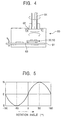
- Fig. 4 shows an angle sensor provided with the GMR sensor 20 or 50 shown in Fig. 1 or 3.
- the angle sensor 60 is provided with a case 61.
- a rotatable shaft 64 is vertically provided so as to pass through the upper wall of the case 61, and a disk-shaped magnet 62 is fixed to the lower end of the shaft 64.
- a board 63 is provided at the lower portion of the case 61, and the GMR sensor 20 or 50 is fixed on the board 63 below the magnet 62.
- the vector of magnetization applied to the GMR sensor 20 or 50 from the magnet 62 changes with the rotation of the shaft 64, resulting in a change in the resistance.
- the angle of the rotation of the shaft 64 can be detected from the change in the resistance.
- Fig. 5 is a graph illustrating the change in the vector of magnetization with the angle of the rotation of the shaft in the angle sensor 60.
- the change in the vector of the magnetization has a sinusoidal curve as shown in Fig. 5.
- a plurality of multilayered magnetoresistive films are arranged in parallel and the vectors of magnetization of the pinned ferromagnetic layers of these multilayered magnetoresistive films are substantially antiparallel to each other.
- the resistances of the multilayered magnetoresistive films having opposite directions of magnetization change in opposite phases.
- a change in the direction of the external magnetic field can be detected as the difference between these resistances.
- each multilayered magnetoresistive film includes a combination of a pinned ferromagnetic layer and a free ferromagnetic layer having a magnetoresistive effect
- the magnetoresistive sensor of the present invention exhibits a large change in resistance with respect to a change in the vector of the external magnetic field and thus has a high sensitivity to the change in the vector of the external magnetic field.
- the vector of magnetization of the hard magnetic layer can control the vector of magnetization of the pinned ferromagnetic layer.
- the vectors of magnetization of the two multilayered magnetic films can be easily oriented to be antiparallel to each other.
- the vector of the pinned ferromagnetic layer can be controlled in an appropriate direction by magnetization.
- the direction of magnetization of the pinned ferromagnetic layers of the multilayered magnetoresistive films, which are arranged in parallel, can be easily oriented to be antiparallel.
- the magnetoresistive sensor can obtain a large change is resistance, and a reduced hysteresis. Thus, this sensor has high sensitivity.
- the vectors of the individual pinned ferromagnetic layers can be controlled without restriction by independently magnetizing these pinned ferromagnetic layers.
- the vectors of magnetization of the pinned ferromagnetic layers can be oriented antiparallel to each other.
Landscapes
- Engineering & Computer Science (AREA)
- Chemical & Material Sciences (AREA)
- Nanotechnology (AREA)
- Physics & Mathematics (AREA)
- Crystallography & Structural Chemistry (AREA)
- General Physics & Mathematics (AREA)
- Condensed Matter Physics & Semiconductors (AREA)
- Power Engineering (AREA)
- Mathematical Physics (AREA)
- Theoretical Computer Science (AREA)
- Hall/Mr Elements (AREA)
- Measuring Magnetic Variables (AREA)
- Thin Magnetic Films (AREA)
Claims (5)
- Capteur magnétorésistif de type GMR (Giant magnetoresistive) comprenant : au moins deux films magnétorésistifs multicouches (35, 41) installés l'un à côté de l'autre sur un substrat (30), chaque film magnétorésistif multicouches contenant une couche ferromagnétique bloquée (32, 38) et une couche ferromagnétique libre (34, 40) entre lesquelles s'intercale une couche amagnétique (33, 39) d'une épaisseur comprise entre 2 × 10⁻⁹ m (20 Å) et 4 × 10⁻⁹ m (40 Å), dans lequel le vecteur d'aimantation de ladite couche ferromagnétique libre peut s'inverser librement en réponse à un champ magnétique externe et l'aimantation de ladite couche ferromagnétique bloquée ne peut pas s'inverser librement en réponse à un champ magnétique externe ; caractérisé par une couche magnétique dure (36) prévue sous un seul des films d'une paire adjacente desdits films magnétorésistifs multicouches ; et un conducteur (43) formé sur le substrat qui raccorde en série les films magnétorésistifs multicouches adjacents ; dans lequel une borne de conducteur (H) est connectée au conducteur et disposée entre les couches ferromagnétiques libres ; les vecteurs d'aimantation des couches ferromagnétiques bloquées dans les films magnétorésistifs multicouches adjacents sont essentiellement antiparallèles l'un par rapport à l'autre après une première aimantation avec un champ magnétique supérieur au champ coercitif de la couche magnétique dure et une deuxième aimantation avec un champ magnétique supérieur au champ coercitif de la couche ferromagnétique bloquée dudit film magnétorésistif multicouches non muni de ladite couche magnétique dure et inférieur au champ coercitif de la couche magnétique dure ; et le champ coercitif de la couche ferromagnétique bloquée du film magnétorésistif multicouches muni de ladite couche magnétique dure est supérieur au champ coercitif de la couche ferromagnétique bloquée du film magnétorésistif multicouches adjacent non muni de ladite couche magnétique dure.
- Capteur magnétorésistif de type GMR selon la revendication 1, dans lequel au moins deux films magnétorésistifs multicouches ont une forme essentiellement rectangulaire et sont disposés de manière parallèle sur le substrat.
- Capteur magnétorésistif de type GMR selon la revendication 2, incluant un axe rotatif (64) équipé d'un aimant (62), au voisinage desdits films magnétorésistifs multicouches, et dans lequel ledit axe est orienté essentiellement perpendiculairement auxdits films magnétorésistifs multicouches.
- Capteur magnétorésistif de type GMR selon l'une quelconque des revendications 1 à 3, dans lequel ladite couche ferromagnétique bloquée comprend le même matériau ferromagnétique que la couche ferromagnétique libre.
- Capteur magnétorésistif de type GMR selon l'une quelconque des revendications 1 à 4, dans lequel ladite couche ferromagnétique bloquée entre en contact avec une couche facilitant le champ coercitif comprenant du α-Fe2O3.
Applications Claiming Priority (3)
| Application Number | Priority Date | Filing Date | Title |
|---|---|---|---|
| JP53717/97 | 1997-03-07 | ||
| JP05371797A JP3886589B2 (ja) | 1997-03-07 | 1997-03-07 | 巨大磁気抵抗効果素子センサ |
| JP5371797 | 1997-03-07 |
Publications (3)
| Publication Number | Publication Date |
|---|---|
| EP0863406A2 EP0863406A2 (fr) | 1998-09-09 |
| EP0863406A3 EP0863406A3 (fr) | 1999-12-29 |
| EP0863406B1 true EP0863406B1 (fr) | 2003-10-15 |
Family
ID=12950591
Family Applications (1)
| Application Number | Title | Priority Date | Filing Date |
|---|---|---|---|
| EP98301211A Expired - Lifetime EP0863406B1 (fr) | 1997-03-07 | 1998-02-19 | Détecteur magnétorésistif |
Country Status (5)
| Country | Link |
|---|---|
| US (1) | US6191577B1 (fr) |
| EP (1) | EP0863406B1 (fr) |
| JP (1) | JP3886589B2 (fr) |
| KR (1) | KR100300386B1 (fr) |
| DE (1) | DE69818884T2 (fr) |
Cited By (1)
| Publication number | Priority date | Publication date | Assignee | Title |
|---|---|---|---|---|
| US9529060B2 (en) | 2014-01-09 | 2016-12-27 | Allegro Microsystems, Llc | Magnetoresistance element with improved response to magnetic fields |
Families Citing this family (41)
| Publication number | Priority date | Publication date | Assignee | Title |
|---|---|---|---|---|
| DE19843349A1 (de) * | 1998-09-22 | 2000-03-23 | Bosch Gmbh Robert | Magnetoresistives Sensorelement, insbesondere Winkelsensorelement |
| EP1105743B1 (fr) * | 1999-06-18 | 2005-12-28 | Koninklijke Philips Electronics N.V. | Procede de fabrication d'un dispositif de capteur magnetique |
| US6501678B1 (en) * | 1999-06-18 | 2002-12-31 | Koninklijke Philips Electronics N.V. | Magnetic systems with irreversible characteristics and a method of manufacturing and repairing and operating such systems |
| DE19949714A1 (de) * | 1999-10-15 | 2001-04-26 | Bosch Gmbh Robert | Magnetisch sensitives Bauteil, insbesondere Sensorelement, mit magnetoresistiven Schichtsystemen in Brückenschaltung |
| JP4543350B2 (ja) * | 1999-12-03 | 2010-09-15 | 日立金属株式会社 | 回転角度センサー及び回転角度センサーユニット |
| JP3971934B2 (ja) * | 2001-03-07 | 2007-09-05 | ヤマハ株式会社 | 磁気センサとその製法 |
| JP3603872B2 (ja) * | 2001-05-16 | 2004-12-22 | 松下電器産業株式会社 | 磁気センサとこれを用いた紙幣識別装置 |
| US6486659B1 (en) * | 2001-05-21 | 2002-11-26 | Delphi Technologies, Inc. | Magnetoresistor sensor die with an array of MRs |
| US6946834B2 (en) * | 2001-06-01 | 2005-09-20 | Koninklijke Philips Electronics N.V. | Method of orienting an axis of magnetization of a first magnetic element with respect to a second magnetic element, semimanufacture for obtaining a sensor, sensor for measuring a magnetic field |
| DE10128135A1 (de) | 2001-06-09 | 2002-12-19 | Bosch Gmbh Robert | Magnetoresistive Schichtanordnung und Gradiometer mit einer derartigen Schichtanordnung |
| JP4979165B2 (ja) * | 2001-08-23 | 2012-07-18 | 東北特殊鋼株式会社 | 磁気抵抗素子の感応特性評価装置 |
| JP4028971B2 (ja) * | 2001-08-28 | 2008-01-09 | アルプス電気株式会社 | 磁気センサの組立方法 |
| DE10144269A1 (de) * | 2001-09-08 | 2003-03-27 | Bosch Gmbh Robert | Sensorelement zur Erfassung einer physikalischen Messgröße zwischen tribologisch hoch beanspruchten Körpern |
| DE10228662A1 (de) * | 2002-06-27 | 2004-01-22 | Philips Intellectual Property & Standards Gmbh | Magnetoresistiver Sensor |
| KR20040011128A (ko) * | 2002-07-29 | 2004-02-05 | 주식회사 씨앤케이 | 고포화자화 박막과 저포화자화 박막을 다층화시킨 자계센서 |
| DE10236983A1 (de) * | 2002-08-13 | 2004-03-04 | Robert Bosch Gmbh | Magnetsensoranordnung |
| KR100479445B1 (ko) * | 2002-08-31 | 2005-03-30 | 한국과학기술연구원 | 풀 브리지 특성을 갖는 교환 바이어스형 스핀밸브를이용한 자기센서 제조방법 |
| US7016163B2 (en) * | 2003-02-20 | 2006-03-21 | Honeywell International Inc. | Magnetic field sensor |
| DE10308030B4 (de) * | 2003-02-24 | 2011-02-03 | Meas Deutschland Gmbh | Magnetoresistiver Sensor zur Bestimmung eines Winkels oder einer Position |
| US7167391B2 (en) * | 2004-02-11 | 2007-01-23 | Hewlett-Packard Development Company, L.P. | Multilayer pinned reference layer for a magnetic storage device |
| US7102920B2 (en) * | 2004-03-23 | 2006-09-05 | Hewlett-Packard Development Company, L.P. | Soft-reference three conductor magnetic memory storage device |
| US7474094B2 (en) * | 2004-08-31 | 2009-01-06 | International Business Machines Corporation | Reorientation of magnetic layers and structures having reoriented magnetic layers |
| US20070030594A1 (en) * | 2005-08-04 | 2007-02-08 | Biskeborn Robert G | Tape recording head with overlapping read transducers |
| JP4298691B2 (ja) | 2005-09-30 | 2009-07-22 | Tdk株式会社 | 電流センサおよびその製造方法 |
| DE102006005746B4 (de) * | 2006-02-07 | 2009-02-26 | Elbau Elektronik Bauelemente Gmbh Berlin | Elektronische Baugruppe, insbesondere elektronisches Sensorsystem, vorzugsweise für Positions- und Winkelmesssysteme |
| EP2088446B1 (fr) * | 2006-11-15 | 2015-12-30 | Alps Electric Co., Ltd. | Détecteur magnétique et dispositif électronique |
| US8715776B2 (en) * | 2007-09-28 | 2014-05-06 | Headway Technologies, Inc. | Method for providing AFM exchange pinning fields in multiple directions on same substrate |
| US8269491B2 (en) | 2008-02-27 | 2012-09-18 | Allegro Microsystems, Inc. | DC offset removal for a magnetic field sensor |
| WO2011013412A1 (fr) | 2009-07-27 | 2011-02-03 | 富士電機ホールディングス株式会社 | Capteur de courant sans contact |
| JP4900855B2 (ja) * | 2009-09-24 | 2012-03-21 | 日立金属株式会社 | 絶対位置検出方法、回転角度検出方法、及び絶対位置検出構造 |
| JPWO2011111494A1 (ja) * | 2010-03-12 | 2013-06-27 | アルプス電気株式会社 | 磁気センサ及び磁気エンコーダ |
| JP5809478B2 (ja) * | 2011-08-02 | 2015-11-11 | アルプス電気株式会社 | 磁気センサ |
| US9111557B2 (en) * | 2013-10-04 | 2015-08-18 | Seagate Technology Llc | Electrically insulating magnetic material for a read head |
| US9812637B2 (en) | 2015-06-05 | 2017-11-07 | Allegro Microsystems, Llc | Spin valve magnetoresistance element with improved response to magnetic fields |
| CN105866715B (zh) * | 2016-03-23 | 2018-12-18 | 电子科技大学 | 一种线性各向异性磁阻传感器的制备方法 |
| US11022661B2 (en) | 2017-05-19 | 2021-06-01 | Allegro Microsystems, Llc | Magnetoresistance element with increased operational range |
| US10620279B2 (en) | 2017-05-19 | 2020-04-14 | Allegro Microsystems, Llc | Magnetoresistance element with increased operational range |
| US11719771B1 (en) | 2022-06-02 | 2023-08-08 | Allegro Microsystems, Llc | Magnetoresistive sensor having seed layer hysteresis suppression |
| US12320870B2 (en) | 2022-07-19 | 2025-06-03 | Allegro Microsystems, Llc | Controlling out-of-plane anisotropy in an MR sensor with free layer dusting |
| US12359904B2 (en) | 2023-01-26 | 2025-07-15 | Allegro Microsystems, Llc | Method of manufacturing angle sensors including magnetoresistance elements including different types of antiferromagnetic materials |
| US12352832B2 (en) | 2023-01-30 | 2025-07-08 | Allegro Microsystems, Llc | Reducing angle error in angle sensor due to orthogonality drift over magnetic-field |
Family Cites Families (13)
| Publication number | Priority date | Publication date | Assignee | Title |
|---|---|---|---|---|
| US4616281A (en) * | 1982-03-10 | 1986-10-07 | Copal Company Limited | Displacement detecting apparatus comprising magnetoresistive elements |
| US5206590A (en) | 1990-12-11 | 1993-04-27 | International Business Machines Corporation | Magnetoresistive sensor based on the spin valve effect |
| US5159513A (en) | 1991-02-08 | 1992-10-27 | International Business Machines Corporation | Magnetoresistive sensor based on the spin valve effect |
| US5287238A (en) * | 1992-11-06 | 1994-02-15 | International Business Machines Corporation | Dual spin valve magnetoresistive sensor |
| DE4301704A1 (de) * | 1993-01-22 | 1994-07-28 | Siemens Ag | Vorrichtung zum Erfassen einer Winkelposition eines Objektes |
| US5422571A (en) * | 1993-02-08 | 1995-06-06 | International Business Machines Corporation | Magnetoresistive spin valve sensor having a nonmagnetic back layer |
| JP3260921B2 (ja) * | 1993-08-25 | 2002-02-25 | 株式会社デンソー | 可動体変位検出装置 |
| US5828525A (en) * | 1994-03-15 | 1998-10-27 | Kabushiki Kaisha Toshiba | Differential detection magnetoresistance head |
| DE4427495C2 (de) * | 1994-08-03 | 2000-04-13 | Siemens Ag | Sensoreinrichtung mit einem GMR-Sensorelement |
| JP2738312B2 (ja) * | 1994-09-08 | 1998-04-08 | 日本電気株式会社 | 磁気抵抗効果膜およびその製造方法 |
| US5561368A (en) * | 1994-11-04 | 1996-10-01 | International Business Machines Corporation | Bridge circuit magnetic field sensor having spin valve magnetoresistive elements formed on common substrate |
| US5744950A (en) * | 1996-05-09 | 1998-04-28 | Ssi Technologies, Inc. | Apparatus for detecting the speed of a rotating element including signal conditioning to provide a fifty percent duty cycle |
| DE19619806A1 (de) * | 1996-05-15 | 1997-11-20 | Siemens Ag | Magnetfeldempfindliche Sensoreinrichtung mit mehreren GMR-Sensorelementen |
-
1997
- 1997-03-07 JP JP05371797A patent/JP3886589B2/ja not_active Expired - Fee Related
-
1998
- 1998-02-19 EP EP98301211A patent/EP0863406B1/fr not_active Expired - Lifetime
- 1998-02-19 DE DE69818884T patent/DE69818884T2/de not_active Expired - Fee Related
- 1998-03-05 KR KR1019980007277A patent/KR100300386B1/ko not_active Expired - Fee Related
- 1998-03-06 US US09/036,606 patent/US6191577B1/en not_active Expired - Fee Related
Cited By (1)
| Publication number | Priority date | Publication date | Assignee | Title |
|---|---|---|---|---|
| US9529060B2 (en) | 2014-01-09 | 2016-12-27 | Allegro Microsystems, Llc | Magnetoresistance element with improved response to magnetic fields |
Also Published As
| Publication number | Publication date |
|---|---|
| EP0863406A3 (fr) | 1999-12-29 |
| EP0863406A2 (fr) | 1998-09-09 |
| JPH10256620A (ja) | 1998-09-25 |
| US6191577B1 (en) | 2001-02-20 |
| DE69818884T2 (de) | 2004-08-05 |
| KR100300386B1 (ko) | 2001-09-06 |
| KR19980079939A (ko) | 1998-11-25 |
| JP3886589B2 (ja) | 2007-02-28 |
| DE69818884D1 (de) | 2003-11-20 |
Similar Documents
| Publication | Publication Date | Title |
|---|---|---|
| EP0863406B1 (fr) | Détecteur magnétorésistif | |
| EP0687917B1 (fr) | Capteur magnétorésistif à soupape de spin muni d'une couche laminée d'ancrage spontanée et système d'enregistrement magnétique utilisant le capteur | |
| EP0498668B1 (fr) | Capteur magnétorésistif | |
| EP1399748B1 (fr) | Produit semi-fini permettant d'obtenir un capteur de mesure d'un champ magnetique | |
| US5561368A (en) | Bridge circuit magnetic field sensor having spin valve magnetoresistive elements formed on common substrate | |
| JP3180027B2 (ja) | スピン・バルブ磁気抵抗センサと、このセンサを使用した磁気記録システム | |
| US6496338B2 (en) | Spin-valve magnetoresistive sensor including a first antiferromagnetic layer for increasing a coercive force and a second antiferromagnetic layer for imposing a longitudinal bias | |
| EP1151482B1 (fr) | Capteur a effet tunnel dependant du spin | |
| US5668473A (en) | Magnetoresistive sensor including shortened measuring layers | |
| US6510031B1 (en) | Magnetoresistive sensor with magnetostatic coupling to obtain opposite alignment of magnetic regions | |
| EP0660127A2 (fr) | Capteur magnétorésistive multicouche | |
| US6331773B1 (en) | Pinned synthetic anti-ferromagnet with oxidation protection layer | |
| US20020154455A1 (en) | Magnetic device with a coupling layer and method of manufacturing and operation of such device | |
| JPH11510911A (ja) | 磁気抵抗式磁界センサ | |
| GB2387711A (en) | Magnetic sensing element with multi-layer free layer | |
| WO2021040801A1 (fr) | Capteur magnéto-résistif à effet tunnel (tmr) à jonctions tunnel magnétiques avec une couche libre ayant une anisotropie intrinsèque | |
| KR20010078004A (ko) | 자기센서 및 이를 이용한 자기기억장치 | |
| EP0677750A2 (fr) | Capteur magnétorésistif géant avec une couche d'ancrage | |
| KR100363462B1 (ko) | 스핀밸브형 자기저항 효과소자와 그 제조방법 | |
| KR100462792B1 (ko) | 교환바이어스형 스핀밸브를 이용한 브리지센서 제조방법 | |
| KR19990037227A (ko) | 자기저항 효과 센서 및 그 제조 방법 | |
| EP2096689A1 (fr) | Elément à effet de magnétorésistance, capteur magnétique et procédé de fabrication d'un élément à effet de magnétorésistance |
Legal Events
| Date | Code | Title | Description |
|---|---|---|---|
| PUAI | Public reference made under article 153(3) epc to a published international application that has entered the european phase |
Free format text: ORIGINAL CODE: 0009012 |
|
| AK | Designated contracting states |
Kind code of ref document: A2 Designated state(s): DE FR GB IT SE |
|
| AX | Request for extension of the european patent |
Free format text: AL;LT;LV;MK;RO;SI |
|
| PUAL | Search report despatched |
Free format text: ORIGINAL CODE: 0009013 |
|
| AK | Designated contracting states |
Kind code of ref document: A3 Designated state(s): AT BE CH DE DK ES FI FR GB GR IE IT LI LU MC NL PT SE |
|
| AX | Request for extension of the european patent |
Free format text: AL;LT;LV;MK;RO;SI |
|
| RIC1 | Information provided on ipc code assigned before grant |
Free format text: 6G 01R 33/09 A, 6H 01F 10/08 B |
|
| 17P | Request for examination filed |
Effective date: 20000425 |
|
| AKX | Designation fees paid |
Free format text: DE FR GB IT SE |
|
| 17Q | First examination report despatched |
Effective date: 20011029 |
|
| GRAH | Despatch of communication of intention to grant a patent |
Free format text: ORIGINAL CODE: EPIDOS IGRA |
|
| GRAS | Grant fee paid |
Free format text: ORIGINAL CODE: EPIDOSNIGR3 |
|
| GRAA | (expected) grant |
Free format text: ORIGINAL CODE: 0009210 |
|
| AK | Designated contracting states |
Kind code of ref document: B1 Designated state(s): DE FR GB IT SE |
|
| PG25 | Lapsed in a contracting state [announced via postgrant information from national office to epo] |
Ref country code: IT Free format text: LAPSE BECAUSE OF FAILURE TO SUBMIT A TRANSLATION OF THE DESCRIPTION OR TO PAY THE FEE WITHIN THE PRESCRIBED TIME-LIMIT;WARNING: LAPSES OF ITALIAN PATENTS WITH EFFECTIVE DATE BEFORE 2007 MAY HAVE OCCURRED AT ANY TIME BEFORE 2007. THE CORRECT EFFECTIVE DATE MAY BE DIFFERENT FROM THE ONE RECORDED. Effective date: 20031015 |
|
| REG | Reference to a national code |
Ref country code: GB Ref legal event code: FG4D |
|
| REF | Corresponds to: |
Ref document number: 69818884 Country of ref document: DE Date of ref document: 20031120 Kind code of ref document: P |
|
| PG25 | Lapsed in a contracting state [announced via postgrant information from national office to epo] |
Ref country code: SE Free format text: LAPSE BECAUSE OF FAILURE TO SUBMIT A TRANSLATION OF THE DESCRIPTION OR TO PAY THE FEE WITHIN THE PRESCRIBED TIME-LIMIT Effective date: 20040115 |
|
| ET | Fr: translation filed | ||
| PLBE | No opposition filed within time limit |
Free format text: ORIGINAL CODE: 0009261 |
|
| 26N | No opposition filed |
Effective date: 20040716 |
|
| PGFP | Annual fee paid to national office [announced via postgrant information from national office to epo] |
Ref country code: FR Payment date: 20070130 Year of fee payment: 10 |
|
| REG | Reference to a national code |
Ref country code: FR Ref legal event code: ST Effective date: 20081031 |
|
| PG25 | Lapsed in a contracting state [announced via postgrant information from national office to epo] |
Ref country code: FR Free format text: LAPSE BECAUSE OF NON-PAYMENT OF DUE FEES Effective date: 20080229 |
|
| PGFP | Annual fee paid to national office [announced via postgrant information from national office to epo] |
Ref country code: GB Payment date: 20081218 Year of fee payment: 12 |
|
| PGFP | Annual fee paid to national office [announced via postgrant information from national office to epo] |
Ref country code: DE Payment date: 20090428 Year of fee payment: 12 |
|
| GBPC | Gb: european patent ceased through non-payment of renewal fee |
Effective date: 20100219 |
|
| PG25 | Lapsed in a contracting state [announced via postgrant information from national office to epo] |
Ref country code: DE Free format text: LAPSE BECAUSE OF NON-PAYMENT OF DUE FEES Effective date: 20100901 |
|
| PG25 | Lapsed in a contracting state [announced via postgrant information from national office to epo] |
Ref country code: GB Free format text: LAPSE BECAUSE OF NON-PAYMENT OF DUE FEES Effective date: 20100219 |