EP0863633A2 - Automatische Ersatzschaltung von Primärreferenzquellen in synchronen Netzen - Google Patents
Automatische Ersatzschaltung von Primärreferenzquellen in synchronen Netzen Download PDFInfo
- Publication number
- EP0863633A2 EP0863633A2 EP98103691A EP98103691A EP0863633A2 EP 0863633 A2 EP0863633 A2 EP 0863633A2 EP 98103691 A EP98103691 A EP 98103691A EP 98103691 A EP98103691 A EP 98103691A EP 0863633 A2 EP0863633 A2 EP 0863633A2
- Authority
- EP
- European Patent Office
- Prior art keywords
- sdh
- clock
- network element
- equipment
- ssm
- Prior art date
- Legal status (The legal status is an assumption and is not a legal conclusion. Google has not performed a legal analysis and makes no representation as to the accuracy of the status listed.)
- Withdrawn
Links
- 230000001360 synchronised effect Effects 0.000 title claims description 14
- 238000000034 method Methods 0.000 claims abstract description 7
- 101100465401 Saccharomyces cerevisiae (strain ATCC 204508 / S288c) SCL1 gene Proteins 0.000 claims description 5
- 230000005540 biological transmission Effects 0.000 claims 2
- 102000002273 Polycomb Repressive Complex 1 Human genes 0.000 abstract 1
- 108010000598 Polycomb Repressive Complex 1 Proteins 0.000 abstract 1
- 230000007257 malfunction Effects 0.000 description 2
- 241000931526 Acer campestre Species 0.000 description 1
- 229910052792 caesium Inorganic materials 0.000 description 1
- TVFDJXOCXUVLDH-UHFFFAOYSA-N caesium atom Chemical compound [Cs] TVFDJXOCXUVLDH-UHFFFAOYSA-N 0.000 description 1
- 230000007774 longterm Effects 0.000 description 1
- 238000007726 management method Methods 0.000 description 1
- 229910052701 rubidium Inorganic materials 0.000 description 1
- IGLNJRXAVVLDKE-UHFFFAOYSA-N rubidium atom Chemical compound [Rb] IGLNJRXAVVLDKE-UHFFFAOYSA-N 0.000 description 1
Images

Classifications
-
- H—ELECTRICITY
- H04—ELECTRIC COMMUNICATION TECHNIQUE
- H04J—MULTIPLEX COMMUNICATION
- H04J3/00—Time-division multiplex systems
- H04J3/02—Details
- H04J3/06—Synchronising arrangements
- H04J3/0635—Clock or time synchronisation in a network
- H04J3/0638—Clock or time synchronisation among nodes; Internode synchronisation
-
- H—ELECTRICITY
- H04—ELECTRIC COMMUNICATION TECHNIQUE
- H04J—MULTIPLEX COMMUNICATION
- H04J2203/00—Aspects of optical multiplex systems other than those covered by H04J14/05 and H04J14/07
- H04J2203/0001—Provisions for broadband connections in integrated services digital network using frames of the Optical Transport Network [OTN] or using synchronous transfer mode [STM], e.g. SONET, SDH
- H04J2203/0028—Local loop
- H04J2203/0039—Topology
- H04J2203/0042—Ring
-
- H—ELECTRICITY
- H04—ELECTRIC COMMUNICATION TECHNIQUE
- H04J—MULTIPLEX COMMUNICATION
- H04J2203/00—Aspects of optical multiplex systems other than those covered by H04J14/05 and H04J14/07
- H04J2203/0001—Provisions for broadband connections in integrated services digital network using frames of the Optical Transport Network [OTN] or using synchronous transfer mode [STM], e.g. SONET, SDH
- H04J2203/0057—Operations, administration and maintenance [OAM]
- H04J2203/006—Fault tolerance and recovery
Definitions
- the invention relates to a method and a Device for the automatic equivalent switching of Primary reference sources in synchronous networks (CSE-3 Synchronization Distribution, Protection and Management).
- a primary reference clock (Primary Reference Clock, PRC) are in ITU-T recommendation G.811 and specified in ANSI stratum 1. It's a simple matter a reference clock, which is a clock or Synchronization signal is available, which one Long-term deviation from UTC (Universal Time Coordinated) of maximum 1 x 10 exp (-11). The Generation of this time signal can be completely autonomous respectively. But it can also depend on directly signal sources derived from UTC.
- a device that generates a PRC clock has in usually a signal source and signal processing as well as an output interface.
- an autonomous PRC is the signal source a highly stable Reference oscillator, the cesium, maser or Rubidium oscillator is implemented. With one not This is the autonomous generation of the time signal Reference oscillator itself to an external signal synchronized. This can be done by a GPS receiver (Global Positioning System) or a receiver of time signals other type, e.g. B. DCF77, LORAN-C, GLONASS.
- the output interface provides a clock or data signal available, which arises directly from the signal of the Derives reference oscillator, as output signals 2048 kHz, 2048 kbit / s, 1544 kbit / s, 1 MHz, 5 MHz or 10 MHz according to G.811, but other signals are also conceivable are.
- the Reference oscillator and the output interface often redundant.
- the signal processing then dials in Dependence on many criteria one of the Reference oscillator signals or an average signal for the output interface.
- the configuration and The PRC alarm is displayed via an operator terminal. This Operator terminal connected via a data line can also stand in another place.
- PRCs Physical Random Access Responses
- the invention is therefore based on the object Method and device for automatic Equivalent circuit of primary reference sources in the event of a fault specify. According to the invention, this object is achieved by the features of claim 1 and 2 respectively.
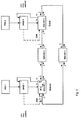
- the clock source PRC 1 which functions as a master, feeds the primary clock into the network in undisturbed operation, all SDH network elements SDH-NE n being supplied with the network clock by this clock source PRC1.
- the signal path of the clock supply runs - starting with the clock source PRC1 - via the priority 1 input of a SASE1 (Stand Alone Synchronization Equipment) and via T3 to the SDH network element SDH-NE1. This feeds all STM-n outputs with this clock.
- the network element SDH-NE3 forwards the clock received via the operating path W (Working) via T4 via the priority 1 input to the equipment SASE2. Due to the presence of a priority 1 input signal, the priority 2 input signal of the second clock source PRC2 is not taken into account in normal operation.
- the clock source PRC1 falls as a result of Malfunction, the priority 1 signal of the Equipment SASE1.
- Network element SDH-NE1 this quality level in the SSM byte of all STM-n signals, where n for 1, 2, 4, 16, 64 according to Recommandation ITU-T G.707 stands. With that everyone learns the network element SDH-NE1 concatenated network elements this clock quality change and can turn on it react. The network element SDH-NE3 then switches the T4 clock output, since it is on the operating path W as well as on the protection path PO this clock quality receives.
- All other network elements SDH-NE n synchronize to the new clock supplier, ie to the network element SDH-NE3.
- This is now supplied by the clock source PRC2 via the equipment SASE2 with the replacement primary clock PRC2.
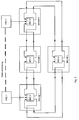
- the equipment SASE1,2 shown in Figure 2 are one independent synchronization equipment as Carrier of the clock supply unit SSU (synchronization Supply unit).
- An SSU is a logical function, which Synchronization inputs from different sources accepted and selected one of these sources as well as this filters accordingly and the resulting signal to the outside delivers.
- the properties of this filter function are in the Recommendations ITU-T G.812 and ETSI DE / TM-3017-4 specified. Are all synchronization sources down or not? more usable for synchronization, so the SSU gives it internal oscillator signal from the outside, whereby it saved the last synchronization state.
- This So-called "holdover mode” must meet certain requirements are sufficient, which also in the specifications mentioned are defined.
- the SSU output signal differs from derives from an external synchronization source also called slave clock.
- the internal one The synchronization and operating status of the SSU provides information about the quality of the output signal.
- This Synchronization status can be signaled to the outside. This can be done via a network management interface Operator terminal, over a certain number of alarm contacts or under certain conditions via the signal itself respectively. If the output signal is a 2048 kbit / s signal, so can its quality in the so-called SSM (synchronization Status Message) encoded in the SA bits of the data signal will. This is described in ITU-T G-704. Is this Output signal a 2048 kHz signal, so there is none Possibility to encode the clock quality directly in the signal.
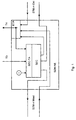
- a network element SDH-NE Network Element der Synchronous digital hierarchy with those for the The synchronization of essential function blocks is shown in FIG. 1 shown. It includes in the model shown here for a characteristic SDH-NE the information inputs STM-n-Ost and -West as well as an ETA function block (Input clock selection) and a function block SEC (Synchronous Equipment Clock).
- the one about the Information inputs arriving signal clock is in the ETA according fixed or programmable priority and Quality features selected and as T4 for internal or submitted to external processing.
- T4 is currently in ITU-T G.707 defined as a sinusoidal 2048 kHz signal.
- the signal priorities are usually free programmable.
- the clock quality features of the STM-n signals are usually determined by the SSM (in ITU TG.707 defined). But you can too be programmed.
- the clock selection in the SEC function block is similar the ETA.
- the internal SDH-NE oscillator has the lowest priority among possible clock sources.
- the clock delivering SDH-NE returned clock as SSM the Information "DNU" must be received in order to loop clocks avoid.
- a potential system malfunction is by externally grinding the clock from T4 to T3 given.
- An internal clock loop from ETA to SEC-TA (SEC clock selection) and back again is programmatic prevented.
Landscapes
- Engineering & Computer Science (AREA)
- Computer Networks & Wireless Communication (AREA)
- Signal Processing (AREA)
- Synchronisation In Digital Transmission Systems (AREA)
- Detection And Prevention Of Errors In Transmission (AREA)
Abstract
Description
- ANSI
- American National Standards Institut
- DNU
- Do Not Use for Timing
- ETA
- Eingangs-Takt-Auswahl
- ETSI
- European Telecommunication Standards Institut
- GPS
- Global Positioning System
- ITU-T
- International Telecommunication Union-Telecommunication Sector
- PRC
- Primary Reference Clock
- SASE
- Stand Alone Synchronisation Equipment
- SDH
- Synchronous Digital Hierarchy
- SDH-NE
- SDH-Network Element
- SEC
- Synchronous Equipment Clock
- SEC-TA
- SEC-Taktauswahl
- SSM
- Synchronisation Status Message
- SSU
- Synchronisation Supply Unit
- STM-n
- Synchronous Transport Multiplex-n
- UTC
- Universal Time Coordinated
Claims (8)
- Verfahren zur automatischen Ersatzschaltung von Primärreferenzquellen in synchronen Netzen, bei dem zur Übertragung einer SSM-Information (Synchronisation Status Message) eine Steuerleitung zwischen SASE-Synchronisations-Equipment (Stand Alone Synchronisation Equipment) und einem Netzwerkelement (SDH-NE, Synchronous Digital Hierarchy Network Element) verwendet wird.
- Verfahren nach Anspruch 1, mit folgenden Schritten:Im ungestörten Betrieb speist eine als Master fungierende Taktquelle (PRC 1) einen Primärtakt ein, wobei alle SDH-Netzwerkelemente (SDH-NE1 - SDH-NE4) von dieser Taktquelle (PRC 1) über einen Priorität-1-Eingang eines Equipments (SASE1) und über eine erste Steuerleitung (T3) mit dem Netztakt versorgt werden;ein erstes Netzwerkelement (SDH-NE1) speist alle STM-n-Ausgänge mit diesem Takt;ein drittes Netzwerkelement (SDH-NE3) empfängt die Taktqualität SSM = G.811, zum einen über den Betriebsweg (W) über SDH-NE2 und zum anderen über Ersatzweg (P0);das dritte Netzwerkelement (SDH-NE3) gibt über eine zweite Steuerleitung (T4) den über den Betriebsweg (W) empfangenen Takt über den Priorität-1-Eingang an ein zweites Equipment (SASE2) weiter, wobei das Priorität-2-Eingangssignal der zweiten Taktquelle aufgrund des Priorität-1-Eingangssignals unberücksichtigt bleibt.
- Verfahren nach Anspruch 1 oder 2, mit folgenden Schritten:Bei einem Ausfall des Primärreferenztaktes (PRC 1) geht das erste Equipment (SASE 1) in den Zustand "Holdover", wobei ein an der ersten Steuerleitung (T3) anstehendes Signal weiterhin bestehen bleibt;über eine SSM-Steuerleitung wird dem ersten Netzwerkelement (SDH-NE1) eine Information SSM = G.812T mitgeteilt;das erste Netzwerkelement (SDH-NE1) setzt diese Qualitätsstufe in ein SSM-Byte aller STM-Signale ein, wobei die Information-SSM sowohl über den Betriebsweg (W) als auch über den Protection-Weg (P0) verläuft;das dritte Netzwerkelement (SDH-NE3) schaltet seinen zweiten Taktausgang (T4) ab;das zweite Equipment (SASE2) schaltet auf Priorität-2-Takteingang um und gibt weiterhin einen Takt der Qualitätsstufe SSM = G.811 über seine erste Steuerleitung (T3) und über die SSM-Steuerleitung die Taktqualität SSM = G.811 an das dritte Netzwerkelement (SDH-NE3) ab;das dritte Netzwerkelement (SDH-NE3) gibt auf allen abgehenden STM-n-Signalen die Taktqualität SSM = G.811 ab;die anderen Netzwerkelemente (SDH-NEn) synchronisieren sich auf den neuen Taktgeber (SDH-NE3), der von einer zweiten Taktquelle (PRC2) über das zweite Equipment (SASE2) versorgt wird, wobei das zweite Netzwerkelement (SDH-NE2) die Taktsignale der SSM = G.811-Qualität sowohl über Protection-Weg (P1) als auch über Betriebsweg (W) erhält.
- Verfahren nach Ansprüchen 1 bis 3, mit den folgenden Schritten:Die beiden Equipments (SASE1, SASE2) werden durch erklären dieser zu Master bzw. Slave voneinander unterschieden, wodurch vermieden wird, daß eine Taktschleife über das erste Equipment (SASE1) und eine Rücksynchronisation auf eine Pseudo-PRC1 gebildet wird.
- Vorrichtung zur automatischen Ersatzschaltung von Primärreferenzquellen in Synchronen Netzen, mit einem über eine Steuerleitung zur Übertragung einer SSM-Information (Synchronisation Status Message) mit einem Netzwerkelement (SDH-NE, Synchronous Digital Hierarchy Network Element) verbundenen SASE-Synchronisations-Equipment (Stand Alone Synchronisation Equipment).
- Vorrichtung nach Anspruch 5, dadurch gekennzeichnet, daß die Equipments (SASE1, SASE2) jeweils ein eigenständiges Synchronisations-Equipment als Träger einer Taktversorgungseinheit (SSU) sind.
- Vorrichtung nach Anspruch 5 oder 6, dadurch gekennzeichnet, daß die SSU eine logische Funktion ist, welche Synchronisationseingänge von verschiedenen Quellen akzeptiert.
- Vorrichtung nach einem der Ansprüche 5 bis 7, dadurch gekennzeichnet, daß das Netzwerkelement (SDH-NE) Informationseingänge (STM-n-West, STM-n-Ost) sowie einen Funktionsblock (ETA) und einen Funktionsblock (SEC) umfaßt.
Applications Claiming Priority (2)
| Application Number | Priority Date | Filing Date | Title |
|---|---|---|---|
| DE19708506 | 1997-03-03 | ||
| DE19708506 | 1997-03-05 |
Publications (2)
| Publication Number | Publication Date |
|---|---|
| EP0863633A2 true EP0863633A2 (de) | 1998-09-09 |
| EP0863633A3 EP0863633A3 (de) | 2004-07-07 |
Family
ID=7822033
Family Applications (1)
| Application Number | Title | Priority Date | Filing Date |
|---|---|---|---|
| EP98103691A Withdrawn EP0863633A3 (de) | 1997-03-03 | 1998-03-03 | Automatische Ersatzschaltung von Primärreferenzquellen in synchronen Netzen |
Country Status (2)
| Country | Link |
|---|---|
| US (1) | US6418151B1 (de) |
| EP (1) | EP0863633A3 (de) |
Cited By (2)
| Publication number | Priority date | Publication date | Assignee | Title |
|---|---|---|---|---|
| WO2002075992A3 (de) * | 2001-03-16 | 2003-10-30 | Siemens Ag | System und verfahren zur einführung von redundanzmechanismen in ein kommunikationssystem |
| EP1076432A3 (de) * | 1999-08-10 | 2004-01-21 | Marconi UK Intellectual Property Ltd | Telekommunikationssystem |
Families Citing this family (9)
| Publication number | Priority date | Publication date | Assignee | Title |
|---|---|---|---|---|
| US6895189B1 (en) * | 1998-10-20 | 2005-05-17 | Lucent Technologies Inc. | Optical synchronization system |
| JP3485250B2 (ja) * | 1999-02-17 | 2004-01-13 | 富士通株式会社 | 従属同期装置及び該従属同期装置を有するsdh装置 |
| FR2886793A1 (fr) * | 2005-06-06 | 2006-12-08 | France Telecom | Procede et systeme de transmission d'un rythme de synchronisation sur un lien reseau de technologie ethernet et leurs applications |
| US8125930B2 (en) * | 2006-12-13 | 2012-02-28 | Rockstar Bidco Lp | Protocol for clock distribution and loop resolution |
| CN101141240B (zh) * | 2007-04-18 | 2010-06-09 | 中兴通讯股份有限公司 | Sdh时钟自动组网方法 |
| CN101174913B (zh) * | 2007-11-21 | 2011-05-25 | 中兴通讯股份有限公司 | 基于光网的端口级以太网保护方法 |
| GB2475331A (en) * | 2009-11-17 | 2011-05-18 | Rad Data Comm Ltd | Reference frequency source |
| US9252904B2 (en) * | 2011-06-01 | 2016-02-02 | Coriant Operations, Inc. | Method and apparatus for distributing network timing in a mesh optical network |
| CN113472669B (zh) * | 2016-03-18 | 2022-09-16 | 华为技术有限公司 | 更新时钟同步拓扑的方法、确定时钟同步路径的方法及设备 |
Family Cites Families (6)
| Publication number | Priority date | Publication date | Assignee | Title |
|---|---|---|---|---|
| FI95975C (fi) * | 1994-02-25 | 1996-04-10 | Nokia Telecommunications Oy | Hierarkkinen synkronointimenetelmä |
| FI95976C (fi) * | 1994-02-25 | 1996-04-10 | Nokia Telecommunications Oy | Verkkojärjestely |
| FI98770C (fi) * | 1994-03-01 | 1997-08-11 | Nokia Telecommunications Oy | Hierarkkinen synkronointimenetelmä |
| DE4446511A1 (de) * | 1994-12-24 | 1996-06-27 | Sel Alcatel Ag | Synchrones digitales Nachrichtenübertragungssystem mit hierarchischem Synchronisierungsnetz |
| US6134234A (en) * | 1996-07-19 | 2000-10-17 | Nokia Telecommunications Oy | Master-slave synchronization |
| JP3374054B2 (ja) * | 1997-09-01 | 2003-02-04 | 富士通株式会社 | 伝送装置の同期メッセージ処理方法 |
-
1998
- 1998-03-03 US US09/034,664 patent/US6418151B1/en not_active Expired - Lifetime
- 1998-03-03 EP EP98103691A patent/EP0863633A3/de not_active Withdrawn
Non-Patent Citations (9)
| Title |
|---|
| "A TECHNICAL REPORT ON SYNCHRONIZATION NETWORK MANAGEMENT USING SYNCHRONIZATION STATUS MESSAGES" TECHNICAL REPORT ON SYNCHRONIZATION NETWORK MANAGEMENT USING SYNCHRONIZATION STATUS MESSAGES, XX, XX, Nr. 33, April 1994 (1994-04), Seiten A-E,1-31, XP000879540 * |
| "KEEPING SONET/SDH IN SYNC THROUGH CRITICAL SYNCHRONIZATION STATUS MESSAGES" SONET/SDH NETSYNC SSM ARTICLE, XX, XX, Januar 1997 (1997-01), Seiten 1-11, XP000783800 * |
| "SYNC STATUS MESSAGES TO SUPPORT ADVANCED SELF-HEALING TELECOM NETWORKS" FIBER NETWORKS FOR VOICE, VIDEO & MULTIMEDIA SERVICES PROCEEDINGS, 19 NOVEMBER 1992, BOSTON, MA, BELLINGHAM, WA, US, 19. November 1992 (1992-11-19), Seiten 1-2, XP000783799 * |
| ABATE J E ET AL: "AT&T'S NEW APPROACH TO THE SYNCHRONIZATION OF TELECOMMUNICATION NETWORKS" IEEE COMMUNICATIONS MAGAZINE, IEEE SERVICE CENTER. PISCATAWAY, N.J, US, Bd. 27, Nr. 4, 1. April 1989 (1989-04-01), Seiten 35-45, XP000051483 ISSN: 0163-6804 * |
| ERNST W: "DIGITALSIGNALE IM RICHTIGEN TAKT SYNCHRONISATION DIGITALER KOMMUNIKATIONSNETZE" TELCOM REPORT, SIEMENS AG. MUNCHEN, DE, Bd. 12, Nr. 5, 1. September 1989 (1989-09-01), Seiten 150-153, XP000071077 ISSN: 0344-4724 * |
| HOWE CHRISTINA: "Results from a Field Trial of Synchronization Status Messaging" T1X1.3/97-027 - COMMITTEE T1 - TELECOMUNNICATIONS STANDARDS CONTRIBUTION, M{rz 1997 (1997-03), XP002261956 * |
| KLETT TH: "NETWORK SYNCHRONIZATION ASPECTS" ELECTRICAL COMMUNICATION, ALCATEL. BRUSSELS, BE, 1997, Seiten 31-37, XP000685831 ISSN: 0013-4252 * |
| STUMMER B VOLEJNIK W: "TAKTKONSTANZ SICHERT UEBERTRAGUNGSQUALITAET" TELCOM REPORT, SIEMENS AG. MUNCHEN, DE, Bd. 17, Nr. 3, 1. Mai 1994 (1994-05-01), Seiten 115-117, XP000451993 ISSN: 0344-4724 * |
| UNDERWOOD E., HENDERSON G. S., GREEN M., SINCLAIRE H.: "SONET Ring with Synchronization Status Message - Restoration Behaviour" T1X1.3/97-028R1, 11. M{rz 1997 (1997-03-11), XP002261955 * |
Cited By (3)
| Publication number | Priority date | Publication date | Assignee | Title |
|---|---|---|---|---|
| EP1076432A3 (de) * | 1999-08-10 | 2004-01-21 | Marconi UK Intellectual Property Ltd | Telekommunikationssystem |
| CN100362832C (zh) * | 1999-08-10 | 2008-01-16 | 爱立信股份有限公司 | 电信系统 |
| WO2002075992A3 (de) * | 2001-03-16 | 2003-10-30 | Siemens Ag | System und verfahren zur einführung von redundanzmechanismen in ein kommunikationssystem |
Also Published As
| Publication number | Publication date |
|---|---|
| US6418151B1 (en) | 2002-07-09 |
| EP0863633A3 (de) | 2004-07-07 |
Similar Documents
| Publication | Publication Date | Title |
|---|---|---|
| DE3751571T2 (de) | Verfahren zur Synchronisation der Echtzeituhren in einem Datenübertragungssystem. | |
| DE3500512C2 (de) | Zeitmultiplex-Ring | |
| DE69631367T2 (de) | Verfahren und vorrichtung zur individuellen synchronisierung von basisstationen in einem nachrichtenübertragungssystem | |
| DE3850339T2 (de) | "Master/Slave"-Synchronisierungsschaltung und -verfahren. | |
| EP0849904B1 (de) | Synchrones digitales Nachrichtenübertragungssystem, Steuerungseinrichtung, Netzelement und zentraler Taktgenerator | |
| EP1217771A2 (de) | Verfahren, Taktgebermodul und Empfängermodul zur Synchronisierung | |
| EP1021009B1 (de) | Synchronisation eines Netzelementes in einem synchronen digitalen Nachrichtenübertragungsnetz | |
| DE1180404B (de) | Synchronisierungs-System | |
| EP0863633A2 (de) | Automatische Ersatzschaltung von Primärreferenzquellen in synchronen Netzen | |
| DE69534017T2 (de) | Uhren synchronisierung | |
| DE19917354B4 (de) | Synchronisationsverfahren für eine Haupteinheit und mindestens eine Nebeneiheit mit internen, miteinander zu synchronisierenden Zeitgebern, hiermit korrespodierndes Kommunikationssystem sowie Haupteinheit und Nebeneinheit eines derartigen Kommunikationssystems | |
| DE10013313A1 (de) | Verfahren, Module und Programm-Module zur Synchronisierung | |
| DE4409383A1 (de) | System zum Synchronisieren von einem Realzeit-Zeittakt durch übertragene Realzeit-Information | |
| EP1079559B1 (de) | Verfahren und Anordnung zur Synchronisation von Systemeinheiten | |
| DE60030643T2 (de) | Telekommunikationssystem | |
| DE10123932B4 (de) | Verfahren zur Erzeugung eines internen Taktes in einer elektrischen Schaltung und entsprechende elektrische Schaltung mit einem zentralen Taktgenerator | |
| DE19618953C2 (de) | Synchroner Taktschaltkreis | |
| DE19924988A1 (de) | Verfahren zur Synchronisation von Netzelementen eines Netzes | |
| EP0631407A2 (de) | Verfahren und Vorrichtung zum phasengenauen Umschalten gleichgearteter Impulszüge mit unterschiedlicher Phasenlage | |
| DE60130480T2 (de) | Verfahren und vorrichtung zur datenübertragung über einen tdm-bus | |
| DE4408760A1 (de) | Knoten mit einer Einrichtung zur Überprüfung der Einrichtung einer Synchronisierung | |
| EP0530393A1 (de) | Verfahren und Vorrichtung zur Synchronisation einer Takteinrichtung eines Fernmeldevermittlungssystems | |
| DE69803019T2 (de) | Apparat und Methode zur Synchronisation eines externen Systems | |
| EP4507220B1 (de) | Verfahren zum vermeiden von funktionsblockaden intelligenter elektronischer einheiten (ieds) | |
| DE69711806T2 (de) | Genaue Datierung eines Vorfalls erlaubendes Kommunikationsverfahren und Vorrichtung dazu |
Legal Events
| Date | Code | Title | Description |
|---|---|---|---|
| PUAI | Public reference made under article 153(3) epc to a published international application that has entered the european phase |
Free format text: ORIGINAL CODE: 0009012 |
|
| AK | Designated contracting states |
Kind code of ref document: A2 Designated state(s): AT BE CH DE DK ES FI FR GB GR IE IT LI LU MC NL PT SE |
|
| AX | Request for extension of the european patent |
Free format text: AL;LT;LV;MK;RO;SI |
|
| PUAL | Search report despatched |
Free format text: ORIGINAL CODE: 0009013 |
|
| AK | Designated contracting states |
Kind code of ref document: A3 Designated state(s): AT BE CH DE DK ES FI FR GB GR IE IT LI LU MC NL PT SE |
|
| AX | Request for extension of the european patent |
Extension state: AL LT LV MK RO SI |
|
| STAA | Information on the status of an ep patent application or granted ep patent |
Free format text: STATUS: THE APPLICATION HAS BEEN WITHDRAWN |
|
| 17P | Request for examination filed |
Effective date: 20041218 |
|
| 18W | Application withdrawn |
Effective date: 20050204 |
|
| AKX | Designation fees paid |
Designated state(s): AT BE CH DE DK ES FI LI |
|
| AXX | Extension fees paid |
Extension state: SI Payment date: 20041218 Extension state: RO Payment date: 20041218 Extension state: LV Payment date: 20041218 Extension state: LT Payment date: 20041218 Extension state: AL Payment date: 20041218 |