EP0864275A2 - Stuhl - Google Patents
Stuhl Download PDFInfo
- Publication number
- EP0864275A2 EP0864275A2 EP98301872A EP98301872A EP0864275A2 EP 0864275 A2 EP0864275 A2 EP 0864275A2 EP 98301872 A EP98301872 A EP 98301872A EP 98301872 A EP98301872 A EP 98301872A EP 0864275 A2 EP0864275 A2 EP 0864275A2
- Authority
- EP
- European Patent Office
- Prior art keywords
- chair
- armrest
- chairs
- armrests
- support member
- Prior art date
- Legal status (The legal status is an assumption and is not a legal conclusion. Google has not performed a legal analysis and makes no representation as to the accuracy of the status listed.)
- Withdrawn
Links
Images


Classifications
-
- A—HUMAN NECESSITIES
- A47—FURNITURE; DOMESTIC ARTICLES OR APPLIANCES; COFFEE MILLS; SPICE MILLS; SUCTION CLEANERS IN GENERAL
- A47C—CHAIRS; SOFAS; BEDS
- A47C7/00—Parts, details, or accessories of chairs or stools
- A47C7/54—Supports for the arms
- A47C7/543—Supports for the arms movable to inoperative position
-
- A—HUMAN NECESSITIES
- A47—FURNITURE; DOMESTIC ARTICLES OR APPLIANCES; COFFEE MILLS; SPICE MILLS; SUCTION CLEANERS IN GENERAL
- A47C—CHAIRS; SOFAS; BEDS
- A47C3/00—Chairs characterised by structural features; Chairs or stools with rotatable or vertically-adjustable seats
- A47C3/04—Stackable chairs or nesting chairs
Definitions
- This invention relates to a chair, and in particular to a chair of the type which can be stacked upon another substantially identical chair.
- Stackable chairs are commonly used in auditoria in which a variety of seating arrangements are required, or where on some occasions little or no seating is required. It has been found that providing stackable chairs with raised armrests is inconvenient as the armrests restrict the ability to stack the chairs efficiently unless the arms protrude laterally beyond the legs of the chair. Clearly, the increased width of the chairs increases the space required to store the chairs and reduces the number of chairs which can be provided in an auditorium. Further, in order to connect the chairs to one another, a variety of lengths of link members are required, particularly where both chairs with armrests and chairs without armrests are to be connected to one another. One way of overcoming this disadvantage is to provide the chairs with removable armrests, the armrests being removed prior to stacking the chairs. Such arrangements are inconvenient as the work involved in arranging the chairs and in stacking the chairs is increased.
- a stackable chair having an armrest which is moveable between a raised position and a lowered position, wherein when the armrest occupies its lowered position, stacking of a second, similar chair upon the stackable chair is not obstructed by the armrest.
- the armrest is conveniently mounted upon the chair by a telescopic mounting arrangement.
- the telescopic mounting arrangement conveniently comprises a support member telescopically mounted within a leg of the chair, the support member carrying the armrest.
- the chair preferably further comprises a second armrest moveable between raised and lowered positions.
- the chair illustrated in the accompanying drawings comprises a moulded plastics seat 10 and back 12 supported by a leg assembly 14. If required, the seat and back may be upholstered.
- the leg assembly comprises tubular steel front and rear legs 16, 18 which are interconnected by means of a hub 20 which is secured to the seat 10 and back 12. The lower ends of the legs 16, 18 are closed by feet 16a, 18a.
- the legs 16, 18 and seat 10 and back 12 are shaped to permit the chair to be stacked upon another identical chair in the manner illustrated in Figure 5, for example for the purposes of storage.
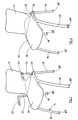
- the chair further comprises a pair of armrests 22 which are mounted upon support members 24 which are telescopically mounted in the rear legs 18 to permit movement of the armrests 22 between a raised position as illustrated in Figures 1 and 3 and a lowered position as illustrated in Figures 2, 4 and 5.
- the support member 24 is of tubular construction, the lower end of the support member 24 which is received within the rear leg 18 being closed by means of a plug 26 which locates the lower end of the support member 24 for sliding movement within the rear leg 18.
- the hub 20 defines a passage of appropriate dimensions to further guide sliding movement of the support member 24 with respect to the rear leg 18. It will be appreciated, therefore, that the provision of the plug 26 and hub 20 permits smooth movement of the armrests 22 between their raised and lowered positions.
- a collar may be provided at the upper end of each rear leg 18, the collar guiding the support member 24.
- the plug 26 may be replaced by a series of pips 26 a (see Figures 6 and 7) which guide the lower end of the support member 24.
- the pips 26 a are conveniently of a plastics material and are secured to the support member 24 using any appropriate technique. As shown in Figure 7, a series of four pips 26 a can substantially prevent all lateral movement of the support member 24 with respect to the rear leg 18. Conveniently, two or more series of pips are provided as shown in Figure 6.
- Each of the rear legs 18 includes retainer means for locking the armrests 22 in their raised and lowered positions.
- the locking means comprises a member 28 which is located within an opening provided in the rear leg, and which, when the armrests 22 occupies its lowered position projects through a first opening 24 a provided in the support member 24 to secure the armrests 22 in its lowered position.
- the member 28 is retracted from the first opening 24 a provided in the support member 24, and movement of the armrest 22 to lift the armrest 22 away from its lowered position is commenced. The member 28 can then be released.
- Movement of the armrest 22 towards its raised position continues, and when the armrest 22 reaches its raised position, the member 28 is received within a second opening 24 b provided in the support member 24, thus securing the armrest 22 in its raised position.
- the member 28 is biased by means of a spring, thus when the armrest 22 reaches its raised position, the armrest 22 is automatically locked in its raised position.
- the member 28 is once more retracted from the second opening 24 b provided in the support member 24 and movement of the armrest 22 towards its lowered position commences. The member 28 can then be released. Movement of the armrest 22 continues until it reaches its lowered position whereupon the member 28 locates within the first opening 24 a provided in the support member 24 to lock the armrest 22 in its lowered position.
- the member 28 may take the form of a screw-threaded member which is in engagement with a screw-threaded member secured to the rear leg 18 adjacent the opening therein.
- Figure 5 illustrates a pair of chairs identical to the chair illustrated in Figures 1 to 4, with one of the chairs stacked upon the other of the chairs.
- the armrests 22 occupying their lowered positions, the armrests 22 of the lower chair do not obstruct stacking of the upper chair upon the lower chair.
- the armrests 22 in the stacked position, there is no engagement between the upper chair and the armrests of the lower chair, the engagement occurring only between the front legs 14, the seat backs 12, and the rear leg 18 of the upper chair engaging the hub 20 of the lower chair.
- the provision of the retractable armrests 22 has no effect on the ability to stack such chairs, and there is no increase in the stacking height. It will be appreciated that the work involved in stacking the chairs is not significantly greater than that of chairs without armrests, as all that is required is for the armrests 22 to be moved to their lowered positions prior to stacking of the chairs.
- the armrests are conveniently further shaped to lie within the plan of the chair, thus the width of the chair including armrests is not greater than one without armrests.
- the provision of armrests does not, therefore, restrict the ability to stack the chairs or increase the space required to store the chairs when not in use.
- a standard length of link member can be used to connect the chairs in rows, thus avoiding the requirement to provide a variety of lengths of link members.
- the hubs 20 conveniently include appropriately shaped projections/recesses to permit the chairs to be secured to one another in a row. It will be appreciated that the chairs may be modified to incorporate other means for securing one chair to a neighbouring chair to enable the chairs to be secured to one another in rows, if desired.
Landscapes
- Chairs Characterized By Structure (AREA)
Applications Claiming Priority (2)
| Application Number | Priority Date | Filing Date | Title |
|---|---|---|---|
| GB9705054 | 1997-03-12 | ||
| GBGB9705054.6A GB9705054D0 (en) | 1997-03-12 | 1997-03-12 | Chair |
Publications (2)
| Publication Number | Publication Date |
|---|---|
| EP0864275A2 true EP0864275A2 (de) | 1998-09-16 |
| EP0864275A3 EP0864275A3 (de) | 1999-08-25 |
Family
ID=10809072
Family Applications (1)
| Application Number | Title | Priority Date | Filing Date |
|---|---|---|---|
| EP98301872A Withdrawn EP0864275A3 (de) | 1997-03-12 | 1998-03-12 | Stuhl |
Country Status (2)
| Country | Link |
|---|---|
| EP (1) | EP0864275A3 (de) |
| GB (1) | GB9705054D0 (de) |
Cited By (2)
| Publication number | Priority date | Publication date | Assignee | Title |
|---|---|---|---|---|
| DE10250858A1 (de) * | 2002-10-24 | 2004-05-06 | Matthias Fischer Design Gmbh | Sitzmöbel mit einer Sitzfläche |
| EP1529465A1 (de) * | 2003-10-30 | 2005-05-11 | Matthias Fischer Design GmbH | Sitzmöbel mit einer Sitzfläche |
Family Cites Families (1)
| Publication number | Priority date | Publication date | Assignee | Title |
|---|---|---|---|---|
| US5050933A (en) * | 1990-07-02 | 1991-09-24 | Marta Tornero | Stacking chair with collapsible arms |
-
1997
- 1997-03-12 GB GBGB9705054.6A patent/GB9705054D0/en active Pending
-
1998
- 1998-03-12 EP EP98301872A patent/EP0864275A3/de not_active Withdrawn
Non-Patent Citations (1)
| Title |
|---|
| None |
Cited By (2)
| Publication number | Priority date | Publication date | Assignee | Title |
|---|---|---|---|---|
| DE10250858A1 (de) * | 2002-10-24 | 2004-05-06 | Matthias Fischer Design Gmbh | Sitzmöbel mit einer Sitzfläche |
| EP1529465A1 (de) * | 2003-10-30 | 2005-05-11 | Matthias Fischer Design GmbH | Sitzmöbel mit einer Sitzfläche |
Also Published As
| Publication number | Publication date |
|---|---|
| EP0864275A3 (de) | 1999-08-25 |
| GB9705054D0 (en) | 1997-04-30 |
Similar Documents
| Publication | Publication Date | Title |
|---|---|---|
| US5282669A (en) | Ganging mechanism and stacking bar assembly for stacking chairs | |
| US4400031A (en) | Interlocking chair | |
| DE60013359T2 (de) | Stapelbarer Stuhl | |
| US5762396A (en) | Stackable chair and associated stacking support assembly | |
| US5992936A (en) | Foldable seat having removable panels | |
| DE60126691T2 (de) | Neigungsverstellbarer Stuhl | |
| US5863096A (en) | Stackable and laterally interlockable chairs | |
| JPS6051889B2 (ja) | 積み重ね可能なひじ掛け椅子 | |
| CA2151605A1 (en) | Combined Chair | |
| US6520586B2 (en) | Seating structure equipped with retractable armrest | |
| US20120126596A1 (en) | Stackable chair with telescopic leg mechanism | |
| US6095597A (en) | Collapsible chair | |
| EP1201162A2 (de) | Sitzmöbel aus schichtweise verleimtem Formsperrholz | |
| DE2323313A1 (de) | Kunststoffstuhl | |
| US3316016A (en) | Stack chair | |
| US4906046A (en) | Stackable chair with foldable back and arm rests | |
| DE102015112618A1 (de) | Stuhl | |
| US3826453A (en) | Ganging chairs | |
| US5383704A (en) | Intermediate armrest for a row of seats | |
| US6860556B2 (en) | Chair frame for a stackable chair | |
| US7111902B1 (en) | Folding chair with ganging elements | |
| DE69412636T2 (de) | Stuhl mit einer rückenlehne, die im zusammengeklappten zustand als schützende abdeckung dient | |
| US5584529A (en) | Folding chair | |
| US20040222676A1 (en) | Segmented frame furniture system | |
| US6428097B1 (en) | Deployable bleacher/chair combination |
Legal Events
| Date | Code | Title | Description |
|---|---|---|---|
| PUAI | Public reference made under article 153(3) epc to a published international application that has entered the european phase |
Free format text: ORIGINAL CODE: 0009012 |
|
| AK | Designated contracting states |
Kind code of ref document: A2 Designated state(s): AT BE CH DE DK ES FI FR GB GR IE IT LI LU MC NL PT SE |
|
| AX | Request for extension of the european patent |
Free format text: AL;LT;LV;MK;RO;SI |
|
| PUAL | Search report despatched |
Free format text: ORIGINAL CODE: 0009013 |
|
| AK | Designated contracting states |
Kind code of ref document: A3 Designated state(s): AT BE CH DE DK ES FI FR GB GR IE IT LI LU MC NL PT SE |
|
| AX | Request for extension of the european patent |
Free format text: AL;LT;LV;MK;RO;SI |
|
| AKX | Designation fees paid | ||
| REG | Reference to a national code |
Ref country code: DE Ref legal event code: 8566 |
|
| STAA | Information on the status of an ep patent application or granted ep patent |
Free format text: STATUS: THE APPLICATION IS DEEMED TO BE WITHDRAWN |
|
| 18D | Application deemed to be withdrawn |
Effective date: 20000226 |